EP0363685B1 - Schnellhärtende Polyurethandichtmasse, die silylsubstituierte Guanidinbeschleuniger enthält - Google Patents
Schnellhärtende Polyurethandichtmasse, die silylsubstituierte Guanidinbeschleuniger enthält Download PDFInfo
- Publication number
- EP0363685B1 EP0363685B1 EP89117261A EP89117261A EP0363685B1 EP 0363685 B1 EP0363685 B1 EP 0363685B1 EP 89117261 A EP89117261 A EP 89117261A EP 89117261 A EP89117261 A EP 89117261A EP 0363685 B1 EP0363685 B1 EP 0363685B1
- Authority
- EP
- European Patent Office
- Prior art keywords
- propyl
- propoxy
- moisture
- sealant composition
- component
- Prior art date
- Legal status (The legal status is an assumption and is not a legal conclusion. Google has not performed a legal analysis and makes no representation as to the accuracy of the status listed.)
- Expired - Lifetime
Links
- 239000000203 mixture Substances 0.000 title claims abstract description 97
- -1 silylsubstituted guanidine Chemical class 0.000 title abstract description 31
- 239000004588 polyurethane sealant Substances 0.000 title description 2
- 239000000565 sealant Substances 0.000 claims abstract description 64
- 229920000642 polymer Polymers 0.000 claims abstract description 34
- 229920002635 polyurethane Polymers 0.000 claims abstract description 34
- 239000004814 polyurethane Substances 0.000 claims abstract description 34
- FZHAPNGMFPVSLP-UHFFFAOYSA-N silanamine Chemical compound [SiH3]N FZHAPNGMFPVSLP-UHFFFAOYSA-N 0.000 claims abstract description 19
- 125000004432 carbon atom Chemical group C* 0.000 claims description 24
- 125000002572 propoxy group Chemical group [*]OC([H])([H])C(C([H])([H])[H])([H])[H] 0.000 claims description 23
- 239000001257 hydrogen Substances 0.000 claims description 20
- 229910052739 hydrogen Inorganic materials 0.000 claims description 20
- 125000000217 alkyl group Chemical group 0.000 claims description 19
- 150000001875 compounds Chemical class 0.000 claims description 18
- 125000001495 ethyl group Chemical group [H]C([H])([H])C([H])([H])* 0.000 claims description 17
- 150000002148 esters Chemical class 0.000 claims description 16
- 125000002496 methyl group Chemical group [H]C([H])([H])* 0.000 claims description 16
- 125000000325 methylidene group Chemical group [H]C([H])=* 0.000 claims description 16
- 125000002924 primary amino group Chemical group [H]N([H])* 0.000 claims description 16
- BIGOJJYDFLNSGB-UHFFFAOYSA-N 3-isocyanopropyl(trimethoxy)silane Chemical group CO[Si](OC)(OC)CCC[N+]#[C-] BIGOJJYDFLNSGB-UHFFFAOYSA-N 0.000 claims description 15
- JCHANMMPPLAHIA-UHFFFAOYSA-N 3-triethoxysilylpropylcarbamic acid Chemical compound CCO[Si](OCC)(OCC)CCCNC(O)=O JCHANMMPPLAHIA-UHFFFAOYSA-N 0.000 claims description 15
- UFHFLCQGNIYNRP-UHFFFAOYSA-N Hydrogen Chemical compound [H][H] UFHFLCQGNIYNRP-UHFFFAOYSA-N 0.000 claims description 13
- 229930195733 hydrocarbon Natural products 0.000 claims description 11
- 125000004435 hydrogen atom Chemical group [H]* 0.000 claims description 11
- 239000004215 Carbon black (E152) Substances 0.000 claims description 10
- 239000004721 Polyphenylene oxide Substances 0.000 claims description 6
- 125000002837 carbocyclic group Chemical group 0.000 claims description 6
- RTZKZFJDLAIYFH-UHFFFAOYSA-N ether Substances CCOCC RTZKZFJDLAIYFH-UHFFFAOYSA-N 0.000 claims description 6
- 239000012948 isocyanate Substances 0.000 claims description 6
- 229920000570 polyether Polymers 0.000 claims description 6
- 229920005862 polyol Polymers 0.000 claims description 6
- 150000003077 polyols Chemical class 0.000 claims description 6
- 125000002887 hydroxy group Chemical group [H]O* 0.000 claims description 5
- 229920006395 saturated elastomer Polymers 0.000 claims description 5
- HHYMMQRFYOBBMR-UHFFFAOYSA-N 2-[2-hydroxy-3-(3-trimethoxysilylpropoxy)propyl]-1,1,3,3-tetramethylguanidine Chemical compound CO[Si](OC)(OC)CCCOCC(O)CN=C(N(C)C)N(C)C HHYMMQRFYOBBMR-UHFFFAOYSA-N 0.000 claims description 4
- NJYLHTIINLUKQJ-UHFFFAOYSA-N 2-[3-[3-(diethoxymethylsilyl)propoxy]-2-hydroxypropyl]-1,1,3,3-tetramethylguanidine Chemical compound OC(CN=C(N(C)C)N(C)C)COCCC[SiH2]C(OCC)OCC NJYLHTIINLUKQJ-UHFFFAOYSA-N 0.000 claims description 4
- OIMAVTLWBIDIAU-UHFFFAOYSA-N 2-[3-[3-[ethoxy(dimethyl)silyl]propoxy]-2-hydroxypropyl]-1,1,3,3-tetramethylguanidine Chemical compound CCO[Si](C)(C)CCCOCC(O)CN=C(N(C)C)N(C)C OIMAVTLWBIDIAU-UHFFFAOYSA-N 0.000 claims description 4
- 125000003545 alkoxy group Chemical group 0.000 claims description 4
- IQPQWNKOIGAROB-UHFFFAOYSA-N isocyanate group Chemical group [N-]=C=O IQPQWNKOIGAROB-UHFFFAOYSA-N 0.000 claims description 3
- 150000002430 hydrocarbons Chemical class 0.000 claims description 2
- 150000002513 isocyanates Chemical class 0.000 claims description 2
- PHQOGHDTIVQXHL-UHFFFAOYSA-N n'-(3-trimethoxysilylpropyl)ethane-1,2-diamine Chemical group CO[Si](OC)(OC)CCCNCCN PHQOGHDTIVQXHL-UHFFFAOYSA-N 0.000 claims description 2
- MDFFNEOEWAXZRQ-UHFFFAOYSA-N aminyl Chemical compound [NH2] MDFFNEOEWAXZRQ-UHFFFAOYSA-N 0.000 claims 1
- 239000007795 chemical reaction product Substances 0.000 claims 1
- BLRPTPMANUNPDV-UHFFFAOYSA-N Silane Chemical compound [SiH4] BLRPTPMANUNPDV-UHFFFAOYSA-N 0.000 abstract description 5
- 229910000077 silane Inorganic materials 0.000 abstract description 4
- 239000003431 cross linking reagent Substances 0.000 abstract description 3
- OKKJLVBELUTLKV-UHFFFAOYSA-N Methanol Chemical compound OC OKKJLVBELUTLKV-UHFFFAOYSA-N 0.000 description 24
- YXFVVABEGXRONW-UHFFFAOYSA-N Toluene Chemical compound CC1=CC=CC=C1 YXFVVABEGXRONW-UHFFFAOYSA-N 0.000 description 12
- 239000003795 chemical substances by application Substances 0.000 description 11
- 239000000463 material Substances 0.000 description 11
- 238000002360 preparation method Methods 0.000 description 11
- ISKQADXMHQSTHK-UHFFFAOYSA-N [4-(aminomethyl)phenyl]methanamine Chemical compound NCC1=CC=C(CN)C=C1 ISKQADXMHQSTHK-UHFFFAOYSA-N 0.000 description 9
- 239000013008 thixotropic agent Substances 0.000 description 9
- 239000006229 carbon black Substances 0.000 description 8
- 238000012360 testing method Methods 0.000 description 8
- 239000003963 antioxidant agent Substances 0.000 description 7
- 230000003078 antioxidant effect Effects 0.000 description 7
- 235000006708 antioxidants Nutrition 0.000 description 7
- 238000000034 method Methods 0.000 description 7
- 239000002904 solvent Substances 0.000 description 7
- 239000011324 bead Substances 0.000 description 6
- 239000000126 substance Substances 0.000 description 6
- ZRALSGWEFCBTJO-UHFFFAOYSA-N Guanidine Chemical compound NC(N)=N ZRALSGWEFCBTJO-UHFFFAOYSA-N 0.000 description 5
- 239000002318 adhesion promoter Substances 0.000 description 5
- 229920001296 polysiloxane Polymers 0.000 description 5
- 239000012812 sealant material Substances 0.000 description 5
- XKRFYHLGVUSROY-UHFFFAOYSA-N Argon Chemical compound [Ar] XKRFYHLGVUSROY-UHFFFAOYSA-N 0.000 description 4
- CHJJGSNFBQVOTG-UHFFFAOYSA-N N-methyl-guanidine Natural products CNC(N)=N CHJJGSNFBQVOTG-UHFFFAOYSA-N 0.000 description 4
- 238000006243 chemical reaction Methods 0.000 description 4
- SWSQBOPZIKWTGO-UHFFFAOYSA-N dimethylaminoamidine Natural products CN(C)C(N)=N SWSQBOPZIKWTGO-UHFFFAOYSA-N 0.000 description 4
- 150000002357 guanidines Chemical class 0.000 description 4
- 125000001436 propyl group Chemical group [H]C([*])([H])C([H])([H])C([H])([H])[H] 0.000 description 4
- 239000011541 reaction mixture Substances 0.000 description 4
- 150000001412 amines Chemical class 0.000 description 3
- 229920005601 base polymer Polymers 0.000 description 3
- 239000003054 catalyst Substances 0.000 description 3
- 239000007789 gas Substances 0.000 description 3
- 239000011521 glass Substances 0.000 description 3
- 125000001183 hydrocarbyl group Chemical group 0.000 description 3
- 238000010992 reflux Methods 0.000 description 3
- 239000007858 starting material Substances 0.000 description 3
- UOCLXMDMGBRAIB-UHFFFAOYSA-N 1,1,1-trichloroethane Chemical compound CC(Cl)(Cl)Cl UOCLXMDMGBRAIB-UHFFFAOYSA-N 0.000 description 2
- KYVBNYUBXIEUFW-UHFFFAOYSA-N 1,1,3,3-tetramethylguanidine Chemical compound CN(C)C(=N)N(C)C KYVBNYUBXIEUFW-UHFFFAOYSA-N 0.000 description 2
- SJECZPVISLOESU-UHFFFAOYSA-N 3-trimethoxysilylpropan-1-amine Chemical compound CO[Si](OC)(OC)CCCN SJECZPVISLOESU-UHFFFAOYSA-N 0.000 description 2
- QTBSBXVTEAMEQO-UHFFFAOYSA-N Acetic acid Chemical compound CC(O)=O QTBSBXVTEAMEQO-UHFFFAOYSA-N 0.000 description 2
- XEEYBQQBJWHFJM-UHFFFAOYSA-N Iron Chemical compound [Fe] XEEYBQQBJWHFJM-UHFFFAOYSA-N 0.000 description 2
- JUJWROOIHBZHMG-UHFFFAOYSA-N Pyridine Chemical class C1=CC=NC=C1 JUJWROOIHBZHMG-UHFFFAOYSA-N 0.000 description 2
- LINDOXZENKYESA-UHFFFAOYSA-N TMG Natural products CNC(N)=NC LINDOXZENKYESA-UHFFFAOYSA-N 0.000 description 2
- 229910052786 argon Inorganic materials 0.000 description 2
- QVGXLLKOCUKJST-UHFFFAOYSA-N atomic oxygen Chemical compound [O] QVGXLLKOCUKJST-UHFFFAOYSA-N 0.000 description 2
- GYZLOYUZLJXAJU-UHFFFAOYSA-N diglycidyl ether Chemical compound C1OC1COCC1CO1 GYZLOYUZLJXAJU-UHFFFAOYSA-N 0.000 description 2
- 230000000694 effects Effects 0.000 description 2
- 239000000945 filler Substances 0.000 description 2
- 238000002156 mixing Methods 0.000 description 2
- 150000007524 organic acids Chemical class 0.000 description 2
- 125000005646 oximino group Chemical class 0.000 description 2
- 239000001301 oxygen Substances 0.000 description 2
- 229910052760 oxygen Inorganic materials 0.000 description 2
- 238000006116 polymerization reaction Methods 0.000 description 2
- 229920001451 polypropylene glycol Polymers 0.000 description 2
- 150000003839 salts Chemical class 0.000 description 2
- UAIVFDJJMVMUGY-UHFFFAOYSA-N 1,2,4-trimethylpiperazine Chemical compound CC1CN(C)CCN1C UAIVFDJJMVMUGY-UHFFFAOYSA-N 0.000 description 1
- LBLYYCQCTBFVLH-UHFFFAOYSA-N 2-Methylbenzenesulfonic acid Chemical compound CC1=CC=CC=C1S(O)(=O)=O LBLYYCQCTBFVLH-UHFFFAOYSA-N 0.000 description 1
- HXIQYSLFEXIOAV-UHFFFAOYSA-N 2-tert-butyl-4-(5-tert-butyl-4-hydroxy-2-methylphenyl)sulfanyl-5-methylphenol Chemical compound CC1=CC(O)=C(C(C)(C)C)C=C1SC1=CC(C(C)(C)C)=C(O)C=C1C HXIQYSLFEXIOAV-UHFFFAOYSA-N 0.000 description 1
- XEFKASNXUBJUBB-UHFFFAOYSA-L CC([O-])=O.CC([O-])=O.CCCC[Sn+2]CCCC.CCO[Si](OCC)(OCC)CCCNC(O)=O Chemical compound CC([O-])=O.CC([O-])=O.CCCC[Sn+2]CCCC.CCO[Si](OCC)(OCC)CCCNC(O)=O XEFKASNXUBJUBB-UHFFFAOYSA-L 0.000 description 1
- XDTMQSROBMDMFD-UHFFFAOYSA-N Cyclohexane Chemical compound C1CCCCC1 XDTMQSROBMDMFD-UHFFFAOYSA-N 0.000 description 1
- 238000004566 IR spectroscopy Methods 0.000 description 1
- 240000005428 Pistacia lentiscus Species 0.000 description 1
- DUFKCOQISQKSAV-UHFFFAOYSA-N Polypropylene glycol (m w 1,200-3,000) Chemical compound CC(O)COC(C)CO DUFKCOQISQKSAV-UHFFFAOYSA-N 0.000 description 1
- 229910000831 Steel Inorganic materials 0.000 description 1
- NINIDFKCEFEMDL-UHFFFAOYSA-N Sulfur Chemical compound [S] NINIDFKCEFEMDL-UHFFFAOYSA-N 0.000 description 1
- ATJFFYVFTNAWJD-UHFFFAOYSA-N Tin Chemical class [Sn] ATJFFYVFTNAWJD-UHFFFAOYSA-N 0.000 description 1
- UKLDJPRMSDWDSL-UHFFFAOYSA-L [dibutyl(dodecanoyloxy)stannyl] dodecanoate Chemical class CCCCCCCCCCCC(=O)O[Sn](CCCC)(CCCC)OC(=O)CCCCCCCCCCC UKLDJPRMSDWDSL-UHFFFAOYSA-L 0.000 description 1
- NBJODVYWAQLZOC-UHFFFAOYSA-L [dibutyl(octanoyloxy)stannyl] octanoate Chemical class CCCCCCCC(=O)O[Sn](CCCC)(CCCC)OC(=O)CCCCCCC NBJODVYWAQLZOC-UHFFFAOYSA-L 0.000 description 1
- 238000010521 absorption reaction Methods 0.000 description 1
- 229960000583 acetic acid Drugs 0.000 description 1
- 239000002253 acid Substances 0.000 description 1
- 230000002378 acidificating effect Effects 0.000 description 1
- 150000001335 aliphatic alkanes Chemical class 0.000 description 1
- 125000001931 aliphatic group Chemical group 0.000 description 1
- 125000003282 alkyl amino group Chemical group 0.000 description 1
- 125000005037 alkyl phenyl group Chemical group 0.000 description 1
- 238000004458 analytical method Methods 0.000 description 1
- 125000002029 aromatic hydrocarbon group Chemical group 0.000 description 1
- 125000003118 aryl group Chemical group 0.000 description 1
- 230000004888 barrier function Effects 0.000 description 1
- 230000000903 blocking effect Effects 0.000 description 1
- 238000009835 boiling Methods 0.000 description 1
- 238000010924 continuous production Methods 0.000 description 1
- 238000007796 conventional method Methods 0.000 description 1
- 229920001577 copolymer Polymers 0.000 description 1
- 238000004132 cross linking Methods 0.000 description 1
- 239000012975 dibutyltin dilaurate Chemical class 0.000 description 1
- 125000002147 dimethylamino group Chemical group [H]C([H])([H])N(*)C([H])([H])[H] 0.000 description 1
- 229920005645 diorganopolysiloxane polymer Polymers 0.000 description 1
- 238000004821 distillation Methods 0.000 description 1
- 230000009977 dual effect Effects 0.000 description 1
- 229920001971 elastomer Polymers 0.000 description 1
- 239000000806 elastomer Substances 0.000 description 1
- 230000007717 exclusion Effects 0.000 description 1
- 238000009472 formulation Methods 0.000 description 1
- 239000012362 glacial acetic acid Substances 0.000 description 1
- 229940093915 gynecological organic acid Drugs 0.000 description 1
- 238000010438 heat treatment Methods 0.000 description 1
- 238000002329 infrared spectrum Methods 0.000 description 1
- 239000004615 ingredient Substances 0.000 description 1
- 229910052742 iron Inorganic materials 0.000 description 1
- FRVCGRDGKAINSV-UHFFFAOYSA-L iron(2+);octadecanoate Chemical class [Fe+2].CCCCCCCCCCCCCCCCCC([O-])=O.CCCCCCCCCCCCCCCCCC([O-])=O FRVCGRDGKAINSV-UHFFFAOYSA-L 0.000 description 1
- VQPKAMAVKYTPLB-UHFFFAOYSA-N lead;octanoic acid Chemical class [Pb].CCCCCCCC(O)=O VQPKAMAVKYTPLB-UHFFFAOYSA-N 0.000 description 1
- 239000007788 liquid Substances 0.000 description 1
- 230000007246 mechanism Effects 0.000 description 1
- QSHDDOUJBYECFT-UHFFFAOYSA-N mercury Chemical class [Hg] QSHDDOUJBYECFT-UHFFFAOYSA-N 0.000 description 1
- 229910052753 mercury Inorganic materials 0.000 description 1
- 125000000956 methoxy group Chemical group [H]C([H])([H])O* 0.000 description 1
- 150000007522 mineralic acids Chemical class 0.000 description 1
- 239000000178 monomer Substances 0.000 description 1
- 150000002780 morpholines Chemical class 0.000 description 1
- 229910052757 nitrogen Inorganic materials 0.000 description 1
- QJGQUHMNIGDVPM-UHFFFAOYSA-N nitrogen group Chemical group [N] QJGQUHMNIGDVPM-UHFFFAOYSA-N 0.000 description 1
- 235000005985 organic acids Nutrition 0.000 description 1
- 125000001997 phenyl group Chemical group [H]C1=C([H])C([H])=C(*)C([H])=C1[H] 0.000 description 1
- 125000003884 phenylalkyl group Chemical group 0.000 description 1
- 239000000049 pigment Substances 0.000 description 1
- 230000000485 pigmenting effect Effects 0.000 description 1
- 150000004885 piperazines Chemical class 0.000 description 1
- 239000003495 polar organic solvent Substances 0.000 description 1
- 229920000058 polyacrylate Polymers 0.000 description 1
- 230000037452 priming Effects 0.000 description 1
- 230000001737 promoting effect Effects 0.000 description 1
- UMJSCPRVCHMLSP-UHFFFAOYSA-N pyridine Chemical class COC1=CC=CN=C1 UMJSCPRVCHMLSP-UHFFFAOYSA-N 0.000 description 1
- 239000002516 radical scavenger Substances 0.000 description 1
- 150000003254 radicals Chemical class 0.000 description 1
- 238000000518 rheometry Methods 0.000 description 1
- 238000007789 sealing Methods 0.000 description 1
- 150000004756 silanes Chemical class 0.000 description 1
- 239000010959 steel Substances 0.000 description 1
- 229910052717 sulfur Inorganic materials 0.000 description 1
- 239000011593 sulfur Substances 0.000 description 1
- 238000012956 testing procedure Methods 0.000 description 1
- KSBAEPSJVUENNK-UHFFFAOYSA-L tin(ii) 2-ethylhexanoate Chemical class [Sn+2].CCCCC(CC)C([O-])=O.CCCCC(CC)C([O-])=O KSBAEPSJVUENNK-UHFFFAOYSA-L 0.000 description 1
- DVKJHBMWWAPEIU-UHFFFAOYSA-N toluene 2,4-diisocyanate Chemical compound CC1=CC=C(N=C=O)C=C1N=C=O DVKJHBMWWAPEIU-UHFFFAOYSA-N 0.000 description 1
- LSZKGNJKKQYFLR-UHFFFAOYSA-J tri(butanoyloxy)stannyl butanoate Chemical class [Sn+4].CCCC([O-])=O.CCCC([O-])=O.CCCC([O-])=O.CCCC([O-])=O LSZKGNJKKQYFLR-UHFFFAOYSA-J 0.000 description 1
- 125000005270 trialkylamine group Chemical group 0.000 description 1
- FRGPKMWIYVTFIQ-UHFFFAOYSA-N triethoxy(3-isocyanatopropyl)silane Chemical compound CCO[Si](OCC)(OCC)CCCN=C=O FRGPKMWIYVTFIQ-UHFFFAOYSA-N 0.000 description 1
- BPSIOYPQMFLKFR-UHFFFAOYSA-N trimethoxy-[3-(oxiran-2-ylmethoxy)propyl]silane Chemical compound CO[Si](OC)(OC)CCCOCC1CO1 BPSIOYPQMFLKFR-UHFFFAOYSA-N 0.000 description 1
Classifications
-
- C—CHEMISTRY; METALLURGY
- C09—DYES; PAINTS; POLISHES; NATURAL RESINS; ADHESIVES; COMPOSITIONS NOT OTHERWISE PROVIDED FOR; APPLICATIONS OF MATERIALS NOT OTHERWISE PROVIDED FOR
- C09K—MATERIALS FOR MISCELLANEOUS APPLICATIONS, NOT PROVIDED FOR ELSEWHERE
- C09K3/00—Materials not provided for elsewhere
- C09K3/10—Materials in mouldable or extrudable form for sealing or packing joints or covers
-
- C—CHEMISTRY; METALLURGY
- C09—DYES; PAINTS; POLISHES; NATURAL RESINS; ADHESIVES; COMPOSITIONS NOT OTHERWISE PROVIDED FOR; APPLICATIONS OF MATERIALS NOT OTHERWISE PROVIDED FOR
- C09K—MATERIALS FOR MISCELLANEOUS APPLICATIONS, NOT PROVIDED FOR ELSEWHERE
- C09K3/00—Materials not provided for elsewhere
- C09K3/10—Materials in mouldable or extrudable form for sealing or packing joints or covers
- C09K3/1006—Materials in mouldable or extrudable form for sealing or packing joints or covers characterised by the chemical nature of one of its constituents
- C09K3/1021—Polyurethanes or derivatives thereof
-
- C—CHEMISTRY; METALLURGY
- C08—ORGANIC MACROMOLECULAR COMPOUNDS; THEIR PREPARATION OR CHEMICAL WORKING-UP; COMPOSITIONS BASED THEREON
- C08G—MACROMOLECULAR COMPOUNDS OBTAINED OTHERWISE THAN BY REACTIONS ONLY INVOLVING UNSATURATED CARBON-TO-CARBON BONDS
- C08G18/00—Polymeric products of isocyanates or isothiocyanates
- C08G18/06—Polymeric products of isocyanates or isothiocyanates with compounds having active hydrogen
- C08G18/08—Processes
- C08G18/10—Prepolymer processes involving reaction of isocyanates or isothiocyanates with compounds having active hydrogen in a first reaction step
-
- C—CHEMISTRY; METALLURGY
- C08—ORGANIC MACROMOLECULAR COMPOUNDS; THEIR PREPARATION OR CHEMICAL WORKING-UP; COMPOSITIONS BASED THEREON
- C08K—Use of inorganic or non-macromolecular organic substances as compounding ingredients
- C08K5/00—Use of organic ingredients
- C08K5/54—Silicon-containing compounds
- C08K5/544—Silicon-containing compounds containing nitrogen
- C08K5/5465—Silicon-containing compounds containing nitrogen containing at least one C=N bond
-
- C—CHEMISTRY; METALLURGY
- C09—DYES; PAINTS; POLISHES; NATURAL RESINS; ADHESIVES; COMPOSITIONS NOT OTHERWISE PROVIDED FOR; APPLICATIONS OF MATERIALS NOT OTHERWISE PROVIDED FOR
- C09K—MATERIALS FOR MISCELLANEOUS APPLICATIONS, NOT PROVIDED FOR ELSEWHERE
- C09K3/00—Materials not provided for elsewhere
- C09K3/10—Materials in mouldable or extrudable form for sealing or packing joints or covers
- C09K2003/1034—Materials or components characterised by specific properties
- C09K2003/1056—Moisture-curable materials
-
- C—CHEMISTRY; METALLURGY
- C09—DYES; PAINTS; POLISHES; NATURAL RESINS; ADHESIVES; COMPOSITIONS NOT OTHERWISE PROVIDED FOR; APPLICATIONS OF MATERIALS NOT OTHERWISE PROVIDED FOR
- C09K—MATERIALS FOR MISCELLANEOUS APPLICATIONS, NOT PROVIDED FOR ELSEWHERE
- C09K3/00—Materials not provided for elsewhere
- C09K3/10—Materials in mouldable or extrudable form for sealing or packing joints or covers
- C09K2003/1034—Materials or components characterised by specific properties
- C09K2003/1071—Thixotropic materials
-
- Y—GENERAL TAGGING OF NEW TECHNOLOGICAL DEVELOPMENTS; GENERAL TAGGING OF CROSS-SECTIONAL TECHNOLOGIES SPANNING OVER SEVERAL SECTIONS OF THE IPC; TECHNICAL SUBJECTS COVERED BY FORMER USPC CROSS-REFERENCE ART COLLECTIONS [XRACs] AND DIGESTS
- Y10—TECHNICAL SUBJECTS COVERED BY FORMER USPC
- Y10S—TECHNICAL SUBJECTS COVERED BY FORMER USPC CROSS-REFERENCE ART COLLECTIONS [XRACs] AND DIGESTS
- Y10S528/00—Synthetic resins or natural rubbers -- part of the class 520 series
- Y10S528/901—Room temperature curable silicon-containing polymer
Definitions
- This invention relates to room temperature moisture-curable polymer sealant compositions. More particularly, this invention concerns one-part room temperature curable polyurethane sealant compositions containing silyl-substituted guanidine accelerating agents having improved cure rates.
- Sealants are comprised of pigmented or unpigmented synthetic elastomeric polymers which, in the uncured state, constitute pourable or easily extrudable putty-like mastics. When cured, the sealants are transformed into elastomeric materials which have viscoelastic properties and can react to the relative motion of the structural elements which the sealant connects and seals. They also form a tight barrier against moisture, gases and chemicals. Such sealants find a wide variety of applications in the building trades industry and the automotive industry. In the latter case they are widely used to seal fixed window panels and taillight glass panels to coated auto, truck, and bus bodies.
- sealants include compositions based on polysiloxane polymers as well as others which include polyurethane or polyacrylate polymers. Additionally, modern sealant compositions include one-part and two-part formulations which cure by a variety of chemical mechanisms.
- One-part sealant compositions generally contain an end-capped base polymer together with a reactive cross-linking agent and, typically, a curing catalyst which promotes the cross-linking reaction either when heated or exposed to atmospheric moisture. Upon application under normal conditions of temperature and moisture, one-part sealants react to form tough, pliable elastomeric seals.
- Two-part sealant compositions comprise two reactive components which are separately packaged and mixed just prior to or at the time of application and react upon mixing to form the semi-rigid sealant bead.
- Two-part sealant compositions are less convenient to use since it is necessary to accurately premeasure and mix the components prior to use or accurately meter the components during application to insure correct proportions if the two components are applied together to form the sealant bead. For this reason, one-part sealants have found wider acceptance in the market. A number of such one-part moisture-curable sealant compositions are known. Because of their convenience and ease of use, there has been increasing demand for such sealants, especially if they possess both good shelf life and rapid curing rates.
- organic and inorganic acids salts of organic acids such as tin naphthenate, tin octoate, tin butyrate, dibutyltin dioctoate, dibutyltin dilaurate, dibutyltin diacetate, iron stearate, lead octoate, or organic amines).
- Polysiloxane-based curable sealant compositions employing nitrogen-containing compounds as accelerators, adhesion promoters, cross-linking agents or end-blocking groups include the following: 3,471,434 to Pande, et al. (silicon-substituted oximino blocking groups); 3,622,529 and 3,665,026 to Evans (imidatosilanes); and 3,839,386 to Lengnick (oximino end-blocked disiloxanes).
- compositions of the present invention are the following United States Patents: 4,180,642 and 4,248,993 to Takago and 4,395,526 to White, et al. which disclose organopolysiloxane compositions containing substituted guanidinyl accelerator compounds.
- US-A-3,632,557 discloses one-part sealant compositions containing a silane-terminated polyurethane polymer. It is an object of the present invention to provide one part sealant compositions as disclosed in US-A-3,632,557 which exhibit enhanced curing rates.
- US-A-4,180,642 is concerned with room temperature curable organopolysiloxane compositions comprising a diorganopolysiloxane terminated at both chain ends with hydroxy groups, a vinyloxy group containing silane and a silane containing at least one group derived from guanidine.
- the compositions disclosed in US-A-4,180,642 are not based on silane-terminated polyurethane polymers and do not contain the accelerators according to the present invention.
- one-component polyurethane-based sealant compositions having fast cure rates at room temperature in the presence of moisture comprise a mixture of a silane-terminated polyurethane polymer, from about 0.0 to about 1.0 parts by weight of an aminosilane per 100 parts by weight of the polyurethane polymer, and from about 0.2 to about 1.0 parts by weight of a silyl-substituted guanidine accelerator per 100 parts of the polyurethane polymer.
- the silane-capped polyurethane polymer has the structure where R is lower alkyl of from 1 to 6 carbon atoms and R1 is a divalent bridging radical selected from the group consisting of divalent hydrocarbon radicals, divalent hydrocarbon ether radicals, and divalent hydrocarbon amino radicals.
- R1 is a divalent bridging radical selected from the group consisting of divalent hydrocarbon radicals, divalent hydrocarbon ether radicals, and divalent hydrocarbon amino radicals.
- the group A is selected from -S- and -NR2- where R2 is hydrogen or alkyl of from one to six carbon atoms.
- the aminosilane has the structure where x is an integer of from one to three, and R3 and R4 may be the same or different and are selected from alkyl of from one to four carbon atoms.
- the group R5 is alkyl of from one to four carbon atoms or alkoxyl of from one to four carbon atoms and R6 is hydrogen or -(CH2) y NHR7 where R7 is hydrogen or -(CH2) z NH2.
- the subscripts y and z may be the same or different and are integers of from one to three.
- the silyl-substituted guanidine accelerator in the compositions of the present invention is selected from the group consisting of compounds having the structure where x and R are as previously defined, and R8, is hydrogen or where R3, R4, R5, and x are as defined above.
- R9 and R10 are hydrogen or, when taken together with the carbon atoms to which they are attached, form a saturated six-membered carbocyclic ring.
- R11, R12, R13, and R14 are independently hydrogen or alkyl of from one to four carbon atoms.
- composition may also contain other ingredients generally known to formulators of polymeric sealant compositions such as pigments, thixotropic agents, fillers, acidic or basic polymerization agents, and the like.
- alkyl means a hydrocarbon residue derived from branched or unbranched alkane by removal of a single hydrogen atom.
- alkoxyl denotes alkyl groups attached through an oxygen ether linkage to the remainder of the parent molecule.
- divalent hydrocarbyl means a branched or unbranched hydrocarbon group derived by removal of two hydrogen atoms from a saturated or unsaturated acyclic hydrocarbon.
- divalent hydrocarbaryl denotes a group derived from the removal of two hydrogen atoms from hydrocarbons containing one or more carbocyclic aromatic rings including phenyl, alkylphenyl, and phenylalkyl and the like.
- divalent cyclohydrocarbyl means a group derived by the removal of two hydrogen atoms from a carbocyclic non-aromatic hydrocarbon ring including cyclohexane, alkylcyclohexane, and the like.
- the sealant compositions of the present invention comprise a base silane-capped polyurethane polymer having a number average molecular weight in the range of from about 10,000 to about 30,000 having the structure where R, R1, and A are defined above.
- silane-capped polyurethane polymers are prepared by conventional polymerization techniques by reacting a polyether polyol having at least two free hydroxyl groups per molecule with an isocyanate compound having at least two isocyanate reactive groups per molecule.
- the polyether polyol and isocyanate compound are reacted in a weight ratio of about 8:1 to about 12:1, respectively.
- the starting polyether polyol preferably has a number average molecular weight of between about 1,000 and 5,000.
- One such preferred starting material is polypropylene glycol available as Polypropylene Glycol 2025 from Union Carbide Co., 270 Park Avenue, New York, NY 10017.
- the starting isocyanate compound may be selected from a variety of materials known in the art for such purposes, but one such preferred material is toluene diisocycanate.
- the copolymer formed by reaction of these two monomers is end-capped with a silane group having the structure -A-R1-Si-(OR)3.
- the group A is sulfur, >NH, or an alkylamino group in which the alkyl portion contains from one to six carbon atoms.
- the bridging group R1 may be a divalent hydrocarbon radical, a divalent hydrocarbon radical containing one or more oxygen ether linkages, or a divalent hydrocarbon radical containing one or more >NH linkages.
- the end-capping of the polyurethane polymer is achieved by including in the reaction mixture containing the polyether polyol and isocyanate compound an aminosilane compound such as gamma -aminopropyl trimethoxysilane (A 1110) availiable from Union Carbide Corp., 270 Park Ave., New York, NY 10017).
- an aminosilane compound such as gamma -aminopropyl trimethoxysilane (A 1110) availiable from Union Carbide Corp., 270 Park Ave., New York, NY 10017).
- the silane-capped polyurethane polymer is mixed with from about 20 to about 50 parts by weight of a pigmenting agent and/or filler such as carbon black per 100 parts by weight of the capped polyurethane polymer. Small amounts, ranging from about 0.25 to about 0.75 parts by weight of a thixotropic agent per 100 parts by weight of polyurethane polymer may also be added to adjust the flow characteristics of the sealant composition.
- a typical thixotropic agent suitable for this purpose is Thixseal 1085 available from NL chemicals, Inc., Heightstown, NJ 08520.
- Additional aminosilane optionally is added to the sealant composition in amounts ranging between about 0.2 to about 1.0 parts by weight (preferably between about 0.4 to about 0.8 parts by weight) per 100 parts by weight of the polyurethane polymer.
- the aminosilane used is selected from compounds having the formula where x is an integer of from one to three and R3 and R4 may be the same or different and are selected from alkyl of from one to four carbon atoms.
- the group R5 is alkyl of from one to four carbon atoms or alkoxyl of from one to four carbon atoms and R6 is hydrogen or -(CH2) y NHR7.
- R7 is hydrogen or -(CH2) z NH2 wherein y and z may be the same or different and are integers of from one to three.
- Suitable materials for this purpose are aminosilanes such as A 1110, A 1120, and A 1130, available from Union Carbide Corp., 270 Park Ave., New York, NY 10017).
- the sealant compositions of this invention further contain from about 0.2 to about 1.0 parts by weight (preferably between about 0.2 to about 0.8 parts by weight) per 100 parts by weight of the polyurethane polymer of a silyl-substituted guanidine accelerator selected from compounds having the structure where x and R are as previously defined, and R8, is hydrogen or where R3, R4, R5, and x are as defined above.
- R9 and R10 are hydrogen or, when taken together with the carbon atoms to which they are attached, form a saturated six-membered carbocyclic ring.
- R11, R12, R13, and R14 are independently hydrogen or alkyl of from one to four carbon atoms.
- the reaction is carried out for a period sufficient to effect substantially complete reaction between the two starting materials, typically for about two to six hours.
- the starting glycidyl ethers of alkylalkoxysilanes are commercially available from Dynamit Nobel Chemicals, Silanes & Silicones Group, Bartram Road, Bristol, PA 19007, USA.
- the starting substituted guanidine compounds are commercially available from such sources as Aldrich Chemical Co., 940 West St. Paul Ave., Milwaukee, WI, 53233 USA or are easily synthesized by conventional methods known to practitioners of the organic chemical arts.
- silyl-substituted piperizinyl compound While not adhering to any particular theory to the exclusion of others, it is believed that the function of the silyl-substituted piperizinyl compound is at least three-fold: first, the silyl-substituted guanidine compound is thought to be instrumental in accelerating the curing rate of the polymeric composition; second, it is believed to promote the adherence of the resulting elastomer; and third, the amine functionality present in the substituted guanidine compounds is believed to act as an acid scavenger in the composition, promoting its shelf-life.
- shear strength test plates were prepared by priming pairs of glass and steel plates, each about 1 inch by 4 inches by 0.32 inches (2.54 cm x 0.81 cm), with a primer of the type disclosed in United States Patent 3,979,344 to Bryant, et al.
- a sealant bead 1 inch long by 0.25 inches wide by 5/16 inches thick (2.54 cm x 0.64 cm x 0.79 cm) was then applied to each plate over the sealant primer along one of the one-inch edges of the test plates.
- the plates were then pressed together so that the sealant bead was about 0.25 inches (0.64 cm) thick.
- the sealant bead applied to the bonded test plates was allowed to cure at room temperature and 50% relative humidity for periods which varied between three hours and seven days. After the appropriate cure time in each case, the shear strength of each sealant bead was tested on an Instron testing machine by pulling in a direction parallel to the faces of the bonded test plates. The results of these tests, along with other properties of the tested compositions, appear in the following Table.
- Example 4 contained a preferred accelerator of the invention, while in Example 6 the composition was identical, except that the accelerator was missing. After three hours of curing, the lap shear strength of the material of Example 4 was almost seven times as great as that of Example 6. The difference was even greater between Examples 9 and 6.
- Example 9 contained a preferred accelerator of the present invention at the higher concentration of 0.8 parts by weight based on 100 parts by weight of the base polymer composition. After three hours of curing at room temperature at 50% relative humidity, the composition of Example 9 had nearly ten times the lap shear trength of the accelerator-free control composition.
- Example 7 the aminosilane adhesion promoter was omitted to test the resulting effect, and the data indicate that there were slight differences due to the omission on the cure rate and other properties of the resulting composition (such as percent elongation). (The presence of the aminosilane is preferred, however, to enhance other desirable properties of the final sealant composition such as adhesion.)
- a silane-capped polyurethane polymer of the type described in United States Patent 3,632,557 was prepared as follows: A. Niax PPG 2025 ONE (2000 Molecular weight polyether polyol availabe from Union Carbide Corp., 270 Park Ave., New York, NY 10017) 2001.00 g Hylene TM (80:20 Grade toluene diisocyanate available from E.I. duPont de Nemours & Co., Wilmington, DE 19898) 204.00 g Glacial acetic acid 0.55 g Dibutyltin diacetate 0.45 g B. Anhydrous toluene 110.00 g C.
- the infrared spectrum of the product exhibited absorption peaks at 3300 cm ⁇ 1 (hydroxyl), 1040 cm ⁇ 1 (-Si-OCH3), 1624 cm ⁇ 1 (-C ⁇ N), and 1200 cm ⁇ 1 (-N-CH3).
- reaction mixture containing 71% by weight of [3-(triethoxysilyl)propyl]carbamic acid, [2-[[ bis (dimethylamino)methylene]amino]-1-[[3-(trimethoxysilyl)propoxy]methyl]ethyl] ester, was used without further puriofication as an accelerator.
- a five gallon Meyers mixer with dual mixing blades was charged with 100 parts by weight of the silane-terminated polyurethane base polymer composition of Example 1 and thoroughly mixed for five minutes under a slight vacuum with 8 parts by weight of anhydrous methanol.
- adhesion promoter N-beta -aminoethyl- gamma -aminopropyl trimethoxysilane, (available as Silane A1120 from Union Carbide Company, 270 Park Avenue, New York, NY 10017), 0.5 parts by weight of a rheology control agent, Thixseal 1084 (available from NL Chemicals, Inc., Heightstown, NJ 08520), 0.5 parts by weight of DBTDA anti-oxidant (available as anti-oxidant AO 2246 from American Cyanamide Co., Bound Brook, NJ 08805), and 0.1 parts by weight of dibutyltin diacetate.
- the resulting mixture was stirred for ten minutes under slight vacuum, after which time 0.1 parts by weight of N ⁇ -[2-hydroxy-3-[3-(trimethoxysilyl)propoxy]propyl]- N , N , N ′, N ′-tetramethylguanidine were added as an accelerating agent. Carbon black (40 parts by weight) which had been previously dried to less than 0.05% by weight moisture content, was added and the resulting mixture was mixed for one hour. The resulting mixture was stirred for ten minutes under slight vacuum, cooled to room temperature, and packaged under anhydrous conditions.
- the material had the following composition: Component Parts by Weight Base polyurethane polymer 100 Solvent (methanol) 8 Carbon black 40 Thixotropic agent 0.5 A 1120 Aminosilane 0.5 AO 2246 Anti-oxidant 0.5 Dibutyl tin diacetate 0.1 N ⁇ -[2-hydroxy-3-[3-(trimethoxysilyl)propoxy]-propyl]- N , N , N ′, N '-tetramethylguanidine accelerating agent 0.4
- Example 4 The procedure of Example 4 was followed to prepare a sealant material having the composition given below.
- Component Parts by Weight Base polyurethane polymer 100 Solvent (methanol) 8 Carbon black 40 Thixotropic agent 0.5 A 1120 Aminosilane 0.5 AO 2246 Anti-oxidant 0.5 Dibutyl tin diacetate [3-(Triethoxysilyl)propyl]carbamic acid, [2-[[ bis (dimethylamino) methylene]amino]-1-[[3-(trimethoxysilyl)propoxy]methyl]ethyl] ester accelerating agent 0.1
- Example 4 The procedure to Example 4 was followed to prepare a sealant material having the composition of Example 4, with the exception that no silyl-substituted guanidine accelerator was added.
- the material had the following composition: Component Parts by Weight Base polyurethane polymer 100 Solvent (methanol) 8 Carbon black 40 Thixotropic agent 0.5 A 1120 Aminosilane 0.5 AO 2246 Anti-oxidant 0.5 Dibutyl tin diacetate 0.1 Accelerating agent None
- Example 4 The procedure of Example 4 was followed to prepare a sealant material having the composition of Example 4, with the exception that the A 1120 aminosilane adhesion promoter was omitted to determine the affect of such omission on the behavior of the resulting sealant composition.
- the material had the following composition: Component Parts by Weight Base polyurethane polymer 100 Solvent (methanol) 8 Carbon black 40 Thixotropic agent 0.5 A 1120 Aminosilane None AO 2246 Anti-oxidant 0.5 Dibutyl tin diacetate 0.1 N ⁇ -[2-hydroxy-3-[3-(trimethoxysilyl)propoxy]-propyl]- N , N , N ', N '-tetramethylguanidine accelerating agent 0.4
- Example 4 The procedure of Example 4 was followed to prepare a sealant material having a lower concentration of the silyl-substituted guanidine accelerator.
- the material had the following composition: Component Parts by Weight Base polyurethane polymer 100 Solvent (methanol) 8 Carbon black 40 Thixotropic agent 0.5 A 1120 Aminosilane 0.5 AO 2246 Anti-oxidant 0.5 Dibutyl tin diacetate 0.1 N ⁇ -[2-hydroxy-3-[3-(trimethoxysilyl)propoxy]-propyl]- N , N , N ′, N ′-tetramethylguanidine accelerating agent 0.2
- Example 4 The procedure of Example 4 was followed to prepare a sealant material having a higher concentration of the silyl-substituted guanidine accelerator.
- the material had the following composition: Component Parts by Weight Base polyurethane polymer 100 Solvent (methanol) 8 Carbon black 40 Thixotropic agent 0.5 A 1120 Aminosilane 0.5 AO 2246 Anti-oxidant 0.5 Dibutyl tin diacetate 0.1 N ⁇ -[2-hydroxy-3-[3-(trimethoxysilyl)propoxy]-propyl]- N , N , N ′, N ′-tetramethylguanidine accelerating agent 0.8
Landscapes
- Chemical & Material Sciences (AREA)
- Organic Chemistry (AREA)
- Health & Medical Sciences (AREA)
- Chemical Kinetics & Catalysis (AREA)
- Medicinal Chemistry (AREA)
- Polymers & Plastics (AREA)
- Engineering & Computer Science (AREA)
- Materials Engineering (AREA)
- Sealing Material Composition (AREA)
- Compositions Of Macromolecular Compounds (AREA)
- Polyurethanes Or Polyureas (AREA)
Claims (23)
- Feuchtigkeitshärtende Einkomponentendichtungsmassenzusammensetzung bestehend aus einer Mischung aus(a) einem mit Silan verkappten Polyurethanpolymer der Formel
 R Niederalkyl mit 1 bis 6 Kohlenstoffatomen;R¹ ein zweiwertiger Verbrückungsrest, ausgewählt aus der Gruppe zweiwertiger Kohlenwasserstoffreste, zweiwertiger Kohlenwasserstoffetherreste und zweiwertiger Kohlenwasserstoffaminoreste sind;A aus der Gruppe -S- und -NR²- ausgewählt ist, worin R² Wasserstoff oder Alkyl mit einem bis sechs Kohlenstoffatomen bedeutet;(b) 0,0 bis 1,0 Gewichtsteilen eines Aminosilans pro 100 Gewichtsteile jenes Polyurethanpolymers, wobei das Aminosilan die Struktur
worinx eine ganze Zahl von eins bis drei bedeutet;R³ und R⁴ gleich oder verschieden sein können und aus Alkyl mit 1 bis 4 Kohlenstoffatomen ausgewählt sind;R⁵ Alkyl mit 1 bis 4 Kohlenstoffatomen oder Alkoxy mit 1 bis 4 Kohlenstoffatomen bedeutet;R⁶ Wasserstoff oder -(CH₂)yNHR⁷ bedeutet, worin R⁷ Wasserstoff oder -(CH₂)zNH₂ ist, und worin y und z gleich oder verschieden sein können und ganze Zahlen von eins bis drei bedeuten;(c) 0,2 bis 1,0 Gewichtsteilen eines Beschleunigers pro 100 Gewichtsteile jenes Polyurethanpolymers, wobei jener Beschleuniger aus der Gruppe der Verbindungen oder deren Mischungen mit der Struktur
 R⁹ und R¹⁰ Wasserstoff bedeuten oder zusammen mit den Kohlenstoffatomen, an die sie gebunden sind, einen gesättigten sechsgliedrigen carbocyclischen Ring bilden; undR¹¹, R¹², R¹³ und R¹⁴ unabhängig Wasserstoff oder Alkyl mit 1 bis 4 Kohlenstoffatomen bedeuten.
 - Feuchtigkeitshärtbare Einkomponentendichtungsmassenzusammensetzung nach Anspruch 1, dadurch gekennzeichnet, daß jenes Polyurethanpolymer das Umsetzungsprodukt aus einem Polyetherpolyol mit mindestens zwei Hydroxylgruppen pro Molekül und einem zahlenmittleren Molekulargewicht von etwa 1000 bis etwa 3000 und einem Isocyanat mit mindestens zwei Isocyanatgruppen pro Molekül ist.
- Feuchtigkeitshärtbare Einkomponentendichtungsmassenzusammensetzung nach Anspruch 1, dadurch gekennzeichnet, daß jenes Polyurethanpolymer ein zahlenmittleres Molekulargewicht von etwa 10.000 bis etwa 30.000 besitzt.
- Feuchtigkeitshärtbare Einkomponentendichtungsmassenzusammensetzung nach Anspruch 3, dadurch gekennzeichnet, daß A -NR²- bedeutet, worin R² die dort angegebene Bedeutung aufweist.
- Feuchtigkeitshärtbare Einkomponentendichtungsmassenzusammensetzung nach Anspruch 1, dadurch gekennzeichnet, daß jene Zusammensetzung 0,2 bis 1,0, bevorzugt 0,4 bis 0,8, Gewichtsteile jenes Aminosilans pro 100 Gewichtsteile Polyurethanpolymer enthält.
- Feuchtigkeitshärtbare Einkomponentendichtungsmassenzusammensetzung nach Anspruch 5, dadurch gekennzeichnet, daß jenes Aminosilan N-(β-Aminoethyl)-γ-aminopropyltrimethoxysilan ist.
- Feuchtigkeitshärtbare Einkomponentendichtungsmassenzusammensetzung nach Anspruch 1, dadurch gekennzeichnet, daß jene Zusammensetzung 0,2 bis 0,8 Gewichtsteile jenes Beschleunigers pro 100 Gewichtsteile jenes Polyurethanpolymers enthält.
- Feuchtigkeitshärtbare Einkomponentendichtungsmassenzusammensetzung nach Anspruch 1, dadurch gekennzeichnet, daß jener Beschleuniger aus der Gruppe(a) N''-[2-Hydroxy-3-[3-(trimethoxy-silyl)propoxy]propyl]-N,N,N',N'-tetramethylguanidin;(b) N''-[2-Hydroxy-3-[3-(ethoxydimethylsilyl)propoxy]propyl]-N,N,N',N'-tetramethylguanidin;(c) N''-[2-Hydroxy-3-[3-(diethoxymethylsilyl)propoxy]propyl]-N,N,N',N'-tetramethylguanidin;(d) [3-(Triethoxysilyl)propyl]carbaminsäure-[2-[[bis(dimethylamino)methylen]amino]-1-[[3-(trimethoxysilyl)propoxy]methyl]ethyl]ester;(e) [3-(Triethoxysilyl)propyl]carbaminsäure-[2-[[bis(dimethylamino)methylen]amino]-1-[[3-(ethoxydimethylsilyl)propoxy]methyl]ethyl]ester und(f) [3-(Triethoxysilyl)propyl]carbaminsäure-[2-[[bis(dimethylamino)methylen]amino]-1-[[3-(diethoxymethylsilyl)propoxy]methyl]ethyl]ester ausgewählt ist.
- Feuchtigkeitshärtbare Einkomponentendichtungsmassenzusammensetzung nach Anspruch 8, dadurch gekennzeichnet, daß jener Beschleuniger N''-[2-Hydroxy-3-[3-(trimethoxysilyl)propoxy]propyl]-N,N,N',N'-tetramethylguanidin ist.
- Feuchtigkeitshärtbare Einkomponentendichtungsmassenzusammensetzung nach Anspruch 8, dadurch gekennzeichnet, daß jener Beschleuniger N''-[2-Hydroxy-3-[3-(ethoxydimethylsilyl)propoxy]propyl]-N,N,N',N'-tetramethylguanidin ist.
- Feuchtigkeitshärtbare Einkomponentendichtungsmassenzusammensetzung nach Anspruch 8, dadurch gekennzeichnet, daß jener Beschleuniger N''-[2-Hydroxy-3-[3-(diethoxymethylsilyl)propoxy]propyl]-N,N,N',N'-tetramethylguanidin ist.
- Feuchtigkeitshärtbare Einkomponentendichtungsmassenzusammensetzung nach Anspruch 8, dadurch gekennzeichnet, daß jener Beschleuniger N''-[4-[2-(Trimethoxysilyl)ethyl]-2-hydroxycyclohexyl]-N,N,N',N'-tetramethylguanidin ist.
- Feuchtigkeitshärtbare Einkomponentendichtungsmassenzusammensetzung nach Anspruch 8, dadurch gekennzeichnet, daß jener Beschleuniger [3-(Triethoxysilyl)propyl]carbaminsäure-[2-[[bis(dimethylamino)methylen]amino]-1-[[3-(trimethoxysilyl)propoxy]methyl]ethyl]ester ist.
- Feuchtigkeitshärtbare Einkomponentendichtungsmassenzusammensetzung nach Anspruch 8, dadurch gekennzeichnet, daß jener Beschleuniger [3-(Triethoxysilyl)propyl]carbaminsäure-[2-[[bis(dimethylamino)methylen]amino]-1-[[3-(ethoxydimethylsilyl)propoxy]methyl]ethyl]ester ist.
- Feuchtigkeitshärtbare Einkomponentendichtungsmassenzusammensetzung nach Anspruch 8, dadurch gekennzeichnet, daß jener Beschleuniger [3-(Triethoxysilyl)propyl]carbaminsäure-[2-[[bis(dimethylamino)methylen]amino]-1-[[3-(diethoxymethylsilyl)propoxy]methyl]ethyl]ester ist.
- Feuchtigkeitshärtbare Einkomponentendichtungsmassenzusammensetzung nach Anspruch 8, dadurch gekennzeichnet, daß jener Beschleuniger [3-(Triethoxysilyl)-propyl]carbaminsäure-[2-[[bis(dimethylamino)methylen]amino]-5-[2-(trimethoxysilyl)ethyl]]ester ist.
- Beschleunigerverbindung ausgewählt aus Verbindungen der Struktur
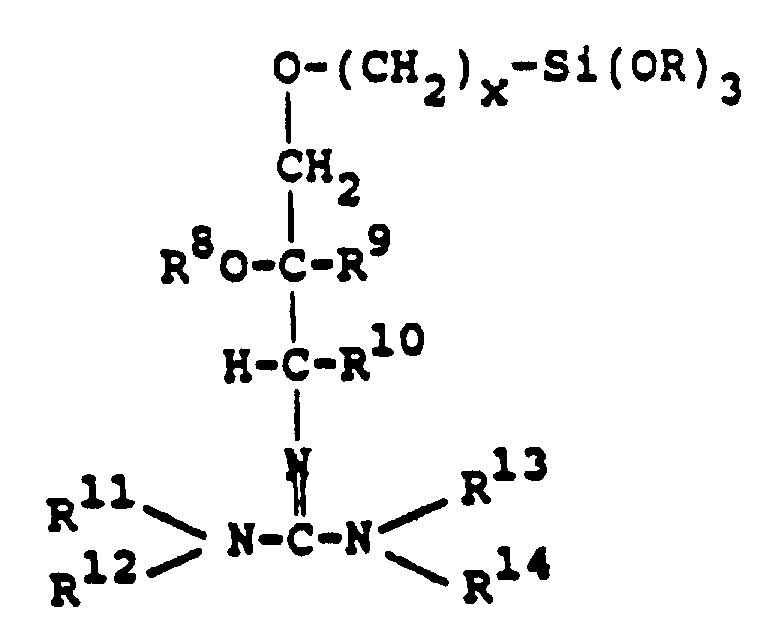 R Alkyl mit 1 bis 6 Kohlenstoffatomen;R⁸ Wasserstoff oder
 R⁹ und R¹⁰ Wasserstoff bedeuten oder zusammen mit den Kohlenstoffatomen, an die sie gebunden sind, einen gesättigten sechsgliedrigen carbocyclischen Ring bilden; undR¹¹, R¹², R¹³ und R¹⁴ unabhängig Wasserstoff oder Alkyl mit 1 bis 4 Kohlenstoffatomen bedeuten.
 - Verbindung nach Anspruch 17 mit der Bezeichnung N''-[2-Hydroxy-3-[3-(trimethoxysilyl)propoxy]propyl]-N,N,N',N'-tetramethylguanidin.
- Verbindung nach Anspruch 17 mit der Bezeichnung N''-[2-Hydroxy-3-[3-(ethoxydimethylsilyl)propoxy]propyl]-N,N,N',N'-tetramethylguanidin.
- Verbindung nach Anspruch 17 mit der Bezeichnung N''-[2-Hydroxy-3-[3-(diethoxymethylsilyl)propoxy]propyl]-N,N,N',N'-tetramethylguanidin.
- Verbindung nach Anspruch 17 mit der Bezeichnung [3-(Triethoxysilyl)propyl]carbaminsäure-[2-[[bis(dimethylamino)methylen]amino]-1-[[3-(trimethoxysilyl)propoxy]methyl]ethyl]ester.
- Verbindung nach Anspruch 17 mit der Bezeichnung [3-(Triethoxysilyl)propyl]carbaminsäure-[2-[[bis(dimethylamino)methylen]amino]-1-[[3-(ethoxydimethylsilyl)propoxy]methyl]ethyl]ester.
- Verbindung nach Anspruch 17 mit der Bezeichnung [3-(Triethoxysilyl)propyl]carbaminsäure-[2-[[bis(dimethylamino)methylen]amino]-1-[[3-(diethoxymethylsilyl)propoxy]methyl]ethyl]ester.
Priority Applications (1)
| Application Number | Priority Date | Filing Date | Title |
|---|---|---|---|
| AT89117261T ATE103319T1 (de) | 1988-10-13 | 1989-09-19 | Schnellhaertende polyurethandichtmasse, die silylsubstituierte guanidinbeschleuniger enthaelt. |
Applications Claiming Priority (2)
| Application Number | Priority Date | Filing Date | Title |
|---|---|---|---|
| US257486 | 1988-10-13 | ||
| US07/257,486 US4954598A (en) | 1988-10-13 | 1988-10-13 | Fast-cure polyurethane sealant composition containing silyl-substituted guanidine accelerators |
Publications (3)
| Publication Number | Publication Date |
|---|---|
| EP0363685A2 EP0363685A2 (de) | 1990-04-18 |
| EP0363685A3 EP0363685A3 (en) | 1990-12-19 |
| EP0363685B1 true EP0363685B1 (de) | 1994-03-23 |
Family
ID=22976497
Family Applications (1)
| Application Number | Title | Priority Date | Filing Date |
|---|---|---|---|
| EP89117261A Expired - Lifetime EP0363685B1 (de) | 1988-10-13 | 1989-09-19 | Schnellhärtende Polyurethandichtmasse, die silylsubstituierte Guanidinbeschleuniger enthält |
Country Status (6)
| Country | Link |
|---|---|
| US (1) | US4954598A (de) |
| EP (1) | EP0363685B1 (de) |
| KR (1) | KR930006469B1 (de) |
| AT (1) | ATE103319T1 (de) |
| CA (1) | CA2000608A1 (de) |
| DE (1) | DE68914081T2 (de) |
Families Citing this family (24)
| Publication number | Priority date | Publication date | Assignee | Title |
|---|---|---|---|---|
| US5097053A (en) * | 1988-10-13 | 1992-03-17 | Basf Corporation | Fast-cure polyurethane sealant composition containing silyl-substituted guanidine accelerators |
| US5102967A (en) * | 1989-12-27 | 1992-04-07 | General Electric Company | Process for making polysilsequioxane and polymethyl-n-hexylsilsesquioxane coating compositions and coating compositions formed thereby |
| US5272224A (en) * | 1990-05-30 | 1993-12-21 | Adco Products, Inc. | Polyurethane based adhesion composition and method |
| US5225512A (en) * | 1991-08-29 | 1993-07-06 | Basf Corporation | Polymer and adhesive composition |
| DE4243399C2 (de) * | 1991-12-28 | 2003-07-17 | Mitsubishi Materials Corp | Eine Guanidylgruppe enthaltende antibakterielle Verbindungen |
| DE4243398C2 (de) * | 1991-12-28 | 1994-11-03 | Mitsubishi Materials Corp | Antibakterielle, eine Guanidylgruppe enthaltende Silankupplungsverbindungen |
| US5423735A (en) * | 1993-04-16 | 1995-06-13 | Minnesota Mining And Manufacturing Company | Orthopedic cast composed of an alkoxysilane terminated resin |
| US5539045A (en) * | 1995-10-27 | 1996-07-23 | Morton International, Inc. | Aliphatic silylated polyurethane mixtures having reduced viscosites |
| JP3317353B2 (ja) | 1997-06-17 | 2002-08-26 | コニシ株式会社 | ウレタン系樹脂の製造方法及びウレタン系樹脂組成物 |
| US6124387A (en) * | 1998-12-22 | 2000-09-26 | Adco Products, Inc. | Fast-cure silylated polymer adhesive |
| US6498210B1 (en) | 2000-07-13 | 2002-12-24 | Adco Products, Inc. | Silylated polyurethanes for adhesives and sealants with improved mechanical properties |
| US7700082B2 (en) * | 2001-01-26 | 2010-04-20 | 3M Innovative Properties Company | Silylated polyurethane-urea compositions for use in cosmetic applications |
| US6679018B2 (en) * | 2002-02-01 | 2004-01-20 | Chem Link, Inc. | Roofing system and method |
| US6649016B2 (en) | 2002-03-04 | 2003-11-18 | Dow Global Technologies Inc. | Silane functional adhesive composition and method of bonding a window to a substrate without a primer |
| US7317051B2 (en) | 2003-11-14 | 2008-01-08 | Chem Link | Moisture curable sealer and adhesive composition |
| US7416599B2 (en) * | 2003-12-10 | 2008-08-26 | Dow Global Technologies Inc. | System for bonding glass into a structure |
| US7494540B2 (en) * | 2004-12-15 | 2009-02-24 | Dow Global Technologies, Inc. | System for bonding glass into a structure |
| DE102004062975A1 (de) * | 2004-12-22 | 2006-07-13 | Ge Bayer Silicones Gmbh & Co. Kg | Vernetzte Amino-Polyorganosiloxan-Verbindungen sowie sie enthaltende Zusammensetzungen |
| US7435787B2 (en) * | 2005-09-14 | 2008-10-14 | Momentive Performance Materials Inc. | Process for the continuous production of silylated resin |
| JP5378684B2 (ja) * | 2005-09-30 | 2013-12-25 | 株式会社カネカ | 硬化性組成物 |
| US7345130B2 (en) * | 2005-10-25 | 2008-03-18 | Dow Global Technologies Inc. | Silane functional prepolymer and isocyanate functional prepolymer blend based adhesive composition |
| US7819964B2 (en) * | 2007-02-16 | 2010-10-26 | Dow Global Technologies Inc. | System for bonding glass into a structure |
| TW201434882A (zh) * | 2013-03-13 | 2014-09-16 | Momentive Performance Mat Inc | 可濕氣固化之有機聚矽氧烷組成物 |
| JP2016536408A (ja) * | 2013-08-23 | 2016-11-24 | モーメンティブ・パフォーマンス・マテリアルズ・インク | 湿気硬化性組成物 |
Citations (1)
| Publication number | Priority date | Publication date | Assignee | Title |
|---|---|---|---|---|
| EP0227936A1 (de) * | 1985-12-23 | 1987-07-08 | Gurit-Essex AG | Verfahren zum Auftragen einer Masse auf Gegenstände |
Family Cites Families (19)
| Publication number | Priority date | Publication date | Assignee | Title |
|---|---|---|---|---|
| US3471434A (en) * | 1965-12-27 | 1969-10-07 | Stauffer Chemical Co | Room temperature curing organopolysiloxane elastomers |
| DE1745526B2 (de) * | 1967-03-16 | 1980-04-10 | Union Carbide Corp., New York, N.Y. (V.St.A.) | Verfahren zur Herstellung vulkanisierbarer, unter wasserfreien Bedingungen beständiger Polymerisate |
| US3665026A (en) * | 1969-03-14 | 1972-05-23 | Gen Electric | Imidatosilanes |
| US3622529A (en) * | 1969-03-14 | 1971-11-23 | Gen Electric | Rtv silicone composition containing an imidatosilane |
| US3779794A (en) * | 1970-03-05 | 1973-12-18 | Essex Chemical Corp | Polyurethane sealant-primer system |
| US3839386A (en) * | 1970-12-30 | 1974-10-01 | Stauffer Chemical Co | Oximo endblocked disiloxanes and process therefor |
| US4038239A (en) * | 1973-11-23 | 1977-07-26 | Contech Inc. | Moisture curable polyurethane systems |
| US3979344A (en) * | 1974-11-19 | 1976-09-07 | Inmont Corporation | Vulcanizable silicon terminated polyurethane polymer composition having improved cure speed |
| JPS5411953A (en) * | 1977-06-29 | 1979-01-29 | Shin Etsu Chem Co Ltd | Cold-curable organopolysiloxane composition |
| US4248993A (en) * | 1977-06-29 | 1981-02-03 | Shin-Etsu Chemical Co. Ltd. | Room temperature curable organopolysiloxane |
| JPS5810431B2 (ja) * | 1978-03-30 | 1983-02-25 | 東芝シリコ−ン株式会社 | 室温硬化性ポリオルガノシロキサン組成物 |
| US4257932A (en) * | 1978-06-27 | 1981-03-24 | General Electric Company | Curable compositions and process |
| US4395526A (en) * | 1981-06-26 | 1983-07-26 | General Electric Company | One package, stable, moisture curable, polyalkoxy-terminated organopolysiloxane compositions and method for making |
| US4469831A (en) * | 1981-08-26 | 1984-09-04 | Basf Aktiengesellschaft | Moisture-curing, storage stable, single-component polyurethane systems |
| US4358575A (en) * | 1981-12-16 | 1982-11-09 | General Electric Company Silicone Products Business Division | Self-bonding one-component RTV silicone rubber compositions |
| US4483972A (en) * | 1983-02-01 | 1984-11-20 | General Electric Company | Integrated cross-linkers and amine functional siloxane scavengers for RTV silicone rubber compositions |
| FR2572415B1 (fr) * | 1984-10-29 | 1987-01-09 | Rhone Poulenc Spec Chim | Composition organopolysiloxanique vulcanisable a temperature ambiante en elastomere auto-adherent |
| GB8510690D0 (en) * | 1985-04-26 | 1985-06-05 | Bostik Ltd | Moisture curable sealants |
| US4645816A (en) * | 1985-06-28 | 1987-02-24 | Union Carbide Corporation | Novel vulcanizable silane-terminated polyurethane polymers |
-
1988
- 1988-10-13 US US07/257,486 patent/US4954598A/en not_active Expired - Lifetime
-
1989
- 1989-09-19 DE DE68914081T patent/DE68914081T2/de not_active Expired - Fee Related
- 1989-09-19 EP EP89117261A patent/EP0363685B1/de not_active Expired - Lifetime
- 1989-09-19 AT AT89117261T patent/ATE103319T1/de not_active IP Right Cessation
- 1989-10-13 KR KR1019890014671A patent/KR930006469B1/ko not_active Expired - Fee Related
- 1989-10-13 CA CA002000608A patent/CA2000608A1/en not_active Abandoned
Patent Citations (1)
| Publication number | Priority date | Publication date | Assignee | Title |
|---|---|---|---|---|
| EP0227936A1 (de) * | 1985-12-23 | 1987-07-08 | Gurit-Essex AG | Verfahren zum Auftragen einer Masse auf Gegenstände |
Also Published As
| Publication number | Publication date |
|---|---|
| ATE103319T1 (de) | 1994-04-15 |
| US4954598A (en) | 1990-09-04 |
| KR900006476A (ko) | 1990-05-08 |
| EP0363685A3 (en) | 1990-12-19 |
| CA2000608A1 (en) | 1990-04-13 |
| DE68914081D1 (de) | 1994-04-28 |
| EP0363685A2 (de) | 1990-04-18 |
| DE68914081T2 (de) | 1994-07-07 |
| KR930006469B1 (ko) | 1993-07-16 |
Similar Documents
| Publication | Publication Date | Title |
|---|---|---|
| US4954598A (en) | Fast-cure polyurethane sealant composition containing silyl-substituted guanidine accelerators | |
| US5097053A (en) | Fast-cure polyurethane sealant composition containing silyl-substituted guanidine accelerators | |
| EP0353551B1 (de) | Titanesterbeschleuniger enthaltende schnellhärtende Polyurethan-Dichtungsmittelzusammensetzung | |
| EP0355426B1 (de) | Silylsubstituierte Piperazinbeschleuniger enthaltende schnellhärtende Polyurethan-Dichtungszusammensetzung | |
| US5225512A (en) | Polymer and adhesive composition | |
| EP0070475B1 (de) | Verfahren zur Herstellung von beim Aussetzen der Feuchtigkeit härtenden, endständige Silylgruppen enthaltenden, Polymeren | |
| JP4173807B2 (ja) | アルコキシ架橋性一成分系湿分硬化性材料 | |
| KR19990022079A (ko) | 히드록시 작용성 알콕시실란 및 이로부터 제조된 알콕시실란작용성 폴리우레탄 | |
| US5434198A (en) | Moisture-curing one-component polysiloxane compound | |
| KR20060053971A (ko) | 2,4'-mdi 기재의 저-점도 폴리우레탄 예비 중합체 | |
| JP2010202886A (ja) | 3−(n−シリルアルキル)アミノプロペン酸エステル基を含むポリマーおよびその使用 | |
| JP5407626B2 (ja) | 硬化性組成物 | |
| EP0341322A1 (de) | Mit hydrolysierbaren Silylgruppen end-blockierte Polyether, Verfahren zur Herstellung und bei Raumtemperatur härtbare Zusammensetzung, die den Polyether verwendet | |
| US11760900B2 (en) | Condensation curable composition | |
| JPH0749576B2 (ja) | 水分にて硬化可能な一剤式シーリング材組成物 | |
| JP7448656B2 (ja) | オルガニルオキシシラン末端ポリマーをベースとする架橋性組成物 | |
| US20240317935A1 (en) | Organyloxysilyl-terminated polymers on the basis of 1,3-dioxolane copolymer building blocks | |
| JPS62151453A (ja) | シ−リング材組成物 | |
| JPH03167286A (ja) | 湿気硬化性シーリング材組成物 |
Legal Events
| Date | Code | Title | Description |
|---|---|---|---|
| PUAI | Public reference made under article 153(3) epc to a published international application that has entered the european phase |
Free format text: ORIGINAL CODE: 0009012 |
|
| AK | Designated contracting states |
Kind code of ref document: A2 Designated state(s): AT BE CH DE ES FR GB GR IT LI LU NL SE |
|
| PUAL | Search report despatched |
Free format text: ORIGINAL CODE: 0009013 |
|
| AK | Designated contracting states |
Kind code of ref document: A3 Designated state(s): AT BE CH DE ES FR GB GR IT LI LU NL SE |
|
| 17P | Request for examination filed |
Effective date: 19910608 |
|
| 17Q | First examination report despatched |
Effective date: 19920402 |
|
| RAP1 | Party data changed (applicant data changed or rights of an application transferred) |
Owner name: ADCO PRODUCTS, INC. |
|
| GRAA | (expected) grant |
Free format text: ORIGINAL CODE: 0009210 |
|
| AK | Designated contracting states |
Kind code of ref document: B1 Designated state(s): AT BE CH DE ES FR GB GR IT LI LU NL SE |
|
| PG25 | Lapsed in a contracting state [announced via postgrant information from national office to epo] |
Ref country code: IT Free format text: LAPSE BECAUSE OF FAILURE TO SUBMIT A TRANSLATION OF THE DESCRIPTION OR TO PAY THE FEE WITHIN THE PRE;WARNING: LAPSES OF ITALIAN PATENTS WITH EFFECTIVE DATE BEFORE 2007 MAY HAVE OCCURRED AT ANY TIME BEFORE 2007. THE CORRECT EFFECTIVE DATE MAY BE DIFFERENT FROM THE ONE RECORDED.SCRIBED TIME-LIMIT Effective date: 19940323 Ref country code: ES Free format text: THE PATENT HAS BEEN ANNULLED BY A DECISION OF A NATIONAL AUTHORITY Effective date: 19940323 Ref country code: BE Effective date: 19940323 Ref country code: NL Effective date: 19940323 Ref country code: GR Free format text: LAPSE BECAUSE OF FAILURE TO SUBMIT A TRANSLATION OF THE DESCRIPTION OR TO PAY THE FEE WITHIN THE PRESCRIBED TIME-LIMIT Effective date: 19940323 Ref country code: AT Effective date: 19940323 Ref country code: SE Free format text: THE PATENT HAS BEEN ANNULLED BY A DECISION OF A NATIONAL AUTHORITY Effective date: 19940323 |
|
| REF | Corresponds to: |
Ref document number: 103319 Country of ref document: AT Date of ref document: 19940415 Kind code of ref document: T |
|
| REF | Corresponds to: |
Ref document number: 68914081 Country of ref document: DE Date of ref document: 19940428 |
|
| ET | Fr: translation filed | ||
| NLV1 | Nl: lapsed or annulled due to failure to fulfill the requirements of art. 29p and 29m of the patents act | ||
| PG25 | Lapsed in a contracting state [announced via postgrant information from national office to epo] |
Ref country code: LU Free format text: LAPSE BECAUSE OF NON-PAYMENT OF DUE FEES Effective date: 19940930 |
|
| PLBE | No opposition filed within time limit |
Free format text: ORIGINAL CODE: 0009261 |
|
| STAA | Information on the status of an ep patent application or granted ep patent |
Free format text: STATUS: NO OPPOSITION FILED WITHIN TIME LIMIT |
|
| 26N | No opposition filed | ||
| PGFP | Annual fee paid to national office [announced via postgrant information from national office to epo] |
Ref country code: CH Payment date: 19950810 Year of fee payment: 7 |
|
| PGFP | Annual fee paid to national office [announced via postgrant information from national office to epo] |
Ref country code: FR Payment date: 19950811 Year of fee payment: 7 |
|
| PG25 | Lapsed in a contracting state [announced via postgrant information from national office to epo] |
Ref country code: FR Effective date: 19960930 Ref country code: CH Effective date: 19960930 Ref country code: LI Effective date: 19960930 |
|
| REG | Reference to a national code |
Ref country code: CH Ref legal event code: PL |
|
| REG | Reference to a national code |
Ref country code: FR Ref legal event code: ST |
|
| REG | Reference to a national code |
Ref country code: FR Ref legal event code: ST |
|
| REG | Reference to a national code |
Ref country code: GB Ref legal event code: 732E |
|
| PGFP | Annual fee paid to national office [announced via postgrant information from national office to epo] |
Ref country code: GB Payment date: 19980806 Year of fee payment: 10 |
|
| PGFP | Annual fee paid to national office [announced via postgrant information from national office to epo] |
Ref country code: DE Payment date: 19980928 Year of fee payment: 10 |
|
| PG25 | Lapsed in a contracting state [announced via postgrant information from national office to epo] |
Ref country code: GB Free format text: LAPSE BECAUSE OF NON-PAYMENT OF DUE FEES Effective date: 19990919 |
|
| GBPC | Gb: european patent ceased through non-payment of renewal fee |
Effective date: 19990919 |
|
| PG25 | Lapsed in a contracting state [announced via postgrant information from national office to epo] |
Ref country code: DE Free format text: LAPSE BECAUSE OF NON-PAYMENT OF DUE FEES Effective date: 20000701 |