EP0363756B1 - Verfahren zur Herstellung von 2,5-Diarylaminoterephthalsäuren - Google Patents
Verfahren zur Herstellung von 2,5-Diarylaminoterephthalsäuren Download PDFInfo
- Publication number
- EP0363756B1 EP0363756B1 EP89118109A EP89118109A EP0363756B1 EP 0363756 B1 EP0363756 B1 EP 0363756B1 EP 89118109 A EP89118109 A EP 89118109A EP 89118109 A EP89118109 A EP 89118109A EP 0363756 B1 EP0363756 B1 EP 0363756B1
- Authority
- EP
- European Patent Office
- Prior art keywords
- parts
- process according
- oxidation
- diarylamino
- acid
- Prior art date
- Legal status (The legal status is an assumption and is not a legal conclusion. Google has not performed a legal analysis and makes no representation as to the accuracy of the status listed.)
- Expired - Lifetime
Links
- 238000000034 method Methods 0.000 title claims description 29
- 238000002360 preparation method Methods 0.000 title claims description 8
- 239000002253 acid Substances 0.000 claims description 41
- OKKJLVBELUTLKV-UHFFFAOYSA-N Methanol Chemical compound OC OKKJLVBELUTLKV-UHFFFAOYSA-N 0.000 claims description 27
- 230000003647 oxidation Effects 0.000 claims description 24
- 238000007254 oxidation reaction Methods 0.000 claims description 24
- 150000002148 esters Chemical class 0.000 claims description 22
- LFQSCWFLJHTTHZ-UHFFFAOYSA-N Ethanol Chemical compound CCO LFQSCWFLJHTTHZ-UHFFFAOYSA-N 0.000 claims description 19
- 239000000203 mixture Substances 0.000 claims description 19
- QVGXLLKOCUKJST-UHFFFAOYSA-N atomic oxygen Chemical compound [O] QVGXLLKOCUKJST-UHFFFAOYSA-N 0.000 claims description 15
- 229910052760 oxygen Inorganic materials 0.000 claims description 15
- 239000001301 oxygen Substances 0.000 claims description 15
- 150000007513 acids Chemical class 0.000 claims description 13
- MMNWSHJJPDXKCH-UHFFFAOYSA-N 9,10-dioxoanthracene-2-sulfonic acid Chemical compound C1=CC=C2C(=O)C3=CC(S(=O)(=O)O)=CC=C3C(=O)C2=C1 MMNWSHJJPDXKCH-UHFFFAOYSA-N 0.000 claims description 9
- 150000003856 quaternary ammonium compounds Chemical class 0.000 claims description 8
- 150000004982 aromatic amines Chemical class 0.000 claims description 6
- 238000006243 chemical reaction Methods 0.000 claims description 6
- 239000003795 chemical substances by application Substances 0.000 claims description 6
- 125000004178 (C1-C4) alkyl group Chemical group 0.000 claims description 5
- 230000015572 biosynthetic process Effects 0.000 claims description 5
- KFZMGEQAYNKOFK-UHFFFAOYSA-N Isopropanol Chemical compound CC(C)O KFZMGEQAYNKOFK-UHFFFAOYSA-N 0.000 claims description 4
- 238000009835 boiling Methods 0.000 claims description 4
- 239000007789 gas Substances 0.000 claims description 4
- 125000001424 substituent group Chemical group 0.000 claims description 4
- 239000000725 suspension Substances 0.000 claims description 3
- 125000000229 (C1-C4)alkoxy group Chemical group 0.000 claims description 2
- 239000004215 Carbon black (E152) Substances 0.000 claims description 2
- ZAMOUSCENKQFHK-UHFFFAOYSA-N Chlorine atom Chemical compound [Cl] ZAMOUSCENKQFHK-UHFFFAOYSA-N 0.000 claims description 2
- PXGOKWXKJXAPGV-UHFFFAOYSA-N Fluorine Chemical compound FF PXGOKWXKJXAPGV-UHFFFAOYSA-N 0.000 claims description 2
- 101500021084 Locusta migratoria 5 kDa peptide Proteins 0.000 claims description 2
- 239000012670 alkaline solution Substances 0.000 claims description 2
- 125000000217 alkyl group Chemical group 0.000 claims description 2
- 125000003118 aryl group Chemical group 0.000 claims description 2
- 125000003917 carbamoyl group Chemical group [H]N([H])C(*)=O 0.000 claims description 2
- 125000003178 carboxy group Chemical group [H]OC(*)=O 0.000 claims description 2
- 239000000460 chlorine Substances 0.000 claims description 2
- 229910052801 chlorine Inorganic materials 0.000 claims description 2
- 125000004122 cyclic group Chemical group 0.000 claims description 2
- 229910052731 fluorine Inorganic materials 0.000 claims description 2
- 239000011737 fluorine Substances 0.000 claims description 2
- 125000001072 heteroaryl group Chemical group 0.000 claims description 2
- 229930195733 hydrocarbon Natural products 0.000 claims description 2
- 239000001257 hydrogen Substances 0.000 claims description 2
- 229910052739 hydrogen Inorganic materials 0.000 claims description 2
- 125000000449 nitro group Chemical group [O-][N+](*)=O 0.000 claims description 2
- 125000004430 oxygen atom Chemical group O* 0.000 claims description 2
- 239000011541 reaction mixture Substances 0.000 claims description 2
- 125000002023 trifluoromethyl group Chemical group FC(F)(F)* 0.000 claims description 2
- UFHFLCQGNIYNRP-UHFFFAOYSA-N Hydrogen Chemical compound [H][H] UFHFLCQGNIYNRP-UHFFFAOYSA-N 0.000 claims 1
- XLYOFNOQVPJJNP-UHFFFAOYSA-N water Substances O XLYOFNOQVPJJNP-UHFFFAOYSA-N 0.000 description 27
- KWYUFKZDYYNOTN-UHFFFAOYSA-M Potassium hydroxide Chemical compound [OH-].[K+] KWYUFKZDYYNOTN-UHFFFAOYSA-M 0.000 description 22
- 239000000243 solution Substances 0.000 description 18
- QTBSBXVTEAMEQO-UHFFFAOYSA-N Acetic acid Chemical compound CC(O)=O QTBSBXVTEAMEQO-UHFFFAOYSA-N 0.000 description 16
- VEXZGXHMUGYJMC-UHFFFAOYSA-N Hydrochloric acid Chemical compound Cl VEXZGXHMUGYJMC-UHFFFAOYSA-N 0.000 description 14
- HEMHJVSKTPXQMS-UHFFFAOYSA-M Sodium hydroxide Chemical compound [OH-].[Na+] HEMHJVSKTPXQMS-UHFFFAOYSA-M 0.000 description 12
- LRHPLDYGYMQRHN-UHFFFAOYSA-N N-Butanol Chemical compound CCCCO LRHPLDYGYMQRHN-UHFFFAOYSA-N 0.000 description 10
- 230000007935 neutral effect Effects 0.000 description 9
- 229960000583 acetic acid Drugs 0.000 description 8
- 239000012362 glacial acetic acid Substances 0.000 description 8
- RZXMPPFPUUCRFN-UHFFFAOYSA-N p-toluidine Chemical compound CC1=CC=C(N)C=C1 RZXMPPFPUUCRFN-UHFFFAOYSA-N 0.000 description 8
- QAOWNCQODCNURD-UHFFFAOYSA-N Sulfuric acid Chemical class OS(O)(=O)=O QAOWNCQODCNURD-UHFFFAOYSA-N 0.000 description 7
- RTZKZFJDLAIYFH-UHFFFAOYSA-N Diethyl ether Chemical compound CCOCC RTZKZFJDLAIYFH-UHFFFAOYSA-N 0.000 description 6
- -1 aromatic nitro compounds Chemical class 0.000 description 6
- 150000003242 quaternary ammonium salts Chemical class 0.000 description 6
- FVLUGNOOEZYDNV-UHFFFAOYSA-N 2,5-bis(4-methylanilino)terephthalic acid Chemical compound C1=CC(C)=CC=C1NC(C(=C1)C(O)=O)=CC(C(O)=O)=C1NC1=CC=C(C)C=C1 FVLUGNOOEZYDNV-UHFFFAOYSA-N 0.000 description 5
- 150000008044 alkali metal hydroxides Chemical class 0.000 description 5
- JBIROUFYLSSYDX-UHFFFAOYSA-M benzododecinium chloride Chemical compound [Cl-].CCCCCCCCCCCC[N+](C)(C)CC1=CC=CC=C1 JBIROUFYLSSYDX-UHFFFAOYSA-M 0.000 description 5
- HTZCNXWZYVXIMZ-UHFFFAOYSA-M benzyl(triethyl)azanium;chloride Chemical compound [Cl-].CC[N+](CC)(CC)CC1=CC=CC=C1 HTZCNXWZYVXIMZ-UHFFFAOYSA-M 0.000 description 5
- 238000001816 cooling Methods 0.000 description 5
- ZJQZWNLKRBUEKX-UHFFFAOYSA-N 2,5-dianilinoterephthalic acid Chemical class OC(=O)C=1C=C(NC=2C=CC=CC=2)C(C(=O)O)=CC=1NC1=CC=CC=C1 ZJQZWNLKRBUEKX-UHFFFAOYSA-N 0.000 description 4
- PAYRUJLWNCNPSJ-UHFFFAOYSA-N Aniline Chemical compound NC1=CC=CC=C1 PAYRUJLWNCNPSJ-UHFFFAOYSA-N 0.000 description 4
- 0 CNc(cc(C(O)=O)c(N*)c1)c1C(O)=O Chemical compound CNc(cc(C(O)=O)c(N*)c1)c1C(O)=O 0.000 description 4
- AFBPFSWMIHJQDM-UHFFFAOYSA-N N-methyl-N-phenylamine Natural products CNC1=CC=CC=C1 AFBPFSWMIHJQDM-UHFFFAOYSA-N 0.000 description 4
- 230000001476 alcoholic effect Effects 0.000 description 4
- PYKYMHQGRFAEBM-UHFFFAOYSA-N anthraquinone Natural products CCC(=O)c1c(O)c2C(=O)C3C(C=CC=C3O)C(=O)c2cc1CC(=O)OC PYKYMHQGRFAEBM-UHFFFAOYSA-N 0.000 description 4
- 150000004056 anthraquinones Chemical class 0.000 description 4
- LYCAIKOWRPUZTN-UHFFFAOYSA-N ethylene glycol Natural products OCCO LYCAIKOWRPUZTN-UHFFFAOYSA-N 0.000 description 4
- 239000007800 oxidant agent Substances 0.000 description 4
- 238000010992 reflux Methods 0.000 description 4
- 150000003839 salts Chemical class 0.000 description 4
- LBLYYCQCTBFVLH-UHFFFAOYSA-M 2-methylbenzenesulfonate Chemical compound CC1=CC=CC=C1S([O-])(=O)=O LBLYYCQCTBFVLH-UHFFFAOYSA-M 0.000 description 3
- WIWJFWANKMRGGS-UHFFFAOYSA-N 3,4-dimethyl-1,6-dioxecane-2,5,7,10-tetrone Chemical compound C1(CCC(=O)OC(C(C(C(=O)O1)C)C)=O)=O WIWJFWANKMRGGS-UHFFFAOYSA-N 0.000 description 3
- UHOVQNZJYSORNB-UHFFFAOYSA-N Benzene Chemical compound C1=CC=CC=C1 UHOVQNZJYSORNB-UHFFFAOYSA-N 0.000 description 3
- 229930192627 Naphthoquinone Natural products 0.000 description 3
- 238000001035 drying Methods 0.000 description 3
- 125000001495 ethyl group Chemical group [H]C([H])([H])C([H])([H])* 0.000 description 3
- OJURWUUOVGOHJZ-UHFFFAOYSA-N methyl 2-[(2-acetyloxyphenyl)methyl-[2-[(2-acetyloxyphenyl)methyl-(2-methoxy-2-oxoethyl)amino]ethyl]amino]acetate Chemical compound C=1C=CC=C(OC(C)=O)C=1CN(CC(=O)OC)CCN(CC(=O)OC)CC1=CC=CC=C1OC(C)=O OJURWUUOVGOHJZ-UHFFFAOYSA-N 0.000 description 3
- 125000002496 methyl group Chemical group [H]C([H])([H])* 0.000 description 3
- 150000002791 naphthoquinones Chemical class 0.000 description 3
- 239000010695 polyglycol Substances 0.000 description 3
- 229920000151 polyglycol Polymers 0.000 description 3
- 238000005406 washing Methods 0.000 description 3
- UHNQJYAKDVEVGU-UHFFFAOYSA-N 2,5-bis(4-methoxyanilino)terephthalic acid Chemical compound C1=CC(OC)=CC=C1NC(C(=C1)C(O)=O)=CC(C(O)=O)=C1NC1=CC=C(OC)C=C1 UHNQJYAKDVEVGU-UHFFFAOYSA-N 0.000 description 2
- QSNSCYSYFYORTR-UHFFFAOYSA-N 4-chloroaniline Chemical compound NC1=CC=C(Cl)C=C1 QSNSCYSYFYORTR-UHFFFAOYSA-N 0.000 description 2
- JAJIPIAHCFBEPI-UHFFFAOYSA-N 9,10-dioxoanthracene-1-sulfonic acid Chemical compound O=C1C2=CC=CC=C2C(=O)C2=C1C=CC=C2S(=O)(=O)O JAJIPIAHCFBEPI-UHFFFAOYSA-N 0.000 description 2
- YYVYAPXYZVYDHN-UHFFFAOYSA-N 9,10-phenanthroquinone Chemical compound C1=CC=C2C(=O)C(=O)C3=CC=CC=C3C2=C1 YYVYAPXYZVYDHN-UHFFFAOYSA-N 0.000 description 2
- VEXZGXHMUGYJMC-UHFFFAOYSA-M Chloride anion Chemical compound [Cl-] VEXZGXHMUGYJMC-UHFFFAOYSA-M 0.000 description 2
- JUJWROOIHBZHMG-UHFFFAOYSA-N Pyridine Chemical compound C1=CC=NC=C1 JUJWROOIHBZHMG-UHFFFAOYSA-N 0.000 description 2
- NRCMAYZCPIVABH-UHFFFAOYSA-N Quinacridone Chemical compound N1C2=CC=CC=C2C(=O)C2=C1C=C1C(=O)C3=CC=CC=C3NC1=C2 NRCMAYZCPIVABH-UHFFFAOYSA-N 0.000 description 2
- 230000002378 acidificating effect Effects 0.000 description 2
- 150000001298 alcohols Chemical class 0.000 description 2
- 239000003513 alkali Substances 0.000 description 2
- 229910001854 alkali hydroxide Inorganic materials 0.000 description 2
- 229940027983 antiseptic and disinfectant quaternary ammonium compound Drugs 0.000 description 2
- OTPBAANTTKRERC-UHFFFAOYSA-N benzyl(dodecyl)azanium;chloride Chemical compound Cl.CCCCCCCCCCCCNCC1=CC=CC=C1 OTPBAANTTKRERC-UHFFFAOYSA-N 0.000 description 2
- 150000001805 chlorine compounds Chemical class 0.000 description 2
- 238000001914 filtration Methods 0.000 description 2
- 150000004679 hydroxides Chemical class 0.000 description 2
- 150000005451 methyl sulfates Chemical class 0.000 description 2
- BHAAPTBBJKJZER-UHFFFAOYSA-N p-anisidine Chemical compound COC1=CC=C(N)C=C1 BHAAPTBBJKJZER-UHFFFAOYSA-N 0.000 description 2
- 239000000049 pigment Substances 0.000 description 2
- 239000000843 powder Substances 0.000 description 2
- 150000004053 quinones Chemical class 0.000 description 2
- 238000007127 saponification reaction Methods 0.000 description 2
- 239000002904 solvent Substances 0.000 description 2
- 150000003460 sulfonic acids Chemical class 0.000 description 2
- 150000003467 sulfuric acid derivatives Chemical class 0.000 description 2
- UGNWTBMOAKPKBL-UHFFFAOYSA-N tetrachloro-1,4-benzoquinone Chemical compound ClC1=C(Cl)C(=O)C(Cl)=C(Cl)C1=O UGNWTBMOAKPKBL-UHFFFAOYSA-N 0.000 description 2
- 125000005208 trialkylammonium group Chemical group 0.000 description 2
- 125000006702 (C1-C18) alkyl group Chemical group 0.000 description 1
- 125000004169 (C1-C6) alkyl group Chemical group 0.000 description 1
- WDCYWAQPCXBPJA-UHFFFAOYSA-N 1,3-dinitrobenzene Chemical compound [O-][N+](=O)C1=CC=CC([N+]([O-])=O)=C1 WDCYWAQPCXBPJA-UHFFFAOYSA-N 0.000 description 1
- GNPSDJOWGWWXSS-UHFFFAOYSA-M 1-benzylpyridin-1-ium;chloride Chemical compound [Cl-].C=1C=CC=C[N+]=1CC1=CC=CC=C1 GNPSDJOWGWWXSS-UHFFFAOYSA-M 0.000 description 1
- GKQHIYSTBXDYNQ-UHFFFAOYSA-M 1-dodecylpyridin-1-ium;chloride Chemical compound [Cl-].CCCCCCCCCCCC[N+]1=CC=CC=C1 GKQHIYSTBXDYNQ-UHFFFAOYSA-M 0.000 description 1
- XNWFRZJHXBZDAG-UHFFFAOYSA-N 2-METHOXYETHANOL Chemical compound COCCO XNWFRZJHXBZDAG-UHFFFAOYSA-N 0.000 description 1
- AIRRELHUAAZTTL-UHFFFAOYSA-N 3-nitrobenzenesulfonic acid;sodium Chemical compound [Na].OS(=O)(=O)C1=CC=CC([N+]([O-])=O)=C1 AIRRELHUAAZTTL-UHFFFAOYSA-N 0.000 description 1
- CZGCEKJOLUNIFY-UHFFFAOYSA-N 4-Chloronitrobenzene Chemical compound [O-][N+](=O)C1=CC=C(Cl)C=C1 CZGCEKJOLUNIFY-UHFFFAOYSA-N 0.000 description 1
- IMPPGHMHELILKG-UHFFFAOYSA-N 4-ethoxyaniline Chemical compound CCOC1=CC=C(N)C=C1 IMPPGHMHELILKG-UHFFFAOYSA-N 0.000 description 1
- ZPTVNYMJQHSSEA-UHFFFAOYSA-N 4-nitrotoluene Chemical compound CC1=CC=C([N+]([O-])=O)C=C1 ZPTVNYMJQHSSEA-UHFFFAOYSA-N 0.000 description 1
- ZCYVEMRRCGMTRW-UHFFFAOYSA-N 7553-56-2 Chemical compound [I] ZCYVEMRRCGMTRW-UHFFFAOYSA-N 0.000 description 1
- OZTBHAGJSKTDGM-UHFFFAOYSA-N 9,10-dioxoanthracene-1,5-disulfonic acid Chemical compound O=C1C=2C(S(=O)(=O)O)=CC=CC=2C(=O)C2=C1C=CC=C2S(O)(=O)=O OZTBHAGJSKTDGM-UHFFFAOYSA-N 0.000 description 1
- ONMOULMPIIOVTQ-UHFFFAOYSA-N 98-47-5 Chemical compound OS(=O)(=O)C1=CC=CC([N+]([O-])=O)=C1 ONMOULMPIIOVTQ-UHFFFAOYSA-N 0.000 description 1
- SNRUBQQJIBEYMU-UHFFFAOYSA-N Dodecane Natural products CCCCCCCCCCCC SNRUBQQJIBEYMU-UHFFFAOYSA-N 0.000 description 1
- IAYPIBMASNFSPL-UHFFFAOYSA-N Ethylene oxide Chemical compound C1CO1 IAYPIBMASNFSPL-UHFFFAOYSA-N 0.000 description 1
- DGAQECJNVWCQMB-PUAWFVPOSA-M Ilexoside XXIX Chemical compound C[C@@H]1CC[C@@]2(CC[C@@]3(C(=CC[C@H]4[C@]3(CC[C@@H]5[C@@]4(CC[C@@H](C5(C)C)OS(=O)(=O)[O-])C)C)[C@@H]2[C@]1(C)O)C)C(=O)O[C@H]6[C@@H]([C@H]([C@@H]([C@H](O6)CO)O)O)O.[Na+] DGAQECJNVWCQMB-PUAWFVPOSA-M 0.000 description 1
- 238000005684 Liebig rearrangement reaction Methods 0.000 description 1
- QAOWNCQODCNURD-UHFFFAOYSA-L Sulfate Chemical compound [O-]S([O-])(=O)=O QAOWNCQODCNURD-UHFFFAOYSA-L 0.000 description 1
- 125000000129 anionic group Chemical group 0.000 description 1
- 239000002585 base Substances 0.000 description 1
- 229940077388 benzenesulfonate Drugs 0.000 description 1
- SRSXLGNVWSONIS-UHFFFAOYSA-M benzenesulfonate Chemical compound [O-]S(=O)(=O)C1=CC=CC=C1 SRSXLGNVWSONIS-UHFFFAOYSA-M 0.000 description 1
- SRSXLGNVWSONIS-UHFFFAOYSA-N benzenesulfonic acid Chemical class OS(=O)(=O)C1=CC=CC=C1 SRSXLGNVWSONIS-UHFFFAOYSA-N 0.000 description 1
- 125000001797 benzyl group Chemical group [H]C1=C([H])C([H])=C(C([H])=C1[H])C([H])([H])* 0.000 description 1
- KXHPPCXNWTUNSB-UHFFFAOYSA-M benzyl(trimethyl)azanium;chloride Chemical compound [Cl-].C[N+](C)(C)CC1=CC=CC=C1 KXHPPCXNWTUNSB-UHFFFAOYSA-M 0.000 description 1
- NDKBVBUGCNGSJJ-UHFFFAOYSA-M benzyltrimethylammonium hydroxide Chemical compound [OH-].C[N+](C)(C)CC1=CC=CC=C1 NDKBVBUGCNGSJJ-UHFFFAOYSA-M 0.000 description 1
- 150000001735 carboxylic acids Chemical class 0.000 description 1
- 239000000969 carrier Substances 0.000 description 1
- 125000002091 cationic group Chemical group 0.000 description 1
- YMKDRGPMQRFJGP-UHFFFAOYSA-M cetylpyridinium chloride Chemical compound [Cl-].CCCCCCCCCCCCCCCC[N+]1=CC=CC=C1 YMKDRGPMQRFJGP-UHFFFAOYSA-M 0.000 description 1
- 229960001927 cetylpyridinium chloride Drugs 0.000 description 1
- 150000001875 compounds Chemical class 0.000 description 1
- 238000009833 condensation Methods 0.000 description 1
- 230000005494 condensation Effects 0.000 description 1
- VSCYLSLFZOEXPK-UHFFFAOYSA-M dibenzyl(diethyl)azanium;chloride Chemical compound [Cl-].C=1C=CC=CC=1C[N+](CC)(CC)CC1=CC=CC=C1 VSCYLSLFZOEXPK-UHFFFAOYSA-M 0.000 description 1
- ZJXBEXRSXKGGHS-UHFFFAOYSA-N diethyl 2,5-dianilinocyclohexa-1,4-diene-1,4-dicarboxylate Chemical compound C1C(C(=O)OCC)=C(NC=2C=CC=CC=2)CC(C(=O)OCC)=C1NC1=CC=CC=C1 ZJXBEXRSXKGGHS-UHFFFAOYSA-N 0.000 description 1
- DENRZWYUOJLTMF-UHFFFAOYSA-N diethyl sulfate Chemical compound CCOS(=O)(=O)OCC DENRZWYUOJLTMF-UHFFFAOYSA-N 0.000 description 1
- 229940008406 diethyl sulfate Drugs 0.000 description 1
- 238000010790 dilution Methods 0.000 description 1
- 239000012895 dilution Substances 0.000 description 1
- ALPXOPKPVWQJMZ-UHFFFAOYSA-N dimethyl 2,5-bis(4-methylanilino)cyclohexa-1,4-diene-1,4-dicarboxylate Chemical compound C1C(C(=O)OC)=C(NC=2C=CC(C)=CC=2)CC(C(=O)OC)=C1NC1=CC=C(C)C=C1 ALPXOPKPVWQJMZ-UHFFFAOYSA-N 0.000 description 1
- 125000000118 dimethyl group Chemical group [H]C([H])([H])* 0.000 description 1
- 125000003438 dodecyl group Chemical group [H]C([H])([H])C([H])([H])C([H])([H])C([H])([H])C([H])([H])C([H])([H])C([H])([H])C([H])([H])C([H])([H])C([H])([H])C([H])([H])C([H])([H])* 0.000 description 1
- DDXLVDQZPFLQMZ-UHFFFAOYSA-M dodecyl(trimethyl)azanium;chloride Chemical compound [Cl-].CCCCCCCCCCCC[N+](C)(C)C DDXLVDQZPFLQMZ-UHFFFAOYSA-M 0.000 description 1
- 150000005452 ethyl sulfates Chemical class 0.000 description 1
- 238000002474 experimental method Methods 0.000 description 1
- 150000002334 glycols Chemical class 0.000 description 1
- 125000004435 hydrogen atom Chemical group [H]* 0.000 description 1
- XLYOFNOQVPJJNP-UHFFFAOYSA-M hydroxide Chemical compound [OH-] XLYOFNOQVPJJNP-UHFFFAOYSA-M 0.000 description 1
- WGCNASOHLSPBMP-UHFFFAOYSA-N hydroxyacetaldehyde Natural products OCC=O WGCNASOHLSPBMP-UHFFFAOYSA-N 0.000 description 1
- 125000002883 imidazolyl group Chemical group 0.000 description 1
- 239000000543 intermediate Substances 0.000 description 1
- 229910052740 iodine Inorganic materials 0.000 description 1
- 239000011630 iodine Substances 0.000 description 1
- 125000001449 isopropyl group Chemical group [H]C([H])([H])C([H])(*)C([H])([H])[H] 0.000 description 1
- 238000004519 manufacturing process Methods 0.000 description 1
- JZMJDSHXVKJFKW-UHFFFAOYSA-M methyl sulfate(1-) Chemical compound COS([O-])(=O)=O JZMJDSHXVKJFKW-UHFFFAOYSA-M 0.000 description 1
- TWOFDIYIPNBWBG-UHFFFAOYSA-N n-benzyldodecan-1-amine Chemical compound CCCCCCCCCCCCNCC1=CC=CC=C1 TWOFDIYIPNBWBG-UHFFFAOYSA-N 0.000 description 1
- 230000001590 oxidative effect Effects 0.000 description 1
- 125000000913 palmityl group Chemical group [H]C([*])([H])C([H])([H])C([H])([H])C([H])([H])C([H])([H])C([H])([H])C([H])([H])C([H])([H])C([H])([H])C([H])([H])C([H])([H])C([H])([H])C([H])([H])C([H])([H])C([H])([H])C([H])([H])[H] 0.000 description 1
- AZQWKYJCGOJGHM-UHFFFAOYSA-N para-benzoquinone Natural products O=C1C=CC(=O)C=C1 AZQWKYJCGOJGHM-UHFFFAOYSA-N 0.000 description 1
- 125000001997 phenyl group Chemical group [H]C1=C([H])C([H])=C(*)C([H])=C1[H] 0.000 description 1
- BDERNNFJNOPAEC-UHFFFAOYSA-N propan-1-ol Chemical compound CCCO BDERNNFJNOPAEC-UHFFFAOYSA-N 0.000 description 1
- 238000000746 purification Methods 0.000 description 1
- UMJSCPRVCHMLSP-UHFFFAOYSA-N pyridine Natural products COC1=CC=CN=C1 UMJSCPRVCHMLSP-UHFFFAOYSA-N 0.000 description 1
- 238000005956 quaternization reaction Methods 0.000 description 1
- 230000035484 reaction time Effects 0.000 description 1
- 229910052708 sodium Inorganic materials 0.000 description 1
- 239000011734 sodium Substances 0.000 description 1
- ICTMDIORIDZWQN-UHFFFAOYSA-M triethyl(phenyl)azanium;chloride Chemical compound [Cl-].CC[N+](CC)(CC)C1=CC=CC=C1 ICTMDIORIDZWQN-UHFFFAOYSA-M 0.000 description 1
- MQAYPFVXSPHGJM-UHFFFAOYSA-M trimethyl(phenyl)azanium;chloride Chemical compound [Cl-].C[N+](C)(C)C1=CC=CC=C1 MQAYPFVXSPHGJM-UHFFFAOYSA-M 0.000 description 1
- 238000010626 work up procedure Methods 0.000 description 1
Classifications
-
- C—CHEMISTRY; METALLURGY
- C07—ORGANIC CHEMISTRY
- C07C—ACYCLIC OR CARBOCYCLIC COMPOUNDS
- C07C229/00—Compounds containing amino and carboxyl groups bound to the same carbon skeleton
- C07C229/52—Compounds containing amino and carboxyl groups bound to the same carbon skeleton having amino and carboxyl groups bound to carbon atoms of six-membered aromatic rings of the same carbon skeleton
- C07C229/54—Compounds containing amino and carboxyl groups bound to the same carbon skeleton having amino and carboxyl groups bound to carbon atoms of six-membered aromatic rings of the same carbon skeleton with amino and carboxyl groups bound to carbon atoms of the same non-condensed six-membered aromatic ring
- C07C229/62—Compounds containing amino and carboxyl groups bound to the same carbon skeleton having amino and carboxyl groups bound to carbon atoms of six-membered aromatic rings of the same carbon skeleton with amino and carboxyl groups bound to carbon atoms of the same non-condensed six-membered aromatic ring with amino groups and at least two carboxyl groups bound to carbon atoms of the same six-membered aromatic ring
-
- C—CHEMISTRY; METALLURGY
- C07—ORGANIC CHEMISTRY
- C07C—ACYCLIC OR CARBOCYCLIC COMPOUNDS
- C07C227/00—Preparation of compounds containing amino and carboxyl groups bound to the same carbon skeleton
- C07C227/14—Preparation of compounds containing amino and carboxyl groups bound to the same carbon skeleton from compounds containing already amino and carboxyl groups or derivatives thereof
- C07C227/18—Preparation of compounds containing amino and carboxyl groups bound to the same carbon skeleton from compounds containing already amino and carboxyl groups or derivatives thereof by reactions involving amino or carboxyl groups, e.g. hydrolysis of esters or amides, by formation of halides, salts or esters
Definitions
- the invention relates to a process for the preparation of 2,5-diarylaminoterephthalic acids, the important intermediates for the production of the valuable violet or red quinacridone pigments.
- the 2,5-diarylaminoterephthalic acids are oxidized by oxidation of 2,5-diarylamino-3,6-dihydroterephthalic acid dialkyl esters with iodine in alcoholic solution or with atmospheric oxygen in glacial acetic acid / alcohol and obtained by saponification of the 2,5-diarylaminoterephthalic acid dialkyl esters obtained and isolated in this way with alcoholic-aqueous alkali.
- this air oxidation process is a significant improvement, but it is unsatisfactory, in particular for the preparation of the substituted 2,5-dianilinoterephthalic acids such as, for example, di-4-toluidino or di-4-chloroanilinoterephthalic acids.
- 2,5-diarylaminoterephthalic acids n-butanol / water is used as the solvent, since the oxidation in methanol / water or ethanol / water cannot be carried out completely with air.
- the process according to the invention leads in high yields to high-purity 2,5-diarylaminoterephthalic acids with significantly shorter oxidation times.
- the process according to the invention for the preparation of 2,5-diarylamino terephthalic acids by oxidation of 2,5-diarylamino-3,6-dihydroterephthalic acid esters with oxygen or oxygen-containing gases, preferably air, in an alcoholic-alkaline or alcoholic-aqueous-alkaline solution or suspension in the presence of a Oxygen transfer agent and work-up to the 2,5-diarylaminoterephthalic acids is characterized in that one oxidizes in the presence of a quaternary ammonium compound.
- One embodiment of this process is that the 2,5-diarylamino-3,6-dihydroterephthalic acid ester formation mixture is obtained in the oxidation, as is obtained in the reaction of 1 mol of succinylsuccinic acid ester with 2 mol of an arylamine, preferably in alcoholic solution. starts.
- the oxidations are preferably carried out at 70 to 130 ° C., particularly preferably at the boiling point of the reaction mixture. If necessary, you can work under pressure.
- the new process is used to produce 2,5-diarylaminoterephthalic acids of the formula in the or are, wherein the rings A and B by 1 to 4 substituents from the series C1-C4-alkyl, chlorine, fluorine, C1-C4-alkoxy, optionally substituted by C1-C4-alkyl mono- or disubstituted carbamoyl, trifluoromethyl, carboxy, nitro can or an aromatic or heteroaromatic ring can be fused to them, preferably 2,5-diarylamino-3,6-dihydroterephthalic acid ester of the formula in which R1, R2 have the meanings given above and R3 is alkyl, preferably C1-C6-alkyl, for example methyl, ethyl, i-propyl, or the corresponding formation mixtures are used in the oxidation.
- the method according to the invention can e.g. Execute as follows: The 2,5-diarylamino-3,6-dihydroterephthalic acid ester is suspended in a mixture consisting of an alcohol and an alkali metal hydroxide or consisting of an alcohol, water and an alkali metal hydroxide, an oxygen carrier, for example anthraquinone sulfonic acid and additionally a quaternary ammonium compound added, the mixture heated and oxidized by passing oxygen or oxygen-containing gases such as air, optionally under pressure.
- an oxygen carrier for example anthraquinone sulfonic acid and additionally a quaternary ammonium compound added
- a further embodiment of the new process consists in adding an alkali hydroxide or a solution to the formation mixture for the preparation of the 2,5-diarylamino-3,6-dihydroterephthalic esters, which consists of succinylsuccinic acid ester, arylamine, alcohol and, for example, some glacial acetic acid for condensation
- alkali metal hydroxide in water, an oxygen carrier, for example anthraquinone sulfonic acid and a quaternary ammonium compound, the mixture is heated and oxidized by passing oxygen or oxygen-containing gases such as air, if appropriate under pressure.
- Aniline, p-toluidine, p-chloroaniline, p-anisidine or p-phenetidine are preferably used as arylamines.
- Sodium hydroxide and potassium hydroxide are particularly preferred as alkali hydroxides.
- Preferred alcohols are methanol, ethanol, propanol, i-propanol, n-butanol, glycols or glycol ethers, e.g. Ethylene glycol, ethylene glycol monomethyl ether and polyglycols as well as mixtures of these alcohols.
- oxygen-transfer agents quinones such as anthraquinone, phenanthrenequinone, naphthoquinone and chloranil, and also their sulfonic and carboxylic acids, which can also be used as salts.
- quinones such as anthraquinone, phenanthrenequinone, naphthoquinone and chloranil, and also their sulfonic and carboxylic acids, which can also be used as salts.
- the use of anthraquinone mono- and disulfonic acids or their salts is particularly preferred;
- Anthraquinone-2-sulfonic acid (salt) is very particularly preferably used.
- Based on 2,5-diarylamino-3,6-dihydroterephthalic acid esters 0.5 to 5% by weight of oxygen-transfer agent is preferably added.
- Preferred quaternary ammonium compounds are compounds of the formulas used, where R5, R6, R7, R8, R9 denote C1-C54 hydrocarbon radicals whose C chain can be interrupted by 1 to 15 O atom (s), R10 is hydrogen or a substituent, for example C1-C4 alkyl (methyl, ethyl) and Y, Y 'the remaining members of a preferably 5- or 6-membered ring, for example a pyridine or imidazole ring, or a ring system and Denote an anionic residue.
- anionic radicals An ⁇ are: chloride, sulfate, methyl sulfate, benzenesulfonate, toluenesulfonate, hydroxide.
- trimethylphenyl ammonium chloride triethylphenylammonium chloride, triethylbenzylammonium chloride, trimethylbenzylammonium chloride, dimethyl dibenzyl, Diethyldibenzylammoniumchlorid, dodecyltrimethylammonium chloride, dodecyldimethylbenzylammonium chloride, with dimethyl or diethyl sulfate quaternized adducts of 5 to 10 moles of ethylene oxide with C16-C20-alkylamines, Dodecylbenzylalkylamine and Dodecylbenzylamin, Benzylpyridiniumchlorid, dodecylpyridinium chloride and Cetylpyridinium chloride.
- the hydrogen sulfates, sulfates, methyl sulfates, ethyl sulfates, benzene or toluenesulfonates and hydroxides can also be used with the same success instead of the chlorides mentioned.
- the process according to the invention can of course also be carried out in the presence of mixtures of quaternary ammonium compounds and / or mixtures of oxygen-transferring agents.
- the amounts of quaternary ammonium salts are - based on the ester to be oxidized - generally between 0.1 and 15, preferably between 0.5 and 8% by weight.
- Cationic radicals of the formulas (III) to (V) are, for example: tri-C1-C4-alkylphenylammonium; Di-C1-C4-alkyl-dibenzylammonium, C10-C16-alkyl-tri-C1-C4-alkylammonium, trialkylammonium polyglycol ether, dialkylbenzylammonium polyglycol ether, alkylbenzylammonium dipolyglycol ether, N-C10-C17-alkylpyridium and cationic residues of quaternization products of C1-C4 trialkylammonium, N-C1-C18 alkylimidazolium.
- the cationic radicals mentioned can be present, for example, in the form of the chlorides, sulfates, methyl sulfates, toluenesulfonates, benzenesulfonates or hydroxides.
- saponification to form 2,5-diarylaminoterephthalic acid takes place simultaneously with the oxidation. Otherwise it can be saponified in the usual way. In many cases there is a clear solution.
- the end of the reaction can be determined chromatographically.
- 1 to 20 parts by weight particularly preferably 4 to 12 parts by weight of solvent and preferably 0.1 to 2.5 parts by weight are preferred .
- the process according to the invention provides 2,5-diarylamino terephthalic acids in very good yields and in very high purity after very short reaction times. They can be converted directly to quinacridone pigments without further purification, for example by the processes mentioned in US Pat. No. 3,342,823.
Landscapes
- Chemical & Material Sciences (AREA)
- Organic Chemistry (AREA)
- Chemical Kinetics & Catalysis (AREA)
- Organic Low-Molecular-Weight Compounds And Preparation Thereof (AREA)
Description
- Die Erfindung betrifft ein Verfahren zur Herstellung von 2,5-Diarylaminoterephthalsäuren, den wichtigen Zwischenprodukten zur Herstellung der wertvollen violetten oder roten Chinacridonpigmente.
- Nach Liebermann (Liebigs Annalen, Band 404 (1914), S. 272) werden die 2,5-Diarylaminoterephthalsäuren durch Oxidation von 2,5-Diarylamino-3,6-dihydroterephthalsäuredialkylestern mit Jod in alkoholischer Lösung oder mit Luftsauerstoff in Eisessig/Alkohol und durch Verseifung der so erhaltenen und isolierten 2,5-Diarylaminoterephthalsäuredialkylester mit alkoholisch-wäßriger Lauge erhalten.
- In der BE-PS 579 621 wurde dann ein vereinfachtes Verfahren beschrieben, wobei die 2,5-Diarylamino-3,6-dihydroterephthalsäuredialkylester in wäßrig-alkoholischer Lauge oxidiert und gleichzeitig zu den 2,5-Diarylaminoterephthalsäuren in einer einzigen Reaktionsstufe verseift werden. Als Oxidationsmittel wird dabei m-nitrobenzolsulfonsaures Natrium verwendet. Dabei ist mindestens 1 Mol des Oxidationsmittels pro Mol des eingesetzten 2,5-Diarylamino-3,6-dihydroterephthalsäureesters erforderlich. Außerdem wird erwähnt, daß an Stelle von m-nitrobenzolsulfonsaurem Natrium auch Luftsauerstoff als Oxidationsmittel verwendet werden kann. Das Verfahren ist dann jedoch viel weniger wirksam und bedeutend schwieriger zu kontrollieren (s. BE-PS 579 621, S. 7, Abs, 2, Zeile 8 bis 11). Auch weitere aromatische Nitroverbindungen wie beispielsweise m-Dinitrobenzol, p-Nitrotoluol, p-Nitrochlorbenzol u.a. werden als Oxidationsmittel in wäßrig-alkoholischen Laugen beschrieben (US-PS 3 388 149).
- Um die Verwendung von aromatischen Nitroverbindungen vermeiden zu können, wurden weitere Versuche unternommen, Verfahren für die Oxidation mit Luft zu entwickeln. In der DE-AS 1 118 215 wird die Oxidation der 2,5-Diarylamino-3,6-dihydroterephthalsäuredialkylester direkt nach ihrer Bildung aus Succinylobernsteinsäuredialkylestern und dem jeweiligen Arylamin im überschüssigen Arylamin mit Luft vorgenommen. In einem zusätzlichen Schritt muß der entstandene und isolierte 2,5-Diarylaminoterephthalsäuredialkylester zur 2,5-Diarylaminoterephthalsäure verseift werden. Dieses Verfahren ist sehr aufwendig.
- In der DE-AS 1 114 285 wurde dann ein Verfahren veröffentlicht, bei dem die Oxidation der 2,5-Diarylamino-3,6-dihydroterephthalsäuredialkylester in wäßrig-alkoholischen Laugen unter Zusatz von geringen Mengen Chinonsulfonsäuren, wie Naphthochinon-, Anthrachinon- und Phenanthrenchinonsulfonsäuren, als Sauerstoffüberträger mit Luft vorgenommen wird. Eine Erweiterung erfährt dieses Verfahren durch die DE-AS 1 147 953, indem als Sauerstoffüberträger direkt Chinone wie Anthrachinon, Phenanthrenchinon, Naphthochinon, Chloranil oder Chinoncarbonsäuren Verwendung finden. Gegenüber den übrigen Verfahren stellt dieses Luftoxidations-Verfahren zwar eine deutliche Verbesserung dar, es kann jedoch insbesondere für die Herstellung der substituierten 2,5-Dianilinoterephthalsäuren wie beispielsweise Di-4-toluidino- oder Di-4-chloranilinoterephthalsäuren nicht befriedigen. Zur Darstellung dieser beiden substituierten, 2,5-Diarylaminoterephthalsäuren wird als Lösungsmittel n-Butanol/Wasser eingesetzt, da die Oxidation in Methanol/Wasser oder Ethanol/Wasser mit Luft nicht vollständig durchgeführt werden kann. In n-Butanol/Wasser entsteht jedoch ein mehrphasiges System, durch das, beispielsweise bei der Nacharbeitung des Beispiels 2 der DE-AS 1 144 285, ein sehr schmieriges und verklumptes Produkt entsteht. Außerdem wird bedingt durch dieses mehrphasige System eine erheblich längere Oxidationszeit benötigt, als angegeben worden ist. Die Ausbeuten in beiden Auslegeschriften schwanken je nach Derivat zwischen 86 % und 93 %.
- Überraschenderweise führt das erfindungsgemäße Verfahren mit hohen Ausbeuten zu 2,5-Diarylaminoterephthalsäuren hoher Reinheit bei deutlich kürzeren Oxidationszeiten. Das erfindungsgemäße Verfahren zur Herstellung von 2,5-Diarylaminoterephthalsäuren durch Oxidation von 2,5-Diarylamino-3,6-dihydroterephthalsäureestern mit Sauerstoff oder sauerstoffhaltigen Gasen, vorzugsweise Luft, in alkoholisch-alkalischer oder alkoholisch-wäßrig-alkalischer Lösung oder Suspension in Gegenwart eines sauerstoffübertragenden Mittels und Aufarbeitung zu den 2,5-Diarylaminoterephthalsäuren ist dadurch gekennzeichnet, daß man in Gegenwart einer quartären Ammoniumverbindung oxidiert. Eine Ausgestaltung dieses Verfahrens besteht darin, daß man in die Oxidation das 2,5-Diarylamino-3,6-dihydroterephthalsäureester-Bildungsgemisch, wie es bei der Umsetzung von 1 Mol Succinylobernsteinsäureester mit 2 Mol eines Arylamins, vorzugsweise in alkoholischer Lösung, erhalten wird, einsetzt.
- Die Oxidationen werden vorzugsweise bei 70 bis 130°C, besonders bevorzugt beim Siedepunkt des Reaktionsgemischs, durchgeführt. Gegebenenfalls kann unter Druck gearbeitet werden.
- Insbesondere dient das neue Verfahren zur Herstellung von 2,5-Diarylaminoterephthalsäuren der Formel

in der
oder
sind,
wobei die Ringe A und B durch 1 bis 4 Substituenten aus der Reihe C₁-C₄-Alkyl, Chlor, Fluor, C₁-C₄-Alkoxy, gegebenenfalls durch C₁-C₄-Alkyl mono- oder disubstituiertes Carbamoyl, Trifluormethyl, Carboxy, Nitro substituiert sein können oder an sie ein aromatischer oder heteroaromatischer Ring ankondensiert sein kann, wobei man vorzugsweise 2,5-Diarylamino-3,6-dihydroterephthalsäureester der Formel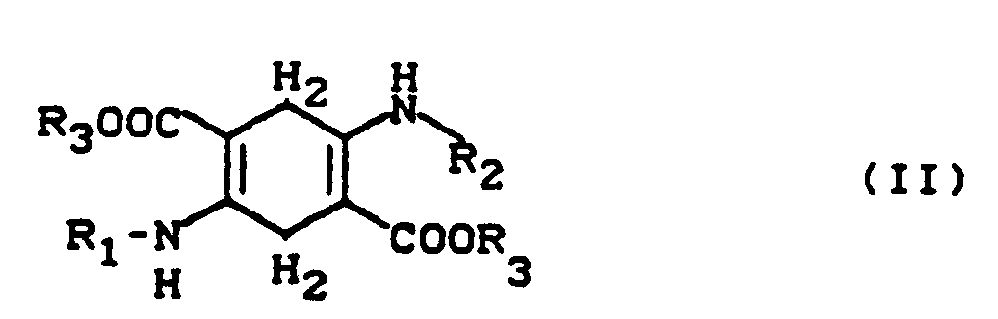
in der R₁, R₂ die oben angegebenen Bedeutungen haben und R₃ für Alkyl, vorzugsweise C₁-C₆-Alkyl, z.B. Methyl, Ethyl, i-Propyl, steht oder entsprechende Bildungsgemische in die Oxidation einsetzt. - Das erfindungsgemäße Verfahren läßt sich z.B. wie folgt ausführen: Der 2,5-Diarylamino-3,6-dihydroterephthalsäureester wird in einem Gemisch, bestehend aus einem Alkohol und einem Alkalihydroxid oder bestehend aus einem Alkohol, Wasser und einem Alkalihydroxid suspendiert, ein Sauerstoffüberträger, beispielsweise Anthrachinonsulfonsäure und zusätzlich eine quartäre Ammoniumverbindung hingezufügt, das Gemisch erhitzt und durch Durchleiten von Sauerstoff oder sauerstoffhaltigen Gasen wie beispielsweise Luft, gegebenenfalls unter Druck, oxidiert.
- Eine weitere Ausführung des neuen Verfahrens besteht darin, daß man zu dem Bildungsgemisch zur Herstellung der 2,5-Diarylamino-3,6-dihydroterephthalsäureester, das aus Succinylobernsteinsäureester, Arylamin, Alkohol und beispielsweise etwas Eisessig zur Kondensation besteht, ein Alkalihydroxid oder eine Lösung eines Alkalihydroxids in Wasser, einem Sauerstoffüberträger, beispielsweise Anthrachinonsulfonsäure und eine quartäre Ammoniumverbindung hinzufügt, das Gemisch erhitzt und durch Durchleiten von Sauerstoff oder sauerstoffhaltigen Gasen wie beispielsweise Luft, gegebenenfalls unter Druck, oxidiert.
- Als Arylamine werden bevorzugt Anilin, p-Toluidin, p-Chloranilin, p-Anisidin oder p-Phenetidin eingesetzt. Als Alkalihydroxide sind Natriumhydroxid und Kaliumhydroxid besonders bevorzugt.
- Als Alkohole kommen vorzugsweise Methanol, Ethanol, Propanol, i-Propanol, n-Butanol, Glykole oder Glykolether, z.B. Ethylenglykol, Ethylenglykolmonomethylether und Polyglykole sowie Gemische dieser Alkohole in Betracht.
- Als sauerstoffübertragende Mittel werden vorzugsweise eingesetzt: Chinone wie Anthrachinon, Phenanthrenchinon, Naphthochinon und Chloranil sowie deren Sulfon- und Carbonsäuren, die auch als Salze Verwendung finden können. Besonders bevorzugt ist die Verwendung von Anthrachinonmono- und disulfonsäuren, bzw. deren Salzen; ganz besonders bevorzugt wird Anthrachinon-2-sulfonsäure(salz) eingesetzt. Bezogen auf 2,5-Diarylamino-3,6-dihydroterephthalsäureester werden vorzugsweise 0,5 bis 5 Gew.-% sauerstoffübertragendes Mittel zugesetzt.
- Als quartäre Ammoniumverbindungen werden vorzugsweise Verbindungen der Formeln


eingesetzt, wobei
R⁵, R⁶, R⁷, R⁸, R⁹ C₁-C₅₄-Kohlenwasserstoffreste bezeichnen, deren C-Kette durch 1 bis 15 O-Atom(e) unterbrochen sein kann,
R¹⁰ Wasserstoff oder einen Substituenten, z.B. C₁-C₄-Alkyl (Methyl, Ethyl) und
Y, Y′ die restlichen Glieder eines vorzugsweise 5- oder 6-gliedrigen Ringes, z.B. eines Pyridin- oder Imidazol-Ringes, oder eines Ringsystems und
An⁻ einen anionischen Rest bezeichnen. - Als Reste R⁵-R⁹ seien insbesondere genannt : C₁-C₁₈-Alkyl, z.B. Methyl, Ethyl, Dodecyl, Cetyl, Phenyl, Phenyl-C₁-C₁₈-alkyl, z.B. Benzyl, -CH₂CH₂O-(-CH₂-CH₂O-)n-H mit n = 0 bis 20.
- Als anionische Reste An⁻ seien beispielhaft genannt : Chlorid, Sulfat, Methylsulfat, Benzolsulfonat, Toluolsulfonat, Hydroxid.
- Im einzelnen sind zu nennen: Trimethylphenylammoniumchlorid, Triethylphenylammoniumchlorid, Triethylbenzylammoniumchlorid, Trimethylbenzylammoniumchlorid, Dimethyldibenzylammoniumchlorid, Diethyldibenzylammoniumchlorid, Dodecyltrimethylammoniumchlorid, Dodecyldimethylbenzylammoniumchlorid, mit Dimethyl- oder Diethylsulfat quarternierte Anlagerungsprodukte von 5 bis 10 Mol Ethylenoxid an C₁₆-C₂₀-Alkylamine, Dodecylbenzylalkylamine und Dodecylbenzylamin, Benzylpyridiniumchlorid, Dodecylpyridiniumchlorid und Cetylpyridiniumchlorid.
- Auch die Hydrogensulfate, Sulfate, Methylsulfate, Ethylsulfate, Benzol- oder Toluolsulfonate und Hydroxide können statt der genannten Chloride mit gleichem Erfolg eingesetzt werden.
- Naturgemäß kann das erfindungsgemäße Verfahren auch in Gegenwart von Mischungen quartärer Ammoniumverbindungen und/oder Mischungen von sauerstoffübertragenden Mitteln durchgeführt werden.
- Die Mengen an quartären Ammoniumsalzen liegen - bezogen auf den zu oxidierenden Ester - im allgemeinen zwischen 0,1 und 15, vorzugsweise zwischen 0,5 und 8 Gew.-%.
- Kationische Reste der Formeln (III) bis (V) sind z.B.: Tri-C₁-C₄-alkyl-phenylammonium; Di-C₁-C₄-alkyl-dibenzylammonium, C₁₀-C₁₆-Alkyl-tri-C₁-C₄-alkylammonium, Trialkylammoniumpolyglykolether, Dialkylbenzylammoniumpolyglykolether, Alkylbenzylammoniumdipolyglykolether, N-C₁₀-C₁₅-Alkylpyridinium, N-Phenyl-C₇-C₁₀-alkylpyridinium sowie kationische Reste von Quaternierungsprodukten von C₁-C₄-Trialkylammonium, N-C₁-C₁₈-Alkylimidazolium. Die genannten kationischen Reste können z.B. in Form der Chloride, Sulfate, Methylsulfate, Toluolsulfonate, Benzolsulfonate oder Hydroxide vorliegen. Gleichzeitig mit der Oxidation erfolgt in den meisten Fällen die Verseifung zur 2,5-Diarylaminoterephthalsäure. Anderfalls kann auf die übliche Weise verseift werden. Es entsteht in vielen Fällen eine klare Lösung. Das Ende der Reaktion läßt sich chromatografisch bestimmen.
- Bezogen auf 1 Gew.-Teil des eingesetzten 2,5-Diarylamino-3,6-dihydroterephthalsäuredialkylesters werden bevorzugt 1 - 20 Gew.-Teile, besonders bevorzugt 4 bis 12 Gew.-Teile Lösungsmittel und bevorzugt 0,1 bis 2,5 Gew.-Teile, besonders bevorzugt 0,3 bis 1,5 Gew.-Teile Alkali, z.B. NaOH oder KOH, eingesetzt.
- Die Aufarbeitung des Ansatzes kann z.B. wie folgt durchgeführt werden: Aus der vorliegenden Lösung der Dialkalisalze werden die 2,5-Diarylaminoterephthalsäuren durch einen Überschuß an Säure, wie beispielsweise Salzsäure oder Schwefelsäure, gegebenenfalls nach Verdünnung mit Wasser und Klärfiltration, freigesetzt und durch Filtration isoliert.
- Das erfindungsgemäße Verfahren liefert die 2,5-Diarylaminoterephthalsäuren in sehr guten Ausbeuten und in sehr hoher Reinheit bereits nach sehr kurzen Reaktionszeiten. Sie können ohne eine weitere Reinigung, z.B. nach den in der US-PS 3 342 823 genannten Verfahren, direkt zu Chinacridon-Pigmenten umgesetzt werden.
- Das erfindungsgemäße Verfahren wird durch die folgenden Ausführungsbeispiele weiter erläutert. Die darin angegebenen Teile und Prozentangaben beziehen sich auf das Gewicht.
- In 115 Teilen Methanol werden 30 Teile 2,5-Dianilino-3,6-dihydroterephthalsäurediethylester, 93 Teile 14%ige Natronlauge und 1,5 Teile Anthrachinon-2-sulfonsäure eingetragen. Nach Zusatz von 4 Teilen einer 50%igen Lösung von Dodecylbenzyldimethylammoniumchlorid in Wasser wird die Suspension zum Sieden erhitzt und 10 l Luft/Stunde durchgeleitet. Nach 30 Minuten ist die Reaktion beendet und Lösung eingetreten.
- Zur Isolierung des Produktes werden zunächst 90 Teile Methanol abdestilliert und die verbleibende Reaktionslösung bei Raumtemperatur mit 66 Teilen 25%iger Schwefelsäure kongosauer gestellt. Das ausgefällte Produkt wird abgesaugt, mit Wasser neutral gewaschen und getrocknet.
- Man erhält 25,5 Teile (= 99 % der Theorie) der 2,5-Dianilinoterephthalsäure als violettes, kristallines Pulver.
- Wird dieses Beispiel wiederholt ohne Zusatz des quartären Ammoniumsalzes, so werden 3 Stunden zur Oxidation benötigt.
- 395 Teile Methanol, 36 Teile Succinylobernsteinsäuredimethylester, 39 Teile Anilin und 15,3 Teile Eisessig werden in einem Rührwerksautoklaven 4 Stunden auf 102 bis 105°C erhitzt.
- Es wird abgekühlt, 42,5 Teile Kaliumhydroxid gelöst in 79 Teilen Methanol, 3 Teile Anthrachinon-2-sulfonsäure und 5 Teile einer 50%igen Lösung von Dodecylbenzyldimethylammoniumchlorid zugesetzt und zum Sieden erhitzt. Nachdem 3 Stunden unter Durchleitung von 10 l Luft/Stunde oxidiert worden ist, wird mit 350 Teilen Wasser verdünnt, die Lösung geklärt und mit 95 Teilen konzentrierter Salzsäure kongosauer gestellt. Die ausgefallene 2,5-Dianilinoterephthalsäure wird abgesaugt, mit Wasser neutral gewaschen und getrocknet.
- Man erhält 53,9 Teile (= 98 % der Theorie) and 2,5-Dianilinoterephthalsäure.
- Wird der gleiche Versuch ohne Zusatz des quartären Ammoniumsalzes durchgeführt, so werden nach 6 Stunden 48,9 Teile (= 89 % der Theorie) erhalten.
- In 152 Teile n-Butanol werden 29,9 Teile 2,5-Di-4-toluidino-3,6-dihydroterephthalsäuredimethylester, 114 Teile 22%ige Natronlauge und 1,5 Teile Anthrachinon-1,5-disulfonsäure eingetragen. Nach Zusatz von 4 Teilen einer 50%igen Lösung von Dodecylbenzyldimethylammoniumchlorid in Wasser wird auf 80 bis 90°C erhitzt und 7 Stunden unter Durchleiten von 10 l Luft/Stunde oxidiert. Anschließend werden etwa 220 Teile eines azeotropen Gemisches von n-Butanol und Wasser abdestilliert, wobei gleichzeitig etwa 220 Teile Wasser zugefügt werden. Danach wird mit 66 Teilen 25%iger Schwefelsäure kongoneutral gestellt, abgesaugt, mit Wasser neutral gewaschen und getrocknet. Man erhält 27 Teile (= 97,5 % der Theorie) an 2,5-Di-4-toluidinoterephthalsäure als violettes Pulver. Wird dieses Beispiel ohne Zusatz des quartären Ammoniumsalzes durchgeführt, so wird eine Ausbeute von 19,8 Teilen (= 71,5 % der Theorie) nach Oxidation erhalten.
- 410 Teile Ethanol, 52,5 Teile p-Toluidin, 41,9 Teile Succinylobernsteinsäuredimethylester und 17,7 Teile Eisessig werden in einem Rührwerksautoklaven 4 Stunden auf 102 bis 105°C erwärmt. Anschließend werden nach dem Abkühlen 66 Teile Waser, 49 Teile Kaliumhydroxid, 3 Teile Anthrachinon-2-sulfonsäure und 2,5 Teile Dipolyglykoldodecylbenzylammoniumchlorid (Soluofen-VV-308 der GAF Corporation) zugesetzt und 3 Stunden unter Rückfluß mit 10 l Luft/Stunde oxidiert. Danach werden 300 Teile Wasser zugefügt, die Lösung geklärt und das Produkt mit 89 Teilen konzentrierter Salzsäure gefällt. Nach dem Absaugen, Neutralwaschen und Trocknen werden 66,4 Teile (= 96,1 % der Theorie) an 2,5-Di-4-toluidinoterephthalsäure erhalten.
- In 315 Teile Ethanol werden 36 Teile Succinylobernsteinsäuredimethylester, 45 Teile p-Toluidin und 15 Teile Eisessig eingetragen. Das Gemisch wird in einem Rührwerksautoklaven 4 Stunden bei 102 bis 105°C gerührt. Nach dem Abkühlen werden 200 Teile Ethanol, 60 Teile Wasser, 42,5 Teile Kaliumhydroxid, 3 Teile Anthrachinon-2-sulfonsäure und 4 g einer 50%igen Lösung von Dodecylbenzyldimethyldiammoniumchlorid in Wasser zugefügt. Unter Rückfluß wird 2,5 Stunden unter Durchleiten von 10 l Luft/Stunde oxidiert. Anschließend wird mit 300 Teilen Wasser verdünnt, geklärt und das Produkt mit 83 Teilen konzentrierter Salzsäure ausgefällt. Nach dem Absaugen, Neutralwaschen und Trocknen werden 58,5 Teile (= 98,5 % der Theorie) an 2,5-Di-4-toluidinoterephthalsäure erhalten.
- 408 Teile Isopropanol, 52,5 Teile p-Toluidin, 41,9 Teile Succinylobernsteinsäuredimethylester und 18 Teile Eisessig werden im Rührwerksautoklaven 4 Stunden auf 102 bis 105°C erwärmt. Nach dem Abkühlen werden 66 Teile Wasser, 49 Teile Kaliumhydroxid, 3 Teile Anthrachinon-2-sulfonsäure und 2,5 Teile Benzyltriethylammoniumchlorid hinzugegeben. Unter Rückfluß wird 3 Stunden mit 10 l Luft/Stunde oxidiert. Nach Zugabe von 600 Teilen Wasser und Klärung wird mit 89 Teilen konzentrierter Salzsäure kongoneutral gestellt. Das ausgefallene Produkt wird abgesaugt, mit Wasser neutral gewaschen und getrocknet. Man erhält 65,9 Teile (= 95,4 % der Theorie) an 2,5-Di-4-toluidinoterephthalsäure.
- Wird das Beispiel 6 wiederholt und statt 2,5 g Benzyltriethylammoniumchlorid 2,5 g Benzyltrimethylammoniumhydroxid eingesetzt, so werden nach ebenfalls 3 Stunden Oxidationszeit 66,1 Teile (= 95,7 % der Theorie) an 2,5-Di-4-toluidinoterephthalsäure erhalten.
- In 430 Teilen Methanol werden 95 Teile p-Chloranilin, 72,4 Teile Succinylobernsteinsäuredimethylester und 26 Teile Eisessig verrührt und in einem Rührwerksautoklaven 4 Stunden auf 90 bis 95°C erhitzt. Nach dem Abkühlen werden 130 Teile Methanol, 183 Teile 45%ige Kalilauge, 1 Teil Anthrachinon-2-sulfonsäure und 10 Teile einer 50%igen Lösung von Dodecylbenzyldimethylammoniumchlorid in Wasser zugesetzt. Unter Rückflußtemperatur wird mit 10 l Luft/Stunde 5 Stunden oxidiert. Anschließend werden 650 Teile Wasser zugesetzt, die Lösung geklärt und mit 160 Teilen konzentrierter Salzsäure kongoneutral gestellt. Nach dem Absaugen, Neutralwaschen und Trocknen erhält man 126,7 Teile (= 95,7 % der Theorie) der roten, kristallinen 2,5-Di-4-chloranilino-terephthalsäure. Wird dieses Beispiel ohne Zusatz des quartären Ammoniumsalzes wiederholt, so erhält man nach 11 Stunden 124,2 Teile (= 93,8 % der Theorie) an 2,5-Di-4-chloranilinoterephthalsäure.
- 620 Teile Ethanol, 102 Teile p-Anisidin, 81 Teile Succinylobernsteinsäuredimethylester und 30 Teile Eisessig werden in einem Rührwerksautoklaven 5 Stunden auf 100 bis 103°C geheizt. Nach dem Abkühlen werden 94 Teile Kaliumhydroxid, 125 Teile Wasser, 3 Teile Anthrachinon-2-sulfonsäure und 5 Teile Dipolyglykoldodecylbenzylammoniumchlorid (Soluofen-VV-308 der GAF Corporation) zugesetzt und 3 Stunden unter Rückfluß mit 10 ltr. Luft/Stunde oxidiert. Anschließend wird mit 600 Teilen Wasser verdünnt, die Lösung geklärt und mit 155 Teilen konzentrierter Salzsäure kongosauer gestellt. Das ausgefallene Produkt wird abgesaugt, neutral gewaschen und getrocknet. Man erhält 142 Teile (= 98 % der Theorie) der violetten, kristallinen, 2,5-Di-4-anisidinoterephthalsäure. Wird dieses Beispiel ohne den Zusatz des quartären Ammoniumsalzes durchgeführt, so werden nach 10 Stunden Oxidationszeit 135 Teile (= 93,2 % der Theorie) an 2,5-Di-4-anisidinoterephthalsäure erhalten.
Claims (9)
- Verfahren zur Herstellung von 2,5-Diarylaminoterephthalsäuren durch Oxidation von 2,5-Diarylamino-3,6-dihydroterephthalsäuredialkylestern mit Sauerstoff oder sauerstoffhaltigen Gasen, vorzugsweise Luft, in alkoholisch-alkalischer oder alkoholisch-wäßrig-alkalischer Lösung oder Suspension in Gegenwart eines sauerstoffübertragenden Mittels und Aufarbeitung zu den 2,5-Diarylaminoterephthalsäuren, dadurch gekennzeichnet, daß man in Gegenwart einer quartären Ammoniumverbindung oxidiert.
- Verfahren gemäß Anspruch 1 zur Herstellung von 2,5-Diarylaminoterephthalsäuren der Formel (I)


- Verfahren gemäß den Ansprüchen 1 bis 2, dadurch gekennzeichnet, daß man in die Oxidation das 2,5-Diarylamino-3,6-dihydroterephthalsäureester-Bildungsgemisch, wie es bei der Umsetzung von Succinylobernsteinsäureester mit einem Arylamin erhalten wird, einsetzt.
- Verfahren gemäß einem oder mehreren der Ansprüche 1 bis 3, dadurch gekennzeichnet, daß man eine quartäre Ammoniumverbindung der Formeln


R⁵, R⁶, R⁷, R⁸, R⁹ C₁-C₅₄-Kohlenwasserstoffreste bezeichnen, deren C-Kette durch 1 bis 15 O-Atom(e) unterbrochen sein kann,
R¹⁰ Wasserstoff oder einen Substituenten,
Y, Y′ die restlichen Glieder eines vorzugsweise 5-oder 6-gliedrigen Ringes oder eines Ringsystems und
An⁻ einen anionischen Rest bezeichnen. - Verfahren gemäß einem oder mehreren der Ansprüche 1 bis 4, dadurch gekennzeichnet, daß man, bezogen auf 2,5-Diarylamino-3,6-dihydroterephthalsäureester, 0,1 bis 15 Gew.-%, vorzugsweise 0,5 bis 8 Gew.-% quartäre Ammoniumverbindung einsetzt.
- Verfahren gemäß einem oder mehreren der Ansprüche 1 bis 5, dadurch gekennzeichnet, daß man als sauerstoffübertragendes Mittel Anthrachinon-2-sulfonsäure einsetzt.
- Verfahren gemäß einem oder mehreren der Ansprüche 1 bis 6, dadurch gekennzeichnet, daß man als Alkohol Methanol, Ethanol oder i-Propanol einsetzt.
- Verfahren gemäß einem oder mehreren der Ansprüche 1 bis 7, dadurch gekennzeichnet, daß man bei 70 bis 130°C oxidiert.
- Verfahren gemäß einem oder mehreren der Ansprüche 1 bis 8, dadurch gekennzeichnet, daß man beim Siedepunkt des Reaktionsgemisches oxidiert.
Applications Claiming Priority (2)
| Application Number | Priority Date | Filing Date | Title |
|---|---|---|---|
| DE3834747A DE3834747A1 (de) | 1988-10-12 | 1988-10-12 | Verfahren zur herstellung von 2,5-diarylaminoterephthalsaeuren |
| DE3834747 | 1988-10-12 |
Publications (3)
| Publication Number | Publication Date |
|---|---|
| EP0363756A2 EP0363756A2 (de) | 1990-04-18 |
| EP0363756A3 EP0363756A3 (de) | 1991-03-27 |
| EP0363756B1 true EP0363756B1 (de) | 1992-12-02 |
Family
ID=6364956
Family Applications (1)
| Application Number | Title | Priority Date | Filing Date |
|---|---|---|---|
| EP89118109A Expired - Lifetime EP0363756B1 (de) | 1988-10-12 | 1989-09-29 | Verfahren zur Herstellung von 2,5-Diarylaminoterephthalsäuren |
Country Status (4)
| Country | Link |
|---|---|
| US (1) | US4981997A (de) |
| EP (1) | EP0363756B1 (de) |
| JP (1) | JP2882535B2 (de) |
| DE (2) | DE3834747A1 (de) |
Families Citing this family (11)
| Publication number | Priority date | Publication date | Assignee | Title |
|---|---|---|---|---|
| CA2096845A1 (en) * | 1990-11-23 | 1992-05-24 | Otto Arndt | Verfahren zur herstellung von 2,5-di-phenylamino-terephtalsaure und ihrer dialkylester in hoher reinheit |
| US5208365A (en) * | 1991-06-14 | 1993-05-04 | Hoechst Aktiengesellschaft | Process for the preparation of 2,5-di(phenylamino)-terephthalic acid and its dialkyl esters in high purity |
| TW226359B (de) | 1991-08-22 | 1994-07-11 | Hoechst Ag | |
| EP0569823B1 (de) * | 1992-05-12 | 1996-08-28 | Hoechst Aktiengesellschaft | Verfahren zur Herstellung von 2,5-Di-phenylamino-terephthalsäure und ihrer Dialkylester |
| JP3055365B2 (ja) * | 1993-06-30 | 2000-06-26 | 東洋インキ製造株式会社 | 2,5−ジ(アリールアミノ)−3,6−ジヒドロテレフタル酸ジアルキルエステル類の製造法およびこれを中間体とするキナクリドン類の製造法 |
| AT401515B (de) * | 1993-10-19 | 1996-09-25 | Chemie Linz Gmbh | Verfahren zur umesterung von dimethylsuccinylsuccinat |
| DE19523445A1 (de) * | 1995-06-28 | 1997-01-02 | Bayer Ag | Verfahren zur Oxidation organischer Verbindungen |
| EP2024325B1 (de) * | 2006-05-22 | 2017-05-03 | Sun Chemical Corporation | 2,5-di(methoxyanilino)-terephthalsäurepolymorphe und daraus hergestellte chinacridone |
| US8603612B2 (en) * | 2010-04-22 | 2013-12-10 | Xerox Corporation | Curable compositions for three-dimensional printing |
| CN104693057A (zh) * | 2015-02-15 | 2015-06-10 | 上海应用技术学院 | 一种2,5-二氨基对苯二甲酸的制备方法 |
| CN105384652B (zh) * | 2015-11-27 | 2017-12-19 | 百合花集团股份有限公司 | 制备2,5‑二(取代)芳胺基对苯二酸的方法 |
Family Cites Families (6)
| Publication number | Priority date | Publication date | Assignee | Title |
|---|---|---|---|---|
| BE579621A (de) * | 1958-06-16 | |||
| DE1144285B (de) * | 1961-03-17 | 1963-02-28 | Cassella Farbwerke Mainkur Ag | Verfahren zur Herstellung von 2, 5-Diarylaminoterephthalsaeuren |
| FR1328683A (fr) * | 1962-07-11 | 1963-05-31 | Cassella Farbwerke Mainkur Ag | Procédé de préparation d'acides 2.5-diarylamino-téréphtaliques |
| US3388149A (en) * | 1964-01-30 | 1968-06-11 | Allied Chem | Oxidation of 2, 5-diarylamino-3, 6-dihydroterephthalic esters |
| DE1768049B2 (de) * | 1968-03-26 | 1974-06-20 | Farbwerke Hoechst Ag, Vormals Meister Lucius & Bruening, 6000 Frankfurt | Verfahren zur Herstellung von 2,5-(Di-arylamino)-terephthalsäuren |
| DE3104644A1 (de) * | 1981-02-10 | 1982-08-19 | Bayer Ag, 5090 Leverkusen | Verfahren zur herstellung von dimethylsuccinylosuccinat, dessen dinatriumsalz, dianilinodihydroterephthalsaeuren, deren dimethylestern und salzen sowie von dianilinoterephthalsaeuren, deren dimethylestern und salzen |
-
1988
- 1988-10-12 DE DE3834747A patent/DE3834747A1/de not_active Withdrawn
-
1989
- 1989-09-29 EP EP89118109A patent/EP0363756B1/de not_active Expired - Lifetime
- 1989-09-29 DE DE8989118109T patent/DE58902890D1/de not_active Expired - Fee Related
- 1989-09-29 US US07/414,825 patent/US4981997A/en not_active Expired - Lifetime
- 1989-10-12 JP JP1264105A patent/JP2882535B2/ja not_active Expired - Fee Related
Also Published As
| Publication number | Publication date |
|---|---|
| EP0363756A2 (de) | 1990-04-18 |
| US4981997A (en) | 1991-01-01 |
| EP0363756A3 (de) | 1991-03-27 |
| DE3834747A1 (de) | 1990-05-03 |
| JPH02169556A (ja) | 1990-06-29 |
| DE58902890D1 (de) | 1993-01-14 |
| JP2882535B2 (ja) | 1999-04-12 |
Similar Documents
| Publication | Publication Date | Title |
|---|---|---|
| EP0363756B1 (de) | Verfahren zur Herstellung von 2,5-Diarylaminoterephthalsäuren | |
| EP0363759B1 (de) | Verfahren zur Herstellung eines gegebenenfalls substituierten Chinacridons | |
| EP0057873B1 (de) | Verfahren zur Herstellung von Dimethylsuccinylosuccinat, dessen Dinatriumsalz, Dianilinodihydroterephthalsäuren, deren Dimethylestern und Salzen sowie von Dianilinoterephthalsäuren, deren Dimethylestern und Salzen | |
| EP0751105A2 (de) | Verfahren zur Oxidation organischer Verbindungen | |
| EP0196275B1 (de) | Verfahren zur Herstellung von 2,4,6-Tris-(amino-phenylamino)-triazinen | |
| DE2542494C3 (de) | Verfahren zur Herstellung reiner substituierter 2,5 Diarylaminoterephthalsäureester und der entsprechenden freien Säuren | |
| EP0057861B1 (de) | Verfahren zur Herstellung von Nitroanilinen | |
| EP0504182B1 (de) | Verfahren zur herstellung von chinophthalonderivaten | |
| DE3107700A1 (de) | Verfahren zur herstellung von aromatischen sulfohalogeniden | |
| EP0367067B1 (de) | Verfahren zur Herstellung von Küpenfarbstoffen und Pigmenten der Perinon-Reihe | |
| EP0204139A2 (de) | Verfahren zur Herstellung von linearen Chinacridonen | |
| DE19627424A1 (de) | Verfahren zur Herstellung von 4-Hydroxyanilinen | |
| EP0479842B1 (de) | Verfahren zur herstellung von anthrachinonfarbstoffen | |
| CH390271A (de) | Verfahren zur Herstellung von diarylaminoaromatischen Dicarbonsäuren | |
| EP0508184B1 (de) | Verfahren zur Herstellung und Reinigung von 1-Amino-2-phenoxy-4-hydroxy-anthrachinon | |
| EP0418662A1 (de) | Verfahren zur Herstellung von 2-Alkylamino-4-aminobenzolsulfonsäuren | |
| DE19517071A1 (de) | Verfahren zur Herstellung von N,N'-disubstituierten 1,4-Diaminoanthrachinonen | |
| DE1117137B (de) | Verfahren zur Herstellung von aromatischen Aminen | |
| DE1144285B (de) | Verfahren zur Herstellung von 2, 5-Diarylaminoterephthalsaeuren | |
| DE3301025A1 (de) | Verfahren zur herstellung von kationischen methinfarbstoffen | |
| EP0057382B1 (de) | Verfahren zur Herstellung von Küpenfarbstoffen aus Abfallprodukten der Nitroanthrachinon- und Anthrachinonsulfonsäuresynthesen | |
| DE3535276A1 (de) | Verfahren zur herstellung von tetrachlor-3-imino-isoindolin-1-on | |
| DE2035657B2 (de) | 27.03.70 Japan 26217-70 Verfahren zur Herstellung von 4-Halogen-5-sulfamoylanthranilsäureaniliden | |
| DE3641698A1 (de) | Verfahren zur herstellung von heteroaromatischen aminoaldehyden | |
| EP0132757A1 (de) | Verfahren zur Herstellung von Oxamiden |
Legal Events
| Date | Code | Title | Description |
|---|---|---|---|
| PUAI | Public reference made under article 153(3) epc to a published international application that has entered the european phase |
Free format text: ORIGINAL CODE: 0009012 |
|
| 17P | Request for examination filed |
Effective date: 19890929 |
|
| AK | Designated contracting states |
Kind code of ref document: A2 Designated state(s): CH DE FR GB LI |
|
| PUAL | Search report despatched |
Free format text: ORIGINAL CODE: 0009013 |
|
| AK | Designated contracting states |
Kind code of ref document: A3 Designated state(s): CH DE FR GB LI |
|
| 17Q | First examination report despatched |
Effective date: 19920514 |
|
| GRAA | (expected) grant |
Free format text: ORIGINAL CODE: 0009210 |
|
| AK | Designated contracting states |
Kind code of ref document: B1 Designated state(s): CH DE FR GB LI |
|
| GBT | Gb: translation of ep patent filed (gb section 77(6)(a)/1977) |
Effective date: 19921207 |
|
| REF | Corresponds to: |
Ref document number: 58902890 Country of ref document: DE Date of ref document: 19930114 |
|
| ET | Fr: translation filed | ||
| PLBE | No opposition filed within time limit |
Free format text: ORIGINAL CODE: 0009261 |
|
| STAA | Information on the status of an ep patent application or granted ep patent |
Free format text: STATUS: NO OPPOSITION FILED WITHIN TIME LIMIT |
|
| 26N | No opposition filed | ||
| REG | Reference to a national code |
Ref country code: GB Ref legal event code: IF02 |
|
| REG | Reference to a national code |
Ref country code: GB Ref legal event code: 732E |
|
| REG | Reference to a national code |
Ref country code: CH Ref legal event code: PUE Owner name: SUN CHEMICAL CORPORATION Free format text: BAYER AKTIENGESELLSCHAFT##D-51368 LEVERKUSEN (DE) -TRANSFER TO- SUN CHEMICAL CORPORATION#222 BRIDGE PLAZA SOUTH#FORT LEE, NJ 07024 (US) |
|
| REG | Reference to a national code |
Ref country code: CH Ref legal event code: PFA Owner name: SUN CHEMICAL CORPORATION Free format text: SUN CHEMICAL CORPORATION#222 BRIDGE PLAZA SOUTH#FORT LEE, NJ 07024 (US) -TRANSFER TO- SUN CHEMICAL CORPORATION#35 WATERVIEW BOULEVARD#PARSIPPANY, NJ 07054-1285 (US) |
|
| PGFP | Annual fee paid to national office [announced via postgrant information from national office to epo] |
Ref country code: FR Payment date: 20060908 Year of fee payment: 18 |
|
| PGFP | Annual fee paid to national office [announced via postgrant information from national office to epo] |
Ref country code: DE Payment date: 20060922 Year of fee payment: 18 |
|
| PGFP | Annual fee paid to national office [announced via postgrant information from national office to epo] |
Ref country code: GB Payment date: 20060927 Year of fee payment: 18 |
|
| PGFP | Annual fee paid to national office [announced via postgrant information from national office to epo] |
Ref country code: CH Payment date: 20060928 Year of fee payment: 18 |
|
| REG | Reference to a national code |
Ref country code: CH Ref legal event code: PFA Owner name: SUN CHEMICAL CORPORATION Free format text: SUN CHEMICAL CORPORATION#35 WATERVIEW BOULEVARD#PARSIPPANY, NJ 07054-1285 (US) -TRANSFER TO- SUN CHEMICAL CORPORATION#35 WATERVIEW BOULEVARD#PARSIPPANY, NJ 07054-1285 (US) |
|
| REG | Reference to a national code |
Ref country code: CH Ref legal event code: PL |
|
| GBPC | Gb: european patent ceased through non-payment of renewal fee |
Effective date: 20070929 |
|
| PG25 | Lapsed in a contracting state [announced via postgrant information from national office to epo] |
Ref country code: LI Free format text: LAPSE BECAUSE OF NON-PAYMENT OF DUE FEES Effective date: 20070930 Ref country code: DE Free format text: LAPSE BECAUSE OF NON-PAYMENT OF DUE FEES Effective date: 20080401 Ref country code: CH Free format text: LAPSE BECAUSE OF NON-PAYMENT OF DUE FEES Effective date: 20070930 |
|
| REG | Reference to a national code |
Ref country code: FR Ref legal event code: ST Effective date: 20080531 |
|
| PG25 | Lapsed in a contracting state [announced via postgrant information from national office to epo] |
Ref country code: FR Free format text: LAPSE BECAUSE OF NON-PAYMENT OF DUE FEES Effective date: 20071001 |
|
| PG25 | Lapsed in a contracting state [announced via postgrant information from national office to epo] |
Ref country code: GB Free format text: LAPSE BECAUSE OF NON-PAYMENT OF DUE FEES Effective date: 20070929 |