EP0057873B1 - Verfahren zur Herstellung von Dimethylsuccinylosuccinat, dessen Dinatriumsalz, Dianilinodihydroterephthalsäuren, deren Dimethylestern und Salzen sowie von Dianilinoterephthalsäuren, deren Dimethylestern und Salzen - Google Patents
Verfahren zur Herstellung von Dimethylsuccinylosuccinat, dessen Dinatriumsalz, Dianilinodihydroterephthalsäuren, deren Dimethylestern und Salzen sowie von Dianilinoterephthalsäuren, deren Dimethylestern und Salzen Download PDFInfo
- Publication number
- EP0057873B1 EP0057873B1 EP82100611A EP82100611A EP0057873B1 EP 0057873 B1 EP0057873 B1 EP 0057873B1 EP 82100611 A EP82100611 A EP 82100611A EP 82100611 A EP82100611 A EP 82100611A EP 0057873 B1 EP0057873 B1 EP 0057873B1
- Authority
- EP
- European Patent Office
- Prior art keywords
- dimethyl
- acids
- formula
- salts
- isolated
- Prior art date
- Legal status (The legal status is an assumption and is not a legal conclusion. Google has not performed a legal analysis and makes no representation as to the accuracy of the status listed.)
- Expired
Links
- 239000002253 acid Substances 0.000 title claims description 33
- 238000000034 method Methods 0.000 title claims description 28
- 150000007513 acids Chemical class 0.000 title claims description 22
- 125000000118 dimethyl group Chemical group [H]C([H])([H])* 0.000 title claims description 16
- 150000003839 salts Chemical class 0.000 title claims description 16
- 238000002360 preparation method Methods 0.000 title claims description 12
- WIWJFWANKMRGGS-UHFFFAOYSA-N 3,4-dimethyl-1,6-dioxecane-2,5,7,10-tetrone Chemical compound C1(CCC(=O)OC(C(C(C(=O)O1)C)C)=O)=O WIWJFWANKMRGGS-UHFFFAOYSA-N 0.000 title 1
- 159000000000 sodium salts Chemical class 0.000 title 1
- OKKJLVBELUTLKV-UHFFFAOYSA-N Methanol Chemical compound OC OKKJLVBELUTLKV-UHFFFAOYSA-N 0.000 claims description 42
- MHKKFFHWMKEBDW-UHFFFAOYSA-N dimethyl 2,5-dioxocyclohexane-1,4-dicarboxylate Chemical compound COC(=O)C1CC(=O)C(C(=O)OC)CC1=O MHKKFFHWMKEBDW-UHFFFAOYSA-N 0.000 claims description 16
- PAYRUJLWNCNPSJ-UHFFFAOYSA-N Aniline Chemical compound NC1=CC=CC=C1 PAYRUJLWNCNPSJ-UHFFFAOYSA-N 0.000 claims description 12
- WQDUMFSSJAZKTM-UHFFFAOYSA-N Sodium methoxide Chemical compound [Na+].[O-]C WQDUMFSSJAZKTM-UHFFFAOYSA-N 0.000 claims description 12
- 150000001875 compounds Chemical class 0.000 claims description 11
- QXNVGIXVLWOKEQ-UHFFFAOYSA-N Disodium Chemical class [Na][Na] QXNVGIXVLWOKEQ-UHFFFAOYSA-N 0.000 claims description 10
- 150000001991 dicarboxylic acids Chemical class 0.000 claims description 9
- 239000000203 mixture Substances 0.000 claims description 9
- 239000000725 suspension Substances 0.000 claims description 9
- 150000001412 amines Chemical class 0.000 claims description 8
- 238000002955 isolation Methods 0.000 claims description 8
- MUXOBHXGJLMRAB-UHFFFAOYSA-N Dimethyl succinate Chemical compound COC(=O)CCC(=O)OC MUXOBHXGJLMRAB-UHFFFAOYSA-N 0.000 claims description 7
- RZXMPPFPUUCRFN-UHFFFAOYSA-N p-toluidine Chemical compound CC1=CC=C(N)C=C1 RZXMPPFPUUCRFN-UHFFFAOYSA-N 0.000 claims description 6
- 150000002148 esters Chemical class 0.000 claims description 5
- 238000009833 condensation Methods 0.000 claims description 4
- 230000005494 condensation Effects 0.000 claims description 4
- QSNSCYSYFYORTR-UHFFFAOYSA-N 4-chloroaniline Chemical compound NC1=CC=C(Cl)C=C1 QSNSCYSYFYORTR-UHFFFAOYSA-N 0.000 claims description 3
- ZAMOUSCENKQFHK-UHFFFAOYSA-N Chlorine atom Chemical compound [Cl] ZAMOUSCENKQFHK-UHFFFAOYSA-N 0.000 claims description 3
- PXGOKWXKJXAPGV-UHFFFAOYSA-N Fluorine Chemical compound FF PXGOKWXKJXAPGV-UHFFFAOYSA-N 0.000 claims description 3
- AFBPFSWMIHJQDM-UHFFFAOYSA-N N-methyl-N-phenylamine Natural products CNC1=CC=CC=C1 AFBPFSWMIHJQDM-UHFFFAOYSA-N 0.000 claims description 3
- 125000003118 aryl group Chemical group 0.000 claims description 3
- 125000003917 carbamoyl group Chemical group [H]N([H])C(*)=O 0.000 claims description 3
- 125000003178 carboxy group Chemical group [H]OC(*)=O 0.000 claims description 3
- 239000000460 chlorine Substances 0.000 claims description 3
- 229910052801 chlorine Inorganic materials 0.000 claims description 3
- 239000011737 fluorine Substances 0.000 claims description 3
- 229910052731 fluorine Inorganic materials 0.000 claims description 3
- 125000000449 nitro group Chemical group [O-][N+](*)=O 0.000 claims description 3
- 125000001424 substituent group Chemical group 0.000 claims description 3
- 125000002023 trifluoromethyl group Chemical group FC(F)(F)* 0.000 claims description 3
- 238000006243 chemical reaction Methods 0.000 claims description 2
- WPNVSPQSMPKAFH-UHFFFAOYSA-N dimethyl 3,4-dianilinocyclohexa-1,5-diene-1,4-dicarboxylate Chemical class C=1C=CC=CC=1NC1(C(=O)OC)C=CC(C(=O)OC)=CC1NC1=CC=CC=C1 WPNVSPQSMPKAFH-UHFFFAOYSA-N 0.000 claims description 2
- 125000001072 heteroaryl group Chemical group 0.000 claims description 2
- 125000004178 (C1-C4) alkyl group Chemical group 0.000 claims 2
- 125000000229 (C1-C4)alkoxy group Chemical group 0.000 claims 1
- 150000001990 dicarboxylic acid derivatives Chemical class 0.000 claims 1
- QTBSBXVTEAMEQO-UHFFFAOYSA-N Acetic acid Chemical compound CC(O)=O QTBSBXVTEAMEQO-UHFFFAOYSA-N 0.000 description 10
- QAOWNCQODCNURD-UHFFFAOYSA-N Sulfuric acid Chemical compound OS(O)(=O)=O QAOWNCQODCNURD-UHFFFAOYSA-N 0.000 description 9
- 239000000243 solution Substances 0.000 description 7
- BDAGIHXWWSANSR-UHFFFAOYSA-N Formic acid Chemical compound OC=O BDAGIHXWWSANSR-UHFFFAOYSA-N 0.000 description 6
- HEMHJVSKTPXQMS-UHFFFAOYSA-M Sodium hydroxide Chemical compound [OH-].[Na+] HEMHJVSKTPXQMS-UHFFFAOYSA-M 0.000 description 6
- VEXZGXHMUGYJMC-UHFFFAOYSA-N Hydrochloric acid Chemical compound Cl VEXZGXHMUGYJMC-UHFFFAOYSA-N 0.000 description 5
- NBIIXXVUZAFLBC-UHFFFAOYSA-N Phosphoric acid Chemical compound OP(O)(O)=O NBIIXXVUZAFLBC-UHFFFAOYSA-N 0.000 description 5
- 239000000543 intermediate Substances 0.000 description 5
- 239000002904 solvent Substances 0.000 description 5
- XLYOFNOQVPJJNP-UHFFFAOYSA-N water Substances O XLYOFNOQVPJJNP-UHFFFAOYSA-N 0.000 description 5
- ONMOULMPIIOVTQ-UHFFFAOYSA-N 98-47-5 Chemical compound OS(=O)(=O)C1=CC=CC([N+]([O-])=O)=C1 ONMOULMPIIOVTQ-UHFFFAOYSA-N 0.000 description 4
- IJGRMHOSHXDMSA-UHFFFAOYSA-N Atomic nitrogen Chemical compound N#N IJGRMHOSHXDMSA-UHFFFAOYSA-N 0.000 description 4
- 230000003647 oxidation Effects 0.000 description 4
- 238000007254 oxidation reaction Methods 0.000 description 4
- MMNWSHJJPDXKCH-UHFFFAOYSA-N 9,10-dioxoanthracene-2-sulfonic acid Chemical compound C1=CC=C2C(=O)C3=CC(S(=O)(=O)O)=CC=C3C(=O)C2=C1 MMNWSHJJPDXKCH-UHFFFAOYSA-N 0.000 description 3
- DGAQECJNVWCQMB-PUAWFVPOSA-M Ilexoside XXIX Chemical compound C[C@@H]1CC[C@@]2(CC[C@@]3(C(=CC[C@H]4[C@]3(CC[C@@H]5[C@@]4(CC[C@@H](C5(C)C)OS(=O)(=O)[O-])C)C)[C@@H]2[C@]1(C)O)C)C(=O)O[C@H]6[C@@H]([C@H]([C@@H]([C@H](O6)CO)O)O)O.[Na+] DGAQECJNVWCQMB-PUAWFVPOSA-M 0.000 description 3
- ZMXDDKWLCZADIW-UHFFFAOYSA-N N,N-Dimethylformamide Chemical compound CN(C)C=O ZMXDDKWLCZADIW-UHFFFAOYSA-N 0.000 description 3
- KWYUFKZDYYNOTN-UHFFFAOYSA-M Potassium hydroxide Chemical compound [OH-].[K+] KWYUFKZDYYNOTN-UHFFFAOYSA-M 0.000 description 3
- 229960000583 acetic acid Drugs 0.000 description 3
- 238000001035 drying Methods 0.000 description 3
- 238000001914 filtration Methods 0.000 description 3
- 239000000049 pigment Substances 0.000 description 3
- 238000010992 reflux Methods 0.000 description 3
- 238000007127 saponification reaction Methods 0.000 description 3
- 239000011734 sodium Substances 0.000 description 3
- 229910052708 sodium Inorganic materials 0.000 description 3
- OSWFIVFLDKOXQC-UHFFFAOYSA-N 4-(3-methoxyphenyl)aniline Chemical compound COC1=CC=CC(C=2C=CC(N)=CC=2)=C1 OSWFIVFLDKOXQC-UHFFFAOYSA-N 0.000 description 2
- OFOBLEOULBTSOW-UHFFFAOYSA-N Malonic acid Chemical compound OC(=O)CC(O)=O OFOBLEOULBTSOW-UHFFFAOYSA-N 0.000 description 2
- NRCMAYZCPIVABH-UHFFFAOYSA-N Quinacridone Chemical compound N1C2=CC=CC=C2C(=O)C2=C1C=C1C(=O)C3=CC=CC=C3NC1=C2 NRCMAYZCPIVABH-UHFFFAOYSA-N 0.000 description 2
- 229910000147 aluminium phosphate Inorganic materials 0.000 description 2
- PYKYMHQGRFAEBM-UHFFFAOYSA-N anthraquinone Natural products CCC(=O)c1c(O)c2C(=O)C3C(C=CC=C3O)C(=O)c2cc1CC(=O)OC PYKYMHQGRFAEBM-UHFFFAOYSA-N 0.000 description 2
- 150000004056 anthraquinones Chemical class 0.000 description 2
- -1 des Methanols Chemical class 0.000 description 2
- 235000019253 formic acid Nutrition 0.000 description 2
- 150000007522 mineralic acids Chemical class 0.000 description 2
- 229910052757 nitrogen Inorganic materials 0.000 description 2
- 150000007524 organic acids Chemical class 0.000 description 2
- 238000003756 stirring Methods 0.000 description 2
- 150000003504 terephthalic acids Chemical class 0.000 description 2
- AZUYLZMQTIKGSC-UHFFFAOYSA-N 1-[6-[4-(5-chloro-6-methyl-1H-indazol-4-yl)-5-methyl-3-(1-methylindazol-5-yl)pyrazol-1-yl]-2-azaspiro[3.3]heptan-2-yl]prop-2-en-1-one Chemical compound ClC=1C(=C2C=NNC2=CC=1C)C=1C(=NN(C=1C)C1CC2(CN(C2)C(C=C)=O)C1)C=1C=C2C=NN(C2=CC=1)C AZUYLZMQTIKGSC-UHFFFAOYSA-N 0.000 description 1
- JZMCXQLWZRNZNI-UHFFFAOYSA-N 2,3-dianilino-5,6-dichloroterephthalic acid Chemical compound C=1C=CC=CC=1NC=1C(C(=O)O)=C(Cl)C(Cl)=C(C(O)=O)C=1NC1=CC=CC=C1 JZMCXQLWZRNZNI-UHFFFAOYSA-N 0.000 description 1
- XFEIEYJSHQJZMZ-UHFFFAOYSA-N 2-anilino-3,5-dichloroterephthalic acid Chemical compound OC(=O)C1=CC(Cl)=C(C(O)=O)C(Cl)=C1NC1=CC=CC=C1 XFEIEYJSHQJZMZ-UHFFFAOYSA-N 0.000 description 1
- YYVYAPXYZVYDHN-UHFFFAOYSA-N 9,10-phenanthroquinone Chemical compound C1=CC=C2C(=O)C(=O)C3=CC=CC=C3C2=C1 YYVYAPXYZVYDHN-UHFFFAOYSA-N 0.000 description 1
- 229930192627 Naphthoquinone Natural products 0.000 description 1
- 150000001298 alcohols Chemical class 0.000 description 1
- 239000003513 alkali Substances 0.000 description 1
- 229910052783 alkali metal Inorganic materials 0.000 description 1
- 150000001448 anilines Chemical class 0.000 description 1
- QVGXLLKOCUKJST-UHFFFAOYSA-N atomic oxygen Chemical compound [O] QVGXLLKOCUKJST-UHFFFAOYSA-N 0.000 description 1
- 239000002585 base Substances 0.000 description 1
- 230000015572 biosynthetic process Effects 0.000 description 1
- BVKZGUZCCUSVTD-UHFFFAOYSA-N carbonic acid Chemical compound OC(O)=O BVKZGUZCCUSVTD-UHFFFAOYSA-N 0.000 description 1
- 150000001735 carboxylic acids Chemical class 0.000 description 1
- 239000000969 carrier Substances 0.000 description 1
- 238000011083 clear filtration Methods 0.000 description 1
- 239000003085 diluting agent Substances 0.000 description 1
- 238000010790 dilution Methods 0.000 description 1
- 239000012895 dilution Substances 0.000 description 1
- 238000004880 explosion Methods 0.000 description 1
- 239000000706 filtrate Substances 0.000 description 1
- 239000012362 glacial acetic acid Substances 0.000 description 1
- 229940093915 gynecological organic acid Drugs 0.000 description 1
- 125000000623 heterocyclic group Chemical group 0.000 description 1
- 238000009413 insulation Methods 0.000 description 1
- 238000011031 large-scale manufacturing process Methods 0.000 description 1
- 238000004519 manufacturing process Methods 0.000 description 1
- 239000000463 material Substances 0.000 description 1
- 238000002844 melting Methods 0.000 description 1
- 230000008018 melting Effects 0.000 description 1
- 150000002791 naphthoquinones Chemical class 0.000 description 1
- 230000007935 neutral effect Effects 0.000 description 1
- 150000002828 nitro derivatives Chemical class 0.000 description 1
- 235000005985 organic acids Nutrition 0.000 description 1
- 239000007800 oxidant agent Substances 0.000 description 1
- 230000001590 oxidative effect Effects 0.000 description 1
- 239000001301 oxygen Substances 0.000 description 1
- 229910052760 oxygen Inorganic materials 0.000 description 1
- 239000003444 phase transfer catalyst Substances 0.000 description 1
- 239000000047 product Substances 0.000 description 1
- 150000004053 quinones Chemical class 0.000 description 1
- 239000011541 reaction mixture Substances 0.000 description 1
- 238000000926 separation method Methods 0.000 description 1
- ZDQYSKICYIVCPN-UHFFFAOYSA-L sodium succinate (anhydrous) Chemical compound [Na+].[Na+].[O-]C(=O)CCC([O-])=O ZDQYSKICYIVCPN-UHFFFAOYSA-L 0.000 description 1
- RPACBEVZENYWOL-XFULWGLBSA-M sodium;(2r)-2-[6-(4-chlorophenoxy)hexyl]oxirane-2-carboxylate Chemical compound [Na+].C=1C=C(Cl)C=CC=1OCCCCCC[C@]1(C(=O)[O-])CO1 RPACBEVZENYWOL-XFULWGLBSA-M 0.000 description 1
- 239000007858 starting material Substances 0.000 description 1
- 150000003460 sulfonic acids Chemical class 0.000 description 1
- 239000001117 sulphuric acid Substances 0.000 description 1
- 238000003786 synthesis reaction Methods 0.000 description 1
- UGNWTBMOAKPKBL-UHFFFAOYSA-N tetrachloro-1,4-benzoquinone Chemical compound ClC1=C(Cl)C(=O)C(Cl)=C(Cl)C1=O UGNWTBMOAKPKBL-UHFFFAOYSA-N 0.000 description 1
- 238000005406 washing Methods 0.000 description 1
Classifications
-
- C—CHEMISTRY; METALLURGY
- C07—ORGANIC CHEMISTRY
- C07C—ACYCLIC OR CARBOCYCLIC COMPOUNDS
- C07C69/00—Esters of carboxylic acids; Esters of carbonic or haloformic acids
- C07C69/95—Esters of quinone carboxylic acids
Definitions
- the invention relates to processes for the preparation of dimethylsuccinylosuccinate, its disodium salt and dianilinodihydroterephthalic acids, their dimethyl esters and salts and dianilinoterephthalic acids, their dimethyl esters and salts, starting from the disodium salt of dimethylsuccinylosuccinate produced by the new process without intermediate isolation.
- the compounds mentioned, especially dianilinoterephthalic acids, are important intermediates for the production of valuable violet or red quinacridone pigments.
- Dianilinoterephthalic acids are almost always produced from isolated and dried dialkylsuccinylosuccinate. The intermediate drying and insulation require considerable expenditure of time, equipment, labor and energy. According to DE-AS 1 082 907, a single-stage process is used, but the dianilinoterephthalic acid ester is obtained in a solvent such as dimethylformamide which is not inert in the subsequent saponification reaction.
- Inert aromatics mostly serve as solvents; Alcohols have already been proposed, but have been described as “diluents which are unsuitable for kinetic reasons (DE-AS 1 082907, page 1, lines 48/49), which lead to lower yields. Since 4 moles of methanol are released in the condensation of dimethyl succinate to dimethylsuccinylosuccinate, mixtures of these solvents with methanol are always obtained in the course of the reaction during the condensation in solvents, the separation of which is often time-consuming and costly.
- dimethylsuccinylosuccinate can be prepared in good yield in methanol as solvent and without the use of metallic sodium.
- the new process for the preparation of dimethylsuccinylosuccinate or its disodium salt is characterized in that dimethyl succinate is condensed in a 35-45 weight percent solution of 120-180% sodium methylate in methanol.
- the implementation proceeds according to
- the dimethyl esters obtained can be saponified in a conventional manner in an alkaline medium and the dicarboxylic acids can be released by adding acid. If desired, the dimethyl esters, the alkali metal salts formed by the saponification and the dicarboxylic acids can be isolated in bulk in a manner known per se. These compounds can be used as starting materials for the synthesis of special quinacridones by first cyclizing and then oxidizing to the pigment.
- the dimethyl esters of the formula (I) are preferably converted into optionally substituted dianilinoterephthalic acids of the formula (IV) without intermediate isolation in which R 1 and R 2 have the meanings given for formula (I) or are further processed to give dimethyl esters and salts of the dicarboxylic acids of the formula (IV).
- the suspension of the esters of dianilinodihydroterephthalic acid obtained in the above-mentioned manner is oxidized to the dimethyl esters of the compounds of the formula (IV), which are saponified to give the salts of the dianilinoterephthalic acids of the formula (IV); by adding acid, the free dicarboxylic acids (IV) can be released and isolated in a manner known per se. If desired, the dimethyl esters and salts of the compounds of the formula (IV) can also be isolated in a conventional manner.
- Aniline, p-toluidine or p-chloroaniline are preferably used as amines of the formulas (II) and (III); it is particularly preferred to react with only one amine.
- the suspension of the ester of the formula (I) thus obtained is then made alkaline without isolation and oxidized at 60-120 ° C., if appropriate under pressure.
- the preferred oxidizing agent is air, but also nitroaromatics such as m-nitrobenzenesulfonic acid or nitro compounds of the formula in which the ring A 'has 1 to 4 substituents from the series C 1 -C 4 alkyl, chlorine, fluorine, C 1 -C 4 alkoxy, carbamoyl or trifluoromethyl mono- or disubstituted by C 1 -C 4 alkyl, Carboxy, nitro, or an aromatic or heterocyclic ring can be fused to it, give very good results.
- quinones such as anthraquinone, phenanthraquinone, naphthoquinone and chloranil, and their sulfonic and carboxylic acids are preferably used as oxygen carriers in the air oxidation.
- quinones such as anthraquinone, phenanthraquinone, naphthoquinone and chloranil, and their sulfonic and carboxylic acids are preferably used as oxygen carriers in the air oxidation.
- anthraquinone mono- and disulfonic acids in particular anthraquinone-2-sulfonic acid.
- the temperature can optionally be increased to 80-150 ° C. under pressure and the amount of alkali - preferably sodium hydroxide or potassium hydroxide - increased. If necessary, phase transfer catalysts can also be added.
- the dicarboxylic acid can be released from the present suspension of the dialkali salt by an excess of the abovementioned acids, if appropriate after dilution with water and clear filtration, and isolated by filtration.
- the process according to the invention provides the dianilino terephthalic acids in good yields and in very high purities.
- You can z. B. can be implemented according to the process mentioned in US Pat. No. 3,342,823 to quinacridone pigments.
- Dianilinoterephthalic acid can be obtained in equally good quality and yield if one clicks on the
- the addition of anthraquinone-2-sulfonic acid and the passage of air are dispensed with and instead oxidized with 132 g of m-nitrobenzenesulfonic acid (Na salt).
- the dichlorodianilinoterephthalic acid is obtained in a similar yield and quality if the oxidation is carried out using m-nitrobenzenesulfonic acid instead of air.
- Ditoluidinoterephthalic acid is obtained in a similar yield and quality if the oxidation is carried out using m-nitrobenzenesulfonic acid instead of air.
Landscapes
- Chemical & Material Sciences (AREA)
- Organic Chemistry (AREA)
- Organic Low-Molecular-Weight Compounds And Preparation Thereof (AREA)
Description
- Die Erfindung betrifft Verfahren zur Herstellung von Dimethylsuccinylosuccinat, dessen Dinatriumsalz sowie von Dianilinodihydroterephthalsäuren, deren Dimethylestern und Salzen sowie von Dianilinoterephthalsäuren, deren Dimethylestern und Salzen ausgehend von dem nach dem neuen Verfahren hergestellten Dinatriumsalz von Dimethylsuccinylosuccinat ohne Zwischenisolierung. Die genannten Verbindungen, insbesondere Dianilinoterephthalsäuren, sind wichtige Zwischenprodukte zur Herstellung von wertvollen violetten oder roten Chinacridonpigmenten.
- In der Literatur wurden bereits Verfahren zur Herstellung von Dimethylsuccinylosuccinat und Dianilinoterephthalsäuren oder -estern vorgeschlagen [s. z. B. Ann. 229, 52 (1885) ; Ann. 404, 272 (1914) ; US 2 803 644 ; US 3 024 268 ; FR 1 352 663 ; JP 50 019-738 ; JP 52 059-135; DE-AS 1144 284; DE-AS 1 082 907 ; DE-AS 1 328 683 ; DE-AS 2 542 494 ; DE-AS 1 118 215 ; JP 9 108 036].
- Keines der literaturbekannten Verfahren kann in der Praxis voll befriedigen. So werden Dianilinoterephthalsäuren fast immer ausgehend von isoliertem und getrocknetem Dialkylsuccinylosuccinat hergestellt. Die zwischengeschaltete Trocknung und Isolierung erfordern erheblichen Aufwand an Zeit, Apparaten, Arbeitskraft und Energie. Nach der DE-AS 1 082 907 wird zwar in einem Einstufenverfahren gearbeitet, jedoch fällt der Dianilinoterephthalsäureester in einem Lösungsmittel wie Dimethylformamid an, das bei der folgenden Verseifungsreaktion nicht inert ist.
- Zur Herstellung von Dimethylsuccinylosuccinat empfehlen die meisten Literaturvorschriften die Verwendung von metallischem Natrium.
- Für eine großtechnische Herstellung ist diese Arbeitsweise aber wegen der damit verbundenen Brand- und Explosionsgefahr nur mit aufwendigen und teuren Sicherheitsvorkehrungen durchführbar. Trotzdem kann dabei auf den Einsatz von metallischem Natrium nicht verzichtet werden, da bei Verwendung von Alkoholaten als Basen die Ausbeuten deutlich tiefer liegen (s. DE-AS 1 082907, S. 1, Zeile 34-40).
- Als Lösungsmittel dienen meist inerte Aromaten ; Alkohole sind zwar schon vorgeschlagen worden, wurden aber als «aus kinetischen Gründen ungeeignete Verdünnungsmittel bezeichnet (DE-AS 1 082907, Seite 1, Zeile 48/49), die zu geringeren Ausbeuten führen. Da bei der Kondensation von Bernsteinsäuredimethylester zu Dimethylsuccinylosuccinat 4 Mol Methanol frei werden, erhält man bei der Kondensation in Lösungsmitteln im Laufe der Reaktion immer Gemische dieser Lösungsmittel mit Methanol, deren Auftrennung oft zeitraubend und kostspielig ist.
- Überraschenderweise wurde nun gefunden, daß sich Dimethylsuccinylosuccinat in Methanol als Lösungsmittel und ohne Einsatz von metallischem Natrium in guten Ausbeuten herstellen läßt.
- Das neue Verfahren zur Herstellung von Dimethylsuccinylosuccinat oder dessen Dinatriumsalz ist dadurch gekennzeichnet, daß man Bernsteinsäuredimethylester in einer 35-45 gewichtsprozentigen Lösung von 120-180 % Natriummethylat in Methanol kondensiert.
- Die Umsetzung verläuft gemäß

- Vorzugsweise wird das Verfahren folgendermaßen durchgeführt :
- Bei 80-120 °C, vorzugsweise bei 90-100 °C, und gegebenenfalls unter Druck gibt man Bernsteinsäuredirriethylester zu einer 35-45 gewichtsprozentigen Lösung von 120-180 %, vorzugsweise 140-160 % d. Th. Natriummethylat in Methanol, destilliert einen Teil des Methanols heraus und kocht gegebenenfalls noch 6-12 Stunden am Rückflußkühler. Gewünschtenfalls kann an dieser Stelle das Dinatriumsalz in an sich bekannter Weise isoliert werden. Durch einen Überschuß einer anorganischen oder organischen Säure. z. B. wäßrige Schwefelsäure Phosphorsäure, Salzsäure, Essigsäure oder Ameisensäure kann aus dem Dinatriumsalz, ohne oder nach Isolierung aus dem Rekationsgemisch Dimethylsuccinylosuccinat freigesetzt und durch Filtration in guter Ausbeute isoliert werden.
- Das erfindungsgemäße Verfahren zur Herstellung von Dianilinodihydroterephthalsäuredimethylester der Formel


- Die erhaltenen Dimethylester können in üblicher Weise im alkalischen Medium verseift und die Dicarbonsäuren durch Säurezusatz freigesetzt werden. Gewünschtenfalls können die Dimethylester, die durch die Verseifung entstandenen Alkalisalze und die Dicarbonsäuren in an sich bekannter Weise in Substanz isoliert werden. Diese Verbindungen können als Ausgangsmaterialien zur Synthese spezieller Chinacridone eingesetzt werden, indem man zunächst cyclisiert und anschließend zum Pigment oxidiert.
- Vorzugsweise werden die Dimethylester der Formel (I) jedoch ohne Zwischenisolierung zu gegebenenfalls substituierten Dianilinoterephthalsäuren der Formel (IV)

- Zu diesem Zweck wird die auf die oben angegebene Weise erhaltene Suspension der Ester der Dianilinodihydroterephthalsäure zu den Dimethylestern der Verbindungen der Formel (IV) oxidiert, die alkalisch zu den Salzen der Dianilinoterephthalsäuren der Formel (IV) verseift werden ; durch Säurezusatz lassen sich die freien Dicarbonsäuren (IV) freisetzen und in an sich bekannter Weise isolieren. Gewünschtenfalls können auch die Dimethylester und Salze der Verbindungen der Formel (IV) in üblicher Weise isoliert werden.
- Als Amine der Formeln (II) und (III) werden vorzugsweise Anilin, p-Toluidin oder p-Chloranilin eingesetzt ; besonders bevorzugt setzt man mit nur einem Amin um.
- In einer bevorzugten Ausführungsform wird die Suspension des Dinatriumsalzes von Dimethylsuccinylosuccinat z. B. mit Schwefelsäure, Salzsäure, Phosphorsäure, Essigsäure, Ameisensäure oder Kohlensäure angesäuert, dann mit 110-200 % einer Verbindung der Formel (11) und (111), wobei diese Amine auch ganz oder teilweise in Form ihrer Salze mit den obengenannten Säuren vorliegen können, versetzt und bei 90-130 °C bis zur vollständigen Umsetzung gerührt. Die so erhaltene Suspension des Esters der Formel (I) wird dann ohne Isolierung alkalisch gestellt und bei 60-120 °C, gegebenenfalls unter Druck oxidiert. Bevorzugtes Oxidationsmittel ist Luft, aber auch Nitroaromaten wie m-Nitrobenzolsulfonsäure oder Nitroverbindungen der Formel

- Als Sauerstoffüberträger bei der Luftoxidation werden vorzugsweise 0,5 bis 5 % (bezogen auf zu oxidierendes Material) Chinone, wie Anthrachinon, Phenanthrachinon, Naphthochinon und Chloranil, sowie deren Sulfon- und Carbonsäuren eingesetzt. Bevorzugt ist die Verwendung von Anthrachinonmono- und -disulfonsäuren, insbesondere von Anthrachinon-2-sulfonsäure.
- Gleichzeitig mit der oxidation erfolgt in den meisten Fällen bereits die Verseifung zur Dicarbonsäure. Zur Vervollständigung kann man die Temperatur gegebenenfalls unter Druck auf 80-150 °C steigern und die Alkalimenge - bevorzugt Natriumhydroxid oder Kaliumhydroxid - erhöhen. Gegebenenfalls können zusätzlich Phasentransferkatalysatoren zugesetzt werden.
- Aus der vorliegenden Suspension des Dialkalisalzes läßt sich die Dicarbonsäure durch einen Überschuß der obengenannten Säuren, gegebenenfalls nach Verdünnen mit Wasser und Klarfiltrieren, freisetzen und durch Filtration isolieren.
- Das erfindungsgemäße Verfahren liefert die Dianilinoterephthalsäuren in guten Ausbeuten und in sehr hohen Reinheiten. Sie können ohne weitere Reinigung z. B. nach dem in US-PS 3 342 823 genannten Verfahren zu Chinacridon-Pigmenten umgesetzt werden.
- Unter Stickstoff tropft man bei 95-100 °C zu 350 g 37 %iger Natriummethylat-Lösung in Methanol 234 g Bernsteinsäuredimethylester. Bei derselben Temperatur destilliert man dann 220 ml Methanol ab und kocht weitere 6 Stunden am Rückflußkühler. Anschließend wird durch Einrühren eines Gemisches von 1,2 kg Eis und 120 ml konz. Schwefelsäure angesäuert, bei Raumtemperatur abgesaugt und mit Wasser neutral gewaschen. nach dem Trocknen verbleiben 139 g (76 % d. Th.) Dimethylsuccinylosuccinat vom Schmelzpunkt 154-155 °C.
- Unter Stickstoff tropft man bei 95-100 °C zu 350 g 37 %iger Natriummethylat-Lösung in Methanol 234 g Bernsteinsäuredimethylester. Bei derselben Temperatur destilliert man dann 220 ml Methanol ab und kocht weitere 6 Stunden am Rückflußkühler. Anschließend werden das methanolische Destillat, 80 g Methanol und 200 g Eisessig zugesetzt und homogen verrührt. Nach Zugabe von 143 g Anilin wird 2 Stunden unter Druck bei 105° gerührt, bei Raumtemperatur dann mit 3 g Anthrachinon-2-sulfonsäure und 500 g 30 %iger Natronlauge versetzt und bei ca. 70° unter gutem Rühren Luft durchgeblasen, bis sich eine Probe beim Verdünnen mit Wasser vollständig löst. Man setzt 2 I Wasser zu, filtriert heiß durch und säuert das Filtrat mit ca. 500 g konz. Schwefelsäure an. Nach Absaugen, Wäsche mit heißem Wasser und Trocknen bei 70 °C verbleiben 210 g (75 %) Dianilinoterephthalsäure der Formel


- In gleich guter Qualität und Ausbeute erhält man die Dianilinoterephthalsäure, wenn man auf den Zusatz von Anthrachinon-2-sulfonsäure und das Durchleiten von Luft verzichtet und stattdessen mit 132 g m-Nitrobenzolsulfonsäure (Na-Salz) oxidiert.
- Nach dem in Beispiel 2 beschriebenen Verfahren erhält man bei Einsatz von 200 g p-Chloranilin anstelle von 143 g Anilin 240 g (72% d. Th.) der Dichloranilinoterephthalsäure der Formel


- In ähnlicher Ausbeute und Qualität erhält man die Dichlordianilinoterephthalsäure, wenn man die Oxidation statt mit Luft mit m-Nitrobenzolsulfonsäure durchführt.
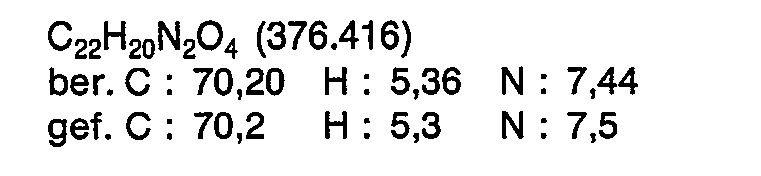
- Nach dem in Beispiel 2 beschriebenen Verfahren erhält man bei Einsatz von 165 g p-Toluidin anstelle von 143 g Anilin 226 g (75,1 %) der Ditoluidinoterephthalsäure der Formel

- In ähnlicher Ausbeute und Qualität erhält man die Ditoluidinoterephthalsäure, wenn man die Oxidation statt mit Luft mit m-Nitrobenzolsulfonsäure durchführt.
- Nach dem in Beispiel 1a genannten Verfahren erhält man unter Verwendung der in der folgenden Tabelle aufgeführen Aniline anstelle von Anilin die entsprechenden Dianilinoterephthalsäuren in sehr guten Reinheiten. Die Elementaranalysen der einzelnen Produkte stimmten gut mit den berechneten Werten überein.


Claims (8)


Applications Claiming Priority (2)
| Application Number | Priority Date | Filing Date | Title |
|---|---|---|---|
| DE3104644 | 1981-02-10 | ||
| DE19813104644 DE3104644A1 (de) | 1981-02-10 | 1981-02-10 | Verfahren zur herstellung von dimethylsuccinylosuccinat, dessen dinatriumsalz, dianilinodihydroterephthalsaeuren, deren dimethylestern und salzen sowie von dianilinoterephthalsaeuren, deren dimethylestern und salzen |
Publications (2)
| Publication Number | Publication Date |
|---|---|
| EP0057873A1 EP0057873A1 (de) | 1982-08-18 |
| EP0057873B1 true EP0057873B1 (de) | 1984-07-25 |
Family
ID=6124468
Family Applications (1)
| Application Number | Title | Priority Date | Filing Date |
|---|---|---|---|
| EP82100611A Expired EP0057873B1 (de) | 1981-02-10 | 1982-01-29 | Verfahren zur Herstellung von Dimethylsuccinylosuccinat, dessen Dinatriumsalz, Dianilinodihydroterephthalsäuren, deren Dimethylestern und Salzen sowie von Dianilinoterephthalsäuren, deren Dimethylestern und Salzen |
Country Status (4)
| Country | Link |
|---|---|
| US (1) | US4435589A (de) |
| EP (1) | EP0057873B1 (de) |
| JP (1) | JPS57149252A (de) |
| DE (2) | DE3104644A1 (de) |
Cited By (1)
| Publication number | Priority date | Publication date | Assignee | Title |
|---|---|---|---|---|
| RU2144022C1 (ru) * | 1995-10-30 | 2000-01-10 | Такеда Кемикал Индастриз, Лтд. | Эфиры n-(бифенилметил)аминобензойной кислоты и способ их получения |
Families Citing this family (12)
| Publication number | Priority date | Publication date | Assignee | Title |
|---|---|---|---|---|
| DE3423548A1 (de) * | 1984-06-26 | 1986-01-02 | Lentia GmbH Chem. u. pharm. Erzeugnisse - Industriebedarf, 8000 München | Verfahren zur herstellung von succinylobernsteinsaeuredialkylestern |
| DE3834747A1 (de) * | 1988-10-12 | 1990-05-03 | Bayer Ag | Verfahren zur herstellung von 2,5-diarylaminoterephthalsaeuren |
| KR960014910B1 (ko) * | 1990-11-23 | 1996-10-21 | 훽스트 아크티엔게젤샤프트 | 고순도의 2,5-디페닐아미노-테레프탈산 및 그의 디알킬 에스테르의 제조방법 |
| JPH04274197A (ja) * | 1991-02-28 | 1992-09-30 | Matsushita Electric Ind Co Ltd | 放電灯点灯装置 |
| ATE134987T1 (de) * | 1991-09-30 | 1996-03-15 | Ciba Geigy Ag | Verfahren zur synthese von succinylobernsternsäuredialkylestern und ihre umwandlung in dialkyl 2,5-diarylamino-3,6- dihydroterephthalsäureester |
| EP0569823B1 (de) * | 1992-05-12 | 1996-08-28 | Hoechst Aktiengesellschaft | Verfahren zur Herstellung von 2,5-Di-phenylamino-terephthalsäure und ihrer Dialkylester |
| GB9223048D0 (en) * | 1992-11-04 | 1992-12-16 | Ici Plc | Chemical process |
| AT401515B (de) * | 1993-10-19 | 1996-09-25 | Chemie Linz Gmbh | Verfahren zur umesterung von dimethylsuccinylsuccinat |
| DE4339994A1 (de) * | 1993-11-24 | 1995-06-01 | Chemie Linz Deutschland | Chinacridonsynthese und Verfahren zur Herstellung von Zwischenprodukten |
| ES2164859T3 (es) * | 1995-09-25 | 2002-03-01 | Ciba Sc Holding Ag | Procedimiento para la preparacion de dialquil succinilsuccinatos. |
| CN102584593A (zh) * | 2012-01-09 | 2012-07-18 | 浙江永泉化学有限公司 | 丁二酰丁二酸二甲酯的制备方法 |
| CN108373412B (zh) * | 2018-03-28 | 2021-08-03 | 彩客化学(沧州)有限公司 | 连续化生产丁二酰丁二酸二甲酯的方法和设备 |
Family Cites Families (12)
| Publication number | Priority date | Publication date | Assignee | Title |
|---|---|---|---|---|
| NL94468C (de) | 1953-05-01 | |||
| BE536624A (de) | 1954-03-19 | |||
| US2821541A (en) | 1955-07-22 | 1958-01-28 | Du Pont | Production of dialkyl 2, 5-diarylamino-3, 6-dihydroterephthalates |
| US3024268A (en) | 1957-10-28 | 1962-03-06 | Du Pont | Production of dialkyl succinylsuccinates |
| DE1082907B (de) | 1958-09-10 | 1960-06-09 | Basf Ag | Verfahren zur Herstellung von 2, 5-diarylamino-3, 6-dihydro-terephthalsaeureestern |
| GB891640A (en) | 1959-06-19 | 1962-03-14 | Ciba Ltd | Process for the manufacture of esters of dianilidoterephthalic acid |
| DE1118215B (de) * | 1959-06-19 | 1961-11-30 | Ciba Geigy | Verfahren zur Herstellung von 2, 5-Dianilino-terephthalsaeureestern |
| DE1144285B (de) | 1961-03-17 | 1963-02-28 | Cassella Farbwerke Mainkur Ag | Verfahren zur Herstellung von 2, 5-Diarylaminoterephthalsaeuren |
| DE1768049B2 (de) * | 1968-03-26 | 1974-06-20 | Farbwerke Hoechst Ag, Vormals Meister Lucius & Bruening, 6000 Frankfurt | Verfahren zur Herstellung von 2,5-(Di-arylamino)-terephthalsäuren |
| JPS5221499B2 (de) * | 1973-02-19 | 1977-06-10 | ||
| DE2542494C3 (de) | 1975-09-24 | 1981-04-30 | Hoechst Ag, 6000 Frankfurt | Verfahren zur Herstellung reiner substituierter 2,5 Diarylaminoterephthalsäureester und der entsprechenden freien Säuren |
| JPS5819665B2 (ja) * | 1975-11-10 | 1983-04-19 | 昭和電工株式会社 | サクシニルコハクサンジエステルノ セイゾウホウ |
-
1981
- 1981-02-10 DE DE19813104644 patent/DE3104644A1/de not_active Withdrawn
-
1982
- 1982-01-21 US US06/341,047 patent/US4435589A/en not_active Expired - Lifetime
- 1982-01-29 DE DE8282100611T patent/DE3260415D1/de not_active Expired
- 1982-01-29 EP EP82100611A patent/EP0057873B1/de not_active Expired
- 1982-02-09 JP JP57018304A patent/JPS57149252A/ja active Granted
Cited By (1)
| Publication number | Priority date | Publication date | Assignee | Title |
|---|---|---|---|---|
| RU2144022C1 (ru) * | 1995-10-30 | 2000-01-10 | Такеда Кемикал Индастриз, Лтд. | Эфиры n-(бифенилметил)аминобензойной кислоты и способ их получения |
Also Published As
| Publication number | Publication date |
|---|---|
| DE3260415D1 (en) | 1984-08-30 |
| US4435589A (en) | 1984-03-06 |
| EP0057873A1 (de) | 1982-08-18 |
| DE3104644A1 (de) | 1982-08-19 |
| JPS57149252A (en) | 1982-09-14 |
| JPH0244297B2 (de) | 1990-10-03 |
Similar Documents
| Publication | Publication Date | Title |
|---|---|---|
| EP0057873A1 (de) | Verfahren zur Herstellung von Dimethylsuccinylosuccinat, dessen Dinatriumsalz, Dianilinodihydroterephthalsäuren, deren Dimethylestern und Salzen sowie von Dianilinoterephthalsäuren, deren Dimethylestern und Salzen | |
| EP0363759B1 (de) | Verfahren zur Herstellung eines gegebenenfalls substituierten Chinacridons | |
| EP0363756B1 (de) | Verfahren zur Herstellung von 2,5-Diarylaminoterephthalsäuren | |
| DE2524747C3 (de) | Verfahren zur Isolierung von 1,5-/1,8-Dinitroanthrachinon mit einem hohen Gehalt an a , a '-Duutroverbindungen | |
| DE1082907B (de) | Verfahren zur Herstellung von 2, 5-diarylamino-3, 6-dihydro-terephthalsaeureestern | |
| EP0367067B1 (de) | Verfahren zur Herstellung von Küpenfarbstoffen und Pigmenten der Perinon-Reihe | |
| EP0184751A2 (de) | Neue Diaminoalkyldiphenylether, ein Verfahren zu ihrer Herstellung sowie deren Verwendung | |
| EP0500639B1 (de) | Verfahren zur herstellung von alkyl-[3-chlorphenyl]-sulfonen | |
| CH390271A (de) | Verfahren zur Herstellung von diarylaminoaromatischen Dicarbonsäuren | |
| DE4217954A1 (de) | Verfahren zur Herstellung von Dianthrachinon-N,N'-dihydroazin und dessen Chlorierungsprodukten | |
| DD238611A1 (de) | Verfahren zur herstellung von spirobenzo-1.4-2h- oxazinen und deren farbsalze | |
| CH404034A (de) | Verfahren zur Herstellung von linearen Chinacridin-dionen | |
| DE1768049B2 (de) | Verfahren zur Herstellung von 2,5-(Di-arylamino)-terephthalsäuren | |
| DE921871C (de) | Verfahren zur Herstellung von mehrkernigen sekundaeren und tertiaeren Aminen, insbesondere von Anthrimiden | |
| EP0011078B1 (de) | Verfahren zur Herstellung der reinen Natriumhydroxid-Additionsverbindungen von cis-Isomeren von Naphthoylen-bis-benzimidazolen | |
| DE1542872A1 (de) | Selektives herbizides Mittel | |
| EP0017806B1 (de) | Verfahren zur Herstellung von 1-Amino-2-acetyl-4-bromanthrachinon | |
| DE552760C (de) | Verfahren zur Herstellung von Abkoemmlingen der Naphthalin-1, 4, 5, 8-tetracarbonsaeure | |
| DE939151C (de) | Verfahren zur Herstellung von Aminocarbonsaeure-N, N-alkylenimiden | |
| EP0057665B1 (de) | Verfahren zur Herstellung von 1-Acylamino-3,4-phthaloyl-acridonen | |
| DE3535276A1 (de) | Verfahren zur herstellung von tetrachlor-3-imino-isoindolin-1-on | |
| DE831431C (de) | Verfahren zur Herstellung von Pyren-Kondensationsprodukten | |
| DE229316C (de) | ||
| DE3022783A1 (de) | Verfahren zur herstellung von 4-acylamido-2-nitro-1-alkoxybenzol-verbindungen | |
| EP0153908A1 (de) | Verfahren zur Herstellung von Pyridin-2,3-dicarbonsäure |
Legal Events
| Date | Code | Title | Description |
|---|---|---|---|
| PUAI | Public reference made under article 153(3) epc to a published international application that has entered the european phase |
Free format text: ORIGINAL CODE: 0009012 |
|
| 17P | Request for examination filed |
Effective date: 19820129 |
|
| AK | Designated contracting states |
Designated state(s): CH DE FR GB |
|
| GRAA | (expected) grant |
Free format text: ORIGINAL CODE: 0009210 |
|
| AK | Designated contracting states |
Designated state(s): CH DE FR GB LI |
|
| REF | Corresponds to: |
Ref document number: 3260415 Country of ref document: DE Date of ref document: 19840830 |
|
| ET | Fr: translation filed | ||
| PLBE | No opposition filed within time limit |
Free format text: ORIGINAL CODE: 0009261 |
|
| STAA | Information on the status of an ep patent application or granted ep patent |
Free format text: STATUS: NO OPPOSITION FILED WITHIN TIME LIMIT |
|
| 26N | No opposition filed | ||
| PGFP | Annual fee paid to national office [announced via postgrant information from national office to epo] |
Ref country code: DE Payment date: 19921216 Year of fee payment: 12 |
|
| PGFP | Annual fee paid to national office [announced via postgrant information from national office to epo] |
Ref country code: GB Payment date: 19930118 Year of fee payment: 12 |
|
| PGFP | Annual fee paid to national office [announced via postgrant information from national office to epo] |
Ref country code: CH Payment date: 19930126 Year of fee payment: 12 |
|
| PGFP | Annual fee paid to national office [announced via postgrant information from national office to epo] |
Ref country code: FR Payment date: 19930129 Year of fee payment: 12 |
|
| PG25 | Lapsed in a contracting state [announced via postgrant information from national office to epo] |
Ref country code: GB Effective date: 19940129 |
|
| PG25 | Lapsed in a contracting state [announced via postgrant information from national office to epo] |
Ref country code: CH Effective date: 19940131 Ref country code: LI Effective date: 19940131 |
|
| GBPC | Gb: european patent ceased through non-payment of renewal fee |
Effective date: 19940129 |
|
| PG25 | Lapsed in a contracting state [announced via postgrant information from national office to epo] |
Ref country code: FR Effective date: 19940930 |
|
| REG | Reference to a national code |
Ref country code: CH Ref legal event code: PL |
|
| PG25 | Lapsed in a contracting state [announced via postgrant information from national office to epo] |
Ref country code: DE Effective date: 19941001 |
|
| REG | Reference to a national code |
Ref country code: FR Ref legal event code: ST |