EP0364566B1 - Installation de refroidissement par liquide a contrainte reduite - Google Patents
Installation de refroidissement par liquide a contrainte reduite Download PDFInfo
- Publication number
- EP0364566B1 EP0364566B1 EP89904923A EP89904923A EP0364566B1 EP 0364566 B1 EP0364566 B1 EP 0364566B1 EP 89904923 A EP89904923 A EP 89904923A EP 89904923 A EP89904923 A EP 89904923A EP 0364566 B1 EP0364566 B1 EP 0364566B1
- Authority
- EP
- European Patent Office
- Prior art keywords
- contacts
- board
- conduits
- assembly according
- printed circuit
- Prior art date
- Legal status (The legal status is an assumption and is not a legal conclusion. Google has not performed a legal analysis and makes no representation as to the accuracy of the status listed.)
- Expired - Lifetime
Links
Images



Classifications
-
- H—ELECTRICITY
- H10—SEMICONDUCTOR DEVICES; ELECTRIC SOLID-STATE DEVICES NOT OTHERWISE PROVIDED FOR
- H10W—GENERIC PACKAGES, INTERCONNECTIONS, CONNECTORS OR OTHER CONSTRUCTIONAL DETAILS OF DEVICES COVERED BY CLASS H10
- H10W40/00—Arrangements for thermal protection or thermal control
- H10W40/70—Fillings or auxiliary members in containers or in encapsulations for thermal protection or control
- H10W40/77—Auxiliary members characterised by their shape
- H10W40/772—Bellows
-
- H—ELECTRICITY
- H10—SEMICONDUCTOR DEVICES; ELECTRIC SOLID-STATE DEVICES NOT OTHERWISE PROVIDED FOR
- H10W—GENERIC PACKAGES, INTERCONNECTIONS, CONNECTORS OR OTHER CONSTRUCTIONAL DETAILS OF DEVICES COVERED BY CLASS H10
- H10W40/00—Arrangements for thermal protection or thermal control
- H10W40/40—Arrangements for thermal protection or thermal control involving heat exchange by flowing fluids
- H10W40/47—Arrangements for thermal protection or thermal control involving heat exchange by flowing fluids by flowing liquids, e.g. forced water cooling
Definitions
- the invention relates to an improved liquid cooled electronic circuit assembly which includes a printed circuit board having two oppositely facing major surfaces, electronic components mounted on one of said two surfaces, and conduits which carry a liquid and touch said electronic components to cool them.
- integrated circuit packages have been liquid-cooled by providing a plurality of cooling jackets which respectively contact the integrated circuit packages.
- a liquid coolant passes through the cooling jackets to carry heat away from the integrated circuit packages by conduction.
- Fluid is supplied to the cooling jackets by means of an input manifold, and fluid is taken from the cooling jackets by means of an output manifold.
- Such liquid cooling assemblies are generally known and described for instance in EP-A-217 676 and US-A-4,558,395.
- a problem, however, which the above referenced liquid-cooling mechanism does not address is how to reduce and minimize mechanical stresses in the printed circuit board. Those stresses, as the present application shows, will occur due to certain forces which the cooling jackets exert on the integrated circuit packages. If these stresses are not properly managed and become too large, the printed circuit board can bend to a point where malfunctions start to occur. Specifically, conductors on the board which interconnect the integrated circuit package can break. Also, the thermal conduction that occurs between an integrated circuit package and its cooling jacket can be degraded, causing the integrated ci-rcuit packages to heat up and not operate properly.
- a primary object of the invention is to provide an improved mechanism for cooling integrated circuit packages on a printed circuit board in which mechanical stress and deflection in the board is greatly reduced.
- an improved liquid cooled electronic circuit assembly which comprises a frame for holding said conduits snugly against said components without overstressing said printed circuit board; said frame having:
- reference numeral 10 indicates a printed circuit board which has two major surfaces 10a and 10b. Electrical components, such as integrated circuit packages 11, are mounted on surface 10a. Those packages dissipate heat when they operate. So to cool the packages 11, a conduit 12 is provided which includes components 12a-12d. Each of the components 12a is a cooling jacket which contacts a respective integrated circuit package 11 to cool it. A liquid coolant is routed through the cooling jackets 12a by means of an input manifold 12b, a plurality of hoses 12c, and an output manifold 12d.
- FIG. 1 shows only one column of packages 11 and cooling jackets 12a, but other identical parallel columns are disposed over almost the entire surface 10a.
- the FIG. 1 assembly also includes a frame 20 which is made of all of the components that are numbered in the twenties (i.e., components 21, 21a, 22, 22a, 23, 24).
- This frame operates to hold the cooling jackets 12a snugly against the integrated circuit packages 11 without overstressing the printed circuit board 10.
- Components 21 and 22 are a pair of beams.
- Beam 21 has a set of helical spring contacts 21a which engage each of the cooling jackets 12a; and beam 22 has another set of cylindrical contacts 22a which project towards the printed circuit board and engage its surface 10b at spaced apart locations which are predetermined distances from the board's perimeter.
- Frame 20 also includes some bolts 23 which pass through the ends of the beams 21 and 22. Respective nuts 24 are tightened on the bolts to move the contacts 21a and 22a towards each other. This movement, in turn, squeezes together the cooling jackets 12a, the integrated circuit packages 11, and the printed circuit board 10.
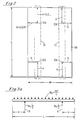
- FIG. 2 it shows in greater detail one preferred configuration and placement of the contacts 22a on surface 10b of the printed circuit board.
- FIG. 2 there are a total of four contacts 22a. Two of the contacts 22a on the left half of surface 10b are provided by one beam 22; and the remaining two contacts on the right half of surface 10b are provided by another beam 22.
- These contacts 22a are located at distances of approximately 0.2L and 0.2W from the perimeter of the board where L and W respectively are length and width of the board.
- Such a contact configuration has the effect of greatly reducing stress in the board 10 as will be described now in conjunction with FIGs. 3A-3D.
- FIG. 3A shows the forces which act on the left half and the right half of board 10. Both halves of the board 10 are identically loaded, and so the analysis of each half of the board is the same.
- a distributed force W0 is exerted on surface 10a since the contacts 21a of beam 21 squeeze the cooling jackets 12a and the integrated circuit packages 11 against essentially that entire surface.
- This distributed force W0 has a per unit length magnitude of (NF)/L where N is the number of cooling jackets on the printed circuit board, and F is the force that a single contact 21a exerts against a single cooling jacket.
- Two concentrated forces 31 on surface 10b counterbalance the distributed force on surface 10a. Those forces 31 are exerted by two of the contacts 22a, and they each have a magnitude of (W0L)/2.
- FIG. 3B it contains a curve 32 which is the integral of the loading in FIG. 3A taken along the length of the board. This integral at any point along the length is proportional to the shear stress that exists in the printed circuit board 10 at that same point.
- Another curve 33 in FIG. 3C is the integral of curve 32 taken along the board's length. Curve 33 is important since its magnitude at any point is proportional to the bending stress in the printed circuit board 10 at that same point.
- Curve 33 has three peaks which occur at the distances of "a", “L/2", “L-a”. Those peaks have magnitudes which are indicated by terms 34a and 34b. Inspection of the terms 34a and 34b shows that as the distance "a" decreases, term 34a gets smaller and term 34b gets bigger. Conversely, as distance "a" increases, term 34a gets bigger and term 34b gets smaller.
- Equation 1 in FIG. 3D.
- Equation 2 peak bending stress will be minimized in board 10 when the distance "a” is made equal to approximately 0.2L.
- Equation 2 states, peak bending stress will be minimized in board 10 when the distance "a” is made equal to approximately 0.2L.
- a similar analysis can be made on a cross section of board 10 which is taken along the board's width W; and, the result of that analysis is that the distance "b" should be equal to 0.2W.
- Equation 4 dividing Equation 3 by Equation 4 yields Equation 5 - which says that the peak bending stress in board 10 when Equation 2 is met is only 17% of the peak bending stress in board 10 when the conduit is supported at the board's perimeter.
- the leftmost column defines an arbitrary point "X" along the length of board 10 as a ratio of X to L. Normalized deflection in board 10 at the point X is given by the middle column for the condition where frame 20 is employed to support the board and the contacts 22a are positioned as shown in FIG. 2.
- the rightmost column of Table 1 gives the normalized deflection at point X under the conditions where beam 22 and its contacts 22a are eliminated, and the bolts 23a and 23b connect directly to the perimeter of the board.
- normalized deflection can be converted to actual deflection by multiplying it by (W0L4)/EI where "E” is the flexural modulus of the material from which board 10 is made and “I” is the area moment of inertia of board 10.
- FIG. 4 Another significant feature which results from the FIG. 1 structure is illustrated in FIG. 4.
- the FIG. 1 members are illustrated schematically, and board 10 is shown as having warps 10c.
- This figure shows that frame 20 will produce essentially the same stress in board 10 regardless of whether that board is warped or flat. Board warpage will not affect stress when frame 20 is used because the contacts 22a hold beam 22 away from the board surface 10b. Without such spacing, beam 22 would rest directly on surface 10b; and thus beam 22 would tend to flatten out any warps in surface 10b. But flattening out a warp in surface 10b produces stress in the board, and the magnitude of the stress would be proportional to the inverse of the radius of curvature of the warp that is flattened. To ensure that no such flattening occurs under the contacts 22a, the area of engagement for each contact preferably is less than 6.45 cm2 (0.25 in2).
- FIG. 5 a modified embodiment is shown in FIG. 5.
- beam 22 is eliminated; holes are placed in board 10 at the distances of 0.2L and 0.2W from the board's perimeter; and the bolts 23 pass through those holes and attach to beam 21.
- the heads of the bolts act as the contacts 22a.
- This embodiment has the same force diagrams as FIGs. 3A-3D; and consequently, it has the same stress reduction features.
- stress in the FIG. 5 embodiment is independent of board warpage.
- the holes for the bolts in the FIG. 5 embodiment do take up a certain amount of board space.
- the total number of contacts 22a can be increased.
- the total number of contacts 22a ranges from four to twenty-five. Increasing the number of contacts lowers the peak bending stress that occurs in board 10, but it also adds material and thus increases cost.
- FIG. 6 shows an embodiment which has three beams 22, with each beam having three contacts 22a - giving a total of nine contacts 22a.
- the distance al is 2/14L
- the distance a2 is 5/14L
- the distance bl is 2.5/15W
- the distance b2 is 5/15W.
- the cylindrical shape of the contacts 22a can be changed.
- they can be semi-spherical shaped, or shaped as a helical spring.
- the contacts 22a can be made of various materials; but preferably they are made of an elastic material, such as rubber, which is stiffer than the springs 21a.
- various electrical components, such as resistors or capacitors, can be mounted between the contacts 22a on surface 10b of the printed circuit board.
Landscapes
- Cooling Or The Like Of Electrical Apparatus (AREA)
- Cooling Or The Like Of Semiconductors Or Solid State Devices (AREA)
Abstract
Claims (11)
- Ensemble amélioré de circuits électroniques refroidis par un liquide qui comprend une carte à circuit imprimé (10) ayant deux surfaces principales opposées (10a, 10b), des composants électroniques (11) montés sur l'une (10a) des deux surfaces, et des conduites (12) qui transportent un liquide et qui touchent lesdits composants électroniques (11) pour les refroidir ;
un cadre (20) pour maintenir lesdites conduites (12) commodément contre lesdits composants (11) sans contraindre ladite carte à circuit imprimé (10) ;
ledit cadre (20) comprenant :(a) un premier jeu de contacts (21a) qui viennent en contact avec lesdites conduites (12) ;(b) un second jeu de contacts (22a) qui viennent en contact avec la surface (10b) de ladite carte à circuit imprimé (10) opposée à ladite surface (10a) ;(c) un moyen (21, 22, 23, 24) pour presser lesdites conduites (12) contre lesdits composants électroniques (11) en déplaçant lesdits premier et second jeux de contacts (21a, 22a) l'un vers l'autre avec lesdites conduites (12), lesdits composants électroniques (11) et ladite carte à circuit imprimé (10) s'étendant entre eux ;
caractérisé en ce que :(d) lesdits contacts (22a) dudit second jeu étant espacés et répartis uniformément sur la totalité de la surface opposée (10b) à ladite surface (10a), les positions desdits contacts dudit second jeu étant déterminées de façon que la pointe de contrainte de flexion dans ladite carte (10) soit minimisée. - Ensemble selon la revendication 1, dans lequel ledit cadre (20) comprend : une poutrelle (21) qui comporte des contacts (21a) dudit premier jeu qui viennent en contact avec lesdites conduites (12), une seconde poutrelle (22) qui comporte des contacts (22a) dudit second jeu qui viennent en contact avec la surface (10b) de ladite carte à circuit imprimé (10) opposée à ladite surface (10a), et des dispositifs d'attache (23, 24) qui joignent et qui déplacent lesdites première et seconde poutrelles (21, 22) l'une vers l'autre.
- Ensemble selon la revendication 1, dans lequel ledit cadre (20) comprend : une poutrelle (21) qui comporte des contacts (21a) dudit premier jeu qui viennent en contact avec lesdites conduites (12), et des dispositifs d'attache (23) qui se relient à ladite poutrelle (21) et qui pénètrent dans ladite carte (10) au niveau desdits emplacements prédéterminés pour y former ledit second jeu de contacts (22a).
- Ensemble selon l'une quelconque des revendications 1 à 3, dans lequel lesdits contacts (22a) dudit second jeu sont espacés selon une configuration qui égalise les amplitudes de pointe des contraintes de flexion positives et négatives dans ladite carte (10).
- Ensemble selon l'une quelconque des revendications 1 à 3, dans lequel un total de quatre contacts (22a) est dans ledit second jeu, et dans lequel lesdits quatre contacts (22a) sont situés à des distances (a, b) d'environ 0,2 L et 0,2 W à partir du périmètre de ladite carte (10) où L et W sont respectivement la longueur et la largeur de la carte (10).
- Ensemble selon l'une quelconque des revendications 1 à 3, dans lequel un total de neuf contacts (22a) est dans ledit second jeu, et dans lequel lesdits neuf contacts (22a) sont situés à des distances (a1, a2 ; b1, b2) d'environ (2/14)L, (7/14)L, (2,5/15)W et (7,5/15)W à partir du périmètre de ladite carte (10) où L et W sont respectivement la longueur et la largeur de la carte (10).
- Ensemble selon l'une quelconque des revendications précédentes, dans lequel chaque contact (22a) dudit second jeu touche une surface inférieure à 6,45 cm² (0,25 pouce carré) de ladite carte (10).
- Ensemble selon l'une quelconque des revendications 1 à 3, dans lequel ledit second jeu de contacts est constitué de quatre à vingt-cinq contacts (22a).
- Ensemble selon l'une quelconque des revendications précédentes, dans lequel lesdits contacts (22a) dudit second jeu sont des éléments cylindriques.
- Ensemble selon l'une quelconque des revendications 1 à 8, dans lequel lesdits contacts (22a) dudit second jeu sont des ressorts hélicoïdaux.
- Ensemble selon l'une quelconque des revendications précédentes, dans lequel lesdits contacts (21a, 22a) desdits premier et second jeux sont fabriqués à partir d'une matière élastique, lesdits contacts (22a) dudit second jeu étant plus rigides que les contacts (21a) dudit premier jeu.
Applications Claiming Priority (3)
| Application Number | Priority Date | Filing Date | Title |
|---|---|---|---|
| US182393 | 1988-04-18 | ||
| US07/182,393 US4809134A (en) | 1988-04-18 | 1988-04-18 | Low stress liquid cooling assembly |
| PCT/US1989/001288 WO1989010630A1 (fr) | 1988-04-18 | 1989-03-29 | Installation de refroidissement par liquide a contrainte reduite |
Publications (2)
| Publication Number | Publication Date |
|---|---|
| EP0364566A1 EP0364566A1 (fr) | 1990-04-25 |
| EP0364566B1 true EP0364566B1 (fr) | 1995-03-01 |
Family
ID=22668268
Family Applications (1)
| Application Number | Title | Priority Date | Filing Date |
|---|---|---|---|
| EP89904923A Expired - Lifetime EP0364566B1 (fr) | 1988-04-18 | 1989-03-29 | Installation de refroidissement par liquide a contrainte reduite |
Country Status (6)
| Country | Link |
|---|---|
| US (1) | US4809134A (fr) |
| EP (1) | EP0364566B1 (fr) |
| JP (1) | JP2607964B2 (fr) |
| KR (1) | KR0124413B1 (fr) |
| DE (1) | DE68921406T2 (fr) |
| WO (1) | WO1989010630A1 (fr) |
Families Citing this family (22)
| Publication number | Priority date | Publication date | Assignee | Title |
|---|---|---|---|---|
| EP0341950B1 (fr) * | 1988-05-09 | 1994-09-14 | Nec Corporation | Structure de refroidissement plane d'un circuit intégré |
| US5016090A (en) * | 1990-03-21 | 1991-05-14 | International Business Machines Corporation | Cross-hatch flow distribution and applications thereof |
| JPH06342990A (ja) * | 1991-02-04 | 1994-12-13 | Internatl Business Mach Corp <Ibm> | 統合冷却システム |
| JP2852148B2 (ja) * | 1991-10-21 | 1999-01-27 | 日本電気株式会社 | 集積回路パッケージの冷却構造 |
| US5929518A (en) * | 1997-07-20 | 1999-07-27 | Motorola, Inc. | Circuit board and method |
| JP3315649B2 (ja) | 1998-08-11 | 2002-08-19 | 富士通株式会社 | 電子機器 |
| US6700396B1 (en) | 2001-05-16 | 2004-03-02 | Ltx Corporation | Integrated micromachine relay for automated test equipment applications |
| US20030033398A1 (en) * | 2001-08-10 | 2003-02-13 | Sun Microsystems, Inc. | Method, system, and program for generating and using configuration policies |
| US20030033346A1 (en) * | 2001-08-10 | 2003-02-13 | Sun Microsystems, Inc. | Method, system, and program for managing multiple resources in a system |
| US7252139B2 (en) * | 2001-08-29 | 2007-08-07 | Sun Microsystems, Inc. | Method and system for cooling electronic components |
| US7133907B2 (en) * | 2001-10-18 | 2006-11-07 | Sun Microsystems, Inc. | Method, system, and program for configuring system resources |
| US6965559B2 (en) * | 2001-10-19 | 2005-11-15 | Sun Microsystems, Inc. | Method, system, and program for discovering devices communicating through a switch |
| US20030135609A1 (en) * | 2002-01-16 | 2003-07-17 | Sun Microsystems, Inc. | Method, system, and program for determining a modification of a system resource configuration |
| US7103889B2 (en) | 2002-07-23 | 2006-09-05 | Sun Microsystems, Inc. | Method, system, and article of manufacture for agent processing |
| US7143615B2 (en) | 2002-07-31 | 2006-12-05 | Sun Microsystems, Inc. | Method, system, and program for discovering components within a network |
| US20040022200A1 (en) * | 2002-07-31 | 2004-02-05 | Sun Microsystems, Inc. | Method, system, and program for providing information on components within a network |
| US20040024887A1 (en) * | 2002-07-31 | 2004-02-05 | Sun Microsystems, Inc. | Method, system, and program for generating information on components within a network |
| US6953227B2 (en) * | 2002-12-05 | 2005-10-11 | Sun Microsystems, Inc. | High-power multi-device liquid cooling |
| US7327578B2 (en) * | 2004-02-06 | 2008-02-05 | Sun Microsystems, Inc. | Cooling failure mitigation for an electronics enclosure |
| US7298618B2 (en) * | 2005-10-25 | 2007-11-20 | International Business Machines Corporation | Cooling apparatuses and methods employing discrete cold plates compliantly coupled between a common manifold and electronics components of an assembly to be cooled |
| US7508676B1 (en) * | 2008-04-11 | 2009-03-24 | International Business Machines Corporation | Cold plate structure and method for cooling planar arrays of processors during assembly and test allowing for single module site reworkability |
| EP4025024B1 (fr) * | 2021-01-04 | 2026-03-18 | Aptiv Technologies AG | Dispositif de refroidissement et son procédé de fabrication |
Citations (2)
| Publication number | Priority date | Publication date | Assignee | Title |
|---|---|---|---|---|
| US4558395A (en) * | 1983-04-27 | 1985-12-10 | Hitachi, Ltd. | Cooling module for integrated circuit chips |
| EP0217676A2 (fr) * | 1985-10-04 | 1987-04-08 | Fujitsu Limited | Système de refroidissement pour un dispositif de circuit électronique |
Family Cites Families (7)
| Publication number | Priority date | Publication date | Assignee | Title |
|---|---|---|---|---|
| DE2813529A1 (de) * | 1978-03-29 | 1979-10-04 | Siemens Ag | Anordnung zur beidseitigen kuehlung von halbleiterbauelementen |
| US4226281A (en) * | 1979-06-11 | 1980-10-07 | International Business Machines Corporation | Thermal conduction module |
| US4235283A (en) * | 1979-12-17 | 1980-11-25 | International Business Machines Corporation | Multi-stud thermal conduction module |
| US4381032A (en) * | 1981-04-23 | 1983-04-26 | Cutchaw John M | Apparatus for cooling high-density integrated circuit packages |
| US4649990A (en) * | 1985-05-06 | 1987-03-17 | Hitachi, Ltd. | Heat-conducting cooling module |
| JPS62290161A (ja) * | 1986-06-09 | 1987-12-17 | Hitachi Ltd | 電子装置の冷却装置 |
| US4791983A (en) * | 1987-10-13 | 1988-12-20 | Unisys Corporation | Self-aligning liquid-cooling assembly |
-
1988
- 1988-04-18 US US07/182,393 patent/US4809134A/en not_active Expired - Lifetime
-
1989
- 1989-03-29 WO PCT/US1989/001288 patent/WO1989010630A1/fr not_active Ceased
- 1989-03-29 EP EP89904923A patent/EP0364566B1/fr not_active Expired - Lifetime
- 1989-03-29 KR KR1019890702274A patent/KR0124413B1/ko not_active Expired - Fee Related
- 1989-03-29 JP JP1504724A patent/JP2607964B2/ja not_active Expired - Fee Related
- 1989-03-29 DE DE68921406T patent/DE68921406T2/de not_active Expired - Fee Related
Patent Citations (2)
| Publication number | Priority date | Publication date | Assignee | Title |
|---|---|---|---|---|
| US4558395A (en) * | 1983-04-27 | 1985-12-10 | Hitachi, Ltd. | Cooling module for integrated circuit chips |
| EP0217676A2 (fr) * | 1985-10-04 | 1987-04-08 | Fujitsu Limited | Système de refroidissement pour un dispositif de circuit électronique |
Also Published As
| Publication number | Publication date |
|---|---|
| DE68921406T2 (de) | 1995-06-29 |
| US4809134A (en) | 1989-02-28 |
| WO1989010630A1 (fr) | 1989-11-02 |
| DE68921406D1 (de) | 1995-04-06 |
| KR900701041A (ko) | 1990-08-17 |
| JPH02504207A (ja) | 1990-11-29 |
| JP2607964B2 (ja) | 1997-05-07 |
| KR0124413B1 (ko) | 1997-12-11 |
| EP0364566A1 (fr) | 1990-04-25 |
Similar Documents
| Publication | Publication Date | Title |
|---|---|---|
| EP0364566B1 (fr) | Installation de refroidissement par liquide a contrainte reduite | |
| US4791983A (en) | Self-aligning liquid-cooling assembly | |
| EP0363687B1 (fr) | Structure de refroidissement pour composants électroniques | |
| US5894882A (en) | Heat sink structure for cooling a substrate and an electronic apparatus having such a heat sink structure | |
| US5031689A (en) | Flexible thermal apparatus for mounting of thermoelectric cooler | |
| US5089936A (en) | Semiconductor module | |
| US4800956A (en) | Apparatus and method for removal of heat from packaged element | |
| US6946755B2 (en) | Linear motor | |
| US10750639B2 (en) | Cooling memory modules | |
| US20150075755A1 (en) | Fabricating separable and integrated heat sinks facilitating cooling multi-component electronic assembly | |
| KR20200014843A (ko) | 프로세서 고정 구조 부재 및 컴포넌트 및 컴퓨터 디바이스 | |
| AU2021257650B2 (en) | Thermal interface material structures for directing heat in a three-dimensional space | |
| JP3563695B2 (ja) | 電子デバイスの温度を調整するための機械的アセンブリ | |
| JP2002532880A (ja) | 角以外で電子デバイスの平面全体と接触する熱交換器 | |
| US20070268673A1 (en) | Heatspreader for single-device and multi-device modules | |
| US4538675A (en) | Retention and cooling of plug-in electronic modules in a high shock and vibration environment | |
| WO2000035011A1 (fr) | Systeme mecanique de reglage de la temperature d'un dispositif electronique | |
| CN101018464A (zh) | 散热装置 | |
| JPH0886578A (ja) | 柔軟性薄形プレートヒートパイプ | |
| US20070074852A1 (en) | Heat sink | |
| CN223928694U (zh) | 一种散热屏蔽簧片 | |
| KR100910227B1 (ko) | 반도체 모듈용 냉각 유닛 | |
| JPS62172798A (ja) | 冷却プレ−ト | |
| JPH11174483A (ja) | 液晶表示装置 | |
| US11774190B2 (en) | Pierced thermal interface constructions |
Legal Events
| Date | Code | Title | Description |
|---|---|---|---|
| PUAI | Public reference made under article 153(3) epc to a published international application that has entered the european phase |
Free format text: ORIGINAL CODE: 0009012 |
|
| AK | Designated contracting states |
Kind code of ref document: A1 Designated state(s): BE DE FR GB NL |
|
| 17P | Request for examination filed |
Effective date: 19900302 |
|
| 17Q | First examination report despatched |
Effective date: 19920807 |
|
| GRAA | (expected) grant |
Free format text: ORIGINAL CODE: 0009210 |
|
| AK | Designated contracting states |
Kind code of ref document: B1 Designated state(s): BE DE FR GB NL |
|
| PG25 | Lapsed in a contracting state [announced via postgrant information from national office to epo] |
Ref country code: NL Free format text: LAPSE BECAUSE OF NON-PAYMENT OF DUE FEES Effective date: 19950301 Ref country code: BE Effective date: 19950301 |
|
| ET | Fr: translation filed | ||
| REF | Corresponds to: |
Ref document number: 68921406 Country of ref document: DE Date of ref document: 19950406 |
|
| NLV1 | Nl: lapsed or annulled due to failure to fulfill the requirements of art. 29p and 29m of the patents act | ||
| PLBE | No opposition filed within time limit |
Free format text: ORIGINAL CODE: 0009261 |
|
| STAA | Information on the status of an ep patent application or granted ep patent |
Free format text: STATUS: NO OPPOSITION FILED WITHIN TIME LIMIT |
|
| 26N | No opposition filed | ||
| REG | Reference to a national code |
Ref country code: GB Ref legal event code: IF02 |
|
| PGFP | Annual fee paid to national office [announced via postgrant information from national office to epo] |
Ref country code: GB Payment date: 20020205 Year of fee payment: 14 |
|
| PGFP | Annual fee paid to national office [announced via postgrant information from national office to epo] |
Ref country code: FR Payment date: 20020228 Year of fee payment: 14 |
|
| PGFP | Annual fee paid to national office [announced via postgrant information from national office to epo] |
Ref country code: DE Payment date: 20020327 Year of fee payment: 14 |
|
| PG25 | Lapsed in a contracting state [announced via postgrant information from national office to epo] |
Ref country code: GB Free format text: LAPSE BECAUSE OF NON-PAYMENT OF DUE FEES Effective date: 20030329 |
|
| PG25 | Lapsed in a contracting state [announced via postgrant information from national office to epo] |
Ref country code: DE Free format text: LAPSE BECAUSE OF NON-PAYMENT OF DUE FEES Effective date: 20031001 |
|
| GBPC | Gb: european patent ceased through non-payment of renewal fee |
Effective date: 20030329 |
|
| PG25 | Lapsed in a contracting state [announced via postgrant information from national office to epo] |
Ref country code: FR Free format text: LAPSE BECAUSE OF NON-PAYMENT OF DUE FEES Effective date: 20031127 |
|
| REG | Reference to a national code |
Ref country code: FR Ref legal event code: ST |