EP0364831A2 - Elektrische Glühlampe und Verfahren zu ihrer Herstellung - Google Patents
Elektrische Glühlampe und Verfahren zu ihrer Herstellung Download PDFInfo
- Publication number
- EP0364831A2 EP0364831A2 EP89118562A EP89118562A EP0364831A2 EP 0364831 A2 EP0364831 A2 EP 0364831A2 EP 89118562 A EP89118562 A EP 89118562A EP 89118562 A EP89118562 A EP 89118562A EP 0364831 A2 EP0364831 A2 EP 0364831A2
- Authority
- EP
- European Patent Office
- Prior art keywords
- lamp
- lead
- filament
- conductors
- envelope
- Prior art date
- Legal status (The legal status is an assumption and is not a legal conclusion. Google has not performed a legal analysis and makes no representation as to the accuracy of the status listed.)
- Granted
Links
Images

Classifications
-
- H—ELECTRICITY
- H01—ELECTRIC ELEMENTS
- H01K—ELECTRIC INCANDESCENT LAMPS
- H01K3/00—Apparatus or processes adapted to the manufacture, installing, removal, or maintenance of incandescent lamps or parts thereof
- H01K3/06—Attaching of incandescent bodies to mount
-
- H—ELECTRICITY
- H01—ELECTRIC ELEMENTS
- H01K—ELECTRIC INCANDESCENT LAMPS
- H01K1/00—Details
- H01K1/18—Mountings or supports for the incandescent body
- H01K1/24—Mounts for lamps with connections at opposite ends, e.g. for tubular lamp
Definitions
- This invention relates generally to electric incandescent lamps of the type which provide radiant energy efficiently and more particularly to a structural configuration for the filament light source means employed in this type lamp to improve its operating efficiency.
- a wide variety of electric incandescent lamps which employ a refractory metal filament as the light source to provide general illumination.
- a coiled tungsten filament is commonly employed having opposite end turns extending outwardly along the central coil axis and which are physically clamped for support by refractory metal lead-in wires. If the clamping is too tight it can produce broken filaments while too loose clamping can result in erratic electrical contact producing flicker or electro-magnetic interference.
- a further serious problem arises during customary manufacture wherein the lamps is "flashed" to provide a recrystallized grain structure in the assembled filament.
- a transition zone of uncrystallized refractory metal often occurs at the junction site of clamping which is also recognized to enhance mechanical breakage of the supported filament. It would be understandably desirable to eliminate or minimize all such problems with utilization of a coiled refractory metal filament in an electric incandescent lamp.
- the optical pass-band and the stop-band characteristics selected for said reflective film medium serve to reflect infrared radiation back to the lamp filament.
- the filament operating efficiency can be increased in this manner for more efficient light output from the lamp since the reflective film is selected so as to still transmit a major portion of the desired visible radiation.
- the above mentioned patent is specifically incorporated herein by reference, therefore, due to the same reflective film characteristics which can be employed in one embodiment of the present lamp improvement.
- the doubled ended lamp construction disclosed in said prior art patent is further reported to mechanically and electrically connect an elongated tungsten filament extending substantially the full length of a tubular lamp envelope with lead-in wires joined thereto by known "spudding" techniques.
- Such joinder of the filament coil to the lead-in wire conductors is customarily provided by inserting one end of a lead-in wire length into the central coil opening and thereafter welding the inserted end to a number of the end coil turns.
- the lighted length of the coil filament may vary widely especially due to melting of the lead-in refractory metal which can short circuit a variable number of these end turns.
- Still another important object of the present invention is to provide more effective engagement between the filament member and its lead-in conductors which better controls centering of the assembled filament within the lamp envelope.
- a still further important object of the present invention is to provide an improved coiled filament assembly in said type electric incandescent lamp enabling still more reliable lamp manufacture, particularly with high speed automated lamp manufacturing equipment.
- Novel connection of the lead-in conductors to a coiled filament in an electric incandescent lamp has now been discovered which improves centering of the filament coil within the lamp envelope as well as better controls the light output from this light source. More particularly, such improvement is provided with lead-in conductors having an L-shaped configuration and which are connected to opposite single end turns of the filament coil in a specific manner. A welded connection between one leg of such lead-in conductor elements and a predetermined location on the circumference of a single filament coil end turn joined thereto avoid electrical shorting of adjacent coil turns.
- a still further advantage achieved with the present light source is control of the lighted length in the filament coil with relative location of the lead-in conductors joined thereto.
- alignment of the respective lead-in conductors on the circumferential edge of the filament coil can be offset with respect to each other thereby providing a means for either shortening or lengthening the effective lighted length of the filament coil, if desired.
- Providing a light source in the foregoing manner thus enables the lighted length of the filament coil to be more accurately centered within an elongated lamp envelope with respect to both its longitudinal lamp axis as well as in directions transverse thereto.
- an electric incandescent lamp comprising in combination an elongated hermetically sealed light transmissive lamp envelope containing an inert gas filling, an incandescent refractory metal coiled filament having a linear axis substantially coincident with the longitudinal axis of the the lamp envelope and extending substantially the full length of the lamp envelope, and lead-in conductors sealed through opposite ends of the lamp envelope and each joined directly to opposite single end turns of the coil filament, the lead-in conductors each comprising refractory metal wire lengths having a bent end joined to the single end turn at a circumferential edge location with the opposite free end extending outwardly and being aligned substantially parallel to the longitudinal axis of the lamp envelope.
- the filament coil in this lamp is preferably tungsten while the lead-in conductors are molybdenum although it is also contemplated that lead-in conductors of tungsten can also be used.
- said lead-in conductors are joined directly to the filament coil by a welding process selected from the group consisting of plasma welding and laser welding which avoids objectionable weld splatter to adjacent coil turns when such joinder is made.
- the preferred lamp embodiment further employs a reflective film deposited on the surface of the lamp envelope for improved operating efficiency since the filament coil emits both in the visible and infrared spectral regions.
- this reflective film is capable of operating at a temperature in the range up to and including 950 o C with said film being formed of a plurality of layers exhibiting high and low optical refractive indices of refractory materials effective to establish a pass-band characteristic and a stop-band characteristic providing the selective radiant energy distribution above specified.
- the coiled refractory metal filament in said lamp extends the axial length of the lamp envelope while being mechanically and electrically connected at both ends to the in-lead conductors hermetically sealed at the envelope ends.
- a pre-assembly of the lamp filament coil and lead-in conductors is first effected as above specified and said pre-assembly thereafter inserted into one end of the cylindrical lamp envelope tube.
- a fill of inert gas which preferivelyably contains a relatively small quantity of a halogen substance to further improve lamp operating efficiency is added to the lamp envelope all in an otherwise conventional lamp manufacturing manner.
- Hermetically sealing both ends of the lamp envelope at the in-lead conductor locations completes said lamp manufacture with the filament coil being maintained by such support means at the center of the envelope cylinder and extending along its axial length.
- an ovoid shaped lamp envelope again preferably having the reflective film deposited on the exterior surface of said lamp envelope to improve lamp operating efficiency.
- the filament coil to be centered within said lamp envelope to an accuracy of approximately one percent. Since the present lamp embodiment is again of such high efficiency type, the elevated lamp operating temperatures further requires the lamp envelope to be formed with a relatively refractory light transmissive substance such as fused quartz, aluminosilicate glass or silicate borate glass.
- a lamp is depicted in FIG. 1 employing the same general construction as disclosed in the aforementioned 4,588,923 patent. Accordingly, said lamp includes a radiation transmissive envelope 10 having an elongated tubular shape and fabricated of a clear fused quartz, translucent fused quartz, or quartz-like glass such as that known commercially as VYCOR available from the Corning Glass Works.
- a radiation transmissive envelope 10 having an elongated tubular shape and fabricated of a clear fused quartz, translucent fused quartz, or quartz-like glass such as that known commercially as VYCOR available from the Corning Glass Works.
- the tubular envelope depicted in FIG. 1 is a double ended type
- practice of the present invention further contemplates a single-ended type elongated lamp envelope as hereinafter more fully described.
- Typical dimensions for a suitable double ended type quartz envelope can be 3 x 5 millimeter diameter quartz tubing having a 20 millimeter length.
- Each end of said lamp 10 has a pinched portion 12 through which is sealed a lead-in conductor 13 connected to another lead-in conductor 15 by a thin intermediate foil portion 14 which is hermetically sealed and embedded in the pinch portion 12.
- the foil portion 14 may be a separate piece of molybdenum welded to one end of each of the lead-in conductors 13 and 15. Alternately, the foil portion 14 can be an integral portion of a single length of 10 molybdenum wire.
- the lead-in conductors 13 and 15 may be a single rod type member not having foil portion 14, for a straight through entrance into tubular envelope 10.
- both lead-in conductors 15 have a bent construction enabling a direct individual joinder to a single end turn of a coiled coil type tungsten filament 17 extending through the axial length of the lamp envelope.
- the depicted lead-in conductors 15 each employ an L shaped configuration 16 wherein one leg 16a is affixed at a predetermined location on the circumference of the single coil end turn joined thereto, 18 or 19, while the remaining free leg 16b of said individual lead-in conductors are both disposed substantially parallel to the central axis of the filament coil for joinder to the individual foil elements 14 being utilized in the depicted lamp construction.
- a fine size tungsten wire diameter can be employed for a lamp to be operated at household voltages with the coil length and pitch being further determined in a conventional manner by the rated lamp wattage, such as 90 watts for the representative lamp embodiment herein being depicted.
- Said filament coil 17 is shown to be further physically supported by a plurality of tungsten support elements 20 which are optionally provided depending on the relative coil length.
- a reflective film 22 cover the outer surface of the lamp envelop 10 to provide means whereby a major portion of the visible radiation being emitted by said lamp filament 17 is transmitted outwardly from said lamp envelope 10 whereas a major portion of the infrared radiation being emitted by said lamp filament is reflected by said reflective film back toward said filament.
- said reflective film 22 exhibits the necessary passband and stop-band optical characteristics for such operative association with the lamp filament 17 and also makes it essential for maximum benefit that said filament remain accurately centered in the lamp envelope throughout its operating lifetime.
- FIG. 2 there is shown a different preferred lamp construction embodying the presently improved light source means.
- said lamp includes an ovoid shaped fused quartz envelope 23 of the double ended type and with both ends of said lamp envelope employing the pinched-sealed construction hereinbefore described in the preceding embodiment.
- An alternative hermetic sealing technique described in the aforementioned 4,389,201 patent can also be employed wherein both ends of the quartz envelope are fused causing the quartz to collapse and seal to the refractory metal components at said locations.
- Each lamp termination thereby features in-lead conductors 24 and 25 connected at one end to refractory metal foil elements 26 and 27, respectively, and which are connected at opposite ends to internal in-lead conductors 28 and 28a.
- the latter in-lead conductors again employ an L shaped configuration 29 having one leg element 29a welded to a circumferential edge of the exteriormost end turns 30 or 31 of filament coil 32 while the remaining free leg 29b of said individual internal lead-in conductors are affixed to the intermediate foil elements 26 or 27.
- the leg elements 29b for said internal lead-in conductors are aligned substantially coaxial with the longitudinal axis of the lamp envelope 23 thereby enabling the light source to be centered within the internal cavity.
- leg element 29a for the remaining internal lead-in conductor 28a when being joined to single end turn 31 at the opposite end of the filament coil 32, such as having said leg element now extend horizontally will alter the lighted length of said light source. Accordingly, it can be appreciated that the present lead-in conductor members not only enable the filament light source to be centered with respect to the lamp longitudinal axis but can impart further desired centering along said axis as well as obtain more precise control of lamp watt lumens and life by controlling the lighted filament length.
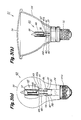
- FIG. 3 there is depicted in FIG. 3 two representative incandescent lamp embodiments each employing an outer bulb filled with an inert gas or evacuated and an inner lamp envelope containing a halogen atmosphere along with a relatively high pressure fill gas.
- the inner elongated lamp envelope has on one of its surfaces an infrared reflective film which is operatively associated with a tungsten filament disposed along the longitudinal axis of this envelope.
- incandescent lamp 32 includes an outer envelope 33 sealed to an electrically conductive base 33a.
- the outer envelope 33 has spatially disposed in a coaxial manner a single ended generally cylindrical inner envelope 45.
- the inner envelope 45 has a pair of lead-in conductors 37 and 40 which are ridgedly affixed to a stem 34.
- the lead-in wire 37 is affixed to the stem 34 by a crossmember conductor 36 having one end connected to in-lead 37 and the other end connected to conductor 35 which extends through stem 34 and which is connected to the appropriate portion of the electrically conductive base 33a.
- Lead-in wire 40 is affixed to stem 34 by a cross-member conductor 39 having one end connected to in-lead 40 and the other end connected to conductor 38 which extends through stem 34 and is connected to the appropriate portion of the electrically conductive base 33a.
- the inner envelope 45 of the present invention shown within the general service incandescent lamp 32 of FIG. 3(a) is also applicable to another embodiment shown in FIG. 3(b) with a PAR lamp 50. Accordingly, the same numerals have been retained for said inner lamp envelope in the FIG. 3(b) lamp embodiment.
- the PAR lamp 50 of FIG. 3(b) has a generally frustoconical side portion 54 and a relatively flat top lens portion 56 as shown in a partially exposed manner so as to illustrate the location of the inner envelope 45 therein.
- the inner envelope 45 is centrally positioned adjacent to the base of the PAR lamp 50 and the lead-in conductors 37 and 40 are electrically connected (not shown) to the electrically conductive base 52 thereof.
- the filament 48 within the inner envelope 45 is located within lamp 50 so as to be predeterminately aligned in a longitudinal manner relative to the focal point of the parabolic lamp 50. More particularly, the mid-section of the filament 48 is aligned in a longitudinal manner to within ⁇ 7.5 millimeters of the focal point of lamp 50.
- This alignment provides, in part, the desired optical light transmission characteristics of lamp 50. Still further with regard to said lamp filament 48, it is advantageous from an optical view point to have the length of said filament held to a relatively small value so that it acts as point source for emitting the incandescent light of the lamp 50.
- the lead-in wires 37 and 40 are respectively connected to molybdenum foil elements 42 and 41 and encapsulated within a pinch seal region 45b of the inner envelope 45.
- the molybdenum foil elements 42 and 41 are respectively connected to conductors 43 and 44.
- Said molybdenum foil elements 42 and 41 have flat-like structure and are commonly utilized to provide for proper sealing within pinch seal region 45b when a quartz tube is used to form the inner envelope 45.
- the lead-in wires 37 and 40 may each be rod-like for entrance into inner envelope 45 to obviate further need for the molybdenum foil elements 41 and 42 and also the conductors 43 and 44.
- the inner envelope 45 employs internal lead-in conductors each having an L shaped configuration and with respective leg portions 57 and 58 being joined directly to opposite single end turns of the coiled filament 48 in the same manner as described for the previously disclosed lamp embodiments.
Landscapes
- Engineering & Computer Science (AREA)
- Manufacturing & Machinery (AREA)
- Resistance Heating (AREA)
- Vessels And Coating Films For Discharge Lamps (AREA)
Applications Claiming Priority (2)
| Application Number | Priority Date | Filing Date | Title |
|---|---|---|---|
| US07/243,371 US4918356A (en) | 1988-10-17 | 1988-10-17 | Electric incandescent lamp and method of manufacture therefor |
| US243371 | 1988-10-17 |
Publications (3)
| Publication Number | Publication Date |
|---|---|
| EP0364831A2 true EP0364831A2 (de) | 1990-04-25 |
| EP0364831A3 EP0364831A3 (de) | 1991-04-03 |
| EP0364831B1 EP0364831B1 (de) | 1995-05-24 |
Family
ID=22918495
Family Applications (1)
| Application Number | Title | Priority Date | Filing Date |
|---|---|---|---|
| EP89118562A Expired - Lifetime EP0364831B1 (de) | 1988-10-17 | 1989-10-06 | Elektrische Glühlampe und Verfahren zu ihrer Herstellung |
Country Status (4)
| Country | Link |
|---|---|
| US (1) | US4918356A (de) |
| EP (1) | EP0364831B1 (de) |
| JP (1) | JPH0626115B2 (de) |
| DE (1) | DE68922816T2 (de) |
Cited By (4)
| Publication number | Priority date | Publication date | Assignee | Title |
|---|---|---|---|---|
| EP0397422A3 (de) * | 1989-05-09 | 1991-04-24 | General Electric Company | Glühlampendrahtträger |
| US5926078A (en) * | 1995-08-04 | 1999-07-20 | Ngk Spark Plug Co., Ltd. | Dielectric filter including various means of adjusting the coupling between resonators |
| WO2007113710A1 (en) * | 2006-03-30 | 2007-10-11 | Koninklijke Philips Electronics N.V. | Incandescent lamp with filament support |
| US7282847B2 (en) | 2001-11-12 | 2007-10-16 | Koninklijke Philips Electronics, N.V. | Electric lamp and manufacturing method |
Families Citing this family (8)
| Publication number | Priority date | Publication date | Assignee | Title |
|---|---|---|---|---|
| US5168193A (en) * | 1991-09-30 | 1992-12-01 | General Electric Company | Lamp having boron nitride reflective coating |
| TW297551U (en) * | 1992-03-27 | 1997-02-01 | Gen Electric | Filament support for incandescent lamps |
| JP3594138B2 (ja) | 2002-01-25 | 2004-11-24 | ノーリツ鋼機株式会社 | ハロゲンランプ |
| US20070035249A1 (en) * | 2005-08-10 | 2007-02-15 | Geza Cseh | Lamp with inner capsule |
| US7977855B2 (en) * | 2005-12-22 | 2011-07-12 | Randal Lee Wimberly | Incandescent lamp and illumination system with optimized filament shape and size |
| US8215002B2 (en) * | 2007-09-29 | 2012-07-10 | Osram Sylvania Inc. | Method of making a lamp coil |
| US8183760B2 (en) * | 2010-06-15 | 2012-05-22 | Osram Sylvania Inc. | Coils for electron discharge devices |
| JP2016206484A (ja) * | 2015-04-24 | 2016-12-08 | 株式会社リコー | ヒータ、定着装置及び画像形成装置 |
Family Cites Families (12)
| Publication number | Priority date | Publication date | Assignee | Title |
|---|---|---|---|---|
| GB1062819A (en) * | 1963-08-12 | 1967-03-22 | Sylvania Electric Prod | Incandescent lamps using coiled-coil filaments |
| US3416024A (en) * | 1966-05-31 | 1968-12-10 | Gen Electric | Differential output incandescent lamp |
| US3423622A (en) * | 1966-07-05 | 1969-01-21 | Sylvania Electric Prod | Electrical filament support device |
| JPS4514872Y1 (de) * | 1966-11-29 | 1970-06-22 | ||
| US4012659A (en) * | 1975-12-31 | 1977-03-15 | Gte Sylvania Incorporated | Method of flashing tungsten filament |
| JPS5546448A (en) * | 1978-09-30 | 1980-04-01 | Tokyo Shibaura Electric Co | Bulb |
| US4389201A (en) * | 1979-03-12 | 1983-06-21 | General Electric Company | Method of manufacturing a lamp |
| US4588923A (en) * | 1983-04-29 | 1986-05-13 | General Electric Company | High efficiency tubular heat lamps |
| US4535269A (en) * | 1983-08-01 | 1985-08-13 | General Electric Company | Incandescent lamp |
| JPS6335254U (de) * | 1986-08-26 | 1988-03-07 | ||
| DE3752039T2 (de) * | 1986-12-16 | 1997-10-30 | Gte Prod Corp | Kompakte Doppelglühwendel mit Haltern |
| US4835443A (en) * | 1986-12-16 | 1989-05-30 | Gte Products Corporation | High voltage hard glass halogen capsule |
-
1988
- 1988-10-17 US US07/243,371 patent/US4918356A/en not_active Expired - Lifetime
-
1989
- 1989-10-06 EP EP89118562A patent/EP0364831B1/de not_active Expired - Lifetime
- 1989-10-06 DE DE68922816T patent/DE68922816T2/de not_active Expired - Lifetime
- 1989-10-16 JP JP1268860A patent/JPH0626115B2/ja not_active Expired - Lifetime
Cited By (4)
| Publication number | Priority date | Publication date | Assignee | Title |
|---|---|---|---|---|
| EP0397422A3 (de) * | 1989-05-09 | 1991-04-24 | General Electric Company | Glühlampendrahtträger |
| US5926078A (en) * | 1995-08-04 | 1999-07-20 | Ngk Spark Plug Co., Ltd. | Dielectric filter including various means of adjusting the coupling between resonators |
| US7282847B2 (en) | 2001-11-12 | 2007-10-16 | Koninklijke Philips Electronics, N.V. | Electric lamp and manufacturing method |
| WO2007113710A1 (en) * | 2006-03-30 | 2007-10-11 | Koninklijke Philips Electronics N.V. | Incandescent lamp with filament support |
Also Published As
| Publication number | Publication date |
|---|---|
| JPH0626115B2 (ja) | 1994-04-06 |
| DE68922816D1 (de) | 1995-06-29 |
| EP0364831B1 (de) | 1995-05-24 |
| DE68922816T2 (de) | 1995-12-21 |
| US4918356A (en) | 1990-04-17 |
| JPH02181358A (ja) | 1990-07-16 |
| EP0364831A3 (de) | 1991-04-03 |
Similar Documents
| Publication | Publication Date | Title |
|---|---|---|
| US4942331A (en) | Filament alignment spud for incandescent lamps | |
| US4959585A (en) | Electric incandescent lamp and method of manufacture therefor | |
| US4918356A (en) | Electric incandescent lamp and method of manufacture therefor | |
| CA1181050A (en) | Discharge lamp with mount providing self centering and thermal expansion compensation | |
| JP2677941B2 (ja) | 白熱ランプのフィラメント支持物 | |
| US3445713A (en) | Halogen cycle incandescent lamp | |
| US3515930A (en) | Compact bent end electric lamp | |
| US4916353A (en) | Incandescent lamp utilizing cylindrical transparent heat mirror | |
| US4918354A (en) | Compact coiled coil incandescent filament with supports and pitch control | |
| EP0429256B1 (de) | Verbesserte Aufbauzuordnung für Doppelendlampe | |
| US4295185A (en) | Filament mount assembly for miniature incandescent lamp, and method of manufacture | |
| US2980818A (en) | Projection lamp | |
| US6225731B1 (en) | Glass halogen lamp with internal ellipsoidal shroud | |
| JP2004502278A (ja) | 押圧封止部内で緊締されたフィラメント脚部を有するハロゲン白熱ランプ | |
| US3696265A (en) | Compact single-ended incandescent lamp having improved filament mount assembly | |
| WO1993013545A1 (en) | Filament support for tubular lamp capsule | |
| US4839559A (en) | Radiant energy incandescent lamp | |
| US4835443A (en) | High voltage hard glass halogen capsule | |
| EP0465198A2 (de) | Scheinwerferlampe | |
| EP0271857B1 (de) | Kompakte Doppelglühwendel mit Haltern | |
| US6429579B1 (en) | Apparatus and method of lead centering for halogen/incandescent lamps | |
| US4574217A (en) | Incandescent lamp and base | |
| EP0271858B1 (de) | Halogenkolben aus Hartglas für Hochspannung | |
| GB2231717A (en) | Improved reflector lamp unit construction | |
| EP0271859B1 (de) | Kompakte Doppelglühwendel mit Anwendung der Steigung für Biegungskontrolle |
Legal Events
| Date | Code | Title | Description |
|---|---|---|---|
| PUAI | Public reference made under article 153(3) epc to a published international application that has entered the european phase |
Free format text: ORIGINAL CODE: 0009012 |
|
| AK | Designated contracting states |
Kind code of ref document: A2 Designated state(s): DE FR GB NL |
|
| PUAL | Search report despatched |
Free format text: ORIGINAL CODE: 0009013 |
|
| AK | Designated contracting states |
Kind code of ref document: A3 Designated state(s): DE FR GB NL |
|
| 17P | Request for examination filed |
Effective date: 19910926 |
|
| 17Q | First examination report despatched |
Effective date: 19931019 |
|
| GRAA | (expected) grant |
Free format text: ORIGINAL CODE: 0009210 |
|
| AK | Designated contracting states |
Kind code of ref document: B1 Designated state(s): DE FR GB NL |
|
| REF | Corresponds to: |
Ref document number: 68922816 Country of ref document: DE Date of ref document: 19950629 |
|
| ET | Fr: translation filed | ||
| PLBE | No opposition filed within time limit |
Free format text: ORIGINAL CODE: 0009261 |
|
| STAA | Information on the status of an ep patent application or granted ep patent |
Free format text: STATUS: NO OPPOSITION FILED WITHIN TIME LIMIT |
|
| 26N | No opposition filed | ||
| PGFP | Annual fee paid to national office [announced via postgrant information from national office to epo] |
Ref country code: FR Payment date: 20010920 Year of fee payment: 13 |
|
| PGFP | Annual fee paid to national office [announced via postgrant information from national office to epo] |
Ref country code: NL Payment date: 20010925 Year of fee payment: 13 |
|
| REG | Reference to a national code |
Ref country code: GB Ref legal event code: IF02 |
|
| PG25 | Lapsed in a contracting state [announced via postgrant information from national office to epo] |
Ref country code: NL Free format text: LAPSE BECAUSE OF NON-PAYMENT OF DUE FEES Effective date: 20030501 |
|
| PG25 | Lapsed in a contracting state [announced via postgrant information from national office to epo] |
Ref country code: FR Free format text: LAPSE BECAUSE OF NON-PAYMENT OF DUE FEES Effective date: 20030630 |
|
| NLV4 | Nl: lapsed or anulled due to non-payment of the annual fee |
Effective date: 20030501 |
|
| REG | Reference to a national code |
Ref country code: FR Ref legal event code: ST |
|
| PGFP | Annual fee paid to national office [announced via postgrant information from national office to epo] |
Ref country code: DE Payment date: 20081201 Year of fee payment: 20 |
|
| PGFP | Annual fee paid to national office [announced via postgrant information from national office to epo] |
Ref country code: GB Payment date: 20081029 Year of fee payment: 20 |
|
| REG | Reference to a national code |
Ref country code: GB Ref legal event code: PE20 Expiry date: 20091005 |
|
| PG25 | Lapsed in a contracting state [announced via postgrant information from national office to epo] |
Ref country code: GB Free format text: LAPSE BECAUSE OF EXPIRATION OF PROTECTION Effective date: 20091005 |