EP0365405A1 - Verfahren zur Kodierung, geeignet zur Erkennung von Synchronisations-Worten in einer Folge von kodierten Worten, die mittels eines Kodes mit variabler Länge kodiert sind - Google Patents
Verfahren zur Kodierung, geeignet zur Erkennung von Synchronisations-Worten in einer Folge von kodierten Worten, die mittels eines Kodes mit variabler Länge kodiert sind Download PDFInfo
- Publication number
- EP0365405A1 EP0365405A1 EP89402831A EP89402831A EP0365405A1 EP 0365405 A1 EP0365405 A1 EP 0365405A1 EP 89402831 A EP89402831 A EP 89402831A EP 89402831 A EP89402831 A EP 89402831A EP 0365405 A1 EP0365405 A1 EP 0365405A1
- Authority
- EP
- European Patent Office
- Prior art keywords
- leaves
- words
- tree
- bits
- level
- Prior art date
- Legal status (The legal status is an assumption and is not a legal conclusion. Google has not performed a legal analysis and makes no representation as to the accuracy of the status listed.)
- Granted
Links
- 238000000034 method Methods 0.000 title claims abstract description 28
- 230000005540 biological transmission Effects 0.000 claims description 3
- 230000003247 decreasing effect Effects 0.000 abstract 1
- 238000004422 calculation algorithm Methods 0.000 description 15
- 230000001174 ascending effect Effects 0.000 description 3
- 238000010276 construction Methods 0.000 description 2
- 238000007796 conventional method Methods 0.000 description 2
- 238000001514 detection method Methods 0.000 description 2
- 230000004048 modification Effects 0.000 description 2
- 238000012986 modification Methods 0.000 description 2
- 238000004364 calculation method Methods 0.000 description 1
- 230000006835 compression Effects 0.000 description 1
- 238000007906 compression Methods 0.000 description 1
- 230000001186 cumulative effect Effects 0.000 description 1
- 230000001627 detrimental effect Effects 0.000 description 1
- 238000010586 diagram Methods 0.000 description 1
- 238000006073 displacement reaction Methods 0.000 description 1
- 230000000694 effects Effects 0.000 description 1
- 238000004519 manufacturing process Methods 0.000 description 1
- 238000000926 separation method Methods 0.000 description 1
- 238000004088 simulation Methods 0.000 description 1
- 230000001360 synchronised effect Effects 0.000 description 1
Images


Classifications
-
- H—ELECTRICITY
- H03—ELECTRONIC CIRCUITRY
- H03M—CODING; DECODING; CODE CONVERSION IN GENERAL
- H03M7/00—Conversion of a code where information is represented by a given sequence or number of digits to a code where the same, similar or subset of information is represented by a different sequence or number of digits
- H03M7/30—Compression; Expansion; Suppression of unnecessary data, e.g. redundancy reduction
- H03M7/40—Conversion to or from variable length codes, e.g. Shannon-Fano code, Huffman code, Morse code
Definitions
- the present invention relates to a method for recognizing synchronization words in sequences of coded words of variable length. It applies in particular to the production of flow compression systems.
- Huffman's statistical coding method is often used.
- this method leads to the construction of code words of variable lengths, the maximum length of which, which cannot be controlled, leads to embodiments of complicated coding devices.
- the codes have non-uniform lengths, the binary words which they form can be altered; which causes transmission errors.
- a first method consists in ignoring the type of information which is transmitted and in placing a synchronization word after a determined number N of bits used in the transmission.
- the advantage of this method is that it fixes the length of the blocks and precisely determines the position of the synchronization words. Under these conditions it is possible to use self-correcting error codes to preferentially protect the synchronization words.
- a second method consists in placing a synchronization word after N coded events. Under these conditions the position of the synchronization words is not known.
- the third method consists in performing a coding where the number of coded events and the number of bits per block are not necessarily known. In the latter two cases, it is essential to protect or at least recognize the synchronization words in order to effectively locate the disturbances caused by the errors. However, the existing correcting codes do not make it possible to privilege the protection of the synchronization words when the positions of these are not known.
- the object of the invention is therefore to overcome this drawback.
- the subject of the invention is a coding method suitable for recognizing synchronization words in sequences of coded words of variable lengths, each code word corresponding to a determined event or message from a series of messages each affected by 'a probability of occurrence, of the type consisting in constructing a dichotomous coding tree comprising a determined number of leaves distributed over priority levels classified in descending order from the root of the tree to the leaves, the number of leaves being equal to the number of events to be coded, characterized in that it consists in placing the adjacent leaves together on each level, the leaves corresponding to the most likely events being placed at the same end on the right or left on each level, and to prohibit in coded words the sequences of Smax bits of the same value, zero or one.
- the conventional method used to locate a synchronization word in a sequence of binary words consists in comparing the weight of several sequences of successive bits with each other, each sequence comprising a determined number of bits.
- this weight is defined on a sequence of bits by the sum of all the bits at "1" of the sequence it is clear that by giving for example a weight equal to "0" to the synchronization word, this word becomes perfectly identifiable among the other sequences which have weights greater than "0".
- the word MS is recognized with however a position error like this appears in Figure 1B, the same is true whenever the word C ends with zeros, but these problems may be resolved by adding as shown in FIG. 1C, a bit at "1" at the end for example of the synchronization word MS.
- the solution can be generalized for any number of T errors.
- the position of the synchronization word can be ensured on the condition that it contains at least T + 1 bits at "1". It can be seen in fact without taking into account the position of the T + 1 bits at "1" in the synchronization word, or its length only if T bits at "1" are deleted in the synchronization word the position of the word MS is kept even if it is preceded by "0" due to the presence of the remaining "1".
- a first solution may consist in prohibiting sequences of 0 or 1 in the Huffman coding tree. But the flow cost provided by this solution can be very important because the constraint intervenes even on the most likely event.
- the solution implemented by the invention consists in defining an algorithm enabling the choice of synchronization words to be facilitated, allowing without constraint to generate complete trees on the left or respectively complete on the right as shown in FIG. 2.
- a tree complete on the left being a tree where all the leaves of each level are adjacent, that is to say where there is no intermediate node to separate the leaves on the same level.
- the leaves (F1 ... F4) are represented by circles and the intermediate nodes by dots.
- the search for the length to be given to the synchronization word MS from the previous algorithm must take account on the one hand, of the fact that to ensure the position of a word MS in the presence of T errors at most, this must contain T + 1 bits at "1" and on the other hand, from the result PK of the "exclusive OR" operation defined by the relation (1) performed on any sequence of length S with the synchronization word MS. Indeed, if no error appears the result PK is zero and the synchronization word is recognized in position without error. However in the presence of V errors less than or equal to T, the result PK is less than or equal to T and then MS is recognized in position in the presence of V errors.
- the synchronization word MS must have a length S equal to (3T + 2) (Smax + 1) and have T + 1 bits at 1.
- each set of N events to be coded is coded into a set of N binary words or messages, these being assigned a numbering such that the first coded message always corresponds to the most probable event and that the last message N corresponds to the event with the lowest probability of occurrence.
- Messages 1 to N are thus ranked in order of priority such as P (1) ⁇ P (2) ⁇ P (3) ... ⁇ P (N) (5) with the condition that
- the coding tree has a binary structure which is either empty, or formed by a root, or a binary tree called the left sub-tree (SAG) or a binary tree called the right sub-tree ( SAD).
- SAG left sub-tree
- SAD right sub-tree
- Huffman's conventional method is to code events from the leaves to go back to the root of the tree.
- the N probabilities of the messages or sheets are classified in ascending order and the two lowest probabilities are isolated to form the root of a tree carrying the sum of these two probabilities.
- the N-1 remaining probabilities are then reordered in ascending order, then the preceding operations are repeated until the number of probabilities of the sorting which is performed becomes zero.
- the depth of the tree which is also that which corresponds to the number of bits of the least probable word, is only known when it is constructed. This fact can be detrimental for obtaining a low practical complexity for coding as for decoding.
- the method according to the invention overcomes this drawback by the algorithms described below which allow the coding of the events not by traversing the coding tree from the leaves towards the roots but conversely from the root to descend towards the leaves.
- TOP-DOWN A first method called "TOP-DOWN" consists in building a complete tree on the left (respectively on the right) by trying each time that the message sheets 1 to K-1 are placed in the tree to place the message sheet K on further to the right (respectively to the left) possible at the depth B considered as this is represented in FIG. 6 and on determine the number M of leaves or roots of the tree at depth B + 1 by the relation
- the leaves or roots of trees K + 1 to K + N carry a probability P (I) as a leaf or sum of probabilities as the root of a tree. Seeking to build a complete tree on the left amounts to performing a sorting simulation in ascending order of probabilities at depth B + 1.
- sheet F (K) can be considered as placed in the right place.
- P (M + K-1) + P (M + K-2) is less than the probability P (K) (12)
- the sheet F (K) is out of place and must be incremented by 1 the length of the message code K.
- P (M + K-1) + P (M + K-2) is greater than or equal to P (K) (13) the only solution is to build two trees, one first tree where the sheet F (K) is placed there and a second tree by incrementing the length of the code word by 1.
- the number of possible sheets at the depth Pmax is then given by the relation:
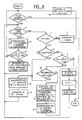
- a corresponding program, the steps 1 to 18 of which are illustrated by the flow diagram of FIG. 8, is as follows:
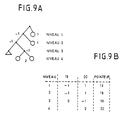
- Compliance with the constraints imposed by the search for the synchronization word namely that one prohibits sequences of more than Smax "0" in a tree and that prohibited leaves are introduced in the selected tree, can be followed at using a particular representation according to a two-dimensional table in which the first vertical dimension represents the levels in the tree and the second horizontal dimension characterizes the distribution of the leaf-intermediate nodes and forbidden leaves.
- a positive number characterizes a number of leaves placed side by side in the tree
- a negative number characterizes a number of intermediate nodes placed side by side
- the representation of a "0" characterizes a prohibited leaf .
- the last element of each level is a pointer which permanently indicates the address of the last element placed. This pointer is one of the stacked conditions. It allows, when unstacking an unfinished tree, to resume calculations on the useful sheet.
- SI designates a sequence of I "0" (respectively I "1") less than or equal to Smax, to realize the condition on the sequences of "0" it is necessary to know constantly during the execution of the algorithm the set of values of the sequences SI at the current level B and at the next level B + 1.
- the sequences SI are sequences of "0" on which we try to place the leaves, the intermediate nodes, the prohibited sheets.
- SIK designating by SIK the sequence of "0" in the tree where we are trying to place the current sheet of number K and respecting the depth limitation, it is necessary to continuously calculate the variations of FPmax as a function of SIK, LK (length of the current code word) and Pmax. Two functions are then used.
- the first function FP (SIK, LK, Pmax) calculates the modification of the number of leaves possible at the level Pmax when the leaf K is considered to be placed, the leaves 1 to K-1 being already placed in the tree.
- the second FNP function (SIK, LK, Pmax) makes it possible to calculate the modification of the number of sheets possible at the Pmax level, the sheets 1 to K-1 being already placed in the tree, the sheet K supposed to be placed seeing its length incremented by 1.
- the variations in the number of sheets at Pmax level are calculated only once if necessary, the corresponding results are used many times during the course of the algorithm.
Landscapes
- Engineering & Computer Science (AREA)
- Theoretical Computer Science (AREA)
- Compression, Expansion, Code Conversion, And Decoders (AREA)
- Compression Or Coding Systems Of Tv Signals (AREA)
- Synchronisation In Digital Transmission Systems (AREA)
Priority Applications (1)
| Application Number | Priority Date | Filing Date | Title |
|---|---|---|---|
| AT89402831T ATE104487T1 (de) | 1988-10-19 | 1989-10-13 | Verfahren zur kodierung, geeignet zur erkennung von synchronisations-worten in einer folge von kodierten worten, die mittels eines kodes mit variabler laenge kodiert sind. |
Applications Claiming Priority (2)
| Application Number | Priority Date | Filing Date | Title |
|---|---|---|---|
| FR8813760 | 1988-10-19 | ||
| FR8813760A FR2637995B1 (de) | 1988-10-19 | 1988-10-19 |
Publications (2)
| Publication Number | Publication Date |
|---|---|
| EP0365405A1 true EP0365405A1 (de) | 1990-04-25 |
| EP0365405B1 EP0365405B1 (de) | 1994-04-13 |
Family
ID=9371165
Family Applications (1)
| Application Number | Title | Priority Date | Filing Date |
|---|---|---|---|
| EP89402831A Expired - Lifetime EP0365405B1 (de) | 1988-10-19 | 1989-10-13 | Verfahren zur Kodierung, geeignet zur Erkennung von Synchronisations-Worten in einer Folge von kodierten Worten, die mittels eines Kodes mit variabler Länge kodiert sind |
Country Status (9)
| Country | Link |
|---|---|
| US (1) | US5077760A (de) |
| EP (1) | EP0365405B1 (de) |
| JP (1) | JPH03503351A (de) |
| AT (1) | ATE104487T1 (de) |
| DE (1) | DE68914579T2 (de) |
| ES (1) | ES2050829T3 (de) |
| FR (1) | FR2637995B1 (de) |
| PT (1) | PT92018A (de) |
| WO (1) | WO1990004885A1 (de) |
Families Citing this family (7)
| Publication number | Priority date | Publication date | Assignee | Title |
|---|---|---|---|---|
| JPH0765002A (ja) * | 1993-08-31 | 1995-03-10 | Fuji Xerox Co Ltd | 文書処理装置 |
| US5661763A (en) * | 1995-07-28 | 1997-08-26 | Adtran, Inc. | Apparatus and method for detecting programmable length bit pattern in serial digital data stream |
| JP3267142B2 (ja) * | 1996-02-23 | 2002-03-18 | ケイディーディーアイ株式会社 | 可変長符号生成装置 |
| US6725244B1 (en) * | 2000-02-25 | 2004-04-20 | Sun Microsystems, Inc. | Method and system for allocation of file descriptors |
| US8106797B2 (en) * | 2007-11-30 | 2012-01-31 | Comtech Ef Data Corporation | Assigning codes to and repairing Huffman trees |
| CN117176539A (zh) * | 2018-01-26 | 2023-12-05 | 加州理工学院 | 通过在零点上调制数据来进行通信的系统和方法 |
| CN114008985B (zh) * | 2019-02-07 | 2024-03-12 | 加州理工学院 | 存在信道损伤时通过在零点上调制数据进行通信的系统和方法 |
Citations (4)
| Publication number | Priority date | Publication date | Assignee | Title |
|---|---|---|---|---|
| GB2123654A (en) * | 1982-07-12 | 1984-02-01 | Nec Corp | Synchronization circuit for a viterbi decoder |
| EP0139511A2 (de) * | 1983-10-11 | 1985-05-02 | Signal Processors Limited | Digitaler Datendekodierer |
| US4539684A (en) * | 1983-01-07 | 1985-09-03 | Motorola, Inc. | Automatic frame synchronization recovery utilizing a sequential decoder |
| EP0208537A2 (de) * | 1985-07-09 | 1987-01-14 | Codex Corporation | Übertragungssysteme |
Family Cites Families (5)
| Publication number | Priority date | Publication date | Assignee | Title |
|---|---|---|---|---|
| US4475174A (en) * | 1981-09-08 | 1984-10-02 | Nippon Telegraph & Telephone Public Corporation | Decoding apparatus for codes represented by code tree |
| JP2563239B2 (ja) * | 1984-02-06 | 1996-12-11 | 松下電器産業株式会社 | 同期パタ−ン選定方法 |
| US4899149A (en) * | 1986-02-28 | 1990-02-06 | Gary Kahan | Method of and apparatus for decoding Huffman or variable-length coees |
| US4870695A (en) * | 1987-03-20 | 1989-09-26 | International Business Machines Corporation | Compression and de-compression of column-interlaced, row-interlaced graylevel digital images |
| US4853696A (en) * | 1987-04-13 | 1989-08-01 | University Of Central Florida | Code converter for data compression/decompression |
-
1988
- 1988-10-19 FR FR8813760A patent/FR2637995B1/fr not_active Expired - Lifetime
-
1989
- 1989-10-10 JP JP1511367A patent/JPH03503351A/ja active Pending
- 1989-10-10 US US07/499,283 patent/US5077760A/en not_active Expired - Fee Related
- 1989-10-10 WO PCT/FR1989/000521 patent/WO1990004885A1/fr not_active Ceased
- 1989-10-13 EP EP89402831A patent/EP0365405B1/de not_active Expired - Lifetime
- 1989-10-13 DE DE68914579T patent/DE68914579T2/de not_active Expired - Fee Related
- 1989-10-13 AT AT89402831T patent/ATE104487T1/de not_active IP Right Cessation
- 1989-10-13 ES ES89402831T patent/ES2050829T3/es not_active Expired - Lifetime
- 1989-10-18 PT PT92018A patent/PT92018A/pt not_active Application Discontinuation
Patent Citations (4)
| Publication number | Priority date | Publication date | Assignee | Title |
|---|---|---|---|---|
| GB2123654A (en) * | 1982-07-12 | 1984-02-01 | Nec Corp | Synchronization circuit for a viterbi decoder |
| US4539684A (en) * | 1983-01-07 | 1985-09-03 | Motorola, Inc. | Automatic frame synchronization recovery utilizing a sequential decoder |
| EP0139511A2 (de) * | 1983-10-11 | 1985-05-02 | Signal Processors Limited | Digitaler Datendekodierer |
| EP0208537A2 (de) * | 1985-07-09 | 1987-01-14 | Codex Corporation | Übertragungssysteme |
Non-Patent Citations (3)
| Title |
|---|
| IEE PROCEEDINGS, PART E vol. 133, no. 1, janvier 1986, STEVENAGE GB pages 54 - 63; M.R.TITCHENER ET AL: "SYNCHRONISATION PROCESS FOR THE VARIABLE-LENGTH T-CODES" * |
| IEEE TRANSACTIONS ON INFORMATION THEORY. vol. IT-17, no. 4, juillet 1971, NEW YORK US pages 478 - 487; BEULAH RUDNER: "CONSTRUCTION OF MINIMUM-REDUNDANCY CODES WITH AN OPTIMUM SYNCHRONIZING PROPERTY" * |
| PATENT ABSTRACTS OF JAPAN vol. 9, no. 332 (E-370)(2055) 26 décembre 1985, & JP-A-60 163548 (MATSUSHITA DENKI SANGYO K.K.) 26 août 1985, * |
Also Published As
| Publication number | Publication date |
|---|---|
| DE68914579D1 (de) | 1994-05-19 |
| JPH03503351A (ja) | 1991-07-25 |
| FR2637995A1 (de) | 1990-04-20 |
| ATE104487T1 (de) | 1994-04-15 |
| DE68914579T2 (de) | 1994-07-21 |
| WO1990004885A1 (fr) | 1990-05-03 |
| PT92018A (pt) | 1990-04-30 |
| ES2050829T3 (es) | 1994-06-01 |
| US5077760A (en) | 1991-12-31 |
| EP0365405B1 (de) | 1994-04-13 |
| FR2637995B1 (de) | 1990-11-23 |
Similar Documents
| Publication | Publication Date | Title |
|---|---|---|
| EP0436251B1 (de) | System zur Kodierung/Dekodierung von digitalen Signalen zur Übertragung und/oder Speicherung | |
| EP0329533B1 (de) | Kodierungs- und Dekodierungsverfahren variabler Länge, Kodierungs- und Dekodierungsvorrichtung zur Ausführung dieses Verfahrens | |
| FR2931271A1 (fr) | Procede et dispositif de codage d'un document structure et procede et dispositif de decodage d'un document ainsi code | |
| EP0511139A1 (de) | Dekodierungsverfahren für Maximalwahrscheinlichkeitsfaltungskoder, und Bewertung der Entscheidungen, und Dekoder dafür | |
| EP0239453A1 (de) | Verfahren und Anordnung zur Übertragung von digitalen, in Nachrichtenrahmen zusammengefassten Daten | |
| FR2681486A1 (fr) | Appareil de decodage de viterbi. | |
| EP0365405B1 (de) | Verfahren zur Kodierung, geeignet zur Erkennung von Synchronisations-Worten in einer Folge von kodierten Worten, die mittels eines Kodes mit variabler Länge kodiert sind | |
| FR2933514A1 (fr) | Procedes et dispositifs de codage et de decodage par similarites pour documents de type xml | |
| EP0372608A1 (de) | Verfahren und Einrichtung zur Bilddatenkompression mit einem neuronalen Netzwerk | |
| FR2929778A1 (fr) | Procedes et dispositifs de codage et de decodage binaire iteratif pour documents de type xml. | |
| EP2661814B1 (de) | Dekodierverfahren und dekodierer | |
| EP1358583B1 (de) | Verfahren zur codierung und decodierung eines pfades in der baumstruktur eines strukturierten dokuments | |
| EP0066512A1 (de) | Kodierungsverfahren für binäre Daten und Anwendung des Verfahrens in einem Magnetband-Transfer-System für ein digitales Videosignal | |
| EP2661815B1 (de) | Verfahren zur korrektur von nachrichten mit bitstopfung | |
| EP1527521B1 (de) | Vorrichtung und verfahren zur robusten dekodierung arithmetischer kodes | |
| EP1326345A1 (de) | Kompakter Turbo-Dekoder mit hoher Effizienz | |
| EP1946496B1 (de) | Verfahren und vorrichtung zur konfliktauflösung in einem drahtlosen telekommunikationsnetzwerk | |
| EP0341166A1 (de) | Verfahren und Vorrichtung zur asynchronen Übertragung von Datenpaketen | |
| CA2039285C (fr) | Procede et dispositif de decodage sequentiel d'un train numerique code par un code correcteur d'erreurs de type convolutif | |
| FR2873518A1 (fr) | Procede de codage et de decodage d'une sequence de mots, signal, codeur, decodeur, programmes d'ordinateur et moyens de stockage correspondants | |
| EP0982866A1 (de) | Verfahren zur Faltungskodierung und Uebertragung von digitalen Datenpaketen, Gerät und Verfahren zur entsprechenden Dekodierung | |
| EP1613103B1 (de) | Verfahren zur Erkennung redundanter Nachrichten in einem Nachrichtenstrom | |
| FR3138220A1 (fr) | Procédé de détection d'anomalies réseau | |
| EP1129554B1 (de) | Verfahren zur effizienten durchführung einer treillisbasierten spektralformung mit vorhersage | |
| FR2640840A1 (fr) | Procede de codage d'une suite d'images, par une transformation et une pluralite de codes a longueur variable, et dispositifs pour la mise en oeuvre de ce procede |
Legal Events
| Date | Code | Title | Description |
|---|---|---|---|
| PUAI | Public reference made under article 153(3) epc to a published international application that has entered the european phase |
Free format text: ORIGINAL CODE: 0009012 |
|
| AK | Designated contracting states |
Kind code of ref document: A1 Designated state(s): AT CH DE ES GB LI NL SE |
|
| 17P | Request for examination filed |
Effective date: 19900914 |
|
| 17Q | First examination report despatched |
Effective date: 19930414 |
|
| GRAA | (expected) grant |
Free format text: ORIGINAL CODE: 0009210 |
|
| AK | Designated contracting states |
Kind code of ref document: B1 Designated state(s): AT CH DE ES GB LI NL SE |
|
| PG25 | Lapsed in a contracting state [announced via postgrant information from national office to epo] |
Ref country code: SE Free format text: THE PATENT HAS BEEN ANNULLED BY A DECISION OF A NATIONAL AUTHORITY Effective date: 19940413 Ref country code: NL Effective date: 19940413 Ref country code: AT Effective date: 19940413 |
|
| REF | Corresponds to: |
Ref document number: 104487 Country of ref document: AT Date of ref document: 19940415 Kind code of ref document: T |
|
| REF | Corresponds to: |
Ref document number: 68914579 Country of ref document: DE Date of ref document: 19940519 |
|
| REG | Reference to a national code |
Ref country code: ES Ref legal event code: FG2A Ref document number: 2050829 Country of ref document: ES Kind code of ref document: T3 |
|
| GBT | Gb: translation of ep patent filed (gb section 77(6)(a)/1977) |
Effective date: 19940519 |
|
| NLV1 | Nl: lapsed or annulled due to failure to fulfill the requirements of art. 29p and 29m of the patents act | ||
| PG25 | Lapsed in a contracting state [announced via postgrant information from national office to epo] |
Ref country code: LI Effective date: 19941031 Ref country code: CH Effective date: 19941031 |
|
| PLBE | No opposition filed within time limit |
Free format text: ORIGINAL CODE: 0009261 |
|
| STAA | Information on the status of an ep patent application or granted ep patent |
Free format text: STATUS: NO OPPOSITION FILED WITHIN TIME LIMIT |
|
| 26N | No opposition filed | ||
| REG | Reference to a national code |
Ref country code: CH Ref legal event code: PL |
|
| REG | Reference to a national code |
Ref country code: ES Ref legal event code: PC2A Owner name: THOMSON MULTIMEDIA, S.A. |
|
| REG | Reference to a national code |
Ref country code: GB Ref legal event code: 746 Effective date: 19971104 |
|
| PGFP | Annual fee paid to national office [announced via postgrant information from national office to epo] |
Ref country code: DE Payment date: 19981026 Year of fee payment: 10 |
|
| PGFP | Annual fee paid to national office [announced via postgrant information from national office to epo] |
Ref country code: GB Payment date: 19990908 Year of fee payment: 11 |
|
| PGFP | Annual fee paid to national office [announced via postgrant information from national office to epo] |
Ref country code: ES Payment date: 19991027 Year of fee payment: 11 |
|
| PG25 | Lapsed in a contracting state [announced via postgrant information from national office to epo] |
Ref country code: DE Free format text: LAPSE BECAUSE OF NON-PAYMENT OF DUE FEES Effective date: 20000801 |
|
| PG25 | Lapsed in a contracting state [announced via postgrant information from national office to epo] |
Ref country code: GB Free format text: LAPSE BECAUSE OF NON-PAYMENT OF DUE FEES Effective date: 20001013 |
|
| PG25 | Lapsed in a contracting state [announced via postgrant information from national office to epo] |
Ref country code: ES Free format text: LAPSE BECAUSE OF NON-PAYMENT OF DUE FEES Effective date: 20001014 |
|
| GBPC | Gb: european patent ceased through non-payment of renewal fee |
Effective date: 20001013 |
|
| REG | Reference to a national code |
Ref country code: ES Ref legal event code: FD2A Effective date: 20011113 |