EP0366024B1 - Montage à barette chauffante - Google Patents
Montage à barette chauffante Download PDFInfo
- Publication number
- EP0366024B1 EP0366024B1 EP89119553A EP89119553A EP0366024B1 EP 0366024 B1 EP0366024 B1 EP 0366024B1 EP 89119553 A EP89119553 A EP 89119553A EP 89119553 A EP89119553 A EP 89119553A EP 0366024 B1 EP0366024 B1 EP 0366024B1
- Authority
- EP
- European Patent Office
- Prior art keywords
- heater
- bar assembly
- heater bar
- pivot
- pivot point
- Prior art date
- Legal status (The legal status is an assumption and is not a legal conclusion. Google has not performed a legal analysis and makes no representation as to the accuracy of the status listed.)
- Expired - Lifetime
Links
Images

Classifications
-
- H—ELECTRICITY
- H05—ELECTRIC TECHNIQUES NOT OTHERWISE PROVIDED FOR
- H05K—PRINTED CIRCUITS; CASINGS OR CONSTRUCTIONAL DETAILS OF ELECTRIC APPARATUS; MANUFACTURE OF ASSEMBLAGES OF ELECTRICAL COMPONENTS
- H05K13/00—Apparatus or processes specially adapted for manufacturing or adjusting assemblages of electric components
- H05K13/04—Mounting of components, e.g. of leadless components
- H05K13/046—Surface mounting
- H05K13/0465—Surface mounting by soldering
-
- B—PERFORMING OPERATIONS; TRANSPORTING
- B23—MACHINE TOOLS; METAL-WORKING NOT OTHERWISE PROVIDED FOR
- B23K—SOLDERING OR UNSOLDERING; WELDING; CLADDING OR PLATING BY SOLDERING OR WELDING; CUTTING BY APPLYING HEAT LOCALLY, e.g. FLAME CUTTING; WORKING BY LASER BEAM
- B23K3/00—Tools, devices or special appurtenances for soldering, e.g. brazing, or unsoldering, not specially adapted for particular methods
- B23K3/04—Heating appliances
- B23K3/047—Heating appliances electric
- B23K3/0471—Heating appliances electric using resistance rod or bar, e.g. carbon silica
-
- H—ELECTRICITY
- H05—ELECTRIC TECHNIQUES NOT OTHERWISE PROVIDED FOR
- H05K—PRINTED CIRCUITS; CASINGS OR CONSTRUCTIONAL DETAILS OF ELECTRIC APPARATUS; MANUFACTURE OF ASSEMBLAGES OF ELECTRICAL COMPONENTS
- H05K3/00—Apparatus or processes for manufacturing printed circuits
- H05K3/30—Assembling printed circuits with electric components, e.g. with resistors
- H05K3/32—Assembling printed circuits with electric components, e.g. with resistors electrically connecting electric components or wires to printed circuits
- H05K3/34—Assembling printed circuits with electric components, e.g. with resistors electrically connecting electric components or wires to printed circuits by soldering
- H05K3/341—Surface mounted components
- H05K3/3421—Leaded components
-
- H—ELECTRICITY
- H05—ELECTRIC TECHNIQUES NOT OTHERWISE PROVIDED FOR
- H05K—PRINTED CIRCUITS; CASINGS OR CONSTRUCTIONAL DETAILS OF ELECTRIC APPARATUS; MANUFACTURE OF ASSEMBLAGES OF ELECTRICAL COMPONENTS
- H05K3/00—Apparatus or processes for manufacturing printed circuits
- H05K3/30—Assembling printed circuits with electric components, e.g. with resistors
- H05K3/32—Assembling printed circuits with electric components, e.g. with resistors electrically connecting electric components or wires to printed circuits
- H05K3/34—Assembling printed circuits with electric components, e.g. with resistors electrically connecting electric components or wires to printed circuits by soldering
- H05K3/3494—Heating processes for reflow soldering
Definitions
- the present invention relates to a heater bar assembly including
- a heater bar assembly of this kind is known from U.S. patent US 4,654,507.
- this invention is directed to a heater bar for soldering closely spaced components to printed wiring boards, and particularly apply heat to leads to melt solder already in place to cause reflow soldering.
- Printed wiring boards have pads thereon which are coated with solder. Electrical components are positioned so their electrical leads lie on the pads. The solder is heated to melting so that the leads are connected to the pads by means of a solder joint. There are a number of ways for heating the solder. One of the ways is to apply a heater bar to the lead, for heating the lead and solder.
- said heater comprises a pivot point adjacent said heating face, said pivot point on said heater engaging said pivot point on said body, whereby said rotational axis passes through the engagement of said pivot points.
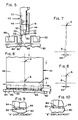
- the heater bar assembly of this invention is generally indicated at 10 in FIGS. 1 and 2.
- Body 12 is rectangular and preferably, metallic and serves as the mounting structure for the heater bar assembly.
- Body 12 extends upward from the broken-away line in FIGS. 1 and 2 and has fastener means thereon for mounting upon the soldering machine.
- the soldering machine preferably automatically positions the heater bar assembly and brings it down in to soldering position.
- the soldering machine supplies the correct current for the correct time to provide sufficient heat for proper soldering.
- Body 12 extends downward from its mounting location and is slotted across to provide guide section 14. Below the guide section, the body is narrowed to define rectangular finger 16. Pressed into a drilled opening in the lower end of the finger is pivot pin 18.
- the lower end of pivot pin 18 carries pivot point 20 thereon, see FIGS. 2 and 5. This provides the rigid structure which defines the precise location of the pivot point with respect to the body 12 and thus with respect to the soldering machine.
- FIG. 1 is a back view of the assembly, and in this orientation, it is seen that right and left busses 22 and 24 are positioned adjacent the sides of finger 18 and are spaced therefrom and extend downward therealong.
- the buss bars 22 and 24 extend upward to the back of the guide section 14 where they respectively lie on pads 26 and 28.
- Right pad 26 is also seen in FIG. 2 to show that the buss bars are spaced from the metallic guide section.
- the pads 26 and 28 are of insulative, low-friction material to electrically separate the buss bars from the guide section and to permit lateral sliding motion of the buss bars with respect to the guide section.
- thermocouple connector body 30 Opposite the upper end of the buss bars is thermocouple connector body 30.
- Body 30 is made of dielectric material and carries thereon thermocouple connectors 32 and 34.
- Thermocouple leads 36 extend downward from the thermocouple connectors.
- Right and left lugs 38 and 39 are positioned between the thermocouple connector body and the two busses, respectively. Power leads from the right and left lugs are connected to the soldering machine, which supplies the heater current therethrough.
- Clamp screws 40 and 41 have their heads engaging on the front of the thermocouple connector body, extend through the thermocouple connector body, through lugs 38 and 39, and threadedly engage in the busses 22 and 24.
- the screw 40 is shown in FIG. 2 in dashed lines to illustrate this connection function.
- FIG. 1 illustrates that the lugs 38 and 39 are slotted so that they may be pulled out simply by loosening the clamp screws.
- the busses 22 and 24 on the back and the thermocouple connector body on the front are not clamped tight to the guide section 14, but lateral motion is provided.
- the fit is close so that rotation around the center line, as defined by the axis of pivot pin 18, is minimized.
- Heater 42 is a U-shaped structure of metal of intermediate resistance so that, when electric current is passed therethrough, heating of the heater results.
- Heater 42 is U-shaped with a front leg 44 and a back leg 46.
- the front leg is attached to right buss 22 and is spaced from left buss 24.
- the back leg 46 is connected to left buss 24 and is spaced from right buss 22, see FIG. 4. In this way, current passing through the busses passes through the heater, from one leg to the other.
- heater 42 has a first bend 48 of about 90 degrees which produces a platform 50 between the front and back legs of the heater. Beyond the platform, second bend 52 is of more than 90 degrees and carries the front 54 of the U-shaped heater past the platform 50.
- Pivot opening 56 in the platform receives pivot point 20.
- heated tip 58 is attached by any convenient means which is of high thermal conductivity and is strong at heater temperatures. Heated tip 58 has a soldering face 60 which applies the heat to the required location for soldering.
- the movable structure comprised of heated tip 58, busses 22 and 24, lugs 38 and 39, thermocouple connector body 30 and the screws 40 and 41 which hold it together thus pivot around pivot opening 56 engaging upon pivot point 20.
- the small dimension of these parts is such that conical binding does not occur, although spherical surfaces could be employed if the structure was larger.
- the closeness of the busses and thermocouple connector body to the guide section 14 constrains the pivoting motion to a plane parallel to the paper in FIG. 1 with its axis normal to the plane of the paper in FIG. 1 with the axis passing through the engagement of the pivot pin in the pivot opening.
- tension spring 62 see FIGS. 1 and 2.
- the upper part of the tension spring lies in spring slot 64.
- Cross pin 66 lies in a cross pin opening through the body adjacent the top of slot 64 with the spring engaged upon the cross pin.
- the lower end of the spring is engaged upon cross pin 60, see FIG. 2.
- Dielectric insulating cups 70 and 72 lie on the ends of cross pin 68. These cups engage in slots 74 and 76, respectively, in busses 22 and 24.
- the tension of spring 64 not only holds up the movable structure, but also urges it toward the centered position illustrated in FIG. 1. Any rotation of the movable assembly stretches the spring.
- the thermocouple leads 36 extend down into heater 42 and terminate in a thermocouple 78 within the U of the heater, directly above the heated tip 58. In this way, heater temperature is signaled.
- the heated tip 58 is thin enough and long enough to reach between components, as shown in FIG. 5, and is as wide as is necessary to reach across the desired number of leads and pads.
- An additional advantage of having this extended heated tip is that the face 60 can be dressed should it become other than flat along the face. Repeated dressings of the face to make it planar in a direction parallel to its rotational axis B give long life to the heater. Such dressing does not wear away the current-carrying U-portion of the heater, but merely reduces the height of heated tip 58. Thus, many dressings can be obtained without reducing the utility of the heater.
- FIGS. 6, 7, 8, 9 and 10 illustrate the significance of having a pivot point close to the soldering point at the face of the heated tip.
- FIG. 6 illustrates the heater 42 moving downward so that the face 60 of the heated tip 58 engages on a plurality of component leads on contacts on a printed wiring board 80.
- One of the pads on the printed wiring board is indicated at 82, and the component lead 84 is shown in association with that pad.
- component 86 has five such component leads in association with a corresponding number of pads.
- the component 86 may be a flat pack with the leads forming a lead frame therefrom.
- the heater 42 must pivot so that its face 60 contacts all of the leads.
- the angle Theta at the lower right of FIG. 6 illustrates this lack of level condition of that portion of the printed wiring board. Such may occur from board warping. If the pivot point of the heater 42 is high, for example at point A, far away from the face 60, then the rotation about the angle Theta produces a large displacement 88, as seen in FIG. 7.
- FIG. 7 is on the same scale as FIG. 6, and FIG. 9 is on an enlarged scale to illustrate how this displacement moves the component lead 84 at least partially off of the pad 82. This results in unsatisfactory solder conditions so that reliable soldering is difficult to achieve.
- the limited rocking of the heater and its face 60 provide this equal force, and the low pivot minimizes the offset which occurs. Since the spring 62 centers the movable structure, including the heated tip 58, the face 60 starts level and rotates only to provide equal force on all of the leads. Thus, translational forces are not produced when the board is level.
- the rocking limit of the moving structure is the striking of one or the other buss bars against the center finger 16, as seen in FIG. 1. However, this is a mechanical limit which prevents damage to the heater bar assembly and is not reached during normal soldering operation.
- FIG. 5 illustrates how two closely adjacent components 86 and 92 can have their leads reached by the heater bar assembly of this invention due to the narrow front-to-back dimension and due to the fact that heated tip 58 is thin and extends down from the U-shaped heater to keep the U-shape of the heater above and away from the component. In this way, reliable soldering is achieved.
Landscapes
- Engineering & Computer Science (AREA)
- Manufacturing & Machinery (AREA)
- Microelectronics & Electronic Packaging (AREA)
- Mechanical Engineering (AREA)
- Electric Connection Of Electric Components To Printed Circuits (AREA)
- Manufacturing Of Electrical Connectors (AREA)
- Lining Or Joining Of Plastics Or The Like (AREA)
Claims (14)
- Assemblage (10) de barrette chauffante comprenant- un corps (12) ;- un point (20) de pivotement sur ledit corps (12), adjacent à son extrémité inférieure ;- un élément chauffant (42) ;- un moyen de guidage (14) sur ledit assemblage (10) de barrette chauffante pour limiter le mouvement dudit élément chauffant (42), par rapport audit corps (12), à une rotation dans un plan unique autour d'un axe de rotation ;- une face chauffante (60) sur ledit élément chauffant (42), ladite face chauffante (60) s'étendant sensiblement parallèlement audit axe de rotation et s'étendant longitudinalement dans une direction sensiblement perpendiculaire audit axe de rotation ;caractérisé en ce que- ledit élément chauffant (42) comporte un point (56) de pivotement adjacent à ladite face chauffante (60), ledit point (56) de pivotement sur ledit élément chauffant (42) engageant ledit point (20) de pivotement sur ledit corps (12), de manière que ledit axe de rotation passe par l'engagement desdits points de pivotement.
- Assemblage (10) de barrette chauffante selon la revendication 1, dans lequel ledit élément chauffant (42) est un élément chauffant (42) de forme en U formé par des branches avant et arrière (44, 46), caractérisé en ce que ledit point (20) de pivotement sur ledit élément chauffant (42) est entre lesdites branches (44, 46).
- Assemblage (10) de barrette chauffante selon la revendication 2, caractérisé par un coude (48, 50, 52) entre lesdites branches avant et arrière (44, 46), ledit point (20) de pivotement étant audit coude (48, 50, 52).
- Assemblage (10) de barrette chauffante selon l'une quelconque des revendications précédentes, caractérisé en ce que ledit point (20) de pivotement sur ledit corps (12) comprend une broche (18) s'engageant dans ledit élément chauffant (42).
- Assemblage (10) de barrette chauffante selon l'une quelconque des revendications précédentes, caractérisé en ce que ledit corps (12) est destiné à être fixé à une machine à souder.
- Assemblage (10) de barrette chauffante selon l'une quelconque des revendications précédentes, caractérisé par une pointe chauffée (58) fixée audit assemblage (10) de barrette chauffante, ladite face chauffante (60) étant une face (60) de soudage située sur ladite pointe chauffée (58).
- Assemblage (10) de barrette chauffante selon la revendication 6, caractérisé en ce que ladite pointe chauffée (58) dépasse dudit assemblage (10) de barrette chauffante pour permettre un resurfaçage de ladite face (60) de soudage pour une réutilisation de ladite pointe chauffée (58).
- Assemblage (10) de barrette chauffante selon l'une quelconque des revendications précédentes, caractérisé en ce que ledit moyen (14) de guidage comporte au moins une surface de guidage sur ledit corps (12) et un moyen de guidage sur l'assemblage (10) de barrette chauffante destiné à entrer en contact avec ladite surface de guidage pour limiter la rotation dudit élément chauffant (42) autour dudit pivot (20).
- Assemblage (10) de barrette chauffante selon la revendication 8 et l'une quelconque des revendications 2 à 7, caractérisé par au moins un, et avantageusement des premier et second bus (22, 24), respectivement, fixés auxdites branches (44, 46) dudit élément chauffant (42) de forme en U pour alimenter en courant ledit élément chauffant (42), ledit bus ou lesdits bus (22, 24) s'étendant contre ladite surface de guidage pour limiter la rotation dudit élément chauffant (42) par rapport audit corps (12).
- Assemblage (10) de barrette chauffante selon la revendication 8 ou 9, caractérisé en ce que ladite surface de guidage sur ledit corps (12) comprend une surface de guidage avant sensiblement parallèle à une surface de guidage arrière, et comprend en outre une isolation par diélectrique.
- Assemblage (10) de barrette chauffante selon les revendications 9 et 10, caractérisé en ce que ledit moyen de guidage sur ledit assemblage (10) de barrette chauffante destiné à entrer en contact avec la surface de guidage avant comporte un corps (30) de connecteur de thermocouple et une barre omnibus (22, 24), ledit corps (30) de connecteur de thermocouple et ladite barre omnibus (22, 24) étant fixés entre eux et espacés l'un de l'autre de façon à engager ladite surface de guidage avant.
- Assemblage (10) de barrette chauffante selon l'une quelconque des revendications précédentes, caractérisé en ce qu'un ressort (62) est engagé entre ledit élément chauffant (42) et ledit corps (12) pour retenir élastiquement ledit élément chauffant (42) en place et centrer ledit élément chauffant (42) dans sa rotation.
- Assemblage (10) de barrette chauffante selon la revendication 12 et l'une quelconque des revendications 6 à 11, caractérisé en ce que ledit ressort (62) retient élastiquement ladite face chauffante (60) dans une orientation centrale avant qu'un contact avec ladite face chauffante (60) provoque une rotation de ladite pointe (58) sur son pivot (20) dans ledit plan.
- Assemblage (10) de barrette chauffante selon la revendication 12 ou 13 et la revendication 14, et l'une quelconque des revendications 9 à 11, avec des premier et second bus (22, 24), caractérisé en ce que ledit ressort (62) est relié à une goupille (68) engageant lesdits premier et second bus (22, 24) pour rappeler ledit élément chauffant (42) dans ledit pivot (20).
Applications Claiming Priority (2)
| Application Number | Priority Date | Filing Date | Title |
|---|---|---|---|
| US07/261,215 US4851648A (en) | 1988-10-24 | 1988-10-24 | Heater bar assembly |
| US261215 | 1988-10-24 |
Publications (3)
| Publication Number | Publication Date |
|---|---|
| EP0366024A2 EP0366024A2 (fr) | 1990-05-02 |
| EP0366024A3 EP0366024A3 (fr) | 1991-03-27 |
| EP0366024B1 true EP0366024B1 (fr) | 1994-03-30 |
Family
ID=22992362
Family Applications (1)
| Application Number | Title | Priority Date | Filing Date |
|---|---|---|---|
| EP89119553A Expired - Lifetime EP0366024B1 (fr) | 1988-10-24 | 1989-10-21 | Montage à barette chauffante |
Country Status (8)
| Country | Link |
|---|---|
| US (1) | US4851648A (fr) |
| EP (1) | EP0366024B1 (fr) |
| JP (1) | JPH0632846B2 (fr) |
| AU (1) | AU656880B2 (fr) |
| CA (1) | CA1296107C (fr) |
| DE (1) | DE68914243T2 (fr) |
| ES (1) | ES2050754T3 (fr) |
| IL (1) | IL91748A0 (fr) |
Families Citing this family (12)
| Publication number | Priority date | Publication date | Assignee | Title |
|---|---|---|---|---|
| US4982890A (en) * | 1989-01-10 | 1991-01-08 | Siemens Aktiengesellschaft | Soldering means having at least one stirrup electrode and two soldering webs lying opposite one another or four soldering webs lying opposite one another in pairs |
| US5016804A (en) * | 1989-01-10 | 1991-05-21 | Siemens Aktiengesellschaft | Soldering apparatus having at least one stirrup electrode |
| US5051555A (en) * | 1990-02-26 | 1991-09-24 | Universal Instruments Corporation | Hot-bar suspension system |
| GB9004247D0 (en) * | 1990-02-26 | 1990-04-18 | Automation Tooling Syst | Floating heater bar and guide |
| US5068508A (en) * | 1990-10-01 | 1991-11-26 | Raytheon Company | Complaint hot bar apparatus |
| US5150827A (en) * | 1991-11-22 | 1992-09-29 | Hughes Aircraft Company | Self-leveling reflow solder head with double pivot |
| US5614118A (en) * | 1994-10-27 | 1997-03-25 | Weber; Wolfgang | Hot plate welder with pivotably movable carriage unit |
| US6152353A (en) * | 1999-01-14 | 2000-11-28 | Celestica International Inc. | Printed circuit board header attachment station |
| JP2008296238A (ja) * | 2007-05-30 | 2008-12-11 | Fujitsu Ltd | 加工装置 |
| CN102259219B (zh) * | 2011-07-26 | 2013-04-17 | 苏州大学 | 多头焊锡机构 |
| CN106104795B (zh) * | 2014-03-29 | 2019-03-08 | 英特尔公司 | 使用局部热源的集成电路芯片附接 |
| US9576928B2 (en) * | 2015-02-27 | 2017-02-21 | Kulicke And Soffa Industries, Inc. | Bond head assemblies, thermocompression bonding systems and methods of assembling and operating the same |
Family Cites Families (10)
| Publication number | Priority date | Publication date | Assignee | Title |
|---|---|---|---|---|
| DE1266895B (de) * | 1962-07-02 | 1968-04-25 | Ibm | Loeteinrichtung fuer elektrische Schaltungsteile |
| US3448911A (en) * | 1967-06-15 | 1969-06-10 | Western Electric Co | Compensating base for simultaneously bonding multiple leads |
| JPS5252369A (en) * | 1975-10-25 | 1977-04-27 | Fujitsu Ltd | Junction head |
| JPS5524726A (en) * | 1978-08-09 | 1980-02-22 | Fujitsu Ltd | Soldering mechanism with face profiling mechanism |
| JPS5819386B2 (ja) * | 1978-11-27 | 1983-04-18 | 富士通株式会社 | 面ならい装置 |
| JPS587545Y2 (ja) * | 1980-06-30 | 1983-02-09 | 松下電工株式会社 | 反射板可動型照明器具 |
| US4568819A (en) * | 1982-12-20 | 1986-02-04 | General Electric Company | Pressure-sensitive electric soldering/desoldering tool |
| JPS60166466U (ja) * | 1984-04-10 | 1985-11-05 | 三菱電機株式会社 | ヒ−タ−バ−式リフロ−はんだ付け用電極機構 |
| JPH0414931Y2 (fr) * | 1985-03-12 | 1992-04-03 | ||
| US4654507A (en) * | 1985-05-07 | 1987-03-31 | Hughes Aircraft Company | Solder reflow heater bar assembly |
-
1988
- 1988-10-24 US US07/261,215 patent/US4851648A/en not_active Expired - Fee Related
-
1989
- 1989-09-20 CA CA000612096A patent/CA1296107C/fr not_active Expired - Fee Related
- 1989-09-22 IL IL91748A patent/IL91748A0/xx not_active IP Right Cessation
- 1989-10-11 AU AU42802/89A patent/AU656880B2/en not_active Ceased
- 1989-10-21 ES ES89119553T patent/ES2050754T3/es not_active Expired - Lifetime
- 1989-10-21 EP EP89119553A patent/EP0366024B1/fr not_active Expired - Lifetime
- 1989-10-21 DE DE68914243T patent/DE68914243T2/de not_active Expired - Fee Related
- 1989-10-24 JP JP1275106A patent/JPH0632846B2/ja not_active Expired - Lifetime
Also Published As
| Publication number | Publication date |
|---|---|
| AU656880B2 (en) | 1995-02-23 |
| AU4280289A (en) | 1990-04-26 |
| CA1296107C (fr) | 1992-02-18 |
| ES2050754T3 (es) | 1994-06-01 |
| EP0366024A3 (fr) | 1991-03-27 |
| DE68914243D1 (de) | 1994-05-05 |
| IL91748A0 (en) | 1990-06-10 |
| EP0366024A2 (fr) | 1990-05-02 |
| JPH0632846B2 (ja) | 1994-05-02 |
| US4851648A (en) | 1989-07-25 |
| DE68914243T2 (de) | 1994-07-07 |
| JPH02169178A (ja) | 1990-06-29 |
Similar Documents
| Publication | Publication Date | Title |
|---|---|---|
| EP0366024B1 (fr) | Montage à barette chauffante | |
| US4918277A (en) | Heated tool with non-flat heating surface for avoiding solder-bridging | |
| US4647126A (en) | Compliant lead clip | |
| US4788404A (en) | Self-soldering flexible circuit connector | |
| US7179091B2 (en) | Edge mount electrical connector | |
| US5175409A (en) | Self-soldering flexible circuit connector | |
| US6454573B2 (en) | Board-cable connection structure | |
| US5490786A (en) | Termination of contact tails to PC board | |
| JP3903332B2 (ja) | 電気コネクタ | |
| US5622508A (en) | Electrical connector and thermal printhead using the same | |
| US5150827A (en) | Self-leveling reflow solder head with double pivot | |
| US5145101A (en) | Tweezer handpiece for installation and removal of electronic components with respect to a substrate and tips and tool for use therewith | |
| IE77635B1 (en) | Low Height Chip Carrier Socket | |
| US4654507A (en) | Solder reflow heater bar assembly | |
| JPH0511340U (ja) | サーフエスマウント式電子部品 | |
| US4871899A (en) | Titiable electric thermode for multiple connection reflow soldering | |
| US5419483A (en) | Method and apparatus for manufacturing a printed circuit card and connector assembly | |
| US5246157A (en) | Tool for use with tweezer handpiece for installation and removal of electronic components with respect to a substrate | |
| EP1211921A2 (fr) | Composant pour le soudage à un panneau à circuit imprimé | |
| EP1109265B1 (fr) | Boîtier de connecteur électrique | |
| US5334031A (en) | Contact device for an electrical component and method for manufacture | |
| CN1178568C (zh) | 纱线处理装置 | |
| US20080108233A1 (en) | Connector having self-adjusting surface-mount attachment structures | |
| US5185509A (en) | Robotic arm tool mounting apparatus | |
| US5226825A (en) | Surface mount chip carrier socket |
Legal Events
| Date | Code | Title | Description |
|---|---|---|---|
| PUAI | Public reference made under article 153(3) epc to a published international application that has entered the european phase |
Free format text: ORIGINAL CODE: 0009012 |
|
| 17P | Request for examination filed |
Effective date: 19891113 |
|
| AK | Designated contracting states |
Kind code of ref document: A2 Designated state(s): CH DE ES FR GB IT LI SE |
|
| PUAL | Search report despatched |
Free format text: ORIGINAL CODE: 0009013 |
|
| AK | Designated contracting states |
Kind code of ref document: A3 Designated state(s): CH DE ES FR GB IT LI SE |
|
| 17Q | First examination report despatched |
Effective date: 19920228 |
|
| GRAA | (expected) grant |
Free format text: ORIGINAL CODE: 0009210 |
|
| AK | Designated contracting states |
Kind code of ref document: B1 Designated state(s): CH DE ES FR GB IT LI SE |
|
| REF | Corresponds to: |
Ref document number: 68914243 Country of ref document: DE Date of ref document: 19940505 |
|
| ITF | It: translation for a ep patent filed | ||
| REG | Reference to a national code |
Ref country code: ES Ref legal event code: FG2A Ref document number: 2050754 Country of ref document: ES Kind code of ref document: T3 |
|
| ET | Fr: translation filed | ||
| PGFP | Annual fee paid to national office [announced via postgrant information from national office to epo] |
Ref country code: FR Payment date: 19940912 Year of fee payment: 6 |
|
| PGFP | Annual fee paid to national office [announced via postgrant information from national office to epo] |
Ref country code: GB Payment date: 19940914 Year of fee payment: 6 |
|
| PGFP | Annual fee paid to national office [announced via postgrant information from national office to epo] |
Ref country code: SE Payment date: 19940916 Year of fee payment: 6 |
|
| PGFP | Annual fee paid to national office [announced via postgrant information from national office to epo] |
Ref country code: DE Payment date: 19940919 Year of fee payment: 6 Ref country code: CH Payment date: 19940919 Year of fee payment: 6 |
|
| PGFP | Annual fee paid to national office [announced via postgrant information from national office to epo] |
Ref country code: ES Payment date: 19941007 Year of fee payment: 6 |
|
| EAL | Se: european patent in force in sweden |
Ref document number: 89119553.9 |
|
| PLBE | No opposition filed within time limit |
Free format text: ORIGINAL CODE: 0009261 |
|
| STAA | Information on the status of an ep patent application or granted ep patent |
Free format text: STATUS: NO OPPOSITION FILED WITHIN TIME LIMIT |
|
| 26N | No opposition filed | ||
| PG25 | Lapsed in a contracting state [announced via postgrant information from national office to epo] |
Ref country code: GB Effective date: 19951021 |
|
| PG25 | Lapsed in a contracting state [announced via postgrant information from national office to epo] |
Ref country code: SE Effective date: 19951022 |
|
| PG25 | Lapsed in a contracting state [announced via postgrant information from national office to epo] |
Ref country code: ES Free format text: LAPSE BECAUSE OF EXPIRATION OF PROTECTION Effective date: 19951023 |
|
| PG25 | Lapsed in a contracting state [announced via postgrant information from national office to epo] |
Ref country code: LI Effective date: 19951031 Ref country code: CH Effective date: 19951031 |
|
| REG | Reference to a national code |
Ref country code: CH Ref legal event code: PL |
|
| GBPC | Gb: european patent ceased through non-payment of renewal fee |
Effective date: 19951021 |
|
| PG25 | Lapsed in a contracting state [announced via postgrant information from national office to epo] |
Ref country code: FR Effective date: 19960628 |
|
| EUG | Se: european patent has lapsed |
Ref document number: 89119553.9 |
|
| PG25 | Lapsed in a contracting state [announced via postgrant information from national office to epo] |
Ref country code: DE Effective date: 19960702 |
|
| REG | Reference to a national code |
Ref country code: FR Ref legal event code: ST |
|
| REG | Reference to a national code |
Ref country code: ES Ref legal event code: FD2A Effective date: 19990601 |
|
| PG25 | Lapsed in a contracting state [announced via postgrant information from national office to epo] |
Ref country code: IT Free format text: LAPSE BECAUSE OF NON-PAYMENT OF DUE FEES;WARNING: LAPSES OF ITALIAN PATENTS WITH EFFECTIVE DATE BEFORE 2007 MAY HAVE OCCURRED AT ANY TIME BEFORE 2007. THE CORRECT EFFECTIVE DATE MAY BE DIFFERENT FROM THE ONE RECORDED. Effective date: 20051021 |