EP0366084A1 - Procédé pour le traitement de sels d'onium quaternaires et son application à la préparation de l'oxyde d'hexafluoropropylène - Google Patents
Procédé pour le traitement de sels d'onium quaternaires et son application à la préparation de l'oxyde d'hexafluoropropylène Download PDFInfo
- Publication number
- EP0366084A1 EP0366084A1 EP89119747A EP89119747A EP0366084A1 EP 0366084 A1 EP0366084 A1 EP 0366084A1 EP 89119747 A EP89119747 A EP 89119747A EP 89119747 A EP89119747 A EP 89119747A EP 0366084 A1 EP0366084 A1 EP 0366084A1
- Authority
- EP
- European Patent Office
- Prior art keywords
- organic phase
- quaternary onium
- thiocyanate
- ion
- phase
- Prior art date
- Legal status (The legal status is an assumption and is not a legal conclusion. Google has not performed a legal analysis and makes no representation as to the accuracy of the status listed.)
- Granted
Links
- 238000000034 method Methods 0.000 title claims abstract description 173
- PGFXOWRDDHCDTE-UHFFFAOYSA-N hexafluoropropylene oxide Chemical compound FC(F)(F)C1(F)OC1(F)F PGFXOWRDDHCDTE-UHFFFAOYSA-N 0.000 title claims abstract description 130
- 150000003839 salts Chemical class 0.000 title claims abstract description 130
- 230000008569 process Effects 0.000 title claims abstract description 80
- 238000002360 preparation method Methods 0.000 title claims description 71
- 239000012074 organic phase Substances 0.000 claims abstract description 171
- 239000008346 aqueous phase Substances 0.000 claims abstract description 94
- 239000012071 phase Substances 0.000 claims abstract description 76
- 239000007800 oxidant agent Substances 0.000 claims abstract description 59
- ZMZDMBWJUHKJPS-UHFFFAOYSA-M Thiocyanate anion Chemical compound [S-]C#N ZMZDMBWJUHKJPS-UHFFFAOYSA-M 0.000 claims abstract description 58
- 239000003054 catalyst Substances 0.000 claims abstract description 50
- WQYVRQLZKVEZGA-UHFFFAOYSA-N hypochlorite Chemical compound Cl[O-] WQYVRQLZKVEZGA-UHFFFAOYSA-N 0.000 claims abstract description 49
- 150000002500 ions Chemical class 0.000 claims abstract description 46
- 229910052731 fluorine Inorganic materials 0.000 claims abstract description 42
- 239000007864 aqueous solution Substances 0.000 claims abstract description 37
- ZMZDMBWJUHKJPS-UHFFFAOYSA-N hydrogen thiocyanate Natural products SC#N ZMZDMBWJUHKJPS-UHFFFAOYSA-N 0.000 claims abstract description 35
- YCKRFDGAMUMZLT-UHFFFAOYSA-N Fluorine atom Chemical compound [F] YCKRFDGAMUMZLT-UHFFFAOYSA-N 0.000 claims abstract description 31
- 239000011737 fluorine Substances 0.000 claims abstract description 31
- XLYOFNOQVPJJNP-UHFFFAOYSA-N water Substances O XLYOFNOQVPJJNP-UHFFFAOYSA-N 0.000 claims abstract description 23
- HCDGVLDPFQMKDK-UHFFFAOYSA-N hexafluoropropylene Chemical group FC(F)=C(F)C(F)(F)F HCDGVLDPFQMKDK-UHFFFAOYSA-N 0.000 claims abstract description 22
- 150000007942 carboxylates Chemical class 0.000 claims abstract description 21
- 238000004519 manufacturing process Methods 0.000 claims abstract description 12
- 238000006243 chemical reaction Methods 0.000 claims description 90
- -1 phosphonium ion Chemical class 0.000 claims description 63
- 239000002351 wastewater Substances 0.000 claims description 48
- 150000001450 anions Chemical class 0.000 claims description 31
- 230000003197 catalytic effect Effects 0.000 claims description 31
- SUKJFIGYRHOWBL-UHFFFAOYSA-N sodium hypochlorite Chemical group [Na+].Cl[O-] SUKJFIGYRHOWBL-UHFFFAOYSA-N 0.000 claims description 30
- 239000005708 Sodium hypochlorite Substances 0.000 claims description 24
- 230000003247 decreasing effect Effects 0.000 claims description 23
- 239000003960 organic solvent Substances 0.000 claims description 21
- VGTPCRGMBIAPIM-UHFFFAOYSA-M sodium thiocyanate Chemical group [Na+].[S-]C#N VGTPCRGMBIAPIM-UHFFFAOYSA-M 0.000 claims description 21
- 125000004432 carbon atom Chemical group C* 0.000 claims description 18
- 239000002904 solvent Substances 0.000 claims description 17
- 229910052783 alkali metal Inorganic materials 0.000 claims description 14
- 150000001768 cations Chemical class 0.000 claims description 13
- 229910052784 alkaline earth metal Inorganic materials 0.000 claims description 11
- 150000002430 hydrocarbons Chemical group 0.000 claims description 10
- MHAJPDPJQMAIIY-UHFFFAOYSA-N Hydrogen peroxide Chemical group OO MHAJPDPJQMAIIY-UHFFFAOYSA-N 0.000 claims description 8
- 150000001340 alkali metals Chemical class 0.000 claims description 8
- 150000004010 onium ions Chemical class 0.000 claims description 8
- VWDWKYIASSYTQR-UHFFFAOYSA-N sodium nitrate Chemical compound [Na+].[O-][N+]([O-])=O VWDWKYIASSYTQR-UHFFFAOYSA-N 0.000 claims description 8
- GRYLNZFGIOXLOG-UHFFFAOYSA-N Nitric acid Chemical group O[N+]([O-])=O GRYLNZFGIOXLOG-UHFFFAOYSA-N 0.000 claims description 6
- 239000006227 byproduct Substances 0.000 claims description 6
- QWPPOHNGKGFGJK-UHFFFAOYSA-N hypochlorous acid Chemical class ClO QWPPOHNGKGFGJK-UHFFFAOYSA-N 0.000 claims description 6
- 229910017604 nitric acid Inorganic materials 0.000 claims description 6
- 229910052757 nitrogen Inorganic materials 0.000 claims description 6
- 125000004433 nitrogen atom Chemical group N* 0.000 claims description 6
- 125000004437 phosphorous atom Chemical group 0.000 claims description 6
- 229910052698 phosphorus Inorganic materials 0.000 claims description 6
- ZKQDCIXGCQPQNV-UHFFFAOYSA-N Calcium hypochlorite Chemical group [Ca+2].Cl[O-].Cl[O-] ZKQDCIXGCQPQNV-UHFFFAOYSA-N 0.000 claims description 5
- 125000000524 functional group Chemical group 0.000 claims description 5
- 229930195733 hydrocarbon Natural products 0.000 claims description 5
- 238000004064 recycling Methods 0.000 claims description 5
- 125000000217 alkyl group Chemical group 0.000 claims description 4
- 150000008280 chlorinated hydrocarbons Chemical class 0.000 claims description 4
- 125000000623 heterocyclic group Chemical group 0.000 claims description 4
- 235000010344 sodium nitrate Nutrition 0.000 claims description 4
- 150000001338 aliphatic hydrocarbons Chemical class 0.000 claims description 3
- 239000004317 sodium nitrate Substances 0.000 claims description 3
- 150000004945 aromatic hydrocarbons Chemical class 0.000 claims description 2
- RTZKZFJDLAIYFH-UHFFFAOYSA-N Diethyl ether Chemical compound CCOCC RTZKZFJDLAIYFH-UHFFFAOYSA-N 0.000 claims 4
- 239000004215 Carbon black (E152) Substances 0.000 claims 3
- 125000001453 quaternary ammonium group Chemical group 0.000 claims 2
- 239000000243 solution Substances 0.000 description 68
- 229940099408 Oxidizing agent Drugs 0.000 description 42
- AJDIZQLSFPQPEY-UHFFFAOYSA-N 1,1,2-Trichlorotrifluoroethane Chemical compound FC(F)(Cl)C(F)(Cl)Cl AJDIZQLSFPQPEY-UHFFFAOYSA-N 0.000 description 38
- 238000000354 decomposition reaction Methods 0.000 description 29
- 238000005342 ion exchange Methods 0.000 description 26
- HEMHJVSKTPXQMS-UHFFFAOYSA-M Sodium hydroxide Chemical compound [OH-].[Na+] HEMHJVSKTPXQMS-UHFFFAOYSA-M 0.000 description 24
- 229960005076 sodium hypochlorite Drugs 0.000 description 21
- 229910052801 chlorine Inorganic materials 0.000 description 18
- 150000003242 quaternary ammonium salts Chemical class 0.000 description 18
- 239000000460 chlorine Substances 0.000 description 16
- 238000000605 extraction Methods 0.000 description 16
- 238000012546 transfer Methods 0.000 description 15
- PLEAMOKYLSQAEX-UHFFFAOYSA-M methyl(trioctyl)azanium;thiocyanate Chemical compound [S-]C#N.CCCCCCCC[N+](C)(CCCCCCCC)CCCCCCCC PLEAMOKYLSQAEX-UHFFFAOYSA-M 0.000 description 14
- XKBGEWXEAPTVCK-UHFFFAOYSA-M methyltrioctylammonium chloride Chemical compound [Cl-].CCCCCCCC[N+](C)(CCCCCCCC)CCCCCCCC XKBGEWXEAPTVCK-UHFFFAOYSA-M 0.000 description 14
- 238000003756 stirring Methods 0.000 description 14
- 238000006555 catalytic reaction Methods 0.000 description 12
- 230000004913 activation Effects 0.000 description 11
- ZAMOUSCENKQFHK-UHFFFAOYSA-N Chlorine atom Chemical compound [Cl] ZAMOUSCENKQFHK-UHFFFAOYSA-N 0.000 description 9
- FAPWRFPIFSIZLT-UHFFFAOYSA-M Sodium chloride Chemical compound [Na+].[Cl-] FAPWRFPIFSIZLT-UHFFFAOYSA-M 0.000 description 8
- ZQBFAOFFOQMSGJ-UHFFFAOYSA-N hexafluorobenzene Chemical compound FC1=C(F)C(F)=C(F)C(F)=C1F ZQBFAOFFOQMSGJ-UHFFFAOYSA-N 0.000 description 8
- 239000002253 acid Substances 0.000 description 7
- 230000015572 biosynthetic process Effects 0.000 description 7
- 238000004821 distillation Methods 0.000 description 7
- 230000002209 hydrophobic effect Effects 0.000 description 7
- 150000004714 phosphonium salts Chemical class 0.000 description 7
- 150000003567 thiocyanates Chemical class 0.000 description 7
- 229910019093 NaOCl Inorganic materials 0.000 description 6
- YXFVVABEGXRONW-UHFFFAOYSA-N Toluene Chemical compound CC1=CC=CC=C1 YXFVVABEGXRONW-UHFFFAOYSA-N 0.000 description 6
- 230000003213 activating effect Effects 0.000 description 6
- 125000001153 fluoro group Chemical group F* 0.000 description 6
- 238000000862 absorption spectrum Methods 0.000 description 5
- 238000000806 fluorine-19 nuclear magnetic resonance spectrum Methods 0.000 description 5
- 238000011835 investigation Methods 0.000 description 5
- 239000000203 mixture Substances 0.000 description 5
- 125000002023 trifluoromethyl group Chemical group FC(F)(F)* 0.000 description 5
- 238000004566 IR spectroscopy Methods 0.000 description 4
- 235000002597 Solanum melongena Nutrition 0.000 description 4
- 244000061458 Solanum melongena Species 0.000 description 4
- 150000001875 compounds Chemical class 0.000 description 4
- 238000010586 diagram Methods 0.000 description 4
- 229910052739 hydrogen Inorganic materials 0.000 description 4
- VLKZOEOYAKHREP-UHFFFAOYSA-N n-Hexane Chemical compound CCCCCC VLKZOEOYAKHREP-UHFFFAOYSA-N 0.000 description 4
- 230000001590 oxidative effect Effects 0.000 description 4
- 239000011780 sodium chloride Substances 0.000 description 4
- GEHJYWRUCIMESM-UHFFFAOYSA-L sodium sulfite Chemical compound [Na+].[Na+].[O-]S([O-])=O GEHJYWRUCIMESM-UHFFFAOYSA-L 0.000 description 4
- SCYULBFZEHDVBN-UHFFFAOYSA-N 1,1-Dichloroethane Chemical compound CC(Cl)Cl SCYULBFZEHDVBN-UHFFFAOYSA-N 0.000 description 3
- 238000004293 19F NMR spectroscopy Methods 0.000 description 3
- LCPVQAHEFVXVKT-UHFFFAOYSA-N 2-(2,4-difluorophenoxy)pyridin-3-amine Chemical compound NC1=CC=CN=C1OC1=CC=C(F)C=C1F LCPVQAHEFVXVKT-UHFFFAOYSA-N 0.000 description 3
- UHOVQNZJYSORNB-UHFFFAOYSA-N Benzene Chemical compound C1=CC=CC=C1 UHOVQNZJYSORNB-UHFFFAOYSA-N 0.000 description 3
- YMWUJEATGCHHMB-UHFFFAOYSA-N Dichloromethane Chemical compound ClCCl YMWUJEATGCHHMB-UHFFFAOYSA-N 0.000 description 3
- QAOWNCQODCNURD-UHFFFAOYSA-N Sulfuric acid Chemical compound OS(O)(=O)=O QAOWNCQODCNURD-UHFFFAOYSA-N 0.000 description 3
- 238000010521 absorption reaction Methods 0.000 description 3
- 238000004458 analytical method Methods 0.000 description 3
- 125000003178 carboxy group Chemical group [H]OC(*)=O 0.000 description 3
- 239000003638 chemical reducing agent Substances 0.000 description 3
- 230000000052 comparative effect Effects 0.000 description 3
- 238000004817 gas chromatography Methods 0.000 description 3
- 125000004435 hydrogen atom Chemical group [H]* 0.000 description 3
- 239000003444 phase transfer catalyst Substances 0.000 description 3
- 238000011084 recovery Methods 0.000 description 3
- 238000000926 separation method Methods 0.000 description 3
- CHQMHPLRPQMAMX-UHFFFAOYSA-L sodium persulfate Substances [Na+].[Na+].[O-]S(=O)(=O)OOS([O-])(=O)=O CHQMHPLRPQMAMX-UHFFFAOYSA-L 0.000 description 3
- 239000000126 substance Substances 0.000 description 3
- VZGDMQKNWNREIO-UHFFFAOYSA-N tetrachloromethane Chemical compound ClC(Cl)(Cl)Cl VZGDMQKNWNREIO-UHFFFAOYSA-N 0.000 description 3
- QPFMBZIOSGYJDE-UHFFFAOYSA-N 1,1,2,2-tetrachloroethane Chemical compound ClC(Cl)C(Cl)Cl QPFMBZIOSGYJDE-UHFFFAOYSA-N 0.000 description 2
- VEXZGXHMUGYJMC-UHFFFAOYSA-M Chloride anion Chemical compound [Cl-] VEXZGXHMUGYJMC-UHFFFAOYSA-M 0.000 description 2
- HEDRZPFGACZZDS-UHFFFAOYSA-N Chloroform Chemical compound ClC(Cl)Cl HEDRZPFGACZZDS-UHFFFAOYSA-N 0.000 description 2
- VEXZGXHMUGYJMC-UHFFFAOYSA-N Hydrochloric acid Chemical compound Cl VEXZGXHMUGYJMC-UHFFFAOYSA-N 0.000 description 2
- DTQVDTLACAAQTR-UHFFFAOYSA-N Trifluoroacetic acid Chemical class OC(=O)C(F)(F)F DTQVDTLACAAQTR-UHFFFAOYSA-N 0.000 description 2
- 239000003929 acidic solution Substances 0.000 description 2
- 150000007513 acids Chemical class 0.000 description 2
- SOIFLUNRINLCBN-UHFFFAOYSA-N ammonium thiocyanate Chemical compound [NH4+].[S-]C#N SOIFLUNRINLCBN-UHFFFAOYSA-N 0.000 description 2
- 239000012736 aqueous medium Substances 0.000 description 2
- 125000003710 aryl alkyl group Chemical group 0.000 description 2
- 125000003118 aryl group Chemical group 0.000 description 2
- 150000001732 carboxylic acid derivatives Chemical class 0.000 description 2
- 239000007795 chemical reaction product Substances 0.000 description 2
- 239000003153 chemical reaction reagent Substances 0.000 description 2
- 125000001309 chloro group Chemical group Cl* 0.000 description 2
- MVPPADPHJFYWMZ-UHFFFAOYSA-N chlorobenzene Chemical compound ClC1=CC=CC=C1 MVPPADPHJFYWMZ-UHFFFAOYSA-N 0.000 description 2
- NNBZCPXTIHJBJL-UHFFFAOYSA-N decalin Chemical compound C1CCCC2CCCCC21 NNBZCPXTIHJBJL-UHFFFAOYSA-N 0.000 description 2
- 230000000694 effects Effects 0.000 description 2
- 125000001033 ether group Chemical group 0.000 description 2
- 125000005843 halogen group Chemical group 0.000 description 2
- 150000007529 inorganic bases Chemical class 0.000 description 2
- 239000007788 liquid Substances 0.000 description 2
- 230000007246 mechanism Effects 0.000 description 2
- UAEPNZWRGJTJPN-UHFFFAOYSA-N methylcyclohexane Chemical compound CC1CCCCC1 UAEPNZWRGJTJPN-UHFFFAOYSA-N 0.000 description 2
- ZUZLIXGTXQBUDC-UHFFFAOYSA-N methyltrioctylammonium Chemical compound CCCCCCCC[N+](C)(CCCCCCCC)CCCCCCCC ZUZLIXGTXQBUDC-UHFFFAOYSA-N 0.000 description 2
- TVMXDCGIABBOFY-UHFFFAOYSA-N octane Chemical compound CCCCCCCC TVMXDCGIABBOFY-UHFFFAOYSA-N 0.000 description 2
- 238000005191 phase separation Methods 0.000 description 2
- ZNNZYHKDIALBAK-UHFFFAOYSA-M potassium thiocyanate Chemical compound [K+].[S-]C#N ZNNZYHKDIALBAK-UHFFFAOYSA-M 0.000 description 2
- 229940116357 potassium thiocyanate Drugs 0.000 description 2
- 239000000047 product Substances 0.000 description 2
- 238000000425 proton nuclear magnetic resonance spectrum Methods 0.000 description 2
- 239000000376 reactant Substances 0.000 description 2
- 230000035484 reaction time Effects 0.000 description 2
- NDVLTYZPCACLMA-UHFFFAOYSA-N silver oxide Chemical compound [O-2].[Ag+].[Ag+] NDVLTYZPCACLMA-UHFFFAOYSA-N 0.000 description 2
- 235000010265 sodium sulphite Nutrition 0.000 description 2
- AKHNMLFCWUSKQB-UHFFFAOYSA-L sodium thiosulfate Chemical compound [Na+].[Na+].[O-]S([O-])(=O)=S AKHNMLFCWUSKQB-UHFFFAOYSA-L 0.000 description 2
- 235000019345 sodium thiosulphate Nutrition 0.000 description 2
- 239000007858 starting material Substances 0.000 description 2
- 239000004094 surface-active agent Substances 0.000 description 2
- CIHOLLKRGTVIJN-UHFFFAOYSA-N tert‐butyl hydroperoxide Chemical compound CC(C)(C)OO CIHOLLKRGTVIJN-UHFFFAOYSA-N 0.000 description 2
- 238000009834 vaporization Methods 0.000 description 2
- 230000008016 vaporization Effects 0.000 description 2
- TXGPGHBYAPBDAG-UHFFFAOYSA-N 1,1,2,2,3,3-hexafluoro-4,4-bis(trifluoromethyl)cyclobutane Chemical compound FC(F)(F)C1(C(F)(F)F)C(F)(F)C(F)(F)C1(F)F TXGPGHBYAPBDAG-UHFFFAOYSA-N 0.000 description 1
- UGCSPKPEHQEOSR-UHFFFAOYSA-N 1,1,2,2-tetrachloro-1,2-difluoroethane Chemical compound FC(Cl)(Cl)C(F)(Cl)Cl UGCSPKPEHQEOSR-UHFFFAOYSA-N 0.000 description 1
- WSLDOOZREJYCGB-UHFFFAOYSA-N 1,2-Dichloroethane Chemical compound ClCCCl WSLDOOZREJYCGB-UHFFFAOYSA-N 0.000 description 1
- DDMOUSALMHHKOS-UHFFFAOYSA-N 1,2-dichloro-1,1,2,2-tetrafluoroethane Chemical compound FC(F)(Cl)C(F)(F)Cl DDMOUSALMHHKOS-UHFFFAOYSA-N 0.000 description 1
- SJBBXFLOLUTGCW-UHFFFAOYSA-N 1,3-bis(trifluoromethyl)benzene Chemical compound FC(F)(F)C1=CC=CC(C(F)(F)F)=C1 SJBBXFLOLUTGCW-UHFFFAOYSA-N 0.000 description 1
- DURPTKYDGMDSBL-UHFFFAOYSA-N 1-butoxybutane Chemical compound CCCCOCCCC DURPTKYDGMDSBL-UHFFFAOYSA-N 0.000 description 1
- FFYRIXSGFSWFAQ-UHFFFAOYSA-N 1-dodecylpyridin-1-ium Chemical compound CCCCCCCCCCCC[N+]1=CC=CC=C1 FFYRIXSGFSWFAQ-UHFFFAOYSA-N 0.000 description 1
- ALWXETURCOIGIZ-UHFFFAOYSA-N 1-nitropropylbenzene Chemical compound CCC([N+]([O-])=O)C1=CC=CC=C1 ALWXETURCOIGIZ-UHFFFAOYSA-N 0.000 description 1
- YLCLKCNTDGWDMD-UHFFFAOYSA-N 2,2,3,3,3-pentafluoropropanoyl fluoride Chemical compound FC(=O)C(F)(F)C(F)(F)F YLCLKCNTDGWDMD-UHFFFAOYSA-N 0.000 description 1
- BZSXEZOLBIJVQK-UHFFFAOYSA-N 2-methylsulfonylbenzoic acid Chemical compound CS(=O)(=O)C1=CC=CC=C1C(O)=O BZSXEZOLBIJVQK-UHFFFAOYSA-N 0.000 description 1
- CPELXLSAUQHCOX-UHFFFAOYSA-M Bromide Chemical compound [Br-] CPELXLSAUQHCOX-UHFFFAOYSA-M 0.000 description 1
- KZBUYRJDOAKODT-UHFFFAOYSA-N Chlorine Chemical compound ClCl KZBUYRJDOAKODT-UHFFFAOYSA-N 0.000 description 1
- XDTMQSROBMDMFD-UHFFFAOYSA-N Cyclohexane Chemical compound C1CCCCC1 XDTMQSROBMDMFD-UHFFFAOYSA-N 0.000 description 1
- ZAFNJMIOTHYJRJ-UHFFFAOYSA-N Diisopropyl ether Chemical compound CC(C)OC(C)C ZAFNJMIOTHYJRJ-UHFFFAOYSA-N 0.000 description 1
- VZJFGSRCJCXDSG-UHFFFAOYSA-N Hexamethonium Chemical compound C[N+](C)(C)CCCCCC[N+](C)(C)C VZJFGSRCJCXDSG-UHFFFAOYSA-N 0.000 description 1
- NHNBFGGVMKEFGY-UHFFFAOYSA-N Nitrate Chemical compound [O-][N+]([O-])=O NHNBFGGVMKEFGY-UHFFFAOYSA-N 0.000 description 1
- IOVCWXUNBOPUCH-UHFFFAOYSA-N Nitrous acid Chemical compound ON=O IOVCWXUNBOPUCH-UHFFFAOYSA-N 0.000 description 1
- CTQNGGLPUBDAKN-UHFFFAOYSA-N O-Xylene Chemical compound CC1=CC=CC=C1C CTQNGGLPUBDAKN-UHFFFAOYSA-N 0.000 description 1
- 229920006169 Perfluoroelastomer Polymers 0.000 description 1
- FKNQFGJONOIPTF-UHFFFAOYSA-N Sodium cation Chemical compound [Na+] FKNQFGJONOIPTF-UHFFFAOYSA-N 0.000 description 1
- DTQVDTLACAAQTR-UHFFFAOYSA-M Trifluoroacetate Chemical compound [O-]C(=O)C(F)(F)F DTQVDTLACAAQTR-UHFFFAOYSA-M 0.000 description 1
- 125000002252 acyl group Chemical group 0.000 description 1
- 239000012670 alkaline solution Substances 0.000 description 1
- 125000005024 alkenyl aryl group Chemical group 0.000 description 1
- 125000003342 alkenyl group Chemical group 0.000 description 1
- 125000003545 alkoxy group Chemical group 0.000 description 1
- 125000002947 alkylene group Chemical group 0.000 description 1
- 150000003863 ammonium salts Chemical class 0.000 description 1
- 239000003945 anionic surfactant Substances 0.000 description 1
- HPEWZLCIOKVLBZ-UHFFFAOYSA-N barium hypochlorite Chemical compound [Ba+2].Cl[O-].Cl[O-] HPEWZLCIOKVLBZ-UHFFFAOYSA-N 0.000 description 1
- LKZCRGABYQYUFX-UHFFFAOYSA-L barium(2+);dithiocyanate Chemical compound [Ba+2].[S-]C#N.[S-]C#N LKZCRGABYQYUFX-UHFFFAOYSA-L 0.000 description 1
- VBQDSLGFSUGBBE-UHFFFAOYSA-N benzyl(triethyl)azanium Chemical compound CC[N+](CC)(CC)CC1=CC=CC=C1 VBQDSLGFSUGBBE-UHFFFAOYSA-N 0.000 description 1
- 229910001423 beryllium ion Inorganic materials 0.000 description 1
- 239000011575 calcium Substances 0.000 description 1
- YALMXYPQBUJUME-UHFFFAOYSA-L calcium chlorate Chemical compound [Ca+2].[O-]Cl(=O)=O.[O-]Cl(=O)=O YALMXYPQBUJUME-UHFFFAOYSA-L 0.000 description 1
- 229910052799 carbon Inorganic materials 0.000 description 1
- 125000002915 carbonyl group Chemical group [*:2]C([*:1])=O 0.000 description 1
- 150000001735 carboxylic acids Chemical class 0.000 description 1
- NEUSVAOJNUQRTM-UHFFFAOYSA-N cetylpyridinium Chemical compound CCCCCCCCCCCCCCCC[N+]1=CC=CC=C1 NEUSVAOJNUQRTM-UHFFFAOYSA-N 0.000 description 1
- RLGQACBPNDBWTB-UHFFFAOYSA-N cetyltrimethylammonium ion Chemical compound CCCCCCCCCCCCCCCC[N+](C)(C)C RLGQACBPNDBWTB-UHFFFAOYSA-N 0.000 description 1
- 230000008859 change Effects 0.000 description 1
- 239000003795 chemical substances by application Substances 0.000 description 1
- XTEGARKTQYYJKE-UHFFFAOYSA-M chlorate Inorganic materials [O-]Cl(=O)=O XTEGARKTQYYJKE-UHFFFAOYSA-M 0.000 description 1
- 238000007796 conventional method Methods 0.000 description 1
- 238000001816 cooling Methods 0.000 description 1
- 125000000392 cycloalkenyl group Chemical group 0.000 description 1
- 125000000753 cycloalkyl group Chemical group 0.000 description 1
- DIOQZVSQGTUSAI-UHFFFAOYSA-N decane Chemical compound CCCCCCCCCC DIOQZVSQGTUSAI-UHFFFAOYSA-N 0.000 description 1
- 238000011161 development Methods 0.000 description 1
- VAYGXNSJCAHWJZ-UHFFFAOYSA-N dimethyl sulfate Chemical compound COS(=O)(=O)OC VAYGXNSJCAHWJZ-UHFFFAOYSA-N 0.000 description 1
- 238000009826 distribution Methods 0.000 description 1
- 239000000839 emulsion Substances 0.000 description 1
- 238000006735 epoxidation reaction Methods 0.000 description 1
- 125000004185 ester group Chemical group 0.000 description 1
- 150000002170 ethers Chemical class 0.000 description 1
- 239000011521 glass Substances 0.000 description 1
- 229910052736 halogen Inorganic materials 0.000 description 1
- QAOWNCQODCNURD-UHFFFAOYSA-M hydrogensulfate Chemical compound OS([O-])(=O)=O QAOWNCQODCNURD-UHFFFAOYSA-M 0.000 description 1
- XLYOFNOQVPJJNP-UHFFFAOYSA-M hydroxide Chemical compound [OH-] XLYOFNOQVPJJNP-UHFFFAOYSA-M 0.000 description 1
- 239000012442 inert solvent Substances 0.000 description 1
- 239000003456 ion exchange resin Substances 0.000 description 1
- 229920003303 ion-exchange polymer Polymers 0.000 description 1
- DXTCFKRAUYBHRC-UHFFFAOYSA-L iron(2+);dithiocyanate Chemical compound [Fe+2].[S-]C#N.[S-]C#N DXTCFKRAUYBHRC-UHFFFAOYSA-L 0.000 description 1
- 238000002955 isolation Methods 0.000 description 1
- 238000006317 isomerization reaction Methods 0.000 description 1
- 239000007791 liquid phase Substances 0.000 description 1
- LWXVCCOAQYNXNX-UHFFFAOYSA-N lithium hypochlorite Chemical compound [Li+].Cl[O-] LWXVCCOAQYNXNX-UHFFFAOYSA-N 0.000 description 1
- 239000000314 lubricant Substances 0.000 description 1
- YZQBYALVHAANGI-UHFFFAOYSA-N magnesium;dihypochlorite Chemical compound [Mg+2].Cl[O-].Cl[O-] YZQBYALVHAANGI-UHFFFAOYSA-N 0.000 description 1
- 239000000463 material Substances 0.000 description 1
- 239000002609 medium Substances 0.000 description 1
- 229910052751 metal Inorganic materials 0.000 description 1
- 239000002184 metal Substances 0.000 description 1
- AZFQCTBZOPUVOW-UHFFFAOYSA-N methyl(triphenyl)phosphanium Chemical compound C=1C=CC=CC=1[P+](C=1C=CC=CC=1)(C)C1=CC=CC=C1 AZFQCTBZOPUVOW-UHFFFAOYSA-N 0.000 description 1
- GYNNXHKOJHMOHS-UHFFFAOYSA-N methyl-cycloheptane Natural products CC1CCCCCC1 GYNNXHKOJHMOHS-UHFFFAOYSA-N 0.000 description 1
- 150000007522 mineralic acids Chemical class 0.000 description 1
- 239000011259 mixed solution Substances 0.000 description 1
- 238000003541 multi-stage reaction Methods 0.000 description 1
- 125000002560 nitrile group Chemical group 0.000 description 1
- BCCOBQSFUDVTJQ-UHFFFAOYSA-N octafluorocyclobutane Chemical compound FC1(F)C(F)(F)C(F)(F)C1(F)F BCCOBQSFUDVTJQ-UHFFFAOYSA-N 0.000 description 1
- 235000019407 octafluorocyclobutane Nutrition 0.000 description 1
- 230000003647 oxidation Effects 0.000 description 1
- 238000007254 oxidation reaction Methods 0.000 description 1
- 125000004430 oxygen atom Chemical group O* 0.000 description 1
- XUSPWDAHGXSTHS-UHFFFAOYSA-N pentamethonium Chemical compound C[N+](C)(C)CCCCC[N+](C)(C)C XUSPWDAHGXSTHS-UHFFFAOYSA-N 0.000 description 1
- 229960004624 perflexane Drugs 0.000 description 1
- 125000006551 perfluoro alkylene group Chemical group 0.000 description 1
- FYJQJMIEZVMYSD-UHFFFAOYSA-N perfluoro-2-butyltetrahydrofuran Chemical compound FC(F)(F)C(F)(F)C(F)(F)C(F)(F)C1(F)OC(F)(F)C(F)(F)C1(F)F FYJQJMIEZVMYSD-UHFFFAOYSA-N 0.000 description 1
- 125000005010 perfluoroalkyl group Chemical group 0.000 description 1
- BPHQIXJDBIHMLT-UHFFFAOYSA-N perfluorodecane Chemical compound FC(F)(F)C(F)(F)C(F)(F)C(F)(F)C(F)(F)C(F)(F)C(F)(F)C(F)(F)C(F)(F)C(F)(F)F BPHQIXJDBIHMLT-UHFFFAOYSA-N 0.000 description 1
- ZJIJAJXFLBMLCK-UHFFFAOYSA-N perfluorohexane Chemical compound FC(F)(F)C(F)(F)C(F)(F)C(F)(F)C(F)(F)C(F)(F)F ZJIJAJXFLBMLCK-UHFFFAOYSA-N 0.000 description 1
- YVBBRRALBYAZBM-UHFFFAOYSA-N perfluorooctane Chemical compound FC(F)(F)C(F)(F)C(F)(F)C(F)(F)C(F)(F)C(F)(F)C(F)(F)C(F)(F)F YVBBRRALBYAZBM-UHFFFAOYSA-N 0.000 description 1
- 150000002978 peroxides Chemical class 0.000 description 1
- 150000004968 peroxymonosulfuric acids Chemical class 0.000 description 1
- 238000006116 polymerization reaction Methods 0.000 description 1
- VKJKEPKFPUWCAS-UHFFFAOYSA-M potassium chlorate Chemical compound [K+].[O-]Cl(=O)=O VKJKEPKFPUWCAS-UHFFFAOYSA-M 0.000 description 1
- SATVIFGJTRRDQU-UHFFFAOYSA-N potassium hypochlorite Chemical compound [K+].Cl[O-] SATVIFGJTRRDQU-UHFFFAOYSA-N 0.000 description 1
- 238000004321 preservation Methods 0.000 description 1
- 238000004445 quantitative analysis Methods 0.000 description 1
- 230000036647 reaction Effects 0.000 description 1
- 230000009257 reactivity Effects 0.000 description 1
- 230000009467 reduction Effects 0.000 description 1
- 239000011347 resin Substances 0.000 description 1
- 229920005989 resin Polymers 0.000 description 1
- 238000005070 sampling Methods 0.000 description 1
- 229910001923 silver oxide Inorganic materials 0.000 description 1
- 239000011734 sodium Substances 0.000 description 1
- UYCAUPASBSROMS-UHFFFAOYSA-M sodium;2,2,2-trifluoroacetate Chemical group [Na+].[O-]C(=O)C(F)(F)F UYCAUPASBSROMS-UHFFFAOYSA-M 0.000 description 1
- UYCAUPASBSROMS-AWQJXPNKSA-M sodium;2,2,2-trifluoroacetate Chemical compound [Na+].[O-][13C](=O)[13C](F)(F)F UYCAUPASBSROMS-AWQJXPNKSA-M 0.000 description 1
- VLHOVNZJTJUSQU-UHFFFAOYSA-M sodium;carbonofluoridate Chemical class [Na+].[O-]C(F)=O VLHOVNZJTJUSQU-UHFFFAOYSA-M 0.000 description 1
- 125000001424 substituent group Chemical group 0.000 description 1
- 239000000725 suspension Substances 0.000 description 1
- USFPINLPPFWTJW-UHFFFAOYSA-N tetraphenylphosphonium Chemical compound C1=CC=CC=C1[P+](C=1C=CC=CC=1)(C=1C=CC=CC=1)C1=CC=CC=C1 USFPINLPPFWTJW-UHFFFAOYSA-N 0.000 description 1
- 231100000331 toxic Toxicity 0.000 description 1
- 230000002588 toxic effect Effects 0.000 description 1
- CYRMSUTZVYGINF-UHFFFAOYSA-N trichlorofluoromethane Chemical compound FC(Cl)(Cl)Cl CYRMSUTZVYGINF-UHFFFAOYSA-N 0.000 description 1
- ZNEOHLHCKGUAEB-UHFFFAOYSA-N trimethylphenylammonium Chemical compound C[N+](C)(C)C1=CC=CC=C1 ZNEOHLHCKGUAEB-UHFFFAOYSA-N 0.000 description 1
- PXXNTAGJWPJAGM-UHFFFAOYSA-N vertaline Natural products C1C2C=3C=C(OC)C(OC)=CC=3OC(C=C3)=CC=C3CCC(=O)OC1CC1N2CCCC1 PXXNTAGJWPJAGM-UHFFFAOYSA-N 0.000 description 1
- 239000008096 xylene Substances 0.000 description 1
- MLVWCBYTEFCFSG-UHFFFAOYSA-L zinc;dithiocyanate Chemical compound [Zn+2].[S-]C#N.[S-]C#N MLVWCBYTEFCFSG-UHFFFAOYSA-L 0.000 description 1
Images



Classifications
-
- C—CHEMISTRY; METALLURGY
- C07—ORGANIC CHEMISTRY
- C07F—ACYCLIC, CARBOCYCLIC OR HETEROCYCLIC COMPOUNDS CONTAINING ELEMENTS OTHER THAN CARBON, HYDROGEN, HALOGEN, OXYGEN, NITROGEN, SULFUR, SELENIUM OR TELLURIUM
- C07F9/00—Compounds containing elements of Groups 5 or 15 of the Periodic Table
- C07F9/02—Phosphorus compounds
- C07F9/28—Phosphorus compounds with one or more P—C bonds
- C07F9/54—Quaternary phosphonium compounds
- C07F9/5456—Arylalkanephosphonium compounds
-
- C—CHEMISTRY; METALLURGY
- C07—ORGANIC CHEMISTRY
- C07C—ACYCLIC OR CARBOCYCLIC COMPOUNDS
- C07C209/00—Preparation of compounds containing amino groups bound to a carbon skeleton
-
- C—CHEMISTRY; METALLURGY
- C07—ORGANIC CHEMISTRY
- C07C—ACYCLIC OR CARBOCYCLIC COMPOUNDS
- C07C211/00—Compounds containing amino groups bound to a carbon skeleton
- C07C211/62—Quaternary ammonium compounds
- C07C211/63—Quaternary ammonium compounds having quaternised nitrogen atoms bound to acyclic carbon atoms
-
- C—CHEMISTRY; METALLURGY
- C07—ORGANIC CHEMISTRY
- C07D—HETEROCYCLIC COMPOUNDS
- C07D303/00—Compounds containing three-membered rings having one oxygen atom as the only ring hetero atom
- C07D303/02—Compounds containing oxirane rings
- C07D303/48—Compounds containing oxirane rings with hetero atoms or with carbon atoms having three bonds to hetero atoms with at the most one bond to halogen, directly attached to ring carbon atoms, e.g. ester or nitrile radicals
-
- C—CHEMISTRY; METALLURGY
- C07—ORGANIC CHEMISTRY
- C07F—ACYCLIC, CARBOCYCLIC OR HETEROCYCLIC COMPOUNDS CONTAINING ELEMENTS OTHER THAN CARBON, HYDROGEN, HALOGEN, OXYGEN, NITROGEN, SULFUR, SELENIUM OR TELLURIUM
- C07F9/00—Compounds containing elements of Groups 5 or 15 of the Periodic Table
- C07F9/02—Phosphorus compounds
- C07F9/28—Phosphorus compounds with one or more P—C bonds
- C07F9/54—Quaternary phosphonium compounds
- C07F9/5407—Acyclic saturated phosphonium compounds
Definitions
- the present invention relates to a process for the treatment of a quaternary onium salt. More specifically, it relates to a process for separating the polyfluorocarboxylate anion of RfCO2 ⁇ from a quaternary onium fluorine-containing carboxylate represented by formula [I] RfCO2 ⁇ +AR1R2R3R4 [I] wherein A is a nitrogen atom or a phosphorus atom; R1, R2, R3 and R4 may be the same or difficult and each is a hydrocarbon group which is unsubstituted or substituted by a functional group inert to the reaction conditions and may contain another onium ion, the total number of carbon atoms contained in R1, R2, R3 and R4 being at least 8 per onium ion, and R1 and R2 or R1, R2 and R3 or R1, R2, R3 and R4 may combine to form a heterocyclic ring; and RfCO2 ⁇ is a polyfluorocarbox
- Quaternary onium salts are useful substances as phase transfer ctalysts and extracting agents for various anions in an aqueous phase using their ion exchangeability.
- Polyfluorocarboxylic acids are useful compounds as fluorine-containing surfactants and solvents and are very expensive, and an effective method of recovering them is desired but at present no excellent method is found.
- the polyfluorocarboxylate anion is confirmed to form a very stable ion pair with Q+ in an organic phase, it is possible to simply extract the polyfluorocarboxylate anion as the counter ion to Q+ in the organic phase by contacting an aqueous solution or an emulsion containing a polyfluorocarboxylate salt with an organic phase containing Q+.
- a quaternary ammonium salt of the fluoroalkanoic acid is firstly formed and secondly an aqueous 50 % by weight sulfuric acid solution is added to the quaternary ammonium salt and thirdly the mixture solution is heated to distill the fluoroalkanoic acid.
- This method is complicated and moreover, requires the treatment of the quaternary onium salt in an aqueous highly concentrated sulfuric acid solution at a high temperature of at least 100 °C for a long period of time and the decomposition of the part of the quaternary onium cation cannot be avoided. Thus, this method cannot be said to be economically advantageous.
- the quaternary onium thiocyanate formed in the organic phase forms a very stable ion pair and it was difficult to exchange the quaternary onium thiocyanate as such with various anions in the aqueous phase.
- the organic phase containing a quaternary onium thiocyanate was contacted with an aqueous phase containing a water-soluble oxidizing agent, it was found that SCN ⁇ can easily be decomposed under mild conditions to form an active quaternary onium salt in the organic phase which is easily ion exchangeable with various anions.
- the type and length of the hydrocarbon group are appropriately selected depending on the type of solvent used, the object of use and so forth.
- hydrocarbon groups include an alkyl group, an alkenyl group, a cycloalkyl group, a cycloalkenyl group, an aryl group, an aralkyl group and alkenylaryl group. Of these groups, an alkyl group, an aryl group and an aralkyl group are particularly preferred.
- the total number of carbon atoms contained in R1, R2, R3 and R4 is at least 8, usually from 8 to 70, preferably from 10 to 50 and particularly preferably 12 to 40, per onium ion.
- the inert functional group which can be used as substituents for the hydrocarbon group is limited depending on the reaction conditions. Usually a halogen atom, an acyl group, an ether group, an ester group, a nitrile group and an alkoxy group are used.
- R1 and R2 or R4, R2 and R3 or R1, R2, R3 and R4 may combine together to form a heterocyclic ring and also, R1, R2, R3 or R4 may contain another onium ion.
- Exemplary hydrophobic quaternary onium cations which can be used in the present invention include quaternary ammonium ions such as a tetra-n-propylammonium ion, a tetra-n-butylammonium ion, a tri-n-octylmethylammonium ion, a tetra-n-octylammonium ion, a tetra-n-decylammonium ion, a cetyltrimethylammonium ion, a tri-n-decylmethylammonium ion, a benzyltrimethylammonium ion, a benzyltriethylammonium ion, a cetylbenzyldimethylammonium ion, a cetylpyridinium ion, a n-dodecylpyridinium ion, phenyl
- a polyfluorocarboxylate anion having 2 to 15 carbon atoms is used.
- the polyfluorocarboxylate anion is a carboxylate anion having 2 to 15 carbon atoms in which a plurality of hydrogen atoms have been substituted by fluorine atoms, preferably one in which the number of fluorine atoms is at least that of hydrogen atoms and may have a halogen atom other than fluorine atom and a substitutent such an ether group which are inert under the conditions of the present invention.
- these polyfluorocarboxylate anions particularly preferred is one in which at least one fluorine atom is bonded to the carbon atom bonded to the carbonyl group.
- the number of carbon atoms in the polyfluorocarboxylate anion which can be used in the present invention is typically from 2 to 15, preferably from 2 to 12.
- Exemplary polyfluorocarboxylate anions include a tri-fluoroacetate anion, a 2,3,3,3-tetrafluoropropionate anion, a 2-chloro-2,3,3,3-tetrafluoropropionate anion, a 2,2,3,3-tetrafluoropropionate anion, a pentafluoropropionate anion, a perfluorovalerate anion, a long chain polyfluorocarboxylate anion represented by the following formula [II] Z-Y-CO2H [II] wherein Y is a perfluorinated linear or branched alkylene group having 5 to 10 carbon atoms; and Z is a hydrogen atom, a fluorine atom or a chlorine atom, which is useful as a fluorine-type anionic surfactant whose representative example is a perfluorooctanate anion; a perfluoroethercarboxylate anion whose representative example is
- the quaternary onium salt which can be employed in the present invention may contain an anion other than RfCO2 ⁇ since most of such an anion together with RfCO2 ⁇ can be ion exchanged with SCN ⁇ without causing any problem.
- the anion other than RfCO2 ⁇ contained in the quaternary onium salt is an oxidative anion such as a hypochlorite ion and a nitrate ion, part of SCN ⁇ is decomposed by the oxidative anion in the ion exchange reaction between RfCO2 ⁇ Q+ and SCN ⁇ .
- the oxidative anion when a large amount of the oxidative anion is present in the quaternary onium salt, it is effective to treat the organic phase containing the quaternary onium salt with an aqueous solution containing a reducing agent such as sodium sulfite and sodium thiosulfate before contacting the organic phase with an aqueous solution containing SCN ⁇ or to add the reducing agent to the aqueous solution containing SCN ⁇ to suppress the decomposition of SCN ⁇ .
- a reducing agent such as sodium sulfite and sodium thiosulfate
- the organic phase sparingly miscible in water which can be employed in the present invention is a phase containing a quaternary onium salt of formula [I] and forming a phase different from an aqueous phase and usually consists of the quaternary onium salt and an organic solvent sparingly miscible in water.
- the main component of the organic phase may be a liquid quaternary onium salt and the organic phase may consist of a plurality of organic phases sparingly miscible in water.
- Exemplary organic solvents sparingly miscible in water which are used to form the organic phase include aliphatic hydrocarbons such as n-hexane, n-octane and n-decane; alicyclic hydrocarbons such as cyclohexane, methylcyclohexane and decalin; aromatic hydrocarbons such as benzene, toluene and xylene; ethers such as diisopropyl ether and di-n-butyl ether; chlorinated hydrocarbons such as methylene chloride, chloroform, carbon tetrachloride, 1,2-dichloroethane and chlorobenzene; hydrocarbons substituted with a chlorine atom and a fluorine atom such as 1,2-dichloro-1,1,2,2-tetrafluoroethane, fluorotrichloromethane, 1,1,2-trichloro-1,2,2-trifluoroethane and 1,1,2,2-t
- the organic solvent is appropriately selected taking into account the solubility of the quaternary onium salts, the phase separability from the aqueous phase, the operation temperature for conducting the method of the present invention and the conditions under which the activated onium salts obtained by the treatment of the present invention are actually used in a phase transfer catalytic reaction or in an extraction.
- chlorinated hydrocarbons are suitable for use in the present invention because of the high solubilities of RfCO2 ⁇ Q+ therein
- fluorine-containing solvents are suitable for use in the present invention because of their good phase separability from the aqueous phase and the high solubilities of the fluorine-containing reactants and the products therein when used in the phase transfer catalytic reaction.
- the sources of thiocyanate ion which can be used in the present invention may be any compounds capable of forming thiocyanate ion in an aqueous solution and include various water-soluble thiocyanate salts.
- Exemplary water-soluble thiocyanate salts include alkali metal thiocyanates such as sodium thiocyanate and potassium thiocyanate; alkaline earth metal thiocyanates such as calcium thiocyanate and barium thiocyanate; zinc thiocyanate, iron thiocyanate and ammonium thiocyanate.
- alkali metal thiocyanates such as sodium thiocyanate and potassium thiocyanate
- alkaline earth metal thiocyanates such as calcium thiocyanate and barium thiocyanate
- zinc thiocyanate iron thiocyanate
- ammonium thiocyanate are preferred as the thiocyanic ion source in consideration of their price and easy availability.
- the mole ratio of SCN ⁇ to RfCO2 ⁇ Q+ is not critical but when it is less than one, complete exchange of RfCO2 ⁇ cannot be realized. Accordingly, in order to exchange substantially all of the RfCO2 ⁇ with SCN ⁇ , the mole ratio of SCN ⁇ to RfCO2 ⁇ Q+ is required to be at least one. In taking account of the cost of SCN ⁇ and ease of ion exchange reaction, practically the mole ratio of SCN ⁇ to RfCO2 ⁇ Q+ is typically in the range of from 0.5 to 20, preferably from 0.8 to 10, particularly preferably from 1 to 4.
- the mole ratio of SCN ⁇ to Q+ is at least one. Practially the mole ratio of SCN ⁇ to Q+ is typically from 0.5 to 20, preferably from 0.8 to 10, particularly from 1 to 4.
- the reaction between the organic phase containing RfCO2 ⁇ Q+ and the aqueous phase containing SCN ⁇ can be carried out by a number of methods including a batch method, a semi-flow method and a flow method which are employed in the conventional two-liquid phase reaction.
- a flow method capable of continuous operation such as a counter-current multistage contacting reaction system and continuously stirring vessel type reaction system and particularly the flow method of counter-current multistage contacting reaction system is advantageous from the viewpoint of using smaller amounts of SCN ⁇ against RfCO2 ⁇ Q+.
- a mixer-settler As counter-current multistage reaction devices there can be used a mixer-settler, a rotary disk extractor, a perforated plate extractor, a stirring extraction column and so forth which are usually employed in extraction procedure.
- the temperature for the reaction between the organic phase containing RfCO2 ⁇ Q+ and the aqueous phase containing SCN ⁇ may be around room temperature and is not particularly limited. When the temperature is too low, the rate of ion exchange becomes slow and in extreme cases, the aqueous phase and the organic phase freeze. On the other hand, when the temperature is too high, the vaporization of the solvent is brought about. Thus, the temperature is usually within the range of from -10 °C to 100 °C, preferably within the range of from -5 °C to 80 °C.
- the water-soluble oxidizing agents which can be employed in the present invention include various oxidizing agents capable of decomposing the thiocyanate ion structure by the reaction with the thiocyanate ion.
- Exemplary oxidizing agents include alkali metal or alkaline earth metal hypochlorites such as lithium hypochlorite, sodium hypochlorite, potassium hypochlorite, magnesium hypochlorite, calcium hypochlorite and barium hypochlorite; alkali metal or alkaline earth metal chlorate such as sodium chlorate, potassium chlorate and calcium chlorate; oxidizing agents of chlorine type such as hypochloric acid and chlorine water; oxidizing agents of peroxide type such as tert-butyl hydroperoxide and hydrogen peroxide; oxidizing agents of nitric acid type such as nitric acid, nitrous acid and sodium nitrate; and oxidizing agents of persulfuric acid type such as sodium persulfate.
- alkali metal or alkaline earth metal hypochlorites such as lithium hypochlorite, sodium hypochlorite, potassium hypochlorite, magnesium hypochlorite, calcium hypochlorite and barium hypochlorite
- inorganic oxidizing agents are preferred because of their easy availability and their small residual amount in the organic phase, and oxidizing agents of chlorine type and alkali metal or alkaline earth metal hypochlorites such as sodium hypochlorite and calcium hypochlorite are particularly suitable for use in the present invention because they are commercially available and excellent in safety, handling and reactivity.
- the step for contacting Q+SCN ⁇ with an aqueous solution containing a water-soluble oxidizing agent can be deleted. That is, when the organic phase containing Q+SCN ⁇ is used in the presence of a water-soluble oxidizing agent for a certain object, the formation of an activated quaternary onium salt by the decomposition of Q+SCN ⁇ and the object can be simultaneously attained.
- the aqueous solution containing the water-soluble oxidizing agent which can be employed in the present invention may contain a polyfluorocarboxylate ion (RfCO2 ⁇ ) in the quaternary onium fluorine-containing carboxylate of formula [I].
- RfCO2 ⁇ polyfluorocarboxylate ion
- the mole ratio of the water-soluble oxidizing agent to be reacted to the quaternary onium thiocyanate is not subject to any limitations.
- the water-soluble oxidizing agent is typically employed in an amount of at least one mole per mole of the quaternary onium thiocyanate. Practically from the standpoints of economy and reaction efficiency the water-soluble oxidizing agent is preferivelyably employed in an amount of from 2 to 100 moles, preferably from 2 to 20 moles, per mole of the quaternary onium thiocyanate, with the range of from 3 to 15 moles being particularly preferred.
- the temperature for the reaction between the organic phase containing a quaternary onium thiocyanate and the aqueous phase containing a water-soluble oxidizing agent may be around room temperature and is not subject to any limitations. When the temperature is too low, the rate of reaction becomes slow and in extreme cases, the aqueous phase and the organic phase freeze. On the other hand, when the temperature is too high, the vaporization of the solvent is brought about. Thus, the temperature is usually within the range of -10 °C to 100 °C, preferably within the range of from -5 °C to 60 °C.
- the treatment of the quaternary onium salt according to the present invention can be advantageously applied to a separation process and a process of phase transfer catalytic reaction which use the characteristic feature of the quaternary onium salt.
- Hexafluoropropylene oxide (hereinafter referred to as "HFPO") is an important starting material useful for preparing various high functional fluorine-containing materials such as perfluoro lubricant oil, perfluoro elastomer and perfluoro ion exchange resin.
- HFP hexafluoropropylene
- a process for preparing HFPO from hexafluoropropylene (hereinafter referred to as "HFP") under mild conditions in high yields which comprises epoxidizing HFP in a two-phase system of an aqueous phase and an organic phase using a hypochlorite salt dissolved or dispersed in the aqueous phase in the presence of a variety of phase transfer catalysts such as quaternary ammonium salts and quaternary phosphonium salts.
- the CF3CF2CO2 ⁇ may be considered to derive from CF3CF2COF formed by the isomerization of HFPO.
- the CF3CO2 ⁇ and other Rf′CO2 ⁇ may be considered to be formed by the decomposition of HFP or HFPO although their formation mechanism in detail is not clear.
- a process for preparing HFPO from HFP in a two-phase system of an organic phase sparingly miscible in water containing a quaternary onium salt having a cation of +AR1R2R3R4 in formula [I] and an aqueous phase containing a hypochlorite salt as an oxidizing agent which comprises the steps of:
- steps (a) and (b) can be conducted under the same conditions by the same procedure as in the treatment of the quaternary onium salt of formula [I].
- the organic phase, the aqueous phase and the quaternary ammonium salt or the quaternary phosphonium salt which can be employed in the preparation of HFPO are those described in European Patent No. 0,064,293.
- the organic solvent used for the organic phase is an inert solvent substantially immiscible or sparingly miscible in the aqueous phase and the solvent used is the same type of the solvent which can be used in the above described treatment of the quaternary onium salt.
- the organic solvent used in the step of the preparation of HFPO may be the same or different solvent used in the step of the treatment of the quaternary onium salt but for the simplicity of procedure it is preferred to use the same solvent as far as there is no procedural restriction.
- the organic phase in the preparatioin of HFPO or in the treatment of the quaternary onium salt may be any organic phase containing a quaternary onium salt capable of forming a phase different from an aqueous phase and usually consists of a quaternary onium salt and an organic solvent sparingly miscible in water.
- the organic phase may also be a phase whose main component is a liquid quaternary onium salt sparingly miscible in water or a phase consisting of two or more organic phases sparingly miscible in water containing a quaternary onium salt.
- the quaternary onium cation in the hydrophobic quaternary ammonium salt or quaternary phosphonium salt which can be employed is a cation of +AR1R2R3R4 in formula [I].
- Various anions can be used as an anion in the quaternary onium salt in the first preparation of HFPO, and typically a halogen ion such as a chlorine ion and a bromine ion, a hydroxyl ion or a hydrogensulfate ion (HSO4 ⁇ ) is used.
- hypochlorite salt which can be used in the preparation of HFPO is described in European Patent No. 0,064,293. Of them, sodium hypochlorite and calcium hypochlorite are preferred because of their easy availability at a low cost.
- the presence of an inorganic base such as sodium hydroxide is preferred because the inorganic base advantageously gives a high HFPO selectivity even at a high HFP conversion when the amount of the hypochlorite salt added is small.
- the process for preparing HFPO can be carried out by a number of methods including a batch method, a semi-flow method and a flow method.
- the contact between the organic phase containing Rf′CO2 ⁇ Q+ and an aqueous phase containing a thiocyanate ion may be conducted either before or after the removal of HFPO and unreacted HFP from the organic phase after the preparation of HFPO by, for example, distillation.
- a remarkable amount of hypochlorite ions is present in the organic phase containing Rf′CO2 ⁇ Q+ and, if necessary or required, the organic phase may be treated with an aqueous solution of a reducing agent such as sodium sulfite and sodium thiosulfate before contacting with an aqueous solution containing a thiocyanate ion.
- the activation of the quaternary onium salt catalyst containing Rf′CO2 ⁇ Q+ can be conducted after every preparation of HFPO or after repeating the preparation of HFPO several times. Or in repeating the preparation of HFPO, part of the quaternary onium salt catalyst containing Rf′CO2 ⁇ Q+ can be withdrawn after every preparation of HFPO, activated and returned to the preparation of HFPO.
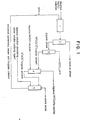
- Numeral 1 is a step for the preparation of HFPO in a two-phase system and numeral 2 is a step for the phase separation of an organic phase and an aqueous phase as obtained in the preparation of HFPO in step 1 and numeral 3 is a step for the distillation of HFPO and unreacted HFP from the organic phase as obtained in step 2 and numeral 4 is a step for the ion exchange reaction by contacting the bottom solution of the distillation containing Rf′CO2 ⁇ Q+ from step 3 with an aqueous phase containing a thiocyanate ion such as an aqueous sodium thiocyanate solution to form Q+SCN ⁇ and an aqueous phase containing Rf′CO2 ⁇ such as an aqueous Rf′CO2Na solution is collected from step 4.
- Numeral 5 is a step for the decomposition of SCN ⁇ by contacting the organic phase containing Q+SCN ⁇ from step 4 with an aqueous solution of a water-soluble oxidizing agent such as an aqueous sodium hypochlorite solution to form activated quaternary onium salt in the organic phase which is then reused in step 1, while the aqueous phase thus obtained is discharged as a waste water.
- a water-soluble oxidizing agent such as an aqueous sodium hypochlorite solution
- HFPO HFPO
- a hypochlorite salt whose amount is more than that required for the epoxidization of HFP.
- the amount of the hypochlorite salt is sufficient for carrying out both the decomposition of Q+SCN ⁇ and the epoxidization of HFP, it is possible to conduct these two reactions at the same time.
- steps (b) and (c) can be carried out at the same time by using the organic phase containing Q+SCN ⁇ formed in step (a) as the organic phase in the step of preparing HFPO.
- the mole ratio represented by formula [III] below is typically at least one, preferably from 2 to 100, particularly preferably from 2 to 20.
- the quaternary onium salt catalyst with decreased catalytic activity can be activated under mild conditions by simple procedure, and an economical process for the preparation of HFPO, comprising repeatedly using the quaternary onium salt catalyst is made possible. Further, it is possible to recover R′CO2 ⁇ as a by-product from the aqueous phase after the ion exchange reaction between Rf′CO2 ⁇ Q+ and SCN ⁇ .
- the composition of Rf′CO2 ⁇ may very depending on the reaction conditions but the ratio of CF3CO2 ⁇ in Rf′CO2 ⁇ in the aqueous phase is higher compared with that of Rf′CO2 ⁇ in Rf′CO2 ⁇ Q+ in the organic phase.
- the ratio of CF3CO2 ⁇ in Rf′CO2 ⁇ in the aqueous phase is 87 % as will be shown in Example 17.
- a process for preparing HFPO from HFP in the presence of a catalyst in a two-phase stystem of an organic phase sparingly miscible in water and an aqueous phase containing a hypochlorite salt as an oxidizing agent which comprises the steps of:
- steps (e) and (f) can be conducted under the same conditions by the same procedure as in the treatment of the quaternary onium salt of formula [I].
- the amount of the quaternary onium salt used in step (d) of the above described process mainly depends on that of Rf′CO2 ⁇ in a waste water phase.
- the quaternary onium salt is employed in an amount of from 0.5 to 20 moles, preferably from 1 to 10 moles, more preferably from 1 to 5, per mole of Rf′CO2 ⁇ .
- the amount of the quaternary onium salt is less than 0.5 mole per mole of RfCO2 ⁇ , the ratio of extraction of Rf′CO2 ⁇ is too small for practical purposes, whereas when the amount is greater than 20 moles per mole of Rf′CO2 ⁇ , the operational cost of the process increases, which is disadvantageous from an economical standpoint.
- step (d) which can be employed in this process are the same as in the above described ion exchange reaction by contacting an organic phase containing the quaternary onium salt of formula [I] with an aqueous phase containing SCN ⁇ .
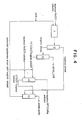
- numeral 6 is an ion exchange step where a waste water containing Rf′COO ⁇ after the preparation of HFPO is contacted with an organic solvent sparingly miscible in water containing, for example, tri-n-octylmethylammonium chloride as a quaternary ammonium salt or a quaternary phosphonium salt to conduct the ion exchange between the quaternary ammonium salt or the quaternary phosphonium salt and Rf′CO2 ⁇ and as a result, Rf′CO2 ⁇ is extracted from the aqueous phase to form Rf′CO2 ⁇ Q+ in the organic solvent phase. The aqueous phase thus obtained is discharged as a waste water.
- an organic solvent sparingly miscible in water containing, for example, tri-n-octylmethylammonium chloride as a quaternary ammonium salt or a quaternary phosphonium salt to conduct the ion exchange between the quaternary ammonium
- Numeral 7 is an ion exchange step where Rf′CO2 ⁇ Q+ in the organic solvent phase from step 6 is contacted with for example, an aqueous NaSCN solution as an aqueous phase containing SCN ⁇ to conduct the ion exchange between Rf′CO2 ⁇ Q+ and SCN ⁇ and as a result, Rf′CO2 ⁇ as Rf′CO2 ⁇ Na+ migrates to the aqueous phase while Q+SCN ⁇ is formed in the organic solvent phase. Then the aqueous Rf′CO2 ⁇ Na+ solution is collected.
- Numeral 8 is a SCN ⁇ decomposition step where Q+SCN ⁇ in the organic solvent phase is contacted with, for example, an aqueous NaOCl solution as an aqueous phase containing a water-soluble oxidizing agent to conduct the decomposition of SCN ⁇ in Q+SCN ⁇ and as a result, in the organic solvent phase is formed an activated tri-n-octylmethylammonium salt as an activated quaternary ammonium salt or an activated quaternary phosphonium salt and this organic solvent phase is recycled to step 6 to extract Rf′CO2 ⁇ .
- the aqueous phase is discharged as a waste water.
- hypochlorite salt is present in the waste water in an amount of the residual hypochlorite salt of at least 1 mole, preferably 2 to 100 moles, particularly preferably 2 to 20 moles per mole of the quaternary onium salt to be employed, the above described step 8 can be deleted. More specifically, the activation of thc quaternary onium salt by the decomposition of SCN ⁇ and the extraction of Rf′CO2 ⁇ by the activated quaternary onium salt can be simultaneously conducted.
- step 9 is a step for the SCN ⁇ decomposition reaction and the ion exchange reaction.
- the waste water containing Rf′CO2 ⁇ and OCl is contacted with the organic solvent phase containing Q+SCN ⁇ to form Rf′CO2 ⁇ Q+ by the decomposition of SCN ⁇ and the successive ion exchange reaction of the quaternary onium salt with Rf′CO2 ⁇ , and the aqueous phase thus obtained is discharged as a waste water.
- Numeral 10 is a step for the ion exchange reaction where the organic solvent phase containing Rf′CO2 ⁇ Q+ from step 9 is contacted with, for example, an aqueous NaSCN solution as an aqueous phase containing SCN ⁇ . As a result, in the organic solvent phase is formed Q+SCN ⁇ which is then recycled to step 9. On the other hand, the aqueous Rf′CO2 ⁇ Na+ solution is collected. Thus, by alternatingly repeating step 9 and step 10, the quaternary onium salt can repeatedly be used for the extraction of Rf′CO2 ⁇ .
- the activation of the quaternary onium salt by the decomposition of SCN ⁇ and the extraction of Rf′CO2 ⁇ can be simultaneously carried out by treating the organic phase containing Q+SCN ⁇ with a waste water phase containing a hypochlorite ion and Rf′CO2 ⁇ whose main component is CF3CO2 ⁇ .
- the quaternary onium salt whose main component is CF3CO2 ⁇ Q+ obtained by the above described treatment shows a sufficient catalytic activity as the catalyst for the preparation of HFPO from HFP, in contrast with the quaternary onium salt whose main component is CF3CFXCO2 ⁇ Q+ wherein X is F, Cl or H in the organic phase after the preparation of HFPO which requires an activation treatment.
- the waste water phase containing unreacted hypochlorite salt formed in the preparation of HFPO as the aqueous solution containing a water-soluble oxidizing agent in step (b).
- the mole number of the hypochlorite ion in the waste water before carrying out this treatment which can be employed is typically more than that of Q+SCN ⁇ in the organic phase in step (b), preferably 2 to 100 times that of Q+SCN.
- the mole number of the hypochlorite ion is 3 to 15 times that of Q+SCN ⁇ .
- the Rf′CO2 ⁇ extracted from the waste water phase is recycled to the step of preparing HFPO from HFP, and with increased numbers of recycling, the amount of the Rf′CO2 ⁇ in the waste water phase increases and finally all of the Rf′CO2 ⁇ cannot be extracted with the quaternary onium salt catalyst.
- HFPO cannot be continuously prepared for a long period of time.
- the mole number of the Rf′CO2 ⁇ in the waste water phase is more than that of the quaternary onium salt catalyst in the organic phase, the Rf′CO2 ⁇ in the aqueous phase cannot be extracted.
- the mole number of the quaternary onium salt in the organic phase to be returned to step (a) is appropriately determined depending on the mole number of Rf′CO2 ⁇ in the waste water phase, the mole number of the quaternary onium salt in the organic phase used in the step of preparing HFPO from HFP, the HFP conversion and the HFPO selectivity obtained and the conditions for extracting Rf′CO2 ⁇ employed.
- the process is conducted in such a manner that the total mole number of the quaternary onium salt to be used in the step of preparing HFPO from HFP and the quaternary onium salt in the organic phase to be recycled to step (a), i.e., the mole number of the quaternary onium salts used in steps (a) and (b) is from 5 % by mole to 100 % by mole, preferably from 10 % by mole to 60 % by mole of HFPO forming in the step of preparing HFPO from HFP.
- the mole number of the hypochlorite ion in the aqueous phase as a waste water phase from the step of preparing HFPO from HFP which can be employed in this process is typically more than that of Q+SCN ⁇ in step (a) and is preferably from 2 to 100 times that of Q+SCN ⁇ in step (a).
- the mole number of the hypochlorite ion is from 2 to 20 times that of Q+SCN ⁇ in step (a).
- Steps 11, 12 and 13 are the same as steps 1, 2 and 3 in FIG. 1.
- Numeral 14 is a step for the ion exchange reaction
- numeral 15 is a step for the decomposition of SCN ⁇ and the ion exchange reaction.
- step 14 the organic phase containing Rf′CO2 ⁇ Q+ in which the main component of Rf′CO2 ⁇ is CF3CFXCO2 ⁇ Q+ wherein X is F, Cl or H from step 13 is combined with part of the organic phase from step 15 and the organic phase thus combined is contacted with an aqueous solution containing SCN ⁇ , for example, an aqueous NaSCN solution to form an organic phase containing Q+SCN ⁇ .
- step 15 the organic phase containing Q+SCN ⁇ from step 14 is contacted with a waste water phase containing Rf′CO2 ⁇ Na whose main component is CF3CO2Na and NaOCl from step 12 to simultaneously conduct the activation of the quaternary onium salt by the decomposition of SCN ⁇ and the extraction of Rf′CO2 ⁇ .
- the activated quaternary onium salt contains Rf′CO2 ⁇ Q+ and Q+X ⁇ and the main component of Rf′CO2 ⁇ Q+ is CF3CO2 ⁇ Q+ and X ⁇ in Q+X ⁇ is not clear but seems to be OCl ⁇ .
- the organic phase from step 15 is divided into two portions and one portion is reused as an organic phase in step 11 for the preparation of HFPO, and the other portion is recycled to step 14. On the other hand, the aqueous phase from step 15 is discharged as a waste water.
- step 11 for the preparation of HFPO substantially all of the amount of Rf′CO2 ⁇ by-produced in step 11 for the preparation of HFPO can be separated as an aqueous solution of Rf′CO2Na in step 12 and accordingly, the concentration of Rf′CO2 ⁇ in the waste water phase from step 11 can be maintained constant.
- the concentration of Rf′CO2 ⁇ in the waste water phase from step 11 can be maintained constant.
- F-113 1,1,2-trichloro-1,2,2-trifluoroethane
- TOMAC tri-n-octylmethylammonium chloride
- Example 2 The procedure of Example 2 was repeated with the exception that 20 millimoles of sodium chloride were used instead of the sodium thiocyanate. As a result, hardly any conversion of CF3CO2 ⁇ Q+ to Q+Cl ⁇ was observed.
- the ion exchange reaction between CF3CO2 ⁇ Q+ in an organic phase and sodium thiocyanate in an agueous phase was conducted using a jacketed multistage counter current extracting column having a column diameter of 40 mm and 10 stage stirring compartments.
- Example 1 was repeated except that the organic phase as obtained in the above described Run No. 4 was employed instead of the F-113 solution of Q+Cl ⁇ .
- the organic phase as obtained in the above described Run No. 4 was employed instead of the F-113 solution of Q+Cl ⁇ .
- almost all of the quaternary ammonium salt in the organic phase was converted to CF3CO2 ⁇ Q+.
- an easily ion exchangeable active quaternary ammonium salt like Q+Cl ⁇ was formed in an organic phase by treating an organic phase containing tri-n-octylmethylammonium thiocyanate with an aqueous phase containing sodium hypochlorite.
- Example 4 100 ml of an F-113 solution containing 10 millimoles of tri-n-octylmethylammonium thiocyanate and 100 ml of an aqueous solution containing 50 millimoles of sodium chloride were stirred. As a result, the SCN ⁇ of tri-n-octylmethylammonium thiocyanate in the organic phase was hardly decreased.
- Example 2 In the same manner as in Example 1 the F-113 solution of Q+Cl ⁇ was contacted with each of the aqueous solutions of various sodium fluorocarboxylates to obtain an F-113 solution of CF3CF2CO2 ⁇ Q+, CF3CFHCO2 ⁇ Q+ or CF3CFClCO2 ⁇ Q+. Each of these F-113 solutions was treated with an aqueous NaSCN solution in the same manner as in Example 3 to convert RfCO2 ⁇ Q+ to tri-n-octylmethylammonium thiocyanate. The results are shown in Table 2. Table 2 RfCO2 ⁇ Q+ Conversion to TCA (%) CF3CF2CO2 ⁇ Q+ 94 CF3CFHCO2 ⁇ Q+ 96 CF3CFClCO2 ⁇ Q+ 94
- the decomposition of the SCN ⁇ of tri-n-octylmethylammonium thiocyanate was conducted by repeating the procedure of Example 4 except that each of various water-soluble oxidizing agents as shown in Table 4 below was employed instead of the sodium hypochlorite and the mole ratio of the oxidizing agent to tri-n-octylmethylammonium thiocyanate employed was 1 to 10 and the stirring was conducted at 30 °C for 20 minutes.
- the concentration of the water-soluble oxidizing agents as shown in Table 4 was 2N.
- Example 5 The procedure of Example 5 was repeated except that dichloroethane was employed as an organic solvent instead of the F-113 and varioius onium trifluoroacetates as shown in Table 6 below were employed instead of RfCO2 ⁇ Q+.
- the decomposition of the SCN ⁇ of tri-n-octylmethylammonium thiocyanate was conducted by repeating the procedure of Example 4 except that an aqueous 0.3N sodium persulfate solution was employed instead of the aqueous 1N sodium hypochlorite solution, the mole ratio of sodium persulfate to tri-n-octylmethylammonium thiocyanate employed was 3.0 to 1.0 and stirring was carried out at 40 °C for 30 minutes. As a result, 73% of the SCN ⁇ were decomposed.
- a 300 ml pressure resistant glass reactor equipped with a fluorine resin-coated stirring bar, a pressure gauge, a nozzle for a thermocouple, a cooling device, a nozzle (A) for sampling and a nozzle (B) for supplying a reaction solution and withdrawing a reaction product was charged with 160 ml of an F-113 solution containing 0.580 g (1.44 millimoles) of TOMAC and 70 ml of an aqueous sodium hypochlorite solution with an available chlorine content of 6 % containing 1.5 % by weight of sodium hydroxide.
- the pressure within the reactor was reduced and hexafluoropropylene oxide and about 40 ml of F-113 were removed from the reactor through nozzle (B). Then, the pressure within the reactor was rendered atmospheric and the aqueous phase was removed from nozzle (B) and 70 ml of an aqueous sodium hypochlorite solution with an available chlorine content of 6 % containing 1.5 % by weight of sodium hydroxide and F-113 in the same amount as removed under reduced pressure were charged in the reactor through nozzle (B). Then the reactor was sealed and the contents of the reactor were cooled to -5 °C and 4.20 g of hexafluoropropylene cooled to -5 °C were charged in the reactor. The subsequent procedure for the preparation of hexafluoropropylene oxide was conducted in the same manner as in the first preparation of hexafluoropropylene oxide.
- Rf′CO2 ⁇ in Rf′CO2 ⁇ Q+ are fluorine-containing carboxylate anions having 2 or 3 carbon atoms and are considered as by-products derived from HFPO formed or HFP in the preparation of HFPO.
- Example 2 In the same manner as in Example 2, using 20 ml of an aqueous 5 % by weight NaSCN solution the ion exchange treatment was conducted with 160 ml of the F-113 solution containing 1.44 millimoles of the quaternary ammonium salt catalyst with decreased catalytic activity containing at least 90 % by mole of Rf′CO2 ⁇ Q+ in the quaternary ammonium salt catalyst as obtained in Example 11. After the treatment, about 70 % by mole of Rf′CO2 ⁇ in Rf′CO2 ⁇ Q+ were exchanged with SCN ⁇ . After repeating the ion exchange treatment five times almost all of the quaternary onium salts in the F-113 solution were converted to Q+SCN ⁇ .
- Example 11 The procedure for preparing HFPO of Example 11 was repeated except that 160 ml of the F-113 solution containing 1.44 millimoles of the quarternary ammonium salt catalyst as obtained in Example 12 were employed instead of 160 ml of the F-113 solution containing 1.44 millimoles of TOMAC.
- Table 8 The results are shown in Table 8. It was confirmed that the catalytic activity of the activated catalyst of Example 12 was almost same as that of TOMAC.
- the tubular reactor 16 was cooled to -5 °C and a F-113 solution containing 1.2 % by weight of TOMAC was circulated in the reaction equipment at a flow rate of 9.4 l per hour. Then, an aqueous sodium hypochlorite solution containing 1.0 mole per liter of sodium hypochlorite and 1.5 % by weight of sodium hydroxide was introduced into the tubular reactor 16 at a flow rate of 8.2 l per hour, and HFP was introduced into an organic phase line before the tubular reactor 16 at a flow rate of 0.5 Kg per hour to start the reaction.
- the reaction solution leaving the tubular reactor 16 was introduced into the decantor 17 where it was separated into an organic phase and an aqueous phase.
- the aqueous phase was discharged out of the reaction equipment, while the organic phase containing HFPO formed was sent to the HFPO distillation column 18 where HFPO formed and unreacted HFP were separated from the organic phase.
- the organic phase from which HFPO and HFP had been distilled in the HFPO distillation column 18 was sent to the organic phase tank 19 and, thereafter, was returned to the tubular reactor 16.
- the HFP conversion was over 99 % and the HFPO selectivity was 81 % by gas chromatography analysis. However, when the reaction was continued for 30 hours, the HFP conversion was decreased to 72 %.
- the structure of the quaternary onium salt catalyst with decreased catalytic activity in the organic phase after the 30-hour continuous preparation of HFPO of Example 14 was examined in the same manner as in Example 11 and as a result, almost all of the quaternary onium salt catalyst was Rf′CO2 ⁇ Q+ and the mole ratio of CF3CFXCO2 ⁇ wherein X was F or Cl to CF3CO2 ⁇ in Rf′CO2 ⁇ was 84 to 16.
- the organic phase containing this quaternary onium salt catalyst with decreased catalytic activity was treated by the following method to activate the catalyst.
- the preparation of HFPO from HFP of Example 14 was conducted using 5 l of the F-113 solution containing the quaternary onium salt thus obtained instead of the F-113 solution containing 1.2 % by weight of TOMAC in such a manner that the aqueous phase was introduced into the continuous reaction equipment before the organic phase.
- Example 11 160 ml of a F-113 solution containing 1.44 millimole of Q+SCN ⁇ were prepared using the F-113 solution containing Q+SCN ⁇ obtained during the above described procedure. Then, the procedure of Example 11 was repeated using the F-113 solution thus obtained, 100 ml of an aqueous sodium hypochlorite solution containing 1.5 % by weight of sodium hydroxide with an available chlorine content of 6 % and 4.20 g (28 millimoles) of HFP.
- Example 14 The procedure for the continuous preparation of HFPO of Example 14 was repeated except that the flow rate of the aqueous sodium hypochlorite solution was changed from 8.2 l per hour to 9.8 l per hour, and the flow rate of the F-113 solution containing TOMAC was changed from 9.4 l per hour to 7.5 l per hour, and the rate of feeding HFP was changed from 0.5 Kg per hour to 0.4 Kg per hour.
- Procedure E was repeated using the organic phase containing Q+SCN ⁇ obtained in Procedure F.
- the Rf′CO2 ⁇ in the aqueous phase as a waste water phase was mostly extracted in the organic phase.
- Example 18 The procedure of Example 18 was repeated except that 7.5 l of the organic phase containing Rf′CO2 ⁇ Q+ obtained in Procedure H were employed as the organic phase. As a result, 30 minutes after the start of the reaction the HFP conversion was at least about 99 % and the HFPO selectivity was 81 % at the outlet of the tubular reactor. This reaction results show that the quaternary onium salt catalyst obtained in Procedure H was more active than that obtained in Example 18 five hours after the continuous preparation of HFPO using the catalyst recycled.
Landscapes
- Chemical & Material Sciences (AREA)
- Organic Chemistry (AREA)
- Health & Medical Sciences (AREA)
- Life Sciences & Earth Sciences (AREA)
- Biochemistry (AREA)
- General Health & Medical Sciences (AREA)
- Molecular Biology (AREA)
- Organic Low-Molecular-Weight Compounds And Preparation Thereof (AREA)
- Catalysts (AREA)
- Epoxy Compounds (AREA)
- Low-Molecular Organic Synthesis Reactions Using Catalysts (AREA)
Applications Claiming Priority (2)
| Application Number | Priority Date | Filing Date | Title |
|---|---|---|---|
| JP267152/88 | 1988-10-25 | ||
| JP63267152A JP2712036B2 (ja) | 1988-10-25 | 1988-10-25 | 第四級オニウム塩の処理方法 |
Publications (2)
| Publication Number | Publication Date |
|---|---|
| EP0366084A1 true EP0366084A1 (fr) | 1990-05-02 |
| EP0366084B1 EP0366084B1 (fr) | 1993-06-16 |
Family
ID=17440813
Family Applications (1)
| Application Number | Title | Priority Date | Filing Date |
|---|---|---|---|
| EP19890119747 Expired - Lifetime EP0366084B1 (fr) | 1988-10-25 | 1989-10-24 | Procédé pour le traitement de sels d'onium quaternaires et son application à la préparation de l'oxyde d'hexafluoropropylène |
Country Status (4)
| Country | Link |
|---|---|
| EP (1) | EP0366084B1 (fr) |
| JP (1) | JP2712036B2 (fr) |
| CA (1) | CA2001344C (fr) |
| DE (1) | DE68907178T2 (fr) |
Cited By (1)
| Publication number | Priority date | Publication date | Assignee | Title |
|---|---|---|---|---|
| DE10354327A1 (de) * | 2003-11-20 | 2005-07-07 | Epcos Ag | Leitsalz, Elektrolytlösung mit dem Leitsalz, Kondensator und Verfahren zur Herstellung des Leitsalzes |
Families Citing this family (1)
| Publication number | Priority date | Publication date | Assignee | Title |
|---|---|---|---|---|
| FR2933693B1 (fr) * | 2008-07-10 | 2010-09-03 | Rhodia Operations | Procede de separation d'un acide carboxylique sous forme salifiee porteur d'au moins un atome d'halogene |
Citations (7)
| Publication number | Priority date | Publication date | Assignee | Title |
|---|---|---|---|---|
| US2961466A (en) * | 1957-05-14 | 1960-11-22 | Monsanto Chemicals | Quaternary ammonium thiocarbonates |
| US3227748A (en) * | 1963-02-25 | 1966-01-04 | Metal Hydrides Inc | Purification of quaternary ammonium compounds |
| DE1911265A1 (de) * | 1968-03-07 | 1969-10-23 | Monsanto Co | Verfahren zur Herstellung eines quarternaeren Ammoniumhydroxyds |
| FR2194684A1 (fr) * | 1972-07-27 | 1974-03-01 | Phillips Petroleum Co | |
| EP0100488A1 (fr) * | 1982-07-26 | 1984-02-15 | Asahi Kasei Kogyo Kabushiki Kaisha | Fluoroépoxydes et procédé pour leur préparation |
| EP0194681A2 (fr) * | 1985-03-14 | 1986-09-17 | E.I. Du Pont De Nemours And Company | Procédé pour récupérer des agents tensio-actifs |
| EP0269949A2 (fr) * | 1986-11-25 | 1988-06-08 | Mitsubishi Gas Chemical Company, Inc. | Procédé de production d'un hydroxyde d'ammonium quaternaire à haute pureté |
-
1988
- 1988-10-25 JP JP63267152A patent/JP2712036B2/ja not_active Expired - Fee Related
-
1989
- 1989-10-24 EP EP19890119747 patent/EP0366084B1/fr not_active Expired - Lifetime
- 1989-10-24 CA CA 2001344 patent/CA2001344C/fr not_active Expired - Fee Related
- 1989-10-24 DE DE1989607178 patent/DE68907178T2/de not_active Expired - Fee Related
Patent Citations (7)
| Publication number | Priority date | Publication date | Assignee | Title |
|---|---|---|---|---|
| US2961466A (en) * | 1957-05-14 | 1960-11-22 | Monsanto Chemicals | Quaternary ammonium thiocarbonates |
| US3227748A (en) * | 1963-02-25 | 1966-01-04 | Metal Hydrides Inc | Purification of quaternary ammonium compounds |
| DE1911265A1 (de) * | 1968-03-07 | 1969-10-23 | Monsanto Co | Verfahren zur Herstellung eines quarternaeren Ammoniumhydroxyds |
| FR2194684A1 (fr) * | 1972-07-27 | 1974-03-01 | Phillips Petroleum Co | |
| EP0100488A1 (fr) * | 1982-07-26 | 1984-02-15 | Asahi Kasei Kogyo Kabushiki Kaisha | Fluoroépoxydes et procédé pour leur préparation |
| EP0194681A2 (fr) * | 1985-03-14 | 1986-09-17 | E.I. Du Pont De Nemours And Company | Procédé pour récupérer des agents tensio-actifs |
| EP0269949A2 (fr) * | 1986-11-25 | 1988-06-08 | Mitsubishi Gas Chemical Company, Inc. | Procédé de production d'un hydroxyde d'ammonium quaternaire à haute pureté |
Cited By (1)
| Publication number | Priority date | Publication date | Assignee | Title |
|---|---|---|---|---|
| DE10354327A1 (de) * | 2003-11-20 | 2005-07-07 | Epcos Ag | Leitsalz, Elektrolytlösung mit dem Leitsalz, Kondensator und Verfahren zur Herstellung des Leitsalzes |
Also Published As
| Publication number | Publication date |
|---|---|
| CA2001344A1 (fr) | 1990-04-25 |
| CA2001344C (fr) | 1997-03-18 |
| DE68907178D1 (de) | 1993-07-22 |
| EP0366084B1 (fr) | 1993-06-16 |
| JPH02115150A (ja) | 1990-04-27 |
| JP2712036B2 (ja) | 1998-02-10 |
| DE68907178T2 (de) | 1993-09-23 |
Similar Documents
| Publication | Publication Date | Title |
|---|---|---|
| EP1177184B1 (fr) | Epoxydes polyfluorees, polymeres associes et procedes | |
| EP0064293B1 (fr) | Procédé pour la préparation de l'oxyde d'hexafluoropropylène | |
| US4410714A (en) | Production of epoxy compounds from olefinic compounds | |
| EP0421379B1 (fr) | Préparation de monoépoxydes | |
| JPS5844752B2 (ja) | 廃ブラインの精製法 | |
| EP0100488B1 (fr) | Fluoroépoxydes et procédé pour leur préparation | |
| US5352785A (en) | Continuous process for purifying perfluorochemical compositions | |
| US5276189A (en) | Process for the treatment of quaternary onium salts and its application to the preparation of hexafluoropropylene oxide | |
| EP0366084B1 (fr) | Procédé pour le traitement de sels d'onium quaternaires et son application à la préparation de l'oxyde d'hexafluoropropylène | |
| US6528665B1 (en) | Preventing undesired odor in and/or purifying alkanediols | |
| EP0084158A1 (fr) | Procédé de production de 4-hydroxy-2,4,6-triméthylcyclohexa-2,5-diène-1-one | |
| US5396002A (en) | Process to produce vinylidene chloride using phase transfer catalyst | |
| EP0359331B1 (fr) | Procédé continu pour la production de la dichlorohydrine | |
| JP2899899B2 (ja) | 廃水の処理方法 | |
| EP0414569A2 (fr) | Epoxydation d'oléfines perfluorées en système liquide triphasé | |
| JPS6127377B2 (fr) | ||
| US6525208B1 (en) | Epoxidation of olefins | |
| JP2805358B2 (ja) | ヘキサフルオロプロピレンオキシドの製造方法 | |
| US4261906A (en) | Process for making vicinal epoxides | |
| JPS6411021B2 (fr) | ||
| US3686289A (en) | Production of percarboxylic acids | |
| US5945562A (en) | Process of preparing perfluoroalkylcarboxylic acid | |
| DK152666B (da) | Fremgangsmaade til selektiv fremstilling af 3-chlor eller 3,5-dichlorphenoler ved katalyseret hydrogenering af polychlorphenoler | |
| JPH0470314B2 (fr) | ||
| JPH0330593B2 (fr) |
Legal Events
| Date | Code | Title | Description |
|---|---|---|---|
| PUAI | Public reference made under article 153(3) epc to a published international application that has entered the european phase |
Free format text: ORIGINAL CODE: 0009012 |
|
| 17P | Request for examination filed |
Effective date: 19891024 |
|
| AK | Designated contracting states |
Kind code of ref document: A1 Designated state(s): DE FR GB IT NL |
|
| 17Q | First examination report despatched |
Effective date: 19911031 |
|
| GRAA | (expected) grant |
Free format text: ORIGINAL CODE: 0009210 |
|
| AK | Designated contracting states |
Kind code of ref document: B1 Designated state(s): DE FR GB IT NL |
|
| REF | Corresponds to: |
Ref document number: 68907178 Country of ref document: DE Date of ref document: 19930722 |
|
| ET | Fr: translation filed | ||
| ITF | It: translation for a ep patent filed | ||
| PLBE | No opposition filed within time limit |
Free format text: ORIGINAL CODE: 0009261 |
|
| STAA | Information on the status of an ep patent application or granted ep patent |
Free format text: STATUS: NO OPPOSITION FILED WITHIN TIME LIMIT |
|
| 26N | No opposition filed | ||
| ITPR | It: changes in ownership of a european patent |
Owner name: OFFERTA DI LICENZA AL PUBBLICO;AL PUBBLICO |
|
| REG | Reference to a national code |
Ref country code: GB Ref legal event code: 746 Effective date: 19970228 |
|
| REG | Reference to a national code |
Ref country code: FR Ref legal event code: D6 |
|
| REG | Reference to a national code |
Ref country code: GB Ref legal event code: IF02 |
|
| PGFP | Annual fee paid to national office [announced via postgrant information from national office to epo] |
Ref country code: FR Payment date: 20031003 Year of fee payment: 15 |
|
| PGFP | Annual fee paid to national office [announced via postgrant information from national office to epo] |
Ref country code: NL Payment date: 20031008 Year of fee payment: 15 |
|
| PGFP | Annual fee paid to national office [announced via postgrant information from national office to epo] |
Ref country code: GB Payment date: 20031022 Year of fee payment: 15 |
|
| PG25 | Lapsed in a contracting state [announced via postgrant information from national office to epo] |
Ref country code: GB Free format text: LAPSE BECAUSE OF NON-PAYMENT OF DUE FEES Effective date: 20041024 |
|
| PG25 | Lapsed in a contracting state [announced via postgrant information from national office to epo] |
Ref country code: NL Free format text: LAPSE BECAUSE OF NON-PAYMENT OF DUE FEES Effective date: 20050501 |
|
| GBPC | Gb: european patent ceased through non-payment of renewal fee |
Effective date: 20041024 |
|
| PG25 | Lapsed in a contracting state [announced via postgrant information from national office to epo] |
Ref country code: FR Free format text: LAPSE BECAUSE OF NON-PAYMENT OF DUE FEES Effective date: 20050630 |
|
| NLV4 | Nl: lapsed or anulled due to non-payment of the annual fee |
Effective date: 20050501 |
|
| REG | Reference to a national code |
Ref country code: FR Ref legal event code: ST |
|
| PGFP | Annual fee paid to national office [announced via postgrant information from national office to epo] |
Ref country code: DE Payment date: 20051020 Year of fee payment: 17 |
|
| PGFP | Annual fee paid to national office [announced via postgrant information from national office to epo] |
Ref country code: IT Payment date: 20061031 Year of fee payment: 18 |
|
| PG25 | Lapsed in a contracting state [announced via postgrant information from national office to epo] |
Ref country code: DE Free format text: LAPSE BECAUSE OF NON-PAYMENT OF DUE FEES Effective date: 20070501 |
|
| PG25 | Lapsed in a contracting state [announced via postgrant information from national office to epo] |
Ref country code: IT Free format text: LAPSE BECAUSE OF NON-PAYMENT OF DUE FEES Effective date: 20071024 |