EP0366370B1 - Particules fines d'oxyde sous forme de plaquettes contenant essentiellement Ba et Fe et leur procédé de fabrication de celles-ci - Google Patents
Particules fines d'oxyde sous forme de plaquettes contenant essentiellement Ba et Fe et leur procédé de fabrication de celles-ci Download PDFInfo
- Publication number
- EP0366370B1 EP0366370B1 EP89310817A EP89310817A EP0366370B1 EP 0366370 B1 EP0366370 B1 EP 0366370B1 EP 89310817 A EP89310817 A EP 89310817A EP 89310817 A EP89310817 A EP 89310817A EP 0366370 B1 EP0366370 B1 EP 0366370B1
- Authority
- EP
- European Patent Office
- Prior art keywords
- salt
- amount
- group
- iii
- metal
- Prior art date
- Legal status (The legal status is an assumption and is not a legal conclusion. Google has not performed a legal analysis and makes no representation as to the accuracy of the status listed.)
- Expired - Lifetime
Links
- 239000002131 composite material Substances 0.000 title claims description 41
- 238000000034 method Methods 0.000 title claims description 33
- 239000010419 fine particle Substances 0.000 title description 37
- 229910052788 barium Inorganic materials 0.000 title description 19
- 229910052742 iron Inorganic materials 0.000 title description 18
- 239000002245 particle Substances 0.000 claims description 69
- 150000003839 salts Chemical class 0.000 claims description 65
- 229910052751 metal Inorganic materials 0.000 claims description 40
- 239000002184 metal Substances 0.000 claims description 40
- CWYNVVGOOAEACU-UHFFFAOYSA-N Fe2+ Chemical compound [Fe+2] CWYNVVGOOAEACU-UHFFFAOYSA-N 0.000 claims description 35
- 229910000859 α-Fe Inorganic materials 0.000 claims description 33
- VTLYFUHAOXGGBS-UHFFFAOYSA-N Fe3+ Chemical compound [Fe+3] VTLYFUHAOXGGBS-UHFFFAOYSA-N 0.000 claims description 30
- BAUYGSIQEAFULO-UHFFFAOYSA-L iron(2+) sulfate (anhydrous) Chemical compound [Fe+2].[O-]S([O-])(=O)=O BAUYGSIQEAFULO-UHFFFAOYSA-L 0.000 claims description 30
- 230000005415 magnetization Effects 0.000 claims description 26
- 230000005291 magnetic effect Effects 0.000 claims description 18
- 239000002244 precipitate Substances 0.000 claims description 15
- 238000010438 heat treatment Methods 0.000 claims description 12
- 230000004907 flux Effects 0.000 claims description 9
- 229910052725 zinc Inorganic materials 0.000 claims description 9
- 239000012670 alkaline solution Substances 0.000 claims description 7
- 229910052718 tin Inorganic materials 0.000 claims description 7
- 229910052719 titanium Inorganic materials 0.000 claims description 7
- 229910052726 zirconium Inorganic materials 0.000 claims description 7
- 229910052732 germanium Inorganic materials 0.000 claims description 6
- 229910052759 nickel Inorganic materials 0.000 claims description 6
- 229910052749 magnesium Inorganic materials 0.000 claims description 5
- 239000000696 magnetic material Substances 0.000 claims description 5
- 239000010936 titanium Substances 0.000 description 20
- HEMHJVSKTPXQMS-UHFFFAOYSA-M Sodium hydroxide Chemical compound [OH-].[Na+] HEMHJVSKTPXQMS-UHFFFAOYSA-M 0.000 description 9
- 238000002441 X-ray diffraction Methods 0.000 description 8
- 239000011701 zinc Substances 0.000 description 8
- 238000000975 co-precipitation Methods 0.000 description 7
- FAPWRFPIFSIZLT-UHFFFAOYSA-M Sodium chloride Chemical compound [Na+].[Cl-] FAPWRFPIFSIZLT-UHFFFAOYSA-M 0.000 description 6
- 230000000052 comparative effect Effects 0.000 description 5
- 229910052595 hematite Inorganic materials 0.000 description 4
- 239000011019 hematite Substances 0.000 description 4
- LIKBJVNGSGBSGK-UHFFFAOYSA-N iron(3+);oxygen(2-) Chemical compound [O-2].[O-2].[O-2].[Fe+3].[Fe+3] LIKBJVNGSGBSGK-UHFFFAOYSA-N 0.000 description 4
- XLYOFNOQVPJJNP-UHFFFAOYSA-N water Substances O XLYOFNOQVPJJNP-UHFFFAOYSA-N 0.000 description 4
- PTFCDOFLOPIGGS-UHFFFAOYSA-N Zinc dication Chemical compound [Zn+2] PTFCDOFLOPIGGS-UHFFFAOYSA-N 0.000 description 3
- WDIHJSXYQDMJHN-UHFFFAOYSA-L barium chloride Chemical compound [Cl-].[Cl-].[Ba+2] WDIHJSXYQDMJHN-UHFFFAOYSA-L 0.000 description 3
- 229910001626 barium chloride Inorganic materials 0.000 description 3
- 238000004519 manufacturing process Methods 0.000 description 3
- 239000000047 product Substances 0.000 description 3
- 239000011780 sodium chloride Substances 0.000 description 3
- 239000000243 solution Substances 0.000 description 3
- 239000000126 substance Substances 0.000 description 3
- VEXZGXHMUGYJMC-UHFFFAOYSA-N Hydrochloric acid Chemical compound Cl VEXZGXHMUGYJMC-UHFFFAOYSA-N 0.000 description 2
- 229910021578 Iron(III) chloride Inorganic materials 0.000 description 2
- WCUXLLCKKVVCTQ-UHFFFAOYSA-M Potassium chloride Chemical compound [Cl-].[K+] WCUXLLCKKVVCTQ-UHFFFAOYSA-M 0.000 description 2
- KWYUFKZDYYNOTN-UHFFFAOYSA-M Potassium hydroxide Chemical compound [OH-].[K+] KWYUFKZDYYNOTN-UHFFFAOYSA-M 0.000 description 2
- HCHKCACWOHOZIP-UHFFFAOYSA-N Zinc Chemical compound [Zn] HCHKCACWOHOZIP-UHFFFAOYSA-N 0.000 description 2
- 239000000654 additive Substances 0.000 description 2
- 239000007864 aqueous solution Substances 0.000 description 2
- IWOUKMZUPDVPGQ-UHFFFAOYSA-N barium nitrate Chemical compound [Ba+2].[O-][N+]([O-])=O.[O-][N+]([O-])=O IWOUKMZUPDVPGQ-UHFFFAOYSA-N 0.000 description 2
- UFMZWBIQTDUYBN-UHFFFAOYSA-N cobalt dinitrate Chemical compound [Co+2].[O-][N+]([O-])=O.[O-][N+]([O-])=O UFMZWBIQTDUYBN-UHFFFAOYSA-N 0.000 description 2
- 230000000694 effects Effects 0.000 description 2
- 238000000635 electron micrograph Methods 0.000 description 2
- 230000005294 ferromagnetic effect Effects 0.000 description 2
- 150000002500 ions Chemical class 0.000 description 2
- NMCUIPGRVMDVDB-UHFFFAOYSA-L iron dichloride Chemical compound Cl[Fe]Cl NMCUIPGRVMDVDB-UHFFFAOYSA-L 0.000 description 2
- RBTARNINKXHZNM-UHFFFAOYSA-K iron trichloride Chemical compound Cl[Fe](Cl)Cl RBTARNINKXHZNM-UHFFFAOYSA-K 0.000 description 2
- VCJMYUPGQJHHFU-UHFFFAOYSA-N iron(3+);trinitrate Chemical compound [Fe+3].[O-][N+]([O-])=O.[O-][N+]([O-])=O.[O-][N+]([O-])=O VCJMYUPGQJHHFU-UHFFFAOYSA-N 0.000 description 2
- 239000006249 magnetic particle Substances 0.000 description 2
- 230000005389 magnetism Effects 0.000 description 2
- 150000001455 metallic ions Chemical class 0.000 description 2
- 239000006104 solid solution Substances 0.000 description 2
- XJDNKRIXUMDJCW-UHFFFAOYSA-J titanium tetrachloride Chemical compound Cl[Ti](Cl)(Cl)Cl XJDNKRIXUMDJCW-UHFFFAOYSA-J 0.000 description 2
- VHUUQVKOLVNVRT-UHFFFAOYSA-N Ammonium hydroxide Chemical compound [NH4+].[OH-] VHUUQVKOLVNVRT-UHFFFAOYSA-N 0.000 description 1
- 229910021577 Iron(II) chloride Inorganic materials 0.000 description 1
- 229910002651 NO3 Inorganic materials 0.000 description 1
- NHNBFGGVMKEFGY-UHFFFAOYSA-N Nitrate Chemical compound [O-][N+]([O-])=O NHNBFGGVMKEFGY-UHFFFAOYSA-N 0.000 description 1
- 229910003074 TiCl4 Inorganic materials 0.000 description 1
- 229910021627 Tin(IV) chloride Inorganic materials 0.000 description 1
- 150000001242 acetic acid derivatives Chemical class 0.000 description 1
- 239000002253 acid Substances 0.000 description 1
- 150000007513 acids Chemical class 0.000 description 1
- 235000011114 ammonium hydroxide Nutrition 0.000 description 1
- 238000004458 analytical method Methods 0.000 description 1
- RQPZNWPYLFFXCP-UHFFFAOYSA-L barium dihydroxide Chemical compound [OH-].[OH-].[Ba+2] RQPZNWPYLFFXCP-UHFFFAOYSA-L 0.000 description 1
- 229910001863 barium hydroxide Inorganic materials 0.000 description 1
- 159000000009 barium salts Chemical class 0.000 description 1
- 238000006243 chemical reaction Methods 0.000 description 1
- 150000001805 chlorine compounds Chemical class 0.000 description 1
- 238000001816 cooling Methods 0.000 description 1
- 229910052802 copper Inorganic materials 0.000 description 1
- TVQLLNFANZSCGY-UHFFFAOYSA-N disodium;dioxido(oxo)tin Chemical compound [Na+].[Na+].[O-][Sn]([O-])=O TVQLLNFANZSCGY-UHFFFAOYSA-N 0.000 description 1
- 230000005307 ferromagnetism Effects 0.000 description 1
- 229960002089 ferrous chloride Drugs 0.000 description 1
- UCNNJGDEJXIUCC-UHFFFAOYSA-L hydroxy(oxo)iron;iron Chemical compound [Fe].O[Fe]=O.O[Fe]=O UCNNJGDEJXIUCC-UHFFFAOYSA-L 0.000 description 1
- 229910052748 manganese Inorganic materials 0.000 description 1
- 239000000463 material Substances 0.000 description 1
- 150000002739 metals Chemical class 0.000 description 1
- 150000002823 nitrates Chemical class 0.000 description 1
- AJCDFVKYMIUXCR-UHFFFAOYSA-N oxobarium;oxo(oxoferriooxy)iron Chemical compound [Ba]=O.O=[Fe]O[Fe]=O.O=[Fe]O[Fe]=O.O=[Fe]O[Fe]=O.O=[Fe]O[Fe]=O.O=[Fe]O[Fe]=O.O=[Fe]O[Fe]=O AJCDFVKYMIUXCR-UHFFFAOYSA-N 0.000 description 1
- CMOAHYOGLLEOGO-UHFFFAOYSA-N oxozirconium;dihydrochloride Chemical compound Cl.Cl.[Zr]=O CMOAHYOGLLEOGO-UHFFFAOYSA-N 0.000 description 1
- 239000000843 powder Substances 0.000 description 1
- 229940079864 sodium stannate Drugs 0.000 description 1
- POWFTOSLLWLEBN-UHFFFAOYSA-N tetrasodium;silicate Chemical compound [Na+].[Na+].[Na+].[Na+].[O-][Si]([O-])([O-])[O-] POWFTOSLLWLEBN-UHFFFAOYSA-N 0.000 description 1
- HPGGPRDJHPYFRM-UHFFFAOYSA-J tin(iv) chloride Chemical compound Cl[Sn](Cl)(Cl)Cl HPGGPRDJHPYFRM-UHFFFAOYSA-J 0.000 description 1
- 229910000349 titanium oxysulfate Inorganic materials 0.000 description 1
Images


Classifications
-
- G—PHYSICS
- G11—INFORMATION STORAGE
- G11B—INFORMATION STORAGE BASED ON RELATIVE MOVEMENT BETWEEN RECORD CARRIER AND TRANSDUCER
- G11B5/00—Recording by magnetisation or demagnetisation of a record carrier; Reproducing by magnetic means; Record carriers therefor
- G11B5/62—Record carriers characterised by the selection of the material
- G11B5/68—Record carriers characterised by the selection of the material comprising one or more layers of magnetisable material homogeneously mixed with a bonding agent
- G11B5/70—Record carriers characterised by the selection of the material comprising one or more layers of magnetisable material homogeneously mixed with a bonding agent on a base layer
- G11B5/706—Record carriers characterised by the selection of the material comprising one or more layers of magnetisable material homogeneously mixed with a bonding agent on a base layer characterised by the composition of the magnetic material
- G11B5/70626—Record carriers characterised by the selection of the material comprising one or more layers of magnetisable material homogeneously mixed with a bonding agent on a base layer characterised by the composition of the magnetic material containing non-metallic substances
- G11B5/70642—Record carriers characterised by the selection of the material comprising one or more layers of magnetisable material homogeneously mixed with a bonding agent on a base layer characterised by the composition of the magnetic material containing non-metallic substances iron oxides
- G11B5/70678—Ferrites
Definitions
- the present invention relates to plate-like composite oxide fine ferrite particles, to a process for producing such particles and to magnetic media incorporating the particles.
- plate-like ferrite particles containing Ba are well known as ferromagnetic non-acicular particles.
- a method for producing plate-like ferrite fine particles containing Ba a method comprising heat-treating co-precipitates formed from a ferric salt and a Ba salt in an aqueous alkaline solution is known (this method is hereinafter referred to as a "co-precipitation method").
- the plate-like ferrite fine particles containing Ba for magnetic recording are required to have an appropriate average particle size and magnetic properties such as an appropriate coercive force and a high magnetization, as well as excellent temperature dependence of the coercive force (temperature stability).
- the size of the plate-like ferrite particles containing Ba for magnetic recording is as small as possible, especially not greater than 0.3 »m in average diameter.
- the plate-like ferrite fine particles containing Ba for magnetic recording have a coercive force of about 300 to 2,000 Oe.
- magnetization of the particles is as high as possible. This is described, for instance, in JP-A-56-149328 (1981) which states: "Magnetoplumbite ferrite used as a material for magnetic recording media is required to have as high saturation magnetization as possible.”
- the coercive force of plate-like ferrite particles containing Ba increases with rise in temperature, and thus the temperature dependence of magnetic properties of the particles, especially the coercive force (hereinafter referred to as "temperature stability") is poor. Improvement of the temperature stability has been required.
- Plate-like composite ferrite fine particles containing Ba having a high magnetization, an appropriate coercive force and excellent temperature stability are most acutely required at present, but it is hardly possible with the afore-mentioned co-precipitation method to obtain plate-like Ba-containing ferrite fine particles having all of the above-mentioned properties.
- the resultant particles have a relatively large magnetization such as around 50 to 60 emu/g, but the temperature stability thereof is quite unsatisfactory (the temperature dependence of the coercive force is from +2.5 to 6.0 Oe/°C in the specified temperature range).
- the coercive force of plate-like composite ferrite fine particles containing Ba plus Co (II) and Ti (IV) increases as the temperature rises. This phenomenon can be also presumed from Fig. 1 on page 1,459 of Journal of Magnetism and Magnetic Materials, No. 15 - 18, 1980.
- plate-like composite ferrite fine particles containing Ba and which also contain elements such as Co (II) and Ti (IV) for reducing the coercive force are subjected to a heat-treatment in a reducing atmosphere at 300 - 700°C, but in this method, as a result of the heat-treatment, the coercive force is increased to more than twice the value before the heat-treatment, thereby making it difficult to control the coercive force to an appropriate amount.
- plate-like composite ferrite fine particles containing Ba are formed such that their average diameter is not more than 1.0 »m, the thickness in the c-axis direction is not more than 0.2 »m and the plate ratio (average diameter of plate surface : thickness in the c-axis direction) is not more than 5:1.
- This method has the disadvantage that the improvement of temperature stability is subject to restrictions by the particle shape.
- the method of JP-A-63-164203 comprises adding at least one metal selected from Ni, Cu, Zn and Mg in addition to the elements for reducing the coercive force in producing the plate-like composite ferrite fine particles containing Ba. According to this method, because of the use of large amounts of additives, the obtained particles have necessarily lowered magnetization and are unable to have a high magnetization.
- JP-B-49-23676 (1974) discloses that a ferrous salt is used in the co-precipitation.
- the object of this process is to provide magnetoplumbite type ferrite particles containing Ba for sintered magnets which are required to have a high coercive force of 4,000 to 5,300 Oe taking no notice of temperature stability.
- the amount of ferrous salt relative to the sum of ferrous and ferric salts in the co-precipitation is about 20 to 23% (calculated as Fe(II)/[Fe(II) + Fe(III)]).
- JP-A-63-214,914 (1988) discloses an improvement of the temperature stability of plate-like composite ferrite particles containing Ba by adding a ferrous salt in an autoclaving method and heat-treating the resultant product in an inert atmosphere.
- the plate-like composite ferrite particles containing Ba obtained according to this process contain Fe(II).
- EP-A-272,148 discloses Ba-containing plate-like magnetoplumbite-type ferrite particles suitable for magnetic recording containing ions of one group (II) metal selected from Ni and Zn and ions of one group (IV) metal selected from Ti, Sn and Zr, and which have zinc incorporated as a solid solution close to the particle surface and exhibit a change in coercive force at a temperature of from -20 to 120°C of from -39.8 to +39.8 Am ⁇ 1/°C (-0.5 to +0.5 Oe/°C).
- EP-A-232,131 discloses plate-like barium ferrite particles with a solid solution of zinc on the surface thereof which have an average particle diameter of between 0.03 and 0.1 »m, a coercive force of 2.39 x 10⁴ to 11.94 x 10⁴ Am ⁇ 1 (300 to 1500 Oe) and a magnetization of not less than 57 Am2/kg (57 emu/g), and which have the formula BaO.n[(Fe 1-x-y , Co x Ti y )2O 3-x+y ] wherein x and y are from 0.02 to 0.12, n is from 4 to 11, the atomic ratio Co:Fe(III) is from 0.02:1 to 0.13:1 and the molar ratio Ti:Co is between O and 0.08:1.
- the present invention provides plate-like composite oxide ferrite particles which:
- the present invention also provides a process for producing plate-like composite oxide fine ferrite particles as defined above, which process comprises heat-treating at from 750 to 950°C a co-precipitate produced from a ferrous salt, a Ba salt, a salt of Co, a salt of a said group (IV) metal and optionally a ferric salt in an at least equivalent amount of an aqueous alkaline solution based on the total amount of the ferrous salt, ferric salt, Ba salt, Co salt and group (IV) metal salt; the amount of ferrous salt used being from 5 to 100% based on the sum of ferrous and ferric salts (calculated as Fe(II)/[Fe(II) + Fe(III)]).
- the present invention further provides a process for producing plate-like composite oxide fine ferrite particles containing Fe, Ba, at least one metal of group (II) selected from Co, Ni, Zn and Mg and at least one metal of group (IV) selected from Ti, Sn, Zr and Ge, which process comprises heat-treating at from 750 to 950°C a co-precipitate produced from a ferrous salt, a Ba salt, a salt of a said group (II) metal, a salt of a said group (IV) metal and optionally a ferric salt in an at least equivalent amount of an aqueous alkaline solution based on the total amount of the ferrous salt, ferric salt, Ba salt, group (II) metal salt and group (IV) metal salt; the amount of ferrous salt used being from 5 to 100% based on the sum of ferrous and ferric salts (calculated as Fe(II)/[Fe(II) + Fe(III)].
- the above plate-like composite oxide particles may be prepared by the above process.
- Fig. 1 is a graph showing the relation between the amount of ferrous salt added for co-precipitating and the temperature stability of the plate-like composite oxide fine particles containing mainly Ba and Fe.
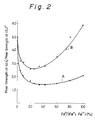
- curves A and B represent the results obtained when the heat-treatment temperature was 800°C and 970°C, respectively.
- curves A and B represent the results obtained when the heat-treatment temperature was 800°C and 970°C, respectively.
- Figs. 3 and 4 are X-ray diffraction patterns of the plate-like composite oxide fine particles containing mainly Ba and Fe obtained in Example 1 and Comparative Example 1, respectively.
- the plate-like composite oxide fine particles of the present invention have improved temperature stability without suffering any restrictions by particle shape or magnetic properties such as magnetization and coercive force, and maintain an adequate coercive force and a high magnetization.
- the temperature stability of the plate-like composite oxide fine particles produced by the process of the present invention is preferably -159 to +159 Am ⁇ 1/°C (-2.0 to +2.0 Oe/°C) at a temperature of from -20 to 70°C.
- Fig. 1 shows the relation between the amount of ferrous salt added and the temperature stability of the plate-like composite oxide fine particles containing mainly Ba and Fe which have been obtained in the same way as Example 1 described-later except that the amount of ferrous salt relative to the sum of ferrous and ferric salts is varied from 0 to 100% (calculated as Fe(II)/[Fe(II) + Fe(III)]) and that the heat-treatment temperature is changed to 800°C and 970°C.
- the amount of ferrous salt relative to the sum of ferrous and ferric salts is varied from 0 to 100% (calculated as Fe(II)/[Fe(II) + Fe(III)]) and that the heat-treatment temperature is changed to 800°C and 970°C.
- the temperature stability of the plate-like composite oxide fine particles containing mainly Ba and Fe obtained by adjusting the amount of ferrous salt relative the sum of ferrous and ferric salts to from 5 to 100% is not more than 2.0 Oe/°C, and the temperature stability improves as the heat-treatment temperature is lowered.
- ferrous salt examples include ferrous nitrate and ferrous chloride.
- ferric salt examples include ferric nitrate and ferric chloride.
- Ba salts are barium hydroxide, barium chloride and barium nitrate.
- the metals which are the substituent elements for reducing the coercive force in the present invention are at least one group (II) metal selected from Co, Ni, Zn and Mg, and at least one group (IV) metal selected from Ti, Sn, Zr and Ge.
- Examples of the group (II) metal salt are chlorides, nitrates or acetates of Co, Ni, Zn or Mg.
- the group (II) metal salt is added in an amount of 4.0 to 15.0 atom%, preferably 5.0 to 12.0 atom%, based on the total amount of Fe (II) and Fe (III). Substantially the whole amount of added group (II) metal is contained in the plate-like composite oxide fine particles containing mainly Ba and Fe.
- the content of the group (II) metal salt is less than 4.0 atom%, the coercive force increases and it is difficult to control it to an appropriate value.
- the content exceeds 15.0 atom% the obtained particles have reduced magnetization and are unsuited for use as magnetic particles for magnetic recording.
- the group (IV) metal salts usable in the present invention include Ti salts such as titanium tetrachloride and titanyl sulfate, Sn salts such as tin tetrachloride and sodium stannate, Zr salts such as zirconium oxychloride, and Ge salts such as Na2GeO3.
- Such a group (IV) metal salt is added in an amount of 4.0 to 15.0 atom%, preferably 5.0 to 12.0 atom%, based on the total amount of Fe (II) and Fe (III). Substantially the whole amount of added group (IV) metal salt is contained in the plate-like composite oxide fine particles containing mainly Ba and Fe.
- the content of the group (IV) metal salt is less than 4.0 atom%, the coercive force increases and it is difficult to control it to an appropriate value.
- the content exceeds 15.0 atom%, the obtained particles have reduced magnetization and are unsuited for use as magnetic particles for magnetic recording.
- the amount of ferrous salt used in the present invention should be from 5 to 100% based on the sum of ferrous and ferric salts (calculated as Fe(II)/[Fe(II) + Fe(III)]).
- the amount of ferrous salt is less than 5%, the obtained plate-like composite oxide particles containing mainly Ba and Fe do not have improved temperature stability, and therefore the object of the present invention is not be attained.
- the amount of ferrous salt is preferably not less than 9% to obtain excellent temperature stability.
- the average particle size of the particles obtained is larger as the amount of ferrous salt added increases.
- the amount of ferrous salt [Fe(II)/(Fe(II) + Fe(III)] used is 5 to 70%. Taking into consideration the temperature stability and average particle size, the most preferred amount of ferrous salt is 9 to 50%.
- Examples of the aqueous alkaline solution used for forming co-precipitates in the present invention are aqueous solutions of NaOH, KOH or NH4OH.
- the amount of the aqueous alkaline solution used in the present invention is at least equivalent, preferably 1 to 4 equivalents, to the sum of ferrous salt, ferric salt, barium salt, metal (II) salt and metal (IV) salt used in the co-precipitation treatment in the present invention.
- the heat-treatment in the present invention can be accomplished either in the presence or in the absence of a flux, but the presence of a flux facilitates production of the plate-like composite oxide fine particles containing mainly Ba and Fe.
- the flux examples include NaCl, KCl, BaCl2 and sodium orthosilicate.
- the amount of flux allowed to exist in the system is preferably not less than 5% by weight, more preferably 5 to 100% by weight, based on the amount of co-precipitates. Although suitable particles can be obtained even when the amount of flux used exceeds 100% by weight, it is pointless to use the flux in an excess amount.
- the heat-treatment temperature is 750 to 950°C, preferably 790 to 860°C.
- the heat-treatment temperature is below 750°C, it is difficult to carry out the reaction for producing the plate-like composite oxide fine particles containing mainly Ba and Fe and hematite may be mixed in the particles.
- the temperature exceeds 950°C, it becomes hard to attain an improvement in the temperature stability, which is an object of the present invention.
- the product obtained by heat-treating at a temperature of 750 to 950°C according to the present invention is pulverized and washed with, for example, water or acids in the usual way.
- the particles according to the present invention are further characterized by the fact that Ba is contained in an amount of 6 to 15 atom%, preferably 7 to 13 atom% based on the amount of Fe(III), the group (II) metal is contained in an amount of 4 to 15 atom%, preferably 5 to 12 atom% based on the amount of Fe(III), and the group (IV) metal is contained in an amount of 4 to 15 atom%, preferably 5 to 12 atom%, based on the amount of Fe(III).
- the present invention has realized an improvement in the temperature stability of the particles independently of other matters with no restrictions by particle shape or magnetic properties such as magnetization and coercive force.
- the plate-like composite oxide fine particles containing mainly Ba and Fe according to the present invention or produced by the process of the present invention have an adequate coercive force, a large magnetization and excellent temperature stability. It is particularly remarkable that the temperature dependence of the coercive force of the particles (temperature stability) in the temperature range of -20 to 70°C is in -2.0 to +2.0 Oe/°C.
- the particles according to the present invention or produced by the process of the present invention are best suited for use as magnetic oxide particles for magnetic recording, which are most acutely required at present.
- the average diameter of the particles shown in the following Examples and Comparative Examples is the value determined by electron micrograph.
- the magnetization and coercive force of the particles were measured in a powder state in a magnetic field of 10 KOe.
- the temperature stability was expressed by a value (in Oe/°C) obtained by dividing the difference between the coercive forces at -20°C and at 70°C by the temperature difference between 70°C and -20°C (viz. 90°C).
- the obtained fine particles had an average diameter of 0.06 »m as determined by observation under an electron microphotograph. These particles also had a coercive force (Hc) of 776 Oe and a magnetization ( ⁇ s) of 53.1 emu/g.
- the temperature stability was -0.5 Oe/°C in the range of -20°C to 70°C.
- the result of X-ray diffractometry was as shown in Fig. 3.
- Fluorescent X-ray analysis of the obtained plate-like composite oxide fine particles containing mainly Ba and Fe showed that the content of Ba was 8.8 atom% (calculated as Ba/Fe), the content of Co was 8.0 atom% (calculated as Co/Fe) and the content of Ti was 8.0 atom% (calculated as Ti/Fe).
- Plate-like composite oxide fine particles containing mainly Ba and Fe were produced in the same way as in Example 1 except that the kind and amount of the ferric salt, the amount of the ferrous salt, the kind and amount of the group (II) metal salt, the kind and amount of the group (IV) metal salt, the kind and amount of the Ba salt, the amount of NaOH, the kind and amount of the flux in the heat-treatment step and the ratio of the flux to the co-precipitates were varied.
Landscapes
- Hard Magnetic Materials (AREA)
- Compounds Of Iron (AREA)
Claims (9)
- Particules de type ferrite d'oxyde composite sous forme de plaquettes, qui :(i) contiennent du Fe(III), de 6 à 15% en atomes de Ba par rapport à la quantité de Fe(III), de 4 à 15% en atomes de Co par rapport à la quantité de Fe(III) et de 4 à 15% en atomes d'un métal du groupe (IV) choisi parmi Ti, Sn, Zr et Ge par rapport à la quantité de Fe(III);(ii) ne contiennent pas de Fe(II);(iii) ont un diamètre particulaire moyen de 0,01 à 0,3 »m;(iv) ont une stabilité à la température allant de -159 à +159 Am⁻¹/°C (-2,0 à +2,0 Oe/°C), à une température de -20 à 70°C;(v) ont une force coercitive (Hc) allant de 23,9 à 159 kAm⁻¹ (300 à 2000 Oe); et(vi) ont une magnétisation (σs) d'au moins 48 Am²/kg (48 ému/g).
- Particules suivant la revendication 1, qui ont une dimension particulaire moyenne comprise entre 0,05 et 0,15 »m, une force coercitive (Hc) de 23,9 à 95,5 kAm⁻¹ (300 à 1200 Oe) et une magnétisation (σs) d'au moins 50 Am²/kg (50 ému/g).
- Particules suivant les revendications 1 ou 2, dans lesquelles la teneur en Ba est de 7 à 13% en atomes par rapport à la quantité de Fe(III).
- Particules suivant l'une quelconque des revendications précédentes, qui contiennent de 5 à 12% en atomes de Co par rapport au Fe(III) et de 5 à 12% en atomes d'un métal du groupe (IV) choisi parmi Ti, Sn, Zr et Ge par rapport à la quantité de Fe(III).
- Procédé pour la production de particules de type ferrite d'oxyde composite sous forme de plaquettes suivant l'une quelconque des revendications 1 à 4, qui comprend un traitement à chaud effectué à une température de 750 à 950°C, d'un co-précipité produit à partir d'un sel ferreux, d'un sel de Ba, d'un sel de Co, d'un sel de ce métal du groupe (IV) et éventuellement d'un sel ferrique dans une quantité au moins équivalente d'une solution alcaline aqueuse par rapport à la quantité totale de sel ferreux, de sel ferrique, de sel de Ba, de sel de Co et de sel du métal du groupe (IV); la quantité de sel ferreux utilisée étant de 5 à 100% par rapport à la somme des quantités de sels ferreux et ferrique (calculés en tant que Fe(II) / [Fe(II) + Fe(III)]).
- Procédé suivant la revendication 5, dans lequel la quantité de sel de Co et la quantité de sel du métal du groupe (IV) sont chacune, de facon indépendante, comprise entre 5,0 et 12,0% en atomes par rapport à la somme de Fe(II) et de Fe(III).
- Procédé suivant les revendications 5 ou 6, dans lequel un fondant est ajouté pour ce traitement à chaud, en une quantité de 5 à 100% en poids par rapport au co-précipité.
- Procédé pour la production de particules de type ferrite d'oxyde composite sous forme de plaquettes contenant Fe, Ba, au moins un métal du groupe (II) choisi parmi Co, Ni, Zn et Mg et au moins un métal du groupe (IV) choisi parmi Ti, Sn, Zr et Ge, qui comprend un traitement à chaud effectué à une température de 750 à 950°C, d'un co-précipité produit à partir d'un sel ferreux, d'un sel de Ba, d'un sel d'un métal de ce groupe (II), d'un sel d'un métal de ce groupe (IV) et éventuellement d'un sel ferrique dans une quantité au moins équivalente d'une solution alcaline aqueuse par rapport à la quantité totale de sel ferreux, de sel ferrique, de sel de Ba, de sel d'un métal du groupe (II) et de sel d'un métal du groupe (IV); la quantité de sel ferreux utilisée étant de 5 à 100% par rapport à la somme des quantités des sels ferreux et ferrique (calculés en tant que Fe(II) / [Fe(II) + Fe(III)]).
- Milieu pour l'enregistrement magnétique, dans lequel le matériau magnétique comprend des particules suivant l'une quelconque des revendications 1 à 4 ou qui ont été produites par un procédé suivant l'une quelconque des revendications 5 à 7.
Applications Claiming Priority (2)
| Application Number | Priority Date | Filing Date | Title |
|---|---|---|---|
| JP268948/88 | 1988-10-24 | ||
| JP63268948A JP2791562B2 (ja) | 1988-10-24 | 1988-10-24 | Ba及びFeを主成分として含む板状酸化物微粒子粉末及びその製造法 |
Publications (3)
| Publication Number | Publication Date |
|---|---|
| EP0366370A2 EP0366370A2 (fr) | 1990-05-02 |
| EP0366370A3 EP0366370A3 (fr) | 1991-04-03 |
| EP0366370B1 true EP0366370B1 (fr) | 1995-02-08 |
Family
ID=17465515
Family Applications (1)
| Application Number | Title | Priority Date | Filing Date |
|---|---|---|---|
| EP89310817A Expired - Lifetime EP0366370B1 (fr) | 1988-10-24 | 1989-10-20 | Particules fines d'oxyde sous forme de plaquettes contenant essentiellement Ba et Fe et leur procédé de fabrication de celles-ci |
Country Status (3)
| Country | Link |
|---|---|
| EP (1) | EP0366370B1 (fr) |
| JP (1) | JP2791562B2 (fr) |
| DE (1) | DE68921036T2 (fr) |
Families Citing this family (1)
| Publication number | Priority date | Publication date | Assignee | Title |
|---|---|---|---|---|
| JPH0620254A (ja) * | 1992-07-03 | 1994-01-28 | Tdk Corp | 磁気記録媒体およびその製造方法 |
Citations (1)
| Publication number | Priority date | Publication date | Assignee | Title |
|---|---|---|---|---|
| EP0272148A2 (fr) * | 1986-12-19 | 1988-06-22 | Toda Kogyo Corp. | Particules de ferrite du type magnétoplumbite sous la forme de plaquettes pour l'enregistrement magnétique et leur procédé de fabrication |
Family Cites Families (4)
| Publication number | Priority date | Publication date | Assignee | Title |
|---|---|---|---|---|
| KR900000429B1 (ko) * | 1984-05-31 | 1990-01-30 | 도다 교오교오 가부시끼가이샤 | 자기 기록용 판상 아철산 바륨입자와 그 제조방법 |
| EP0232132B1 (fr) * | 1986-01-29 | 1991-10-02 | Toda Kogyo Corp. | Particules de ferrite de barium sous forme de plaquette et procédé pour la fabrication de celles-ci |
| JPS62265121A (ja) * | 1986-05-09 | 1987-11-18 | Toda Kogyo Corp | 板状Baフエライト微粒子粉末及びその製造法 |
| JPH0761874B2 (ja) * | 1986-09-12 | 1995-07-05 | 戸田工業株式会社 | 磁気記録用板状Baフエライト微粒子粉末及びその製造法 |
-
1988
- 1988-10-24 JP JP63268948A patent/JP2791562B2/ja not_active Expired - Fee Related
-
1989
- 1989-10-20 EP EP89310817A patent/EP0366370B1/fr not_active Expired - Lifetime
- 1989-10-20 DE DE1989621036 patent/DE68921036T2/de not_active Expired - Fee Related
Patent Citations (1)
| Publication number | Priority date | Publication date | Assignee | Title |
|---|---|---|---|---|
| EP0272148A2 (fr) * | 1986-12-19 | 1988-06-22 | Toda Kogyo Corp. | Particules de ferrite du type magnétoplumbite sous la forme de plaquettes pour l'enregistrement magnétique et leur procédé de fabrication |
Also Published As
| Publication number | Publication date |
|---|---|
| JP2791562B2 (ja) | 1998-08-27 |
| EP0366370A3 (fr) | 1991-04-03 |
| DE68921036T2 (de) | 1995-09-21 |
| DE68921036D1 (de) | 1995-03-23 |
| EP0366370A2 (fr) | 1990-05-02 |
| JPH02116633A (ja) | 1990-05-01 |
Similar Documents
| Publication | Publication Date | Title |
|---|---|---|
| EP0394586B1 (fr) | Particules de ferrite de baryum sous forme de plaquette pour l'enregistrement magnétique et procédé pour la fabrication de celles-ci | |
| JPS62216922A (ja) | 磁気記録媒体用六万晶フエライト微粉末及びその製造法 | |
| US4781981A (en) | Plate-like magnetoplumbite ferrite particles for magnetic recording and process for producing the same | |
| AU2471692A (en) | Hexagonal magnetic ferrite pigment for high density magnetic recording applications | |
| EP0232131B1 (fr) | Particules de ferrite de barium sous forme de plaquette pour l'enregistrement magnétique et procédé pour la fabrication de celles-ci | |
| EP0366370B1 (fr) | Particules fines d'oxyde sous forme de plaquettes contenant essentiellement Ba et Fe et leur procédé de fabrication de celles-ci | |
| US5766763A (en) | Hexagonal system ferrite powder for a high density magnetic recording medium | |
| EP0349287B1 (fr) | Particules fines de ferrite sous forme de platelets capables pour l'usage dans l'enregistrement magnétique et son procédé de fabrication | |
| EP0231128B1 (fr) | Particules de ferrite de barium sous forme de plaquette et procédé de fabrication de celles-ci | |
| JP2607920B2 (ja) | 磁気記録用板状複合フェライト微粒子粉末及びその製造法 | |
| JP3024974B2 (ja) | 高保磁力板状マグネトプランバイト型フェライト粒子粉末及びその製造法 | |
| JP2741198B2 (ja) | 磁気記録用板状マグネトプランバイト型フェライト微粒子粉末 | |
| EP0371384B1 (fr) | Procédé de fabrication de particules magnétiques d'oxyde de fer pour l'enregistrement magnétique | |
| JP2958370B2 (ja) | 複合フェライト磁性粉の製造方法 | |
| JPH0440844B2 (fr) | ||
| JPH0764567B2 (ja) | 磁気記録用板状マグネトプランバイト型フエライト微粒子粉末 | |
| JPH0614486B2 (ja) | 磁気記録用板状複合フェライト微粒子粉末及びその製造法 | |
| JP2958369B2 (ja) | 複合フェライト磁性粉の製造方法 | |
| JPH0372014B2 (fr) | ||
| JPH0672019B2 (ja) | 磁気記録用板状複合フェライト微粒子粉末及びその製造法 | |
| JPH0669018A (ja) | 複合フェライト磁性粉の製造方法 | |
| JPH0524868B2 (fr) | ||
| JPH0240127A (ja) | 磁気記録用板状複合フェライト微粒子粉末及びその製造法 | |
| JPH0524869B2 (fr) | ||
| JPH04362019A (ja) | フェライト磁性粉及びその製造法 |
Legal Events
| Date | Code | Title | Description |
|---|---|---|---|
| PUAI | Public reference made under article 153(3) epc to a published international application that has entered the european phase |
Free format text: ORIGINAL CODE: 0009012 |
|
| AK | Designated contracting states |
Kind code of ref document: A2 Designated state(s): DE FR GB NL |
|
| 17P | Request for examination filed |
Effective date: 19901218 |
|
| PUAL | Search report despatched |
Free format text: ORIGINAL CODE: 0009013 |
|
| AK | Designated contracting states |
Kind code of ref document: A3 Designated state(s): DE FR GB NL |
|
| 17Q | First examination report despatched |
Effective date: 19930120 |
|
| GRAA | (expected) grant |
Free format text: ORIGINAL CODE: 0009210 |
|
| AK | Designated contracting states |
Kind code of ref document: B1 Designated state(s): DE FR GB NL |
|
| REF | Corresponds to: |
Ref document number: 68921036 Country of ref document: DE Date of ref document: 19950323 |
|
| ET | Fr: translation filed | ||
| PLBE | No opposition filed within time limit |
Free format text: ORIGINAL CODE: 0009261 |
|
| STAA | Information on the status of an ep patent application or granted ep patent |
Free format text: STATUS: NO OPPOSITION FILED WITHIN TIME LIMIT |
|
| 26N | No opposition filed | ||
| PGFP | Annual fee paid to national office [announced via postgrant information from national office to epo] |
Ref country code: FR Payment date: 20011010 Year of fee payment: 13 |
|
| PGFP | Annual fee paid to national office [announced via postgrant information from national office to epo] |
Ref country code: GB Payment date: 20011024 Year of fee payment: 13 |
|
| PGFP | Annual fee paid to national office [announced via postgrant information from national office to epo] |
Ref country code: NL Payment date: 20011031 Year of fee payment: 13 |
|
| REG | Reference to a national code |
Ref country code: GB Ref legal event code: IF02 |
|
| PG25 | Lapsed in a contracting state [announced via postgrant information from national office to epo] |
Ref country code: GB Free format text: LAPSE BECAUSE OF NON-PAYMENT OF DUE FEES Effective date: 20021020 |
|
| PGFP | Annual fee paid to national office [announced via postgrant information from national office to epo] |
Ref country code: DE Payment date: 20021024 Year of fee payment: 14 |
|
| PG25 | Lapsed in a contracting state [announced via postgrant information from national office to epo] |
Ref country code: NL Free format text: LAPSE BECAUSE OF NON-PAYMENT OF DUE FEES Effective date: 20030501 |
|
| GBPC | Gb: european patent ceased through non-payment of renewal fee |
Effective date: 20021020 |
|
| PG25 | Lapsed in a contracting state [announced via postgrant information from national office to epo] |
Ref country code: FR Free format text: LAPSE BECAUSE OF NON-PAYMENT OF DUE FEES Effective date: 20030630 |
|
| NLV4 | Nl: lapsed or anulled due to non-payment of the annual fee |
Effective date: 20030501 |
|
| REG | Reference to a national code |
Ref country code: FR Ref legal event code: ST |
|
| PG25 | Lapsed in a contracting state [announced via postgrant information from national office to epo] |
Ref country code: DE Free format text: LAPSE BECAUSE OF NON-PAYMENT OF DUE FEES Effective date: 20040501 |