EP0366771B1 - Joint a brides - Google Patents
Joint a brides Download PDFInfo
- Publication number
- EP0366771B1 EP0366771B1 EP89905682A EP89905682A EP0366771B1 EP 0366771 B1 EP0366771 B1 EP 0366771B1 EP 89905682 A EP89905682 A EP 89905682A EP 89905682 A EP89905682 A EP 89905682A EP 0366771 B1 EP0366771 B1 EP 0366771B1
- Authority
- EP
- European Patent Office
- Prior art keywords
- flange
- limb
- tube
- web
- bead
- Prior art date
- Legal status (The legal status is an assumption and is not a legal conclusion. Google has not performed a legal analysis and makes no representation as to the accuracy of the status listed.)
- Expired - Lifetime
Links
- 238000003780 insertion Methods 0.000 claims description 5
- 230000037431 insertion Effects 0.000 claims description 5
- 239000011324 bead Substances 0.000 abstract description 28
- 239000002184 metal Substances 0.000 description 7
- 238000004519 manufacturing process Methods 0.000 description 2
- 244000089486 Phragmites australis subsp australis Species 0.000 description 1
- 229910000639 Spring steel Inorganic materials 0.000 description 1
- 238000005452 bending Methods 0.000 description 1
- 230000015572 biosynthetic process Effects 0.000 description 1
- 239000013013 elastic material Substances 0.000 description 1
- 238000007373 indentation Methods 0.000 description 1
- 238000004080 punching Methods 0.000 description 1
- 238000009987 spinning Methods 0.000 description 1
- 238000009423 ventilation Methods 0.000 description 1
Images


Classifications
-
- F—MECHANICAL ENGINEERING; LIGHTING; HEATING; WEAPONS; BLASTING
- F24—HEATING; RANGES; VENTILATING
- F24F—AIR-CONDITIONING; AIR-HUMIDIFICATION; VENTILATION; USE OF AIR CURRENTS FOR SCREENING
- F24F13/00—Details common to, or for air-conditioning, air-humidification, ventilation or use of air currents for screening
- F24F13/02—Ducting arrangements
- F24F13/0209—Ducting arrangements characterised by their connecting means, e.g. flanges
-
- F—MECHANICAL ENGINEERING; LIGHTING; HEATING; WEAPONS; BLASTING
- F16—ENGINEERING ELEMENTS AND UNITS; GENERAL MEASURES FOR PRODUCING AND MAINTAINING EFFECTIVE FUNCTIONING OF MACHINES OR INSTALLATIONS; THERMAL INSULATION IN GENERAL
- F16L—PIPES; JOINTS OR FITTINGS FOR PIPES; SUPPORTS FOR PIPES, CABLES OR PROTECTIVE TUBING; MEANS FOR THERMAL INSULATION IN GENERAL
- F16L23/00—Flanged joints
- F16L23/12—Flanged joints specially adapted for particular pipes
- F16L23/14—Flanged joints specially adapted for particular pipes for rectangular pipes
Definitions
- the invention relates to a flange connection for thin-walled, in particular wound pipes, with a flange profile which has a first web, which can be inserted into the end of the pipe, extends parallel to the pipe wall, and a second web which stands up vertically therefrom, and with several on the second Web to be arranged clamping elements that connect the tube to the flange profile.
- connection of thin-walled pipes which are used primarily for the production of ventilation ducts or the like, is a problem that has not been satisfactorily solved in spite of a large number of different proposals, since it requires the connection flanges to be attached to the smooth pipe ends as simply as possible.
- EP-A-148286 shows a flange connection of the type mentioned at the outset, which connects rectangular tubes. It consists of an approximately L-shaped profile per side of the rectangle, which is inserted into the tube, in the edge area of which a bead is formed towards the tube wall and on the free edges of which a beading corresponding to the dimensioning of the bead is provided.
- an elastic clamping strip or several sections of the clamping strip the profile is clamped in a sheet metal tube between the bead and the edge flange of the upstanding web, and in a tube made of elastic material between the bead and the edge flange of the web engaging in the tube.
- the flange profiles are connected to each other by clamping or screwing the upstanding webs.
- EP-A-78946 describes a flange ring which is folded from sheet metal, in particular spring steel sheet, and which is also approximately L-shaped.
- the web to be inserted into the tube is bent back obliquely towards the end, so that when the ring is driven into the tube, the bent-back part presses against the tube wall, additional securing being achieved by the ring locking behind inward projections or bends in the tube .
- Two flange rings are also connected by screwing or clipping.
- the invention has set itself the task of creating a flange connection which leads to a positive connection in the longitudinal direction without additional processing of the pipe end.
- this object is achieved in that the first web of the flange profile that can be inserted into the pipe end has a bead in the side facing the second web, and that each tensioning element is rotatably mounted on the second web about an axis perpendicular to the web and has a head part, which has a locking cam which can be pivoted into the bead.
- the rotatable arrangement of the tensioning element provided by the proposal according to the invention is preferably provided by a bearing in an opening in the second web, which results in a preferred embodiment in which the tensioning element connects the second webs of two adjacent flange profiles to one another.
- a further preferred embodiment provides that the tensioning element has a head part with a locking cam on both sides of a middle piece passing through the two second webs of the two flange profiles, so that each tensioning element connects both tubes with the flange profiles and both flange profiles simultaneously.
- the center piece of the tensioning element can be formed, for example, by a conventional screw with a nut, to which two approximately rectangular flat pieces with an eccentric bore are assigned in the manner of washers, the free ends of the flat pieces forming the locking cams pivoting into the beads.
- the locking cam preferably has a face that is rounded up to half in order to facilitate pivoting in, the second half of the face acting as a stop against spinning.
- a particularly simple design is obtained if longitudinal slots aligned with one another are provided on the second webs, and the tensioning element is designed as a one-piece flat bolt which can be rotated from an insertion position parallel to the first webs into a tensioning position perpendicular thereto.
- the two head parts of the flange bolt are spaced apart from one another by twice the thickness of a second web through the center piece, and each second web has a bead between the longitudinal slot and the first web shaped towards the respective head part. Due to the bead in the raised second webs, the tensioning position is secured against unintentional loosening by friction between the bead and the flat bar.
- the bead can also be provided at the lowest possible point, ie in the edge area within the bead in the first web.
- the edges of the head part touching the flange profile are chamfered or rounded.
- a simplified design of the flange connection in particular for shorter pipe sections of smaller cross-section, has a single flange profile, which is then approximately T-shaped, so that it is first inserted into the end of one tube, and then the other tube is pushed onto the free web of the flange profile. After the tensioning elements have been turned, the positive locking in the longitudinal direction is also given.
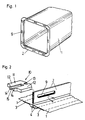
- a tube 1 of any cross-sectional shape (FIGS. 1, 9, 10) is provided with a flange profile 2, which is approximately L-shaped in the illustrations in FIGS. 1 to 12, and in the illustration according to FIG. 14 is formed approximately in a T-shape from a flat sheet metal strip.
- the flange profile 2 preferably extends in one piece over the circumference of the tube 1, but it could also be composed of a plurality of sections or a plurality of profiles arranged in a row.
- the L-shaped flange profile 2 made from a flat sheet metal strip consists of a first web 3, which runs parallel to the pipe wall and is placed on the inside of the pipe wall.
- the web 3 is provided directly next to the edge with the second upstanding web 6 with a bead 4 which is formed in the interior of the tube, so that a recess is formed on the outside.
- the upstanding second web 6 is provided according to the embodiment according to FIGS. 1 to 8 in the upper part with a stiffening web 7, and below the stiffening web 7 a further bead 8 is arranged, which is bent in the direction of the first web 3, and the stiffening web 7 slightly overlooked.
- the upstanding web 6 and the stiffening web 7 are provided with openings 9 which, as shown in FIG. 10, are circular holes or, according to FIGS. 1 and 2, longitudinal slots parallel to the first web 3.
- a T-shaped flange profile according to FIG. 14 is also folded from a flat sheet metal strip and has a first web 3 parallel to the pipe wall on each side of the upstanding webs 6 connected via the bent upper edge 18, each of which in turn has a bead 4 near the edge is provided in the manner described. While an L-shaped flange profile is provided at each pipe end, and then adjacent flange profiles are connected in the manner yet to be explained, a pipe connection is made via a T-shaped flange profile so that this first into one Pipe end inserted and then the second pipe is plugged on. This flange profile is therefore more suitable for shorter, easily manipulable pipes.
- Clamping elements 10 are used for the connection mentioned between the flange profile 2 and the tube 1.
- Each clamping element 10 has a center piece 13 defining an axis of rotation, which is rotatably mounted in an opening 9.
- a central part 12 is assigned to the middle piece 13 and has a locking cam 14.
- the tensioning element 10 pivots into the depression formed by the bead 4.
- the edge 5 of the tube 1 covering the bead 4, into which the flange profile 2 is inserted (FIG. 6), is turned into the bead 4 by rotating the tensioning element 10 into its locking position (FIG. 8) in a short section below the tensioning element 10 indented and permanently deformed, as shown in FIG. 7, in which the clamping element 10 was not shown, and can be seen in FIG.
- the clamping element 10 serves as a deformation tool .
- the clamping element 10, which is rotatably mounted in the opening 9, is simultaneously used in the case of L-shaped flange profiles 2 for connecting the upstanding webs 6 and thus for connecting the flange profiles 2 to one another.
- a clamping element designed as a flat bolt 11 is shown in detail in FIGS. 2 to 5 and 8.
- the center piece 13, which is rotatable in the openings 9, carries on both sides a flat head part 12, each of which is provided with a locking cam 14, and between which a gap 15 is formed.
- To insert the Flat bars 11 must be provided as openings 9 longitudinal slots through which the flat bars 11 are inserted.
- Each flat bar 11 is then rotated by 90 ° from the insertion position parallel to the first webs 3, the edges 5 of both tubes 1 being pressed simultaneously into the beads 4 by the locking cams 14 (FIG. 8). The connection between the two flange profiles 2 and the two tubes 1 is thus established and fixed.
- the total width is somewhat larger than the width of the gap 15 in the flat bar 11, so that the flat bar 11 is clamped in the locking position.
- the end faces of the flat bolt 11 that come into contact with the flange profile 2 are chamfered at the edges (FIGS. 3, 4, 5), so that twisting into the locking position is facilitated.
- the clamping element 10 is formed by a nut screw, the head of which is irregularly shaped. It represents a flat piece 16 which projects eccentrically from the central part 13 formed by the threaded bolt, a part corresponding to a conventional screw head being angularly designed to engage a wrench, while the eccentric part forms the locking cam 14 which can be pivoted into the bead 4.
- the lower end face is half curved and the other half flat, the flat part forming a rotation limit stop after pivoting into the bead 4.
- the openings 9 in the upstanding webs 6, which in this embodiment have neither the stiffening web 7 nor the bead 8, are designed as a circular hole, the threaded nut 17 on the second side connecting the two flanges. If such tensioning elements 10 are used alternately from different sides, then both tubes 1 are also positively connected to the flange profiles 2.
- the clamping element 10 consists of a nut screw with head 20 and nut 21, similar to washers, one flat piece 19 in the manner described above is assigned to the screw head 20 and the screw nut 21.
- the shaft of the nut screw again forms the center piece 13, which is formed as perforations 9 and the flat pieces 19 represent the two head parts 12, each carrying a locking cam 14.
- the nut-side flat piece 19 rotates up to the stop due to the friction in the crimp 4 of the one flange head 2 and by turning the head 20 by about 90 ° due to the rotation, also the head-side flat piece 19 as far as possible in the crimp 4 of the other flange profile 2, so that in this embodiment also the insertion and tightening of the tensioning elements 10 both the pipes 1 with the flange profiles 2 and these fixed to one another.
- a one-piece T-shaped flange profile 2 the two upstanding and perforated webs 6 of which are connected to one another via the bent edge 18, is inserted with its first web 3 into one tube 1, and then the second tube 1 onto the second web 3 postponed. After the tensioning elements 10 have been attached, both tubes are positively connected to the flange profile 2.
- seals can be inserted between the upstanding webs 6 of two L-shaped flange profiles 2 and between the webs 3 and the pipe ends, it being possible for additional receiving grooves to be formed in the webs 3.
- additional receiving grooves can be formed in the webs 3.
- a receiving groove in the upstanding webs 6, especially the through two beads 8 formed cavity 22 can be used. (Fig. 8)
Landscapes
- Engineering & Computer Science (AREA)
- General Engineering & Computer Science (AREA)
- Mechanical Engineering (AREA)
- Chemical & Material Sciences (AREA)
- Combustion & Propulsion (AREA)
- Flanged Joints, Insulating Joints, And Other Joints (AREA)
- Quick-Acting Or Multi-Walled Pipe Joints (AREA)
- Compositions Of Oxide Ceramics (AREA)
- Diaphragms For Electromechanical Transducers (AREA)
Claims (6)
Applications Claiming Priority (2)
| Application Number | Priority Date | Filing Date | Title |
|---|---|---|---|
| AT0129288A AT389931B (de) | 1988-05-18 | 1988-05-18 | Flanschverbindung |
| AT1292/88 | 1988-05-18 |
Publications (2)
| Publication Number | Publication Date |
|---|---|
| EP0366771A1 EP0366771A1 (fr) | 1990-05-09 |
| EP0366771B1 true EP0366771B1 (fr) | 1991-08-14 |
Family
ID=3510732
Family Applications (1)
| Application Number | Title | Priority Date | Filing Date |
|---|---|---|---|
| EP89905682A Expired - Lifetime EP0366771B1 (fr) | 1988-05-18 | 1989-04-28 | Joint a brides |
Country Status (8)
| Country | Link |
|---|---|
| EP (1) | EP0366771B1 (fr) |
| JP (1) | JPH03501151A (fr) |
| CN (1) | CN1018948B (fr) |
| AT (2) | AT389931B (fr) |
| DK (1) | DK13890A (fr) |
| ES (1) | ES2014101A6 (fr) |
| FI (1) | FI900263A7 (fr) |
| WO (1) | WO1989011615A1 (fr) |
Families Citing this family (4)
| Publication number | Priority date | Publication date | Assignee | Title |
|---|---|---|---|---|
| US7234734B2 (en) * | 2005-01-31 | 2007-06-26 | Met-Coil Systems, Llc | Integral transverse flanges for a duct connecting system |
| CN106498181A (zh) * | 2016-10-20 | 2017-03-15 | 北京矿冶研究总院 | 一种氧化铅锌矿绿色冶金提取的方法 |
| CN112901865A (zh) * | 2021-02-08 | 2021-06-04 | 山东悦龙橡塑科技有限公司 | 一种法兰连接的软管总成 |
| CN115475885B (zh) * | 2022-10-24 | 2025-09-12 | 陕西科技大学 | 一种基于摩擦辅助的板材-管材连接方法及装置 |
Family Cites Families (4)
| Publication number | Priority date | Publication date | Assignee | Title |
|---|---|---|---|---|
| DE2553720A1 (de) * | 1975-11-26 | 1977-06-02 | Herbst Donald | Flanschverbindung fuer die aus blech bestehenden kanalabschnitte von lueftungs- oder klimaanlagen |
| DE3143893C1 (de) * | 1981-11-05 | 1983-04-21 | Karl Meinig KG, 7201 Rietheim-Weilheim | Flanschring fuer Rohre |
| DE3374588D1 (en) * | 1983-12-30 | 1987-12-23 | Siegfried Geldner | Flanged joint |
| DE3710665A1 (de) * | 1987-03-31 | 1988-10-27 | Meinig Metu System | Stossverbindung zwischen zwei blechkanalabschnitten |
-
1988
- 1988-05-18 AT AT0129288A patent/AT389931B/de not_active IP Right Cessation
-
1989
- 1989-04-28 AT AT89905682T patent/ATE66293T1/de active
- 1989-04-28 JP JP1505106A patent/JPH03501151A/ja active Pending
- 1989-04-28 EP EP89905682A patent/EP0366771B1/fr not_active Expired - Lifetime
- 1989-04-28 WO PCT/EP1989/000475 patent/WO1989011615A1/fr not_active Ceased
- 1989-04-28 FI FI900263A patent/FI900263A7/fi not_active IP Right Cessation
- 1989-05-16 ES ES8901636A patent/ES2014101A6/es not_active Expired - Fee Related
- 1989-05-17 CN CN89103317.3A patent/CN1018948B/zh not_active Expired
-
1990
- 1990-01-17 DK DK013890A patent/DK13890A/da not_active Application Discontinuation
Also Published As
| Publication number | Publication date |
|---|---|
| FI900263A0 (fi) | 1990-01-17 |
| FI900263A7 (fi) | 1990-01-17 |
| EP0366771A1 (fr) | 1990-05-09 |
| WO1989011615A1 (fr) | 1989-11-30 |
| DK13890A (da) | 1990-03-02 |
| ATA129288A (de) | 1989-07-15 |
| CN1018948B (zh) | 1992-11-04 |
| ES2014101A6 (es) | 1990-06-16 |
| AT389931B (de) | 1990-02-26 |
| ATE66293T1 (de) | 1991-08-15 |
| DK13890D0 (da) | 1990-01-17 |
| JPH03501151A (ja) | 1991-03-14 |
| CN1038505A (zh) | 1990-01-03 |
Similar Documents
| Publication | Publication Date | Title |
|---|---|---|
| DE3500400C2 (fr) | ||
| DE3803731C2 (de) | Kunststoffabdeckung für eine Rohrleitung | |
| DE3313235C2 (fr) | ||
| DE2321814A1 (de) | Schlauchklemme | |
| DE2333237C2 (fr) | ||
| AT408773B (de) | Sieb und verfahren zur herstellung eines derartigen siebes | |
| EP0366771B1 (fr) | Joint a brides | |
| EP0400345A1 (fr) | Dispositif de fixation | |
| DE2810630C3 (de) | Verbundprofil | |
| DE3301229C2 (fr) | ||
| DE3800729C2 (de) | Käfig für ein Linear- oder Drehbewegungen ausführendes Rollenlager | |
| EP0984119B1 (fr) | Axe à ressort, notamment un carré de poignée | |
| DE9110896U1 (de) | Vorrichtung zur Feststellung des Verschleißes von Rollenketten | |
| DE102021127787B3 (de) | Freilauf mit einem Käfig und Käfig mit Führungselementen | |
| DE4316808A1 (de) | Spannstück für Rohrelemente | |
| CH652188A5 (en) | Composite profile | |
| DE3518866C1 (de) | Bolzenteile zur Bildung eines selbstsichernden Sperrbolzens | |
| EP2177807A2 (fr) | Collier en bande | |
| DE9001664U1 (de) | Klemmeinrichtung | |
| DE3302855C2 (de) | Innenrippenrohr für druckgas- oder druckölbeheizte Heizkessel | |
| DE29815970U1 (de) | Kaminrohr | |
| EP0809060A2 (fr) | Raccord articulé pour un collier de serrage | |
| DE2515822A1 (de) | Spannschloss zum spannen von spanndraehten fuer drahtzaeune | |
| DE69811772T2 (de) | Band für eine Befestigungsschelle und Befestigungsschelle | |
| DE102022100151A1 (de) | Endrohrblende zur befestigung an einem abgasrohr |
Legal Events
| Date | Code | Title | Description |
|---|---|---|---|
| PUAI | Public reference made under article 153(3) epc to a published international application that has entered the european phase |
Free format text: ORIGINAL CODE: 0009012 |
|
| 17P | Request for examination filed |
Effective date: 19900113 |
|
| AK | Designated contracting states |
Kind code of ref document: A1 Designated state(s): AT BE CH DE FR GB IT LI LU NL SE |
|
| 17Q | First examination report despatched |
Effective date: 19910122 |
|
| GRAA | (expected) grant |
Free format text: ORIGINAL CODE: 0009210 |
|
| AK | Designated contracting states |
Kind code of ref document: B1 Designated state(s): AT BE CH DE FR GB IT LI LU NL SE |
|
| REF | Corresponds to: |
Ref document number: 66293 Country of ref document: AT Date of ref document: 19910815 Kind code of ref document: T |
|
| REF | Corresponds to: |
Ref document number: 58900216 Country of ref document: DE Date of ref document: 19910919 |
|
| ITF | It: translation for a ep patent filed | ||
| ET | Fr: translation filed | ||
| GBT | Gb: translation of ep patent filed (gb section 77(6)(a)/1977) | ||
| PG25 | Lapsed in a contracting state [announced via postgrant information from national office to epo] |
Ref country code: AT Effective date: 19920428 |
|
| PG25 | Lapsed in a contracting state [announced via postgrant information from national office to epo] |
Ref country code: SE Effective date: 19920429 |
|
| PG25 | Lapsed in a contracting state [announced via postgrant information from national office to epo] |
Ref country code: LU Free format text: LAPSE BECAUSE OF NON-PAYMENT OF DUE FEES Effective date: 19920430 Ref country code: LI Effective date: 19920430 Ref country code: CH Effective date: 19920430 Ref country code: BE Effective date: 19920430 |
|
| PLBE | No opposition filed within time limit |
Free format text: ORIGINAL CODE: 0009261 |
|
| STAA | Information on the status of an ep patent application or granted ep patent |
Free format text: STATUS: NO OPPOSITION FILED WITHIN TIME LIMIT |
|
| 26N | No opposition filed | ||
| BERE | Be: lapsed |
Owner name: SPIRO-MASCHINEN A.G. Effective date: 19920430 |
|
| PG25 | Lapsed in a contracting state [announced via postgrant information from national office to epo] |
Ref country code: NL Effective date: 19921101 |
|
| NLV4 | Nl: lapsed or anulled due to non-payment of the annual fee | ||
| PG25 | Lapsed in a contracting state [announced via postgrant information from national office to epo] |
Ref country code: FR Effective date: 19921230 |
|
| REG | Reference to a national code |
Ref country code: CH Ref legal event code: PL |
|
| PG25 | Lapsed in a contracting state [announced via postgrant information from national office to epo] |
Ref country code: DE Effective date: 19930101 |
|
| REG | Reference to a national code |
Ref country code: FR Ref legal event code: ST |
|
| PG25 | Lapsed in a contracting state [announced via postgrant information from national office to epo] |
Ref country code: GB Effective date: 19930428 |
|
| GBPC | Gb: european patent ceased through non-payment of renewal fee |
Effective date: 19930428 |
|
| EUG | Se: european patent has lapsed |
Ref document number: 89905682.4 Effective date: 19921108 |
|
| PG25 | Lapsed in a contracting state [announced via postgrant information from national office to epo] |
Ref country code: IT Free format text: LAPSE BECAUSE OF NON-PAYMENT OF DUE FEES;WARNING: LAPSES OF ITALIAN PATENTS WITH EFFECTIVE DATE BEFORE 2007 MAY HAVE OCCURRED AT ANY TIME BEFORE 2007. THE CORRECT EFFECTIVE DATE MAY BE DIFFERENT FROM THE ONE RECORDED. Effective date: 20050428 |