EP0366796B1 - Aktivierter kohlenstoff und verfahren zur herstellung - Google Patents
Aktivierter kohlenstoff und verfahren zur herstellung Download PDFInfo
- Publication number
- EP0366796B1 EP0366796B1 EP88910105A EP88910105A EP0366796B1 EP 0366796 B1 EP0366796 B1 EP 0366796B1 EP 88910105 A EP88910105 A EP 88910105A EP 88910105 A EP88910105 A EP 88910105A EP 0366796 B1 EP0366796 B1 EP 0366796B1
- Authority
- EP
- European Patent Office
- Prior art keywords
- carbon
- meso
- microbeads
- activating
- carbon microbeads
- Prior art date
- Legal status (The legal status is an assumption and is not a legal conclusion. Google has not performed a legal analysis and makes no representation as to the accuracy of the status listed.)
- Expired - Lifetime
Links
- OKTJSMMVPCPJKN-UHFFFAOYSA-N Carbon Chemical compound [C] OKTJSMMVPCPJKN-UHFFFAOYSA-N 0.000 title claims abstract description 41
- 238000000034 method Methods 0.000 title claims abstract description 25
- 238000004519 manufacturing process Methods 0.000 title claims description 5
- 239000002931 mesocarbon microbead Substances 0.000 claims abstract description 36
- 230000003213 activating effect Effects 0.000 claims abstract description 29
- KWYUFKZDYYNOTN-UHFFFAOYSA-M potassium hydroxide Substances [OH-].[K+] KWYUFKZDYYNOTN-UHFFFAOYSA-M 0.000 claims description 43
- 229910052799 carbon Inorganic materials 0.000 claims description 27
- 239000011148 porous material Substances 0.000 claims description 20
- 230000004913 activation Effects 0.000 claims description 15
- CSCPPACGZOOCGX-UHFFFAOYSA-N Acetone Chemical compound CC(C)=O CSCPPACGZOOCGX-UHFFFAOYSA-N 0.000 claims description 14
- HEMHJVSKTPXQMS-UHFFFAOYSA-M Sodium hydroxide Chemical compound [OH-].[Na+] HEMHJVSKTPXQMS-UHFFFAOYSA-M 0.000 claims description 12
- 239000011325 microbead Substances 0.000 claims description 7
- OKKJLVBELUTLKV-UHFFFAOYSA-N Methanol Chemical compound OC OKKJLVBELUTLKV-UHFFFAOYSA-N 0.000 claims description 6
- 239000002245 particle Substances 0.000 claims description 6
- LFQSCWFLJHTTHZ-UHFFFAOYSA-N Ethanol Chemical compound CCO LFQSCWFLJHTTHZ-UHFFFAOYSA-N 0.000 claims description 4
- 239000004094 surface-active agent Substances 0.000 claims description 3
- 235000019441 ethanol Nutrition 0.000 claims description 2
- 238000000151 deposition Methods 0.000 claims 2
- 238000001035 drying Methods 0.000 claims 1
- 238000005406 washing Methods 0.000 claims 1
- 239000003575 carbonaceous material Substances 0.000 abstract description 29
- URGAHOPLAPQHLN-UHFFFAOYSA-N sodium aluminosilicate Chemical group [Na+].[Al+3].[O-][Si]([O-])=O.[O-][Si]([O-])=O URGAHOPLAPQHLN-UHFFFAOYSA-N 0.000 abstract description 13
- 239000000126 substance Substances 0.000 abstract description 8
- 230000000379 polymerizing effect Effects 0.000 abstract 1
- 238000001179 sorption measurement Methods 0.000 description 21
- 239000000463 material Substances 0.000 description 17
- 238000001994 activation Methods 0.000 description 14
- 239000002808 molecular sieve Substances 0.000 description 12
- XLYOFNOQVPJJNP-UHFFFAOYSA-N water Chemical compound O XLYOFNOQVPJJNP-UHFFFAOYSA-N 0.000 description 12
- 239000007789 gas Substances 0.000 description 9
- 238000009826 distribution Methods 0.000 description 8
- 239000012298 atmosphere Substances 0.000 description 7
- UHOVQNZJYSORNB-UHFFFAOYSA-N Benzene Chemical compound C1=CC=CC=C1 UHOVQNZJYSORNB-UHFFFAOYSA-N 0.000 description 6
- 239000007858 starting material Substances 0.000 description 6
- CURLTUGMZLYLDI-UHFFFAOYSA-N Carbon dioxide Chemical compound O=C=O CURLTUGMZLYLDI-UHFFFAOYSA-N 0.000 description 4
- 238000010438 heat treatment Methods 0.000 description 4
- VNWKTOKETHGBQD-UHFFFAOYSA-N methane Chemical compound C VNWKTOKETHGBQD-UHFFFAOYSA-N 0.000 description 4
- 239000000203 mixture Substances 0.000 description 4
- 238000000926 separation method Methods 0.000 description 4
- 239000002002 slurry Substances 0.000 description 4
- IJGRMHOSHXDMSA-UHFFFAOYSA-N Atomic nitrogen Chemical compound N#N IJGRMHOSHXDMSA-UHFFFAOYSA-N 0.000 description 3
- 229920000049 Carbon (fiber) Polymers 0.000 description 3
- QVGXLLKOCUKJST-UHFFFAOYSA-N atomic oxygen Chemical compound [O] QVGXLLKOCUKJST-UHFFFAOYSA-N 0.000 description 3
- 238000006243 chemical reaction Methods 0.000 description 3
- 230000000052 comparative effect Effects 0.000 description 3
- 230000003028 elevating effect Effects 0.000 description 3
- OFBQJSOFQDEBGM-UHFFFAOYSA-N n-pentane Natural products CCCCC OFBQJSOFQDEBGM-UHFFFAOYSA-N 0.000 description 3
- 230000001590 oxidative effect Effects 0.000 description 3
- 239000001301 oxygen Substances 0.000 description 3
- 229910052760 oxygen Inorganic materials 0.000 description 3
- 238000002360 preparation method Methods 0.000 description 3
- 238000011084 recovery Methods 0.000 description 3
- 238000011160 research Methods 0.000 description 3
- CXWXQJXEFPUFDZ-UHFFFAOYSA-N tetralin Chemical compound C1=CC=C2CCCCC2=C1 CXWXQJXEFPUFDZ-UHFFFAOYSA-N 0.000 description 3
- KXGFMDJXCMQABM-UHFFFAOYSA-N 2-methoxy-6-methylphenol Chemical compound [CH]OC1=CC=CC([CH])=C1O KXGFMDJXCMQABM-UHFFFAOYSA-N 0.000 description 2
- UGFAIRIUMAVXCW-UHFFFAOYSA-N Carbon monoxide Chemical compound [O+]#[C-] UGFAIRIUMAVXCW-UHFFFAOYSA-N 0.000 description 2
- HEDRZPFGACZZDS-UHFFFAOYSA-N Chloroform Chemical compound ClC(Cl)Cl HEDRZPFGACZZDS-UHFFFAOYSA-N 0.000 description 2
- 235000013162 Cocos nucifera Nutrition 0.000 description 2
- 244000060011 Cocos nucifera Species 0.000 description 2
- DKGAVHZHDRPRBM-UHFFFAOYSA-N Tert-Butanol Chemical compound CC(C)(C)O DKGAVHZHDRPRBM-UHFFFAOYSA-N 0.000 description 2
- WYURNTSHIVDZCO-UHFFFAOYSA-N Tetrahydrofuran Chemical compound C1CCOC1 WYURNTSHIVDZCO-UHFFFAOYSA-N 0.000 description 2
- 229910002092 carbon dioxide Inorganic materials 0.000 description 2
- 239000004917 carbon fiber Substances 0.000 description 2
- 229910002091 carbon monoxide Inorganic materials 0.000 description 2
- 239000007795 chemical reaction product Substances 0.000 description 2
- 239000003245 coal Substances 0.000 description 2
- 150000001875 compounds Chemical class 0.000 description 2
- RWGFKTVRMDUZSP-UHFFFAOYSA-N cumene Chemical compound CC(C)C1=CC=CC=C1 RWGFKTVRMDUZSP-UHFFFAOYSA-N 0.000 description 2
- PAFZNILMFXTMIY-UHFFFAOYSA-N cyclohexylamine Chemical compound NC1CCCCC1 PAFZNILMFXTMIY-UHFFFAOYSA-N 0.000 description 2
- NNBZCPXTIHJBJL-UHFFFAOYSA-N decalin Chemical compound C1CCCC2CCCCC21 NNBZCPXTIHJBJL-UHFFFAOYSA-N 0.000 description 2
- 229910001873 dinitrogen Inorganic materials 0.000 description 2
- 230000000694 effects Effects 0.000 description 2
- NNPPMTNAJDCUHE-UHFFFAOYSA-N isobutane Chemical compound CC(C)C NNPPMTNAJDCUHE-UHFFFAOYSA-N 0.000 description 2
- QWTDNUCVQCZILF-UHFFFAOYSA-N isopentane Chemical compound CCC(C)C QWTDNUCVQCZILF-UHFFFAOYSA-N 0.000 description 2
- VLKZOEOYAKHREP-UHFFFAOYSA-N n-Hexane Chemical compound CCCCCC VLKZOEOYAKHREP-UHFFFAOYSA-N 0.000 description 2
- IJDNQMDRQITEOD-UHFFFAOYSA-N n-butane Chemical compound CCCC IJDNQMDRQITEOD-UHFFFAOYSA-N 0.000 description 2
- 229920001568 phenolic resin Polymers 0.000 description 2
- 239000005011 phenolic resin Substances 0.000 description 2
- 239000010970 precious metal Substances 0.000 description 2
- 239000000243 solution Substances 0.000 description 2
- VZGDMQKNWNREIO-UHFFFAOYSA-N tetrachloromethane Chemical compound ClC(Cl)(Cl)Cl VZGDMQKNWNREIO-UHFFFAOYSA-N 0.000 description 2
- 239000010457 zeolite Substances 0.000 description 2
- JIAARYAFYJHUJI-UHFFFAOYSA-L zinc dichloride Chemical compound [Cl-].[Cl-].[Zn+2] JIAARYAFYJHUJI-UHFFFAOYSA-L 0.000 description 2
- 239000004215 Carbon black (E152) Substances 0.000 description 1
- XDTMQSROBMDMFD-UHFFFAOYSA-N Cyclohexane Chemical compound C1CCCCC1 XDTMQSROBMDMFD-UHFFFAOYSA-N 0.000 description 1
- UFHFLCQGNIYNRP-UHFFFAOYSA-N Hydrogen Chemical compound [H][H] UFHFLCQGNIYNRP-UHFFFAOYSA-N 0.000 description 1
- NHTMVDHEPJAVLT-UHFFFAOYSA-N Isooctane Chemical compound CC(C)CC(C)(C)C NHTMVDHEPJAVLT-UHFFFAOYSA-N 0.000 description 1
- -1 N2/O2 Chemical compound 0.000 description 1
- 229910021536 Zeolite Inorganic materials 0.000 description 1
- 239000003463 adsorbent Substances 0.000 description 1
- 239000012296 anti-solvent Substances 0.000 description 1
- 239000000729 antidote Substances 0.000 description 1
- 229940075522 antidotes Drugs 0.000 description 1
- 238000013459 approach Methods 0.000 description 1
- 239000007864 aqueous solution Substances 0.000 description 1
- 239000012300 argon atmosphere Substances 0.000 description 1
- 239000011230 binding agent Substances 0.000 description 1
- 239000001273 butane Substances 0.000 description 1
- 125000004432 carbon atom Chemical group C* 0.000 description 1
- 239000001569 carbon dioxide Substances 0.000 description 1
- 239000000969 carrier Substances 0.000 description 1
- 239000003054 catalyst Substances 0.000 description 1
- 229920002678 cellulose Polymers 0.000 description 1
- 239000001913 cellulose Substances 0.000 description 1
- 239000003795 chemical substances by application Substances 0.000 description 1
- 238000005229 chemical vapour deposition Methods 0.000 description 1
- 239000011335 coal coke Substances 0.000 description 1
- 239000000571 coke Substances 0.000 description 1
- 238000007796 conventional method Methods 0.000 description 1
- 238000004332 deodorization Methods 0.000 description 1
- 238000011161 development Methods 0.000 description 1
- 238000009792 diffusion process Methods 0.000 description 1
- AFABGHUZZDYHJO-UHFFFAOYSA-N dimethyl butane Natural products CCCC(C)C AFABGHUZZDYHJO-UHFFFAOYSA-N 0.000 description 1
- HNPSIPDUKPIQMN-UHFFFAOYSA-N dioxosilane;oxo(oxoalumanyloxy)alumane Chemical compound O=[Si]=O.O=[Al]O[Al]=O HNPSIPDUKPIQMN-UHFFFAOYSA-N 0.000 description 1
- 238000005516 engineering process Methods 0.000 description 1
- 235000013305 food Nutrition 0.000 description 1
- 238000002309 gasification Methods 0.000 description 1
- 239000012761 high-performance material Substances 0.000 description 1
- 229930195733 hydrocarbon Natural products 0.000 description 1
- 150000002430 hydrocarbons Chemical class 0.000 description 1
- 239000001257 hydrogen Substances 0.000 description 1
- 229910052739 hydrogen Inorganic materials 0.000 description 1
- 239000012535 impurity Substances 0.000 description 1
- 239000001282 iso-butane Substances 0.000 description 1
- 239000007788 liquid Substances 0.000 description 1
- 239000011159 matrix material Substances 0.000 description 1
- CXKWCBBOMKCUKX-UHFFFAOYSA-M methylene blue Chemical compound [Cl-].C1=CC(N(C)C)=CC2=[S+]C3=CC(N(C)C)=CC=C3N=C21 CXKWCBBOMKCUKX-UHFFFAOYSA-M 0.000 description 1
- 229960000907 methylthioninium chloride Drugs 0.000 description 1
- 239000011331 needle coke Substances 0.000 description 1
- 229910052757 nitrogen Inorganic materials 0.000 description 1
- 239000012299 nitrogen atmosphere Substances 0.000 description 1
- 239000003960 organic solvent Substances 0.000 description 1
- 239000007800 oxidant agent Substances 0.000 description 1
- 230000003647 oxidation Effects 0.000 description 1
- 238000007254 oxidation reaction Methods 0.000 description 1
- 229920002239 polyacrylonitrile Polymers 0.000 description 1
- 238000010926 purge Methods 0.000 description 1
- 229920005989 resin Polymers 0.000 description 1
- 239000011347 resin Substances 0.000 description 1
- 230000000717 retained effect Effects 0.000 description 1
- 150000003839 salts Chemical class 0.000 description 1
- 239000007787 solid Substances 0.000 description 1
- 239000008399 tap water Substances 0.000 description 1
- 235000020679 tap water Nutrition 0.000 description 1
- 238000012360 testing method Methods 0.000 description 1
- YLQBMQCUIZJEEH-UHFFFAOYSA-N tetrahydrofuran Natural products C=1C=COC=1 YLQBMQCUIZJEEH-UHFFFAOYSA-N 0.000 description 1
- FLTJDUOFAQWHDF-UHFFFAOYSA-N trimethyl pentane Natural products CCCCC(C)(C)C FLTJDUOFAQWHDF-UHFFFAOYSA-N 0.000 description 1
- PXXNTAGJWPJAGM-UHFFFAOYSA-N vertaline Natural products C1C2C=3C=C(OC)C(OC)=CC=3OC(C=C3)=CC=C3CCC(=O)OC1CC1N2CCCC1 PXXNTAGJWPJAGM-UHFFFAOYSA-N 0.000 description 1
- 239000002699 waste material Substances 0.000 description 1
- 239000002023 wood Substances 0.000 description 1
- 239000011592 zinc chloride Substances 0.000 description 1
- 235000005074 zinc chloride Nutrition 0.000 description 1
Images

Classifications
-
- C—CHEMISTRY; METALLURGY
- C01—INORGANIC CHEMISTRY
- C01B—NON-METALLIC ELEMENTS; COMPOUNDS THEREOF; METALLOIDS OR COMPOUNDS THEREOF NOT COVERED BY SUBCLASS C01C
- C01B13/00—Oxygen; Ozone; Oxides or hydroxides in general
- C01B13/02—Preparation of oxygen
- C01B13/0229—Purification or separation processes
- C01B13/0248—Physical processing only
- C01B13/0259—Physical processing only by adsorption on solids
- C01B13/0262—Physical processing only by adsorption on solids characterised by the adsorbent
- C01B13/0266—Carbon based materials
-
- C—CHEMISTRY; METALLURGY
- C01—INORGANIC CHEMISTRY
- C01B—NON-METALLIC ELEMENTS; COMPOUNDS THEREOF; METALLOIDS OR COMPOUNDS THEREOF NOT COVERED BY SUBCLASS C01C
- C01B32/00—Carbon; Compounds thereof
- C01B32/30—Active carbon
- C01B32/306—Active carbon with molecular sieve properties
-
- C—CHEMISTRY; METALLURGY
- C01—INORGANIC CHEMISTRY
- C01B—NON-METALLIC ELEMENTS; COMPOUNDS THEREOF; METALLOIDS OR COMPOUNDS THEREOF NOT COVERED BY SUBCLASS C01C
- C01B32/00—Carbon; Compounds thereof
- C01B32/30—Active carbon
- C01B32/312—Preparation
- C01B32/336—Preparation characterised by gaseous activating agents
-
- C—CHEMISTRY; METALLURGY
- C01—INORGANIC CHEMISTRY
- C01B—NON-METALLIC ELEMENTS; COMPOUNDS THEREOF; METALLOIDS OR COMPOUNDS THEREOF NOT COVERED BY SUBCLASS C01C
- C01B32/00—Carbon; Compounds thereof
- C01B32/30—Active carbon
- C01B32/312—Preparation
- C01B32/342—Preparation characterised by non-gaseous activating agents
-
- C—CHEMISTRY; METALLURGY
- C01—INORGANIC CHEMISTRY
- C01B—NON-METALLIC ELEMENTS; COMPOUNDS THEREOF; METALLOIDS OR COMPOUNDS THEREOF NOT COVERED BY SUBCLASS C01C
- C01B32/00—Carbon; Compounds thereof
- C01B32/30—Active carbon
- C01B32/312—Preparation
- C01B32/342—Preparation characterised by non-gaseous activating agents
- C01B32/348—Metallic compounds
-
- C—CHEMISTRY; METALLURGY
- C01—INORGANIC CHEMISTRY
- C01B—NON-METALLIC ELEMENTS; COMPOUNDS THEREOF; METALLOIDS OR COMPOUNDS THEREOF NOT COVERED BY SUBCLASS C01C
- C01B32/00—Carbon; Compounds thereof
- C01B32/30—Active carbon
- C01B32/354—After-treatment
- C01B32/382—Making shaped products, e.g. fibres, spheres, membranes or foam
-
- C—CHEMISTRY; METALLURGY
- C01—INORGANIC CHEMISTRY
- C01B—NON-METALLIC ELEMENTS; COMPOUNDS THEREOF; METALLOIDS OR COMPOUNDS THEREOF NOT COVERED BY SUBCLASS C01C
- C01B2210/00—Purification or separation of specific gases
- C01B2210/0043—Impurity removed
- C01B2210/0046—Nitrogen
Definitions
- Active carbon has been used long for removal of impurities and recovery of useful substances from liquids and gases because of its high adsorptivity. Stated more specifically, active carbon is used for treatment of tap water (deodorization and decoloration), decoloration of foods, removal or recovery of organic solvents or recovery of precious metals from solutions of precious metal salts, or as carriers for catalysts, antidotes, molecular sieves for separation of air, materials for batteries or the like.
- the active carbon derived from crushed coal or coke serving as the starting material is packed too closely because of its crush-type shape, disadvantageously involving a great pressure loss in the device.
- zeolites are used as an adsorbent capable of selectively adsorbing only the molecules of particular size, namely as a material having an ability to achieve molecular sieve effect.
- zeolite has the drawback of adsorbing water vapor in preference due to its high affinity for water, markedly lowering within a short time the ability to adsorb the desired substance.
- Conventional carbon materials used as molecular sieves for adsorption of O2 exhibit an adsorption volume of about 5.0 to about 7.5 ml/g and is so limited due to the pore volume of base material itself. Depending on this value, the dimensions of adsorption column in a PSA device are determined.
- spherulites having reticular layers of 6-membered carbon ring superposed in parallel over each other are formed in the pitch during heating of petroleum-type or coal-type pitch in preparation of needle coke or carbon fibers from the pitch.
- the spherulites form a phase different from the phase of matrix pitch and can be isolated by anti-solvent method, centrifugal separation method or the like.
- the separated spherulites generally termed meso-carbon microbeads, are spherical bodies about 3 to about 60 »m in diameter and about 400 to about 4,500 m2/g in specific surface area and have optically anisotropic structure.
- the meso-carbon microbeads are expected to find use as new materials for production of high-performance materials. Nevertheless the mesocarbon microbeads have been so far used merely as starting materials for manufacture of high-density carbon materials.
- meso-carbon microbeads are provided on the surface thereof with an activating auxiliary selected from the group consisting of KOH and NaOH.
- the amount of the activating auxiliary used is about 1 to about 10 times the weight of meso-carbon microbeads. Since the degree of activating is substantially in proportion to the amount of activating auxiliary used, the specific surface area of the active carbon can be varied by varying the amount thereof.
- An activating auxiliary such as KOH which is solid at room temperature is used preferably in the form of an aqueous solution.
- acetone, methyl alcohol, ethyl alcohol or the like may be conjointly used as a surfactant.
- a preferred amount of the surfactant used is about 5 to about 10% based on the total amount of meso-carbon microbeads and an activating auxiliary or a solution containing an activating auxiliary.
- Activation is done by heating meso-carbon microbeads with the activating auxiliary deposited thereon to a temperature of about 400 to about 1200°C.
- the rate of elevating the temperature and the heat-retaining time are not specifically limited.
- the microbeads are immediately cooled or held at the same temperature for about 3 hours or less.
- the activation is effected in any of inert atmospheres such as nitrogen or argon atmosphere, and oxidizing atmospheres containing water vapor, carbon monoxide, oxygen or the like. In case of inert atmosphere, a higher yield is achieved.
- Activation in an oxidizing atmosphere is done more preferably by heating the microbeads to a temperature of about 400 to about 900°C in the presence of activating auxiliary, at a temperature-elevating rate of about 300 to about 600°C/h, followed by maintaining the same temperature for about 2 to about 3 hours. Care should be taken to avoid bumping which may occur in use of activating-auxiliary.
- optimal activating temperatures are about 800 to about 1000°C for KOH, about 600°C for NaOH.
- the meso-carbon microbeads are cooled to room temperature, washed with water to remove the unreacted activating auxiliary and the reaction product of activating auxiliary and dried to provide a carbon material according to the first invention.
- the portion having not participated in the reaction becomes carbonized, developing a difference in the structure between the reacted and unreacted portions, thereby forming pores.
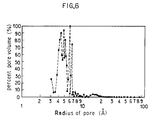
- the meso-carbon microbeads are formed with the micropores substantially 20 ⁇ in pore diameter as a whole and having a pore diameter distribution with a sharp peak in the vicinity of 13 to 14 ⁇ .
- the gas reaction at the surface of microbeads occurs with an increased selectivity, resulting in a prominent increase of yield.
- the reaction of carbon and activating auxiliary in the invention proceeds at a high intensity.
- the activated carbon fibers are deformed to a shape entirely different from the original one and imparted a significantly reduced strength.
- the activated meso-carbon microbeads retain the original spherical shape and exhibit no marked reduction of strength.
- the active carbon prepared according to the invention is optically anisotropic and include micropores 20 ⁇ or less in diameter which constitute 85% or more of pore volume.
- the micropores of the active carbon is about 500 to about 4600 m2/g in the specific surface area and about 0.5 to about 3.0 ml/g in the entire pore volume.
- the active carbon adsorbs benzene at an adsorptivity of about 0.2 to about 1.0 g/g according to JIS K 1474 and methylene blue at an adsorptivity of about 100 to about 650 ml/g according to JIS K 1470.
- the activating auxiliary to be used is inexpensive and the carbon materials are produced in a high yield, therefore at exceedingly reduced costs.
- the specific surface area can be varied in a wide range of 500 to 4,600 m2/g by varying the amount of activating auxiliary used.
- the carbon materials of the invention display an adsorptivity equal to or higher than that of conventional granular active carbon under elevated pressure as well as normal pressure.
- the carbon materials of the invention are useful in extremely wide areas because of their shape and properties of achieving rapid adsorption with high adsorptivity.
- Table 1 shows the weight ratio (KOH/M) of potassium hydroxide to mesocarbon microbeads (MCB), and the amount of the water and acetone used.
- Table 2 shows the properties of the obtained carbon materials Nos. 1 to 11.
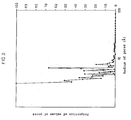
- Fig. 3 shows an adsoption isotherm determined by subjecting carbon material No. 5 to N2 gas adsorption method (determined with Autosorb I, manufactured by Yuasa Ionics Kabushiki Kaisha). Fig. 3 clearly indicates that almost all the pores formed are micropores having a radius of up to 10 ⁇ .
- the properties of the carbon materials as shown in Table 2 were determined as follows. First, the adsorption isotherm was determined by N2 gas adsorption method (with Autosorb I, manufactured by Yuasa Ionics Kabushiki Kaisha) and then, on the basis of the adsorption isotherm, there were determined (I) BET specific surface area (m2/g), (II) specific surface area of micropores (m2/g), (III) specific surface area of mesopores (m2/g), (IV) total volume of whole pores (ml/g) and (V) volume of the micropores (ml/g). In Fig. 2, the column (VI) shows the yields (wt.%). Table 1 No.
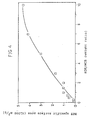
- Fig. 4 is a graph showing the relationship between the amount of KOH used (weight ratio of KOH/M) and the BET specific surface area of the carbon material obtained in this example.
- the degree of activation can be desirably adjusted.
- Carbon materials were each produced in the same manner as done for preparing the material No. 5 of Example 1 with the exception of effecting the activation at a temperature of 400°C, 600°C, 800°C, 1000°C and 1200°C, respectively.
- Table 3 shows the properties of the thus obtained carbon materials Nos. 12 to 16.
- Table 3 No. (I) (II) (III) (IV) (V) 12* 46 36 10 0.0423 0.021 13 609 601 8 0.3337 0.312 14 1062 1054 9 0.5739 0.547 15 1050 1041 7 0.5651 0.538 16 823 795 22 0.4671 0.410 * Comparative example
- Carbon materials were each produced in the same manner as done for preparing the material No. 5 of Example 1 with the exception of using NaOH in place of KOH and effecting the activation at a temperature of 400°C, 600°C and 800°C, respectively.
- Table 4 shows the properties of the thus obtained carbon materials Nos. 17 to 19.
- Table 4 No. (I) (II) (III) (IV) (V) 17* 181 143 38 0.1549 0.082 18 933 917 22 0.5220 0.475 19 520 493 37 0.3286 0.262 * Comparative example.
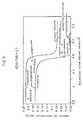
- the equilibrium adsorption amount at 25°C was measured according to JIS K-1474 in respect of benzene, n-pentane, tetrahydrofuran, n-hexane, chloroform, isopentane, cyclohexane, cumene, tetralin, cyclohexylamine, decalin, t-butyl alcohol, trimethylpentane and carbon tetrachloride.
- Fig. 5 shows the results.
- Fig. 5 indicates that the carbon material of the present invention has an ability to achieve such a molecular sieve effect that molecules having a particle size (minor axis) of larger than 4.8 ⁇ are likely to be adsorbed only in a slight amount on the carbon material. Accordingly, it is clear that the carbon material of the invention is usable for separating various compounds.
- Example 1 The carbon materials No. 8 and No. 11 obtained in Example 1 were tested for occlusion with methane under a pressure of 9 kg/cm2 G.
- Table 5 shows the test results together with a result obtained with use of a known granular activated carbon.
Landscapes
- Chemical & Material Sciences (AREA)
- Organic Chemistry (AREA)
- Inorganic Chemistry (AREA)
- Engineering & Computer Science (AREA)
- Materials Engineering (AREA)
- Analytical Chemistry (AREA)
- Carbon And Carbon Compounds (AREA)
- Solid-Sorbent Or Filter-Aiding Compositions (AREA)
Claims (5)
- Verfahren zur Herstellung von Aktivkohle, das- die Abscheidung eines Aktivierhilfsstoffes auf der Oberfläche von Mesokohlenstoff-Mikrokügelchen und- das Aktivieren, waschen und Trocknen der Mesokohlenstoff-Mikrokügelchen vorsieht,welches Verfahren dadurch gekennzeichnet ist, daß der Aktivierhilfsstoff wenigstens eines von KOH und NaOH ist und in einer 1- bis 10-fachen Menge des Gewichts der Mesokohlenstoff-Mikrokügelchen verwendet wird, und daß die Aktivierung bei einer Temperatur über 400 °C bis zu etwa 1200 °C durchgeführt wird.
- Verfahren nach Anspruch 1, bei dem die Aktivierung bei einer Temperatur von etwa 600 °C bis etwa 1000 °C durchgeführt wird.
- Verfahren nach irgendeinem der Ansprüche 1 und 2, dadurch gekennzeichnet, daß ein oberflächenaktiver Stoff, der aus der aus Aceton, Methylalkohol und Ethylalkohol bestehenden Gruppe gewählt wird, beim Abscheiden des Aktivierhilfsstoffes auf der Oberfläche der Mesokohlenstoff-Mikrokügelchen verwendet wird.
- Aktivkohlenstoff-Mikrokügelchen, dadurch gekennzeichnet, daß sie durch das Verfahren nach irgendeinem der Ansprüche 1 bis 3 erhältlich sind.
- Aktivkohlenstoff-Mikrokügelchen nach Anspruch 4, dadurch gekennzeichnet, daß. sie optisch anisotrop sind,. sie 90 % oder mehr von Teilchen einer Teilchengröße von 80 »m oder weniger aufweisen,. ihr gesamtes Porenvolumen von 0,5 bis etwa 3 ml/g ist,. 85 % oder mehr ihres gesamten Porenvolumens aus Mikroporen von 20 Å oder weniger Porendurchmesser bestehen,
und. sie eine spezifische Oberflächengröße von 500 bis 4600 m²/g haben.
Applications Claiming Priority (5)
| Application Number | Priority Date | Filing Date | Title |
|---|---|---|---|
| JP29483187 | 1987-11-20 | ||
| JP294831/87 | 1987-11-20 | ||
| JP63158510A JPH01230414A (ja) | 1987-11-20 | 1988-06-27 | 活性炭及びその製造方法 |
| JP158510/88 | 1988-06-27 | ||
| PCT/JP1988/001179 WO1989004810A1 (fr) | 1987-11-20 | 1988-11-21 | Charbon actif et procede de production |
Publications (3)
| Publication Number | Publication Date |
|---|---|
| EP0366796A1 EP0366796A1 (de) | 1990-05-09 |
| EP0366796A4 EP0366796A4 (en) | 1991-12-27 |
| EP0366796B1 true EP0366796B1 (de) | 1995-05-17 |
Family
ID=26485610
Family Applications (1)
| Application Number | Title | Priority Date | Filing Date |
|---|---|---|---|
| EP88910105A Expired - Lifetime EP0366796B1 (de) | 1987-11-20 | 1988-11-21 | Aktivierter kohlenstoff und verfahren zur herstellung |
Country Status (5)
| Country | Link |
|---|---|
| US (1) | US5143889A (de) |
| EP (1) | EP0366796B1 (de) |
| JP (1) | JPH01230414A (de) |
| DE (1) | DE3853824T2 (de) |
| WO (1) | WO1989004810A1 (de) |
Families Citing this family (46)
| Publication number | Priority date | Publication date | Assignee | Title |
|---|---|---|---|---|
| US5086033A (en) * | 1990-08-30 | 1992-02-04 | Air Products And Chemicals, Inc. | Use of helium and argon diluent gases in modification of carbon molecular sieves |
| DE4132971C2 (de) * | 1991-10-04 | 1996-02-01 | Bergwerksverband Gmbh | Verfahren zur Herstellung von Kohlenstoffmolekularsieben |
| JP3078107B2 (ja) * | 1992-04-07 | 2000-08-21 | 日本原子力研究所 | 放射性廃棄物の減容処理方法 |
| JP2735491B2 (ja) * | 1993-10-25 | 1998-04-02 | ウェストヴァコ コーポレイション | 微細孔活性炭とその製造方法 |
| JP3446339B2 (ja) * | 1994-10-18 | 2003-09-16 | 三菱化学株式会社 | 活性炭の製造方法 |
| US5726118A (en) * | 1995-08-08 | 1998-03-10 | Norit Americas, Inc. | Activated carbon for separation of fluids by adsorption and method for its preparation |
| GB9522476D0 (en) * | 1995-11-02 | 1996-01-03 | Boc Group Plc | Method and vessel for the storage of gas |
| US5972077A (en) * | 1996-02-15 | 1999-10-26 | Lockheed Martin Energy Research Corporation | Gas separation device based on electrical swing adsorption |
| BR9713164A (pt) | 1996-08-09 | 2000-02-01 | Stemmler Heinz | Processo para o revestimento de salsicha defumada e queijo duro. |
| EP0927778B1 (de) * | 1997-12-04 | 2003-07-02 | Kashima Oil Co., Ltd. | Aktivierte Kohlenstofffasern und deren Verwendung in einem Zweischichtkondensator |
| US6353528B1 (en) * | 1998-05-22 | 2002-03-05 | Kyocera Corporation | Solid activated carbon, process for manufacturing the same and electric double layer capacitor using the same |
| CN1120800C (zh) * | 1999-04-30 | 2003-09-10 | 煤炭科学研究总院北京煤化学研究所 | 一种煤基中孔活性炭制造方法 |
| AU5034500A (en) * | 1999-05-20 | 2000-12-12 | Procter & Gamble Company, The | Method for removal of nano-sized pathogens from liquids |
| JP2001118753A (ja) * | 1999-10-21 | 2001-04-27 | Matsushita Electric Ind Co Ltd | 電気二重層キャパシタ用活性炭およびその製造方法 |
| US20070122609A1 (en) * | 1999-11-23 | 2007-05-31 | Hiltzik Laurence H | Porous coatings on adsorbent materials |
| US20050035062A1 (en) * | 1999-11-23 | 2005-02-17 | Hiltzik Laurence H. | Coated activated carbon for contaminant removal from a fluid stream |
| JP2001287906A (ja) * | 2000-01-31 | 2001-10-16 | Kawasaki Steel Corp | 多孔質炭素材料の製造方法、多孔質炭素材料およびこれを用いた電気二重層キャパシタ |
| JP2001302226A (ja) * | 2000-04-19 | 2001-10-31 | Kawasaki Steel Corp | 多孔質炭素材料の製造方法、多孔質炭素材料およびこれを用いた電気二重層キャパシタ |
| JP2001302225A (ja) * | 2000-04-19 | 2001-10-31 | Kawasaki Steel Corp | 多孔質炭素材料の製造方法、多孔質炭素材料およびこれを用いた電気二重層キャパシタ |
| WO2002054422A1 (en) * | 2000-12-28 | 2002-07-11 | Honda Giken Kogyo Kabushiki Kaisha | Alkaline activating charcoal for electrode of electric double layer capacitor |
| KR100777951B1 (ko) | 2001-08-23 | 2007-11-28 | 더 프록터 앤드 갬블 캄파니 | 정수 필터 재료, 대응하는 정수 필터 및 그의 사용 방법 |
| US20050279696A1 (en) | 2001-08-23 | 2005-12-22 | Bahm Jeannine R | Water filter materials and water filters containing a mixture of microporous and mesoporous carbon particles |
| US7614507B2 (en) | 2001-08-23 | 2009-11-10 | Pur Water Purification Products Inc. | Water filter materials, water filters and kits containing particles coated with cationic polymer and processes for using the same |
| US7615152B2 (en) | 2001-08-23 | 2009-11-10 | Pur Water Purification Products, Inc. | Water filter device |
| US7614508B2 (en) | 2001-08-23 | 2009-11-10 | Pur Water Purification Products Inc. | Water filter materials, water filters and kits containing silver coated particles and processes for using the same |
| WO2003033135A1 (en) * | 2001-09-21 | 2003-04-24 | Ad'all Co., Ltd. | Activated carbon fiber for the removal of organochlorine compounds |
| JP4662730B2 (ja) * | 2003-09-12 | 2011-03-30 | ローム アンド ハース カンパニー | エネルギー貯蔵装置において有用なマクロレティキュラー炭質材料 |
| CN101167404B (zh) * | 2005-03-28 | 2011-05-04 | 松下电器产业株式会社 | 扬声器装置 |
| US20080170737A1 (en) * | 2005-03-28 | 2008-07-17 | Shuji Saiki | Loudspeaker System |
| RU2307069C2 (ru) * | 2005-09-27 | 2007-09-27 | Институт угля и углехимии СО РАН | Способ получения азотсодержащего пористого углеродного материала |
| US8247072B2 (en) | 2006-02-14 | 2012-08-21 | Eastman Chemical Company | Resol beads, methods of making them and methods of using them |
| US20070207917A1 (en) * | 2006-02-14 | 2007-09-06 | Chester Wayne Sink | Activated carbon monoliths and methods of making them |
| US20070191571A1 (en) * | 2006-02-14 | 2007-08-16 | Sink Chester W | Resol beads, methods of making them, and methods of using them |
| CN100427202C (zh) * | 2006-10-30 | 2008-10-22 | 山东大学 | 活性杞柳根炭的炭化及造孔制备方法 |
| KR101438854B1 (ko) * | 2006-11-08 | 2014-09-05 | 더 큐레이터스 오브 더 유니버시티 오브 미주리 | 높은 표면적 탄소 및 이를 생산하기 위한 공정 |
| JP2011121785A (ja) * | 2009-12-08 | 2011-06-23 | Habikkusu Kk | 活性炭化物 |
| CN102140062B (zh) * | 2011-03-13 | 2012-11-14 | 联化科技股份有限公司 | 一种2,5-二甲基苯乙酸的制备方法 |
| KR20130037091A (ko) * | 2011-10-05 | 2013-04-15 | 삼성에스디아이 주식회사 | 음극 활물질 및 이를 채용한 리튬 전지 |
| CN102659101A (zh) * | 2012-01-12 | 2012-09-12 | 江西师范大学 | 用龙眼果壳制备活性炭的方法 |
| CN102963891B (zh) * | 2012-11-14 | 2014-10-08 | 湖北华强科技有限责任公司 | 一种低灰分超高比表面积活性炭及其制备方法 |
| TWI500578B (zh) * | 2013-04-09 | 2015-09-21 | China Steel Corp | 高比表面積之活性碳微球的製造方法 |
| TWI511923B (zh) * | 2013-09-26 | 2015-12-11 | China Steel Corp | 用於電極片及電容之高比表面積的活性碳微球及其製造方法 |
| CN104979731A (zh) * | 2014-04-02 | 2015-10-14 | 德昌电机(深圳)有限公司 | 电机换向器、含碳制品及其制造方法 |
| CN106744953B (zh) * | 2016-12-22 | 2018-10-19 | 济南大学 | 一种分级多孔活性炭电极材料的无模板制备方法 |
| NO343769B1 (en) | 2017-04-06 | 2019-06-03 | Ipr Holding As | Method for producing activated carbon |
| CN117699799B (zh) * | 2024-02-06 | 2024-06-07 | 玖贰伍碳源科技(天津)有限公司 | 一种筛分型碳及其制备方法和应用 |
Citations (3)
| Publication number | Priority date | Publication date | Assignee | Title |
|---|---|---|---|---|
| FR2215997A1 (de) * | 1973-02-03 | 1974-08-30 | Bergwerksverband Gmbh | |
| US3979330A (en) * | 1971-04-23 | 1976-09-07 | Bergwerksverband Gmbh | Carbon containing molecular sieves |
| EP0119925A2 (de) * | 1983-03-16 | 1984-09-26 | Calgon Carbon Corporation | Kohlenstoff-molekularsiebe, Verfahren zu deren Herstellung und Verwendung |
Family Cites Families (12)
| Publication number | Priority date | Publication date | Assignee | Title |
|---|---|---|---|---|
| GB1298938A (en) * | 1968-12-24 | 1972-12-06 | Lancashire Tar Distillers Ltd | Active carbon |
| US3818874A (en) * | 1973-04-02 | 1974-06-25 | P Tria | Safety switch assembly for a relief valve |
| JPS53131989A (en) * | 1977-04-22 | 1978-11-17 | Takeda Chem Ind Ltd | Molecular sieving organic gas removing agent |
| GB2056423B (en) * | 1979-08-16 | 1983-02-23 | Lancashire Tar Distillers Ltd | Porous carbon |
| JPS5917044B2 (ja) * | 1981-06-01 | 1984-04-19 | 興亜石油株式会社 | 晶質化物質の製造方法および装置 |
| JPS5930887A (ja) * | 1982-08-11 | 1984-02-18 | Koa Sekiyu Kk | バルクメソフエ−ズの製造装置 |
| JPS60161316A (ja) * | 1984-01-31 | 1985-08-23 | Pentel Kk | 活性炭の製造方法 |
| JPS60255604A (ja) * | 1984-05-30 | 1985-12-17 | Sumitomo Metal Ind Ltd | メソカ−ボンマイクロビ−ズの製造法 |
| DD231328A1 (de) * | 1984-11-14 | 1985-12-24 | Engels Chemiefaserwerk Veb | Verbessertes verfahren zur herstellung von atemschutzkohlen |
| JPS61205611A (ja) * | 1985-03-07 | 1986-09-11 | Hitachi Chem Co Ltd | メソカ−ボンマイクロビ−ズ、その製造法及び吸着剤 |
| JPS62283808A (ja) * | 1986-05-29 | 1987-12-09 | Hitachi Chem Co Ltd | メソカ−ボンマイクロビ−ズ,その製造法及び吸着剤 |
| DD257821A1 (de) * | 1987-02-23 | 1988-06-29 | Akad Wissenschaften Ddr | Verfahren zur herstellung von aktivkohlenstoff mit geringem gehalt an verunreinigungen |
-
1988
- 1988-06-27 JP JP63158510A patent/JPH01230414A/ja active Pending
- 1988-11-21 WO PCT/JP1988/001179 patent/WO1989004810A1/ja not_active Ceased
- 1988-11-21 EP EP88910105A patent/EP0366796B1/de not_active Expired - Lifetime
- 1988-11-21 DE DE3853824T patent/DE3853824T2/de not_active Expired - Fee Related
-
1990
- 1990-12-20 US US07/631,258 patent/US5143889A/en not_active Expired - Fee Related
Patent Citations (3)
| Publication number | Priority date | Publication date | Assignee | Title |
|---|---|---|---|---|
| US3979330A (en) * | 1971-04-23 | 1976-09-07 | Bergwerksverband Gmbh | Carbon containing molecular sieves |
| FR2215997A1 (de) * | 1973-02-03 | 1974-08-30 | Bergwerksverband Gmbh | |
| EP0119925A2 (de) * | 1983-03-16 | 1984-09-26 | Calgon Carbon Corporation | Kohlenstoff-molekularsiebe, Verfahren zu deren Herstellung und Verwendung |
Non-Patent Citations (1)
| Title |
|---|
| "The formation of some graphitizing carbons" J.D. Brooks and G.H. Taylor, "Chemistry and Physics of Carbon" ed. Philip J. Walker, pp. 243-245 Volume 4, publ. Dekker - New York (1968) * |
Also Published As
| Publication number | Publication date |
|---|---|
| JPH01230414A (ja) | 1989-09-13 |
| US5143889A (en) | 1992-09-01 |
| EP0366796A1 (de) | 1990-05-09 |
| WO1989004810A1 (fr) | 1989-06-01 |
| DE3853824D1 (de) | 1995-06-22 |
| DE3853824T2 (de) | 1995-11-30 |
| EP0366796A4 (en) | 1991-12-27 |
Similar Documents
| Publication | Publication Date | Title |
|---|---|---|
| EP0366796B1 (de) | Aktivierter kohlenstoff und verfahren zur herstellung | |
| US5902562A (en) | Method for the preparation of high surface area high permeability carbons | |
| EP0401285B1 (de) | Abscheidung von kohlendioxid mit aminierten molekularsieben aus kohlenstoff | |
| US4820681A (en) | Preparation of hydrophobic carbon molecular sieves | |
| US6258300B1 (en) | Activated carbon fiber composite material and method of making | |
| US5482915A (en) | Transition metal salt impregnated carbon | |
| EP0474106B1 (de) | Verfahren zur Herstellung von veränderten Kohlenstoffmolekularsieben zur Gastrennung | |
| KR20020092940A (ko) | 활성탄과 팽창된 흑연을 포함하는 복합 재료 | |
| Braymer et al. | Granular carbon molecular sieves | |
| EP0554805A1 (de) | Lufttrennung mittels Druckwechseladsorption unter Anwendung von Molekularsieben mit hoher Kapazität | |
| JP3446771B2 (ja) | 高比表面積炭素材料の製造方法 | |
| IE900320L (en) | Carbon molecular sieves for purification of¹chlorofluorocarbons | |
| US5238888A (en) | Carbon molecular sieve | |
| EP0662070B1 (de) | Speicherung von wasserstoff | |
| EP0588459A1 (de) | Verfahren zum Entfernen von schnell oxidierbaren, organischen Verbindungen aus Gasströmen | |
| CA1100721A (en) | Carbon pellets with controlled porosity | |
| JP3310348B2 (ja) | 分子ふるい炭素の製造方法 | |
| JPH0280315A (ja) | 造粒活性炭 | |
| JPS6359740B2 (de) | ||
| KR100599254B1 (ko) | 수소저장용 고기공도 활성탄과 이의 제조방법 | |
| JPS62132543A (ja) | 分子篩活性炭、その製造法、およびそれを用いて混合ガスから特定ガスを分離する方法 | |
| EP0394350B1 (de) | Hydrophobe kohlenstoffmolekularsiebe | |
| JPH0663397A (ja) | 水素精製用分子篩炭素材 | |
| JPWO1989004810A1 (ja) | 活性炭及びその製造方法 | |
| JP2771200B2 (ja) | 繊維付着活性炭 |
Legal Events
| Date | Code | Title | Description |
|---|---|---|---|
| PUAI | Public reference made under article 153(3) epc to a published international application that has entered the european phase |
Free format text: ORIGINAL CODE: 0009012 |
|
| 17P | Request for examination filed |
Effective date: 19890803 |
|
| AK | Designated contracting states |
Kind code of ref document: A1 Designated state(s): DE FR GB |
|
| A4 | Supplementary search report drawn up and despatched |
Effective date: 19911108 |
|
| AK | Designated contracting states |
Kind code of ref document: A4 Designated state(s): DE FR GB |
|
| 17Q | First examination report despatched |
Effective date: 19930603 |
|
| GRAA | (expected) grant |
Free format text: ORIGINAL CODE: 0009210 |
|
| AK | Designated contracting states |
Kind code of ref document: B1 Designated state(s): DE FR GB |
|
| REF | Corresponds to: |
Ref document number: 3853824 Country of ref document: DE Date of ref document: 19950622 |
|
| ET | Fr: translation filed | ||
| PLBE | No opposition filed within time limit |
Free format text: ORIGINAL CODE: 0009261 |
|
| STAA | Information on the status of an ep patent application or granted ep patent |
Free format text: STATUS: NO OPPOSITION FILED WITHIN TIME LIMIT |
|
| 26N | No opposition filed | ||
| PGFP | Annual fee paid to national office [announced via postgrant information from national office to epo] |
Ref country code: FR Payment date: 19991028 Year of fee payment: 12 |
|
| PGFP | Annual fee paid to national office [announced via postgrant information from national office to epo] |
Ref country code: GB Payment date: 19991115 Year of fee payment: 12 |
|
| PGFP | Annual fee paid to national office [announced via postgrant information from national office to epo] |
Ref country code: DE Payment date: 19991231 Year of fee payment: 12 |
|
| PG25 | Lapsed in a contracting state [announced via postgrant information from national office to epo] |
Ref country code: GB Free format text: LAPSE BECAUSE OF NON-PAYMENT OF DUE FEES Effective date: 20001121 |
|
| GBPC | Gb: european patent ceased through non-payment of renewal fee |
Effective date: 20001121 |
|
| PG25 | Lapsed in a contracting state [announced via postgrant information from national office to epo] |
Ref country code: FR Free format text: LAPSE BECAUSE OF NON-PAYMENT OF DUE FEES Effective date: 20010731 |
|
| PG25 | Lapsed in a contracting state [announced via postgrant information from national office to epo] |
Ref country code: DE Free format text: LAPSE BECAUSE OF NON-PAYMENT OF DUE FEES Effective date: 20010801 |
|
| REG | Reference to a national code |
Ref country code: FR Ref legal event code: ST |