EP0366976A2 - Circuit pour transformée - Google Patents
Circuit pour transformée Download PDFInfo
- Publication number
- EP0366976A2 EP0366976A2 EP19890118685 EP89118685A EP0366976A2 EP 0366976 A2 EP0366976 A2 EP 0366976A2 EP 19890118685 EP19890118685 EP 19890118685 EP 89118685 A EP89118685 A EP 89118685A EP 0366976 A2 EP0366976 A2 EP 0366976A2
- Authority
- EP
- European Patent Office
- Prior art keywords
- signal processors
- transformation
- signals
- block
- matrix
- Prior art date
- Legal status (The legal status is an assumption and is not a legal conclusion. Google has not performed a legal analysis and makes no representation as to the accuracy of the status listed.)
- Granted
Links
Images



Classifications
-
- G—PHYSICS
- G06—COMPUTING OR CALCULATING; COUNTING
- G06F—ELECTRIC DIGITAL DATA PROCESSING
- G06F17/00—Digital computing or data processing equipment or methods, specially adapted for specific functions
- G06F17/10—Complex mathematical operations
- G06F17/14—Fourier, Walsh or analogous domain transformations, e.g. Laplace, Hilbert, Karhunen-Loeve, transforms
- G06F17/147—Discrete orthonormal transforms, e.g. discrete cosine transform, discrete sine transform, and variations therefrom, e.g. modified discrete cosine transform, integer transforms approximating the discrete cosine transform
Definitions
- the invention relates to a transformation circuit for a device for coding or decoding video signals according to the preamble of the main claim.
- Various data-reducing coding methods have become known for transmitting images, for example in the case of narrowband video telephones.
- An essential element of various known coding methods is a block-wise transformation of the video signals to be transmitted. For this purpose, blocks of 16 by 16 picture elements are formed, for example, which are each transformed in a data-reducing manner.
- One of these transformations is the discrete cosine transformation. To carry out the discrete cosine transformation as well as other transformations, a two-time matrix multiplication is required, which is associated with considerable computational effort.
- the object of the present invention is to provide a transformation circuit for a device for coding or decoding, in which the
- Matrix multiplications can be carried out with as little effort as possible.
- the transformation circuit according to the invention with the characterizing features of the main claim has the advantage that commercially available integrated digital signal processors can be used.
- the transformation circuit according to the invention can be easily adapted to different block sizes and types of transformation.
- both circuits can be implemented in the same way with the invention, with the luminance signal for the DCT and the IDCT each use four signal processors, while a circuit with two signal processors for the DCT and for the IDCT is sufficient for the chrominance signals because of the smaller block size of 8 by 8 picture elements.
- more than four signal processors can also work together without departing from the teaching of the invention.
- the circuit arrangement shown in FIG. 1 represents a transmission device for a narrowband videophone, the output signals of a video camera 1 being converted analog / digital and then encoded using data-reducing methods in such a way that they are transmitted to a receiver via a narrowband channel 2 can.
- 1 refer to the so-called CIF resolution of 360 x 288 picture elements for the luminance component and of 180 x 144 picture elements for the chrominance components U, V.
- the capacity of the transmission channel 2 is 64000 bits / s.
- the following known methods essentially contribute to the reduction of the data stream: reduction of the motion resolution (only every third image is transmitted), DPCM (interframe), discrete cosine transformation (DCT), adaptive quantization and entropy coding.
- reduction of the motion resolution only every third image is transmitted
- DPCM interframe
- DCT discrete cosine transformation
- a switchover to intraframe coding is also provided.
- the coding of the luminance signal is explained below using individual functional units, while the coding of the chrominance signals U, V is only represented by a functional unit 3, since this coding is carried out in a manner similar to the coding of the luminance signal Y.
- the output signals of the analog / digital converter 4 are alternately written image-wise into one of two image memories 6, 7 via a changeover switch 5.
- the signals After temporary storage for time adjustment in a FIFO memory 9, the signals arrive at a subtraction circuit 10, which is part of a prediction loop 11.
- the output signals of the subtraction circuit - that is, the differences between the signal generated by the camera and the signal of a stored image - are transformed block by block.
- a block each includes n picture elements from n successive lines, which represent a partial area of the picture of n x n picture elements.
- blocks of 8 x 8 picture elements are suggested.
- blocks of 16 x 16 picture elements for the luminance and 8 x 8 picture elements each for the chrominance were found to be favorable.
- the output signals of the circuit 12 are fed to a controllable quantizer 13, which can carry out a coarser or finer quantization depending on a supplied control signal.
- the quantized signals are then fed within the prediction loop 11 to a circuit 14 for inverse discrete cosine transformation and are read into additional image memories 16, 17 via an adder circuit 15.
- the image memories 16, 17 represent a prediction memory. Two image memories are used to enable reading while new signals are being written. For this purpose, the changeover switches 18, 19 are controlled accordingly.
- the signals read out from the prediction memory 16, 17 reach the subtraction circuit 10 and, via a FIFO memory 20 used for time adjustment, the adder circuit 15.
- a motion estimator 21 which generates a motion vector for a block by comparing successive images.
- the motion vectors are fed to an addressing logic 22, so that when the signals are read block by block from the prediction memory 16, 17, a shift in the content of the respective block caused by movement between the stored and the current picture is taken into account.
- the output signals of the quantizer 13, the encoder 3 for the chrominance signals U, V and the output signals of the motion estimator 21 are fed to an entropy encoder 23, in which incoming code words are converted into shorter or longer outgoing code words according to the frequency of their occurrence.
- a buffer memory 24 is provided in front of the transmission link 2, which has, for example, the capacity of an image. If the buffer memory 24 threatens to overflow, the amount of data supplied to the buffer is reduced, which can be done in particular by appropriately controlling the quantizer 13.
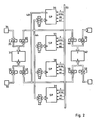
- the transformation circuit shown in FIG. 2 can be used both for the DCT (circuit 12, FIG. 1) or for the IDCT (circuit 14, FIG. 1). Only different programs are required for the signal processors.
- the signals of the block to be transformed are written into a first buffer 31 from the previous circuit. For this purpose, corresponding addresses are fed via an input 32 and a bus driver 33 to the address input A of the buffer, while the data from an input 34 via a bus driver 35 to the data input / output D of the buffer 31.
- Four digital signal processors 36, 37, 38, 39 are connected with their data inputs / outputs D via a bidirectional bus driver 40, 41, 42, 43 to a data bus 44, to which the data input / output is also connected via a bus driver 45 D of the first buffer 31 and via a further bus driver 46 the data input / output of the second buffer 47 can be connected.
- the signal processor 36 also provides addresses for reading out from the first buffer 41 and for writing into the second buffer 47. The addresses are supplied to the buffers via an address bus 48 and a bus driver 49, 50 each.
- Each of the signal processors 36 to 39 receives a clock signal T with a frequency of 40 MHz, for example.
- a synchronization signal SYNC and a reset signal RS are also supplied.
- an interrupt is triggered at the beginning of each block via a signal INT.
- the generation of these signals, which are fed to the signal processors 36 to 39 via a control bus 51, is known per se and need not be explained in more detail to explain the invention.
- the INT signal reference is made to the patent application P 38 27 219.9 filed by the applicant, in which a circuit arrangement is described with which clock pulse sequences are generated for individual functional units of a narrowband videophone.
- the coefficients are retrieved from the second circuit 47 by the subsequent circuit, for which purpose a bus driver 52 is provided for the addresses and a bus driver 53 for the data.
- the algorithm for calculating the transformation is a double matrix multiplication, which will be explained in detail later with reference to FIGS. 3 and 4.
- the coefficients of the cosine matrix are each stored in the program memory of the processors.
- Signal processors of the TMS 320C25 type are preferably suitable.
- the structure of the signal processor allows quick calculation of the Coefficients of the result matrix, since the processor can carry out a multiplication with subsequent accumulation in a system clock cycle of 100 ns.
- Each of the signal processors takes over the calculation of a quarter of the result matrix.
- the processors work independently of one another without exchanging data.
- the signal processor calculates 36 addresses for the intermediate memories 31 and 47.
- the signal values belonging to a block are read into the working memories of all signal processors.
- the calculated coefficients are then written into the second buffer memory 47 by the signal processors via the data bus 44.
- equation (G1) represents the discrete cosine transformation, where ⁇ is the respective coefficient with the coordinates u and v and x the signal size of a picture element with the coordinates i and j.
- N2 is the number of picture elements of a block.
- a partial matrix B1 is carried out by multiplying a part of the matrix F t by the entire matrix X t .
- the sub-matrix B1 is read out by appropriate reading transposed the working memory into a partial matrix B1 t and multiplied by the matrix F t .
- the result represents a first part of the result matrix ⁇ .
- a second, third and fourth part is obtained in a corresponding manner with the aid of the further signal processors.
- the transformations described enable the two matrix multiplications to be carried out optimally with the signal processors used.
- the calculation can be divided between several signal processors without the need to exchange intermediate results.
- the command set of the signal processors used enables the necessary arithmetic and address operations to be carried out easily.
- FIG. 5 a shows a flowchart of a program which is provided for the signal processor 36 (FIG. 2).
- 256 input values are read in at 62 from the first intermediate memory 31.
- the first matrix multiplication is then carried out in program part 63 and 64 intermediate results are stored in the internal memory of the signal processor.
- the program part 63 is shown in more detail in Fig. 5b). It begins at 64 with the clearing of the multiplication registers, whereupon the CPU battery is charged with a rounding value at 65. Thereafter, address registers are loaded at 66, and a repeat counter is set at 67.
- program part 68 16 multiplications and an accumulation of the multiplication results then take place in program part 68.
- the result of the accumulation is stored in the internal memory.
- the program part shown in FIG. 5b) is then repeated for the next intermediate result, etc.
- the second becomes 70 Matrix multiplication carried out and their 64 results stored as final results in the internal memory.
- the 64 final results are output from the internal memory of the signal processor 36 to the second buffer memory 47 (FIG. 2), for which purpose addresses for the second buffer memory 47 are generated in the signal processor 36.
- signal processor 36 addresses second buffer memory 47, while signal processors 37 to 39 each output their 64 final results.
- the signal processors 37 to 39 work with programs which also comprise the parts 61 to 70. However, no addresses are generated, so that the program parts 72 to 74 are not present there and the part 71 of the program includes reading out the final results using the addresses supplied.
Landscapes
- Physics & Mathematics (AREA)
- General Physics & Mathematics (AREA)
- Engineering & Computer Science (AREA)
- Mathematical Physics (AREA)
- Data Mining & Analysis (AREA)
- Mathematical Optimization (AREA)
- Mathematical Analysis (AREA)
- Pure & Applied Mathematics (AREA)
- Computational Mathematics (AREA)
- Theoretical Computer Science (AREA)
- General Engineering & Computer Science (AREA)
- Databases & Information Systems (AREA)
- Software Systems (AREA)
- Discrete Mathematics (AREA)
- Algebra (AREA)
- Compression Or Coding Systems Of Tv Signals (AREA)
- Image Processing (AREA)
- Oscillators With Electromechanical Resonators (AREA)
- Amplifiers (AREA)
- Input Circuits Of Receivers And Coupling Of Receivers And Audio Equipment (AREA)
- Image Analysis (AREA)
Applications Claiming Priority (2)
| Application Number | Priority Date | Filing Date | Title |
|---|---|---|---|
| DE3837328A DE3837328A1 (de) | 1988-11-03 | 1988-11-03 | Transformationsschaltung |
| DE3837328 | 1988-11-03 |
Publications (3)
| Publication Number | Publication Date |
|---|---|
| EP0366976A2 true EP0366976A2 (fr) | 1990-05-09 |
| EP0366976A3 EP0366976A3 (fr) | 1992-06-03 |
| EP0366976B1 EP0366976B1 (fr) | 1996-07-10 |
Family
ID=6366409
Family Applications (1)
| Application Number | Title | Priority Date | Filing Date |
|---|---|---|---|
| EP89118685A Expired - Lifetime EP0366976B1 (fr) | 1988-11-03 | 1989-10-07 | Circuit pour transformée |
Country Status (4)
| Country | Link |
|---|---|
| EP (1) | EP0366976B1 (fr) |
| AT (1) | ATE140328T1 (fr) |
| DE (2) | DE3837328A1 (fr) |
| ES (1) | ES2090028T3 (fr) |
Cited By (3)
| Publication number | Priority date | Publication date | Assignee | Title |
|---|---|---|---|---|
| EP0399487A3 (fr) * | 1989-05-24 | 1991-04-03 | Mitsubishi Denki Kabushiki Kaisha | Dispositif de codage par transformation |
| EP0667583A1 (fr) * | 1994-01-18 | 1995-08-16 | Daewoo Electronics Co., Ltd | Système de calcul d'un bidimensionel discrète transformé du cosinus |
| EP0696002A3 (fr) * | 1994-07-27 | 1996-04-24 | Fujitsu Ltd | Dispositif de calcul pour la transformation en cosinus discrète en deux dimensions |
Families Citing this family (1)
| Publication number | Priority date | Publication date | Assignee | Title |
|---|---|---|---|---|
| DE102004039904B4 (de) * | 2004-04-27 | 2006-11-09 | Andreas Dr. Rainer | Vorrichtung zum Befestigen einer elektrischen Installationseinheit an einer Decke oder Wand eines Gebäudes |
Family Cites Families (2)
| Publication number | Priority date | Publication date | Assignee | Title |
|---|---|---|---|---|
| JPS55500708A (fr) * | 1978-10-06 | 1980-09-25 | ||
| EP0289629B1 (fr) * | 1987-05-02 | 1991-09-18 | ANT Nachrichtentechnik GmbH | Méthode de transformation spectrale bidimensionnelle |
-
1988
- 1988-11-03 DE DE3837328A patent/DE3837328A1/de not_active Withdrawn
-
1989
- 1989-10-07 EP EP89118685A patent/EP0366976B1/fr not_active Expired - Lifetime
- 1989-10-07 DE DE58909699T patent/DE58909699D1/de not_active Expired - Fee Related
- 1989-10-07 ES ES89118685T patent/ES2090028T3/es not_active Expired - Lifetime
- 1989-10-07 AT AT89118685T patent/ATE140328T1/de not_active IP Right Cessation
Cited By (4)
| Publication number | Priority date | Publication date | Assignee | Title |
|---|---|---|---|---|
| EP0399487A3 (fr) * | 1989-05-24 | 1991-04-03 | Mitsubishi Denki Kabushiki Kaisha | Dispositif de codage par transformation |
| EP0667583A1 (fr) * | 1994-01-18 | 1995-08-16 | Daewoo Electronics Co., Ltd | Système de calcul d'un bidimensionel discrète transformé du cosinus |
| EP0696002A3 (fr) * | 1994-07-27 | 1996-04-24 | Fujitsu Ltd | Dispositif de calcul pour la transformation en cosinus discrète en deux dimensions |
| US5719963A (en) * | 1994-07-27 | 1998-02-17 | Fujitsu Limited | Two-dimensional discrete cosine transform computing circuit |
Also Published As
| Publication number | Publication date |
|---|---|
| EP0366976B1 (fr) | 1996-07-10 |
| EP0366976A3 (fr) | 1992-06-03 |
| ATE140328T1 (de) | 1996-07-15 |
| DE58909699D1 (de) | 1996-08-14 |
| ES2090028T3 (es) | 1996-10-16 |
| DE3837328A1 (de) | 1990-05-10 |
Similar Documents
| Publication | Publication Date | Title |
|---|---|---|
| DE69032177T2 (de) | Kodierungsgerät | |
| EP0309669B1 (fr) | Procédé de réduction de données d'images se basant sur des modèles de scènes pour signaux de télévision numériques | |
| DE69522861T2 (de) | Verfahren und Einrichtung zur Codeumwandlung von codiertem Datenstrom | |
| DE69323156T2 (de) | Bilddatenkomprimierungs/Dekomprimierungssystem | |
| DE69330620T2 (de) | Verfahren und Einrichtung zur Bildkodierung | |
| DE69637335T2 (de) | Bildsignalkodierungsmethode und -vorrichtung | |
| DE69227970T2 (de) | Signalprozessor zur Kodierung | |
| EP0517324B1 (fr) | Appareil pour commander le quantificateur d'un codeur hybride | |
| DE69419635T2 (de) | Bewegungsvektorprozessor für Bildsignalkompression | |
| DE69712836T2 (de) | Vorrichtung und verfahren zur videosignalkodierung | |
| DE69331174T2 (de) | Bildverarbeitungsvorrichtung | |
| EP0525900B1 (fr) | Circuit de filtrage pour le pré-traitement d'un signal vidéo | |
| EP0366976B1 (fr) | Circuit pour transformée | |
| DE3834477A1 (de) | Schaltungsanordnung zur schaetzung von bewegung in einem aufgenommenen bild | |
| DE68924538T2 (de) | Prädiktive kodierung und dekodierung. | |
| EP0544735B1 (fr) | Procede et dispositif de transformation de donnees video | |
| DE69636139T2 (de) | Hierarchische Kodierungs- Dekodierungs-Vorrictung mit Speichervorrichtung für ein digitales Bildsignal | |
| EP0366919B1 (fr) | Filtre numérique bidimensionnel | |
| EP0336510B1 (fr) | Codeur predictif d'image immobile | |
| DE69514144T2 (de) | Gerät zur Dekodierung eines Bildsignales mit Kodierungsfehlerkompensation | |
| DE69509421T2 (de) | Verschiebungsstufe für einen Dekodierer von digitalen Kodes veränderlicher Länge | |
| EP0364748A2 (fr) | Circuit pour lire des données d'une mémoire d'image | |
| DE3839642A1 (de) | Einrichtung zur codierung von videosignalen | |
| DE69933858T2 (de) | Arithmetische filtervorrichtung | |
| DE4126883A1 (de) | Adaptives filter zur reduktion des rauschens in einem videosignal |
Legal Events
| Date | Code | Title | Description |
|---|---|---|---|
| PUAI | Public reference made under article 153(3) epc to a published international application that has entered the european phase |
Free format text: ORIGINAL CODE: 0009012 |
|
| AK | Designated contracting states |
Kind code of ref document: A2 Designated state(s): AT CH DE ES FR GB IT LI SE |
|
| RAP3 | Party data changed (applicant data changed or rights of an application transferred) |
Owner name: ROBERT BOSCH GMBH |
|
| PUAL | Search report despatched |
Free format text: ORIGINAL CODE: 0009013 |
|
| AK | Designated contracting states |
Kind code of ref document: A3 Designated state(s): AT CH DE ES FR GB IT LI SE |
|
| 17P | Request for examination filed |
Effective date: 19920717 |
|
| 17Q | First examination report despatched |
Effective date: 19950426 |
|
| GRAG | Despatch of communication of intention to grant |
Free format text: ORIGINAL CODE: EPIDOS AGRA |
|
| GRAH | Despatch of communication of intention to grant a patent |
Free format text: ORIGINAL CODE: EPIDOS IGRA |
|
| GRAH | Despatch of communication of intention to grant a patent |
Free format text: ORIGINAL CODE: EPIDOS IGRA |
|
| GRAA | (expected) grant |
Free format text: ORIGINAL CODE: 0009210 |
|
| AK | Designated contracting states |
Kind code of ref document: B1 Designated state(s): AT CH DE ES FR GB IT LI SE |
|
| REF | Corresponds to: |
Ref document number: 140328 Country of ref document: AT Date of ref document: 19960715 Kind code of ref document: T |
|
| REG | Reference to a national code |
Ref country code: CH Ref legal event code: NV Representative=s name: SCINTILLA AG, DIREKTION |
|
| ET | Fr: translation filed | ||
| REF | Corresponds to: |
Ref document number: 58909699 Country of ref document: DE Date of ref document: 19960814 |
|
| PGFP | Annual fee paid to national office [announced via postgrant information from national office to epo] |
Ref country code: GB Payment date: 19960926 Year of fee payment: 8 |
|
| ITF | It: translation for a ep patent filed | ||
| GBT | Gb: translation of ep patent filed (gb section 77(6)(a)/1977) |
Effective date: 19960913 |
|
| PGFP | Annual fee paid to national office [announced via postgrant information from national office to epo] |
Ref country code: FR Payment date: 19961011 Year of fee payment: 8 |
|
| REG | Reference to a national code |
Ref country code: ES Ref legal event code: FG2A Ref document number: 2090028 Country of ref document: ES Kind code of ref document: T3 |
|
| PGFP | Annual fee paid to national office [announced via postgrant information from national office to epo] |
Ref country code: SE Payment date: 19961018 Year of fee payment: 8 Ref country code: AT Payment date: 19961018 Year of fee payment: 8 |
|
| PGFP | Annual fee paid to national office [announced via postgrant information from national office to epo] |
Ref country code: CH Payment date: 19961024 Year of fee payment: 8 |
|
| PGFP | Annual fee paid to national office [announced via postgrant information from national office to epo] |
Ref country code: ES Payment date: 19961031 Year of fee payment: 8 |
|
| REG | Reference to a national code |
Ref country code: ES Ref legal event code: FG2A Ref document number: 2090028 Country of ref document: ES Kind code of ref document: T3 |
|
| PLBE | No opposition filed within time limit |
Free format text: ORIGINAL CODE: 0009261 |
|
| STAA | Information on the status of an ep patent application or granted ep patent |
Free format text: STATUS: NO OPPOSITION FILED WITHIN TIME LIMIT |
|
| PG25 | Lapsed in a contracting state [announced via postgrant information from national office to epo] |
Ref country code: DE Effective date: 19970701 |
|
| 26N | No opposition filed | ||
| PG25 | Lapsed in a contracting state [announced via postgrant information from national office to epo] |
Ref country code: GB Free format text: LAPSE BECAUSE OF NON-PAYMENT OF DUE FEES Effective date: 19971007 Ref country code: AT Free format text: LAPSE BECAUSE OF NON-PAYMENT OF DUE FEES Effective date: 19971007 |
|
| PG25 | Lapsed in a contracting state [announced via postgrant information from national office to epo] |
Ref country code: SE Free format text: LAPSE BECAUSE OF NON-PAYMENT OF DUE FEES Effective date: 19971008 Ref country code: ES Free format text: LAPSE BECAUSE OF NON-PAYMENT OF DUE FEES Effective date: 19971008 |
|
| PG25 | Lapsed in a contracting state [announced via postgrant information from national office to epo] |
Ref country code: LI Free format text: LAPSE BECAUSE OF NON-PAYMENT OF DUE FEES Effective date: 19971031 Ref country code: FR Free format text: THE PATENT HAS BEEN ANNULLED BY A DECISION OF A NATIONAL AUTHORITY Effective date: 19971031 Ref country code: CH Free format text: LAPSE BECAUSE OF NON-PAYMENT OF DUE FEES Effective date: 19971031 |
|
| GBPC | Gb: european patent ceased through non-payment of renewal fee |
Effective date: 19971007 |
|
| REG | Reference to a national code |
Ref country code: CH Ref legal event code: PL |
|
| EUG | Se: european patent has lapsed |
Ref document number: 89118685.0 |
|
| REG | Reference to a national code |
Ref country code: FR Ref legal event code: ST |
|
| REG | Reference to a national code |
Ref country code: ES Ref legal event code: FD2A Effective date: 19981113 |
|
| PG25 | Lapsed in a contracting state [announced via postgrant information from national office to epo] |
Ref country code: IT Free format text: LAPSE BECAUSE OF NON-PAYMENT OF DUE FEES Effective date: 20051007 |