EP0367131A2 - Strahlungsempfindliches Gemisch - Google Patents
Strahlungsempfindliches Gemisch Download PDFInfo
- Publication number
- EP0367131A2 EP0367131A2 EP89119965A EP89119965A EP0367131A2 EP 0367131 A2 EP0367131 A2 EP 0367131A2 EP 89119965 A EP89119965 A EP 89119965A EP 89119965 A EP89119965 A EP 89119965A EP 0367131 A2 EP0367131 A2 EP 0367131A2
- Authority
- EP
- European Patent Office
- Prior art keywords
- radiation
- ester
- acid
- sensitive mixture
- mixture according
- Prior art date
- Legal status (The legal status is an assumption and is not a legal conclusion. Google has not performed a legal analysis and makes no representation as to the accuracy of the status listed.)
- Granted
Links
Images

Classifications
-
- G—PHYSICS
- G03—PHOTOGRAPHY; CINEMATOGRAPHY; ANALOGOUS TECHNIQUES USING WAVES OTHER THAN OPTICAL WAVES; ELECTROGRAPHY; HOLOGRAPHY
- G03F—PHOTOMECHANICAL PRODUCTION OF TEXTURED OR PATTERNED SURFACES, e.g. FOR PRINTING, FOR PROCESSING OF SEMICONDUCTOR DEVICES; MATERIALS THEREFOR; ORIGINALS THEREFOR; APPARATUS SPECIALLY ADAPTED THEREFOR
- G03F7/00—Photomechanical, e.g. photolithographic, production of textured or patterned surfaces, e.g. printing surfaces; Materials therefor, e.g. comprising photoresists; Apparatus specially adapted therefor
- G03F7/004—Photosensitive materials
- G03F7/0045—Photosensitive materials with organic non-macromolecular light-sensitive compounds not otherwise provided for, e.g. dissolution inhibitors
Definitions
- the invention relates to positive-working radiation-sensitive mixtures which contain a water-insoluble binder which is soluble in aqueous alkaline solutions, a compound which forms an acid under the action of radiation and an organic compound which is saponified and decarboxylated by acid catalytic action, as a result of which the alkali solubility of the mixture is increased.
- These mixtures are sensitive to UV, electron and X-rays and are particularly suitable as a resist material.
- Positive-working radiation-sensitive mixtures are known and particularly positive-working resist materials which contain o-quinonediazides in binders soluble in aqueous alkaline e.g. Novolaks or poly (p-vinylphenol) s, are used commercially.
- Novolaks or poly (p-vinylphenol) s are used commercially.
- the sensitivity of these systems to radiation, especially short-wave radiation is sometimes unsatisfactory.
- radiation-sensitive mixtures based on acid-cleavable compounds which as binders are an aqueous-alkaline soluble polymer and a compound which photochemically forms a strong acid and a further compound with bonds cleavable by acid which, due to the action of the acid, make them soluble in an alkaline Increase developer, included (see. DE-A 3 406 927).
- Diazonium, phosphonium, sulfonium and iodonium as well as halogen compounds are mentioned as photochemically strong acid-forming compounds.
- the use of these onium salts as photochemical acid donors in resist materials is e.g. also known from US-A 4,491,628. Crivello in Org. Coatings and Appl. Provides an overview of the use of onium salts in resist materials. Polym. Sci., 48, p. 65-69 (1985).
- Copolymers with phenolic and acid-labile groups such as, for example, poly (p-hydroxystyrene-co-t-butoxicarbonyloxistyrene), are known from J. Polym. Sci., Part A, Polym. Chem. Ed., Vol. 24, 2971-2980 (1986).
- those copolymers of this group which are still alkali-soluble are used in conjunction with the commercial sulfonium salts, such as triphenylphosphonium hexafluoroarsenate, as also described in US Pat. No. 4,491,628, these mixtures have the disadvantage that a very high removal of the unexposed areas takes place since the sulfonium salts mentioned do not sufficiently contribute to the solubility inhibition.
- DE-A 37 21 741 describes radiation-sensitive mixtures which contain a polymeric binder which is soluble in aqueous-alkaline solutions and an organic compound whose solubility in an aqueous-alkaline developer is increased by the action of acid and which contain at least one which can be cleaved by acid Grouping contains, this organic compound generates a strong acid under the action of radiation.
- the object of the present invention is to demonstrate new, positive-working, highly active radiation-sensitive systems for the production of relief structures which can be developed with aqueous-alkaline solutions and which enable the production of layers sensitive to short-wave UV.
- a radiation-sensitive mixture which contains a water-insoluble binder which is soluble in aqueous alkaline solution, an acid-labile organic compound which is saponified and decarboxylated by the action of acid and which contains a compound which forms a strong acid when irradiated, is imagewise irradiated and the imagewise irradiated layer areas are washed out with developer solution.
- the radiation-sensitive mixture can be a binder (a), a phenolic resin, such as novolaks with medium molecular weights M n between 200 and 20,000, copolymers of p-hydroxystyrene and p-tert-butoxycarbonyloxistyrene, copolymers of p-hydroxystyrene and alkoxystyrene and copolymers of p-hydroxystyrene and 2-tetrahydropyranyloxistyrene or mixtures thereof.
- a a binder
- a phenolic resin such as novolaks with medium molecular weights M n between 200 and 20,000
- copolymers of p-hydroxystyrene and p-tert-butoxycarbonyloxistyrene copolymers of p-hydroxystyrene and alkoxystyrene and copolymers of p-hydroxystyrene and 2-tetrahydropyranyloxistyrene or mixture
- Preferred malonic acid esters are bromo- or chloromonic acid dialkyl esters with 1 to 4 carbon atoms in the alkyl group, benzyl and 4-bromobenzylmalonic acid dialkyl esters with 1 to 4 carbon atoms in the alkyl group, malonic acid dibenzyl esters, malonic acid di (trimethylsilyl) ester, malonic acid di (tetrahydropyroisopropyl ester) as well as methyl, bromoethyl, methylphenyl or bromobenzylmalonic acid.
- the present invention also relates to a method for producing relief structures or for structuring wafers by applying photoresist solutions in a layer thickness of 0.1 to 5 ⁇ m to a substrate pretreated in a customary manner, drying, imagewise exposure, optionally heating to temperatures of up to at 150 ° C, and developing with an aqueous alkaline solution, using photoresist solutions containing radiation-sensitive mixtures according to the invention.
- the method according to the invention is particularly advantageous since it ensures very good reproducibility.
- the relief structures thus obtained are characterized by high resolution.
- phenolic resins such as, for example, novolaks with molecular weights
- phenolic resins are generally suitable because of the plasma etch stability that is usually required M n between 200 and 20,000, preferably between 300 and 2000 g / mol, for exposure in the short-wave UV range ( ⁇ 300 nm), in particular novolaks based on p-cresol / formaldehyde, poly (p-hydroxystyrenes), poly (p-hydroxy) ⁇ -methylstyrenes), these poly (p-hydroxystyrenes) generally having molecular weights M n between 200 and 100,000, preferably between 1000 and 40,000 g / mol, these poly (p-hydroxystyrenes) also being modified in a known manner by reaction (polymer-analogous reaction) of their hydroxyl groups with, for example, chloroacetic acid, chloroacetic acid ester, alky
- modified polymeric binders (a) obtainable in this case and also understood as copolymers in the present case are, for example, those composed of p-hydroxystyrene and p-tert-butoxycarbonyloxistyrene, p-hydroxystyrene and alkoxystyrene, p-hydroxystyrene and 2-tetrahydropyranyloxistyrene.
- Preferred copolymers of p-hydroxystyrene which carry pendant protective groups essentially contain groupings of the formula ie copolymers with p-benzyl-oxistyrene-, p- (2-tetrahydropyranyl) -oxistyrene-, p- (iso-propyl-oxicarbonyl) -oxistyrene-, p- (cyclohexyl-oxicarbonyl) -oxistyrene-, p- (benzyloxicarbonyl) -oxistyrene, p- (t.butyloxicarbonyl) -oxistyrene and / or p- (t.pentyloxicarbonyl) -oxistyrene units.
- Binder (a) is generally present in the mixture according to the invention in amounts of 45 to 95, preferably 80 to 90,% by weight, based on the total amount of the radiation-sensitive mixture (a) + (b) + (c).
- compounds (b) which form a strong acid upon irradiation are all compounds which have this property and are thus effective as acid donors.
- iodonium and especially sulfonium salts are preferred for irradiation with short-wave UV rays. These correspond to the general formula (II) or (III) wherein R5 and R6 are identical or different from one another and for H, (triphenyl sulfonium salt or diphenyl iodonium salt), 0H,
- Component (b) is generally present in the radiation-sensitive mixture according to the invention in amounts of 0.1 to 20, preferably 2 to 10% by weight, based on the total amount of the radiation-sensitive mixture (a) + (b) + (c).
- malonic esters of the general formula (I) are used as organic compound (c) which inhibits the solubility of the binder (a), wherein R1 and R2 are the same or different from each other and for alkyl, such as n-alkyl with 1 to 8 carbon atoms, e.g. methyl, ethyl, n-propyl, n-butyl, sec.alkyl with 3 to 7 carbon atoms, e.g. isopropyl, sec .
- alkyl such as n-alkyl with 1 to 8 carbon atoms, e.g. methyl, ethyl, n-propyl, n-butyl, sec.alkyl with 3 to 7 carbon atoms, e.g. isopropyl, sec .
- R3 and R4 are identical or different from each other and for hydrogen, halogen, such as Cl, Br, J, with Cl and Br being preferred, alkyl, such as n-alkyl having 1 to 4 carbon atoms, for example methyl, ethyl, n-propyl or n-butyl, alkoxy, for example methoxy, ethoxy, propoxy or butoxy, where in each case only one of the radicals R3 and R4 represents an alkoxy group, Aryl, such as phenyl, in particular halogen-substituted aryl, such as chloro- or bromophenyl, aralkyl having 1 to 2 carbon atoms in the alkyl group, such as benzyl, halogen-substituted aralkyl, in particular Br- or Cl-substituted aralkyl, for example 4-bromo-benzyl.
- halogen such as Cl, Br, J, with Cl and Br being preferred
- malonic esters are: Diethyl bromomalonic acid, di-isobutyl chloromalonic acid, di-tert-butyl bromalonic acid, di-trimethylsilyl malonate, dibenzyl malonate, di-tetrahydropyranyl malonate, diethyl benzylmalonate, 4-tert-butyl benzylmalonate, benzylmalonic acid.
- the malonic esters (c) are generally present in the radiation-sensitive mixture according to the invention in amounts of 3 to 35, preferably 10 to 25,% by weight, based on the total amount of the mixture of (a), (b) and (c).
- the radiation-sensitive mixture according to the invention can additionally contain other customary auxiliaries and additives.
- the mixtures according to the invention are preferably dissolved in an organic solvent, the solids content generally being between 5 and 40% by weight.
- Preferred solvents are aliphatic ketones, ethers and esters, and mixtures thereof.
- Alkylene glycol monoalkyl ethers such as ethyl cellosolve, butyl glycol, methyl cellosolve and 1-methoxy-2-propanol
- alkylene glycol alkyl ether esters such as methyl cellosolve acetate, ethyl cellosolve acetate and methyl propylene glycol are particularly preferred acetate and ethyl propylene glycol acetate
- ketones such as cyclohexanone, cyclopentanone and methyl ethyl ketone
- acetates such as butyl acetate and aromatics such as toluene and xylene.
- the choice of the appropriate solvents and their mixture is based on the choice of the respective
- additives such as adhesion promoters, wetting agents, dyes and plasticizers can be added.
- sensitizers can also be added to sensitize the compounds in the longer-wave UV to the visible range.
- Polycyclic aromatics such as pyrene and perylene are preferred for this, but other dyes which act as sensitizers can also be used.
- a radiation-sensitive recording layer which essentially consists of the radiation-sensitive mixture according to the invention, is irradiated imagewise in such a dose that the solubility of the exposed areas in aqueous-alkaline solvents increases and these irradiated areas selectively with the alkaline developer can be removed.
- the radiation-sensitive mixture according to the invention is suitable as a photoresist for the production of relief structures for semiconductor components.
- the photoresist solutions containing the radiation-sensitive mixture according to the invention are generally applied in a layer thickness of 0.1 to 5 ⁇ m, preferably 0.5 to 1.5 ⁇ m, to suitable substrates, for example surface-oxidized silicon wafers by spin coating, dried (for example exposed at temperatures between 70 and 130 ° C) and with a suitable light source through a photo mask.
- suitable substrates for example surface-oxidized silicon wafers by spin coating, dried (for example exposed at temperatures between 70 and 130 ° C) and with a suitable light source through a photo mask.
- Short-wave UV rays (deep UV) with wavelengths between 200 and 300 nm are particularly suitable as light sources.
- Excimer lasers from KrF (248 nm) are particularly suitable light sources.
- the exposure energy required for the radiation-sensitive mixtures according to the invention is generally between 30 and 200 mJ / cm2 with layer thicknesses of 1 ⁇ m.
- the solution was then filtered through a filter with a pore diameter of 0.2 ⁇ m.
- the resist solution was then spun onto a silicon wafer with an SiO 2 surface, which is coated with hexamethyldisilazane as an adhesion promoter, at 4000 rpm / 30 seconds, a dry layer thickness of about 1 ⁇ m being obtained.
- the wafer is then heated at 80 ° C. for 1 minute and developed with a developer with a pH of 12.1-13.4.
- a photoresist solution is prepared from 80 parts of poly (p-hydroxystyrene), 6 parts of triphenylsulfonium hexafluoroarsenate, 14 parts of diethyl benzylmalonate and 270 parts of ethylene glycol monomethyl ether acetate.
- the procedure is as in Example 1.
- the sensitivity is 110 mJ / cm2.
- a photoresist solution is prepared from 80 parts of poly (p-hydroxystyrene), 6 parts of triphenylsulfonium hexafluoroarsenate, 14 parts of dibenzyl malonate and 270 parts of ethylene glycol monomethyl ether acetate.
- the procedure is as in Example 1.
- the sensitivity is 130 mJ / cm2.
- a photoresist solution is made from 80 parts of poly (p-hydroxystyrene), 6 parts of diphenyliodonium hexafluorophosphate (commercial product from ALFA), and 14 parts of methylmeldrum's acid and 250 parts of ethylene glycol monomethyl ether acetate.
- the procedure is as in Example 1, but without a postbake step (80 ° C./1 min after exposure).
- the sensitivity is 40 mJ) / cm2.
Landscapes
- Physics & Mathematics (AREA)
- Spectroscopy & Molecular Physics (AREA)
- General Physics & Mathematics (AREA)
- Materials For Photolithography (AREA)
- Exposure And Positioning Against Photoresist Photosensitive Materials (AREA)
- Soy Sauces And Products Related Thereto (AREA)
- Food Preservation Except Freezing, Refrigeration, And Drying (AREA)
Abstract
Description
- Die Erfindung betrifft positiv arbeitende strahlungsempfindliche Gemische, die ein in Wasser unlösliches, in wäßrig-alkalischen Lösungen lösliches Bindemittel, eine unter Einwirkung von Strahlung eine Säure bildende Verbindung und eine organische Verbindung, die durch säurekatalytische Einwirkung verseift und decarboxyliert wird, wodurch die Alkalilöslichkeit des Gemisches erhöht wird, enthalten. Diese Gemische sind sensitiv gegenüber UV-, Elektronen- und Röntgenstrahlen und eignen sich besonders als Resistmaterial.
- Positiv arbeitende strahlungsempfindliche Gemische sind bekannt und besonders positiv arbeitende Resistmaterialien, die o-Chinondiazide in wäßrig-alkalisch löslichen Bindemitteln, z.B. Novolaken oder Poly(p-vinylphenol)en, enthalten, werden kommerziell eingesetzt. Die Empfindlichkeit dieser Systeme gegenüber Strahlung, insbesondere kurzwelliger Strahlung, ist jedoch teilweise unbefriedigend.
- Empfindlichkeitserhöhungen in strahlungsempfindlichen Systemen, die in der Primärfotoreaktion eine Spezies erzeugen, die dann unabhängig von der Strahlung eine katalytische Sekundärreaktion auslösen, sind beschrieben. So sind in der US-A 3,915,706 beispielsweise Photoinitiatoren beschrieben, die eine starke Säure erzeugen, die dann in einer Sekundärreaktion säurelabile Gruppen, wie Polyaldehydgruppierungen spalten.
- Weiterhin sind strahlungsempfindliche Gemische auf Basis von säurespaltbaren Verbindungen bekannt, die als Bindemittel ein wäßrig-alkalisch lösliches Polymer sowie eine Verbindung die photochemisch eine starke Säure bildet und eine weitere Verbindung mit durch Säure spaltbaren Bindungen, die durch die Einwirkung der Säure ihre Löslichkeit in einem alkalischen Entwickler erhöhen, enthalten (vgl. DE-A 3 406 927). Als photochemisch eine starke Säure bildende Verbindungen werden Diazonium-, Phosphonium-, Sulfonium- und Iodonium-, sowie Halogenverbindungen genannt. Die Verwendung dieser Oniumsalze als photochemische Säurespender in Resistmaterialien ist z.B. auch aus US-A 4,491,628 bekannt. Einen Überblick über die Anwendung von Oniumsalzen in Resistmaterialien gibt Crivello in Org. Coatings and Appl. Polym. Sci., 48, p. 65-69 (1985).
- Strahlungsempfindliche Gemische von Polymeren mit säurelabilen Seitengruppen und photochemischen Säurespendern sind z.B. aus US-A 4,491,628 und FR-A 2,570,844 bekannt. Diese polymeren Bindemittel sind jedoch hydrophob und werden erst nach der Belichtung alkalilöslich.
- Copolymere mit phenolischen und säurelabilen Gruppen, wie beispielsweise Poly-(p-hydroxistyrol-co-t-butoxicarbonyloxistyrol), sind aus J. Polym. Sci., Part A, Polym. Chem. Ed., Vol. 24, 2971-2980 (1986) bekannt. Verwendet man jedoch diejenigen Copolymeren dieser Gruppe, die noch alkalilöslich sind, in Verbindung mit den kommerziellen Sulfoniumsalzen, wie Triphenylphosphoniumhexafluoroarsenat, wie auch in US-A 4,491,628 beschrieben, so haben diese Gemische den Nachteil, daß ein sehr hoher Abtrag der unbelichteten Bereiche stattfindet, da die genannten Sulfoniumsalze nicht genügend zur Löslichkeitsinhibierung beitragen.
- In der DE-A 37 21 741 werden strahlungsempfindliche Gemische beschrieben, die ein in wäßrig-alkalischen Lösungen lösliches polymeres Bindemittel enthalten sowie eine organische Verbindung, deren Löslichkeit in einem wäßrig-alkalischen Entwickler durch Einwirkung von Säure erhöht wird und die mindestens eine durch Säure spaltbare Gruppierung enthält, wobei diese organische Verbindung unter Einwirkung von Strahlung eine starke Säure erzeugt.
- Aufgabe der vorliegenden Erfindung ist es, neue positiv arbeitende hochaktive strahlungsempfindliche Systeme für die Herstellung von Reliefstrukturen aufzuzeigen, die sich mit wäßrig-alkalischen Lösungen entwickeln lassen und die Herstellung von im kurzwelligen UV lichtempfindlichen Schichten ermöglichen.
- Dazu soll ein strahlungsempfindliches Gemisch, das ein in Wasser unlösliches, in wäßrig-alkalischer Lösung lösliches Bindemittel, eine säurelabile organische Verbindung, die durch Einwirkung von Säure verseift und decarboxyliert wird, und eine bei Bestrahlung eine starke Säure bildende Verbindung enthält, bildmäßig bestrahlt, erwärmt und die bildmäßig bestrahlten Schichtbereiche mit Entwicklerlösung ausgewaschen werden.
- Überraschenderweise wurde gefunden, daß durch den Einsatz von Malonsäureestern als die Löslichkeit der Bindemittel in wäßrig-alkalischen Lösungen inhibierenden Verbindungen hochaktive strahlungsempfindliche Systeme für die Herstellung von Reliefstrukturen im kurzwelligen UV erhalten werden, die sich besonders durch sehr gute Reproduzierbarkeit und hohe Auflösung auszeichnen.
- Gegenstand der vorliegenden Erfindung ist ein strahlungsempfindliches Gemisch, im wesentlichen bestehend aus
- (a) einem in Wasser unlöslichen, in wäßrig-alkalischen Lösungen löslichen Bindemittel oder Bindemittelgemisch,
- (b) einer bei Bestrahlung eine starke Säure bildenden Verbindung und
- (c) einer oder mehreren die Löslichkeit von (a) in wäßrig-alkalischen Lösungen inhibierenden organischen Verbindungen,
- Das strahlungsempfindliche Gemisch kann als Bindemittel (a) ein phenolisches Harz, wie beispielsweise Novolake mit mittleren Molekulargewichten
M n zwischen 200 und 20 000, Copolymerisate aus p-Hydroxystyrol und p-tert.-Butoxycarbonyloxistyrol, Copolymerisate aus p-Hydroxystyrol und Alkoxystyrol sowie Copolymerisate aus p-Hydroxystyrol und 2-Tetrahydropyranyloxistyrol oder deren Gemische enthalten. - Bevorzugt als bei Bestrahlung eine starke Säure bildende Verbindungen (b) sind Sulfoniumsalze der allgemeinen Formel (II)


und X⊖ = Cl⊖, Br⊖, ClO₄⊖, Hexafluoroarsenat, Hexafluoroantimonat, Hexafluorophosphat und/oder Tetrafluoroborat ist. - Bevorzugte Malonsäureester sind Brom- oder Chlormalonsäuredialkylester mit 1 bis 4 Kohlenstoffatomen in der Alkylgruppe, Benzyl- und 4-Brombenzylmalonsäuredialkylester mit 1 bis 4 Kohlenstoffatomen in der Alkylgruppe, Malonsäuredibenzylester, Malonsäuredi(trimethylsilyl)ester, Malonsäuredi(tetrahydropyranyl)ester sowie die Cycloisopropylidenester von Brom-methyl-, Brom-ethyl-, Methyl-phenyl- oder Brom-benzylmalonsäure.
- Gegenstand der vorliegenden Erfindung ist auch ein Verfahren zur Herstellung von Reliefstrukturen oder zur Strukturierung von Wafern durch Auftragen von Photoresistlösungen in einer Schichtdicke von 0,1 bis 5 µm auf ein in üblicher Weise vorbehandeltes Substrat, Trocknen, bildmäßige Belichtung, gegebenenfalls Erhitzen auf Temperaturen von bis zu 150°C, und Entwickeln mit einer wäßrig-alkalischen Lösung, wobei Photoresistlösungen eingesetzt werden, die erfindungsgemäße strahlungsempfindliche Gemische enthalten.
- Das erfindungsgemäße Verfahren ist besonders vorteilhaft, da es sehr gute Reproduzierbarkeit gewährleistet. Die damit erhaltenen Reliefstrukturen zeichnen sich durch hohe Auflösung aus.
- Zu den Aufbaukomponenten des erfindungsgemäßen strahlungsempfindlichen Gemisches ist im einzelnen folgendes auszuführen.
- a) Als in Wasser unlösliche, in wäßrig-alkalischen Lösungen lösliche Bindemittel oder Bindemittelgemische kommen wegen der meist erforderlichen Plasmaätzstabilität im allgemeinen phenolische Harze in Betracht, wie z.B. Novolake mit Molekulargewichten
M n zwischen 200 und 20.000, vorzugsweise zwischen 300 und 2000 g/mol, für Belichtung im kurzwelligen UV-Bereich (≦ 300 nm) insbesondere Novolake auf Basis p-Kresol/Formaldehyd, Poly(p-hydroxystyrole), Poly(p-hydroxy-α-methylstyrole), wobei diese Poly(p-hydroxystyrole) im allgemeinen MolekulargewichteM n zwischen 200 und 100.000, vorzugsweise zwischen 1000 und 40.000 g/mol aufweisen, wobei diese Poly(p-hydroxystyrole) auch in bekannter Weise durch Umsetzung (polymeranaloge Umsetzung) ihrer Hydroxylgruppen mit z.B. Chloressigsäure, Chloressigsäureester, Alkylhalogenid, Benzylhalogenid, 3,4-Dihydropyran, Dihydrofuran, Chlorkohlensäureester und/oder Pyrokohlensäureester modifiziert sein können. Die so erhältlichen und im vorliegenden Falle auch als Copolymerisate verstandenen modifizierten polymeren Bindemittel (a) sind beispielsweise solche aus p-Hydroxystyrol und p-tert.-Butoxycarbonyloxistyrol, p-Hydroxystyrol und Alkoxystyrol, p-Hydroxystyrol und 2-Tetrahydropyranyloxistyrol. Bevorzugte Copolymere von p-Hydroxystyrol, die seitenständige Schutzgruppen tragen, enthalten im wesentlichen Gruppierungen der Formel
- b) Als bei Bestrahlung eine starke Säure bildende Verbindungen (b) kommen im Prinzip alle Verbindungen in Frage, die diese Eigenschaft aufweisen und so als Säurespender wirksam sind. Für die Bestrahlung mit kurzwelligen UV-Strahlen sind jedoch Iodonium- und insbesondere Sulfoniumsalze bevorzugt. Diese entsprechen der allgemeinen Formel (II) bzw. (III)

R⁵ und R⁶ untereinander gleich oder verschieden sind und für H, (Triphenylsulfoniumsalz bzw. Diphenyljodoniumsalz), 0H,
- Auch Gemische der unter (b) genannten Verbindungen können eingesetzt werden. Komponente (b) ist im erfindungsgemäßen strahlungsempfindlichen Gemisch im allgemeinen in Mengen von 0,1 bis 20, vorzugsweise 2 bis 10 Gew.%, bezogen auf die Gesamtmenge des strahlungsempfindlichen Gemisches (a)+(b)+(c) enthalten.
- c) Als die Löslichkeit des Bindemittels (a) inhibierende organische Verbindung (c) werden erfindungsgemäß Malonsäureester der allgemeinen Formel (I) eingesetzt,


oder R¹ und R² zusammen einen sauerstoffhaltigen sechsgliedrigen heterocyclischen Ring, z.B.
R³ und R⁴ untereinander gleich oder verschieden sind und für Wasserstoff, Halogen, wie z.B. Cl, Br, J, wobei Cl und Br bevorzugt sind, Alkyl, wie z.B. n-Alkyl mit 1 bis 4 Kohlenstoffatomen, z.B. Methyl, Ethyl, n-Propyl oder n-Butyl, Alkoxy, z.B. Methoxy, Ethoxy, Propoxy oder Butoxy, wobei jeweils nur einer der Reste R³ und R⁴ für eine Alkoxygruppe steht,
Aryl, wie z.B. Phenyl, insbesondere halogensubstituiertes Aryl, wie Chlor- oder Bromphenyl, Aralkyl mit 1 bis 2 Kohlenstoffatomen in der Alkylgruppe, wie Benzyl, halogensubstituiertes Aralkyl, insbesondere Br- oder Cl-substituiertes Aralkyl, beispielsweise 4-Brom-benzyl stehen. - Beispiele derartiger Malonsäureester sind:
Brommalonsäure-diethylester, Chlormalonsäure-di-isobutylester, Brommalonsäure-di-tert.-butylester, Malonsäure-di-trimethylsilylester, Malonsäure-dibenzylester, Malonsäure-di-tetrahydropyranylester, Benzylmalonsäurediethylester, Benzylmalonsäure-di-tert.-butylester, 4-Brombenzylmalonsäure-diethylester, Methyl-malonsäurediethylester, Ethyl-malonsäurediethylester, Propyl-malonsäurediethylester, Methyl-malonsäure-di-isobutylester, Ethyl-malonsäure-di-isobutylester, Propyl-malonsäure-di-isobutylester, Methyl-malonsäure-di-tert.-butylester, Ethyl-malonsäure-di-tert.-butylester, Propyl-malonsäre-di-tert.-butylester, Methyl-malonsäure-di(trimethylsilyl)ester, Ethyl-malonsäure-di(trimethylsilyl)ester, Propyl-malonsäure-di(trimethylsilyl)ester, Brommethylmalonsäure-cyclo-isopropylideneste, Bromethylmalonsäure-cyclo-isopropylidenester, Methyl-phenylmalonsäure-cycl.-isopropylidenester, Benzyl-brommalonsäure-cyclo-isopropyliden ester. - Auch Gemische der obengenannten Malonsäureester können eingesetzt werden. Die Malonsäureester (c) sind im erfindungsgemäßen strahlungsempfindlichen Gemisch im allgemeinen in Mengen von 3 bis 35, vorzugsweise 10 bis 25 Gew.%, bezogen auf die Gesamtmenge des Gemisches aus (a), (b) und (c) vorhanden.
- Das erfindungsgemäße strahlungsempfindliche Gemisch kann zusätzlich noch weitere übliche Hilfs- und Zusatzstoffe enthalten.
- Die erfindungsgemäßen Gemische werden bevorzugt in einem organischen Lösungsmittel gelöst, wobei der Feststoffgehalt im allgemeinen im Bereich zwischen 5 und 40 Gew.% liegt. Als Lösungsmittel kommen bevorzugt aliphatische Ketone, Ether und Ester, sowie Mischungen derselben in Frage. Besonders bevorzugt sind Alkylenglykol-monoalkylether, wie beispielsweise Ethyl-cellosolve, Butylglykol, Methyl-cellosolve und 1-Methoxy-2-propanol, Alkylenglykol-alkylether-ester, wie beispielsweise Methyl-cellosolve-acetat, Ethyl-cellosolve-acetat, Methyl-propylenglykol-acetat und Ethyl-propylenglykol-acetat, Ketone, wie beispielsweise Cyclohexanon, Cyclopentanon und Methyl-ethyl-keton, sowie Acetate wie Butylacetat und Aromaten, wie Toluol und Xylol. Die Auswahl der entsprechenden Lösungsmittel, sowie deren Mischung richtet sich nach der Wahl des jeweiligen phenolischen Polymers, Novolaks und der photoempfindlichen Komponente.
- Weiterhin können andere Zusätze wie Haftvermittler, Netzmittel, Farbstoffe und Weichmacher zugesetzt werden.
- Gegebenenfalls können auch Sensibilisatoren in geringen Mengen zugesetzt werden, um die Verbindungen im längerwelligen UV- bis hin zum sichtbaren Bereich zu sensibilisieren. Polycyclische Aromaten, wie Pyren und Perylen sind hierfür bevorzugt, jedoch können auch andere Farbstoffe, die als Sensibilisatoren wirken, verwendet werden.
- Bei dem erfindungsgemäßen Verfahren zur Herstellung von Reliefmustern wird eine strahlungsempfindliche Aufzeichnungsschicht, die im wesentlichen aus dem erfindungsgemäßen strahlungsempfindlichen Gemisch besteht, bildmäßig in solcher Dosis bestrahlt, daß die Löslichkeit der belichteten Bereiche in wäßrig-alkalischen Lösungsmitteln zunimmt und diese bestrahlten Bereiche selektiv mit dem alkalischen Entwickler entfernt werden können.
- Das erfindungsgemäße strahlungsempfindliche Gemisch eignet sich als Photoresist zur Herstellung von Reliefstrukturen für Halbleiterbauelemente.
- Die das erfindungsgemäße strahlungsempfindliche Gemisch enthaltenden Photoresistlösungen werden im allgemeinen in Schichtdicken von 0,1 bis 5 µm, vorzugsweise 0,5 bis 1,5 µm auf geeignete Substrate, beispielsweise oberflächlich oxidierte Silizium-Wafer durch Aufschleudern (spin coating) aufgetragen, getrocknet (z.B. bei Temperaturen zwischen 70 und 130°C) und mit einer geeigneten Lichtquelle durch eine Photomaske bildmäßig belichtet. Als Lichtquellen eignen sich insbesondere kurzwellige UV-Strahlen (deep UV) mit Wellenlängen zwischen 200 und 300 nm. Besonders geeignete Lichtquellen sind Excimer-Laser von KrF (248 nm). Nach dem bildmäßigen Belichten wird - gegebenenfalls nach kurzem Ausheizen (postbake) bei Temperaturen bis zu 150°C - mit üblichen wäßrig-alkalischen Entwicklerlösungen - im allgemeinen bei pH-Werten zwischen 12 und 14 - entwickelt, wobei die belichteten Stellen ausgewaschen werden. Die Auflösung liegt im Submikron-Bereich. Die für die erfindungsgemäßen strahlungsempfindlichen Gemische benötigte Belichtungsenergie liegt im allgemeinen zwischen 30 und 200 mJ/cm² bei Schichtdicken von 1 µm.
- Die in den Beispielen angegebenen Teile und Prozente sind, soweit nicht anders angegeben, Gewichtsteile bzw. Gewichtsprozente.
- Eine Photoresistlösung wird aus 70 Teilen Poly-(p-hydroxystyrol) (= kommerzielles Produkt der Fa. Polysciences INC, MG 1500-7000), 4 Gew.-Teilen Triphenylsulfoniumhexafluoroarsenat (= kommerzielles Produkt der Fa. ALFA), 16 Teilen Brom-malonsäurediethylester und 270 Teilen Ethylenglykol-monomethyletheracetat hergestellt.
- Die Lösung wurde anschließend durch ein Filter mit einem Porendurchmesser von 0,2 µm filtriert.
- Die Resistlösung wurde dann auf einen Siliciumwafer mit einer SiO₂-Oberfläche, der mit Hexamethyldisilazan als Haftvermittler überzogen ist, mit 4000 Upm/30 Sekunden aufgeschleudert, wobei eine Trockenschichtdicke von etwa 1 µm erhalten wurde. Der Wafer wird während 3 Minuten auf einer Heizplatte bei 80°C getrocknet, anschließend mit einer bildmäßig strukturierten Testmaske in Kontakt gebracht und 2,5 sec mit Excimer-Laser (λ = 248 nm, E = 35 mW/cm²) belichtet. Danach wird der Wafer 1 Minute bei 80°C ausgeheizt und mit einem Entwickler vom pH-Wert 12,1-13,4 entwickelt.
- Eine Photoresistlösung wird aus 80 Teilen Poly-(p-hydroxystyrol), 6 Teilen Triphenylsulfoniumhexafluoroarsenat, 14 Teilen Benzylmalonsäure-diethylester und 270 Teilen Ethylenglykol-monomethyletheracetat hergestellt. Es wird wie in Beispiel 1 verfahren. Die Empfindlichkeit beträgt 110 mJ/cm².
- Eine Photoresistlösung wird aus 80 Teilen Poly-(p-hydroxystyrol), 6 Teilen Triphenylsulfoniumhexafluoroarsenat, 14 Teilen Malonsäure-dibenzylester und 270 Teilen Ethylenglykol-monomethyletheracetat hergestellt. Es wird wie in Beispiel 1 verfahren. Die Empfindlichkeit beträgt 130 mJ/cm².
- Eine Photoresistlösung wird aus 80 Teilen Poly-(p-hydroxystyrol), 6 Teilen Diphenyljodoniumhexafluorophosphat (kommerzielles Produkt der Fa. ALFA), 14 Teilen Methylmeldrumsäure

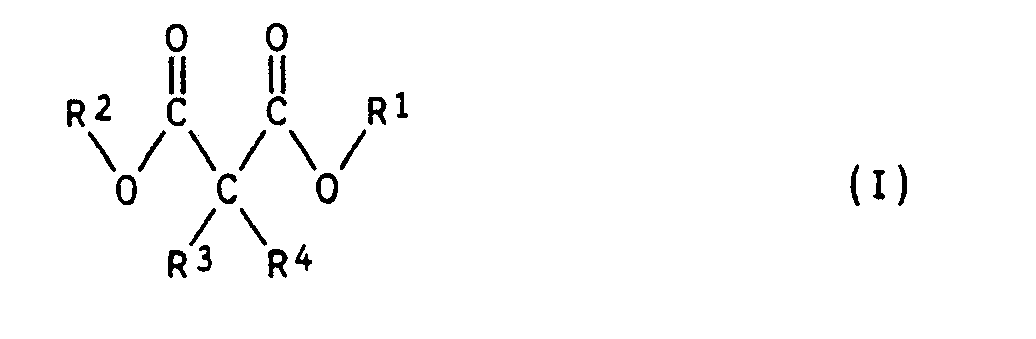
R¹ und R² untereinander gleich oder verschieden sind und für Alkyl, Cycloalkyl, Aralkyl, Trialkylsilyl oder einen heterocyclischen Rest stehen oder zusammen einen sauerstoffhaltigen, sechsgliedrigen heterocyclischen Ring bilden, sowie
R³ und R⁴ untereinander gleich oder verschieden sind und für Wasserstoff, Halogen, Alkyl, Cycloalkyl, Alkoxy, Aralkyl, Aryl, am Arylrest halogensubstituiertes Aralkyl oder Aryl stehen.
Claims (11)
(a) einem in Wasser unlöslichen, in wäßrig-alkalischen Lösungen löslichen Bindemittel oder Bindemittelgemisch,
(b) einer bei Bestrahlung eine starke Säure bildenden Verbindung und
(c) einer oder mehreren die Löslichkeit von (a) in wäßrig-alkalischen Lösungen inhibierenden organischen Verbindungen,
dadurch gekennzeichnet, daß die organische Verbindung (c) ein Malonsäureester der allgemeinen Formel (I)

R¹ und R² untereinander gleich oder verschieden sind und für Alkyl, Cycloalkyl, Aralkyl, Trialkylsilyl oder einen heterocyclischen Rest stehen oder zusammen einen sauerstoffhaltigen, sechsgliedrigen heterocyclischen Ring bilden, sowie
R³ und R⁴ untereinander gleich oder verschieden sind und für Wasserstoff, Halogen, Alkyl, Cycloalkyl, Alkoxy, Aralkyl, Aryl, am Arylrest halogensubstituiertes Aralkyl oder Aryl stehen.


und X⊖ = Cl⊖, Br⊖ ClO₄⊖, Hexafluoroarsenat, Hexafluoroantimonat, Hexafluorophosphat und/oder Tetrafluoroborat ist.

Applications Claiming Priority (2)
| Application Number | Priority Date | Filing Date | Title |
|---|---|---|---|
| DE3837438 | 1988-11-04 | ||
| DE3837438A DE3837438A1 (de) | 1988-11-04 | 1988-11-04 | Strahlungsempfindliches gemisch |
Publications (3)
| Publication Number | Publication Date |
|---|---|
| EP0367131A2 true EP0367131A2 (de) | 1990-05-09 |
| EP0367131A3 EP0367131A3 (de) | 1991-04-24 |
| EP0367131B1 EP0367131B1 (de) | 1995-02-22 |
Family
ID=6366474
Family Applications (1)
| Application Number | Title | Priority Date | Filing Date |
|---|---|---|---|
| EP89119965A Expired - Lifetime EP0367131B1 (de) | 1988-11-04 | 1989-10-27 | Strahlungsempfindliches Gemisch |
Country Status (4)
| Country | Link |
|---|---|
| US (1) | US5035979A (de) |
| EP (1) | EP0367131B1 (de) |
| JP (1) | JP2845520B2 (de) |
| DE (2) | DE3837438A1 (de) |
Families Citing this family (22)
| Publication number | Priority date | Publication date | Assignee | Title |
|---|---|---|---|---|
| US5252435A (en) * | 1990-01-30 | 1993-10-12 | Matsushita Electric Industrial Co., Ltd. | Method for forming pattern |
| DE4005212A1 (de) * | 1990-02-20 | 1991-08-22 | Basf Ag | Strahlungsempfindliches gemisch |
| DE4007924A1 (de) * | 1990-03-13 | 1991-09-19 | Basf Ag | Strahlungsempfindliches gemisch |
| JPH04149445A (ja) * | 1990-10-12 | 1992-05-22 | Mitsubishi Electric Corp | ポジ型感光性組成物 |
| JPH04158363A (ja) * | 1990-10-22 | 1992-06-01 | Mitsubishi Electric Corp | パターン形成用レジスト材料 |
| US6340552B1 (en) * | 1990-12-27 | 2002-01-22 | Kabushiki Kaisha Toshiba | Photosensitive composition containing a dissolution inhibitor and an acid releasing compound |
| JP2919142B2 (ja) * | 1990-12-27 | 1999-07-12 | 株式会社東芝 | 感光性組成物およびそれを用いたパターン形成方法 |
| JP2764771B2 (ja) * | 1991-10-01 | 1998-06-11 | 富士写真フイルム株式会社 | 感光性組成物 |
| JP2964107B2 (ja) * | 1991-11-11 | 1999-10-18 | 日本電信電話株式会社 | ポジ型レジスト材料 |
| TW226444B (de) * | 1992-04-01 | 1994-07-11 | Ciba Geigy | |
| US6004720A (en) * | 1993-12-28 | 1999-12-21 | Fujitsu Limited | Radiation sensitive material and method for forming pattern |
| EP0691575B1 (de) * | 1994-07-04 | 2002-03-20 | Fuji Photo Film Co., Ltd. | Positiv-photoresistzusammensetzung |
| US5648196A (en) * | 1995-07-14 | 1997-07-15 | Cornell Research Foundation, Inc. | Water-soluble photoinitiators |
| KR970059835A (ko) * | 1996-01-18 | 1997-08-12 | 김광호 | 화학 증폭형 레지스트용 베이스 수지 |
| KR0183901B1 (ko) * | 1996-07-03 | 1999-04-01 | 삼성전자 주식회사 | 레지스트 조성물 |
| US6159653A (en) | 1998-04-14 | 2000-12-12 | Arch Specialty Chemicals, Inc. | Production of acetal derivatized hydroxyl aromatic polymers and their use in radiation sensitive formulations |
| KR100287175B1 (ko) * | 1998-05-20 | 2001-09-22 | 윤종용 | 화학 증폭형 포토레지스트의 용해 억제제 및 이를 포함하는 화학증폭형 포토레지스트 조성물 |
| US6072006A (en) * | 1998-11-06 | 2000-06-06 | Arch Specialty Chemicals, Inc. | Preparation of partially cross-linked polymers and their use in pattern formation |
| JP3299214B2 (ja) | 1999-03-12 | 2002-07-08 | 松下電器産業株式会社 | パターン形成材料及びパターン形成方法 |
| US7959714B2 (en) * | 2007-11-15 | 2011-06-14 | Cummins Filtration Ip, Inc. | Authorized filter servicing and replacement |
| US9138673B2 (en) | 2013-03-14 | 2015-09-22 | Baldwin Filters, Inc. | Coalescer filter |
| KR102836230B1 (ko) * | 2021-03-10 | 2025-07-22 | 주식회사 엘지화학 | 다층인쇄회로기판용 절연층 |
Family Cites Families (15)
| Publication number | Priority date | Publication date | Assignee | Title |
|---|---|---|---|---|
| US3915706A (en) * | 1974-03-11 | 1975-10-28 | Xerox Corp | Imaging system based on photodegradable polyaldehydes |
| DE2928636A1 (de) * | 1979-07-16 | 1981-02-12 | Hoechst Ag | Strahlungsempfindliches gemisch und verfahren zur herstellung von reliefbildern |
| US4284706A (en) * | 1979-12-03 | 1981-08-18 | International Business Machines Corporation | Lithographic resist composition for a lift-off process |
| US4491628A (en) * | 1982-08-23 | 1985-01-01 | International Business Machines Corporation | Positive- and negative-working resist compositions with acid generating photoinitiator and polymer with acid labile groups pendant from polymer backbone |
| DE3406927A1 (de) * | 1984-02-25 | 1985-08-29 | Hoechst Ag, 6230 Frankfurt | Strahlungsempfindliches gemisch auf basis von saeurespaltbaren verbindungen |
| FR2570844B1 (fr) * | 1984-09-21 | 1986-11-14 | Commissariat Energie Atomique | Film photosensible a base de polymere silicie et son utilisation comme resine de masquage dans un procede de lithographie |
| US4770977A (en) * | 1984-09-21 | 1988-09-13 | Commissariat A L'energie Atomique | Silicon-containing polymer and its use as a masking resin in a lithography process |
| US4624908A (en) * | 1985-04-15 | 1986-11-25 | J. T. Baker Chemical Company | Deep ultra-violet lithographic resist composition and process of using |
| US4737426A (en) * | 1985-05-15 | 1988-04-12 | Ciba-Geigy Corporation | Cyclic acetals or ketals of beta-keto esters or amides |
| JPS6291938A (ja) * | 1985-10-18 | 1987-04-27 | Fuji Photo Film Co Ltd | 製版方法 |
| US4808512A (en) * | 1986-10-02 | 1989-02-28 | J. T. Baker Inc. | Process of deep ultra-violet imaging lithographic resist compositions |
| US4810613A (en) * | 1987-05-22 | 1989-03-07 | Hoechst Celanese Corporation | Blocked monomer and polymers therefrom for use as photoresists |
| DE3721741A1 (de) * | 1987-07-01 | 1989-01-12 | Basf Ag | Strahlungsempfindliches gemisch fuer lichtempfindliche beschichtungsmaterialien |
| DE3817010A1 (de) * | 1988-05-19 | 1989-11-30 | Basf Ag | Strahlungsempfindliches gemisch und verfahren zur herstellung von reliefmustern |
| JPH02176661A (ja) * | 1988-10-28 | 1990-07-09 | Matsushita Electric Ind Co Ltd | パターン形成材料 |
-
1988
- 1988-11-04 DE DE3837438A patent/DE3837438A1/de not_active Withdrawn
-
1989
- 1989-10-17 US US07/422,456 patent/US5035979A/en not_active Expired - Lifetime
- 1989-10-27 EP EP89119965A patent/EP0367131B1/de not_active Expired - Lifetime
- 1989-10-27 DE DE58909028T patent/DE58909028D1/de not_active Expired - Lifetime
- 1989-11-01 JP JP1283165A patent/JP2845520B2/ja not_active Expired - Fee Related
Also Published As
| Publication number | Publication date |
|---|---|
| US5035979A (en) | 1991-07-30 |
| DE3837438A1 (de) | 1990-05-10 |
| DE58909028D1 (de) | 1995-03-30 |
| JPH02181151A (ja) | 1990-07-13 |
| JP2845520B2 (ja) | 1999-01-13 |
| EP0367131B1 (de) | 1995-02-22 |
| EP0367131A3 (de) | 1991-04-24 |
Similar Documents
| Publication | Publication Date | Title |
|---|---|---|
| EP0447868B1 (de) | Strahlungsempfindliches Gemisch | |
| EP0367131B1 (de) | Strahlungsempfindliches Gemisch | |
| EP0342498B1 (de) | Positiv und negativ arbeitende strahlungsempfindliche Gemische sowie Verfahren zur Herstellung von Reliefmustern | |
| EP0297443B1 (de) | Strahlungsempfindliches Gemisch für lichtempfindliche Beschichtungsmaterialien | |
| EP0342496B1 (de) | Strahlungsempfindliches Gemisch und Verfahren zur Herstellung von Reliefmustern | |
| EP0342495B1 (de) | Strahlungsempfindliches Gemisch und Verfahren zur Herstellung von Reliefmustern | |
| EP0553737B1 (de) | Strahlungsempfindliches Gemisch | |
| EP0367132B1 (de) | Strahlungsempfindliches Gemisch | |
| EP0616258B1 (de) | Strahlungsempfindliches Gemisch und Verfahren zur Herstellung von Reliefstrukturen mit verbessertem Kontrast | |
| EP0762207B1 (de) | Positivarbeitendes strahlenempfindliches Gemisch und Verfahren zur Herstellung von Reliefstrukturen | |
| EP0337257B1 (de) | Positiv arbeitendes, strahlungsempfindliches Gemisch auf Basis von säurespaltbaren und photochemisch säurebildenden Verbindungen und Verfahren zur Herstellung von Reliefmustern und Reliefbildern | |
| EP0424766A2 (de) | Strahlungsempfindliches Gemisch und Verfahren zur Herstellung von Reliefmustern | |
| EP0372408B1 (de) | Strahlungsempfindliches Gemisch | |
| EP0436174A2 (de) | Strahlungsempfindliches Gemisch und Verfahren zur Herstellung von Reliefstrukturen | |
| EP0540965A1 (de) | Positiv arbeitendes strahlungsempfindliches Gemisch und Verfahren zur Herstellung von Reliefmustern | |
| EP0443415A2 (de) | Strahlungsempfindliches Gemisch | |
| EP0432599B1 (de) | Strahlungsempfindliches Gemisch und Verfahren zur Herstellung von Reliefstrukturen | |
| EP0424737A2 (de) | Strahlungsempfindliches Gemisch und Verfahren zur Herstellung von Reliefmustern | |
| DE3935876A1 (de) | Strahlungsempfindliches gemisch | |
| EP0459260A2 (de) | Kondensationsprodukt und damit hergestelltes strahlungsempfindliches Gemisch | |
| DE4025959A1 (de) | Strahlungsempfindliches gemisch und verfahren zur herstellung von reliefmustern |
Legal Events
| Date | Code | Title | Description |
|---|---|---|---|
| PUAI | Public reference made under article 153(3) epc to a published international application that has entered the european phase |
Free format text: ORIGINAL CODE: 0009012 |
|
| AK | Designated contracting states |
Kind code of ref document: A2 Designated state(s): BE DE FR GB IT NL |
|
| 17P | Request for examination filed |
Effective date: 19901227 |
|
| PUAL | Search report despatched |
Free format text: ORIGINAL CODE: 0009013 |
|
| AK | Designated contracting states |
Kind code of ref document: A3 Designated state(s): BE DE FR GB IT NL |
|
| 17Q | First examination report despatched |
Effective date: 19931020 |
|
| K1C3 | Correction of patent application (complete document) published |
Effective date: 19900509 |
|
| GRAA | (expected) grant |
Free format text: ORIGINAL CODE: 0009210 |
|
| AK | Designated contracting states |
Kind code of ref document: B1 Designated state(s): BE DE FR GB IT NL |
|
| REF | Corresponds to: |
Ref document number: 58909028 Country of ref document: DE Date of ref document: 19950330 |
|
| GBT | Gb: translation of ep patent filed (gb section 77(6)(a)/1977) |
Effective date: 19950308 |
|
| ITF | It: translation for a ep patent filed | ||
| ET | Fr: translation filed | ||
| PLBE | No opposition filed within time limit |
Free format text: ORIGINAL CODE: 0009261 |
|
| STAA | Information on the status of an ep patent application or granted ep patent |
Free format text: STATUS: NO OPPOSITION FILED WITHIN TIME LIMIT |
|
| 26N | No opposition filed | ||
| PGFP | Annual fee paid to national office [announced via postgrant information from national office to epo] |
Ref country code: BE Payment date: 19981008 Year of fee payment: 10 |
|
| PG25 | Lapsed in a contracting state [announced via postgrant information from national office to epo] |
Ref country code: BE Free format text: LAPSE BECAUSE OF NON-PAYMENT OF DUE FEES Effective date: 19991031 |
|
| BERE | Be: lapsed |
Owner name: BASF A.G. Effective date: 19991031 |
|
| REG | Reference to a national code |
Ref country code: GB Ref legal event code: IF02 |
|
| PGFP | Annual fee paid to national office [announced via postgrant information from national office to epo] |
Ref country code: FR Payment date: 20020920 Year of fee payment: 14 |
|
| PGFP | Annual fee paid to national office [announced via postgrant information from national office to epo] |
Ref country code: NL Payment date: 20021011 Year of fee payment: 14 |
|
| PGFP | Annual fee paid to national office [announced via postgrant information from national office to epo] |
Ref country code: GB Payment date: 20021015 Year of fee payment: 14 |
|
| PGFP | Annual fee paid to national office [announced via postgrant information from national office to epo] |
Ref country code: DE Payment date: 20021116 Year of fee payment: 14 |
|
| PG25 | Lapsed in a contracting state [announced via postgrant information from national office to epo] |
Ref country code: GB Free format text: LAPSE BECAUSE OF NON-PAYMENT OF DUE FEES Effective date: 20031027 |
|
| PG25 | Lapsed in a contracting state [announced via postgrant information from national office to epo] |
Ref country code: DE Free format text: LAPSE BECAUSE OF THE APPLICANT RENOUNCES Effective date: 20031117 |
|
| PG25 | Lapsed in a contracting state [announced via postgrant information from national office to epo] |
Ref country code: NL Free format text: LAPSE BECAUSE OF NON-PAYMENT OF DUE FEES Effective date: 20040501 |
|
| GBPC | Gb: european patent ceased through non-payment of renewal fee |
Effective date: 20031027 |
|
| PG25 | Lapsed in a contracting state [announced via postgrant information from national office to epo] |
Ref country code: FR Free format text: LAPSE BECAUSE OF NON-PAYMENT OF DUE FEES Effective date: 20040630 |
|
| NLV4 | Nl: lapsed or anulled due to non-payment of the annual fee |
Effective date: 20040501 |
|
| REG | Reference to a national code |
Ref country code: FR Ref legal event code: ST |
|
| PG25 | Lapsed in a contracting state [announced via postgrant information from national office to epo] |
Ref country code: IT Free format text: LAPSE BECAUSE OF NON-PAYMENT OF DUE FEES;WARNING: LAPSES OF ITALIAN PATENTS WITH EFFECTIVE DATE BEFORE 2007 MAY HAVE OCCURRED AT ANY TIME BEFORE 2007. THE CORRECT EFFECTIVE DATE MAY BE DIFFERENT FROM THE ONE RECORDED. Effective date: 20051027 |