EP0367588B1 - Optisches Aufzeichnungsmedium - Google Patents
Optisches Aufzeichnungsmedium Download PDFInfo
- Publication number
- EP0367588B1 EP0367588B1 EP89311292A EP89311292A EP0367588B1 EP 0367588 B1 EP0367588 B1 EP 0367588B1 EP 89311292 A EP89311292 A EP 89311292A EP 89311292 A EP89311292 A EP 89311292A EP 0367588 B1 EP0367588 B1 EP 0367588B1
- Authority
- EP
- European Patent Office
- Prior art keywords
- recording layer
- substrate
- copolymer
- recording
- random copolymer
- Prior art date
- Legal status (The legal status is an assumption and is not a legal conclusion. Google has not performed a legal analysis and makes no representation as to the accuracy of the status listed.)
- Expired - Lifetime
Links
Images

Classifications
-
- G—PHYSICS
- G11—INFORMATION STORAGE
- G11B—INFORMATION STORAGE BASED ON RELATIVE MOVEMENT BETWEEN RECORD CARRIER AND TRANSDUCER
- G11B7/00—Recording or reproducing by optical means, e.g. recording using a thermal beam of optical radiation by modifying optical properties or the physical structure, reproducing using an optical beam at lower power by sensing optical properties; Record carriers therefor
- G11B7/24—Record carriers characterised by shape, structure or physical properties, or by the selection of the material
- G11B7/241—Record carriers characterised by shape, structure or physical properties, or by the selection of the material characterised by the selection of the material
- G11B7/242—Record carriers characterised by shape, structure or physical properties, or by the selection of the material characterised by the selection of the material of recording layers
- G11B7/243—Record carriers characterised by shape, structure or physical properties, or by the selection of the material characterised by the selection of the material of recording layers comprising inorganic materials only, e.g. ablative layers
- G11B7/2433—Metals or elements of Groups 13, 14, 15 or 16 of the Periodic Table, e.g. B, Si, Ge, As, Sb, Bi, Se or Te
-
- G—PHYSICS
- G11—INFORMATION STORAGE
- G11B—INFORMATION STORAGE BASED ON RELATIVE MOVEMENT BETWEEN RECORD CARRIER AND TRANSDUCER
- G11B7/00—Recording or reproducing by optical means, e.g. recording using a thermal beam of optical radiation by modifying optical properties or the physical structure, reproducing using an optical beam at lower power by sensing optical properties; Record carriers therefor
- G11B7/24—Record carriers characterised by shape, structure or physical properties, or by the selection of the material
- G11B7/241—Record carriers characterised by shape, structure or physical properties, or by the selection of the material characterised by the selection of the material
- G11B7/252—Record carriers characterised by shape, structure or physical properties, or by the selection of the material characterised by the selection of the material of layers other than recording layers
- G11B7/253—Record carriers characterised by shape, structure or physical properties, or by the selection of the material characterised by the selection of the material of layers other than recording layers of substrates
- G11B7/2533—Record carriers characterised by shape, structure or physical properties, or by the selection of the material characterised by the selection of the material of layers other than recording layers of substrates comprising resins
- G11B7/2538—Record carriers characterised by shape, structure or physical properties, or by the selection of the material characterised by the selection of the material of layers other than recording layers of substrates comprising resins polycycloolefins [PCO]
-
- G—PHYSICS
- G11—INFORMATION STORAGE
- G11B—INFORMATION STORAGE BASED ON RELATIVE MOVEMENT BETWEEN RECORD CARRIER AND TRANSDUCER
- G11B7/00—Recording or reproducing by optical means, e.g. recording using a thermal beam of optical radiation by modifying optical properties or the physical structure, reproducing using an optical beam at lower power by sensing optical properties; Record carriers therefor
- G11B7/24—Record carriers characterised by shape, structure or physical properties, or by the selection of the material
- G11B7/241—Record carriers characterised by shape, structure or physical properties, or by the selection of the material characterised by the selection of the material
- G11B7/242—Record carriers characterised by shape, structure or physical properties, or by the selection of the material characterised by the selection of the material of recording layers
- G11B7/243—Record carriers characterised by shape, structure or physical properties, or by the selection of the material characterised by the selection of the material of recording layers comprising inorganic materials only, e.g. ablative layers
-
- G—PHYSICS
- G11—INFORMATION STORAGE
- G11B—INFORMATION STORAGE BASED ON RELATIVE MOVEMENT BETWEEN RECORD CARRIER AND TRANSDUCER
- G11B7/00—Recording or reproducing by optical means, e.g. recording using a thermal beam of optical radiation by modifying optical properties or the physical structure, reproducing using an optical beam at lower power by sensing optical properties; Record carriers therefor
- G11B7/24—Record carriers characterised by shape, structure or physical properties, or by the selection of the material
- G11B7/241—Record carriers characterised by shape, structure or physical properties, or by the selection of the material characterised by the selection of the material
- G11B7/252—Record carriers characterised by shape, structure or physical properties, or by the selection of the material characterised by the selection of the material of layers other than recording layers
- G11B7/253—Record carriers characterised by shape, structure or physical properties, or by the selection of the material characterised by the selection of the material of layers other than recording layers of substrates
-
- G—PHYSICS
- G11—INFORMATION STORAGE
- G11B—INFORMATION STORAGE BASED ON RELATIVE MOVEMENT BETWEEN RECORD CARRIER AND TRANSDUCER
- G11B7/00—Recording or reproducing by optical means, e.g. recording using a thermal beam of optical radiation by modifying optical properties or the physical structure, reproducing using an optical beam at lower power by sensing optical properties; Record carriers therefor
- G11B7/24—Record carriers characterised by shape, structure or physical properties, or by the selection of the material
- G11B7/241—Record carriers characterised by shape, structure or physical properties, or by the selection of the material characterised by the selection of the material
- G11B7/242—Record carriers characterised by shape, structure or physical properties, or by the selection of the material characterised by the selection of the material of recording layers
- G11B7/243—Record carriers characterised by shape, structure or physical properties, or by the selection of the material characterised by the selection of the material of recording layers comprising inorganic materials only, e.g. ablative layers
- G11B2007/24302—Metals or metalloids
- G11B2007/24306—Metals or metalloids transition metal elements of groups 3-10
-
- G—PHYSICS
- G11—INFORMATION STORAGE
- G11B—INFORMATION STORAGE BASED ON RELATIVE MOVEMENT BETWEEN RECORD CARRIER AND TRANSDUCER
- G11B7/00—Recording or reproducing by optical means, e.g. recording using a thermal beam of optical radiation by modifying optical properties or the physical structure, reproducing using an optical beam at lower power by sensing optical properties; Record carriers therefor
- G11B7/24—Record carriers characterised by shape, structure or physical properties, or by the selection of the material
- G11B7/241—Record carriers characterised by shape, structure or physical properties, or by the selection of the material characterised by the selection of the material
- G11B7/242—Record carriers characterised by shape, structure or physical properties, or by the selection of the material characterised by the selection of the material of recording layers
- G11B7/243—Record carriers characterised by shape, structure or physical properties, or by the selection of the material characterised by the selection of the material of recording layers comprising inorganic materials only, e.g. ablative layers
- G11B2007/24302—Metals or metalloids
- G11B2007/24316—Metals or metalloids group 16 elements (i.e. chalcogenides, Se, Te)
-
- G—PHYSICS
- G11—INFORMATION STORAGE
- G11B—INFORMATION STORAGE BASED ON RELATIVE MOVEMENT BETWEEN RECORD CARRIER AND TRANSDUCER
- G11B7/00—Recording or reproducing by optical means, e.g. recording using a thermal beam of optical radiation by modifying optical properties or the physical structure, reproducing using an optical beam at lower power by sensing optical properties; Record carriers therefor
- G11B7/24—Record carriers characterised by shape, structure or physical properties, or by the selection of the material
- G11B7/241—Record carriers characterised by shape, structure or physical properties, or by the selection of the material characterised by the selection of the material
- G11B7/242—Record carriers characterised by shape, structure or physical properties, or by the selection of the material characterised by the selection of the material of recording layers
- G11B7/243—Record carriers characterised by shape, structure or physical properties, or by the selection of the material characterised by the selection of the material of recording layers comprising inorganic materials only, e.g. ablative layers
- G11B2007/24318—Non-metallic elements
- G11B2007/24328—Carbon
-
- Y—GENERAL TAGGING OF NEW TECHNOLOGICAL DEVELOPMENTS; GENERAL TAGGING OF CROSS-SECTIONAL TECHNOLOGIES SPANNING OVER SEVERAL SECTIONS OF THE IPC; TECHNICAL SUBJECTS COVERED BY FORMER USPC CROSS-REFERENCE ART COLLECTIONS [XRACs] AND DIGESTS
- Y10—TECHNICAL SUBJECTS COVERED BY FORMER USPC
- Y10S—TECHNICAL SUBJECTS COVERED BY FORMER USPC CROSS-REFERENCE ART COLLECTIONS [XRACs] AND DIGESTS
- Y10S430/00—Radiation imagery chemistry: process, composition, or product thereof
- Y10S430/146—Laser beam
Definitions
- This invention relates to optical recording media of the type wherein pits corresponding to information are formed on a recording layer on a substrate by irradiation with beam of energy such as light or heat.
- optical recording media there are two types of optical recording media, in use of one of which physically deformed portions such as holes or concavities are formed in a recording layer upon imagewise irradiation with beam of energy, and in use of the other of which portions having changed optical properties such as refractive index and reflectance are formed in a recording layer upon imagewise irradiation with beam of energy.
- Te thin film typical of low-melting metallic films, is capable of forming thereon desired physically deformed portions or portions having changed optical properties (hereinafter generally called "pits") by irradiating with very low energy radiation, and thus is very useful as a high sensitivity material.
- sensitivity as used herein is meant the energy (mJ/cm2) required for forming pits per unit surface area.
- optical recording media comprising these recording layers laminated to conventional substrates such as a polycarbonate resin substrate can have poor sensitivity. Hence, optical recording media having improved recording sensitivity are needed.
- a further problem with such recording media is that the adhesion of the substrate to the recording layer is insufficient. To deal with this problem, a stage involving the removal of water contained in the polycarbonate resin to be used as the substrate is required. Further, there is sometimes required a stage for treating the surface of the polycarbonate resin substrate with plasma to improve the adhesion of the substrate to the recording layer.
- EP-A-231121 we describe an optical disc structure having an air sandwich structure comprising two discs, each of which discs has a recording layer on a substrate of a copolymer of ethylene with a cycloolefin monomer.
- a Te film comprising C and H, and a Cr- comprising Te film have been proposed as recording media in JP-A-33320/1984 and JP-A-63084/1984, respectively.
- recording layers mainly comprising Te are not sufficiently oxidation-resistant.
- the present invention seeks to provide optical recording media having excellent recording sensitivity and adhesion between the substrate and the recording layer.
- the invention provides an optical recording medium comprising a substrate and a recording layer formed thereon, in use of which the recording layer is irradiated with a beam of energy to form pits therein corresponding to given pieces of information and thereby record the pieces of information
- said recording layer is a thin film having a thickness of 10 ⁇ 8 to 10 ⁇ 6 m (100 ⁇ to 1 »m) and consisting essentially of Te, Cr, C and H, the content of Cr in the recording layer being from 0.1 to 40 atom % based on the total atoms present in the recording layer
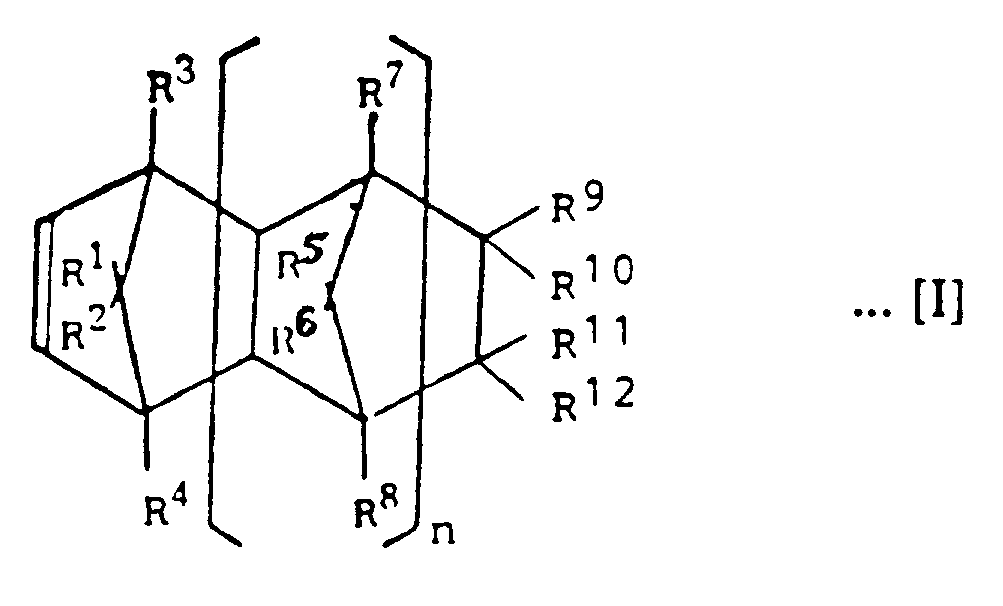
- said substrate comprises a cycloolefin random copolymer comprising units derived from ethylene and units derived from a cycloolefin of general formula [I] wherein n is 0 or a positive integer, preferably not more than 3, and R1 to R12, which may be the same or different, each represents hydrogen, halogen or a hydrocarbon group, provided that R9 to R12 together may form a mono- or polycyclic
- the unit derived from the cycloolefins of the general formula [I] is present in the form of a recurring unit as represented by the following general formula [II]. wherein R1 to R12 and n are as defined above.
- Figure 1 is a rough sectional view of one embodiment of the optical recording medium of the present invention.
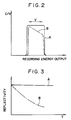
- FIGS. 1 and Figure 3 show differences of functions and effects between the optical recording media of this invention and conventional ones.
- Figure 4 is a rough sectional view of another embodiment of the optical recording medium of the present invention.
- numeral 10 represents optical recording medium
- 11 represents substrate
- 12 represents recording layer
- 13 represents undercoat layer
- optical recording media of the present invention will be illustrated in more detail below.
- an optical recording medium 10 As shown in Fig. 1, an optical recording medium 10 according to the present invention comprises a substrate 11 and a recording layer 12 formed thereon.
- the substrate 11 is composed of a cycloolefin random copolymer of ethylene and at least one cycloolefin unit of general formula [I] and having an intrinsic viscosity [ ⁇ ] of from 0.05 to 10 dl/g as measured at 135°C in decalin.
- said substrate 11 is composed of a cycloolefin random copolymer composition containing a said cycloolefin random copolymer [A] having an intrinsic viscosity [ ⁇ ] of from 0.05 to 10 dl/g as measured at 135°C in decalin and a softening temperature (TMA) of not lower than 70°C, and a said cycloolefin random copolymer [B] having an intrinsic viscosity [ ⁇ ] of from 0.05 to 5 dl/g as measured at 135°C in decalin and a softening temperature (TMA) of below 70°C in a weight ratio of copolymer [A] to copolymer [B] from 100/0.1 to 100/10.
- TMA softening temperature
- copolymer [A] is blended with copolymer [B] in the ratio specified above, the adhesion between the substrate 11 and the recording layer 12 can be further improved as compared with the case where the recording layer 12 is laminated onto a substrate 11 composed of the component [A] alone.
- the cycloolefin used herein include, for example the following unsaturated monomers represented by the general formula [I].
- the cycloolefins represented by the general formula [I] can be easily prepared by condensation reaction of cyclopentadienes with appropriate olefins by Diels-Alder reaction.
- Examples of the cycloolefins represented by the general formula [I] include such compounds as exemplified in Table 1 and derivatives thereof, and in addition to 1,4,5,8-dimethano-1,2,3,4,4a,5,8,8a-octahydronaphthalene, such octahydronaphthalenes as 2-methyl-1,4,5,8-dimethano-1,2,3,4,4a,5,8,8a-aoctahydronaphthalene, 2-ethyl-1,4,5,8-dimethano-1,2,3,4,4a,5,8,8a-octahydronaphthalene, 2-propyl-1,4,5,8-dimethano-1,2,3,4,4a,5,8,8a-octahydronaphthalene, 2-hexyl-1,4,5,8-dimethano-1,2,3,4,4a,5,8,8a-octahydronaphthalene, 2-stearyl-1,4,5,8-dimethano
- the cycloolefin random copolymer contains as essential components the ethylene unit and the cycloolefin unit as described above. In addition to said two essential units, however, the cycloolefin random copolymer may optionally contain other copolymerizable unsaturated monomer units in such amount that they do not hinder the object of the present invention.
- Such unsaturated monomers which may optionally be copolymerized include ⁇ -olefins having from 3 to 20 carbon atoms, such as propylene, 1-butene, 4-methyl-1-pentene, 1-hexene, 1-octene, 1-decene, 1-dodecene, 1-tetradecene, 1-hexadecene, 1-octadecene and 1-eicosene.
- the recurring units (a) derived from ethylene are present in an amount of from 40 to 85% by mole, preferably from 50 to 75% by mole, while the recurring units (b) derived from the cycloolefin or cycloolefins are present in an amount of from 15 to 60% by mole, preferably from 25 to 50% by mole, and these recurring units (a) and (b) are arranged at random in the substantially linear chain of the copolymer.
- the molar percentage of the recurring units (a) and (b) were determined by 13C-NMR. The fact that the copolymer is completely soluble in decalin at a temperature of 135°C, indicates that the chemical structure of said copolymer is substantially linear and free from a gel-forming cross-linked structure.
- the copolymer has an intrinsic viscosity [ ⁇ ] of from 0.05 to 10 dl/g, preferably from 0.08 to 5 dl/g, as measured in decalin at a temperature of 135°C.
- the softening temperature (TMA) of the copolymer is desirably at least 70°C, preferably from 90° to 250°C, and more preferably from 100° to 200°C.
- the softening temperature (TMA) of the copolymer [A] was determined by monitoring thermal deformation behavior of a 1 mm sheet of the copolymer using a thermomechanical analyzer supplied by Du Pont. More specifically, a quartz needle was vertically placed on the sheet under a load of 49 g and the assembly was heated at a rate of 5°C/min. The temperature at which the needle penetrated into the sheet by a depth of 0.635 mm was taken as the softening temperature of the copolymer.
- the copolymer has a glass transition temperature (Tg) of normally from 50° to 230°C, and preferably from 70° to 210°C.
- Tg glass transition temperature
- the crystallinity of the copolymer is normally from 0 to 10%, preferably from 0 to 7%, and more preferably from 0 to 5%.
- optical recording medium The second preferred embodiment of optical recording medium will be described in more detail hereinafter.
- the recurring units (a) derived from ethylene are present in an amount of from 40 to 85 mol%, preferably from 50 to 75 mol%, while the recurring units (b) derived from the cycloolefin or cycloolefins are present in an amount of from 15 to 60 mol%, preferably 25 to 50 mol%, and these recurring units (a) and (b) are arranged at random in the substantially linear chain of the copolymer [A].
- the molar percentage of the recurring units (a) and (b) were determined by 13C-NMR.
- An intrinsic viscosity [ ⁇ ] as measured at 135°C in decalin of the cycloolefin random copolymer [A] is in the range of from 0.05 to 10 dl/g, preferably from 0.08 to 5 dl/g.
- a softening temperature (TMA) as measured with a thermal mechanical analyzer of the cycloolefin random copolymer [A] is not lower than 70°C, preferably in the range of from 90 to 250°C, more preferably from 100 to 200°C.
- a glass transition temperature (Tg) of said cycloolefin random copolymer [A] is usually in the range of from 50 to 230°C, preferably from 70 to 210°C.
- a crystallinity index as measured by X-ray diffractometry of the cycloolefin random copolymer [A] is in the range of from 0 to 10%, preferably from 0 to 7%, more preferably from 0 to 5%.
- the recurring units (a) derived from ethylene are present in an amount of from 60 to 98 mol%, preferably 60 to 95 mol%, while the recurring unit (b) derived from the cycloolefin or cycloolefins are present in an amount of from 2 to 40 mol%, preferably 5 to 40 mol%, and these recurring units (a) and (b) are arranged at random in the substantially linear chain of the copolymer [B].
- the molar percentage of the recurring units (a) and (b) were determined by 13C-NMR.
- the copolymer [B] has an intrinsic viscosity [ ⁇ ] of from 0.05 to 5 dl/g, preferably from 0.08 to 3 dl/g as measured in decalin at a temperature of 135°C.
- the softening temperature of the copolymer [B] as measured by a thermal mechanical analyzer is below 70°C, preferably from -10 to 60°C, more preferably from 10 to 55°C.
- the copolymer [B] has a glass transition temperature (Tg) of normally from -30 to 60°C, preferably from -20 to 50°C.
- the crystallinity of the copolymer [B] as measured by X-ray diffractometry is normally from 0 to 10%, preferably from 0 to 7%, and more preferably from 0 to 5%.
- the ratio by weight of the copolymer [A] to the copolymer [B] in the cycloolefin random copolymer composition to be used as the substrate of the second preferred embodiment of the present invention is from 100/0.1 to 100/10, preferably 100/0.3 to 100/7, and more preferably 100/0.5 to 100/5.
- the copolymer [A] is blended with the copolymer [B] in the ratio defined above, there can be obtained an improved adhesion between the substrate and the recording layer under severe conditions while retaining the excellent transparency and surface smoothness of the substrate itself.
- the substrate composed of the cycloolefin random copolymer composition comprising the copolymer [A] and the copolymer [B] has such an advantage that the excellent adhesion between the substrate and the recording layer used in the present invention does not deteriorate even when the media are left to stand under high temperature and humidity conditions.
- the cycloolefin random copolymer and the cycloolefin random copolymers [A] and [B] of the cycloolefin random copolymer composition which constitute the substrate of the present invention may be prepared by suitably selecting the conditions under which they are prepared in accordance with the processes as proposed by the present applicant in Japanese Patent L-O-P Publns. Nos. 168708/1985, 120816/1986, 115912/1986, 115916/1986, 95905/1986, 95906/1986, 271308/1986 and 272216/1986.
- the substrates of the optical discs according to the invention may be made of polymers having recurring units of the general formula [III] resulting from ring opening of the cycloolefin monomers [I], or polymers having recurring units of the general formula [IV] resulting from hydrogenation of the units [III].
- n and R1 to R12 are as defined above.
- the cycloolefin random copolymer or the cycloolefin random copolymer compositions may incorporate heat stabilizers, weathering stabilizers, antistatic agents, slip agents, anti-blocking agents, anti-fogging agents, lubricants, dyes, pigments, natural oil, synthetic oil or wax, and the amounts of these additives may be suitably decided.
- the stabilisers which may be optionally incorporated include concretely phenolic antioxidants such as tetrakis[methylene-3-(3,5-di-t-butyl-4-hydroxyphenyl)propionate]methane, alkyl esters of ⁇ -(3,5-di-t-butyl-4-hydroxyphenyl)propionic acid (18C or lower alkyl esters being particularly preferred) and 2,2'-oxamidobis[ethyl-3-(3,5-di-t-butyl-4-hydroxyphenyl)]propinate, metallic salts of fatty acids, such as zinc stearate, calcium stearate and calcium 12-hydroxystearate, and fatty esters of polyhydric alcohols such as glycerin monostearate, glycerin monolaurate, glycerin distearate, pentaerythritol distearate and pentaerythritol tristearate.
- phenolic antioxidants such as
- These compounds may be incorporated into the copolymers or the copolymer compositions either singly or in combination. For instance, there may be used such a combination of tetrakis[methylene-3-(3,5-di-t-butyl-4-hydroxyphenyl)propionate]methane with zinc stearate and glycerin monostearate.
- phenolic antioxidants with fatty esters of polyhydric alcohols.
- the fatty esters of the polyhydric alcohols are those wherein part of alcoholic hydroxyl groups of trihydric or polyhydric alcohols are esterified.
- fatty esters of polyhydric alcohols include fatty esters of glycerin such as glycerin monostearate, glycerin monolaurate, glycerin monomyristate, glycerin monopalmitate, glycerin distearate and glycerin dilaurate, and fatty esters of pentaerythritol such as pentaerythritol monostearate, pentaerythritol monolaurate, pentaerythritol distearate, pentaerythritol dilaurate and pentaerythritol tristearate.
- glycerin such as glycerin monostearate, glycerin monolaurate, glycerin monomyristate, glycerin monopalmitate, glycerin distearate and glycerin dilaurate
- pentaerythritol such
- the phenolic antioxidants are used in an amount of 0.01 to 10 parts by weight, preferably 0.05 to 3 parts by weight, more preferably 0.1 to 1 part by weight based on the amount of the cycloolefin random copolymer or the cycloolefin random copolymer composition.
- the fatty ester of the polyhydric alcohols are used in an amount of 0.01 to 10 parts by weight, preferably 0.05 to 3 parts by weight based on the amount of the cycloolefin random copolymer or the cycloolefin random copolymer composition.
- the cycloolefin random copolymers or the cycloolefin random copolymer compositions are used as the substrates 11.
- the optical recording media of the present invention are superior in recording sensitivity to conventional optical recording media in which polycarbonates or poly(methyl methacrylate) are used as the substrate, though the reasons for the unexpected results so far are not known.
- the substrates 11 composed of the cycloolefin random copolymers or the cycloolefin random copolymer compositions are excellent in adhesion to the recording layer 12. Accordingly, the recording layer is excellent in long-term stability and can be effectively prevented from being oxidized.
- the optical recording media comprising the substrates 11 composed of the cycloolefin random copolymers or the cycloolefin random copolymer compositions and the recording layer 12 laminated thereon are excellent in recording sensitivity as well as in durability and long-term stability. Further, the optical recording media 10 of the present invention cause neither warpage nor cracking.
- the recording layer 12 is a thin film consisting essentially of Te and additionally containing at least Cr, C and H.
- the recording layer may contain low melting elements other than Te or other components.
- Elements other than Te, which can be incorporated in the recording layer 12, include, for example, Ti, Mn, Ni, Zr, Nb, Ta, Al, Pt, Sb, Ge, Ag, Sm, Bi, In, Se, Pb, Co, Si, Pd, Sn and Zn.
- the content of Cr in the recording layer 12 is from 0.1 to 40 atom%, preferably from 0.5 to 10 atom%, especially preferably from 1 to 4 atom % based on the total atoms present in the recording layer, or from 0.1 to 40 atom%, preferably from 0.5 to 10 atom%, especially preferably from 1 to 4 atom% based on the sum of total Te and Cr atoms present in the recording layer.
- the contents of C in the recording layer 12 is less than 40 atom%, preferably from 3 to 20 atom% based on the total atoms present in the recording layer, or less than 40 atom%, preferably from 3 to 20 atom% based on the sum total of Te, Cr and C atoms present in the recording layer.
- the content of H in the recording layer 12 is from 1 to 40 atom%, preferably from 3 to 25 atom% based on the total atoms present in the recording layer.
- the amounts of elements contained in the recording layer 12, for example, metallic elements such as Te and Cr are determined by ICP emission spectroscopic analysis (induced coupled plasma emission spectrometry).
- the amount of C is determined by X-ray photoelectron spectrometry (ESCA) and the amount of H is determined by organic elementary analysis.
- the desired recording of given pieces of information may be accomplished by irradiating the recording layer with beam of energy such as a laser beam modulated (on or off) according to the piece of information to be recorded and forming the corresponding pits on the irradiated portions of the recording layer.
- the pits may be those physically deformed such as holes or concavities, or may be such portions of the recording layer in which optical properties such as refractive index and reflectance have been changed by the irradiation with beam of energy.
- the recording layer 12 as mentioned above must be large in thickness to such an extent that sufficient light reflectance is obtained thereby and at the same time, it must be small in thickness to such an extent that no sensitivity is marred thereby.
- a film thickness of the recording layer is from 10 ⁇ 8 to 10 ⁇ 6m, preferably 10 ⁇ 8 to 5 x 10 ⁇ 7m and more preferably 1.5 x 10 ⁇ 8 to 7 x 10 ⁇ 8m (100 ⁇ to 1 »m, preferably 100 to 5000 ⁇ and more preferably 150 to 700 ⁇ ).
- a film thickness of the recording layer is from 10 ⁇ 8 to 10 ⁇ 6m, preferably 10 ⁇ 8 to 5 x 10 ⁇ 7m and more preferably 2 x 10 ⁇ 8 to 2 x 10 ⁇ 7m (100 ⁇ to 1 »m, preferably 100 to 5000 ⁇ and more preferably 200 to 2000 ⁇ ).
- the recording layer 12 may be formed on the substrate 11, for example, by the following procedure.
- the recording layer 12 composed of a thin Te-Cr alloy film containing C and H can be formed on the substrate 11 by using Te-Cr alloy as a target or Te and Cr respectively arranged target applying magnetron sputtering in a mixed gas of an organic gas containing C and H such as CH4 or C2H2 gas and Ar gas.
- the recording layer 12 composed of a thin Te-Cr alloy film containing C and H can also be formed on the substrate 11 by depositing a vapor of CH4, Te and Cr in the form of plasma without using sputtering.
- the recording layer 12 can also be formed on the substrate 11 by vapor phase growth or plasma vapor phase growth. Further, other methods can also be used, for example, part or all of Te, Cr, C and H atoms is ionized to beam-like state and allowed to accumlate on the substrate.
- the atomic content ratio of Te to Cr of the recording layer 12 composed of a thin Te-Cr alloy film containing C and H can be freely controlled by controlling the voltage applied to Te and Cr separately in the case of sputtering Te and Cr simultaneously, and by altering the alloy composition in the case of using an alloy target.
- the contents of C and H in the recording layer 12 composed of a thin Te-Cr alloy film can be arbitrarily controlled by the mixing ratio of CH4 and Ar or applied power preferably high frequency.
- the most suitable content of H in the recording layer will be determined depending on the content of C.
- the content of H can be arbitrarily chosen, so long as the content of H in the recording layer is not so high that hydrogen gas (H2) evolves. Further, since the film thickness is in proportion to sputtering time, the 'film thickness' can be easily controlled.
- the optical characteristics such as refractive index and extinction coefficient of the thus-formed recording layer 12 composed of a thin Te-Cr alloy film containing C and H vary depending on the contents of C and H. Accordingly, the film thickness is determined according to the required optical characteristics when the recording layer is used for the recording of information.
- the recording layer 12 as illustrated above has been markedly improved in oxidation resistance and recording sensitivity in comparison with recording layer formed by using a low melting metal alone such as Te alone.
- the recording layer of the present invention requires a relatively small recording energy output and has an improved recording sensitivity.
- the optical recording media of this invention shows almost no change in the C/N ratio during reproducing against minute voltage variation of a recording energy output, and has a wide recording margin, compared with conventional optical recording media comprising a Te recording layer containing C and H as shown in a curve B in Fig. 2.
- the optical recording media of this invention shows almost no change in reflectance in the elapse of time compared with conventional optical recording media comprising a Te recording layer containing C and H as shown in a curve B in Fig. 3.
- Table 3 described hereinafter.
- the recording layer 12 alone or together with the substrate 11 may be heat-treated in a gas atmosphere containing inert gas, reducing gas or oxygen.
- the heat treatment temperature must be lower than the melting point of Te contained in the recording layer, and is preferably 70 to 300°C, particularly 90 to 150°C.
- the heating time is at least 5 seconds, preferably from 5 seconds to 10 hours, more preferably from 5 minutes to 2 hours.
- the recording sensitivity in the recording layer is improved and recording margin is enlarged. This is thought to be due to the fact that the recording layer is crystallized to a certain extent by heat treatment.
- the present invention is not limited to the embodiment shown in Fig. 1.
- an undercoat layer 13 may be provided between the substrate 11 and the recording layer 12 as shown in Fig. 4.
- the undercoat layer includes, for example, films of fluorides such as magnesium fluoride (MgF2), films of silicon compounds such as silicon oxide (SiO2, SiO) or silicon nitride (Si3N4), metallic films composed of Ti, Ni, Cr, Al or Ni-Cr, films of fluorine-substituted hydrocarbon compounds such as polytetrafluoroethylene (PTFE) film and/or polymer films thereof, and Cr-C-H-films (films containing Cr, C and H).
- fluorides such as magnesium fluoride (MgF2)
- films of silicon compounds such as silicon oxide (SiO2, SiO) or silicon nitride (Si3N4)
- metallic films composed of Ti, Ni, Cr, Al or Ni-Cr films of fluorine-substituted hydrocarbon compounds such as polytetrafluoroethylene (PTFE) film and/or poly
- the undercoat layer generally has a film thickness of from 10 ⁇ 9 to 10 ⁇ 7m, preferably from 5 x 10 ⁇ 9 to 5 x 10 ⁇ 8m (10 to 1000 ⁇ , preferably from 50 to 500 ⁇ ), though the film thickness may vary according to the material used for the undercoat layer.
- these undercoat layers exemplified above can maintain their transparency and, at the same time, can exhibit various characteristics as the undercoat layer.
- the undercoat layer 13 as mentioned above may be formed on the surface of the substrate 11 in the same manner as in the case of formation of the recording layer 12 by the magnetron sputtering, vapor phase growth, plasma vapor phase growth, vacuum evaporation or spincoat process.
- Provision of the above-mentioned undercoat layer between the substrate 11 and the recording layer 12 results in a further improvement in recording sensitivity and a further enlargement of the recording margin thereof under certain circumstances.
- optical recording media obtained by laminating the recording layer 12 onto the substrate 11 in the manner described above are excellent in recording sensitivity in particular and have sometimes the enlarged recording margin.
- a surface layer may be formed on the surface of the recording layer 12 of the optical recording medium 10 as shown in Figs. 1 and 4.
- the material used for forming the surface layer includes elements used for the recording layer and oxides, nitrides and elements such as Si and Ti.
- the surface layer has a film thickness of from 5 x 10 ⁇ 10 to 10 ⁇ 8m, preferably 10 ⁇ 9 to 5 x 10 ⁇ 9m (5 to 100 ⁇ , preferably from 10 to 50 ⁇ ), though the film thickness may vary according to the material used for forming the surface layer.
- the water absorption value of the copolymer used as substrate material in accordance with this invention is lower than that of common resin such as polycarbonate resin, and therefore the substrate composed of said copolymer requires before sputtering only about a half of an evacuating time required by the substrate composed of polycarbonate resin. Accordingly, the productivity of the discs of this invention will be significantly increased.
- Te and Cr were used as targets and simultaneously sputtered, while controlling the voltage applied to each target and sputtering time, to obtain a recording layer composed of Te87Cr2C4H7 and having a film thickness of 2.4 x 10 ⁇ 8m (240 ⁇ ) on an optical disc substrate (hereinafter referred to as PO (1) substrate) composed of a non-crystalline copolymer of ethylene and 1,4,5,8-dimethano-1,2,3,4,4a,5,8,8a-octahydronaphthalene (chemical structure formula: hereinafter abbreviated to DMON), whereby an optical recording medium could be obtained.
- PO (1) substrate composed of a non-crystalline copolymer of ethylene and 1,4,5,8-dimethano-1,2,3,4,4a,5,8,8a-octahydronaphthalene (chemical structure formula: hereinafter abbreviated to DMON), whereby an optical recording medium could be obtained.
- Said copolymer had an ethylene unit of 59 mol% and a DMON unit of 41 mol% as measured by 13C-NMR analysis, an intrinsic viscosity [ ⁇ ] of 0.42 dl/g as measured at 135°C in decalin and a softening temperature (TMA) of 154°C.
- Example 1 The procedure of Example 1 was repeated with the exception of setting the film thickness of 2.9 x 10 ⁇ 8m (290 ⁇ ) to obtain a recording layer composed of Te87Cr2C4H7 on the PO (1) substrate.
- optical recording media obtained in Examples 1 and 2 were subjected individually to heat treatment at a temperature of 100°C in N2 atmosphere for 20 minutes.
- a Te97Cr3 alloy target to obtain a recording layer composed of Te87Cr2C4H7 and having a film thickness of 2.3 x 10 ⁇ 8m (230 ⁇ ) on the PO (1) substrate.
- Thus obtained optical recording medium was subjected to heat treatment at a temperature of 100°C in N2 atmosphere for 20 minutes.
- Te and Cr were used as targets and simultaneously sputtered, while controlling the voltage applied to each target and sputtering time, to obtain a recording layer containing Te, Cr, C and H on the PO (1) substrate, the atomic ratio of Te, Cr and C in said recording layer being represented by the formula (Te 98.8 Cr 1.2 )96C4 and having a film thickness of 2.4 x 10 ⁇ 8m (240 ⁇ ).
- Example 6 The procedure of Example 6 was repeated with the exception of setting the film thickness to 2.9 x 10 ⁇ 8m (290 ⁇ ) to obtain a recording layer containing Te, Cr, C and H on the PO (1) substrate, the atomic ratio of Te, Cr and C in said recording layer being represented by the formula (Te98Cr2)96C4.
- Example 6 The procedure of Example 6 was repeated with the exception of setting the film thickness to 2.3 x 10 ⁇ 8m (230 ⁇ ) to obtain a recording layer containing Te, Cr, C and H on the PO (1) substrate, the atomic ratio of Te, Cr and C in said recording layer being represented by the formula (Te92Cr8)98C2.
- Example 6 The procedure of Example 6 was repeated with the exception of using a Te97Cr3 alloy target and setting the film thickness to 2.3 x 10 ⁇ 8m (230 ⁇ ) to obtain a recording layer containing Te, Cr, C and H on the PO(1) substrate, the atomic ratio of Te, Cr and C in the said recording layer being represented by the formula (Te 97.5 Cr 2.5 )96C4.
- Example 6 The procedure of Example 6 was repeated with the exception of using a Te94Cr6 alloy target and setting the film thickness to 2.5 x 10 ⁇ 8m (250 ⁇ ) to obtain a recording layer containing Te, C and H on the PO (1) substrate, the atomic ratio of Te, Cr and C in said recording layer being represented by the formula (Te 95.1 Cr 4.9 )98C2.
- optical recording media obtained in Examples 6-11, respectively, were subjected individually to heat treatment at a temperature of 100°C in N2 atmosphere for 20 minutes.
- ethylene was fed at a rate of 85 l/hr
- hydrogen was fed at a rate of 6 l/hr
- nitrogen was fed at a rate of 45 l/hr.
- the copolymerization reaction was carried out at 10°C by circulating a refrigerant through a jacket fitted externally to the polymerization reactor.
- the copolymerization was carried out under the conditions as illustrated above, whereupon a polymerization reaction mixture containing an ethylene/DMON random copolymer was obtained.
- the polymerization reaction was stopped by adding a small amount of isopropyl alcohol to the polymerization liquid withdrawn from the bottom of the reactor. Thereafter, the polymerization liquid was poured into a household mixer containing acetone of about three times the volume of the polymerization liquid, while rotating the mixer, thereby depositing the resulting copolymer.
- the deposited copolymer was collected by filtration, dispersed in acetone so that the polymer concentration became about 50 g/l, and the copolymer was treated at the boiling point of acetone for 2 hours. After the treatment as above, the copolymer was collected by filtration and dried at 120°C overnight (12 hours) under reduced pressure.
- ethylene DMON-random copolymer (A) had an ethylene unit of 59 mol% as measured by 13C-NMR analysis, an intrinsic viscosity [ ⁇ ] of 0.42 dl/g as measured at 135°C in decalin, and a softening temperature (TMA) of 154°C.
- the thus-obtained ethylene DMON copolymer (B) had an ethylene unit of 89 mol% as measured by 13C-NMR analysis, an intrinsic viscosity [ ⁇ ] of 0.44 dl/g as measured at 135°C in decalin and a softening temperature (TMA) of 39°C.
- the (A)/(B) blend thus obtained was incorporated with 0.5% of tetrakis[methylene-3-(3,5-di-t-butyl-4-hydroxyphenyl)propionate]methane, 0.05% of zinc stearate and 0.5% of glycerin monostearate as stabilizers, each amount being based on the total weight of the copolymers (A) and (B).
- Example 18 The procedure of Example 18 was repeated with the exception of setting the film thickness to 2.9 x 10 ⁇ 8m (290 ⁇ ) to obtain a recording layer composed of Te87Cr2C4H7 on the PO (2) substrtate.
- optical recording media obtained in Examples 18 and 19, respectively were subjected individually to heat treatment at a temperature of 100°C in N2 atmosphere for 20 minutes.
- Example 23 The procedure of Example 23 was repeated with the exception of setting the film thickness to 2.9 x 10 ⁇ 8m (290 ⁇ ) to obtain a recording layer containing Te, Cr, C and H on the PO (2) substrate, the atomic ratio of Te, Cr and C atoms in said recording layer being represented by the formula (Te98Cr2)96C4.
- Example 23 The procedure of Example 23 was repeated with the exception of setting the film thickness to 2.6 x 10 ⁇ 8m (260 ⁇ ) to obtain a recording layer containing Te, Cr, C and H on the PO (2) substrate, the atomic ratio of Te, Cr, and C in said recording layer being represented by the formula (Te 96.8 Cr 3.2 )96C4.
- Example 23 The procedure of Example 23 was repeated with the exception of setting the film thickness to 2.3 x 10 ⁇ 8m (230 ⁇ ) to obtain a recording layer containing Te, Cr, C and H on the PO (2) substrate, the atomic ratio of Te, Cr and C in said recording layer being represented by the formula (Te92Cr8)98C2.
- Example 23 The procedure of Example 23 was repeated with the exception of using a Te97Cr3 alloy target and setting the film thickness to 2.3 x 10 ⁇ 8m (230 ⁇ ) to obtain a recording layer containing Te, Cr, C and H on the PO (2) substrate, the atomic ratio of Te, Cr and C in said recording layer being represented by the formula (Te 97.5 Cr 2.5 )96C4.
- Example 23 The procedure of Example 23 was repeated with the excepton of using a Te94Cr6 alloy target and setting the film thickness to 2.5 x 10 ⁇ 8m (250 ⁇ ) to obtain a recording layer containing Te, Cr, C and H on the PO (2) substrate, the atomic ratio of Te, Cr and C in said recording layer being represented by the formula (Te 95.1 Cr 4.9 )98C2.
- optical recording media obtained in Examples 23-28, respectively, were subjected individually to heat treatment at a temperature of 100°C in N2 atmosphere for 20 minutes.
Landscapes
- Chemical & Material Sciences (AREA)
- Inorganic Chemistry (AREA)
- Optical Record Carriers And Manufacture Thereof (AREA)
- Thermal Transfer Or Thermal Recording In General (AREA)
- Holo Graphy (AREA)
- Addition Polymer Or Copolymer, Post-Treatments, Or Chemical Modifications (AREA)
Claims (5)
- Optisches Aufzeichnungsmedium, umfassend ein Substrat und eine darauf gebildete Aufzeichnungsschicht, bei dessen Verwendung die Aufzeichnungsschicht mit einem Energiestrahl bestrahlt wird unter Bildung von Pits (Vertiefungen) darin, entsprechend vorgegebenen Teilen der Information und dadurch Aufzeichnung der Teile der Information, wobei die Aufzeichnungsschicht ein dünner Film ist mit einer Dicke von 10⁻⁸ bis 10⁻⁶ m (100 Å bis 1 »m), und bestehend im wesentlichen aus Te, Cr, C und H, wobei der Gehalt an Cr in der Aufzeichnungsschicht 0,1 bis 40 Atom%, bezogen auf die Gesamtatome in der Aufzeichnungsschicht, beträgt und das Substrat ein statistisches Cycloolefin-Copolymer umfaßt, umfassend Einheiten, abgeleitet von Ethylen, und Einheiten, abgeleitet von Cycloolefin der allgemeinen Formel [I]
- Aufzeichnungsmedium nach Anspruch 1, wobei das Substrat ein statistisches Cycloolefin-Copolymer mit einer Erweichungstemperatur (TMA) von nicht weniger als 70°C umfaßt.
- Aufzeichnungsmedium nach Anspruch 1 oder 2, wobei der Gehalt an C in der Aufzeichnungsschicht weniger als 40 Atom%, bezogen auf die Gesamtatome in der Aufzeichnungsschicht, beträgt.
- Aufzeichnungsmedium nach Anspruch 1, 2 oder 3, wobei der Gehalt an H in der Aufzeichnungsschicht 1 bis 40 Atom%, bezogen auf die Gesamtatome in der Aufzeichnungsschicht, beträgt.
- Aufzeichnungsmedium nach einem der vorangehenden Ansprüche, wobei das Substrat eine Masse umfaßt, enthaltend ein statistisches Cycloolefin-Copolymer [A] mit einer Grenzviskosität [η] von 0,05 bis 10 dl/g, gemessen in Decalin von 135°C, und einer Erweichungstemperatur (TMA) von nicht weniger als 70°C, und
ein statistisches Cycloolefin-Copolymer [B] mit einer Grenzviskosität [η] von 0,05 bis 5 dl/g, gemessen in Decalin von 135°C, und einer Erweichungstemperatur (TMA) von weniger als 70°C, in einem Gewichtsverhältnis von Copolymer [A] zu Copolymer [B] von 100/0,1 bis 100/10.
Applications Claiming Priority (4)
| Application Number | Priority Date | Filing Date | Title |
|---|---|---|---|
| JP276739/88 | 1988-11-01 | ||
| JP27673988 | 1988-11-01 | ||
| JP30035788 | 1988-11-28 | ||
| JP300357/88 | 1988-11-28 |
Publications (3)
| Publication Number | Publication Date |
|---|---|
| EP0367588A2 EP0367588A2 (de) | 1990-05-09 |
| EP0367588A3 EP0367588A3 (en) | 1990-11-22 |
| EP0367588B1 true EP0367588B1 (de) | 1994-06-29 |
Family
ID=26552084
Family Applications (1)
| Application Number | Title | Priority Date | Filing Date |
|---|---|---|---|
| EP89311292A Expired - Lifetime EP0367588B1 (de) | 1988-11-01 | 1989-11-01 | Optisches Aufzeichnungsmedium |
Country Status (9)
| Country | Link |
|---|---|
| US (1) | US4994354A (de) |
| EP (1) | EP0367588B1 (de) |
| KR (1) | KR930005975B1 (de) |
| CN (1) | CN1042674C (de) |
| AT (1) | ATE108039T1 (de) |
| AU (1) | AU606298B2 (de) |
| CA (1) | CA2001769C (de) |
| DE (1) | DE68916511T2 (de) |
| MY (1) | MY104251A (de) |
Families Citing this family (20)
| Publication number | Priority date | Publication date | Assignee | Title |
|---|---|---|---|---|
| DE3880642T2 (de) * | 1987-12-08 | 1993-11-18 | Mitsui Petrochemical Ind | Zusammensetzung , mit aktiven Strahlen härtbar, und Medium für die optische Registrierung mit dieser gehärteten Zusammensetzung. |
| AU615734B2 (en) * | 1988-04-22 | 1991-10-10 | Mitsui Petrochemical Industries, Ltd. | Optical recording media and process for preparing same |
| MY104252A (en) * | 1988-11-01 | 1994-02-28 | Mitsui Petrochemical Ind | Optical recording media. |
| US5215798A (en) * | 1991-01-31 | 1993-06-01 | Tdk Corporation | Optical recording medium |
| US5244706A (en) * | 1991-02-27 | 1993-09-14 | Tdk Corporation | Optical recording disk |
| JP3062294B2 (ja) * | 1991-05-10 | 2000-07-10 | ティーディーケイ株式会社 | 光記録媒体 |
| WO1993007615A1 (en) * | 1991-10-03 | 1993-04-15 | Del Mar Avionics | Optical disc master |
| US5312664A (en) * | 1992-05-21 | 1994-05-17 | Eastman Kodak Company | Optical recording media |
| JPH08306069A (ja) * | 1995-05-11 | 1996-11-22 | Seiko Epson Corp | 光ディスクおよび光ディスクの製造方法 |
| US6171780B1 (en) | 1997-06-02 | 2001-01-09 | Aurora Biosciences Corporation | Low fluorescence assay platforms and related methods for drug discovery |
| US5910287A (en) * | 1997-06-03 | 1999-06-08 | Aurora Biosciences Corporation | Low background multi-well plates with greater than 864 wells for fluorescence measurements of biological and biochemical samples |
| US6426050B1 (en) | 1997-05-16 | 2002-07-30 | Aurora Biosciences Corporation | Multi-well platforms, caddies, lids and combinations thereof |
| US6063338A (en) | 1997-06-02 | 2000-05-16 | Aurora Biosciences Corporation | Low background multi-well plates and platforms for spectroscopic measurements |
| US6229603B1 (en) | 1997-06-02 | 2001-05-08 | Aurora Biosciences Corporation | Low background multi-well plates with greater than 864 wells for spectroscopic measurements |
| EP0921857B1 (de) * | 1997-06-02 | 2007-07-18 | Aurora Discovery Inc. | Mehrgefässplatten mit kleiner störstrahlung für fluoreszenzmessungen von biologischen und biochemischen proben |
| US6517781B1 (en) | 1997-06-02 | 2003-02-11 | Aurora Biosciences Corporation | Low fluorescence assay platforms and related methods for drug discovery |
| US6861035B2 (en) * | 1998-02-24 | 2005-03-01 | Aurora Discovery, Inc. | Multi-well platforms, caddies, lids and combinations thereof |
| CN100383870C (zh) * | 2004-11-19 | 2008-04-23 | 上海乐金广电电子有限公司 | 持有防止破损结构的耐损光盘 |
| TW200801129A (en) * | 2006-03-20 | 2008-01-01 | Mitsubishi Chem Corp | Crystalline phthalocyanine, and electrophotographic photoreceptor, electrophotographic photoreceptor cartridge and image-forming device using the same |
| CN111777702B (zh) * | 2020-05-13 | 2022-07-01 | 拓烯科技(衢州)有限公司 | 一种改性环烯烃型无规共聚物及其制备方法 |
Citations (1)
| Publication number | Priority date | Publication date | Assignee | Title |
|---|---|---|---|---|
| EP0367589A2 (de) * | 1988-11-01 | 1990-05-09 | Mitsui Petrochemical Industries, Ltd. | Optisches Aufzeichnungsmedium |
Family Cites Families (7)
| Publication number | Priority date | Publication date | Assignee | Title |
|---|---|---|---|---|
| JPS5764596A (en) * | 1980-10-06 | 1982-04-19 | Fuji Photo Film Co Ltd | Heat mode recording material |
| JPS5933320B2 (ja) * | 1981-04-03 | 1984-08-15 | 株式会社東芝 | 光学的情報記録媒体 |
| DE3377173D1 (en) * | 1982-09-29 | 1988-07-28 | Toshiba Kk | Radiation-sensitive carrier body utilized as stamper structure |
| US4702991A (en) * | 1984-10-30 | 1987-10-27 | Kabushiki Kaisha Toshiba | Optical type information recording medium and manufacturing method thereof |
| JPS61158051A (ja) * | 1984-12-28 | 1986-07-17 | Pioneer Electronic Corp | 光学式情報記録媒体及びその記録再生装置 |
| DE3763594D1 (de) * | 1986-01-28 | 1990-08-16 | Mitsui Petrochemical Ind | Struktur einer optischen scheibe mit zwischenraum zwischen den aufzeichnungsschichten. |
| DE3855983T2 (de) * | 1987-05-01 | 1998-01-02 | Mitsui Petrochemical Ind | Ungeordnete Cycloolefincopolymer-Zusammensetzungen und deren Anwendung |
-
1989
- 1989-10-27 US US07/427,509 patent/US4994354A/en not_active Expired - Lifetime
- 1989-10-27 MY MYPI89001495A patent/MY104251A/en unknown
- 1989-10-30 CA CA002001769A patent/CA2001769C/en not_active Expired - Fee Related
- 1989-10-31 AU AU43958/89A patent/AU606298B2/en not_active Ceased
- 1989-10-31 CN CN89108331A patent/CN1042674C/zh not_active Expired - Fee Related
- 1989-11-01 DE DE68916511T patent/DE68916511T2/de not_active Expired - Fee Related
- 1989-11-01 KR KR1019890015799A patent/KR930005975B1/ko not_active Expired - Fee Related
- 1989-11-01 EP EP89311292A patent/EP0367588B1/de not_active Expired - Lifetime
- 1989-11-01 AT AT89311292T patent/ATE108039T1/de not_active IP Right Cessation
Patent Citations (1)
| Publication number | Priority date | Publication date | Assignee | Title |
|---|---|---|---|---|
| EP0367589A2 (de) * | 1988-11-01 | 1990-05-09 | Mitsui Petrochemical Industries, Ltd. | Optisches Aufzeichnungsmedium |
Also Published As
| Publication number | Publication date |
|---|---|
| KR930005975B1 (ko) | 1993-06-30 |
| US4994354A (en) | 1991-02-19 |
| DE68916511T2 (de) | 1994-10-13 |
| CN1042674C (zh) | 1999-03-24 |
| EP0367588A3 (en) | 1990-11-22 |
| ATE108039T1 (de) | 1994-07-15 |
| CA2001769C (en) | 1994-06-07 |
| KR900008452A (ko) | 1990-06-04 |
| AU606298B2 (en) | 1991-01-31 |
| AU4395889A (en) | 1990-05-17 |
| CA2001769A1 (en) | 1990-05-01 |
| DE68916511D1 (de) | 1994-08-04 |
| MY104251A (en) | 1994-02-28 |
| CN1042425A (zh) | 1990-05-23 |
| EP0367588A2 (de) | 1990-05-09 |
Similar Documents
| Publication | Publication Date | Title |
|---|---|---|
| EP0367588A2 (de) | Optisches Aufzeichnungsmedium | |
| EP0764324A1 (de) | Optischer aufzeichnungsträger mit gleichgewicht der eutektischen phase | |
| EP0367589B1 (de) | Optisches Aufzeichnungsmedium | |
| KR920007293B1 (ko) | 광기록매체 및 그 제조방법 | |
| EP0366369B1 (de) | Magneto-optisches Aufzeichnungsmedium | |
| DE69028032T2 (de) | Informationsaufzeichnungsmedien | |
| US4965114A (en) | Optical recording medium | |
| JP2509714B2 (ja) | 光記録媒体 | |
| JP2509715B2 (ja) | 光記録媒体 | |
| EP0410468B1 (de) | Substrat für optische Scheibe | |
| JP2682710B2 (ja) | 光磁気記録媒体 | |
| DE69026863T2 (de) | Informationsaufzeichnungsmedien | |
| CA2014751C (en) | Magnetooptical recording media | |
| KR910006655B1 (ko) | 광학기록 매체 제조방법 | |
| JPH04364238A (ja) | 光記録媒体 | |
| JP2682709B2 (ja) | 光磁気記録媒体 | |
| US4960627A (en) | Optical recording media and process for preparing same | |
| JPH02223478A (ja) | 光記録媒体 | |
| US5215798A (en) | Optical recording medium | |
| JP3429406B2 (ja) | 光記録媒体およびその製造方法 | |
| JPH02223477A (ja) | 光記録媒体 | |
| EP0339889A2 (de) | Medium für optische Aufzeichnung und Verfahren zu dessen Herstellung | |
| JPH0742365B2 (ja) | 環状オレフイン系ランダム共重合体組成物およびその用途 | |
| JPH04247343A (ja) | 光記録媒体 | |
| JPH0248990A (ja) | 光記録媒体およびその製造方法 |
Legal Events
| Date | Code | Title | Description |
|---|---|---|---|
| PUAI | Public reference made under article 153(3) epc to a published international application that has entered the european phase |
Free format text: ORIGINAL CODE: 0009012 |
|
| AK | Designated contracting states |
Kind code of ref document: A2 Designated state(s): AT BE CH DE ES FR GB GR IT LI LU NL SE |
|
| PUAL | Search report despatched |
Free format text: ORIGINAL CODE: 0009013 |
|
| AK | Designated contracting states |
Kind code of ref document: A3 Designated state(s): AT BE CH DE ES FR GB GR IT LI LU NL SE |
|
| 17P | Request for examination filed |
Effective date: 19901229 |
|
| 17Q | First examination report despatched |
Effective date: 19921105 |
|
| GRAA | (expected) grant |
Free format text: ORIGINAL CODE: 0009210 |
|
| AK | Designated contracting states |
Kind code of ref document: B1 Designated state(s): AT BE CH DE ES FR GB GR IT LI LU NL SE |
|
| PG25 | Lapsed in a contracting state [announced via postgrant information from national office to epo] |
Ref country code: LI Effective date: 19940629 Ref country code: GR Free format text: LAPSE BECAUSE OF FAILURE TO SUBMIT A TRANSLATION OF THE DESCRIPTION OR TO PAY THE FEE WITHIN THE PRESCRIBED TIME-LIMIT Effective date: 19940629 Ref country code: ES Free format text: THE PATENT HAS BEEN ANNULLED BY A DECISION OF A NATIONAL AUTHORITY Effective date: 19940629 Ref country code: CH Effective date: 19940629 Ref country code: BE Effective date: 19940629 Ref country code: AT Effective date: 19940629 |
|
| REF | Corresponds to: |
Ref document number: 108039 Country of ref document: AT Date of ref document: 19940715 Kind code of ref document: T |
|
| REF | Corresponds to: |
Ref document number: 68916511 Country of ref document: DE Date of ref document: 19940804 |
|
| ET | Fr: translation filed | ||
| ITF | It: translation for a ep patent filed | ||
| PG25 | Lapsed in a contracting state [announced via postgrant information from national office to epo] |
Ref country code: SE Effective date: 19940929 |
|
| REG | Reference to a national code |
Ref country code: CH Ref legal event code: PL |
|
| PG25 | Lapsed in a contracting state [announced via postgrant information from national office to epo] |
Ref country code: LU Free format text: LAPSE BECAUSE OF NON-PAYMENT OF DUE FEES Effective date: 19941130 |
|
| PLBE | No opposition filed within time limit |
Free format text: ORIGINAL CODE: 0009261 |
|
| STAA | Information on the status of an ep patent application or granted ep patent |
Free format text: STATUS: NO OPPOSITION FILED WITHIN TIME LIMIT |
|
| 26N | No opposition filed | ||
| REG | Reference to a national code |
Ref country code: FR Ref legal event code: CD |
|
| NLT1 | Nl: modifications of names registered in virtue of documents presented to the patent office pursuant to art. 16 a, paragraph 1 |
Owner name: MITSUI CHEMICALS, INC. |
|
| REG | Reference to a national code |
Ref country code: GB Ref legal event code: IF02 |
|
| PGFP | Annual fee paid to national office [announced via postgrant information from national office to epo] |
Ref country code: GB Payment date: 20021030 Year of fee payment: 14 |
|
| PGFP | Annual fee paid to national office [announced via postgrant information from national office to epo] |
Ref country code: DE Payment date: 20021107 Year of fee payment: 14 |
|
| PGFP | Annual fee paid to national office [announced via postgrant information from national office to epo] |
Ref country code: FR Payment date: 20021108 Year of fee payment: 14 |
|
| PGFP | Annual fee paid to national office [announced via postgrant information from national office to epo] |
Ref country code: NL Payment date: 20021129 Year of fee payment: 14 |
|
| PG25 | Lapsed in a contracting state [announced via postgrant information from national office to epo] |
Ref country code: GB Free format text: LAPSE BECAUSE OF NON-PAYMENT OF DUE FEES Effective date: 20031101 |
|
| PG25 | Lapsed in a contracting state [announced via postgrant information from national office to epo] |
Ref country code: NL Free format text: LAPSE BECAUSE OF NON-PAYMENT OF DUE FEES Effective date: 20040601 |
|
| PG25 | Lapsed in a contracting state [announced via postgrant information from national office to epo] |
Ref country code: DE Free format text: LAPSE BECAUSE OF NON-PAYMENT OF DUE FEES Effective date: 20040602 |
|
| GBPC | Gb: european patent ceased through non-payment of renewal fee |
Effective date: 20031101 |
|
| PG25 | Lapsed in a contracting state [announced via postgrant information from national office to epo] |
Ref country code: FR Free format text: LAPSE BECAUSE OF NON-PAYMENT OF DUE FEES Effective date: 20040730 |
|
| NLV4 | Nl: lapsed or anulled due to non-payment of the annual fee |
Effective date: 20040601 |
|
| REG | Reference to a national code |
Ref country code: FR Ref legal event code: ST |
|
| PG25 | Lapsed in a contracting state [announced via postgrant information from national office to epo] |
Ref country code: IT Free format text: LAPSE BECAUSE OF NON-PAYMENT OF DUE FEES;WARNING: LAPSES OF ITALIAN PATENTS WITH EFFECTIVE DATE BEFORE 2007 MAY HAVE OCCURRED AT ANY TIME BEFORE 2007. THE CORRECT EFFECTIVE DATE MAY BE DIFFERENT FROM THE ONE RECORDED. Effective date: 20051101 |