EP0367595A1 - Drehmomentnachweisvorrichtung - Google Patents
Drehmomentnachweisvorrichtung Download PDFInfo
- Publication number
- EP0367595A1 EP0367595A1 EP89311321A EP89311321A EP0367595A1 EP 0367595 A1 EP0367595 A1 EP 0367595A1 EP 89311321 A EP89311321 A EP 89311321A EP 89311321 A EP89311321 A EP 89311321A EP 0367595 A1 EP0367595 A1 EP 0367595A1
- Authority
- EP
- European Patent Office
- Prior art keywords
- measuring shaft
- detecting device
- torque detecting
- set forth
- temperature
- Prior art date
- Legal status (The legal status is an assumption and is not a legal conclusion. Google has not performed a legal analysis and makes no representation as to the accuracy of the status listed.)
- Granted
Links
- 239000000463 material Substances 0.000 claims abstract description 18
- 238000001514 detection method Methods 0.000 claims abstract description 17
- 230000005284 excitation Effects 0.000 claims abstract description 12
- 229910052802 copper Inorganic materials 0.000 claims description 7
- 229910052750 molybdenum Inorganic materials 0.000 claims description 7
- 230000035699 permeability Effects 0.000 claims description 7
- 229910052759 nickel Inorganic materials 0.000 claims description 5
- 229910052758 niobium Inorganic materials 0.000 claims description 5
- 229910052721 tungsten Inorganic materials 0.000 claims description 5
- 229910052720 vanadium Inorganic materials 0.000 claims description 5
- 229910052726 zirconium Inorganic materials 0.000 claims description 5
- 229910052804 chromium Inorganic materials 0.000 claims description 4
- 229910052715 tantalum Inorganic materials 0.000 claims description 4
- 229910052719 titanium Inorganic materials 0.000 claims description 4
- 229910017061 Fe Co Inorganic materials 0.000 claims description 2
- 229910052748 manganese Inorganic materials 0.000 claims description 2
- 229910000831 Steel Inorganic materials 0.000 description 9
- 239000010959 steel Substances 0.000 description 9
- 230000007423 decrease Effects 0.000 description 8
- 239000000126 substance Substances 0.000 description 7
- 239000000203 mixture Substances 0.000 description 6
- 230000000694 effects Effects 0.000 description 4
- 238000011835 investigation Methods 0.000 description 4
- 230000035945 sensitivity Effects 0.000 description 4
- 238000005255 carburizing Methods 0.000 description 3
- 230000002964 excitative effect Effects 0.000 description 3
- 238000005259 measurement Methods 0.000 description 3
- 238000012360 testing method Methods 0.000 description 3
- 230000002411 adverse Effects 0.000 description 2
- 230000003247 decreasing effect Effects 0.000 description 2
- 238000010586 diagram Methods 0.000 description 2
- 239000011159 matrix material Substances 0.000 description 2
- 238000000034 method Methods 0.000 description 2
- 239000002994 raw material Substances 0.000 description 2
- 230000003014 reinforcing effect Effects 0.000 description 2
- 238000005496 tempering Methods 0.000 description 2
- 230000005540 biological transmission Effects 0.000 description 1
- 229910052791 calcium Inorganic materials 0.000 description 1
- 238000005256 carbonitriding Methods 0.000 description 1
- 239000003795 chemical substances by application Substances 0.000 description 1
- 230000000052 comparative effect Effects 0.000 description 1
- 238000010276 construction Methods 0.000 description 1
- 238000005260 corrosion Methods 0.000 description 1
- 230000007797 corrosion Effects 0.000 description 1
- 230000003009 desulfurizing effect Effects 0.000 description 1
- 238000007598 dipping method Methods 0.000 description 1
- 238000002474 experimental method Methods 0.000 description 1
- 230000020169 heat generation Effects 0.000 description 1
- 238000010438 heat treatment Methods 0.000 description 1
- 239000012535 impurity Substances 0.000 description 1
- 230000006698 induction Effects 0.000 description 1
- 229910052745 lead Inorganic materials 0.000 description 1
- 239000000696 magnetic material Substances 0.000 description 1
- 230000005389 magnetism Effects 0.000 description 1
- 238000005121 nitriding Methods 0.000 description 1
- 229910000889 permalloy Inorganic materials 0.000 description 1
- 229910052698 phosphorus Inorganic materials 0.000 description 1
- 238000004881 precipitation hardening Methods 0.000 description 1
- 238000007670 refining Methods 0.000 description 1
- 229910052711 selenium Inorganic materials 0.000 description 1
- 238000009628 steelmaking Methods 0.000 description 1
- 238000004381 surface treatment Methods 0.000 description 1
- 229910052714 tellurium Inorganic materials 0.000 description 1
Images




Classifications
-
- G—PHYSICS
- G01—MEASURING; TESTING
- G01D—MEASURING NOT SPECIALLY ADAPTED FOR A SPECIFIC VARIABLE; ARRANGEMENTS FOR MEASURING TWO OR MORE VARIABLES NOT COVERED IN A SINGLE OTHER SUBCLASS; TARIFF METERING APPARATUS; MEASURING OR TESTING NOT OTHERWISE PROVIDED FOR
- G01D3/00—Indicating or recording apparatus with provision for the special purposes referred to in the subgroups
- G01D3/028—Indicating or recording apparatus with provision for the special purposes referred to in the subgroups mitigating undesired influences, e.g. temperature, pressure
-
- G—PHYSICS
- G01—MEASURING; TESTING
- G01D—MEASURING NOT SPECIALLY ADAPTED FOR A SPECIFIC VARIABLE; ARRANGEMENTS FOR MEASURING TWO OR MORE VARIABLES NOT COVERED IN A SINGLE OTHER SUBCLASS; TARIFF METERING APPARATUS; MEASURING OR TESTING NOT OTHERWISE PROVIDED FOR
- G01D5/00—Mechanical means for transferring the output of a sensing member; Means for converting the output of a sensing member to another variable where the form or nature of the sensing member does not constrain the means for converting; Transducers not specially adapted for a specific variable
- G01D5/12—Mechanical means for transferring the output of a sensing member; Means for converting the output of a sensing member to another variable where the form or nature of the sensing member does not constrain the means for converting; Transducers not specially adapted for a specific variable using electric or magnetic means
- G01D5/14—Mechanical means for transferring the output of a sensing member; Means for converting the output of a sensing member to another variable where the form or nature of the sensing member does not constrain the means for converting; Transducers not specially adapted for a specific variable using electric or magnetic means influencing the magnitude of a current or voltage
- G01D5/20—Mechanical means for transferring the output of a sensing member; Means for converting the output of a sensing member to another variable where the form or nature of the sensing member does not constrain the means for converting; Transducers not specially adapted for a specific variable using electric or magnetic means influencing the magnitude of a current or voltage by varying inductance, e.g. by a movable armature
- G01D5/22—Mechanical means for transferring the output of a sensing member; Means for converting the output of a sensing member to another variable where the form or nature of the sensing member does not constrain the means for converting; Transducers not specially adapted for a specific variable using electric or magnetic means influencing the magnitude of a current or voltage by varying inductance, e.g. by a movable armature differentially influencing two coils
- G01D5/2208—Mechanical means for transferring the output of a sensing member; Means for converting the output of a sensing member to another variable where the form or nature of the sensing member does not constrain the means for converting; Transducers not specially adapted for a specific variable using electric or magnetic means influencing the magnitude of a current or voltage by varying inductance, e.g. by a movable armature differentially influencing two coils by influencing the self-induction of the coils
-
- G—PHYSICS
- G01—MEASURING; TESTING
- G01R—MEASURING ELECTRIC VARIABLES; MEASURING MAGNETIC VARIABLES
- G01R33/00—Arrangements or instruments for measuring magnetic variables
- G01R33/12—Measuring magnetic properties of articles or specimens of solids or fluids
- G01R33/18—Measuring magnetostrictive properties
-
- Y—GENERAL TAGGING OF NEW TECHNOLOGICAL DEVELOPMENTS; GENERAL TAGGING OF CROSS-SECTIONAL TECHNOLOGIES SPANNING OVER SEVERAL SECTIONS OF THE IPC; TECHNICAL SUBJECTS COVERED BY FORMER USPC CROSS-REFERENCE ART COLLECTIONS [XRACs] AND DIGESTS
- Y10—TECHNICAL SUBJECTS COVERED BY FORMER USPC
- Y10S—TECHNICAL SUBJECTS COVERED BY FORMER USPC CROSS-REFERENCE ART COLLECTIONS [XRACs] AND DIGESTS
- Y10S73/00—Measuring and testing
- Y10S73/02—Magnetostrictive
Definitions
- This invention relates to a torque detecting device of the magnetostriction type used for detecting torque applied on a measuring shaft.
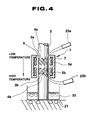
- the torque detecting device 1 shown in Figure 1 to Figure 3 is provided with a measuring shaft 2 at the center thereof.
- a measuring shaft 2 On the surface of said measuring shaft 2, concave parts 3a, 3b and convex parts 4a, 4b making a certain angle with the axial direction of said measuring shaft 2 are formed to be integral with said measuring shaft 2 at appropriate spaces, said shaped-magnetic anisotropy is given by these concave parts 3a, 3b and convex parts 4a, 4b.
- said concave part 3a, convex part 4a on the one side and concave part 3b, convex part 4b on the other side are provided as a pair with an inclination of 45° relative to the axial direction in opposite directions relative to each other.
- the torque detecting device 1 has a pair of coils 5a, 5b disposed in facing relation to the concave part 3a, convex part 4a on the one side and concave part 3b, convex part 4b on the other side which are formed on said measuring shaft 2 as an addition to the said measuring shaft 2, and has the structure providing a cylindrical yoke 7 made from a material with high permeability at the outside of said coils 5a, 5b while leaving a gap 6 between the yoke 7 and the measuring shaft 2.
- the coils 5a and 5b are used for excitation means for forming a magnetic circuit wherein the measuring shaft 2 is a part of said magnetic circuit in common with detection means for detecting a magnetostrictive force passing through said measuring shaft 2.
- the coils 5a and 5b compose the bridge circuit in combination with resistors 11 and 12 as examplified in Figure 2.
- Said bridge circuit is provided with a variable resistance 13 for balancing and the excitative directions are adjusted into the same direciton by connecting an excitative oscillator 14 to connecting points A,C in the bridge circuit.
- a differential amplifier 15 is connected to connecting points B, B′ so as to pick up a detection output from output terminals 16, 17.
- said lines of magnetic force flow in a part of surface of the maesuring shaft 2, in particular in the convex parts 4a, 4b mainly, because the concave parts 3a, 3b are formed on the measuring shaft 2 at a certain angle with the axial direciton of the said measuring shaft 2, they become magnetic reluctance.
- the effect of shaped-magnetic anisotropy caused by said concave parts 3a, 3b and convex paets 4a, 4b is produced.
- the maximum tensile stress - ⁇ acts on it because the convex part 4a on the one side is formed in the direction of 45° to the right side on the contrary, the maximum compressive stress - ⁇ acts on it because the convex part 4b on the other side is formed in the direction of 45° to the left side.
- the permeability of the convex part 4a on the one side increases in comparison with it when the torque is zero.
- the permeability of the convex part 4b on the other side decreases in comparison with it when the torque is zero.
- the torque detecting device 1 having such a structure, because the concave parts 3a, 3b and the convex parts 4a, 4b are formed in a pair with reverse inclination facing the coils 5a and 5b respectively, and the difference of magnetism variation of said concave parts 3a, 3b and convex parts 4a, 4b is detected by means of a bridge circuit, the temperature of the measuring shaft 2 changes uniformly on the whole, the zero point of the output can cease to shift and it is possible to heighten the detecting accuracy of the torque even if the permeability of the measuring shaft 2 is varied on the whole according to the temperature.
- This invention is made in view of the above-mentioned problem of the prior art, it is an object of the present invention to provide a torque detecting device of the magnetostriction type which is able to prevent the occurrence of the serious drift of the detection output even if a temperature gradient is produced in the axial direction of the measuring shaft.
- the construction of the torque detecting device according to this invention for attaining the above-mentioned object is characterized by having a measuring shaft, excitation means for forming a magnetic circuit wherein said measuring shaft is part of said magnetic circuit, and detection means for detecting a magnetostrictive forvce passing through said measuring shaft, wherein said measuring shaft has following electromagnetic characteristics at least in a part in which said magnetostrictive force is detected : specific resistance ⁇ RT of not less than 30 ⁇ -cm at room temperature ; temperature coefficient ⁇ of specific resistance of not more than 0.25 x 10 ⁇ 2 / °C at temperature of -50 to 150°c ; and temperature coefficient ⁇ L of inductance L of not more than 0.07 x 10 ⁇ 2/°C at temperature of -50 to 150°C.
- the torque detecting device has the structure provided with a measuring shaft, excitation means for forming a magnetic circuit wherein said measuring shaft is a part of said magnetic circuit, and detection means for detecting a magnetostrictive force passing through said measuring shaft. It is applicable to the torque detecting device having the same or similar structure of the torque detecting device 1 examplified in Figure 1, it is needless to say that it is not restricted to the torque detecting device 1 having structure shown in Figure 1.
- excitation means and detection means may be constructed from different coils, namely, from the excitation coils and the detection coil respectively in place of forming said excitation and detection means from common coils 5a and 5b.
- the magnetic anisotropy when the magnetic anisotropy is given to the measuring shaft 2, it is not restricted to forming concave parts 3a, 3b and convex parts 4a, 4b as shown in Figure 1, said magnetic anisotropy may be given by sticking the magnetic material on the measuring shaft 2 or by performing surface treatment on the measuring shaft 2.
- the torque detecting device 1 in the torque detecting device 1 according to this invntion, at least a part in which magnetostrictive force is detected of the measuring shaft 2 has electromagnetic characteristics that specific resistance ⁇ RT at room temperature is not less than 30 ⁇ -cm, temperature coefficient ⁇ of specific resistance ⁇ at temperature of -50 to 150°C is not more than 0.25x 10 ⁇ 2 /°C, and temperature coefficient ⁇ L of inductance L at temperature of -50 to 150°C is not more than 0.07 x 10 ⁇ 2/°C.
- the higher specific resistance of said measuring shaft 2 is desirable at least in the part in which the magnetostrictive force is detected.
- the temperature range of said characteristics is defined in a range of -50 to 150°C considering the temperature range in which machinery structure such as a motor vehicle is used generally.
- the measuring shaft 2 in all or at least in the part in which the magnetostrictive force is detected, may be made from a material comprising, by weight percentage of, not more than 1.5% of C, not more than 4.0% of Si, not more than 3,0% of Mn, and one or both of not more than 5.0% of Ni and not more than 5.0% of Cr, and if necessary not more than 3.0% of Al, not more than 5.0% of Co, and if necessary at least one selected from not more than 0.5% of Pb, not more than 0.5% of Bi, not more than 0.5% of S, not more than 0.3% of P, not more than 0.5% of Te, not more than 0.5% of Se and not more than 0.05% of Ca, and if necessary at least one selected from not more than 1.0% of Cu, not more than 1.0% of Mo, not more than 0.05% of B, not more than 0,5% of W, not more than 0.5% of V, not more than 0.5% of Ti, not more than 0.5% of Nb, not more than 0.5%
- C is a necessary element to maintain the strength required in shaft-structural substances of a power transmission system and the like such as a drive shaft, a colum shaft.
- the toughness is rather degraded and plastic workability in cold is adversely affected, so that it is desirable to difine the upper limit of C as 1.5%.
- Si is effective to increase the sensitivity, and to decrease the hysteresis, and so it is desirable to contain not less than 0.5% of Si in case Co not contained.
- the toughness is degraded so that it is preferable to contain not more than 4.0% of Si.
- Mn acts a deoxidizer and a desulfurizing agent at steel making and an effective element for increasing the strength by improving the hardenability of steel. It is desirable to contain not more than 3.0% of Mn because the workability is degraded when contained too much.
- Ni and Cr are effective elements for increasing the strength in concequence of improving the hardenability of the steel and reinforcing the matrix. It is preferable to contain not more than 5.0% of Ni because the hysteresis increases when Ni is contained too much, and preferable to contain not more than 5.0% of Cr because the sensitivity is degraded when Cr is contained too much.
- Al may be contained according to demend in the range of not less than 3.0% because it is effective to increase the sensitivity and to decrease the hysteresis similarly to the case of Si.
- Co may be contained at need in the range of not more than 5.0% because it is effective to increase the sensitivity similarly to the case of Si or Al.
- Pb, Bi, S, P, Te, Se, and Ca are effective to improve the machinability, so that it is preferable to contain at least one of them in the ranges not more than 0.5% of Pb, not more than 0.5% of Bi, not more than 0.5% of S, not more than 0.3% of P, not more than 0.5% of Te, not more than 0.5% of Se, and not more than 0.05% of Ca.
- Cu and Mo may be contained according to demand in the range of not less than 1.0% respectively, because Cu and Mo are effective elements equally for reinforcing the matrix of steel and improving the strength.
- B may be contained in the range of not more than 0.05% in order to improve the hardenability of steel, and at least one of not more than 0.5% of W, not more than 0.5% of V, not more than 0.5% of Ti, not more than 0.5% of Nb, not more than 0.5% of Ta, not more than 0.5% of Zr, not more than 0.5% of Hf and not more than 0.1% of N may be contained in order to improve the strength by grain refining and precipitation hardening .
- the measuring shaft 2 having such chemical compositions, it is desireble according to demand to perform not only ordinary quenching-tepmering but also carburizing, carburizing-tempering, carbonitriding, nitriding, induction hardening-tempering, and it is preferable to keep the amount of C in the carburized layer in the range of more than 0.1% to 1.5% according to demand for example.
- the measuring shaft 2 in all or at least in the part in which the magnetostrictive force is detected, may be made from a material comprising, by weight percentage of, not more than 0.1% of C, not more than 3.0% of Mn, not more than 10% of Si +Al, in the range of 30 to 90% of Ni, not more than 10% of Cu + Cr + Mo + Ti + W + V + Nb + Ta + Zr, with the remainder being substantially Fe and having electromagnetic characteristics that specific resistance ⁇ RT at room temperature is not less than 30 ⁇ -cm, temperature coefficient ⁇ of specific resistance ⁇ at temperature of -50 to 150°C is not more than 0.25 X 10 ⁇ 2/°C, and temperature coefficient ⁇ L of inductance L at temperature of -50 to 150°C is not more than 0.07 X 10 ⁇ 2/°C.
- Ni is effective to improve the magnetic characteristics as a main element of Permalloy, it is preferable to contain in the range of 30 to 90%. And it is also preferable to contain in the range of not more than 10% of Cu + Cr + Mo + Ti +W + V + Nb + Ta + Zr, because these elements are effective to improve the magnetic characteristics and the strength.
- the measuring shaft 2 in all or at least in the part in which the magnetostrictive force is detected, may be also made from a material comprising, by weight percentage of, not more than 0.1% of C, not more than 3.0% of Mn, in the range of 4 to 18% of Si + Al, not more than 10% of Co +Cu + Ni + Cr +Mo + W + V + Nb + Ta + Ti +Zr, with the remainder being substantially Fe and having electromagnetic characteristics that specific resistance ⁇ RT at room temperature is not less than 30 ⁇ -cm, temperature coefficient ⁇ of specific resistance ⁇ at temperature of -50 to 150°C is not more than 0.25 X 10 ⁇ 2 /°C, and temperature coefficient of inductance L at temperature - 50 to 150°C not more than 0.07 X 10 ⁇ 2/°C.
- Co, Cu, Ni, Cr, Mo, W, V, Nb, Ta, Ti and Zr are effective elements for improving the magnetic characteristics and the strength, and so it is also preferable to contain at least one of these elements in the range of not more than 10% in tatal.
- the measuring shaft 2 in all or at least in the part in which the magnetostrictive force is detected, may be made from another material comprising, by weight percentage of, not more than 0.1% of C, not more than 3.0% of Mn, not more than 10% of Ai +Al, in the range of 5 to 35% of Cr, not more than 10% of Co + Cu + Ni + Mo + W + V + Nb + Ta + Ti + Zr, with the remainder being substantially Fe, and having electromagnetic characteristics that specific resistance ⁇ RT at room temperature is not less than 30 ⁇ -cm, temperature coefficient ⁇ of specific resistance ⁇ at temperature of -50 to 150°C is not more than 0.25 X 10 ⁇ 2/°C, and temperature coefficient ⁇ L of inductance L at tepemrature -50 to 150°C is not more than 0.07 X 10 ⁇ 2/°C.
- Fe-Co based or Co-based high-permeability materials having electromagnetic characteristics that specific resistance ⁇ RT at room temperature is not less than 30 ⁇ -cm, temperature coefficient ⁇ of specific resistance ⁇ at temperature of -50 to 150°C is not more than 0.25 X 10 ⁇ 2/°C, and temperature coefficient ⁇ L of inductance L at temperature of -50 to 150 °C is not more than 0.07 X 10 ⁇ 2/°C.
- the measuring shaft at least in the part in which the magnetostrictive force is detected, has electromagnetic characteristics that specific resistance ⁇ RT at room temperature is not less than 30 ⁇ -cm, temperature coefficient ⁇ of specific resistance ⁇ at temperature of -50 to 150°C is not more than 0.25 X 10 ⁇ 2/°C, and temperature coefficient ⁇ L of inductance L at temperature of -50 to 150°C is not more than 0.07 X 10 ⁇ 2/°C. Therefore, it is a remarkably improved torque detecting device in the thermal characteristics.
- the performance characteristics of the torque detecting device never change remarkably and the drift caused by fluctuation of the zero point is never produced even when the temperature gradient is produced in the measuring shaft. Accordingly, the accuracy of the measurement of the torque detecting device is never deteriorated.
- Table 1 Each of steels having a chemical composition as shown in Table 1 was used as a raw material of the measuring shaft 2 of the torque detecting device 1 shown in Figure 1.
- Table 1 No Chemical composition (weight%) C Si Mo Cr Mn Fe 1 0.20 0.11 0.12 0.18 0.19 Bal. 2 0.21 0.26 0.74 2.02 0.20 Bal. 3 0.20 1.02 0.78 2.02 0.20 Bal. 4 0.22 1.01 1.49 3.00 0.21 Bal. 5 0.19 2.02 0.76 3.03 0.20 Bal.
- Test pieces having a height of 3mm, a width of 3mm and a length of 100mm were prepared in order to measure respective specific resistance of the steels having such chemical compositions, and different test pieces having an outer diameter of 30mm, an inner diameter of 25mm and a thickness of 2mm were also prepared in order to measure respective inductance of the steels.
- Each of the test pieces were subjected to a carburizing at 910°C for 2 hours and quenched into oil, then tempered at 170°C for 2hours.
- the measurement of the specific resistance was carried out by the four terminal method, specific resistance ⁇ RT at room temperature was measured, and temperature coefficient ⁇ of the specific resistance per 1°C was obtained by measuring the specific resistance at temperature of -50 to 150°C.
- Figure 5 is a graph examplified the relationship between the drift and specific resistance ⁇ RT at room temperature, it has been found that the drift decreases in proportion to the increase of specific resistance ⁇ RT at room temperature.
- Figure 6 is a graph examplified the relationship between the drift and temperature coefficient ⁇ of the specific resistance, it has been found that the drift decreases in proportion to decrease of temperature coefficcent ⁇ of the specific resistance.
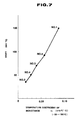
- Figure 7 is a graph examplified the relationship between the drift and temperature coefficient ⁇ L of the inductance, it has been found that the drift decreases in proportion to decrease of temprature coefficient ⁇ L of the inductance.
- Each of steels having a chemical composition as shown in Table 2-1 was used as a raw material of the measuring shaft 2 of the torque detecting device 1 shown in Figure 1.
- Said measuring shaft 2 of 20mm in diameter having concave parts 3a, 3b and convex parts 4a, 4b of 2mm in width and 1mm of difference in level was subjected to heat treatment shown also in Table 2-2 respectively.
- the measuring values also shown in Table 2-2 were obtained as a result of measuring specific resistance ⁇ RT at room temperature, temperature coefficient ⁇ of the specific resistance and temperature coefficient ⁇ L of the inductance of the respective measuring shaft 2 in the same procedures as that of the case of EXAMPLE 1.
- the torque detecting device has a measuring shaft, excitation means for forming a magnetic circuit wherien said measuring shaft is a part of said magnetic circuit, and detection means for detecting a magnetostrictive force passing through said measuring shaft, wherein said measuring shaft has following electromagnetic characteristics at least in a part in which said magnetostrictive force is detected : specific resistance ⁇ RT of not less than 30 ⁇ -cm at room temperature, tempeature coefficient ⁇ of specific resistance ⁇ of not more than 0.25 X 10 ⁇ 2/°C at temperature of -50 to 150°C, and temperature coefficient ⁇ L of inductance L of not more than 0.07 X 10 ⁇ 2/ °C at temperature of -50 to 150°C. Therefore, the serious drift in the detection output does not occur even when the temperature gradient is produced in the axial direction of the measuring shaft. And very excellent effects are obtained since it is possible to measure the torque with accuracy more than ever.
Landscapes
- Physics & Mathematics (AREA)
- General Physics & Mathematics (AREA)
- Condensed Matter Physics & Semiconductors (AREA)
- Power Steering Mechanism (AREA)
- Measuring Magnetic Variables (AREA)
- Heat Treatment Of Articles (AREA)
Applications Claiming Priority (2)
| Application Number | Priority Date | Filing Date | Title |
|---|---|---|---|
| JP278981/88 | 1988-11-04 | ||
| JP63278981A JP2598493B2 (ja) | 1988-11-04 | 1988-11-04 | トルクセンサ |
Publications (2)
| Publication Number | Publication Date |
|---|---|
| EP0367595A1 true EP0367595A1 (de) | 1990-05-09 |
| EP0367595B1 EP0367595B1 (de) | 1997-04-16 |
Family
ID=17604762
Family Applications (1)
| Application Number | Title | Priority Date | Filing Date |
|---|---|---|---|
| EP89311321A Expired - Lifetime EP0367595B1 (de) | 1988-11-04 | 1989-11-01 | Drehmomentnachweisvorrichtung |
Country Status (4)
| Country | Link |
|---|---|
| US (1) | US4991447A (de) |
| EP (1) | EP0367595B1 (de) |
| JP (1) | JP2598493B2 (de) |
| DE (1) | DE68927973T2 (de) |
Cited By (1)
| Publication number | Priority date | Publication date | Assignee | Title |
|---|---|---|---|---|
| DE9309216U1 (de) * | 1993-06-21 | 1994-11-03 | Burandt, Dieter, 27580 Bremerhaven | Anordnung zur Erzeugung eines magnetischen Wechselfeldes |
Families Citing this family (21)
| Publication number | Priority date | Publication date | Assignee | Title |
|---|---|---|---|---|
| SE9102122D0 (sv) * | 1991-07-08 | 1991-07-08 | Skf Nova Ab | Sensor respektive foerfarande foer maetning av vridmoment och/eller krafter |
| DE4238863C2 (de) * | 1992-01-30 | 1994-09-29 | Daimler Benz Ag | Vorrichtung zur Messung mechanischer Spannungszustände in Bauteilen |
| US5585574A (en) * | 1993-02-02 | 1996-12-17 | Mitsubishi Materials Corporation | Shaft having a magnetostrictive torque sensor and a method for making same |
| US5412999A (en) * | 1993-02-26 | 1995-05-09 | Sensorteck L.P. | Position sensing with magnetostrictive stress sensor |
| JPH09145496A (ja) * | 1995-11-27 | 1997-06-06 | Toyota Autom Loom Works Ltd | 磁歪式トルクセンサ |
| US7409878B2 (en) * | 2005-04-08 | 2008-08-12 | Honeywell International Inc. | Torqueshaft magnetic field measurement systems for gas turbine engines |
| US9817078B2 (en) | 2012-05-10 | 2017-11-14 | Allegro Microsystems Llc | Methods and apparatus for magnetic sensor having integrated coil |
| US10145908B2 (en) | 2013-07-19 | 2018-12-04 | Allegro Microsystems, Llc | Method and apparatus for magnetic sensor producing a changing magnetic field |
| US10495699B2 (en) | 2013-07-19 | 2019-12-03 | Allegro Microsystems, Llc | Methods and apparatus for magnetic sensor having an integrated coil or magnet to detect a non-ferromagnetic target |
| US9823092B2 (en) | 2014-10-31 | 2017-11-21 | Allegro Microsystems, Llc | Magnetic field sensor providing a movement detector |
| US10641842B2 (en) * | 2017-05-26 | 2020-05-05 | Allegro Microsystems, Llc | Targets for coil actuated position sensors |
| US11428755B2 (en) | 2017-05-26 | 2022-08-30 | Allegro Microsystems, Llc | Coil actuated sensor with sensitivity detection |
| US10837943B2 (en) | 2017-05-26 | 2020-11-17 | Allegro Microsystems, Llc | Magnetic field sensor with error calculation |
| US10996289B2 (en) * | 2017-05-26 | 2021-05-04 | Allegro Microsystems, Llc | Coil actuated position sensor with reflected magnetic field |
| US10823586B2 (en) | 2018-12-26 | 2020-11-03 | Allegro Microsystems, Llc | Magnetic field sensor having unequally spaced magnetic field sensing elements |
| US11280637B2 (en) | 2019-11-14 | 2022-03-22 | Allegro Microsystems, Llc | High performance magnetic angle sensor |
| US11237020B2 (en) | 2019-11-14 | 2022-02-01 | Allegro Microsystems, Llc | Magnetic field sensor having two rows of magnetic field sensing elements for measuring an angle of rotation of a magnet |
| US11262422B2 (en) | 2020-05-08 | 2022-03-01 | Allegro Microsystems, Llc | Stray-field-immune coil-activated position sensor |
| US11493361B2 (en) | 2021-02-26 | 2022-11-08 | Allegro Microsystems, Llc | Stray field immune coil-activated sensor |
| US11578997B1 (en) | 2021-08-24 | 2023-02-14 | Allegro Microsystems, Llc | Angle sensor using eddy currents |
| US12523717B2 (en) | 2024-02-15 | 2026-01-13 | Allegro Microsystems, Llc | Closed loop magnetic field sensor with current control |
Citations (2)
| Publication number | Priority date | Publication date | Assignee | Title |
|---|---|---|---|---|
| US3861206A (en) * | 1972-04-03 | 1975-01-21 | Hitachi Ltd | Method and device for measuring a stress employing magnetostriction |
| EP0338227A2 (de) * | 1988-03-04 | 1989-10-25 | Nissan Motor Co., Ltd. | Magnetostriktiver Drehmomentwandler |
Family Cites Families (2)
| Publication number | Priority date | Publication date | Assignee | Title |
|---|---|---|---|---|
| JPS59181575A (ja) * | 1983-03-31 | 1984-10-16 | Toshiba Corp | トルクセンサ |
| JPS6420678A (en) * | 1987-07-16 | 1989-01-24 | Matsushita Electric Industrial Co Ltd | Torque sensor |
-
1988
- 1988-11-04 JP JP63278981A patent/JP2598493B2/ja not_active Expired - Fee Related
-
1989
- 1989-11-01 DE DE68927973T patent/DE68927973T2/de not_active Expired - Fee Related
- 1989-11-01 EP EP89311321A patent/EP0367595B1/de not_active Expired - Lifetime
- 1989-11-02 US US07/430,406 patent/US4991447A/en not_active Expired - Lifetime
Patent Citations (2)
| Publication number | Priority date | Publication date | Assignee | Title |
|---|---|---|---|---|
| US3861206A (en) * | 1972-04-03 | 1975-01-21 | Hitachi Ltd | Method and device for measuring a stress employing magnetostriction |
| EP0338227A2 (de) * | 1988-03-04 | 1989-10-25 | Nissan Motor Co., Ltd. | Magnetostriktiver Drehmomentwandler |
Cited By (1)
| Publication number | Priority date | Publication date | Assignee | Title |
|---|---|---|---|---|
| DE9309216U1 (de) * | 1993-06-21 | 1994-11-03 | Burandt, Dieter, 27580 Bremerhaven | Anordnung zur Erzeugung eines magnetischen Wechselfeldes |
Also Published As
| Publication number | Publication date |
|---|---|
| EP0367595B1 (de) | 1997-04-16 |
| US4991447A (en) | 1991-02-12 |
| DE68927973D1 (de) | 1997-05-22 |
| JP2598493B2 (ja) | 1997-04-09 |
| JPH02126174A (ja) | 1990-05-15 |
| DE68927973T2 (de) | 1997-09-11 |
Similar Documents
| Publication | Publication Date | Title |
|---|---|---|
| EP0367595A1 (de) | Drehmomentnachweisvorrichtung | |
| US4840073A (en) | Torque detecting device | |
| EP1211331B1 (de) | Weichmagnetischer Werkstoff aus Fe-Cr-Legierung und Verfahren zu dessen Herstellung | |
| US5107711A (en) | Torque sensor | |
| JP2002294408A (ja) | 鉄系制振合金およびその製造方法 | |
| JP2697846B2 (ja) | トルクセンサ | |
| JP2865279B2 (ja) | トルクセンサ | |
| JP2615661B2 (ja) | トルクセンサ | |
| JP2592491B2 (ja) | トルクセンサ用被測定軸の熱処理方法 | |
| JPH0543991A (ja) | 磁気目盛り鋼棒 | |
| JP2002340701A (ja) | 磁歪式トルクセンサ軸の製造方法 | |
| JPH0758810B2 (ja) | トルクセンサ | |
| JP3521010B2 (ja) | 磁歪式歪センサ | |
| CA1075048A (en) | Low permeability, nonmagnetic alloy steel | |
| JPH01225182A (ja) | トルクセンサ | |
| JP2697842B2 (ja) | トルクセンサ | |
| JPH0913148A (ja) | オーステナイト系析出硬化型非磁性鋼 | |
| JPH09263907A (ja) | トルク・センサ用軟質磁性高強度材料 | |
| JPH0841604A (ja) | 高感度、耐蝕性トルクセンサ検出軸材 | |
| JPH09165656A (ja) | トルク・センサ用高センサ出力、高強度材料 | |
| JPH05271768A (ja) | 非磁性ステンレス鋼厚板の製造方法 | |
| JPH01225181A (ja) | トルクセンサ | |
| JPH11183278A (ja) | トルクセンサ用高感度磁歪材料,並びにセンサシャフト及びその製造方法 | |
| JPH1143743A (ja) | 機械加工性および転動疲労寿命特性に優れた析出硬化型非磁性鋼 | |
| JPH1143742A (ja) | 機械加工性および転動疲労寿命特性に優れた析出硬化型非磁性鋼 |
Legal Events
| Date | Code | Title | Description |
|---|---|---|---|
| PUAI | Public reference made under article 153(3) epc to a published international application that has entered the european phase |
Free format text: ORIGINAL CODE: 0009012 |
|
| AK | Designated contracting states |
Kind code of ref document: A1 Designated state(s): DE GB |
|
| 17P | Request for examination filed |
Effective date: 19901022 |
|
| 17Q | First examination report despatched |
Effective date: 19920805 |
|
| APAB | Appeal dossier modified |
Free format text: ORIGINAL CODE: EPIDOS NOAPE |
|
| APAB | Appeal dossier modified |
Free format text: ORIGINAL CODE: EPIDOS NOAPE |
|
| GRAG | Despatch of communication of intention to grant |
Free format text: ORIGINAL CODE: EPIDOS AGRA |
|
| GRAH | Despatch of communication of intention to grant a patent |
Free format text: ORIGINAL CODE: EPIDOS IGRA |
|
| GRAH | Despatch of communication of intention to grant a patent |
Free format text: ORIGINAL CODE: EPIDOS IGRA |
|
| GRAA | (expected) grant |
Free format text: ORIGINAL CODE: 0009210 |
|
| AK | Designated contracting states |
Kind code of ref document: B1 Designated state(s): DE GB |
|
| REF | Corresponds to: |
Ref document number: 68927973 Country of ref document: DE Date of ref document: 19970522 |
|
| PLBE | No opposition filed within time limit |
Free format text: ORIGINAL CODE: 0009261 |
|
| STAA | Information on the status of an ep patent application or granted ep patent |
Free format text: STATUS: NO OPPOSITION FILED WITHIN TIME LIMIT |
|
| 26N | No opposition filed | ||
| APAC | Appeal dossier modified |
Free format text: ORIGINAL CODE: EPIDOS NOAPO |
|
| REG | Reference to a national code |
Ref country code: GB Ref legal event code: IF02 |
|
| PGFP | Annual fee paid to national office [announced via postgrant information from national office to epo] |
Ref country code: GB Payment date: 20031029 Year of fee payment: 15 |
|
| PGFP | Annual fee paid to national office [announced via postgrant information from national office to epo] |
Ref country code: DE Payment date: 20031113 Year of fee payment: 15 |
|
| PG25 | Lapsed in a contracting state [announced via postgrant information from national office to epo] |
Ref country code: GB Free format text: LAPSE BECAUSE OF NON-PAYMENT OF DUE FEES Effective date: 20041101 |
|
| PG25 | Lapsed in a contracting state [announced via postgrant information from national office to epo] |
Ref country code: DE Free format text: LAPSE BECAUSE OF NON-PAYMENT OF DUE FEES Effective date: 20050601 |
|
| GBPC | Gb: european patent ceased through non-payment of renewal fee |
Effective date: 20041101 |
|
| APAH | Appeal reference modified |
Free format text: ORIGINAL CODE: EPIDOSCREFNO |