EP0367776B1 - Pierre artificielle - Google Patents
Pierre artificielle Download PDFInfo
- Publication number
- EP0367776B1 EP0367776B1 EP88905550A EP88905550A EP0367776B1 EP 0367776 B1 EP0367776 B1 EP 0367776B1 EP 88905550 A EP88905550 A EP 88905550A EP 88905550 A EP88905550 A EP 88905550A EP 0367776 B1 EP0367776 B1 EP 0367776B1
- Authority
- EP
- European Patent Office
- Prior art keywords
- globules
- layer
- stone
- resin
- simulated
- Prior art date
- Legal status (The legal status is an assumption and is not a legal conclusion. Google has not performed a legal analysis and makes no representation as to the accuracy of the status listed.)
- Expired - Lifetime
Links
- 239000004575 stone Substances 0.000 title claims abstract description 39
- 229920005989 resin Polymers 0.000 claims abstract description 43
- 239000011347 resin Substances 0.000 claims abstract description 43
- 239000011342 resin composition Substances 0.000 claims abstract description 43
- 239000007788 liquid Substances 0.000 claims abstract description 33
- 239000000945 filler Substances 0.000 claims abstract description 18
- 239000011343 solid material Substances 0.000 claims description 18
- 238000000034 method Methods 0.000 claims description 16
- 239000003086 colorant Substances 0.000 claims description 12
- 239000006185 dispersion Substances 0.000 claims description 10
- 239000002245 particle Substances 0.000 claims description 10
- 238000004519 manufacturing process Methods 0.000 claims description 4
- 239000000654 additive Substances 0.000 abstract description 4
- 239000000203 mixture Substances 0.000 description 15
- 239000000047 product Substances 0.000 description 13
- VYPSYNLAJGMNEJ-UHFFFAOYSA-N Silicium dioxide Chemical compound O=[Si]=O VYPSYNLAJGMNEJ-UHFFFAOYSA-N 0.000 description 11
- 239000000049 pigment Substances 0.000 description 9
- 229920004552 POLYLITE® Polymers 0.000 description 8
- OMPJBNCRMGITSC-UHFFFAOYSA-N Benzoylperoxide Chemical group C=1C=CC=CC=1C(=O)OOC(=O)C1=CC=CC=C1 OMPJBNCRMGITSC-UHFFFAOYSA-N 0.000 description 6
- 239000003054 catalyst Substances 0.000 description 5
- 239000000463 material Substances 0.000 description 5
- 229920000728 polyester Polymers 0.000 description 5
- 229920001225 polyester resin Polymers 0.000 description 5
- 239000004645 polyester resin Substances 0.000 description 5
- -1 Methyl Ethyl Chemical group 0.000 description 4
- PPBRXRYQALVLMV-UHFFFAOYSA-N Styrene Chemical compound C=CC1=CC=CC=C1 PPBRXRYQALVLMV-UHFFFAOYSA-N 0.000 description 4
- 229910021485 fumed silica Inorganic materials 0.000 description 4
- 150000002978 peroxides Chemical class 0.000 description 4
- 239000000126 substance Substances 0.000 description 4
- 239000012467 final product Substances 0.000 description 3
- 239000010453 quartz Substances 0.000 description 3
- PNEYBMLMFCGWSK-UHFFFAOYSA-N aluminium oxide Inorganic materials [O-2].[O-2].[O-2].[Al+3].[Al+3] PNEYBMLMFCGWSK-UHFFFAOYSA-N 0.000 description 2
- 230000015572 biosynthetic process Effects 0.000 description 2
- 150000001875 compounds Chemical class 0.000 description 2
- 230000006835 compression Effects 0.000 description 2
- 238000007906 compression Methods 0.000 description 2
- 239000000843 powder Substances 0.000 description 2
- 239000007921 spray Substances 0.000 description 2
- 229920003002 synthetic resin Polymers 0.000 description 2
- 239000000057 synthetic resin Substances 0.000 description 2
- 150000004684 trihydrates Chemical class 0.000 description 2
- 239000004342 Benzoyl peroxide Substances 0.000 description 1
- 239000004593 Epoxy Substances 0.000 description 1
- JOYRKODLDBILNP-UHFFFAOYSA-N Ethyl urethane Chemical compound CCOC(N)=O JOYRKODLDBILNP-UHFFFAOYSA-N 0.000 description 1
- 239000005909 Kieselgur Substances 0.000 description 1
- 235000019738 Limestone Nutrition 0.000 description 1
- 241000872198 Serjania polyphylla Species 0.000 description 1
- YKTSYUJCYHOUJP-UHFFFAOYSA-N [O--].[Al+3].[Al+3].[O-][Si]([O-])([O-])[O-] Chemical compound [O--].[Al+3].[Al+3].[O-][Si]([O-])([O-])[O-] YKTSYUJCYHOUJP-UHFFFAOYSA-N 0.000 description 1
- 239000002253 acid Substances 0.000 description 1
- 150000007513 acids Chemical class 0.000 description 1
- CEGOLXSVJUTHNZ-UHFFFAOYSA-K aluminium tristearate Chemical compound [Al+3].CCCCCCCCCCCCCCCCCC([O-])=O.CCCCCCCCCCCCCCCCCC([O-])=O.CCCCCCCCCCCCCCCCCC([O-])=O CEGOLXSVJUTHNZ-UHFFFAOYSA-K 0.000 description 1
- 229940063655 aluminum stearate Drugs 0.000 description 1
- 235000019400 benzoyl peroxide Nutrition 0.000 description 1
- 238000009835 boiling Methods 0.000 description 1
- 229910021538 borax Inorganic materials 0.000 description 1
- 230000001680 brushing effect Effects 0.000 description 1
- 239000000378 calcium silicate Substances 0.000 description 1
- 229910052918 calcium silicate Inorganic materials 0.000 description 1
- OYACROKNLOSFPA-UHFFFAOYSA-N calcium;dioxido(oxo)silane Chemical compound [Ca+2].[O-][Si]([O-])=O OYACROKNLOSFPA-UHFFFAOYSA-N 0.000 description 1
- 238000005266 casting Methods 0.000 description 1
- 239000002734 clay mineral Substances 0.000 description 1
- 239000011248 coating agent Substances 0.000 description 1
- 238000000576 coating method Methods 0.000 description 1
- 239000000428 dust Substances 0.000 description 1
- 230000009970 fire resistant effect Effects 0.000 description 1
- 239000011953 free-radical catalyst Substances 0.000 description 1
- 239000011521 glass Substances 0.000 description 1
- 239000010438 granite Substances 0.000 description 1
- 230000005484 gravity Effects 0.000 description 1
- 239000010440 gypsum Substances 0.000 description 1
- 229910052602 gypsum Inorganic materials 0.000 description 1
- 229910052900 illite Inorganic materials 0.000 description 1
- NLYAJNPCOHFWQQ-UHFFFAOYSA-N kaolin Chemical compound O.O.O=[Al]O[Si](=O)O[Si](=O)O[Al]=O NLYAJNPCOHFWQQ-UHFFFAOYSA-N 0.000 description 1
- 239000006028 limestone Substances 0.000 description 1
- 229910001552 magnesium chloroborate Inorganic materials 0.000 description 1
- 239000004579 marble Substances 0.000 description 1
- 238000012986 modification Methods 0.000 description 1
- 230000004048 modification Effects 0.000 description 1
- 238000000465 moulding Methods 0.000 description 1
- VGIBGUSAECPPNB-UHFFFAOYSA-L nonaaluminum;magnesium;tripotassium;1,3-dioxido-2,4,5-trioxa-1,3-disilabicyclo[1.1.1]pentane;iron(2+);oxygen(2-);fluoride;hydroxide Chemical compound [OH-].[O-2].[O-2].[O-2].[O-2].[O-2].[F-].[Mg+2].[Al+3].[Al+3].[Al+3].[Al+3].[Al+3].[Al+3].[Al+3].[Al+3].[Al+3].[K+].[K+].[K+].[Fe+2].O1[Si]2([O-])O[Si]1([O-])O2.O1[Si]2([O-])O[Si]1([O-])O2.O1[Si]2([O-])O[Si]1([O-])O2.O1[Si]2([O-])O[Si]1([O-])O2.O1[Si]2([O-])O[Si]1([O-])O2.O1[Si]2([O-])O[Si]1([O-])O2.O1[Si]2([O-])O[Si]1([O-])O2 VGIBGUSAECPPNB-UHFFFAOYSA-L 0.000 description 1
- 239000001301 oxygen Substances 0.000 description 1
- 229910052760 oxygen Inorganic materials 0.000 description 1
- 239000002685 polymerization catalyst Substances 0.000 description 1
- 238000005057 refrigeration Methods 0.000 description 1
- 238000005096 rolling process Methods 0.000 description 1
- 239000004576 sand Substances 0.000 description 1
- 239000000377 silicon dioxide Substances 0.000 description 1
- 239000004328 sodium tetraborate Substances 0.000 description 1
- 235000010339 sodium tetraborate Nutrition 0.000 description 1
- 238000003756 stirring Methods 0.000 description 1
- 150000005846 sugar alcohols Polymers 0.000 description 1
- 239000000454 talc Substances 0.000 description 1
- 229910052623 talc Inorganic materials 0.000 description 1
- CIHOLLKRGTVIJN-UHFFFAOYSA-N tert‐butyl hydroperoxide Chemical compound CC(C)(C)OO CIHOLLKRGTVIJN-UHFFFAOYSA-N 0.000 description 1
- 230000009974 thixotropic effect Effects 0.000 description 1
- 229920006305 unsaturated polyester Polymers 0.000 description 1
- 229920006337 unsaturated polyester resin Polymers 0.000 description 1
Images

Classifications
-
- B—PERFORMING OPERATIONS; TRANSPORTING
- B44—DECORATIVE ARTS
- B44F—SPECIAL DESIGNS OR PICTURES
- B44F9/00—Designs imitating natural patterns
- B44F9/04—Designs imitating natural patterns of stone surfaces, e.g. marble
-
- B—PERFORMING OPERATIONS; TRANSPORTING
- B29—WORKING OF PLASTICS; WORKING OF SUBSTANCES IN A PLASTIC STATE IN GENERAL
- B29C—SHAPING OR JOINING OF PLASTICS; SHAPING OF MATERIAL IN A PLASTIC STATE, NOT OTHERWISE PROVIDED FOR; AFTER-TREATMENT OF THE SHAPED PRODUCTS, e.g. REPAIRING
- B29C43/00—Compression moulding, i.e. applying external pressure to flow the moulding material; Apparatus therefor
- B29C43/02—Compression moulding, i.e. applying external pressure to flow the moulding material; Apparatus therefor of articles of definite length, i.e. discrete articles
-
- B—PERFORMING OPERATIONS; TRANSPORTING
- B29—WORKING OF PLASTICS; WORKING OF SUBSTANCES IN A PLASTIC STATE IN GENERAL
- B29C—SHAPING OR JOINING OF PLASTICS; SHAPING OF MATERIAL IN A PLASTIC STATE, NOT OTHERWISE PROVIDED FOR; AFTER-TREATMENT OF THE SHAPED PRODUCTS, e.g. REPAIRING
- B29C70/00—Shaping composites, i.e. plastics material comprising reinforcements, fillers or preformed parts, e.g. inserts
- B29C70/58—Shaping composites, i.e. plastics material comprising reinforcements, fillers or preformed parts, e.g. inserts comprising fillers only, e.g. particles, powder, beads, flakes, spheres
- B29C70/64—Shaping composites, i.e. plastics material comprising reinforcements, fillers or preformed parts, e.g. inserts comprising fillers only, e.g. particles, powder, beads, flakes, spheres the filler influencing the surface characteristics of the material, e.g. by concentrating near the surface or by incorporating in the surface by force
-
- B—PERFORMING OPERATIONS; TRANSPORTING
- B29—WORKING OF PLASTICS; WORKING OF SUBSTANCES IN A PLASTIC STATE IN GENERAL
- B29K—INDEXING SCHEME ASSOCIATED WITH SUBCLASSES B29B, B29C OR B29D, RELATING TO MOULDING MATERIALS OR TO MATERIALS FOR MOULDS, REINFORCEMENTS, FILLERS OR PREFORMED PARTS, e.g. INSERTS
- B29K2105/00—Condition, form or state of moulded material or of the material to be shaped
- B29K2105/06—Condition, form or state of moulded material or of the material to be shaped containing reinforcements, fillers or inserts
- B29K2105/16—Fillers
-
- B—PERFORMING OPERATIONS; TRANSPORTING
- B29—WORKING OF PLASTICS; WORKING OF SUBSTANCES IN A PLASTIC STATE IN GENERAL
- B29K—INDEXING SCHEME ASSOCIATED WITH SUBCLASSES B29B, B29C OR B29D, RELATING TO MOULDING MATERIALS OR TO MATERIALS FOR MOULDS, REINFORCEMENTS, FILLERS OR PREFORMED PARTS, e.g. INSERTS
- B29K2995/00—Properties of moulding materials, reinforcements, fillers, preformed parts or moulds
- B29K2995/0018—Properties of moulding materials, reinforcements, fillers, preformed parts or moulds having particular optical properties, e.g. fluorescent or phosphorescent
- B29K2995/002—Coloured
- B29K2995/0021—Multi-coloured
-
- Y—GENERAL TAGGING OF NEW TECHNOLOGICAL DEVELOPMENTS; GENERAL TAGGING OF CROSS-SECTIONAL TECHNOLOGIES SPANNING OVER SEVERAL SECTIONS OF THE IPC; TECHNICAL SUBJECTS COVERED BY FORMER USPC CROSS-REFERENCE ART COLLECTIONS [XRACs] AND DIGESTS
- Y10—TECHNICAL SUBJECTS COVERED BY FORMER USPC
- Y10T—TECHNICAL SUBJECTS COVERED BY FORMER US CLASSIFICATION
- Y10T428/00—Stock material or miscellaneous articles
- Y10T428/24—Structurally defined web or sheet [e.g., overall dimension, etc.]
- Y10T428/24355—Continuous and nonuniform or irregular surface on layer or component [e.g., roofing, etc.]
- Y10T428/24372—Particulate matter
- Y10T428/24405—Polymer or resin [e.g., natural or synthetic rubber, etc.]
-
- Y—GENERAL TAGGING OF NEW TECHNOLOGICAL DEVELOPMENTS; GENERAL TAGGING OF CROSS-SECTIONAL TECHNOLOGIES SPANNING OVER SEVERAL SECTIONS OF THE IPC; TECHNICAL SUBJECTS COVERED BY FORMER USPC CROSS-REFERENCE ART COLLECTIONS [XRACs] AND DIGESTS
- Y10—TECHNICAL SUBJECTS COVERED BY FORMER USPC
- Y10T—TECHNICAL SUBJECTS COVERED BY FORMER US CLASSIFICATION
- Y10T428/00—Stock material or miscellaneous articles
- Y10T428/25—Web or sheet containing structurally defined element or component and including a second component containing structurally defined particles
- Y10T428/254—Polymeric or resinous material
-
- Y—GENERAL TAGGING OF NEW TECHNOLOGICAL DEVELOPMENTS; GENERAL TAGGING OF CROSS-SECTIONAL TECHNOLOGIES SPANNING OVER SEVERAL SECTIONS OF THE IPC; TECHNICAL SUBJECTS COVERED BY FORMER USPC CROSS-REFERENCE ART COLLECTIONS [XRACs] AND DIGESTS
- Y10—TECHNICAL SUBJECTS COVERED BY FORMER USPC
- Y10T—TECHNICAL SUBJECTS COVERED BY FORMER US CLASSIFICATION
- Y10T428/00—Stock material or miscellaneous articles
- Y10T428/29—Coated or structually defined flake, particle, cell, strand, strand portion, rod, filament, macroscopic fiber or mass thereof
- Y10T428/2982—Particulate matter [e.g., sphere, flake, etc.]
- Y10T428/2991—Coated
- Y10T428/2998—Coated including synthetic resin or polymer
Definitions
- the present invention relates to a cast simulated-stone and methods of making such simulated stone.
- Simulated-stone products are well-known and are in great demand due to their low cost relative to natural stone. Simulated stone is useful in the production of walls, floors, fireplaces, table and countertops, tiles, and an assortment of other products. Typically, this simulated stone is prepared by casting or molding a curable synthetic resin composition which may contain natural stone additives such as stone chips.
- a method of making a cast simulated stone is known from US-A-3097080 which comprises combining particles with a first liquid resin and allowing the combination to cure.
- a method of making a cast simulated-stone as defined with reference to US-A-3097080, characterised by forming the particles as separable, discrete globules of a catalyzed, uncured resin and compressing said combination until said globules flatten.
- the present invention provides a novel simulated-stone that is easy and inexpensive to make.
- the invention avoids the use and associated expense of natural stone additives.
- the cured product more closely resembles natural stone than any prior art product known to the inventor.
- the globules may be formed by mixing an excess of a filler with a catalyzed liquid resin composition, the filler being added in an amount sufficient to cause the liquid to break apart into discrete, separable globules.
- a colorant may be added to the resin composition so that the globules are colored.
- the simulated-stone may be formed by applying a first layer of a clear liquid resin composition to a mold and allowing this first layer to cure.
- a second layer of a clear liquid resin can be applied to this first layer.
- the globules may then be dispersed into this second layer.
- a flat surface of a solid material may be applied under pressure to the exposed surface of the globules to compress and flatten the globules.
- the resin and globules then are allowed to cure.
- a third layer of resin, preferably containing a colorant may be applied to cover the globules. In this instance, the flat surface is applied to the third or topmost layer of resin to compress and flatten the globules.
- the resins and flattened globules are then allowed to cure.
- the flat surface may be capable of bonding to the curing resin or may be nonstick such that it may be removed from contact with the resin after the resin cures.
- the solid material becomes a backing or support layer for the cured simulated-stone.
- a product for use in making a cast simulated-stone comprising globules of over-filled, catalyzed, uncured resin composition.
- a cast simulated-stone containing globules or discrete portions of cured resin composition is known from FR-A-2227107.
- a cast simulated stone as defined with reference to FR-A-2227107, wherein the globules or discrete portions are overfilled.
- the globules or portions are dispersed in a first layer of a cured liquid resin.
- the cast simulated-stone may further comprise a second layer of cured liquid resin bonded to the first layer.
- the globules or portions may contain a colorant and may be substantially in the shape of a disk.
- the invention requires the formation of discrete globules of overfilled, catalyzed, uncured resin composition.
- the globules are formed by mixing an excess of a filler with a catalyzed liquid resin composition.
- the filler is added in an amount sufficient to cause the liquid to break apart into discrete, separable globules of a desirable size that do not stick together.
- the globules will feel like a mixture of sand and pebbles.
- the curable resin composition useful for carrying out this invention may have as a component a polyester, epoxy, urethane or cementitious base.
- Virtually any curable synthetic resinous liquid coating material may be used.
- Preferred resin bases are the polymerizable unsaturated polyesters such as those prepared from ethylenically-unsaturated polycarboxylic acids and polyhydric alcohols.
- the resin compositions also may contain a copolymerizable ethylenically unsaturated compound such as styrene.
- the primary component of the curable synthetic resin composition is PolyLite Resin 33-031 sold by Reichhold Chemicals, Inc. of Elizabeth, New Jersey.
- Fillers useful in forming the globules may be any one of the fillers well known to those skilled in the art including powdered talc, powdered quartz, fine silica, diatomaceous earth, gypsum, powdered glass, clay minerals such as china clay (KALON), illite, powdered chalk, powdered marble, powdered limestone, aluminum silicate, aluminum stearate, calcium silicate, boracite, borax, and alumina trihydrate.
- the latter, alumina trihydrate is especially effective in improving the fire resistant properties of the final product and is the preferred filler.
- the filler can contribute to the color, transparency, and surface properties of the cured composition. Therefore, it is appropriate to use different fillers when simulating different stones.
- the filler is finely divided, resembling fine dust or powder in consistency.
- the filler is CAB-O-SIL® M-5 Fumed Silica, an amorphous fumed silica having a specific surface area of 200, plus or minus 25, square meters/gram as determined by B.E.T. method. It is sold by Cabot Corporation of Tuscola, Illinois.
- a catalyst first is added to a liquid resin composition.
- a colorant also may be added as desired.
- filler is added to the colored, catalyzed liquid resin composition while mixing until the liquid breaks apart into discrete, separable globules of resin that do not stick together.
- the globules also may be stored under refrigeration to prevent curing of the globules and then may be used at a later time.
- the colorant may be a color pigment, and preferably is an inert, inorganic, finely-divided substance applied either as a dry powder or in paste form. Such color pigments are commonly known and readily available. Most preferably the color pigment is a selected polyester-dispersed pigment, available from American Colors of Sandusky, Ohio.
- the catalyst may be any of the polymerization catalysts or mixtures thereof well recognized in the art. Typically these are free radical catalysts based on a peroxide-type compound such as for example methyl ethyl keytone peroxide, benzoyl peroxide, tertiary butyl hydroperoxide and the like. Typically the catalyst is added in amounts ranging from about .1 to 6% by weight of the polyester resin.
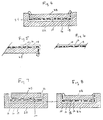
- a first layer 10 of a clear, catalyzed, liquid resin composition is applied to a mold base 12 using a spray gun 14 (FIG. 1).
- the first layer 10 of liquid resin composition may be applied to the mold base 12 by other suitable methods such as brushing or rolling.
- the first layer 10 of liquid resin composition is applied in a thickness of about 0.508 mm (.020"). This first layer is allowed to cure.
- a second layer 16 of a clear, catalyzed liquid resin composition is applied to the cured first layer 10.
- globules 18 prepared as described above are dispersed by sprinkling them into the surface of the second layer 16 (FIG. 2).
- the globules 18 may be prescreened or sifted to eliminate any globules that are undesirably large or small. It should be noted that the globules may be applied by suitable methods other than sprinkling such as with a pneumatic spray device. The size of the globules and their density, of course, will affect the appearance of the final product.
- FIG. 3 shows in cross section the two layers 10, 16 of resin composition overlayed with the dispersion of globules 18 in a mold 20.
- the mold has a base 22 and perimeter walls 24.
- the solid material 28 is sized such that it fits within the perimeter walls 24 leaving a space between the periphery of the solid material 28 and the perimeter walls 24.
- the inner surface of the mold 20 contacting the resin composition is nonstick such that when the resin cures, the product is easily removed from the mold.
- the solid material 28 is forced toward the base 22 of the mold 20 to compress and flatten the globules 18 (FIG. 4). Excess resin composition is squeezed through the space between the periphery of the solid material 28 and the perimeter walls 24 as the globules are flattened. Typically, the globules are larger in diameter than the thickness of the second layer 16 to minimize the amount of excess resin that must be squeezed through the space between the solid material 28 and the perimeter walls 24 and to provide for the flattening of the globules 18. The compressed composition then is allowed to cure and the cured product 30 is removed from the mold.
- the surface 26 of the solid material 28 is capable of binding to the resin as the resin cures, then the cured product 30 will be attached to the solid material 28 which solid material 28 will act as a supporting base for the simulated-stone cured product 30 (FIG. 5). This is particularly desirable when the final product is intended to be a countertop, desk top or the like.
- the solid material 28 and mold 20 may be sized such that sidewalls 32 are formed along with the formation of a flat top surface 34. It should be understood further that simulated-stone products having various shapes including curved surfaces may be formed with appropriate molds according to the invention.
- FIGS. 7 and 8 show an alternative embodiment of the invention.
- a third layer 36 of liquid resin composition is applied to cover the globules 18 and any exposed second layer 16 (FIG. 7).
- this layer is applied in a thickness sufficient to impart the desired color, usually no more than 0.127mm-0.254mm (.005"-.010").
- the layers of material are compressed to flatten the globules as described above (FIG. 8).
- the third layer 36 forms the underside of the cured product and may include a colorant to impart a desirable hue consistent with the particular stone being simulated.
- the first layer 10 forms the exposed surface of the cured product and is clear.
- Base Resin PolyLite Polyester Resin 33-031 obtained from Reichhold Chemicals, Inc. of Elizabeth, New Jersey. Catalyst: Superox M.E.K. Peroxide 46-710, Methyl Ethyl Keytone Peroxide having approximately 9% active oxygen peroxide in dimethylphthyalate obtained from Reichhold Chemicals, Inc. of Elizabeth, New Jersey. Filler: CAB-O-SIL® M-5 Fumed Silica obtained from Cabot Corporation of Tuscola, Illinois.
- the PolyLite Resin was catalyzed with 1% volume per volume of the Superox®. Then one part CAB-O-SIL® was added to three parts of the catalyzed PolyLite® to form the clear resin composition.
- Base resin PolyLite® Polyester Resin 33-031.
- Catalyst Superox® M.E.K. Peroxide 46-710 Color Pigment: Black P.C. 1802 and white P.C. 1100 polyester dispersed pigments obtained from American Colors of Sandusky, Ohio.
- Filler CAB-O-SIL® M-5 Fumed Silica.
- the PolyLite® was catalyzed with 1% volume per volume of the Superox®. Then a black color composition was prepared by mixing four parts black with one part white polyester dispersed pigments. 5% volume per volume of the black color composition was added to the catalyzed resin composition. Finally, 4 to 5 parts of CAB-O-SIL® were added to 1 part of the colored resin composition with continuous stirring to form the black globules.
- the brown globules were formed according to the procedure followed for the black globules except that a brown color composition consisting of one part red (PL 1500), one part blue (SP 0088) and two parts yellow (PC 1202) polyester dispersed pigment obtained from American Colors was used in place of the black color composition.
- a brown color composition consisting of one part red (PL 1500), one part blue (SP 0088) and two parts yellow (PC 1202) polyester dispersed pigment obtained from American Colors was used in place of the black color composition.
- the clear globules were formed according to the same procedure as the brown and black globules, except that no colorant was added to the resin composition.
- the clear resin composition was applied in a layer of about 0.508mm (.020") thick to the nonstick surface of a mold and allowed to cure.
- a second layer about 1.59mm (1/16" (.0625”)) thick of the clear resin composition was applied to the cured layer of resin.
- the dispersion of black, brown and clear globules was sprinkled over the surface of this second layer to completely cover it.
- the globules were about 6.35mm (1/4") in diameter on the average. Particles larger than 9.53mm (3/8") in diameter were prescreened.
- a piece of 1.90mm (3/4") particle board was applied to the exposed surface of the globules.
- the particle board was pressed against the globules to compress and flatten the globules. Pressure was applied until the total thickness of the resin and the globules was about 3.175mm (1/8"). The resins then were allowed to cure.
- the clear resin composition was formed as described in Example 1.
- a pink color composition was prepared by mixing one part red (PC 1500) with four parts white (PC 1100) polyester dispersed pigments obtained from American color. 7% volume per volume of this pink color composition was added to PolyLite Polyester Resin 33-031 catalyzed with 1% volume per volume of Superox .
- a first layer of the clear resin composition was applied to the nonstick surface of a mold in a thickness of about 0.508mm (.020") and allowed to cure.
- a second layer of the clear resin composition was applied to the cured first layer in a thickness of about 1.59mm (1/16").
- the clear globules then were sprinkled upon the surface of this second uncured layer of clear resin composition to completely cover it.
- a very thin layer of the pink colored resin composition was sprayed over the exposed surface of the clear globules.
- the thickness of this layer of pink colored resin composition was on the order of about 0.127mm-0.254mm (5-10 thousandths of an inch).
Landscapes
- Engineering & Computer Science (AREA)
- Mechanical Engineering (AREA)
- Chemical & Material Sciences (AREA)
- Composite Materials (AREA)
- Casting Or Compression Moulding Of Plastics Or The Like (AREA)
- Road Paving Structures (AREA)
- Aftertreatments Of Artificial And Natural Stones (AREA)
- Laminated Bodies (AREA)
- Compositions Of Macromolecular Compounds (AREA)
- Instructional Devices (AREA)
Claims (17)
- Méthode d'élaboration de pierre synthétique moulée comportant:
le mélange de particules (18) avec une première résine liquide (16) laissant durcir le mélange, caractérisée par la formation des particules (18) en globules discrètes séparables de résine molle catalysée, lesdites globules (18) étant alors comprimées et aplaties. - Méthode telle que revendiquée à la revendication 1, selon laquelle lesdites globules (18) sont formées à partir du mélange d'un excédent de produit de remplissage avec une deuxième résine liquide catalysée en montant suffisant pour provoquer la séparation dudit liquide en globules discrètes séparables (18) de résine.
- Méthode telle que revendiquée à la revendication 2, comportant en outre la phase d'une première application d'une première couche (10) d'une troisième résine liquide dans un moule (24) laissant lors durcir la troisième résine et selon laquelle lesdites globules (18) et là première résine liquide (16) sont combinées suivant l'application d'une deuxième couche (16) de ladite première résine à ladite première couche (10) de résine durcie et l'application d'une dispersion desdites globules (18) à ladite deuxième couche (16).
- Méthode telle que revendiquée à la revendication 3, selon laquelle lesdites globules (18) sont aplaties en appliquant une surface de matière massive à ladite dispersion de globules (18) pour comprimer et aplatir lesdites globules (18).
- Méthode telle que revendiquée à la revendication 4, selon laquelle un colorant est ajouté à ladite deuxième résine liquide lors de la formation desdites globules (18).
- Méthode telle que revendiquée à la revendication 5 selon laquelle ladite surface est susceptible de coller auxdites globules (18) permettant alors le durcissement desdites globules (18) suivant le contact avec ladite surface de façon telle que ladite matière massive (28) devient un support pour ladite pierre synthétique moulée.
- Méthode telle que revendiquée à la revendication 5, selon laquelle ladite surface est anti-adhérente ladite surface étant retirée du contact avec lesdites globules (18) après le durcissement desdites globules (18).
- Méthode telle que revendiquée à la revendication 5, selon laquelle ladite première couche (10) prévoit une épaisseur d'env. 0,508mm (0,020") et la deuxième couche (16) prévoit une épaisseur d'env. 1,524mm (0,060").
- Méthode telle que revendiquée à la revendication 3, comportant en outre les phases d'application d'une troisième couche (36) d'une quatrième résine liquide pour couvrir ladite dispersion de globules (18), et l'application d'une surface de matière massive (28) à ladite troisième couche pour comprimer et aplatir lesdites globules (18).
- Méthode telle que revendiquée à la revendication 9, selon laquelle ladite surface est susceptible de coller à ladite troisième couche (16), admettant le durcissement de cette troisième couche au contact avec ladite surface de façon telle que ladite matière massive (28) devient un support pour ladite pierre synthétique moulée.
- Produit utilisé pour la fabrication de pierre synthétique moulée comportant des globules d'une formulation de résine catalysée non durcie à remplissage excédentaire.
- Pierre synthétique moulée comportant des globules (18) ou portions discrètes de formulation de résine durcie, caractérisée en ce que les globules (18) ou portions discrètes prévoient une charge excédentaire de remplissage.
- Pierre synthétique moulée telle que revendiquée à la revendication 12, selon laquelle la surface des globules (18) ou portions discrètes est essentiellement plate.
- Pierre synthétique moulée telle que revendiquée à la revendication 12, caractérisée en outre en ce que les globules (18) ou portions sont dispersées dans une première couche (16) de résine liquide durcie.
- Pierre synthétique moulée telle que revendiquée à la revendication 14, comportant en outre une deuxième couche de résine liquide collée à la première couche (10).
- Pierre synthétique moulée telle que revendiquée à la revendication 14 ou 15, dont les globules (18) ou portions contiennent un colorant. 17. Pierre synthétique moulée telle que revendiquée à la revendication 14, dont les portions discrètes (18) ou globules sont essentiellement sous forme de disque.
Applications Claiming Priority (3)
| Application Number | Priority Date | Filing Date | Title |
|---|---|---|---|
| US07/059,546 US4908257A (en) | 1987-06-08 | 1987-06-08 | Simulated stone |
| US59546 | 1987-06-08 | ||
| PCT/US1988/001916 WO1988009723A1 (fr) | 1987-06-08 | 1988-06-07 | Pierre artificielle |
Publications (3)
| Publication Number | Publication Date |
|---|---|
| EP0367776A1 EP0367776A1 (fr) | 1990-05-16 |
| EP0367776A4 EP0367776A4 (en) | 1990-11-28 |
| EP0367776B1 true EP0367776B1 (fr) | 1995-03-08 |
Family
ID=22023676
Family Applications (1)
| Application Number | Title | Priority Date | Filing Date |
|---|---|---|---|
| EP88905550A Expired - Lifetime EP0367776B1 (fr) | 1987-06-08 | 1988-06-07 | Pierre artificielle |
Country Status (6)
| Country | Link |
|---|---|
| US (1) | US4908257A (fr) |
| EP (1) | EP0367776B1 (fr) |
| AT (1) | ATE119468T1 (fr) |
| CA (1) | CA1332854C (fr) |
| DE (1) | DE3853288T2 (fr) |
| WO (1) | WO1988009723A1 (fr) |
Families Citing this family (8)
| Publication number | Priority date | Publication date | Assignee | Title |
|---|---|---|---|---|
| US5055327A (en) * | 1987-06-08 | 1991-10-08 | David Baskin | Simulated stone |
| US5275852A (en) * | 1990-12-06 | 1994-01-04 | Jones Anthony H | Simulated stone product |
| US5634307A (en) * | 1991-10-11 | 1997-06-03 | Larriberot; Jean-Paul | Imitation stone surface apparatus and method |
| US5789032A (en) * | 1996-09-20 | 1998-08-04 | Excelstone International, Inc. | Moldless coated board |
| US6568146B2 (en) | 2000-11-07 | 2003-05-27 | James Harvey | Method of manufacturing decorative cementuous floor surface |
| US6620464B2 (en) | 2001-07-25 | 2003-09-16 | Vincor | Coated construction substrates |
| US6599452B1 (en) | 2002-06-17 | 2003-07-29 | Bevona, Inc. | Method for manufacturing simulated architectural forms |
| US20230160578A1 (en) * | 2021-11-22 | 2023-05-25 | Douglas A. Baker | Fireplace mantel and related methods |
Family Cites Families (12)
| Publication number | Priority date | Publication date | Assignee | Title |
|---|---|---|---|---|
| DE672391C (de) * | 1936-07-14 | 1939-03-01 | F Raschig G M B H Dr | Verfahren zur Herstellung von marmorierten oder gemaserten Presskoerpern aus Kunstharzmasse |
| US2234994A (en) * | 1939-05-20 | 1941-03-18 | Vernon Benshoff Company | Article formed of thermoplastic synthetic resins and process of manufacturing the same |
| US3298894A (en) * | 1963-01-14 | 1967-01-17 | Barnette Stanley Ronald | Plastic article with enveloped core |
| US3097080A (en) * | 1959-06-29 | 1963-07-09 | Arthur R Weir | Artificial stone facing plaque |
| US3230284A (en) * | 1963-09-18 | 1966-01-18 | Gen Mills Inc | One-coat marbleizing process |
| FR2031664A5 (fr) * | 1969-02-03 | 1970-11-20 | Lareprin Ste Vendomoise | |
| NL156350B (nl) * | 1973-04-26 | 1978-04-17 | All Decostone Pvba | Werkwijze voor het vervaardigen van decoratieve gekleurde kunststofvoorwerpen, alsmede voortbrengselen vervaardigd volgens de werkwijze. |
| SU611794A1 (ru) * | 1976-03-26 | 1978-06-25 | Всесоюзный Научно-Исследовательский И Проектно-Конструкторский Институт Полимерных Строительных Материалов | Способ изготовлени слоистого материала |
| US4554118A (en) * | 1983-11-10 | 1985-11-19 | Seifert Janice P | Process of inlaying a design in molded simulated marble |
| DE3483208D1 (de) * | 1984-01-30 | 1990-10-18 | Ross Gilbert D | Onyximitationsprodukte und ihr herstellungsverfahren. |
| GB2171413B (en) * | 1985-02-22 | 1988-07-20 | Ici Plc | Decorative coatings |
| US4734302A (en) * | 1985-10-18 | 1988-03-29 | David Baskin | Process for forming simulated stone and resulting product |
-
1987
- 1987-06-08 US US07/059,546 patent/US4908257A/en not_active Expired - Fee Related
-
1988
- 1988-06-07 WO PCT/US1988/001916 patent/WO1988009723A1/fr not_active Ceased
- 1988-06-07 EP EP88905550A patent/EP0367776B1/fr not_active Expired - Lifetime
- 1988-06-07 DE DE3853288T patent/DE3853288T2/de not_active Expired - Fee Related
- 1988-06-07 AT AT88905550T patent/ATE119468T1/de not_active IP Right Cessation
- 1988-06-08 CA CA000568957A patent/CA1332854C/fr not_active Expired - Fee Related
Also Published As
| Publication number | Publication date |
|---|---|
| US4908257A (en) | 1990-03-13 |
| EP0367776A4 (en) | 1990-11-28 |
| WO1988009723A1 (fr) | 1988-12-15 |
| DE3853288D1 (de) | 1995-04-13 |
| ATE119468T1 (de) | 1995-03-15 |
| DE3853288T2 (de) | 1995-11-09 |
| EP0367776A1 (fr) | 1990-05-16 |
| CA1332854C (fr) | 1994-11-01 |
Similar Documents
| Publication | Publication Date | Title |
|---|---|---|
| US5055327A (en) | Simulated stone | |
| US4734302A (en) | Process for forming simulated stone and resulting product | |
| US4956030A (en) | Method of fabricating simulated stone surfaces and improved simulated stone products | |
| EP0356148A2 (fr) | Imitation de surfaces de pierre | |
| US5885503A (en) | Mold process for producing a finished solid surface countertop | |
| US5185192A (en) | Ornamental pre-cast terrazzo panels with integral inlay design | |
| US5047187A (en) | Method of making ornamental pre-cast terrazzo panels with integral inlay design | |
| JPH03504488A (ja) | 人工石およびその製造法と用途 | |
| EP1905749B1 (fr) | Procede de fabrication de panneaux en pierre artificielle et en resine polymerisable a effet veine obtenus au moyen d'un systeme de vibrocompression sous vide | |
| US5055324A (en) | Method of forming a synthetic surface simulating stone, marble or the like | |
| EP1878712A1 (fr) | Procede de fabrication de panneaux en pierre artificielle avec resine de metacrylate pour exterieurs au moyen d'un systeme de vibrocompression sous vide | |
| CA1332854C (fr) | Simulation de la pierre | |
| EP0064396B1 (fr) | Procédé de production d'articles moulés de résines et moules pour utilisation dans ce procédé | |
| US5275852A (en) | Simulated stone product | |
| KR100621477B1 (ko) | 인공 석재의 제조 방법 | |
| CN1051325A (zh) | 珠丽板及其制造工艺 | |
| JPS6330841B2 (fr) | ||
| EP0368294A2 (fr) | Méthode pour produire une surface synthétique imitant la pierre, le marbre ou similaire | |
| JPH0780870A (ja) | 型内被覆成形品の製造方法 | |
| CA2000535C (fr) | Methode de fabrication de surfaces de simili-pierre et produit de simili-pierre ameliore | |
| JPS6220894B2 (fr) | ||
| CN1027148C (zh) | 一种制造仿真玉雕夜光音乐工艺品的方法 | |
| JPH06246762A (ja) | 型内被覆成形法 | |
| JPH0250839A (ja) | 化粧材とその製造方法 | |
| JPS5918148A (ja) | 人造大理石装置品の製造方法 |
Legal Events
| Date | Code | Title | Description |
|---|---|---|---|
| PUAI | Public reference made under article 153(3) epc to a published international application that has entered the european phase |
Free format text: ORIGINAL CODE: 0009012 |
|
| 17P | Request for examination filed |
Effective date: 19891207 |
|
| AK | Designated contracting states |
Kind code of ref document: A1 Designated state(s): AT BE CH DE FR GB IT LI LU NL SE |
|
| A4 | Supplementary search report drawn up and despatched |
Effective date: 19901011 |
|
| AK | Designated contracting states |
Kind code of ref document: A4 Designated state(s): AT BE CH DE FR GB IT LI LU NL SE |
|
| 17Q | First examination report despatched |
Effective date: 19930308 |
|
| GRAA | (expected) grant |
Free format text: ORIGINAL CODE: 0009210 |
|
| AK | Designated contracting states |
Kind code of ref document: B1 Designated state(s): AT BE CH DE FR GB IT LI LU NL SE |
|
| PG25 | Lapsed in a contracting state [announced via postgrant information from national office to epo] |
Ref country code: NL Free format text: LAPSE BECAUSE OF FAILURE TO SUBMIT A TRANSLATION OF THE DESCRIPTION OR TO PAY THE FEE WITHIN THE PRESCRIBED TIME-LIMIT Effective date: 19950308 Ref country code: LI Effective date: 19950308 Ref country code: CH Effective date: 19950308 Ref country code: BE Effective date: 19950308 Ref country code: AT Effective date: 19950308 |
|
| REF | Corresponds to: |
Ref document number: 119468 Country of ref document: AT Date of ref document: 19950315 Kind code of ref document: T |
|
| REF | Corresponds to: |
Ref document number: 3853288 Country of ref document: DE Date of ref document: 19950413 |
|
| ITF | It: translation for a ep patent filed | ||
| ET | Fr: translation filed | ||
| PG25 | Lapsed in a contracting state [announced via postgrant information from national office to epo] |
Ref country code: SE Effective date: 19950608 |
|
| REG | Reference to a national code |
Ref country code: CH Ref legal event code: PL |
|
| PG25 | Lapsed in a contracting state [announced via postgrant information from national office to epo] |
Ref country code: LU Free format text: LAPSE BECAUSE OF NON-PAYMENT OF DUE FEES Effective date: 19950630 |
|
| NLV1 | Nl: lapsed or annulled due to failure to fulfill the requirements of art. 29p and 29m of the patents act | ||
| PLBE | No opposition filed within time limit |
Free format text: ORIGINAL CODE: 0009261 |
|
| STAA | Information on the status of an ep patent application or granted ep patent |
Free format text: STATUS: NO OPPOSITION FILED WITHIN TIME LIMIT |
|
| 26N | No opposition filed | ||
| PGFP | Annual fee paid to national office [announced via postgrant information from national office to epo] |
Ref country code: FR Payment date: 20000511 Year of fee payment: 13 |
|
| PGFP | Annual fee paid to national office [announced via postgrant information from national office to epo] |
Ref country code: GB Payment date: 20000523 Year of fee payment: 13 |
|
| PGFP | Annual fee paid to national office [announced via postgrant information from national office to epo] |
Ref country code: DE Payment date: 20000524 Year of fee payment: 13 |
|
| PG25 | Lapsed in a contracting state [announced via postgrant information from national office to epo] |
Ref country code: GB Free format text: LAPSE BECAUSE OF NON-PAYMENT OF DUE FEES Effective date: 20010607 |
|
| GBPC | Gb: european patent ceased through non-payment of renewal fee |
Effective date: 20010607 |
|
| PG25 | Lapsed in a contracting state [announced via postgrant information from national office to epo] |
Ref country code: FR Free format text: LAPSE BECAUSE OF NON-PAYMENT OF DUE FEES Effective date: 20020228 |
|
| PG25 | Lapsed in a contracting state [announced via postgrant information from national office to epo] |
Ref country code: DE Free format text: LAPSE BECAUSE OF NON-PAYMENT OF DUE FEES Effective date: 20020403 |
|
| PG25 | Lapsed in a contracting state [announced via postgrant information from national office to epo] |
Ref country code: IT Free format text: LAPSE BECAUSE OF NON-PAYMENT OF DUE FEES;WARNING: LAPSES OF ITALIAN PATENTS WITH EFFECTIVE DATE BEFORE 2007 MAY HAVE OCCURRED AT ANY TIME BEFORE 2007. THE CORRECT EFFECTIVE DATE MAY BE DIFFERENT FROM THE ONE RECORDED. Effective date: 20050607 |