EP0368412B1 - Procédé pour fabriquer des matériaux flexibles de renforcement imprégnés de polymère, les matériaux de renforcement imprégnés de polymère fabriqués de telle manière et des articles de forme produits à base de tels matériaux de renforcement - Google Patents
Procédé pour fabriquer des matériaux flexibles de renforcement imprégnés de polymère, les matériaux de renforcement imprégnés de polymère fabriqués de telle manière et des articles de forme produits à base de tels matériaux de renforcement Download PDFInfo
- Publication number
- EP0368412B1 EP0368412B1 EP89202805A EP89202805A EP0368412B1 EP 0368412 B1 EP0368412 B1 EP 0368412B1 EP 89202805 A EP89202805 A EP 89202805A EP 89202805 A EP89202805 A EP 89202805A EP 0368412 B1 EP0368412 B1 EP 0368412B1
- Authority
- EP
- European Patent Office
- Prior art keywords
- film
- polymer
- forming
- forming polymer
- impregnated
- Prior art date
- Legal status (The legal status is an assumption and is not a legal conclusion. Google has not performed a legal analysis and makes no representation as to the accuracy of the status listed.)
- Expired - Lifetime
Links
- 238000000034 method Methods 0.000 title claims abstract description 51
- 239000012779 reinforcing material Substances 0.000 title claims abstract description 23
- 238000004519 manufacturing process Methods 0.000 title claims abstract description 9
- 229920000642 polymer Polymers 0.000 claims abstract description 83
- 239000011159 matrix material Substances 0.000 claims abstract description 33
- 239000002131 composite material Substances 0.000 claims abstract description 21
- 238000005470 impregnation Methods 0.000 claims abstract description 19
- 239000000463 material Substances 0.000 claims abstract description 16
- 239000006185 dispersion Substances 0.000 claims description 35
- 229920001169 thermoplastic Polymers 0.000 claims description 18
- 239000002245 particle Substances 0.000 claims description 15
- 239000004416 thermosoftening plastic Substances 0.000 claims description 15
- XLYOFNOQVPJJNP-UHFFFAOYSA-N water Substances O XLYOFNOQVPJJNP-UHFFFAOYSA-N 0.000 claims description 9
- 239000000155 melt Substances 0.000 claims description 5
- 238000002844 melting Methods 0.000 claims description 4
- 230000008018 melting Effects 0.000 claims description 4
- 239000002270 dispersing agent Substances 0.000 claims description 3
- 238000000354 decomposition reaction Methods 0.000 claims description 2
- 239000000843 powder Substances 0.000 description 30
- 239000000835 fiber Substances 0.000 description 23
- 239000003365 glass fiber Substances 0.000 description 16
- 239000010408 film Substances 0.000 description 10
- 238000001035 drying Methods 0.000 description 9
- 239000004743 Polypropylene Substances 0.000 description 8
- 229920001155 polypropylene Polymers 0.000 description 8
- 239000000203 mixture Substances 0.000 description 7
- 230000003014 reinforcing effect Effects 0.000 description 7
- 229920001187 thermosetting polymer Polymers 0.000 description 7
- 238000009434 installation Methods 0.000 description 6
- 239000000047 product Substances 0.000 description 6
- 229920000573 polyethylene Polymers 0.000 description 5
- 229920005989 resin Polymers 0.000 description 5
- 239000011347 resin Substances 0.000 description 5
- 239000004952 Polyamide Substances 0.000 description 4
- PPBRXRYQALVLMV-UHFFFAOYSA-N Styrene Chemical compound C=CC1=CC=CC=C1 PPBRXRYQALVLMV-UHFFFAOYSA-N 0.000 description 4
- -1 adhesion improvers Substances 0.000 description 4
- 229920002647 polyamide Polymers 0.000 description 4
- 239000002904 solvent Substances 0.000 description 4
- 150000001875 compounds Chemical class 0.000 description 3
- 229920001577 copolymer Polymers 0.000 description 3
- 230000000694 effects Effects 0.000 description 3
- 239000012530 fluid Substances 0.000 description 3
- 229920003009 polyurethane dispersion Polymers 0.000 description 3
- 229920005789 ACRONAL® acrylic binder Polymers 0.000 description 2
- 238000005538 encapsulation Methods 0.000 description 2
- 238000009940 knitting Methods 0.000 description 2
- 239000004745 nonwoven fabric Substances 0.000 description 2
- 238000003825 pressing Methods 0.000 description 2
- 239000011265 semifinished product Substances 0.000 description 2
- 239000007787 solid Substances 0.000 description 2
- 238000009987 spinning Methods 0.000 description 2
- 238000003860 storage Methods 0.000 description 2
- 239000000725 suspension Substances 0.000 description 2
- 239000004634 thermosetting polymer Substances 0.000 description 2
- 238000009941 weaving Methods 0.000 description 2
- NIXOWILDQLNWCW-UHFFFAOYSA-M Acrylate Chemical compound [O-]C(=O)C=C NIXOWILDQLNWCW-UHFFFAOYSA-M 0.000 description 1
- 239000005995 Aluminium silicate Substances 0.000 description 1
- 241000531908 Aramides Species 0.000 description 1
- OKTJSMMVPCPJKN-UHFFFAOYSA-N Carbon Chemical compound [C] OKTJSMMVPCPJKN-UHFFFAOYSA-N 0.000 description 1
- LFQSCWFLJHTTHZ-UHFFFAOYSA-N Ethanol Chemical compound CCO LFQSCWFLJHTTHZ-UHFFFAOYSA-N 0.000 description 1
- 229920000663 Hydroxyethyl cellulose Polymers 0.000 description 1
- 239000004354 Hydroxyethyl cellulose Substances 0.000 description 1
- 229920000571 Nylon 11 Polymers 0.000 description 1
- 229920002292 Nylon 6 Polymers 0.000 description 1
- 229920002302 Nylon 6,6 Polymers 0.000 description 1
- 239000004695 Polyether sulfone Substances 0.000 description 1
- 239000004697 Polyetherimide Substances 0.000 description 1
- 239000002202 Polyethylene glycol Substances 0.000 description 1
- 229920001328 Polyvinylidene chloride Polymers 0.000 description 1
- 238000010521 absorption reaction Methods 0.000 description 1
- 239000000654 additive Substances 0.000 description 1
- 239000000853 adhesive Substances 0.000 description 1
- 230000001070 adhesive effect Effects 0.000 description 1
- 230000032683 aging Effects 0.000 description 1
- 235000012211 aluminium silicate Nutrition 0.000 description 1
- 239000003963 antioxidant agent Substances 0.000 description 1
- 230000003078 antioxidant effect Effects 0.000 description 1
- 235000006708 antioxidants Nutrition 0.000 description 1
- 229920003235 aromatic polyamide Polymers 0.000 description 1
- 238000009954 braiding Methods 0.000 description 1
- 229910052799 carbon Inorganic materials 0.000 description 1
- 239000000919 ceramic Substances 0.000 description 1
- 239000003086 colorant Substances 0.000 description 1
- 239000000470 constituent Substances 0.000 description 1
- 239000006184 cosolvent Substances 0.000 description 1
- 239000000839 emulsion Substances 0.000 description 1
- 229920006351 engineering plastic Polymers 0.000 description 1
- 239000003822 epoxy resin Substances 0.000 description 1
- 239000004744 fabric Substances 0.000 description 1
- 239000000945 filler Substances 0.000 description 1
- 239000006260 foam Substances 0.000 description 1
- 239000010440 gypsum Substances 0.000 description 1
- 229910052602 gypsum Inorganic materials 0.000 description 1
- LNEPOXFFQSENCJ-UHFFFAOYSA-N haloperidol Chemical compound C1CC(O)(C=2C=CC(Cl)=CC=2)CCN1CCCC(=O)C1=CC=C(F)C=C1 LNEPOXFFQSENCJ-UHFFFAOYSA-N 0.000 description 1
- 238000010438 heat treatment Methods 0.000 description 1
- 229920001903 high density polyethylene Polymers 0.000 description 1
- 239000004700 high-density polyethylene Substances 0.000 description 1
- 238000007731 hot pressing Methods 0.000 description 1
- 235000019447 hydroxyethyl cellulose Nutrition 0.000 description 1
- 229910052500 inorganic mineral Inorganic materials 0.000 description 1
- NLYAJNPCOHFWQQ-UHFFFAOYSA-N kaolin Chemical compound O.O.O=[Al]O[Si](=O)O[Si](=O)O[Al]=O NLYAJNPCOHFWQQ-UHFFFAOYSA-N 0.000 description 1
- 239000007788 liquid Substances 0.000 description 1
- 239000002184 metal Substances 0.000 description 1
- 238000010327 methods by industry Methods 0.000 description 1
- 239000011707 mineral Substances 0.000 description 1
- 239000000178 monomer Substances 0.000 description 1
- 239000003960 organic solvent Substances 0.000 description 1
- 230000003647 oxidation Effects 0.000 description 1
- 238000007254 oxidation reaction Methods 0.000 description 1
- 230000035515 penetration Effects 0.000 description 1
- 229920003023 plastic Polymers 0.000 description 1
- 239000004033 plastic Substances 0.000 description 1
- 239000004014 plasticizer Substances 0.000 description 1
- 229920000647 polyepoxide Polymers 0.000 description 1
- 229920000728 polyester Polymers 0.000 description 1
- 229920006393 polyether sulfone Polymers 0.000 description 1
- 229920001601 polyetherimide Polymers 0.000 description 1
- 229920001223 polyethylene glycol Polymers 0.000 description 1
- 229920006254 polymer film Polymers 0.000 description 1
- 239000002861 polymer material Substances 0.000 description 1
- 229920000098 polyolefin Polymers 0.000 description 1
- 229920002635 polyurethane Polymers 0.000 description 1
- 239000004814 polyurethane Substances 0.000 description 1
- 239000005033 polyvinylidene chloride Substances 0.000 description 1
- 238000011112 process operation Methods 0.000 description 1
- 230000002035 prolonged effect Effects 0.000 description 1
- 238000012216 screening Methods 0.000 description 1
- 239000000344 soap Substances 0.000 description 1
- 238000003892 spreading Methods 0.000 description 1
- 238000003756 stirring Methods 0.000 description 1
- 239000000126 substance Substances 0.000 description 1
- 239000000375 suspending agent Substances 0.000 description 1
- 229920003002 synthetic resin Polymers 0.000 description 1
- 239000000057 synthetic resin Substances 0.000 description 1
- 239000012815 thermoplastic material Substances 0.000 description 1
- 239000010409 thin film Substances 0.000 description 1
- 231100000331 toxic Toxicity 0.000 description 1
- 230000002588 toxic effect Effects 0.000 description 1
- 229920002554 vinyl polymer Polymers 0.000 description 1
- 238000010792 warming Methods 0.000 description 1
- 238000004804 winding Methods 0.000 description 1
- 239000010456 wollastonite Substances 0.000 description 1
- 229910052882 wollastonite Inorganic materials 0.000 description 1
Images

Classifications
-
- C—CHEMISTRY; METALLURGY
- C08—ORGANIC MACROMOLECULAR COMPOUNDS; THEIR PREPARATION OR CHEMICAL WORKING-UP; COMPOSITIONS BASED THEREON
- C08J—WORKING-UP; GENERAL PROCESSES OF COMPOUNDING; AFTER-TREATMENT NOT COVERED BY SUBCLASSES C08B, C08C, C08F, C08G or C08H
- C08J5/00—Manufacture of articles or shaped materials containing macromolecular substances
- C08J5/24—Impregnating materials with prepolymers which can be polymerised in situ, e.g. manufacture of prepregs
- C08J5/241—Impregnating materials with prepolymers which can be polymerised in situ, e.g. manufacture of prepregs using inorganic fibres
- C08J5/244—Impregnating materials with prepolymers which can be polymerised in situ, e.g. manufacture of prepregs using inorganic fibres using glass fibres
-
- C—CHEMISTRY; METALLURGY
- C08—ORGANIC MACROMOLECULAR COMPOUNDS; THEIR PREPARATION OR CHEMICAL WORKING-UP; COMPOSITIONS BASED THEREON
- C08J—WORKING-UP; GENERAL PROCESSES OF COMPOUNDING; AFTER-TREATMENT NOT COVERED BY SUBCLASSES C08B, C08C, C08F, C08G or C08H
- C08J5/00—Manufacture of articles or shaped materials containing macromolecular substances
- C08J5/04—Reinforcing macromolecular compounds with loose or coherent fibrous material
- C08J5/0405—Reinforcing macromolecular compounds with loose or coherent fibrous material with inorganic fibres
- C08J5/043—Reinforcing macromolecular compounds with loose or coherent fibrous material with inorganic fibres with glass fibres
-
- B—PERFORMING OPERATIONS; TRANSPORTING
- B29—WORKING OF PLASTICS; WORKING OF SUBSTANCES IN A PLASTIC STATE IN GENERAL
- B29B—PREPARATION OR PRETREATMENT OF THE MATERIAL TO BE SHAPED; MAKING GRANULES OR PREFORMS; RECOVERY OF PLASTICS OR OTHER CONSTITUENTS OF WASTE MATERIAL CONTAINING PLASTICS
- B29B15/00—Pretreatment of the material to be shaped, not covered by groups B29B7/00 - B29B13/00
- B29B15/08—Pretreatment of the material to be shaped, not covered by groups B29B7/00 - B29B13/00 of reinforcements or fillers
- B29B15/10—Coating or impregnating independently of the moulding or shaping step
- B29B15/12—Coating or impregnating independently of the moulding or shaping step of reinforcements of indefinite length
-
- B—PERFORMING OPERATIONS; TRANSPORTING
- B29—WORKING OF PLASTICS; WORKING OF SUBSTANCES IN A PLASTIC STATE IN GENERAL
- B29K—INDEXING SCHEME ASSOCIATED WITH SUBCLASSES B29B, B29C OR B29D, RELATING TO MOULDING MATERIALS OR TO MATERIALS FOR MOULDS, REINFORCEMENTS, FILLERS OR PREFORMED PARTS, e.g. INSERTS
- B29K2105/00—Condition, form or state of moulded material or of the material to be shaped
- B29K2105/0058—Liquid or visquous
- B29K2105/0064—Latex, emulsion or dispersion
Definitions
- the invention relates to a method for the production of a composite material by impregnating a fibrous reinforcing material with a pulverulent matrix polymer.
- composite materials for example consisting of a reinforcing fibre and a polymer matrix
- Composite materials which are obtained, for example, by impregnating a reinforcing fibre with a polymer, can serve as a semi-finished product (so-called "prepreg") for the production of shaped articles.
- prepreg semi-finished product
- Composite materials based on thermosetting plastics are relatively easy to produce because thermosetting compounds, by virtue of their low viscosity in the processing phase, are very suitable for the impregnation of fibres.
- thermoplastic compounds offer various advantages over thermosetting compounds for the production of composite materials, such as a greater impact resistance, a high elongation at break, a more rapid cleaner and more environmentally friendly processing, a better deformability and reprocessibility and also a virtually unlimited stability of the semi-finished product impregnated with thermoplastic.
- thermoplastic prepregs reinforced with fibres The following methods are known for the production of thermoplastic prepregs reinforced with fibres:
- profiles of composite materials can be produced by impregnating the reinforcing fibres with resin particles by means of mechanical force, removing the excess resin particles and melting the resin. With this method, however, a fairly stiff fibre results because of the direct melting-on of the polymer.
- polymer materials reinforced with fibres can be produced by impregnating the fibres with a dispersion of polymer particles of less than 5 ⁇ m, partially removing the dispersant and drying.
- polymer powders can be permanently applied to reinforcing materials with the aid of a film-forming polymer which is added via the impregnating bath or directly to the reinforcing material which is to be impregnated or has been impregnated.
- the characterizing feature of the method according to the invention consists, therefore, in treating the fibrous reinforcing material, before, during or after impregnation with the pulverulent matrix polymer, with at least one film-forming polymer and drying the material which has been impregnated and treated with the film-forming polymer at a temperature above the film-forming temperature of the film-forming polymer and below the temperature at which the pulverulent polymer melts or cures.
- the implementation of the method according to the invention is simple from the standpoint of process engineering and, because the cost price of the requisite constituents is relatively low, is also economically attractive.
- the film-forming polymer forms a very thin film around the matrix material, as a result of which no particular requirements with regard to particle size and the like are demanded of the matrix powder.
- the composite materials obtained using the method according to the invention also has the following significant advantages over the materials according to the prior art:
- Polymers which can be used as a film-forming polymer in the method according to the invention are all thermoplastic polymers which form a polymer film in the presence of a suspending agent, usually water.
- the film-forming polymers preferably do not crosslink or crosslink to only a slight extent.
- Film-forming polymers of this type are customarily used in the form of so-called film-forming dispersions.
- a film-forming dispersion is understood to be any dispersion or suspension of thermoplastic film-forming polymers.
- Film-forming dispersions are described by F. Hölscher and H. Reinhard in "Dispersionen synthetischer Hochpolymerer” ("Dispersions of synthetic high polymers"), Vol. I and II, K.A. Wolf, Springer Verlag, 1969.
- the dispersion usually has a low viscosity, which leads to a good penetration of the film former and thus to a good encapsulation.
- the film-forming dispersion is preferably used as such, for example in the form of a commercially available dispersion.
- the dispersion or suspension can, however, also be prepared in the process itself from a film-forming polymer as such.
- the dispersing agent in the film-forming dispersion is preferably essentially water.
- the dispersion can contain customary auxiliaries, such as plasticizers, auxiliary solvents and the like.
- Various thermoplastic polymers and dispersions thereof, such as polyurethane dispersions, can be used.
- a polyvinylidene chloride dispersion can be useful.
- Copolymers for example of acrylate and styrene, can also be used.
- Combinations of film-forming polymers (dispersions) are also satisfactory.
- the particle size of the film-forming polymer is of the order of 0.01-5 ⁇ m.
- the particle size of the film former is smaller than or equal to that of the pulverulent matrix polymer.
- the film formed from the film-forming polymer has a relatively high elongation at break because the prepreg obtained has the desired flexibility and processibility (windability, drapability and the like).
- the elongation at break is preferably at least 15 % and in particular at least 50 %.
- the film formed from the film-forming polymer has a decomposition temperature which is equal to or higher than the melting point or curing temperature of the pulverulent matrix polymer.
- the film is preferably flexible, non-adhesive, not crosslinked, resistant to wear, resistant to aging, absorbs little or no moisture and is to some extent permeable to moisture (microporous).
- the film can have a small thickness, preferably approximately 1 ⁇ m.
- powders can in general be used directly.
- the particle size is not critical, although smaller grains are easier to process in some cases. If necessary, the powder is ground before use. Powders with a particle size of less than 200 ⁇ m are preferred.
- the impregnation of the reinforcing material can take place in a liquid bath or in a fluidized bed.
- the treatment with the film-forming dispersion can be effected at the same time as the impregnation, but also beforehand or afterwards.
- the method according to the invention to add the film-forming dispersion to the impregnating bath, so that the impregnation with matrix polymer powder and the treatment with film-forming polymer take place in one step.
- An attendant advantage of this preferred embodiment is that diverse polymer powders which otherwise are difficult to suspend in water or cannot be suspended in water, such as polyalkene powders, are also frequently more readily suspendible in water as a result of the presence of the film-forming dispersion. If a pulverulent thermoplastic is still insufficiently suspendible, a dispersing auxiliary, such as an alcohol or a soap, can then be added to the bath.
- the impregnation is carried out in a bed of matrix polymer particles fluidized by means of a stream of gas and the impregnated fibres are then treated with the film-forming polymer, for example by passing the fibres along a roll (“kiss roll") rotating through a film-forming dispersion.
- a roll (“kiss roll") rotating through a film-forming dispersion.
- both the impregnation with the matrix polymer powder and the treatment with the film former are carried out in a fluidized bed.
- the film forming can then be effected by passing the impregnated fibres along a "kiss roll" with water or by treating them with steam.
- the impregnation with the matrix polymer powder and the treatment with the film-forming dispersion are carried out in two different fluid baths; with this procedure the fibre can be treated in a first bath with the film-forming dispersion and in a subsequent bath with the matrix polymer powder which, if necessary, is pressed between the fibres by means of mechanical forces; the fibres can also be first passed through an impregnating bath and then through a bath containing the film-forming dispersion.
- fillers can be added to the dispersion, to a volume percentage of at least 15%, like kaolin, gypsum, short glass- or stonefibers with a length of shorter than 2 mm or any other mineral material like for example wollastonite.
- the drying of the treated, impregnated fibres can be effected at room temperature or preferably at elevated temperatures; however, the drying temperature is lower than the melting point of the thermoplastic matrix polymer or than the curing temperature of the thermosetting matrix polymer.
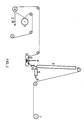
- the method according to the invention can, for example, be carried out in an installation such as is shown schematically in Fig. 1.
- the fibrous reinforcing material is fed from a feed roll 1 via a fibre tensioning regulator 2, which regulates the spreading of the fibre and thus the impregnability, into the impregnating bath 3 in which, according to this embodiment, the polymer powder and the film-forming dispersion are located.
- the impregnating mixture is stirred using stirring device 4 and the bath level is preferably above half of the bottom most roll 9.
- the impregnated material is fed via roll 10, which if necessary serves as a stripping roll, into drying tube 6, in which air or another gas warmed by means of warming device 5 is passed.
- the dried prepreg is fed to take-up roll 7.
- the invention also relates to a composite material consisting of a fibrous reinforcing material, a pulverulent polymer and film-forming polymer, the reinforcing material and the pulverulent polymer being encapsulated in the film-forming polymer.
- Composite material of this type can be produced by the method described above. These impregnated reinforcing materials (prepregs) have a high strength and a good rigidity in the fibre direction, coupled with a high stability. These composite materials can be used for the production of shaped articles by means of winding, pressing, pultrusion and the like. By virtue of the good flexibility, the composite material according to the invention can be used for specific types of processing, such as weaving, knitting, braiding and the like. These fabric structures can be shaped into final shaped articles, inter alia by hot pressing. They can also be cut and then pressed to shaped articles. The invention also relates to the shaped articles produced in this way.
- the impregnated glass fibres were dried in a drying tube (length 150 cm, internal diameter 2 cm), through which 5.5 litres of air at a temperature of 150°C were blown per minute.
- the polypropene or polyethene powder is homogeneously distributed over and in the glass fibres of the prepreg material thus produced. Moreover, the polypropene or polyethene powder is fixed on the glass fibres by the film-forming dispersion.
- the level in the impregnating bath was adjusted such that the guide rolls were approximately half submerged under the fluid level.
- the impregnated glass fibres were passed over two fixed, non-rotating, stripper rolls.
- the impregnated glass fibres were then dried in a drying tube (length 150 cm, internal diameter 2 cm), through which 5.5 litres of air at a temperature of 150°C were blown per minute.
- the process speed was 1.9 m/min.
- the prepregs produced in the above manner were post-dried at 50°C in vacuo until the weight of the prepreg was constant, before the matrix content was determined.
- the polypropylene powder is homogeneously distributed over and in the glass fibres of the prepreg material. Moreover, the polypropylene powder is fixed on the glass fibres by the film-forming dispersion.
- the level in the impregnating bath was adjusted such that the guide rolls were approximately half submerged beneath the fluid level.
- the fibre tension was 21.7 MPa.
- the impregnated glass fibres were passed over two fixed, non-rotating stripper rolls.
- the impregnated glass fibres were then dried in a drying tube (length 150 cm, internal diameter 2 cm), through which 5.5 litres of air at a temperature 150°C were blown per minute).
- the process speed was 1.9 m/min.
- the prepregs produced in the above manner were post-dried at 50°C in vacuo until the weight of the prepreg was constant, before the matrix content was determined.
- the matrix content in the prepreg expressed in per cent by volume, was 57%.
- the polyamide powder is homogeneously distributed over and in the glass fibres of the prepreg materials. Moreover, the polyamide powder is fixed on the glass fibres by the film-forming dispersion.
Landscapes
- Chemical & Material Sciences (AREA)
- Engineering & Computer Science (AREA)
- Materials Engineering (AREA)
- Chemical Kinetics & Catalysis (AREA)
- Manufacturing & Machinery (AREA)
- Health & Medical Sciences (AREA)
- Inorganic Chemistry (AREA)
- Medicinal Chemistry (AREA)
- Polymers & Plastics (AREA)
- Organic Chemistry (AREA)
- Mechanical Engineering (AREA)
- Reinforced Plastic Materials (AREA)
- Moulding By Coating Moulds (AREA)
Claims (12)
- Procédé de production d'une matière composite par imprégnation d'une matière fibreuse de renforcement avec un polymère de matrice pulvérulent, caractérisé en ce qu'on traite la matière de renforcement avant, pendant ou après l'imprégnation avec le polymère de matrice pulvérulent, avec au moins un polymère filmogène, et on sèche la matière imprégnée et traitée par la polymère filmogène à une température supérieure à la température filmogène du polymère filmogène et inférieure à la température à laquelle le polymère pulvérulent fond ou durcit.
- Procédé selon la revendication 1,
caractérisé en ce qu'on utilise le polymère filmogène sous forme d'une dispersion filmogène du polymère filmogène. - Procédé selon la revendication 2,
caractérisé en ce que le dispersant dans la dispersion filmogène est essentiellement de l'eau. - Procédé selon l'une quelconque des revendications 1 à 3, caractérisé en ce que l'on effectue simultanément l'imprégnation et le traitement par le polymère filmogène dans un bain qui contient le polymère de matrice et le polymère filmogène.
- Procédé selon l'une quelconque des revendications 1 à 4, caractérisé en ce qu'on effectue l'imprégnation dans un lit fluidisé et on traite la matière imprégnée par le polymère filmogène.
- Procédé selon l'une quelconque des revendications 1 à 5, caractérisé en ce que le polymère filmogène ne réticule pas ou ne réticule qu'à un faible degré.
- Procédé selon l'une quelconque des revendications 1 à 6, caractérisé en ce que le polymère filmogène donne une pellicule qui, à la température ambiante, présente un allongement à la rupture d'au moins 15%.
- Procédé selon l'une quelconque des revendications 1 à 7, caractérisé en ce que le polymère filmogène donne une pellicule dont la température de décomposition est supérieure au point de fusion du polymère de matrice pulvérulent.
- Procédé selon l'une quelconque des revendications 1 à 8, caractérisé en ce que le polymère filmogène présente une granulométrie moyenne inférieure à la granulométrie moyenne du polymère de matrice pulvérulent.
- Procédé selon l'une quelconque des revendications 1 à 9, caractérisé en ce que le polymère de matrice pulvérulent est thermoplastique.
- Matière composite comprenant une matière fibreuse de renforcement, un polymère pulvérulent et un polymère filmogène, la matière de renforcement et le polymère pulvérulent étant enrobés dans le polymère filmogène, ledit matière composite pouvant être obtenu par la mise en oeuvre du procédé selon l'une quelconque des revendications 1 à 10.
- Articles obtenus par traitement de la matière composite selon la revendication 11.
Priority Applications (1)
| Application Number | Priority Date | Filing Date | Title |
|---|---|---|---|
| AT89202805T ATE86170T1 (de) | 1988-11-10 | 1989-11-07 | Verfahren zur herstellung eines flexiblen, polymerimpraegnierten verstaerkungsmaterials, derart hergestelltes polymerimpraegniertes verstaerkungsmaterial und auf basis dieses verstaerkungsmaterials hergestellte formstuecke. |
Applications Claiming Priority (2)
| Application Number | Priority Date | Filing Date | Title |
|---|---|---|---|
| NL8802768 | 1988-11-10 | ||
| NL8802768A NL8802768A (nl) | 1988-11-10 | 1988-11-10 | Werkwijze voor het vervaardigen van flexibele met polymeren geimpregneerde versterkingsmaterialen, de vervaardigde met polymeren geimpregneerde versterkingsmaterialen, alsmede op basis van deze versterkingsmaterialen vervaardigde vormstukken. |
Publications (3)
| Publication Number | Publication Date |
|---|---|
| EP0368412A2 EP0368412A2 (fr) | 1990-05-16 |
| EP0368412A3 EP0368412A3 (en) | 1990-09-12 |
| EP0368412B1 true EP0368412B1 (fr) | 1993-03-03 |
Family
ID=19853201
Family Applications (1)
| Application Number | Title | Priority Date | Filing Date |
|---|---|---|---|
| EP89202805A Expired - Lifetime EP0368412B1 (fr) | 1988-11-10 | 1989-11-07 | Procédé pour fabriquer des matériaux flexibles de renforcement imprégnés de polymère, les matériaux de renforcement imprégnés de polymère fabriqués de telle manière et des articles de forme produits à base de tels matériaux de renforcement |
Country Status (8)
| Country | Link |
|---|---|
| EP (1) | EP0368412B1 (fr) |
| JP (1) | JPH02255838A (fr) |
| KR (1) | KR900007922A (fr) |
| AT (1) | ATE86170T1 (fr) |
| CA (1) | CA2002469A1 (fr) |
| DE (1) | DE68905139T2 (fr) |
| ES (1) | ES2040453T3 (fr) |
| NL (1) | NL8802768A (fr) |
Families Citing this family (9)
| Publication number | Priority date | Publication date | Assignee | Title |
|---|---|---|---|---|
| JP2829323B2 (ja) * | 1989-12-14 | 1998-11-25 | 出光石油化学株式会社 | 繊維強化樹脂成形材料の製造装置 |
| SE501855C2 (sv) * | 1990-11-19 | 1995-06-06 | Skf Ab | Gjutgods med ingjuten armering, samt förfarande för framställning av ett sådant gjutgods |
| BE1005106A3 (nl) * | 1991-07-16 | 1993-04-20 | Dsm Nv | Werkwijze voor het maken van een voorgeimpregneerd materiaal door het impregneren van een vezelig versterkingsmateriaal met een dispersie. |
| DE4325260A1 (de) * | 1993-07-28 | 1995-02-02 | Hoechst Ag | Verfahren zur Herstellung faserverstärkter Verbundwerkstoffe |
| DE69526997T2 (de) * | 1994-03-31 | 2003-01-23 | Toray Industries, Inc. | Prepreg-Pröcursor aus kohlenfasergeweben Prepregs und Verfahren zu deren Herstellung |
| JPH08323748A (ja) * | 1995-05-29 | 1996-12-10 | Toho Rayon Co Ltd | 成形材料及びその製造方法 |
| FR2918081B1 (fr) * | 2007-06-27 | 2009-09-18 | Cabinet Hecke Sa | Procede d'impregnation de fibres continues par une matrice polymerique composite renfermant un polymere thermoplastique |
| EP3747627A1 (fr) * | 2019-06-05 | 2020-12-09 | L'air Liquide Sa | Procédé de fabrication d'une bande composite et bande composite correspondante, procédé de fabrication d'un récipient composite utilisant cette bande composite et récipient composite ainsi obtenu |
| GB202318374D0 (en) * | 2023-12-01 | 2024-01-17 | Victrex Mfg Ltd | A method of coating a reinforcement fibre |
Family Cites Families (8)
| Publication number | Priority date | Publication date | Assignee | Title |
|---|---|---|---|---|
| DE1619197B2 (de) * | 1966-06-24 | 1977-01-27 | Asahi Glass Co. Ltd., Tokio | Verfahren zur herstellung von glasfaserverstaerktem formbaren thermoplastischen bahnmaterial und dessen verwendung |
| US4292105A (en) * | 1978-12-28 | 1981-09-29 | Union Carbide Corporation | Method of impregnating a fibrous textile material with a plastic resin |
| US4397909A (en) * | 1980-06-11 | 1983-08-09 | Aeci Limited | Production of sheet material |
| FI78514C (fi) * | 1983-12-16 | 1989-08-10 | Sicpa Holding Sa | Transfertryckplatta, foerfarande foer dess framstaellning, trycksvaerta foer anvaendning i foerfarandet samt transfertryckningsfoerfarande foer att trycka textilunderlag medelst transfertryckplattan. |
| GB8430949D0 (en) * | 1984-12-07 | 1985-01-16 | Smith Tech Dev | Impregnating fibre reinforcements |
| DE3540537A1 (de) * | 1985-11-15 | 1987-05-21 | Klaus Kurt Koelzer | Verstaerkungsmaterial |
| FR2600585B1 (fr) * | 1986-06-30 | 1988-11-10 | Galichon Jean | Procede de fabrication de pieces thermostables en materiaux composites et les pieces ainsi obtenues |
| DE3726921A1 (de) * | 1987-02-10 | 1988-08-18 | Menzolit Gmbh | Halbzeug und verfahren und vorrichtung zum herstellen formhaltigen halbzeugs aus thermoplast |
-
1988
- 1988-11-10 NL NL8802768A patent/NL8802768A/nl not_active Application Discontinuation
-
1989
- 1989-11-07 EP EP89202805A patent/EP0368412B1/fr not_active Expired - Lifetime
- 1989-11-07 AT AT89202805T patent/ATE86170T1/de not_active IP Right Cessation
- 1989-11-07 DE DE8989202805T patent/DE68905139T2/de not_active Expired - Fee Related
- 1989-11-07 ES ES198989202805T patent/ES2040453T3/es not_active Expired - Lifetime
- 1989-11-08 CA CA002002469A patent/CA2002469A1/fr not_active Abandoned
- 1989-11-10 JP JP1291391A patent/JPH02255838A/ja active Pending
- 1989-11-10 KR KR1019890016273A patent/KR900007922A/ko not_active Ceased
Also Published As
| Publication number | Publication date |
|---|---|
| JPH02255838A (ja) | 1990-10-16 |
| DE68905139D1 (de) | 1993-04-08 |
| DE68905139T2 (de) | 1993-09-23 |
| KR900007922A (ko) | 1990-06-02 |
| EP0368412A3 (en) | 1990-09-12 |
| EP0368412A2 (fr) | 1990-05-16 |
| NL8802768A (nl) | 1990-06-01 |
| ES2040453T3 (es) | 1993-10-16 |
| CA2002469A1 (fr) | 1990-05-10 |
| ATE86170T1 (de) | 1993-03-15 |
Similar Documents
| Publication | Publication Date | Title |
|---|---|---|
| US4541884A (en) | Method of producing fibre-reinforced composition | |
| AU598090B2 (en) | Production of improved preimpregnated material comprising a particulate thermoplastic polymer suitable for use in the formation of a substantially void-free fiber-reinforced composite article | |
| US5108458A (en) | Sizing agent for carbon fiber | |
| EP0330980A2 (fr) | Fabrication de matériau fibreux préimprégné pour former un objet composite exempt d'espaces vides | |
| EP0292266A2 (fr) | Déploiement d'un faisceau de fibres | |
| CN103826819B (zh) | 用树脂浸渍的挠性补强纤维纱 | |
| EP0368412B1 (fr) | Procédé pour fabriquer des matériaux flexibles de renforcement imprégnés de polymère, les matériaux de renforcement imprégnés de polymère fabriqués de telle manière et des articles de forme produits à base de tels matériaux de renforcement | |
| WO2002046276A2 (fr) | Articles de composites hybrides et leurs procedes de production | |
| JP5665416B2 (ja) | 強化繊維用サイジング剤およびその用途 | |
| CA2157543C (fr) | Procede pour la preparation d'un filament composite souple et matiere thermoplastique contenant des fibres continues | |
| US4446255A (en) | Sized carbon fibers suitable for use in composites of improved impact resistance | |
| US4818613A (en) | Single tow prepreg | |
| US5091255A (en) | Molding granules, their manufacture and their use in the production of molded articles | |
| US3214324A (en) | Fibrous materials impregnated with a partial reaction product derived from fatty guanamines and epoxy resins | |
| CN105568694A (zh) | 一种热塑性上浆剂及其制备方法与应用 | |
| KR970001082B1 (ko) | 표면처리된 무기섬유, 그 제조방법 및 용도 | |
| US5741384A (en) | Process for making glass fiber-reinforced composite material | |
| EP0440970B1 (fr) | Granules de moulage, leur préparation et leur application dans la production d'objets moulés | |
| WO1998030374A1 (fr) | Procede pour preparer des preformes et des articles moules | |
| WO2002042363A2 (fr) | Liant de cordon de resine polyester | |
| US6828024B1 (en) | Epoxy film former string binder | |
| KR20160037256A (ko) | 탄소섬유 사이징제 도포방법, 이의 장치, 및 이들에 의해 제조된 복합재료 | |
| WO2002042235A2 (fr) | Liant de cordon d'epoxyurethanne | |
| WO1992018433A1 (fr) | Fibres de verre enrobees | |
| WO2002068356A1 (fr) | Materiau particulaire reparti entre les fibres assemblees d'un brin et charge de collage augmentee resultante |
Legal Events
| Date | Code | Title | Description |
|---|---|---|---|
| PUAI | Public reference made under article 153(3) epc to a published international application that has entered the european phase |
Free format text: ORIGINAL CODE: 0009012 |
|
| AK | Designated contracting states |
Kind code of ref document: A2 Designated state(s): AT BE CH DE ES FR GB GR IT LI NL SE |
|
| PUAL | Search report despatched |
Free format text: ORIGINAL CODE: 0009013 |
|
| AK | Designated contracting states |
Kind code of ref document: A3 Designated state(s): AT BE CH DE ES FR GB GR IT LI NL SE |
|
| 17P | Request for examination filed |
Effective date: 19901022 |
|
| 17Q | First examination report despatched |
Effective date: 19920121 |
|
| RAP1 | Party data changed (applicant data changed or rights of an application transferred) |
Owner name: DSM N.V. |
|
| GRAA | (expected) grant |
Free format text: ORIGINAL CODE: 0009210 |
|
| AK | Designated contracting states |
Kind code of ref document: B1 Designated state(s): AT BE CH DE ES FR GB GR IT LI NL SE |
|
| PG25 | Lapsed in a contracting state [announced via postgrant information from national office to epo] |
Ref country code: SE Effective date: 19930303 Ref country code: LI Effective date: 19930303 Ref country code: GR Free format text: LAPSE BECAUSE OF FAILURE TO SUBMIT A TRANSLATION OF THE DESCRIPTION OR TO PAY THE FEE WITHIN THE PRESCRIBED TIME-LIMIT Effective date: 19930303 Ref country code: CH Effective date: 19930303 Ref country code: BE Effective date: 19930303 Ref country code: AT Effective date: 19930303 |
|
| REF | Corresponds to: |
Ref document number: 86170 Country of ref document: AT Date of ref document: 19930315 Kind code of ref document: T |
|
| REF | Corresponds to: |
Ref document number: 68905139 Country of ref document: DE Date of ref document: 19930408 |
|
| ITF | It: translation for a ep patent filed | ||
| ET | Fr: translation filed | ||
| REG | Reference to a national code |
Ref country code: CH Ref legal event code: PL |
|
| REG | Reference to a national code |
Ref country code: ES Ref legal event code: FG2A Ref document number: 2040453 Country of ref document: ES Kind code of ref document: T3 |
|
| PGFP | Annual fee paid to national office [announced via postgrant information from national office to epo] |
Ref country code: FR Payment date: 19931022 Year of fee payment: 5 |
|
| PGFP | Annual fee paid to national office [announced via postgrant information from national office to epo] |
Ref country code: GB Payment date: 19931104 Year of fee payment: 5 |
|
| PGFP | Annual fee paid to national office [announced via postgrant information from national office to epo] |
Ref country code: ES Payment date: 19931110 Year of fee payment: 5 |
|
| PGFP | Annual fee paid to national office [announced via postgrant information from national office to epo] |
Ref country code: NL Payment date: 19931130 Year of fee payment: 5 |
|
| PLBE | No opposition filed within time limit |
Free format text: ORIGINAL CODE: 0009261 |
|
| STAA | Information on the status of an ep patent application or granted ep patent |
Free format text: STATUS: NO OPPOSITION FILED WITHIN TIME LIMIT |
|
| PGFP | Annual fee paid to national office [announced via postgrant information from national office to epo] |
Ref country code: DE Payment date: 19940131 Year of fee payment: 5 |
|
| 26N | No opposition filed | ||
| PG25 | Lapsed in a contracting state [announced via postgrant information from national office to epo] |
Ref country code: GB Effective date: 19941107 |
|
| PG25 | Lapsed in a contracting state [announced via postgrant information from national office to epo] |
Ref country code: ES Free format text: LAPSE BECAUSE OF EXPIRATION OF PROTECTION Effective date: 19941108 |
|
| ITTA | It: last paid annual fee | ||
| PG25 | Lapsed in a contracting state [announced via postgrant information from national office to epo] |
Ref country code: NL Effective date: 19950601 |
|
| GBPC | Gb: european patent ceased through non-payment of renewal fee |
Effective date: 19941107 |
|
| NLV4 | Nl: lapsed or anulled due to non-payment of the annual fee | ||
| PG25 | Lapsed in a contracting state [announced via postgrant information from national office to epo] |
Ref country code: FR Effective date: 19950731 |
|
| PG25 | Lapsed in a contracting state [announced via postgrant information from national office to epo] |
Ref country code: DE Effective date: 19950801 |
|
| REG | Reference to a national code |
Ref country code: FR Ref legal event code: ST |
|
| REG | Reference to a national code |
Ref country code: ES Ref legal event code: FD2A Effective date: 20010301 |
|
| PG25 | Lapsed in a contracting state [announced via postgrant information from national office to epo] |
Ref country code: IT Free format text: LAPSE BECAUSE OF NON-PAYMENT OF DUE FEES;WARNING: LAPSES OF ITALIAN PATENTS WITH EFFECTIVE DATE BEFORE 2007 MAY HAVE OCCURRED AT ANY TIME BEFORE 2007. THE CORRECT EFFECTIVE DATE MAY BE DIFFERENT FROM THE ONE RECORDED. Effective date: 20051107 |