EP0368964B1 - Procede d'extraction de l'eau melangee a un fluide liquide - Google Patents
Procede d'extraction de l'eau melangee a un fluide liquide Download PDFInfo
- Publication number
- EP0368964B1 EP0368964B1 EP89905415A EP89905415A EP0368964B1 EP 0368964 B1 EP0368964 B1 EP 0368964B1 EP 89905415 A EP89905415 A EP 89905415A EP 89905415 A EP89905415 A EP 89905415A EP 0368964 B1 EP0368964 B1 EP 0368964B1
- Authority
- EP
- European Patent Office
- Prior art keywords
- hydrates
- water
- fluid
- gas
- accordance
- Prior art date
- Legal status (The legal status is an assumption and is not a legal conclusion. Google has not performed a legal analysis and makes no representation as to the accuracy of the status listed.)
- Expired - Lifetime
Links
Images
Classifications
-
- C—CHEMISTRY; METALLURGY
- C02—TREATMENT OF WATER, WASTE WATER, SEWAGE, OR SLUDGE
- C02F—TREATMENT OF WATER, WASTE WATER, SEWAGE, OR SLUDGE
- C02F1/00—Treatment of water, waste water, or sewage
- C02F1/26—Treatment of water, waste water, or sewage by extraction
-
- C—CHEMISTRY; METALLURGY
- C10—PETROLEUM, GAS OR COKE INDUSTRIES; TECHNICAL GASES CONTAINING CARBON MONOXIDE; FUELS; LUBRICANTS; PEAT
- C10G—CRACKING HYDROCARBON OILS; PRODUCTION OF LIQUID HYDROCARBON MIXTURES, e.g. BY DESTRUCTIVE HYDROGENATION, OLIGOMERISATION, POLYMERISATION; RECOVERY OF HYDROCARBON OILS FROM OIL-SHALE, OIL-SAND, OR GASES; REFINING MIXTURES MAINLY CONSISTING OF HYDROCARBONS; REFORMING OF NAPHTHA; MINERAL WAXES
- C10G33/00—Dewatering or demulsification of hydrocarbon oils
- C10G33/04—Dewatering or demulsification of hydrocarbon oils with chemical means
-
- C—CHEMISTRY; METALLURGY
- C02—TREATMENT OF WATER, WASTE WATER, SEWAGE, OR SLUDGE
- C02F—TREATMENT OF WATER, WASTE WATER, SEWAGE, OR SLUDGE
- C02F2101/00—Nature of the contaminant
- C02F2101/30—Organic compounds
- C02F2101/32—Hydrocarbons, e.g. oil
Definitions
- the invention relates to a method for extracting water mixed with a liquid fluid by forming hydrates of dispersed gases using at least one gas and an additive.
- This gas which forms hydrates with water can be, for example, methane, ethane, ethylene, propane, propene, n-butane, i-butane, H2S , C02, and can come from natural deposits, such as hydrocarbon natural gas, petroleum gas or other gases.
- thermodynamic temperature of hydrate formation this temperature being determined for a known gas composition and when their pressure is fixed.
- the thermodynamic temperature is higher the higher the pressure of the gas or gases. This means that the higher the pressure, the less it will be necessary to cool the gas and the water to form hydrates.
- the invention is particularly advantageous for the transport of oil and gas production when the conditions required for the formation of hydrates are reached.
- natural gas or oil produced by a deposit most often includes water, which under certain thermodynamic conditions, such as the North Sea climatic conditions, winter or polar, reacts with the gas or gases to form hydrates that clog pipes and create significant financial losses.
- GB-1,074,144 discloses a method which makes it possible to obtain purified water from an aqueous saline solution using the formation of propane hydrates and hydrate washing steps thus formed before decompose the hydrate to obtain purified water.
- hydrates are formed in dispersed form so as to be able to (easily) separate the water contained in the hydrate from the liquid fluid with which it is mixed.
- this hydrate formation in dispersed form can be carried out before or during the transport of fluids reaching the hydrate formation conditions.
- an additive suitable for producing the hydrates in dispersed form is used.
- the liquid fluid may contain hydrocarbons.
- the additive, the water and the said fluid will be adapted to allow good dispersion of the fluid in the water.
- the additive may comprise at least one element from the group of polyol esters and substituted or unsubstituted carboxylic acids, and from the group of hydroxycarbylamides of substituted or unsubstituted carboxylic acids.
- Hydrates can be formed by lowering the temperature and / or by increasing the pressure of the gas and of the mixture comprising the fluid and the water.
- the water from the hydrates and the remaining part of the fluid can be separated from each other.
- At least part of the gas originating from the decomposition of hydrates may be used to heat said reactor.
- the liquid fluid mixed with the water to be extracted therefrom is added beforehand with at least one additive and a suitable gas and subjected to thermodynamic conditions of temperature and pressure making it possible to form hydrates of gases dispersed within the fluid .
- the liquid fluid is a condensate extracted with water and gas from a marine petroleum deposit, this gas forming hydrates with water.
- a typical volume proportion of water and condensate is for example 5 parts of water for 95 parts of condensate.
- composition by weight of the condensate can be, for molecules having less than 11 carbon atoms, 22% of a mixture of paraffins, isoparaffins, aromatic naphthemes.
- the gas in the deposit comprises 98% methane and 2% ethane by volume.
- the mixture originating from the deposit is supplemented with coconut diethanolamide in an amount of 0.2% by weight relative to water.
- This mixture is then transported to the bottom of the sea over several tens of kilometers where it reaches the bottom temperature of around 3 ° C or even lower due to the JOULE-THOMSON effect produced by the expansion of methane and its vaporization produced by l reduction in pressure due to line pressure losses.
- the maximum pressure drop normally accepted is around 1 bar per kilometer.
- the well discharges under a pressure of 100 bars at sea level.
- the minimum temperature reached by the mixture being 1 ° C., associated with the pressure conditions and the presence of suitable additive, allows the formation of hydrates in dispersed form.
- the mixture having reached the level of the emerged surface of the earth, is directed to the separator 10 into which it enters through the orifice 1 under a pressure of 50 bars.
- the volume ratio of the gas to the condensate and of 100 m 3 / m 3 and a proportion of 25 mol% of gas relative to the condensate is dissolved in the latter.
- the density of the hydrates is 0.91 and that of the condensate less than 0.8.
- This separator 10 separates, the gas which is evacuated by the high outlet 2, from the condensate which flows by the medium outlet 3, and the hydrates mixed with the rest of the condensate are eliminated by the bottom outlet 4.
- the remaining proportions of condensate and hydrates at outlet 4 are respectively by weight 1/3 to 2/3.
- the separator 10 used and shown is a gravity separator comprising a scraper, but we could just as easily use a separator by flotation, centrifugation, filtration, a hydrocyclone, etc.
- the hydrates concentrated and mixed with the condensate from the lower outlet 4 are conveyed to the inlet 5 of a dissociation reactor.
- the pressure of 7 bars and the temperature kept constant at + 15 ° C allow the decomposition of hydrates.
- the mixture formed by the condensate, the water produced by the decomposition of the hydrates and the hydrates is stirred by a stirrer 12 so as to increase the rate of decomposition.
- the gas produced by the decomposition of hydrates is eliminated from the reactor by the upper outlet 6, while a fraction of the mixture comprising water and condensate and free of hydrate is evacuated from the reactor by outlet 7.
- Separation means 13 such as a filter provided with an anti-clogging device, prevent hydrates from passing through the outlet 7.
- the reactor 11 is heated by heating means comprising, for example, an oven 14 supplied with part of the gas coming from the upper outlet 6 of the reactor, this furnace heating a heat transfer fluid in contact with the reactor.
- the power required for this furnace 14 which is 140 KW for a mixing flow of 50 OOOKg / h, can be largely supplied by the gas coming from the reactor (2 MW).
- the outlet 7 through which the water and the condensate pass is connected to decanting means, such as a tank, which make it possible to separate them one and the other.
- decanting means such as a tank, which make it possible to separate them one and the other.
- the supernatant condensate on the water is discharged via the upper outlet 8 while the latter is removed via the lower outlet 9.
- the pressure in these settling means is maintained at 2 bars.
- the following table provides the mass balance (Kg / h) of the material transfers in the extraction unit described above at the various inputs and outputs of the devices for a flow rate of fluid to be treated of 50,000 Kg / h.
- the content of hydrate dispersing additive being 0.2% by weight relative to water, the hourly transit of additive is 4.4 kg / h.
- This additive which is not recovered in the extraction unit, ends up largely with the water extracted and is not introduced in the balance sheet.
- the methane entering this mass balance is both gaseous and liquid and mixed in the condensate.
- hydrates form naturally in a transfer line. It will not depart from the scope of the invention to produce hydrates by any other suitable means, such as refrigeration and / or compression units for said liquid and / or said gas.
- water As water is extracted from a liquid fluid, water can be separated from a liquid fluid that does not form hydrates in order to recover the water. The process then allows the production of depolluted water, such as desalted water.
- the quantities of liquid fluid and of water may be very different from the case of petroleum production, for example 20 parts by weight of fluid per 100 parts in weight of water, even 40 parts by weight per 100 parts by weight of water.
- the quantity and nature of the additives used will be adapted to the nature and quantity of the water and of the fluid.
- Another liquid compound can be added to the liquid fluid and to the water.
Landscapes
- Chemical & Material Sciences (AREA)
- Engineering & Computer Science (AREA)
- Organic Chemistry (AREA)
- Oil, Petroleum & Natural Gas (AREA)
- Life Sciences & Earth Sciences (AREA)
- Hydrology & Water Resources (AREA)
- Environmental & Geological Engineering (AREA)
- Water Supply & Treatment (AREA)
- Chemical Kinetics & Catalysis (AREA)
- General Chemical & Material Sciences (AREA)
- Organic Low-Molecular-Weight Compounds And Preparation Thereof (AREA)
Abstract
Description
- L'invention concerne un procédé d'extraction de l'eau mélangée à un fluide liquide parformation d'hydrates de gaz dispersés au moyen d'au moins un gaz et d'un additif.
- Ce gaz qui forme des hydrates avec l'eau peut être, par exemple, du méthane de l'éthane, de l'éthylène, du propane, du propène, du n-butane, de l'i-butane, de l'H2S, du C02, et peut provenir de gisements naturels, tels de gisement de gaz naturel d'hydrocarbures, de gaz de pétrole ou d'autres gaz.
- Ces hydrates se forment lorsque de l'eau se trouve en présence du gaz, que celui-ci soit à l'état libre, ou à l'état dissous dans un fluide liquide tel un hydrocarbure liquide, et lorsque la température atteinte par le mélange notamment d'eau, de gaz et éventuellement de fluide liquide, tel de l'huile ou un condensat, devient inférieure à la température thermodynamique de formation des hydrates, cette température étant déterminée pour une composition de gaz connue et lorsque leur pression est fixée. La température thermodynamique est d'autant plus haute que la pression du ou des gaz est forte. C'est à dire que plus la pression est élevée moins il faudra refroidir le gaz et l'eau pour former des hydrates.
- L'invention est particulièrement intéressante pour le transport de la production pétrolière et gazière lorsque les conditions requises pour la formation d'hydrates sont atteintes.
- En effet, le gaz naturel ou le pétrole produit par un gisement comporte le plus souvent de l'eau, qui sous certaines conditions thermodynamiques, telles les conditions climatiques de mer du Nord, hivernales ou polaires, réagit avec le ou les gaz pour former des hydrates qui colmatent les conduites et créent des pertes financières importantes.
- Le document Chemical Abstracts vol. 87, 1977, 204120v enseigne la séparation de l'eau sous forme d'hydrates contenue dans un liquide pétrolier.
- Il est connu dans le brevet GB-1.074.144 une méthode qui permet d'obtenir de l'eau purifiée d'une solution aqueuse saline en utilisant la formation d'hydrates du propane et des étapes de lavage d'hydrate ainsi formé avant de décomposer l'hydrate pour obtenir de l'eau purifiée.
- Ces deux documents ne concernent pas le domaine du transport de fluides.
- Selon l'invention, on forme des hydrates sous forme dispersée de manière à pouvoir séparer, (facilement) l'eau contenue dans l'hydrate, du fluide liquide auquel celle-ci est mélangée.
- D'une manière avantageuse, cette formation d'hydrate sous forme dispersée peut-être réalisée avant ou au cours du transport de fluides atteignant les conditions de formation d'hydrates.
- Ces conditions se rencontrent naturellement lorsque une conduite de transfert est disposée au fond de la mer où l'eau peut être par exemple à une température de 3 ou 4°C.
- Ainsi, d'une part, la formation d'hydrates qui se produit naturellement, complètement ou en partie seulement, évite toute ou une certaine consommation d'énergie d'hydratation indispensable à l'extraction de l'eau, et d'autre part la dispersion des hydrates évite leur coalesence et le blocage des conduites.
- La possibilité de former des hydrates se dispersant au sein d'un liquide a été découverte lorsque l'on a trouvé que certains tensio-actifs, qui jusqu'à maintenant n'étaient pas utilisés dans ce but, présentent une excellente aptitude à modifier le mécanisme de formation des hydrates.
- En effet, au lieu de constater que les hydrates s'agglomèrent les uns aux autres en formant des blocs et des bouchons très solides, ou des dépôts dans les appareils où circule le fluide générant des hydrates, il a été observé, dans une large plage de température, que ces tensio-actifs dispersent ces hydrates dans ce fluide et empêchent alors leur agglomération.
- Lorsqu'on soumet un mélange de gaz, de fluides et de tensio-actifs donnés à une température notablement plus basse que la température de début de formation des hydrates, il se crée un épaississement du fluide, sans qu'il y ait de formation de blocs ou de bouchons, cet épaississement étant d'autant plus fort que la température est basse.
- Ces additifs sont très avantageux, d'une part par leur efficacité :
- - concentration très faible (généralement inférieure à 2 % voire à 0,5 % en poids par rapport à l'eau),
- - et d'autre part pour leur coût modéré.
- L'invention fournit un procédé d'extraction de l'eau mélangée à un fluide liquide substantiellement insoluble dans ladite eau, notamment caractérisé en ce qu'on effectue les étapes suivantes :
- - on forme, au sein du fluide, une dispersion d'hydrates d'un gaz, ces hydrates étant formés à partir de l'eau et du gaz en quantité suffisante, le gaz étant adapté à former des hydrates,
- - on sépare les hydrates d'au moins la plus grande partie du fluide, les hydrates se trouvant éventuellement avec une partie restante du fluide, et
- - on décompose les hydrates précédemment concentrés de manière à obtenir le gaz et l'eau.
- Avant ou au cours de la formation d'hydrates, on utilise un additif adapté à produire les hydrates sous forme dispersée.
- Le fluide liquide pourra comporter des hydrocarbures.
- D'une manière avantageuse, l'additif, l'eau et ledit fluide seront adaptés pour permettre une bonne dispersion du fluide dans l'eau.
- L'additif pourra comporter au moins un élément du groupe des esters de polyols et d'acides carboxyliques substitués ou non substitués, et du groupe des hydroxycarbylamides d'acides carboxyliques substitués ou non substitués.
- On pourra former les hydrates en abaissant la température et/ou en augmentant la pression du gaz et du mélange comportant le fluide et l'eau.
- Après avoir décomposé les hydrates, l'eau provenant des hydrates et la partie restante de fluide pourront être séparées l'une de l'autre.
- Après avoir concentré les hydrates,
- . on pourra les introduire dans un réacteur de dissociation, éventuellement mélangés à ladite partie restante de fluide,
- . on pourra réchauffer le réacteur par des moyens adaptés à permettre la décomposition des hydrates,
- . on pourra agiter le mélange formé par le fluide, l'eau produite par la décomposition des hydrates et les hydrates,
- . on pourra éliminer du réacteur le gaz produit par ladite décomposition, et
- . on pourra évacuer du réacteur une fraction du mélange exempte d'hydrate.
- On pourra séparer l'eau et le fluide contenu dans la fraction du mélange évacué du réacteur et exempte d'hydrate.
- On pourra utiliser au moins une partie du gaz provenant de la décomposition des hydrates pour réchauffer ledit réacteur.
- On pourra utiliser le procédé à l'extraction de l'eau contenue dans des effluents pétroliers, ledit gaz adapté à former des hydrates comportant un gaz pétrolier.
- Les effluents étant transportés dans des conditions où des hydrates se forment, on pourra ajouter aux effluents un additif adapté à produire les hydrates sous forme dispersée avant ou pendant le transport de ces effluents.
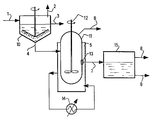
- L'invention sera bien comprise et ses avantages apparaitront clairement à la lecture de la description qui suit d'un exemple non limitatif de réalisation illustré par la figure annexée représentant schématiquement une unité d'extraction d'eau fonctionnant avec le procédé selon l'invention.
- Le fluide liquide mélangé à l'eau devant en être extrait est préalablement additionné d'au moins un additif et d'un gaz appropriés et soumis à des conditions thermodynamiques de température et de pression permettant de former des hydrates de gaz dispersés au sein du fluide.
- Dans l'exemple de réalisation, le fluide liquide est un condensat extrait avec de l'eau et du gaz d'un gisement pétrolier marin, ce gaz formant des hydrates avec l'eau.
- Une proportion en volume typique de l'eau et du condensat est par exemple de 5 parties d'eau pour 95 parties de condensat.
- La composition pondérale du condensat peut être pour les molécules ayant moins 11 atomes de carbone, 22 % d'un mélange de paraffines, d'isoparaffines, de naphtèmes d'aromatiques. Le gaz du gisement comprend en volume 98 % de méthane et 2 % d'éthane.
- Le mélange provenant du gisement est additionné de diéthanolamide du coprah à raison de 0,2 % en poids par rapport à l'eau. Ce mélange est ensuite transporté au fond de la mer sur plusieurs dizaines de kilomètres où il atteint la température du fond voisine de 3°C voire inférieure du fait de l'effet JOULE-THOMSON produit par la détente du méthane et sa vaporisation produites par l'abaissement de la pression due aux pertes de charges en ligne. La perte de charge maximale admise ordinairement est de l'orde de 1 bar par kilomètre. Dans l'exemple décrit, le puits débite sous une pression de 100 bars au niveau du fond de la mer. La température minimale atteinte par la mélange étant de 1°C, associée aux conditions de pression et la présence d'additif adapté, permet la formation d'hydrates sous forme dispersée.
- Quasiment toute l'eau contenue dans le mélange se retrouve dans les hydrates.
- Le mélange, ayant atteint le niveau de la surface émergée des terres, est dirigé vers le séparateur 10 dans lequel il pénètre par l'orifice 1 sous une pression de 50 bars.
- Dans ces conditions, le rapport volumique du gaz sur le condensat et de 100 m3/m3 et une proportion de 25 % molaire de gaz par rapport au condensat est dissous dans ce dernier. La densité des hydrates est de 0,91 et celle du condensat inférieure à 0,8.
- Ce séparateur 10 sépare, le gaz qui s'évacue par la sortie haute 2, du condensat qui s'écoule par la sortie moyenne 3, et les hydrates mélangés avec le reste de condensat s'éliminent par la sortie inférieure 4. Les proportions restantes de condensat et d'hydrates à la sortie 4 sont respectivement en poids 1/3 pour 2/3.
- Le séparateur 10 utilisé et représenté est un séparateur à décantation gravitaire comportant un racleur, mais on pourrait tout aussi bien utiliser un séparateur par flottation, centrifugation, filtration, un hydrocyclone, etc.
- Les hydrates concentrés et mélangés au condensat provenant de la sortie inférieure 4 sont véhiculés vers l'entrée 5 d'un réacteur de dissociation. Dans ce réacteur, la pression de 7 bars et la température maintenue constante à + 15°C permettent la décomposition des hydrates. Le mélange formé par le condensat, l'eau produite par la décomposition des hydrates et les hydrates est agité par un agitateur 12 de manière à augmenter la vitesse de décomposition.
- Le gaz produit par la décomposition des hydrates est éliminé du réacteur par la sortie supérieure 6, alors qu'une fraction du mélange comportant l'eau et le condensat et exempte d'hydrate est évacué du réacteur par la sortie 7. Des moyens de séparation 13, tels un filtre pourvu d'un dispositif anti-colmatage, empêchent les hydrates d'emprunter la sortie 7. Le réacteur 11 est réchauffé par des moyens de chauffage comportant, par exemple, un four 14 alimenté par une partie du gaz provenant de la sortie supérieure 6 du réacteur, ce four réchauffant un fluide caloporteur en contact avec le réacteur.
- La puissance requise pour ce four 14 qui est de 140 KW pour un débit de mélange de 50 OOOKg/h, peut être largement fournie par le gaz issu du réacteur (2 MW). On pourra remplacer le four 14 par un échangeur de chaleur succeptible d'apporter de l'énergie.
- La sortie 7 traversée par l'eau et le condensat est reliée à des moyens de décantation, tel un bac, qui permettent de les séparer l'un et l'autre. Le condensat surnageant sur l'eau est évacué par la sortie supérieure 8 alors que cette dernière est éliminée via la sortie inférieure 9.
- La pression dans ces moyens de décantation est maintenue à 2 bars. Le tableau suivant réalise le bilan massique (Kg/h) des transferts de matière dans l'unité d'extraction précédemment décrite au niveau des différentes entrées et sorties des appareils pour un débit de fluide à traiter de 50.000 Kg/h.
- La teneur en additif disperseur d'hydrates étant 0,2 % en poids par rapport t'eau, le transit horaire d'additif est de 4,4 Kg/h. Cet additif, qui n'est pas récupéré dans l'unité d'extraction, se retrouve pour une grande part avec l'eau extraite et n'est pas introduit dans le bilan.
- Le méthane entrant dans ce bilan massique est aussi bien gazeux que liquide et mélangé dans le condensat.

- Dans l'exemple de réalisation précédemment décrit, les hydrates se forment naturellement dans une conduite de transfert. On ne sortira pas du cadre de l'invention en produisant des hydrates par tout autre moyen adapté, tels des unités de réfrigération et/ou de compression dudit liquide et/ou dudit gaz.
- De la même manière que l'on a déshydraté le condensat, on pourra assécher toutes sortes de produits chimiques, tels des produits pharmaceutiques ne supportant ni de faibles pressions, ni des élévations de températures.
- Comme l'on extrait l'eau d'un fluide liquide, on pourra séparer l'eau d'un fluide liquide ne formant pas d'hydrates dans le but de récupérer l'eau. Le procédé permet alors la production d'eau dépolluée, telle de l'eau désalée.
- Sans sortir du cadre de l'invention, pour le mélange traité par le procédé, les quantités de fluide liquide et d'eau pourront être très différentes du cas de la production pétrolière, par exemple de 20 parties en poids de fluide pour 100 parties en poids d'eau, voire 40 parties en poids pour 100 parties en poids d'eau.
- De même, la quantité et la nature des additifs utilisés seront adaptées à la nature et à la quantité de l'eau et du fluide.
- On pourra ajouter au fluide liquide et à l'eau un autre composé liquide.
Claims (12)
Applications Claiming Priority (2)
| Application Number | Priority Date | Filing Date | Title |
|---|---|---|---|
| FR8805491 | 1988-04-22 | ||
| FR8805491A FR2630344B1 (fr) | 1988-04-22 | 1988-04-22 | Procede d'extraction de l'eau melangee a un fluide liquide |
Publications (2)
| Publication Number | Publication Date |
|---|---|
| EP0368964A1 EP0368964A1 (fr) | 1990-05-23 |
| EP0368964B1 true EP0368964B1 (fr) | 1992-07-08 |
Family
ID=9365660
Family Applications (1)
| Application Number | Title | Priority Date | Filing Date |
|---|---|---|---|
| EP89905415A Expired - Lifetime EP0368964B1 (fr) | 1988-04-22 | 1989-04-20 | Procede d'extraction de l'eau melangee a un fluide liquide |
Country Status (4)
| Country | Link |
|---|---|
| US (1) | US5055178A (fr) |
| EP (1) | EP0368964B1 (fr) |
| FR (1) | FR2630344B1 (fr) |
| WO (1) | WO1989010392A1 (fr) |
Families Citing this family (22)
| Publication number | Priority date | Publication date | Assignee | Title |
|---|---|---|---|---|
| US5420370A (en) * | 1992-11-20 | 1995-05-30 | Colorado School Of Mines | Method for controlling clathrate hydrates in fluid systems |
| US5432292A (en) * | 1992-11-20 | 1995-07-11 | Colorado School Of Mines | Method for controlling clathrate hydrates in fluid systems |
| US5639925A (en) * | 1992-11-20 | 1997-06-17 | Colorado School Of Mines | Additives and method for controlling clathrate hydrates in fluid systems |
| US5964093A (en) * | 1997-10-14 | 1999-10-12 | Mobil Oil Corporation | Gas hydrate storage reservoir |
| US6245955B1 (en) * | 1998-09-01 | 2001-06-12 | Shell Oil Company | Method for the sub-sea separation of hydrocarbon liquids from water and gases |
| NO985001D0 (no) | 1998-10-27 | 1998-10-27 | Eriksson Nyfotek As Leiv | FremgangsmÕte og system for transport av en str°m av fluide hydrokarboner inneholdende vann |
| US20040195160A1 (en) * | 1999-07-12 | 2004-10-07 | Marine Desalination Systems, L.L.C. | Hydrate-based reduction of fluid inventories and concentration of aqueous and other water-containing products |
| US6497794B1 (en) | 1999-07-12 | 2002-12-24 | Marine Desalination Systems L.L.C. | Desalination using positively buoyant or negatively buoyant/assisted buoyancy hydrate |
| US6565715B1 (en) | 1999-07-12 | 2003-05-20 | Marine Desalination Systems Llc | Land-based desalination using buoyant hydrate |
| US6767471B2 (en) * | 1999-07-12 | 2004-07-27 | Marine Desalination Systems, L.L.C. | Hydrate desalination or water purification |
| US6969467B1 (en) * | 1999-07-12 | 2005-11-29 | Marine Desalination Systems, L.L.C. | Hydrate-based desalination with hydrate-elevating density-driven circulation |
| US6890444B1 (en) | 2003-04-01 | 2005-05-10 | Marine Desalination Systems, L.L.C. | Hydrate formation and growth for hydrate-based desalination by means of enriching water to be treated |
| US6673249B2 (en) | 2000-11-22 | 2004-01-06 | Marine Desalination Systems, L.L.C. | Efficiency water desalination/purification |
| US6475460B1 (en) | 1999-07-12 | 2002-11-05 | Marine Desalination Systems Llc | Desalination and concomitant carbon dioxide capture yielding liquid carbon dioxide |
| AU2001270061A1 (en) * | 2000-06-26 | 2002-01-08 | Marine Desalination Systems, L.L.C. | Controlled cooling of input water by dissociation of hydrate in an artificially pressurized assisted desalination fractionation apparatus |
| CA2410578A1 (fr) * | 2001-03-29 | 2002-11-25 | Mitsubishi Heavy Industries, Ltd. | Dispositif de production d'hydrate de gaz et dispositif de deshydratation d'hydrate de gaz |
| JP5019683B2 (ja) * | 2001-08-31 | 2012-09-05 | 三菱重工業株式会社 | ガスハイドレートスラリーの脱水装置及び脱水方法 |
| CN1324289C (zh) * | 2001-12-28 | 2007-07-04 | 中国科学院广州能源研究所 | 促进气体水合物生长的方法 |
| US7008544B2 (en) * | 2002-05-08 | 2006-03-07 | Marine Desalination Systems, L.L.C. | Hydrate-based desalination/purification using permeable support member |
| US8436219B2 (en) * | 2006-03-15 | 2013-05-07 | Exxonmobil Upstream Research Company | Method of generating a non-plugging hydrate slurry |
| WO2009042319A1 (fr) | 2007-09-25 | 2009-04-02 | Exxonmobil Upstream Research Company | Procédé de gestion des hydrates dans une ligne de production sous-marine |
| CN112062177A (zh) * | 2020-08-19 | 2020-12-11 | 大连理工大学 | 一种基于旋转分离气体水合物法的海水淡化装置 |
Family Cites Families (5)
| Publication number | Priority date | Publication date | Assignee | Title |
|---|---|---|---|---|
| US3126334A (en) * | 1964-03-24 | Process and apparatus for melting | ||
| US3124926A (en) * | 1964-03-17 | Woodell | ||
| GB426793A (en) * | 1933-10-09 | 1935-04-09 | Desire Zimmermann | Improvements in petrol purifiers |
| GB1074144A (en) * | 1964-04-28 | 1967-06-28 | British Petroleum Co | Improvements in or relating to a method for producing purified water from aqueous saline solutions |
| SU571503A1 (ru) * | 1975-02-04 | 1977-09-05 | Всесоюзный нефтегазовый научно-исследовательский институт | Способ обезвоживани нефти |
-
1988
- 1988-04-22 FR FR8805491A patent/FR2630344B1/fr not_active Expired - Lifetime
-
1989
- 1989-04-20 WO PCT/FR1989/000185 patent/WO1989010392A1/fr not_active Ceased
- 1989-04-20 US US07/460,322 patent/US5055178A/en not_active Expired - Lifetime
- 1989-04-20 EP EP89905415A patent/EP0368964B1/fr not_active Expired - Lifetime
Non-Patent Citations (1)
| Title |
|---|
| Chemical Abstracts, volume 87, no 26, 26 December 1977, (Columbus, Ohio, US), see page 138, abstract 204120v, & SU, A, 571503 (ALL-UNION SCIENTIFIC-RESEARCH INSTITUTE OF PETROLEUM GAS) 05 September 1977 * |
Also Published As
| Publication number | Publication date |
|---|---|
| WO1989010392A1 (fr) | 1989-11-02 |
| FR2630344A1 (fr) | 1989-10-27 |
| EP0368964A1 (fr) | 1990-05-23 |
| FR2630344B1 (fr) | 1992-02-21 |
| US5055178A (en) | 1991-10-08 |
Similar Documents
| Publication | Publication Date | Title |
|---|---|---|
| EP0368964A1 (fr) | Procede d'extraction de l'eau melangee a un fluide liquide. | |
| TWI468505B (zh) | 含碳氫化合物的材料中碳氫化合物的萃取及/或含碳氫化合物之材料的加工 | |
| BE1001683A4 (fr) | Procede et produit pour la preparation d'emulsions d'hydrocarbures visqueux dans l'eau et emulsions ainsi preparees. | |
| US9416645B2 (en) | Extraction of hydrocarbons from hydrocarbon-containing materials and/or processing of hydrocarbon-containing materials | |
| US7638057B2 (en) | Method of treating water using petroleum coke | |
| JPH02273502A (ja) | 固体および水と混合した抽出可能有機物質を含む組成物から抽出可能有機物質を分離する方法 | |
| EP0225199B1 (fr) | Procédé permettant d'homogénéiser un mélange de liquides résiduaires aqueux et de combustibles liquides ou solides | |
| US5186817A (en) | Process for separating extractable organic material from compositions comprising oil-in-water emulsions comprising said extractable organic material and solids | |
| RS55492B2 (sr) | Postupak za pretvaranje organske materije u proizvod | |
| CA2178281A1 (fr) | Procede de transport d'un fluide, tel un gaz sec, susceptible de former des hydrates | |
| CN103221545A (zh) | 生产生物燃料的系统和方法 | |
| EP0323307A1 (fr) | Procédé de transport d'un fluide formant des hydrates | |
| KR20190104050A (ko) | 발전 시스템 및 공정 | |
| JP5255303B2 (ja) | 無灰炭の製造方法 | |
| US4121995A (en) | Surfactant-assisted liquefaction of particulate carbonaceous substances | |
| JPS5987058A (ja) | 高剪断条件を使用する炭素質物質の選炭方法 | |
| CN114538725A (zh) | 一种油泥与含油土壤超临界co2萃取回收综合处理工艺 | |
| MXPA01013436A (es) | Descomposicion de una emulsion de aceite en agua. | |
| CN112876023A (zh) | 一种利用热解析装置回收油泥的预处理方法 | |
| WO2013139515A9 (fr) | Procede de traitement de sables bitumineux et dispositif de mise en oeuvre d'un tel procede | |
| EP4186962A1 (fr) | Procédé et appareil de production d'un précurseur de pétrole brut et de pétrole brut à partir de déchets organiques | |
| CA2129151C (fr) | Melanges de charbon et d'eau provenant de charbon de qualite inferieure; methode de production | |
| CA1036524A (fr) | Traitement des residus provenant des sables bitumineux | |
| CN116144334A (zh) | 生物质提取物在原油降粘以及水力空化处理中的应用 | |
| NO175485B (no) | Fremgangsmåte for ekstraksjon av vann fra en væske |
Legal Events
| Date | Code | Title | Description |
|---|---|---|---|
| PUAI | Public reference made under article 153(3) epc to a published international application that has entered the european phase |
Free format text: ORIGINAL CODE: 0009012 |
|
| 17P | Request for examination filed |
Effective date: 19891122 |
|
| AK | Designated contracting states |
Kind code of ref document: A1 Designated state(s): GB IT NL |
|
| 17Q | First examination report despatched |
Effective date: 19910111 |
|
| ITF | It: translation for a ep patent filed | ||
| GRAA | (expected) grant |
Free format text: ORIGINAL CODE: 0009210 |
|
| AK | Designated contracting states |
Kind code of ref document: B1 Designated state(s): GB IT NL |
|
| GBT | Gb: translation of ep patent filed (gb section 77(6)(a)/1977) | ||
| PLBE | No opposition filed within time limit |
Free format text: ORIGINAL CODE: 0009261 |
|
| STAA | Information on the status of an ep patent application or granted ep patent |
Free format text: STATUS: NO OPPOSITION FILED WITHIN TIME LIMIT |
|
| 26N | No opposition filed | ||
| REG | Reference to a national code |
Ref country code: GB Ref legal event code: IF02 |
|
| PGFP | Annual fee paid to national office [announced via postgrant information from national office to epo] |
Ref country code: NL Payment date: 20070418 Year of fee payment: 19 |
|
| PGFP | Annual fee paid to national office [announced via postgrant information from national office to epo] |
Ref country code: GB Payment date: 20070419 Year of fee payment: 19 |
|
| PGFP | Annual fee paid to national office [announced via postgrant information from national office to epo] |
Ref country code: IT Payment date: 20070618 Year of fee payment: 19 |
|
| GBPC | Gb: european patent ceased through non-payment of renewal fee |
Effective date: 20080420 |
|
| NLV4 | Nl: lapsed or anulled due to non-payment of the annual fee |
Effective date: 20081101 |
|
| PG25 | Lapsed in a contracting state [announced via postgrant information from national office to epo] |
Ref country code: NL Free format text: LAPSE BECAUSE OF NON-PAYMENT OF DUE FEES Effective date: 20081101 |
|
| PG25 | Lapsed in a contracting state [announced via postgrant information from national office to epo] |
Ref country code: GB Free format text: LAPSE BECAUSE OF NON-PAYMENT OF DUE FEES Effective date: 20080420 |
|
| PG25 | Lapsed in a contracting state [announced via postgrant information from national office to epo] |
Ref country code: IT Free format text: LAPSE BECAUSE OF NON-PAYMENT OF DUE FEES Effective date: 20080420 |