EP0369344B1 - N-Arylierung von Isatinen - Google Patents
N-Arylierung von Isatinen Download PDFInfo
- Publication number
- EP0369344B1 EP0369344B1 EP89120863A EP89120863A EP0369344B1 EP 0369344 B1 EP0369344 B1 EP 0369344B1 EP 89120863 A EP89120863 A EP 89120863A EP 89120863 A EP89120863 A EP 89120863A EP 0369344 B1 EP0369344 B1 EP 0369344B1
- Authority
- EP
- European Patent Office
- Prior art keywords
- formula
- isatin
- compound
- group
- halogen
- Prior art date
- Legal status (The legal status is an assumption and is not a legal conclusion. Google has not performed a legal analysis and makes no representation as to the accuracy of the status listed.)
- Expired - Lifetime
Links
- 0 Cc(cc1)cc(*(C2)=O)c1S2(Cc1ccccc1)=O Chemical compound Cc(cc1)cc(*(C2)=O)c1S2(Cc1ccccc1)=O 0.000 description 3
Classifications
-
- C—CHEMISTRY; METALLURGY
- C07—ORGANIC CHEMISTRY
- C07F—ACYCLIC, CARBOCYCLIC OR HETEROCYCLIC COMPOUNDS CONTAINING ELEMENTS OTHER THAN CARBON, HYDROGEN, HALOGEN, OXYGEN, NITROGEN, SULFUR, SELENIUM OR TELLURIUM
- C07F9/00—Compounds containing elements of Groups 5 or 15 of the Periodic Table
- C07F9/94—Bismuth compounds
-
- C—CHEMISTRY; METALLURGY
- C07—ORGANIC CHEMISTRY
- C07D—HETEROCYCLIC COMPOUNDS
- C07D209/00—Heterocyclic compounds containing five-membered rings, condensed with other rings, with one nitrogen atom as the only ring hetero atom
- C07D209/02—Heterocyclic compounds containing five-membered rings, condensed with other rings, with one nitrogen atom as the only ring hetero atom condensed with one carbocyclic ring
- C07D209/04—Indoles; Hydrogenated indoles
- C07D209/30—Indoles; Hydrogenated indoles with hetero atoms or with carbon atoms having three bonds to hetero atoms with at the most one bond to halogen, directly attached to carbon atoms of the hetero ring
- C07D209/32—Oxygen atoms
- C07D209/38—Oxygen atoms in positions 2 and 3, e.g. isatin
-
- C—CHEMISTRY; METALLURGY
- C07—ORGANIC CHEMISTRY
- C07D—HETEROCYCLIC COMPOUNDS
- C07D209/00—Heterocyclic compounds containing five-membered rings, condensed with other rings, with one nitrogen atom as the only ring hetero atom
- C07D209/56—Ring systems containing three or more rings
- C07D209/58—[b]- or [c]-condensed
- C07D209/60—Naphtho [b] pyrroles; Hydrogenated naphtho [b] pyrroles
-
- C—CHEMISTRY; METALLURGY
- C07—ORGANIC CHEMISTRY
- C07D—HETEROCYCLIC COMPOUNDS
- C07D219/00—Heterocyclic compounds containing acridine or hydrogenated acridine ring systems
- C07D219/04—Heterocyclic compounds containing acridine or hydrogenated acridine ring systems with hetero atoms or with carbon atoms having three bonds to hetero atoms with at the most one bond to halogen, e.g. ester or nitrile radicals, directly attached to carbon atoms of the ring system
-
- C—CHEMISTRY; METALLURGY
- C07—ORGANIC CHEMISTRY
- C07D—HETEROCYCLIC COMPOUNDS
- C07D219/00—Heterocyclic compounds containing acridine or hydrogenated acridine ring systems
- C07D219/04—Heterocyclic compounds containing acridine or hydrogenated acridine ring systems with hetero atoms or with carbon atoms having three bonds to hetero atoms with at the most one bond to halogen, e.g. ester or nitrile radicals, directly attached to carbon atoms of the ring system
- C07D219/06—Oxygen atoms
-
- C—CHEMISTRY; METALLURGY
- C07—ORGANIC CHEMISTRY
- C07D—HETEROCYCLIC COMPOUNDS
- C07D219/00—Heterocyclic compounds containing acridine or hydrogenated acridine ring systems
- C07D219/04—Heterocyclic compounds containing acridine or hydrogenated acridine ring systems with hetero atoms or with carbon atoms having three bonds to hetero atoms with at the most one bond to halogen, e.g. ester or nitrile radicals, directly attached to carbon atoms of the ring system
- C07D219/08—Nitrogen atoms
-
- C—CHEMISTRY; METALLURGY
- C07—ORGANIC CHEMISTRY
- C07D—HETEROCYCLIC COMPOUNDS
- C07D221/00—Heterocyclic compounds containing six-membered rings having one nitrogen atom as the only ring hetero atom, not provided for by groups C07D211/00 - C07D219/00
- C07D221/02—Heterocyclic compounds containing six-membered rings having one nitrogen atom as the only ring hetero atom, not provided for by groups C07D211/00 - C07D219/00 condensed with carbocyclic rings or ring systems
- C07D221/04—Ortho- or peri-condensed ring systems
- C07D221/18—Ring systems of four or more rings
Definitions
- the present invention relates to a process and intermediates for the production of N-arylated isatins which are in turn used in the manufacture of N-alkyl acridine sulfonamide chemiluminescent labels.
- CLIAs chemiluminescent immunoassays
- an antibody (or antigen) is labeled with a chemiluminescent moiety, and the labeled antibody (or antigen) is introduced to a sample containing the corresponding antigen (or antibody) to be detected or measured.
- the presence or amount of antigen (or antibody) in the sample can be determined, depending upon the type of assay format utilized.
- assay formats enzyme immunoassays, radioimmunoassays, fluorescent polarization immunoassays, and the like. Chemiluminescent immunoassays may thus match or exceed the sensitivity of radioimmunoassays (RIA), or enzyme immunoassays (EIA). [Kircka et al. Diagnostic Medicine, 1 , 45-52 (1984].
- Substituted acridine-9-carboxylic acid compounds have been demonstrated to be useful in CLIAs. To make such compounds, one can directly substitute an existing acridine compound. However, direct substitution often achieves low yields, forms many isomers, and often destroys other functional groups on the acridine rings. Substituted acridine-9-carboxylic acid compounds can also be prepared with the Jourdan-Ullmann-Goldberg synthesis and/or Chapman rearrangements. These procedures are labor intensive, unfortunately, and the substituted acridines formed from the cyclization of diphenyl amines often cannot be converted to the 9-carboxylic acids with known techniques.
- acridine-9-carboxylic acids can be prepared with a Pfitzinger rearrangement of isatins and ketones, with subsequent aromatization of the final ring on the acridine. But, low yields are often encountered, isomers are formed, and other functionalities on the acridine ring are often destroyed. This reaction scheme is also labor intensive and performed under harsh conditions. Accordingly, simple, economic processes for making acridines have been sought.
- N-arylation of amines was disclosed by Barton et al "Metallic Copper Catalysts of N-Arylation of Amines," Tetrahedron Letters, Vol. 27, No. 31, pp. 3615-3618 (1986).
- amines are nucleophillic species, and are chemically reactive.
- the amide (e.g. isatin) nitrogen is typically not considered nucleophillic.
- the present invention is a simple, economical process for making substituted acridine-9-carboxylic acids.
- Isatins are N-arylated with triaryl bismuth reagents and copper or copper salts.
- the substituted, N-arylated isatins are subsequently rearranged to produce substituted acridines.
- This is a regiospecific (i.e. provides predominantly one regioisomer) process, which allows direct synthesis of isomerically pure substituted acridines in good yields. This process affords the production of acridines with different functional substitutions.
- the process of the current invention involves the N-arylation of isatins by (a) reacting a compound of formula I wherein A, B, C and D are selected independently in each instance from hydrogen, halogen, cyano, nitro, amino, carboxy, sulfone, alkyl and alkoxy, or B and C together can form a fused aromatic ring: (b) with a compound of formula II: where X is selected from one or more of hydrogen, halogen, nitro, cyano, alkyl and alkoxy.
- Z is either a halogen or a substituent of formula III: with the proviso that where Z is a halogen, a salt of the formula is added to the reaction mixture.
- Y is a group I or group II metal, and R* in each instance is selected from a group such that the conjugate acid of the group of formula III has a pka in water of less than 5.0.
- the reaction above is performed in the presence of a copper catalyst to produce an N-arylated isatin of formula IV:
- the N-arylated isatin of formula IV is treated with a strong base, and heated to produce an acridine compound of formula V:
- an isatin of formula I is reacted with a triaryl bismuth reagent of formula II in the presence of copper or a copper salt to produce an N-arylated isatin of formula IV which can be converted to an acridine of formula V.
- the acridine can then be converted to a chemiluminescent label as described in U.S. Patent Application No. 921,979 filed October 22, 1986 which is incorporated herein by reference.
- the substituent R* in formula III is selected from a group such that the conjugate acid of the group of formula III have a pKa in water of less than 5.0.
- conjugate acid of the group of formula III is meant an acid of the formula:
- Preferred substituents for R* include hydrogen, alkyl, halo-substituted alkyl or cyano-substituted alkyl.
- the most preferred substituents for R* include trifluoromethyl or methyl.
- the bismuth arylating reagent can be presynthesized as described in Example 1.
- the bismuth arylating reagent can be generated in situ (i.e. during the arylation of the isatin) as illustrated in the following reaction scheme and in Example 3(b).
- Y is a group I or group II metal
- Z is a halogen
- X is as defined above.
- Linear benz[f] isatin (Eteine, A.; Staehelin, A.; Bull. Chim. Soc. Fr. , 1954, 243-748) (50 mg), triphenyl bismuth diacetate (354 mg), and methylene chloride (about 15 ml) were placed into a 25 ml flask under a nitrogen atmosphere. To this bright orange mixture was added copper powder (4.5 mg). The mixture was then heated to reflux while stirring for 12 hours.
- 5-carboxy methyl isatin [Bauer, et al. , Brit. J. Pharmacol , 15 , 101 (1960)] (50 mg, 0.24 mmoles), triphenyl bismuth diacetate (300 mg) and copper powder (3 mg) were added to methylene chloride (10 ml). The reaction mixture was refluxed under nitrogen for 16 hours during which time additional triphenyl bismuth diacetate (95 mg) was added at four hour intervals.
- 5-amino isatin [Ger. Offen. 2,144,877] was treated with di-t-butyl dicarbonate [Aldrich, #20,524-9] in tetrahydrofuran water (1:1) in the presence of an equivalent amount of triethyl amine. After stirring overnight at room temperature, the reaction mixture was diluted with ethyl acetate and washed with dilute hydrochloric acid, brine and dried over MgSO4. 5-(N- t Boc-amino)isatin was isolated on evaporation.
- triphenyl bismuth diacetate 300 mg
- copper powder 3 mg
- Tri-(4-nitrophenyl)bismuth dichloride [Barton, et al. , Tetrahedron , 42 , 3111 (1986)] was converted to this diacetate as in example 1.
- Tri-(3-nitrophenyl)bismuth dichloride [Ptitsyna, et al. , Chem. Abst. , 57 , 15147 (1962)] was converted to the diacetate as in example 1.
- o-Tolyl magnesium bromide (Aldrich 29, 898-0) was converted to tri-(o-tolyl)bismuth dichloride on reaction with bismuth trichloride (Aldrich #22, 483-9) following the procedure outlined in Barton, et al. , Tetrahedron , 42 , 3111 (1986).
- the diacetate was formed as in example 1.
- the title compound can be prepared by placing N-phenyl-benz [f] isatin (16 mg) from Example 4 and 10% KOH solution (10 ml) into a 35 ml flask. The bright orange solution is heated overnight on a steam bath in the dark.
- the title compound can be prepared by placing N-phenyl-5-bromoisatin (20 mg) from Example 5 and 10% KOH solution (10 ml) in a 25 ml flask. The bright yellow mixture is heated in a steam bath overnight.
- the title compound can be prepared by placing N-phenyl-5-nitroisatin (40 mg) from Example 3 and 10% KOH solution (10 ml) into a 25 ml flask. The dark amber mixture is then heated overnight on a steam bath. The dark brown solution is then suction filtered to collect a black insoluble solid. The filtrate is acidified to pH 0 to 1 with concentrated hydrochloric acid. The dark brown filtrate is then filtered, and the golden brown filtrate is neutralized to pH 7-8 and evaporated to dryness.
- the title compound can be prepared from N-(4-methoxy phenyl) isatin of example 15 and 10% KOH by heating for 12 hours on a steam bath.
- the product is isolated as in example 25.
- the title compound can be prepared from N-(o-tolyl)isatin of example 18 and 10% KOH by heating for 12 hours on a steam bath.
Landscapes
- Chemical & Material Sciences (AREA)
- Organic Chemistry (AREA)
- Indole Compounds (AREA)
- Heterocyclic Carbon Compounds Containing A Hetero Ring Having Nitrogen And Oxygen As The Only Ring Hetero Atoms (AREA)
- Low-Molecular Organic Synthesis Reactions Using Catalysts (AREA)
- Nitrogen Condensed Heterocyclic Rings (AREA)
- Saccharide Compounds (AREA)
Claims (10)
- Ein Verfahren zur N-Arylierung von Isatinen der Formel I, welches umfaßt:(a) die Umsetzung einer Verbindung der Formel I, wobei A, B, C und D bei jedem Beispiel unabhängig aus Wasserstoff, Halogen, Cyano, Nitro, Amino, Carboxy, Sulfon, Alkyl und Alkoxy wählbar sind, oder B und C bilden zusammen einen ankondensierten aromatischen Ring;
 (b) mit einer Verbindung der Formel II:

 (c) in Gegenwart eines Kupferkatalysators; wobei ein N-aryliertes Isatin der Formel IV entsteht: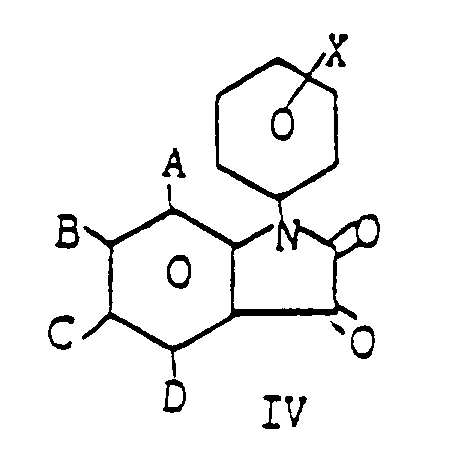
- Ein Verfahren zur N-Arylierung von Isatinen der Formel Ia, umfassend:(a) die Umsetzung einer Verbindung der Formel I, wobei C entweder Carboxymethyl oder Aminoethyl ist,
 (b) mit einer Verbindung der Formel II:

 (c) in der Gegenwart eines Kupferkatalysators, wobei ein N-aryliertes Isatin der Formel IVa entsteht:
- Das Verfahren gemäß Anspruch 1 oder 2, wobei R* aus Wasserstoff, Alkyl, halogensubstituiertem Alkyl, oder Cyano-alkyl ausgewählt ist.
- Das Verfahren gemäß Anspruch 3, wobei R* aus Trifluormethyl oder Methyl gewählt ist.
- Ein Verfahren gemäß Anspruch 1 oder 2, wobei die Reaktionsmischung während der Reaktion zur Rückflußtemperatur erhitzt wird.
- Ein Verfahren zur Darstellung eines Acridins der Formel V
 (a) die Umsetzung einer Verbindung der Formel I
 (b) mit einer Verbindung der Formel II
 (c) in Gegenwart eines Kupferkatalysators zur Bildung eines N-arylierten Isatins der Formel IV
 (d) und die Behandlung des N-arylierten Isatins der FormelIV mit einer starken Base und Wärme zur Bildung einer Verbindung der Formel V
- Ein Verfahren zur Darstellung eines Acridins der Formel Va
 (a) die Umsetzung einer Verbindung der Formel Ia
 (b) mit einer Verbindung der Formel II
 (c) in Gegenwart eines Kupferkatalysators zur Darstellung eines N-arylierten Isatins der Formel IVa
 (d) und die Behandlung des N-arylierten Isatins der Formel IVa mit einer starken Base und Wärme zur Darstellung einer Verbindung der Formel Va
- Das Verfahren der Ansprüche 6 oder 7, wobei R* gewählt ist aus Wasserstoff, Alkyl, halogensubstituiertem Alkyl oder Cyano-Alkyl.
- Das Verfahren von Anspruch 8, wobei R* gewählt ist aus Trifluormethyl oder Methyl.
- Das Verfahren von Anspruch 6 oder 7, wobei die Verbindung der Formel II in situ entsteht durch Umsetzung einer Verbindung der Formel


Priority Applications (1)
| Application Number | Priority Date | Filing Date | Title |
|---|---|---|---|
| AT89120863T ATE103895T1 (de) | 1988-11-15 | 1989-11-10 | N-arylierung von isatinen. |
Applications Claiming Priority (2)
| Application Number | Priority Date | Filing Date | Title |
|---|---|---|---|
| US27179988A | 1988-11-15 | 1988-11-15 | |
| US271799 | 1988-11-15 |
Publications (2)
| Publication Number | Publication Date |
|---|---|
| EP0369344A1 EP0369344A1 (de) | 1990-05-23 |
| EP0369344B1 true EP0369344B1 (de) | 1994-04-06 |
Family
ID=23037139
Family Applications (1)
| Application Number | Title | Priority Date | Filing Date |
|---|---|---|---|
| EP89120863A Expired - Lifetime EP0369344B1 (de) | 1988-11-15 | 1989-11-10 | N-Arylierung von Isatinen |
Country Status (8)
| Country | Link |
|---|---|
| EP (1) | EP0369344B1 (de) |
| JP (1) | JPH02193966A (de) |
| KR (1) | KR900007800A (de) |
| AT (1) | ATE103895T1 (de) |
| AU (1) | AU630122B2 (de) |
| CA (1) | CA2002708A1 (de) |
| DE (1) | DE68914403T2 (de) |
| ES (1) | ES2054986T3 (de) |
Families Citing this family (12)
| Publication number | Priority date | Publication date | Assignee | Title |
|---|---|---|---|---|
| US5208228A (en) * | 1989-11-13 | 1993-05-04 | Merck & Co., Inc. | Aminomacrolides and derivatives having immunosuppressive activity |
| US5162334A (en) * | 1991-05-13 | 1992-11-10 | Merck & Co., Inc. | Amino O-alkyl, O-alkenyl and O-alkynlmacrolides having immunosuppressive activity |
| US5250678A (en) * | 1991-05-13 | 1993-10-05 | Merck & Co., Inc. | O-aryl, O-alkyl, O-alkenyl and O-alkynylmacrolides having immunosuppressive activity |
| US5565560A (en) * | 1991-05-13 | 1996-10-15 | Merck & Co., Inc. | O-Aryl,O-alkyl,O-alkenyl and O-alkynylmacrolides having immunosuppressive activity |
| US5189042A (en) * | 1991-08-22 | 1993-02-23 | Merck & Co. Inc. | Fluoromacrolides having immunosuppressive activity |
| US5208241A (en) * | 1991-09-09 | 1993-05-04 | Merck & Co., Inc. | N-heteroaryl, n-alkylheteroaryl, n-alkenylheteroaryl and n-alkynylheteroarylmacrolides having immunosuppressive activity |
| US5395752A (en) * | 1993-03-19 | 1995-03-07 | Ciba Corning Diagnostics Corp. | Long emission wavelength chemiluminescent compounds and their use in test assays |
| DE4314318A1 (de) * | 1993-04-30 | 1994-11-03 | Henkel Kgaa | Isatinderivate zum Färben von keratinhaltigen Fasern |
| US5693648A (en) * | 1994-09-30 | 1997-12-02 | Merck & Co., Inc. | O-aryl, O-alkyl, O-alkenyl and O-alkynyl-macrolides having immunosuppressive activity |
| WO2001002394A1 (en) | 1999-07-01 | 2001-01-11 | Geron Corporation | Substituted indole compounds and their use for the treatment of cancer |
| DE102006046330A1 (de) * | 2006-09-28 | 2008-04-03 | Bayer Materialscience Ag | Polycarbonate und Copolycarbonate mit verbesserter Metallhaftung |
| EP2527324A4 (de) | 2010-01-20 | 2013-08-07 | Mitsubishi Gas Chemical Co | Cyanatesterverbindung und härteprodukt daraus |
Family Cites Families (1)
| Publication number | Priority date | Publication date | Assignee | Title |
|---|---|---|---|---|
| DE3279029D1 (en) * | 1981-12-11 | 1988-10-20 | Welsh Nat School Med | Luminescent labelling materials and procedures |
-
1989
- 1989-11-08 AU AU44483/89A patent/AU630122B2/en not_active Ceased
- 1989-11-10 DE DE68914403T patent/DE68914403T2/de not_active Expired - Fee Related
- 1989-11-10 EP EP89120863A patent/EP0369344B1/de not_active Expired - Lifetime
- 1989-11-10 AT AT89120863T patent/ATE103895T1/de active
- 1989-11-10 CA CA002002708A patent/CA2002708A1/en not_active Abandoned
- 1989-11-10 ES ES89120863T patent/ES2054986T3/es not_active Expired - Lifetime
- 1989-11-14 KR KR1019890016449A patent/KR900007800A/ko not_active Withdrawn
- 1989-11-14 JP JP1296010A patent/JPH02193966A/ja active Pending
Also Published As
| Publication number | Publication date |
|---|---|
| ES2054986T3 (es) | 1994-08-16 |
| DE68914403T2 (de) | 1994-07-21 |
| DE68914403D1 (de) | 1994-05-11 |
| AU630122B2 (en) | 1992-10-22 |
| JPH02193966A (ja) | 1990-07-31 |
| AU4448389A (en) | 1990-05-24 |
| EP0369344A1 (de) | 1990-05-23 |
| CA2002708A1 (en) | 1990-05-15 |
| KR900007800A (ko) | 1990-06-02 |
| ATE103895T1 (de) | 1994-04-15 |
Similar Documents
| Publication | Publication Date | Title |
|---|---|---|
| EP0369344B1 (de) | N-Arylierung von Isatinen | |
| GB1567862A (en) | Tetracyclic derivatives | |
| FR2655988A1 (fr) | Nouveaux derives de la napht-1-yl piperazine, leur procede de preparation et les compositions pharmaceutiques qui les contiennent. | |
| US3074931A (en) | Dibenzazepines | |
| JPS5912667B2 (ja) | ピリジン誘導体の製造法 | |
| EP0172004A2 (de) | Chinolinone, Verfahren zu ihrer Herstellung und die sie enthaltenden pharmazeutischen Präparate | |
| US5151518A (en) | N-arylation of isatins | |
| Butin et al. | Furan ring opening‐indole ring closure: Synthesis of furo [2′, 3′: 3, 4]‐cyclohepta [1, 2‐b] indolium chlorides | |
| AU594858B2 (en) | Process and intermediates for quinolonecarboxylic acid | |
| US4258191A (en) | Multi-step process for the production of methanesulfon-m-anisidide, 4'-(9-acridinylamino)- | |
| CA2052287A1 (en) | Tricyclic heterocyclic compounds, their production and use | |
| US5602131A (en) | EburnanE analogues | |
| US4575553A (en) | Antitumor m-AMSA analog | |
| SU1487811A3 (ru) | СПОСОБ ПОЛУЧЕНИЯ ПРОИЗВОДНЫХ 12-АМИНО-ПИРИДАЗИНО [4 ’, 51 : 3,4 )ПИРРОЛО[2,1—а)ИЗОХИНОЛИНА,ИЛИ ИХ ФИЗИОЛОГИЧЕСКИ ПЕРЕНОСИМЫХ КИСЛОТНО-, АДДИТИВНЫХ СОЛЕЙ ' | |
| JPH0524158B2 (de) | ||
| EP0934277B1 (de) | Verfahren zur herstellung von n-[2-(dimethylamino)ethyl]akridin-4-carbonsäureamide | |
| CA1137489A (en) | Derivatives of 1,2,3,3a,8,8a-hexadydropyrrolo (2,3-b) indole | |
| US6162822A (en) | Bisimide compounds | |
| GB2113682A (en) | 3,3 dialkyl or 3,3 alkene indolines | |
| JPH07121931B2 (ja) | ベンゾ〔b〕フラン誘導体 | |
| US3047572A (en) | Dimethylaminophenotfflazine | |
| EP1125940B1 (de) | Derivate von Aryl- oder Heteroaryl-Quinolinylphosphonsäuren, Verfahren zu ihrer Herstellung und sie enthaltende Arzneimittel | |
| Döpp et al. | Dicyanomethylene compounds as cyanation reagents | |
| Mann | 614. 1: 2-Disubstituted 3-aminoindoles. Part I. Preparation and reactions | |
| SU999967A3 (ru) | Способ получени 6-N-замещенных 6-амино-3-пиридазинилгидразинов или их солей |
Legal Events
| Date | Code | Title | Description |
|---|---|---|---|
| PUAI | Public reference made under article 153(3) epc to a published international application that has entered the european phase |
Free format text: ORIGINAL CODE: 0009012 |
|
| AK | Designated contracting states |
Kind code of ref document: A1 Designated state(s): AT BE CH DE ES FR GB IT LI NL |
|
| 17P | Request for examination filed |
Effective date: 19901119 |
|
| 17Q | First examination report despatched |
Effective date: 19920623 |
|
| GRAA | (expected) grant |
Free format text: ORIGINAL CODE: 0009210 |
|
| AK | Designated contracting states |
Kind code of ref document: B1 Designated state(s): AT BE CH DE ES FR GB IT LI NL |
|
| REF | Corresponds to: |
Ref document number: 103895 Country of ref document: AT Date of ref document: 19940415 Kind code of ref document: T |
|
| REF | Corresponds to: |
Ref document number: 68914403 Country of ref document: DE Date of ref document: 19940511 |
|
| ITF | It: translation for a ep patent filed | ||
| ET | Fr: translation filed | ||
| REG | Reference to a national code |
Ref country code: ES Ref legal event code: FG2A Ref document number: 2054986 Country of ref document: ES Kind code of ref document: T3 |
|
| PGFP | Annual fee paid to national office [announced via postgrant information from national office to epo] |
Ref country code: GB Payment date: 19941017 Year of fee payment: 6 |
|
| PGFP | Annual fee paid to national office [announced via postgrant information from national office to epo] |
Ref country code: AT Payment date: 19941020 Year of fee payment: 6 |
|
| PGFP | Annual fee paid to national office [announced via postgrant information from national office to epo] |
Ref country code: FR Payment date: 19941114 Year of fee payment: 6 |
|
| PGFP | Annual fee paid to national office [announced via postgrant information from national office to epo] |
Ref country code: ES Payment date: 19941116 Year of fee payment: 6 |
|
| PGFP | Annual fee paid to national office [announced via postgrant information from national office to epo] |
Ref country code: NL Payment date: 19941130 Year of fee payment: 6 Ref country code: DE Payment date: 19941130 Year of fee payment: 6 |
|
| PGFP | Annual fee paid to national office [announced via postgrant information from national office to epo] |
Ref country code: BE Payment date: 19941205 Year of fee payment: 6 |
|
| PGFP | Annual fee paid to national office [announced via postgrant information from national office to epo] |
Ref country code: CH Payment date: 19950109 Year of fee payment: 6 |
|
| PLBE | No opposition filed within time limit |
Free format text: ORIGINAL CODE: 0009261 |
|
| 26N | No opposition filed | ||
| PG25 | Lapsed in a contracting state [announced via postgrant information from national office to epo] |
Ref country code: GB Effective date: 19951110 Ref country code: AT Effective date: 19951110 |
|
| PG25 | Lapsed in a contracting state [announced via postgrant information from national office to epo] |
Ref country code: ES Free format text: LAPSE BECAUSE OF NON-PAYMENT OF DUE FEES Effective date: 19951111 |
|
| PG25 | Lapsed in a contracting state [announced via postgrant information from national office to epo] |
Ref country code: LI Effective date: 19951130 Ref country code: CH Effective date: 19951130 Ref country code: BE Effective date: 19951130 |
|
| BERE | Be: lapsed |
Owner name: ABBOTT LABORATORIES Effective date: 19951130 |
|
| PG25 | Lapsed in a contracting state [announced via postgrant information from national office to epo] |
Ref country code: NL Effective date: 19960601 |
|
| GBPC | Gb: european patent ceased through non-payment of renewal fee |
Effective date: 19951110 |
|
| REG | Reference to a national code |
Ref country code: CH Ref legal event code: PL |
|
| PG25 | Lapsed in a contracting state [announced via postgrant information from national office to epo] |
Ref country code: FR Effective date: 19960731 |
|
| NLV4 | Nl: lapsed or anulled due to non-payment of the annual fee |
Effective date: 19960601 |
|
| PG25 | Lapsed in a contracting state [announced via postgrant information from national office to epo] |
Ref country code: DE Effective date: 19960801 |
|
| REG | Reference to a national code |
Ref country code: FR Ref legal event code: ST |
|
| REG | Reference to a national code |
Ref country code: ES Ref legal event code: FD2A Effective date: 19961213 |
|
| PG25 | Lapsed in a contracting state [announced via postgrant information from national office to epo] |
Ref country code: IT Free format text: LAPSE BECAUSE OF NON-PAYMENT OF DUE FEES;WARNING: LAPSES OF ITALIAN PATENTS WITH EFFECTIVE DATE BEFORE 2007 MAY HAVE OCCURRED AT ANY TIME BEFORE 2007. THE CORRECT EFFECTIVE DATE MAY BE DIFFERENT FROM THE ONE RECORDED. Effective date: 20051110 |