EP0369525A1 - Procédé de production d'une texture à armure de gaze - Google Patents
Procédé de production d'une texture à armure de gaze Download PDFInfo
- Publication number
- EP0369525A1 EP0369525A1 EP19890202828 EP89202828A EP0369525A1 EP 0369525 A1 EP0369525 A1 EP 0369525A1 EP 19890202828 EP19890202828 EP 19890202828 EP 89202828 A EP89202828 A EP 89202828A EP 0369525 A1 EP0369525 A1 EP 0369525A1
- Authority
- EP
- European Patent Office
- Prior art keywords
- thread
- plane
- stationary
- weaving
- crossing
- Prior art date
- Legal status (The legal status is an assumption and is not a legal conclusion. Google has not performed a legal analysis and makes no representation as to the accuracy of the status listed.)
- Granted
Links
Images




Classifications
-
- D—TEXTILES; PAPER
- D03—WEAVING
- D03C—SHEDDING MECHANISMS; PATTERN CARDS OR CHAINS; PUNCHING OF CARDS; DESIGNING PATTERNS
- D03C7/00—Leno or similar shedding mechanisms
- D03C7/06—Mechanisms having eyed needles for moving warp threads from side to side of other warp threads
Definitions
- the present invention relates to a method for producing a leno or cross weaving texture.
- Some methods belonging to a first type thereof take advantage of the successive and alternate tensioning and releasing of two warp threads moving to both sides of another warp thread -- called "stationary-thread" --, slidingly connected with each other, so as to cause the crossing-thread(s) to shift to the one or to the other sides of the stationary-thread, with the desired textile effect of crossing of the crossing-thread(s) with the stationary-thread being consequently achieved.
- a method of a second type exploits, on the contrary, the combined action of a set of special heddles -- called "English leno or crossing weaving units" -- in order to obtain the successive crossing of the stationary-thread and of the crossing-thread for generating the leno or cross weaving texture.
- the first type of methods some of which enable the speeds rendered possible by the modern needle weaving planes (more than 2,000 weft insertions per minute) to be fully exploited, mandatorily require that mechanisms be provided which make it possible some warp threads to be successively tensioned and released, with said warp threads undergoing strong stretches, and rendering more complex the initial threading of the threads through the same weaving plane.
- the purpose of the method according to the present invention is of providing a solution for overcoming the limitations which affect the above said methods known from the prior art, thus making it possible the actual capabilities of the modern weaving planes to be fully taken advantage of, while simultaneously simplifying their threading system and offering a high flexibility of realization.
- This purpose is achieved by means of a method for producing a leno or cross weaving texture in which, alternatingly with successive weft insertions, a first warp thread gets crossed with at least one second warp thread, on the one side and on the other one side relatively to said at least one second warp thread, with said first warp thread, also said "crossing-thread”, being provided with both transversal and perpendicular movement to the weaving plane, and said at least one second warp thread, also said "stationary-thread”, being provided with only perpendicular movement to the weaving plane, said method being characterized in that it comprises the steps of: ⁇ providing a line segment connecting, upstream a beating reed, two planes perpendicular to the weaving plane and laying: the one plane, on one side of the stationary thread, and the other one plane on the other side of said at least one stationary thread, with both of said planes being parallel to said at least one stationary thread, ⁇ inclining said line segment so as to cause said line segment
- Said line segment can be composed by a plurality of segments, and e.g., any portions or set of portions of at least one thread constituted by either natural or artificial fibres, of plastic thread or of metal thread can be taken into consideration, which is destined to become a part of the fabric which is being formed, and is used for this specific function of realizing the shift of the crossing-thread from either side to the other side of the stationary-thread(s), by being moved in a per se known way, by connecting, e.g., two heals situated on opposite sides relatively to said stationary-thread(s).
- the thread(s) which constitute(s) said line segment can then, one of them, a portion of them, or all of them, perform the function of stationary-threads in the end fabric, or can make a part as well of that portion of the fabric which is not a part of the gauze interlacement.
- one, a portion of, or all of, the further at least one warp thread(s) which constitute(s) the line segment in question can remain inside the fabric only along a short distance downstream the point wherein the fabric is formed, in that said fabric gets disengaged from said warp thread(s) during and thanks to its movement of production progressing.
- the line segment could also be at least a length of at least one thread which just connects organs, such as, e.g., two normal healds, which shift it by inclining it according to the desired sequential cycles and in the proper directions.
- a normal weaving plane is used, which is previously provided, according to known techniques, with more or less advanced devices for moving, according to desired and presettable sequential cycles, the healds of the warp threads for the purpose of forming the shed through which other devices, also known from the prior art, subsequently insert the weft thread.
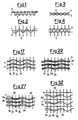
- Figure 1 relevant to the warp profile, shows the non-essential feature of the stationary-thread remaining always on one side relatively to the weft, indicated by the reference numeral 3 in its various insertions, around which, on the contrary, the crossing-thread 2 gets interlaced.
- the textile pattern shown in Figure 2 makes it possible the feature -- essential for the gauze interlacement -- to be seen, of the crossing-wire 2 getting crossed with the stationary-thread 1, by being alternatively shifted, according to predetermined sequences, to the one and to the other side of the same stationary thread.
- the action of this crossing as one will easily understand, fixes both of these threads in the fabric much better than same threads would do by getting tied with the weft insertions, while remaining parallel to each other. It is precisely this feature which characterizes the so-said "leno or cross weaving texture"; in fact, the same word “leno” means "light open texture fabric", i.e.
- Figures 3 and 4 show how the stationary-thread 1 and the crossing-thread 2 get arranged in practice owing to the effects of the tensions and of the natural flexibility of the threads which constitute the textile interlacement. From these figures, one will easily see that the definition of "crossing-thread” and “stationary-thread” loses its ground for being once that both of said threads have been incorporated in the fabric in that, as said Figures precisely show, in the finished fabric they cannot be any longer distinguished from each other.
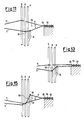
- Figure 5 and, in plan view, also Figure 6, show a first step of a first example of practical embodiment of the process according to the present invention in order to cross two warp threads, i.e., a crossing-thread 4 and a stationary-thread 7, with each other.
- the crossing-thread 4 is, threaded through the hole of a first heald 5, in the top position of a shed 6, whilst the stationary-thread 7 is in the opposite position, threaded first through the hole of a second heald 8 and then through the hole of a third heald 9 having a particular shape.
- the third heald 9 in this particular form of practical embodiment of the present invention, is provided with an arm 9a extending from it and along a short distance parallel to it, so as to define a gap 11.
- a length, or a portion 10, of the stationary thread 7, running between the threading holes of the two healds 8 and 9 which move it, constitutes a line segment.
- Said line segment 10 can be inclined, so as to cross a weaving plane, indicated by the character "C" in Figure 5, alternatively on the one half-plane and on the opposite half-plane of the same weaving plane, which is defined as the plane on which the fabric is formed, and is subdivided into said half-planes by the stationary-thread 7.
- the inclined line segment 10 is such as to cause the crossing-thread 4 to alternatively shift to both sides of the stationary-thread 7.
- the inclination of the length, or line segment 10, of the stationary-thread 7 is such as to move the crossing-thread 4 to run, during its subsequent movement in order to come to the opposite position of the shed 6, along its surface, until said crossing-thread 4 enters the gap provided on the third heald 9.
- the line segment constituted by the length 10 of stationary thread 7 connects two planes, or two sets of planes, indicated in chain line in A and B, perpendicular to the weaving plane C and laying parallel to the stationary-thread, on both sides of this latter.
- a beating reed 12 beats then a first weft insertion taken into consideration 13, up to bring it to rest against the weft insertions already inserted in the fabric, before the healds are moved in order to invert the positions of the threads in the shed 6.
- FIG 7 shows an intermediante time point, in which the shed 6 is practically closed, between the steps of the preceding Figures 5 and 6 and the step depicted in following Figures 9 and 10.
- the crossing-thread 4 has ended its sliding, and has entered the gap 11 of the third heald 9, thus getting shifted and coming to lay on a plane A perpendicular to the weaving plane C and parallel to the stationary-thread 7, but on the opposite side relatively to the side on which it was during the initial step shown in Figures 5 and 6, on one plane from the set of planes B.
- Figures 13 and 14 show an intermediate point of time between the step shown by Figures 11 and 12, and the step shown by the subsequent Figures 15 and 16.
- the crossing-thread 4 is not deviated now, during its movement of shifting towards the opposite side of the shed 6, by the inclined length 10 of the stationary-thread 4.
- Such a stationary-thread length 10, with the herein shown inclination enables hence said crossing-thread 4 to simply completely move on a plane perpendicular to the weaving plane C, without any motion components parallel to said weaving plane, but it does not constitute, in this step of this particular form of practical embodiment of the present invention, a sliding line which may cause the crossing-thread to shift parallelly to the weaving plane.
- FIG 17 a schematic view can be seen of a portion of a gauze fabric, or of a leno or cross weaving texture, manufactured according to the exemplifying form of practical embodiment of the method proposed by the present invention, as disclosed by the Figures from 5 to 16.
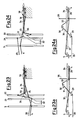
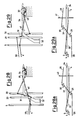
- Figures from 18 to 22 and from 18a to 22a show another possible exemplifying form of possible practical embodiment of the method proposed according to the present invention, in which for same components same reference numerals are used, and in which two warp threads 17 and 18 are provided, which are destined to act as stationary-threads.
- the line segment which can be inclined in order to cause the crossing-thread 4 to slide during its movement of shifting to the one, or to the other one, of the sides of the two stationary-threads 17 and 18, is actually constituted by two lengths 21 and 22 of the same two different stationary threads 17 and 18 so as to form, from a strictly geometrical point of view, not one only, but two different line segments.
- the crossing-thread 4 moved by the corresponding heald 5 is in the top position of the shed 6 and before going to the fabric being formed, runs above a first weft insertion 24, through a "V" region formed by two lengths 21 and 22 of the stationary threads 17 and respectively 18.
- each one of the lifted healds 19 and 20 relatively to the further, lowered, heald 23 determines the inclinations of both lengths 21 and 22 of the stationary-threads which, in their turn, cause the shifting of the crossing-thread 4 to the one side and to the other side of the further heald 23, and therefore of the stationaty-threads 17 and 18 coming together into the hole thereof, and exiting it, such as to define the two half-planes into which the weaving plane C is subdivided.
- the movement of the further heald 23 is decided on the basis of the desired textile interlacement between weft insertions 24 and following, and the stationary-threads 17 and 18.
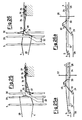
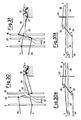
- the crossing-thread 4 by getting crossed with the metal blade 34, is obliged to form loop portions, or loops, 39, around it, which loops are of size and shape corresponding to those of the cross-section of said metal blade so that, as the fabric gets disengaged from said metal blade, only the loops remain, which loops precisely protrude outwards from the fabric with a stationary-thread 28 being inside them. More precisely, the element for keeping raised portions of the crossing-thread 4 is positioned in correspondence of at least one portion of the stationary-thread 28, denominated "line segment" and indicated by the reference numeral 31, and under it.
- the crossing-thread 4 is in the bottom position of the shed 6, looking at the figure, and is before the metal blade 34 and the stationary-thread 28 positioned above a weft insertion 35.
- a portion, or line segment, 31 of the stationary thread 28, thanks to the lowered position of a heald 29 and to the simultaneously lifted position of the heald 30, is inclined towards a plane B on the same side as of the heald 29.
- the stationary-thread runs through the holes of such healds 29 and 30 before also running through the hole 33 of the metal blade 34 which returns it back to a stable position, parallel to the weaving plane, alongside of the same metal blade.
- the crossing-thread 4 After a weft insertion 37, in Figures 26 and 26a, the crossing-thread 4 returns back to its top position, with the healds 29 and 30 which control the stationary-thread 24 simultaneously inverting again their position, so that the inclination of the length 31 will be now in the suitable direction for a further crossing to be caused to occur between the stationary thread 28 and the crossing-thread 4.
- the weaving method called "gauze weaving” has in fact been used here for the only purpose of creating the loops 39 thanks to the crossing of the crossing-thread 4 which constitutes them, with the metal blade 34 replacing, at least for a certain length inside the fabric, the stationary-thread.
- Such a method is essentially characterized by the use of one or more line segments which can be alternatively inclined towards the one side, or towards the other side, of the at least one stationary-thread provided, and constituted by lengths of warp threads on whose surface the crossing-thread is caused to slide, thus being alternatively shifted, owing to the effect of such different inclinations, to the one side and to the other side of the same at least one stationary-thread: only thanks to such one or more inclined sliding length(s) the possibility is given of accomplishing the gauze interlacement in all of its possible and imaginable variants, due to the function performed by these lengths, of causing the crossing-thread, according to presettable sequential cycles, to slide to opposite regions of the shed, and to opposite half-weaving planes relatively to the stationary-thread.
- the same at least one inclined sliding length can be accomplished, and/or thought of, in several ways and positions.
- the essential characteristic thereof is that it should perform the hereinabove illustrated functions in order that the leno or cross weaving texture can be obtained by means of the sliding which said inclined sliding length will cause the crossing-thread to undergo, in order that said crossing-thread is brought to cross with the stationary-thread.
- the stationary-thread can be accompanied by other warp threads, with each of said threads performing its independent movements in its own shed and perpendicularly to the weaving plane: the crossing-thread will perform its movements getting crossed with this set of warp threads.
Landscapes
- Engineering & Computer Science (AREA)
- Textile Engineering (AREA)
- Looms (AREA)
- Treatments For Attaching Organic Compounds To Fibrous Goods (AREA)
- Woven Fabrics (AREA)
- Adornments (AREA)
- Knitting Of Fabric (AREA)
Applications Claiming Priority (2)
| Application Number | Priority Date | Filing Date | Title |
|---|---|---|---|
| IT2262488 | 1988-11-15 | ||
| IT8822624A IT1230646B (it) | 1988-11-15 | 1988-11-15 | Metodo per la realizzazione di un intreccio tessile a garza. |
Publications (2)
| Publication Number | Publication Date |
|---|---|
| EP0369525A1 true EP0369525A1 (fr) | 1990-05-23 |
| EP0369525B1 EP0369525B1 (fr) | 1997-01-15 |
Family
ID=11198560
Family Applications (1)
| Application Number | Title | Priority Date | Filing Date |
|---|---|---|---|
| EP89202828A Expired - Lifetime EP0369525B1 (fr) | 1988-11-15 | 1989-11-08 | Procédé de production d'une texture à armure de gaze |
Country Status (8)
| Country | Link |
|---|---|
| US (1) | US5085253A (fr) |
| EP (1) | EP0369525B1 (fr) |
| JP (1) | JPH0762289B2 (fr) |
| AT (1) | ATE147802T1 (fr) |
| DE (1) | DE68927664T2 (fr) |
| ES (1) | ES2096555T3 (fr) |
| GR (1) | GR3022602T3 (fr) |
| IT (1) | IT1230646B (fr) |
Cited By (1)
| Publication number | Priority date | Publication date | Assignee | Title |
|---|---|---|---|---|
| US6311737B2 (en) | 2000-02-02 | 2001-11-06 | Lindauer Dornier Gesellschaft Mbh | Method and weaving loom for producing a leno ground fabric |
Families Citing this family (5)
| Publication number | Priority date | Publication date | Assignee | Title |
|---|---|---|---|---|
| GB9814971D0 (en) * | 1998-07-11 | 1998-09-09 | Griffith Textile Mach Ltd | Leno weaving |
| GB2426253B (en) * | 2005-05-20 | 2009-11-25 | Griffith Textile Mach Ltd | Apparatus and a method for weaving leno fabric |
| BR112014021318B1 (pt) * | 2012-03-01 | 2020-12-01 | Groz-Beckert Kg | tecido para ser utilizado em materiais compostos e processo para a produção do tecido e de um corpo de material composto |
| BE1022146B1 (nl) * | 2014-06-13 | 2016-02-19 | Picanol | Zelfkantvormingsinrichting voor een inslagdraad |
| US10905188B2 (en) * | 2016-07-19 | 2021-02-02 | Bradford C. Jamison | Plexus of filaments with linked members |
Citations (3)
| Publication number | Priority date | Publication date | Assignee | Title |
|---|---|---|---|---|
| DE42013C (de) * | L. RICHTER in Berlin SO., Gräfestrafse 82 I | Webstuhl für gazebindige Gewebe | ||
| US1416410A (en) * | 1921-11-03 | 1922-05-16 | Draper Corp | Leno or cross-weaving loom |
| EP0253451A2 (fr) * | 1986-07-18 | 1988-01-20 | Carmelo Motta | Méthode simplifiée pour obtenir un entrelacement textile du type dit à gaze |
Family Cites Families (5)
| Publication number | Priority date | Publication date | Assignee | Title |
|---|---|---|---|---|
| US2187540A (en) * | 1937-11-05 | 1940-01-16 | Boller Winkler & Co | Manufacture of full-cross gauze fabrics |
| US2278862A (en) * | 1941-06-25 | 1942-04-07 | Octave P Caron | Loom |
| US2389258A (en) * | 1944-07-08 | 1945-11-20 | Steel Heddle Mfg Co | Harness for cross-weaving |
| US2647541A (en) * | 1951-02-17 | 1953-08-04 | Draper Corp | Leno weaving |
| JPH0243902Y2 (fr) * | 1985-12-05 | 1990-11-21 |
-
1988
- 1988-11-15 IT IT8822624A patent/IT1230646B/it active
-
1989
- 1989-11-08 EP EP89202828A patent/EP0369525B1/fr not_active Expired - Lifetime
- 1989-11-08 DE DE68927664T patent/DE68927664T2/de not_active Expired - Lifetime
- 1989-11-08 AT AT89202828T patent/ATE147802T1/de not_active IP Right Cessation
- 1989-11-08 ES ES89202828T patent/ES2096555T3/es not_active Expired - Lifetime
- 1989-11-09 US US07/433,791 patent/US5085253A/en not_active Expired - Lifetime
- 1989-11-15 JP JP1295166A patent/JPH0762289B2/ja not_active Expired - Fee Related
-
1997
- 1997-02-19 GR GR970400287T patent/GR3022602T3/el unknown
Patent Citations (3)
| Publication number | Priority date | Publication date | Assignee | Title |
|---|---|---|---|---|
| DE42013C (de) * | L. RICHTER in Berlin SO., Gräfestrafse 82 I | Webstuhl für gazebindige Gewebe | ||
| US1416410A (en) * | 1921-11-03 | 1922-05-16 | Draper Corp | Leno or cross-weaving loom |
| EP0253451A2 (fr) * | 1986-07-18 | 1988-01-20 | Carmelo Motta | Méthode simplifiée pour obtenir un entrelacement textile du type dit à gaze |
Cited By (1)
| Publication number | Priority date | Publication date | Assignee | Title |
|---|---|---|---|---|
| US6311737B2 (en) | 2000-02-02 | 2001-11-06 | Lindauer Dornier Gesellschaft Mbh | Method and weaving loom for producing a leno ground fabric |
Also Published As
| Publication number | Publication date |
|---|---|
| ATE147802T1 (de) | 1997-02-15 |
| US5085253A (en) | 1992-02-04 |
| JPH0762289B2 (ja) | 1995-07-05 |
| ES2096555T3 (es) | 1997-03-16 |
| IT1230646B (it) | 1991-10-28 |
| DE68927664D1 (de) | 1997-02-27 |
| DE68927664T2 (de) | 1997-07-31 |
| IT8822624A0 (it) | 1988-11-15 |
| JPH02210040A (ja) | 1990-08-21 |
| GR3022602T3 (en) | 1997-05-31 |
| EP0369525B1 (fr) | 1997-01-15 |
Similar Documents
| Publication | Publication Date | Title |
|---|---|---|
| EP1900861A1 (fr) | Procédé de tissage d'une étoffe et étoffe tissée selon ce procédé | |
| US5085253A (en) | Leno weaving with stationary warp threads and shifting cross threads | |
| US3746051A (en) | Machine for making a partly woven and partly knitted fabric | |
| US2318080A (en) | Loop pile fabric and method and apparatus for weaving same | |
| US4406309A (en) | Method and apparatus for forming a woven pile fabric | |
| US3499471A (en) | Method of weaving velvet tapes and the like | |
| US3976106A (en) | Method of making a slide fastener | |
| US3512378A (en) | Lace-knitting machine | |
| US3550642A (en) | Catch cord lockstitch selvage method and mechanism for producing same | |
| JPS6375138A (ja) | いわゆるゴ−ズ型の繊維のインタ−レ−スを達成する簡素化された方法 | |
| US3664380A (en) | Loom with traveling shed | |
| US3199542A (en) | Apparatus for weaving pile fabrics | |
| US3636988A (en) | Apparatus and method for weaving fabric with intricate pile formations | |
| US3256913A (en) | Crossing formation on fabrics | |
| US2141409A (en) | Lace fabric | |
| JPH0860490A (ja) | 湾曲付き針によるビーズ織り機 | |
| SU942736A1 (ru) | Многоканальный протез кровеносного сосуда | |
| US2418775A (en) | Art of weaving wide mesh fabric | |
| US2073494A (en) | Method of and means for producing textile fabrics | |
| US764208A (en) | Woven lace fabric. | |
| GB2078795A (en) | Combined knitting and weaving process for fabric forming | |
| JP2516521B2 (ja) | 3次元構造織物の連続糸挿入による耳形成法 | |
| US1992862A (en) | Pile fabric and method of and apparatus for weaving the same | |
| SU1101482A1 (ru) | Способ формировани ткани на ткацком станке | |
| US4431035A (en) | Woven fabric with covered edges and method of a manufacture |
Legal Events
| Date | Code | Title | Description |
|---|---|---|---|
| PUAI | Public reference made under article 153(3) epc to a published international application that has entered the european phase |
Free format text: ORIGINAL CODE: 0009012 |
|
| AK | Designated contracting states |
Kind code of ref document: A1 Designated state(s): AT BE CH DE ES FR GB GR LI LU NL SE |
|
| RAP1 | Party data changed (applicant data changed or rights of an application transferred) |
Owner name: YOSHIDA KOGYO K.K. |
|
| RIN1 | Information on inventor provided before grant (corrected) |
Inventor name: MOTTA,CARMELO |
|
| 17P | Request for examination filed |
Effective date: 19901017 |
|
| 17Q | First examination report despatched |
Effective date: 19920721 |
|
| RAP1 | Party data changed (applicant data changed or rights of an application transferred) |
Owner name: YKK CORPORATION |
|
| GRAH | Despatch of communication of intention to grant a patent |
Free format text: ORIGINAL CODE: EPIDOS IGRA |
|
| GRAH | Despatch of communication of intention to grant a patent |
Free format text: ORIGINAL CODE: EPIDOS IGRA |
|
| GRAA | (expected) grant |
Free format text: ORIGINAL CODE: 0009210 |
|
| AK | Designated contracting states |
Kind code of ref document: B1 Designated state(s): AT BE CH DE ES FR GB GR LI LU NL SE |
|
| REF | Corresponds to: |
Ref document number: 147802 Country of ref document: AT Date of ref document: 19970215 Kind code of ref document: T |
|
| REG | Reference to a national code |
Ref country code: CH Ref legal event code: EP |
|
| REF | Corresponds to: |
Ref document number: 68927664 Country of ref document: DE Date of ref document: 19970227 |
|
| REG | Reference to a national code |
Ref country code: CH Ref legal event code: NV Representative=s name: AMMANN PATENTANWAELTE AG BERN |
|
| REG | Reference to a national code |
Ref country code: ES Ref legal event code: FG2A Ref document number: 2096555 Country of ref document: ES Kind code of ref document: T3 |
|
| ET | Fr: translation filed | ||
| REG | Reference to a national code |
Ref country code: GR Ref legal event code: FG4A Free format text: 3022602 |
|
| PLBE | No opposition filed within time limit |
Free format text: ORIGINAL CODE: 0009261 |
|
| STAA | Information on the status of an ep patent application or granted ep patent |
Free format text: STATUS: NO OPPOSITION FILED WITHIN TIME LIMIT |
|
| 26N | No opposition filed | ||
| REG | Reference to a national code |
Ref country code: GB Ref legal event code: IF02 |
|
| PGFP | Annual fee paid to national office [announced via postgrant information from national office to epo] |
Ref country code: NL Payment date: 20081116 Year of fee payment: 20 Ref country code: LU Payment date: 20081119 Year of fee payment: 20 Ref country code: CH Payment date: 20081117 Year of fee payment: 20 Ref country code: DE Payment date: 20081107 Year of fee payment: 20 |
|
| PGFP | Annual fee paid to national office [announced via postgrant information from national office to epo] |
Ref country code: ES Payment date: 20081127 Year of fee payment: 20 Ref country code: AT Payment date: 20081112 Year of fee payment: 20 |
|
| PGFP | Annual fee paid to national office [announced via postgrant information from national office to epo] |
Ref country code: SE Payment date: 20081107 Year of fee payment: 20 Ref country code: BE Payment date: 20081016 Year of fee payment: 20 |
|
| PGFP | Annual fee paid to national office [announced via postgrant information from national office to epo] |
Ref country code: FR Payment date: 20081112 Year of fee payment: 20 |
|
| PGFP | Annual fee paid to national office [announced via postgrant information from national office to epo] |
Ref country code: GB Payment date: 20081105 Year of fee payment: 20 Ref country code: GR Payment date: 20081017 Year of fee payment: 20 |
|
| REG | Reference to a national code |
Ref country code: CH Ref legal event code: PL |
|
| BE20 | Be: patent expired |
Owner name: *YKK CORP. Effective date: 20091108 |
|
| REG | Reference to a national code |
Ref country code: GB Ref legal event code: PE20 Expiry date: 20091107 |
|
| NLV7 | Nl: ceased due to reaching the maximum lifetime of a patent |
Effective date: 20091108 |
|
| REG | Reference to a national code |
Ref country code: ES Ref legal event code: FD2A Effective date: 20091109 |
|
| PG25 | Lapsed in a contracting state [announced via postgrant information from national office to epo] |
Ref country code: NL Free format text: LAPSE BECAUSE OF EXPIRATION OF PROTECTION Effective date: 20091108 |
|
| PG25 | Lapsed in a contracting state [announced via postgrant information from national office to epo] |
Ref country code: GB Free format text: LAPSE BECAUSE OF EXPIRATION OF PROTECTION Effective date: 20091107 Ref country code: ES Free format text: LAPSE BECAUSE OF EXPIRATION OF PROTECTION Effective date: 20091109 |