EP0369907A2 - Procédé et appareil d'imprégnation de vernis - Google Patents
Procédé et appareil d'imprégnation de vernis Download PDFInfo
- Publication number
- EP0369907A2 EP0369907A2 EP89420444A EP89420444A EP0369907A2 EP 0369907 A2 EP0369907 A2 EP 0369907A2 EP 89420444 A EP89420444 A EP 89420444A EP 89420444 A EP89420444 A EP 89420444A EP 0369907 A2 EP0369907 A2 EP 0369907A2
- Authority
- EP
- European Patent Office
- Prior art keywords
- low
- viscosity liquid
- base material
- varnish
- vapor
- Prior art date
- Legal status (The legal status is an assumption and is not a legal conclusion. Google has not performed a legal analysis and makes no representation as to the accuracy of the status listed.)
- Granted
Links
Images







Classifications
-
- B—PERFORMING OPERATIONS; TRANSPORTING
- B05—SPRAYING OR ATOMISING IN GENERAL; APPLYING FLUENT MATERIALS TO SURFACES, IN GENERAL
- B05D—PROCESSES FOR APPLYING FLUENT MATERIALS TO SURFACES, IN GENERAL
- B05D7/00—Processes, other than flocking, specially adapted for applying liquids or other fluent materials to particular surfaces or for applying particular liquids or other fluent materials
- B05D7/02—Processes, other than flocking, specially adapted for applying liquids or other fluent materials to particular surfaces or for applying particular liquids or other fluent materials to macromolecular substances, e.g. rubber
- B05D7/04—Processes, other than flocking, specially adapted for applying liquids or other fluent materials to particular surfaces or for applying particular liquids or other fluent materials to macromolecular substances, e.g. rubber to surfaces of films or sheets
-
- B—PERFORMING OPERATIONS; TRANSPORTING
- B29—WORKING OF PLASTICS; WORKING OF SUBSTANCES IN A PLASTIC STATE IN GENERAL
- B29B—PREPARATION OR PRETREATMENT OF THE MATERIAL TO BE SHAPED; MAKING GRANULES OR PREFORMS; RECOVERY OF PLASTICS OR OTHER CONSTITUENTS OF WASTE MATERIAL CONTAINING PLASTICS
- B29B15/00—Pretreatment of the material to be shaped, not covered by groups B29B7/00 - B29B13/00
- B29B15/08—Pretreatment of the material to be shaped, not covered by groups B29B7/00 - B29B13/00 of reinforcements or fillers
- B29B15/10—Coating or impregnating independently of the moulding or shaping step
- B29B15/12—Coating or impregnating independently of the moulding or shaping step of reinforcements of indefinite length
- B29B15/122—Coating or impregnating independently of the moulding or shaping step of reinforcements of indefinite length with a matrix in liquid form, e.g. as melt, solution or latex
- B29B15/125—Coating or impregnating independently of the moulding or shaping step of reinforcements of indefinite length with a matrix in liquid form, e.g. as melt, solution or latex by dipping
-
- B—PERFORMING OPERATIONS; TRANSPORTING
- B05—SPRAYING OR ATOMISING IN GENERAL; APPLYING FLUENT MATERIALS TO SURFACES, IN GENERAL
- B05C—APPARATUS FOR APPLYING FLUENT MATERIALS TO SURFACES, IN GENERAL
- B05C3/00—Apparatus in which the work is brought into contact with a bulk quantity of liquid or other fluent material
- B05C3/02—Apparatus in which the work is brought into contact with a bulk quantity of liquid or other fluent material the work being immersed in the liquid or other fluent material
- B05C3/12—Apparatus in which the work is brought into contact with a bulk quantity of liquid or other fluent material the work being immersed in the liquid or other fluent material for treating work of indefinite length
- B05C3/15—Apparatus in which the work is brought into contact with a bulk quantity of liquid or other fluent material the work being immersed in the liquid or other fluent material for treating work of indefinite length not supported on conveying means
- B05C3/152—Apparatus in which the work is brought into contact with a bulk quantity of liquid or other fluent material the work being immersed in the liquid or other fluent material for treating work of indefinite length not supported on conveying means the work passing in zig-zag fashion over rollers
Definitions
- the present invention relates to a varnish impregnation process and apparatus for sheet-like fibrous base materials such as paper or cloth to be used in the manufacture of laminated boards such as facing boards.
- the base material is not only exposed to the air but also subjected to the pressure of the guide rolls while moving from the preliminary impregnation liquid tank to the varnish tank, so that neither satisfactory impregnation of the varnish nor the absence of air pockets can be expected.
- the contact surface pressure acts on the fiber bundles constituting the base material to open the fiber bundles, thereby destroying the liquid phase of the preliminary impregnation liquid maintained by capillary action in the fiber bundles.
- the fiber bundles are released from the compressive force acting thereon as the base material passes the guide rollers, and the fiber bundles, opened due to the compressive pressure, are formed into bundles again. Since destruction of the impregnation liquid phase and restoration of the fiber bundles take place in air, air re-enters the base material while the base material moves into the varnish from the preliminary impregnation liquid.
- An object of the present invention is to provide a varnish impregnation process and apparatus which permits even and adequate impregnation of a base material with varnish, the impregnated base material having no air bubbles therein, thus ensuring high quality finished products such as electric insulating boards or facing boards in which the impregnated base material is used.
- Another object of the present invention is to provide a varnish impregnation process and apparatus which enables a substantial reduction in the dimensions, and substantial simplification of the construction of, the apparatus without using a timing roll or the like.
- Another object of the present invention is to provide a varnish impregnation process and apparatus which enables the quantity of low-viscosity liquid used in the base material to be reduced to an extremely small amount. This permits a substantial reduction in the amount of vapor of the low-viscosity liquid exhausted from a drying furnace in a drying step following the impregnation process.
- Another object of the present invention is to provide a varnish impregnation process and apparatus which enables the loss of the low-viscosity liquid and the thinning of the varnish to be effectively prevented and also enables the impregnation of a base material with varnish to be facilitated.
- Another object of the present invention is to provide a varnish impregnation process and apparatus which enables the pressure of the vapor in a thermal syphon to be kept within a certain range irrespective of alterations or changes in the varnish impregnation conditions, such as base material feed speed, to insure satisfactory impregnation of a base material with a varnish.
- Another object of the present invention is to provide a varnish impregnation process and apparatus which enables the vapor pressure in a thermal syphon region to be controlled more surely and accurately than the case where a pressure control device is employed, not only without using any high precision pressure control device at all, but also without requiring any further sophistication and extension of the device and its construction.
- Another object of the present invention is to provide a process and apparatus which prevents undesirable conditions such as the low-viscosity liquid and the varnish being drawn into a thermal syphon room even when a vacuum or negative pressure is formed in the thermal syphon room.
- a thermal syphon region communicating with a varnish storage region in a liquid-sealed condition with the surface of the varnish, is provided between a lowviscosity liquid storage region containing a lowviscosity liquid such as a solvent, and a varnish storage region containing a varnish arranged such that a sheet-like base material may be passed through the low-viscosity liquid storage region, the thermal syphon region and the varnish storage region sequentially and the base material can be heated in the thermal syphon region to enable the low-viscosity liquid, absorbed in the base material, to be evaporated.
- a lowviscosity liquid storage region containing a lowviscosity liquid such as a solvent
- a varnish storage region containing a varnish arranged such that a sheet-like base material may be passed through the low-viscosity liquid storage region, the thermal syphon region and the varnish storage region sequentially and the base material can be heated in the thermal syphon region to enable the low-vis
- the base material is heated to, or kept at, a temperature that is higher than the temperature at which the vapor of the low-viscosity liquid starts to condense.
- the vapor of the low-viscosity liquid, produced in the thermal syphon region, is condensed and collected in liquid form.
- the thermal syphon region may communicate with the low-viscosity liquid storage region to form a liquid-seal at the surface of the liquid so that the low-viscosity liquid in the communicating region may be heated for evaporation, and the rate of evaporation can be controlled according to changes in the liquid-sealed level in the communicating region.
- the communicating region between the thermal syphon region and the varnish storage region may be heated to, and kept at, a level that is higher than the temperature at which the low-viscosity liquid starts to boil.
- Apparatus for practicing the above-mentioned process comprises a low-viscosity liquid storage tank containing a low-viscosity liquid such as a solvent, a varnish storage tank containing a varnish, a thermal syphon room with a base material inlet opening under or above the surface of the liquid in the low-viscosity liquid storage tank and a base material outlet opening under the surface of the liquid in the varnish storage tank, a guiding mechanism for enabling a sheet-like base material consisting of a fibrous material to pass sequentially through the low-viscosity storage tank, the thermal syphon room and the varnish storage tank, and a heater to heat the base material to evaporate the low-viscosity liquid absorbed in the base material.
- a low-viscosity liquid such as a solvent
- varnish storage tank containing a varnish
- a thermal syphon room with a base material inlet opening under or above the surface of the liquid in the low-viscosity liquid storage tank and a
- the apparatus may be provided with a cooler to liquefy the vapor of the low-viscosity liquid by condensing and a liquid collector to collect the resulting liquid. Further, the apparatus may be provided with a condensation prevention means for heating to, or keeping the base material at, a temperature higher than that at which vapor of the low-viscosity liquid starts to condense.
- the condensation prevention means extends from a base material heater in the thermal syphon room to the end of an opening in the base material outlet and surrounds the path of the base material.
- the base material inlet is made to open under the surface of the liquid in the low-viscosity liquid storage tank
- the low-viscosity liquid storage region and a low-viscosity liquid heater at the base material outlet, and it is also desirable to provide a vapor flowing mechanism which enables not only the low-viscosity liquid to be heated for evaporation, but also enables the vapor of the low-viscosity liquid generated in the thermal syphon room to flow from the side of the base material outlet towards the base material inlet.
- the low-viscosity liquid storage tank and the low-viscosity liquid storage region should communicate with each other.
- the vapor flowage mechanism may be provided with a low-viscosity liquid collector communicating with the low-viscosity liquid storage region located at the base material inlet, and a cooler located at the low-viscosity liquid collector.
- the wall surrounding the thermal syphon room may have a jacket construction so that a heating medium can be supplied and flowed through the jacket.
- a heating device may be provided to heat the boundary of the varnish surface in the base material outlet to a temperature higher than the boiling point temperature of the low-viscosity liquid.
- the cross-sectional area of the base material passage in the base material outlet should be as small as possible while still permitting passage of the base material.
- a varnish impregnation quantity control device is provided to adjust the quantity of varnish contained in the base material after it has passed through the varnish storage tank.
- a vapor injection nozzle to supply vapor of the low-viscosity liquid into the thermal syphon room may be provided.
- the top of the low-viscosity liquid storage tank may be closed with a cover provided with a base material inlet, and the base material inlet may be provided with a cooler to prevent leakage of the vapor.
- Fig. 1 illustrates a first embodiment of the invention wherein a varnish impregnation system comprises an open-top low-viscosity liquid storage tank 2 containing a predetermined quantity of low-viscosity liquid 12 such as a solvent, an open-top varnish storage tank 3 containing a predetermined quantity of varnish 13, a thermal syphon room 4 located between the two storage tanks 2 and 3, a base material heater 5 to heat the base material 1 in the thermal syphon room 4, a cooling device 6 to condense and liquefy the vapor of the low-viscosity liquid, a guiding device 7 to guide or transport the run of the base material 1 along a predetermined course, a condensate collector 8 to collect the condensate of the low-viscosity liquid 12 and a varnish impregnation control device 9.
- a predetermined quantity of low-viscosity liquid 12 such as a solvent
- an open-top varnish storage tank 3 containing a predetermined quantity of varnish 13
- the base material 1 is in a sheet-like form and comprises fibrous materials such as woven cloth or non-woven cloth made of synthetic or natural and organic or inorganic fibers.
- the low-viscosity liquid 12 should have an adequate wettability to the base material 1.
- the solvent should be one whose viscosity is lower than that of the varnish 13 or lower than 100cP, but such a solvent should preferably have the same properties as those of the solvent mixed with the varnish so that there will be no problem even when the solvent is mixed with the varnish 13.
- the low-viscosity liquid 12 is kept at a predetermined temperature Ts by a temperature controller and heater (not shown) of conventional design.
- the varnish 13 be a thermosetting resin varnish although other varnishes, such as thermoplastic resin and natural resins, or liquid synthetic resins and liquid natural resins not containing the solvent may also be used.
- a temperature controlled heater (not shown) keeps varnish 13 at a predetermined temperature Tw that is higher than the temperature Ts of the low-viscosity liquid.
- the thermal syphon room 4 is disposed above the storage tanks 2 and 3 and formed into a reverse U-shaped syphon tube with an inlet 4a through which the base material enters from storage tank 2 and an outlet 4b through which the base material exits into storage tank 3.
- the inlet 4a and the outlet 4b open under the liquid surface 12′ of the low-viscosity liquid storage region 2′ and the liquid surface 13′ of the varnish storage region 3′, respectively, to form a liquid-sealed thermal syphon region 4′ in the thermal syphon room 4.
- the base material inlet 4a has a relatively large cross-sectional area to secure a large condensation area for the saturated vapor of the low-viscosity liquid
- the base material outlet 4b has a relatively small cross-sectional area to provide a relatively small evaporation area for the saturated vapor of the low-viscosity liquid.
- the wall surrounding the thermal syphon room 4, including the base material inlet 4a and the base material outlet 4b, comprises a heat insulator so as to prevent the vapor of the low-viscosity liquid from being cooled by outside air, thus reducing condensation of the vapor on the internal surface of the wall.
- the thermal syphon room 4 is connected to an exhaust pump 15 thorugh a bleeding tube 14 and a pressure regulating valve 16. This not only permits air in the thermal syphon region 4′ to be eliminated but also permits the pressure of the region 4′ to be controlled.
- the pump 15 is connected to a separator 17 so that the vapor 12s of the low-viscosity liquid, contained in the air exhausted through bleeding tube 14, can be separated and collected in the form of the saturated liquid 12 and returned to the low-viscosity liquid storage tank 2 through a collecting tube 18.
- the base material heating device 5 comprises a heating roll 5a installed rotatably in the thermal syphon room 4 so as to be able to follow the circular run of the base material 1.
- the heating roll 5a heats the base material 1 to a temperature higher than, or approximating the boiling point temperature of the low-viscosity liquid 12, to evaporate the low-viscosity liquid 12 absorbed in the base material.
- the heating roll 5a may be driven to rotate in the direction of movement of the base material 1. If the heating roll is driven, it is necessary to provide suitable means for adjusting its circumferential speed to the speed of the base material 1.
- the temperature Th (>Tw) to which the base material is heated by the heating roll 5a is controlled by a temperature controller (not shown).
- the evaporating ability of the heating roll should be large enough to evaporate from the base material 1 the largest quantity of low-viscosity liquid brought into thermal syphon room 4 by the base material.
- the cooling device 6 comprises a cooling coil 6a located at the top end of the base material outlet 4b in the thermal syphon room 4.
- the cooling coil 6a liquefies or condenses the vapor 12s of the low-viscosity liquid produced in the thermal syphon region 4′ to provide the effective thermal syphon action.
- the cooling coil also prevents, to the largest extent possible, condensation of vapor 12s in the varnish storage region 3′.
- the cooling coil is maintained at a temperature tc which is lower than the temperature Ts of the low-viscosity liquid.
- the guiding device 7 comprises a plurality of guide rolls 7a and 7b installed above low-viscosity liquid storage tank 2 and in the storage tanks 2 and 3 so that the base material 1 from a base material supply source 1′ can be guided through the low- viscosity storage region 2′ into the thermal syphon region 4′ where it passes over heating roll 5a.
- the base material is then guided through cooling coil 6a, base material outlet 4b and varnish storage region 3′ from whence it passes through the varnish impregnation control device 9.
- At least one of the guide rolls 7a and 7b disposed in each of the storage regions 2′ and 3′ is of the expander type so that an expanding force can be applied in the lateral direction, orthogonal to the direction of advancement of the base material 1. This facilitates replacement of air in the base material with the low-viscosity liquid in the storage region 2′ and impregnation of the base material with varnish in the varnish storage region 3′.
- the condensate collection device 8 comprises a condensate pool 8a formed at the bottom of the thermal syphon room 4 and immediately below the cooling coil 6a, and a downwardly inclined member 8b for down flow of the condensate into storage tank 2.
- the varnish impregnation control device 9 comprises a squeeze roll or a squeeze bar disposed above storage tank 3 for squeezing excess varnish from the base material as it emerges from the varnish storage tank 3.
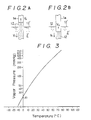
- the varnish impregnation system described above operates as follows to carry out the process according to the present invention. Firstly, the base material 1 from the base material supply source 1′ is brought into the storage tank 2 where it is immersed in the low-viscosity liquid 12, so that air in the base material 1 is replaced with the low-viscosity liquid. That is, when the base material 1 reaches the surface 12′ of the low-viscosity liquid 12, the low viscosity liquid 12 permeates into the fiber bundles 1a (Fig. 2A) of the base material due to capillary action. Simultaneously, air in the fiber bundles is forced out due to the osmotic pressure of the liquid.
- Fig. 2A illustrates the condition where V1>V2 while Fig. 2B illustrates the condition where V1 ⁇ V2.
- the expander type guide roll 7a facilitates the replacement by forcing the air from the fiber bundles.
- the base material 1, impregnated with the low-viscosity liquid 12 is fed into the thermal syphon room 4, passing through the base material inlet 4a opening under the liquid surface 12′.
- the base material is heated by heating roll 5a to remove by evaporation the low-viscosity liquid 12 contained in the base material 1.
- the base material 1 continues to supply low-viscosity liquid 12 to the base material heating device 5a, so that the base material serves as the wick of a thermal syphon.
- the thermal syphon room 4 can be filled with saturated vapor of the low-viscosity liquid after air therein is discharged by the exhaust pump 15.
- the base material heating region temperature Th is greater than the low-viscosity liquid temperature Ts which in turn is greater than the cooling coil temperature Tc, the vapor pressure of the low-viscosity liquid 12 will tend to be different in various parts in the thermal syphon region 4′.
- the vapor pressure Ph in the base material heating device is greater than the vapor pressure Pw on the surface of the varnish, which is greater than the vapor pressure Ps on the surface of the low-viscosity liquid, which is greater than the vapor pressure Pc in the cooling coil region.
- the low-viscosity liquid vapor 12s moves at sonic speed due to this pressure gradient, so that most of the vapor is collected into the low-viscosity liquid storage tank 2 from the base material heating region 5a without allowing the vapor to enter into the varnish storage tank 3. That is, the low-viscosity liquid vapor 12s produced in the base material heating region is returned to the low-viscosity liquid storage tank 2 from the thermal syphon room 4 by way of the base material inlet 4a, or liquified by the cooling coil 6a to be returned to the low-viscosity liquid storage tank 2 from the condensate tank 8 by way of the down-flow member 8b as shown in Fig. 1.
- the saturated vapor 12s of the low-viscosity liquid contained in the base material 1 changes into a trace of low-viscosity saturated liquid and diffuses into the varnish 13 when the base material enters into the varnish storage region 4′.
- the base material 1 can thus be impregnated evenly and adequately with the varnish 13 while the base material passes through the varnish storage region. Also, since most of the low-viscosity liquid vapor 12s generated in the thermal syphon room 4 is collected into the low-viscosity liquid storage tank 2, and only an extremely small quantity of the saturated vapor is brought into the varnish storage tank by the base material 1, the viscosity of the varnish in the varnish storage tank 3 is scarcely affected.
- the expander type guide rolls 7a and 7b cause a stretching force to act in the lateral direction in the base material as the base material passes over the rolls, and this stretching force ends after the base material has passed the rolls, so that the fiber bundles in the base material are stretched and then contracted laterally in the low-viscosity liquid 12 and the varnish 13, whereby the replacement of air with the low-viscosity liquid and impregnation of the fiber bundles with the varnish is more efficiently accomplished.
- the varnish 13 is adequately absorbed into the fiber bundles of the base material 1.
- the present inventor conducted an experimental operation of the varnish impregnation system described above using glass fiber cloths #7628 for electronic base material as the base material 1.
- the varnish 13 had the composition shown in Table I.
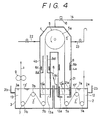
- Fig. 4 shows a second embodiment of the present invention.
- the varnish impregnation system comprises a low-viscosity liquid storage tank 2, a varnish storage tank 3, a thermal syphon room 4, a base material heating device 5, a cooling device 6, a guide device 7, a varnish impregnation control device 9 and a low-viscosity liquid heating device 21.
- the side wall of the storage tanks 2 and 3 are provided with overflow dams 2a and 3a and overflow pools 2b and 3b respectively, so that the level of the liquid in each of the storage tanks 2 and 3 can be kept constant at the level of the storage dams.
- the overflow pools 2b and 3b are designed so that liquid in the pools can be returned to the storage tanks 2 and 3 by return devices of conventional design (not shown).
- the thermal syphon room 4 is connected to a bleeding tube 14, an inert gas supply tube 22 and an exhaust tube 23.
- the cooling device 6 comprises a primary cooling coil 6b located in the base material inlet 4a and above the low-viscosity liquid storage region 12a, and a secondary cooling coil 6c located in the base material outlet 4b above the varnish storage region 13a.
- the cooling capacity or the condensing capacity of the primary cooling coil 6b should be large enough to condense all of the vapor of the low-viscosity liquid produced when the base material 1 is heated by the heating roll 5a. That is, the cooling capacity or condensing capacity of coil 6b should be larger than the liquid evaporating capacity of heating roll 5a.
- the condensing capacity of the secondary cooling coil 6c should be lower than that of, or within, 10 to 20% of the capacity of the primary cooling coil 6b.
- the space between each of cooling coils 6b and 6c and the wall of the room 4 is heat-insulated so that vapor of the low-viscosity liquid will not condense on the wall as might otherwise occur if the wall were cooled by the coils.
- a low-viscosity liquid heating device 21 is provided to heat and thereby cause evaporation of the low-viscosity liquid in the low-viscosity liquid storage region 12a.
- Heating device 21 comprises a coil 21a through which a heating medium may be circulated from a source not shown.
- the heating capacity of the heating device 21 must be large enough to at least ensure that the quantity of low-viscosity liquid vaporized is equal to the quantity (aggregate) condensed by the cooling coils 6b and 6c.
- the space between the coil 21a and the wall of the thermal syphon room 4 is heat-insulated to prevent, as far as possible, the transmission of heat from the region 12a to the wall.
- a condensate collection device 8 comprises a wall 8d attached to the interior wall of the base material outlet 4b immediately below the secondary cooling coil 6c, and a collecting tube 8c through which the collected condensate may flow to the low-viscosity liquid storage tank 2 or, more specifically, to the low-viscosity storage region 12a.
- the vapor of the low-viscosity liquid condensed by the primary cooling coil 6b is collected into the storage region 12a because it falls, under gravity, through the base material inlet 4a.
- the wall 8d also serves as a heat-insulating wall between the base material 1 and the secondary cooling coil 6c so that the condensate of the vapor of the low-viscosity liquid, formed when the base material is cooled by the cooling coil 6c, can be prevented from depositing on the base material 1.
- the thermal syphon room 4 When starting the system illustrated in Fig. 4, the thermal syphon room 4 should be filled with the saturated vapor of the low-viscosity liquid by the procedure described below, and the vapor pressure therein should be kept within a predetermined range.
- inert gas is supplied to the thermal syphon room 4 through supply tube 22 to exhaust air from room 4 through exhaust tube 23.
- the internal pressure of the thermal syphon room 4 is kept at atmospheric pressure.
- the liquid levels in the low-viscosity liquid storage regions 12a and 13a are thus equal to the liquid levels 12′ and 13′ of the storage tanks 2 and 3 as indicated by the solid lines at 12′a and 13′a.
- the heating devices 5 and 21 are then actuated to generate vapor of the low-viscosity liquid in the thermal syphon room 4, this vaporization taking place primarily as a result of the heat produced by heating device 21.
- the secondary cooling coil 6c responsible for the partial secondary cooling capacity of the system, is actuated to condense the vapor of the low-viscosity liquid. Since the primary cooling coil 6b having a higher cooling capacity is left unactuated, the rate of vaporization by the two heating devices 5 and 21 surpasses the rate of condensation by the secondary cooling coil 6c, thus causing an increase in the vapor pressure in the thermal syphon room 4.
- the bleeding valve 16 in bleeding tube 14 is opened and the excess vapor, with inert gas, in the thermal syphon room 4 is discharged into the low-viscosity liquid storage tank 2 through the bleeding tube 14 to maintain the internal pressure of the room 4 at atmospheric pressure.
- the liquid levels 12′a and 13′a remain unchanged at the levels indicated by solid lines in Fig. 4.
- the condensate of the vapor the low-viscosity liquid resulting from the condensation by the secondary cooling 6c is collected into the condensate pool 8a and flows back into the low-viscosity liquid storage section 12a through collection tube 8c. This prevents the condensed vapor of the low-viscosity from falling into the vanish storage region 3′.
- Heating by heating devices 5 and 21 is continued with valve 16 open until the inert gas in thermal syphon room 4 has been discharged and room 4 contains only the vapor of the low-viscosity liquid. The valve 16 is then closed.
- valve 16 When valve 16 is closed, continued heating causes the internal pressure of the room 4 to increase. As the internal pressure of room 4 rises, the liquid sealed levels 12′a and 13′a fall to the levels indicated by the dotted lines in Fig. 4. As the liquid level 12′a of the low-viscosity liquid pool 12a falls, the depth of immersion of the low-viscosity liquid heating coil 21a in the pool 12a, and consequently the contact area between the heating coil and the low-viscosity liquid decreases. This causes a decrease in the rate of evaporization due to the low-viscosity liquid heating device 21 and establishes equilibrium between the evaporation rate and the condensation rate of the secondary cooling coil 6c.
- the base material 1 can be impregnated with varnish in the same manner as that of the Fig. 1 embodiment by feeding the base material 1 through the impregnation system.
- the internal vapor pressure of the thermal syphon room 4 can be maintained constant insofar as the evaporation rate of the low-viscosity liquid 12 due to heating devices 5 and 12, and the condensation rate due to the cooling devices 6b and 6c, is concerned.
- a change in varnish impregnation conditions such as a change in the feeding speed of the base material, upsets equilibrium between the evaporation rate and the condensation rate, resulting in fluctuation of the internal vapor pressure in the thermal syphon room 4.
- the apparatus of Fig. 4 is capable of re-establishing equilibrium after occurrence of an upset condition.
- any change in the internal vapor pressure of the thermal syphon room 4 is accompanied by a change in the liquid level 12′a of the low-viscosity liquid pool 12a and the liquid level 13′a of the varnish pool 13a.
- the evaporation rate due to the low-viscosity liquid heating device 21 is thus controlled automatically depending on changes in the liquid levels. That is, when the liquid level 12′a of the low-viscosity liquid pool 12a rises due to a fall of the vapor pressure, the contact area between the low-viscosity liquid and the low-viscosity liquid heating coil 21a increases, as indicated by the solid line in Fig. 4.
- the rate of evaporation increases in an amount corresponding to the drop of the vapor pressure to prevent the drop of the internal pressure in the thermal syphon room 4.
- a rise of the vapor pressure causes the liquid level 12′a to drop, resulting in a decrease in the contact area between the low-viscosity liquid 12a and the low-viscosity liquid heating coil 21a as indicated by the dotted line in Fig. 4.
- the rate of evaporation due to the low-viscosity liquid heating device 21 decreases to limit the rise of the vapor pressure in room 4.
- the internal vapor pressure of the thermal syphon room 4 can be self-controlled to remain within a certain range even without a pressure controller.
- a stop of the operating of the system and the resulting stop of the feed of the base material, or a change in an operating condition such as the alteration or change of the base material feeding speed may cause the condensation rate due to the cooling device 6 to largely surpass the evaporation rate due to the heating of the base material to thus form a vacuum or negative pressure in the thermal syphon room 4.
- This may cause adverse effects such as the low-viscosity liquid 12 and the varnish 13 being drawn up into the thermal syphon room 4 through the base material inlet 4a and the base material outlet 4b.
- the system according to the present invention is free of such problems.
- Fig. 5 shows a third embodiment of the invention.
- the varnish impregnation system represented by this embodiment comprises a low-viscosity liquid storage tank 2, a varnish storage tank 3, a thermal syphon room 4, a base material heating device 5, a cooling device 6, a guiding device 7, a condensate collection device 8, a varnish impregnation control device 9, a low-viscosity liquid heating device 21 and a condensation prevention device 31.
- the wall of the thermal syphon room 4 is provided with a jacket 4c except on the bottom wall which is a down-flow plane 8d.
- An appropriate heating medium is supplied to the jacket from a suitable source (not shown) to heat and maintain the low-viscosity liquid in room 4 at a temperature higher than that of the boiling point of the low-viscosity liquid.
- the jacket enables the internal pressure of the thermal syphon room 4 to be quickly raised to the saturated vapor pressure of the low-viscosity liquid 12. At system start up, this quick rise can be accomplished without causing condensate of the vapor 12s of the low-viscosity liquid to deposit on the internal surface of the wall 4c.
- the external and bottom walls of the jacket are formed of a heat-insulating material.
- the condensation prevention device 31 comprises a base material passage cylinder 32 which surrounds a base material passage region 32′ extending from the vicinity of the heating roll 5a to the varnish pool 13a.
- the lower end of the base material passage cylinder 32 serves as the base material outlet 4b, and the wall of the outlet forms the heating walls 32a and 32b having a jacket construction.
- the heating walls 32a and 32b are designed to permit a heating medium to flow therein whenever necessary in order to heat the base material 1 to a temperature higher than the condensation temperature of the low-viscosity liquid vapor 12s in the base material passage cylinder and the base material passage region 32′.
- This system is especially characterized by being designed so that a heating medium of a higher temperature is supplied to and flowed through the lower heating wall 32b surrounding the varnish pool 13a so as to heat the liquid surface 13′ of the varnish in varnish pool 13 to a temperature higher than the boiling-point temperature of the low-viscosity liquid 12.
- the same heating medium supply and flow system may be applied to the upper heating wall 32a.
- the two heating walls 32a and 32b may be formed into a continuous jacket construction.
- the external walls of the jackets of the heating walls 32a and 32b are formed of heat insulating material so that heat in the base material passage cylinder 32 is not transmitted outside. More specifically, the heat-insulating walls are provided to prevent such adverse effects as a lowering of the cooling effect of the cooling device 6 and a rise in the temperature of the varnish 13 around the varnish pool 13a. Also, it is desirable for the upper end of the base material passage cylinder 32 to be located as close as possible to the heating roll 5a.
- Fig. 5 The embodiment of Fig. 5 is similar in many respects to previously described embodiment hence all of its elements are not described. However, it is noted that the condensate collection device 8 may be like that shown in Fig. 1.
- the base material 1 passes over the heating roll 5a, enters the base material passage cylinder 32, and moves into the varnish pool 13a.
- the inside of the base material cylinder 32 is heated to, and maintained at, a temperature higher than the condensation temperature of the low-viscosity liquid vapor 12s by flowing a heating medium through walls 32a and 32b.
- the base material passage region 32′ extending from the heating roll 5a to the varnish pool 13a is thus thoroughly filled with the vapor of the low-viscosity liquid 12s, and the low-viscosity liquid vapor in the base material passage region 32′ is prevented from condensing on the surface of the base material or entering into the varnish pool 13a as might otherwise occur due to the effect of the radiational cooling of the cooling device 6.
- the varnish temperature is lower than that of the saturated vapor of the low-viscosity liquid, so the low-viscosity liquid vapor 12s contained in the base material would normally condense when the base material 1 enters into the varnish 13.
- the liquid surface 13a′ of the varnish pool 13a is heated to a temperature higher than the boiling point temperature of the low-viscosity liquid 12 by the lower heating wall 32b, so that the condensate generated when the base material enters into the varnish 13 is re-evaporated so that practically no vapor enters the varnish 13.
- the varnish 13 thus remains undiluted by the low-viscosity liquid.
- the heating walls 32a and 32b may be formed simply as heat-insulating walls which prevent the base material 1 passing the base material passage cylinder 32 from being subjected to the radiational cooling effect of the cooling device 6, while at the same time permitting the temperature of the base material 1 and the ambient temperature within the region extending from the heating roll 5a to the varnish pool 13a to be maintained at a temperature higher than the condensation temperature of the low-viscosity liquid 12.
- the heating wall 32a need not necessarily be cylindrical in form to surround the base material completely but may take the form of two opposite walls facing the sides of the descending base material.
- the heating means at the varnish pool 13a is not necessarily limited to the heating wall 32b with jacket construction but may take any other conventional form.
- the base material outlet 4b should have the smallest possible cross-sectional area consonant with free passage of the base material so that the area of the boundary between the varnish storage region 3′ and the thermal syphon region 4′ is kept to a minimum.
- part of the outlet 4b that is, the heating wall 32b, should be formed with a metal nozzle 34.
- the nozzle 34 is provided with a fluid conduit 34a through which a heating medium may flow to heat the varnish pool 13a to a temperature higher than the boiling point temperature of the low-viscosity liquid 12. It is desirable that the external surface of the nozzle 34 to be provided with a heat-insulating layer 35 to prevent the surrounding varnish 13 from being heated.
- the arrangement shown in Fig. 6 prevents, to the greatest possible extent, the evaporation of the solvent in the varnish 13 due to heating of the varnish pool 13a, and entry of the vapor into the thermal syphon room 4. Furthermore, condensation of the low-viscosity liquid vapor 12s at the liquid surface 13a′ of the varnish pool 13a can be reduced.
- the surrounding wall of the thermal syphon room 4 or, more particularly, the base material outlet 4b may be provided with a plurality of vapor injection nozzles 36 for injecting low-viscosity liquid vapor 12s into the thermal syphon room 4.
- This arrangement coupled with the aforementioned heating by the surrounding wall 4c of the thermal syphon room 4, permits a quick rise in vapor pressure to be realized at the start of the operation.
- the open top of the low viscosity liquid storage tank 2 may be closed with a cover 2c that it provided with an inlet 2d for entry of the base material 1.
- the inlet 2d may be provided with a collar 37 comprising, for example, a cooling coil in order to prevent leakage of the vapor.
- the low-viscosity liquid vapor 12s is condensed or liquefied by a cooling coil 37.
- a similar arrangement may be provided for the varnish storage tank 3.
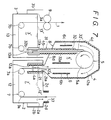
- a varnish impregnation system comprises a low-viscosity liquid storage tank 2, a varnish storage tank 3, a thermal syphon room 4, a base material heating device 5, a cooling device 6, a guiding device 7, a condensate collection device 8, a varnish impregnation control device 9 and a vapor flow device 41.
- the vapor flow device 41 comprises a low-viscosity liquid storage section 43 surrounding the base material outlet 4b and a low-viscosity liquid pool 12a provided with a self-controlled heater 44.
- the low-viscosity liquid storage section 43 is formed at the lower end of the base material outlet 4a and communicates with the low-viscosity liquid storage tank 2 through a passage 42a so that the low-viscosity liquid 12 can be stored in a predetermined quantity.
- the liquid surface level of the low-viscosity storage section 42 coincides with the liquid surface 12′ of the low-viscosity liquid storage tank 2 regardless of the evaporation of the low-viscosity liquid in the storage section 42.
- the low-viscosity liquid heater 43 comprises a wall with jacket construction surrounding the low-viscosity liquid storage section 42.
- the jacket allows an appropriate heating medium to flow therein to heat and evaporate the low-viscosity liquid 12 in the low-viscosity liquid storage section 42.
- the jacket wall of liquid heater 43 is made of heat-insulating material except for those parts in contact with the low-viscosity liquid storage section 42 and the varnish pool 13a so that the heat of the jacket is not transmitted to the varnish 13 around the varnish pool 13a.
- the low-viscosity liquid heater 43 is formed into a continuous jacket wall construction communicating with the surrounding wall 4c of the thermal syphon room 4.
- the self-controlled heater 44 comprises a heat transfer coil through which a heating medium flows from a source not shown.
- the heater is used to heat and evaporate the low-viscosity liquid 12 of the low-viscosity liquid pool 12a.
- the evaporation capacity of the self-controlled heater 44 is lower than that of the low-viscosity liquid heater 43, and heater 44 is provided with a low-viscosity liquid heating plane 44a extending both upward and downward from the surface of the low-viscosity liquid pool 12a.
- the heater 44 is designed so that the evaporation capacity can be self-controlled according to variation of the internal vapor pressure of the thermal syphon room 4, in a manner similar to that of the low-viscosity liquid heating device 21 of Fig. 4.
- the evaporation rate of the low-viscosity liquid to form vapor 12s in the thermal syphon room 4 is decreased by the self-controlled heater 44 as the vapor pressure rises in room 4, and the low-viscosity liquid vapor 12s is caused to flow from base material outlet 4b toward base material heater 5a and from heater 5a toward material inlet 4a, as illustrated by the arrows in Fig. 8.
- the base material passage region extending from the base material heater 5a to the varnish pool 13a is filled with atmosphere of the low-viscosity liquid vapor without air.
- the base material may be impregnated with varnish without air voids.
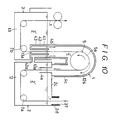
- the vapor flow system 41 may be provided with a cooler or cooling coil 45 at the base material inlet 4a in place of the heater 44 of the preceding embodiment.
- the low-viscosity liquid vapor 12s generated in the thermal syphon room 4 is condensed by the cooler 45 and collected into the low-viscosity liquid pool 12a. This results in flow of the low-viscosity liquid vapor 12s as indicated by the arrows.
- the bleeding tube 14 is not necessarily required.
- both the heater 44 of Fig. 8 and the cooler 45 of Fig. 9 may be omitted on the side of the base material inlet 4a.
- the cover 2c and the cooler 37 are provided to prevent diffusion of the low-viscosity liquid vapor 12s, as described with reference to Fig. 7.
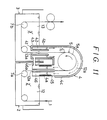
- Fig. 11 illustrates an embodiment wherein a liquid collector 46 communicating with the low-viscosity liquid storage section 42 through the passage 46a, is provided for collecting the condensed vapor of the low-viscosity liquid.
- the collector 46 is provided with a cooler 45 to condense and collect the condensate of the low-viscosity liquid vapor into collector 46.
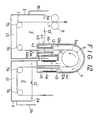
- Figure 12 illustrates an embodiment of the invention which is basically similar to the embodiment of Fig. 8 but differs from each of the foregoing embodiments in that the base material inlet 4a opens above the liquid surface 12′ of the low-viscosity liquid storage tank 2.
- the base material 1 is exposed to the air while moving from the low-viscosity liquid storage tank 2 into the thermal syphon room 4, but air will not enter into the base material 1 before the base material moves into the thermal syphon room 4 since the base material is impregnated with the low-viscosity liquid.
- absence of the liquid seal at the base material inlet 4a causes no problem.
- the vapor diffusion prevention devices 2c and 37 may be provided for preventing the diffusion of the low-viscosity liquid vapor 12s from the low-viscosity liquid storage tank 2.
- the effects of the cover 2c and cooling coil 37 are greater than that of a liquid seal at the base inlet 4a.
- the condensate may be directly collected into the low-viscosity liquid storage tank 2 from the base material inlet 4a.
Landscapes
- Engineering & Computer Science (AREA)
- Mechanical Engineering (AREA)
- Life Sciences & Earth Sciences (AREA)
- Wood Science & Technology (AREA)
- Reinforced Plastic Materials (AREA)
- Application Of Or Painting With Fluid Materials (AREA)
- Coating Apparatus (AREA)
Applications Claiming Priority (10)
| Application Number | Priority Date | Filing Date | Title |
|---|---|---|---|
| JP63292958A JPH0626811B2 (ja) | 1988-11-18 | 1988-11-18 | ワニス含浸方法及びその装置 |
| JP292958/88 | 1988-11-18 | ||
| JP29043/89 | 1989-02-08 | ||
| JP1029043A JPH02208009A (ja) | 1989-02-08 | 1989-02-08 | ワニス含浸方法及びその装置 |
| JP34672/89 | 1989-02-14 | ||
| JP1034672A JPH02214615A (ja) | 1989-02-14 | 1989-02-14 | ワニス含浸方法及びその装置 |
| JP34671/89 | 1989-02-14 | ||
| JP34670/89 | 1989-02-14 | ||
| JP1034671A JPH02214614A (ja) | 1989-02-14 | 1989-02-14 | ワニス含浸方法及びその装置 |
| JP1034670A JPH02214613A (ja) | 1989-02-14 | 1989-02-14 | ワニス含浸方法及びその装置 |
Publications (3)
| Publication Number | Publication Date |
|---|---|
| EP0369907A2 true EP0369907A2 (fr) | 1990-05-23 |
| EP0369907A3 EP0369907A3 (fr) | 1992-01-22 |
| EP0369907B1 EP0369907B1 (fr) | 1994-05-18 |
Family
ID=27521098
Family Applications (1)
| Application Number | Title | Priority Date | Filing Date |
|---|---|---|---|
| EP89420444A Expired - Lifetime EP0369907B1 (fr) | 1988-11-18 | 1989-11-15 | Procédé et appareil d'imprégnation de vernis |
Country Status (4)
| Country | Link |
|---|---|
| US (2) | US5056457A (fr) |
| EP (1) | EP0369907B1 (fr) |
| KR (1) | KR930001712B1 (fr) |
| DE (1) | DE68915401T2 (fr) |
Cited By (1)
| Publication number | Priority date | Publication date | Assignee | Title |
|---|---|---|---|---|
| EP0444819A3 (en) * | 1990-02-28 | 1991-12-18 | Takuma Co., Ltd. | Varnish impregnation method and apparatus |
Families Citing this family (11)
| Publication number | Priority date | Publication date | Assignee | Title |
|---|---|---|---|---|
| JP2890599B2 (ja) * | 1990-02-06 | 1999-05-17 | ソニー株式会社 | 加工方法 |
| US5205303A (en) * | 1990-12-06 | 1993-04-27 | Electrovert Ltd. | Liquid cleaning process and apparatus for circuit boards and the like |
| ES2120703T3 (es) * | 1994-01-28 | 1998-11-01 | Solipat Ag | Procedimiento y dispositivo para tratar una banda textil especialmente sensible a la traccion. |
| US5780366A (en) * | 1996-09-10 | 1998-07-14 | International Business Machines Corporation | Technique for forming resin-impregnated fiberglass sheets using multiple resins |
| US5756405A (en) * | 1996-09-10 | 1998-05-26 | International Business Machines Corporation | Technique for forming resin-impregnated fiberglass sheets |
| US5719090A (en) * | 1996-09-10 | 1998-02-17 | International Business Machines Corporation | Technique for forming resin-imprenated fiberglass sheets with improved resistance to pinholing |
| US7238251B1 (en) * | 2003-11-07 | 2007-07-03 | Insituform (Netherlands) B.V. | Method of preparing cured in place liner using resin impregnation tower |
| US9976258B2 (en) | 2014-10-03 | 2018-05-22 | E I Du Pont De Nemours And Company | Honeycomb core having a high compression strength |
| DE102015002797A1 (de) * | 2014-10-31 | 2016-05-04 | Rotodecor Gmbh Maschinen- Und Anlagenbau | Vorrichtung für ein Vernetzen eines Schutzlackes auf einer Materialbahn, insbesondere für eine Lackieranlage |
| CN105345945B (zh) * | 2015-12-11 | 2018-05-29 | 广东生益科技股份有限公司 | 增强材料的浸润方法和浸润装置 |
| TWI832346B (zh) * | 2022-07-20 | 2024-02-11 | 陽程科技股份有限公司 | 應用於傳動式物料的真空式含浸裝置 |
Family Cites Families (14)
| Publication number | Priority date | Publication date | Assignee | Title |
|---|---|---|---|---|
| US1595236A (en) * | 1920-03-04 | 1926-08-10 | Minton Ogden | Method of treating material in a vacuum and apparatus |
| US1595474A (en) * | 1920-03-04 | 1926-08-10 | Minton Ogden | Treatment of material in a vacuum |
| US1805474A (en) * | 1927-10-24 | 1931-05-19 | Atlantic Prec Instr Company | Apparatus for controlling moisture content of paper or the like |
| US1805145A (en) * | 1930-04-24 | 1931-05-12 | J P Devine Mfg Co | Impregnating apparatus |
| US2604415A (en) * | 1948-10-12 | 1952-07-22 | Whitfield & Sheshunoff Inc | Method and apparatus for the formation of hot dip coatings |
| US2876131A (en) * | 1954-11-23 | 1959-03-03 | Du Pont | Coating of fibrous structrues with tetrafluoroethylene polymer |
| US2956613A (en) * | 1957-07-05 | 1960-10-18 | Westinghouse Electric Corp | Treated glass cloth insulation making |
| FR1244313A (fr) * | 1959-05-06 | 1960-09-19 | Perfectionnement aux traitements mouillés | |
| BE631970A (fr) * | 1962-05-28 | |||
| US3593543A (en) * | 1969-05-26 | 1971-07-20 | Dow Chemical Co | Apparatus for treating fabrics from an organic solvent |
| IL40966A (en) * | 1972-11-29 | 1976-07-30 | Klier S | A process for continuous treatment of textile materials |
| US4416123A (en) * | 1980-09-16 | 1983-11-22 | Sando Iron Works Co., Ltd. | Apparatus for wet heat treating a textile product |
| EP0054084B1 (fr) * | 1980-12-11 | 1985-03-27 | Hendrik Van Dalen | Procédé pour la fabrication de produits renforcés en matière plastique |
| US4690836A (en) * | 1985-10-23 | 1987-09-01 | International Business Machines Corp. | Process for the production of void-free prepreg sheets |
-
1989
- 1989-10-04 KR KR1019890014226A patent/KR930001712B1/ko not_active Expired - Fee Related
- 1989-11-02 US US07/430,329 patent/US5056457A/en not_active Expired - Fee Related
- 1989-11-15 EP EP89420444A patent/EP0369907B1/fr not_active Expired - Lifetime
- 1989-11-15 DE DE68915401T patent/DE68915401T2/de not_active Expired - Fee Related
-
1991
- 1991-08-01 US US07/738,953 patent/US5137756A/en not_active Expired - Fee Related
Cited By (1)
| Publication number | Priority date | Publication date | Assignee | Title |
|---|---|---|---|---|
| EP0444819A3 (en) * | 1990-02-28 | 1991-12-18 | Takuma Co., Ltd. | Varnish impregnation method and apparatus |
Also Published As
| Publication number | Publication date |
|---|---|
| KR900007492A (ko) | 1990-06-01 |
| US5056457A (en) | 1991-10-15 |
| DE68915401T2 (de) | 1994-09-01 |
| DE68915401D1 (de) | 1994-06-23 |
| US5137756A (en) | 1992-08-11 |
| KR930001712B1 (ko) | 1993-03-12 |
| EP0369907A3 (fr) | 1992-01-22 |
| EP0369907B1 (fr) | 1994-05-18 |
Similar Documents
| Publication | Publication Date | Title |
|---|---|---|
| EP0369907B1 (fr) | Procédé et appareil d'imprégnation de vernis | |
| Hihara et al. | Effect of surfactant on falling film absorption | |
| US3078589A (en) | Xerographic fusing apparatus | |
| US3583685A (en) | Method and apparatus for controlling quantity of a vapor in a gas | |
| KR930005387B1 (ko) | 와니스 함침 방법 및 장치 | |
| EP0580980A1 (fr) | Procédé de séchage à la vapeur | |
| KR840008296A (ko) | 이중용기 열교환 장치 | |
| US6395041B1 (en) | Method and apparatus for sizing a yarn sheet | |
| HK1041917A1 (en) | Absorption refrigeration machine | |
| US4307518A (en) | Process for removing water from surfaces of articles and water removing bath for use in the process | |
| US20050172417A1 (en) | Method and machine for treating textile materials by ammonia or other liquids | |
| US6116497A (en) | Process and device for the wave or vapor-phase soldering of electronic units | |
| JP4230068B2 (ja) | 蒸着装置 | |
| US4369035A (en) | Process and apparatus for liquid treatment of fiber material | |
| US4100366A (en) | Method and apparatus for cooling electrical apparatus using vapor lift pump | |
| JPH02214613A (ja) | ワニス含浸方法及びその装置 | |
| JPH0581409B2 (fr) | ||
| JP3068244B2 (ja) | 発電所における蒸気を用いて補給水を加熱および多工程脱ガスする方法および装置 | |
| JPH02214615A (ja) | ワニス含浸方法及びその装置 | |
| JPH0248930A (ja) | ワニス含浸方法及びその装置 | |
| JPH0583046B2 (fr) | ||
| JPH039813A (ja) | ワニス含浸方法及びその装置 | |
| US2501672A (en) | Dipping tank for coating articles | |
| JPS5579992A (en) | Heat transfer device | |
| GB1597987A (en) | Processing ammonia-containing exhaust in developing apparatus |
Legal Events
| Date | Code | Title | Description |
|---|---|---|---|
| PUAI | Public reference made under article 153(3) epc to a published international application that has entered the european phase |
Free format text: ORIGINAL CODE: 0009012 |
|
| AK | Designated contracting states |
Kind code of ref document: A2 Designated state(s): CH DE GB IT LI |
|
| PUAL | Search report despatched |
Free format text: ORIGINAL CODE: 0009013 |
|
| AK | Designated contracting states |
Kind code of ref document: A3 Designated state(s): CH DE GB IT LI |
|
| 17P | Request for examination filed |
Effective date: 19920220 |
|
| 17Q | First examination report despatched |
Effective date: 19930217 |
|
| GRAA | (expected) grant |
Free format text: ORIGINAL CODE: 0009210 |
|
| AK | Designated contracting states |
Kind code of ref document: B1 Designated state(s): CH DE GB IT LI |
|
| REF | Corresponds to: |
Ref document number: 68915401 Country of ref document: DE Date of ref document: 19940623 |
|
| ITF | It: translation for a ep patent filed | ||
| PG25 | Lapsed in a contracting state [announced via postgrant information from national office to epo] |
Ref country code: GB Effective date: 19941115 |
|
| PG25 | Lapsed in a contracting state [announced via postgrant information from national office to epo] |
Ref country code: LI Effective date: 19941130 Ref country code: CH Effective date: 19941130 |
|
| PLBE | No opposition filed within time limit |
Free format text: ORIGINAL CODE: 0009261 |
|
| STAA | Information on the status of an ep patent application or granted ep patent |
Free format text: STATUS: NO OPPOSITION FILED WITHIN TIME LIMIT |
|
| 26N | No opposition filed | ||
| GBPC | Gb: european patent ceased through non-payment of renewal fee |
Effective date: 19941115 |
|
| REG | Reference to a national code |
Ref country code: CH Ref legal event code: PL |
|
| PG25 | Lapsed in a contracting state [announced via postgrant information from national office to epo] |
Ref country code: DE Effective date: 19950801 |
|
| PG25 | Lapsed in a contracting state [announced via postgrant information from national office to epo] |
Ref country code: IT Free format text: LAPSE BECAUSE OF NON-PAYMENT OF DUE FEES;WARNING: LAPSES OF ITALIAN PATENTS WITH EFFECTIVE DATE BEFORE 2007 MAY HAVE OCCURRED AT ANY TIME BEFORE 2007. THE CORRECT EFFECTIVE DATE MAY BE DIFFERENT FROM THE ONE RECORDED. Effective date: 20051115 |