EP0370922A2 - Optischer Gegenstand, enthaltend ein lineares Kondensationspolymer mit hohem Grad an Polarisationssuszeptibilität zweiter Ordnung - Google Patents
Optischer Gegenstand, enthaltend ein lineares Kondensationspolymer mit hohem Grad an Polarisationssuszeptibilität zweiter Ordnung Download PDFInfo
- Publication number
- EP0370922A2 EP0370922A2 EP89420434A EP89420434A EP0370922A2 EP 0370922 A2 EP0370922 A2 EP 0370922A2 EP 89420434 A EP89420434 A EP 89420434A EP 89420434 A EP89420434 A EP 89420434A EP 0370922 A2 EP0370922 A2 EP 0370922A2
- Authority
- EP
- European Patent Office
- Prior art keywords
- electron
- moiety
- optical article
- molecular
- further characterized
- Prior art date
- Legal status (The legal status is an assumption and is not a legal conclusion. Google has not performed a legal analysis and makes no representation as to the accuracy of the status listed.)
- Ceased
Links
- 0 C[C@@]1*CCCC1 Chemical compound C[C@@]1*CCCC1 0.000 description 2
Images

Classifications
-
- G—PHYSICS
- G02—OPTICS
- G02F—OPTICAL DEVICES OR ARRANGEMENTS FOR THE CONTROL OF LIGHT BY MODIFICATION OF THE OPTICAL PROPERTIES OF THE MEDIA OF THE ELEMENTS INVOLVED THEREIN; NON-LINEAR OPTICS; FREQUENCY-CHANGING OF LIGHT; OPTICAL LOGIC ELEMENTS; OPTICAL ANALOGUE/DIGITAL CONVERTERS
- G02F1/00—Devices or arrangements for the control of the intensity, colour, phase, polarisation or direction of light arriving from an independent light source, e.g. switching, gating or modulating; Non-linear optics
- G02F1/01—Devices or arrangements for the control of the intensity, colour, phase, polarisation or direction of light arriving from an independent light source, e.g. switching, gating or modulating; Non-linear optics for the control of the intensity, phase, polarisation or colour
- G02F1/061—Devices or arrangements for the control of the intensity, colour, phase, polarisation or direction of light arriving from an independent light source, e.g. switching, gating or modulating; Non-linear optics for the control of the intensity, phase, polarisation or colour based on electro-optical organic material
- G02F1/065—Devices or arrangements for the control of the intensity, colour, phase, polarisation or direction of light arriving from an independent light source, e.g. switching, gating or modulating; Non-linear optics for the control of the intensity, phase, polarisation or colour based on electro-optical organic material in an optical waveguide structure
-
- G—PHYSICS
- G02—OPTICS
- G02F—OPTICAL DEVICES OR ARRANGEMENTS FOR THE CONTROL OF LIGHT BY MODIFICATION OF THE OPTICAL PROPERTIES OF THE MEDIA OF THE ELEMENTS INVOLVED THEREIN; NON-LINEAR OPTICS; FREQUENCY-CHANGING OF LIGHT; OPTICAL LOGIC ELEMENTS; OPTICAL ANALOGUE/DIGITAL CONVERTERS
- G02F1/00—Devices or arrangements for the control of the intensity, colour, phase, polarisation or direction of light arriving from an independent light source, e.g. switching, gating or modulating; Non-linear optics
- G02F1/35—Non-linear optics
- G02F1/355—Non-linear optics characterised by the materials used
- G02F1/361—Organic materials
- G02F1/3615—Organic materials containing polymers
- G02F1/3616—Organic materials containing polymers having the non-linear optical group in the main chain
-
- G—PHYSICS
- G02—OPTICS
- G02F—OPTICAL DEVICES OR ARRANGEMENTS FOR THE CONTROL OF LIGHT BY MODIFICATION OF THE OPTICAL PROPERTIES OF THE MEDIA OF THE ELEMENTS INVOLVED THEREIN; NON-LINEAR OPTICS; FREQUENCY-CHANGING OF LIGHT; OPTICAL LOGIC ELEMENTS; OPTICAL ANALOGUE/DIGITAL CONVERTERS
- G02F1/00—Devices or arrangements for the control of the intensity, colour, phase, polarisation or direction of light arriving from an independent light source, e.g. switching, gating or modulating; Non-linear optics
- G02F1/35—Non-linear optics
- G02F1/37—Non-linear optics for second-harmonic generation
- G02F1/377—Non-linear optics for second-harmonic generation in an optical waveguide structure
Definitions
- the invention relates to optical articles, particularly articles which exhibit effects attributable to the polarization of electromagnetic radiation.
- the invention relates specifically to optical articles which exhibit effects attributable to the nonlinear polarization of electromagnetic radiation.
- P the total induced polarization
- E the local electric field created by electromagnetic radiation
- ⁇ , ⁇ , and ⁇ are the first, second, and third order polarizabilities, each of which is a function of molecular properties.
- ⁇ and ⁇ are also referred to as first and second hyperpolarizabilities, respectively.
- the molecular level terms of Equation 1 are first order or linear polarization ⁇ E, second order or first nonlinear polarization ⁇ E2, and third order or second nonlinear polarization ⁇ E3.
- P the total induced polarization
- E the local electric field created by electromagnetic radiation
- ⁇ (1) , ⁇ (2) , and ⁇ (3) are the first, second, and third order polarization susceptibilities of the electromagnetic wave transmission medium.
- ⁇ (2) and ⁇ (3) are also referred to as the first and second nonlinear polarization susceptibilities, respectively, of the transmission medium.
- the macromolecular level terms of Equation 2 are first order or linear polarization ⁇ E, second order or first nonlinear polarization ⁇ (2) E2, and third order or second nonlinear polarization ⁇ (3) E3.
- Second order polarization ( ⁇ (2) E2) has been suggested to be useful for a variety of purposes, including optical rectification (converting electromagnetic radiation input into a DC output), generating an electro-optical (Pockels) effect (using combined electromagnetic radiation and DC inputs to alter during their application the refractive index of the medium), phase alteration of electromagnetic radiation, and parametric effects, most notably frequency doubling, also referred to as second harmonic generation (SHG).
- optical rectification converting electromagnetic radiation input into a DC output
- an electro-optical (Pockels) effect using combined electromagnetic radiation and DC inputs to alter during their application the refractive index of the medium
- phase alteration of electromagnetic radiation and parametric effects, most notably frequency doubling, also referred to as second harmonic generation (SHG).
- SHG second harmonic generation
- ⁇ (2) For ⁇ (2) to exhibit a usefully large value it is not only necessary that ⁇ be large, but, in addition, the molecular dipoles must be aligned so as to lack inversion symmetry.
- the largest values of ⁇ (2) are realized when the molecular dipoles are arranged in polar alignment ⁇ e.g., the alignment obtained when molecular dipoles are allowed to align themselves in an electric field.
- thermotropic liquid crystalline polymer which is characterized by a recurring monomeric unit of the formula: where P is a polymer main chain unit, S is a flexible spacer, and M is a pendant mesogen which exhibits a second order nonlinear optical susceptibility ⁇ of at least about 20 X 10 ⁇ 30 esu under stated conditions of measurement.
- the mesogen satisfies the formula: (4) -X-Y-Z where X is -NR- or -S-; Y can take various stilbenoid forms; and Z is an electron donating or withdrawing group, the latter including nitro, haloalkyl, acyl, alkanoyloxy, alkoxysulfonyl, and the like.
- Optical articles containing polar aligned organic molecular dipoles which form repeating units in a crosslinked polymeric matrix are the subject matter of Robello et al U.S. Patent 4,796,971.
- Optical articles containing a polar aligned organic molecular dipole containing a sulfonyl moiety as an electron acceptor are the specific subject matter of Ulman et al U.S. Patent 4,792,208.
- the present invention is directed to an optical article containing, for the transmission of electromagnetic radiation, a medium exhibiting a second order polarization susceptibility greater than 10 ⁇ 9 electrostatic units comprised of a linear polymer containing polar aligned noncentrosymmetric molecular dipoles having an electron donor moiety linked through a conjugated ⁇ bonding system to an electron acceptor moiety to permit oscillation of the molecular dipole between a ground state exhibiting a first dipole moment and an excited state exhibiting a differing dipole moment.
- the invention is characterized in that the linear polymer is a condensation polymer including in its backbone a plurality of molecular dipoles the electron acceptor moieties of which are sulfonyl electron acceptor moieties, the molecular dipoles being relatively oriented to reinforce electron displacement along the polymer backbone.
- the present invention constitutes a departure from the prior state of the art.
- linear polymers with a plurality of molecular dipoles arranged to reinforce electron displacement along the polymer backbone optical articles can be produced having increased second order polarization susceptibilities as compared to corresponding optical articles employing linear polymers which contain molecular dipoles in pendant groups.
- This has in part been made possible by the availability of efficient electron acceptor moieties capable of being functionally substituted, specifically sulfonyl electron acceptor moieties.
- none of the efficient electron acceptor moieties, such as cyano or nitro moieties can be chemically substituted without destroying their essential electronic properties.
- the sulfonyl moiety requires by definition a hydrocarbon substituent, which can in turn permit further functional substitution.
- the molecular dipole By incorporating the molecular dipole in a polymer a variety of problems (e.g., limited solubilities and phase separation) that arise from attempts to disperse or dissolve molecular dipoles in separate polymeric binders are entirely avoided. Additionally, the sulfonyl electron acceptor moiety offers much greater freedom for controlling the physical properties of the high second order polarization susceptibility medium of the optical article. The substitution of sulfonyl electron acceptor moieties for conventional electron acceptor moieties can extend optical utility to different wavelength regions of the spectrum by being more transparent to input electromagnetic radiation, output radiation ⁇ e.g., second harmonic radiation, or a combination of both.
- the sulfonyl containing dipoles offer a broader range of solvent and binder compatibilities for achieving the required polar alignments for useful effects produced by second order polarization in optical articles. Sulfonyl substitution to achieve optimized physical compatibility with other materials encountered in optical article fabrication is readily achieved.
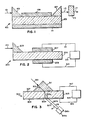
- the optical article 100 is capable of generating a second harmonic of electromagnetic radiation 101 supplied to it.
- Incoming electromagnetic radiation is introduced through input means 103, shown as a first prism, into an optically active transmission medium 105 which exhibits a high level (> 10 ⁇ 9 esu) second order or first nonlinear polarization susceptibility, hereinafter referred to simply as the optically active transmission medium according to the invention or, more succinctly, as the optically active transmission medium.
- Electromagnetic radiation is transmitted through the medium 105 to output means 107, shown as a second prism. In the simplest form of the optical article neither the input nor output prisms are required.
- Escape of electromagnetic radiation from the transmission medium can be minimized by locating optional guiding elements 109 and 111 above and below the transmission medium.
- the guiding elements can minimize radiation loss by being chosen to exhibit a lower refractive index than the transmission medium. Additionally or alternatively, the guiding elements can be chosen to be reflective to the electromagnetic radiation.
- the transmission medium When the transmission medium is constructed according to the requirements of the invention, specifically described below, at least a portion of the electromagnetic radiation entering the transmission medium will be altered in frequency during its travel through the medium. More specifically, a second harmonic of the frequency will be generated.
- the electromagnetic radiation leaving the output means, indicated by arrow 113 exhibits both the original frequency of the input radiation and a second harmonic of this frequency.
- the electromagnetic radiation retaining the original frequency can, if desired, be removed by passing the electromagnetic radiation leaving the article through a filter 115 capable of absorbing radiation of the original frequency while transmitting higher frequency (shorter wavelength) portions of the electromagnetic radiation. By employing one or a combination of filters any broad or narrow frequency band of electromagnetic radiation can be retained in the transmitted output electromagnetic radiation 117.
- an optical article 200 capable of producing a DC potential when electromagnetic radiation 201 is supplied through input means 203, shown as a prism, to optically active transmission medium 205, which can be identical to medium 105, described above.
- electromagnetic radiation 201 is supplied through input means 203, shown as a prism, to optically active transmission medium 205, which can be identical to medium 105, described above.
- a potential difference is produced between upper electrode 207 and lower electrode 209 in electrical contact with the upper and lower surfaces of the transmission medium.
- Electrical conductors 211 and 213 can be used to relay the potential of the upper and lower electrodes to an electronic response unit 215.
- the electronic response unit can in its simplest form be a unit that provides a digital response indicative of the the presence or absence of electromagnetic radiation in the transmission medium. Alternatively, the electronic response unit can provide an analog response indicative not only of the presence, but also the intensity or wavelength of electromagnetic radiation in the transmission medium.
- the optical article 300 is capable of physically displacing a beam 301 of electromagnetic radiation being transmitted through it as a function of the concurrent receipt of a DC bias.
- Optically active transmission medium 305 which can be identical to optically active medium 105 or 205, is provided with transparent upper and lower electrodes 307 and 309.
- the electrodes can, for example, be thin layers of a vacuum vapor deposited metal or metal oxide ⁇ e.g., indium tin oxide.
- An electromagnetic radiation input means, shown as prism 311, is located on the upper transparent electrode.
- the electromagnetic radiation passes through the prism as indicated by arrow 313. When the electromagnetic radiation enters the transmission medium, it follows either path 315a or path 315b.
- the first electromagnetic radiation either travels along path 317a or 317b upon emerging from the lower transparent electrode.
- Shifting of electromagnetic radiation between the A and B paths is achieved by supplying a DC bias to the upper and lower electrodes while transmission of the electromagnetic radiation through the optically active transmission medium is occurring.
- a DC potential source is shown connected to the upper and lower electrodes by electrical conductors 327 and 329.
- the DC bias alters the refractive index of the transmission medium when it is formed of a material exhibiting a significant second order susceptibility. This causes the first electromagnetic radiation beam to be refracted at a different angle when the transmission medium is electrically biased, and this changes the first electromagnetic radiation path through the transmission medium. In some instances the refractive index of the transmission medium is increased by the electrical bias and in other instances lowered by the electrical bias, depending upon whether the molecular dipole contained within the transmission medium exhibits a positive or negative first hyperpolarizability ⁇ .
- an optical article 400 is shown comprised of a reflective substrate 401 and an optically active transmission medium 403 according to the invention shown in the form of a layer.
- Electromagnetic radiation is supplied from a source 405 as indicated by arrow 407.
- the electromagnetic radiation traverses the optically active transmission medium, is reflected by the substrate, and traverses the optically active transmission medium a second time.
- Electromagnetic radiation leaving the optically active transmission medium is indicated by arrow 409.
- a sensor 411 which is responsive to the second harmonic of the input electromagnetic radiation, but not radiation at the wavelength of the input radiation, is shown provided to receive electromagnetic radiation from the layer 403.
- a sensor with a broader frequency band of response can be employed in combination with one or more filter elements, as described above in connection with Figure 1.
- the optically active transmission medium can be a monomolecular oriented molecular dipole layer.
- an optical article 500 according to the invention is shown capable of inducing parametric effects, such as second harmonic generation, by acting on input electromagnetic radiation, indicated by arrow 501.
- a transparent optical waveguide 503 of any conventional type is provided having on its external surface a layer of an optically active transmission medium 505 according to the invention, which can have the same properties as the medium 105, described above.
- the optical waveguide 503 is normally optically passive ⁇ that is, exhibits no significant levels of nonlinear (second or third order) polarization.
- Means 507 shown as a prism
- Means 509 shown as a prism
- the optically active transmission medium is shown interposed between the input and output prisms, it is appreciated that an interposed layer is not required in these locations.
- a portion of the radiation will impinge on the surrounding layer of the optically active transmission medium and be refracted back into the waveguide.
- a reflective layer can be coated over the optically active transmission medium. Successive impingements of transmitted radiation on the optically active medium result in measurable parametric effects, such as second harmonic generation.
- an optical article 600 is shown capable of producing useful parametric effects similarly as optical article 500, but exhibiting a greater capability for better phase matching, such as that desired for improved efficiency second harmonic generation.
- a substrate 601 is shown supporting superimposed waveguide layers 603, 605, 607, and 609. While four superimposed layers are shown, in practice any odd or even number of superimposed layers can be provided.
- the odd layers (603 and 607) in the sequence can be formed of an optically active transmission medium according to the invention (similarly as medium 105) while the even layers (605 and 609) can be formed of a passive or linear optical medium, as described above. Alternatively, the optically active and passive transmission media layers can be reversed in order.
- electromagnetic radiation indicated by arrow 611 is supplied to the waveguiding layers through input means 613, shown as a prism.
- input means 613 shown as a prism
- output means 615 shown as a prism
- the optically active and passive media layers together alter the form of the electromagnetic radiation, indicated by output arrow 617, so that parametric (e.g., second harmonic) effects are more efficiently generated.
- optical article constructions described above are exemplary of a large variety of possible differing optical article constructions.
- the present invention is compatible with any conventional construction of an optical article relying on a significant second order polarization susceptibility to produce a useful effect.
- an optical article is disclosed in which the optically active transmission medium surrounds a substrate, which can have linear optical properties
- Zyss discloses just the converse arrangement, in which the optically active transmission medium forms a core clad with a shell of a linear optical transmission medium.
- Zyss also discloses an arrangement in which the optically active transmission medium is located in a groove on the surface of a linear optical transmission substrate. All of the optical article constructions of Zyss exhibiting second order nonpolarization effects can be applied to the practice of this invention.
- An essential component of each of the optical articles of this invention is an optically active transmission medium which exhibits a second order polarization susceptibility ⁇ (2) greater than 10 ⁇ 9 (preferably greater than 10 ⁇ 8) electrostatic units.
- This high level of ⁇ (2) is achieved by providing a transmission medium comprised of a poled condensation polymer including in its backbone a plurality of molecular dipoles containing sulfonyl electron acceptor moieties and by relatively orienting the molecular dipoles to reinforce electron displacement along the polymer backbone.
- Condensation polymers satisfying these requirements can be formed by the condensation of A-B monomers containing the molecular dipoles. It is generally understood that condensation polymers can be formed by the condensation of A-A monomers with B-B monomers or by the condensation of A-B monomers, where A and B represent functional groups capable of selectively reacting with each other in a condensation reaction.
- A-B monomers condense to form linear polymers in which each repeating unit is aligned in the polymer backbone in exactly the same way: Since each A functional group selectively reacts with only a B functional group, there is no possibility of some molecular dipoles being incorporated in the polymer backbone in a reversed orientation, which would tend to diminish rather increase ⁇ (2) .
- a and B represent a pair of interactive functional groups capable of supporting a condensation polymerization reaction
- BA is a divalent linking moiety created by the condensation reaction of A and B
- Ac is an electron acceptor moiety
- D is an electron donor moiety
- E is a conjugated ⁇ bonding system.
- the polymer can be represented as follows: Note that in both linear condensation polymer structures electrons are being displaced from the electron donor moieties D through E to the electron acceptor moieties Ac in the same direction along the polymer backbone.
- the molecular dipoles are therefore reinforcing each other, and, since a reversed orientation of any one of the molecular dipoles in the polymer backbone is not possible, there is no possibility for reserved orientations, as could result, for example, from starting with molecular dipoles in A-A and/or B-B monomers.
- a significant feature of the present invention is the provision of linear condensation polymers incorporating in their backbone molecular dipoles having their electron donor and acceptor moieties relatively aligned to reinforce electron displacement.
- both the electron donor moieties D and the electron acceptor moieties Ac must be susceptible to functional group substitution.
- One major difficulty in the construction of optically active transmission media containing molecular dipoles has been the unavailability of efficient electron acceptor moieties that can be functionally substituted.
- neither nitro nor cyano moieties, two of the most efficient electron acceptor moieties for molecular dipoles can be functionally substituted.
- the present invention provides an electron acceptor which is capable of functional substitution to satisfy the requirements of condensation polymerization and which is also a highly efficient electron acceptor.
- the molecular dipoles in both the linear condensation polymer and the monomers from which the polymers are formed are comprised of an electron acceptor sulfonyl moiety bonded to an electron donor moiety by a linking moiety providing a conjugated ⁇ bonding system to permit oscillation of the molecular dipole between a lower polarity ground state and a higher polarity excited state.
- the molecular dipoles of the invention are represented by the oscillation (resonance) ground state and excited state extremes, since these lend themselves to representation by chemical formulae.
- the linear condensation polymers employed in the practice of this invention include in the polymer backbone molecular dipoles containing sulfonyl (-SO2R-) electron acceptor moieties.
- the A-B monomers containing molecular dipoles of formulae 6 and 7 satisfying the requirements of this invention can be represented as follows: where A and B represent a pair of interactive functional groups capable of supporting a condensation polymerization reaction, D is an electron donor moiety, E is a conjugated ⁇ bonding system, and R is an optionally substituted divalent hydrocarbon moiety.
- the electron donor moieties can take any convenient conventional form.
- the electron donor moiety can be an amino moiety. Secondary and tertiary amino moieties are contemplated for use. The tertiary amino moiety produces the most highly polar excited state.
- the electron donor moiety is an amino moiety
- the molecular dipole monomers employed in the practice of the invention can be represented as follows: where A, B, E, and R are as previously defined, R1 is hydrogen or, preferably, an optionally substituted hydrocarbon moiety, R2 is a separate hydrocarbon moiety, or R1 and R2 together complete a cyclic amino moiety, and m is 0 or 1.
- the molecular dipole monomers can be represented as follows: where A, B, E, and R are as previously defined, R3 is an optionally substituted hydrocarbon moiety, and X is oxygen or sulfur.
- the moiety E linking the electron donor and sulfonyl electron acceptor moieties is selected to satisfy three fundamental characteristics. First, it is chosen so that the molecule will be noncentrosymmetric, thereby exhibiting a dipole moment even in its ground state. Second, it is chosen to provide sufficient spatial separation of the electron donor and acceptor moieties to provide a large dipole moment in the polar excited state of the electron donor and acceptor moieties. Third, the linking moiety is chosen to permit efficient oscillation or charge transfer resonance between the ground and excited states. This results in large differences between the excited state and ground state dipole moments.
- the resonance path be defined by an even number of atoms.
- the number of atoms in the resonance path between the electron donor and acceptor is preferably at least 4 and optimally at least 8.
- the number of atoms in the resonance path between the electron donor and acceptor be 20 or less and optimally 14 or less.
- the molecular dipole monomers can be represented as follows: where A, B, D, and R are as previously described; G is independently in each occurrence methine or aza; and n is 4 to 20, preferably 8 to 14.
- linking moieties are those which have been at least partially rigidized by substituents bridging methine groups in the resonance path. Rigidization of the linking moiety reduces energy dissipation.
- the linking moiety is wholly or, preferably, partially aromatized. Both carbocyclic and heterocyclic aromatization is specifically contemplated.
- a specifically preferred class of molecular dipoles satisfying the requirements of the invention are 4-sulfonyl-4′-D-stilbenes, where D is an electron donor moiety, such as an amino, oxy, or thio substituent, as previously defined.
- D an electron donor moiety
- the electron acceptor sulfonyl and electron donor moieties are each bonded to one terminal aromatized portion of the conjugated ⁇ bonding linking moiety, with the aromatized portions of the linking moiety being joined by an ethylene (vinylene) group.
- the stilbene and stilbenoid monomers can be represented as follows: where A, B, D, and R are as previously described; G is independently in each occurrence a methine or aza moiety, with the proviso that no more than two aza moieties are next adjacent; n is an integer of from 1 to 3; R a represent hydrogen, substituents which together with the sulfonyl group SO2R collectively enhance the electron acceptance of the phenyl ring to which they are attached, or a combination of both; and R d represent hydrogen, substituents which together with the electron donor D collectively enhance the electron donation of the phenyl ring to which they are attached, or a combination of both.
- the sulfonyl and aza groups in combination form a sulfonimino, N-SO2R-, group.
- One preferred class of dipolar compounds exhibiting high levels of hyperpolarizability incorporating a terminal sulfonimino group can be represented as follows: where A, B, D, R, R a , and R d are as previously defined; G is independently in each occurrence a methine or aza moiety, with the proviso that no more than two aza moieties are next adjacent; and p is 0 or 1.
- the two aromatic rings are coplanar.
- the G groups of the formulae are methine groups, they remain unsubstituted.
- sterically compact methine substituents compatible with copolanarity such as fluorine and lower alkyl groups of from about 1 to 3 carbon atoms, are contemplated.
- the aromatic rings can be left unsubstituted while achieving high levels of performance. It is appreciated, however, that the dipole moment can be increased by employing in available phenylene ring positions substituents which supplement the electronic asymmetry induced by the electron acceptor sulfonyl moiety and the electron donor moiety D. Electron donating and accepting properties of phenyl rings imparted by substitution have been extensively studied and quantified by the assignment of Hammett sigma values. Substituents which render phenyl rings electron accepting are assigned positive Hammett sigma values while negative Hammett sigma values are assigned to substituents which render phenyl rings electron donating.
- Hydrogen atoms attached to phenyl rings are assigned a Hammett sigma value of zero.
- By algebraically summing the Hammett sigma values of substituents to a phenyl ring it is possible to arrive at a net Hammett sigma value for the phenyl ring that is indicative of whether the substituted phenyl ring is electron accepting (indicated by a positive net Hammett sigma value) or electron donating (indicated by a negative net Hammett sigma value).
- the algebraic sum of the substituent Hammett sigma values quantifies the degree to which the substituted phenyl ring is electron accepting or donating.
- These alkyl substituents are synthetically convenient and therefore contemplated.
- Alkyl substituents containing tertiary carbon atoms and particularly tertiary alkyl groups tend to be even more highly electron donating.
- haloaryl substituents e.g., p -bromophenyl, m -bromophenyl, and p -ch
- R a substituents independently from among known phenyl ring substituents having a positive Hammett sigma value and to select R d substituents independently from among known phenyl ring substituents having a negative Hammett sigma value.
- R a substituents are possible, some of which are electron donating, some of which are essentially neutral, and some of which are electron accepting.
- Combinations of R a substituents are possible which, together with the sulfonyl, -SO2R-, algebraically sum to a positive net Hammett sigma value.
- the combination of R a substituents without inclusion of the sulfonyl group, provide a positive net Hammett sigma value.
- any combination of R d substituents is possible which, together with the electron donor, D, algebraically sum to a negative net Hammett sigma value.
- the combination of R d substituents, without inclusion of the substituent D provide a negative net Hammett sigma value.
- R a or R d substituents can, if desired, together form a ring fused with the phenyl ring to which they are attached.
- Fused benzo rings are specifically contemplated. Polycyclic aromatic rings, such as naphthyl and anthracyl aromatic rings, in the linking moieties are therefore possible. Fused benzo rings are compatible with the coplanarity of the aromatic nuclei and, unless they are themselves substituted, have little effect on electronic asymmetry.
- R1, R2, and R3 can, if desired, form with an R d substituent ortho to D a fused ring, preferably of 5 or 6 member ring.
- fused ring substituent patterns are not generally preferred, since they increase molecular bulk, thereby reducing the hyperpolarizability density ⁇ /V (defined above), while lacking in many instances the synthetic convenience of monovalent substituents.
- R, R1, R2, and R3 are hydrocarbon substituents. Specifically contemplated are all aliphatic hydrocarbon substituents containing from 1 to about 40 carbon atoms ⁇ e.g., alkyl, alkenyl, and alkynyl, including all cyclic forms thereof; all aromatic hydrocarbon substituents containing from 6 to 20 carbon atoms (preferably 6 to 10 carbon atoms ⁇ i.e., phenyl and naphthyl); and hydrocarbon substituents which are composites of these aliphatic and aromatic substituents ⁇ e.g., alkaryl, aralkyl, alkaralkyl, aralkaryl, etc.
- hydrocarbon substituents contain no more than 12 carbon atoms, optimally no more than 7 carbon atoms.
- the aliphatic substituents and substituent moieties can contain unsaturation for steric or synthetic convenience.
- the hydrocarbon substituent R is substituted with functional group A while the hydrocarbon substituents R2 and R3 are substituted with functional group B.
- Other, optional substituents of all the hydrocarbon substituents which do not compete in the condensation reaction are, of course, possible.
- the hydrocarbon and substituted hydrocarbon substituents of the electron acceptor and donor moieties can be chosen, if desired, to enhance the electron accepting or donating functions of the electron acceptor and donor moieties, respectively. Hammett sigma values of the electron donor and electron acceptor moieties are useful for this purpose, as explained above in connection with the selection of R a and R d substituents.
- the molecular dipole monomers can include any interactive pair of functional groups A and B known to be capable of supporting a condensation polymerization reaction.
- One preferred class of condensation polymers compatible with the A-B molecular dipole monomer requirements of this invention are polyesters.
- the divalent linking moiety -BA- created by the condensation reaction of A and B can be either -O-C(O)- or -C(O)-O-.
- a or B can be an -OH group or its reactive equivalent while the other is a carboxy group -C(O)-OH or its reactive equivalent.
- polyester reaction When carboxy and hydroxy groups are reacted, water is eliminated and the ester linkage is produced as part of the polymer backbone.
- a common alternative polyester reaction is to employ a carbonyl halide (e.g., -C(O)Cl) reactive group instead of the carboxy group. The reaction results in polyester formation via dehydrohalogenation.
- Another alternative polyester reaction is to employ an ester and an alcohol having a lower vapor pressure than the alcohol moiety of the ester, so that on heating polyesterification occurs, eliminating an alcohol having a higher vapor pressure than that of the initially present alcohol reactant.
- R4 is any convenient optionally substituted hydrocarbon.
- R4 can be selected from among the same types of hydrocarbons described above in connection with R, R2, or R3, but a somewhat broader range of choices is possible, since R4 forms no part of the final polyester molecular dipole. For example, when A is -C(O)OH and B is -O-C(O)-R4, the carboxylic acid HO-C(O)-R4 is eliminated.
- a second preferred class of condensation polymers compatible with the A-B molecular dipole monomer requirements of this invention are polyamides.
- One of the two interactive functional groups A and B can be a carboxy, carbonyl halide, or equivalent group of the type described above as useful in forming a polyester.
- the remaining interactive functional group is a primary or secondary amine ⁇ i.e., -NH2 or -NHR5, where R5 is any convenient optionally substituted hydrocarbon.
- the optionally substituted hydrocarbon can be selected employing the criteria set forth above for the selection of R, R1, R2, and R3.
- R5 is a hydrocarbon substituent it preferably contains from 1 to 12 carbon atoms, optimally form 1 to 6 carbon atoms.
- primary amino groups are the preferred interactive amino functional groups in forming polyamide condensation polymers satisfying the requirements of the invention.
- Polyester and polyamide condensation polymers are the preferred embodiments of the invention, since the condensation reactions occur under milder reactive conditions than are generally required for the formation of other condensation polymers, allowing the greatest freedom of molecular dipole selection and particularly molecular dipole substitution.
- the condensation polymer can be a polyurethane.
- one of the interactive functional groups A and B is an isocyanate -NCO group while the remaining interactive functional group is a hydroxy -OH group. This results in the formation of a divalent linking group BA -O-C(O)-NH- or -NH-C(O)-O-.
- the condensation polymer can be a polyamine.
- one of the interactive functional groups A and B can be a halogen, such as a chloro substituent, while the other reactive group can be the hydrogen of a secondary amino group.
- Dehydrohalogenation results in forming the polyamine as a condensation product.
- a and B are both entirely eliminated by the condensation reaction.
- These polyamines are illustrative of the type of condensation polymers satisfying the invention described above in connection with formula 7.
- a molecular dipole monomer is represented by formula 9 above, wherein A is halogen (e.g., chloro), B is hydrogen, R1 is hydrogen or an optionally substituted hydrocarbon, and m is zero.
- A is halogen (e.g., chloro)
- B is hydrogen
- R1 is hydrogen or an optionally substituted hydrocarbon
- m is zero.
- It is also possible to form a polyamine by first forming a polyamide as described above followed by reduction of the amido
- the molecular dipole monomers are formed with the interactive functional group A being a substituent of the electron acceptor moiety of the molecular dipole and the interactive function group B being a substituent of the electron donor moiety of the molecular dipole. While this arrangement of interactive functional groups is synthetically convenient, it is not essential. When the interactive functional groups are entirely eliminated by condensation, such as in the formation of polyamines of the type described above, the following monomer arrangement is possible: where A is a halogen substituent, B is an active hydrogen, and E, R and R1 can take any of the various forms previously described. Upon condensation by dehydrohalogenation, the following polyamine molecular dipole repeating units are formed:
- the polyamine polymer can be synthesized by reacting 1-mercapto-4-chlorobenzene as a starting material with Cl(CH2)2C(O)NHCH3 in the presence of NaOC2H3 to produce a sulfide by elimination of the mercapto hydrogen and the amide chloro substituent.
- the sulfide can then be oxidized to the corresponding sulfonyl compound by any convenient technique (e.g., treatment with hydrogen peroxide and acetic acid).
- the second order polarization susceptibility ⁇ (2) of the optically active transmission medium containing aligned (poled) condensation polymers satisfying the requirements of this invention is increased as compared to monomeric molecular dipoles or polymers containing molecular dipoles as pendant groups by the square root of the number of aligned molecular dipole repeating units in the backbone of the polymer.
- ⁇ (2) there is no theoretical limit on the number of repeating molecular dipole units which can be incorporated in the polymer backbone.
- Each additional repeating unit will incrementally increase ⁇ (2) , assuming that the polymer backbones can be aligned in the optically active medium.
- the number of molecular dipoles in the linear polymer backbone so that the polymer can be aligned (poled) by the application of an electric field while the polymer is in a heated fluid state and then locked in its aligned (poled) position by cooling to ambient temperatures with the electric field applied.
- a typical technique is to pattern (e.g., spin cast or otherwise suitably shape) the polymer in a fluid state to form an optically active transmission medium of the desired geometrical configuration.
- the glass transition (T g ) temperature of the polymer should be well above ambient temperatures to avoid relaxation of poling when the externally supplied electric field is removed.
- the polymers contemplated for use in the practice of this invention are those which contain sufficient repeating units to exhibit a T g of greater than 50°C, preferably greater than 100°C.
- the glass transition temperature of the polymer must be lower than the decomposition temperature of the polymer, preferably no greater than 200°C.
- a practical limit on the number of repeating units that can be contained in the polymers to be poled can be related to the time of response to poling. As the molecular weight of the polymer (a function of both the number of repeating units and their bulk) increases the duration of poling increases exponentially.
- the foregoing considerations suggest that between simple dimers and extremely long chain length linear polymers there is a range of polymer molecular weights and numbers of molecular dipole repeating units that are particularly well suited for the purposes of the present invention.
- the preferred polymers satisfying requirements of this invention contain from 10 to 250, optimally from 25 to 120, repeating units.
- the preferred linear polymers have molecular weights (weight average) in the range of from about 4,000 to 100,000, optimally 10,000 to 50,000. Polymer molecular weights, unless otherwise indicated are understood to be measured by gel permeation chromotography (GPC) using differential refractive index differential and polystyrene standards.
- the advantage of forming the optically active medium by poling as described above is that the medium can consist entirely of the linear polymers satisfying the requirements of the invention, if desired. In this instance there no possibility of ⁇ (2) reduction attributable to a diluting influence of other ingredients. Further, there is no possibility of nonuniformities attribution to incomplete mixing or partial phase separations occurring on heating and cooling, as can occur in a multicomponent composition. Additionally, by relying on a T g well above ambient to hold the polymers in their aligned arrangement there is no need to complicate the polymers with crosslinking sites that have the potential for degrading ⁇ (2) .
- the linear condensation polymer can be blended with a transparent binder which can be relied upon to hold the polymer in its poled alignment.
- the T g of the linear condensation polymer can be well below ambient temperature, if desired.
- the techniques of Singer et al and Scozzafava et al, cited above, are illustrative of this approach.
- the binder can be a photopolymerizable or photocrosslinkable material.
- optically active transmission media The specific selection of materials forming the optically active transmission media will be influenced by the wavelengths of electromagnetic radiation the transmission be used to propagate.
- the preferred optical articles of this invention are those which exhibit the lowest possible absorptions of electromagnetic radiation in the optically active transmission medium.
- transmission media are employed which exhibit absorption minima within the wavelength region of propagation.
- the transmission medium is preferably chosen to exhibit minimal absorptions in both spectral regions.
- the linear polymers are chosen to exhibit the lowest levels of absorption possible at the laser wavelength in the infrared and at the wavelength of the second harmonic in the visible spectrum.
- the optically active medium is most conveniently fabricated in the form of a coating on a substrate.
- its thickness can range from the minimum thickness compatible with achieving a defect free layer, typically at least about 10,000 ⁇ , up to any desired maximum.
- Optically active medium thicknesses ranging up to 100 ⁇ m or more are typical, with preferred thicknesses being in the range from about 1 to 10 ⁇ m.
- the oil was dissolved in a mixture of 100 g of sodium acetate, 260 mL of ethanol, and 140 mL of water, and refluxed with stirring for 16 hours.
- the product was extracted with ethyl ether and the extract was dried (MgSO4) and concentrated.
- a waxy solid was obtained which was recrystallized from 60% ethanol/40% water at -20°C to provide 74 g (61%) of a tan solid.
- a 4.2 g sample of the title monomer was placed in a polymerization bulb and heated to 155°C at 2 X 10 ⁇ 3 mm with stirring for 16 hours. The sample was cooled, 2 drops of dibutyltin diacetate was added and heated at 155°C at 2 X 10 ⁇ 3 mm with stirring for 4 hours. After cooling, the orange polymer was broken up, slurried with excess methanol, filtered, and dried in vacuo at 60°C.
- Control Polymer 1 was compared with a pendant molecular dipole polymer of the type disclosed in U.S. Serial No. 241,740, filed Sept. 8, 1988, Example 12, hereinafter referred to as Control Polymer 1.
- Control Polymer 1 and its synthesis are described in detail in the APPENDIX.
- the Example 7 was spin coated onto a indium tin oxide support, heated to a temperature 30°C above its glass transition temperature and poled by applying an electrical field gradient of 106 V/cm across the film.
- the decay time required for the polarization imparted by poling to be reduced by half was measured to provide an indication of the orientational stability of the polymer.
- a temperature of 30°C above the glass transition temperature a period of from about 100 to 140 minutes was required for polarization to decline to half its original value.
- the purpose of holding the coating above its glass transition temperature was to accelerate the rate of poling decline and thereby shorten the duration of the experiment. If the coating had been allowed to cool to a temperature below its glass transition temperature, much longer elapsed times would have been necessary to measure polarization decline.
- Control Polymer 1 was similarly coated and poled, except that the coating was held at a temperature 20°C below its glass transition temperature. If the orientational stabilities of the Example 7 and Control Polymer 1 samples were similar, the Control Polymer 1 coating should have retained its polarization for a much longer period than the Example 7 coating, since the Control Polymer 1 coating was maintained below its glass transition temperature. In fact, the Control Polymer 1 lost half of its polarization within about 30 minutes.
- the bright yellow solution was poured over 400 g of crushed ice under a nitrogen blanket and the resulting mixture was extracted with four 250 mL portions of dichloromethane.
- the combined organic extracts were washed three times with 250 mL of water, and the solvent was removed at reduced pressure.
- the residue was dissolved in 250 mL of 10% (v/v) HCl in 1:1 ethanol: water and the solution was heated at reflux for 4 hours. After cooling the solution was neutralized to pH 7 by the slow and careful addition of sodium carbonate.
- the yellow solid thus formed was collected by filtration, washed with water and air dried. Recrystallization from methanol yielded 31.4 g (81%) of a bright yellow solid.
- This material contained some acetate which was not hydrolized ( ⁇ 5%), however, a pure sample of the material was obtained by chromatography. Thus, 5 g of the material was dissolved in 25 mL of a mixture of acetone:ethylacetate 1:5, and loaded onto a dry silica gel column (500 g, 5 cm diameter). Elution gave 4.5 g of pure material which was then recrystallized from absolute methanol. mp 113-115°C.
- the organic layer was dried (MgSO4), and the solvent was removed at reduced pressure to deposit a yellow oil which gradually crystallized.
- the product was recrystallized from tetrahydrofuran (THF)/hexanes to yield 15.5 g (68%) of a yellow solid, mp 88-90°C.
Landscapes
- Physics & Mathematics (AREA)
- Nonlinear Science (AREA)
- General Physics & Mathematics (AREA)
- Optics & Photonics (AREA)
- Optical Integrated Circuits (AREA)
- Addition Polymer Or Copolymer, Post-Treatments, Or Chemical Modifications (AREA)
- Polyesters Or Polycarbonates (AREA)
- Compositions Of Macromolecular Compounds (AREA)
Applications Claiming Priority (4)
| Application Number | Priority Date | Filing Date | Title |
|---|---|---|---|
| US27417888A | 1988-11-21 | 1988-11-21 | |
| US274178 | 1988-11-21 | ||
| US402725 | 1989-09-05 | ||
| US07/402,725 US5075043A (en) | 1988-11-21 | 1989-09-05 | Optical article containing a linear condensation polymer exhibiting a high level of second order polarization susceptibility |
Publications (2)
| Publication Number | Publication Date |
|---|---|
| EP0370922A2 true EP0370922A2 (de) | 1990-05-30 |
| EP0370922A3 EP0370922A3 (de) | 1991-12-04 |
Family
ID=26956648
Family Applications (1)
| Application Number | Title | Priority Date | Filing Date |
|---|---|---|---|
| EP19890420434 Ceased EP0370922A3 (de) | 1988-11-21 | 1989-11-13 | Optischer Gegenstand, enthaltend ein lineares Kondensationspolymer mit hohem Grad an Polarisationssuszeptibilität zweiter Ordnung |
Country Status (4)
| Country | Link |
|---|---|
| US (1) | US5075043A (de) |
| EP (1) | EP0370922A3 (de) |
| JP (1) | JPH02223939A (de) |
| CA (1) | CA2002248A1 (de) |
Cited By (4)
| Publication number | Priority date | Publication date | Assignee | Title |
|---|---|---|---|---|
| WO1992003417A3 (en) * | 1990-08-28 | 1992-06-11 | Du Pont | Nonlinear optical materials |
| EP0430139A3 (en) * | 1989-11-27 | 1992-08-12 | The Dow Chemical Company | Polymeric nonlinear optical materials from anisotropic dipolar monomers |
| US5517350A (en) * | 1992-10-27 | 1996-05-14 | Hoechst Aktiengesellschaft | Optical component based on Langmuir-Blodgett layers |
| WO1997001782A1 (en) * | 1995-06-28 | 1997-01-16 | Akzo Nobel N.V. | At least penta-layered optical device |
Families Citing this family (10)
| Publication number | Priority date | Publication date | Assignee | Title |
|---|---|---|---|---|
| EP0358476B1 (de) * | 1988-09-08 | 1998-07-22 | Akzo Nobel N.V. | Integrierte optische Bauteile |
| DE59209499D1 (de) * | 1991-07-26 | 1998-10-22 | Rolic Ag | Orientierte Photopolymere und Verfahren zu ihrer Herstellung |
| US5223310A (en) * | 1992-03-02 | 1993-06-29 | The United States Of America As Represented By The Administrator Of The National Aeronautics And Space Administration | Shear sensitive monomer-polymer laminate structure and method of using same |
| US5410630A (en) * | 1993-11-18 | 1995-04-25 | Eastman Kodak Company | Optical article containing a polymer exhibiting a high level of second order polarization susceptibility |
| US5381507A (en) * | 1993-11-18 | 1995-01-10 | Eastman Kodak Company | Optical article containing a polymer that exhibits nonlinear second order polarization susceptibility |
| US6240882B1 (en) | 1999-09-21 | 2001-06-05 | Schon A. Gross | Protective garment for pets |
| US20100161015A1 (en) * | 2008-12-22 | 2010-06-24 | Wilson Kimberly D | K9 Comfort Therm-a-Pack |
| US9752932B2 (en) | 2010-03-10 | 2017-09-05 | Drexel University | Tunable electro-optic filter stack |
| US9576694B2 (en) | 2010-09-17 | 2017-02-21 | Drexel University | Applications for alliform carbon |
| CN113480454B (zh) * | 2021-07-07 | 2022-08-26 | 东南大学 | 一种线性氢键型偶氮苯晶体及其制备方法和应用 |
Family Cites Families (6)
| Publication number | Priority date | Publication date | Assignee | Title |
|---|---|---|---|---|
| US4694066A (en) * | 1986-01-24 | 1987-09-15 | Celanese Corporation | Polyoxyalkylene polymers exhibiting nonlinear optical response |
| US4749774A (en) * | 1986-12-29 | 1988-06-07 | Eastman Kodak Company | Condensation polymer containing the residue of a poly-methine compound and shaped articles produced therefrom |
| US4886339A (en) * | 1987-09-28 | 1989-12-12 | Eastman Kodak Company | Optical article containing a transmission medium exhibiting a high level of second order polarization susceptibility |
| US4900127A (en) * | 1987-09-28 | 1990-02-13 | Eastman Kodak Company | Optical article containing a linear polymer exhibiting a high level of second order polymerization susceptibility |
| US4792208A (en) * | 1987-09-28 | 1988-12-20 | Eastman Kodak Company | Optical article exhibiting a high level of second order polarization susceptibility |
| US4796971A (en) * | 1987-09-28 | 1989-01-10 | Eastman Kodak Company | Optical article containing a polymeric matrix exhibiting a high level of second order polarization susceptibility |
-
1989
- 1989-09-05 US US07/402,725 patent/US5075043A/en not_active Expired - Fee Related
- 1989-11-06 CA CA002002248A patent/CA2002248A1/en not_active Abandoned
- 1989-11-13 EP EP19890420434 patent/EP0370922A3/de not_active Ceased
- 1989-11-20 JP JP1299878A patent/JPH02223939A/ja active Pending
Non-Patent Citations (1)
| Title |
|---|
| ANGEW. CHEM. INT. ED. ENGL., vol. 23, 1984, pages 690-703; D.J. WILLIAMS: "Organic polymeric and non-polymeric materials with large optical nonlinearities" * |
Cited By (6)
| Publication number | Priority date | Publication date | Assignee | Title |
|---|---|---|---|---|
| EP0430139A3 (en) * | 1989-11-27 | 1992-08-12 | The Dow Chemical Company | Polymeric nonlinear optical materials from anisotropic dipolar monomers |
| WO1992003417A3 (en) * | 1990-08-28 | 1992-06-11 | Du Pont | Nonlinear optical materials |
| US5312565A (en) * | 1990-08-28 | 1994-05-17 | E. I. Dupont De Nemours And Company | Nonlinear optical materials |
| US5517350A (en) * | 1992-10-27 | 1996-05-14 | Hoechst Aktiengesellschaft | Optical component based on Langmuir-Blodgett layers |
| WO1997001782A1 (en) * | 1995-06-28 | 1997-01-16 | Akzo Nobel N.V. | At least penta-layered optical device |
| US5861976A (en) * | 1995-06-28 | 1999-01-19 | Akzo Nobel Nv | At Least penta-layered optical device |
Also Published As
| Publication number | Publication date |
|---|---|
| EP0370922A3 (de) | 1991-12-04 |
| CA2002248A1 (en) | 1990-05-21 |
| JPH02223939A (ja) | 1990-09-06 |
| US5075043A (en) | 1991-12-24 |
Similar Documents
| Publication | Publication Date | Title |
|---|---|---|
| US4900127A (en) | Optical article containing a linear polymer exhibiting a high level of second order polymerization susceptibility | |
| EP0370922A2 (de) | Optischer Gegenstand, enthaltend ein lineares Kondensationspolymer mit hohem Grad an Polarisationssuszeptibilität zweiter Ordnung | |
| Nemoto et al. | Novel types of polyesters containing second-order nonlinear optically active chromophores with high density | |
| US4971426A (en) | Optical article for reflection modulation | |
| EP0313474A2 (de) | Optischer Gegenstand mit hohem Grad an Polarisationssuszeptibilität zweiter Ordnung | |
| Tsutsumi et al. | Nonlinear optical polymers. 2. Novel NLO linear polyurethane with dipole moments aligned transverse to the main backbone | |
| JPH0532904A (ja) | オプトエレクトロニクス用の発色団含有化合物 | |
| CA2036036C (en) | Optical article exhibiting a high level of second order polarization susceptibility | |
| US5207952A (en) | Side chain liquid crystalline polymers as nonlinear optical materials | |
| US5189134A (en) | Nonlinearly optically active polymers | |
| EP0457485B1 (de) | Nichtlineare optische Vorrichtungen und Verfahren zur Herstellung | |
| US5588083A (en) | Non-linear optically active polycarbonate | |
| Saadeh et al. | A new synthetic approach to novel polymers exhibiting large electrooptic coefficients and high thermal stability | |
| EP0313477B1 (de) | Optischer Gegenstand, enthaltend ein lineares Polymer mit hohem Grad an Polarisationssuszeptibilität zweiter Ordnung | |
| JPS62256808A (ja) | 新規ジアセチレンおよびポリジアセチレン型重合体 | |
| US6228977B1 (en) | Nonlinear optically active copolymers | |
| Rondou et al. | Synthesis of frequency doubling polymeric materials, 1. Second‐order nonlinear optical properties of poled chromophore‐functionalized polymethacrylates | |
| US5119228A (en) | Nonlinear optical devices | |
| US5381507A (en) | Optical article containing a polymer that exhibits nonlinear second order polarization susceptibility | |
| JPH04233521A (ja) | 高レベルの二次分極感受率を示す光学製品 | |
| US5410630A (en) | Optical article containing a polymer exhibiting a high level of second order polarization susceptibility | |
| US5501821A (en) | Optical article exhibiting a large first hyperpolarizability | |
| Nemoto et al. | Polyamides for nonlinear optics containing second-order NLO-phores with high density | |
| Nemoto et al. | Polyamides for nonlinear optics: Side-chain all donor-attached NLO-phores versus side-chain alternating donor-attached and acceptor-attached NLO-phores | |
| US7670512B2 (en) | Second order nonlinear optical polyimides having benzobisthiazole-based pendant groups, and preparation of the same |
Legal Events
| Date | Code | Title | Description |
|---|---|---|---|
| PUAI | Public reference made under article 153(3) epc to a published international application that has entered the european phase |
Free format text: ORIGINAL CODE: 0009012 |
|
| AK | Designated contracting states |
Kind code of ref document: A2 Designated state(s): AT BE CH DE ES FR GB GR IT LI LU NL SE |
|
| PUAL | Search report despatched |
Free format text: ORIGINAL CODE: 0009013 |
|
| AK | Designated contracting states |
Kind code of ref document: A3 Designated state(s): AT BE CH DE ES FR GB GR IT LI LU NL SE |
|
| 17P | Request for examination filed |
Effective date: 19920520 |
|
| 17Q | First examination report despatched |
Effective date: 19940412 |
|
| STAA | Information on the status of an ep patent application or granted ep patent |
Free format text: STATUS: THE APPLICATION HAS BEEN REFUSED |
|
| 18R | Application refused |
Effective date: 19941007 |