EP0374461A1 - Kraftstoffe für Verbrennungsmaschinen - Google Patents
Kraftstoffe für Verbrennungsmaschinen Download PDFInfo
- Publication number
- EP0374461A1 EP0374461A1 EP89120840A EP89120840A EP0374461A1 EP 0374461 A1 EP0374461 A1 EP 0374461A1 EP 89120840 A EP89120840 A EP 89120840A EP 89120840 A EP89120840 A EP 89120840A EP 0374461 A1 EP0374461 A1 EP 0374461A1
- Authority
- EP
- European Patent Office
- Prior art keywords
- esters
- detergents
- oil
- fuels
- polyethers
- Prior art date
- Legal status (The legal status is an assumption and is not a legal conclusion. Google has not performed a legal analysis and makes no representation as to the accuracy of the status listed.)
- Granted
Links
Classifications
-
- C—CHEMISTRY; METALLURGY
- C10—PETROLEUM, GAS OR COKE INDUSTRIES; TECHNICAL GASES CONTAINING CARBON MONOXIDE; FUELS; LUBRICANTS; PEAT
- C10L—FUELS NOT OTHERWISE PROVIDED FOR; NATURAL GAS; SYNTHETIC NATURAL GAS OBTAINED BY PROCESSES NOT COVERED BY SUBCLASSES C10G OR C10K; LIQUIFIED PETROLEUM GAS; USE OF ADDITIVES TO FUELS OR FIRES; FIRE-LIGHTERS
- C10L1/00—Liquid carbonaceous fuels
- C10L1/10—Liquid carbonaceous fuels containing additives
- C10L1/14—Organic compounds
- C10L1/146—Macromolecular compounds according to different macromolecular groups, mixtures thereof
-
- C—CHEMISTRY; METALLURGY
- C10—PETROLEUM, GAS OR COKE INDUSTRIES; TECHNICAL GASES CONTAINING CARBON MONOXIDE; FUELS; LUBRICANTS; PEAT
- C10L—FUELS NOT OTHERWISE PROVIDED FOR; NATURAL GAS; SYNTHETIC NATURAL GAS OBTAINED BY PROCESSES NOT COVERED BY SUBCLASSES C10G OR C10K; LIQUIFIED PETROLEUM GAS; USE OF ADDITIVES TO FUELS OR FIRES; FIRE-LIGHTERS
- C10L1/00—Liquid carbonaceous fuels
- C10L1/10—Liquid carbonaceous fuels containing additives
- C10L1/14—Organic compounds
-
- C—CHEMISTRY; METALLURGY
- C10—PETROLEUM, GAS OR COKE INDUSTRIES; TECHNICAL GASES CONTAINING CARBON MONOXIDE; FUELS; LUBRICANTS; PEAT
- C10L—FUELS NOT OTHERWISE PROVIDED FOR; NATURAL GAS; SYNTHETIC NATURAL GAS OBTAINED BY PROCESSES NOT COVERED BY SUBCLASSES C10G OR C10K; LIQUIFIED PETROLEUM GAS; USE OF ADDITIVES TO FUELS OR FIRES; FIRE-LIGHTERS
- C10L1/00—Liquid carbonaceous fuels
- C10L1/10—Liquid carbonaceous fuels containing additives
- C10L1/14—Organic compounds
- C10L1/143—Organic compounds mixtures of organic macromolecular compounds with organic non-macromolecular compounds
-
- C—CHEMISTRY; METALLURGY
- C10—PETROLEUM, GAS OR COKE INDUSTRIES; TECHNICAL GASES CONTAINING CARBON MONOXIDE; FUELS; LUBRICANTS; PEAT
- C10L—FUELS NOT OTHERWISE PROVIDED FOR; NATURAL GAS; SYNTHETIC NATURAL GAS OBTAINED BY PROCESSES NOT COVERED BY SUBCLASSES C10G OR C10K; LIQUIFIED PETROLEUM GAS; USE OF ADDITIVES TO FUELS OR FIRES; FIRE-LIGHTERS
- C10L1/00—Liquid carbonaceous fuels
- C10L1/10—Liquid carbonaceous fuels containing additives
- C10L1/14—Organic compounds
- C10L1/18—Organic compounds containing oxygen
- C10L1/19—Esters ester radical containing compounds; ester ethers; carbonic acid esters
-
- C—CHEMISTRY; METALLURGY
- C10—PETROLEUM, GAS OR COKE INDUSTRIES; TECHNICAL GASES CONTAINING CARBON MONOXIDE; FUELS; LUBRICANTS; PEAT
- C10L—FUELS NOT OTHERWISE PROVIDED FOR; NATURAL GAS; SYNTHETIC NATURAL GAS OBTAINED BY PROCESSES NOT COVERED BY SUBCLASSES C10G OR C10K; LIQUIFIED PETROLEUM GAS; USE OF ADDITIVES TO FUELS OR FIRES; FIRE-LIGHTERS
- C10L1/00—Liquid carbonaceous fuels
- C10L1/10—Liquid carbonaceous fuels containing additives
- C10L1/14—Organic compounds
- C10L1/18—Organic compounds containing oxygen
- C10L1/19—Esters ester radical containing compounds; ester ethers; carbonic acid esters
- C10L1/1905—Esters ester radical containing compounds; ester ethers; carbonic acid esters of di- or polycarboxylic acids
-
- C—CHEMISTRY; METALLURGY
- C10—PETROLEUM, GAS OR COKE INDUSTRIES; TECHNICAL GASES CONTAINING CARBON MONOXIDE; FUELS; LUBRICANTS; PEAT
- C10L—FUELS NOT OTHERWISE PROVIDED FOR; NATURAL GAS; SYNTHETIC NATURAL GAS OBTAINED BY PROCESSES NOT COVERED BY SUBCLASSES C10G OR C10K; LIQUIFIED PETROLEUM GAS; USE OF ADDITIVES TO FUELS OR FIRES; FIRE-LIGHTERS
- C10L1/00—Liquid carbonaceous fuels
- C10L1/10—Liquid carbonaceous fuels containing additives
- C10L1/14—Organic compounds
- C10L1/18—Organic compounds containing oxygen
- C10L1/19—Esters ester radical containing compounds; ester ethers; carbonic acid esters
- C10L1/191—Esters ester radical containing compounds; ester ethers; carbonic acid esters of di- or polyhydroxyalcohols
-
- C—CHEMISTRY; METALLURGY
- C10—PETROLEUM, GAS OR COKE INDUSTRIES; TECHNICAL GASES CONTAINING CARBON MONOXIDE; FUELS; LUBRICANTS; PEAT
- C10L—FUELS NOT OTHERWISE PROVIDED FOR; NATURAL GAS; SYNTHETIC NATURAL GAS OBTAINED BY PROCESSES NOT COVERED BY SUBCLASSES C10G OR C10K; LIQUIFIED PETROLEUM GAS; USE OF ADDITIVES TO FUELS OR FIRES; FIRE-LIGHTERS
- C10L1/00—Liquid carbonaceous fuels
- C10L1/10—Liquid carbonaceous fuels containing additives
- C10L1/14—Organic compounds
- C10L1/18—Organic compounds containing oxygen
- C10L1/192—Macromolecular compounds
- C10L1/198—Macromolecular compounds obtained otherwise than by reactions involving only carbon-to-carbon unsaturated bonds homo- or copolymers of compounds having one or more unsaturated aliphatic radicals, each having only one carbon to carbon double bond, and at least one being terminated by an acyloxy radical of a saturated carboxylic acid, of carbonic acid
- C10L1/1985—Macromolecular compounds obtained otherwise than by reactions involving only carbon-to-carbon unsaturated bonds homo- or copolymers of compounds having one or more unsaturated aliphatic radicals, each having only one carbon to carbon double bond, and at least one being terminated by an acyloxy radical of a saturated carboxylic acid, of carbonic acid polyethers, e.g. di- polygylcols and derivatives; ethers - esters
-
- C—CHEMISTRY; METALLURGY
- C10—PETROLEUM, GAS OR COKE INDUSTRIES; TECHNICAL GASES CONTAINING CARBON MONOXIDE; FUELS; LUBRICANTS; PEAT
- C10L—FUELS NOT OTHERWISE PROVIDED FOR; NATURAL GAS; SYNTHETIC NATURAL GAS OBTAINED BY PROCESSES NOT COVERED BY SUBCLASSES C10G OR C10K; LIQUIFIED PETROLEUM GAS; USE OF ADDITIVES TO FUELS OR FIRES; FIRE-LIGHTERS
- C10L1/00—Liquid carbonaceous fuels
- C10L1/10—Liquid carbonaceous fuels containing additives
- C10L1/14—Organic compounds
- C10L1/22—Organic compounds containing nitrogen
- C10L1/222—Organic compounds containing nitrogen containing at least one carbon-to-nitrogen single bond
- C10L1/224—Amides; Imides carboxylic acid amides, imides
-
- C—CHEMISTRY; METALLURGY
- C10—PETROLEUM, GAS OR COKE INDUSTRIES; TECHNICAL GASES CONTAINING CARBON MONOXIDE; FUELS; LUBRICANTS; PEAT
- C10L—FUELS NOT OTHERWISE PROVIDED FOR; NATURAL GAS; SYNTHETIC NATURAL GAS OBTAINED BY PROCESSES NOT COVERED BY SUBCLASSES C10G OR C10K; LIQUIFIED PETROLEUM GAS; USE OF ADDITIVES TO FUELS OR FIRES; FIRE-LIGHTERS
- C10L1/00—Liquid carbonaceous fuels
- C10L1/10—Liquid carbonaceous fuels containing additives
- C10L1/14—Organic compounds
- C10L1/22—Organic compounds containing nitrogen
- C10L1/234—Macromolecular compounds
- C10L1/238—Macromolecular compounds obtained otherwise than by reactions involving only carbon-to-carbon unsaturated bonds
- C10L1/2383—Polyamines or polyimines, or derivatives thereof (poly)amines and imines; derivatives thereof (substituted by a macromolecular group containing 30C)
-
- F—MECHANICAL ENGINEERING; LIGHTING; HEATING; WEAPONS; BLASTING
- F02—COMBUSTION ENGINES; HOT-GAS OR COMBUSTION-PRODUCT ENGINE PLANTS
- F02B—INTERNAL-COMBUSTION PISTON ENGINES; COMBUSTION ENGINES IN GENERAL
- F02B1/00—Engines characterised by fuel-air mixture compression
- F02B1/02—Engines characterised by fuel-air mixture compression with positive ignition
- F02B1/04—Engines characterised by fuel-air mixture compression with positive ignition with fuel-air mixture admission into cylinder
Definitions
- the invention relates to fuels for internal combustion engines, which contain small amounts of additives consisting of known amino or amide groups containing detergents for cleaning or keeping the fuel inlet system clean and as a carrier oil of a mixture of polyethers and alkanol or polyol esters.
- detergents as active ingredients for fuel additives for cleaning and keeping the mixture formation and intake system of gasoline engines (carburettors, injection nozzles, intake valves, mixture distribution system) clean is known.
- the detergents with a wide variety of chemical compositions are usually combined with so-called carrier oils.
- the carrier oils have a solvent or washing function in combination with the detergents.
- the carrier oils are usually high-boiling, viscous, thermostable liquids. They coat the hot metal surface (e.g. the inlet valves) with a thin liquid film and thereby prevent or delay the formation or deposition of decomposition products on the metal surfaces.
- high-boiling, refined mineral oil fractions mostly vacuum distillates
- a particularly good carrier oil is Brightstock in combination with low-boiling, highly refined lubricating oil fractions.
- Synthetic components have also been used as carrier oils. Esters in particular have been described as suitable carrier oils (e.g. DE 10 62 484, DE 21 29 461 and DE 23 04 086).
- polyethers have already been used as fuel additives or as a component of fuel additive mixtures.
- Valve plug Since the valves no longer close under these conditions in extreme cases, such an engine can no longer be started.
- All known detergents are high-boiling or difficult to evaporate substances. Due to the unavoidable dilution of petrol in the engine oil during daily driving, the detergents are also enriched in significant concentrations in the engine oil during an oil change interval. While the gasoline components gradually evaporate from the oil, especially when the engine is warm, the detergents remain in the oil sump. In the course of an oil change interval, this leads to oil thickening, the motor oil viscosity increases, the motor oil is increasingly loaded with foreign substances and the oil's dispersing effect for solids is no longer sufficient. Deposits and oil silting occur before the end of the oil change interval.
- the amount of mixture (b) contained in the fuel is generally 50 to 5000 ppm, preferably 100 to 2000 ppm, that of (a) generally 50 to 1000 ppm, preferably 50 to 400 ppm.
- Fuels for internal combustion engines are organic, mostly hydrocarbon-containing liquids that are suitable for the operation of Otto, Wankel and diesel engines.
- hydrocarbons from coal hydrogenation hydrocarbons from coal hydrogenation, alcohols of various origins and compositions and ethers such as Methyl tertiary butyl ether contained therein.
- the admissible mixtures are mostly nationally defined worldwide.
- Polybutenamines produced by other processes e.g. by chlorination of polyisobutylene with a molecular weight of 1000 and subsequent reaction with mono- or diamines or oligoamines such as diethylenetriamine, triethylenetetramine and alkanolamines such as aminoethylethanolamine are equally suitable.
- polycarboxamides e.g. phthalamides or imides
- amides and / or imides of nitrilotriacetic acid are obtained by reacting the acids (possibly the anhydrides) with long-chain mono- or polyamines (C8 to C18) or fatty amines e.g. Coconut fatty amine or dicocosamine but also e.g. To name oleic acid diethylenetriamine diamide.
- Polyalkylene oxides are generally suitable as polyethers (ba).
- the polyethers In order to be effective as carrier oils, the polyethers must have at least molecular weights above 500. The viscosity of these polyethers is usually significantly higher than that of the esters described below. In most cases, polyalkylene oxides have high viscosity indices. This makes them, especially in combination with esters according to the invention, suitable carrier oils for formulating additive packages which do not tend to "valve sticking".
- suitable starting molecules for the polyalkylene oxides are aliphatic and aromatic mono-, di- or polyalcohols, but also amines or amides and alkylphenols.
- Preferred olefin oxides for suitable polyethers are propylene oxide and butene oxides and mixtures thereof.
- pentene oxide and higher oxides are also suitable for polyethers which can be combined according to the invention.
- the following polyethers may be mentioned: Starter molecule Butene oxide [mol] Propene oxide [mol] 1 hexanediol 0 30th 2 iso-tridecanol 15 22 3 iso-tridecanol 8th 0 4 iso-nonylphenol 8th 0 5 iso-dodecylphenol 0 12 6 iso-tridecylamine 24th 0 7 bisphenol A 24th 0
- Esters according to bb) are e.g. Esters of aliphatic or aromatic mono- or polycarboxylic acids with long-chain alcohols; they are more or less viscous liquids. However, only those esters with a minimum viscosity of 2 mm2 / s at 100 ° C are suitable as carrier oils for fuel additives.
- polyol esters e.g. based on neopentyl glycol, pentaerythritol or trimethylol propane with corresponding monocarboxylic acids
- oligomer esters or polymer esters e.g. those based on dicarboxylic acid, polyol and monoalcohol.
- Esters of aromatic di-, tri- and tetracarboxylic acid with long-chain aliphatic alcohols containing only carbon, hydrogen and oxygen are also suitable, the total carbon number of the esters being at least 22 carbon atoms and the molecular weight 370 to 1500, preferably 414 to 1200.
- adipates, phthalates, isophthalates, terephthalates and trimellitates of iso-octanol, iso-nonanols, iso-decanols and iso-tridekanols and mixtures thereof may be mentioned in particular as esters.
- the test results of the systematic testing of detergents in combination with different carrier oil systems are summarized in the attached Table 1.
- the Opel Kadett test (CEC-F-02-T-79) was used as the test method.
- the formation of deposits in the Opel Kadett test engine fluctuates very strongly under the standardized test conditions with the quality of the test gasoline used.
- a test gasoline with deposits between 300 and 450 mg per intake valve was selected.
- the results in the table show that when the Pure detergent dosages of 600 to 800 ppm are required to reduce deposits to below 10 mg per valve. At doses of 300 to 400 ppm, the deposits are on average less than 50 mg per valve and if only 150 ppm of the detergents are used, residual deposits in the range of approx. 110 - 180 mg per valve can still be expected.
- esters When only esters were used as fuel additives without the presence of detergents, residual deposits in the range of 110 to 200 mg per valve were still found in the dose range of the esters from 500 to 800 ppm in the Opel Kadett Test. The effect of the esters decreases significantly with a total number of carbon atoms below C36.
- polyethers based on aliphatic alcohols alkoxylated with butylene oxide
- polyethers with propylene oxide / butylene oxide / mixed oxide which have been started in the same way.
- the average residual deposits were 68 to 82 mg per valve, in the second case even with higher ether doses 84 - 93 mg per valve.
- Alkylphenol-started polyethers based on butylene oxide show a better effectiveness when combined alone with the known detergents compared to the polyethers started with aliphatic alcohols. Average residual deposits of 30 - 45 mg per valve were found here.
- esters and polyethers have now been used in a mixture with the known detergents. It was shown that the synergistic effect increases with increasing molecular weight of the polyethers and in all cases investigated average residual deposits of less than 20 mg per valve were found.
- Carrier oil mixtures based on phthalic acid and trimellitic acid esters in combination with polyethers based on butylene oxide have proven to be particularly effective if the detergent component was based on polybutene chemistry.
- butene oxide-based polyethers offer fewer advantages than mixed oxide or pure propene oxide. Table 1 Keeping various detergents clean in the Opel-Kadett engine (comparison tests) Current No.
- the fuels according to the invention based on detergent doses of only 100 to 200 ppm in combination with the polyether / ester / carrier oil mixtures made it possible to solve the undesirable phenomenon of valve sticking in a very satisfactory manner.
- a Volkswagen van with a 1.9 l (44 kW) boxer engine (water-cooled) is subjected to a road driving program.
- the road driving program runs under the following conditions: 10 km driving distance at a speed of 50 km / h 10 minutes standstill 10 km driving distance at a speed of 60 km / h 10 minutes standstill
- the cycle is repeated until approximately 130 km of driving have been completed in one day.
- the valve stems of the intake valves are visually assessed with the aid of a motoscope.
- a compression diagram is created with the exhaust manifold removed. After complete assembly of the engine again, start attempts are made. The starting behavior and engine running immediately after starting are described.
- Table 5 shows results from the Volkswagen valve adhesive test described above. The advantages when using the ester / polyether-carrier oil mixtures according to the invention are obvious.
- non-volatile, non-evaporable additive components accumulate in the oil sump of an engine during the course of an oil change interval. Due to the so-called “blow-by gases" circulating over the oil pan, which contain partially burned hydrocarbons and nitrogen oxides (NOX), chemical secondary reactions occur at the high oil sump temperatures of 120 to 150 ° C. Gasoline components containing olefins and high-boiling aromatic gasoline fractions, but also the lubricating oil additives in the oil sump are subjected to the nitriding reaction. As a result, polymerizations and resinification occur, which ultimately can no longer be carried by the dispersants in the motor oil. Oil thickening, precipitation and oil sludge are the result.
- Polyisobutylamines are not critical with regard to sludge formation in motor oil.
- polyisobutene residue when linked to a dispersing polyamine group, such polyisobutene amines even contribute to an improvement in the sludge behavior in motor oils.
- Detergents with a different chemical structure, in particular those with amide or imide groups, can only be regarded as non-critical with regard to the sludge formation in the motor oil if the dosage is correspondingly low.
- Table 5 Valve sticking test in a 1.9 liter VW transporter (44 kW) with a water-cooled boxer engine Current No.
- Type Additive dose (ppm) Test temperature (° C) Deposits on the valve stems 1) Loss of compression Starting behavior 2) Engine run after start 3) Remark kung Yes No in cylinders 9 A 600 -1 ++ Yes 4th b) ⁇ ⁇ Comparative tests 52 A *) 600 -3 +++ Yes 1 - 4 c) - 6 B 400 -5 ++ Yes 1 c) - 10th B 800 -3 +++ Yes 1 - 4 c) - 53 A **) 400 -3 +++ Yes 1 - 4 c) - 43 A, I, K 200/100/500 -5 - No - a) ⁇ Experiments according to the invention 45 A, F, K 200/400/200 -2 + No - b) ⁇ 48 D, G, L 200/400/200 -6 - No - a) ⁇ 50 A, B, G, K 200/100/400/100 -3 - No - a) ⁇ 51 A, D, H, L 150/100/400/150
- Footnote table 3 **) Medium molecular weight polybutenamine 1250 1) Rating: +++ strong ++ medium + low - no 2) Evaluation: a) Engine starts within 4 seconds b) Engine starts after 5 to 10 seconds c) Engine does not start 3) Evaluation: ⁇ Motor runs smoothly ⁇ ⁇ Motor runs out of round / stutters
Landscapes
- Chemical & Material Sciences (AREA)
- Oil, Petroleum & Natural Gas (AREA)
- Engineering & Computer Science (AREA)
- Chemical Kinetics & Catalysis (AREA)
- General Chemical & Material Sciences (AREA)
- Organic Chemistry (AREA)
- Lubricants (AREA)
- Liquid Carbonaceous Fuels (AREA)
- Detergent Compositions (AREA)
Abstract
Description
- Die Erfindung betrifft Kraftstoffe für Verbrennungsmaschinen, die geringe Mengen an Additiven bestehend aus an sich bekannten Amino- oder Amidgruppen enthaltenden Detergentien zur Reinigung bzw. Reinhaltung des Kraftstoffeinlaßsystems und als Trägeröl einer Mischung aus Polyethern und Alkanol oder Polyol Estern enthalten.
- Die Verwendung von Detergentien als Wirkstoffe für Kraftstoffzusätze zur Reinigung und Reinhaltung des Gemischbildungs- und Einlaßsystems von Ottomotoren (Vergaser, Einspritzdüsen, Einlaßventile, Gemischverteilungssystem) ist bekannt.
- Bei der praktischen Anwendung werden in der Regel die Detergentien der unterschiedlichsten chemischen Zusammensetzung mit sogenannten Trägerölen kombiniert. Die Trägeröle üben eine Lösungsmittel- bzw. Waschfunktion in Kombination mit den Detergentien aus. Bei den Trägerölen handelt es sich in der Regel um hochsiedende, viskose, thermostabile Flüssigkeiten. Sie überziehen die heiße Metalloberfläche (z.B. die Einlaßventile) mit einem dünnen Flüssigkeitsfilm und verhindern bzw. verzögern dadurch die Bildung bzw. Ablagerung von Zersetzungsprodukten an den Metalloberflächen. In der Praxis werden vielfach hochsiedende, raffinierte Mineralölfraktionen (meist Vakuumdestillate) als Trägeröle eingesetzt. Ein besonders gutes Trägeröl ist Brightstock in Kombination mit niedriger siedenden hochraffinierten Schmierölfraktionen. Als Trägeröle wurden weiterhin auch Synthesekomponenten verwendet. Insbesondere Ester sind als geeignete Trägeröle beschrieben worden (z.B. DE 10 62 484, DE 21 29 461 und DE 23 04 086).
- Gleichermaßen wurden schon als Kraftstoffadditive bzw. als Bestandteil von Kraftstoffadditivmischungen auch Polyether eingesetzt.
- Die Wirkung bekannter Detergentien zur Reinigung bzw. Reinhaltung des Einlaßsystems ist sehr stark dosierungsabhängig. Daneben spielen die Motorkonstruktion, die Fahrbedingungen sowie insbesondere die Zusammensetzung des Kraftstoffs eine entscheidende Rolle. Kraftstoffe mit hohen Anteilen an olefinreichen Fraktionen (Diolefine im unteren Siedebereich sowie Crackkomponenten aus thermischen und katalytischen Crackanlagen, Visbreakerbenzin, Kokerbenzin und insbesondere hochsiedende Pyrolyse-benzinfraktionen) neigen besonders zur Bildung von Ablagerungen im Einlaß-system von Ottomotoren. Zur Reinhaltung der Vergaser solcher Motoren genügt es, die bekannten Detergentien in Dosierungen von 100 - 200 ppm einzusetzen. Für moderne Hochleistungsmotoren ist jedoch die Reinhaltung und Reinigung des gesamten Einlaßsystems, insbesondere der Einlaßventile für einen störungsfreien Fahrbetrieb unabdingbare Voraussetzung. Um dies zu erreichen, müssen die bekannten Detergentien in Dosierungen von über 200 z.T. bis 1000 ppm dosiert werden. Derart hohe Detergens-Konzentrationen führen jedoch zu unerwünschten Nebenreaktionen.
- So neigen Detergentien auf Basis von Polyisobuten mit Molekulargewicht
M n 950 und höher zur Bildung klebriger Rückstände an den Ventilschäften. Dies führt im Extremfall zum sogenannten "Ventilstecken". Da die Ventile unter diesen Verhältnissen im Extremfall nicht mehr schließen, kann ein solcher Motor nicht mehr gestartet werden. - Alle bekannten Detergentien sind hochsiedende bzw. schwer verdampfbare Substanzen. Durch die im täglichen Fahrbetrieb unvermeidbare Benzinverdünnung im Motorenöl werden auch die Detergentien in merklichen Konzentrationen im Laufe eines Ölwechselintervalls im Motorenöl angereichert. Während die Benzinkomponenten, insbesondere bei warmgefahrenen Motoren allmählich aus dem Öl verdampfen, verbleiben die Detergentien im Ölsumpf. Dies führt im Laufe eines Ölwechselintervalls zur Ölaufdickung, die Motorenölviskosität steigt an, das Motorenöl wird zunehmend mit Fremdstoffen beladen und die Dispergierwirkung des Öles für Feststoffe reicht nicht mehr aus. Es kommt noch vor dem Ende des Ölwechselintervalls zu Abscheidungen und zur Ölverschlammung.
- Da die Anreicherung von Detergentien im Motorenöl proportional zur Dosierung der Kraftstoffadditive verläuft, bestand wegen der in der Praxis zunehmend längeren Ölwechselfristen deshalb die Aufgabe, solche Additivpakete zu entwickeln, die mit einer relativ geringen Grunddosierung an Detergentien auskommen.
- Überraschenderweise wurde nun gefunden, daß sich durch die Verwendung bestimmter Trägerölgemische bestehend aus Polyethern und hochsiedenden oder schwer verdampfbaren aliphatischen bzw. aromatischen Carbonsäureestern unerwartete synergistische Effekte erzielen lassen und man nur relativ geringen Mengen Detergentien benötigt.
- Demgemäß werden gemäß der Erfindung Kraftstoffe für Verbrennungsmaschinen vorgeschlagen, enthaltend geringe Mengen an Additiven, bestehend aus
- a) an sich bekannten Amino- oder Amidogruppen enthaltenden Detergentien zur Reinigung bzw. Reinhaltung des Einlaßsystems und
- b) als Trägeröl einer Mischung aus
- ba) Polyethern auf der Basis von Propylenoxid und/oder Butylenoxid mit einer Molmasse von mindestens 500 und
- bb) Estern aus Monocarbonsäuren oder Polycarbonsäuren und Alkanolen oder Polyolen, wobei diese Ester eine Mindestviskosität von 2 mm²/s bei 100°C aufweisen, wobei das Gewichtsverhältnis der Polyether zu den Estern 20:80 bis 80:20 beträgt.
- Die im Kraftstoff enthaltene Menge der Mischung (b) beträgt in der Regel 50 bis 5000 ppm, bevorzugt 100 bis 2000 ppm, die von (a) im allgemeinen 50 bis 1000 ppm, vorzugsweise 50 bis 400 ppm.
- Unter Kraftstoffen für Verbrennungsmaschinen versteht man organische, meist überwiegend kohlenwasserstoffhaltige Flüssigkeiten, die für den Betrieb von Otto-, Wankel- und Dieselmotoren geeignet sind. Neben Fraktionen der Rohölverarbeitung sind auch Kohlenwasserstoffe der Kohlehydrierung, Alkohole unterschiedlichster Herkunft und Zusammensetzung und Ether wie z.B. Methyltertiärbutylether darin enthalten. Die zulässigen Gemische sind weltweit meist national festgelegt.
- Als Amino- oder Amidgruppen enthaltende Detergentien (a) kommen beispielsweise in Betracht:
- A Polyisobutylamin erhalten durch Hydroformylierung (Oxierung) von reaktivem Polyisobutylen, mittlere Molmasse 1000, zu Polyisobutylalkohol und nachfolgender reduktiver Aminierung mit Ammoniak zum Polyisobutylamin,
- B Umsetzungsprodukt aus Ethylendiamintetraessigsäure mit Mono-isotridecylamin im Molverhältnis 1:3 gemäß DE-OS 26 24 630,
- C Umsetzungsprodukt aus Ethylendiamintetraessigsäure (EDTE) mit einem Gemisch aus Mono-iso-tridecylamin und Di-isotridecylamin (1:1 Gew.-Teile) im Molverhältnis 1:3,5 gemäß DE-OS 26 24 630,
- D Umsetzung von Isononansäure mit Diethylentriamin im Molverhältnis 2:1 und nachfolgender Reaktion des Isononansäurediethylentriamindiamids mit 30 Mol Buten-1-oxid zum entsprechenden Butoxilat gemäß EP-A 81744.
- Auch Polybutenamine, hergestellt nach anderen Verfahren (z.B. durch Chlorierung von Polyisobutylen Molmasse 1000 und Nachfolgereaktion mit Mono- oder Diaminen bzw. Oligo-aminen wie Diethylentriamin, Triethylentetramin sowie Alkanolaminen, wie Aminoethylethanolamin) kommen gleichermaßen in Betracht.
- Ferner sind Polycarbonsäureamide (z.B. Phthalamide oder -imide) Amide und/oder Imide der Nitrilotriessigsäure erhalten durch Umsetzung der Säuren (ggf. der Anhydride) mit langkettigen Mono- oder Polyaminen (C₈ bis C₁₈) oder Fettaminen z.B. Kokosfettamin bzw. Dicocosamin aber auch z.B. Ölsäurediethylentriamindiamid zu nennen.
- Als Polyether (ba) kommen allgemein Polyalkylenoxide in Betracht. Um als Trägeröle wirksam zu sein, müssen die Polyether mindestens Molmassen oberhalb 500 haben. Die Viskosität dieser Polyether ist meist deutlich höher als die der weiter unten beschriebenen Ester. Polyalkylenoxide verfügen in den meisten Fällen über hohe Viskositätsindizes. Dies macht sie vor allem in Kombination mit Estern gemäß der Erfindung zu geeigneten Trägerölen um Additivpakete zu formulieren, die nicht zum sog. "Ventilkleben bzw. Ventilstecken" neigen. Als Startmolekül für die Polyalkylenoxide eignen sich aliphatische und aromatische Mono-, Di- oder Polyalkohole aber auch Amine oder Amide und Alkylphenole.
- Bevorzugte Olefinoxide für geeignete Polyether sind Propylenoxid und Butenoxide sowie deren Mischungen. Aber auch Penten-oxid und höhere Oxide eignen sich für erfindungsgemäß kombinierbare Polyether.
- Im einzelnen seien folgende Polyether genannt:
Startermolekül Butenoxid [mol] Propenoxid [mol] 1 Hexandiol 0 30 2 iso-Tridekanol 15 22 3 iso-Tridekanol 8 0 4 iso-Nonylphenol 8 0 5 iso-Dodecylphenol 0 12 6 iso-Tridecylamin 24 0 7 Bisphenol A 24 0 - Ester gemäß bb) sind z.B. Ester aus aliphatischen bzw. aromatischen Mono- oder Polycarbonsäuren mit langkettigen Alkoholen; sie sind mehr oder weniger viskose Flüssigkeiten. Als Trägeröle für Kraftstoffadditive eignen sich aber nur solche Ester mit einer Mindestviskosität von 2 mm²/s bei 100°C.
- Ferner eignen sich Polyolester (z.B. auf Basis Neopentylglykol, Pentaerythrit oder Trimethylolpropan mit entsprechenden Monocarbonsäuren) oder sog. Oligomer-Ester bzw. Polymer-Ester, z.B. solche auf Basis Dicarbonsäure, Polyol und Monoalkohol.
- Ferner kommen Ester aromatischer Di-, Tri- und Tetracarbonsäure mit langkettigen aliphatischen, nur Kohlenstoff, Wasserstoff und Sauerstoff enthaltenden Alkoholen in Betracht, wobei die Gesamtkohlenstoffzahl der Ester mindestens 22 C-Atome und das Molekulargewicht 370 bis 1500, vorzugsweise 414 bis 1200 beträgt.
- Als Ester seien insbesondere die Adipate, Phthalate, iso-Phthalate, Terephthalate und Trimellitate des iso-Octanols, iso-Nonanols, iso-Decanols und iso-Tridekanols und deren Gemische im einzelnen genannt.
- In der beigefügten Tabelle 1 sind die Versuchsergebnisse der systematischen Prüfung von Detergentien in Kombination mit verschiedenen Trägerölsystemen zusammengefaßt. Als Prüfverfahren wurde der Opel Kadett-Test (CEC-F-02-T-79) verwendet. Als Prüfkraftstoff diente ein Superbenzin, westdeutsche Raffinerieware, mit ROZ 98, verbleibt mit 0,15 g Pb/l. (Die Ablagerungsbildung im Opel Kadett-Prüfmotor schwankt unter den standardisierten Prüfbedingungen sehr stark mit der Qualität des verwendeten Prüfbenzins. Es wurde ein Prüfbenzin mit einer Ablagerungsbildung zwischen 300 und 450 mg pro Einlaßventil ausgewählt.) Die Ergebnisse in der Tabelle zeigen, daß bei Verwendung der reinen Detergentien Dosierungen von 600 bis 800 ppm erforderlich sind, um die Ablagerungen auf unter 10 mg pro Ventil zu reduzieren. Bei Dosierungen von 300 bis 400 ppm liegen die Ablagerungen durchschnittlich unter 50 mg pro Ventil und bei der Verwendung von nur 150 ppm der Detergentien ist noch mit Restablagerungen im Bereich von ca. 110 - 180 mg pro Ventil zu rechnen.
- Bei alleiniger Verwendung von Estern als Kraftstoffadditive ohne Anwesenheit von Detergentien wurden im Dosierungsbereich der Ester von 500 - 800 ppm im Opel Kadett Test noch Restablagerungen im Bereich von 110 bis 200 mg pro Ventil festgestellt. Die Wirkung der Ester nimmt dabei bei einer Gesamtkohlenstoffatomzahl unterhalb C₃₆ deutlich ab.
- Auch die alleinige Verwendung von Polyethern auf Basis Propylenoxid, Butylenoxid bzw. Propylenoxid/Butylenoxid-Mischoxid im Dosierungsbereich von 400 bis 700 ppm ergab lediglich eine Reduzierung der Ablagerungen auf den Einlaßventilen auf Restwerte von ca. 80 bis 220 mg pro Ventil.
- Durch den Beitrag der Trägeröle auf die Gesamtreinigungswirkung läßt sich die Konzentration aus Detergentien im Kraftstoffadditiv signifikant reduzieren. Dies ist wegen der oben geschilderten Nebenwirkungen äußerst erwünscht. Es wurden deshalb Untersuchungsreihen durchgeführt, bei denen einmal die bekannten Detergentien in Kombination mit Estern allein sowie mit Polyethern allein im Opel Kadett-Test geprüft wurden. Die Detergentien wurden für diese Versuche jeweils in einer Dosierung von 150 bzw. 200 ppm eingesetzt. Die Dosierung der Ester lag zwischen 150 und 300 ppm. Die Tabelle 3 zeigt am Beispiel eines C₉/C₁₀-Oxoölphthalates bzw. des Tridecyltrimellitates, daß im Vergleich zu der Verwendung der Detergentien allein bzw. der Ester allein eine merkliche Reduzierung der Ablagerungsbildung erreicht werden kann. Bei Verwendung von Oxoölphthalat liegen die durchschnittlichen Restablagerungen zwischen 73 und 104 mg pro Ventil. Bei Verwendung von Triisotridecyltrimellitat liegen die durchschnittlichen Restablagerungen zwischen 62 und 78 mg pro Ventil.
- Die alleinige Verwendung von Polyethern in Kombination mit den bekannten Detergentien zeigt, daß Polyether auf Basis aliphatischer Alkohole, alkoxiliert mit Butylenoxid, eine höhere Wirksamkeit gegenüber gleichartig gestarteten Polyethern mit Propylenoxid/Butylenoxid/Mischoxid aufweisen. Im ersteren Fall lagen die durchschnittlichen Restablagerungen bei 68 bis 82 mg pro Ventil, im zweiten Fall selbst bei höherer Etherdosierung noch bei 84 - 93 mg pro Ventil. Alkylphenol-gestartete Polyether auf Basis Butylenoxid zeigen im Vergleich zu den mit aliphatischen Alkoholen gestarteten Polyethern eine bessere Wirksamkeit bei der alleinigen Kombination mit den bekannten Detergentien. Hier wurden durchschnittliche Restablagerungen von 30 - 45 mg pro Ventil festgestellt.
- Gemäß der Erfindung wurden nun Ester und Polyether im Gemisch mit den bekannten Detergentien eingesetzt. Es zeigte sich, daß die synergistische Wirkung mit steigendem Molekulargewicht der Polyether zunimmt und in allen untersuchten Fällen durchschnittliche Restablagerungen von weniger als 20 mg pro Ventil festgestellt wurden. Als besonders wirksam erwiesen sich Trägerölgemische auf Basis von Phthalsäure- und Trimellitsäureestern in Kombination mit Polyethern auf Basis Butylenoxid, wenn die Detergentkomponente auf einer Polybutenchemie basierte. Bei polareren Detergentien bringen Polyether auf Butenoxidbasis weniger Vorteile gegenüber Mischoxid oder reinem Propenoxid.
Tabelle 1 Reinhaltung verschiedener Detergentien im Opel-Kadett Motor (Vergleichsversuche) Lfd. Nr. DETERGENT Typ Dosis (ppm) ESTER Typ Dosis (ppm) ETHER Typ Dosis (ppm) Ventilablagerungen OPEL-KADETT-TEST (mg/Ventil) 1 Polyisobutylamin, MW ca. 1000 ca. C₇₂H₁₄₅NH₂ (A) 150 - - - - 114 2 EdTE-tridecyl-diamidimid (B) 150 - - - - 178 3 EdTE-tridecyl-tetramid (C) 150 - - - - 156 4 Isononsäurediethylen-Triamid-Butoxilat (D) 150 - - - - 128 5 A 300 - - - - 39 6 B 400 - - - - 48 7 C 300 - - - - 44 8 D 400 - - - - 38 9 A 600 - - - - < 10 10 B 800 - - - - < 10 11 C 600 - - - - < 10 12 D 800 - - - - < 10 


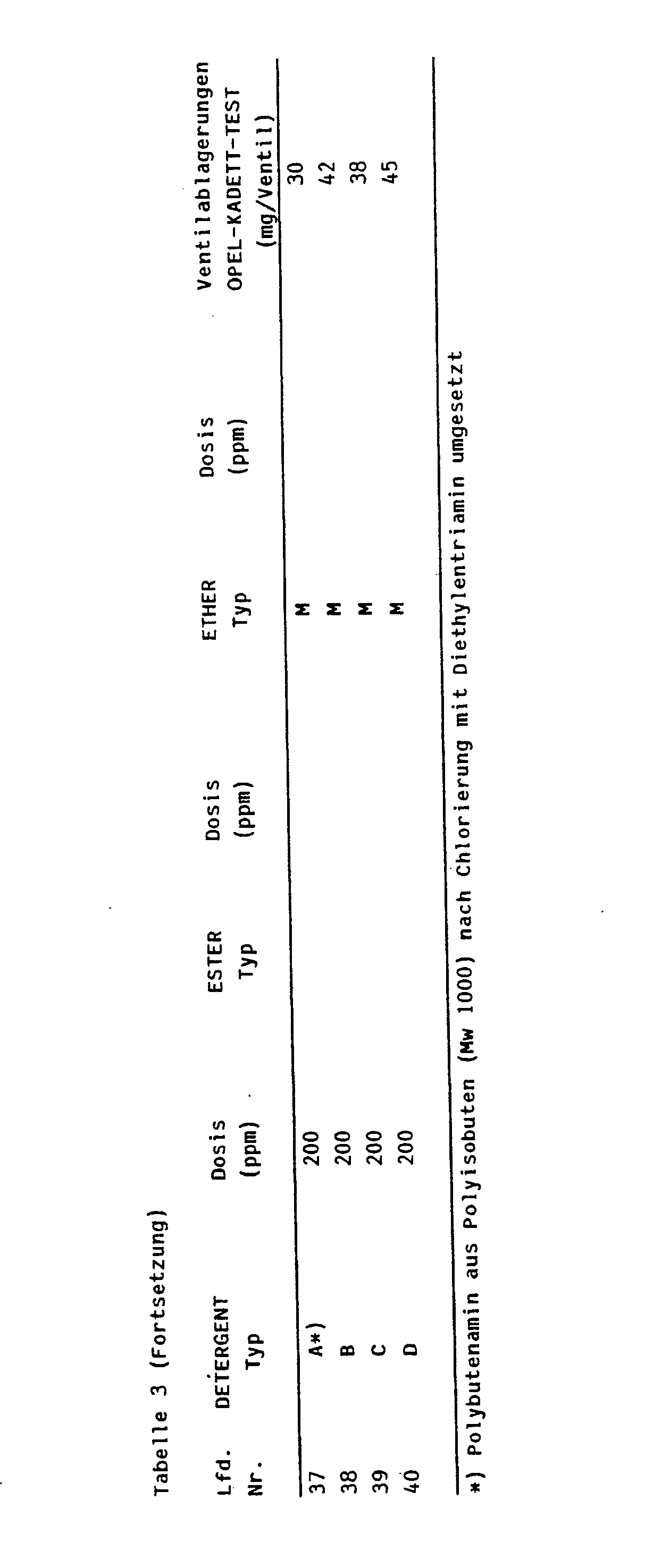
Tabelle 4 Reinhaltewirkung von erfindungsgemäßen Trägerölgemischen aus Estern und Polyethern auf die Einlaßventile im Opel-Kadett Motor Lfd. Nr. DETERGENT Typ Dosis (ppm) ESTER Typ Dosis (ppm) ETHER Typ Dosis (ppm) Ventilablagerungen OPEL-KADETT-TEST (mg/Ventil) 41 A 200 F 200 K 200 18 42 A 200 G 300 K 100 < 5 43 A 200 I 100 K 300 < 10 44 A 200 G 300 L 100 < 10 45 A 200 F 300 K 100 < 10 46 B 200 H 200 K 200 < 10 47 B 200 G 300 K 100 < 10 48 D 200 G 200 L 200 < 10 49 D 200 F 200 L 200 17 50 A 100 G 300 K 100 < 5 B 100 51 A 100 H 300 L 100 < 5 D 100 - Durch die erfindungsgemäßen Kraftstoffe basierend auf Detergentdosierungen von nur 100 bis 200 ppm in Kombination mit den Polyether/ester-Trägerölgemischen war es möglich, das unerwünschte Phänomen des Ventilklebens auf sehr befriedigende Art und Weise zu lösen.
- Zur Prüfung des Ventilklebeeffektes wird ein Volkswagen-Transporter mit einem 1,9 l (44 kW) Boxermotor (wassergekühlt) einem Straßenfahrprogramm unterzogen. Das Straßenfahrprogramm läuft unter folgenden Bedingungen ab:
10 km Fahrstrecke mit einer Geschwindigkeit von 50 km/h
10 Min. Stillstand
10 km Fahrstrecke mit einer Geschwindigkeit von 60 km/h
10 Min. Stillstand - Der Zyklus wird solange wiederholt bis ca. 130 km Fahrstrecke an einem Tag gefahren sind. Nach einer Standzeit des Fahrzeugs über Nacht (Temperaturen +5°C bis -5°C) werden die Ventilschäfte der Einlaßventile mit Hilfe eines Motoskops visuell beurteilt. Danach wird bei abmontiertem Ausgangkrümmer ein Kompressionsdiagramm erstellt. Nach wieder kompletter Montage des Motors werden Startversuche gemacht. Es wird das Startverhalten und der Motorlauf unmittelbar nach dem Start beschrieben.
- Die nachfolgende Tabelle 5 zeigt Ergebnisse aus dem obenbeschriebenen Volkswagen-ventilklebetest. Die Vorteile bei Verwendung der erfindungsgemäßen Ester/Polyether-Trägerölgemische sind offenkundig.
- Wie bereits erwähnt, reichern sich schwerflüchtige unverdampfbare Additivkomponenten im Laufe eines Öwechselintervalles konstruktionsbedingt im Ölsumpf eines Motors an. Durch die über die Ölwanne zirkulierenden sog. "blow-by Gase", die u.a. teilverbrannte Kohlenwasserstoffe und Stickoxide (NOX) enthalten, kommt es bei den hohen Ölsumpftemperaturen von 120 bis 150°C zu chemischen Folgereaktionen. Olefinhaltige Benzinkomponenten sowie hochsiedende aromatische Benzinfraktionen, aber auch die im ölsumpf befindlichen Schmieröladditive werden Nitrierungsreaktion unterworfen. In der weiteren Folge kommt es zu Polymerisationen und Verharzungen, die schließlich von den im Motorenöl befindlichen Dispergatoren nicht mehr getragen werden können. Ölaufdickungen, Ausfällungen und Ölverschlammungen sind die Folge. Polyisobutylamine verhalten sich hinsichtlich der Schlammbildung im Motorenöl unkritisch. In einigen Fällen, wenn der Polyisobutenrest mit einer dispergierenden Polyamingruppe verknüpft ist, tragen solche Polyisobutenamine sogar zu einer Verbesserung des Schlammverhaltens in Motorenölen bei. Detergentien anderer chemischer Struktur, insbesondere solche mit Amid- oder Imidgruppierungen sind nur bei entsprechend niedriger Dosierung hinsichtlich der Schlammbildung im Motorenöl als unkritisch anzusehen.
Tabelle 5 Ventilklebetest im 1,9 l VW-Transporter (44 kW) mit wassergekühltem Boxermotor Lfd. Nr. Typ Additiv Dosis (ppm) Testtemperatur (°C) Ablagerungen an den Ventilschäften ¹) Kompressionsverlust Startverhalten ²) Motorlaufnach dem Start ³) Bemerkung kung ja/nein in Zylinder 9 A 600 -1 ++ ja 4 b) ● ● Vergleichsversuche 52 A*) 600 -3 +++ ja 1 - 4 c) - 6 B 400 -5 ++ ja 1 c) - 10 B 800 -3 +++ ja 1 - 4 c) - 53 A**) 400 -3 +++ ja 1 - 4 c) - 43 A, I, K 200/100/500 -5 - nein - a) ● Versuche gemäß Erfindung 45 A, F, K 200/400/200 -2 + nein - b) ● 48 D, G, L 200/400/200 -6 - nein - a) ● 50 A, B, G, K 200/100/400/100 -3 - nein - a) ● 51 A, D, H, L 150/100/400/150 -1 - nein - a) ● *) vgl. Fußnote Tabelle 3 **) Polybutenamin mit mittlerer Molmasse 1250 ¹) Bewertung: +++ stark ++ mittel + gering - keine ²) Bewertung: a) Motor startet innerhalb von 4 Sekunden b) Motor startet nach 5 bis 10 Sekunden c) Motor startet nicht ³) Bewertung: ● Motor läuft problemlos rund ● ● Motor läuft unrund/stottert
Claims (3)
a) an sich bekannten Amino- oder Amidogruppen enthaltenden Detergentien zur Reinigung bzw. Reinhaltung des Einlaßsystems und
b) als Trägeröl einer Mischung aus
ba) Polyethern auf der Basis von Propylenoxid und/oder Butylenoxid mit einer Molmasse von mindestens 500 und
bb) Estern aus Monocarbonsäuren oder Polycarbonsäuren und Alkanolen oder Polyolen, wobei diese Ester eine Mindestviskosität von 2 mm²/s bei 100°C aufweisen.
wobei das Gewichtsverhältnis Polyether:Ester 20:80 bis 80:20 beträgt.
Applications Claiming Priority (2)
| Application Number | Priority Date | Filing Date | Title |
|---|---|---|---|
| DE3838918A DE3838918A1 (de) | 1988-11-17 | 1988-11-17 | Kraftstoffe fuer verbrennungsmaschinen |
| DE3838918 | 1988-11-17 |
Publications (2)
| Publication Number | Publication Date |
|---|---|
| EP0374461A1 true EP0374461A1 (de) | 1990-06-27 |
| EP0374461B1 EP0374461B1 (de) | 1992-05-13 |
Family
ID=6367362
Family Applications (1)
| Application Number | Title | Priority Date | Filing Date |
|---|---|---|---|
| EP89120840A Expired - Lifetime EP0374461B1 (de) | 1988-11-17 | 1989-11-10 | Kraftstoffe für Verbrennungsmaschinen |
Country Status (6)
| Country | Link |
|---|---|
| US (1) | US5004478A (de) |
| EP (1) | EP0374461B1 (de) |
| JP (1) | JP2803732B2 (de) |
| CA (1) | CA2002675C (de) |
| DE (2) | DE3838918A1 (de) |
| ES (1) | ES2033067T3 (de) |
Cited By (17)
| Publication number | Priority date | Publication date | Assignee | Title |
|---|---|---|---|---|
| EP0460957A3 (en) * | 1990-06-07 | 1992-05-06 | Tonen Corporation | Gasoline additive composition |
| EP0530094A1 (de) * | 1991-08-30 | 1993-03-03 | Institut Francais Du Petrole | Esterprodukte und Detergenz-Dispergiermittel enthaltende Brennstoffzusätze-Formulierung |
| EP0452328A4 (en) * | 1987-11-18 | 1993-03-10 | Chevron Research And Technology Company | Synergistic fuel compositions |
| EP0704519A1 (de) | 1994-09-28 | 1996-04-03 | Basf Aktiengesellschaft | Als Kraft- und Schmierstoffadditiv geeignete Mischung aus Aminen, Kohlenwasserstoffpolymeren und Trägerölen |
| WO1996018707A1 (en) * | 1994-12-13 | 1996-06-20 | Exxon Chemical Patents Inc. | Fuel oil compositions |
| WO1996023855A1 (en) * | 1995-02-02 | 1996-08-08 | Exxon Chemical Patents Inc. | Additives and fuel oil compositions |
| EP0706552A4 (de) * | 1994-05-02 | 1996-09-11 | Chevron Chem Co | Treibstoffzusatzzusammensetzungen, die ein aliphatisches amin, ein polyolefin und einen aromatischen ester enthalten |
| EP0947576A1 (de) * | 1998-03-31 | 1999-10-06 | Chevron Chemical Company LLC | Eine Aminverbindung und einen Ester enthaltende Brennstoffzusammensetzung |
| EP0950704A1 (de) * | 1998-04-14 | 1999-10-20 | The Lubrizol Corporation | Polyalken-substituiertes Amin und Polyätheralkohol enthaltende Zusammensetzungen |
| WO2000002978A1 (de) * | 1998-07-09 | 2000-01-20 | Basf Aktiengesellschaft | Propoxilat enthaltende kraftstoffzusammensetzungen |
| EP1004652A1 (de) * | 1998-11-25 | 2000-05-31 | Chevron Chemical Company LLC | Aromatische Ester-von-Polyalkylphenoxyalkanolen, Polyoxyalkylenamine und di- oder tri-Carbonsäureester enthaltende Kraftstoffzusammensetzungen |
| EP0706553B1 (de) * | 1994-05-02 | 2000-06-07 | Chevron Chemical Company LLC | Treibstoffzusatzzusammensetzungen, die ein aliphatisches amin, ein polyolefin und ein poly(oxyalkylen)monool enthalten |
| WO2001085874A3 (de) * | 2000-05-05 | 2002-04-04 | Basf Ag | Kraftstoffadditivpakete für ottokraftstoffe mit verbesserten viskositätseigenschaften und guter ivd performance |
| WO2003074637A1 (de) * | 2002-03-06 | 2003-09-12 | Basf Aktiengesellschaft | Kraftstoffadditivgemisch für ottokraftstoffe mit synergistischer ivd-performance |
| WO2003076492A1 (de) * | 2002-03-11 | 2003-09-18 | Basf Aktiengesellschaft | Polyether und deren verwendung als trägeröle |
| WO2003070861A3 (en) * | 2002-02-19 | 2004-02-19 | Lubrizol Corp | Method for operating internal combustion engine with a fuel composition |
| WO2009074606A1 (en) * | 2007-12-11 | 2009-06-18 | Basf Se | Hydrocarbylphenols as intake valve clean-up boosters |
Families Citing this family (142)
| Publication number | Priority date | Publication date | Assignee | Title |
|---|---|---|---|---|
| US5089028A (en) * | 1990-08-09 | 1992-02-18 | Mobil Oil Corporation | Deposit control additives and fuel compositions containing the same |
| US5211721A (en) * | 1991-02-25 | 1993-05-18 | Texaco Inc. | Polyoxyalkylene ester compounds and ORI-inhibited motor fuel compositions |
| US5697988A (en) * | 1991-11-18 | 1997-12-16 | Ethyl Corporation | Fuel compositions |
| DE4142241A1 (de) * | 1991-12-20 | 1993-06-24 | Basf Ag | Kraftstoffe fuer ottomotoren |
| US5538520A (en) * | 1994-03-25 | 1996-07-23 | Mobil Oil Corporation | Additives for fuels and lubricants |
| DE4425834A1 (de) | 1994-07-21 | 1996-01-25 | Basf Ag | Umsetzungsprodukte aus Polyisobutenen und Stickoxiden oder Gemischen aus Stickoxiden und Sauerstoff und ihre Verwendung als Kraft- und Schmierstoffadditive |
| DE4426003A1 (de) | 1994-07-22 | 1996-01-25 | Basf Ag | Umsetzungsprodukte von Polyolefinen mit Vinylestern und ihre Verwendung als Kraft- und Schmierstoffadditive |
| US5853435A (en) * | 1994-12-30 | 1998-12-29 | Mobil Oil Corporation | Polymeric amine-heterocyclic reaction products as fuel and lubricant antiwear, detergency and cleanliness additives |
| US5620486A (en) * | 1994-12-30 | 1997-04-15 | Chevron Chemical Company | Fuel compositions containing aryl succinimides |
| US5578090A (en) * | 1995-06-07 | 1996-11-26 | Bri | Biodiesel fuel |
| US6296757B1 (en) | 1995-10-17 | 2001-10-02 | Exxon Research And Engineering Company | Synthetic diesel fuel and process for its production |
| US5689031A (en) | 1995-10-17 | 1997-11-18 | Exxon Research & Engineering Company | Synthetic diesel fuel and process for its production |
| DE69608401T2 (de) | 1995-12-19 | 2001-01-11 | Chevron Chemical Co. Llc, San Francisco | Alkylphenylpolyoxyalkylenamine mit sehr langen Ketten, und die selben enthaltende Kraftstoffzusammensetzungen |
| US5599359A (en) | 1995-12-29 | 1997-02-04 | Chevron Chemical Company | Polyalkylphenyl and polyalkyloxycarbonylphenyl hydroxybenzoates and fuel compositions containing the same |
| US5637119A (en) | 1995-12-29 | 1997-06-10 | Chevron Chemical Company | Substituted aromatic polyalkyl ethers and fuel compositions containing the same |
| US5628803A (en) | 1995-12-29 | 1997-05-13 | Chevron Chemical Company | Polyalkylphenyl and polyalkyloxycarbonylphenyl amino and nitro benzoates and fuel compositions containing the same |
| JP2001501992A (ja) * | 1996-09-13 | 2001-02-13 | エクソン リサーチ アンド エンジニアリング カンパニー | ポリオールエステル留出燃料添加剤 |
| US6080212A (en) * | 1996-11-13 | 2000-06-27 | Henkel Corporation | Lubricants for diesel fuel |
| US5752989A (en) * | 1996-11-21 | 1998-05-19 | Ethyl Corporation | Diesel fuel and dispersant compositions and methods for making and using same |
| US5858029A (en) * | 1997-01-13 | 1999-01-12 | Mobil Oil Corporation | Friction reducing additives for fuels and lubricants |
| US5766274A (en) | 1997-02-07 | 1998-06-16 | Exxon Research And Engineering Company | Synthetic jet fuel and process for its production |
| US6821308B2 (en) * | 1997-04-02 | 2004-11-23 | Bayer Antwerp N.V. | Polyoxyalkylene monoethers with reduced water affinity |
| US5863302A (en) * | 1997-04-18 | 1999-01-26 | Mobil Oil Corporation | Friction reducing additives for fuels and lubricants |
| US5756435A (en) * | 1997-04-18 | 1998-05-26 | Mobil Oil Corporation | Friction reducing additives for fuels and lubricants |
| US5993499A (en) * | 1997-06-27 | 1999-11-30 | Chevron Chemical Company | Fuel composition containing an aliphatic amine and a poly (oxyalkylene) monool |
| JP4550195B2 (ja) * | 1999-12-08 | 2010-09-22 | 三洋化成工業株式会社 | 燃料油添加剤および燃料油組成物 |
| US6716258B2 (en) | 1999-12-21 | 2004-04-06 | Exxonmobil Research And Engineering Company | Fuel composition |
| US6458176B2 (en) | 1999-12-21 | 2002-10-01 | Exxonmobil Research And Engineering Company | Diesel fuel composition |
| US6447558B1 (en) | 1999-12-21 | 2002-09-10 | Exxonmobil Research And Engineering Company | Diesel fuel composition |
| US6447557B1 (en) | 1999-12-21 | 2002-09-10 | Exxonmobil Research And Engineering Company | Diesel fuel composition |
| US7204863B2 (en) * | 2001-12-11 | 2007-04-17 | Exxonmobil Research And Engineering Company | Gasoline additives for reducing the amount of internal combustion engine intake valve deposits and combustion chamber deposits |
| US7226489B2 (en) | 2001-12-12 | 2007-06-05 | Exxonmobil Research And Engineering Company | Gasoline additives for reducing the amount of internal combustion engine intake valve deposits and combustion chamber deposits |
| US6660050B1 (en) | 2002-05-23 | 2003-12-09 | Chevron U.S.A. Inc. | Method for controlling deposits in the fuel reformer of a fuel cell system |
| DE10239841A1 (de) * | 2002-08-29 | 2004-03-11 | Basf Ag | Additivgemische für Kraft- und Schmierstoffe |
| MY140297A (en) * | 2002-10-18 | 2009-12-31 | Shell Int Research | A fuel composition comprising a base fuel, a fischer-tropsch derived gas oil and an oxygenate |
| AU2003296971A1 (en) * | 2002-12-13 | 2004-07-09 | Eco-Performance Products Ltd. | Alcohol enhanced alternative fuels |
| JP2004210984A (ja) * | 2003-01-06 | 2004-07-29 | Chevron Texaco Japan Ltd | 燃料油組成物および燃料添加剤 |
| DE10314809A1 (de) | 2003-04-01 | 2004-10-14 | Basf Ag | Polyalkenamine mit verbesserten Anwendungseigenschaften |
| DE10316871A1 (de) | 2003-04-11 | 2004-10-21 | Basf Ag | Kraftstoffzusammensetzung |
| DE102004038113A1 (de) | 2004-08-05 | 2006-03-16 | Basf Ag | Stickstoffhaltige heterocyclische Verbindungen als Reibverschleißvermindernder Zusatz zu Kraftstoffen |
| KR20070049178A (ko) * | 2004-08-06 | 2007-05-10 | 바스프 악티엔게젤샤프트 | 연료 및 윤활유용 폴리아민 첨가제 |
| US7824454B2 (en) | 2004-08-17 | 2010-11-02 | Chevron Oronite Company Llc | Fuel composition for rectifying fuel gauge sending unit problems |
| EP2272821B1 (de) | 2006-02-27 | 2019-12-04 | Basf Se | Dreikernige phenolische Verbindungen |
| EP2066767B1 (de) * | 2006-09-05 | 2015-10-21 | Cerion LLC | Cerdioxidnanopartikel enthaltendes kraftstoffadditiv |
| US8883865B2 (en) | 2006-09-05 | 2014-11-11 | Cerion Technology, Inc. | Cerium-containing nanoparticles |
| US10435639B2 (en) | 2006-09-05 | 2019-10-08 | Cerion, Llc | Fuel additive containing lattice engineered cerium dioxide nanoparticles |
| US8551365B2 (en) | 2007-03-02 | 2013-10-08 | Basf Se | Additive formulation suitable for antistatic modification and improving the electrical conductivity of inanimate organic material |
| JP5393668B2 (ja) | 2007-07-16 | 2014-01-22 | ビーエーエスエフ ソシエタス・ヨーロピア | 相乗混合物 |
| CA2617614C (en) | 2007-08-10 | 2012-03-27 | Indian Oil Corporation Limited | Novel synthetic fuel and method of preparation thereof |
| DE102008037662A1 (de) | 2007-08-17 | 2009-04-23 | Basf Se | Öllösliches Detergens und Verfahren zur Herstellung funktionalisierter Polyalkene |
| CN101861377B (zh) | 2007-10-19 | 2013-11-06 | 国际壳牌研究有限公司 | 用于内燃机的功能性流体 |
| JP5527822B2 (ja) * | 2007-11-28 | 2014-06-25 | シエル・インターナシヨネイル・リサーチ・マーチヤツピイ・ベー・ウイ | ガソリン組成物 |
| US20100319244A1 (en) | 2008-02-01 | 2010-12-23 | Basf Se | Specific polyisobuteneamines and their use as detergents in fuels |
| DE102010001408A1 (de) | 2009-02-06 | 2010-08-12 | Basf Se | Verwendung von Ketonen als Kraftstoffzusatz zur Verringerung des Kraftstoffverbrauches von Dieselmotoren |
| US8552122B2 (en) * | 2009-03-31 | 2013-10-08 | The University Of Southern Mississippi | Amine-terminated telechelic polymers and precursors thereto and methods for their preparation |
| US8394898B2 (en) * | 2009-07-31 | 2013-03-12 | The University Of Southern Mississippi | In situ formation of hydroxy chain end functional polyolefins |
| DE102010039039A1 (de) | 2009-08-24 | 2011-03-03 | Basf Se | Verwendung von organischen Verbindungen als Kraftstoffzusatz zur Verringerung des Kraftstoffverbrauchs von Dieselmotoren |
| US8790426B2 (en) | 2010-04-27 | 2014-07-29 | Basf Se | Quaternized terpolymer |
| BR112012025554A2 (pt) | 2010-04-27 | 2016-06-28 | Basf Se | terpolímero quaternizado, uso e processo para preparar o mesmo, e, combustível. |
| AU2011260433A1 (en) | 2010-06-01 | 2012-12-13 | Basf Se | Low-molecular weight polyisobutyl-substituted amines as detergent boosters |
| JP2013531097A (ja) | 2010-06-25 | 2013-08-01 | ビーエーエスエフ ソシエタス・ヨーロピア | 四級化コポリマー |
| US8911516B2 (en) | 2010-06-25 | 2014-12-16 | Basf Se | Quaternized copolymer |
| BR112013000297B1 (pt) | 2010-07-06 | 2020-10-06 | Basf Se | Processo para preparar compostos de nitrogênio quaternizados, composto de nitrogênio quaternizado,uso de um composto de nitrogênio quaternizado,concentrado de aditivo, e, composição |
| US9296841B2 (en) | 2010-11-30 | 2016-03-29 | Basf Se | Preparation of isobutene homo- or copolymer derivatives |
| EP2646478A2 (de) | 2010-11-30 | 2013-10-09 | Basf Se | Herstellung von isobutenhomo- oder -copolymer-derivaten |
| JP2014501813A (ja) | 2010-12-02 | 2014-01-23 | ビーエーエスエフ ソシエタス・ヨーロピア | ヒドロカルビルで置換されたジカルボン酸と窒素化合物とからの反応生成物の、燃料消費量の低減のための使用 |
| US9006158B2 (en) | 2010-12-09 | 2015-04-14 | Basf Se | Polytetrahydrobenzoxazines and bistetrahydrobenzoxazines and use thereof as a fuel additive or lubricant additive |
| MX2013006289A (es) | 2010-12-09 | 2013-07-15 | Basf Se | Politetrahidrobenzoxazinas y bistetrahidrobenzoxazinas y uso de las mismas como un aditivo de combustible o aditivo de lubricante. |
| US20120304531A1 (en) | 2011-05-30 | 2012-12-06 | Shell Oil Company | Liquid fuel compositions |
| EP2540808A1 (de) | 2011-06-28 | 2013-01-02 | Basf Se | Quaternisierte Stickstoffverbindungen und deren Verwendung als Additive in Kraft- und Schmierstoffen |
| US20130133243A1 (en) | 2011-06-28 | 2013-05-30 | Basf Se | Quaternized nitrogen compounds and use thereof as additives in fuels and lubricants |
| EP2589647A1 (de) | 2011-11-04 | 2013-05-08 | Basf Se | Quaternisierte Polyetheramine und deren Verwendung als Additive in Kraft- und Schmierstoffen |
| EP2604674A1 (de) | 2011-12-12 | 2013-06-19 | Basf Se | Verwendung quaternisierter Alkylamine als Additive in Kraft- und Schmierstoffen |
| BR112014018653A8 (pt) | 2012-02-10 | 2017-07-11 | Basf Se | Uso de um sal de imidazólio, concentrado de aditivo, composição de combustível, e, sal de imidazólio |
| US9062266B2 (en) | 2012-02-10 | 2015-06-23 | Basf Se | Imidazolium salts as additives for fuels |
| AU2013265575B2 (en) | 2012-05-25 | 2017-06-15 | Basf Se | Tertiary amines for reducing injector nozzle fouling in direct injection spark ignition engines |
| WO2014019911A1 (en) | 2012-08-01 | 2014-02-06 | Basf Se | Process for improving thermostability of lubricant oils in internal combustion engines |
| US10173963B2 (en) | 2012-10-23 | 2019-01-08 | Basf Se | Quaternized ammonium salts of hydrocarbyl epoxides and use thereof as additives in fuels and lubricants |
| US9388354B2 (en) | 2012-11-06 | 2016-07-12 | Basf Se | Tertiary amines for reducing injector nozzle fouling and modifying friction in direct injection spark ignition engines |
| WO2014023853A2 (en) | 2012-11-06 | 2014-02-13 | Basf Se | Tertiary amines for reducing injector nozzle fouling and modifying friction in direct injection spark ignition engines |
| US20140173972A1 (en) | 2012-12-21 | 2014-06-26 | Shell Oil Company | Liquid fuel compositions |
| WO2014184066A1 (en) | 2013-05-14 | 2014-11-20 | Basf Se | Polyalkenylsuccinimides for reducing injector nozzle fouling in direct injection spark ignition engines |
| EP4190882B1 (de) | 2013-06-07 | 2024-12-25 | Basf Se | Quaternisierte stickstoffverbindungen mit alkylenoxid und hydrocarbyl-substituierter polycarbonsäure als additive in kraftstoffen |
| EP2811007A1 (de) | 2013-06-07 | 2014-12-10 | Basf Se | Verwendung mit Alkylenoxid und Hydrocarbyl-substituierter Polycarbonsäure quaternisierter Alkylamine als Additive in Kraft- und Schmierstoffen |
| SG11201510755VA (en) | 2013-07-17 | 2016-02-26 | Basf Se | Highly reactive polyisobutylene having a high percentage of vinylidene double bonds in the side chains |
| PL3483234T3 (pl) | 2013-09-20 | 2021-12-13 | Basf Se | Zastosowanie specjalnych pochodnych czwartorzędowanych związków azotowych jako dodatków do paliw silnikowych |
| BR112016006429B1 (pt) * | 2013-09-27 | 2021-08-17 | Dow Global Technologies Llc | Processo para produzir polímeros poli(óxido de 1,2- butileno) e polímero poli(óxido de 1,2- butileno) |
| US10143661B2 (en) | 2013-10-17 | 2018-12-04 | Cerion, Llc | Malic acid stabilized nanoceria particles |
| US20150113859A1 (en) | 2013-10-24 | 2015-04-30 | Basf Se | Use of polyalkylene glycol to reduce fuel consumption |
| US20150113864A1 (en) | 2013-10-24 | 2015-04-30 | Basf Se | Use of a complex ester to reduce fuel consumption |
| US20150113867A1 (en) | 2013-10-24 | 2015-04-30 | Basf Se | Use of an alkoxylated polytetrahydrofuran to reduce fuel consumption |
| WO2015091458A1 (en) | 2013-12-16 | 2015-06-25 | Shell Internationale Research Maatschappij B.V. | Liquid fuel compositions |
| EP2891699B1 (de) | 2013-12-31 | 2021-10-13 | Shell Internationale Research Maatschappij B.V. | Bleifreie Kraftstoffzusammensetzungen |
| SG11201605508UA (en) | 2014-01-29 | 2016-08-30 | Basf Se | Corrosion inhibitors for fuels and lubricants |
| WO2015113681A1 (de) | 2014-01-29 | 2015-08-06 | Basf Se | Polycarbonsäure-basierte additive für kraft und schmierstoffe |
| EP2949733A1 (de) | 2014-05-28 | 2015-12-02 | Shell Internationale Research Maatschappij B.V. | Ottokraftstoffzusammensetzungen enthaltend als uv-absorber wirksame oxanilidverbindungen |
| CN107109264B (zh) | 2014-11-12 | 2019-10-18 | 国际壳牌研究有限公司 | 燃料组合物 |
| WO2016083090A1 (de) | 2014-11-25 | 2016-06-02 | Basf Se | Korrosionsinhibitoren für kraft- und schmierstoffe |
| BR112017018385B1 (pt) | 2015-02-27 | 2022-01-18 | Shell Internationale Research Maatschappij B.V. | Uso de uma amina aromática em uma composição lubrificante |
| US11085001B2 (en) | 2015-07-16 | 2021-08-10 | Basf Se | Copolymers as additives for fuels and lubricants |
| DE212016000150U1 (de) | 2015-07-24 | 2018-03-16 | Basf Se | Korrosionsinhibitoren für Kraft- und Schmierstoffe |
| US10808195B2 (en) | 2015-09-22 | 2020-10-20 | Shell Oil Company | Fuel compositions |
| WO2017093203A1 (en) | 2015-11-30 | 2017-06-08 | Shell Internationale Research Maatschappij B.V. | Fuel composition |
| WO2017144378A1 (de) | 2016-02-23 | 2017-08-31 | Basf Se | HYDROPHOBE POLYCARBONSÄUREN ALS REIBVERSCHLEIß-VERMINDERNDER ZUSATZ ZU KRAFTSTOFFEN |
| EP3481920B1 (de) | 2016-07-05 | 2021-08-11 | Basf Se | Verwendung von korrosionsinhibitoren für kraft- und schmierstoffe |
| PT3481922T (pt) | 2016-07-05 | 2021-03-29 | Basf Se | Inibidores de corrosão para combustíveis e lubrificantes |
| WO2018007486A1 (de) | 2016-07-07 | 2018-01-11 | Basf Se | Polymere als additive für kraft und schmierstoffe |
| WO2018007445A1 (de) | 2016-07-07 | 2018-01-11 | Basf Se | Korrosionsinhibitoren für kraft- und schmierstoffe |
| US20190249099A1 (en) | 2016-07-07 | 2019-08-15 | Basf Se | Copolymers as additives for fuels and lubricants |
| MY202420A (en) | 2016-12-15 | 2024-04-28 | Basf Se | Polymers as additives for fuels |
| WO2018114348A1 (de) | 2016-12-19 | 2018-06-28 | Basf Se | Additive zur verbesserung der thermischen stabilität von kraftstoffen |
| MY193114A (en) | 2016-12-20 | 2022-09-26 | Basf Se | Use of a mixture of a complex ester with a monocarboxylic acid to reduce friction |
| WO2018188982A1 (de) | 2017-04-11 | 2018-10-18 | Basf Se | Alkoxylierte amine als kraftstoffadditive |
| EP3609990B1 (de) | 2017-04-13 | 2021-10-27 | Basf Se | Polymere als additive für kraft- und schmierstoffe |
| JP2021518470A (ja) | 2018-03-23 | 2021-08-02 | シェブロン・オロナイト・カンパニー・エルエルシー | 火花点火内燃機関の低速予備点火を防止または低減するための組成物および方法 |
| MX2020013813A (es) | 2018-07-02 | 2021-03-09 | Shell Int Research | Composiciones de combustible liquido. |
| SG11202103198WA (en) | 2018-10-04 | 2021-04-29 | Chevron Oronite Co | Hydride donors as an additive for reducing low speed pre-ignition events |
| WO2020095189A1 (en) | 2018-11-07 | 2020-05-14 | Chevron Usa Inc. | Amino alkanediols and carboxylate salts as additives for improving fuel efficiency |
| CN113227332B (zh) | 2018-11-15 | 2024-01-12 | 雪佛龙奥伦耐有限责任公司 | 用于防止或降低火花点燃式内燃机的低速早燃的组合物和方法 |
| SG11202105033SA (en) | 2018-11-15 | 2021-06-29 | Chevron Oronite Co | Composition and method for preventing or reducing low speed pre-ignition in spark-ignited internal combustion engines |
| WO2020260062A1 (en) | 2019-06-26 | 2020-12-30 | Basf Se | New additive packages for gasoline fuels |
| WO2021048677A1 (en) | 2019-09-10 | 2021-03-18 | Chevron Oronite Company Llc | Reducing friction in combustion engines through fuel additives |
| EP4038166A1 (de) | 2019-09-30 | 2022-08-10 | Basf Se | Verwendung von stickstoffverbindungen, die mit alkylenoxid- und hydrocarbylsubstituierten polycarbonsäuren quaterniert sind, als additive in kraftstoffen und schmierstoffen |
| EP3933014A1 (de) | 2020-06-30 | 2022-01-05 | Basf Se | Additivierung von kraftstoffen zur verringerung unkontrollierter zündungen in verbrennungsmotoren |
| CN116134116B (zh) | 2020-07-07 | 2025-05-23 | 雪佛龙奥伦耐有限责任公司 | 用于减轻喷射器喷嘴结垢和减少颗粒物排放的燃料添加剂 |
| ES2964845T3 (es) | 2020-07-14 | 2024-04-09 | Basf Se | Inhibidores de corrosión para combustibles y lubricantes |
| CA3189342A1 (en) | 2020-07-20 | 2022-01-27 | Shell Internationale Research Maatschappij B.V. | Fuel composition |
| EP3945126B1 (de) | 2020-07-31 | 2024-03-13 | Basf Se | Enttrübungszusammensetzungen für kraftstoffe |
| JP2023541471A (ja) | 2020-09-17 | 2023-10-02 | シェブロン・オロナイト・カンパニー・エルエルシー | 直接噴射火花点火ガソリンエンジンの噴射装置の付着物を低減するための燃料添加剤としてのアリールオキシアルキルアミン |
| AU2022213776A1 (en) | 2021-01-27 | 2023-08-10 | Basf Se | Branched primary alkyl amines as additives for gasoline fuels |
| CA3214437A1 (en) | 2021-03-31 | 2022-10-06 | Chevron Oronite Company Llc | Fuel additives for reducing low speed pre-ignition events |
| CN117062898A (zh) | 2021-03-31 | 2023-11-14 | 雪佛龙奥伦耐有限责任公司 | 用于减轻低速早燃事件的组合物 |
| BR112023021530A2 (pt) | 2021-04-26 | 2023-12-19 | Shell Int Research | Composição combustível, e, métodos para melhorar a potência de saída, para melhorar a aceleração, para reduzir a duração da queima de uma composição combustível, para aumentar a velocidade da chama de uma composição combustível em um motor de combustão interna |
| WO2022228990A1 (en) | 2021-04-26 | 2022-11-03 | Shell Internationale Research Maatschappij B.V. | Fuel compositions |
| ES3006982T3 (en) | 2021-06-15 | 2025-03-19 | Basf Se | Gasoline fuel and fuel additive packages comprising an amide compound |
| WO2022263244A1 (en) | 2021-06-16 | 2022-12-22 | Basf Se | Quaternized betaines as additives in fuels |
| WO2023052286A1 (en) | 2021-09-29 | 2023-04-06 | Shell Internationale Research Maatschappij B.V. | Fuel compositions |
| EP4163353A1 (de) | 2021-10-06 | 2023-04-12 | Basf Se | Verfahren zur verringerung von ablagerungen auf einlassventilen |
| CA3234489A1 (en) | 2021-10-14 | 2023-04-20 | Chevron U.S.A. Inc. | Polyamide fuel additives |
| EP4382588A1 (de) | 2022-12-06 | 2024-06-12 | Basf Se | Additive zur verbesserung der thermischen stabilität von kraftstoffen |
| WO2024149635A1 (en) | 2023-01-12 | 2024-07-18 | Basf Se | Branched amines as additives for gasoline fuels |
| WO2026046756A1 (en) | 2024-08-29 | 2026-03-05 | Basf Se | Process for improving the injection of direct injection gasoline engines |
Citations (12)
| Publication number | Priority date | Publication date | Assignee | Title |
|---|---|---|---|---|
| FR2096298A5 (de) * | 1970-06-16 | 1972-02-11 | Shell Int Research | |
| US3658495A (en) * | 1968-08-05 | 1972-04-25 | Lubrizol Corp | Fuel compositions comprising a combination of oxy compounds and ashless dispersants |
| US3658494A (en) * | 1969-01-21 | 1972-04-25 | Lubrizol Corp | Fuel compositions comprising a combination of monoether and ashless dispersants |
| FR2207180A1 (de) * | 1972-11-18 | 1974-06-14 | Basf Ag | |
| US4200518A (en) * | 1979-03-22 | 1980-04-29 | Chevron Research Company | Heat exchanger anti-foulant |
| GB2081299A (en) * | 1980-07-29 | 1982-02-17 | Exxon Research Engineering Co | Two-stroke Fuel-lubricant Composition |
| EP0081744A2 (de) * | 1981-12-15 | 1983-06-22 | BASF Aktiengesellschaft | Kraftstoffzusätze für Ottomotoren |
| EP0061895B1 (de) * | 1981-03-31 | 1986-03-05 | Exxon Research And Engineering Company | Zusatz zur Verbesserung des Fliessverhaltens von Destillat-Treibstoffen und Konzentrate daraus |
| EP0235868A1 (de) * | 1986-03-06 | 1987-09-09 | Shell Internationale Researchmaatschappij B.V. | Kraftstoffgemisch |
| DE3611230A1 (de) * | 1986-04-04 | 1987-10-08 | Basf Ag | Polybutyl- und polyisobutylamine, verfahren zu deren herstellung und diese enthaltende kraft- und schmierstoffzusammensetzungen |
| EP0277345A1 (de) * | 1987-01-08 | 1988-08-10 | BASF Aktiengesellschaft | Kraft- oder Schmierstoffzusammensetzung, enthaltend Polybutyl- oder Polyisobutylderivate |
| EP0282845A1 (de) * | 1987-03-14 | 1988-09-21 | BASF Aktiengesellschaft | Kraftstoffe, enthaltend geringe Mengen Alkoxylate und Polycarbonsäureimide |
Family Cites Families (7)
| Publication number | Priority date | Publication date | Assignee | Title |
|---|---|---|---|---|
| US2568876A (en) * | 1949-11-14 | 1951-09-25 | Socony Vacuum Oil Co Inc | Reaction products of n-acylated polyalkylene-polyamines with alkenyl succinic acid anhydrides |
| NL102633C (de) * | 1954-05-15 | |||
| US3449250A (en) * | 1962-05-14 | 1969-06-10 | Monsanto Co | Dispersency oil additives |
| GB1217468A (en) * | 1969-04-18 | 1970-12-31 | Shell Int Research | Ester mixtures |
| US3951614A (en) * | 1972-05-24 | 1976-04-20 | Chevron Research Company | Fuel detergents |
| CA1155088A (en) * | 1980-08-05 | 1983-10-11 | Daniel Bernhardt | Multiple seal container device |
| RU2014347C1 (ru) * | 1981-03-31 | 1994-06-15 | Эксон Рисерч энд Энджиниринг Компани | Топливная композиция |
-
1988
- 1988-11-17 DE DE3838918A patent/DE3838918A1/de not_active Withdrawn
-
1989
- 1989-10-31 US US07/429,814 patent/US5004478A/en not_active Expired - Lifetime
- 1989-11-08 CA CA002002675A patent/CA2002675C/en not_active Expired - Fee Related
- 1989-11-10 EP EP89120840A patent/EP0374461B1/de not_active Expired - Lifetime
- 1989-11-10 DE DE8989120840T patent/DE58901419D1/de not_active Expired - Lifetime
- 1989-11-10 ES ES198989120840T patent/ES2033067T3/es not_active Expired - Lifetime
- 1989-11-17 JP JP1299478A patent/JP2803732B2/ja not_active Expired - Lifetime
Patent Citations (13)
| Publication number | Priority date | Publication date | Assignee | Title |
|---|---|---|---|---|
| US3658495A (en) * | 1968-08-05 | 1972-04-25 | Lubrizol Corp | Fuel compositions comprising a combination of oxy compounds and ashless dispersants |
| DE2112937A1 (de) * | 1968-08-05 | 1972-10-19 | Lubrizol Corp | Kraft- und Brennstoffe sowie Reinigungsloesungen fuer Verbrennungsmotoren oder Heizvorrichtungen |
| US3658494A (en) * | 1969-01-21 | 1972-04-25 | Lubrizol Corp | Fuel compositions comprising a combination of monoether and ashless dispersants |
| FR2096298A5 (de) * | 1970-06-16 | 1972-02-11 | Shell Int Research | |
| FR2207180A1 (de) * | 1972-11-18 | 1974-06-14 | Basf Ag | |
| US4200518A (en) * | 1979-03-22 | 1980-04-29 | Chevron Research Company | Heat exchanger anti-foulant |
| GB2081299A (en) * | 1980-07-29 | 1982-02-17 | Exxon Research Engineering Co | Two-stroke Fuel-lubricant Composition |
| EP0061895B1 (de) * | 1981-03-31 | 1986-03-05 | Exxon Research And Engineering Company | Zusatz zur Verbesserung des Fliessverhaltens von Destillat-Treibstoffen und Konzentrate daraus |
| EP0081744A2 (de) * | 1981-12-15 | 1983-06-22 | BASF Aktiengesellschaft | Kraftstoffzusätze für Ottomotoren |
| EP0235868A1 (de) * | 1986-03-06 | 1987-09-09 | Shell Internationale Researchmaatschappij B.V. | Kraftstoffgemisch |
| DE3611230A1 (de) * | 1986-04-04 | 1987-10-08 | Basf Ag | Polybutyl- und polyisobutylamine, verfahren zu deren herstellung und diese enthaltende kraft- und schmierstoffzusammensetzungen |
| EP0277345A1 (de) * | 1987-01-08 | 1988-08-10 | BASF Aktiengesellschaft | Kraft- oder Schmierstoffzusammensetzung, enthaltend Polybutyl- oder Polyisobutylderivate |
| EP0282845A1 (de) * | 1987-03-14 | 1988-09-21 | BASF Aktiengesellschaft | Kraftstoffe, enthaltend geringe Mengen Alkoxylate und Polycarbonsäureimide |
Cited By (29)
| Publication number | Priority date | Publication date | Assignee | Title |
|---|---|---|---|---|
| EP0452328A4 (en) * | 1987-11-18 | 1993-03-10 | Chevron Research And Technology Company | Synergistic fuel compositions |
| EP0460957A3 (en) * | 1990-06-07 | 1992-05-06 | Tonen Corporation | Gasoline additive composition |
| EP0654524A3 (de) * | 1990-06-07 | 1995-10-11 | Tonen Corp | Treibstoffzusatzezusammensetzung. |
| EP0530094A1 (de) * | 1991-08-30 | 1993-03-03 | Institut Francais Du Petrole | Esterprodukte und Detergenz-Dispergiermittel enthaltende Brennstoffzusätze-Formulierung |
| FR2680796A1 (fr) * | 1991-08-30 | 1993-03-05 | Inst Francais Du Petrole | Formulation d'additifs pour carburants comprenant des produits a fonction ester et un detergent - dispersant. |
| EP0706552A4 (de) * | 1994-05-02 | 1996-09-11 | Chevron Chem Co | Treibstoffzusatzzusammensetzungen, die ein aliphatisches amin, ein polyolefin und einen aromatischen ester enthalten |
| EP0706553B1 (de) * | 1994-05-02 | 2000-06-07 | Chevron Chemical Company LLC | Treibstoffzusatzzusammensetzungen, die ein aliphatisches amin, ein polyolefin und ein poly(oxyalkylen)monool enthalten |
| EP0704519A1 (de) | 1994-09-28 | 1996-04-03 | Basf Aktiengesellschaft | Als Kraft- und Schmierstoffadditiv geeignete Mischung aus Aminen, Kohlenwasserstoffpolymeren und Trägerölen |
| US6579329B1 (en) | 1994-09-28 | 2003-06-17 | Basf Ag | Mixture suitable as a fuel additive and lubricant additive and comprising amines, hydrocarbon polymers and carrier oils |
| WO1996018707A1 (en) * | 1994-12-13 | 1996-06-20 | Exxon Chemical Patents Inc. | Fuel oil compositions |
| WO1996018706A1 (en) * | 1994-12-13 | 1996-06-20 | Exxon Chemical Patents Inc. | Fuel oil compositions |
| US5833722A (en) * | 1994-12-13 | 1998-11-10 | Exxon Chemical Patents, Inc. | Fuel oil compositions with improved lubricity properties |
| WO1996023855A1 (en) * | 1995-02-02 | 1996-08-08 | Exxon Chemical Patents Inc. | Additives and fuel oil compositions |
| EP0947576A1 (de) * | 1998-03-31 | 1999-10-06 | Chevron Chemical Company LLC | Eine Aminverbindung und einen Ester enthaltende Brennstoffzusammensetzung |
| EP0950704A1 (de) * | 1998-04-14 | 1999-10-20 | The Lubrizol Corporation | Polyalken-substituiertes Amin und Polyätheralkohol enthaltende Zusammensetzungen |
| US6348075B1 (en) | 1998-04-14 | 2002-02-19 | The Lubrizol Corporation | Compositions containing polyalkene-substituted amine and polyether alcohol |
| WO2000002978A1 (de) * | 1998-07-09 | 2000-01-20 | Basf Aktiengesellschaft | Propoxilat enthaltende kraftstoffzusammensetzungen |
| US7250065B1 (en) | 1998-07-09 | 2007-07-31 | Basf Aktiengesellschaft | Fuel compositions containing propoxylate |
| EP1004652A1 (de) * | 1998-11-25 | 2000-05-31 | Chevron Chemical Company LLC | Aromatische Ester-von-Polyalkylphenoxyalkanolen, Polyoxyalkylenamine und di- oder tri-Carbonsäureester enthaltende Kraftstoffzusammensetzungen |
| US6840970B2 (en) | 2000-05-05 | 2005-01-11 | Basf Aktiengesellschaft | Fuel additive compositions for fuels for internal combustion engines with improved viscosity properties and good IVD performance |
| WO2001085874A3 (de) * | 2000-05-05 | 2002-04-04 | Basf Ag | Kraftstoffadditivpakete für ottokraftstoffe mit verbesserten viskositätseigenschaften und guter ivd performance |
| WO2003070861A3 (en) * | 2002-02-19 | 2004-02-19 | Lubrizol Corp | Method for operating internal combustion engine with a fuel composition |
| WO2003074637A1 (de) * | 2002-03-06 | 2003-09-12 | Basf Aktiengesellschaft | Kraftstoffadditivgemisch für ottokraftstoffe mit synergistischer ivd-performance |
| AU2003219018B2 (en) * | 2002-03-06 | 2008-11-06 | Basf Aktiengesellschaft | Fuel additive mixtures for gasolines with synergistic IVD performance |
| US7601185B2 (en) | 2002-03-06 | 2009-10-13 | Basf Aktiengesellschaft | Fuel additive mixtures for gasolines with synergistic IVD performance |
| WO2003076492A1 (de) * | 2002-03-11 | 2003-09-18 | Basf Aktiengesellschaft | Polyether und deren verwendung als trägeröle |
| US7470823B2 (en) | 2002-03-11 | 2008-12-30 | Basf Aktiengesellschaft | Polyethers and their use as carrier oils |
| KR100959601B1 (ko) * | 2002-03-11 | 2010-05-27 | 바스프 에스이 | 폴리에테르 및 캐리어 오일로서의 이의 용도 |
| WO2009074606A1 (en) * | 2007-12-11 | 2009-06-18 | Basf Se | Hydrocarbylphenols as intake valve clean-up boosters |
Also Published As
| Publication number | Publication date |
|---|---|
| ES2033067T3 (es) | 1993-03-01 |
| US5004478A (en) | 1991-04-02 |
| JPH02173194A (ja) | 1990-07-04 |
| EP0374461B1 (de) | 1992-05-13 |
| JP2803732B2 (ja) | 1998-09-24 |
| DE58901419D1 (de) | 1992-06-17 |
| CA2002675C (en) | 1994-04-05 |
| CA2002675A1 (en) | 1990-05-17 |
| DE3838918A1 (de) | 1990-05-23 |
Similar Documents
| Publication | Publication Date | Title |
|---|---|---|
| EP0374461B1 (de) | Kraftstoffe für Verbrennungsmaschinen | |
| DE3826797A1 (de) | Kraftstoffzusammensetzungen, die polycarbonsaeureester langkettiger alkohole enthalten | |
| EP0012345B1 (de) | Kraftstoffe und ihre Verwendung | |
| EP0700985B1 (de) | Polyetheramine enthaltende Kraftstoffe für Ottomotoren | |
| EP2270119B1 (de) | Kraftstoffzusammensetzung | |
| DE60214332T2 (de) | Alkylsubstituierte cresolpolyalkoxylate und ihre Verwendung in Brennstoffen | |
| EP0639632A1 (de) | Additiv für unverbleite Ottokraftstoffe sowie dieses enthaltender Kraftstoff | |
| EP0464489B1 (de) | Ester enthaltende Kraftstoffe für Ottomotoren und Dieselmotoren | |
| EP1612257A2 (de) | Kraftstoffzusammensetzung | |
| EP1098953B1 (de) | Propoxilat enthaltende kraftstoffzusammensetzungen | |
| DE2727503A1 (de) | Polyoxyalkylencarbamate | |
| DD254954A5 (de) | Kraftstoffgemisch und verfahren zum betrieb eines fremdzeunduengsverbrennungsmotor | |
| EP0398100B1 (de) | Kraftstoffzusammensetzungen mit einem Gehalt an Alkoxylierungsprodukten | |
| DE3814601A1 (de) | Detergenz fuer kohlenwasserstoff-brennstoffe | |
| EP1230330B1 (de) | Verwendung von fettsäuresalzen von alkoxylierten oligoaminen als schmierfähigkeitsverbesserer für mineralölprodukte | |
| DE69309850T2 (de) | Herstellende Injektorvollreinigung für Dieselkraftstoffzusatz | |
| EP0704519B1 (de) | Als Kraft- und Schmierstoffadditiv geeignete Mischung aus Aminen, Kohlenwasserstoffpolymeren und Trägerölen | |
| EP0489322A2 (de) | Alkoxylierte Polyetherdiamine, Verfahren zu ihrer Herstellung und Kraftstoffe für Ottomotoren, die diese enthalten | |
| EP0282845B1 (de) | Kraftstoffe, enthaltend geringe Mengen Alkoxylate und Polycarbonsäureimide | |
| DE60020783T2 (de) | Brennstoffdispergiermittel mit erhöhter Schmiereigenschaft | |
| EP0006527B1 (de) | Kraftstoffe für Ottomotoren, die Additivmischungen enthalten | |
| DE2531469C3 (de) | Verwendung von w -N.N.N'.N'tetrasubstituierten Aminoalkansäureamiden, w -N,N,N',N'tetrasubstituierte Aminobuttersäure-amide und Verfahren zu deren Herstellung | |
| DE102018133587A1 (de) | Kraftstoffadditiv-mischungen und kraftstoffe, die diese enthalten | |
| DE68901831T2 (de) | Motortreibstoffadditiv und ablagerungen reduzierende motortreibstoffzusammensetzung. | |
| DE69101603T2 (de) | Treibstoffadditivzusammensetzung. |
Legal Events
| Date | Code | Title | Description |
|---|---|---|---|
| PUAI | Public reference made under article 153(3) epc to a published international application that has entered the european phase |
Free format text: ORIGINAL CODE: 0009012 |
|
| 17P | Request for examination filed |
Effective date: 19900308 |
|
| AK | Designated contracting states |
Kind code of ref document: A1 Designated state(s): BE DE ES FR GB IT NL SE |
|
| 17Q | First examination report despatched |
Effective date: 19910425 |
|
| GRAA | (expected) grant |
Free format text: ORIGINAL CODE: 0009210 |
|
| AK | Designated contracting states |
Kind code of ref document: B1 Designated state(s): BE DE ES FR GB IT NL SE |
|
| ITF | It: translation for a ep patent filed | ||
| REF | Corresponds to: |
Ref document number: 58901419 Country of ref document: DE Date of ref document: 19920617 |
|
| GBT | Gb: translation of ep patent filed (gb section 77(6)(a)/1977) | ||
| ET | Fr: translation filed | ||
| REG | Reference to a national code |
Ref country code: ES Ref legal event code: FG2A Ref document number: 2033067 Country of ref document: ES Kind code of ref document: T3 |
|
| PLBE | No opposition filed within time limit |
Free format text: ORIGINAL CODE: 0009261 |
|
| STAA | Information on the status of an ep patent application or granted ep patent |
Free format text: STATUS: NO OPPOSITION FILED WITHIN TIME LIMIT |
|
| 26N | No opposition filed | ||
| EAL | Se: european patent in force in sweden |
Ref document number: 89120840.7 |
|
| REG | Reference to a national code |
Ref country code: GB Ref legal event code: IF02 |
|
| PGFP | Annual fee paid to national office [announced via postgrant information from national office to epo] |
Ref country code: NL Payment date: 20051106 Year of fee payment: 17 |
|
| PGFP | Annual fee paid to national office [announced via postgrant information from national office to epo] |
Ref country code: SE Payment date: 20051107 Year of fee payment: 17 |
|
| PGFP | Annual fee paid to national office [announced via postgrant information from national office to epo] |
Ref country code: FR Payment date: 20051108 Year of fee payment: 17 |
|
| PGFP | Annual fee paid to national office [announced via postgrant information from national office to epo] |
Ref country code: ES Payment date: 20051219 Year of fee payment: 17 |
|
| PGFP | Annual fee paid to national office [announced via postgrant information from national office to epo] |
Ref country code: BE Payment date: 20060120 Year of fee payment: 17 |
|
| PG25 | Lapsed in a contracting state [announced via postgrant information from national office to epo] |
Ref country code: SE Free format text: LAPSE BECAUSE OF NON-PAYMENT OF DUE FEES Effective date: 20061111 |
|
| PG25 | Lapsed in a contracting state [announced via postgrant information from national office to epo] |
Ref country code: BE Free format text: LAPSE BECAUSE OF NON-PAYMENT OF DUE FEES Effective date: 20061130 |
|
| PGFP | Annual fee paid to national office [announced via postgrant information from national office to epo] |
Ref country code: IT Payment date: 20061130 Year of fee payment: 18 |
|
| PG25 | Lapsed in a contracting state [announced via postgrant information from national office to epo] |
Ref country code: NL Free format text: LAPSE BECAUSE OF NON-PAYMENT OF DUE FEES Effective date: 20070601 |
|
| EUG | Se: european patent has lapsed | ||
| NLV4 | Nl: lapsed or anulled due to non-payment of the annual fee |
Effective date: 20070601 |
|
| REG | Reference to a national code |
Ref country code: FR Ref legal event code: ST Effective date: 20070731 |
|
| BERE | Be: lapsed |
Owner name: *BASF A.G. Effective date: 20061130 |
|
| REG | Reference to a national code |
Ref country code: ES Ref legal event code: FD2A Effective date: 20061111 |
|
| PG25 | Lapsed in a contracting state [announced via postgrant information from national office to epo] |
Ref country code: FR Free format text: LAPSE BECAUSE OF NON-PAYMENT OF DUE FEES Effective date: 20061130 Ref country code: ES Free format text: LAPSE BECAUSE OF NON-PAYMENT OF DUE FEES Effective date: 20061111 |
|
| PGFP | Annual fee paid to national office [announced via postgrant information from national office to epo] |
Ref country code: DE Payment date: 20081107 Year of fee payment: 20 |
|
| PGFP | Annual fee paid to national office [announced via postgrant information from national office to epo] |
Ref country code: GB Payment date: 20081105 Year of fee payment: 20 |
|
| PG25 | Lapsed in a contracting state [announced via postgrant information from national office to epo] |
Ref country code: IT Free format text: LAPSE BECAUSE OF NON-PAYMENT OF DUE FEES Effective date: 20071110 |
|
| REG | Reference to a national code |
Ref country code: GB Ref legal event code: PE20 Expiry date: 20091109 |
|
| PG25 | Lapsed in a contracting state [announced via postgrant information from national office to epo] |
Ref country code: GB Free format text: LAPSE BECAUSE OF EXPIRATION OF PROTECTION Effective date: 20091109 |