EP0374630A2 - Polycarbonate aus Cycloalkylidenbisphenolen - Google Patents
Polycarbonate aus Cycloalkylidenbisphenolen Download PDFInfo
- Publication number
- EP0374630A2 EP0374630A2 EP89122664A EP89122664A EP0374630A2 EP 0374630 A2 EP0374630 A2 EP 0374630A2 EP 89122664 A EP89122664 A EP 89122664A EP 89122664 A EP89122664 A EP 89122664A EP 0374630 A2 EP0374630 A2 EP 0374630A2
- Authority
- EP
- European Patent Office
- Prior art keywords
- hydroxyphenyl
- bis
- cyclohexane
- mol
- polycarbonates
- Prior art date
- Legal status (The legal status is an assumption and is not a legal conclusion. Google has not performed a legal analysis and makes no representation as to the accuracy of the status listed.)
- Withdrawn
Links
Classifications
-
- C—CHEMISTRY; METALLURGY
- C08—ORGANIC MACROMOLECULAR COMPOUNDS; THEIR PREPARATION OR CHEMICAL WORKING-UP; COMPOSITIONS BASED THEREON
- C08G—MACROMOLECULAR COMPOUNDS OBTAINED OTHERWISE THAN BY REACTIONS ONLY INVOLVING UNSATURATED CARBON-TO-CARBON BONDS
- C08G64/00—Macromolecular compounds obtained by reactions forming a carbonic ester link in the main chain of the macromolecule
- C08G64/04—Aromatic polycarbonates
- C08G64/06—Aromatic polycarbonates not containing aliphatic unsaturation
-
- C—CHEMISTRY; METALLURGY
- C08—ORGANIC MACROMOLECULAR COMPOUNDS; THEIR PREPARATION OR CHEMICAL WORKING-UP; COMPOSITIONS BASED THEREON
- C08L—COMPOSITIONS OF MACROMOLECULAR COMPOUNDS
- C08L69/00—Compositions of polycarbonates; Compositions of derivatives of polycarbonates
Definitions
- the invention relates to thermoplastic aromatic polycarbonates with average molecular weights M w from at least 10,000, preferably from 10,000 to 250,000, particularly preferably from 10,000 to 120,000, very particularly preferably from 15,000 to 100,000 and in particular 20,000 to 80,000, the bifunctional carbonate structural units of the formula (I)
- R1, R2, R3, R4 independently of one another hydrogen, C1 to C12 hydrocarbon, halogen m 2 or 3 and X is hydrogen or C6 to C12 hydrocarbon, at least one radical X being a C6 to C12 hydrocarbon radical and preferably only one or two radicals X being C6 to C12 hydrocarbon radicals, in amounts of 100 to 1 mol%, preferably 100 to 5 mol% and particularly preferably 100 to 20 mol%, based on the total amount of difunctional carbonate structural units in the polycarbonate.
- those with 100 to 50 mol% are preferred, those with 100 to 80 mol% are particularly preferred and
- the polycarbonates according to the invention have compared to known polycarbonates, e.g. from bisphenol A and from 1,4-bis (4-hydroxyphenyl) cyclohexane, surprising technological properties.
- the polycarbonates according to the invention are also resistant to leakage current, stable to hydrolysis, UV-stable and stable to heat aging and show good optical properties, for example low values of light birefringence.
- the carbonate structural units of the formula (I) are biphenols of the formula (II) underlying, in the R1, R2, R3, R4, m and X have the same meaning as in formula (I).
- R1, R2, R3 and R4 are preferably hydrogen, methyl, ethyl, phenyl, cyclohexyl, chlorine and bromine, but particularly preferably hydrogen, methyl and bromine.
- radicals R1, R2, R3 and R4 are not equal to hydrogen, the same substituents are preferred. If two of the radicals R1, R2, R3 and R4 are not equal to hydrogen, the O, O′-substitution, based on the carbonate groups (formula (I)) or the phenolic OH groups (formula (II)), is preferred. If all four radicals R1, R2, R3 and R4 are not equal to hydrogen, the O, O, O ′, O′-substitution, based on before, is preferred.
- m is preferably 3.
- X is hydrogen or C6-C12 hydrocarbon radicals such as n-C6-C12 alkyl (e.g. n-hexyl, n-octyl, n-nonyl, n-decyl, n-undecyl, n-dodecyl), iso-C6-C12-alkyl (e.g.
- C6-C12- Cycloalkyl such as cyclohexyl, cyclohexyl substituted with n-alkyl or isoalkyl (such as methyl, ethyl, isopropyl or tert-butyl cyclohexyl), aryl substituted cyclohexyl (e.g. phenylcyclohexyl) and cyclohexyl to which phenyl radicals are fused.
- Aryl such as phenyl and naphthyl
- aralkyl such as benzyl and cumenyl
- alkaryl such as methylphenyl and isopropylphenyl
- cycloalkyl-substituted alkyl such as perhydrocumenyl
- X in the formulas (I) and (II) is preferably hydrogen, iso-C6-C12-alkyl, cycloalkyl, cycloalkyl-substituted alkyl, aryl and aralkyl, particularly preferably hydrogen, iso-C8-C9-alkyl, cyclohexyl, phenyl, Cumenyl and perhydrocumenyl, very particularly preferably hydrogen, 1,1,3,3-tetramethylbutyl, phenyl and cyclohexyl.
- this radical X is preferably in the 4-position of the cyclohexylidene ring, if the particularly good accessibility of the starting components is important, or preferred in the 3-position of the cyclohexylidene ring when the high heat resistance of the polycarbonate is important.
- bisphenols of the formula (II) are: 1,1-bis (4-hydroxyphenyl) -4- (1,1-dimethylbutyl) cyclohexane 1,1-bis- (4-hydroxyphenyl) -4- (1,1,3,3-tetramethylbutyl) cyclohexane, 1,1-bis (4-hydroxyphenyl) -4-phenylcyclohexane 1,1-bis (4-hydroxyphenyl) -4-cumyl-cyclohexane 1,1-bis (4-hydroxyphenyl) -4-benzylcyclohexane 1,1-bis (4-hydroxyphenyl) -4-cyclohexyl-cyclohexane 1,1, -Bis- (4-hydroxyphenyl) -4-perhydrocumyl-cyclohexane 1,1-bis (4-hydroxyphenyl) -3-phenylcyclohexane 1,1-bis- (4-hydroxyphenyl) -3-phenylcyclohexan
- Bisphenols of the formula (II) are known or can be prepared from corresponding ketones and phenols by customary processes.
- the polycarbonates according to the invention each contain 100 mol% complementary amounts of other difunctional carbonate structural units, for example those of the formula (III) which are based on bisphenols of the formula (IV). ⁇ OZO- ⁇ (III) HO-Z-OH (IV)
- Bisphenols of the formula (IV) are those in which Z is an aromatic radical having 6 to 30 carbon atoms, which may contain one or more aromatic nuclei, may be substituted and aliphatic radicals or cycloaliphatic radicals other than that of the formula (II) or can contain heteroatoms as bridge members.
- diphenols of the formula (IV) are Hydroquinone, Resorcinol, Dihydroxydiphenyls, Bis (hydroxyphenyl) alkanes, Bis (hydroxyphenyl) cycloalkanes, Bis (hydroxyphenyl) sulfides, Bis (hydroxyphenyl) ether, Bis (hydroxyphenyl) ketones, Bis (hydroxyphenyl) sulfones, Bis (hydroxyphenyl) sulfoxides, ⁇ , ⁇ ′-bis (hydroxyphenyl) diisopropylbenzenes and their nuclear alkylated and nuclear halogenated compounds.
- Preferred other diphenols are, for example: 4,4'-dihydroxydiphenyl, 2,2-bis (4-hydroxyphenyl) propane, 2,4-bis (4-hydroxyphenyl) -2-methylbutane, 1,1-bis (4-hydroxyphenyl) cyclohexane, ⁇ , ⁇ ′-bis (4-hydroxyphenyl) -p-diisopropylbenzene, 2,2-bis (3-methyl-4-hydroxyphenyl) propane, 2,2-bis (3-chloro-4-hydroxyphenyl) propane, Bis (3,5-dimethyl-4-hydroxyphenyl) methane, 2,2-bis (3,5-dimethyl-4-hydroxyphenyl) propane, Bis (3,5-dimethyl-4-hydroxyphenyl) sulfone, 2,4-bis (3,5-dimethyl-4-hydroxyphenyl) -2-methylbutane, 1,1-bis (3,5-dimethyl-4-hydroxyphenyl) cyclohexane, ⁇ , ⁇ ′-bis
- Particularly preferred diphenols of the formula (IV) are, for example: 2,2-bis (4-hydroxyphenyl) propane, 2,2-bis (3,5-dimethyl-4-hydroxyphenyl) propane, 2,2-bis (3,5-dichloro-4-hydroxyphenyl) propane, 2,2-bis (3,5-dibromo-4-hydroxyphenyl) propane and 1,1-bis (4-hydroxyphenyl) cyclohexane.
- the other diphenols can be used both individually and in a mixture.
- small amounts preferably amounts between 0.05 and 2.0 mol% (based on diphenols used), of three- or more than three-functional compounds, in particular those with three or more than three phenolic compounds, are used as branching agents, if known Hydroxyl groups to obtain branched polycarbonates.
- Some of the compounds that can be used have three or more than three phenolic hydroxyl groups Phloroglucin, 4,6-dimethyl-2,4,6-tri- (4-hydroxyphenyl) -hepten-2, 4,6-dimethyl-2,4,6-tri- (4-hydroxyphenyl) heptane, 1,3,5-tri- (4-hydroxyphenyl) benzene, 1,1,1-tri- (4-hydroxyphenyl) ethane, Tri- (4-hydroxyphenyl) phenylmethane, 2,2-bis (4,4-bis (4-hydroxyphenyl) cyclohexyl) propane, 2,4-bis (4-hydroxyphenyl-isopropyl) phenol, 2,6-bis (2-hydroxy-5'-methylbenzyl) -4-methylphenol, 2- (4-hydroxyphenyl) -2- (2,4-dihydroxyphenyl) propane, Hexa- (4- (4-hydroxyphenyl-isopropyl) phenyl) orthoterephthalic acid
- Some of the other three-functional compounds are 2,4-dihydroxybenzoic acid, trimesic acid, cyanuric chloride and 3,3-bis (3-methyl-4-hydroxyphenyl) -2-oxo-2,3-dihydroindole.
- monofunctional compounds in conventional concentrations serve as chain terminators for regulating the molecular weight.
- Suitable compounds are, for example, secondary amines, phenols and acid chlorides.
- Phenols for example tert-butylphenols or other alkyl-substituted phenols, are preferred.
- Small amounts of phenols of the formula (V) are particularly suitable for regulating the molecular weight wherein R represents a branched C8 and / or C9 alkyl radical.
- the proportion of CH3 protons in the alkyl radical R between 47 and 89% and the proportion of CH and CH2 protons between 53 and 11%; R is also preferably in the o- and / or p-position to the OH group, and particularly preferably the upper limit of the ortho fraction 20%.
- phenols are phenol, p-tert-butylphenol, hydroxydiphenyl, p-cumylphenol and in particular p-3,5-dimethylheptylphenol and m- and p-1,1,3,3-tetramethylbutylphenol.
- the chain terminators are generally used in amounts of 0.1 to 10, preferably 0.5 to 8 mol%, based on the diphenols used.
- the polycarbonates according to the invention can preferably be prepared in a manner known per se by the phase boundary process (cf. H. Schnell, "Chemistry and Physics of Polycarbonates", Polymer Reviews, Vol. IX, page 33 ff., Interscience Publ., 1964).
- the diphenols of the formula (II) are dissolved in an aqueous alkaline phase. Mixtures of diphenols of the formula (II) and the other diphenols, for example those of the formula (IV), are used to produce copolycarbonates with other diphenols. To terminate the molecular weight, chain terminators e.g. of the formula (V) are added. Then, in the presence of an inert, preferably polycarbonate-dissolving, organic phase, reaction with phosgene is carried out by the phase interface condensation method. The reaction temperature is generally between 0 ° C and 40 ° C.
- the optionally used 0.05 to 2 mol% of branching agents can either be introduced with the diphenols in the aqueous alkaline phase or added dissolved in the organic solvent before the phosgenation.
- diphenols of the formula (II) to be used as well as the other diphenols of the formula (IV) their mono- and / or bis-chlorocarbonic acid esters can also be added be used, which are added dissolved in organic solvents.
- the amount of chain terminators and branching agents then depends on the moles of diphenolate structural units of (II) and, if appropriate, of the other diphenolate structural units, such as, for example, of (IV); Likewise, the amount of phosgene can be reduced accordingly in a known manner when using chlorocarbonic acid esters.
- Chlorinated hydrocarbons such as chloroform, dichloroethane, di- and tetrachlorethylene, tetrachloroethane, methylene chloride, chlorobenzene and dichlorobenzene, but also not chlorinated, can be used, for example, as the organic phase for the interfacial polycondensation and as the organic solvent for the solution of the chain terminators and optionally for the branching agents and the chlorocarbonic acid esters Hydrocarbons, such as Toluene and xylene, and mixtures of these solvents, in particular mixtures of methylene chloride and chlorobenzene. If necessary, the chain terminators and branches used can be solved in the same solvent.
- the organic phase for the interfacial polycondensation is, for example, methylene chloride, chlorobenzene or toluene and mixtures of methylene chloride and chlorobenzene.
- aqueous NaOH solution or KOH solution serves as the aqueous alkaline phase.
- the preparation of the polycarbonates according to the invention by the phase interface process can be carried out in the usual way by catalysts such as tertiary amines and phase transfer catalysts, in particular tertiary aliphatic amines such as e.g. Tributylamine, triethylamine, N-ethylpiperidine and especially quaternary ammonium and phosphonium compounds and crown ethers such as e.g. Catalyzed tetrabutylammonium bromide and triphenylbenzylphosphonium bromide; the catalysts are generally used in amounts of 0.05 to 30 mol%, based on moles of diphenols used.
- the catalysts are generally added before the start of phosgenation or during or after the phosgenation.
- the polycarbonates according to the invention are isolated in a known manner, e.g. by separating the organic phase obtained in the phase interface processes with the dissolved polycarbonate, washing neutral and free of electrolytes and then the polycarbonate, for example using an evaporation extruder as granules, or by precipitation using a non-solvent and subsequent drying or by spray evaporation as powder or as pellets isolated.
- thermoplastic, aromatic polycarbonates according to the invention can also after known processes in a homogeneous phase, the so-called "pyridine process” and by the known melt transesterification process using, for example, diphenyl carbonate instead of phosgene.
- pyridine process the so-called "pyridine process”
- melt transesterification process using, for example, diphenyl carbonate instead of phosgene.
- the polycarbonates according to the invention are isolated in a known manner.
- the polycarbonates according to the invention can, before or during their processing into shaped articles, the additives customary for thermoplastic polycarbonates such as e.g. Stabilizers, mold release agents, pigments, fire protection additives, antistatic agents, conductivity additives, fillers and reinforcing materials can be added in the usual amounts.
- the additives customary for thermoplastic polycarbonates such as e.g. Stabilizers, mold release agents, pigments, fire protection additives, antistatic agents, conductivity additives, fillers and reinforcing materials can be added in the usual amounts.
- the fire protection measures can be used individually or together.
- the fire protection additives are incorporated individually or in groups, preferably in extruders or kneaders, into the polycarbonates which contain diphenols of the formula I in condensed form.
- the fire retardants can be added to the polycarbonates as early as during manufacture or even as the starting materials.
- the fire protection agents can also be added to solutions of the polycarbonates with subsequent concentration of the solutions to dry.
- the fire protection agent additives are preferably used in amounts of 0.001 to 50% by weight, the fire protection comonomers preferably in amounts of 0.1 to 50 mol% .
- graphite, carbon black, metal fibers, metal powder, diatomaceous earth, quartz, talc, mica, kaolin, clays, CaF2, CaCO3, aluminum oxides, glass fibers, C fibers, ceramic fibers and organic and inorganic pigments can be added, and, for example, glycerol stearates as mold release agents , Pentaerythritol tetrastearate and trimethylolpropane tristearate.
- the polycarbonates according to the invention can be processed into moldings according to the rules of thermoplastic processing, for example by extruding the polycarbonates isolated in a known manner to give granules and these granules, if appropriate after adding the abovementioned additives, for example by injection molding, extrusion, blow molding, rotary molding or hot molding Pressing processed into various moldings in a known manner.
- Shaped bodies are also understood to mean fibers, plates and foils. The latter can also be further shaped using deep-drawing processes.
- the foils can be processed in combination with other foils to form composite foils.
- the polycrbonates according to the invention can also be used in other composite materials, for example in combination with fibers and other polymers.
- the polycarbonates according to the invention can advantageously be used as moldings, for example in the electrical sector and in the construction sector, in particular when complicated components with high heat resistance are required.
- the bisphenolate-free alkaline aqueous phase was separated off, the organic phase after acidification with dilute phosphoric acid was washed with water until free of electrolytes and evaporated.
- Example 2 The procedure of Example 1 was repeated with the difference that instead of the bisphenol used there, 344 g (1 mol) of 1,1-bis (4-hydroxyphenyl) -4- phenyl-cyclohexane were used.
- the glass transition temperature Tg (after differential thermal analysis) was 210 ° C.
- Example 2 was repeated with the difference that half of the bisphenol used there was replaced by 114 g (0.5 mol) of 2,2-bis (4-hydroxyphenyl) propane (bisphenol A).
- the glass transition temperature Tg (according to differential thermal analysis) was 186 ° C.
- Example 2 The procedure of Example 1 was repeated with the difference that 344 g (1 mol) of 1,1-bis (4-hydroxyphenyl) -3-phenylcyclohexane were used instead of the bisphenol used there.
- the glass transition temperature T g (according to differential thermal analysis) was 231 ° C.
- Example 1 The procedure of Example 1 was repeated with the difference that instead of the bisphenol used there, 386 g (1 mol) of 1,1-bis (4-hydroxyphenyl) -4-cumyl-cyclohexane were used.
- Example 1 The procedure of Example 1 was repeated with the difference that 350 g (1 mol) of 1,1-bis (4-hydroxyphenyl) -4-cyclohexyl-cyclohexane were used instead of the bisphenol used there.
- Example 2 was repeated, but 10 mol% of the diphenol was replaced by 3,3 ', 5,5'-tetrabromo-bisphenol A.
- the polycarbonate obtained showed ⁇ rel of 1.302.
- test bars measuring 80 x 6 x 3 mm were produced by injection molding.
Landscapes
- Chemical & Material Sciences (AREA)
- Health & Medical Sciences (AREA)
- Chemical Kinetics & Catalysis (AREA)
- Medicinal Chemistry (AREA)
- Polymers & Plastics (AREA)
- Organic Chemistry (AREA)
- Polyesters Or Polycarbonates (AREA)
Abstract
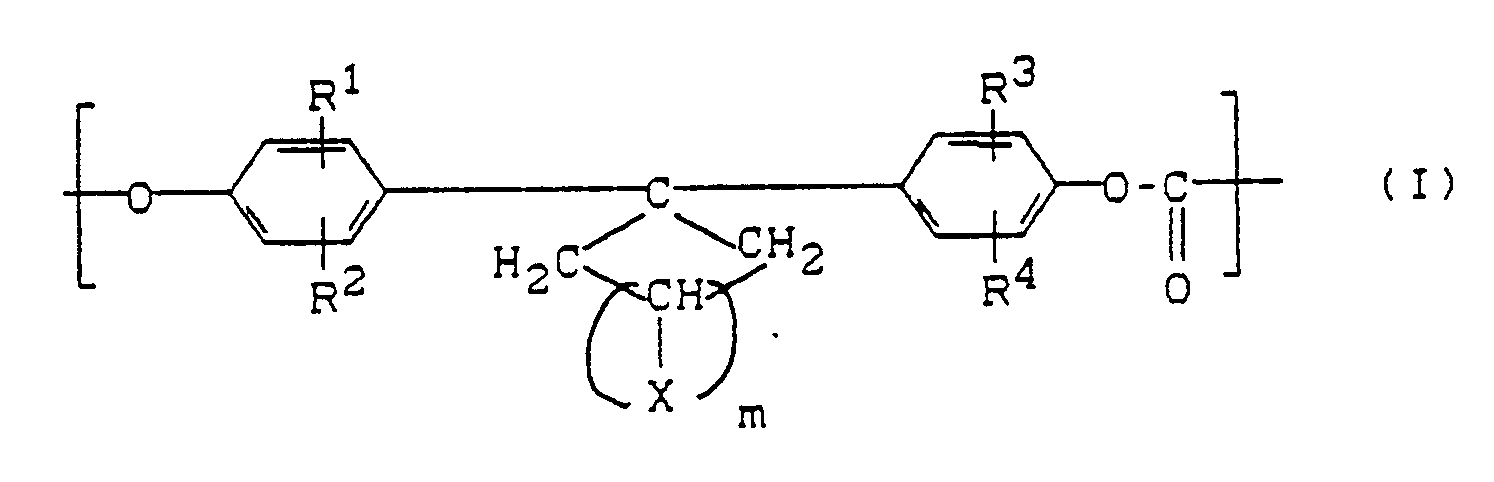
R¹, R², R³, R⁴ unabhängig voneinander Wasserstoff, C₁ bis C₁₂ Kohlenwasserstoffrest, Halogen
m 2 oder 3 und
X Wasserstoff oder C₆ bis C₁₂ Kohlenwasserstoffrest, wobei mindestens ein Rest X ein C₆ bis C₁₂ Kohlenwasserstoffrest ist,
in Mengen von 100 bis 1 Mol-%, bezogen auf die Gesamtmenge von difunktionellen Carbonatstruktureinheiten im Polycarbonat, enthalten.
Description
- Gegenstand der Erfindung sind thermoplastische aromatische Polycarbonate mit mittleren Molekulargewichten
M w von mindestens 10.000, bevorzugt von 10.000 bis 250.000, besonders bevorzugt von 10.000 bis 120.000, ganz besonders bevorzugt von 15.000 bis 100.000 und insbesondere 20.000 bis 80.000, die bifunktionelle Carbonatstruktureinheiten der Formel (I)
R¹, R², R³, R⁴ unabhängig voneinander Wasserstoff, C₁ bis C₁₂ Kohlenwasserstoff, Halogen
m 2 oder 3 und
X Wasserstoff oder C₆ bis C₁₂ Kohlenwasserstoff, wobei mindestens ein Rest X ein C₆- bis C₁₂-Kohlenwasserstoffrest ist und bevorzugt nur ein oder zwei Reste X C₆- bis C₁₂-Kohlenwasserstoffreste sind,
in Mengen von 100 bis 1 Mol-%, bevorzugt 100 bis 5 Mol-% und besonders bevorzugt 100 bis 20 Mol-%, bezogen auf die Gesamtmenge von difunktionellen Carbonatstruktureinheiten im Polycarbonat enthalten. Von den genannten Polycarbonaten mit 100 bis 20 Mol-% an bifunktionellen Carbonatstruktureinheiten der Formel (I) werden die mit 100 bis 50 Mol-% bevorzugt, die mit 100 bis 80 Mol-% besonders bevorzugt und die mit 100 Mol-% ganz besonders bevorzugt. - Die erfindungsgemäßen Polycarbonate weisen gegenüber bekannten Polycarbonaten, z.B. aus Bisphenol A und aus 1,4-Bis-(4-hydroxyphenyl)-cyclohexan, überraschende technologische Eigenschaften auf.
- So besitzen sie überraschend hohe Glastemperaturen T g schon bei kleinen Anteilen an Carbonatstruktureinheiten der Formel (I). Ebenso haben sie ein besonders gutes Entformungsverhalten, außergewöhnlich gute Schmelzfließfähigkeit, insbesondere unter Berücksichtigung der hohen Glastemperatur T g. Die erfindungsgemäßen Polycarbonate sind außerdem kriechstromfest, hydrolysestabil, UV-stabil und wärmealterungsstabil und zeigen gute optische Eigenschaften, so z.B. geringe Werte der Lichtdoppelbrechung.
- Den Carbonatstruktureinheiten der Formel (I) liegen Biphenole der Formel (II)

R¹, R², R³, R⁴, m und X die gleiche Bedeutung wie in Formel (I) haben. - In den Formeln (I) und (II) sind R¹, R², R³ und R⁴ bevorzugt Wasserstoff, Methyl, Ethyl, Phenyl, Cyclohexyl, Chlor und Brom, besonders bevorzugt jedoch Wasserstoff, Methyl und Brom.
- Wenn mehr als einer der Reste R¹, R², R³ und R⁴ ungleich Wasserstoff ist, werden gleiche Substituenten bevorzugt. Wenn zwei der Reste R¹, R², R³ und R⁴ ungleich Wasserstoff sind, wird die O,O′-Substitution, bezogen auf die Carbonatgruppen (Formel (I)) bzw. die phenolischen OH-Gruppen (Formel (II)), bevorzugt. Wenn alle vier Reste R¹, R², R³ und R⁴ ungleich Wasserstoff sind, wird die O,O,O′,O′-Substitution, bezogen wie vor, bevorzugt.
- In den Formeln (I) und (II) ist m bevorzugt 3.
- In den Formeln (I) und (II) bedeutet X Wasserstoff oder C₆-C₁₂-Kohlenwasserstoffreste wie n-C₆-C₁₂-Alkyl (z.B. n-Hexyl, n-Octyl, n-Nonyl, n-Decyl, n-Undecyl, n-Dodecyl), Iso-C₆-C₁₂-Alkyl (z.B. verschiedene Isohexyl-, Isooctyl-und Isododecylreste), C₆-C₁₂-Cycloalkyl wie z.B. Cyclohexyl, mit n-Alkyl oder Isoalkyl substituiertes Cyclohexyl (wie z.B. Methyl-, Ethyl-, Isopropyl- oder tert.-Butyl- Cyclohexyl), Aryl-substituiertes Cyclohexyl (z.B. Phenylcyclohexyl) und Cyclohexyl, an das Phenylreste anelliert sind. Aryl (wie z.B.Phenyl und Naphthyl), Aralkyl (wie z.B. Benzyl und Cumenyl), Alkaryl (wie z.B. Methylphenyl und Isopropylphenyl), Cycloalkyl-substituiertes Alkyl (wie z.B. Perhydrocumenyl).
- Bevorzugt bedeutet X in den Formeln (I) und (II) Wasserstoff, Iso-C₆-C₁₂-Alkyl, Cycloalkyl, Cycloalkyl-substituiertes Alkyl, Aryl und Aralkyl, besonders bevorzugt Wasserstoff, Iso-C₈-C₉-Alkyl, Cyclohexyl, Phenyl, Cumenyl und Perhydrocumenyl, ganz besonders bevorzugt Wasserstoff, 1,1,3,3-Tetramethylbutyl, Phenyl und Cyclohexyl.
- Bei m gleich 3 (Cyclohexylidenring) und nur einem Rest X = Kohlenwasserstoff in den Formeln (I) und (II) steht dieser Rest X bevorzugt in der 4-Stellung des Cyclohexylidenringes, wenn es auf die besonders gute Zugänglichkeit der Ausgangskomponenten ankommt, oder bevorzugt in der 3-Stellung des Cyclohexylidenringes, wenn es auf besonders hohe Wärmestandfestigkeit des Polycarbonats ankommt.
- Bei m = 3 (Cyclohexylidenring) und nur zwei Resten X gleich Kohlenwasserstoff in den Formeln (I) und (II) stehen diese zwei Reste X bevorzugt in 3,5-Stellung, wenn es auf besonders hohe Wärmestandfestigkeit des Polycarbonats ankommt.
- Beispiele für Bisphenole der Formel (II) sind:
1,1-Bis-(4-hydroxyphenyl)-4-(1,1-dimethylbutyl)-cyclohexan
1,1-Bis-(4-hydroxyphenyl)-4-(1,1,3,3-tetramethylbutyl)-cyclohexan,
1,1-Bis-(4-hydroxyphenyl)-4-phenyl-cyclohexan
1,1-Bis-(4-hydroxyphenyl)-4-cumyl-cylcohexan
1,1-Bis-(4-hydroxyphenyl)-4-benzyl-cyclohexan
1,1-Bis-(4-hydroxyphenyl)-4-cyclohexyl-cyclohexan
1,1,-Bis-(4-hydroxyphenyl)-4-perhydrocumyl-cyclohexan
1,1-Bis-(4-hydroxyphenyl)-3-phenyl-cyclohexan
1,1-Bis-(4-hydroxyphenyl)-3- (1,1-dimethylbutyl)-cyclohexan,
1,1-Bis-(4-hydroxyphenyl)-3-(1,1,3,3-tetramethylbutyl)-cyclohexan,
1,1-Bis-(4-hydroxyphenyl)-3-cumyl-cyclohexan,
1,1-Bis-(4-hydroxyphenyl)-3-benzyl-cyclohexan,
1,1-Bis-(4-hydroxyphenyl)-3-cyclohexyl-cyclohexan,
1,1-Bis-(4-hydroxyphenyl)-3-perhydrocumyl-cyclohexan,
1,1-Bis-(4-hydroxyphenyl)-3,5-[bis-(1,1-dimethylbutyl)]-cyclohexan,
1,1-Bis-(4-hydroxyphenyl)-3,5-[bis-(1,1,3,3-tetramethylbutyl)]-cyclohexan,
1,1-Bis-(4-hydroxyphenyl)-3,5-bisphenyl-cyclohexan,
1,1-Bis-(4-hydroxyphenyl)-3,5-bis-cyclohexyl-cyclohexan,
1,1-Bis-(4-hydroxyphenyl)-3,5-bis-cumyl-cyclohexan,
1,1-Bis-(3-methyl-4-hydroxyphenyl)-4-(1,1,3,3-tetramethylbutyl)-cyclohexan
1,1-Bis-(3-methyl-4-hydroxyphenyl)-4-phenyl-cyclohexan
1,1-Bis-(3-methyl-4-hydroxyphenyl)-4-cumyl-cyclohexan
1,1-Bis-(3-methyl-4-hydroxyphenyl)-4-cyclohexyl-cyclohexan,
1,1-Bis-(3,5-dimethyl-4-hydroxyphenyl)-4-(1,1,3,3-tetramethylbutyl)-cyclohexan
1,1-Bis-(3,5-dimethyl-4-hydroxyphenyl)-4-phenyl-cyclohexan
1,1-Bis-(3,5-dimethyl-4-hydroxyphenyl)-4-cumyl-cyclohexan
1,1-Bis-(3,5-dimethyl-4-hydroxyphenyl)-4-cyclohexyl-cyclohexan
1,1-Bis-(3-methyl-5-chlor-4-hydroxyphenyl)-4-phenyl-cyclohexan,
1,1-Bis-(3-methyl-5-brom-4-hydroxyphenyl)-4-cyclohexyl-cyclohexan,
1,1-Bis-(3-chlor-4-hydroxyphenyl)-4- (1,1,3,3-tetramethylbutyl)-cyclohexan
1,1-Bis-(3,5-dichlor-4-hydroxyphenyl)-4-(1,1,3,3-tetramethylbutyl)-cyclohexan
1,1-Bis-(3,5-dichlor-4-hydroxyphenyl)-4-phenyl-cyclohexan
1,1-Bis-(3,5-dichlor-4-hydroxyphenyl)-4-cumyl-cyclohexan
1,1-Bis-(3,5-dichlor-4-hydroxyphenyl)-4-cyclohexyl-cyclohexan
1,1-Bis-(3,5-dibrom-4-hydroxyphenyl)-4-(1,1,3,3-tetramethylbutyl)-cyclohexan
1,1-Bis-(3,5-dibrom-4-hydroxyphenyl)-4-phenyl-cyclohexan
1,1-Bis-(3,5-dibrom-4-hydroxyphenyl)-4-cumyl-cyclohexan
1,1-Bis-(3,5-dibrom-4-hydroxyphenyl)-4-cyclohexyl-cyclohexan
1,1-Bis-(3,5-dibrom-4-hydroxyphenyl)-4-perhydrocumyl-cyclohexan. - Bisphenole der Formel (II) sind bekannt oder können nach üblichen Verfahren aus entsprechenden Ketonen und Phenolen hergestellt werden.
- Die erfindungsgemäßen Polycarbonate enthalten neben den Carbonatstruktureinheiten der Formel (I) jeweils zu 100 Mol-% komplementäre Mengen an anderen difunktionellen Carbonatstruktureinheiten, beispielsweise solche der Formel (III), denen Bisphenole der Formel (IV) zugrundeliegen.
⁅O-Z-O-⁆ (III)
HO-Z-OH (IV) - Bisphenole der Formel (IV) sind solche, in denen Z ein aromatischer Rest mit 6 bis 30 C-Atomen ist, der einen oder mehrere aromatische Kerne enthalten kann, substituiert sein kann und aliphatische Reste oder andere cycloaliphatische Reste als die der Formel (II) oder Heteroatome als Brückenglieder enthalten kann.
- Beispiele für Diphenole der Formel (IV) sind
Hydrochinon,
Resorcin,
Dihydroxydiphenyle,
Bis-(hydroxyphenyl)-alkane,
Bis-(hydroxyphenyl)-cycloalkane,
Bis-(hydroxyphenyl)-sulfide,
Bis-(hydroxyphenyl)-ether,
Bis-(hydroxyphenyl)-ketone,
Bis-(hydroxyphenyl)-sulfone,
Bis-(hydroxyphenyl)-sulfoxide,
α,α′-Bis(hydroxyphenyl)-diisopropylbenzole
sowie deren kernalkylierte und kernhalogenierte Verbindungen. - Diese und weitere geeignete andere Diphenole sind z.B. in den US-PS 3 028 365, 2 999 835, 3 148 172, 3 275 601, 2 991 273, 3 271 367, 3 062 781, 2 970 131 und 2 999 846, in den deutschen Offenlegungsschriften 1 570 703, 2 063 050, 2 063 052, 2 211 956, der fran zösischen Patentschrift 1 561 518 und in der Monographie "H. Schnell, Chemistry and Physics of Polycarbonates, Interscience Publishers, New York 1964", beschrieben.
- Bevorzugte andere Diphenole sind beispielsweise:
4,4′-Dihydroxydiphenyl,
2,2-Bis-(4-hydroxyphenyl)-propan,
2,4-Bis-(4-hydroxyphenyl)-2-methylbutan,
1,1-Bis-(4-hydroxyphenyl)-cyclohexan,
α,α′-Bis-(4-hydroxyphenyl)-p-diisopropylbenzol,
2,2-Bis-(3-methyl-4-hydroxyphenyl)-propan,
2,2-Bis-(3-chlor-4-hydroxyphenyl)-propan,
Bis-(3,5-dimethyl-4-hydroxyphenyl)-methan,
2,2-Bis-(3,5-dimethyl-4-hydroxyphenyl)-propan,
Bis-(3,5-dimethyl-4-hydroxyphenyl)-sulfon,
2,4-Bis-(3,5-dimethyl-4-hydroxyphenyl)-2-methylbutan,
1,1-Bis-(3,5-dimethyl-4-hydroxyphenyl)-cyclohexan,
α,α′-Bis-(3,5-dimethyl-4-hydroxyphenyl)-p-diisopropylbenzol,
2,2-Bis-(3,5-dichlor-4-hydroxyphenyl)-propan und
2,2-Bis-(3,5-dibrom-4-hydroxyphenyl)-propan. - Besonders bevorzugte Diphenole der Formel (IV) sind beispielsweise:
2,2-Bis-(4-hydroxyphenyl)-propan,
2,2-Bis-(3,5-dimethyl-4-hydroxyphenyl)-propan,
2,2-Bis-(3,5-dichlor-4-hydroxyphenyl)-propan,
2,2-Bis-(3,5-dibrom-4-hydroxyphenyl)-propan und
1,1-Bis-(4-hydroxyphenyl)-cyclohexan. - Insbesondere ist 2,2-Bis-(4-hydroxyphenyl)-propan bevorzugt.
- Die anderen Diphenole können sowohl einzeln als auch im Gemisch eingesetzt werden.
- Als Verzweiger dienen, falls benutzt, in bekannter Weise geringe Mengen, vorzugsweise Mengen zwischen 0,05 und 2,0 Mol% (bezogen auf eingesetzte Diphenole), an drei- oder mehr als dreifunktionellen Verbindungen, insbesondere solchen mit drei oder mehr als drei phenolischen Hydroxylgruppen, um verzweigte Polycarbonate zu erhalten. Einige der verwendbaren Verbindungen mit drei oder mehr als drei phenolischen Hydroxylgruppen sind
Phloroglucin,
4,6-Dimethyl-2,4,6-tri-(4-hydroxyphenyl)-hepten-2,
4,6-Dimethyl-2,4,6-tri-(4-hydroxyphenyl)-heptan,
1,3,5-Tri-(4-hydroxyphenyl)-benzol,
1,1,1-Tri-(4-hydroxyphenyl)-ethan,
Tri-(4-hydroxyphenyl)-phenylmethan,
2,2-Bis-(4,4-bis-(4-hydroxyphenyl)-cyclohexyl)-propan,
2,4-Bis-(4-hydroxyphenyl-isopropyl)-phenol,
2,6-Bis-(2-hydroxy-5′-methyl-benzyl)-4-methylphenol,
2-(4-Hydroxyphenyl)-2-(2,4-dihydroxyphenyl)-propan,
Hexa-(4-(4-hydroxyphenyl-isopropyl)-phenyl)-ortho-terephthalsäureester,
Tetra-(4-hydroxyphenyl)-methan,
Tetra-(4-(4-hydroxyphenyl-isopropyl)-phenoxy)-methan und
1,4-Bis-((4′-,4˝-dihydroxytriphenyl)-methyl)-benzol. - Einige der sonstigen dreifunktionellen Verbindungen sind 2,4-Dihydroxybenzoesäure, Trimesinsäure, Cyanurchlorid und 3,3-Bis-(3-methyl-4-hydroxyphenyl)-2-oxo-2,3-dihydroindol.
- Als Kettenabbrecher zur Regelung des Molekulargewichts dienen in bekannter Weise monofunktionelle Verbindungen in üblichen Konzentrationen. Geeignete Verbindungen sind z.B. sekundäre Amine, Phenole und Säurechloride. Bevorzugt werden Phenole, z.B. tert.-Butylphenole oder andere Alkyl-substituierte Phenole. Zur Regelung des Molekulargewichts sind insbesondere kleine Mengen Phenole der Formel (V) geeignet

- Einige besonders geeignete Phenole sind Phenol, p-tert.-Butylphenol, Hydroxydiphenyl, p-Cumylphenol und insbesondere p-3,5-Dimethylheptylphenol und m- und p-1,1,3,3-Tetramethylbutylphenol. Die Kettenabbrecher werden im allgemeinen in Mengen von 0,1 bis 10, bevorzugt 0,5 bis 8 Mol-%, bezogen auf eingesetzte Diphenole, eingesetzt.
- Die erfindungsgemäßen Polycarbonate können vorzugsweise nach dem Phasengrenzflächenverfahren (vgl. H. Schnell, "Chemistry and Physics of Polycarbonates", Polymer Reviews, Vol. IX, Seite 33 ff., Interscience Publ., 1964) in an sich bekannter Weise hergestellt werden.
- Hierbei werden die Diphenole der Formel (II) in wäßrig alkalischer Phase gelöst. Zur Herstellung von Co-Polycarbonaten mit anderen Diphenolen werden Gemische von Diphenolen der Formel (II) und den anderen Diphenolen, beispielsweise denen der Formel (IV), eingesetzt. Zur Regulierung des Molekulargewichtes können Kettenabbrecher z.B. der Formel (V) zugegeben werden. Dann wird in Gegenwart einer inerten, vorzugsweise Polycarbonat lösenden, organischen Phase mit Phosgen nach der Methode der Phasengrenzflächenkondensation umgesetzt. Die Reaktionstemperatur liegt im allgemeinen zwischen 0°C und 40°C.
- Die gegebenenfalls mitzuverwendenden 0,05 bis 2 Mol-% an Verzweigern können entweder mit den Diphenolen in der wäßrig alkalischen Phase vorgelegt werden oder in dem organischen Lösungsmittel gelöst vor der Phosgenierung zugegeben werden.
- Neben den einzusetzenden Diphenolen der Formel (II) sowie den anderen Diphenolen der Formel (IV) können auch deren Mono- und/oder Bis-chlorkohlensäureester mitver wendet werden, wobei diese in organischen Lösungsmitteln gelöst zugegeben werden. Die Menge an Kettenabbrechern sowie an Verzweigern richtet sich dann nach Molen Diphenolat-Struktureinheiten von (II) und gegebenenfalls von den anderen Di-phenolat-Struktureinheiten wie beispielsweise von (IV); ebenso kann bei Einsatz von Chlorkohlensäureestern die Phosgenmenge in bekannter Weise entsprechend reduziert werden.
- Als organische Phase für die Phasengrenzflächenpolykondensation sowie als organische Lösungsmittel für die Lösung der Kettenabbrecher sowie gegebenenfalls für die Verzweiger und die Chlorkohlensäureester können beispielsweise chlorierte Kohlenwasserstoffe, wie Chloroform, Dichlorethan, Di- und Tetrachlorethylen, Tetrachlorethan, Methylenchlorid, Chlorbenzol und Dichlorbenzol, aber auch nicht chlorierte Kohlenwasserstoffe, wie z.B. Toluol und Xylol, sowie Mischungen dieser Lösungsmittel, insbesondere Mischungen aus Methylenchlorid und Chlorbenzol dienen. Gegebenenfalls können die verwendeten Kettenabbrecher und Verzweiger im gleichen Solvens gelöst werden.
- Als organische Phase für die Phasengrenzflächenpolykondensation dienen beispielsweise Methylenchlorid, Chlorbenzol oder Toluol sowie Mischungen aus Methylenchlorid und Chlorbenzol.
- Als wäßrige alkalische Phase dient beispielsweise wäßrige NaOH-Lösung oder KOH-Lösung.
- Die Herstellung der erfindungsgemäßen Polycarbonate nach dem Phasengrenzflächenverfahren kann in üblicher Weise durch Katalysatoren wie tertiäre Amine und Phasentransferkatalysatoren, insbesondere tertiäre aliphatische Amine wie z.B. Tributylamin, Triethylamin, N-Ethylpiperidin und insbesondere quartäre Ammonium- und Phosphoniumverbindungen und Kronenether, wie z.B. Tetrabutylammoniumbromid und Triphenylbenzylphosphoniumbromid katalysiert werden; die Katalysatoren werden im allgemeinen in Mengen von 0,05 bis 30 Mol-%, bezogen auf Mole an eingesetzten Diphenolen, eingesetzt. Die Katalysatoren werden im allgemeinen vor Beginn der Phosgenierung oder während oder auch nach der Phosgenierung zugesetzt.
- Die Isolierung der erfindungsgemäßen Polycarbonate erfolgt in bekannter Weise, z.B. indem man die bei den Phasengrenzflächenverfahren erhaltene organische Phase mit dem gelösten Polycarbonat abtrennt, neutral und elektrolytfrei wäscht und dann das Polycarbonat beispielsweise über einen Eindampfextruder als Granulat, oder über Fällung mit Hilfe eines Nichtlösers und anschließende Trocknung oder über eine Sprühverdampfung als Pulver bzw. als Pellets isoliert.
- Die erfindungsgemäßen hochmolekularen, thermoplastischen, aromatischen Polycarbonate können auch nach dem bekannten Verfahren in homogener Phase, dem sogenannten "Pyridinverfahren" sowie nach dem bekannten Schmelzumesterungsverfahren unter Verwendung von beispielsweise Diphenylcarbonat anstelle von Phosgen hergestellt werden. Auch hier werden die erfindungsgemäßen Polycarbonate in bekannter Weise isoliert.
- Den erfindungsgemäßen Polycarbonaten können vor oder während ihrer Verarbeitung zu Formkörpern die für thermoplastische Polycarbonate üblichen Additive wie z.B. Stabilisatoren, Entformungsmittel, Pigmente, Brandschutz-Additive, Antistatika, Leitfähigkeitszusätze, Füllstoffe und Verstärkungsstoffe in den üblichen Mengen zugesetzt werden.
- Als Brandschutz-Additive kommen in Betracht:
- 1. Alkali-, Erdalkali- und Ammoniumsalze von aliphatischen und aromatischen Sulfonsäuren, Carbonsäuren und Phosphonsäuren. Diese können in mannigfacher Weise substituiert sein, z.B. durch F, Cl, Br, Alkyl. Solche salzartigen Brandschutzmittel können auch oligomer und polymer sein. Salzartige Brandschutzmittel sind u.a. in folgenden Patentanmeldungen beschrieben:
DE-OS 1694640, 1930257, 2049358, 2212987, 2149311, 2253072, 2703710, 2458527, 2458968, 2460786, 2460787, 2460788, 2460935, 2460937, 2460944, 2460945, 2460946, 2461063, 2461077, 2461144, 2461145, 2461146, 2644114, 2645415, 2646120, 2647271, 2648128, 2648131, 2653327, 2744015, 2744016, 2744016, 2744017, 2744018, 2745592, 2948871, 2948439, 3002122. - 2. Organische Halogenverbindungen, gegebenenfalls in Kombination mit Synergisten, z.B. halogenierte Aromaten, Solche Substanzen sind u.a. in folgenden Patentanmeldungen beschrieben:
DE-OS 2631756, JA 51-119059, DE-OS 3342636, EP-A 31959, DE-OS 3010375, 2631756. - 3. Halogenierte Phthalimide, Phthalimidsulfonate:
DE-OS 2703710, 3203905, 3322057, 3337857, 3023818. - 4. Salze von halogenhaltigen Komplexsäuren, z.B. Kryolith, Salze der Tetrafluoroborsäure, der Fluorokieselsäure, beschrieben u.a. in DE-OS 2149311, 3023818.
- 5. Teilweise oder ganz fluorierte Polyolefine, z.B. beschrieben in DE-OS 2535262, 2915563, 2948439, 3023818.
- 6. Sulfonamide, Disulfonamide und Salze davon:
EP-A 71125, 14322, WO 86/4911. - 7. Elementarer Schwefel, roter Phosphor:
DE-OS 2435508, 2355211 - 8. Ferrocen oder dessen Derivate: DE-OS 2644437.
- 9. Diphenylsulfon: DE-OS 2129204.
- 10. Nickel-Salze: DE-OS 1918216.
- 11. Polyphenylensulfid: DE-OS 2503336, EP-A 87038.
- 12. Alkali- und Erdalkali- sowie Zinksalze von Salzsäure, Schwefelsäure, Phosphorsäure, Salpetersäure, Schwefelwasserstoff, Borsäure sowie auch saure Salze dieser Säuren: WO 87/542, US 4408005, EP-A 174684.
- 13. Siloxane: DE-OS 2535261.
- Als Comonomere, die dem Brandschutz dienen können, sind beschrieben:
- 1. Chloriertes und bromiertes BPA sowie 4,4′-Dihydroxy-diphenylsulfid: EP-A 31958, 61060.
- 2. Siloxanblöcke: DE-OS 3334782.
- 3. Dihydroxy-diphenylsulfone: US 3912688.
- 4. Sulfoanilid-Endgruppen: EP-A 82483.
- Die Brandschutzmaßnahmen können einzeln oder gemeinsam zur Anwendung kommen.
- Die Brandschutz-Additive werden einzeln oder zu mehreren gemeinsam vorzugsweise in Extrudern oder Knetern in die Polycarbonate, die Diphenole der Formel I einkondensiert enthalten, eingearbeitet. In vielen Fällen können die Brandschutzmittel den Polycarbonaten schon während der Herstellung oder auch schon den Ausgangsstoffen zugesetzt werden. Weiterhin können die Brandschutzmittel auch Lösungen der Polycarbonate zugegeben werden mit anschließender Einengung der Lösungen zur Trocknen.Die Brandschutzmitteladditive werden bevorzugt in Mengen von 0,001 bis 50 Gew.-%, die Brandschutz-Comonomeren bevorzugt in Mengen von 0,1 bis 50 Mol-% verwendet.
- Im einzelnen können beispielsweise Graphit, Ruß, Metallfasern, Metallpulver, Kieselgur, Quarz, Talkum, Glimmer, Kaolin, Tone, CaF₂, CaCO₃, Aluminiumoxide, Glasfasern, C-Fasern, Keramikfasern und organische und anorganische Pigmente zugesetzt werden, sowie als Entformungsmittel beispielsweise Glycerinstearate, Pentaerythrittetrastearat und Trimethylolpropantristearat.
- Die erfindungsgemäßen Polycarbonate können nach den Regeln der thermoplastischen Verarbeitung zu Formkörpern verarbeitet werden, indem man beispielsweise die in bekannter Weise isolierten Polycarbonate zu Granulat extrudiert und dieses Granulat, gegebenenfalls nach Zusatz der obengenannten Additive, z.B. durch Spritzguß, Extrusion, Blasverformen, Rotationsgruß oder Warmver pressung zu verschiedenen Formkörpern in bekannter Weise verarbeitet. Unter Formkörpern werden auch Fasern, Platten und Folien verstanden. Letztere können auch durch Tiefziehverfahren weiter umgeformt werden. Die Folien können im Verbund mit anderen Folien zu Verbundfolien verarbeitet werden. Weiterhin können die erfindungsgemäßen Polycrbonate auch in anderen Verbundwerkstoffen eingesetzt werden, z.B. in Kombination mit Fasern und anderen Polymeren.
- Die erfindungsgemäßen Polycarbonate sind als Formkörper z.B. im Elektrosektor sowie im Bausektor mit Vorteil einsetzbar und zwar insbesondere dann, wenn komplizierte Bauteile hoher Wärmeformbeständigkeit verlangt werden.
- In 3 l Wasser wurden 184 g (4,6 Mol) NaOH und 380 g (1 Mol) 1,1-Bis-(4-hydroxyphenyl)-4-(1,1,3,3-tetramethylbutyl)-cyclohexan gelöst. Dazu wurden 3 l Methylenchlorid mit darin gelöstem 6,8 g (0,033 Mol) 4-(1,1,3,3-Tetramethylbutyl)-phenol gegeben. Unter intensivem Rühren wurden dann bei 25°C 148,5 g (1,5 Mol) Phosgen innerhalb von 30 Minuten in das Gemisch eingeleitet. Nach Zugabe von 1,13 g (0,01 Mol) N-Ethylpiperidin wurde das Gemisch 60 Minuten bei 25°C intensiv gerührt. Die bisphenolatfreie alkalisch-wäßrige Phase wurde abgetrennt, die organische Phase nach dem Ansäuern mit verdünnter Phosphorsäure mit Wasser elektrolytfrei gewaschen und eingedampft. Das erhaltene Polycarbonat wurde dann durch Trocknung vom restlichen Methylenchlorid befreit. Es war farblos und zeigte eine relative Viskosität ηrel von 1,323 (gemessen in einer Methylenchlorid-Lösung, c = 5 g/l, bei 25°C).
- Die Verfahrensweise des Beispiels 1 wurde wiederholt mit dem Unterschied, das statt des dort eingesetzten Bisphenols 344 g (1 Mol) 1,1-Bis-(4-hydroxyphenyl)-4- phenyl-cyclohexan verwendet wurden. Das erhaltene Polycarbonat hatte eine relative Viskosität von 1,323 (gemessen in einer Methylenchlorid-Lösung, c = 5 g/l, bei 25°C). Die Glastemperatur Tg (nach Differentialthermoanalyse) war 210°C.
- Beispiel 2 wurde wiederholt mit dem Unterschied, daß die hälfte des dort eingesetzten Bisphenols durch 114 g (0,5 Mol) 2,2-Bis-(4-hydroxyphenyl)-propan (Bisphenol A) ersetzt wurde.
- Das erhaltene Polycarbonat hatte eine relative Viskosität ηrel von 1,301 (gemessen in einer Methylenchlorid-Lösung bei 25°C, c = 5 g/l). Die Glastemperatur Tg (nach Differentialthermoanalyse) betrug 186°C.
- Die Verfahrensweise des Beispiels 1 wurde wiederholt mit dem Unterschied, daß statt des dort eingesetzten Bisphenols 344 g (1 Mol) 1,1-Bis-(4-hydroxyphenyl)-3-phenylcyclohexan verwendet wurden. Das erhaltene Polycar bonat hatte eine relative Viskosität von 1,295 (gemessen in einer Methylenchloridlösung bei 25°C, c = 5 g/l). Die Glastemperatur Tg (nach Differentialthermoanalyse) betrug 231°C.
- Die Verfahrensweise des Beispiels 1 wurde wiederholt mit dem Unterschied, daß statt des dort eingesetzten Bisphenols 386 g (1 Mol) 1,1-Bis-(4-hydroxyphenyl)-4-cumyl-cyclohexan verwendet wurden. Das erhaltene Polycarbonat hatte eine relative Viskosität von 1,307 (gemessen in einer Methylenchloridlösung bei 25°C, c = 5 g/l).
- Die Verfahrensweise des Beispiels 1 wurde wiederholt mit dem Unterschied, daß statt des dort eingesetzten Bisphenols 350 g (1 Mol) 1,1-Bis-(4-hydroxyphenyl)-4-cyclohexyl-cyclohexan verwendet wurden. Das erhaltene Polycarbonat hatte eine relative Viskosität von 1,289 (gemessen in einer Methylenchloridlösung bei 25°C, c = 5 g/l).
- Beispiel 2 wurde wiederholt, aber 10 Mol-% des Diphenols durch 3,3′,5,5′-Tetrabrom-bisphenol A ersetzt. Das erhaltene Polycarbonat zeigte ηrel von 1,302.
- Die Ergebnisse der Brandprüfungen der mit Brandschutzmitteln ausgerüsteten Polycarbonate sind in Tabelle 1 zusammengestellt. Die Brandschutzmittel wurden mit einem Doppelwellenextruder ZSK 32 der Firma Werner & Pfleiderer eingearbeitet.
- Das Brandverhalten wurde anhand des O₂-Index gemäß ASTM-D 2863-70 beurteilt. Für diese Untersuchungen wurden Prüfstäbe der Abmessungen 80 x 6 x 3 mm durch Spritzgießen hergestellt.


Claims (2)
- Thermoplastische aromatische Polycarbonate mit mittleren Molekulargewichten
M w von mindestens 10 000, die bifunktionelle Carbonatstruktureinheiten der Formel (I)
R¹, R², R³, R⁴ unabhängig voneinander Wasserstoff, C₁-C₁₂ Kohlenwasserstoffrest, Halogen
m 2 oder 3 und
X Wasserstoff oder C₆-C₁₂ Kohlenwasserstoffrest, wobei mindestens ein Rest X ein C₆-C₁₂ Kohlenwasserstoffrest ist,
in Mengen von 100 bis 1 Mol-%, bezogen auf die Gesamtmenge von difunktionellen Carbonatstruktureinheiten im Polycarbonat, enthalten. - 2. Thermoplastische aromatische Polycarbonate des Anspruchs 1, mit Additiven und/oder Comonomeren brandwidrig ausgerüstet.
Applications Claiming Priority (4)
| Application Number | Priority Date | Filing Date | Title |
|---|---|---|---|
| DE3842944 | 1988-12-21 | ||
| DE3842944 | 1988-12-21 | ||
| DE3926766 | 1989-08-12 | ||
| DE3926766A DE3926766A1 (de) | 1988-12-21 | 1989-08-12 | Polycarbonate aus cycloalkylidenbisphenolen |
Publications (2)
| Publication Number | Publication Date |
|---|---|
| EP0374630A2 true EP0374630A2 (de) | 1990-06-27 |
| EP0374630A3 EP0374630A3 (de) | 1991-04-24 |
Family
ID=25875388
Family Applications (1)
| Application Number | Title | Priority Date | Filing Date |
|---|---|---|---|
| EP19890122664 Withdrawn EP0374630A3 (de) | 1988-12-21 | 1989-12-08 | Polycarbonate aus Cycloalkylidenbisphenolen |
Country Status (5)
| Country | Link |
|---|---|
| US (1) | US5010163A (de) |
| EP (1) | EP0374630A3 (de) |
| JP (1) | JP2858462B2 (de) |
| KR (1) | KR0158872B1 (de) |
| DE (1) | DE3926766A1 (de) |
Families Citing this family (6)
| Publication number | Priority date | Publication date | Assignee | Title |
|---|---|---|---|---|
| DE4232897C2 (de) * | 1992-09-30 | 2002-10-31 | Bayer Ag | Flammwidrige thermoplastische Polycarbonat-Formmassen und Verfahren zu ihrer Herstellung |
| US5278021A (en) * | 1993-04-05 | 1994-01-11 | Ocg Microelectronic Materials, Inc. | O-naphthoquinone diazide sulfonyl esters of 4-(4-hydroxyphenyl)cyclohexanone phenolic derivatives with associated radiation sensitive mixtures and articles |
| US5283374A (en) * | 1993-04-05 | 1994-02-01 | Ocg Microelectronic Materials, Inc. | Selected phenolic derivatives of 4-(4-hydroxyphenyl)-cyclohexanone and their use as sensitivity enhancers for radiation sensitive mixtures |
| US6689863B1 (en) * | 2002-10-08 | 2004-02-10 | General Electric Company | Polycarbonate copolymers and methods for producing the polycarbonate copolymers |
| US7521119B2 (en) * | 2005-07-07 | 2009-04-21 | Sabic Innovative Plastics Ip B.V. | Windows and other articles made from DMBPC polycarbonate homopolymer and copolymer |
| US20080254299A1 (en) * | 2007-04-13 | 2008-10-16 | General Electric Company | Scratch-resistant Layered Composite and Articles |
Family Cites Families (4)
| Publication number | Priority date | Publication date | Assignee | Title |
|---|---|---|---|---|
| DE2546717A1 (de) * | 1975-10-17 | 1977-04-28 | Kotrelew | Verfahren zur herstellung von polykarbonaten |
| US4304899A (en) * | 1978-07-31 | 1981-12-08 | General Electric Company | Polycarbonate compositions having improved barrier properties |
| US4368315A (en) * | 1981-04-27 | 1983-01-11 | General Electric Company | Catalyzed interfacial polycondensation polycarbonate process |
| JPS59166528A (ja) * | 1982-12-27 | 1984-09-19 | ゼネラル・エレクトリツク・カンパニイ | 改良された耐熱性を示すポリカ−ボネ−ト |
-
1989
- 1989-08-12 DE DE3926766A patent/DE3926766A1/de not_active Withdrawn
- 1989-12-08 EP EP19890122664 patent/EP0374630A3/de not_active Withdrawn
- 1989-12-13 US US07/450,604 patent/US5010163A/en not_active Expired - Lifetime
- 1989-12-19 KR KR1019890018864A patent/KR0158872B1/ko not_active Expired - Fee Related
- 1989-12-21 JP JP1332474A patent/JP2858462B2/ja not_active Expired - Fee Related
Also Published As
| Publication number | Publication date |
|---|---|
| KR0158872B1 (ko) | 1999-01-15 |
| KR900009765A (ko) | 1990-07-05 |
| EP0374630A3 (de) | 1991-04-24 |
| DE3926766A1 (de) | 1990-07-05 |
| JPH02242819A (ja) | 1990-09-27 |
| US5010163A (en) | 1991-04-23 |
| JP2858462B2 (ja) | 1999-02-17 |
Similar Documents
| Publication | Publication Date | Title |
|---|---|---|
| EP0374656B1 (de) | Polycarbonate aus Alkylcyclohexylidenbisphenolen | |
| DE2503336C2 (de) | Polycarbonat-Formmassen | |
| EP0010602B1 (de) | Polycarbonate mit Alkylphenyl-Endgruppen und ihre Herstellung | |
| EP0000732B1 (de) | Abmischungen von verzweigtem Polyarylsulfon-Polycarbonat sowie ihre Verwendung zur Herstellung von Extrusionsfolien | |
| DE4240313A1 (de) | Polycarbonate für optische Datenträger | |
| EP0374623B1 (de) | Polycarbonate aus mehrfach substituierten Cyclohexylidenbisphenolen | |
| EP0097861B1 (de) | Aromatische Polyestercarbonate mit hoher Kerbschlagzähigkeit und Verfahren zu ihrer Herstellung | |
| EP0078943A1 (de) | Verfahren zur Herstellung von Polycarbonaten mit verbessertem Alterungsverhalten | |
| EP0414083B1 (de) | Stabilisierte Polycarbonate | |
| EP0065728B1 (de) | Neue Copolyestercarbonate und deren Abmischung mit bekannten Polycarbonaten zu thermoplastischen Formmassen | |
| EP0374630A2 (de) | Polycarbonate aus Cycloalkylidenbisphenolen | |
| EP0028753A1 (de) | Thermoplastische Formmassen aus Polycarbonat, Polyolefin und Butadienpolymerisat | |
| EP0742260B1 (de) | Gegen gamma-Strahlung stabilisierte (Co)Polycarbonate | |
| EP0099990B1 (de) | Verfahren zur Herstellung von Polycarbonaten mit N-Alkyl-perfluoralkylsulfonamid-Endgruppen | |
| EP0423562B1 (de) | Polycarbonate mit verbesserter Wärmeformbeständigkeit | |
| EP0432580B1 (de) | Zweistufen-Verfahren zur Herstellung von Polycarbonaten auf Basis von speziellen Dihydroxydiphenylalkanen | |
| EP0014412B1 (de) | Thermoplastische Massen und Verfahren zu ihrer Herstellung | |
| EP0732365B1 (de) | Gegen Gamma-Strahlung stabilisierte (Co)Polycarbonate | |
| DE3928097A1 (de) | Polyorganosiloxan-polycarbonat-blockcopolymere und ihre verwendung zur herstellung optischer datenspeicher | |
| EP0413190A2 (de) | Polycarbonate aus n-Alkyl-substituierten Cyclohexylidenbisphenolen | |
| EP0480237A1 (de) | Spezielle Dihydroxydiphenylbicycloalkane, ihre Herstellung und ihre Verwendung zur Herstellung von hochmolekularen Polycarbonaten | |
| DE2735092A1 (de) | Abmischungen von verzweigtem polyarylsulfon-polycarbonat sowie ihre verwendung zur herstellung von extrusionsfolien | |
| EP0034265A2 (de) | Synergistisch wirksame Stoffgemische und ihre Verwendung zur antistatischen Ausrüstung von Polycarbonatformmassen | |
| DE3941563A1 (de) | Monofunktionelle polyacrylate, ihre herstellung und verwendung zur herstellung von polycarbonaten | |
| DE19542186A1 (de) | Gegen gamma-Strahlung stabilisierte (Co)Polycarbonate |
Legal Events
| Date | Code | Title | Description |
|---|---|---|---|
| PUAI | Public reference made under article 153(3) epc to a published international application that has entered the european phase |
Free format text: ORIGINAL CODE: 0009012 |
|
| 17P | Request for examination filed |
Effective date: 19891208 |
|
| AK | Designated contracting states |
Kind code of ref document: A2 Designated state(s): BE DE ES FR GB IT NL |
|
| PUAL | Search report despatched |
Free format text: ORIGINAL CODE: 0009013 |
|
| AK | Designated contracting states |
Kind code of ref document: A3 Designated state(s): BE DE ES FR GB IT NL |
|
| 17Q | First examination report despatched |
Effective date: 19910729 |
|
| STAA | Information on the status of an ep patent application or granted ep patent |
Free format text: STATUS: THE APPLICATION HAS BEEN WITHDRAWN |
|
| 18W | Application withdrawn |
Withdrawal date: 19911105 |
|
| R18W | Application withdrawn (corrected) |
Effective date: 19911105 |