EP0375201B1 - Méthode pour séparer les trois types principaux de cellules sanguines à partir d'un histogramme de leucocytes - Google Patents
Méthode pour séparer les trois types principaux de cellules sanguines à partir d'un histogramme de leucocytes Download PDFInfo
- Publication number
- EP0375201B1 EP0375201B1 EP89312714A EP89312714A EP0375201B1 EP 0375201 B1 EP0375201 B1 EP 0375201B1 EP 89312714 A EP89312714 A EP 89312714A EP 89312714 A EP89312714 A EP 89312714A EP 0375201 B1 EP0375201 B1 EP 0375201B1
- Authority
- EP
- European Patent Office
- Prior art keywords
- gran
- population
- lymph
- histogram
- curve
- Prior art date
- Legal status (The legal status is an assumption and is not a legal conclusion. Google has not performed a legal analysis and makes no representation as to the accuracy of the status listed.)
- Expired - Lifetime
Links
- 210000000265 leukocyte Anatomy 0.000 title claims abstract description 29
- 238000000034 method Methods 0.000 title claims abstract description 27
- 210000000601 blood cell Anatomy 0.000 title 1
- 210000002751 lymph Anatomy 0.000 claims abstract description 97
- 239000002131 composite material Substances 0.000 claims abstract description 9
- 210000003714 granulocyte Anatomy 0.000 claims abstract description 6
- 210000004698 lymphocyte Anatomy 0.000 claims abstract description 6
- 210000001616 monocyte Anatomy 0.000 claims abstract description 5
- 210000004027 cell Anatomy 0.000 claims description 14
- 238000005315 distribution function Methods 0.000 claims description 5
- 230000001186 cumulative effect Effects 0.000 claims description 4
- 230000024245 cell differentiation Effects 0.000 claims description 2
- 230000001131 transforming effect Effects 0.000 claims description 2
- 230000010354 integration Effects 0.000 description 7
- 238000010586 diagram Methods 0.000 description 6
- 210000004369 blood Anatomy 0.000 description 4
- 239000008280 blood Substances 0.000 description 4
- 230000006870 function Effects 0.000 description 4
- 230000009466 transformation Effects 0.000 description 3
- 230000008859 change Effects 0.000 description 2
- 229910003460 diamond Inorganic materials 0.000 description 2
- 239000010432 diamond Substances 0.000 description 2
- 238000009499 grossing Methods 0.000 description 2
- 238000013459 approach Methods 0.000 description 1
- 238000004820 blood count Methods 0.000 description 1
- 239000003153 chemical reaction reagent Substances 0.000 description 1
- 238000001514 detection method Methods 0.000 description 1
- 238000003745 diagnosis Methods 0.000 description 1
- 239000003085 diluting agent Substances 0.000 description 1
- 230000000694 effects Effects 0.000 description 1
- 230000002934 lysing effect Effects 0.000 description 1
- 239000002245 particle Substances 0.000 description 1
Images




Classifications
-
- G—PHYSICS
- G01—MEASURING; TESTING
- G01N—INVESTIGATING OR ANALYSING MATERIALS BY DETERMINING THEIR CHEMICAL OR PHYSICAL PROPERTIES
- G01N33/00—Investigating or analysing materials by specific methods not covered by groups G01N1/00 - G01N31/00
- G01N33/48—Biological material, e.g. blood, urine; Haemocytometers
- G01N33/50—Chemical analysis of biological material, e.g. blood, urine; Testing involving biospecific ligand binding methods; Immunological testing
- G01N33/53—Immunoassay; Biospecific binding assay; Materials therefor
- G01N33/569—Immunoassay; Biospecific binding assay; Materials therefor for microorganisms, e.g. protozoa, bacteria, viruses
- G01N33/56966—Animal cells
- G01N33/56972—White blood cells
Definitions
- This invention relates to the method of separating the three major populations of leukocytes, namely, lymphocytes (lymph), monocytes (mono), and granulocytes (gran) populations of white blood cells from a white blood cell histogram which has been derived from automated cell counters which electronically count and size cells employing the well known impedance principles.
- the white blood cells are differentially lysed into separate size classes.
- the size of each cell is then plotted against a frequency of occurrence into a composite histogram.
- This histogram contains all the types of white blood cells as is illustrated, for example, in U.S. Patent No. 4,485,175.
- the histogram is then analyzed to separate out the three major types of white blood cells, namely, lymph, mono and gran populations of the white blood cells.
- the middle population of the histogram is also relatively small compared to the two surrounding populations constituting from 5 to 10% of the total histogram.
- the right gran population is extremely broad causing it to interfere with the mid population and the shape of the histogram, between the middle population and the gran population, is flat making it difficult to establish a stable minimum point therebetween.
- the gran population can also skew both left or right which makes the use of a log-normal curve fit very difficult.
- each population can vary in area from zero and normal curve fits tend to blow up for very small areas.
- the present invention is directed to overcome the aforesaid difficulties.
- Still another object of this invention is to provide a new and improved method of analyzing a histogram for providing a more accurate count of the three populations of white blood cells which takes into account the varying conditions affecting the size distribution of the white blood cells such as changes in temperature or lyse concentration involved when the histogram is made.
- a method for differentiating and identifying white blood cell types in a sample which comprises differentiating the sample into separate size classes, plotting the size of the cells against frequency of occurrence so as to obtain a composite histogram and analysing and separating the three major populations of white blood cells, lymphocytes (lymph), monocytes (mono) and granulocytes (gran), from the composite histogram by the steps of: identifying a mode of the lymph population by determining the highest sum of lymph population over a first predetermined range in the histogram; identifying a mode characteristic concentration of the gran population by determining the highest sum of gran population over a second predetermined range and deriving lymph and gran population curves from said lymph and gran mode populations using lymph and gran curve fitter circuits; subtracting said lymph and gran population curves from said histogram resulting in a mid population curve; identifying the mode of said mid population curve; deriving left and right thresholds based on integrating left and right areas of a
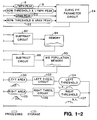
- Figure 1 is an electrical schematic block diagram of the method for separating the three major populations from a white blood cell histogram in accordance with the present invention.
- Figure 2 is a graph of a group of channels of a portion of a histogram illustrating how the peak is selected by the peak detector in Figure 1.
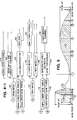
- Figure 3 is a schematic block diagram using the methodology illustrated in Figure 2 for determining the channel with the highest value constituting the lymph or gran peak provided by the peak detector of Figure 1.
- Figure 4 is a block diagram illustration of the calculated parameters for the curve fit parameter circuit of Figure 1.
- Figure 5 is a curve of a histogram useful in explaining the operation of Figure 4.
- Figure 6 is a plot of F(x) vs. X for various alphas and betas for Weibull (pdf).
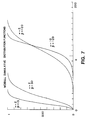
- Figure 7 is a plot of G(x) vs. X for various alphas and betas for Weibull (cdf).
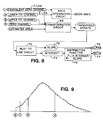
- Figure 8 is a curve fit block diagram used in explaining the operation of the lymph curve fitter and gran curve fitter circuits of Figure 1.
- Figure 9 is a curve useful in the explanation of the curve fitter block diagram of Figure 6.
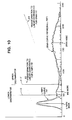
- Figure 10 shows a histogram illustrating the setting of the moving discriminators in accordance with the operation of Figure 1.
- the present invention is directed to analyzing white blood cells in a blood sample.
- the white blood cells types which include three principle populations, namely, lymphocytes, monocytes (middle population) and granulocytes
- the white blood cells in the sample are differentially lysed into separate size classes.
- the size of each cell is then plotted against the frequency of occurrence in a composite histogram, the graph which in one illustrative example contains approximately 255 channels.
- the histogram may be derived from the Baker System 9000 automated cell counter which electronically counts and sizes the cells employing the well known impedance principle.
- the present invention is not limited to this system and is applicable to all differentiating systems which produce the type of histogram used in the present invention.
- the invention is directed to differentiating between the three major groups of the white blood cells in which no clear delineation is normally provided by the histogram of a given sample.
- Prior approaches to the problem have utilized fixed discriminators to separate the three white blood cell types which discriminators are arbitrarily set between certain channels of the histogram.
- moving discriminators are provided which vary in position in accordance with the histogram produced from analyzing any given blood sample.
- a whole blood sample and a predetermined concentration of a diluent are mixed with a lysing reagent in a predetermined total volume which is applied to threshold circuitry 10 and stored in a pulse height memory 12 which provides the accumulated histogram from which the three major white blood cell populations will be determined.
- the threshold circuitry and pulse height memory may be provided by a Baker System 9000 automated cell counter or the like.
- the histogram from the pulse height memory 12 is applied, along with a white blood count done signal which merely delineates completed histograms for a given sample, to a peak detector 14.
- the purpose of the peak detector 14 is to characterize the lymph population which is done by finding the highest sum in one illustrative example of approximately seven channels over a given range in the histogram.
- the peak detector is also utilized to find the mode characteristic of the gran population which is done by finding the highest sum over another range of channels in which more channels are used, for example, 35 plus or minus a few channels which is a greater sum than used in the lymph population in order to compensate for greater variability in the gran population.
- the lymph population mode and the gran population mode are used to initially set discriminators for the lymph and gran mode which amounts to delineating the areas of the histogram occupied by the three major white blood cell populations. It will be appreciated that the selection of the number of channels used in peak detection are empirical values for a specific application. However, other values can be used depending on the data which is being processed.
- Figures 2 and 3 illustrate the methodology used in obtaining the lymph and gran peaks from the peak detector 14. Since the data is noisy, a smoothing function is used.
- the height of a given channel in question is the sum of itself plus neighboring channels across a given span.
- the height of an arbitrary channel on the histogram, for example, channel 65 which for purposes of illustration will be considered the channel with the highest value is arrived at from the summation of channel 65 plus or minus three contiguous channels.
- the maximum channel height over a given range 15 has applied thereto the histogram 12, minimum channel data 16, maximum channel data 18 and a span smoothing function 20 in which the maximum channel height over a given range provides an output of the channel with the highest value to a peak channel register 17.
- the number of channels covered for finding the lymph peak covers a certain range in the histogram which is selected based on past knowledge of lymph populations and the same is true for the selection of channels for the gran population. It should be pointed out if the highest channel occurs at either the maximum channel or the minimum channel a peak is not given from the maximum channel height 15.
- the output of the peak channel register 17 is applied to a search circuit 19 which searches for the channel to the left and right of peak which falls below 60% of peak height and produces stored outputs in register 21 and 23.
- the output of the peak detector 14 provides a lymph peak stored in register 16, a 60% threshold plus or minus the lymph peak is applied to a storage register 18, a gran peak 20 along with a 60% threshold plus or minus the gran peak are stored in a register 20 and 22, respectively, with the output of the registers 16, 18, 20 and 22 being applied to a curve fit parameter circuit 24.
- the 60% thresholds have been empirically chosen from a range of 30 - 90%.
- the function of the curve fit parameter circuit 24 is to estimate the areas of the three white blood cell populations by summing between the initial discriminators which have been set in accordance with the lymph and gran modes determined by the peak detector 14.
- Figures 4 and 5 are used to explain the operation of the curve fit parameter circuit 24.
- the gran mode or peak of register 20 is applied to a gran zero channel circuit 26, to a gran upper and lower fit channel fit circuit 28, and to a high discriminator circuit 30.
- Gran upper and lower 60% thresholds are also applied to the high discriminator circuit 30.
- the gran zero channel is determined by using the gran peak minus [(gran mode minus gran lower threshold) x 3.7)] + 15 while the gran upper and lower fit channels are determined by using the gran mode plus or minus 50 channels.
- the high discriminator 30 is set by the gran mode minus (gran mode - gran low threshold) minus (gran upper threshold - gran mode).
- the output from the high discriminator circuit 30 is stored in the high discriminator register 32 and applied therefrom to an estimated gran area circuit 34 which integrates the area between the high discriminator and the right end of the histogram to provide a value which is stored in a register of the estimated gran area 36.
- the output of the high discriminator register 32 is also applied to a gran equivalent zero area channel register 38.
- the gran zero channel 26 is stored in a gran zero channel register 27 and the gran upper and lower fit channels 28 are stored in gran upper and lower fit channel registers 29 and 31, respectively.
- the lymph mode or peak 16 is applied to a lymph mode minus 17 (empirical value for this specific example) circuit 40 whose output is applied to a minimum lymph channel register 42 providing a lymph zero channel output to register 44 and a lymph equivalent zero area channel output to register 46.
- the lymph mode 16 is also applied to a lymph mode plus or minus 10 (empirical value for this specific example) circuit 48 which applies an output to lymph lower fit channel register 50 and a lymph upper fit channel register 52.
- the lymph lower and upper 60% threshold register outputs 18 are applied to an integrated area circuit 54 which integrates the area between the upper and lower 60% thresholds of the lymph populations of the histogram and applies the area to a lymph mode middle area circuit 56 which is applied to a multiplier circuit which multiplies the lymph middle area by 1.2987 (empirical value for this specific example) to provide an estimated lymph area to the register 60.
- Diamond enclosed numerals are shown on Figure 4 and Figure 5 to illustrate the relationship of the derived parameters in Figure 4 to the histogram in Figure 5.
- the curve fit parameter circuit 24 providing the parameters 60, 50, 52, 44 and 46 which are the lymph parameters, are provided and applied to a lymph curve fitter circuit 62 along with the histogram from the pulse height memory circuit 12.
- the purpose of the lymph curve fitter and the gran curve fitters 62 and 64, respectively, are to fit the lymph and gran populations to a Weibull probability distribution function.
- this is done by transforming the cumulative distribution of the lymph population into a straight line and fitting the least squares line and calculating the Weibull parameters ⁇ and ⁇ from the slope and intercept of the line.
- some of the parameters in the fit are determined by estimating the width of the distribution which is done by finding the channels to the right and left of the histogram which are at a given percentage of the height of the gran mode and corresponds to the 60% threshold values found by the peak detector circuit 14 in the example illustrated.
- the Weibull pdf is defined as: A plot of F(x) vs. x for various alphas and betas is shown in Figure 6.
- the cumulative distribution (cdf) is the integration of the pdf. It can be derived from the pdf and is as follows: Thus, G(x) is the summation of channels up to channel x. A plot of G(x) vs. x for various alphas and betas is shown in Figure 7.
- a smooth, Weibull pdf curve can be constructed using equation 1. Since the area under a Weibull pdf is 1, the Weibull pdf must then be scaled using the estimated area of the population.
- the Gran population does not go to zero before merging into the mid population. Rather, the two populations overlap. Thus, it is necessary to start integrating from a point representing zero area. The area to the right of this point represents the entire area of the gran population. This estimated point is called the EQUIVALENT ZERO CHANNEL.
- granulocytes and lymphocytes will only physically get so small. Therefore, there will be some point which, to the left, there are no more grans (or lymphs in the case of lymphs). This point is called the ZERO CHANNEL and defines where the fitted curve must go to zero.
- the zero channel is used to offset the x axis.
- x is defined as the real channel number minus the zero channel.
- the integrated area up to the point of the Lower Fit Channel is called the BEGIN AREA and is calculated by summing from the Equivalent Zero Channel to the Lower Fit Channel.
- FIGs 8 and 9 illustrate the functioning of the curve fitters 62 and 64.
- the purpose is the transformation of a curve to linear coordinates for both the lymph fit and the gran fit as is indicated on the histogram shown in Figure 10.
- the lower fit channel, upper fit channel, zero channel and estimated area are applied to a transformation circuit 66.
- the output of the transformation circuit 66 is stored in a transposed array register 68 and applied to a best fit line circuit 70 using a least squares method in which the output is provided to a slope register 72 and an intercept register 74 with the slope of the line applied to the ⁇ register 76 and the intercept 74 applied to an equation circuit 75 representing providing the ⁇ output 77.
- the reconstituted lymph curve fit is indicated in the dotted lines on Figure 9.
- the output of the lymph curve fitter 62 is applied to the stored lymph curve register 80 which is applied to a subtract circuit 82 along with the histogram from the pulse height memory register 12 which subtracts the lymph curve fit from the histogram, the result which is stored in register 84 with the result being applied to gran curve fitter 64 producing a stored gran curve in register 86 which is applied to a subtract circuit 88 which in effect removes the fitted lymph and gran curves from the histogram producing an output of a mid population curve which is stored in the register 90.
- the mid population curve from register 90 is applied to a mid peak circuit 92 which scans for the mid peak in the mid population memory 90 producing a mid peak output stored in register 94.
- the output of the mid peak register 94 is applied to integration circuits 96 and 98 along with the output of the mid population register 90.
- Integration circuit 96 integrates the area to the left of the peak of the mid population while the integration circuit 98 integrates the area to the right of the peak producing outputs of the left area in register 100 and in the right area in register 101.
- the left area register 100 is applied to a left threshold circuit 102 which scans for the left threshold which is a percentage of the left area and provides a left threshold output to a left threshold register 104.
- the right area register 101 is applied to a right threshold circuit 106 which scans for the right threshold which is a percentage of the right area to produce a right threshold output to the right threshold register 107.
- the output of the left threshold register 104 and right threshold register 107 are applied to integration circuits 108, 110 and 112 along with histogram inputs from the pulse height register 12.
- the left and right thresholds represent the channels to the left and right of the mid population mode whose sum is a certain percentage of their areas. These channels thus provide the lower and upper discriminators 115 and 117 for the histograms.
- Integration circuit 108 integrates the histogram from the zero channel to the left threshold channel represented by the lower discriminator 115 illustrated in Figure 10 to produce the lymph area 109. Accordingly, the percentage of lymph is the sum of the channels up to the lower discriminator 115 divided by the total area of the histogram.
- the integration circuit 110 integrates the histogram from the left or lower threshold 115 to the right threshold 117 supplying an output 111 to the mid area register 111 with the percentage of the middle population being the sum of the channels from the lower discriminator 115 to the upper discriminator 117 divided by the total area.
- the integrator 112 integrates the histogram from the right threshold to the right end of the histogram providing an output representing the gran area on storage register 113. The percentage of the grans is the sum of the channels from the upper discriminator 117 to the right end of the histogram.
- Results of one illustration of the moving discriminators namely, the lower and upper discriminators 115 and 117, respectively are shown on the histogram in Figure 8.
- the purpose is to be able to set the discriminators in accordance with the various changing shapes of the white blood cell populations. As the gran and lymph populations vary from sample to sample as depicted in the associated histogram, the mid populations vary and are difficult to find. If the lower and upper discriminators, as shown in Figure 8, are fixed and remain in the same place errors will be made as the populations shift from histogram to histogram.
- By providing moving discriminators using the methodology described a more accurate reading is obtained for separating and delineating the three major populations provided by the histogram curves. The greater flexibility and accuracy provides better diagnosis of what is actually happening in the particular blood sample which is being analyzed.
- the invention also provides apparatus for use in the method described above, which apparatus comprises means for identifying a mode of the lymph population by determining the highest sum of lymph population over a first predetermined range in the histogram, means for identifying a mode characteristic concentration of the gran population by determining the highest sum of gran population over a second predetermined range, means for deriving lymph and gran population curves from said gran and lymph mode populations, processor means for subtracting said lymph and gran population curves from said histogram resulting in a mid population curve, means for identifying the mode of said mid population curve, means for deriving left and right thresholds by integrating left and right areas of a mid population peak on said mid population curve, and further processor means for applying said left and right thresholds to said histogram and integrating the areas of said histogram to the left of said left threshold, between the left and right thresholds and to the right of said right threshold to obtain respectively, the lymph, mono and gran areas of said histogram from which the lymph, mono and gran counts are made.
- Such apparatus
Landscapes
- Life Sciences & Earth Sciences (AREA)
- Health & Medical Sciences (AREA)
- Cell Biology (AREA)
- Hematology (AREA)
- Immunology (AREA)
- Engineering & Computer Science (AREA)
- Molecular Biology (AREA)
- Chemical & Material Sciences (AREA)
- Urology & Nephrology (AREA)
- Biomedical Technology (AREA)
- Virology (AREA)
- Physics & Mathematics (AREA)
- Biotechnology (AREA)
- Tropical Medicine & Parasitology (AREA)
- Zoology (AREA)
- Food Science & Technology (AREA)
- Medicinal Chemistry (AREA)
- Microbiology (AREA)
- Analytical Chemistry (AREA)
- Biochemistry (AREA)
- General Health & Medical Sciences (AREA)
- General Physics & Mathematics (AREA)
- Pathology (AREA)
- Investigating Or Analysing Biological Materials (AREA)
Claims (11)
- Méthode pour différencier et identifier des types de leucocytes dans un échantillon, qui comprend la différenciation de l'échantillon en classes de taille séparées, la représentation graphique de la taille des cellules en fonction de la fréquence d'apparition de façon à obtenir un histogramme composite et l'analyse et la séparation des trois populations majeures de leucocytes, à savoir les lymphocytes, les monocytes et les granulocytes, à partir de l'histogramme composite par les étapes suivantes :
identification d'un mode de la population de lymphocytes par détermination de la somme la plus élevée de population de lymphocytes pour une première gamme prédéterminée dans l'histogramme;
identification d'une concentration caractéristique d'un mode de la population de granulocytes par détermination de la somme la plus élevée de population de granulocytes pour une seconde gamme prédéterminée et obtention des courbes de populations de lymphocytes et de granulocytes à partir de ces populations des modes de lymphocytes et granulocytes avec des circuits d'ajustement des courbes lymphocytes et granulocytes;
soustraction de ces courbes de populations de lymphocytes et de granulocytes de cet histogramme pour obtenir une courbe de population du milieu;
identification du mode de cette courbe de population du milieu;
détermination de seuils à gauche et à droite par intégration des surfaces à gauche et à droite d'un pic de population du milieu sous cette courbe de population du milieu;
application de ces seuils de gauche et de droite à cet histogramme et intégration des surfaces de cet histogramme à la gauche de ce seuil de gauche, entre les seuils de gauche et de droite et à la droite de ce seuil de droite avec un circuit d'intégration séparé pour obtenir, respectivement, les surfaces des lymphocytes, monocytes et granulocytes de cet histogramme à partir desquelles sont faits les comptages de lymphocytes, monocytes et granulocytes. - Méthode suivant la revendication 1, dans laquelle l'étape d'identification des caractéristiques du mode de la courbe de population de granulocytes comprend la détection du pic de la population de granulocytes ainsi que des niveaux de seuils supérieur et inférieur du pic, lequel pic est déterminé par l'obtention de la hauteur maximale du canal de la population de granulocytes pour une gamme donnée qui exclut soit le canal minimum, soit le canal maximum de cette gamme donnée.
- Méthode suivant les revendications 1 ou 2, dans laquelle l'étape d'identification des caractéristiques du mode de la population de lymphocytes comprend la détection du pic de la population de lymphocytes ainsi que des niveaux de seuils supérieur et inférieur du pic, lequel pic est déterminé par l'obtention de la hauteur maximale du canal de la population de lymphocytes pour une gamme donnée qui exclut soit le canal minimum, soit le canal maximum de cette gamme donnée.
- Méthode suivant la revendication 3, dans laquelle l'étape d'obtention de ces courbes de population de lymphocytes et de granulocytes comprend la détermination des paramètres d'ajustement de la courbe à partir de l'histogramme composite pour les deux populations de lymphocytes et de granulocytes, les paramètres étant les surfaces estimées, les canaux d'ajustement inférieur et supérieur, les canaux zéro et le canal zéro équivalent qui sont utilisés pour former les courbes de populations de lymphocytes et de granulocytes.
- Méthode suivant la revendication 4, dans laquelle l'étape d'obtention de cette courbe de population de lymphocytes comprend l'étape d'ajustement de la population de lymphocytes à la courbe avec une fonction de distribution de probabilité de Weibull par transformation de la distribution cumulée de la population de lymphocytes dans l'histogramme en une droite, d'estimation de la distribution de la population des canaux sous la droite et de calcul des paramètres α et β de Weibull à partir de la pente de la droite et de son point d'intersection avec l'axe sur l'histogramme et de formation d'une courbe ajustée de lymphocytes à partir de ces éléments.
- Méthode suivant la revendication 5, dans laquelle l'étape de soustraction commence initialement par l'étape de soustraction de la courbe ajustée de lymphocytes de l'histogramme d'origine.
- Méthode suivant la revendication 6, dans laquelle l'étape d'obtention de cette courbe de population de granulocytes comprend l'étape d'ajustement de la population de granulocytes en une courbe de granulocytes avec une fonction de distribution de probabilité de Weibull appliquée à l'histogramme et de formation à partir de celle-ci d'une courbe ajustée de granulocytes.
- Méthode suivant la revendication 7, dans laquelle l'étape de soustraction de cette courbe de population de granulocytes a lieu après cette soustraction de cette courbe ajustée de lymphocytes de cet histogramme et emploie la courbe ajustée de granulocytes de façon à fournir cette courbe de population du milieu.
- Méthode suivant la revendication 8, dans laquelle l'étape de comptage des lymphocytes, monocytes et granulocytes comprend la détermination de la somme des surfaces depuis l'extrémité droite de l'histogramme jusqu'au seuil de gauche, entre les seuils de gauche et de droite et à partir du seuil de droite jusqu'à l'extrémité de l'histogramme, divisée par la surface totale de l'histogramme.
- Méthode suivant la revendication 9, dans laquelle les leucocytes sont lysés de façon à les séparer en classes de taille distinctes.
- Appareil à utiliser dans une méthode suivant l'une quelconque des revendications 1 à 10, lequel appareil comprend :
un moyen pour identifier un mode de la population de lymphocytes par détermination de la somme la plus élevée de population de lymphocytes pour une première gamme prédéterminée de l'histogramme,
un moyen pour identifier une concentration caractéristique d'un mode de la population de granulocytes par détermination de la somme la plus élevée de population de granulocytes pour une seconde gamme prédéterminée, un moyen pour obtenir des courbes de populations de lymphocytes et de granulocytes à partir de ces populations de mode de granulocytes et lymphocytes,
un moyen de traitement pour la soustraction de ces courbes de populations de lymphocytes et de granulocytes de cet histogramme afin de fournir une courbe de population du milieu,
un moyen pour identifier le mode de cette courbe de population du milieu,
un moyen pour obtenir les seuils de gauche et de droite par intégration des surfaces à gauche et à droite d'un pic de population du milieu sur cette courbe de population du milieu, et
un autre moyen de traitement pour appliquer ces seuils de gauche et de droite à cet histogramme et intégrer les surfaces de cet histogramme à la gauche de ce seuil de gauche, entre les seuils de gauche et de droite et à la droite de ce seuil de droite pour obtenir respectivement, les surfaces de lymphocytes, monocytes et granulocytes de cet histogramme à partir desquelles sont faits les comptages des lymphocytes, monocytes et granulocytes, et
comprenant de plus un moyen pour la différenciation des cellules pour la production d'un histogramme des tailles de cellules en fonction du nombre de cellules.
Applications Claiming Priority (2)
| Application Number | Priority Date | Filing Date | Title |
|---|---|---|---|
| US07/281,250 US5040112A (en) | 1988-12-07 | 1988-12-07 | Method of separating the three major types of blood cells from a white blood cell histogram |
| US281250 | 1988-12-07 |
Publications (2)
| Publication Number | Publication Date |
|---|---|
| EP0375201A1 EP0375201A1 (fr) | 1990-06-27 |
| EP0375201B1 true EP0375201B1 (fr) | 1995-11-08 |
Family
ID=23076538
Family Applications (1)
| Application Number | Title | Priority Date | Filing Date |
|---|---|---|---|
| EP89312714A Expired - Lifetime EP0375201B1 (fr) | 1988-12-07 | 1989-12-06 | Méthode pour séparer les trois types principaux de cellules sanguines à partir d'un histogramme de leucocytes |
Country Status (8)
| Country | Link |
|---|---|
| US (1) | US5040112A (fr) |
| EP (1) | EP0375201B1 (fr) |
| JP (1) | JPH02194359A (fr) |
| AT (1) | ATE130093T1 (fr) |
| CA (1) | CA2001728C (fr) |
| DE (1) | DE68924765T2 (fr) |
| ES (1) | ES2079383T3 (fr) |
| GR (1) | GR3018696T3 (fr) |
Families Citing this family (8)
| Publication number | Priority date | Publication date | Assignee | Title |
|---|---|---|---|---|
| JP2874008B2 (ja) * | 1990-05-18 | 1999-03-24 | スズキ株式会社 | 粒子凝集パターン判定装置 |
| JP3130628B2 (ja) * | 1992-01-30 | 2001-01-31 | シスメックス株式会社 | 粒子判定装置 |
| CA2125228A1 (fr) * | 1993-06-08 | 1994-12-09 | Thomas J. Mercolino | Cytometrie en flux en trois couleurs avec fonction de tri automatique |
| US5692220A (en) * | 1993-09-02 | 1997-11-25 | Coulter Corporation | Decision support system and method for diagnosis consultation in laboratory hematopathology |
| JP3504029B2 (ja) * | 1995-07-04 | 2004-03-08 | シスメックス株式会社 | 粒子分析装置 |
| US6472215B1 (en) | 2001-07-27 | 2002-10-29 | Coulter International Corp. | Method of analyzing nucleated red blood cells in a blood sample |
| CN113139405B (zh) * | 2020-01-19 | 2024-03-05 | 桂林优利特医疗电子有限公司 | 一种基于多峰拟合解析的细胞分类结果校正方法 |
| CN113820260B (zh) * | 2021-09-30 | 2023-07-18 | 深圳市科曼医疗设备有限公司 | 用户状态检测方法、装置、设备和介质 |
Family Cites Families (6)
| Publication number | Priority date | Publication date | Assignee | Title |
|---|---|---|---|---|
| US4284412A (en) * | 1979-07-13 | 1981-08-18 | Ortho Diagnostics, Inc. | Method and apparatus for automated identification and enumeration of specified blood cell subclasses |
| US4485175A (en) * | 1983-01-03 | 1984-11-27 | Coulter Electronics, Inc. | Method for three-volume differential determination of lymphocyte, monocyte and granulocyte populations of leukocytes |
| US4581334A (en) * | 1983-04-25 | 1986-04-08 | Ortho Diagnostics Systems, Inc. | Simultaneous detection of leukocyte phagocytic and killing ability |
| US4596035A (en) * | 1983-06-27 | 1986-06-17 | Ortho Diagnostic Systems Inc. | Methods for enumerating 3-part white cell differential clusters |
| JPH06100596B2 (ja) * | 1986-09-10 | 1994-12-12 | 東亜医用電子株式会社 | フロ−サイトメトリ−による白血球の分類方法 |
| US4882284A (en) * | 1987-04-13 | 1989-11-21 | Ortho Pharmaceutical Corporation | Method for quantitating and differentiating white blood cells |
-
1988
- 1988-12-07 US US07/281,250 patent/US5040112A/en not_active Expired - Fee Related
-
1989
- 1989-10-30 CA CA002001728A patent/CA2001728C/fr not_active Expired - Fee Related
- 1989-12-06 EP EP89312714A patent/EP0375201B1/fr not_active Expired - Lifetime
- 1989-12-06 JP JP1315493A patent/JPH02194359A/ja active Pending
- 1989-12-06 DE DE68924765T patent/DE68924765T2/de not_active Expired - Fee Related
- 1989-12-06 ES ES89312714T patent/ES2079383T3/es not_active Expired - Lifetime
- 1989-12-06 AT AT89312714T patent/ATE130093T1/de not_active IP Right Cessation
-
1996
- 1996-01-17 GR GR960400097T patent/GR3018696T3/el unknown
Also Published As
| Publication number | Publication date |
|---|---|
| JPH02194359A (ja) | 1990-07-31 |
| DE68924765D1 (de) | 1995-12-14 |
| CA2001728C (fr) | 1997-05-20 |
| GR3018696T3 (en) | 1996-04-30 |
| ATE130093T1 (de) | 1995-11-15 |
| DE68924765T2 (de) | 1996-05-30 |
| CA2001728A1 (fr) | 1990-06-07 |
| US5040112A (en) | 1991-08-13 |
| EP0375201A1 (fr) | 1990-06-27 |
| ES2079383T3 (es) | 1996-01-16 |
Similar Documents
| Publication | Publication Date | Title |
|---|---|---|
| CA1161271A (fr) | Methode et appareil pour mesurer le volume globulaire moyen des hematies | |
| US4596464A (en) | Screening method for red cell abnormality | |
| EP0544385A2 (fr) | Procédé pour compter des particules | |
| US5633945A (en) | Accuracy in cell mitosis analysis | |
| EP0375201B1 (fr) | Méthode pour séparer les trois types principaux de cellules sanguines à partir d'un histogramme de leucocytes | |
| US5349538A (en) | Method for determining the distribution of constituent subpopulations within a population of particles having overlapping subpopulations | |
| US4408880A (en) | Laser nephelometric system | |
| CA2125228A1 (fr) | Cytometrie en flux en trois couleurs avec fonction de tri automatique | |
| EP0254380B1 (fr) | Méthode d'analyse pour une distribution de tailles de particules | |
| US4850024A (en) | Method and apparatus for classifying white blood cells | |
| Tucker | An image analysis system for cervical cytology automation using nuclear DNA content. | |
| US4309757A (en) | Method for classification of signals by comparison with an automatically determined threshold | |
| EP0138591A2 (fr) | Procédé pour la séparation de globules rouges anormaux | |
| JPS5830049B2 (ja) | 網赤血球自動計測装置 | |
| JP2676089B2 (ja) | 粒度分布処理装置 | |
| EP0045495B1 (fr) | Procédé néphélométrique à laser | |
| Schuette et al. | A count‐dependent filter for smoothing flow cytometric histograms | |
| DE19721323C2 (de) | Verfahren und Vorrichtung zur Gammaspektroskopie mit Unterscheidung von Einzel- und Mehrfachwechselwirkungen | |
| Cruz et al. | Fuzzy gating and the problem of screening | |
| JPH0629838B2 (ja) | 粒度分布解析法 | |
| JPH0629840B2 (ja) | 粒度分布解析法 | |
| JP2003075446A (ja) | 粒度分布作成方法とそれを用いた粒子凝集度解析装置 | |
| CN121595779A (zh) | 一种基于大数据分析的液相色谱检测结果处理方法 | |
| JPH0926389A (ja) | 分析データ補正方法およびそれに用いる演算装置ならびにその補正方法を用いた粒子分析装置 | |
| Seamer et al. | Fluorescence drift detection as a novel QC procedure for DNA cell‐cycle analysis |
Legal Events
| Date | Code | Title | Description |
|---|---|---|---|
| PUAI | Public reference made under article 153(3) epc to a published international application that has entered the european phase |
Free format text: ORIGINAL CODE: 0009012 |
|
| AK | Designated contracting states |
Kind code of ref document: A1 Designated state(s): AT BE CH DE ES FR GB GR IT LI LU NL SE |
|
| 17P | Request for examination filed |
Effective date: 19900824 |
|
| 17Q | First examination report despatched |
Effective date: 19920313 |
|
| GRAA | (expected) grant |
Free format text: ORIGINAL CODE: 0009210 |
|
| RAP1 | Party data changed (applicant data changed or rights of an application transferred) |
Owner name: SERONO DIAGNOSTICS, INC. |
|
| AK | Designated contracting states |
Kind code of ref document: B1 Designated state(s): AT BE CH DE ES FR GB GR IT LI LU NL SE |
|
| REF | Corresponds to: |
Ref document number: 130093 Country of ref document: AT Date of ref document: 19951115 Kind code of ref document: T |
|
| REF | Corresponds to: |
Ref document number: 68924765 Country of ref document: DE Date of ref document: 19951214 |
|
| ET | Fr: translation filed | ||
| RAP2 | Party data changed (patent owner data changed or rights of a patent transferred) |
Owner name: BIOCHEM IMMUNOSYSTEMS (U.S.), INC. |
|
| REG | Reference to a national code |
Ref country code: ES Ref legal event code: FG2A Ref document number: 2079383 Country of ref document: ES Kind code of ref document: T3 |
|
| ITF | It: translation for a ep patent filed | ||
| REG | Reference to a national code |
Ref country code: CH Ref legal event code: PFA Free format text: SERONO DIAGNOSTICS, INC. TRANSFER- BIOCHEM IMMUNOSYSTEMS (U.S.), INC. Ref country code: CH Ref legal event code: NV Representative=s name: A. BRAUN, BRAUN, HERITIER, ESCHMANN AG PATENTANWAE |
|
| NLT2 | Nl: modifications (of names), taken from the european patent patent bulletin |
Owner name: BIOCHEM IMMUNOSYSTEMS (U.S.), INC. |
|
| REG | Reference to a national code |
Ref country code: GR Ref legal event code: FG4A Free format text: 3018696 |
|
| NLXE | Nl: other communications concerning ep-patents (part 3 heading xe) |
Free format text: PAT.BUL.01/96 PAGE 59:CORR.:BIOCHEM IMMUNOSYSTEMS (U.S.), INC. |
|
| PLBE | No opposition filed within time limit |
Free format text: ORIGINAL CODE: 0009261 |
|
| STAA | Information on the status of an ep patent application or granted ep patent |
Free format text: STATUS: NO OPPOSITION FILED WITHIN TIME LIMIT |
|
| 26N | No opposition filed | ||
| ITPR | It: changes in ownership of a european patent |
Owner name: C.N.EPO REG 92;(ORA) BIOCHEM IMMUNOSYSTEMS (U.S.) |
|
| PGFP | Annual fee paid to national office [announced via postgrant information from national office to epo] |
Ref country code: GB Payment date: 19981218 Year of fee payment: 10 |
|
| PGFP | Annual fee paid to national office [announced via postgrant information from national office to epo] |
Ref country code: SE Payment date: 19981221 Year of fee payment: 10 |
|
| PGFP | Annual fee paid to national office [announced via postgrant information from national office to epo] |
Ref country code: GR Payment date: 19981223 Year of fee payment: 10 |
|
| PGFP | Annual fee paid to national office [announced via postgrant information from national office to epo] |
Ref country code: ES Payment date: 19981228 Year of fee payment: 10 |
|
| PGFP | Annual fee paid to national office [announced via postgrant information from national office to epo] |
Ref country code: FR Payment date: 19981229 Year of fee payment: 10 |
|
| PGFP | Annual fee paid to national office [announced via postgrant information from national office to epo] |
Ref country code: AT Payment date: 19981230 Year of fee payment: 10 |
|
| PGFP | Annual fee paid to national office [announced via postgrant information from national office to epo] |
Ref country code: NL Payment date: 19981231 Year of fee payment: 10 |
|
| PGFP | Annual fee paid to national office [announced via postgrant information from national office to epo] |
Ref country code: CH Payment date: 19990104 Year of fee payment: 10 |
|
| PGFP | Annual fee paid to national office [announced via postgrant information from national office to epo] |
Ref country code: LU Payment date: 19990107 Year of fee payment: 10 |
|
| PGFP | Annual fee paid to national office [announced via postgrant information from national office to epo] |
Ref country code: BE Payment date: 19990111 Year of fee payment: 10 |
|
| PGFP | Annual fee paid to national office [announced via postgrant information from national office to epo] |
Ref country code: DE Payment date: 19990128 Year of fee payment: 10 |
|
| PG25 | Lapsed in a contracting state [announced via postgrant information from national office to epo] |
Ref country code: LU Free format text: LAPSE BECAUSE OF NON-PAYMENT OF DUE FEES Effective date: 19991206 Ref country code: GB Free format text: LAPSE BECAUSE OF NON-PAYMENT OF DUE FEES Effective date: 19991206 Ref country code: AT Free format text: LAPSE BECAUSE OF NON-PAYMENT OF DUE FEES Effective date: 19991206 |
|
| PG25 | Lapsed in a contracting state [announced via postgrant information from national office to epo] |
Ref country code: SE Free format text: LAPSE BECAUSE OF NON-PAYMENT OF DUE FEES Effective date: 19991207 |
|
| PG25 | Lapsed in a contracting state [announced via postgrant information from national office to epo] |
Ref country code: LI Free format text: LAPSE BECAUSE OF NON-PAYMENT OF DUE FEES Effective date: 19991231 Ref country code: GR Free format text: LAPSE BECAUSE OF NON-PAYMENT OF DUE FEES Effective date: 19991231 Ref country code: CH Free format text: LAPSE BECAUSE OF NON-PAYMENT OF DUE FEES Effective date: 19991231 Ref country code: BE Free format text: LAPSE BECAUSE OF NON-PAYMENT OF DUE FEES Effective date: 19991231 |
|
| BERE | Be: lapsed |
Owner name: BIOCHEM IMMUNOSYSTEMS (U.S.) INC. Effective date: 19991231 |
|
| PG25 | Lapsed in a contracting state [announced via postgrant information from national office to epo] |
Ref country code: NL Free format text: LAPSE BECAUSE OF NON-PAYMENT OF DUE FEES Effective date: 20000701 |
|
| GBPC | Gb: european patent ceased through non-payment of renewal fee |
Effective date: 19991206 |
|
| EUG | Se: european patent has lapsed |
Ref document number: 89312714.2 |
|
| PG25 | Lapsed in a contracting state [announced via postgrant information from national office to epo] |
Ref country code: FR Free format text: LAPSE BECAUSE OF NON-PAYMENT OF DUE FEES Effective date: 20000831 |
|
| NLV4 | Nl: lapsed or anulled due to non-payment of the annual fee |
Effective date: 20000701 |
|
| PG25 | Lapsed in a contracting state [announced via postgrant information from national office to epo] |
Ref country code: DE Free format text: LAPSE BECAUSE OF NON-PAYMENT OF DUE FEES Effective date: 20001003 |
|
| REG | Reference to a national code |
Ref country code: FR Ref legal event code: ST |
|
| PG25 | Lapsed in a contracting state [announced via postgrant information from national office to epo] |
Ref country code: ES Free format text: LAPSE BECAUSE OF NON-PAYMENT OF DUE FEES Effective date: 20001207 |
|
| REG | Reference to a national code |
Ref country code: ES Ref legal event code: FD2A Effective date: 20010113 |
|
| PG25 | Lapsed in a contracting state [announced via postgrant information from national office to epo] |
Ref country code: IT Free format text: LAPSE BECAUSE OF NON-PAYMENT OF DUE FEES;WARNING: LAPSES OF ITALIAN PATENTS WITH EFFECTIVE DATE BEFORE 2007 MAY HAVE OCCURRED AT ANY TIME BEFORE 2007. THE CORRECT EFFECTIVE DATE MAY BE DIFFERENT FROM THE ONE RECORDED. Effective date: 20051206 |