EP0544385A2 - Procédé pour compter des particules - Google Patents
Procédé pour compter des particules Download PDFInfo
- Publication number
- EP0544385A2 EP0544385A2 EP92304619A EP92304619A EP0544385A2 EP 0544385 A2 EP0544385 A2 EP 0544385A2 EP 92304619 A EP92304619 A EP 92304619A EP 92304619 A EP92304619 A EP 92304619A EP 0544385 A2 EP0544385 A2 EP 0544385A2
- Authority
- EP
- European Patent Office
- Prior art keywords
- cluster
- particles
- gravity
- particle
- membership
- Prior art date
- Legal status (The legal status is an assumption and is not a legal conclusion. Google has not performed a legal analysis and makes no representation as to the accuracy of the status listed.)
- Withdrawn
Links
Images


Classifications
-
- G—PHYSICS
- G06—COMPUTING OR CALCULATING; COUNTING
- G06M—COUNTING MECHANISMS; COUNTING OF OBJECTS NOT OTHERWISE PROVIDED FOR
- G06M11/00—Counting of objects distributed at random, e.g. on a surface
-
- G—PHYSICS
- G06—COMPUTING OR CALCULATING; COUNTING
- G06V—IMAGE OR VIDEO RECOGNITION OR UNDERSTANDING
- G06V20/00—Scenes; Scene-specific elements
- G06V20/60—Type of objects
- G06V20/69—Microscopic objects, e.g. biological cells or cellular parts
- G06V20/695—Preprocessing, e.g. image segmentation
-
- G—PHYSICS
- G06—COMPUTING OR CALCULATING; COUNTING
- G06T—IMAGE DATA PROCESSING OR GENERATION, IN GENERAL
- G06T7/00—Image analysis
- G06T7/60—Analysis of geometric attributes
- G06T7/66—Analysis of geometric attributes of image moments or centre of gravity
-
- G—PHYSICS
- G01—MEASURING; TESTING
- G01N—INVESTIGATING OR ANALYSING MATERIALS BY DETERMINING THEIR CHEMICAL OR PHYSICAL PROPERTIES
- G01N15/00—Investigating characteristics of particles; Investigating permeability, pore-volume or surface-area of porous materials
- G01N15/01—Investigating characteristics of particles; Investigating permeability, pore-volume or surface-area of porous materials specially adapted for biological cells, e.g. blood cells
- G01N2015/011—Investigating characteristics of particles; Investigating permeability, pore-volume or surface-area of porous materials specially adapted for biological cells, e.g. blood cells with lysing, e.g. of erythrocytes
-
- G—PHYSICS
- G01—MEASURING; TESTING
- G01N—INVESTIGATING OR ANALYSING MATERIALS BY DETERMINING THEIR CHEMICAL OR PHYSICAL PROPERTIES
- G01N15/00—Investigating characteristics of particles; Investigating permeability, pore-volume or surface-area of porous materials
- G01N15/01—Investigating characteristics of particles; Investigating permeability, pore-volume or surface-area of porous materials specially adapted for biological cells, e.g. blood cells
- G01N2015/016—White blood cells
-
- G—PHYSICS
- G01—MEASURING; TESTING
- G01N—INVESTIGATING OR ANALYSING MATERIALS BY DETERMINING THEIR CHEMICAL OR PHYSICAL PROPERTIES
- G01N15/00—Investigating characteristics of particles; Investigating permeability, pore-volume or surface-area of porous materials
- G01N15/10—Investigating individual particles
- G01N2015/1024—Counting particles by non-optical means
-
- G—PHYSICS
- G01—MEASURING; TESTING
- G01N—INVESTIGATING OR ANALYSING MATERIALS BY DETERMINING THEIR CHEMICAL OR PHYSICAL PROPERTIES
- G01N15/00—Investigating characteristics of particles; Investigating permeability, pore-volume or surface-area of porous materials
- G01N15/10—Investigating individual particles
- G01N15/1031—Investigating individual particles by measuring electrical or magnetic effects
- G01N15/12—Investigating individual particles by measuring electrical or magnetic effects by observing changes in resistance or impedance across apertures when traversed by individual particles, e.g. by using the Coulter principle
- G01N2015/139—Measuring the ratio of AC/DC impedances
-
- G—PHYSICS
- G06—COMPUTING OR CALCULATING; COUNTING
- G06T—IMAGE DATA PROCESSING OR GENERATION, IN GENERAL
- G06T2207/00—Indexing scheme for image analysis or image enhancement
- G06T2207/30—Subject of image; Context of image processing
- G06T2207/30004—Biomedical image processing
- G06T2207/30024—Cell structures in vitro; Tissue sections in vitro
Definitions
- This invention relates to a method of separately counting the respective numbers of particles of plural kinds included in the same specimen and, for example, to a so-called blood cell counting method for seeking the numbers of lymphocytes, monocytes and granulocytes in white blood cells.
- Such prior art blood cell counting has been effected as follows, as disclosed, for example, in the U.S. patent No. 4,661,913. Blood extracted from a human body is first subjected to a predetermined preliminary treatment to provide a specimen and it is supplied to a suitable particle detector to measure two kinds of properties of each blood cell. Then, a suitable XY co-ordinate system is established and the blood cell is plot on the co-ordinate system using two kinds of measured values thereof as its X and Y co-ordinates, respectively. All blood cells in the specimen are plotted in the same manner to produce a distribution diagram, so-called "scattergram", of the particles regarding both properties as above-mentioned. Thereafter, boundaries for partitioning clusters of the respective blood cells, namely, lymphocytes, monocytes and granulocytes are drafted on the scattergram and the number of plots within each boundary is then counted.
- an object of this invention is to provide an improved clustering method which can obtain accurate count calues from the above-mentioned scattergram of the particles within a relatively short operation time.
- any plot unclearly belonging to a specific cluster is assigned to two or more clusters at the same time.
- An extent to which it is assigned is referred to as "membership (value)" and this membership has a value of one when the plot belongs to a single cluster and a positive value less than one when it belongs to two or more clusters.
- a closed fixed domain is defined first at the position of a specific cluster on the scattergram so that, at least, any particle enclosed therein belongs to the cluster and, therefore, its membership to the cluster is one, and a center of gravity of the cluster is calculated from the particles included therein with a predetermined algorithm.
- distances from the respective particles outside the fixed domains to the center of gravity of each cluster are calculated, then, the membership values of the respective particles to each cluster are calculated from these distances using a predetermined algorithm and the center of gravity of each cluster is calculated with a predetermined algorithm in consideration of the membership values. Thereafter, an interval between the new new center of gravity and the preceding center of gravity is calcualated and it is judged whether it is within a predetermined range or not.
- a further new center of gravity is calculated in the same manner from the distances from the new center of gravity to the respective particles outside the fixed domain and a similar judgement is effected on the interval between the newest center of gravity and its preceding center of gravity.
- the number of particles belonging to each cluster is calculated with a predetermined algorithm from the membership values of the respective particles to the cluster which are variable at that time.
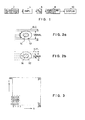
- FIG. 1 shows a configuration of blood cell counting device in which a method of this invention is used for description of an embodiment of this invention.
- the device includes a blood cell detector 2 which is supplied with a specimen obtained by subjecting blood to preliminary treatments such as dilution and addition of hemolyzing agent for measuring properties of each blood cell and producing a corresponding detection signal, a amplifier 4 for suitably amplifying the detection signal, an analog-to-digital (A/D) convertor 6 for converting the amplified signal into a digital signal, an analyzing circuit 8 for analyzing the digital detection signal in accordance with the method of this invention and counting the number of blood cells of each kind and a display device 10 for displaying the result of analysis.
- A/D analog-to-digital
- the blood cell detector 2 is a device, as disclosed, for example, in the U.S. patent No. 3,515,884, which is arranged to pass the specimen through a narrow path enabled to pass the blood cells one by one and apply d.c. and high frequency currents to the path, thereby deriving two kinds of signals based upon d.c. and high frequency impedance changes due to the respective blood cells. More particularly, in the case of d.c. current, a signal proportional to the size of a cytoplasm 12 of each blood cell as shown in FIG.
- the detection signal is not so influenced by the cytoplasm 12 having low density and low impedance and has a value corresponding to the size and density of a nucleus or microsome 14 having high density and high impedance as shown in FIG. 2b.
- the analyzing circuit 8 produces a scattergram, as shown in FIG. 3, having i and j channels on its X and Y axes, respectively.
- the scattergram includes 256 2 basic elements (hereinunder referred to as "sites") having 256 X and Y co-ordinates, respectively, and each site stores the number of blood cells having the same co-ordinates as those of the site.
- sites 256 2 basic elements
- each site stores the number of blood cells having the same co-ordinates as those of the site.
- the analyzing circuit 8 executes an arithmetic processing as shown in the flow chart of FIG. 4.
- a memory value "n" representing the number of repetitions is set to one (step S1) and fixed domains A1, A2, A3 and A4 for the clusters of lymphocytes, monocytes, granulocytes and ghost cells such as red blood cells and platelets, respectively, which exist in the blood, are defined in the scattergram (step S2).
- These fixed domains are surrounded by such boundaries as shown in FIG. 5, for example, which are previously established experientially so that all particles within each boundary belong to the corresponding domain.
- all blood cells within each fixed domain A1, A2, A3 or A4 are lymphocytes, monocytes, granulocytes or ghost cells, respectively, while the cluster to which each blood cell in the external region A5 belong is indefinite. Therefore, it is herein assumed that the values of membership of the blood cells within the fixed domain A1 to the cluster of lymphocytes, the values of membership of the blood cells within the fixed domain A2 to the cluster of monocytes, the values of membership of the blood cells within the fixed domain A3 to the cluster of granulocytes and the values of membership of the blood cells within the fixed domain A4 to the cluster of ghost cells are all "one" and the blood cells in the region A5 belong to the four clusters at the same time at decimal values of membership, respectively. Then, the values of membership of each particle in the region A5 to the respective clusters are calculated in accordance with the following procedure.
- co-ordinates X G and Y G of an initial center of gravity (COG) of each cluster are calculated (step S3).
- These co-ordinates can be calculated with the following equations.
- N ij is the number of blood cells includes in each site within the fixed domain of each cluster.
- FIG. 6 show the initial centers of gravity G1(X G1 ,Y G1 ), G2(X G2 ,Y G2 ), G3(X G3 ,Y G3 ) and G4(X G4 ,Y G4 ) of the clusters of lymphocytes, monocytes, granulocytes and ghost cells, respectively, which have been obtained in this manner.
- the distance from each particle in the region A5 to each initial center of gravity obtained as above is sought (step S4).
- This distance is not an Euclidean distance but one difined as as follows Particularly, as shown in FIG. 7, the distance in question is defined as a half length L of the minor axis of an ellipse 18 having its center located at the initial center of gravity G of each cluster and its major axis tilted by an angle 0 and passing the blood cell 16 in question.
- the tilt angle 0 is peculior to each cluster and determined previously in experiential fashion.
- the reason why the distance is defined as above is that the shape of distribution of each cluster of blood cells is elliptic and, therefore, all blood cells lying on the same ellipse should have the same distance from the center of gravity.
- the calculation of the distance L is effected as follows.
- This equation can be solved as follows as looking for the half minor axis or the distance L.
- the value of membership U 16 of the blood cell 16 to each cluster is calculated with the following equation.
- L is made Li, L 2 , L 3 or L 4 corresponding to each cluster.
- Each value of membership is, of course, less than one.
- the values of membership of all blood cells within the region A5 to the respective clusters are calculated (step 5).
- the operation time can be reduced by previously seeking this relative position of each blood cell for each cluster and storing them as a look-up table.
- each blood cell in the region A5 shares corresponding to its calculated values of membership. Therefore, the center of gravity of the respective clusters are corrected in consideration of weights of tive clusters are corrected in consideraton of weights of these blood cells or, in other words, weighted centers of gravity are calculated (step S6).
- This calculation can be effected with the following equations.
- step S7 By comparing each center of gravity thus obtained with the corresponding initial center of gravity, a displacement d therebetween is obtained (step S7).
- This value d is compared with the corresponding initial center of gravity to judge whether d is greater than D or not (step S8).
- the value D can be selected arbitrarily and may be zero. If d is not greater than D, it is concluded that attribution of all blood cells to the respective clusters has been decided. Accordingly, the number of blood cells in each cluster is herein decided by either one of two methods as follows (step S9). Selection of the method relies upon the state of the available scattergram.
- each blood cell in the region A5 is assumed to belong to a cluster exhibiting the greatest value of membership which is finally obtained for that blood cell.
- the values of membership of these blood cells to the clusters of lymphocites, monocytes, granulocytes and ghost cells, namely, U 1 , U 2 , U 3 and U 4 are 0.95, 0.03, 0.02 and 0.00, respectively all of the ten blood cells are assumed to belong only to the cluster of lymphocytes of the greatest value of membership U, .
- This method is suitable when the values of membership of the blood cells are especially large in a specific cluster and, in other words, the respective clusters are clearly separated.
- the blood cells in each site are allotted to the respective clusters in accordance with their values of membership. For example, when ten blood cells are included in a certain site and the values of membership Ui, U 2 , U 3 and U 4 of these blood cells to the respective clusters are 0.2, 0.5, 0.3 and 0.0, respectively, the values of membership, excepting the cluster of ghost cells, are mutually close and suggest that the three clusters and partially overlapping.
- step S10 the number of blood cells in each cluster is counted and displayed by the display device 10 (step S10).
- step S8 If d is greater than D in step S8, the stored value n is raised by one (step S11) and the resultant value is compared with a predetermined value N (step S12). If n has not yet reached N, returning to step S5, a similar operation is repeated. If n has reached N in step S12, the display device 10 displayes "ANALYSIS IMPOSSIBLE" (step 13).
- the position of the center of gravity of each cluster and the major and minor axes of the ellipse which suggest its state of spread are calculated during the operation of the analyzing circuit 8. Therefore, by comparing these values with predetermined normal values, their deviations, that is, a state of health can be diagnosed.
- the structure of the blood cell detector is not the subject of this invention and, in short, it is enough for use if it can derive two or more kinds of signals from each particle.
- a two- dimensional scattergram is used in the above embodiment, a three-dimensional scattergram can be used if three kinds of signals are available.
- any dimensional scattergram can be utilized theoretically, apart from the problem of complicated arithmetic operation, and these are also within the scope of this invention.
Landscapes
- Engineering & Computer Science (AREA)
- Physics & Mathematics (AREA)
- Theoretical Computer Science (AREA)
- General Physics & Mathematics (AREA)
- Biomedical Technology (AREA)
- General Health & Medical Sciences (AREA)
- Molecular Biology (AREA)
- Life Sciences & Earth Sciences (AREA)
- Multimedia (AREA)
- Health & Medical Sciences (AREA)
- Geometry (AREA)
- Computer Vision & Pattern Recognition (AREA)
- Investigating Or Analysing Biological Materials (AREA)
- Image Generation (AREA)
Applications Claiming Priority (2)
| Application Number | Priority Date | Filing Date | Title |
|---|---|---|---|
| JP339707/91 | 1991-11-27 | ||
| JP03339707A JP3076118B2 (ja) | 1991-11-27 | 1991-11-27 | 粒子計数方法 |
Publications (2)
| Publication Number | Publication Date |
|---|---|
| EP0544385A2 true EP0544385A2 (fr) | 1993-06-02 |
| EP0544385A3 EP0544385A3 (en) | 1994-08-24 |
Family
ID=18330047
Family Applications (1)
| Application Number | Title | Priority Date | Filing Date |
|---|---|---|---|
| EP9292304619A Withdrawn EP0544385A3 (en) | 1991-11-27 | 1992-05-21 | Method of counting particles |
Country Status (5)
| Country | Link |
|---|---|
| US (2) | US5555196A (fr) |
| EP (1) | EP0544385A3 (fr) |
| JP (1) | JP3076118B2 (fr) |
| AU (1) | AU648169B2 (fr) |
| CA (1) | CA2070351C (fr) |
Cited By (2)
| Publication number | Priority date | Publication date | Assignee | Title |
|---|---|---|---|---|
| EP0575091A3 (en) * | 1992-06-19 | 1994-08-24 | Toa Medical Electronics | Method and device for analyzing particles |
| WO2001012981A1 (fr) | 1999-08-17 | 2001-02-22 | L'orange Gmbh | Soupape d'injection pour moteur a combustion |
Families Citing this family (52)
| Publication number | Priority date | Publication date | Assignee | Title |
|---|---|---|---|---|
| JP3504029B2 (ja) * | 1995-07-04 | 2004-03-08 | シスメックス株式会社 | 粒子分析装置 |
| JP3325447B2 (ja) * | 1995-12-19 | 2002-09-17 | シスメックス株式会社 | 粒子分析装置およびその方法 |
| US5832182A (en) * | 1996-04-24 | 1998-11-03 | Wisconsin Alumni Research Foundation | Method and system for data clustering for very large databases |
| JP4136017B2 (ja) * | 1996-09-19 | 2008-08-20 | シスメックス株式会社 | 粒子分析装置 |
| EP0905514B1 (fr) * | 1997-09-27 | 2003-11-26 | Horiba, Ltd. | Appareil de dénombrement de cellules sanguines et d'essais immunologiques utilisant tout le sang |
| US6092072A (en) * | 1998-04-07 | 2000-07-18 | Lucent Technologies, Inc. | Programmed medium for clustering large databases |
| JP2004501358A (ja) * | 2000-05-11 | 2004-01-15 | ベクトン・ディキンソン・アンド・カンパニー | 最適な境界を有する平滑化された多角形を使用して散布図中のクラスタを識別するシステム |
| JP4708605B2 (ja) * | 2000-07-24 | 2011-06-22 | シスメックス株式会社 | 粒子分析装置とその粒子分画方法 |
| US6535836B1 (en) * | 2000-09-29 | 2003-03-18 | Coulter International Corp. | Method for the analysis of abnormal particle populations |
| US6979570B2 (en) * | 2001-07-26 | 2005-12-27 | Sysmex Corporation | Particle analyzer and particle analyzing method |
| DE10353785B4 (de) * | 2003-11-18 | 2006-05-18 | Fraunhofer-Gesellschaft zur Förderung der angewandten Forschung e.V. | Verfahren und Vorrichtung zur Erfassung von verschiedenen Zelltypen von Zellen in einer biologischen Probe |
| AU2011203037B2 (en) * | 2004-08-03 | 2012-05-10 | Fei Company | Data analysis |
| US7490009B2 (en) * | 2004-08-03 | 2009-02-10 | Fei Company | Method and system for spectroscopic data analysis |
| JP4418362B2 (ja) * | 2004-12-28 | 2010-02-17 | オリンパス株式会社 | 画像処理装置 |
| US7523117B2 (en) * | 2005-05-04 | 2009-04-21 | West Virginia University Research Corporation | Method for data clustering and classification by a graph theory model—network partition into high density subgraphs |
| US20070248943A1 (en) * | 2006-04-21 | 2007-10-25 | Beckman Coulter, Inc. | Displaying cellular analysis result data using a template |
| JP4817450B2 (ja) | 2007-01-31 | 2011-11-16 | シスメックス株式会社 | 血液分析装置、血液分析方法およびコンピュータプログラム |
| EP4027130B1 (fr) | 2007-02-01 | 2022-11-02 | Sysmex Corporation | Analyseur d'échantillon |
| JP4994920B2 (ja) * | 2007-02-01 | 2012-08-08 | シスメックス株式会社 | 検体分析装置 |
| EP3260842B1 (fr) | 2007-02-01 | 2022-04-13 | Sysmex Corporation | Analyseur hématologique et procédé d'analyse d'une échantillon |
| US20090065596A1 (en) * | 2007-05-09 | 2009-03-12 | Johnson Controls Technology Company | Systems and methods for increasing building space comfort using wireless devices |
| US20090045939A1 (en) * | 2007-07-31 | 2009-02-19 | Johnson Controls Technology Company | Locating devices using wireless communications |
| KR101244501B1 (ko) | 2007-09-27 | 2013-03-18 | 시스멕스 가부시키가이샤 | 시료 분석용 시약 키트 및 시료 분석 방법 |
| EP2250474A4 (fr) * | 2008-02-06 | 2011-11-02 | Fei Co | Procédé et système d'analyse de données spectrales |
| EP2105723B1 (fr) | 2008-03-28 | 2020-04-15 | Sysmex Corporation | Analyseur d'échantillons, procédé d'analyse d'échantillons et produit de programme informatique |
| CA2730982C (fr) * | 2008-07-17 | 2017-11-14 | Luminex Corporation | Procedes, supports de stockage, et systemes pour configurer des zones de classification dans une matrice de classification d'un systeme d'analyse et pour classifier des particules d'un dosage |
| JP5735361B2 (ja) | 2010-08-02 | 2015-06-17 | シスメックス株式会社 | 検体処理装置 |
| US10289802B2 (en) | 2010-12-27 | 2019-05-14 | The Board Of Trustees Of The Leland Stanford Junior University | Spanning-tree progression analysis of density-normalized events (SPADE) |
| US8664595B2 (en) | 2012-06-28 | 2014-03-04 | Fei Company | Cluster analysis of unknowns in SEM-EDS dataset |
| US9188555B2 (en) | 2012-07-30 | 2015-11-17 | Fei Company | Automated EDS standards calibration |
| US9778215B2 (en) | 2012-10-26 | 2017-10-03 | Fei Company | Automated mineral classification |
| US9048067B2 (en) | 2012-10-26 | 2015-06-02 | Fei Company | Mineral identification using sequential decomposition into elements from mineral definitions |
| US8937282B2 (en) | 2012-10-26 | 2015-01-20 | Fei Company | Mineral identification using mineral definitions including variability |
| US9091635B2 (en) | 2012-10-26 | 2015-07-28 | Fei Company | Mineral identification using mineral definitions having compositional ranges |
| CN104781649B (zh) * | 2012-11-16 | 2019-07-05 | 贝克曼考尔特公司 | 流式细胞术数据分割结果的评价系统和方法 |
| JP6001425B2 (ja) | 2012-11-26 | 2016-10-05 | シスメックス株式会社 | 血球分析方法、血球分析装置およびプログラム |
| US9194829B2 (en) | 2012-12-28 | 2015-11-24 | Fei Company | Process for performing automated mineralogy |
| US9714908B2 (en) | 2013-11-06 | 2017-07-25 | Fei Company | Sub-pixel analysis and display of fine grained mineral samples |
| JP6189743B2 (ja) | 2013-12-26 | 2017-08-30 | シスメックス株式会社 | 血中フィラリア幼虫の検出方法、血液分析装置、及びコンピュータプログラム |
| JP6461494B2 (ja) | 2014-06-19 | 2019-01-30 | シスメックス株式会社 | 血液分析装置、血液分析方法及び血液分析プログラム |
| US10684030B2 (en) | 2015-03-05 | 2020-06-16 | Honeywell International Inc. | Wireless actuator service |
| KR102468895B1 (ko) * | 2015-07-21 | 2022-11-21 | 삼성전자주식회사 | 배터리의 상태를 추정하는 방법 및 장치 |
| US9953474B2 (en) | 2016-09-02 | 2018-04-24 | Honeywell International Inc. | Multi-level security mechanism for accessing a panel |
| WO2018110005A1 (fr) * | 2016-12-15 | 2018-06-21 | 株式会社堀場製作所 | Procédé de détermination d'une ligne de délimitation de classification dans un nuage de points concernant des cellules sanguines et dispositif d'analyse de sang comprenant une unité de traitement pour mettre en œuvre le procédé |
| WO2020133257A1 (fr) * | 2018-12-28 | 2020-07-02 | 深圳迈瑞生物医疗电子股份有限公司 | Procédé de traitement de valeur de détection d'un objet en cours de mesure, analyseur d'hémocytes et support d'informations |
| US10789800B1 (en) | 2019-05-24 | 2020-09-29 | Ademco Inc. | Systems and methods for authorizing transmission of commands and signals to an access control device or a control panel device |
| US10832509B1 (en) | 2019-05-24 | 2020-11-10 | Ademco Inc. | Systems and methods of a doorbell device initiating a state change of an access control device and/or a control panel responsive to two-factor authentication |
| EP4281886A1 (fr) | 2021-01-22 | 2023-11-29 | Ademco Inc. | Vérification biométrique séquentielle améliorée |
| JP7374943B2 (ja) | 2021-02-26 | 2023-11-07 | シスメックス株式会社 | 表示方法および検体分析装置 |
| BR102023003038A2 (pt) | 2022-03-17 | 2024-01-02 | Sysmex Corporation | Método para classificar glóbulos brancos em subpopulações |
| JP2025041387A (ja) | 2023-09-13 | 2025-03-26 | シスメックス株式会社 | 検体分析方法及び検体分析装置 |
| CN121898960A (zh) | 2024-10-21 | 2026-04-21 | 希森美康株式会社 | 被检体测定装置 |
Family Cites Families (11)
| Publication number | Priority date | Publication date | Assignee | Title |
|---|---|---|---|---|
| US3515884A (en) * | 1967-05-17 | 1970-06-02 | Toa Electric Co Ltd | Detecting and counting apparatus for particles suspended in a liquid |
| US4475236A (en) * | 1981-11-12 | 1984-10-02 | Ortho Diagnostic Systems Inc. | Method for counting overlapping cell populations in a distribution histogram |
| US4661913A (en) * | 1984-09-11 | 1987-04-28 | Becton, Dickinson And Company | Apparatus and method for the detection and classification of articles using flow cytometry techniques |
| US4882284A (en) * | 1987-04-13 | 1989-11-21 | Ortho Pharmaceutical Corporation | Method for quantitating and differentiating white blood cells |
| US5432885A (en) * | 1987-10-16 | 1995-07-11 | Mitsubishi Denki Kabushiki Kaisha | Recurrent fuzzy inference apparatus |
| US4987086A (en) * | 1987-11-30 | 1991-01-22 | Becton, Dickinson And Company | Method for analysis of subpopulations of cells |
| US5121338A (en) * | 1988-03-10 | 1992-06-09 | Indiana University Foundation | Method for detecting subpopulations in spectral analysis |
| US4991092A (en) * | 1988-08-12 | 1991-02-05 | The Regents Of The University Of California | Image processor for enhancing contrast between subregions of a region of interest |
| US5187673A (en) * | 1991-02-05 | 1993-02-16 | Edward L. Carver, Jr. | Method and apparatus for determining the distribution of constituent subpopulations within a population of particles having overlapping subpopulations |
| JP3067849B2 (ja) * | 1991-07-29 | 2000-07-24 | シスメックス株式会社 | 白血球分類計数用試料調製方法 |
| US5329461A (en) * | 1992-07-23 | 1994-07-12 | Acrogen, Inc. | Digital analyte detection system |
-
1991
- 1991-11-27 JP JP03339707A patent/JP3076118B2/ja not_active Expired - Lifetime
-
1992
- 1992-05-21 EP EP9292304619A patent/EP0544385A3/en not_active Withdrawn
- 1992-05-22 AU AU17080/92A patent/AU648169B2/en not_active Ceased
- 1992-06-03 CA CA002070351A patent/CA2070351C/fr not_active Expired - Fee Related
- 1992-06-18 US US07/900,449 patent/US5555196A/en not_active Expired - Lifetime
-
1995
- 1995-06-06 US US08/466,371 patent/US5555198A/en not_active Expired - Lifetime
Cited By (3)
| Publication number | Priority date | Publication date | Assignee | Title |
|---|---|---|---|---|
| EP0575091A3 (en) * | 1992-06-19 | 1994-08-24 | Toa Medical Electronics | Method and device for analyzing particles |
| US5703959A (en) * | 1992-06-19 | 1997-12-30 | Toa Medical Electronics Co., Ltd. | Method and device for analyzing particles |
| WO2001012981A1 (fr) | 1999-08-17 | 2001-02-22 | L'orange Gmbh | Soupape d'injection pour moteur a combustion |
Also Published As
| Publication number | Publication date |
|---|---|
| AU648169B2 (en) | 1994-04-14 |
| EP0544385A3 (en) | 1994-08-24 |
| CA2070351A1 (fr) | 1993-05-28 |
| AU1708092A (en) | 1993-07-08 |
| CA2070351C (fr) | 1998-06-09 |
| US5555196A (en) | 1996-09-10 |
| JP3076118B2 (ja) | 2000-08-14 |
| JPH05149863A (ja) | 1993-06-15 |
| US5555198A (en) | 1996-09-10 |
Similar Documents
| Publication | Publication Date | Title |
|---|---|---|
| EP0544385A2 (fr) | Procédé pour compter des particules | |
| EP0575091B1 (fr) | Procédé et dispositif pour analyser des particules | |
| JP2667867B2 (ja) | 粒子解析装置 | |
| Bagwell et al. | Nonparametric flow cytometry analysis. | |
| Bacus et al. | An automated method of differential red blood cell classification with application to the diagnosis of anemia. | |
| EP0254380B1 (fr) | Méthode d'analyse pour une distribution de tailles de particules | |
| Adams et al. | Electrical counting and sizing of mammalian cells in suspension: an experimental evaluation | |
| US6662117B2 (en) | Particle analyzer and particle classifying method | |
| US3473010A (en) | Apparatus and method for determining mean particle volume | |
| CA1130918A (fr) | Methode d'analyse d'un liquide dosage comme fonction d'une etape preparatoire a la mesure d'un specimen contenu dans le liquide | |
| US4309757A (en) | Method for classification of signals by comparison with an automatically determined threshold | |
| CN120472183A (zh) | 基于ai算法的囊胞颗粒分析系统 | |
| EP0375201B1 (fr) | Méthode pour séparer les trois types principaux de cellules sanguines à partir d'un histogramme de leucocytes | |
| US3982183A (en) | Particle sizing apparatus | |
| JPH1185950A (ja) | 画像処理装置、画像処理方法及びコンピュータ読み取り可能な記録媒体 | |
| CA1128130A (fr) | Appareil auxiliaire pour un analyseur de particules | |
| US5327792A (en) | Method of displaying multi-dimensional distribution of particles | |
| Conrad | A rapid, non-parametric clustering scheme for flow cytometric data | |
| CA2377602A1 (fr) | Appareil et procede d'imagerie de reseaux neuronaux multiples | |
| Harkins et al. | Discriminant analysis of macrocytic red cells | |
| JP2714629B2 (ja) | 粒子計数方法および装置 | |
| JPH02304354A (ja) | 血液データの解析方法 | |
| JP2668062B2 (ja) | 粒子計数方法及び装置 | |
| JPH0772711B2 (ja) | 細胞粒度分布測定法 | |
| CN119092122A (zh) | 一种用于生物参考区间建立的权重优化集成方法及装置 |
Legal Events
| Date | Code | Title | Description |
|---|---|---|---|
| PUAI | Public reference made under article 153(3) epc to a published international application that has entered the european phase |
Free format text: ORIGINAL CODE: 0009012 |
|
| AK | Designated contracting states |
Kind code of ref document: A2 Designated state(s): DE FR GB IT |
|
| PUAL | Search report despatched |
Free format text: ORIGINAL CODE: 0009013 |
|
| AK | Designated contracting states |
Kind code of ref document: A3 Designated state(s): DE FR GB IT |
|
| STAA | Information on the status of an ep patent application or granted ep patent |
Free format text: STATUS: THE APPLICATION IS DEEMED TO BE WITHDRAWN |
|
| 18D | Application deemed to be withdrawn |
Effective date: 19950225 |