EP0375408A1 - Verfahren zur Herstellung synthetischer Oligonukleotide, die spezifisch an Bestimmungsstellen auf Duplex-DNA-Molekülen binden durch Formen eines kolinearen Triplex, die synthetischen Oligonukleotide und Verfahren zu ihrer Herstellung - Google Patents
Verfahren zur Herstellung synthetischer Oligonukleotide, die spezifisch an Bestimmungsstellen auf Duplex-DNA-Molekülen binden durch Formen eines kolinearen Triplex, die synthetischen Oligonukleotide und Verfahren zu ihrer Herstellung Download PDFInfo
- Publication number
- EP0375408A1 EP0375408A1 EP89313391A EP89313391A EP0375408A1 EP 0375408 A1 EP0375408 A1 EP 0375408A1 EP 89313391 A EP89313391 A EP 89313391A EP 89313391 A EP89313391 A EP 89313391A EP 0375408 A1 EP0375408 A1 EP 0375408A1
- Authority
- EP
- European Patent Office
- Prior art keywords
- synthetic oligonucleotide
- group
- oligonucleotide
- binding
- dna
- Prior art date
- Legal status (The legal status is an assumption and is not a legal conclusion. Google has not performed a legal analysis and makes no representation as to the accuracy of the status listed.)
- Granted
Links
- 108091034117 Oligonucleotide Proteins 0.000 title claims abstract description 374
- 238000000034 method Methods 0.000 title claims abstract description 101
- JLCPHMBAVCMARE-UHFFFAOYSA-N [3-[[3-[[3-[[3-[[3-[[3-[[3-[[3-[[3-[[3-[[3-[[5-(2-amino-6-oxo-1H-purin-9-yl)-3-[[3-[[3-[[3-[[3-[[3-[[5-(2-amino-6-oxo-1H-purin-9-yl)-3-[[5-(2-amino-6-oxo-1H-purin-9-yl)-3-hydroxyoxolan-2-yl]methoxy-hydroxyphosphoryl]oxyoxolan-2-yl]methoxy-hydroxyphosphoryl]oxy-5-(5-methyl-2,4-dioxopyrimidin-1-yl)oxolan-2-yl]methoxy-hydroxyphosphoryl]oxy-5-(6-aminopurin-9-yl)oxolan-2-yl]methoxy-hydroxyphosphoryl]oxy-5-(6-aminopurin-9-yl)oxolan-2-yl]methoxy-hydroxyphosphoryl]oxy-5-(6-aminopurin-9-yl)oxolan-2-yl]methoxy-hydroxyphosphoryl]oxy-5-(6-aminopurin-9-yl)oxolan-2-yl]methoxy-hydroxyphosphoryl]oxyoxolan-2-yl]methoxy-hydroxyphosphoryl]oxy-5-(5-methyl-2,4-dioxopyrimidin-1-yl)oxolan-2-yl]methoxy-hydroxyphosphoryl]oxy-5-(4-amino-2-oxopyrimidin-1-yl)oxolan-2-yl]methoxy-hydroxyphosphoryl]oxy-5-(5-methyl-2,4-dioxopyrimidin-1-yl)oxolan-2-yl]methoxy-hydroxyphosphoryl]oxy-5-(5-methyl-2,4-dioxopyrimidin-1-yl)oxolan-2-yl]methoxy-hydroxyphosphoryl]oxy-5-(6-aminopurin-9-yl)oxolan-2-yl]methoxy-hydroxyphosphoryl]oxy-5-(6-aminopurin-9-yl)oxolan-2-yl]methoxy-hydroxyphosphoryl]oxy-5-(4-amino-2-oxopyrimidin-1-yl)oxolan-2-yl]methoxy-hydroxyphosphoryl]oxy-5-(4-amino-2-oxopyrimidin-1-yl)oxolan-2-yl]methoxy-hydroxyphosphoryl]oxy-5-(4-amino-2-oxopyrimidin-1-yl)oxolan-2-yl]methoxy-hydroxyphosphoryl]oxy-5-(6-aminopurin-9-yl)oxolan-2-yl]methoxy-hydroxyphosphoryl]oxy-5-(4-amino-2-oxopyrimidin-1-yl)oxolan-2-yl]methyl [5-(6-aminopurin-9-yl)-2-(hydroxymethyl)oxolan-3-yl] hydrogen phosphate Polymers Cc1cn(C2CC(OP(O)(=O)OCC3OC(CC3OP(O)(=O)OCC3OC(CC3O)n3cnc4c3nc(N)[nH]c4=O)n3cnc4c3nc(N)[nH]c4=O)C(COP(O)(=O)OC3CC(OC3COP(O)(=O)OC3CC(OC3COP(O)(=O)OC3CC(OC3COP(O)(=O)OC3CC(OC3COP(O)(=O)OC3CC(OC3COP(O)(=O)OC3CC(OC3COP(O)(=O)OC3CC(OC3COP(O)(=O)OC3CC(OC3COP(O)(=O)OC3CC(OC3COP(O)(=O)OC3CC(OC3COP(O)(=O)OC3CC(OC3COP(O)(=O)OC3CC(OC3COP(O)(=O)OC3CC(OC3COP(O)(=O)OC3CC(OC3COP(O)(=O)OC3CC(OC3COP(O)(=O)OC3CC(OC3COP(O)(=O)OC3CC(OC3CO)n3cnc4c(N)ncnc34)n3ccc(N)nc3=O)n3cnc4c(N)ncnc34)n3ccc(N)nc3=O)n3ccc(N)nc3=O)n3ccc(N)nc3=O)n3cnc4c(N)ncnc34)n3cnc4c(N)ncnc34)n3cc(C)c(=O)[nH]c3=O)n3cc(C)c(=O)[nH]c3=O)n3ccc(N)nc3=O)n3cc(C)c(=O)[nH]c3=O)n3cnc4c3nc(N)[nH]c4=O)n3cnc4c(N)ncnc34)n3cnc4c(N)ncnc34)n3cnc4c(N)ncnc34)n3cnc4c(N)ncnc34)O2)c(=O)[nH]c1=O JLCPHMBAVCMARE-UHFFFAOYSA-N 0.000 title abstract description 77
- 230000027455 binding Effects 0.000 claims abstract description 91
- KDCGOANMDULRCW-UHFFFAOYSA-N 7H-purine Chemical compound N1=CNC2=NC=NC2=C1 KDCGOANMDULRCW-UHFFFAOYSA-N 0.000 claims abstract description 70
- 108090000623 proteins and genes Proteins 0.000 claims abstract description 56
- 230000000295 complement effect Effects 0.000 claims abstract description 24
- 239000002773 nucleotide Substances 0.000 claims abstract description 18
- 125000003729 nucleotide group Chemical group 0.000 claims abstract description 18
- CZPWVGJYEJSRLH-UHFFFAOYSA-N Pyrimidine Chemical compound C1=CN=CN=C1 CZPWVGJYEJSRLH-UHFFFAOYSA-N 0.000 claims abstract description 13
- 230000010261 cell growth Effects 0.000 claims abstract description 9
- 230000002194 synthesizing effect Effects 0.000 claims abstract description 4
- 201000010099 disease Diseases 0.000 claims abstract description 3
- 208000037265 diseases, disorders, signs and symptoms Diseases 0.000 claims abstract description 3
- 230000035897 transcription Effects 0.000 claims description 39
- 238000013518 transcription Methods 0.000 claims description 39
- 230000015572 biosynthetic process Effects 0.000 claims description 27
- 241000713772 Human immunodeficiency virus 1 Species 0.000 claims description 24
- 230000014509 gene expression Effects 0.000 claims description 21
- 230000004700 cellular uptake Effects 0.000 claims description 19
- 239000012634 fragment Substances 0.000 claims description 18
- 238000003786 synthesis reaction Methods 0.000 claims description 17
- 108010035532 Collagen Proteins 0.000 claims description 16
- 150000004713 phosphodiesters Chemical class 0.000 claims description 15
- 230000002401 inhibitory effect Effects 0.000 claims description 13
- 230000003612 virological effect Effects 0.000 claims description 13
- 108060005980 Collagenase Proteins 0.000 claims description 12
- 230000012010 growth Effects 0.000 claims description 11
- 125000000217 alkyl group Chemical group 0.000 claims description 10
- HVYWMOMLDIMFJA-DPAQBDIFSA-N cholesterol Chemical compound C1C=C2C[C@@H](O)CC[C@]2(C)[C@@H]2[C@@H]1[C@@H]1CC[C@H]([C@H](C)CCCC(C)C)[C@@]1(C)CC2 HVYWMOMLDIMFJA-DPAQBDIFSA-N 0.000 claims description 10
- 210000001519 tissue Anatomy 0.000 claims description 10
- 230000001413 cellular effect Effects 0.000 claims description 9
- 241000700588 Human alphaherpesvirus 1 Species 0.000 claims description 8
- 101710172711 Structural protein Proteins 0.000 claims description 8
- 150000003141 primary amines Chemical class 0.000 claims description 6
- 230000000754 repressing effect Effects 0.000 claims description 6
- 101710163270 Nuclease Proteins 0.000 claims description 5
- 239000003153 chemical reaction reagent Substances 0.000 claims description 5
- 235000012000 cholesterol Nutrition 0.000 claims description 5
- 230000006378 damage Effects 0.000 claims description 5
- ZCCUUQDIBDJBTK-UHFFFAOYSA-N furocoumarin Chemical class C1=C2OC(=O)C=CC2=CC2=C1OC=C2 ZCCUUQDIBDJBTK-UHFFFAOYSA-N 0.000 claims description 5
- 244000052769 pathogen Species 0.000 claims description 5
- 125000003396 thiol group Chemical group [H]S* 0.000 claims description 5
- 108091005904 Hemoglobin subunit beta Proteins 0.000 claims description 4
- DZBUGLKDJFMEHC-UHFFFAOYSA-N benzoquinolinylidene Natural products C1=CC=CC2=CC3=CC=CC=C3N=C21 DZBUGLKDJFMEHC-UHFFFAOYSA-N 0.000 claims description 4
- -1 cationic amine Chemical class 0.000 claims description 4
- XHXYXYGSUXANME-UHFFFAOYSA-N eosin 5-isothiocyanate Chemical class O1C(=O)C2=CC(N=C=S)=CC=C2C21C1=CC(Br)=C(O)C(Br)=C1OC1=C(Br)C(O)=C(Br)C=C21 XHXYXYGSUXANME-UHFFFAOYSA-N 0.000 claims description 4
- 125000002887 hydroxy group Chemical group [H]O* 0.000 claims description 4
- 150000008300 phosphoramidites Chemical class 0.000 claims description 4
- 229920001184 polypeptide Polymers 0.000 claims description 4
- 102000004196 processed proteins & peptides Human genes 0.000 claims description 4
- 108090000765 processed proteins & peptides Proteins 0.000 claims description 4
- 102000005962 receptors Human genes 0.000 claims description 4
- 108020003175 receptors Proteins 0.000 claims description 4
- 235000000346 sugar Nutrition 0.000 claims description 4
- 230000001629 suppression Effects 0.000 claims description 4
- RYYWUUFWQRZTIU-UHFFFAOYSA-K thiophosphate Chemical compound [O-]P([O-])([O-])=S RYYWUUFWQRZTIU-UHFFFAOYSA-K 0.000 claims description 4
- 230000029812 viral genome replication Effects 0.000 claims description 4
- XJGFWWJLMVZSIG-UHFFFAOYSA-N 9-aminoacridine Chemical compound C1=CC=C2C(N)=C(C=CC=C3)C3=NC2=C1 XJGFWWJLMVZSIG-UHFFFAOYSA-N 0.000 claims description 3
- 208000024827 Alzheimer disease Diseases 0.000 claims description 3
- 101800003838 Epidermal growth factor Proteins 0.000 claims description 3
- QTANTQQOYSUMLC-UHFFFAOYSA-O Ethidium cation Chemical group C12=CC(N)=CC=C2C2=CC=C(N)C=C2[N+](CC)=C1C1=CC=CC=C1 QTANTQQOYSUMLC-UHFFFAOYSA-O 0.000 claims description 3
- 108010032605 Nerve Growth Factor Receptors Proteins 0.000 claims description 3
- 150000001412 amines Chemical class 0.000 claims description 3
- 229960001441 aminoacridine Drugs 0.000 claims description 3
- 230000003197 catalytic effect Effects 0.000 claims description 3
- 125000002091 cationic group Chemical group 0.000 claims description 3
- 239000007800 oxidant agent Substances 0.000 claims description 3
- 230000007505 plaque formation Effects 0.000 claims description 3
- 150000003220 pyrenes Chemical class 0.000 claims description 3
- 208000007056 sickle cell anemia Diseases 0.000 claims description 3
- 239000004971 Cross linker Substances 0.000 claims description 2
- 102000008934 Muscle Proteins Human genes 0.000 claims description 2
- 108010074084 Muscle Proteins Proteins 0.000 claims description 2
- DPKHZNPWBDQZCN-UHFFFAOYSA-N acridine orange free base Chemical compound C1=CC(N(C)C)=CC2=NC3=CC(N(C)C)=CC=C3C=C21 DPKHZNPWBDQZCN-UHFFFAOYSA-N 0.000 claims description 2
- 150000001875 compounds Chemical group 0.000 claims description 2
- YQGOJNYOYNNSMM-UHFFFAOYSA-N eosin Chemical compound [Na+].OC(=O)C1=CC=CC=C1C1=C2C=C(Br)C(=O)C(Br)=C2OC2=C(Br)C(O)=C(Br)C=C21 YQGOJNYOYNNSMM-UHFFFAOYSA-N 0.000 claims description 2
- CAAULPUQFIIOTL-UHFFFAOYSA-N methyl dihydrogen phosphate Chemical compound COP(O)(O)=O CAAULPUQFIIOTL-UHFFFAOYSA-N 0.000 claims description 2
- 229960000907 methylthioninium chloride Drugs 0.000 claims description 2
- 102000039446 nucleic acids Human genes 0.000 claims description 2
- 108020004707 nucleic acids Proteins 0.000 claims description 2
- 150000007523 nucleic acids Chemical class 0.000 claims description 2
- 230000001717 pathogenic effect Effects 0.000 claims description 2
- 230000010076 replication Effects 0.000 claims description 2
- JRPHGDYSKGJTKZ-UHFFFAOYSA-K selenophosphate Chemical compound [O-]P([O-])([O-])=[Se] JRPHGDYSKGJTKZ-UHFFFAOYSA-K 0.000 claims description 2
- 150000003573 thiols Chemical class 0.000 claims description 2
- MYMOFIZGZYHOMD-UHFFFAOYSA-N Dioxygen Chemical compound O=O MYMOFIZGZYHOMD-UHFFFAOYSA-N 0.000 claims 2
- 102000007339 Nerve Growth Factor Receptors Human genes 0.000 claims 2
- RBTBFTRPCNLSDE-UHFFFAOYSA-N 3,7-bis(dimethylamino)phenothiazin-5-ium Chemical compound C1=CC(N(C)C)=CC2=[S+]C3=CC(N(C)C)=CC=C3N=C21 RBTBFTRPCNLSDE-UHFFFAOYSA-N 0.000 claims 1
- 241001465754 Metazoa Species 0.000 claims 1
- 235000013305 food Nutrition 0.000 claims 1
- 125000003843 furanosyl group Chemical group 0.000 claims 1
- 239000000138 intercalating agent Substances 0.000 claims 1
- HAWPXGHAZFHHAD-UHFFFAOYSA-N mechlorethamine Chemical class ClCCN(C)CCCl HAWPXGHAZFHHAD-UHFFFAOYSA-N 0.000 claims 1
- 229960004961 mechlorethamine Drugs 0.000 claims 1
- 239000002184 metal Substances 0.000 claims 1
- 230000001590 oxidative effect Effects 0.000 claims 1
- 230000008569 process Effects 0.000 abstract description 16
- 102000004169 proteins and genes Human genes 0.000 abstract description 15
- 206010028980 Neoplasm Diseases 0.000 abstract description 8
- 201000011510 cancer Diseases 0.000 abstract 1
- 108020004414 DNA Proteins 0.000 description 111
- 210000004027 cell Anatomy 0.000 description 46
- 108091032973 (ribonucleotides)n+m Proteins 0.000 description 21
- 108020004999 messenger RNA Proteins 0.000 description 19
- 238000011282 treatment Methods 0.000 description 15
- 239000003446 ligand Substances 0.000 description 14
- 238000013461 design Methods 0.000 description 12
- 230000000694 effects Effects 0.000 description 12
- 230000005764 inhibitory process Effects 0.000 description 11
- 108010085238 Actins Proteins 0.000 description 10
- 102000008186 Collagen Human genes 0.000 description 10
- 229920001436 collagen Polymers 0.000 description 9
- 230000006870 function Effects 0.000 description 9
- 108700024542 myc Genes Proteins 0.000 description 9
- 101710135898 Myc proto-oncogene protein Proteins 0.000 description 8
- 101710150448 Transcriptional regulator Myc Proteins 0.000 description 8
- 238000006467 substitution reaction Methods 0.000 description 8
- 101150039798 MYC gene Proteins 0.000 description 7
- 102100038895 Myc proto-oncogene protein Human genes 0.000 description 7
- 108091028043 Nucleic acid sequence Proteins 0.000 description 7
- 235000013330 chicken meat Nutrition 0.000 description 7
- 238000010494 dissociation reaction Methods 0.000 description 7
- 230000005593 dissociations Effects 0.000 description 7
- 239000003814 drug Substances 0.000 description 7
- 230000004048 modification Effects 0.000 description 7
- 238000012986 modification Methods 0.000 description 7
- 108020005029 5' Flanking Region Proteins 0.000 description 6
- LRFVTYWOQMYALW-UHFFFAOYSA-N 9H-xanthine Chemical compound O=C1NC(=O)NC2=C1NC=N2 LRFVTYWOQMYALW-UHFFFAOYSA-N 0.000 description 6
- 102000007469 Actins Human genes 0.000 description 6
- 102000029816 Collagenase Human genes 0.000 description 6
- 241000287828 Gallus gallus Species 0.000 description 6
- 230000008859 change Effects 0.000 description 6
- 229960002424 collagenase Drugs 0.000 description 6
- 229940079593 drug Drugs 0.000 description 6
- 239000001257 hydrogen Substances 0.000 description 6
- 229910052739 hydrogen Inorganic materials 0.000 description 6
- 230000003993 interaction Effects 0.000 description 6
- 230000009257 reactivity Effects 0.000 description 6
- ASJSAQIRZKANQN-CRCLSJGQSA-N 2-deoxy-D-ribose Chemical class OC[C@@H](O)[C@@H](O)CC=O ASJSAQIRZKANQN-CRCLSJGQSA-N 0.000 description 5
- 210000001744 T-lymphocyte Anatomy 0.000 description 5
- 230000032683 aging Effects 0.000 description 5
- 238000004458 analytical method Methods 0.000 description 5
- 238000000338 in vitro Methods 0.000 description 5
- 230000022532 regulation of transcription, DNA-dependent Effects 0.000 description 5
- 239000000523 sample Substances 0.000 description 5
- 239000000126 substance Substances 0.000 description 5
- 101001030211 Homo sapiens Myc proto-oncogene protein Proteins 0.000 description 4
- 241000700605 Viruses Species 0.000 description 4
- 239000012190 activator Substances 0.000 description 4
- 238000003556 assay Methods 0.000 description 4
- 108091092328 cellular RNA Proteins 0.000 description 4
- 230000008878 coupling Effects 0.000 description 4
- 238000010168 coupling process Methods 0.000 description 4
- 238000005859 coupling reaction Methods 0.000 description 4
- 239000003623 enhancer Substances 0.000 description 4
- 230000002068 genetic effect Effects 0.000 description 4
- 230000001965 increasing effect Effects 0.000 description 4
- 208000015181 infectious disease Diseases 0.000 description 4
- 238000001243 protein synthesis Methods 0.000 description 4
- 150000003212 purines Chemical class 0.000 description 4
- 230000001105 regulatory effect Effects 0.000 description 4
- 230000005026 transcription initiation Effects 0.000 description 4
- 230000014616 translation Effects 0.000 description 4
- 101710096438 DNA-binding protein Proteins 0.000 description 3
- 102000016928 DNA-directed DNA polymerase Human genes 0.000 description 3
- 102000004190 Enzymes Human genes 0.000 description 3
- 108090000790 Enzymes Proteins 0.000 description 3
- 108010087705 Proto-Oncogene Proteins c-myc Proteins 0.000 description 3
- 102000009092 Proto-Oncogene Proteins c-myc Human genes 0.000 description 3
- 102000006382 Ribonucleases Human genes 0.000 description 3
- 108010083644 Ribonucleases Proteins 0.000 description 3
- 108700026226 TATA Box Proteins 0.000 description 3
- 239000002253 acid Substances 0.000 description 3
- 230000004075 alteration Effects 0.000 description 3
- 238000007385 chemical modification Methods 0.000 description 3
- 239000003795 chemical substances by application Substances 0.000 description 3
- 239000002299 complementary DNA Substances 0.000 description 3
- 238000012938 design process Methods 0.000 description 3
- 231100000673 dose–response relationship Toxicity 0.000 description 3
- 229940088598 enzyme Drugs 0.000 description 3
- 210000003527 eukaryotic cell Anatomy 0.000 description 3
- 230000003902 lesion Effects 0.000 description 3
- 238000004519 manufacturing process Methods 0.000 description 3
- 230000001404 mediated effect Effects 0.000 description 3
- 238000000302 molecular modelling Methods 0.000 description 3
- 230000002441 reversible effect Effects 0.000 description 3
- 210000002966 serum Anatomy 0.000 description 3
- 230000029663 wound healing Effects 0.000 description 3
- 229940075420 xanthine Drugs 0.000 description 3
- 208000030507 AIDS Diseases 0.000 description 2
- 108020005544 Antisense RNA Proteins 0.000 description 2
- IJGRMHOSHXDMSA-UHFFFAOYSA-N Atomic nitrogen Chemical compound N#N IJGRMHOSHXDMSA-UHFFFAOYSA-N 0.000 description 2
- 102000012422 Collagen Type I Human genes 0.000 description 2
- 108010022452 Collagen Type I Proteins 0.000 description 2
- 102000053602 DNA Human genes 0.000 description 2
- 102000052510 DNA-Binding Proteins Human genes 0.000 description 2
- 108010014303 DNA-directed DNA polymerase Proteins 0.000 description 2
- 108700039691 Genetic Promoter Regions Proteins 0.000 description 2
- 108090000895 Hydroxymethylglutaryl CoA Reductases Proteins 0.000 description 2
- 108010002350 Interleukin-2 Proteins 0.000 description 2
- TWRXJAOTZQYOKJ-UHFFFAOYSA-L Magnesium chloride Chemical compound [Mg+2].[Cl-].[Cl-] TWRXJAOTZQYOKJ-UHFFFAOYSA-L 0.000 description 2
- 239000004677 Nylon Substances 0.000 description 2
- 102000035195 Peptidases Human genes 0.000 description 2
- 108091005804 Peptidases Proteins 0.000 description 2
- 239000004365 Protease Substances 0.000 description 2
- 108020005091 Replication Origin Proteins 0.000 description 2
- 230000003213 activating effect Effects 0.000 description 2
- 230000004913 activation Effects 0.000 description 2
- 238000007792 addition Methods 0.000 description 2
- 239000005557 antagonist Substances 0.000 description 2
- 230000008901 benefit Effects 0.000 description 2
- 230000033228 biological regulation Effects 0.000 description 2
- 231100000481 chemical toxicant Toxicity 0.000 description 2
- 239000003184 complementary RNA Substances 0.000 description 2
- OPTASPLRGRRNAP-UHFFFAOYSA-N cytosine Chemical compound NC=1C=CNC(=O)N=1 OPTASPLRGRRNAP-UHFFFAOYSA-N 0.000 description 2
- 229940127089 cytotoxic agent Drugs 0.000 description 2
- 238000000326 densiometry Methods 0.000 description 2
- 239000005547 deoxyribonucleotide Substances 0.000 description 2
- 125000002637 deoxyribonucleotide group Chemical group 0.000 description 2
- 238000011161 development Methods 0.000 description 2
- 230000018109 developmental process Effects 0.000 description 2
- 239000000975 dye Substances 0.000 description 2
- 210000002950 fibroblast Anatomy 0.000 description 2
- 150000002243 furanoses Chemical group 0.000 description 2
- JIUQEWIVUUPBBX-GTIIZKDVSA-N hiv31 Chemical compound C([C@H]1C(=O)N[C@@H](CO)C(=O)N[C@@H](CC(C)C)C(=O)N[C@H](C(N[C@@H](CCC(=O)NCCCCCNC(=O)CC[C@@H](C(=O)N[C@@H](CC(C)C)C(=O)N[C@H](C(=O)N1)[C@@H](C)CC)NC(=O)[C@@H](NC(=O)[C@H](CC=1C=CC(O)=CC=1)NC(=O)CCC(O)=O)[C@@H](C)O)C(=O)N[C@@H](CCC(O)=O)C(=O)N[C@@H](CO)C(=O)N[C@@H](CCC(N)=O)C(=O)N[C@@H](CC(N)=O)C(=O)N[C@@H](CCC(N)=O)C(=O)N[C@@H](CCC(N)=O)C(=O)N[C@@H]1C(N[C@@H](CCCCN)C(=O)N[C@@H](CC(N)=O)C(=O)N[C@@H](CCC(O)=O)C(=O)N[C@@H](CCC(N)=O)C(=O)N[C@@H](CCC(O)=O)C(=O)N[C@@H](CC(C)C)C(=O)N[C@@H](CCC(=O)NCCCCCNC(=O)CC1)C(=O)N[C@@H](CCC(O)=O)C(=O)N[C@@H](CC(C)C)C(=O)N[C@@H](CC(O)=O)C(N)=O)=O)=O)[C@@H](C)CC)C1=CN=CN1 JIUQEWIVUUPBBX-GTIIZKDVSA-N 0.000 description 2
- 102000053563 human MYC Human genes 0.000 description 2
- 238000001727 in vivo Methods 0.000 description 2
- 238000011534 incubation Methods 0.000 description 2
- 230000000977 initiatory effect Effects 0.000 description 2
- 239000012528 membrane Substances 0.000 description 2
- YACKEPLHDIMKIO-UHFFFAOYSA-N methylphosphonic acid Chemical group CP(O)(O)=O YACKEPLHDIMKIO-UHFFFAOYSA-N 0.000 description 2
- 210000002569 neuron Anatomy 0.000 description 2
- 229920001778 nylon Polymers 0.000 description 2
- 229940037201 oris Drugs 0.000 description 2
- 238000012261 overproduction Methods 0.000 description 2
- 230000003389 potentiating effect Effects 0.000 description 2
- 238000009877 rendering Methods 0.000 description 2
- 230000035945 sensitivity Effects 0.000 description 2
- 238000012772 sequence design Methods 0.000 description 2
- 238000004088 simulation Methods 0.000 description 2
- 206010040882 skin lesion Diseases 0.000 description 2
- 231100000444 skin lesion Toxicity 0.000 description 2
- 239000007787 solid Substances 0.000 description 2
- PFNFFQXMRSDOHW-UHFFFAOYSA-N spermine Chemical compound NCCCNCCCCNCCCN PFNFFQXMRSDOHW-UHFFFAOYSA-N 0.000 description 2
- 150000008163 sugars Chemical class 0.000 description 2
- RWQNBRDOKXIBIV-UHFFFAOYSA-N thymine Chemical compound CC1=CNC(=O)NC1=O RWQNBRDOKXIBIV-UHFFFAOYSA-N 0.000 description 2
- 238000004448 titration Methods 0.000 description 2
- 239000003440 toxic substance Substances 0.000 description 2
- 230000007704 transition Effects 0.000 description 2
- 230000004614 tumor growth Effects 0.000 description 2
- BMVXCPBXGZKUPN-UHFFFAOYSA-N 1-hexanamine Chemical compound CCCCCCN BMVXCPBXGZKUPN-UHFFFAOYSA-N 0.000 description 1
- JVXHQHGWBAHSSF-UHFFFAOYSA-L 2-[2-[bis(carboxylatomethyl)amino]ethyl-(carboxylatomethyl)amino]acetate;hydron;iron(2+) Chemical compound [H+].[H+].[Fe+2].[O-]C(=O)CN(CC([O-])=O)CCN(CC([O-])=O)CC([O-])=O JVXHQHGWBAHSSF-UHFFFAOYSA-L 0.000 description 1
- HRPVXLWXLXDGHG-UHFFFAOYSA-N Acrylamide Chemical compound NC(=O)C=C HRPVXLWXLXDGHG-UHFFFAOYSA-N 0.000 description 1
- GFFGJBXGBJISGV-UHFFFAOYSA-N Adenine Chemical compound NC1=NC=NC2=C1N=CN2 GFFGJBXGBJISGV-UHFFFAOYSA-N 0.000 description 1
- 229930024421 Adenine Natural products 0.000 description 1
- 101000914947 Bungarus multicinctus Long neurotoxin homolog TA-bm16 Proteins 0.000 description 1
- 208000011691 Burkitt lymphomas Diseases 0.000 description 1
- 108091028690 C-myc mRNA Proteins 0.000 description 1
- 108010001857 Cell Surface Receptors Proteins 0.000 description 1
- 102000000844 Cell Surface Receptors Human genes 0.000 description 1
- 241000744472 Cinna Species 0.000 description 1
- 108091012434 DNA polymerase binding proteins Proteins 0.000 description 1
- 230000004543 DNA replication Effects 0.000 description 1
- 108700020911 DNA-Binding Proteins Proteins 0.000 description 1
- 206010059866 Drug resistance Diseases 0.000 description 1
- 102000016942 Elastin Human genes 0.000 description 1
- 108010014258 Elastin Proteins 0.000 description 1
- 108700028146 Genetic Enhancer Elements Proteins 0.000 description 1
- 108010054147 Hemoglobins Proteins 0.000 description 1
- 102000001554 Hemoglobins Human genes 0.000 description 1
- 108010033040 Histones Proteins 0.000 description 1
- 101000899111 Homo sapiens Hemoglobin subunit beta Proteins 0.000 description 1
- 241000598436 Human T-cell lymphotropic virus Species 0.000 description 1
- 241000725303 Human immunodeficiency virus Species 0.000 description 1
- 102000004286 Hydroxymethylglutaryl CoA Reductases Human genes 0.000 description 1
- UGQMRVRMYYASKQ-KQYNXXCUSA-N Inosine Chemical compound O[C@@H]1[C@H](O)[C@@H](CO)O[C@H]1N1C2=NC=NC(O)=C2N=C1 UGQMRVRMYYASKQ-KQYNXXCUSA-N 0.000 description 1
- 229930010555 Inosine Natural products 0.000 description 1
- 102000014150 Interferons Human genes 0.000 description 1
- 108010050904 Interferons Proteins 0.000 description 1
- 102000000588 Interleukin-2 Human genes 0.000 description 1
- 101710179282 Major DNA-binding protein Proteins 0.000 description 1
- 206010029260 Neuroblastoma Diseases 0.000 description 1
- 101150026055 Ngfr gene Proteins 0.000 description 1
- 229910019142 PO4 Inorganic materials 0.000 description 1
- 102000016387 Pancreatic elastase Human genes 0.000 description 1
- 108010067372 Pancreatic elastase Proteins 0.000 description 1
- 201000004681 Psoriasis Diseases 0.000 description 1
- 230000006819 RNA synthesis Effects 0.000 description 1
- 108091081062 Repeated sequence (DNA) Proteins 0.000 description 1
- 102000009661 Repressor Proteins Human genes 0.000 description 1
- 108010034634 Repressor Proteins Proteins 0.000 description 1
- 108091028664 Ribonucleotide Proteins 0.000 description 1
- 108700009124 Transcription Initiation Site Proteins 0.000 description 1
- 239000007983 Tris buffer Substances 0.000 description 1
- 102100033725 Tumor necrosis factor receptor superfamily member 16 Human genes 0.000 description 1
- 241000251539 Vertebrata <Metazoa> Species 0.000 description 1
- 108020005202 Viral DNA Proteins 0.000 description 1
- 108700005077 Viral Genes Proteins 0.000 description 1
- 238000002441 X-ray diffraction Methods 0.000 description 1
- 239000000370 acceptor Substances 0.000 description 1
- 150000007513 acids Chemical class 0.000 description 1
- 230000009471 action Effects 0.000 description 1
- 229960000643 adenine Drugs 0.000 description 1
- 239000000556 agonist Substances 0.000 description 1
- 150000003973 alkyl amines Chemical class 0.000 description 1
- 239000002168 alkylating agent Substances 0.000 description 1
- 230000000692 anti-sense effect Effects 0.000 description 1
- 230000009833 antibody interaction Effects 0.000 description 1
- 239000000427 antigen Substances 0.000 description 1
- 239000002246 antineoplastic agent Substances 0.000 description 1
- QVGXLLKOCUKJST-UHFFFAOYSA-N atomic oxygen Chemical compound [O] QVGXLLKOCUKJST-UHFFFAOYSA-N 0.000 description 1
- 238000000376 autoradiography Methods 0.000 description 1
- 230000037429 base substitution Effects 0.000 description 1
- 208000005980 beta thalassemia Diseases 0.000 description 1
- 230000008827 biological function Effects 0.000 description 1
- 230000023555 blood coagulation Effects 0.000 description 1
- 238000006664 bond formation reaction Methods 0.000 description 1
- 230000005907 cancer growth Effects 0.000 description 1
- 230000015556 catabolic process Effects 0.000 description 1
- 230000001364 causal effect Effects 0.000 description 1
- 238000004113 cell culture Methods 0.000 description 1
- 230000004663 cell proliferation Effects 0.000 description 1
- 238000005119 centrifugation Methods 0.000 description 1
- 239000013522 chelant Substances 0.000 description 1
- 238000002144 chemical decomposition reaction Methods 0.000 description 1
- 239000007795 chemical reaction product Substances 0.000 description 1
- 238000002512 chemotherapy Methods 0.000 description 1
- 230000007012 clinical effect Effects 0.000 description 1
- 108091036078 conserved sequence Proteins 0.000 description 1
- 230000001276 controlling effect Effects 0.000 description 1
- 239000013078 crystal Substances 0.000 description 1
- 239000012228 culture supernatant Substances 0.000 description 1
- 210000004748 cultured cell Anatomy 0.000 description 1
- 229940104302 cytosine Drugs 0.000 description 1
- 239000002254 cytotoxic agent Substances 0.000 description 1
- 231100000599 cytotoxic agent Toxicity 0.000 description 1
- 238000006731 degradation reaction Methods 0.000 description 1
- 238000010217 densitometric analysis Methods 0.000 description 1
- 230000001419 dependent effect Effects 0.000 description 1
- 230000003544 deproteinization Effects 0.000 description 1
- 238000002050 diffraction method Methods 0.000 description 1
- 238000010790 dilution Methods 0.000 description 1
- 239000012895 dilution Substances 0.000 description 1
- 231100000676 disease causative agent Toxicity 0.000 description 1
- 238000009826 distribution Methods 0.000 description 1
- 238000009509 drug development Methods 0.000 description 1
- 230000001516 effect on protein Effects 0.000 description 1
- 230000002708 enhancing effect Effects 0.000 description 1
- 230000007515 enzymatic degradation Effects 0.000 description 1
- 238000002474 experimental method Methods 0.000 description 1
- 239000013604 expression vector Substances 0.000 description 1
- 230000002349 favourable effect Effects 0.000 description 1
- 239000000835 fiber Substances 0.000 description 1
- 108091006104 gene-regulatory proteins Proteins 0.000 description 1
- 102000034356 gene-regulatory proteins Human genes 0.000 description 1
- 238000003306 harvesting Methods 0.000 description 1
- 230000036541 health Effects 0.000 description 1
- 210000005260 human cell Anatomy 0.000 description 1
- 235000003642 hunger Nutrition 0.000 description 1
- 238000007901 in situ hybridization Methods 0.000 description 1
- 230000001939 inductive effect Effects 0.000 description 1
- 229960003786 inosine Drugs 0.000 description 1
- 238000009830 intercalation Methods 0.000 description 1
- 229940079322 interferon Drugs 0.000 description 1
- 230000003834 intracellular effect Effects 0.000 description 1
- 238000011835 investigation Methods 0.000 description 1
- 150000002500 ions Chemical class 0.000 description 1
- ZBKFYXZXZJPWNQ-UHFFFAOYSA-N isothiocyanate group Chemical group [N-]=C=S ZBKFYXZXZJPWNQ-UHFFFAOYSA-N 0.000 description 1
- 229910001629 magnesium chloride Inorganic materials 0.000 description 1
- 210000004962 mammalian cell Anatomy 0.000 description 1
- 239000011159 matrix material Substances 0.000 description 1
- 230000007246 mechanism Effects 0.000 description 1
- 201000001441 melanoma Diseases 0.000 description 1
- CXKWCBBOMKCUKX-UHFFFAOYSA-M methylene blue Chemical compound [Cl-].C1=CC(N(C)C)=CC2=[S+]C3=CC(N(C)C)=CC=C3N=C21 CXKWCBBOMKCUKX-UHFFFAOYSA-M 0.000 description 1
- 230000003278 mimic effect Effects 0.000 description 1
- 230000037257 muscle growth Effects 0.000 description 1
- 230000035772 mutation Effects 0.000 description 1
- 210000003098 myoblast Anatomy 0.000 description 1
- 230000017095 negative regulation of cell growth Effects 0.000 description 1
- 210000005036 nerve Anatomy 0.000 description 1
- 230000007935 neutral effect Effects 0.000 description 1
- 229910052757 nitrogen Inorganic materials 0.000 description 1
- 238000002515 oligonucleotide synthesis Methods 0.000 description 1
- 210000000056 organ Anatomy 0.000 description 1
- 230000002018 overexpression Effects 0.000 description 1
- 239000001301 oxygen Substances 0.000 description 1
- 229910052760 oxygen Inorganic materials 0.000 description 1
- 238000007427 paired t-test Methods 0.000 description 1
- 238000005192 partition Methods 0.000 description 1
- 230000035699 permeability Effects 0.000 description 1
- 230000002688 persistence Effects 0.000 description 1
- 230000000144 pharmacologic effect Effects 0.000 description 1
- NBIIXXVUZAFLBC-UHFFFAOYSA-K phosphate Chemical compound [O-]P([O-])([O-])=O NBIIXXVUZAFLBC-UHFFFAOYSA-K 0.000 description 1
- 239000010452 phosphate Substances 0.000 description 1
- 230000004962 physiological condition Effects 0.000 description 1
- 239000013612 plasmid Substances 0.000 description 1
- 102000040430 polynucleotide Human genes 0.000 description 1
- 108091033319 polynucleotide Proteins 0.000 description 1
- 239000002157 polynucleotide Substances 0.000 description 1
- 239000002243 precursor Substances 0.000 description 1
- 238000002360 preparation method Methods 0.000 description 1
- 230000001566 pro-viral effect Effects 0.000 description 1
- 238000012545 processing Methods 0.000 description 1
- 230000002035 prolonged effect Effects 0.000 description 1
- 238000009790 rate-determining step (RDS) Methods 0.000 description 1
- 230000009467 reduction Effects 0.000 description 1
- 230000002829 reductive effect Effects 0.000 description 1
- 230000008929 regeneration Effects 0.000 description 1
- 238000011069 regeneration method Methods 0.000 description 1
- 230000008439 repair process Effects 0.000 description 1
- 230000004043 responsiveness Effects 0.000 description 1
- 239000002336 ribonucleotide Substances 0.000 description 1
- 125000002652 ribonucleotide group Chemical group 0.000 description 1
- 229920002477 rna polymer Polymers 0.000 description 1
- 150000003839 salts Chemical class 0.000 description 1
- 230000008684 selective degradation Effects 0.000 description 1
- 230000001235 sensitizing effect Effects 0.000 description 1
- 238000012163 sequencing technique Methods 0.000 description 1
- 238000013207 serial dilution Methods 0.000 description 1
- 230000009759 skin aging Effects 0.000 description 1
- 230000006128 skin development Effects 0.000 description 1
- 208000017520 skin disease Diseases 0.000 description 1
- 239000007790 solid phase Substances 0.000 description 1
- 238000010532 solid phase synthesis reaction Methods 0.000 description 1
- 230000000392 somatic effect Effects 0.000 description 1
- 241000894007 species Species 0.000 description 1
- 230000009870 specific binding Effects 0.000 description 1
- 229940063675 spermine Drugs 0.000 description 1
- 238000012289 standard assay Methods 0.000 description 1
- 238000010561 standard procedure Methods 0.000 description 1
- 230000037351 starvation Effects 0.000 description 1
- 208000011580 syndromic disease Diseases 0.000 description 1
- 238000011191 terminal modification Methods 0.000 description 1
- 238000012360 testing method Methods 0.000 description 1
- 229940124597 therapeutic agent Drugs 0.000 description 1
- 230000001225 therapeutic effect Effects 0.000 description 1
- 229940113082 thymine Drugs 0.000 description 1
- 231100000331 toxic Toxicity 0.000 description 1
- 230000002588 toxic effect Effects 0.000 description 1
- 229940043263 traditional drug Drugs 0.000 description 1
- 229910052723 transition metal Inorganic materials 0.000 description 1
- 150000003624 transition metals Chemical class 0.000 description 1
- 238000013519 translation Methods 0.000 description 1
- 239000000717 tumor promoter Substances 0.000 description 1
- 230000004222 uncontrolled growth Effects 0.000 description 1
- 238000005406 washing Methods 0.000 description 1
Images




Classifications
-
- C—CHEMISTRY; METALLURGY
- C12—BIOCHEMISTRY; BEER; SPIRITS; WINE; VINEGAR; MICROBIOLOGY; ENZYMOLOGY; MUTATION OR GENETIC ENGINEERING
- C12N—MICROORGANISMS OR ENZYMES; COMPOSITIONS THEREOF; PROPAGATING, PRESERVING, OR MAINTAINING MICROORGANISMS; MUTATION OR GENETIC ENGINEERING; CULTURE MEDIA
- C12N15/00—Mutation or genetic engineering; DNA or RNA concerning genetic engineering, vectors, e.g. plasmids, or their isolation, preparation or purification; Use of hosts therefor
- C12N15/09—Recombinant DNA-technology
- C12N15/11—DNA or RNA fragments; Modified forms thereof; Non-coding nucleic acids having a biological activity
- C12N15/113—Non-coding nucleic acids modulating the expression of genes, e.g. antisense oligonucleotides; Antisense DNA or RNA; Triplex- forming oligonucleotides; Catalytic nucleic acids, e.g. ribozymes; Nucleic acids used in co-suppression or gene silencing
-
- A—HUMAN NECESSITIES
- A61—MEDICAL OR VETERINARY SCIENCE; HYGIENE
- A61P—SPECIFIC THERAPEUTIC ACTIVITY OF CHEMICAL COMPOUNDS OR MEDICINAL PREPARATIONS
- A61P25/00—Drugs for disorders of the nervous system
- A61P25/28—Drugs for disorders of the nervous system for treating neurodegenerative disorders of the central nervous system, e.g. nootropic agents, cognition enhancers, drugs for treating Alzheimer's disease or other forms of dementia
-
- A—HUMAN NECESSITIES
- A61—MEDICAL OR VETERINARY SCIENCE; HYGIENE
- A61P—SPECIFIC THERAPEUTIC ACTIVITY OF CHEMICAL COMPOUNDS OR MEDICINAL PREPARATIONS
- A61P3/00—Drugs for disorders of the metabolism
-
- A—HUMAN NECESSITIES
- A61—MEDICAL OR VETERINARY SCIENCE; HYGIENE
- A61P—SPECIFIC THERAPEUTIC ACTIVITY OF CHEMICAL COMPOUNDS OR MEDICINAL PREPARATIONS
- A61P31/00—Antiinfectives, i.e. antibiotics, antiseptics, chemotherapeutics
- A61P31/04—Antibacterial agents
-
- C—CHEMISTRY; METALLURGY
- C07—ORGANIC CHEMISTRY
- C07H—SUGARS; DERIVATIVES THEREOF; NUCLEOSIDES; NUCLEOTIDES; NUCLEIC ACIDS
- C07H21/00—Compounds containing two or more mononucleotide units having separate phosphate or polyphosphate groups linked by saccharide radicals of nucleoside groups, e.g. nucleic acids
-
- C—CHEMISTRY; METALLURGY
- C07—ORGANIC CHEMISTRY
- C07H—SUGARS; DERIVATIVES THEREOF; NUCLEOSIDES; NUCLEOTIDES; NUCLEIC ACIDS
- C07H21/00—Compounds containing two or more mononucleotide units having separate phosphate or polyphosphate groups linked by saccharide radicals of nucleoside groups, e.g. nucleic acids
- C07H21/04—Compounds containing two or more mononucleotide units having separate phosphate or polyphosphate groups linked by saccharide radicals of nucleoside groups, e.g. nucleic acids with deoxyribosyl as saccharide radical
-
- C—CHEMISTRY; METALLURGY
- C12—BIOCHEMISTRY; BEER; SPIRITS; WINE; VINEGAR; MICROBIOLOGY; ENZYMOLOGY; MUTATION OR GENETIC ENGINEERING
- C12N—MICROORGANISMS OR ENZYMES; COMPOSITIONS THEREOF; PROPAGATING, PRESERVING, OR MAINTAINING MICROORGANISMS; MUTATION OR GENETIC ENGINEERING; CULTURE MEDIA
- C12N15/00—Mutation or genetic engineering; DNA or RNA concerning genetic engineering, vectors, e.g. plasmids, or their isolation, preparation or purification; Use of hosts therefor
- C12N15/09—Recombinant DNA-technology
- C12N15/11—DNA or RNA fragments; Modified forms thereof; Non-coding nucleic acids having a biological activity
- C12N15/113—Non-coding nucleic acids modulating the expression of genes, e.g. antisense oligonucleotides; Antisense DNA or RNA; Triplex- forming oligonucleotides; Catalytic nucleic acids, e.g. ribozymes; Nucleic acids used in co-suppression or gene silencing
- C12N15/1137—Non-coding nucleic acids modulating the expression of genes, e.g. antisense oligonucleotides; Antisense DNA or RNA; Triplex- forming oligonucleotides; Catalytic nucleic acids, e.g. ribozymes; Nucleic acids used in co-suppression or gene silencing against enzymes
-
- C—CHEMISTRY; METALLURGY
- C12—BIOCHEMISTRY; BEER; SPIRITS; WINE; VINEGAR; MICROBIOLOGY; ENZYMOLOGY; MUTATION OR GENETIC ENGINEERING
- C12N—MICROORGANISMS OR ENZYMES; COMPOSITIONS THEREOF; PROPAGATING, PRESERVING, OR MAINTAINING MICROORGANISMS; MUTATION OR GENETIC ENGINEERING; CULTURE MEDIA
- C12N15/00—Mutation or genetic engineering; DNA or RNA concerning genetic engineering, vectors, e.g. plasmids, or their isolation, preparation or purification; Use of hosts therefor
- C12N15/09—Recombinant DNA-technology
- C12N15/11—DNA or RNA fragments; Modified forms thereof; Non-coding nucleic acids having a biological activity
- C12N15/113—Non-coding nucleic acids modulating the expression of genes, e.g. antisense oligonucleotides; Antisense DNA or RNA; Triplex- forming oligonucleotides; Catalytic nucleic acids, e.g. ribozymes; Nucleic acids used in co-suppression or gene silencing
- C12N15/1138—Non-coding nucleic acids modulating the expression of genes, e.g. antisense oligonucleotides; Antisense DNA or RNA; Triplex- forming oligonucleotides; Catalytic nucleic acids, e.g. ribozymes; Nucleic acids used in co-suppression or gene silencing against receptors or cell surface proteins
-
- C—CHEMISTRY; METALLURGY
- C12—BIOCHEMISTRY; BEER; SPIRITS; WINE; VINEGAR; MICROBIOLOGY; ENZYMOLOGY; MUTATION OR GENETIC ENGINEERING
- C12Q—MEASURING OR TESTING PROCESSES INVOLVING ENZYMES, NUCLEIC ACIDS OR MICROORGANISMS; COMPOSITIONS OR TEST PAPERS THEREFOR; PROCESSES OF PREPARING SUCH COMPOSITIONS; CONDITION-RESPONSIVE CONTROL IN MICROBIOLOGICAL OR ENZYMOLOGICAL PROCESSES
- C12Q1/00—Measuring or testing processes involving enzymes, nucleic acids or microorganisms; Compositions therefor; Processes of preparing such compositions
- C12Q1/68—Measuring or testing processes involving enzymes, nucleic acids or microorganisms; Compositions therefor; Processes of preparing such compositions involving nucleic acids
- C12Q1/6813—Hybridisation assays
- C12Q1/6839—Triple helix formation or other higher order conformations in hybridisation assays
-
- C—CHEMISTRY; METALLURGY
- C12—BIOCHEMISTRY; BEER; SPIRITS; WINE; VINEGAR; MICROBIOLOGY; ENZYMOLOGY; MUTATION OR GENETIC ENGINEERING
- C12Q—MEASURING OR TESTING PROCESSES INVOLVING ENZYMES, NUCLEIC ACIDS OR MICROORGANISMS; COMPOSITIONS OR TEST PAPERS THEREFOR; PROCESSES OF PREPARING SUCH COMPOSITIONS; CONDITION-RESPONSIVE CONTROL IN MICROBIOLOGICAL OR ENZYMOLOGICAL PROCESSES
- C12Q1/00—Measuring or testing processes involving enzymes, nucleic acids or microorganisms; Compositions therefor; Processes of preparing such compositions
- C12Q1/68—Measuring or testing processes involving enzymes, nucleic acids or microorganisms; Compositions therefor; Processes of preparing such compositions involving nucleic acids
- C12Q1/6876—Nucleic acid products used in the analysis of nucleic acids, e.g. primers or probes
-
- C—CHEMISTRY; METALLURGY
- C12—BIOCHEMISTRY; BEER; SPIRITS; WINE; VINEGAR; MICROBIOLOGY; ENZYMOLOGY; MUTATION OR GENETIC ENGINEERING
- C12Q—MEASURING OR TESTING PROCESSES INVOLVING ENZYMES, NUCLEIC ACIDS OR MICROORGANISMS; COMPOSITIONS OR TEST PAPERS THEREFOR; PROCESSES OF PREPARING SUCH COMPOSITIONS; CONDITION-RESPONSIVE CONTROL IN MICROBIOLOGICAL OR ENZYMOLOGICAL PROCESSES
- C12Q1/00—Measuring or testing processes involving enzymes, nucleic acids or microorganisms; Compositions therefor; Processes of preparing such compositions
- C12Q1/68—Measuring or testing processes involving enzymes, nucleic acids or microorganisms; Compositions therefor; Processes of preparing such compositions involving nucleic acids
- C12Q1/6876—Nucleic acid products used in the analysis of nucleic acids, e.g. primers or probes
- C12Q1/6883—Nucleic acid products used in the analysis of nucleic acids, e.g. primers or probes for diseases caused by alterations of genetic material
-
- C—CHEMISTRY; METALLURGY
- C12—BIOCHEMISTRY; BEER; SPIRITS; WINE; VINEGAR; MICROBIOLOGY; ENZYMOLOGY; MUTATION OR GENETIC ENGINEERING
- C12Q—MEASURING OR TESTING PROCESSES INVOLVING ENZYMES, NUCLEIC ACIDS OR MICROORGANISMS; COMPOSITIONS OR TEST PAPERS THEREFOR; PROCESSES OF PREPARING SUCH COMPOSITIONS; CONDITION-RESPONSIVE CONTROL IN MICROBIOLOGICAL OR ENZYMOLOGICAL PROCESSES
- C12Q1/00—Measuring or testing processes involving enzymes, nucleic acids or microorganisms; Compositions therefor; Processes of preparing such compositions
- C12Q1/68—Measuring or testing processes involving enzymes, nucleic acids or microorganisms; Compositions therefor; Processes of preparing such compositions involving nucleic acids
- C12Q1/6876—Nucleic acid products used in the analysis of nucleic acids, e.g. primers or probes
- C12Q1/6883—Nucleic acid products used in the analysis of nucleic acids, e.g. primers or probes for diseases caused by alterations of genetic material
- C12Q1/6886—Nucleic acid products used in the analysis of nucleic acids, e.g. primers or probes for diseases caused by alterations of genetic material for cancer
-
- C—CHEMISTRY; METALLURGY
- C12—BIOCHEMISTRY; BEER; SPIRITS; WINE; VINEGAR; MICROBIOLOGY; ENZYMOLOGY; MUTATION OR GENETIC ENGINEERING
- C12Q—MEASURING OR TESTING PROCESSES INVOLVING ENZYMES, NUCLEIC ACIDS OR MICROORGANISMS; COMPOSITIONS OR TEST PAPERS THEREFOR; PROCESSES OF PREPARING SUCH COMPOSITIONS; CONDITION-RESPONSIVE CONTROL IN MICROBIOLOGICAL OR ENZYMOLOGICAL PROCESSES
- C12Q1/00—Measuring or testing processes involving enzymes, nucleic acids or microorganisms; Compositions therefor; Processes of preparing such compositions
- C12Q1/70—Measuring or testing processes involving enzymes, nucleic acids or microorganisms; Compositions therefor; Processes of preparing such compositions involving virus or bacteriophage
- C12Q1/701—Specific hybridization probes
- C12Q1/702—Specific hybridization probes for retroviruses
- C12Q1/703—Viruses associated with AIDS
-
- C—CHEMISTRY; METALLURGY
- C12—BIOCHEMISTRY; BEER; SPIRITS; WINE; VINEGAR; MICROBIOLOGY; ENZYMOLOGY; MUTATION OR GENETIC ENGINEERING
- C12Q—MEASURING OR TESTING PROCESSES INVOLVING ENZYMES, NUCLEIC ACIDS OR MICROORGANISMS; COMPOSITIONS OR TEST PAPERS THEREFOR; PROCESSES OF PREPARING SUCH COMPOSITIONS; CONDITION-RESPONSIVE CONTROL IN MICROBIOLOGICAL OR ENZYMOLOGICAL PROCESSES
- C12Q1/00—Measuring or testing processes involving enzymes, nucleic acids or microorganisms; Compositions therefor; Processes of preparing such compositions
- C12Q1/70—Measuring or testing processes involving enzymes, nucleic acids or microorganisms; Compositions therefor; Processes of preparing such compositions involving virus or bacteriophage
- C12Q1/701—Specific hybridization probes
- C12Q1/705—Specific hybridization probes for herpetoviridae, e.g. herpes simplex, varicella zoster
-
- C—CHEMISTRY; METALLURGY
- C12—BIOCHEMISTRY; BEER; SPIRITS; WINE; VINEGAR; MICROBIOLOGY; ENZYMOLOGY; MUTATION OR GENETIC ENGINEERING
- C12Q—MEASURING OR TESTING PROCESSES INVOLVING ENZYMES, NUCLEIC ACIDS OR MICROORGANISMS; COMPOSITIONS OR TEST PAPERS THEREFOR; PROCESSES OF PREPARING SUCH COMPOSITIONS; CONDITION-RESPONSIVE CONTROL IN MICROBIOLOGICAL OR ENZYMOLOGICAL PROCESSES
- C12Q1/00—Measuring or testing processes involving enzymes, nucleic acids or microorganisms; Compositions therefor; Processes of preparing such compositions
- C12Q1/70—Measuring or testing processes involving enzymes, nucleic acids or microorganisms; Compositions therefor; Processes of preparing such compositions involving virus or bacteriophage
- C12Q1/701—Specific hybridization probes
- C12Q1/708—Specific hybridization probes for papilloma
-
- C—CHEMISTRY; METALLURGY
- C12—BIOCHEMISTRY; BEER; SPIRITS; WINE; VINEGAR; MICROBIOLOGY; ENZYMOLOGY; MUTATION OR GENETIC ENGINEERING
- C12Y—ENZYMES
- C12Y101/00—Oxidoreductases acting on the CH-OH group of donors (1.1)
- C12Y101/01—Oxidoreductases acting on the CH-OH group of donors (1.1) with NAD+ or NADP+ as acceptor (1.1.1)
- C12Y101/01034—Hydroxymethylglutaryl-CoA reductase (NADPH) (1.1.1.34)
-
- C—CHEMISTRY; METALLURGY
- C12—BIOCHEMISTRY; BEER; SPIRITS; WINE; VINEGAR; MICROBIOLOGY; ENZYMOLOGY; MUTATION OR GENETIC ENGINEERING
- C12Y—ENZYMES
- C12Y205/00—Transferases transferring alkyl or aryl groups, other than methyl groups (2.5)
- C12Y205/01—Transferases transferring alkyl or aryl groups, other than methyl groups (2.5) transferring alkyl or aryl groups, other than methyl groups (2.5.1)
- C12Y205/01018—Glutathione transferase (2.5.1.18)
-
- C—CHEMISTRY; METALLURGY
- C12—BIOCHEMISTRY; BEER; SPIRITS; WINE; VINEGAR; MICROBIOLOGY; ENZYMOLOGY; MUTATION OR GENETIC ENGINEERING
- C12Y—ENZYMES
- C12Y207/00—Transferases transferring phosphorus-containing groups (2.7)
- C12Y207/07—Nucleotidyltransferases (2.7.7)
- C12Y207/07007—DNA-directed DNA polymerase (2.7.7.7), i.e. DNA replicase
-
- A—HUMAN NECESSITIES
- A61—MEDICAL OR VETERINARY SCIENCE; HYGIENE
- A61K—PREPARATIONS FOR MEDICAL, DENTAL OR TOILETRY PURPOSES
- A61K38/00—Medicinal preparations containing peptides
-
- C—CHEMISTRY; METALLURGY
- C12—BIOCHEMISTRY; BEER; SPIRITS; WINE; VINEGAR; MICROBIOLOGY; ENZYMOLOGY; MUTATION OR GENETIC ENGINEERING
- C12N—MICROORGANISMS OR ENZYMES; COMPOSITIONS THEREOF; PROPAGATING, PRESERVING, OR MAINTAINING MICROORGANISMS; MUTATION OR GENETIC ENGINEERING; CULTURE MEDIA
- C12N2310/00—Structure or type of the nucleic acid
- C12N2310/10—Type of nucleic acid
- C12N2310/15—Nucleic acids forming more than 2 strands, e.g. TFOs
-
- C—CHEMISTRY; METALLURGY
- C12—BIOCHEMISTRY; BEER; SPIRITS; WINE; VINEGAR; MICROBIOLOGY; ENZYMOLOGY; MUTATION OR GENETIC ENGINEERING
- C12N—MICROORGANISMS OR ENZYMES; COMPOSITIONS THEREOF; PROPAGATING, PRESERVING, OR MAINTAINING MICROORGANISMS; MUTATION OR GENETIC ENGINEERING; CULTURE MEDIA
- C12N2310/00—Structure or type of the nucleic acid
- C12N2310/30—Chemical structure
- C12N2310/32—Chemical structure of the sugar
- C12N2310/321—2'-O-R Modification
Definitions
- the present invention relates generally to a method for making synthetic oligonucleotides which bind to the major groove of a duplex DNA to form a colinear triplex. It also relates to synthetic oligonucleotides which bind to the purine strand of a DNA duplex. It further relates to a method of regulating and inhibiting cellular growth by administering a synthetic oligonucleotide which is capable of binding to a DNA duplex to form a colinear triplex.
- the polydT-polydA-polydT triplex is stabilized by T-A Hoogstein base pairing between A in the duplex and the third strand of polydT. That interaction necessarily places the third strand, called a ligand, within the major groove of the underlying duplex.
- the binding site in the major groove is also referred to as the target sequence.
- alpha deoxyribonucleotide units of DNA are inherently reversed with respect to the natural beta subunits, an antiparallel triplex formed by alpha oligonucleotides necessarily follows from the observation of parallel triplex formation by the natural beta oligonucleotides.
- alpha deoxyribo oligonucleotides form parallel rather than antiparallel Watson-Crick helices with a complementary strand of the beta DNA isomer.
- the present invention provides a new method for designing synthetic oligonucleotides which will bind tightly and specifically to any duplex DNA target.
- the method can be used to design synthetic oligonucleotides which can be used as a class of drug molecules to selectively manipulate the expression of individual genes.
- the object of the present invention is a method for designing synthetic obligonucleotides which bind to duplex DNA.
- a further object of the present invention is a method for making synthetic obliogonucleotides which form triplexes with DNA.
- An additional object to the present invention is a synthetic oligonucleotide which forms a colinear triplex with a target sequence in a duplex DNA.
- Another object to the present invention is a provision of a synthetic oligonucleotide which inhibits the growth of cells.
- a further object of the present invention is a provision of a synthetic oligonucleotide which inhibits the growth of a pathogen.
- An additional object of the present invention is a method for altering the structural protein content of epidermal tissue for the treatment of aging and blood clotting.
- a further object of the present invention is a method of inhibiting gene expression by permanently altering the DNA sequence.
- a method for making a synthetic oligonucleotide which binds to a target sequence in duplex DNA forming a colinear triplex by binding to the major groove comprising the steps of: scanning genomic duplex DNA and identifying nucleotide target sequences of greater than about 20 nucleotides having either about at least 65% purine bases or about at least 65% pyrimidine bases; and synthesizing said synthetic oligonucleotide complementary to said identified target sequence, said synthetic oligonucleotide having a G when the complementary location in the DNA duplex has a GC base pair, having a T when the complementary location of the DNA duplex has an AT base pair.
- the synthetic oligonucleotide can be selected from the group consisting of an oligonucleotide oriented 5′ to 3′ and binding parallel to the about at least 65% purine strand, or an oligonucleotide oriented 3′ to 5′ and binding anti-parallel to the about at least 65% purine strand.
- a further aspect of the present invention is the synthetic oligonucleotide for forming a colinear triplex with a target sequence in a duplex DNA when said target sequence is either about at least 65% purine bases or about at least 65% pyrimidine basis, comprising, a nucleotide sequence of at least about 20 nucleotides; said nucleotide sequence including G and T, wherein G is used when the complementary location and duplex DNA has a GC base pair and T is used when the complementary location in the duplex DNA is an AT base pair; and said sequence selected from the group consisting of an oligonucleotide oriented 5′ to 3′ and binding parallel to the about at least 65% purine strand of the duplex DNA target sequence, and an oligonucleotide oriented 3′ to 5′ and binding anti-parallel to the about at least 65% purine strand in the duplex DNA target sequence.
- the synthetic oligonucleotide can have at least one T replaced by X, I, and halogenated derivatives of X and I. Furthermore, at least one G can be replaced with halogenated derivatives of G.
- Additional embodiments include substitutions on the synthetic oligonucleotide.
- the base can be substituted at the 2′ furanose position with a non-charged bulky group and the backbone of the synthetic oligonucleotide can be a phosphodiester anologue which is not readily hydrolyzed by cellular nucleases.
- a linker can be affixed at the 3′ and/or 5′ terminus of the synthetic oligonucleotide. This linker provides a method for attaching modifying groups to the oligonucleotide.
- the modifying groups can be intercalators, groove-binding molecules, cationic amines and cationic polypeptides.
- Another aspect of the present invention is a method of inhibiting the growth of cells comprising the step of administering synthetic oligonucleotides in sufficient quantity for cellular uptake and binding to the target sequence, wherein said target sequence is positioned within the DNA domain adjacent to the RNA transcription origin.
- This procedure can be used to inhibit the growth of cancer cells and pathogens. In one preferred embodiment this procedure is used to inhibit HIV-I virus by binding a synthetic oligonucleotide to the viral LTR region.
- Another aspect of the present invention is a method of altering the relative proportions of the structural protein content of epidermal tissue by administering a synthetic oligonucleotide in sufficient quantity for cellular uptake and binding to target sequences for collagen genes.
- synthetic oligonucleotides as used herein is defined as a molecule comprised of two or more deoxyribonucleotides or ribonucleotides, preferably more than ten. Its exact size will depend on many factors, including its specificity and binding affinity.
- the term includes both deoxyribonucleic acids and ribonucleic acids.
- A refers to adenine as well as its deoxyribose derivatives
- T refers to thymine as well as its deoxyribose derivative
- G refers to quanine as well as its deoxyribose derivative
- C refers to cytosine as well as its deoxyribose derivative
- X refers to xanthine as well as its deoxyribose derivative
- I refers to inosine.
- the "major groove' refers to one of the grooves along the outer surface of the DNA helix which is formed because the sugar-phosphate backbone extends further from the axis than the bases do.
- the major groove is important for binding of regulator molecules to specific DNA sequences.
- One embodiment of the present invention is a method for making a synthetic oligonucleotide which binds to a target sequence in duplex DNA forming a colinear triplex by binding to the major groove, said method comprising the steps of: scanning genomic duplex DNA and identifying nucleotide target sequences of greater than 20 nucleotides, said target sequences having either about at least 65% purine bases or about at least 65% pyrimidine bases; and synthesizing said synthetic oligonucleotide complementary to said identified target sequence, said synthetic oligonucleotide having a G when the complementary location in the DNA duplex has a GC base pair, having a T when the complementary location in the DNA duplex has an AT base pair.
- the synthetic oligonucleotide is selected from the group consisting of an oligonucleotide oriented 3′ to 5′ and binding anti-parallel to the about at least 65% purine strand and an oligonucleotide oriented 5′ to 3′ and binding parallel to the about at least 65% purine strand.
- the resulting oligonucleotide can be synthesized in gram quantities by the standard methods of solid phase oligonucleotide synthesis.
- the site-specific oligonucleotide procedure is divided into three parts:
- an oligonucleotide length After identifying a DNA target with an interesting biological function, an oligonucleotide length must be chosen. There is a one to one correspondence between oligonucleotide length and target length. For example, a 27 base long oligonucleotide is required to bind to a 27 base pair long duplex DNA target. Under optimal conditions, the stability of the oligonucleotide-duplex DNA interaction generally increases continuously with oligonucleotide length.
- a DNA oligonucleotide in the range of about 20 to 40 bases is used. Oligonucleotides in this range usually have useful dissociation constants for their specific DNA target. The dissociation constants are in the range of about 10 ⁇ 9 to 10 ⁇ 8 molar. Oligonucleotides shorter than 20 bases display weaker and less specific binding to the target sequence and are thus less useful.
- Oligonucleotide binding to duplex DNA is stabilized by binding to the purines in the underlying duplex. Once a DNA target has been identified, the more purine rich strand of the target area is defined as the "orienting" strand of the binding site.
- An oligonucleotide ligand was designed to bind either parallel or anti-parallel to the orienting strand. The stability of the binding is dependent on the size of the oligonucleotide and the location in the genome. Sometimes the parallel is more stable than the anti-parallel while at other times the reverse is true or they are equally stable.
- the method of designing a detailed sequence of an oligonucleotide ligand involves placing a T in the oligonucleotide whenever an AT base pair occurs in the duplex target, and placing a G in the oligonucleotide whenever a GC base pair occurs in the duplex target.
- Another embodiment of the present invention includes a synthetic oligonucleotide for forming a colinear triplex with a target sequence in a duplex DNA when said target sequence is either about at least 65% purine bases or about at least 65% pyrimidine bases, comprising, a nucleotide sequence of at least about 20 nucleotides; said nucleotide sequence including G and T, wherein G is used when the complementary location in the duplex DNA is a GC base pair and T is used when the complementary location in the duplex DNA is an AT base pair; and said sequence selected from the group consisting of an oligonucleotide oriented 3′ to 5′ and binding anti-parallel to the about at least 65% purine strand in the duplex DNA target sequence and an oligonucleotide oriented 5′ to 3′ and binding parallel to the about at least 65% purine strand in the duplex DNA target sequence.
- Target Sequence 5′-GGGAATTGGGCGGGTAATTTCGGGATAGGCGGTAA-3′ 3′-CCCTTAACCCGCCCATTAAAGCCCTATCCGCCATT-5′ Parallel Synthetic Oligonucleotide 5′-GGGTTTTGGGGGGGTTTTTTGGGGTTTGGGGGTTT-3′ (par) Anti-Parallel Synthetic Oligonucleotide 3′-GGGTTTTGGGGGGGTTTTTTGGGGTTTGGGGGTTT-5′ (anti)
- the synthetic oligonucleotide is constructed with a standard phosphodiester linkage, its binding affinity for the target would be near 10 ⁇ 8M under physiological conditions of salt, divalent ion concentration and temperature. Since the dissociation constant for oligonucleotide binding to a random DNA sequence population is near 10 ⁇ 3M for a 35 base oligonucleotide, the synthetic oligonucleotide affinity for the target would be approximately 105 times greater than for random sequence DNA under the same conditions.
- any duplex DNA sequence of about at least 65% purines can form a stable triplex.
- This formula assumes near-physiological conditions in vitro, that is 0.05 M TRIS/HCl, 5mM MgCl2, 3mM spermine pH 9.2, 37°C. These conditions constitute the operating standard used in the design process.
- oligonucleotides are synthesized by the phosphoramidite method, thereby yielding standard deoxyribonucleic acid oligomers.
- Non-hydrolyzable phosphodiester backbone in the oligonucleotide or elected sites will actually enhance the stability of the resulting triplex.
- the phosphodiester analogues are more resistant to attack by cellular nucleases.
- Examples of non-hydrolyzable phosphodiester backbones are phosphorothioate, phosphoroselenoate, methyl phosphate, phosphotriester and the alpha enantiomer of naturally occurring phosphodiester.
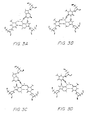
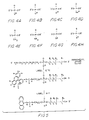
- the thiophosphate and methyl phosphonate linkages are shown in Fig. 4.
- Backbone modification provides a practical tool to "fine tune" the stability of oligonucleotide ligands inside a living cell. For example, oligonucleotides containing the natural phosphodiester linkage are degraded over the course of 1-2 hours in eukaryotic cells, while the non-hydrolyzable derivatives appear to be stable indefinitely.
- Oligonucleotide hybrids provide another method to alter the characteristics of the synthetic oliogonucleotides.
- Linkers can be attached to the 5′ and/or 3′ termini of the synthetic oligonucleotide.
- the linkers which are attached to the 5′ terminus are usually selected from the group consisting of a base analogue with a primary amine affixed to the base plane through an alkyl linkage, a base analogue with a sulfhydryl affixed to the base plane through an alkyl linkage, a long chain amine coupled directly to the 5′ hydroxyl group of the oligonucleotide and a long chain thiol coupled directly to the 5′ hydroxyl group of the oligonucleotide.
- the linker on the 3′ terminus is usually a base analogue with a primary amine affixed to the base plane through an alkyl linkage or a base analogue with a sulfhydryl affixed to the base plane through a alkyl linkage. Affixation of a primary amine linkage to the terminus does not alter oligonucleotide binding to the duplex DNA target.
- modifying groups can be attached to the synthetic oligonucleotide.
- the molecules which can attach include intercalators, groove-binding molecules, cationic amines or cationic polypeptides.
- the modifying group can be selected for its ability to damage DNA.
- the modifying group could include catalytic oxidants such as the iron-EDTA chelate, nitrogen mustards, alkylators, photochemical crosslinkers such as psoralin, photochemical sensitizers of single oxygen such as eosin, methylene blue, acridine orange and 9 amino acridine and reagents of direct photochemical damage such as ethidium and various pyrene derivatives.
- catalytic oxidants such as the iron-EDTA chelate, nitrogen mustards, alkylators, photochemical crosslinkers such as psoralin, photochemical sensitizers of single oxygen such as eosin, methylene blue, acridine orange and 9 amino acridine and reagents of direct photochemical damage such as ethidium and various pyrene derivatives.
- the modified oligonucleotides can be coupled to any reagent which is specific for a primary amine, for example a succimidate or isothiocyanate moiety (Fig. 5).
- an "aminolink" coupling is used to affix the intercalating dyestuff 9 acridine isothiocanate to triplex forming oligonucleotides.
- the duplex binding affinity of the oligonucleotide-dye hybrid is approximately 100-fold greater than the oligonucleotide binding affinity.
- Other embodiments include affixing eosin isothiocyanate to oligonucleotides. Since eosin isothiocyanate cleaves the DNA helix upon irradiation this hybrid oligonucleotide cuts the helix at its binding site when irradiated. This hybrid-oligonucleotide is useful for identifying the oligonucleotide binding site both in vitro and in vivo and potentially can be used as a therapeutic tool for selective gene target destruction.
- Photochemical reactivity is also achieved by affixation of psoralin derivatives to oligonucleotides through a 5′ linkage.
- Psoralin binds covalently to DNA after irradiation, and as a consequence is a potent cytotoxic agent.
- photochemical reactivity, with oligonucleotide sensitivity provides a tool to direct the toxic psoralin lesion to the oligonucleotide target site.
- Similar oligonucleotide coupling is used to target toxic chemical reactivity to specific DNA sequences.
- Examples include catalytic oxidants such as transition metal chelates and nucleases.
- Photochemical reactivity and/or toxic chemical agents can be used to permanently inhibit gene expression.
- modifications of oligonucleotides alter the rate of cellular uptake of the hybrid oligonucleotide molecules.
- the uptake process is rapid, but poorly understood.
- Terminal modification provides a useful procedure to modify cell type specificity, pharmacokinetics, nuclear permeability, and absolute cell uptake rate for oligonucleotide ligands.
- Modified base analogues provide another means of altering the characteristics of the synthetic oligonucleotide.
- X is identical to T with respect to its capacity to form hydrogen bonds.
- Molecular modeling has shown that substitution of X for T in the above oligonucleotide design procedures, results in a modified triplex that is much more stable. The increased stability is due principally to enhanced stacking and to an enhancement of phosphodiester backbone symmetry within the ligand.
- Examples of base substitutions for T are X, I and halogenated X and I.
- G can be replaced by halogenated G.
- the 2′ furanose position on the base can have a non-charged bulky group substitution. Examples of non-charged bulky groups include branched alkyls, sugars and branched sugars. In the preferred embodiment at least one base is substituted.
- oligonucleotide design will produce ligands with target affinity and specificity which exceeds that of even the most specific antigen-monoclonal antibody interaction.
- Synthetic oligonucleotides have been designed to the transcription control region of the human c-myc protooncogene, to the regulation sequence of collagen Ia, to bind to the TATA box segment of the chicken alpha actin gene, and to bind to an enhancer sequence within the early gene region of human HIV-I.
- a further embodiment of the present invention is a method of inhibiting the growth of cells, comprising the step of administering a synthetic oligonucleotide in sufficient amount for cellular uptake and binding to the target sequence, wherein said target sequence is positioned within the DNA domain adjacent to the RNA transcription origin.
- the synthetic oligonucleotide is as described above in the description of the design process. Uptake into the cells is rapid for these synthetic oligonucleotides and can be altered with the appropriate substitutions and modifications. Similarly the binding can be altered by appropriate changes to the synthetic oligonucleotide.
- the inhibition of cell growth can be used in the treatment of cancerous cells. Additions of the specific oligonucleotide will selectively inhibit cell growth.
- synthetic oligonucleotides to the c-myc gene can be used to inhibit some cancerous cell growth.
- synthetic oligonucleotide which inhibit c-myc expression include: 3′-TGGTGTGTGGGTTTTGTGGGGGGTGGGGGGGTTTTTTTTGGGTGGG-5′ and/or 3′-TGTGGTGGGGTGGTTGGGGTGGGTGGGGTGGGTGGG-5′ and/or 5′-TTTGGTGTGGGGGTGGGGGTTTTGTTTTTTGT-3′ and/or 3′-GGTTGGGGTGGGTGGGGTGGGTGGGGT-5′ and/or 5'GGTTGGGGTGGGTGGGGTGGGTGGGGT-3′ and fragments and analogues thereof.
- Another embodiment includes a method of inhibiting the growth of pathogens comprising the step of administering a synthetic oligonucleotide in sufficient amount for cellular uptake and binding to the target sequence, wherein said sequence binds within the nucleic acid domain adjacent the RNA transcription origin.
- HIV-1 virus can be inhibited with a synthetic oligonucleotide which selectively binds to the viral LTR region.
- this synthetic oligonucleotide can include 3′-GTTTTTGGGTGTTGTGGGTGTGTGTGGTT-5′ and/or 5′-TGGGTGGGGTGGGGTGGGGGTGTGGGGTGTGGGGTG-3′ and fragments and analogues thereof.
- An additional embodiment includes a method of manipulating the structural protein content of epidermal tissue comprising the step of administering a synthetic oligonucleotide in sufficient amount for cellular uptake and binding to the target sequence.
- This includes inhibiting the various enzymes and regulating proteins in skin.
- the collagen Ia gene synthesis rate can be altered by using 3′-TGGGTTGGGTGGTGGTGGGGGTGTGGTTTGGTTGTGGGTT TTT-5′ and/or 3′-GTGGGTTGGGTGGTGGTGGGGGTGTGGTTTGG-5′ and fragments and analogues thereof as the synthetic oligonucleotide.
- collagenase gene can be inhibited by using 5′GGTTGGGGTTGGTGTGTTTTTTTTTTGTGTGGGTG-3′ and/or 5′-TTGTGGTTGTTTTTTTGGTTGTGTGT-3, and fragments and analogues thereof.
- the synthetic oligonucleotides described in the examples can include any of the substitutions discussed earlier.
- the backbone, base, linkers and modifying groups can be added. These substitutions will enhance the affinity, the chemical stability, and the cellular uptake properties of the specific oligonucleotide treatments.
- the c-myc gene In both cancerous and normal cells, the c-myc gene possesses several target sequences within its 5′ flanking sequence which satisfy the synthetic oligonucleotide design criteria. In a program of drug development, these target sequences and others are used as templates to direct oligonucleotide design. The purpose of these oligonucleotides is to selectively inhibit c-myc transcription, thereby repressing the uncontrolled growth of tumors with the c-myc lesion.
- Both synthetic oligonucleotides A and B specifically interact within the target duplex to inhibit tumor growth, by means of specific repression of c-myc transcription.
- the specific method of inhibition of oligonucleotide C is unknown.
- oligonucleotides for other genes involved in human tumors can be similarly designed. The procedure is only limited by the available molecular sequence data.
- the structural proteins which define the mechanical properties of skin are well known.
- the molecular structure of the collagen and elastin proteins and their corresponding proteases, collagenase and elastase, have been intensley studied. These proteins are under the control of an elaborate program of regulation, which appears to change during the wound healing process and as a result of the aging process.
- the molecular structure is sufficiently defined to consider treatments based upon gene-specific intervention into the pattern of structural protein synthesis and/or enzymatic degradation.
- a program of synthetic oligonucleotide design, based upon manipulation of collagen I synthesis in human skin is described below. By altering the relative protein concentrations the structure and mechanical properties of skin can be altered.
- the synthetic oligonucleotide can be used as a therapeutic agent to alter the skin aging process or to alter the wound healing process.
- One skilled in the art will readily recognize that the concepts can be extended to other collagens, to other skin proteins and to their complementary proteases based upon the availability of the necessary genetic data.
- target sequences in the transcription control region of the human alpha 1(I) collagen gene the likely function of those sites, their position relative to the RNA transcription origin, and the synthetic oligonucleotide sequence designed for collagen specific treatment as shown below. As the molecular genetics of the collagen gene develops, the list of target sequences within the 5′ flanking region will be expanded.
- Synthetic oligonucleotides A and B inhibit type I collagen protein synthesis.
- the process includes the specific repression of collagen RNA transcription.
- the method of inhibition of the C synthetic oligonucleotide is not known.
- the effect on protein synthesis of skin proteins can be seen by adding sufficient amounts of the synthetic oligonucleotide for uptake into cultured human fibroblasts.
- the D synthetic oligonucleotide inhibits collagenase protein synthesis.
- the process includes specific repression of collagenase RNA transcription.
- the E synthetic oligonucleotide causes loss of TPA sensitivity, and a subsequent repression of collagenase syntheses in the presence of promotors such as TPA.
- This process includes specific repression of collagenase RNA transcription.
- Synthetic oligonucleotide interaction will cause collagen protein levels in the cell to rise, as collagenase levels fall. The clinical effect of the increase should cause a useful alteration of the mechanical properties of skin. The effects can be seen by adding sufficient amounts of oligonucleotide for cellular uptake to cultured human fibroblasts.
- the HIV-I virus is known to be the causative agent in human acquired immune deficiency syndrome (AIDS).
- the long terminal repeat of the HIV-1 virus is known to possess several DNA segments within the LTR region which are required for transcription initiation in a human T-cell host.
- the synthetic oligonucleotides selectively repress HIV-1 mRNA synthesis in a human host cell, by means of triplex formation upon target sequences within the viral LTR. Repression of an RNA synthesis results in the reduction of the growth rate of the virus. This could result in the slowing of the infection process or the repression of the transition from latency to virulent growth.
- Most of the sites within the LTR will comprise target sites for drug (oligonucleotide) intervention. There is no wasted DNA in the small, highly conserved LTR region.
- target sequences in the transcription control region of the human HIV-1 LTR the likely function of these sites, their position relative to the RNA transcription origin, and the oligonucleotide sequence designed as a HIV-I specific treatment are shown below. As the molecular genetics of HIV-I develops, the list of target sequences within the LTR and elsewhere will be expanded.
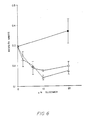
- HIV-1 infected U937 cells were treated with up to 20mM with either HIV29par, HIV31anti, or a random isomer of HIV29 with no detectable in vitro affinity for the target sequence.
- Significant inhibition of viral mRNA production as shown by the decrease in the relative concentrations of env as compared to ö-actin mRNA, was achieved at a dose of 10mM of either oligonucleotide (p ⁇ .01, paired t-test, figure 6). No additional suppression was observed at 20mM.
- the random isomer of HIV29 did not inhibit viral mRNA synthesis, even at 20mM, confirming the specificity of the suppression achieved with HIV29.
- the evidence shows that the oligonucleotides designed to bind within the major groove of the DNA helix, and form triplexes with specific gene sequences in the tar region of the HIV-1 provirus are readily taken up by HIV-1 infected cells and selectively suppress synthesis of HIV-1 mRNA without concomitant suppression of mRNA for ö-actin, which constitutive expressed in these cells. With inhibition of viral MNRA synthesis, translation of virus-encoded proteins is also suppressed. Inhibition of viral mRNA depended on the dose of oligonucleotide added; maximum inhibition occurred at concentrations ⁇ 10mM.
- the synthetic oligonucleotides in A through E will inhibit HIV-I mRNA synthesis, hence viral growth.
- the process includes specific repression of RNA transcription from the viral LTR.
- a representative target sequence in the transcriptions control region of the chicken skeletal alpha actin gene, the function of that site, its position relative to the RNA transcription origin, and the oligonucleotide sequence which would be designed as an actin specific treatment are shown below. As the molecular genetics of the actin gene develops, the list of target sequences within the actin control region will be expanded.
- This synthetic oligonucleotide molecule inhibits actin protein sythesis, by specific repression of RNA transcription. This inhibition can be assessed in cultured chicken myoblasts. The intact chicken will show a change in the quality of actin and other muscle proteins whose synthesis if strongly coupled to actin expression. The practical result of this change will be an alteration of the properties of chicken meat.
- TARGET TRANS PROMOTOR REGION DNA Target Duplex (28bp) Parallel Synthetic Oligonucleotide 5′-TTGGGGTGGGGTTTGTGGGTGTGGTTTT-3′ (IL28par) Anti-Parallel Synthetic Oligonucleotide 3′TTGGGGTGGGGTTTGTGGGTGTGGTTTT-5′ (IL28anti)
- the 28bp target is comprised of 54% G+C base pairs and is 61% purine on the orienting strand.
- the Kdiss for the parallel stand is 1.5 X 10 ⁇ 7 and the Kdiss for the antiparallel is 8 X 10 ⁇ 7.
- the APP770 Gene Promotor is the precursor protein responsible for production of plaque in Alzheimers disease.
- EGFR epidermal growth factor gene
- HMGCoA Reductase is the enzyme which defines the rate limiting step in cholesterol biosynthesis. Its molecular genetics has been studied to understand the control of cholesterol synthesis. The described synthetic oligonucleotides will intervene in the program of cholesterol synthesis by means of modulating the transcription of HMGCoA.
- NGFR Nerve Growth Receptor
- the NGFR gene encodes a cell surface receptor required for nerve cell proliferation. It is overexpressed in neuroblastoma and melanomas. Triplex oligonucleotides are designed to repress the growth of those canoerous tissues. Activation of the gene would be a precondition of activation of nerve cell regeneration.
- the mRNA start site is at -122 in this number scheme.
- HERPES SIMPLEX VIRUS 1 DNA Polymerase and DNA binding proteins
- HSV-1 is responsible for a variety of skin lesions and other infections.
- the triplex oligonucleotide are designed to bind directly to the promotor region of the genes which encode the viral DNA polymerase and DNA binding protein, thereby arresting viral replication. Both genes occur at 0.4 map units and flank the replication origin oriL. Numbering below is in terms of the polypeptide start site for each gene.
- HSV-1 is rseponsible for a variety of skin lesions and other infections.
- the triplex oligonucleotides are designed to bind directly to the two classes of HSV-1 DNA replication origin, thereby arresting viral replication.
- the first origin (oriL) occurs at 0.4 map units and is in between and immediately adjacent to the HSV-1 DNA polymerase and DNA binding protein genes.
- the two identical origins of the second type (oriS) occur at 0.82 and 0.97 map units. Numbering below is the terms of position relative to the two fold symmetry axis of each origin.
- the beta globin gene encodes one of the proteins comprising adult hemoglobin. Mutation in this gene is responsible for beta thalassemia and sickle cell anemia. Triplex oligonucleotides targeted to this gene are designed to inhibit the beta globin gene in thallassemics and in patients with sickle cell anemia, to be replaced by the naturally occuring delta protein. Two classes of triplex oligonucleotides TFO are described, which are targeted against the 5′ enhancer or the promotor/coding domain. Numbering is relative to the principal mRNA start site.
- oligonucleotide binding in cells The effects of triplex-forming oligonucleotides are studied in cell culture. Oligonucleotides are administrered to cultured human cell lines, which are then analyzed for oligonucleotide uptake and for a change in the steady-state level of messenger RNA associated with the DNA target. As an example, the methods for the c-myc gene are shown. One skilled in the art will readily be able to generalize to any gene within a cultured cell.
- HeLa cells grown on a solid support are treated with 32P-labelled oligonucleotide, then incubated as a function of time and concentration. Cells are separated from serum by centrifugation and exhaustive washing, are disrupted by deproteinization then assayed quantitatively on a 8% sequencing gel. This analysis procedure yields the following characteristics:
- Transcription inhibition is assayed by a variation of the RNase protection assay, which is the standard assay for quantitying steady state mRNA levels in mammalian cells.
- Total cellular RNA is extrated from oligonucleotide-treated HeLa cells, then hybridized to a uniformly labelled antisense RNA transcript, generated by the action of T7 polymerase on the SmaI-PvuII human c-myc frangment in pSPT19.
- This SmaI-PvuII probe is complementary to the first myc exon and sequences which comprise both the P1 and P2 transcription start sites of myc.
- a limit RNaseI digest produces either a 0.6 kb duplex (transcription from P1, which is the preferred origin in HeLa cells) or a 0.4 kb duplex (transcription occurs instead from P2, which is used in HeLa cells under conditions of serum starvation).
- the size and quantity of the resulting RNase resistant duplexes is then determined by quantitative autoradiography on a 5% acrylamide gel matrix.
- This assay system can quantify steady-state RNA levels to within 20% accuracy, which is sufficient for the purposes of this analysis.
- the outcome of these cellular titrations is analyzed in the context of two control experiments.
- the first is a comparison of the dose response of oligonucleotides which bind selectively to the target gene and the dose response of oligonucleotides which are unrelated. If oligonucleotide-mediated repression of the c-myc transcription is due to site-specific triplex formation in the cell, then an unrelated oligonucleotide will not elicit an affect, over an equivalent concentration range.
- the second control addresses the gene specificity of the effect.
- data are always normalized to overall RNA concentation in the cell. As such, changes in the steady state level of the myc transcript are meaningful in their own right.
- myc-specific oligonucleotide treatment on the steady state levels of the histone 2A (H2A) message in HeLa cells, probing the RNA complement with an H2A antisense RNA, generated from a construct which, as for myc sequences, has been cloned into a RNA expression vector.
- H2A histone 2A
- oligonucleotides which bind to the control region of the human c-myc gene selectively repress c-myc transcription in an intact HeLa cell. Preliminary work with other oligonucleotides described in the examples have begun to display similar selectivity.
- oligonucleotides variants such as those with chemical moieties added to the 3′ nd 5′ terminus, oligonucleotides with an altered phosphodiester backbone or those with bases other than G and T (i.e., iodo-G or X).
- the design process described herein can be used to design a synthetic DNA oligonucleotide which will bind specifically to any double strand DNA target of interest.
- the resulting oligonucleotide-duplex DNA complex is best described as a colinear triplex. In the triplex the oligonucleotide molecule occupies the major groove of the duplex. The complex is stabilized by base-base hydrogen bonding at the surface of the major groove, leaving Watson-Crick pairing intact. As a result, the stability and site specificity of the synthetic oligonucleotide is not significantly affected by modification of the phosphodiester linkage or by chemical modification of the oligonucleotide terminus.
- these oligonucleotides can be chemically modified; enhancing the overall binding stability, increasing the stability with respect to chemical degradation, increasing the rate at which the oligonucleotides are transported into cells, and conferring chemical reactivity to the molecules.
- oligonucleotides which are readily taken up by eukaryotic cells and, once in the cell, can be targeted to specific sites within a genome.
- site specificity and stability of the synthetic oligonucleotide-target site interaction is as good as current monoclonal antibody-antigen binding interactions.
- This new class of site specific molecules can be used as gene-specific reagents with the capacity to control the transcription process in a gene-specific fashion. This control is effective on both somatic genes and viral genes which have infected a host cell.
- synthetic oligonucleotides are appropriately coupled to a reactive chemical complement, it is possible to create a hybrid molecule with the capacity to selectively destroy a gene target of interest.
Landscapes
- Chemical & Material Sciences (AREA)
- Health & Medical Sciences (AREA)
- Life Sciences & Earth Sciences (AREA)
- Organic Chemistry (AREA)
- Engineering & Computer Science (AREA)
- Genetics & Genomics (AREA)
- Wood Science & Technology (AREA)
- Zoology (AREA)
- Bioinformatics & Cheminformatics (AREA)
- General Health & Medical Sciences (AREA)
- Molecular Biology (AREA)
- Biochemistry (AREA)
- Proteomics, Peptides & Aminoacids (AREA)
- General Engineering & Computer Science (AREA)
- Biotechnology (AREA)
- Biomedical Technology (AREA)
- Immunology (AREA)
- Microbiology (AREA)
- Analytical Chemistry (AREA)
- Physics & Mathematics (AREA)
- Biophysics (AREA)
- Virology (AREA)
- Animal Behavior & Ethology (AREA)
- General Chemical & Material Sciences (AREA)
- Veterinary Medicine (AREA)
- Public Health (AREA)
- Pharmacology & Pharmacy (AREA)
- Nuclear Medicine, Radiotherapy & Molecular Imaging (AREA)
- Medicinal Chemistry (AREA)
- Pathology (AREA)
- Chemical Kinetics & Catalysis (AREA)
- Plant Pathology (AREA)
- Neurosurgery (AREA)
- Oncology (AREA)
- Neurology (AREA)
- Hospice & Palliative Care (AREA)
- Diabetes (AREA)
- Obesity (AREA)
- AIDS & HIV (AREA)
- Hematology (AREA)
Applications Claiming Priority (2)
| Application Number | Priority Date | Filing Date | Title |
|---|---|---|---|
| US28735988A | 1988-12-20 | 1988-12-20 | |
| US287359 | 1988-12-20 |
Publications (2)
| Publication Number | Publication Date |
|---|---|
| EP0375408A1 true EP0375408A1 (de) | 1990-06-27 |
| EP0375408B1 EP0375408B1 (de) | 1995-02-22 |
Family
ID=23102554
Family Applications (2)
| Application Number | Title | Priority Date | Filing Date |
|---|---|---|---|
| EP19900901460 Pending EP0449972A4 (en) | 1988-12-20 | 1989-12-20 | Triple stranded nucleic acid and methods of use |
| EP89313391A Expired - Lifetime EP0375408B1 (de) | 1988-12-20 | 1989-12-20 | Verfahren zur Herstellung synthetischer Oligonukleotide, die spezifisch an Bestimmungsstellen auf Duplex-DNA-Molekülen binden durch Formen eines kolinearen Triplex, die synthetischen Oligonukleotide und Verfahren zu ihrer Herstellung |
Family Applications Before (1)
| Application Number | Title | Priority Date | Filing Date |
|---|---|---|---|
| EP19900901460 Pending EP0449972A4 (en) | 1988-12-20 | 1989-12-20 | Triple stranded nucleic acid and methods of use |
Country Status (10)
| Country | Link |
|---|---|
| EP (2) | EP0449972A4 (de) |
| JP (1) | JPH04502407A (de) |
| AT (1) | ATE118818T1 (de) |
| AU (1) | AU640910B2 (de) |
| CA (1) | CA2006008C (de) |
| DE (1) | DE68921315T2 (de) |
| DK (1) | DK120091A (de) |
| ES (1) | ES2069598T3 (de) |
| PT (1) | PT92640B (de) |
| WO (1) | WO1990006934A1 (de) |
Cited By (110)
| Publication number | Priority date | Publication date | Assignee | Title |
|---|---|---|---|---|
| EP0463712A3 (en) * | 1990-06-27 | 1992-04-08 | University Patents, Inc. | Polynucleotide phosphorodithioates as therapeutic agents for retroviral infections |
| WO1992009705A1 (en) * | 1990-11-23 | 1992-06-11 | Gilead Sciences, Inc. | Triplex-forming oligomers containing modified bases |
| EP0539371A4 (de) * | 1989-10-23 | 1992-09-11 | Gilead Sciences Inc | Tripelhelixbildung in der oligonukleotidtherapie. |
| WO1993005180A1 (en) * | 1991-08-30 | 1993-03-18 | The Johns Hopkins University | Formation of triple helix complexes of double stranded dna using nucleoside oligomers which comprise purine base analogs |
| WO1993007295A1 (en) * | 1991-10-07 | 1993-04-15 | The Johns Hopkins University | Formation of triple helix complexes of single stranded nucleic acids using nucleoside oligomers |
| WO1993009127A1 (en) * | 1991-11-07 | 1993-05-13 | Gilead Sciences, Inc. | Enhanced triple-helix formation directed by oligonucleotides composed of 2'-deoxy-7-deazaxanthosine and 2'-deoxy-7-deazaguanosine and related analogs |
| EP0531436A4 (en) * | 1990-05-25 | 1993-06-16 | Gilead Sciences, Inc. | Sequence-specific nonphotoactivated crosslinking agents which bind to the major groove of duplex dna |
| EP0527804A4 (en) * | 1990-04-10 | 1993-07-14 | Research Development Foundation | Gene therapy for cell proliferative diseases |
| EP0566670A4 (en) * | 1990-12-17 | 1993-12-08 | Idexx Laboratories, Inc. | Nucleic acid sequence detection by triple helix formation |
| WO1994017092A1 (en) * | 1993-01-26 | 1994-08-04 | Microprobe Corporation | Bifunctional crosslinking oligonucleotides adapted for linking to a desired gene sequence of invading organism or cell |
| WO1994025037A1 (en) * | 1993-04-23 | 1994-11-10 | Triplex Pharmaceutical Corporation | Anti-viral guanosine-rich oligonucleotides |
| WO1995001364A1 (en) * | 1993-06-25 | 1995-01-12 | Yale University | Chemically modified oligonucleotide for site-directed mutagenesis |
| US5422251A (en) * | 1986-11-26 | 1995-06-06 | Princeton University | Triple-stranded nucleic acids |
| US5484908A (en) * | 1991-11-26 | 1996-01-16 | Gilead Sciences, Inc. | Oligonucleotides containing 5-propynyl pyrimidines |
| US5488039A (en) * | 1994-01-10 | 1996-01-30 | Abbott Laboratories | Method for the production of an enteral formula containing ribo-nucleotides |
| US5492899A (en) * | 1994-01-10 | 1996-02-20 | Abbott Laboratories | Infant nutritional formula with ribo-nucleotides |
| WO1996040898A1 (en) * | 1995-06-07 | 1996-12-19 | Yale University | Triple-helix forming oligonucleotides for targeted mutagenesis |
| US5594122A (en) * | 1993-06-23 | 1997-01-14 | Genesys Pharma Inc. | Antisense oligonucleotides targeted against human immunodeficiency virus |
| US5594121A (en) * | 1991-11-07 | 1997-01-14 | Gilead Sciences, Inc. | Enhanced triple-helix and double-helix formation with oligomers containing modified purines |
| US5602109A (en) * | 1994-01-10 | 1997-02-11 | Abbott Laboratories | Method to enhance the immune system of a human |
| AU679508B2 (en) * | 1991-11-26 | 1997-07-03 | Isis Pharmaceuticals, Inc. | Enhanced triple-helix and double-helix formation with oligomers containing modified pyrimidines |
| WO1997035002A1 (fr) * | 1996-03-21 | 1997-09-25 | Rhone-Poulenc Rorer S.A. | Purification d'adn plasmidique de qualite pharmaceutique |
| US5683874A (en) * | 1991-03-27 | 1997-11-04 | Research Corporation Technologies, Inc. | Single-stranded circular oligonucleotides capable of forming a triplex with a target sequence |
| US5700590A (en) * | 1994-01-10 | 1997-12-23 | Abbott Laboratories | Nutritional formula with ribo-nucleotides |
| US5721218A (en) * | 1989-10-23 | 1998-02-24 | Gilead Sciences, Inc. | Oligonucleotides with inverted polarity |
| US5780611A (en) * | 1995-09-15 | 1998-07-14 | Ramareddy Venkata Guntaka | Oligomers which inhibit expression of collagen genes |
| US5808037A (en) * | 1995-09-15 | 1998-09-15 | Ramareddy Venkata Guntaka | Oligomers which inhibit expression of collagen genes |
| EP0724589A4 (de) * | 1993-10-18 | 1998-09-16 | Inst Medical W & E Hall | Verfahren zur erhöhung der überlebensrate von neuronen und dafür verwendbare mittel |
| US5830653A (en) * | 1991-11-26 | 1998-11-03 | Gilead Sciences, Inc. | Methods of using oligomers containing modified pyrimidines |
| US5849900A (en) * | 1992-09-29 | 1998-12-15 | Max-Planck-Gesellschaft Zur Forderung Der Wissenschafter E.V. | Inhibition of viruses by antisense oligomers capable of binding to polypurine rich tract of single-stranded RNA or RNA-DNA hybrids |
| US5928863A (en) * | 1986-11-26 | 1999-07-27 | Princeton University | Triple-stranded nucleic acids |
| US5935830A (en) * | 1995-06-07 | 1999-08-10 | Epoch Pharmaceuticals, Inc. | Targeted mutagenesis in living cells using modified oligonucleotides |
| WO2000008213A1 (en) * | 1998-08-07 | 2000-02-17 | Guntaka Ramareddy V | Oligomers which inhibit expression of collagen genes |
| US6040173A (en) * | 1990-08-01 | 2000-03-21 | Johns Hopkins University | Nucleic acid encoding a novel mammalian protein associated with uncontrolled cell division |
| US6136858A (en) * | 1994-01-10 | 2000-10-24 | Abbott Laboratories | Infant formula and methods of improving infant stool patterns |
| US6136601A (en) * | 1991-08-21 | 2000-10-24 | Epoch Pharmaceuticals, Inc. | Targeted mutagenesis in living cells using modified oligonucleotides |
| US6235887B1 (en) | 1991-11-26 | 2001-05-22 | Isis Pharmaceuticals, Inc. | Enhanced triple-helix and double-helix formation directed by oligonucleotides containing modified pyrimidines |
| US6288042B1 (en) | 1993-04-23 | 2001-09-11 | Aronex Pharmaceuticals, Inc. | Anti-viral guanosine-rich tetrad forming oligonucleotides |
| US6323185B1 (en) | 1993-04-23 | 2001-11-27 | The United States Of America As Represented By The Department Of Health And Human Services | Anti-viral guanosine-rich oligonucleotides and method of treating HIV |
| US6403302B1 (en) | 1992-09-17 | 2002-06-11 | California Institute Of Technology | Methods and compositions for triple helix formation |
| WO2002074955A3 (fr) * | 2001-03-16 | 2003-12-24 | Centre Nat Rech Scient | OLIGONUCLEOTIDES POUR LA REGULATION DU GENE CODANT POUR LE TNFα ET/OU DE GENES SOUS SON CONTROLE ET LEUR APPLICATION |
| US6930175B1 (en) | 1997-12-12 | 2005-08-16 | The Johns Hopkins University School Of Medicine | Gene family with transformation modulating activity |
| WO2009010968A2 (en) | 2007-07-15 | 2009-01-22 | Yitzchak Hillman | Disease treatment via antimicrobial peptides or their inhibitors |
| US7498428B2 (en) | 2003-06-19 | 2009-03-03 | Evogene Ltd. | Nucleotide sequences for regulating gene expression in plant trichomes and constructs and methods utilizing same |
| EP2062919A2 (de) | 2002-11-27 | 2009-05-27 | Technion Research and Development Foundation, Ltd. | Nützliche pharmazeutische Zusammensetzungen und Verfahren für Angiogenesemodulation, Metastasen- und Tumorfibrosehemmung sowie Bewertung der Malignität von Dickdarmkarzinomen |
| WO2010113096A1 (en) | 2009-03-30 | 2010-10-07 | Tel Hashomer Medical Research Infrastructure And Services Ltd. | Methods of predicting clinical course and treating multiple sclerosis |
| WO2011021171A1 (en) | 2009-08-21 | 2011-02-24 | Beeologics, Llc | Preventing and curing beneficial insect diseases via plant transcribed molecules |
| WO2011030332A2 (en) | 2009-09-08 | 2011-03-17 | Yeda Research And Development Co. Ltd. | Methods for hematopoietic precursor mobilization |
| WO2011030329A1 (en) | 2009-09-10 | 2011-03-17 | Yissum Research Development Company Of The Hebrew University Of Jerusalem Ltd. | Method of treating tumors |
| US7928083B2 (en) | 2007-01-16 | 2011-04-19 | Yissum Research Development Company Of The Hebrew University Of Jerusalem | H19 silencing nucleic acid agents for treating rheumatoid arthritis |
| WO2011045796A1 (en) | 2009-10-14 | 2011-04-21 | Yissum Research Development Company Of The Hebrew University Of Jerusalem Ltd. | Compositions for controlling varroa mites in bees |
| WO2011133876A2 (en) | 2010-04-22 | 2011-10-27 | Alnylam Pharmaceuticals, Inc. | Oligonucleotides comprising acyclic and abasic nucleosides and analogs |
| WO2011133868A2 (en) | 2010-04-22 | 2011-10-27 | Alnylam Pharmaceuticals, Inc. | Conformationally restricted dinucleotide monomers and oligonucleotides |
| WO2011132182A1 (en) | 2010-04-18 | 2011-10-27 | Yeda Research And Development Co. Ltd. | MOLECULES AND METHODS OF USING SAME FOR TREATING ErbB/ErbB LIGANDS ASSOCIATED DISEASES |
| US8067574B2 (en) | 2005-07-07 | 2011-11-29 | Yissum Research Development Company Of The Hebrew University Of Jerusalem | Nucleic acid agents for downregulating H19, and methods of using same |
| WO2011158243A2 (en) | 2010-06-16 | 2011-12-22 | Yissum Research Development Company Of The Hebrew University Of Jerusalem Ltd. | Method of diagnosing and treating cancer |
| US8129514B2 (en) | 2003-06-19 | 2012-03-06 | Evogene Ltd. | Nucleotide sequences for regulating gene expression in plant trichomes and constructs and methods utilizing same |
| WO2012035539A1 (en) | 2010-09-15 | 2012-03-22 | Ramot At Tel-Aviv University Ltd. | Methods of expanding and redifferentiating islet beta cells |
| WO2012052872A2 (en) | 2010-10-17 | 2012-04-26 | Yeda Research And Development Co. Ltd. | Methods and compositions for the treatment of insulin-associated medical conditions |
| EP2527441A2 (de) | 2007-07-15 | 2012-11-28 | Technion Research & Development Foundation | Zusammensetzungen und Verfahren zur Behandlung von Tumoren, Fibrose und Alveolarproteinose |
| WO2012172555A1 (en) | 2011-06-14 | 2012-12-20 | Yeda Research And Development Co. Ltd. | Combination therapy to prevent dcis formation and progression to breast cancer |
| WO2013021389A2 (en) | 2011-08-09 | 2013-02-14 | Yeda Research And Development Co.Ltd. | Downregulation of mir-7 for promotion of beta cell differentiation and insulin production |
| WO2013061328A2 (en) | 2011-10-27 | 2013-05-02 | Yeda Research And Development Co. Ltd. | Method of treating cancer |
| WO2013076730A1 (en) | 2011-11-27 | 2013-05-30 | Yeda Research And Development Co. Ltd. | Methods of regulating angiogenesis and compositions capable of same |
| WO2013124816A2 (en) | 2012-02-22 | 2013-08-29 | Brainstem Biotec Ltd. | Generation of neural stem cells and motor neurons |
| US8648051B2 (en) * | 1999-04-08 | 2014-02-11 | Advanced Cancer Therapeutics, Llc | Antiproliferative activity of G-rich oligonucleotides and method of using same to bind to nucleolin |
| US8658608B2 (en) | 2005-11-23 | 2014-02-25 | Yale University | Modified triple-helix forming oligonucleotides for targeted mutagenesis |
| EP2757091A1 (de) | 2008-04-01 | 2014-07-23 | Biosearch Technologies, Inc. | Sonden für stabilisiertes Nukleinsäure-Dark-Quencher-Fluorophor |
| WO2014174511A1 (en) | 2013-04-21 | 2014-10-30 | Yeda Research And Development Co. Ltd. | Agents for downregulation of the activity and/or amount of bcl-xl and/or bcl-w |
| WO2015066681A1 (en) | 2013-11-04 | 2015-05-07 | Monsanto Technology Llc | Compositions and methods for controlling arthropod parasite and pest infestations |
| WO2015114638A2 (en) | 2014-02-03 | 2015-08-06 | Yissum Research Development Company Of The Hebrew University Of Jerusalem Ltd. | Method of eliminating stem cells |
| WO2016016894A1 (en) | 2014-07-30 | 2016-02-04 | Yeda Research And Development Co. Ltd. | Media for culturing pluripotent stem cells |
| WO2016030899A1 (en) | 2014-08-28 | 2016-03-03 | Yeda Research And Development Co. Ltd. | Methods of treating amyotrophic lateral scleroses |
| WO2016079736A2 (en) | 2014-11-17 | 2016-05-26 | Yeda Research And Development Co. Ltd. | Methods of treating diseases related to mitochondrial function |
| WO2016135716A1 (en) | 2015-02-26 | 2016-09-01 | Jacob Schneiderman | Methods and compositions relating to leptin antagonists |
| WO2016135732A1 (en) | 2015-02-26 | 2016-09-01 | Yeda Research And Development Co. Ltd. | Method of promoting hair growth |
| WO2016181393A1 (en) | 2015-05-11 | 2016-11-17 | Yeda Research And Development Co. Ltd. | Citrin inhibitors for the treatment of cancer |
| WO2016185457A1 (en) | 2015-05-19 | 2016-11-24 | Yeda Research And Development Co. Ltd. | Methods of promoting lymphangiogenesis |
| WO2016185469A1 (en) | 2015-05-21 | 2016-11-24 | Yeda Research And Development Co. Ltd. | Bacterial populations for promoting health |
| WO2017015109A1 (en) | 2015-07-17 | 2017-01-26 | Alnylam Pharmaceuticals, Inc. | Multi-targeted single entity conjugates |
| WO2017021963A1 (en) | 2015-08-03 | 2017-02-09 | Biokine Therapeutics Ltd. | Cxcr4 binding agents for treatment of diseases |
| WO2017118985A1 (en) | 2016-01-06 | 2017-07-13 | Yeda Research And Development Co. Ltd. | Compositions and methods for treating malignant, autoimmune and inflammatory diseases |
| WO2017153982A1 (en) | 2016-03-06 | 2017-09-14 | Yeda Research And Development Co. Ltd. | Method for modulating myelination |
| WO2018033929A1 (en) | 2016-08-18 | 2018-02-22 | Yeda Research And Development Co. Ltd. | Diagnostic and therapeutic uses of exosomes |
| WO2019021289A1 (en) | 2017-07-27 | 2019-01-31 | The National Institute for Biotechnology in the Negev Ltd. | SMAC / DIABLO INHIBITORS USEFUL IN THE TREATMENT OF CANCER |
| WO2019097514A1 (en) | 2017-11-14 | 2019-05-23 | Yeda Research And Development Co. Ltd. | Hematopoietic stem cells with improved properties |
| WO2019116376A1 (en) | 2017-12-17 | 2019-06-20 | Yeda Research And Development Co. Ltd. | Cop9 signalosome (csn) complex modulators and uses thereof |
| US10378012B2 (en) | 2014-07-29 | 2019-08-13 | Monsanto Technology Llc | Compositions and methods for controlling insect pests |
| WO2019155465A1 (en) | 2018-02-08 | 2019-08-15 | Yeda Research And Development Co. Ltd. | Methods of identifying and using agents for treating diseases associated with intestinal barrier dysfunction |
| WO2019217459A1 (en) | 2018-05-07 | 2019-11-14 | Alnylam Pharmaceuticals, Inc. | Extrahepatic delivery |
| US10494443B2 (en) | 2007-08-02 | 2019-12-03 | Gilead Biologics, Inc. | LOX and LOXL2 inhibitors and uses thereof |
| EP3587434A1 (de) | 2008-09-23 | 2020-01-01 | Alnylam Pharmaceuticals Inc. | Chemische modifikationen von monomeren und oligonukleotiden mit click komponenten um liganden zu konjugieren |
| US10597676B2 (en) | 2013-07-19 | 2020-03-24 | Monsanto Technology Llc | Compositions and methods for controlling Leptinotarsa |
| WO2020170240A1 (en) | 2019-02-21 | 2020-08-27 | Yissum Research Development Company Of The Hebrew University Of Jerusalem Ltd. | Method for reduction drug-induced nephrotoxicity |
| US10801028B2 (en) | 2009-10-14 | 2020-10-13 | Beeologics Inc. | Compositions for controlling Varroa mites in bees |
| WO2020236600A1 (en) | 2019-05-17 | 2020-11-26 | Alnylam Pharmaceuticals, Inc. | Oral delivery of oligonucleotides |
| US10888579B2 (en) | 2007-11-07 | 2021-01-12 | Beeologics Inc. | Compositions for conferring tolerance to viral disease in social insects, and the use thereof |
| US10907152B2 (en) | 2015-05-04 | 2021-02-02 | Monsanto Technology Llc | Compositions and methods for controlling arthropod parasite and pest infestations |
| WO2021019526A1 (en) | 2019-07-29 | 2021-02-04 | Yeda Research And Development Co. Ltd. | Methods of treating and diagnosing lung cancer |
| US10968449B2 (en) | 2015-01-22 | 2021-04-06 | Monsanto Technology Llc | Compositions and methods for controlling Leptinotarsa |
| US11091770B2 (en) | 2014-04-01 | 2021-08-17 | Monsanto Technology Llc | Compositions and methods for controlling insect pests |
| US11136597B2 (en) | 2016-02-16 | 2021-10-05 | Yale University | Compositions for enhancing targeted gene editing and methods of use thereof |
| US11174484B2 (en) | 2015-11-10 | 2021-11-16 | B. G. Negev Technologies And Applications Ltd., At Ben- Gurion University | Means and methods for reducing tumorigenicity of cancer stem cells |
| WO2022011214A1 (en) | 2020-07-10 | 2022-01-13 | Alnylam Pharmaceuticals, Inc. | Circular sirnas |
| WO2023283403A2 (en) | 2021-07-09 | 2023-01-12 | Alnylam Pharmaceuticals, Inc. | Bis-rnai compounds for cns delivery |
| WO2023018621A1 (en) | 2021-08-10 | 2023-02-16 | Gamida-Cell Ltd. | Engineered nk cells, methods of their production and uses thereof |
| US11648260B2 (en) | 2018-03-29 | 2023-05-16 | Technion Research And Development Foundation Limitted | Vesicles comprising a PTEN inhibitor and uses of same |
| WO2023220744A2 (en) | 2022-05-13 | 2023-11-16 | Alnylam Pharmaceuticals, Inc. | Single-stranded loop oligonucleotides |
| WO2024238385A2 (en) | 2023-05-12 | 2024-11-21 | Alnylam Pharmaceuticals, Inc. | Single-stranded loop oligonucleotides |
| US12268774B2 (en) | 2017-04-04 | 2025-04-08 | Yale University | Compositions and methods for in utero delivery |
Families Citing this family (10)
| Publication number | Priority date | Publication date | Assignee | Title |
|---|---|---|---|---|
| US5616461A (en) * | 1992-05-14 | 1997-04-01 | Dana-Farber Cancer Institute | Assay for antiviral activity using complex of herpesvirus origin of replication and cellular protein |
| WO1994011494A1 (en) * | 1992-11-09 | 1994-05-26 | Thomas Jefferson University | Antisense oligonucleotides to inhibit expression of mutated and wild type genes for collagen |
| WO1994013793A1 (en) * | 1992-12-04 | 1994-06-23 | Apollon, Inc. | Compounds and methods for the treatment of leukemias |
| NZ259223A (en) * | 1992-12-08 | 1997-10-24 | Genta Inc | Forming a triple helix of nucleic acids for detection of a single stranded target sequence-containing nucleic acid |
| US6312925B1 (en) * | 1997-05-08 | 2001-11-06 | Epoch Pharmaceuticals, Inc. | Methods and compositions to facilitate D-loop formation by oligonucleotides |
| US8114850B2 (en) | 1999-04-08 | 2012-02-14 | Advanced Cancer Therapeutics, Llc | Antiproliferative activity of G-rich oligonucleotides and method of using same to bind to nucleolin |
| US9107935B2 (en) | 2009-01-06 | 2015-08-18 | Gilead Biologics, Inc. | Chemotherapeutic methods and compositions |
| RU2012110585A (ru) | 2009-08-21 | 2013-09-27 | Джилид Байолоджикс, Инк. | Каталичические домены лизилоксидазы и loxl2 |
| US8680246B2 (en) | 2010-02-04 | 2014-03-25 | Gilead Biologics, Inc. | Antibodies that bind to lysyl oxidase-like 2 (LOXL2) |
| WO2024137756A1 (en) * | 2022-12-23 | 2024-06-27 | Hongene Biotech Corporation | Compounds and methods for liquid phase oligonucleotide synthesis |
-
1989
- 1989-12-19 CA CA002006008A patent/CA2006008C/en not_active Expired - Fee Related
- 1989-12-20 DE DE68921315T patent/DE68921315T2/de not_active Expired - Fee Related
- 1989-12-20 EP EP19900901460 patent/EP0449972A4/en active Pending
- 1989-12-20 AT AT89313391T patent/ATE118818T1/de not_active IP Right Cessation
- 1989-12-20 ES ES89313391T patent/ES2069598T3/es not_active Expired - Lifetime
- 1989-12-20 JP JP2502252A patent/JPH04502407A/ja active Pending
- 1989-12-20 AU AU48384/90A patent/AU640910B2/en not_active Ceased
- 1989-12-20 WO PCT/US1989/005769 patent/WO1990006934A1/en not_active Ceased
- 1989-12-20 EP EP89313391A patent/EP0375408B1/de not_active Expired - Lifetime
- 1989-12-20 PT PT92640A patent/PT92640B/pt not_active IP Right Cessation
-
1991
- 1991-06-20 DK DK120091A patent/DK120091A/da not_active Application Discontinuation
Non-Patent Citations (5)
| Title |
|---|
| NATURE, vol. 339, no. 6226, June 22, 1989 (New York, London) P. RAJAGOPAL et al. "Triple- -strand formation in the homo-purine: homopyrimidine DNA oligonucleotides d(G-A)4 and d(T-C)4" pages 637-640 * |
| PROCEEDINGS OF THE NATIONAL ACADEMY OF SCIENCES OF THE UNITED STATES OF AMERICA, vol. 85, no. 5, March 1988 (Baltimore, USA) D. PRASEUTH et al. "Sequence- specific binding and photo- crosslinking of alpha and beta oligodeoxynucleotides to the major groove of DNA triple-helix formation" pages 1349-1353 * |
| PROCEEDINGS OF THE NATIONAL ACADEMY OF SCIENCES OF THE UNITED STATES OF AMERICA, vol.84, no. 15, August 1987 (Baltimore, USA) S.L. BROITMAN et al. "Forma- tion of the triple-stranded polynucleotide helix, poly (A.A.U)" pages 5120-5124 * |
| SCIENCE, vol. 238, October 30, 1987 (Washington DC) H.E. MOSER et al. "Sequence- Specific Cleavage of Double Helical DNA by Triple Helix Formation" pages 645-650 * |
| SCIENCE, vol. 241, July 22, 1988 (Washington DC) M. COONEY et al. "Site- -Specific Oligonucleotide Binding Represses Transcrip- tion of the Human c-mcy Gene in Vitro" pages 456-459 * |
Cited By (150)
| Publication number | Priority date | Publication date | Assignee | Title |
|---|---|---|---|---|
| US5693471A (en) * | 1986-11-26 | 1997-12-02 | Princeton University | Triple stranded nucleic acids |
| US5928863A (en) * | 1986-11-26 | 1999-07-27 | Princeton University | Triple-stranded nucleic acids |
| US5422251A (en) * | 1986-11-26 | 1995-06-06 | Princeton University | Triple-stranded nucleic acids |
| US5399676A (en) * | 1989-10-23 | 1995-03-21 | Gilead Sciences | Oligonucleotides with inverted polarity |
| EP0539371A4 (de) * | 1989-10-23 | 1992-09-11 | Gilead Sciences Inc | Tripelhelixbildung in der oligonukleotidtherapie. |
| US5721218A (en) * | 1989-10-23 | 1998-02-24 | Gilead Sciences, Inc. | Oligonucleotides with inverted polarity |
| US5527899A (en) * | 1989-10-23 | 1996-06-18 | Gilead Sciences, Inc. | Oligonucleotides with inverted polarity |
| EP0527804A4 (en) * | 1990-04-10 | 1993-07-14 | Research Development Foundation | Gene therapy for cell proliferative diseases |
| EP0531436A4 (en) * | 1990-05-25 | 1993-06-16 | Gilead Sciences, Inc. | Sequence-specific nonphotoactivated crosslinking agents which bind to the major groove of duplex dna |
| EP0463712A3 (en) * | 1990-06-27 | 1992-04-08 | University Patents, Inc. | Polynucleotide phosphorodithioates as therapeutic agents for retroviral infections |
| US6040173A (en) * | 1990-08-01 | 2000-03-21 | Johns Hopkins University | Nucleic acid encoding a novel mammalian protein associated with uncontrolled cell division |
| WO1992009705A1 (en) * | 1990-11-23 | 1992-06-11 | Gilead Sciences, Inc. | Triplex-forming oligomers containing modified bases |
| EP0566670A4 (en) * | 1990-12-17 | 1993-12-08 | Idexx Laboratories, Inc. | Nucleic acid sequence detection by triple helix formation |
| US5800984A (en) * | 1990-12-17 | 1998-09-01 | Idexx Laboratories, Inc. | Nucleic acid sequence detection by triple helix formation at primer site in amplification reactions |
| US5872105A (en) * | 1991-03-27 | 1999-02-16 | Research Corporation Technologies Inc. | Single-stranded circular oligonucleotides useful for drug delivery |
| US5683874A (en) * | 1991-03-27 | 1997-11-04 | Research Corporation Technologies, Inc. | Single-stranded circular oligonucleotides capable of forming a triplex with a target sequence |
| US6136601A (en) * | 1991-08-21 | 2000-10-24 | Epoch Pharmaceuticals, Inc. | Targeted mutagenesis in living cells using modified oligonucleotides |
| WO1993005180A1 (en) * | 1991-08-30 | 1993-03-18 | The Johns Hopkins University | Formation of triple helix complexes of double stranded dna using nucleoside oligomers which comprise purine base analogs |
| WO1993007295A1 (en) * | 1991-10-07 | 1993-04-15 | The Johns Hopkins University | Formation of triple helix complexes of single stranded nucleic acids using nucleoside oligomers |
| WO1993009127A1 (en) * | 1991-11-07 | 1993-05-13 | Gilead Sciences, Inc. | Enhanced triple-helix formation directed by oligonucleotides composed of 2'-deoxy-7-deazaxanthosine and 2'-deoxy-7-deazaguanosine and related analogs |
| US5594121A (en) * | 1991-11-07 | 1997-01-14 | Gilead Sciences, Inc. | Enhanced triple-helix and double-helix formation with oligomers containing modified purines |
| US6380368B1 (en) | 1991-11-26 | 2002-04-30 | Isis Pharmaceuticals, Inc. | Enhanced triple-helix and double-helix formation with oligomers containing modified pyrimidines |
| US6962783B2 (en) | 1991-11-26 | 2005-11-08 | Isis Pharmaceuticals, Inc. | Enhanced triple-helix and double-helix formation with oligomers containing modified pyrimidines |
| AU679508B2 (en) * | 1991-11-26 | 1997-07-03 | Isis Pharmaceuticals, Inc. | Enhanced triple-helix and double-helix formation with oligomers containing modified pyrimidines |
| US5645985A (en) * | 1991-11-26 | 1997-07-08 | Gilead Sciences, Inc. | Enhanced triple-helix and double-helix formation with oligomers containing modified pyrimidines |
| US6875593B2 (en) | 1991-11-26 | 2005-04-05 | Isis Pharmaceuticals, Inc. | Enhanced triple-helix and double-helix formation with oligomers containing modified pyrimidines |
| US5830653A (en) * | 1991-11-26 | 1998-11-03 | Gilead Sciences, Inc. | Methods of using oligomers containing modified pyrimidines |
| US6235887B1 (en) | 1991-11-26 | 2001-05-22 | Isis Pharmaceuticals, Inc. | Enhanced triple-helix and double-helix formation directed by oligonucleotides containing modified pyrimidines |
| US5484908A (en) * | 1991-11-26 | 1996-01-16 | Gilead Sciences, Inc. | Oligonucleotides containing 5-propynyl pyrimidines |
| US7057027B2 (en) | 1991-11-26 | 2006-06-06 | Isis Pharmaceuticals, Inc. | Enhanced triple-helix and double-helix formation with oligomers containing modified pyrimidines |
| US6403302B1 (en) | 1992-09-17 | 2002-06-11 | California Institute Of Technology | Methods and compositions for triple helix formation |
| US5849900A (en) * | 1992-09-29 | 1998-12-15 | Max-Planck-Gesellschaft Zur Forderung Der Wissenschafter E.V. | Inhibition of viruses by antisense oligomers capable of binding to polypurine rich tract of single-stranded RNA or RNA-DNA hybrids |
| WO1994017092A1 (en) * | 1993-01-26 | 1994-08-04 | Microprobe Corporation | Bifunctional crosslinking oligonucleotides adapted for linking to a desired gene sequence of invading organism or cell |
| US6312953B1 (en) | 1993-01-26 | 2001-11-06 | Epoch Pharmaceuticals, Inc. | Bifunctional Crosslinking oligonucleotides adapted for linking to a target sequence of duplex DNA |
| US6323185B1 (en) | 1993-04-23 | 2001-11-27 | The United States Of America As Represented By The Department Of Health And Human Services | Anti-viral guanosine-rich oligonucleotides and method of treating HIV |
| US6184369B1 (en) | 1993-04-23 | 2001-02-06 | Aronex Pharmaceuticals, Inc. | Anti-viral guanosine-rich oligonucleotides |
| AU700196B2 (en) * | 1993-04-23 | 1998-12-24 | Aronex Pharmaceuticals, Inc. | Anti-viral guanosine-rich oligonucleotides |
| US5567604A (en) * | 1993-04-23 | 1996-10-22 | Aronex Pharmaceuticals, Inc. | Anti-viral guanosine-rich oligonucleotides |
| US6288042B1 (en) | 1993-04-23 | 2001-09-11 | Aronex Pharmaceuticals, Inc. | Anti-viral guanosine-rich tetrad forming oligonucleotides |
| WO1994025037A1 (en) * | 1993-04-23 | 1994-11-10 | Triplex Pharmaceutical Corporation | Anti-viral guanosine-rich oligonucleotides |
| US5811537A (en) * | 1993-06-23 | 1998-09-22 | Novopharm Biotech Inc. | Antisense oligonucleotides targeted against human immunodeficiency virus |
| US6420551B1 (en) | 1993-06-23 | 2002-07-16 | Viventia Biotech Inc. | Antisense oligonucleotides targeted against human immunodeficiency virus |
| US5594122A (en) * | 1993-06-23 | 1997-01-14 | Genesys Pharma Inc. | Antisense oligonucleotides targeted against human immunodeficiency virus |
| US6303376B1 (en) | 1993-06-25 | 2001-10-16 | Yale University | Methods of targeted mutagenesis using triple-helix forming oligonucleotides |
| US5962426A (en) * | 1993-06-25 | 1999-10-05 | Yale University | Triple-helix forming oligonucleotides for targeted mutagenesis |
| US7078389B2 (en) | 1993-06-25 | 2006-07-18 | Yale University | Chemically modified oligonucleotide for site-directed mutagenesis |
| WO1995001364A1 (en) * | 1993-06-25 | 1995-01-12 | Yale University | Chemically modified oligonucleotide for site-directed mutagenesis |
| EP1683863A3 (de) * | 1993-10-18 | 2006-08-02 | The Walter And Eliza Hall Institute Of Medical Research | Verfahren zur Erhöhung der Überlebensrate von Neuronen und dafür verwendbare Mittel |
| EP0724589A4 (de) * | 1993-10-18 | 1998-09-16 | Inst Medical W & E Hall | Verfahren zur erhöhung der überlebensrate von neuronen und dafür verwendbare mittel |
| US6596767B2 (en) | 1994-01-10 | 2003-07-22 | Abbott Laboratories | Infant formula and methods of improving infant stool patterns |
| US6248784B1 (en) | 1994-01-10 | 2001-06-19 | Abbott Laboratories | Infant formula and methods of improving infant stool patterns |
| US5492899A (en) * | 1994-01-10 | 1996-02-20 | Abbott Laboratories | Infant nutritional formula with ribo-nucleotides |
| US6136858A (en) * | 1994-01-10 | 2000-10-24 | Abbott Laboratories | Infant formula and methods of improving infant stool patterns |
| US5602109A (en) * | 1994-01-10 | 1997-02-11 | Abbott Laboratories | Method to enhance the immune system of a human |
| US5700590A (en) * | 1994-01-10 | 1997-12-23 | Abbott Laboratories | Nutritional formula with ribo-nucleotides |
| US5488039A (en) * | 1994-01-10 | 1996-01-30 | Abbott Laboratories | Method for the production of an enteral formula containing ribo-nucleotides |
| US5935830A (en) * | 1995-06-07 | 1999-08-10 | Epoch Pharmaceuticals, Inc. | Targeted mutagenesis in living cells using modified oligonucleotides |
| WO1996040898A1 (en) * | 1995-06-07 | 1996-12-19 | Yale University | Triple-helix forming oligonucleotides for targeted mutagenesis |
| US5780611A (en) * | 1995-09-15 | 1998-07-14 | Ramareddy Venkata Guntaka | Oligomers which inhibit expression of collagen genes |
| US5808037A (en) * | 1995-09-15 | 1998-09-15 | Ramareddy Venkata Guntaka | Oligomers which inhibit expression of collagen genes |
| US6156513A (en) * | 1995-09-15 | 2000-12-05 | Ramareddy V. Guntaka | Oligmers which inhibit expression of collagen genes |
| WO1997035002A1 (fr) * | 1996-03-21 | 1997-09-25 | Rhone-Poulenc Rorer S.A. | Purification d'adn plasmidique de qualite pharmaceutique |
| US6730781B1 (en) | 1996-03-21 | 2004-05-04 | Gencell S.A. | Purification of plasmid DNA of pharmaceutical quality |
| FR2746412A1 (fr) * | 1996-03-21 | 1997-09-26 | Rhone Poulenc Rorer Sa | Purification d'adn plasmidique de qualite pharmaceutique |
| US6930175B1 (en) | 1997-12-12 | 2005-08-16 | The Johns Hopkins University School Of Medicine | Gene family with transformation modulating activity |
| WO2000008213A1 (en) * | 1998-08-07 | 2000-02-17 | Guntaka Ramareddy V | Oligomers which inhibit expression of collagen genes |
| US8648051B2 (en) * | 1999-04-08 | 2014-02-11 | Advanced Cancer Therapeutics, Llc | Antiproliferative activity of G-rich oligonucleotides and method of using same to bind to nucleolin |
| WO2002074955A3 (fr) * | 2001-03-16 | 2003-12-24 | Centre Nat Rech Scient | OLIGONUCLEOTIDES POUR LA REGULATION DU GENE CODANT POUR LE TNFα ET/OU DE GENES SOUS SON CONTROLE ET LEUR APPLICATION |
| US8168180B2 (en) | 2002-11-27 | 2012-05-01 | Technion Research & Development Foundation Ltd. | Methods and compositions for modulating angiogenesis |
| EP2062919A2 (de) | 2002-11-27 | 2009-05-27 | Technion Research and Development Foundation, Ltd. | Nützliche pharmazeutische Zusammensetzungen und Verfahren für Angiogenesemodulation, Metastasen- und Tumorfibrosehemmung sowie Bewertung der Malignität von Dickdarmkarzinomen |
| EP2062918A2 (de) | 2002-11-27 | 2009-05-27 | Technion Research and Development Foundation, Ltd. | Nützliche pharmazeutische Zusammensetzungen und Verfahren für Angiogenesemodulation, Metastasen- und Tumorfibrosehemmung sowie Bewertung der Malignität von Dickdarmkarzinomen |
| US7498428B2 (en) | 2003-06-19 | 2009-03-03 | Evogene Ltd. | Nucleotide sequences for regulating gene expression in plant trichomes and constructs and methods utilizing same |
| US8129514B2 (en) | 2003-06-19 | 2012-03-06 | Evogene Ltd. | Nucleotide sequences for regulating gene expression in plant trichomes and constructs and methods utilizing same |
| US8067574B2 (en) | 2005-07-07 | 2011-11-29 | Yissum Research Development Company Of The Hebrew University Of Jerusalem | Nucleic acid agents for downregulating H19, and methods of using same |
| US8067573B2 (en) | 2005-07-07 | 2011-11-29 | Yissum Research Development Company Of The Hebrew University Of Jerusalem | Nucleic acid agents for downregulating H19 and methods of using same |
| US8658608B2 (en) | 2005-11-23 | 2014-02-25 | Yale University | Modified triple-helix forming oligonucleotides for targeted mutagenesis |
| US7928083B2 (en) | 2007-01-16 | 2011-04-19 | Yissum Research Development Company Of The Hebrew University Of Jerusalem | H19 silencing nucleic acid agents for treating rheumatoid arthritis |
| EP2527441A2 (de) | 2007-07-15 | 2012-11-28 | Technion Research & Development Foundation | Zusammensetzungen und Verfahren zur Behandlung von Tumoren, Fibrose und Alveolarproteinose |
| WO2009010968A2 (en) | 2007-07-15 | 2009-01-22 | Yitzchak Hillman | Disease treatment via antimicrobial peptides or their inhibitors |
| US9617347B2 (en) | 2007-07-15 | 2017-04-11 | Technion Research & Development Foundation Limited | Compositions and methods for treating tumors, fibrosis, and pulmonary alveolar proteinosis |
| EP3075854A1 (de) | 2007-07-15 | 2016-10-05 | Technion Research & Development Foundation Ltd. | Zusammensetzungen und verfahren zur behandlung von tumoren, fibrose und pulmonaler alveolarproteinose |
| US9255271B2 (en) | 2007-07-15 | 2016-02-09 | Technion Research & Development Foundation Ltd | Compositions and methods for treating tumors, fibrosis, and pulmonary alveolar proteinosis |
| US10494443B2 (en) | 2007-08-02 | 2019-12-03 | Gilead Biologics, Inc. | LOX and LOXL2 inhibitors and uses thereof |
| US10888579B2 (en) | 2007-11-07 | 2021-01-12 | Beeologics Inc. | Compositions for conferring tolerance to viral disease in social insects, and the use thereof |
| EP2757091A1 (de) | 2008-04-01 | 2014-07-23 | Biosearch Technologies, Inc. | Sonden für stabilisiertes Nukleinsäure-Dark-Quencher-Fluorophor |
| EP3587434A1 (de) | 2008-09-23 | 2020-01-01 | Alnylam Pharmaceuticals Inc. | Chemische modifikationen von monomeren und oligonukleotiden mit click komponenten um liganden zu konjugieren |
| WO2010113096A1 (en) | 2009-03-30 | 2010-10-07 | Tel Hashomer Medical Research Infrastructure And Services Ltd. | Methods of predicting clinical course and treating multiple sclerosis |
| WO2011021171A1 (en) | 2009-08-21 | 2011-02-24 | Beeologics, Llc | Preventing and curing beneficial insect diseases via plant transcribed molecules |
| WO2011030332A2 (en) | 2009-09-08 | 2011-03-17 | Yeda Research And Development Co. Ltd. | Methods for hematopoietic precursor mobilization |
| WO2011030329A1 (en) | 2009-09-10 | 2011-03-17 | Yissum Research Development Company Of The Hebrew University Of Jerusalem Ltd. | Method of treating tumors |
| US10801028B2 (en) | 2009-10-14 | 2020-10-13 | Beeologics Inc. | Compositions for controlling Varroa mites in bees |
| WO2011045796A1 (en) | 2009-10-14 | 2011-04-21 | Yissum Research Development Company Of The Hebrew University Of Jerusalem Ltd. | Compositions for controlling varroa mites in bees |
| EP3272869A1 (de) | 2009-10-14 | 2018-01-24 | Yissum Research Development Company of The Hebrew University of Jerusalem Ltd. | Zusammensetzungen zur bekämpfung von varroa-milben bei bienen |
| WO2011132182A1 (en) | 2010-04-18 | 2011-10-27 | Yeda Research And Development Co. Ltd. | MOLECULES AND METHODS OF USING SAME FOR TREATING ErbB/ErbB LIGANDS ASSOCIATED DISEASES |
| WO2011133868A2 (en) | 2010-04-22 | 2011-10-27 | Alnylam Pharmaceuticals, Inc. | Conformationally restricted dinucleotide monomers and oligonucleotides |
| WO2011133876A2 (en) | 2010-04-22 | 2011-10-27 | Alnylam Pharmaceuticals, Inc. | Oligonucleotides comprising acyclic and abasic nucleosides and analogs |
| WO2011158243A2 (en) | 2010-06-16 | 2011-12-22 | Yissum Research Development Company Of The Hebrew University Of Jerusalem Ltd. | Method of diagnosing and treating cancer |
| WO2012035539A1 (en) | 2010-09-15 | 2012-03-22 | Ramot At Tel-Aviv University Ltd. | Methods of expanding and redifferentiating islet beta cells |
| EP3075396A1 (de) | 2010-10-17 | 2016-10-05 | Yeda Research and Development Co. Ltd. | Verfahren und zusammensetzungen zur behandlung von insulinassoziierten erkrankungen |
| WO2012052872A2 (en) | 2010-10-17 | 2012-04-26 | Yeda Research And Development Co. Ltd. | Methods and compositions for the treatment of insulin-associated medical conditions |
| WO2012172555A1 (en) | 2011-06-14 | 2012-12-20 | Yeda Research And Development Co. Ltd. | Combination therapy to prevent dcis formation and progression to breast cancer |
| WO2013021389A2 (en) | 2011-08-09 | 2013-02-14 | Yeda Research And Development Co.Ltd. | Downregulation of mir-7 for promotion of beta cell differentiation and insulin production |
| WO2013061328A2 (en) | 2011-10-27 | 2013-05-02 | Yeda Research And Development Co. Ltd. | Method of treating cancer |
| WO2013076730A1 (en) | 2011-11-27 | 2013-05-30 | Yeda Research And Development Co. Ltd. | Methods of regulating angiogenesis and compositions capable of same |
| EP3401394A1 (de) | 2012-02-22 | 2018-11-14 | Exostem Biotec Ltd | Erzeugung von neuralen stammzellen |
| WO2013124816A2 (en) | 2012-02-22 | 2013-08-29 | Brainstem Biotec Ltd. | Generation of neural stem cells and motor neurons |
| WO2014174511A1 (en) | 2013-04-21 | 2014-10-30 | Yeda Research And Development Co. Ltd. | Agents for downregulation of the activity and/or amount of bcl-xl and/or bcl-w |
| US11377667B2 (en) | 2013-07-19 | 2022-07-05 | Monsanto Technology Llc | Compositions and methods for controlling Leptinotarsa |
| US10597676B2 (en) | 2013-07-19 | 2020-03-24 | Monsanto Technology Llc | Compositions and methods for controlling Leptinotarsa |
| EP4541356A2 (de) | 2013-11-04 | 2025-04-23 | Greenlight Biosciences, Inc. | Zusammensetzungen und verfahren zur bekämpfung eines befalls durch arthropoden und andere schädlinge |
| WO2015066681A1 (en) | 2013-11-04 | 2015-05-07 | Monsanto Technology Llc | Compositions and methods for controlling arthropod parasite and pest infestations |
| WO2015114638A2 (en) | 2014-02-03 | 2015-08-06 | Yissum Research Development Company Of The Hebrew University Of Jerusalem Ltd. | Method of eliminating stem cells |
| US11091770B2 (en) | 2014-04-01 | 2021-08-17 | Monsanto Technology Llc | Compositions and methods for controlling insect pests |
| US11124792B2 (en) | 2014-07-29 | 2021-09-21 | Monsanto Technology Llc | Compositions and methods for controlling insect pests |
| US10378012B2 (en) | 2014-07-29 | 2019-08-13 | Monsanto Technology Llc | Compositions and methods for controlling insect pests |
| WO2016016894A1 (en) | 2014-07-30 | 2016-02-04 | Yeda Research And Development Co. Ltd. | Media for culturing pluripotent stem cells |
| WO2016030899A1 (en) | 2014-08-28 | 2016-03-03 | Yeda Research And Development Co. Ltd. | Methods of treating amyotrophic lateral scleroses |
| WO2016079736A2 (en) | 2014-11-17 | 2016-05-26 | Yeda Research And Development Co. Ltd. | Methods of treating diseases related to mitochondrial function |
| US10968449B2 (en) | 2015-01-22 | 2021-04-06 | Monsanto Technology Llc | Compositions and methods for controlling Leptinotarsa |
| WO2016135716A1 (en) | 2015-02-26 | 2016-09-01 | Jacob Schneiderman | Methods and compositions relating to leptin antagonists |
| WO2016135732A1 (en) | 2015-02-26 | 2016-09-01 | Yeda Research And Development Co. Ltd. | Method of promoting hair growth |
| US10907152B2 (en) | 2015-05-04 | 2021-02-02 | Monsanto Technology Llc | Compositions and methods for controlling arthropod parasite and pest infestations |
| WO2016181393A1 (en) | 2015-05-11 | 2016-11-17 | Yeda Research And Development Co. Ltd. | Citrin inhibitors for the treatment of cancer |
| WO2016185457A1 (en) | 2015-05-19 | 2016-11-24 | Yeda Research And Development Co. Ltd. | Methods of promoting lymphangiogenesis |
| WO2016185469A1 (en) | 2015-05-21 | 2016-11-24 | Yeda Research And Development Co. Ltd. | Bacterial populations for promoting health |
| EP3919619A1 (de) | 2015-07-17 | 2021-12-08 | Alnylam Pharmaceuticals, Inc. | Mehrfach gerichtete einheitlichen konjugate |
| WO2017015109A1 (en) | 2015-07-17 | 2017-01-26 | Alnylam Pharmaceuticals, Inc. | Multi-targeted single entity conjugates |
| WO2017021963A1 (en) | 2015-08-03 | 2017-02-09 | Biokine Therapeutics Ltd. | Cxcr4 binding agents for treatment of diseases |
| US11174484B2 (en) | 2015-11-10 | 2021-11-16 | B. G. Negev Technologies And Applications Ltd., At Ben- Gurion University | Means and methods for reducing tumorigenicity of cancer stem cells |
| WO2017118985A1 (en) | 2016-01-06 | 2017-07-13 | Yeda Research And Development Co. Ltd. | Compositions and methods for treating malignant, autoimmune and inflammatory diseases |
| US11136597B2 (en) | 2016-02-16 | 2021-10-05 | Yale University | Compositions for enhancing targeted gene editing and methods of use thereof |
| WO2017153982A1 (en) | 2016-03-06 | 2017-09-14 | Yeda Research And Development Co. Ltd. | Method for modulating myelination |
| WO2018033929A1 (en) | 2016-08-18 | 2018-02-22 | Yeda Research And Development Co. Ltd. | Diagnostic and therapeutic uses of exosomes |
| US12268774B2 (en) | 2017-04-04 | 2025-04-08 | Yale University | Compositions and methods for in utero delivery |
| WO2019021289A1 (en) | 2017-07-27 | 2019-01-31 | The National Institute for Biotechnology in the Negev Ltd. | SMAC / DIABLO INHIBITORS USEFUL IN THE TREATMENT OF CANCER |
| US11555192B2 (en) | 2017-07-27 | 2023-01-17 | The National Institute for Biotechnology in the Negev Ltd. | SMAC/Diablo inhibitors useful for treating cancer |
| US11976280B2 (en) | 2017-07-27 | 2024-05-07 | The National Institute for Biotechnology in the Negev Ltd. | SMAC/Diablo inhibitors useful for treating cancer |
| WO2019097514A1 (en) | 2017-11-14 | 2019-05-23 | Yeda Research And Development Co. Ltd. | Hematopoietic stem cells with improved properties |
| WO2019116376A1 (en) | 2017-12-17 | 2019-06-20 | Yeda Research And Development Co. Ltd. | Cop9 signalosome (csn) complex modulators and uses thereof |
| WO2019155465A1 (en) | 2018-02-08 | 2019-08-15 | Yeda Research And Development Co. Ltd. | Methods of identifying and using agents for treating diseases associated with intestinal barrier dysfunction |
| US11648260B2 (en) | 2018-03-29 | 2023-05-16 | Technion Research And Development Foundation Limitted | Vesicles comprising a PTEN inhibitor and uses of same |
| WO2019217459A1 (en) | 2018-05-07 | 2019-11-14 | Alnylam Pharmaceuticals, Inc. | Extrahepatic delivery |
| WO2020170240A1 (en) | 2019-02-21 | 2020-08-27 | Yissum Research Development Company Of The Hebrew University Of Jerusalem Ltd. | Method for reduction drug-induced nephrotoxicity |
| WO2020236600A1 (en) | 2019-05-17 | 2020-11-26 | Alnylam Pharmaceuticals, Inc. | Oral delivery of oligonucleotides |
| WO2021019526A1 (en) | 2019-07-29 | 2021-02-04 | Yeda Research And Development Co. Ltd. | Methods of treating and diagnosing lung cancer |
| WO2022011214A1 (en) | 2020-07-10 | 2022-01-13 | Alnylam Pharmaceuticals, Inc. | Circular sirnas |
| WO2023283403A2 (en) | 2021-07-09 | 2023-01-12 | Alnylam Pharmaceuticals, Inc. | Bis-rnai compounds for cns delivery |
| WO2023018621A1 (en) | 2021-08-10 | 2023-02-16 | Gamida-Cell Ltd. | Engineered nk cells, methods of their production and uses thereof |
| WO2023220744A2 (en) | 2022-05-13 | 2023-11-16 | Alnylam Pharmaceuticals, Inc. | Single-stranded loop oligonucleotides |
| WO2024238385A2 (en) | 2023-05-12 | 2024-11-21 | Alnylam Pharmaceuticals, Inc. | Single-stranded loop oligonucleotides |
Also Published As
| Publication number | Publication date |
|---|---|
| EP0449972A1 (de) | 1991-10-09 |
| PT92640B (pt) | 1995-09-12 |
| JPH04502407A (ja) | 1992-05-07 |
| CA2006008A1 (en) | 1990-06-20 |
| ES2069598T3 (es) | 1995-05-16 |
| AU640910B2 (en) | 1993-09-09 |
| EP0375408B1 (de) | 1995-02-22 |
| CA2006008C (en) | 2000-02-15 |
| AU4838490A (en) | 1990-07-10 |
| ATE118818T1 (de) | 1995-03-15 |
| WO1990006934A1 (en) | 1990-06-28 |
| DK120091D0 (da) | 1991-06-20 |
| DE68921315T2 (de) | 1995-08-03 |
| DE68921315D1 (de) | 1995-03-30 |
| PT92640A (pt) | 1990-06-29 |
| EP0449972A4 (en) | 1992-03-18 |
| DK120091A (da) | 1991-06-20 |
Similar Documents
| Publication | Publication Date | Title |
|---|---|---|
| EP0375408B1 (de) | Verfahren zur Herstellung synthetischer Oligonukleotide, die spezifisch an Bestimmungsstellen auf Duplex-DNA-Molekülen binden durch Formen eines kolinearen Triplex, die synthetischen Oligonukleotide und Verfahren zu ihrer Herstellung | |
| US5176996A (en) | Method for making synthetic oligonucleotides which bind specifically to target sites on duplex DNA molecules, by forming a colinear triplex, the synthetic oligonucleotides and methods of use | |
| EP0638121B1 (de) | Gezielte spaltung von rna mittels eukaryontischer rnase p und externe führungssequenz | |
| Kjems et al. | Specific binding of a basic peptide from HIV‐1 Rev. | |
| US8962582B2 (en) | PKR activation via hybridization chain reaction | |
| US7138383B2 (en) | Treating cancer using an oligonucleotide N3′->N5′ thiophosphoramidate | |
| US6034233A (en) | 2'-O-alkylated oligoribonucleotides and phosphorothioate analogs complementary to portions of the HIV genome | |
| Wang et al. | RNA Conformation in the Tat− TAR Complex Determined by Site-Specific Photo-Cross-Linking | |
| Cristofari et al. | The GAG-like protein of the yeast Ty1 retrotransposon contains a nucleic acid chaperone domain analogous to retroviral nucleocapsid proteins | |
| JP2004507263A (ja) | Vr1に対するアンチセンスオリゴヌクレオチド | |
| GOILA et al. | Inhibition of hepatitis B virus X gene expression by novel DNA enzymes | |
| WO1991011535A1 (en) | Inhibition of transcription by double-stranded oligonucleotides | |
| Naryshkin et al. | Chemical cross-linking of the human immunodeficiency virus type 1 Tat protein to synthetic models of the RNA recognition sequence TAR containing site-specific trisubstituted pyrophosphate analogues | |
| IL94752A (en) | Formation of triple helix complexes of double stranded DNA using nucleoside oligomers method and kit for detecting double stranded DNA sequences | |
| US6403302B1 (en) | Methods and compositions for triple helix formation | |
| US7501503B2 (en) | Compositions and methods for inhibiting RNase H activity of retroid reverse transcriptase | |
| EP0549673A1 (de) | Hemmung von viralem wachstum | |
| WO1996023878A1 (en) | Human immunodeficiency virus transcription inhibitors and methods of their use | |
| AU2001284570B2 (en) | New sequences | |
| Richter et al. | Histone H1 inhibits eukaryotic DNA topoisomerase I | |
| AU2001284570A1 (en) | New sequences | |
| US7148044B1 (en) | Nucleic acid enzyme for RNA cleavage | |
| EP0614988A1 (de) | Verfahren für den Nachweis von schnell-hybridierenden einzelsträngigen Polynukleotiden | |
| WO2002094986A2 (en) | Next-nearest-neighbor sequence determinants of antisense dna | |
| Abbotts et al. | Mechanistic Analysis of HIV-1 Reverse Transcriptase |
Legal Events
| Date | Code | Title | Description |
|---|---|---|---|
| PUAI | Public reference made under article 153(3) epc to a published international application that has entered the european phase |
Free format text: ORIGINAL CODE: 0009012 |
|
| AK | Designated contracting states |
Kind code of ref document: A1 Designated state(s): GR |
|
| 17P | Request for examination filed |
Effective date: 19901206 |
|
| 17Q | First examination report despatched |
Effective date: 19920611 |
|
| XX | Miscellaneous (additional remarks) |
Free format text: VERBUNDEN MIT 90901460.7/0449972 (EUROPAEISCHE ANMELDENUMMER/VEROEFFENTLICHUNGSNUMMER) DURCH ENTSCHEIDUNG VOM 22.07.92. |
|
| GRAA | (expected) grant |
Free format text: ORIGINAL CODE: 0009210 |
|
| ITF | It: translation for a ep patent filed | ||
| AK | Designated contracting states |
Kind code of ref document: B1 Designated state(s): AT BE CH DE ES FR GB GR IT LI LU NL SE |
|
| PG25 | Lapsed in a contracting state [announced via postgrant information from national office to epo] |
Ref country code: NL Free format text: LAPSE BECAUSE OF NON-PAYMENT OF DUE FEES Effective date: 19950222 Ref country code: LI Effective date: 19950222 Ref country code: GR Free format text: LAPSE BECAUSE OF FAILURE TO SUBMIT A TRANSLATION OF THE DESCRIPTION OR TO PAY THE FEE WITHIN THE PRESCRIBED TIME-LIMIT Effective date: 19950222 Ref country code: CH Effective date: 19950222 Ref country code: BE Effective date: 19950222 Ref country code: AT Effective date: 19950222 |
|
| REF | Corresponds to: |
Ref document number: 118818 Country of ref document: AT Date of ref document: 19950315 Kind code of ref document: T |
|
| XX | Miscellaneous (additional remarks) |
Free format text: VERBUNDEN MIT 90901460.7/0449972 (EUROPAEISCHE ANMELDENUMMER/VEROEFFENTLICHUNGSNUMMER) DURCH ENTSCHEIDUNG VOM 22.07.92. |
|
| REF | Corresponds to: |
Ref document number: 68921315 Country of ref document: DE Date of ref document: 19950330 |
|
| REG | Reference to a national code |
Ref country code: ES Ref legal event code: FG2A Ref document number: 2069598 Country of ref document: ES Kind code of ref document: T3 |
|
| PG25 | Lapsed in a contracting state [announced via postgrant information from national office to epo] |
Ref country code: SE Effective date: 19950522 |
|
| ET | Fr: translation filed | ||
| REG | Reference to a national code |
Ref country code: CH Ref legal event code: PL |
|
| NLV1 | Nl: lapsed or annulled due to failure to fulfill the requirements of art. 29p and 29m of the patents act | ||
| PGFP | Annual fee paid to national office [announced via postgrant information from national office to epo] |
Ref country code: LU Payment date: 19951201 Year of fee payment: 7 |
|
| PLBE | No opposition filed within time limit |
Free format text: ORIGINAL CODE: 0009261 |
|
| STAA | Information on the status of an ep patent application or granted ep patent |
Free format text: STATUS: NO OPPOSITION FILED WITHIN TIME LIMIT |
|
| 26N | No opposition filed | ||
| PG25 | Lapsed in a contracting state [announced via postgrant information from national office to epo] |
Ref country code: LU Free format text: LAPSE BECAUSE OF NON-PAYMENT OF DUE FEES Effective date: 19961220 |
|
| REG | Reference to a national code |
Ref country code: GB Ref legal event code: IF02 |
|
| PGFP | Annual fee paid to national office [announced via postgrant information from national office to epo] |
Ref country code: DE Payment date: 20021207 Year of fee payment: 14 |
|
| PGFP | Annual fee paid to national office [announced via postgrant information from national office to epo] |
Ref country code: GB Payment date: 20021209 Year of fee payment: 14 |
|
| PGFP | Annual fee paid to national office [announced via postgrant information from national office to epo] |
Ref country code: ES Payment date: 20021210 Year of fee payment: 14 |
|
| PGFP | Annual fee paid to national office [announced via postgrant information from national office to epo] |
Ref country code: FR Payment date: 20021218 Year of fee payment: 14 |
|
| PG25 | Lapsed in a contracting state [announced via postgrant information from national office to epo] |
Ref country code: GB Free format text: LAPSE BECAUSE OF NON-PAYMENT OF DUE FEES Effective date: 20031220 |
|
| PG25 | Lapsed in a contracting state [announced via postgrant information from national office to epo] |
Ref country code: ES Free format text: LAPSE BECAUSE OF NON-PAYMENT OF DUE FEES Effective date: 20031222 |
|
| PG25 | Lapsed in a contracting state [announced via postgrant information from national office to epo] |
Ref country code: DE Free format text: LAPSE BECAUSE OF NON-PAYMENT OF DUE FEES Effective date: 20040701 |
|
| GBPC | Gb: european patent ceased through non-payment of renewal fee |
Effective date: 20031220 |
|
| PG25 | Lapsed in a contracting state [announced via postgrant information from national office to epo] |
Ref country code: FR Free format text: LAPSE BECAUSE OF NON-PAYMENT OF DUE FEES Effective date: 20040831 |
|
| REG | Reference to a national code |
Ref country code: FR Ref legal event code: ST |
|
| REG | Reference to a national code |
Ref country code: ES Ref legal event code: FD2A Effective date: 20031222 |
|
| PG25 | Lapsed in a contracting state [announced via postgrant information from national office to epo] |
Ref country code: IT Free format text: LAPSE BECAUSE OF NON-PAYMENT OF DUE FEES;WARNING: LAPSES OF ITALIAN PATENTS WITH EFFECTIVE DATE BEFORE 2007 MAY HAVE OCCURRED AT ANY TIME BEFORE 2007. THE CORRECT EFFECTIVE DATE MAY BE DIFFERENT FROM THE ONE RECORDED. Effective date: 20051220 |