EP0376195A1 - Méthode de fabrication d'un élément chauffant plat flexible à autorégulation - Google Patents
Méthode de fabrication d'un élément chauffant plat flexible à autorégulation Download PDFInfo
- Publication number
- EP0376195A1 EP0376195A1 EP89123772A EP89123772A EP0376195A1 EP 0376195 A1 EP0376195 A1 EP 0376195A1 EP 89123772 A EP89123772 A EP 89123772A EP 89123772 A EP89123772 A EP 89123772A EP 0376195 A1 EP0376195 A1 EP 0376195A1
- Authority
- EP
- European Patent Office
- Prior art keywords
- polyethylene glycol
- molecular weight
- plane heater
- temperature
- heater
- Prior art date
- Legal status (The legal status is an assumption and is not a legal conclusion. Google has not performed a legal analysis and makes no representation as to the accuracy of the status listed.)
- Granted
Links
- 238000000034 method Methods 0.000 title description 4
- 229920001223 polyethylene glycol Polymers 0.000 claims abstract description 52
- 239000002202 Polyethylene glycol Substances 0.000 claims abstract description 51
- OKTJSMMVPCPJKN-UHFFFAOYSA-N Carbon Chemical compound [C] OKTJSMMVPCPJKN-UHFFFAOYSA-N 0.000 claims abstract description 13
- 239000000203 mixture Substances 0.000 claims abstract description 11
- 239000002904 solvent Substances 0.000 claims abstract description 8
- 239000012212 insulator Substances 0.000 claims description 6
- 150000001875 compounds Chemical class 0.000 abstract description 9
- 238000010438 heat treatment Methods 0.000 abstract description 6
- 238000002844 melting Methods 0.000 abstract description 5
- 230000008018 melting Effects 0.000 abstract description 5
- 238000004378 air conditioning Methods 0.000 abstract 1
- 230000008014 freezing Effects 0.000 abstract 1
- 238000007710 freezing Methods 0.000 abstract 1
- YXFVVABEGXRONW-UHFFFAOYSA-N Toluene Chemical compound CC1=CC=CC=C1 YXFVVABEGXRONW-UHFFFAOYSA-N 0.000 description 9
- 239000013078 crystal Substances 0.000 description 5
- 230000000694 effects Effects 0.000 description 5
- 229910002804 graphite Inorganic materials 0.000 description 5
- 239000010439 graphite Substances 0.000 description 5
- PPBRXRYQALVLMV-UHFFFAOYSA-N Styrene Chemical compound C=CC1=CC=CC=C1 PPBRXRYQALVLMV-UHFFFAOYSA-N 0.000 description 4
- 238000000113 differential scanning calorimetry Methods 0.000 description 4
- 239000006260 foam Substances 0.000 description 4
- 239000007787 solid Substances 0.000 description 4
- UHOVQNZJYSORNB-UHFFFAOYSA-N Benzene Chemical compound C1=CC=CC=C1 UHOVQNZJYSORNB-UHFFFAOYSA-N 0.000 description 3
- 230000000052 comparative effect Effects 0.000 description 3
- 239000000463 material Substances 0.000 description 3
- 239000002245 particle Substances 0.000 description 3
- 229920000642 polymer Polymers 0.000 description 3
- JOYRKODLDBILNP-UHFFFAOYSA-N Ethyl urethane Chemical compound CCOC(N)=O JOYRKODLDBILNP-UHFFFAOYSA-N 0.000 description 2
- 241000446313 Lamella Species 0.000 description 2
- 239000011247 coating layer Substances 0.000 description 2
- 238000000576 coating method Methods 0.000 description 2
- 230000001747 exhibiting effect Effects 0.000 description 2
- 239000004744 fabric Substances 0.000 description 2
- 239000011521 glass Substances 0.000 description 2
- AFCARXCZXQIEQB-UHFFFAOYSA-N N-[3-oxo-3-(2,4,6,7-tetrahydrotriazolo[4,5-c]pyridin-5-yl)propyl]-2-[[3-(trifluoromethoxy)phenyl]methylamino]pyrimidine-5-carboxamide Chemical compound O=C(CCNC(=O)C=1C=NC(=NC=1)NCC1=CC(=CC=C1)OC(F)(F)F)N1CC2=C(CC1)NN=N2 AFCARXCZXQIEQB-UHFFFAOYSA-N 0.000 description 1
- CTQNGGLPUBDAKN-UHFFFAOYSA-N O-Xylene Chemical compound CC1=CC=CC=C1C CTQNGGLPUBDAKN-UHFFFAOYSA-N 0.000 description 1
- 239000004698 Polyethylene Substances 0.000 description 1
- BZHJMEDXRYGGRV-UHFFFAOYSA-N Vinyl chloride Chemical compound ClC=C BZHJMEDXRYGGRV-UHFFFAOYSA-N 0.000 description 1
- 239000003849 aromatic solvent Substances 0.000 description 1
- 230000015572 biosynthetic process Effects 0.000 description 1
- 239000011248 coating agent Substances 0.000 description 1
- 239000002131 composite material Substances 0.000 description 1
- 239000004020 conductor Substances 0.000 description 1
- 238000006073 displacement reaction Methods 0.000 description 1
- 238000004090 dissolution Methods 0.000 description 1
- 229920001971 elastomer Polymers 0.000 description 1
- 238000002474 experimental method Methods 0.000 description 1
- 230000002349 favourable effect Effects 0.000 description 1
- 238000011835 investigation Methods 0.000 description 1
- 239000010410 layer Substances 0.000 description 1
- 239000007788 liquid Substances 0.000 description 1
- 239000004745 nonwoven fabric Substances 0.000 description 1
- 239000003973 paint Substances 0.000 description 1
- 229920003023 plastic Polymers 0.000 description 1
- 239000004033 plastic Substances 0.000 description 1
- 229920000728 polyester Polymers 0.000 description 1
- 229920006267 polyester film Polymers 0.000 description 1
- -1 polyethylene Polymers 0.000 description 1
- 229920000573 polyethylene Polymers 0.000 description 1
- 229920002379 silicone rubber Polymers 0.000 description 1
- 239000004945 silicone rubber Substances 0.000 description 1
- 239000000126 substance Substances 0.000 description 1
- 239000008096 xylene Substances 0.000 description 1
Images


Classifications
-
- H—ELECTRICITY
- H01—ELECTRIC ELEMENTS
- H01C—RESISTORS
- H01C7/00—Non-adjustable resistors formed as one or more layers or coatings; Non-adjustable resistors made from powdered conducting material or powdered semi-conducting material with or without insulating material
- H01C7/02—Non-adjustable resistors formed as one or more layers or coatings; Non-adjustable resistors made from powdered conducting material or powdered semi-conducting material with or without insulating material having positive temperature coefficient
- H01C7/027—Non-adjustable resistors formed as one or more layers or coatings; Non-adjustable resistors made from powdered conducting material or powdered semi-conducting material with or without insulating material having positive temperature coefficient consisting of conducting or semi-conducting material dispersed in a non-conductive organic material
-
- H—ELECTRICITY
- H05—ELECTRIC TECHNIQUES NOT OTHERWISE PROVIDED FOR
- H05B—ELECTRIC HEATING; ELECTRIC LIGHT SOURCES NOT OTHERWISE PROVIDED FOR; CIRCUIT ARRANGEMENTS FOR ELECTRIC LIGHT SOURCES, IN GENERAL
- H05B3/00—Ohmic-resistance heating
- H05B3/10—Heating elements characterised by the composition or nature of the materials or by the arrangement of the conductor
- H05B3/12—Heating elements characterised by the composition or nature of the materials or by the arrangement of the conductor characterised by the composition or nature of the conductive material
- H05B3/14—Heating elements characterised by the composition or nature of the materials or by the arrangement of the conductor characterised by the composition or nature of the conductive material the material being non-metallic
- H05B3/146—Conductive polymers, e.g. polyethylene, thermoplastics
-
- Y—GENERAL TAGGING OF NEW TECHNOLOGICAL DEVELOPMENTS; GENERAL TAGGING OF CROSS-SECTIONAL TECHNOLOGIES SPANNING OVER SEVERAL SECTIONS OF THE IPC; TECHNICAL SUBJECTS COVERED BY FORMER USPC CROSS-REFERENCE ART COLLECTIONS [XRACs] AND DIGESTS
- Y10—TECHNICAL SUBJECTS COVERED BY FORMER USPC
- Y10T—TECHNICAL SUBJECTS COVERED BY FORMER US CLASSIFICATION
- Y10T428/00—Stock material or miscellaneous articles
- Y10T428/24—Structurally defined web or sheet [e.g., overall dimension, etc.]
- Y10T428/24802—Discontinuous or differential coating, impregnation or bond [e.g., artwork, printing, retouched photograph, etc.]
- Y10T428/24917—Discontinuous or differential coating, impregnation or bond [e.g., artwork, printing, retouched photograph, etc.] including metal layer
Definitions
- the present invention relates to heaters and, more particularly, to a self-temperature control heater and also to a flexible plane heater using the same.
- a compound in a system of conductive particles and polyethylene glycol exhibits a certain switching characteristic in a relation between temperature and electric resistance (i.e., when the temperature increases, a value of the resistance abruptly increases at a threshold temperature).
- a self-temperature control heater making use of this characteristic has been suggested by the inventors of the present application, and already known, such as disclosed in EP-A1-0219678, USP 4,629,584, and USP 4,780,247.
- this performance of self-temperature control is attributed not to thermal expansion of volume of the compound in such a system but to electron displacement through layers of polyethylene glycol which are interposed between the conductive particles ("Polymer", vol. 29; p. 526, 1988).
- the conventional self-temperature control heater of the compound in the conductive-particles/polyethylene-glycol system has usually included polyethylene glycol whose molecular weight is about 600 to 6,000, and consequently not only shape recoverability but also flexibility has been still unfavorable.
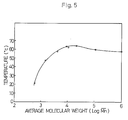
- Polyethylene glycol is in a liquid state at the normal temperature when the molecular weight is small ( M ⁇ 600 ), and as the molecular weight increases, polyethylene glycol is changed into a wax state and further proceeds into a solid state.
- the film is relatively brittle in case of the low molecular weight. But if the molecular weight is over 100,000, such a film becomes flexible.
- Polyethylene glycol having a molecular weight of 600 to 6,000 which has been used for melting snow or heating takes the most remarkable switching effect, but on the other hand, there has been a problem that this kind of polyethylene glycol has high crystallinity, resulting in that only brittle films will be produced.
- the inventors have succeeded in developing a plane heater whose flexibility is realized by using super high polymeric polyethylene glycol so as to change crystalline phase of polyethylene glycol, and which plane heater also performs desirable self-temperature control.
- any chemical substance containing a chain of -(CH2-CH2-O) n - as a unit structure is referred to as polyethylene glycol.
- a flexible self-temperature control plane heater has been accomplished by using polyethylene glycol having a high molecular weight. Further, a sheet of this self-temperature control plane heater having electrodes provided therein is enveloped with softened insulator means, and thus, a flexible plane heater has been developed.
- one object of the present invention is to provide a self-temperature control heater wherein super high polymeric polyethylene glycol whose molecular weight is 100,000 to 1,000,000 is dissolvedly mixed with carbon powder or mixed with it in the presence of a solvent.
- Further object of the present invention is to provide a self-temperature control heater wherein a mixture of super high polymeric polyethylene glycol whose molecular weight is 100,000 to 1,000,000 and polyethylene glycol whose molecular weight is 600 to 10,000 in case of melting snow or 2,000 to 10,000 in case of heating is dissolvedly mixed with carbon powder (CG) or mixed with it in the presence of a solvent.
- CG carbon powder
- the other object of the present invention is to provide a flexible plane heater comprising one of the above self-temperature control heaters which contains electrodes therein, and softened insulator means surrounding the outer periphery of the self-temperature control heater.
- a mixing ratio of carbon powder to polyethylene glycol is normally 5 to 45 weight %.
- softened insulator means rubber and softened plastics or these materials reinforced by fabric and nonwoven fabric are used.
- an aromatic solvent such as benzene, toluene or xylene is used.
- a characteristic curve a extends low-level to some extent relative to the conventional plane heater including polyethylene glycol whose molecular weight is about 2,000.
- the flexibility is extremely high, but the switching characteristic is substantially inferior. This can be such explained that, as the molecular weight becomes larger, the amorphous portion is increased, thereby resulting in the high flexibility, whereas decrease of the crystalline portion induces the inferior switching characteristic. It may be also explained by difference between crystals of the extended molecular chain and crystals of the lamella structure.
- Exothermic temperature of the plane heater was determined at intervals of a predetermined period of time, the result being illustrated with a curve b of Fig. 2.
- a characteristic curve plotting the temperature/resistance relation of the plane heater is illustrated as b in Fig. 3.
- the switching characteristic is a little inferior to that of the conventional less flexible plane heater including polyethylene glycol (#6000), but is far superior to that of the example 1 including polyethylene glycol whose molecular weight is 1,000,000, and there is no problem for practical use. Further, enough flexibility can be given to the plane heater.
- Polyester fabric 3 and a polyester film (25 ⁇ ) 4 were wrapped around this plane heater, and a coating layer of sol-state dry-type vinyl chloride 5 and a coating layer of sol-state dry-type silicone rubber 6 were further enveloped around them.
- Exothermic temperature of this plane heater after AC100V was applied to it was determined at intervals of a predetermined period of time, the result being illustrated with a curve c of Fig. 2.
- a characteristic curve plotting the temperature/resistance relation of the plane heater is illustrated as c in the graph.
- the plane heater in this case, it was intended to utilize a kind of polyethylene glycol exhibiting the desirable switching characteristic, and also to provide flexibility. It is clearly taught by the curve c of Fig. 3 that the resistance is increased into a value of four more digits to ensure the superior switching characteristic. Besides, it was observed that this plane heater had suitable flexibility.
- this plane heater With the top and bottom surfaces of this plane heater being further covered with styrene foam sheets each having a thickness of 100mm, AC100V was applied to the plane heater. Exothermic temperature of the plane heater was determined at intervals of a predetermined period of time, the result being illustrated with a curve d of Fig. 2. Referring to Fig. 3, a characteristic curve plotting the temperature/resistance relation of the plane heater is illustrated as d of the graph. In this case, the plane heater thus obtained can also effect the suitable switching characteristic and the desirable flexibility to the same extent as the example 3. Needless to say, polyethylene glycol having a low molecular weight causes slightly different exothermic temperatures between the examples 3 and 4.
- a flexible plane heater arranged for low temperature, which is useful for melting snow when mounted on the surface of a roof or the like, will now be described.
- the disk piece thus obtained was set in a thermostat maintaining 0°C , and the temperature was changed to determine a value of resistance between both electrodes. The result is shown in the left side of Fig. 3.
- the value of resistance abruptly begins to increase at about 10°C , continues increasing until about 18°C , and stops increasing at about 18°C to be stabilized as a substantial peak. The value continues to be in this condition until about 50°C . If the temperature is then made lower, the value of resistance becomes small again at 10°C or below, and the disk piece recovers the former state as a good conductor.
- a comparative result of a heater containing polyethylene glycol #600 and polyethylene #6000 (7:3) is illustrated in Table 1. Although the stabilized exothermic temperature is about 13.5°C , the value of resistance maintains a peak over a limited range of the temperature, and this heater effects neither flexibility nor shape recoverability.
- the heat-sensitive electrically resistant composite 1 according to this example was shaped to have a width of 80mm, a length of 300mm, and a thickness of 0.36mm, and enveloped as shown in Fig. 4 to form a flexible plane heater.
- this plane heater was set in a thermostat maintaining 0°C , and AC200V was applied between the electrodes 2. Then, exothermic temperature of the plane heater was determined at intervals of a predetermined period of time. The temperature change is shown with a curve in the lower side of Fig. 2.
- the exothermic temperature reaches 10.3°C after 30 minutes, and from this moment, the plane heater continues to have this temperature, thereby proving that the plane heater of this example includes the desirable switching characteristic.
- a flexible plane heater can be obtained by using polyethylene glycol of a high molecular weight which exhibits flexibility. All properties of the plane heater samples which were ascertained by the results of experiments are shown in Table 1. However, it is also understood from the embodiments that, if the molecular weight is in an order of 1,000,000 or more, the switching characteristic of the compound in the graphite-polyethylene-glycol system is relatively inferior. Further, if a plane heater contains polyethylene glycol having a molecular weight of not more than 600, the switching temperature is too low, and such a plane heater is inadequate for practical use, as clearly seen from the above embodiments and comparative examples of Table 1.
- the switching characteristic is prevented from becoming unfavorable, and also, the flexibility is increased.
- a plane heater including one kind of polyethylene glycol having a high molecular weight is more flexible than a plane heater including a mixture of the same and polyethylene glycol #4000 or #6000.
- a plane heater including two kinds of polyethylene glycol such as the examples 3 and 4 can provide sufficient flexibility for practical use. According to this method, the plane heater can have not only a desired exothermic temperature but also favorable flexibility.
- the present invention provides the composition, i.e., the mixture of polyethylene glycol having a molecular weight of 100,000 to 1,000,000 and polyethylene glycol having a molecular weight of 600 to 10,000.
- the composition i.e., the mixture of polyethylene glycol having a molecular weight of 100,000 to 1,000,000 and polyethylene glycol having a molecular weight of 600 to 10,000.
Landscapes
- Engineering & Computer Science (AREA)
- Microelectronics & Electronic Packaging (AREA)
- Chemical & Material Sciences (AREA)
- Dispersion Chemistry (AREA)
- Ceramic Engineering (AREA)
- Physics & Mathematics (AREA)
- Electromagnetism (AREA)
- Resistance Heating (AREA)
- Surface Heating Bodies (AREA)
- Compositions Of Macromolecular Compounds (AREA)
Priority Applications (1)
| Application Number | Priority Date | Filing Date | Title |
|---|---|---|---|
| AT8989123772T ATE105101T1 (de) | 1988-12-24 | 1989-12-22 | Verfahren zur herstellung eines selbstregelnden, biegsamen und planen heizelements. |
Applications Claiming Priority (2)
| Application Number | Priority Date | Filing Date | Title |
|---|---|---|---|
| JP63326485A JP2719946B2 (ja) | 1988-12-24 | 1988-12-24 | 自己温度調節発熱体及びそれを用いたフレキシブル面状発熱体 |
| JP326485/88 | 1988-12-24 |
Publications (2)
| Publication Number | Publication Date |
|---|---|
| EP0376195A1 true EP0376195A1 (fr) | 1990-07-04 |
| EP0376195B1 EP0376195B1 (fr) | 1994-04-27 |
Family
ID=18188346
Family Applications (1)
| Application Number | Title | Priority Date | Filing Date |
|---|---|---|---|
| EP89123772A Expired - Lifetime EP0376195B1 (fr) | 1988-12-24 | 1989-12-22 | Méthode de fabrication d'un élément chauffant plat flexible à autorégulation |
Country Status (5)
| Country | Link |
|---|---|
| US (1) | US5068518A (fr) |
| EP (1) | EP0376195B1 (fr) |
| JP (1) | JP2719946B2 (fr) |
| AT (1) | ATE105101T1 (fr) |
| DE (1) | DE68914966T2 (fr) |
Cited By (3)
| Publication number | Priority date | Publication date | Assignee | Title |
|---|---|---|---|---|
| EP0409393A3 (en) * | 1989-07-17 | 1992-01-15 | Metal Manufactures Limited | Heating mats |
| EP0692924A1 (fr) * | 1994-07-15 | 1996-01-17 | Nihon Engineer Mates Co. Ltd. | Panneau chauffant |
| CH717858A1 (fr) * | 2020-09-15 | 2022-03-15 | Graphenaton Tech Sa | Méthode pour diffuser de la chaleur et ou du froid pour un arbre fruitier. |
Families Citing this family (26)
| Publication number | Priority date | Publication date | Assignee | Title |
|---|---|---|---|---|
| US5389184A (en) * | 1990-12-17 | 1995-02-14 | United Technologies Corporation | Heating means for thermoplastic bonding |
| US5835679A (en) | 1994-12-29 | 1998-11-10 | Energy Converters, Inc. | Polymeric immersion heating element with skeletal support and optional heat transfer fins |
| SE505921C2 (sv) * | 1996-01-17 | 1997-10-20 | Toecksfors Verkstads Ab | System och förfarande för tillverkning av en elektrisk uppvärmningsanordning |
| US6057530A (en) * | 1996-08-29 | 2000-05-02 | Thermosoft International Corporation | Fabric heating element and method of manufacture |
| US5824996A (en) * | 1997-05-13 | 1998-10-20 | Thermosoft International Corp | Electroconductive textile heating element and method of manufacture |
| US5982271A (en) * | 1996-11-28 | 1999-11-09 | Tdk Corporation | Organic positive temperature coefficient thermistor |
| US6229123B1 (en) | 1998-09-25 | 2001-05-08 | Thermosoft International Corporation | Soft electrical textile heater and method of assembly |
| US6452138B1 (en) | 1998-09-25 | 2002-09-17 | Thermosoft International Corporation | Multi-conductor soft heating element |
| US6713733B2 (en) | 1999-05-11 | 2004-03-30 | Thermosoft International Corporation | Textile heater with continuous temperature sensing and hot spot detection |
| US6263158B1 (en) | 1999-05-11 | 2001-07-17 | Watlow Polymer Technologies | Fibrous supported polymer encapsulated electrical component |
| US6403935B2 (en) | 1999-05-11 | 2002-06-11 | Thermosoft International Corporation | Soft heating element and method of its electrical termination |
| US6563094B2 (en) | 1999-05-11 | 2003-05-13 | Thermosoft International Corporation | Soft electrical heater with continuous temperature sensing |
| US6392208B1 (en) | 1999-08-06 | 2002-05-21 | Watlow Polymer Technologies | Electrofusing of thermoplastic heating elements and elements made thereby |
| US6415501B1 (en) | 1999-10-13 | 2002-07-09 | John W. Schlesselman | Heating element containing sewn resistance material |
| US6392206B1 (en) | 2000-04-07 | 2002-05-21 | Waltow Polymer Technologies | Modular heat exchanger |
| US6433317B1 (en) | 2000-04-07 | 2002-08-13 | Watlow Polymer Technologies | Molded assembly with heating element captured therein |
| US6519835B1 (en) | 2000-08-18 | 2003-02-18 | Watlow Polymer Technologies | Method of formable thermoplastic laminate heated element assembly |
| US6539171B2 (en) | 2001-01-08 | 2003-03-25 | Watlow Polymer Technologies | Flexible spirally shaped heating element |
| US6958463B1 (en) | 2004-04-23 | 2005-10-25 | Thermosoft International Corporation | Heater with simultaneous hot spot and mechanical intrusion protection |
| JP4967278B2 (ja) * | 2005-08-22 | 2012-07-04 | パナソニック株式会社 | 高分子抵抗体インク |
| US20140069540A1 (en) * | 2012-09-11 | 2014-03-13 | Jean Renee Chesnais | Wrappable sleeve with heating elements and methods of use and construction thereof |
| US10077372B2 (en) | 2014-06-12 | 2018-09-18 | Lms Consulting Group, Llc | Electrically conductive PTC screen printable ink with double switching temperatures and method of making the same |
| US10373745B2 (en) | 2014-06-12 | 2019-08-06 | LMS Consulting Group | Electrically conductive PTC ink with double switching temperatures and applications thereof in flexible double-switching heaters |
| US11332632B2 (en) | 2016-02-24 | 2022-05-17 | Lms Consulting Group, Llc | Thermal substrate with high-resistance magnification and positive temperature coefficient ink |
| EP3420041A4 (fr) * | 2016-02-24 | 2019-11-13 | LMS Consulting Group | Encre ctp électroconductrice à températures de double commutation et ses applications dans des dispositifs de chauffage souples à double commutation |
| US10822512B2 (en) | 2016-02-24 | 2020-11-03 | LMS Consulting Group | Thermal substrate with high-resistance magnification and positive temperature coefficient |
Citations (1)
| Publication number | Priority date | Publication date | Assignee | Title |
|---|---|---|---|---|
| US4780247A (en) * | 1985-09-18 | 1988-10-25 | Shigeyuki Yasuda | Method for controlling steady state exothermic temperature in the use of heat sensitive-electrically resistant composites |
Family Cites Families (1)
| Publication number | Priority date | Publication date | Assignee | Title |
|---|---|---|---|---|
| US4629584A (en) * | 1984-09-11 | 1986-12-16 | Shigeyuki Yasuda | Composition of heat-sensitive electrosensitive substances and a panel heater made therefrom |
-
1988
- 1988-12-24 JP JP63326485A patent/JP2719946B2/ja not_active Expired - Fee Related
-
1989
- 1989-12-22 US US07/455,613 patent/US5068518A/en not_active Expired - Fee Related
- 1989-12-22 AT AT8989123772T patent/ATE105101T1/de not_active IP Right Cessation
- 1989-12-22 DE DE68914966T patent/DE68914966T2/de not_active Expired - Fee Related
- 1989-12-22 EP EP89123772A patent/EP0376195B1/fr not_active Expired - Lifetime
Patent Citations (1)
| Publication number | Priority date | Publication date | Assignee | Title |
|---|---|---|---|---|
| US4780247A (en) * | 1985-09-18 | 1988-10-25 | Shigeyuki Yasuda | Method for controlling steady state exothermic temperature in the use of heat sensitive-electrically resistant composites |
Cited By (3)
| Publication number | Priority date | Publication date | Assignee | Title |
|---|---|---|---|---|
| EP0409393A3 (en) * | 1989-07-17 | 1992-01-15 | Metal Manufactures Limited | Heating mats |
| EP0692924A1 (fr) * | 1994-07-15 | 1996-01-17 | Nihon Engineer Mates Co. Ltd. | Panneau chauffant |
| CH717858A1 (fr) * | 2020-09-15 | 2022-03-15 | Graphenaton Tech Sa | Méthode pour diffuser de la chaleur et ou du froid pour un arbre fruitier. |
Also Published As
| Publication number | Publication date |
|---|---|
| EP0376195B1 (fr) | 1994-04-27 |
| DE68914966T2 (de) | 1994-10-13 |
| JPH02172179A (ja) | 1990-07-03 |
| US5068518A (en) | 1991-11-26 |
| JP2719946B2 (ja) | 1998-02-25 |
| ATE105101T1 (de) | 1994-05-15 |
| DE68914966D1 (de) | 1994-06-01 |
Similar Documents
| Publication | Publication Date | Title |
|---|---|---|
| EP0376195A1 (fr) | Méthode de fabrication d'un élément chauffant plat flexible à autorégulation | |
| EP2080414B1 (fr) | Element chauffant | |
| US4304987A (en) | Electrical devices comprising conductive polymer compositions | |
| US5580493A (en) | Conductive polymer composition and device | |
| EP0815569B1 (fr) | Composition polymere conductrice et dispositif associe | |
| EP0038718B1 (fr) | Compositions polymères conductrices contenant une matière de remplissage | |
| US3412358A (en) | Self-regulating heating element | |
| EP0417204B1 (fr) | Composition ctp polymere et son dispositif electrique | |
| EP0140893B1 (fr) | Dispositif de chauffage autoregulateur et materiau de resistance | |
| JP3896232B2 (ja) | 有機質正特性サーミスタおよびその製造方法 | |
| JP3564758B2 (ja) | ptc組成物 | |
| CA1337012C (fr) | Composition chauffante a limitation spontanee de la temperature | |
| KR960032513A (ko) | 정온도계수 소자 및 이의 제조방법 | |
| CA2100051C (fr) | Amelioration dans la methode de fabrication d'un appareil de chauffage autonome appareil de chauffage autonome ameliore | |
| EP0372552B1 (fr) | Elément composé sensible à la température et générateur de chaleur à face le comprenant | |
| CA2018934A1 (fr) | Compose souple, a temperature auto-regulee, pour systeme de chauffage | |
| JPH11144848A (ja) | Ptc発熱体およびその製造方法 | |
| CA1133085A (fr) | Polymeres conducteurs pour appareils de chauffage a l'electricite | |
| KR960022851A (ko) | 고분자 ptc(정온도계수)의 조성물 | |
| JP2000109615A (ja) | 正の温度係数特性を有する導電性高分子組成物 | |
| JP3408623B2 (ja) | 導電性シートの成形法 | |
| CA1287428C (fr) | Composition de substances thermosensibles et electrosensibles, et panneau chauffant fait desdites substances | |
| JPH07335378A (ja) | Ptc発熱体の製造法 | |
| JP3438461B2 (ja) | 導電性ポリマおよびこれを用いた過電流保護素子 | |
| CA1176452A (fr) | Compositions de polymere conducteur a charge |
Legal Events
| Date | Code | Title | Description |
|---|---|---|---|
| PUAI | Public reference made under article 153(3) epc to a published international application that has entered the european phase |
Free format text: ORIGINAL CODE: 0009012 |
|
| AK | Designated contracting states |
Kind code of ref document: A1 Designated state(s): AT BE CH DE ES FR GB GR IT LI LU NL SE |
|
| 17P | Request for examination filed |
Effective date: 19900719 |
|
| 17Q | First examination report despatched |
Effective date: 19920806 |
|
| GRAA | (expected) grant |
Free format text: ORIGINAL CODE: 0009210 |
|
| AK | Designated contracting states |
Kind code of ref document: B1 Designated state(s): AT BE CH DE ES FR GB GR IT LI LU NL SE |
|
| PG25 | Lapsed in a contracting state [announced via postgrant information from national office to epo] |
Ref country code: IT Free format text: LAPSE BECAUSE OF FAILURE TO SUBMIT A TRANSLATION OF THE DESCRIPTION OR TO PAY THE FEE WITHIN THE PRESCRIBED TIME-LIMIT;WARNING: LAPSES OF ITALIAN PATENTS WITH EFFECTIVE DATE BEFORE 2007 MAY HAVE OCCURRED AT ANY TIME BEFORE 2007. THE CORRECT EFFECTIVE DATE MAY BE DIFFERENT FROM THE ONE RECORDED. Effective date: 19940427 Ref country code: BE Effective date: 19940427 Ref country code: AT Effective date: 19940427 Ref country code: SE Free format text: THE PATENT HAS BEEN ANNULLED BY A DECISION OF A NATIONAL AUTHORITY Effective date: 19940427 Ref country code: LI Effective date: 19940427 Ref country code: GR Free format text: LAPSE BECAUSE OF FAILURE TO SUBMIT A TRANSLATION OF THE DESCRIPTION OR TO PAY THE FEE WITHIN THE PRESCRIBED TIME-LIMIT Effective date: 19940427 Ref country code: CH Effective date: 19940427 Ref country code: ES Free format text: THE PATENT HAS BEEN ANNULLED BY A DECISION OF A NATIONAL AUTHORITY Effective date: 19940427 |
|
| REF | Corresponds to: |
Ref document number: 105101 Country of ref document: AT Date of ref document: 19940515 Kind code of ref document: T |
|
| REF | Corresponds to: |
Ref document number: 68914966 Country of ref document: DE Date of ref document: 19940601 |
|
| REG | Reference to a national code |
Ref country code: CH Ref legal event code: PL |
|
| ET | Fr: translation filed | ||
| PG25 | Lapsed in a contracting state [announced via postgrant information from national office to epo] |
Ref country code: LU Free format text: LAPSE BECAUSE OF NON-PAYMENT OF DUE FEES Effective date: 19941231 |
|
| PLBE | No opposition filed within time limit |
Free format text: ORIGINAL CODE: 0009261 |
|
| STAA | Information on the status of an ep patent application or granted ep patent |
Free format text: STATUS: NO OPPOSITION FILED WITHIN TIME LIMIT |
|
| 26N | No opposition filed | ||
| PGFP | Annual fee paid to national office [announced via postgrant information from national office to epo] |
Ref country code: FR Payment date: 19981030 Year of fee payment: 10 |
|
| PGFP | Annual fee paid to national office [announced via postgrant information from national office to epo] |
Ref country code: GB Payment date: 19981224 Year of fee payment: 10 |
|
| PGFP | Annual fee paid to national office [announced via postgrant information from national office to epo] |
Ref country code: NL Payment date: 19981231 Year of fee payment: 10 |
|
| PGFP | Annual fee paid to national office [announced via postgrant information from national office to epo] |
Ref country code: DE Payment date: 19990225 Year of fee payment: 10 |
|
| PG25 | Lapsed in a contracting state [announced via postgrant information from national office to epo] |
Ref country code: GB Free format text: LAPSE BECAUSE OF NON-PAYMENT OF DUE FEES Effective date: 19991222 |
|
| PG25 | Lapsed in a contracting state [announced via postgrant information from national office to epo] |
Ref country code: NL Free format text: LAPSE BECAUSE OF NON-PAYMENT OF DUE FEES Effective date: 20000701 |
|
| GBPC | Gb: european patent ceased through non-payment of renewal fee |
Effective date: 19991222 |
|
| PG25 | Lapsed in a contracting state [announced via postgrant information from national office to epo] |
Ref country code: FR Free format text: LAPSE BECAUSE OF NON-PAYMENT OF DUE FEES Effective date: 20000831 |
|
| NLV4 | Nl: lapsed or anulled due to non-payment of the annual fee |
Effective date: 20000701 |
|
| PG25 | Lapsed in a contracting state [announced via postgrant information from national office to epo] |
Ref country code: DE Free format text: LAPSE BECAUSE OF NON-PAYMENT OF DUE FEES Effective date: 20001003 |
|
| REG | Reference to a national code |
Ref country code: FR Ref legal event code: ST |