EP0376592B1 - Mousse de polyimide - Google Patents
Mousse de polyimide Download PDFInfo
- Publication number
- EP0376592B1 EP0376592B1 EP89313301A EP89313301A EP0376592B1 EP 0376592 B1 EP0376592 B1 EP 0376592B1 EP 89313301 A EP89313301 A EP 89313301A EP 89313301 A EP89313301 A EP 89313301A EP 0376592 B1 EP0376592 B1 EP 0376592B1
- Authority
- EP
- European Patent Office
- Prior art keywords
- radical
- foam
- thermoplastic polyimide
- polyimide
- foaming agent
- Prior art date
- Legal status (The legal status is an assumption and is not a legal conclusion. Google has not performed a legal analysis and makes no representation as to the accuracy of the status listed.)
- Expired - Lifetime
Links
Classifications
-
- C—CHEMISTRY; METALLURGY
- C08—ORGANIC MACROMOLECULAR COMPOUNDS; THEIR PREPARATION OR CHEMICAL WORKING-UP; COMPOSITIONS BASED THEREON
- C08G—MACROMOLECULAR COMPOUNDS OBTAINED OTHERWISE THAN BY REACTIONS ONLY INVOLVING UNSATURATED CARBON-TO-CARBON BONDS
- C08G18/00—Polymeric products of isocyanates or isothiocyanates
- C08G18/06—Polymeric products of isocyanates or isothiocyanates with compounds having active hydrogen
-
- C—CHEMISTRY; METALLURGY
- C08—ORGANIC MACROMOLECULAR COMPOUNDS; THEIR PREPARATION OR CHEMICAL WORKING-UP; COMPOSITIONS BASED THEREON
- C08G—MACROMOLECULAR COMPOUNDS OBTAINED OTHERWISE THAN BY REACTIONS ONLY INVOLVING UNSATURATED CARBON-TO-CARBON BONDS
- C08G73/00—Macromolecular compounds obtained by reactions forming a linkage containing nitrogen with or without oxygen or carbon in the main chain of the macromolecule, not provided for in groups C08G12/00 - C08G71/00
- C08G73/06—Polycondensates having nitrogen-containing heterocyclic rings in the main chain of the macromolecule
- C08G73/10—Polyimides; Polyester-imides; Polyamide-imides; Polyamide acids or similar polyimide precursors
- C08G73/1046—Polyimides containing oxygen in the form of ether bonds in the main chain
- C08G73/105—Polyimides containing oxygen in the form of ether bonds in the main chain with oxygen only in the diamino moiety
-
- C—CHEMISTRY; METALLURGY
- C08—ORGANIC MACROMOLECULAR COMPOUNDS; THEIR PREPARATION OR CHEMICAL WORKING-UP; COMPOSITIONS BASED THEREON
- C08G—MACROMOLECULAR COMPOUNDS OBTAINED OTHERWISE THAN BY REACTIONS ONLY INVOLVING UNSATURATED CARBON-TO-CARBON BONDS
- C08G73/00—Macromolecular compounds obtained by reactions forming a linkage containing nitrogen with or without oxygen or carbon in the main chain of the macromolecule, not provided for in groups C08G12/00 - C08G71/00
- C08G73/06—Polycondensates having nitrogen-containing heterocyclic rings in the main chain of the macromolecule
- C08G73/10—Polyimides; Polyester-imides; Polyamide-imides; Polyamide acids or similar polyimide precursors
- C08G73/1067—Wholly aromatic polyimides, i.e. having both tetracarboxylic and diamino moieties aromatically bound
- C08G73/1071—Wholly aromatic polyimides containing oxygen in the form of ether bonds in the main chain
Definitions
- the present invention relates to a thermoplastic polyimide foam which has excellent resistance to heat, flame and abrasion, and also has good fabrication qualities.
- Foams which have conventionally been developed by use of macromolecular materials are roughly divided into the following two classes.
- the former foams are excellent in abrasion resistance and fabrication quality and hence broadly applied to automobiles, buildings or electronic and electric fields by utilising substantial characteristics such as heat insulation property and light-weight property.
- the foams are insufficient in thermal resistance and particularly in flame resistance.
- the foams drastically deform at high temperatures such as above 150°C and performance of foam is eliminated.
- flame resistance is provided by addition of a flame retarder, the foams immediately fuse and drip from the portion in contact with the flame. Thereafter adjacent portions of the foams successively melt and finally most of the foam disappears.
- the foams cannot be applied to fields such as buildings and aircraft parts where flame resistance is required.
- thermoplastic resin for example, polyurethane resin foam
- foams prepared from phenol resin, urea resin and melamine resin have excellent flame resistance and do not melt in contact with the flame.
- these foams are poor in abrasion resistance, liable to crack and impossible to fabricate.
- Polyimide resin foams have also been developed.
- One representative polyimide foam is based upon a prepolymer of International Harvester Co. which is prepared by esterifying an aromatic carboxylic acid dianhydride with an alcohol and adding a diamine whilst another is described in GB-A-1 198 484.
- Such foams have outstanding thermal resistance and do not deform particularly at temperatures of 200°C. Flame resistance is also excellent because the foam does not melt in contact with the flame. On the other hand, abrasion resistance of the foams is insufficient and fabrication is impossible. Once the foams have been made, they cannot be used for various applications by conducting fabrication and hence there have been restrictions imposed upon their use.
- Another typical polyimide foam is based upon a polyetherimide (Another typical polyimide foam is based upon a polyetherimide (ULTEM 1000TM etc., products of General Electric Co.) which is prepared from a tetracarboxylic acid dianhydride having ether bonds in the molecule.
- ULTEM 1000TM etc. products of General Electric Co.
- Such a foam has improved flame resistance, abrasion resistance and fabrication quality. However, its thermal resistance is still unsatisfactory.
- EP-A-269 319 describes a thermoplastic polyimide resin which is capable of extrusion or injection moulding and is excellent as a high temperature adhesive.
- thermoplastic polyimide foam having an apparent density (measured as defined herein) of from 0.02 to 0.2 g/cc, an average cell diameter (measured as defined herein) of from 0.1 to 1 mm and a closed cell content (measured as defined herein) of 50% or more of the cells, and consisting essentially of recurring units of the formula : in which X represents a bond, a divalent hydrocarbon radical having from 1 to 10 carbon atoms, a hexafluorinated isopropylidene radical, a carbonyl radical, a thio radical, or a sulphonyl radical, and R represents an aliphatic radical having two or more carbon atoms, a cycloaliphatic radical, a monoaromatic radical, a condensed polyaromatic radical, or a non-condensed polyaromatic radical, wherein the aromatic radicals are connected by a bond or a linking group.
- thermoplastic polyimide foam having an apparent density (measured as defined herein) of from 0.02 to 0.2 g/cc, an average cell diameter (measured as defined herein) of from 0.1 to 1 mm and a closed cell content (measured as defined herein) of 50% or more of the cells, comprising extrusion foaming of a thermoplastic polyimide consisting essentially of recurring units represented by the formula: in which X represents a bond, a divalent hydrocarbon radical having from 1 to 10 carbon atoms, a hexafluorinated isopropylidene radical, a carbonyl radical, a thio radical, or a sulphonyl radical, and R represents an aliphatic radical having two or more carbon atoms, a cycloaliphatic radical, a monoaromatic radical, a condensed polyaromatic radical, or a non-condensed polyaromatic radical, wherein the aromatic radicals
- the monoaromatic or condensed polyaromatic radical represented by R is preferably
- the non condensed polyaromatic radical represented by R is preferably
- the thermoplastic polyimides of the present invention can be obtained by reacting one or more etherdiamines represented by the formula: in which X is as defined above, with one or more of tetracarboxylic acid dianhydrides represented by the formula: in which R is as defined above.
- the polyimide is characterised in that a diamine having ether linkages in the molecule is used for a raw material.
- a diamine having ether linkages in the molecule is used for a raw material.
- it can be readily prepared by process such as disclosed in United States Patent Specification No. 4,847,349. Any thermoplastic polyimide described in this patent can be used in the present invention.
- a particularly preferred polyimide for use in the production of thermoplastic polyimide of this invention can be prepared by using as the etherdiamine one or more of compounds selected from 4,4'-bis[4-(3-aminophenoxy)phenyl] sulphide, 4,4'-bis[4-(3-aminophenoxy)phenyl] sulphone, 4,4'-bis(3-aminophenoxy)benzophenone, 4,4'-bis(3-aminophenoxy)biphenyl, 2,2-bis[4-(3-aminophenoxy)phenyl]propane and 2,2-bis[4-(3-aminophenoxy)phenyl]-1,1,1-3,3,3-hexafluoropropane, and as the tetracarboxylic acid dianhydride one or more of compounds selected from pyromellitic dianhydride, 3,3',4,4'-biphenyltetracarboxylic dianhydride, 3,3',4,
- the inherent viscosity of the polyimide is preferably from 0.35 to 0.65 dl/g, and more preferably from 0.40 to 0.60 dl/g, as measured at 35°C in a solution containing 0.5 g of the polyimide in 100 ml of a solvent mixture composed of p-chlorophenol/phenol in a ratio of 90/10 by weight.
- thermoforming property When the inherent viscosity of the thermoplastic polyimide is less that 0.35 dl/g, the thermoforming property extremely decreases and closed cell content also lowers. On the other hand, when the inherent viscosity exceeds 0.65 dl/g, extrusion characteristics are reduced and one cannot maintain economical productivity.
- the apparent density of the foam prepared from the above thermoplastic polyimide is in the range of 0.02 to 0.2 g/cc.
- An apparent density exceeding 0.2 g/cc gives adverse effect on the economical advantage due to weight saving and further impairs several merits such as shock-absorbing properties, heat insulation property and sound insulating characteristics of the foam.
- an apparent density less than 0.02 g/cc lowers the mechanical strengths of the foam and also leads to an unfavourable decrease in flame resistance, abrasion resistance or fabrication quality.
- the apparent density is measured by the following method. A foam sample is previously weighed. The foam sample is completely submerged into a prescribed volume of water placed in a measuring cylinder and volume of the foam is measured. Then the apparent density of the foam is calculated by dividing the weight with the volume.
- the average cell diameter and the closed cell content are calculated by the following methods.
- Average Cell Diameter A cross-sectional photograph in a thickness direction of the foam is used. 10 each of large, medium and small cells are selected and their diameters measured. Average cell diameter is the mean value of these diameters.
- a foam sample having prescribed dimensions 40 x 40 mm is weighed. The sample is placed under water surface and the pressure is reduced to 400 mmHg. The foam is allowed to stand in this state for a minute and then taken out of the water and weighed. Amount of the water (V W ) absorbed into the foam is calculated from the weights of the foam before and after immersion into the water.
- the closed cell content is calculated by the following formula: wherein V F is volume of the foam.
- thermoplastic polyimide foam of this invention can be prepared by employing a foaming extruder for use in the processing of conventional thermoplastic resins.
- Exemplary foaming agent which can be used in this invention includes, for example, a sublimable substance having a boiling point exceeding 200°C such as phthalic anhydride, a chemical foaming agent which decomposes in the vicinity of 200°C such as trihydrazinotriazine, barium azodicarboxylate or dinitrosopentamethylenetetramine, a low boiling point organic compound such as dichlorotrifluoroethane, monochlorotetrafluoroethane, dichlorofluoromethane, monochlorodifluoromethane or acetone, or a hydrate such as oxalic acid dihydrate which dissociates water at a temperature above 200°C.
- the preferred foaming agent is a sublimable substance.
- the amount of the foaming agent used is selected on the basis of desired apparent density of the foam to be obtained.
- the amount can be from 0.025 to 0.3 mole of the sublimable substance per 100 g of the thermoplastic polyimide, from 1 to 10 parts by weight of the chemical foaming agent per 100 parts by weight of the polyimide, from 0.05 to 0.5 mole of the low boiling point organic compound per 100 g of the polyimide, and in the case of the hydrate, from 0.025 to 0.3 mole of dissociated water per 100 g of the polyimide.
- the polyimide foam of this invention can be produced through usual foaming processes by adjusting the amount of the foaming agent respectively in the above range.
- the agent and the thermoplastic polyimide are simultaneously fed from the hopper of an extruder.
- Cylinder temperature of the extruder is controlled in the range of 360 to 440°C, and the polyimide and the foaming agent are uniformly kneaded in the cylinder.
- the temperature of the kneaded mass is gradually decreased as it moves forward towards the point of extruder.
- the temperature of the die is controlled in the range of 250 to 370°C.
- the kneaded mass is delivered through the die into the atmosphere and expands into the foam.
- the foam extruded from the die slit can also form a micro cell layer on the surface by cooling with air or a sizing die to a temperature range of 150 to 250°C.
- the foaming agent is liquid
- the foaming agent is injected into the melted thermoplastic polyimide midway of the extruder and then the foam can be produced by the same procedures as mentioned above.
- the size of cells can be controlled by adding an inorganic nucleating agent such as talc, silica gel or a surface-active agent.
- an inorganic nucleating agent such as talc, silica gel or a surface-active agent.
- a foam having an average cell diameter of 0.1 to 1 mm can be preferably prepared by using the above nucleating agent in an amount from 0.1 to 3 parts by weight per 100 parts by weight of the polyimide.
- the foaming agent is a chemical foaming agent, it is preferred to prepare the foam by using from 0.1 to 1 part by weight of the above nucleating agent per 100 parts by weight of the polyimide.
- the closed cell content is suitably controlled by the temperature of the kneaded mass in the extruder and cooling conditions after delivery from the die slit.
- the closed cell content is maintained 50% or more.
- thermoplastic polyimide foam which is excellent in the resistance to heat, flame and abrasion in addition to chemical resistance and thermal insulation and also outstanding in shaping properties and fabrication quality such as lamination, adhesion, coating and other surface treatments.
- Polyimide powder obtained by reacting 4,4'-bis(3-aminophenoxy)biphenyl with pyromellitic dianhydride and having an inherent viscosity of 0.45 dl/g was extruded at a cylinder temperature of 400°C and cut into pellets.
- the inherent viscosity of polyimide is measured at 35°C in a solution containing 0.5 g of the polyimide in 100 ml of a solvent mixture composed of p-chlorophenol/phenol in a ratio of 90/10 by weight.
- a mxiture containing 0.05 mole of phthalic anhdyride per 100 g of the polyimide pellets and 0.7 part by weight of talc per 100 parts by weight of the polyimide pellets was charged to the hopper of an extruder having a diameter of 30 mm. Cylinder temperature of the extruder was maintained from 380 to 410°C. The mixture was melt-kneaded in the cylinder and the temperature of the kneaded mass was gradually lowered during forward movement toward the point of the extruder. The temperature of a die fixed on the point was controlled to 355°C. A pressure gauge mounted on the inlet of the die indicated resin pressure of 110 kg/cm2.
- the kneaded mass was delivered from the die into a sizing die jointly with pressure reduction and thus a foam was obtained.
- the foam had a thickness of 5 mm, width of 100 mm, apparent density of 0.09 g/cc, average cell diameter of 0.5 mm and a closed cell content of 78%.
- a specimen having dimensions of 25 mm x 120 mm was cut out of the foam obtained above.
- the sample was horizontally placed on a pair of supporting points having a span of 100 mm.
- a load of 100 g was applied on the sample at the centre of the span.
- the specimen was allowed to stand in a thermostatic oven at 200°C for an hour. As a result, almost no deformation was observed and excellent thermal resistance of the foam was proved.
- a foam specimen having dimensions of 25 mm x 120 mm was held horizontally and brought into contact with a flame of burner for period of 10 seconds, neither combustion nor dripping was found.
- taber abrasion test was carried out in accordance with JIS K-7204 by using a specimen die-cut into a disc of 100 mm in diameter. The test was conducted under load of 250 g by using a truck wheel CS 10. Abrasion loss of the specimen after 1000 continuous rotations was 95 mg.
- the foam was heated in an atmosphere of 380°C for a minute and shaped in a figure U type mould having a clearance of 4 mm between male and female moulds. A good shape without cracks on the surface could be obtained by setting the mould temperature at 180°C.
- Polyimide powder obtained by reacting bis[4-(3-aminophenoxy)phenyl] sulphide with pyromellitic dianhydride and having an inherent viscosity of 0.46 dl/g was pelletized by the same procedures as carried out in Example 1.
- Example 2 A mixture containing 0.03 mole of phthalic anhydride per 100 g of the polyimide pellets and 0.3 part by weight of talc per 100 parts by weight of the polyimide pellets was extruded by the same procedures as conducted in Example 1.
- the foam thus obtained had an apparent density of 0.15 g/cc, average cell diameter of 0.8 mm and a closed cell content of 75%.
- a foam was obtained by carrying out the same procedures as conducted in Example 1 except that 0.1 mole of phthalic anhydride was mixed.
- the foam obtained had an apparent density of 0.018 g/cc, average cell diameter of 0.5 mm and a closed cell content of 66%.
- Abrasion loss of the foam was a large value corresponding to 2500 mg after 1000 continuous rotations in Taber abrasion test.
- base materials are liable to destruct on the interface and hence sufficient strength of the laminated board could not be obtained.
- a foam was extruded by carrying out the same procedures as conducted in Example 1 except that the temperature of the die fixed on the point of the extruder was set at 410°C.
- the foam thus obtained had an apparent density of 0.11 g/cc and a closed cell content of 45%.
- Thermoforming of the foam was carried out by the same procedures as conducted in Example 1. However, the foam was broken at the corner portion of the figure U.
- a mixture containing 100 parts by weight of the polyimide used in Example 1 and 0.7 parts by weight of talc was charged to the hopper of an extruder of 30 mm in diameter. Cylinder temperature of the extruder was set from 380 to 410°C and the polyimide was melted. Acetone was injected in the midway of the extruder in a proportion of 0.2 mole per 100 g of the polyimide and mixed with the fused polyimide. Temperature of the resulting mixture was gradually decreased during forward movement toward the point of the extruder. The temperature of a die fixed on the point was set at 320°C. The mixture was delivered from the die into a sizing die jointly with pressure reduction.
- the foam obtained had a thickness of 5 mm, width of 100 mm, apparent density of 0.05 g/cc, average cell diameter of 0.8 mm and closed cell content of 62%.
- Example 1 No deformation was found at 200°C in the thermal resistance test illustrated in Example 1. No dripping was observed in the combustion test. Abrasion loss was 537 mg in Taber abrasion test. Heat shaping was carried out by the same procedures as conducted in Example 1, and a shaped article obtained was good.
- a foam was obtained by carrying out the same procedures as conducted in Example 1 except that the polyether imide was prepared from 2,2-bis[4-(3,4-dicarboxyphenoxy)phenyl]propane dianhydride and m-phenylenediamine, e.g. as shown in United States Patent Specification No. 4 639 343.
- the foam obtained had a thickness of 5 mm, width of 100 mm, apparent density of 0.09 g/cc, average cell diameter of 0.5 mm and closed cell content of 85%.
- Example 1 A specimen of 25 mm x 120 mm in dimensions was cut out of the foam and the thermal resistance test was carried out as conducted in Example 1. The specimen sagged at the centre of the span.
- a foam was obtained by carrying out the same procedures as conducted in Example 1 except that trihydrazinotriazine was added in place of phthalic anhydride in an amount of 1.8 parts by weight per 100 parts by weight of the polyimide.
- the foam obtained had an apparent density of 0.15 g/cc, average cell diameter of 0.3 mm and a closed cell content of 86%.
- Example 2 No deformation was observed in the thermal resistance test illustrated in Example 1. No dripping was found in the combustion test. Abrasion loss was 57 mg in Taber abrasion test. When the foam was laminated with an epoxy base adhesive, the laminated board had a sufficient strength without destruction of the base materials on the interface.
- the foam was heated in an atmosphere of 380°C for a minute and shaped in a figure U type mould having a clearance of 4 mm between male and female moulds. A good shape without cracks on the surface could be obtained by setting the mould temperature at 180°C.
Landscapes
- Chemical & Material Sciences (AREA)
- Health & Medical Sciences (AREA)
- Chemical Kinetics & Catalysis (AREA)
- Medicinal Chemistry (AREA)
- Polymers & Plastics (AREA)
- Organic Chemistry (AREA)
- Manufacture Of Porous Articles, And Recovery And Treatment Of Waste Products (AREA)
- Macromolecular Compounds Obtained By Forming Nitrogen-Containing Linkages In General (AREA)
Claims (15)
- Une mousse de polyimide thermoplastique ayant une masse volumique apparente (mesurée comme défini ici) de 0,02 à 0,2 g/cm³, un diamètre moyen des cellules (mesuré comme défini ici) de 0,1 à 1 mm et une teneur en cellules fermées (mesurée comme défini ici) de 50 % ou plus des cellules, et constituée essentiellement de motifs répétés de formule :
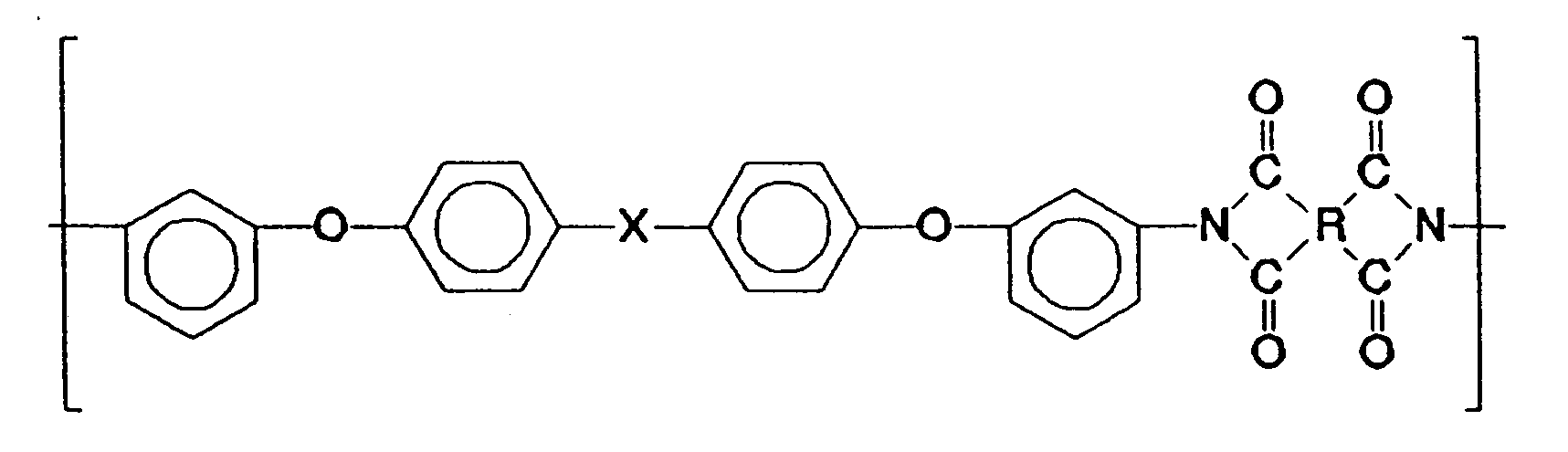
- Une mousse de polyimide selon la revendication 1, dans laquelle X représente une liaison directe ou un radical thio.
- Une mousse de polyimide selon la revendication 1 ou la revendication 2, dans laquelle R représente un groupe benzène.
- Une mousse de polyimide selon l'une quelconque des revendications précédentes, dans laquelle le polyimide thermoplastique est obtenu par réaction d'une ou de plusieurs étherdiamines choisies dans le groupe constitué par le sulfure de 4,4'-bis[4-(3-aminophénoxy)phényle], la 4,4'-bis[4-(3-aminophénoxy) phényl]sulfone, la 4,4'-bis(3-aminophénoxy)benzophénone, le 4,4'-bis(3-aminophénoxy)biphényle, le 2,2-bis[4-(3-aminophénoxy) phényl]propane et le 2,2-bis[4-(3-aminophénoxy)phényl]-1,1,1,3,3,3-hexafluoropropane, avec un ou plusieurs dianhydrides d'acide tétracarboxylique choisis dans le groupe constitué par le dianhydride pyromellitique, le dianhydride 3,3',4,4'-biphényltrétracarboxylique, le dianhydride 3,3',4,4'-benzophénonetétracarboxylique, le dianhydride 3,3',4,4'-diphényléthertétracarboxylique et le dianhydride p-phénylènoxydi(4-phtalique).
- Une mousse de polyimide selon l'une quelconque des revendications précédentes, dans laquelle la viscosité inhérente du polyimide thermoplastique, mesurée dans un mélange solvant fait de p-chlorophénol/phénol dans un rapport de 90/10 en poids, est de 0,35 à 0,65 dl/g à 35°C, à la concentration de 0,5 g/100 ml de solvant.
- Un procédé pour la production d'une mousse de polyimide thermoplastique ayant une masse volumique apparente (mesurée comme défini ici) de 0,02 à 0,2 g/cm³, un diamètre moyen des cellules (mesuré comme défini ici) de 0,1 à 1 mm et une teneur en cellules fermées (mesurée comme défini ici) de 50 % ou plus des cellules, comprenant l'extrusion-expansion d'un polyimide thermoplastique constitué essentiellement de motifs répétés représentés par la formule :

- Un procédé selon la revendication 6, dans lequel le porophore est une substance sublimable et est l'anhydride phtalique.
- Un procédé selon la revendication 7, dans lequel on utilise de 0,025 à 0,3 mole de la substance sublimable pour 100 g du polyimide thermoplastique.
- Un procédé selon la revendication 6, dans lequel on utilise un porophore chimique qui est la trihydrazinotriazine, l'azodicarboxylate de baryum ou la dinitropentaméthylènetétramine.
- Un procédé selon la revendication 6, dans lequel on utilise comme porophore un composé organique à bas point d'ébullition qui est le dichlorotrifluoroéthane, le monochlorotétrafluoroéthane, le dichlorofluorométhane, le monochlorodifluorométhane ou l'acétone.
- Un procédé selon la revendication 10, dans lequel on utilise de 0,05 à 0,5 mole du composé organique à bas point d'ébullition pour 100 g du polyimide thermoplastique.
- Un procédé selon la revendication 6, dans lequel on utilise comme porophore un hydrate dissociant l'eau à une température de 200°C ou plus, qui est l'acide phtalique dihydraté.
- Un procédé selon la revendication 12, dans lequel on utilise de 0,025 à 0,3 mole de l'eau dissociée pour 100 g du polyimide thermoplastique.
- Un procédé selon l'une quelconque des revendications 6 à 13, dans lequel la quantité du porophore est de 1 à 10 parties en poids du porophore chimique pour 100 parties en poids du polyimide thermoplastique.
- Un procédé selon l'une quelconque des revendications 6 à 14, dans lequel un agent minéral de nucléation est présent en une quantité de 0,1 à 3 parties en poids pour 100 parties en poids du polyimide thermoplastique.
Applications Claiming Priority (2)
| Application Number | Priority Date | Filing Date | Title |
|---|---|---|---|
| JP334660/88 | 1988-12-28 | ||
| JP33466088 | 1988-12-28 |
Publications (3)
| Publication Number | Publication Date |
|---|---|
| EP0376592A2 EP0376592A2 (fr) | 1990-07-04 |
| EP0376592A3 EP0376592A3 (en) | 1990-12-19 |
| EP0376592B1 true EP0376592B1 (fr) | 1995-02-08 |
Family
ID=18279840
Family Applications (1)
| Application Number | Title | Priority Date | Filing Date |
|---|---|---|---|
| EP89313301A Expired - Lifetime EP0376592B1 (fr) | 1988-12-28 | 1989-12-19 | Mousse de polyimide |
Country Status (5)
| Country | Link |
|---|---|
| US (2) | US4943594A (fr) |
| EP (1) | EP0376592B1 (fr) |
| KR (1) | KR930003023B1 (fr) |
| CA (1) | CA2006733C (fr) |
| DE (1) | DE68921059T2 (fr) |
Families Citing this family (16)
| Publication number | Priority date | Publication date | Assignee | Title |
|---|---|---|---|---|
| US5087644A (en) * | 1989-02-21 | 1992-02-11 | Mitsui Toatsu Chemicals, Inc. | Carbon-fiber-reinforced polyimide resin compositions |
| DE3918583A1 (de) * | 1989-06-07 | 1990-12-13 | Basf Ag | Verfahren zur herstellung von schaumstoffen mit hoher waermeformbestaendigkeit und schaumstoffe auf basis von aromatischen polyetherketonen |
| US5122546A (en) * | 1990-01-16 | 1992-06-16 | Ethyl Corporation | Polyimide foam precursor |
| US5268447A (en) * | 1990-06-01 | 1993-12-07 | Mitsui Toatsu Chemicals, Inc. | Readily processable polyimide and preparation process of same |
| AT401522B (de) * | 1992-12-28 | 1996-09-25 | Chemie Linz Gmbh | Flammfeste kunststoffe mit einem gehalt an trihydrazinotriazin, triguanidinotriazin oder deren salzen |
| US5484880A (en) * | 1993-12-21 | 1996-01-16 | Mitsui Toatsu Chemicals, Inc. | Polyimide |
| US5662293A (en) * | 1995-05-05 | 1997-09-02 | Hower; R. Thomas | Polyimide foam-containing radomes |
| KR100259489B1 (ko) | 1997-09-12 | 2000-06-15 | 김충섭 | 폴리이미드 발포체의 제조방법 |
| JP4117986B2 (ja) | 1999-06-07 | 2008-07-16 | 日東電工株式会社 | 耐熱性ポリマ発泡体とその製造法、及び発泡体基板 |
| US6391932B1 (en) * | 2000-08-08 | 2002-05-21 | Shipley Company, L.L.C. | Porous materials |
| DE10307736A1 (de) * | 2003-02-24 | 2004-09-02 | Basf Ag | Offenzelliger Schaumstoff aus hochschmelzenden Kunststoffen |
| US20090163609A1 (en) * | 2007-12-20 | 2009-06-25 | Lassor Richard D | Low density and high density polyetherimide foam materials and articles including the same |
| US20090163610A1 (en) * | 2007-12-20 | 2009-06-25 | Lanning Vincent L | Continuous process for making polyetherimide foam materials and articles made therefrom |
| US20120288702A1 (en) * | 2011-05-10 | 2012-11-15 | Erich Otto Teutsch | Adhesive for bonding polyimide resins |
| US9732196B2 (en) | 2011-05-10 | 2017-08-15 | Sabic Global Technologies B.V. | Adhesive for bonding polyimide resins |
| CN116459806A (zh) * | 2023-05-22 | 2023-07-21 | 大连理工大学 | 一类用于捕集混合气体中二氧化碳的高选择性多孔有机聚合物吸附材料及其制备方法与应用 |
Family Cites Families (9)
| Publication number | Priority date | Publication date | Assignee | Title |
|---|---|---|---|---|
| GB1198484A (en) * | 1966-07-27 | 1970-07-15 | Monsanto Co | Polyimide Foams |
| US4696994A (en) * | 1984-12-14 | 1987-09-29 | Ube Industries, Ltd. | Transparent aromatic polyimide |
| US4847349A (en) * | 1985-08-27 | 1989-07-11 | Mitsui Toatsu Chemicals, Inc. | Polyimide and high-temperature adhesive of polyimide from meta substituted phenoxy diamines |
| JPS6253388A (ja) * | 1985-09-03 | 1987-03-09 | Mitsui Toatsu Chem Inc | 耐熱性接着剤 |
| EP0234882B1 (fr) * | 1986-02-25 | 1993-01-13 | MITSUI TOATSU CHEMICALS, Inc. | Adhésif à base de polyimide résistant aux hautes températures |
| US4847311A (en) * | 1986-04-09 | 1989-07-11 | Mitsui Toatsu Chemicals, Inc. | Polyimide resin composition |
| JP2585552B2 (ja) * | 1986-11-19 | 1997-02-26 | 三井東圧化学株式会社 | ポリイミド |
| US4874836A (en) * | 1987-10-28 | 1989-10-17 | Idemitsu Petrochemical Co., Ltd. | Thermoplastic wholly aromatic polyimide esters and process for producing the same |
| DE3801287A1 (de) * | 1988-01-19 | 1989-07-27 | Huels Chemische Werke Ag | Formmassen, enthaltend imidgruppenhaltige aromatische polyamide und verfahren zu ihrer herstellung |
-
1989
- 1989-12-19 EP EP89313301A patent/EP0376592B1/fr not_active Expired - Lifetime
- 1989-12-19 US US07/454,061 patent/US4943594A/en not_active Expired - Fee Related
- 1989-12-19 DE DE68921059T patent/DE68921059T2/de not_active Expired - Fee Related
- 1989-12-26 KR KR1019890019526A patent/KR930003023B1/ko not_active Expired - Fee Related
- 1989-12-27 CA CA002006733A patent/CA2006733C/fr not_active Expired - Fee Related
-
1990
- 1990-05-08 US US07/520,444 patent/US4978692A/en not_active Expired - Fee Related
Also Published As
| Publication number | Publication date |
|---|---|
| DE68921059D1 (de) | 1995-03-23 |
| KR930003023B1 (ko) | 1993-04-16 |
| CA2006733A1 (fr) | 1990-06-28 |
| CA2006733C (fr) | 1996-01-02 |
| US4978692A (en) | 1990-12-18 |
| US4943594A (en) | 1990-07-24 |
| DE68921059T2 (de) | 1995-09-14 |
| EP0376592A2 (fr) | 1990-07-04 |
| EP0376592A3 (en) | 1990-12-19 |
| KR900009734A (ko) | 1990-07-05 |
Similar Documents
| Publication | Publication Date | Title |
|---|---|---|
| US4943594A (en) | Polyimide foam | |
| EP1114079B1 (fr) | Microspheres creuses de polyimide | |
| US4895972A (en) | Process for lowering the dielectric constant of polyimides using diamic acid additives | |
| EP0141481B1 (fr) | Méthode de préparation d'un précurseur de mousse de polyimide | |
| EP1002006B1 (fr) | Mousse de polyimide aromatique | |
| EP0116759B1 (fr) | Production de structures de macro-bulles | |
| US6956066B2 (en) | Polyimide foams | |
| US4038251A (en) | Process for the manufacture of polyaddition products containing imide groups by reaction of polymaleimides with polyhydric phenols using amine catalyst | |
| US4629745A (en) | Expandable polyetherimide compositions and foamed materials obtained therefrom | |
| KR100270407B1 (ko) | 유연성이 우수한 폴리이미드 발포체의 제조방법 | |
| EP0354360A1 (fr) | Copolyimides dérivés de 2,2-bis (aminophenylène) hexafluoropropane | |
| EP1000109B1 (fr) | Residuum solide de precurseur de polyimide | |
| US20020094443A1 (en) | High-density polyimide foam insulation | |
| JPH02255841A (ja) | 熱可塑性ポリイミド発泡体 | |
| CA2000921A1 (fr) | Feuille de polyamide et procede de fabrication | |
| Weiser et al. | Aromatic polyimide foam | |
| Weiser et al. | Hollow Polyimide Microspheres | |
| JPH0328266A (ja) | ポリイミド組成物 |
Legal Events
| Date | Code | Title | Description |
|---|---|---|---|
| PUAI | Public reference made under article 153(3) epc to a published international application that has entered the european phase |
Free format text: ORIGINAL CODE: 0009012 |
|
| 17P | Request for examination filed |
Effective date: 19891230 |
|
| AK | Designated contracting states |
Kind code of ref document: A2 Designated state(s): DE FR GB IT NL SE |
|
| PUAL | Search report despatched |
Free format text: ORIGINAL CODE: 0009013 |
|
| AK | Designated contracting states |
Kind code of ref document: A3 Designated state(s): DE FR GB IT NL SE |
|
| 17Q | First examination report despatched |
Effective date: 19920916 |
|
| GRAA | (expected) grant |
Free format text: ORIGINAL CODE: 0009210 |
|
| AK | Designated contracting states |
Kind code of ref document: B1 Designated state(s): DE FR GB IT NL SE |
|
| REF | Corresponds to: |
Ref document number: 68921059 Country of ref document: DE Date of ref document: 19950323 |
|
| ITF | It: translation for a ep patent filed | ||
| PG25 | Lapsed in a contracting state [announced via postgrant information from national office to epo] |
Ref country code: SE Effective date: 19950508 |
|
| ET | Fr: translation filed | ||
| PG25 | Lapsed in a contracting state [announced via postgrant information from national office to epo] |
Ref country code: GB Effective date: 19951219 |
|
| PLBE | No opposition filed within time limit |
Free format text: ORIGINAL CODE: 0009261 |
|
| STAA | Information on the status of an ep patent application or granted ep patent |
Free format text: STATUS: NO OPPOSITION FILED WITHIN TIME LIMIT |
|
| 26N | No opposition filed | ||
| PG25 | Lapsed in a contracting state [announced via postgrant information from national office to epo] |
Ref country code: NL Effective date: 19960701 |
|
| GBPC | Gb: european patent ceased through non-payment of renewal fee |
Effective date: 19951219 |
|
| PG25 | Lapsed in a contracting state [announced via postgrant information from national office to epo] |
Ref country code: FR Effective date: 19960830 |
|
| NLV4 | Nl: lapsed or anulled due to non-payment of the annual fee |
Effective date: 19960701 |
|
| PG25 | Lapsed in a contracting state [announced via postgrant information from national office to epo] |
Ref country code: DE Effective date: 19960903 |
|
| REG | Reference to a national code |
Ref country code: FR Ref legal event code: ST |
|
| PG25 | Lapsed in a contracting state [announced via postgrant information from national office to epo] |
Ref country code: IT Free format text: LAPSE BECAUSE OF NON-PAYMENT OF DUE FEES Effective date: 20051219 |