EP1000109B1 - Residuum solide de precurseur de polyimide - Google Patents
Residuum solide de precurseur de polyimide Download PDFInfo
- Publication number
- EP1000109B1 EP1000109B1 EP99935281A EP99935281A EP1000109B1 EP 1000109 B1 EP1000109 B1 EP 1000109B1 EP 99935281 A EP99935281 A EP 99935281A EP 99935281 A EP99935281 A EP 99935281A EP 1000109 B1 EP1000109 B1 EP 1000109B1
- Authority
- EP
- European Patent Office
- Prior art keywords
- polyimide precursor
- precursor solid
- aromatic
- aromatic compound
- solution
- Prior art date
- Legal status (The legal status is an assumption and is not a legal conclusion. Google has not performed a legal analysis and makes no representation as to the accuracy of the status listed.)
- Expired - Lifetime
Links
- 229920001721 polyimide Polymers 0.000 title claims abstract description 104
- 239000004642 Polyimide Substances 0.000 title claims abstract description 103
- 239000002243 precursor Substances 0.000 title claims abstract description 72
- 239000007787 solid Substances 0.000 title claims abstract description 71
- 239000008139 complexing agent Substances 0.000 claims abstract description 21
- 239000001257 hydrogen Substances 0.000 claims abstract description 20
- 229910052739 hydrogen Inorganic materials 0.000 claims abstract description 20
- GTDPSWPPOUPBNX-UHFFFAOYSA-N ac1mqpva Chemical compound CC12C(=O)OC(=O)C1(C)C1(C)C2(C)C(=O)OC1=O GTDPSWPPOUPBNX-UHFFFAOYSA-N 0.000 claims abstract description 15
- 125000003118 aryl group Chemical group 0.000 claims abstract description 9
- 150000004984 aromatic diamines Chemical class 0.000 claims abstract description 7
- 238000000034 method Methods 0.000 claims description 64
- WYURNTSHIVDZCO-UHFFFAOYSA-N Tetrahydrofuran Chemical compound C1CCOC1 WYURNTSHIVDZCO-UHFFFAOYSA-N 0.000 claims description 36
- 150000001491 aromatic compounds Chemical class 0.000 claims description 32
- 230000008569 process Effects 0.000 claims description 30
- QQGYZOYWNCKGEK-UHFFFAOYSA-N 5-[(1,3-dioxo-2-benzofuran-5-yl)oxy]-2-benzofuran-1,3-dione Chemical compound C1=C2C(=O)OC(=O)C2=CC(OC=2C=C3C(=O)OC(C3=CC=2)=O)=C1 QQGYZOYWNCKGEK-UHFFFAOYSA-N 0.000 claims description 28
- 239000000843 powder Substances 0.000 claims description 20
- WKDNYTOXBCRNPV-UHFFFAOYSA-N bpda Chemical compound C1=C2C(=O)OC(=O)C2=CC(C=2C=C3C(=O)OC(C3=CC=2)=O)=C1 WKDNYTOXBCRNPV-UHFFFAOYSA-N 0.000 claims description 18
- RTZKZFJDLAIYFH-UHFFFAOYSA-N ether Substances CCOCC RTZKZFJDLAIYFH-UHFFFAOYSA-N 0.000 claims description 18
- HIXDQWDOVZUNNA-UHFFFAOYSA-N 2-(3,4-dimethoxyphenyl)-5-hydroxy-7-methoxychromen-4-one Chemical compound C=1C(OC)=CC(O)=C(C(C=2)=O)C=1OC=2C1=CC=C(OC)C(OC)=C1 HIXDQWDOVZUNNA-UHFFFAOYSA-N 0.000 claims description 17
- 125000004432 carbon atom Chemical group C* 0.000 claims description 17
- XUSNPFGLKGCWGN-UHFFFAOYSA-N 3-[4-(3-aminopropyl)piperazin-1-yl]propan-1-amine Chemical compound NCCCN1CCN(CCCN)CC1 XUSNPFGLKGCWGN-UHFFFAOYSA-N 0.000 claims description 10
- 150000004985 diamines Chemical class 0.000 claims description 10
- 239000002904 solvent Substances 0.000 claims description 10
- ZHBXLZQQVCDGPA-UHFFFAOYSA-N 5-[(1,3-dioxo-2-benzofuran-5-yl)sulfonyl]-2-benzofuran-1,3-dione Chemical compound C1=C2C(=O)OC(=O)C2=CC(S(=O)(=O)C=2C=C3C(=O)OC(C3=CC=2)=O)=C1 ZHBXLZQQVCDGPA-UHFFFAOYSA-N 0.000 claims description 9
- 230000000694 effects Effects 0.000 claims description 8
- ANSXAPJVJOKRDJ-UHFFFAOYSA-N furo[3,4-f][2]benzofuran-1,3,5,7-tetrone Chemical compound C1=C2C(=O)OC(=O)C2=CC2=C1C(=O)OC2=O ANSXAPJVJOKRDJ-UHFFFAOYSA-N 0.000 claims description 8
- RYHBNJHYFVUHQT-UHFFFAOYSA-N 1,4-Dioxane Chemical compound C1COCCO1 RYHBNJHYFVUHQT-UHFFFAOYSA-N 0.000 claims description 7
- 125000004435 hydrogen atom Chemical group [H]* 0.000 claims description 7
- 125000000217 alkyl group Chemical group 0.000 claims description 6
- 238000010438 heat treatment Methods 0.000 claims description 6
- XTHFKEDIFFGKHM-UHFFFAOYSA-N Dimethoxyethane Chemical compound COCCOC XTHFKEDIFFGKHM-UHFFFAOYSA-N 0.000 claims description 5
- XNWFRZJHXBZDAG-UHFFFAOYSA-N 2-METHOXYETHANOL Chemical compound COCCO XNWFRZJHXBZDAG-UHFFFAOYSA-N 0.000 claims description 4
- ZNQVEEAIQZEUHB-UHFFFAOYSA-N 2-ethoxyethanol Chemical compound CCOCCO ZNQVEEAIQZEUHB-UHFFFAOYSA-N 0.000 claims description 4
- 229940093475 2-ethoxyethanol Drugs 0.000 claims description 4
- SBZXBUIDTXKZTM-UHFFFAOYSA-N diglyme Chemical compound COCCOCCOC SBZXBUIDTXKZTM-UHFFFAOYSA-N 0.000 claims description 4
- YLQBMQCUIZJEEH-UHFFFAOYSA-N tetrahydrofuran Natural products C=1C=COC=1 YLQBMQCUIZJEEH-UHFFFAOYSA-N 0.000 claims description 4
- 238000001816 cooling Methods 0.000 claims description 3
- 238000007711 solidification Methods 0.000 claims description 3
- 230000008023 solidification Effects 0.000 claims description 3
- 239000003795 chemical substances by application Substances 0.000 claims description 2
- 230000000536 complexating effect Effects 0.000 claims description 2
- 239000006260 foam Substances 0.000 abstract description 38
- 238000004519 manufacturing process Methods 0.000 abstract description 6
- 238000002360 preparation method Methods 0.000 abstract description 6
- MQJKPEGWNLWLTK-UHFFFAOYSA-N Dapsone Chemical compound C1=CC(N)=CC=C1S(=O)(=O)C1=CC=C(N)C=C1 MQJKPEGWNLWLTK-UHFFFAOYSA-N 0.000 description 27
- 239000000203 mixture Substances 0.000 description 23
- OKKJLVBELUTLKV-UHFFFAOYSA-N Methanol Chemical compound OC OKKJLVBELUTLKV-UHFFFAOYSA-N 0.000 description 21
- 230000003247 decreasing effect Effects 0.000 description 10
- 238000005187 foaming Methods 0.000 description 10
- 230000009286 beneficial effect Effects 0.000 description 5
- 230000000052 comparative effect Effects 0.000 description 5
- 239000000047 product Substances 0.000 description 5
- 238000003756 stirring Methods 0.000 description 5
- 239000004604 Blowing Agent Substances 0.000 description 4
- LFQSCWFLJHTTHZ-UHFFFAOYSA-N Ethanol Chemical compound CCO LFQSCWFLJHTTHZ-UHFFFAOYSA-N 0.000 description 4
- 125000005233 alkylalcohol group Chemical group 0.000 description 4
- 229920000642 polymer Polymers 0.000 description 4
- XLYOFNOQVPJJNP-UHFFFAOYSA-N water Substances O XLYOFNOQVPJJNP-UHFFFAOYSA-N 0.000 description 4
- 230000008901 benefit Effects 0.000 description 3
- 238000006243 chemical reaction Methods 0.000 description 3
- 125000006159 dianhydride group Chemical group 0.000 description 3
- 150000002170 ethers Chemical class 0.000 description 3
- 239000000463 material Substances 0.000 description 3
- 229910052751 metal Inorganic materials 0.000 description 3
- 239000002184 metal Substances 0.000 description 3
- 150000002739 metals Chemical class 0.000 description 3
- OLAPPGSPBNVTRF-UHFFFAOYSA-N naphthalene-1,4,5,8-tetracarboxylic acid Chemical compound C1=CC(C(O)=O)=C2C(C(=O)O)=CC=C(C(O)=O)C2=C1C(O)=O OLAPPGSPBNVTRF-UHFFFAOYSA-N 0.000 description 3
- 125000001997 phenyl group Chemical group [H]C1=C([H])C([H])=C(*)C([H])=C1[H] 0.000 description 3
- 229910001220 stainless steel Inorganic materials 0.000 description 3
- 239000010935 stainless steel Substances 0.000 description 3
- 239000000126 substance Substances 0.000 description 3
- 229920001187 thermosetting polymer Polymers 0.000 description 3
- ATUOYWHBWRKTHZ-UHFFFAOYSA-N Propane Chemical compound CCC ATUOYWHBWRKTHZ-UHFFFAOYSA-N 0.000 description 2
- 239000000853 adhesive Substances 0.000 description 2
- 230000001070 adhesive effect Effects 0.000 description 2
- 238000000498 ball milling Methods 0.000 description 2
- 238000007664 blowing Methods 0.000 description 2
- 125000002915 carbonyl group Chemical group [*:2]C([*:1])=O 0.000 description 2
- 210000004027 cell Anatomy 0.000 description 2
- 239000002131 composite material Substances 0.000 description 2
- 230000006835 compression Effects 0.000 description 2
- 238000007906 compression Methods 0.000 description 2
- 238000000354 decomposition reaction Methods 0.000 description 2
- 238000005516 engineering process Methods 0.000 description 2
- 239000011521 glass Substances 0.000 description 2
- 239000012456 homogeneous solution Substances 0.000 description 2
- 230000003301 hydrolyzing effect Effects 0.000 description 2
- 238000009413 insulation Methods 0.000 description 2
- 239000004620 low density foam Substances 0.000 description 2
- 239000002002 slurry Substances 0.000 description 2
- 239000000779 smoke Substances 0.000 description 2
- 239000000725 suspension Substances 0.000 description 2
- 229920001169 thermoplastic Polymers 0.000 description 2
- 239000004634 thermosetting polymer Substances 0.000 description 2
- WZCQRUWWHSTZEM-UHFFFAOYSA-N 1,3-phenylenediamine Chemical compound NC1=CC=CC(N)=C1 WZCQRUWWHSTZEM-UHFFFAOYSA-N 0.000 description 1
- CBCKQZAAMUWICA-UHFFFAOYSA-N 1,4-phenylenediamine Chemical compound NC1=CC=C(N)C=C1 CBCKQZAAMUWICA-UHFFFAOYSA-N 0.000 description 1
- VLDPXPPHXDGHEW-UHFFFAOYSA-N 1-chloro-2-dichlorophosphoryloxybenzene Chemical compound ClC1=CC=CC=C1OP(Cl)(Cl)=O VLDPXPPHXDGHEW-UHFFFAOYSA-N 0.000 description 1
- LJGHYPLBDBRCRZ-UHFFFAOYSA-N 3-(3-aminophenyl)sulfonylaniline Chemical compound NC1=CC=CC(S(=O)(=O)C=2C=C(N)C=CC=2)=C1 LJGHYPLBDBRCRZ-UHFFFAOYSA-N 0.000 description 1
- ZBMISJGHVWNWTE-UHFFFAOYSA-N 3-(4-aminophenoxy)aniline Chemical compound C1=CC(N)=CC=C1OC1=CC=CC(N)=C1 ZBMISJGHVWNWTE-UHFFFAOYSA-N 0.000 description 1
- DKKYOQYISDAQER-UHFFFAOYSA-N 3-[3-(3-aminophenoxy)phenoxy]aniline Chemical group NC1=CC=CC(OC=2C=C(OC=3C=C(N)C=CC=3)C=CC=2)=C1 DKKYOQYISDAQER-UHFFFAOYSA-N 0.000 description 1
- UCQABCHSIIXVOY-UHFFFAOYSA-N 3-[4-[4-(3-aminophenoxy)phenyl]phenoxy]aniline Chemical group NC1=CC=CC(OC=2C=CC(=CC=2)C=2C=CC(OC=3C=C(N)C=CC=3)=CC=2)=C1 UCQABCHSIIXVOY-UHFFFAOYSA-N 0.000 description 1
- WCXGOVYROJJXHA-UHFFFAOYSA-N 3-[4-[4-(3-aminophenoxy)phenyl]sulfonylphenoxy]aniline Chemical compound NC1=CC=CC(OC=2C=CC(=CC=2)S(=O)(=O)C=2C=CC(OC=3C=C(N)C=CC=3)=CC=2)=C1 WCXGOVYROJJXHA-UHFFFAOYSA-N 0.000 description 1
- AIVVXPSKEVWKMY-UHFFFAOYSA-N 4-(3,4-dicarboxyphenoxy)phthalic acid Chemical compound C1=C(C(O)=O)C(C(=O)O)=CC=C1OC1=CC=C(C(O)=O)C(C(O)=O)=C1 AIVVXPSKEVWKMY-UHFFFAOYSA-N 0.000 description 1
- HLBLWEWZXPIGSM-UHFFFAOYSA-N 4-Aminophenyl ether Chemical compound C1=CC(N)=CC=C1OC1=CC=C(N)C=C1 HLBLWEWZXPIGSM-UHFFFAOYSA-N 0.000 description 1
- WUPRYUDHUFLKFL-UHFFFAOYSA-N 4-[3-(4-aminophenoxy)phenoxy]aniline Chemical group C1=CC(N)=CC=C1OC1=CC=CC(OC=2C=CC(N)=CC=2)=C1 WUPRYUDHUFLKFL-UHFFFAOYSA-N 0.000 description 1
- KMKWGXGSGPYISJ-UHFFFAOYSA-N 4-[4-[2-[4-(4-aminophenoxy)phenyl]propan-2-yl]phenoxy]aniline Chemical compound C=1C=C(OC=2C=CC(N)=CC=2)C=CC=1C(C)(C)C(C=C1)=CC=C1OC1=CC=C(N)C=C1 KMKWGXGSGPYISJ-UHFFFAOYSA-N 0.000 description 1
- HYDATEKARGDBKU-UHFFFAOYSA-N 4-[4-[4-(4-aminophenoxy)phenyl]phenoxy]aniline Chemical group C1=CC(N)=CC=C1OC1=CC=C(C=2C=CC(OC=3C=CC(N)=CC=3)=CC=2)C=C1 HYDATEKARGDBKU-UHFFFAOYSA-N 0.000 description 1
- UTDAGHZGKXPRQI-UHFFFAOYSA-N 4-[4-[4-(4-aminophenoxy)phenyl]sulfonylphenoxy]aniline Chemical compound C1=CC(N)=CC=C1OC1=CC=C(S(=O)(=O)C=2C=CC(OC=3C=CC(N)=CC=3)=CC=2)C=C1 UTDAGHZGKXPRQI-UHFFFAOYSA-N 0.000 description 1
- VQVIHDPBMFABCQ-UHFFFAOYSA-N 5-(1,3-dioxo-2-benzofuran-5-carbonyl)-2-benzofuran-1,3-dione Chemical compound C1=C2C(=O)OC(=O)C2=CC(C(C=2C=C3C(=O)OC(=O)C3=CC=2)=O)=C1 VQVIHDPBMFABCQ-UHFFFAOYSA-N 0.000 description 1
- KNDQHSIWLOJIGP-UHFFFAOYSA-N 826-62-0 Chemical compound C1C2C3C(=O)OC(=O)C3C1C=C2 KNDQHSIWLOJIGP-UHFFFAOYSA-N 0.000 description 1
- 0 CC(C)(C)c(cc1)ccc1Oc1cccc(*c(cc2)ccc2N(C(c2c3ccc(-c4cc(C(NC(C)(C)C)=O)c(*=O)cc4)c2)O)C3=O)c1 Chemical compound CC(C)(C)c(cc1)ccc1Oc1cccc(*c(cc2)ccc2N(C(c2c3ccc(-c4cc(C(NC(C)(C)C)=O)c(*=O)cc4)c2)O)C3=O)c1 0.000 description 1
- 239000004593 Epoxy Substances 0.000 description 1
- 238000005481 NMR spectroscopy Methods 0.000 description 1
- 239000004962 Polyamide-imide Substances 0.000 description 1
- 239000002253 acid Substances 0.000 description 1
- 230000009471 action Effects 0.000 description 1
- 125000003277 amino group Chemical group 0.000 description 1
- QVGXLLKOCUKJST-UHFFFAOYSA-N atomic oxygen Chemical compound [O] QVGXLLKOCUKJST-UHFFFAOYSA-N 0.000 description 1
- 238000010009 beating Methods 0.000 description 1
- 230000015572 biosynthetic process Effects 0.000 description 1
- 239000006227 byproduct Substances 0.000 description 1
- 210000002421 cell wall Anatomy 0.000 description 1
- 210000003850 cellular structure Anatomy 0.000 description 1
- 230000008859 change Effects 0.000 description 1
- 238000000576 coating method Methods 0.000 description 1
- -1 diamine salts Chemical class 0.000 description 1
- 238000000113 differential scanning calorimetry Methods 0.000 description 1
- 125000001033 ether group Chemical group 0.000 description 1
- 239000006261 foam material Substances 0.000 description 1
- 239000004088 foaming agent Substances 0.000 description 1
- 238000013012 foaming technology Methods 0.000 description 1
- 230000009477 glass transition Effects 0.000 description 1
- 239000012948 isocyanate Substances 0.000 description 1
- 150000002513 isocyanates Chemical class 0.000 description 1
- 238000005304 joining Methods 0.000 description 1
- 229940018564 m-phenylenediamine Drugs 0.000 description 1
- 239000011159 matrix material Substances 0.000 description 1
- 238000010907 mechanical stirring Methods 0.000 description 1
- 238000002844 melting Methods 0.000 description 1
- 230000008018 melting Effects 0.000 description 1
- OJURWUUOVGOHJZ-UHFFFAOYSA-N methyl 2-[(2-acetyloxyphenyl)methyl-[2-[(2-acetyloxyphenyl)methyl-(2-methoxy-2-oxoethyl)amino]ethyl]amino]acetate Chemical compound C=1C=CC=C(OC(C)=O)C=1CN(CC(=O)OC)CCN(CC(=O)OC)CC1=CC=CC=C1OC(C)=O OJURWUUOVGOHJZ-UHFFFAOYSA-N 0.000 description 1
- 239000012768 molten material Substances 0.000 description 1
- 239000000178 monomer Substances 0.000 description 1
- 150000002894 organic compounds Chemical class 0.000 description 1
- 229920000620 organic polymer Polymers 0.000 description 1
- 239000001301 oxygen Substances 0.000 description 1
- 229910052760 oxygen Inorganic materials 0.000 description 1
- 239000002245 particle Substances 0.000 description 1
- ISWSIDIOOBJBQZ-UHFFFAOYSA-N phenol group Chemical group C1(=CC=CC=C1)O ISWSIDIOOBJBQZ-UHFFFAOYSA-N 0.000 description 1
- 229920002312 polyamide-imide Polymers 0.000 description 1
- 238000006068 polycondensation reaction Methods 0.000 description 1
- 239000009719 polyimide resin Substances 0.000 description 1
- 239000001294 propane Substances 0.000 description 1
- 238000000425 proton nuclear magnetic resonance spectrum Methods 0.000 description 1
- 239000000376 reactant Substances 0.000 description 1
- 230000002787 reinforcement Effects 0.000 description 1
- 239000013557 residual solvent Substances 0.000 description 1
- 239000011347 resin Substances 0.000 description 1
- 229920005989 resin Polymers 0.000 description 1
- 241000894007 species Species 0.000 description 1
- 230000000087 stabilizing effect Effects 0.000 description 1
- 238000003860 storage Methods 0.000 description 1
- 239000004616 structural foam Substances 0.000 description 1
- 150000000000 tetracarboxylic acids Chemical group 0.000 description 1
- 229920006259 thermoplastic polyimide Polymers 0.000 description 1
- 239000004416 thermosoftening plastic Substances 0.000 description 1
Images


Classifications
-
- C—CHEMISTRY; METALLURGY
- C08—ORGANIC MACROMOLECULAR COMPOUNDS; THEIR PREPARATION OR CHEMICAL WORKING-UP; COMPOSITIONS BASED THEREON
- C08J—WORKING-UP; GENERAL PROCESSES OF COMPOUNDING; AFTER-TREATMENT NOT COVERED BY SUBCLASSES C08B, C08C, C08F, C08G or C08H
- C08J9/00—Working-up of macromolecular substances to porous or cellular articles or materials; After-treatment thereof
- C08J9/02—Working-up of macromolecular substances to porous or cellular articles or materials; After-treatment thereof using blowing gases generated by the reacting monomers or modifying agents during the preparation or modification of macromolecules
-
- C—CHEMISTRY; METALLURGY
- C08—ORGANIC MACROMOLECULAR COMPOUNDS; THEIR PREPARATION OR CHEMICAL WORKING-UP; COMPOSITIONS BASED THEREON
- C08G—MACROMOLECULAR COMPOUNDS OBTAINED OTHERWISE THAN BY REACTIONS ONLY INVOLVING UNSATURATED CARBON-TO-CARBON BONDS
- C08G73/00—Macromolecular compounds obtained by reactions forming a linkage containing nitrogen with or without oxygen or carbon in the main chain of the macromolecule, not provided for in groups C08G12/00 - C08G71/00
- C08G73/06—Polycondensates having nitrogen-containing heterocyclic rings in the main chain of the macromolecule
- C08G73/10—Polyimides; Polyester-imides; Polyamide-imides; Polyamide acids or similar polyimide precursors
-
- C—CHEMISTRY; METALLURGY
- C08—ORGANIC MACROMOLECULAR COMPOUNDS; THEIR PREPARATION OR CHEMICAL WORKING-UP; COMPOSITIONS BASED THEREON
- C08G—MACROMOLECULAR COMPOUNDS OBTAINED OTHERWISE THAN BY REACTIONS ONLY INVOLVING UNSATURATED CARBON-TO-CARBON BONDS
- C08G73/00—Macromolecular compounds obtained by reactions forming a linkage containing nitrogen with or without oxygen or carbon in the main chain of the macromolecule, not provided for in groups C08G12/00 - C08G71/00
- C08G73/06—Polycondensates having nitrogen-containing heterocyclic rings in the main chain of the macromolecule
- C08G73/10—Polyimides; Polyester-imides; Polyamide-imides; Polyamide acids or similar polyimide precursors
- C08G73/1003—Preparatory processes
- C08G73/1007—Preparatory processes from tetracarboxylic acids or derivatives and diamines
-
- C—CHEMISTRY; METALLURGY
- C08—ORGANIC MACROMOLECULAR COMPOUNDS; THEIR PREPARATION OR CHEMICAL WORKING-UP; COMPOSITIONS BASED THEREON
- C08J—WORKING-UP; GENERAL PROCESSES OF COMPOUNDING; AFTER-TREATMENT NOT COVERED BY SUBCLASSES C08B, C08C, C08F, C08G or C08H
- C08J2379/00—Characterised by the use of macromolecular compounds obtained by reactions forming in the main chain of the macromolecule a linkage containing nitrogen with or without oxygen, or carbon only, not provided for in groups C08J2361/00 - C08J2377/00
- C08J2379/04—Polycondensates having nitrogen-containing heterocyclic rings in the main chain; Polyhydrazides; Polyamide acids or similar polyimide precursors
- C08J2379/08—Polyimides; Polyester-imides; Polyamide-imides; Polyamide acids or similar polyimide precursors
Definitions
- the present invention relates generally to polyimides. It relates in particular to a polyimide precursor solid residuum, which is effectively employed in the preparation of polyimide foam and the fabrication of polyimide foam structures.
- High performance polyimides are presently used in the aerospace industry, for example, in joining metals to metals, or metals to composite structures.
- polyimides are rapidly finding new uses as foam insulation in cryogenic applications, and as structural foam having increased structural stiffness without large weight increases, in aerospace structures.
- Polyimide foam materials have a number of beneficial attributes for next generation space vehicles. such as high temperature and solvent resistance. flame resistance, low smoke generation. high modulus and chemical and hot water resistance. Another area for polyimide foams is in the manufacture of low density insulation for thermal and acoustic applications, and reinforcement for the maritime industry.
- U. S. Patents 5,147,966 and 5,478,916 disclose polyimides that can be melt processed into various useful forms such as coatings. adhesives, composite matrix resins and films. These polyimides are prepared from various diamines and dianhydrides in various solvents. The use of monoanhydrides as endcapping agents is also disclosed in these patents to control the molecular weight of the polymers and, in turn, to make them easier to process in molten form. The use of ethers to make polyimide adhesives was disclosed in U. S. Patent 4,065,345. which demonstrates another method to produce polyimide resin systems. Figure I shows the method employed by these patents to produce polyimides.
- U.S. Patent 3,483,144 discloses a process for making polyimide foam by ball milling a mixture of monomers and heating the mixture to 300°C.
- the foams produced by this patent are the result of dianhydrides or tetraacids being dissolved by a diamine upon melting. The ensuing reaction produces water and thus foams the molten material.
- Figure 2 illustrates the process to make foam by this patent.
- the state-of-the-art technology for making polyimide foams as disclosed in U.S. Patents 5,298,531, 5,122,546, 5,077,318, and 4,900,761 utilizes solutions of diamines and dianhydride derivatives in a low molecular weight alkyl alcohol solvent. Polyimide precursor solutions and powders therefrom are then processed into foams through the expulsion of water and alcohol (R-OH) during the thermal imidization process. In these cases the alcohol solvent reacts initially with the dianhydride to form a covalently bonded specie referred to as a dialkylester-diacid (DADA) before the aromatic diamine is added.
- DADA dialkylester-diacid
- the aforementioned patents also illustrate the use of blowing agents to aid in the foaming process. The blowing agents utilized by these patents serve as a separate entity and usually result in a foam that has residual blowing agent within its cell walls.
- Figure 3 demonstrates the state-of-the-art in this foam technology.
- foamed products produced often exhibit non-uniformity of density and cell size throughout the foamed structure, which results in low yields of acceptable product. Additionally, some of the polyimide precursors employed in these related art processes (especially those involving isocyanate chemistry) have poor hydrolytic Stability and poor stability toward other types of decomposition.
- This residuum is an admixture of an aromatic compound (A), which is an aromatic dianhydride or derivative thereof and aromatic compound (B), which is an aromatic diamine or derivative thereof, plus a complexing agent (C), which is complexed with the admixture by hydrogen bonding, the complexing agent (C) being present in an amount sufficient to provide from about 1 to about 15% by weight, based on the total weight of the polyimide precursor solid residuum.
- the polyimide precursor solid residuum according to the present invention is an admixture of an aromatic compound (A) and an aromatic compound (B) wherein n is an integer from 0 to 3, and R 1 is hydrogen or an alkyl group, and R 2 is a tetravalent aromatic radical having 1 to 5 benzenoid-unsaturated rings of 6 carbon atoms, R 3 is a divalent aromatic radical having 1 to 5 benzenoid-unsaturated rings of 6 carbon atoms, along with a complexing agent (C) being present in an amount sufficient to provide from about 1 to about 15% by weight, based on the total weight of the polyimide precursor solid residuum.
- A aromatic compound
- B aromatic compound
- n is an integer from 0 to 3
- R 1 is hydrogen or an alkyl group
- R 2 is a tetravalent aromatic radical having 1 to 5 benzenoid-unsaturated rings of 6 carbon atoms
- R 3 is a divalent aromatic radical
- the complexing agent is an ether. especially one of, or a suitable mixture of tetrahydrofuran, glyme, diglyme, dioxane, 2-methoxy ethanol and 2-ethoxy ethanol.
- the polyimide precursor solid residuum of the present invention advantageously has an apparent density of from about 1 to about 40 pounds/ft 3 (about 16 to about 640 kg/m 3 ), and is beneficially in the form of a powder, or friable balloons (as hereinafter described), or flake (as hereinafter described).
- the aromatic compound (A) is at least one derivative of a dianhydride selected from ODPA; BPDA; BTDA; DSDA; PMDA and BPADA; and the aromatic compound (B) is at least one diamine which is selected from 3,4' ODA: 4,4' ODA; APB; BPB; m-PDA; p-PDA; 3.3' DDS: 4,4' DDS; 4,4 BAPS; 4,3 BAPS; 3 BAPB; 4 BAPB and BAPP.
- a dianhydride selected from ODPA; BPDA; BTDA; DSDA; PMDA and BPADA
- the aromatic compound (B) is at least one diamine which is selected from 3,4' ODA: 4,4' ODA; APB; BPB; m-PDA; p-PDA; 3.3' DDS: 4,4' DDS; 4,4 BAPS; 4,3 BAPS; 3 BAPB; 4 BAPB and BAPP.
- the polyimide precursor solid residuum is a combination of two or more different admixtures of aromatic compound (A) and aromatic compound (B) along with complexing agent (C), the aromatic compound (A) being at least one derivative of a dianhydride selected from ODPA; BPDA; BTDA; DSDA; PMDA and BPDA; and the aromatic compound (B) being at least one diamine which is selected from the group consisting of 3.4' ODA; 4.4' ODA; APB; BPB; m-PDA; p-PDA; 3.3' DDS; 4,4' DDS; 4,4 BAPS; 4,3 BAPS; 3 BAPB; 4 BAPB and BAPP.
- aromatic compound (A) being at least one derivative of a dianhydride selected from ODPA; BPDA; BTDA; DSDA; PMDA and BPDA
- the aromatic compound (B) being at least one diamine which is selected from the group consisting of 3.4' ODA; 4.4' ODA; APB;
- the present invention also comprehends a process for producing the instant polyimide precursor solid residuum. This process includes the sequential steps of:
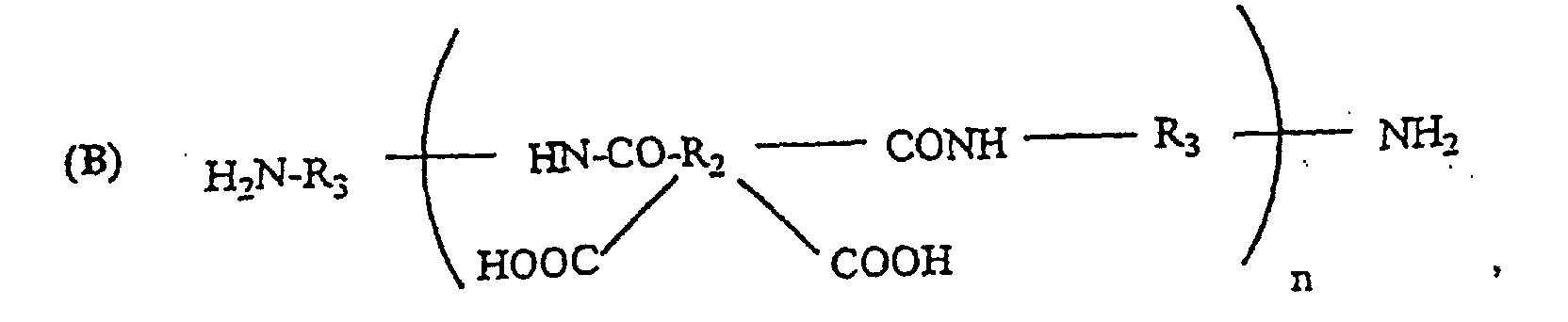
- aromatic compound (A) of the admixture is and an aromatic compound (B) wherein n is an integer from 0 to 3, and R 1 is hydrogen or an alkyl group, and R 2 is a tetravalent aromatic radical having 1 to 5 benzenoid-unsaturated rings of 6 carbon atoms, R 3 is a divalent aromatic radical having 1 to 5 benzenoid-unsaturated rings of 6 carbon atoms.
- the complexing agent (C) is an ether, especially one of, or a suitable mixture of tetrahydrofuran, glyme, diglyme, dioxane, 2-methoxy ethanol and 2-ethoxy ethanol.
- a polyimide precursor solid residuum was formed from the reaction of a dianhydride dispensed in a mixture of ethers and various alkyl alcohols at room temperature. See FIG. 4 for a representation of an ether stabilizing unit, according to the present invention.
- This suspension was treated at 70°C for 6 hours in order to convert the dianhydride into a DADA complexed with ether by hydrogen bonding. This hydrogen bonding occurs between the ether oxygen and the acid protons.
- the resulting solution, DADA with hydrogen bonded ether was mixed with a diamine and stirred for 2 hours to yield a homogeneous polyimide precursor solution.
- polyimide foam precursors were formed from tetracarboxylic acid forms (TA) of the dianhydrides and diamines mixed in various ethers and alkyl alcohols.
- TA tetracarboxylic acid forms
- the solution was then charged into a stainless-steel vat and treated at 70°C for 14 hours in order to evaporate excess solvents (ether and alkyl alcohol).
- the resulting material was allowed to cool and then crushed into a fine powder ( ⁇ 2 to ⁇ 200 ⁇ m).
- the powder was then heated to a temperature to allow foaming and imidization of the foam.
- the presence of the ether complex stabilizes the monomeric reactants and prevents chain growth and imidization until an optimum temperature and melt viscosity are reached for foaming.
- FIG. 5 illustrates a foaming process employing a polyimide precursor solid residuum which is complexed with an ether according to the present invention.
- the need to transform high temperature polyimides into high quality, low density foams is apparent. Foams of various densities, strengths, and thermal properties are now being required for future reusable launch vehicles, maritime ships, and commercial aeronautics applications.
- the present invention affords a technology capable of reproducibly producing high quality foams of various chemical make-ups, densities, thermal properties, and strengths, by utilizing the effects of hydrogen bonding of an ether with a DADA in a mixture with diamines.
- polyimide means a thermally-stable organic polymer wherein 60 to 100mol%, preferably 70 mol% or more, more preferably 80 mol% or more. of the repeating units of the polymer chain thereof have the polyimide structure as represented, by the following formula (I): wherein R is a tetravalent aromatic radical having 1 to 5 benzenoid-unsaturated rings of 6 carbon atoms, the four carbonyl groups being directly bonded to different carbon atoms in a benzene ring of the R radical and each pair of carbonyl groups being bonded to adjacent carbon atoms in the benzene ring of the R radical; and R' is a divalent aromatic radical having 1 to 5 benzenoid-unsaturated rings of 6 carbon atoms, the amino groups being directly bonded to different carbon atoms in a benzene ring of the R' radical.
- R is a tetravalent aromatic radical having 1 to 5 benzenoid-unsaturated rings of 6 carbon
- Polyimide Precursor means an organic compound which becomes a polyimide by thermal imidization.
- Apparent density is estimated, for example, according to ASTM D-3574A.
- Compression strength is estimated, for example, according to ASTM D-3574C.
- This thermal property is determined from the inflection point associated with a change in heat capacity at constant pressure employing Differential Scanning Calorimetry (DSC).
- DSC Differential Scanning Calorimetry
- Friable balloons is understood to mean a particular form of the polyimide precursor solid residuum according to the present invention, which has an apparent density of less than about 10 pounds/ft 3 (less than about 160 kg/m 3 ) and which preferably has a substantially spherical shape.
- Flake means a blend of a polyimide precursor solid residuum according to the present invention with other polymers such as thermoplastic or thermosetting polymers.
- Thermoplastic polymers include thermoplastic polyimide and polyamide imide.
- Thermosetting polymers include epoxy, phenolic, and thermosetting polyimide. These other polymers are blended with the polyimide precursor solid residuum in any ratio to yield the flake.
- Examples of preferred polyimides comprehended herein include polyimides from ODPA / 3,4 'ODA (Formula 2) BPDA / 3,4'ODA (Formula 3).
- BTDA l 4,4'ODA (Formula 4), BTDA / 4,4'DDS (Formula 5), BTDA / 3,4'ODA (Formula 6).
- DSDA/ BPB (Formula 7), BTDA/BPB (Formula 8), and BPDA/BPB (Formula 9).
- the polyimide comprehended in the present invention may be a copolyimide.
- Examples of preferred copolyimides include polyimides of ODPA / 3,4'ODA/PDA (90/10 molar ratio) (Formula 10); BPDA / 3,4'ODA/APB (85/15 molar ratio) (Formula 11);BTDA / BPB / 4,4'ODA (1/1 molar ratio) (Formula 12); and BTDA / PMDA (8/2 molar ratio) / 4.4'ODA (Formula 13).
Landscapes
- Chemical & Material Sciences (AREA)
- Health & Medical Sciences (AREA)
- Chemical Kinetics & Catalysis (AREA)
- Medicinal Chemistry (AREA)
- Polymers & Plastics (AREA)
- Organic Chemistry (AREA)
- Engineering & Computer Science (AREA)
- Materials Engineering (AREA)
- Macromolecular Compounds Obtained By Forming Nitrogen-Containing Linkages In General (AREA)
- Manufacture Of Porous Articles, And Recovery And Treatment Of Waste Products (AREA)
- Polymers With Sulfur, Phosphorus Or Metals In The Main Chain (AREA)
Abstract
Claims (15)
- Résidu solide de précurseur de polyimide comprenant un mélange d'un composé aromatique (A), qui est un dianhydride aromatique ou un dérivé d'un dianhydride aromatique, et d'un composé aromatique (B), qui est une diamine aromatique ou un dérivé d'une diamine aromatique, plus un agent complexant (C), qui est complexé avec le mélange par liaison hydrogène, l'agent complexant (C) étant présent en une quantité suffisante de manière à fournir de 1 à 15 % en poids, sur la base du poids total du résidu solide de précurseur de polyimide.
- Résidu solide de précurseur de polyimide comprenant un mélange d'un composé aromatique (A)et d'un composé aromatique (B)
 dans lesquelles n est un nombre entier de 0 à 3 et R1 est un hydrogène ou un groupe alkyle, et R2 est un radical aromatique tétravalent ayant 1 à 5 cycles benzénoïdes insaturés de 6 atomes de carbone, R3 est un radical aromatique divalent ayant 1 à 5 cycles benzénoïdes insaturés de 6 atomes de carbone ; ensemble avec un agent complexant (C), qui est complexé avec le mélange par liaison hydrogène, l'agent complexant étant présent en une quantité suffisante de manière à fournir de 1 à 15 % en poids, sur la base du poids total du résidu solide de précurseur de polyimide.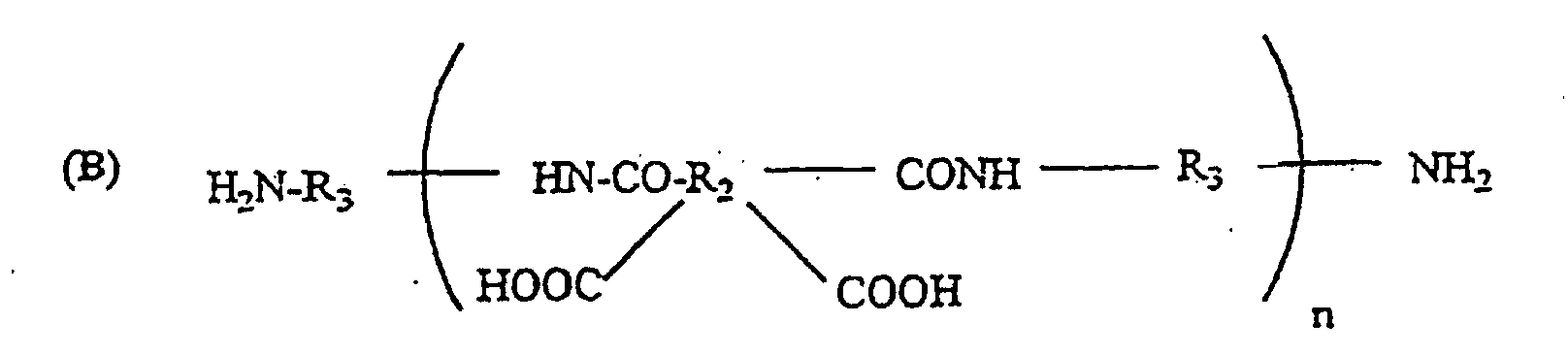
- Résidu solide de précurseur de polyimide comprenant un mélange approximativement équimolaire d'un composé aromatique (A)et d'un composé aromatique (B)
 dans lesquelles n est un nombre entier de 0 à 3 et R1 est un hydrogène ou un groupe alkyle, et R2 est un radical aromatique tétravalent ayant 1 à 5 cycles benzénoïdes insaturés de 6 atomes de carbone, R3 est un radical aromatique divalent ayant 1 à 5 cycles benzénoïdes insaturés de 6 atomes de carbone ; ensemble avec un agent complexant (C), qui est complexé avec le mélange par liaison hydrogène, l'agent complexant étant présent en une quantité suffisante de manière à fournir de 1 à 15 % en poids, sur la base du poids total du résidu solide de précurseur de polyimide.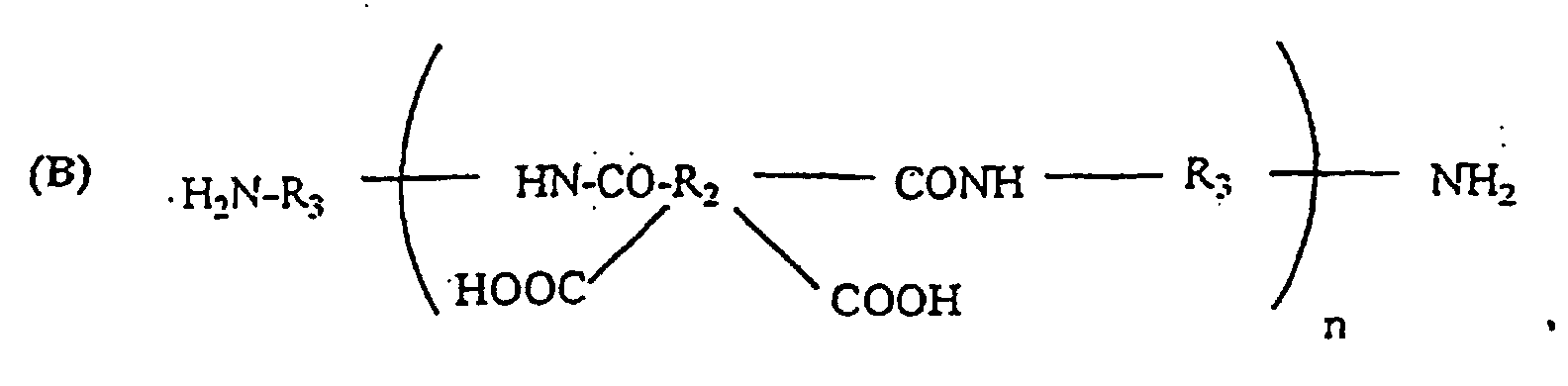
- Résidu solide de précurseur de polyimide selon la revendication 3, dans lequel l'agent complexant (C) est un éther.
- Résidu solide de précurseur de polyimide selon la revendication 4, dans lequel l'éther est choisi dans le groupe constitué par du tétrahydrofuranne, du glyme, du diglyme, du dioxane, du 2-méthoxyéthanol et du 2-éthoxyéthanol.
- Résidu solide de précurseur de polyimide selon la revendication 3, dans lequel le composé aromatique (A) est au moins un dérivé d'un dianhydride choisi dans le groupe constitué par de l'ODPA ; du BPDA ; du BTDA ; du DSDA ; du PMDA et du BPADA ; et le composé aromatique (B) est au moins un dérivé d'une diamine qui est un membre choisi dans le groupe constitué par du 3,4' ODA ; du 4,4' ODA ; de l'APB ; du BPB ; du m-PDA ; du p-PDA ; du 3,3' DDS ; du 4,4' DDS ; du 4,4 BAPS ; du 4,3 BAPS ; du 3 BAPB ; du 4 BAPB et du BAPP.
- Résidu solide de précurseur de polyimide selon la revendication 3, qui est une combinaison de deux ou plus mélanges différents de composé aromatique (A) et de composé aromatique (B) ensemble avec l'agent, complexant (C), le composé aromatique (A) étant au moins un dérivé d'un dianhydride choisi dans le groupe constitué par de l'ODPA ; du BPDA ; du BTDA ; du DSDA ; du PMDA et du BPDA ; et le composé aromatique (B) étant au moins un dérivé d'une diamine qui est un membre choisi dans le groupe constitué par du 3,4' ODA ; du 4',4' ODA ; de l'APB ; du BPB ; du m-PDA ; du p-PDA ; du 3, 3' DDS ; du 4, 4' DDS ; du 4,4 BAPS ; du 4,3 BAPS ; du 3 BAPB ; du 4 BAPB et du BAPP.
- Résidu solide de précurseur de polyimide selon la revendication 3, qui a une densité apparente de 16 à 640 kg/m3 (1 à 40 pounds/ft3).
- Procédé pour produire un résidu solide de précurseur de polyimide de la revendication 1, lequel procédé comprend :(a) de dissoudre un mélange d'un composé aromatique (A), qui est un dianhydride aromatique ou un dérivé de celui-ci, et d'un composé aromatique (B) qui est une diamine aromatique ou un dérivé de celle-ci, dans un solvant contenant un agent complexant (C), qui est capable de complexer avec le mélange par liaison hydrogène, afin de former une solution ayant une teneur en solide d'au moins 20 % en poids, sur la base du poids total de la solution ;(b) de condenser la solution en chauffant afin d'effectuer une solution condensée ayant une teneur en solide jusqu'à 85 % en poids, sur la base du poids total de la solution condensée ;(c) de refroidir la solution condensée afin d'effectuer une solidification de celle-ci ;(d) de concasser la solution condensée solidifiée ; et(e) de chauffer la solution condensée solidifiée concassée à une température entre 70 °C et 140 °C afin de former un résidu solide de précurseur de polyimide de densité apparente de 16 à 640 kg/m3 (1 à 40 pounds/ft3) et une teneur résiduelle de l'agent complexant (C) entre 1 et 15 % en poids, sur la base du poids total du résidu solide de précurseur de polyimide.
- Procédé selon la revendication 9, dans lequel le composé aromatique (A) estet le composé aromatique (B) est
 dans lesquelles n est un nombre entier de 0 à 3 et R1 est un hydrogène ou un groupe alkyle, et R2 est un radical aromatique tétravalent ayant 1 à 5 cycles benzénoïdes insaturés de 6 atomes de carbone, R3 est un radical aromatique divalent ayant 1 à 5 cycles benzénoïdes insaturés de 6 atomes de carbone.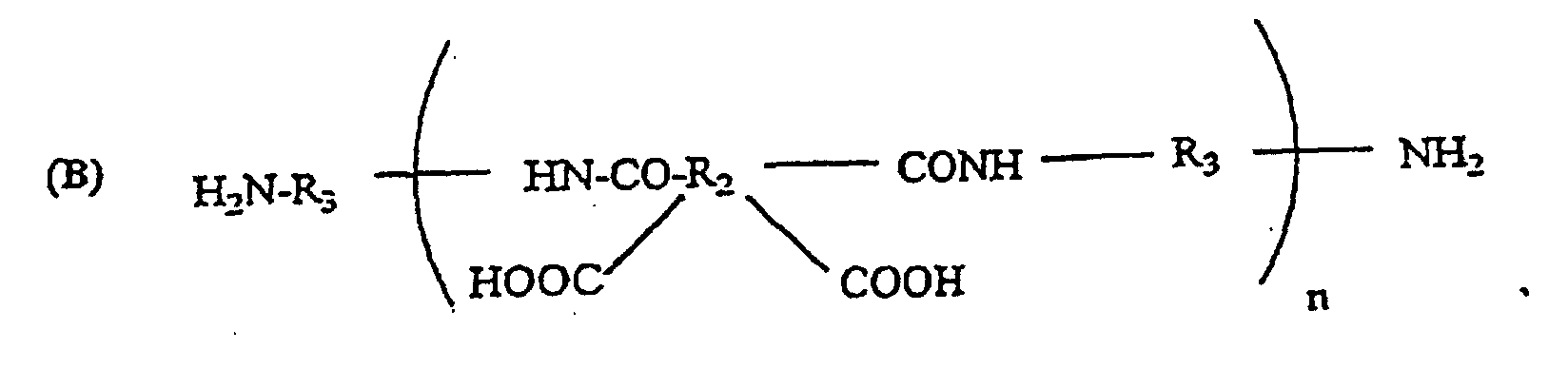
- Procédé pour produire un résidu solide de précurseur de polyimide de la revendication 3, lequel procédé comprend :(a) de dissoudre un mélange approximativement équimolaire d'un composé aromatique (A)et d'un composé aromatique (B)
 dans lesquelles n est un nombre entier de 0 à 3 et R1 est un hydrogène ou un groupe alkyle, et R2 est un radical aromatique tétravalent ayant 1 à 5 cycles benzénoïdes insaturés de 6 atomes de carbone, R3 est un radical aromatique divalent ayant 1 à 5 cycles benzénoïdes insaturés de 6 atomes de carbone ; dans un solvant contenant un agent complexant (C), qui est capable de complexer avec le mélange par liaison hydrogène, afin de former une solution ayant une teneur en solide d'au moins 20 % en poids, sur la base du poids total de la solution ;
 (b) de condenser la solution en chauffant afin d'effectuer une solution condensée ayant une teneur en solide jusqu'à 85 % en poids, sur la base du poids total de la solution condensée ;(c) de refroidir la solution condensée afin d'effectuer une solidification de celle-ci ;(d) de concasser la solution condensée solidifiée ; et(e) de chauffer la solution condensée solidifiée concassée à une température entre 70 °C et 140 °C afin de former un résidu solide de précurseur de polyimide de densité apparente de 16 à 640 kg/m3 (1 à 40 pounds/ft3) et une teneur résiduelle de l'agent complexant (C) entre 1 et 15 % en poids, sur la base du poids total du résidu solide de précurseur de polyimide.
 - Procédé selon la revendication 11, dans lequel l'agent complexant (C) est un éther.
- Procédé selon la revendication 12, dans lequel l'éther est choisi dans le groupe constitué par du tétrahydrofuranne, du glyme, du diglyme, du dioxane, du 2-méthoxyéthanol et du 2-éthoxyéthanol.
- Résidu solide de précurseur de polyimide selon la revendication 3, qui est dans la forme d'un membre choisi dans le groupe constitué par de la poudre, des ballons friables et d'un flocon.
- Résidu solide de précurseur de polyimide selon la revendication 14, qui est dans la forme de ballons friables et a une densité apparente de 16 à 160 kg/m3 (1 à 10 pounds/ft3).
Applications Claiming Priority (5)
| Application Number | Priority Date | Filing Date | Title |
|---|---|---|---|
| US8727298P | 1998-05-29 | 1998-05-29 | |
| US87272P | 1998-05-29 | ||
| PCT/US1999/011295 WO1999062984A2 (fr) | 1998-05-29 | 1999-05-21 | Residuum solide de precurseur de polyimide |
| US316428 | 1999-05-21 | ||
| US09/316,428 US6180746B1 (en) | 1998-05-29 | 1999-05-21 | Polyimide precursor solid residuum |
Publications (2)
| Publication Number | Publication Date |
|---|---|
| EP1000109A2 EP1000109A2 (fr) | 2000-05-17 |
| EP1000109B1 true EP1000109B1 (fr) | 2004-08-18 |
Family
ID=26776791
Family Applications (1)
| Application Number | Title | Priority Date | Filing Date |
|---|---|---|---|
| EP99935281A Expired - Lifetime EP1000109B1 (fr) | 1998-05-29 | 1999-05-21 | Residuum solide de precurseur de polyimide |
Country Status (6)
| Country | Link |
|---|---|
| US (1) | US6180746B1 (fr) |
| EP (1) | EP1000109B1 (fr) |
| JP (1) | JP3485936B2 (fr) |
| AU (2) | AU5079299A (fr) |
| DE (1) | DE69919487T2 (fr) |
| WO (1) | WO1999062984A2 (fr) |
Families Citing this family (12)
| Publication number | Priority date | Publication date | Assignee | Title |
|---|---|---|---|---|
| US6222007B1 (en) * | 1998-05-29 | 2001-04-24 | The United States Of America As Represented By The National Aeronautics And Space Administration | Films, preimpregnated tapes and composites made from polyimide “Salt-like” Solutions |
| US6133401A (en) * | 1998-06-29 | 2000-10-17 | The United States Of America As Represented By The Administrator Of The National Aeronautics And Space Administration | Method to prepare processable polyimides with reactive endgroups using 1,3-bis (3-aminophenoxy) benzene |
| US6956066B2 (en) * | 2003-02-11 | 2005-10-18 | The United States Of America As Represented By The Administrator Of The National Aeronautics And Space Administration | Polyimide foams |
| US20050136239A1 (en) * | 2003-08-29 | 2005-06-23 | Eichinger Jeffrey D. | Multifunctional cryo-insulation apparatus and methods |
| US7129318B2 (en) * | 2003-09-02 | 2006-10-31 | I.S.T. (Ma) Corporation | RTM and RI processable polyimide resins |
| US7781492B2 (en) * | 2006-06-08 | 2010-08-24 | The United States Of America As Represented By The Administrator Of The National Aeronautics And Space Administration | Foam/aerogel composite materials for thermal and acoustic insulation and cryogen storage |
| JPWO2011055530A1 (ja) * | 2009-11-05 | 2013-03-28 | 株式会社アイ.エス.テイ | ポリイミド発泡体、ポリイミド粉体混合物、ポリイミド粉体、ポリイミド発泡体の製造方法、積層ポリイミド発泡成形体の製造方法、湾曲ポリイミド発泡成形体の製造方法、積層ポリイミド発泡成形体および湾曲ポリイミド発泡成形体 |
| WO2011066024A1 (fr) | 2009-11-30 | 2011-06-03 | Exxonmobil Upstream Research Company | Systèmes et procédés pour former des objets compressibles haute performance |
| US20120231979A1 (en) * | 2009-11-30 | 2012-09-13 | Peiffer Dennis G | Systems and Methods For Forming High Performance Compressible Objects |
| CN105017770B (zh) * | 2015-07-08 | 2017-06-06 | 西北工业大学 | 一种碳纤维粉增强聚酰亚胺泡沫材料的制备方法 |
| CN106866964A (zh) * | 2015-12-14 | 2017-06-20 | 清华大学 | 一种聚酰亚胺泡沫塑料及其制备方法 |
| CN105504280B (zh) * | 2015-12-29 | 2018-04-27 | 哈尔滨工业大学 | 一种高温热缩管用无规共聚聚酰亚胺及其制备方法 |
Family Cites Families (7)
| Publication number | Priority date | Publication date | Assignee | Title |
|---|---|---|---|---|
| US4065345A (en) * | 1974-12-16 | 1977-12-27 | The United States Of America As Represented By The United States National Aeronautics And Space Administration | Polyimide adhesives |
| US4311661A (en) | 1980-05-05 | 1982-01-19 | Mcdonnell Douglas Corporation | Resin impregnation process |
| US4670478A (en) | 1986-01-16 | 1987-06-02 | Rmb Products | Polyimide foams and methods of making same |
| US4816493A (en) * | 1988-04-28 | 1989-03-28 | Ethyl Corporation | Polyimide foams and their preparation |
| US5122546A (en) * | 1990-01-16 | 1992-06-16 | Ethyl Corporation | Polyimide foam precursor |
| US4980389A (en) | 1990-04-03 | 1990-12-25 | Irbit Research & Consulting Ag | Polyetherimide foam precursors and foams having improved physical properties and methods of making them |
| US5147966A (en) | 1990-07-31 | 1992-09-15 | The United States Of America As Represented By The Administrator Of The National Aeronautics And Space Administration | Polyimide molding powder, coating, adhesive and matrix resin |
-
1999
- 1999-05-21 US US09/316,428 patent/US6180746B1/en not_active Expired - Lifetime
- 1999-05-21 EP EP99935281A patent/EP1000109B1/fr not_active Expired - Lifetime
- 1999-05-21 AU AU50792/99A patent/AU5079299A/en not_active Abandoned
- 1999-05-21 AU AU45428/99A patent/AU4542899A/en not_active Abandoned
- 1999-05-21 WO PCT/US1999/011295 patent/WO1999062984A2/fr not_active Ceased
- 1999-05-21 DE DE69919487T patent/DE69919487T2/de not_active Expired - Lifetime
- 1999-05-21 JP JP56062399A patent/JP3485936B2/ja not_active Expired - Fee Related
Also Published As
| Publication number | Publication date |
|---|---|
| WO1999062984A3 (fr) | 2000-03-16 |
| AU5079299A (en) | 1999-12-20 |
| JP3485936B2 (ja) | 2004-01-13 |
| US6180746B1 (en) | 2001-01-30 |
| DE69919487D1 (de) | 2004-09-23 |
| AU4542899A (en) | 1999-12-20 |
| JP2002501573A (ja) | 2002-01-15 |
| DE69919487T2 (de) | 2005-09-08 |
| EP1000109A2 (fr) | 2000-05-17 |
| WO1999062984A2 (fr) | 1999-12-09 |
Similar Documents
| Publication | Publication Date | Title |
|---|---|---|
| US5994418A (en) | Hollow polyimide microspheres | |
| EP1002006B1 (fr) | Mousse de polyimide aromatique | |
| EP0116759B1 (fr) | Production de structures de macro-bulles | |
| US4360604A (en) | Polyimide foams | |
| US7541388B2 (en) | Polyimide foams | |
| US4315076A (en) | Polyimides | |
| US6180746B1 (en) | Polyimide precursor solid residuum | |
| JP2002012688A (ja) | 発泡ポリイミドおよびその製法 | |
| US4355120A (en) | Polyimide foams | |
| US4369261A (en) | Polyimide foams | |
| US6057379A (en) | Method of preparing polyimide foam with excellent flexibility properties | |
| US4980389A (en) | Polyetherimide foam precursors and foams having improved physical properties and methods of making them | |
| US6172127B1 (en) | Preparation of polyimide foam | |
| Weiser et al. | Polyimide Precursor Solid Residuum | |
| EP0437821B1 (fr) | Procédé de préparation des produits de mousse de polyimide | |
| EP0048080B1 (fr) | Polyimides | |
| Weiser et al. | Hollow Polyimide Microspheres | |
| Weiser et al. | Aromatic polyimide foam | |
| Weiser et al. | Hollow Polyimide Microspheres | |
| JPH0481462A (ja) | 顆粒状芳香族ポリイミド樹脂組成物 | |
| JPH02300261A (ja) | 顆粒状芳香族ポリイミド樹脂組成物 | |
| JPH02302468A (ja) | 顆粒状芳香族ポリイミド樹脂組成物 | |
| JPH0345654A (ja) | 顆粒状芳香族ポリイミド樹脂組成物 | |
| JPH04154843A (ja) | 顆粒状芳香族ポリイミド樹脂の製造方法 | |
| JPH04325560A (ja) | 顆粒状芳香族ポリイミド樹脂組成物 |
Legal Events
| Date | Code | Title | Description |
|---|---|---|---|
| PUAI | Public reference made under article 153(3) epc to a published international application that has entered the european phase |
Free format text: ORIGINAL CODE: 0009012 |
|
| 17P | Request for examination filed |
Effective date: 20000118 |
|
| AK | Designated contracting states |
Kind code of ref document: A2 Designated state(s): DE FR GB |
|
| RIN1 | Information on inventor provided before grant (corrected) |
Inventor name: KANESHIRO, HISAYASU Inventor name: ECHIGO, YOSHIAKI Inventor name: ST. CLAIR, TERRY Inventor name: WEISER, ERIC |
|
| GRAP | Despatch of communication of intention to grant a patent |
Free format text: ORIGINAL CODE: EPIDOSNIGR1 |
|
| GRAS | Grant fee paid |
Free format text: ORIGINAL CODE: EPIDOSNIGR3 |
|
| GRAA | (expected) grant |
Free format text: ORIGINAL CODE: 0009210 |
|
| AK | Designated contracting states |
Kind code of ref document: B1 Designated state(s): DE FR GB |
|
| REG | Reference to a national code |
Ref country code: GB Ref legal event code: FG4D |
|
| REF | Corresponds to: |
Ref document number: 69919487 Country of ref document: DE Date of ref document: 20040923 Kind code of ref document: P |
|
| ET | Fr: translation filed | ||
| PLBE | No opposition filed within time limit |
Free format text: ORIGINAL CODE: 0009261 |
|
| STAA | Information on the status of an ep patent application or granted ep patent |
Free format text: STATUS: NO OPPOSITION FILED WITHIN TIME LIMIT |
|
| 26N | No opposition filed |
Effective date: 20050519 |
|
| PGFP | Annual fee paid to national office [announced via postgrant information from national office to epo] |
Ref country code: DE Payment date: 20120516 Year of fee payment: 14 |
|
| PGFP | Annual fee paid to national office [announced via postgrant information from national office to epo] |
Ref country code: GB Payment date: 20120516 Year of fee payment: 14 Ref country code: FR Payment date: 20120608 Year of fee payment: 14 |
|
| GBPC | Gb: european patent ceased through non-payment of renewal fee |
Effective date: 20130521 |
|
| PG25 | Lapsed in a contracting state [announced via postgrant information from national office to epo] |
Ref country code: DE Free format text: LAPSE BECAUSE OF NON-PAYMENT OF DUE FEES Effective date: 20131203 |
|
| REG | Reference to a national code |
Ref country code: DE Ref legal event code: R119 Ref document number: 69919487 Country of ref document: DE Effective date: 20131203 |
|
| REG | Reference to a national code |
Ref country code: FR Ref legal event code: ST Effective date: 20140131 |
|
| PG25 | Lapsed in a contracting state [announced via postgrant information from national office to epo] |
Ref country code: GB Free format text: LAPSE BECAUSE OF NON-PAYMENT OF DUE FEES Effective date: 20130521 |
|
| PG25 | Lapsed in a contracting state [announced via postgrant information from national office to epo] |
Ref country code: FR Free format text: LAPSE BECAUSE OF NON-PAYMENT OF DUE FEES Effective date: 20130531 |