EP0377358B1 - Additifs azotes à effet antioxydant et compositions lubrifiantes renfermant lesdits additifs - Google Patents
Additifs azotes à effet antioxydant et compositions lubrifiantes renfermant lesdits additifs Download PDFInfo
- Publication number
- EP0377358B1 EP0377358B1 EP89403355A EP89403355A EP0377358B1 EP 0377358 B1 EP0377358 B1 EP 0377358B1 EP 89403355 A EP89403355 A EP 89403355A EP 89403355 A EP89403355 A EP 89403355A EP 0377358 B1 EP0377358 B1 EP 0377358B1
- Authority
- EP
- European Patent Office
- Prior art keywords
- additives
- group
- radical
- phenol
- hydrogen atom
- Prior art date
- Legal status (The legal status is an assumption and is not a legal conclusion. Google has not performed a legal analysis and makes no representation as to the accuracy of the status listed.)
- Expired - Lifetime
Links
- 239000000654 additive Substances 0.000 title claims description 27
- IJGRMHOSHXDMSA-UHFFFAOYSA-N nitrogen Substances N#N IJGRMHOSHXDMSA-UHFFFAOYSA-N 0.000 title claims description 27
- 239000000203 mixture Substances 0.000 title claims description 19
- 239000000314 lubricant Substances 0.000 title claims description 14
- 229910052757 nitrogen Inorganic materials 0.000 title claims description 14
- 230000003078 antioxidant effect Effects 0.000 title claims description 7
- QJGQUHMNIGDVPM-UHFFFAOYSA-N nitrogen group Chemical group [N] QJGQUHMNIGDVPM-UHFFFAOYSA-N 0.000 title description 2
- -1 alkylene radical Chemical class 0.000 claims description 15
- 125000004435 hydrogen atom Chemical group [H]* 0.000 claims description 12
- CYEJMVLDXAUOPN-UHFFFAOYSA-N 2-dodecylphenol Chemical compound CCCCCCCCCCCCC1=CC=CC=C1O CYEJMVLDXAUOPN-UHFFFAOYSA-N 0.000 claims description 11
- RAXXELZNTBOGNW-UHFFFAOYSA-N imidazole Natural products C1=CNC=N1 RAXXELZNTBOGNW-UHFFFAOYSA-N 0.000 claims description 11
- 229950000688 phenothiazine Drugs 0.000 claims description 10
- WJFKNYWRSNBZNX-UHFFFAOYSA-N 10H-phenothiazine Chemical compound C1=CC=C2NC3=CC=CC=C3SC2=C1 WJFKNYWRSNBZNX-UHFFFAOYSA-N 0.000 claims description 8
- 125000003118 aryl group Chemical group 0.000 claims description 8
- ISWSIDIOOBJBQZ-UHFFFAOYSA-N phenol group Chemical group C1(=CC=CC=C1)O ISWSIDIOOBJBQZ-UHFFFAOYSA-N 0.000 claims description 8
- 230000000996 additive effect Effects 0.000 claims description 5
- 230000001050 lubricating effect Effects 0.000 claims description 5
- HYZJCKYKOHLVJF-UHFFFAOYSA-N 1H-benzimidazole Chemical compound C1=CC=C2NC=NC2=C1 HYZJCKYKOHLVJF-UHFFFAOYSA-N 0.000 claims description 4
- JWAZRIHNYRIHIV-UHFFFAOYSA-N 2-naphthol Chemical compound C1=CC=CC2=CC(O)=CC=C21 JWAZRIHNYRIHIV-UHFFFAOYSA-N 0.000 claims description 4
- NINIDFKCEFEMDL-UHFFFAOYSA-N Sulfur Chemical group [S] NINIDFKCEFEMDL-UHFFFAOYSA-N 0.000 claims description 4
- 150000005840 aryl radicals Chemical group 0.000 claims description 4
- QRUDEWIWKLJBPS-UHFFFAOYSA-N benzotriazole Chemical compound C1=CC=C2N[N][N]C2=C1 QRUDEWIWKLJBPS-UHFFFAOYSA-N 0.000 claims description 4
- 239000012964 benzotriazole Substances 0.000 claims description 4
- YCIMNLLNPGFGHC-UHFFFAOYSA-N catechol Chemical compound OC1=CC=CC=C1O YCIMNLLNPGFGHC-UHFFFAOYSA-N 0.000 claims description 4
- 239000003112 inhibitor Substances 0.000 claims description 4
- 229910052760 oxygen Inorganic materials 0.000 claims description 4
- 239000001301 oxygen Substances 0.000 claims description 4
- GHMLBKRAJCXXBS-UHFFFAOYSA-N resorcinol Chemical compound OC1=CC=CC(O)=C1 GHMLBKRAJCXXBS-UHFFFAOYSA-N 0.000 claims description 4
- 150000003852 triazoles Chemical class 0.000 claims description 4
- 150000001336 alkenes Chemical class 0.000 claims description 3
- 125000006615 aromatic heterocyclic group Chemical group 0.000 claims description 3
- QVGXLLKOCUKJST-UHFFFAOYSA-N atomic oxygen Chemical compound [O] QVGXLLKOCUKJST-UHFFFAOYSA-N 0.000 claims description 3
- JRZJOMJEPLMPRA-UHFFFAOYSA-N olefin Natural products CCCCCCCC=C JRZJOMJEPLMPRA-UHFFFAOYSA-N 0.000 claims description 3
- 125000006539 C12 alkyl group Chemical group [H]C([H])([H])C([H])([H])C([H])([H])C([H])([H])C([H])([H])C([H])([H])C([H])([H])C([H])([H])C([H])([H])C([H])([H])C([H])([H])C([H])([H])* 0.000 claims description 2
- 125000003342 alkenyl group Chemical group 0.000 claims description 2
- 229950011260 betanaphthol Drugs 0.000 claims description 2
- 238000005260 corrosion Methods 0.000 claims description 2
- 230000007797 corrosion Effects 0.000 claims description 2
- 125000000753 cycloalkyl group Chemical group 0.000 claims description 2
- 239000003599 detergent Substances 0.000 claims description 2
- 239000002270 dispersing agent Substances 0.000 claims description 2
- 229910052736 halogen Inorganic materials 0.000 claims description 2
- 150000002367 halogens Chemical class 0.000 claims description 2
- 239000010687 lubricating oil Substances 0.000 claims description 2
- 125000001484 phenothiazinyl group Chemical group C1(=CC=CC=2SC3=CC=CC=C3NC12)* 0.000 claims description 2
- 239000010689 synthetic lubricating oil Substances 0.000 claims description 2
- 230000003254 anti-foaming effect Effects 0.000 claims 1
- 150000001875 compounds Chemical class 0.000 description 16
- YXFVVABEGXRONW-UHFFFAOYSA-N Toluene Chemical compound CC1=CC=CC=C1 YXFVVABEGXRONW-UHFFFAOYSA-N 0.000 description 15
- 238000006243 chemical reaction Methods 0.000 description 13
- 239000003921 oil Substances 0.000 description 12
- 239000003963 antioxidant agent Substances 0.000 description 11
- LFQSCWFLJHTTHZ-UHFFFAOYSA-N Ethanol Chemical compound CCO LFQSCWFLJHTTHZ-UHFFFAOYSA-N 0.000 description 8
- XLYOFNOQVPJJNP-UHFFFAOYSA-N water Substances O XLYOFNOQVPJJNP-UHFFFAOYSA-N 0.000 description 8
- 238000003756 stirring Methods 0.000 description 7
- 239000002585 base Substances 0.000 description 6
- 229910052751 metal Inorganic materials 0.000 description 6
- 239000002184 metal Substances 0.000 description 6
- 239000000047 product Substances 0.000 description 6
- NLHHRLWOUZZQLW-UHFFFAOYSA-N Acrylonitrile Chemical compound C=CC#N NLHHRLWOUZZQLW-UHFFFAOYSA-N 0.000 description 5
- QGZKDVFQNNGYKY-UHFFFAOYSA-N Ammonia Chemical compound N QGZKDVFQNNGYKY-UHFFFAOYSA-N 0.000 description 5
- 125000000217 alkyl group Chemical group 0.000 description 5
- 230000015572 biosynthetic process Effects 0.000 description 5
- 238000007254 oxidation reaction Methods 0.000 description 5
- 150000002990 phenothiazines Chemical class 0.000 description 5
- 238000010992 reflux Methods 0.000 description 5
- 239000002904 solvent Substances 0.000 description 5
- YMWUJEATGCHHMB-UHFFFAOYSA-N Dichloromethane Chemical compound ClCCl YMWUJEATGCHHMB-UHFFFAOYSA-N 0.000 description 4
- RTZKZFJDLAIYFH-UHFFFAOYSA-N Diethyl ether Chemical compound CCOCC RTZKZFJDLAIYFH-UHFFFAOYSA-N 0.000 description 4
- OJPDZEFBOMRMTK-UHFFFAOYSA-N Dinorpromazine Chemical compound C1=CC=C2N(CCCN)C3=CC=CC=C3SC2=C1 OJPDZEFBOMRMTK-UHFFFAOYSA-N 0.000 description 4
- 239000002253 acid Substances 0.000 description 4
- 238000013019 agitation Methods 0.000 description 4
- 239000003054 catalyst Substances 0.000 description 4
- 150000002148 esters Chemical class 0.000 description 4
- 238000001914 filtration Methods 0.000 description 4
- 230000003647 oxidation Effects 0.000 description 4
- 150000003254 radicals Chemical class 0.000 description 4
- WSFSSNUMVMOOMR-UHFFFAOYSA-N Formaldehyde Chemical compound O=C WSFSSNUMVMOOMR-UHFFFAOYSA-N 0.000 description 3
- OKKJLVBELUTLKV-UHFFFAOYSA-N Methanol Chemical compound OC OKKJLVBELUTLKV-UHFFFAOYSA-N 0.000 description 3
- 229930040373 Paraformaldehyde Natural products 0.000 description 3
- HEMHJVSKTPXQMS-UHFFFAOYSA-M Sodium hydroxide Chemical compound [OH-].[Na+] HEMHJVSKTPXQMS-UHFFFAOYSA-M 0.000 description 3
- 150000001299 aldehydes Chemical class 0.000 description 3
- 238000005804 alkylation reaction Methods 0.000 description 3
- 150000004982 aromatic amines Chemical class 0.000 description 3
- NDKBVBUGCNGSJJ-UHFFFAOYSA-M benzyltrimethylammonium hydroxide Chemical compound [OH-].C[N+](C)(C)CC1=CC=CC=C1 NDKBVBUGCNGSJJ-UHFFFAOYSA-M 0.000 description 3
- 150000003949 imides Chemical group 0.000 description 3
- 150000002924 oxiranes Chemical class 0.000 description 3
- 229920002866 paraformaldehyde Polymers 0.000 description 3
- 238000002360 preparation method Methods 0.000 description 3
- 229910052717 sulfur Inorganic materials 0.000 description 3
- FALRKNHUBBKYCC-UHFFFAOYSA-N 2-(chloromethyl)pyridine-3-carbonitrile Chemical compound ClCC1=NC=CC=C1C#N FALRKNHUBBKYCC-UHFFFAOYSA-N 0.000 description 2
- IKHGUXGNUITLKF-UHFFFAOYSA-N Acetaldehyde Chemical compound CC=O IKHGUXGNUITLKF-UHFFFAOYSA-N 0.000 description 2
- CSCPPACGZOOCGX-UHFFFAOYSA-N Acetone Chemical compound CC(C)=O CSCPPACGZOOCGX-UHFFFAOYSA-N 0.000 description 2
- OTMSDBZUPAUEDD-UHFFFAOYSA-N Ethane Chemical compound CC OTMSDBZUPAUEDD-UHFFFAOYSA-N 0.000 description 2
- UFHFLCQGNIYNRP-UHFFFAOYSA-N Hydrogen Chemical compound [H][H] UFHFLCQGNIYNRP-UHFFFAOYSA-N 0.000 description 2
- KFZMGEQAYNKOFK-UHFFFAOYSA-N Isopropanol Chemical compound CC(C)O KFZMGEQAYNKOFK-UHFFFAOYSA-N 0.000 description 2
- CSNNHWWHGAXBCP-UHFFFAOYSA-L Magnesium sulfate Chemical compound [Mg+2].[O-][S+2]([O-])([O-])[O-] CSNNHWWHGAXBCP-UHFFFAOYSA-L 0.000 description 2
- NBIIXXVUZAFLBC-UHFFFAOYSA-N Phosphoric acid Chemical compound OP(O)(O)=O NBIIXXVUZAFLBC-UHFFFAOYSA-N 0.000 description 2
- NBBJYMSMWIIQGU-UHFFFAOYSA-N Propionic aldehyde Chemical compound CCC=O NBBJYMSMWIIQGU-UHFFFAOYSA-N 0.000 description 2
- 150000007513 acids Chemical class 0.000 description 2
- 230000029936 alkylation Effects 0.000 description 2
- 150000001408 amides Chemical class 0.000 description 2
- 150000001412 amines Chemical group 0.000 description 2
- 229910021529 ammonia Inorganic materials 0.000 description 2
- 230000015556 catabolic process Effects 0.000 description 2
- 239000003153 chemical reaction reagent Substances 0.000 description 2
- 238000002485 combustion reaction Methods 0.000 description 2
- 238000006731 degradation reaction Methods 0.000 description 2
- PXJJSXABGXMUSU-UHFFFAOYSA-N disulfur dichloride Chemical compound ClSSCl PXJJSXABGXMUSU-UHFFFAOYSA-N 0.000 description 2
- 125000000623 heterocyclic group Chemical group 0.000 description 2
- 239000001257 hydrogen Substances 0.000 description 2
- 229910052739 hydrogen Inorganic materials 0.000 description 2
- 150000002432 hydroperoxides Chemical class 0.000 description 2
- 230000006698 induction Effects 0.000 description 2
- 229910021645 metal ion Inorganic materials 0.000 description 2
- 150000002739 metals Chemical class 0.000 description 2
- 238000000034 method Methods 0.000 description 2
- 150000002825 nitriles Chemical class 0.000 description 2
- 125000004433 nitrogen atom Chemical group N* 0.000 description 2
- 150000002989 phenols Chemical class 0.000 description 2
- SMQUZDBALVYZAC-UHFFFAOYSA-N salicylaldehyde Chemical compound OC1=CC=CC=C1C=O SMQUZDBALVYZAC-UHFFFAOYSA-N 0.000 description 2
- YGSDEFSMJLZEOE-UHFFFAOYSA-N salicylic acid Chemical compound OC(=O)C1=CC=CC=C1O YGSDEFSMJLZEOE-UHFFFAOYSA-N 0.000 description 2
- 239000007787 solid Substances 0.000 description 2
- 238000001179 sorption measurement Methods 0.000 description 2
- 229940014800 succinic anhydride Drugs 0.000 description 2
- 125000004434 sulfur atom Chemical group 0.000 description 2
- 229940066767 systemic antihistamines phenothiazine derivative Drugs 0.000 description 2
- 239000008096 xylene Substances 0.000 description 2
- 150000003738 xylenes Chemical class 0.000 description 2
- YEYQUBZGSWAPGE-UHFFFAOYSA-N 1,2-di(nonyl)benzene Chemical class CCCCCCCCCC1=CC=CC=C1CCCCCCCCC YEYQUBZGSWAPGE-UHFFFAOYSA-N 0.000 description 1
- CEDHJRXTTZNAQZ-UHFFFAOYSA-N 3-(10h-phenothiazin-1-yl)propan-1-amine Chemical compound S1C2=CC=CC=C2NC2=C1C=CC=C2CCCN CEDHJRXTTZNAQZ-UHFFFAOYSA-N 0.000 description 1
- RREANTFLPGEWEN-MBLPBCRHSA-N 7-[4-[[(3z)-3-[4-amino-5-[(3,4,5-trimethoxyphenyl)methyl]pyrimidin-2-yl]imino-5-fluoro-2-oxoindol-1-yl]methyl]piperazin-1-yl]-1-cyclopropyl-6-fluoro-4-oxoquinoline-3-carboxylic acid Chemical compound COC1=C(OC)C(OC)=CC(CC=2C(=NC(\N=C/3C4=CC(F)=CC=C4N(CN4CCN(CC4)C=4C(=CC=5C(=O)C(C(O)=O)=CN(C=5C=4)C4CC4)F)C\3=O)=NC=2)N)=C1 RREANTFLPGEWEN-MBLPBCRHSA-N 0.000 description 1
- HRPVXLWXLXDGHG-UHFFFAOYSA-N Acrylamide Chemical compound NC(=O)C=C HRPVXLWXLXDGHG-UHFFFAOYSA-N 0.000 description 1
- NLXLAEXVIDQMFP-UHFFFAOYSA-N Ammonium chloride Substances [NH4+].[Cl-] NLXLAEXVIDQMFP-UHFFFAOYSA-N 0.000 description 1
- VHUUQVKOLVNVRT-UHFFFAOYSA-N Ammonium hydroxide Chemical compound [NH4+].[OH-] VHUUQVKOLVNVRT-UHFFFAOYSA-N 0.000 description 1
- BCEXPVVVOSCBLR-HZMRZXPBSA-N COC1NC2O[C@H]2C(CCOSC)C1 Chemical compound COC1NC2O[C@H]2C(CCOSC)C1 BCEXPVVVOSCBLR-HZMRZXPBSA-N 0.000 description 1
- MYMOFIZGZYHOMD-UHFFFAOYSA-N Dioxygen Chemical compound O=O MYMOFIZGZYHOMD-UHFFFAOYSA-N 0.000 description 1
- IAYPIBMASNFSPL-UHFFFAOYSA-N Ethylene oxide Chemical compound C1CO1 IAYPIBMASNFSPL-UHFFFAOYSA-N 0.000 description 1
- VEXZGXHMUGYJMC-UHFFFAOYSA-N Hydrochloric acid Chemical compound Cl VEXZGXHMUGYJMC-UHFFFAOYSA-N 0.000 description 1
- 238000004566 IR spectroscopy Methods 0.000 description 1
- 238000006683 Mannich reaction Methods 0.000 description 1
- RGVDJOIQGDTNCA-UHFFFAOYSA-N NC(C)OCCOC(C)C1=CC=CC=2SC3=CC=CC=C3NC12 Chemical compound NC(C)OCCOC(C)C1=CC=CC=2SC3=CC=CC=C3NC12 RGVDJOIQGDTNCA-UHFFFAOYSA-N 0.000 description 1
- XBDQKXXYIPTUBI-UHFFFAOYSA-N Propionic acid Substances CCC(O)=O XBDQKXXYIPTUBI-UHFFFAOYSA-N 0.000 description 1
- GOOHAUXETOMSMM-UHFFFAOYSA-N Propylene oxide Chemical compound CC1CO1 GOOHAUXETOMSMM-UHFFFAOYSA-N 0.000 description 1
- 239000002262 Schiff base Substances 0.000 description 1
- 150000004753 Schiff bases Chemical class 0.000 description 1
- YSMRWXYRXBRSND-UHFFFAOYSA-N TOTP Chemical compound CC1=CC=CC=C1OP(=O)(OC=1C(=CC=CC=1)C)OC1=CC=CC=C1C YSMRWXYRXBRSND-UHFFFAOYSA-N 0.000 description 1
- PBHMHFVAFKKQIA-UHFFFAOYSA-N [3-hydroxy-2,2-bis(hydroxymethyl)propyl] heptanoate Chemical compound CCCCCCC(=O)OCC(CO)(CO)CO PBHMHFVAFKKQIA-UHFFFAOYSA-N 0.000 description 1
- 239000000370 acceptor Substances 0.000 description 1
- 125000003545 alkoxy group Chemical group 0.000 description 1
- 125000004849 alkoxymethyl group Chemical group 0.000 description 1
- 150000004996 alkyl benzenes Chemical class 0.000 description 1
- 125000004414 alkyl thio group Chemical group 0.000 description 1
- 229910000147 aluminium phosphate Inorganic materials 0.000 description 1
- 125000003368 amide group Chemical group 0.000 description 1
- 238000007098 aminolysis reaction Methods 0.000 description 1
- 235000011114 ammonium hydroxide Nutrition 0.000 description 1
- 150000008064 anhydrides Chemical class 0.000 description 1
- 150000003934 aromatic aldehydes Chemical class 0.000 description 1
- 239000003849 aromatic solvent Substances 0.000 description 1
- 239000012298 atmosphere Substances 0.000 description 1
- ZTQSAGDEMFDKMZ-UHFFFAOYSA-N butyric aldehyde Natural products CCCC=O ZTQSAGDEMFDKMZ-UHFFFAOYSA-N 0.000 description 1
- 125000004432 carbon atom Chemical group C* 0.000 description 1
- 239000003575 carbonaceous material Substances 0.000 description 1
- 238000009903 catalytic hydrogenation reaction Methods 0.000 description 1
- 230000009920 chelation Effects 0.000 description 1
- 239000003795 chemical substances by application Substances 0.000 description 1
- VXIVSQZSERGHQP-UHFFFAOYSA-N chloroacetamide Chemical compound NC(=O)CCl VXIVSQZSERGHQP-UHFFFAOYSA-N 0.000 description 1
- 230000000536 complexating effect Effects 0.000 description 1
- 238000009833 condensation Methods 0.000 description 1
- 230000005494 condensation Effects 0.000 description 1
- 229910052802 copper Inorganic materials 0.000 description 1
- 238000007278 cyanoethylation reaction Methods 0.000 description 1
- 125000004122 cyclic group Chemical group 0.000 description 1
- 238000000354 decomposition reaction Methods 0.000 description 1
- 239000013530 defoamer Substances 0.000 description 1
- 230000008021 deposition Effects 0.000 description 1
- 238000004821 distillation Methods 0.000 description 1
- 239000012990 dithiocarbamate Substances 0.000 description 1
- 150000004659 dithiocarbamates Chemical class 0.000 description 1
- 238000001035 drying Methods 0.000 description 1
- 150000002170 ethers Chemical class 0.000 description 1
- 238000001704 evaporation Methods 0.000 description 1
- 230000008020 evaporation Effects 0.000 description 1
- 239000000446 fuel Substances 0.000 description 1
- 125000005843 halogen group Chemical group 0.000 description 1
- 238000010438 heat treatment Methods 0.000 description 1
- IXCSERBJSXMMFS-UHFFFAOYSA-N hydrogen chloride Substances Cl.Cl IXCSERBJSXMMFS-UHFFFAOYSA-N 0.000 description 1
- 229910000041 hydrogen chloride Inorganic materials 0.000 description 1
- 238000005984 hydrogenation reaction Methods 0.000 description 1
- 125000002887 hydroxy group Chemical group [H]O* 0.000 description 1
- 150000002460 imidazoles Chemical class 0.000 description 1
- 239000011261 inert gas Substances 0.000 description 1
- 230000000977 initiatory effect Effects 0.000 description 1
- 229910052500 inorganic mineral Inorganic materials 0.000 description 1
- PGLTVOMIXTUURA-UHFFFAOYSA-N iodoacetamide Chemical compound NC(=O)CI PGLTVOMIXTUURA-UHFFFAOYSA-N 0.000 description 1
- 229910052742 iron Inorganic materials 0.000 description 1
- 229910052745 lead Inorganic materials 0.000 description 1
- 239000012280 lithium aluminium hydride Substances 0.000 description 1
- 238000003754 machining Methods 0.000 description 1
- 229910052943 magnesium sulfate Inorganic materials 0.000 description 1
- 235000019341 magnesium sulphate Nutrition 0.000 description 1
- FPYJFEHAWHCUMM-UHFFFAOYSA-N maleic anhydride Chemical compound O=C1OC(=O)C=C1 FPYJFEHAWHCUMM-UHFFFAOYSA-N 0.000 description 1
- 229910052748 manganese Inorganic materials 0.000 description 1
- 230000007246 mechanism Effects 0.000 description 1
- 239000011707 mineral Substances 0.000 description 1
- 235000010755 mineral Nutrition 0.000 description 1
- 239000002480 mineral oil Substances 0.000 description 1
- UOBSVARXACCLLH-UHFFFAOYSA-N monomethyl adipate Chemical compound COC(=O)CCCCC(O)=O UOBSVARXACCLLH-UHFFFAOYSA-N 0.000 description 1
- 125000005609 naphthenate group Chemical group 0.000 description 1
- 239000012299 nitrogen atmosphere Substances 0.000 description 1
- 238000006384 oligomerization reaction Methods 0.000 description 1
- 239000006259 organic additive Substances 0.000 description 1
- 239000012074 organic phase Substances 0.000 description 1
- 239000003960 organic solvent Substances 0.000 description 1
- 238000006864 oxidative decomposition reaction Methods 0.000 description 1
- FJKROLUGYXJWQN-UHFFFAOYSA-N papa-hydroxy-benzoic acid Natural products OC(=O)C1=CC=C(O)C=C1 FJKROLUGYXJWQN-UHFFFAOYSA-N 0.000 description 1
- 150000002978 peroxides Chemical class 0.000 description 1
- AQSJGOWTSHOLKH-UHFFFAOYSA-N phosphite(3-) Chemical class [O-]P([O-])[O-] AQSJGOWTSHOLKH-UHFFFAOYSA-N 0.000 description 1
- 239000002798 polar solvent Substances 0.000 description 1
- 229920001083 polybutene Polymers 0.000 description 1
- 229920001451 polypropylene glycol Polymers 0.000 description 1
- 229920001296 polysiloxane Polymers 0.000 description 1
- 239000000843 powder Substances 0.000 description 1
- 239000002244 precipitate Substances 0.000 description 1
- FVSKHRXBFJPNKK-UHFFFAOYSA-N propionitrile Chemical compound CCC#N FVSKHRXBFJPNKK-UHFFFAOYSA-N 0.000 description 1
- 229960004889 salicylic acid Drugs 0.000 description 1
- 150000003839 salts Chemical class 0.000 description 1
- 229920002545 silicone oil Polymers 0.000 description 1
- ODZPKZBBUMBTMG-UHFFFAOYSA-N sodium amide Chemical compound [NH2-].[Na+] ODZPKZBBUMBTMG-UHFFFAOYSA-N 0.000 description 1
- 238000004611 spectroscopical analysis Methods 0.000 description 1
- RINCXYDBBGOEEQ-UHFFFAOYSA-N succinic anhydride Chemical class O=C1CCC(=O)O1 RINCXYDBBGOEEQ-UHFFFAOYSA-N 0.000 description 1
- 239000011593 sulfur Substances 0.000 description 1
- 238000003786 synthesis reaction Methods 0.000 description 1
- JZALLXAUNPOCEU-UHFFFAOYSA-N tetradecylbenzene Chemical compound CCCCCCCCCCCCCCC1=CC=CC=C1 JZALLXAUNPOCEU-UHFFFAOYSA-N 0.000 description 1
- 238000005979 thermal decomposition reaction Methods 0.000 description 1
- 150000003568 thioethers Chemical class 0.000 description 1
- 229910052718 tin Inorganic materials 0.000 description 1
- 238000005292 vacuum distillation Methods 0.000 description 1
Classifications
-
- C—CHEMISTRY; METALLURGY
- C10—PETROLEUM, GAS OR COKE INDUSTRIES; TECHNICAL GASES CONTAINING CARBON MONOXIDE; FUELS; LUBRICANTS; PEAT
- C10M—LUBRICATING COMPOSITIONS; USE OF CHEMICAL SUBSTANCES EITHER ALONE OR AS LUBRICATING INGREDIENTS IN A LUBRICATING COMPOSITION
- C10M133/00—Lubricating compositions characterised by the additive being an organic non-macromolecular compound containing nitrogen
- C10M133/02—Lubricating compositions characterised by the additive being an organic non-macromolecular compound containing nitrogen having a carbon chain of less than 30 atoms
- C10M133/04—Amines, e.g. polyalkylene polyamines; Quaternary amines
- C10M133/12—Amines, e.g. polyalkylene polyamines; Quaternary amines having amino groups bound to a carbon atom of a six-membered aromatic ring
- C10M133/14—Amines, e.g. polyalkylene polyamines; Quaternary amines having amino groups bound to a carbon atom of a six-membered aromatic ring containing hydroxy groups
-
- C—CHEMISTRY; METALLURGY
- C10—PETROLEUM, GAS OR COKE INDUSTRIES; TECHNICAL GASES CONTAINING CARBON MONOXIDE; FUELS; LUBRICANTS; PEAT
- C10M—LUBRICATING COMPOSITIONS; USE OF CHEMICAL SUBSTANCES EITHER ALONE OR AS LUBRICATING INGREDIENTS IN A LUBRICATING COMPOSITION
- C10M133/00—Lubricating compositions characterised by the additive being an organic non-macromolecular compound containing nitrogen
- C10M133/02—Lubricating compositions characterised by the additive being an organic non-macromolecular compound containing nitrogen having a carbon chain of less than 30 atoms
- C10M133/04—Amines, e.g. polyalkylene polyamines; Quaternary amines
- C10M133/12—Amines, e.g. polyalkylene polyamines; Quaternary amines having amino groups bound to a carbon atom of a six-membered aromatic ring
-
- C—CHEMISTRY; METALLURGY
- C10—PETROLEUM, GAS OR COKE INDUSTRIES; TECHNICAL GASES CONTAINING CARBON MONOXIDE; FUELS; LUBRICANTS; PEAT
- C10M—LUBRICATING COMPOSITIONS; USE OF CHEMICAL SUBSTANCES EITHER ALONE OR AS LUBRICATING INGREDIENTS IN A LUBRICATING COMPOSITION
- C10M133/00—Lubricating compositions characterised by the additive being an organic non-macromolecular compound containing nitrogen
- C10M133/02—Lubricating compositions characterised by the additive being an organic non-macromolecular compound containing nitrogen having a carbon chain of less than 30 atoms
- C10M133/16—Amides; Imides
-
- C—CHEMISTRY; METALLURGY
- C10—PETROLEUM, GAS OR COKE INDUSTRIES; TECHNICAL GASES CONTAINING CARBON MONOXIDE; FUELS; LUBRICANTS; PEAT
- C10M—LUBRICATING COMPOSITIONS; USE OF CHEMICAL SUBSTANCES EITHER ALONE OR AS LUBRICATING INGREDIENTS IN A LUBRICATING COMPOSITION
- C10M133/00—Lubricating compositions characterised by the additive being an organic non-macromolecular compound containing nitrogen
- C10M133/02—Lubricating compositions characterised by the additive being an organic non-macromolecular compound containing nitrogen having a carbon chain of less than 30 atoms
- C10M133/22—Lubricating compositions characterised by the additive being an organic non-macromolecular compound containing nitrogen having a carbon chain of less than 30 atoms containing a carbon-to-nitrogen double bond, e.g. guanidines, hydrazones, semicarbazones
-
- C—CHEMISTRY; METALLURGY
- C10—PETROLEUM, GAS OR COKE INDUSTRIES; TECHNICAL GASES CONTAINING CARBON MONOXIDE; FUELS; LUBRICANTS; PEAT
- C10M—LUBRICATING COMPOSITIONS; USE OF CHEMICAL SUBSTANCES EITHER ALONE OR AS LUBRICATING INGREDIENTS IN A LUBRICATING COMPOSITION
- C10M133/00—Lubricating compositions characterised by the additive being an organic non-macromolecular compound containing nitrogen
- C10M133/02—Lubricating compositions characterised by the additive being an organic non-macromolecular compound containing nitrogen having a carbon chain of less than 30 atoms
- C10M133/38—Heterocyclic nitrogen compounds
-
- C—CHEMISTRY; METALLURGY
- C10—PETROLEUM, GAS OR COKE INDUSTRIES; TECHNICAL GASES CONTAINING CARBON MONOXIDE; FUELS; LUBRICANTS; PEAT
- C10M—LUBRICATING COMPOSITIONS; USE OF CHEMICAL SUBSTANCES EITHER ALONE OR AS LUBRICATING INGREDIENTS IN A LUBRICATING COMPOSITION
- C10M135/00—Lubricating compositions characterised by the additive being an organic non-macromolecular compound containing sulfur, selenium or tellurium
- C10M135/20—Thiols; Sulfides; Polysulfides
- C10M135/28—Thiols; Sulfides; Polysulfides containing sulfur atoms bound to a carbon atom of a six-membered aromatic ring
- C10M135/30—Thiols; Sulfides; Polysulfides containing sulfur atoms bound to a carbon atom of a six-membered aromatic ring containing hydroxy groups; Derivatives thereof
-
- C—CHEMISTRY; METALLURGY
- C10—PETROLEUM, GAS OR COKE INDUSTRIES; TECHNICAL GASES CONTAINING CARBON MONOXIDE; FUELS; LUBRICANTS; PEAT
- C10M—LUBRICATING COMPOSITIONS; USE OF CHEMICAL SUBSTANCES EITHER ALONE OR AS LUBRICATING INGREDIENTS IN A LUBRICATING COMPOSITION
- C10M135/00—Lubricating compositions characterised by the additive being an organic non-macromolecular compound containing sulfur, selenium or tellurium
- C10M135/32—Heterocyclic sulfur, selenium or tellurium compounds
- C10M135/36—Heterocyclic sulfur, selenium or tellurium compounds the ring containing sulfur and carbon with nitrogen or oxygen
-
- C—CHEMISTRY; METALLURGY
- C10—PETROLEUM, GAS OR COKE INDUSTRIES; TECHNICAL GASES CONTAINING CARBON MONOXIDE; FUELS; LUBRICANTS; PEAT
- C10M—LUBRICATING COMPOSITIONS; USE OF CHEMICAL SUBSTANCES EITHER ALONE OR AS LUBRICATING INGREDIENTS IN A LUBRICATING COMPOSITION
- C10M159/00—Lubricating compositions characterised by the additive being of unknown or incompletely defined constitution
- C10M159/12—Reaction products
- C10M159/16—Reaction products obtained by Mannich reactions
-
- C—CHEMISTRY; METALLURGY
- C10—PETROLEUM, GAS OR COKE INDUSTRIES; TECHNICAL GASES CONTAINING CARBON MONOXIDE; FUELS; LUBRICANTS; PEAT
- C10M—LUBRICATING COMPOSITIONS; USE OF CHEMICAL SUBSTANCES EITHER ALONE OR AS LUBRICATING INGREDIENTS IN A LUBRICATING COMPOSITION
- C10M2215/00—Organic non-macromolecular compounds containing nitrogen as ingredients in lubricant Compositions
- C10M2215/02—Amines, e.g. polyalkylene polyamines; Quaternary amines
- C10M2215/06—Amines, e.g. polyalkylene polyamines; Quaternary amines having amino groups bound to carbon atoms of six-membered aromatic rings
- C10M2215/062—Amines, e.g. polyalkylene polyamines; Quaternary amines having amino groups bound to carbon atoms of six-membered aromatic rings containing hydroxy groups bound to the aromatic ring
-
- C—CHEMISTRY; METALLURGY
- C10—PETROLEUM, GAS OR COKE INDUSTRIES; TECHNICAL GASES CONTAINING CARBON MONOXIDE; FUELS; LUBRICANTS; PEAT
- C10M—LUBRICATING COMPOSITIONS; USE OF CHEMICAL SUBSTANCES EITHER ALONE OR AS LUBRICATING INGREDIENTS IN A LUBRICATING COMPOSITION
- C10M2215/00—Organic non-macromolecular compounds containing nitrogen as ingredients in lubricant Compositions
- C10M2215/08—Amides [having hydrocarbon substituents containing less than thirty carbon atoms]
-
- C—CHEMISTRY; METALLURGY
- C10—PETROLEUM, GAS OR COKE INDUSTRIES; TECHNICAL GASES CONTAINING CARBON MONOXIDE; FUELS; LUBRICANTS; PEAT
- C10M—LUBRICATING COMPOSITIONS; USE OF CHEMICAL SUBSTANCES EITHER ALONE OR AS LUBRICATING INGREDIENTS IN A LUBRICATING COMPOSITION
- C10M2215/00—Organic non-macromolecular compounds containing nitrogen as ingredients in lubricant Compositions
- C10M2215/08—Amides [having hydrocarbon substituents containing less than thirty carbon atoms]
- C10M2215/082—Amides [having hydrocarbon substituents containing less than thirty carbon atoms] containing hydroxyl groups; Alkoxylated derivatives
-
- C—CHEMISTRY; METALLURGY
- C10—PETROLEUM, GAS OR COKE INDUSTRIES; TECHNICAL GASES CONTAINING CARBON MONOXIDE; FUELS; LUBRICANTS; PEAT
- C10M—LUBRICATING COMPOSITIONS; USE OF CHEMICAL SUBSTANCES EITHER ALONE OR AS LUBRICATING INGREDIENTS IN A LUBRICATING COMPOSITION
- C10M2215/00—Organic non-macromolecular compounds containing nitrogen as ingredients in lubricant Compositions
- C10M2215/086—Imides [having hydrocarbon substituents containing less than thirty carbon atoms]
-
- C—CHEMISTRY; METALLURGY
- C10—PETROLEUM, GAS OR COKE INDUSTRIES; TECHNICAL GASES CONTAINING CARBON MONOXIDE; FUELS; LUBRICANTS; PEAT
- C10M—LUBRICATING COMPOSITIONS; USE OF CHEMICAL SUBSTANCES EITHER ALONE OR AS LUBRICATING INGREDIENTS IN A LUBRICATING COMPOSITION
- C10M2215/00—Organic non-macromolecular compounds containing nitrogen as ingredients in lubricant Compositions
- C10M2215/14—Containing carbon-to-nitrogen double bounds, e.g. guanidines, hydrazones, semicarbazones
-
- C—CHEMISTRY; METALLURGY
- C10—PETROLEUM, GAS OR COKE INDUSTRIES; TECHNICAL GASES CONTAINING CARBON MONOXIDE; FUELS; LUBRICANTS; PEAT
- C10M—LUBRICATING COMPOSITIONS; USE OF CHEMICAL SUBSTANCES EITHER ALONE OR AS LUBRICATING INGREDIENTS IN A LUBRICATING COMPOSITION
- C10M2215/00—Organic non-macromolecular compounds containing nitrogen as ingredients in lubricant Compositions
- C10M2215/24—Organic non-macromolecular compounds containing nitrogen as ingredients in lubricant Compositions having hydrocarbon substituents containing thirty or more carbon atoms, e.g. nitrogen derivatives of substituted succinic acid
- C10M2215/28—Amides; Imides
-
- C—CHEMISTRY; METALLURGY
- C10—PETROLEUM, GAS OR COKE INDUSTRIES; TECHNICAL GASES CONTAINING CARBON MONOXIDE; FUELS; LUBRICANTS; PEAT
- C10M—LUBRICATING COMPOSITIONS; USE OF CHEMICAL SUBSTANCES EITHER ALONE OR AS LUBRICATING INGREDIENTS IN A LUBRICATING COMPOSITION
- C10M2219/00—Organic non-macromolecular compounds containing sulfur, selenium or tellurium as ingredients in lubricant compositions
- C10M2219/08—Thiols; Sulfides; Polysulfides; Mercaptals
- C10M2219/082—Thiols; Sulfides; Polysulfides; Mercaptals containing sulfur atoms bound to acyclic or cycloaliphatic carbon atoms
- C10M2219/087—Thiols; Sulfides; Polysulfides; Mercaptals containing sulfur atoms bound to acyclic or cycloaliphatic carbon atoms containing hydroxy groups; Derivatives thereof, e.g. sulfurised phenols
-
- C—CHEMISTRY; METALLURGY
- C10—PETROLEUM, GAS OR COKE INDUSTRIES; TECHNICAL GASES CONTAINING CARBON MONOXIDE; FUELS; LUBRICANTS; PEAT
- C10M—LUBRICATING COMPOSITIONS; USE OF CHEMICAL SUBSTANCES EITHER ALONE OR AS LUBRICATING INGREDIENTS IN A LUBRICATING COMPOSITION
- C10M2219/00—Organic non-macromolecular compounds containing sulfur, selenium or tellurium as ingredients in lubricant compositions
- C10M2219/08—Thiols; Sulfides; Polysulfides; Mercaptals
- C10M2219/082—Thiols; Sulfides; Polysulfides; Mercaptals containing sulfur atoms bound to acyclic or cycloaliphatic carbon atoms
- C10M2219/087—Thiols; Sulfides; Polysulfides; Mercaptals containing sulfur atoms bound to acyclic or cycloaliphatic carbon atoms containing hydroxy groups; Derivatives thereof, e.g. sulfurised phenols
- C10M2219/088—Neutral salts
-
- C—CHEMISTRY; METALLURGY
- C10—PETROLEUM, GAS OR COKE INDUSTRIES; TECHNICAL GASES CONTAINING CARBON MONOXIDE; FUELS; LUBRICANTS; PEAT
- C10M—LUBRICATING COMPOSITIONS; USE OF CHEMICAL SUBSTANCES EITHER ALONE OR AS LUBRICATING INGREDIENTS IN A LUBRICATING COMPOSITION
- C10M2219/00—Organic non-macromolecular compounds containing sulfur, selenium or tellurium as ingredients in lubricant compositions
- C10M2219/08—Thiols; Sulfides; Polysulfides; Mercaptals
- C10M2219/082—Thiols; Sulfides; Polysulfides; Mercaptals containing sulfur atoms bound to acyclic or cycloaliphatic carbon atoms
- C10M2219/087—Thiols; Sulfides; Polysulfides; Mercaptals containing sulfur atoms bound to acyclic or cycloaliphatic carbon atoms containing hydroxy groups; Derivatives thereof, e.g. sulfurised phenols
- C10M2219/089—Overbased salts
-
- C—CHEMISTRY; METALLURGY
- C10—PETROLEUM, GAS OR COKE INDUSTRIES; TECHNICAL GASES CONTAINING CARBON MONOXIDE; FUELS; LUBRICANTS; PEAT
- C10M—LUBRICATING COMPOSITIONS; USE OF CHEMICAL SUBSTANCES EITHER ALONE OR AS LUBRICATING INGREDIENTS IN A LUBRICATING COMPOSITION
- C10M2219/00—Organic non-macromolecular compounds containing sulfur, selenium or tellurium as ingredients in lubricant compositions
- C10M2219/10—Heterocyclic compounds containing sulfur, selenium or tellurium compounds in the ring
- C10M2219/104—Heterocyclic compounds containing sulfur, selenium or tellurium compounds in the ring containing sulfur and carbon with nitrogen or oxygen in the ring
- C10M2219/108—Phenothiazine
-
- C—CHEMISTRY; METALLURGY
- C10—PETROLEUM, GAS OR COKE INDUSTRIES; TECHNICAL GASES CONTAINING CARBON MONOXIDE; FUELS; LUBRICANTS; PEAT
- C10N—INDEXING SCHEME ASSOCIATED WITH SUBCLASS C10M RELATING TO LUBRICATING COMPOSITIONS
- C10N2040/00—Specified use or application for which the lubricating composition is intended
- C10N2040/08—Hydraulic fluids, e.g. brake-fluids
-
- C—CHEMISTRY; METALLURGY
- C10—PETROLEUM, GAS OR COKE INDUSTRIES; TECHNICAL GASES CONTAINING CARBON MONOXIDE; FUELS; LUBRICANTS; PEAT
- C10N—INDEXING SCHEME ASSOCIATED WITH SUBCLASS C10M RELATING TO LUBRICATING COMPOSITIONS
- C10N2040/00—Specified use or application for which the lubricating composition is intended
- C10N2040/20—Metal working
-
- C—CHEMISTRY; METALLURGY
- C10—PETROLEUM, GAS OR COKE INDUSTRIES; TECHNICAL GASES CONTAINING CARBON MONOXIDE; FUELS; LUBRICANTS; PEAT
- C10N—INDEXING SCHEME ASSOCIATED WITH SUBCLASS C10M RELATING TO LUBRICATING COMPOSITIONS
- C10N2040/00—Specified use or application for which the lubricating composition is intended
- C10N2040/25—Internal-combustion engines
-
- C—CHEMISTRY; METALLURGY
- C10—PETROLEUM, GAS OR COKE INDUSTRIES; TECHNICAL GASES CONTAINING CARBON MONOXIDE; FUELS; LUBRICANTS; PEAT
- C10N—INDEXING SCHEME ASSOCIATED WITH SUBCLASS C10M RELATING TO LUBRICATING COMPOSITIONS
- C10N2040/00—Specified use or application for which the lubricating composition is intended
- C10N2040/25—Internal-combustion engines
- C10N2040/251—Alcohol-fuelled engines
-
- C—CHEMISTRY; METALLURGY
- C10—PETROLEUM, GAS OR COKE INDUSTRIES; TECHNICAL GASES CONTAINING CARBON MONOXIDE; FUELS; LUBRICANTS; PEAT
- C10N—INDEXING SCHEME ASSOCIATED WITH SUBCLASS C10M RELATING TO LUBRICATING COMPOSITIONS
- C10N2040/00—Specified use or application for which the lubricating composition is intended
- C10N2040/25—Internal-combustion engines
- C10N2040/255—Gasoline engines
-
- C—CHEMISTRY; METALLURGY
- C10—PETROLEUM, GAS OR COKE INDUSTRIES; TECHNICAL GASES CONTAINING CARBON MONOXIDE; FUELS; LUBRICANTS; PEAT
- C10N—INDEXING SCHEME ASSOCIATED WITH SUBCLASS C10M RELATING TO LUBRICATING COMPOSITIONS
- C10N2040/00—Specified use or application for which the lubricating composition is intended
- C10N2040/25—Internal-combustion engines
- C10N2040/255—Gasoline engines
- C10N2040/28—Rotary engines
-
- F—MECHANICAL ENGINEERING; LIGHTING; HEATING; WEAPONS; BLASTING
- F02—COMBUSTION ENGINES; HOT-GAS OR COMBUSTION-PRODUCT ENGINE PLANTS
- F02B—INTERNAL-COMBUSTION PISTON ENGINES; COMBUSTION ENGINES IN GENERAL
- F02B1/00—Engines characterised by fuel-air mixture compression
- F02B1/02—Engines characterised by fuel-air mixture compression with positive ignition
- F02B1/04—Engines characterised by fuel-air mixture compression with positive ignition with fuel-air mixture admission into cylinder
Definitions
- the present invention relates to the preparation of new oxidation inhibitor additives and their use in lubricating compositions. It is known that lubricating oils and in particular crankcase oils intended for internal combustion engines contain various additives which serve to improve their performance. Some of these additives are used to protect the oil from oxidation caused by high temperatures or by certain metal ions dispersed in the oil.
- This degradation of the lubricant is linked to the thermal and oxidative decomposition of the oil and the additives. It gives rise to the formation and deposition of carbonaceous substances on the walls of the piston. If these deposits become too large, they can initiate a gumming or seizing of the piston and increase the wear of the moving metal parts. It is therefore important to limit the degradation of lubricants as best as possible by using effective antioxidant additives at economically reasonable concentrations.
- Metallic deactivators are also known which prevent the metal ions present in the oil or on the surfaces from initiating self-oxidation of lubricant. These products act by complexing of metals.
- aromatic amines and more particularly phenothiazine derivatives are the most effective because they act according to several mechanisms, decomposition of hydroperoxides, electronic transfer agents, metal chelation and oxygen acceptors.
- US-A-2 781 318 describes the use in synthetic lubricants of alkylphenothiazines, the alkyl groups of which are carried by the aromatic carbons of phenothazine.
- Patent application WO-A-88 02007 describes the preparation and use of N-alkylthioalkylphenothiazines obtained by condensation of a phenothiazine and an alkylthioalkanol. The presence of a sulfur atom strengthens the antioxidant power of the phenothiazine thus substituted.
- antioxidant additives containing aromatic nitrogen can be improved by the presence of an aminoalkylated chain.
- phenothiazine derivatives are used.
- Ar and Ar ′ may be substituted by alkyl or aryl radicals, preferably C1 to C12 or by hydroxyl, alkoxy, alkylthio or even halogen groups.
- R1 is a hydrogen atom and R2 represents an arylalkyl radical, of general formula -CH2 - Ar1 where Ar1 with the abovementioned meaning.
- the introduction of the phenolic group Ar1 strengthens the antioxidant power of the additive.
- 2,6-diterbutyl-phenol or sulfurized dodecylphenol is used.
- Acrylamide, chloroacetamide, iodoacetamide, acrylonitrile or chloro-3-propionitrile are good alkylation reagents.
- the alkylation reaction is followed by the hydrogenation of the nitrile or amide groups.
- Another method consists in reacting an epoxide, such as ethylene oxide or propylene oxide with the aromatic nitrogen, followed by an aminolysis of the alcohol intermediate by treatment with ammonia or with an amine of general formula R1-NH-R2 where R1 and R2 have the above meaning.
- an epoxide such as ethylene oxide or propylene oxide
- an aminolysis of the alcohol intermediate by treatment with ammonia or with an amine of general formula R1-NH-R2 where R1 and R2 have the above meaning.
- R2 is an arylalkyl radical containing at least one phenolic OH
- the Mannich reaction is advantageously used for its synthesis.
- Linear or cyclic alkylaldehydes or an aromatic aldehyde are used, but preferably formaldehyde or its derivatives such as paraformaldehyde, acetaldehyde or propionaldehyde.
- diterbutyl-2,6-phenol or sulfurized dodecylphenol will advantageously be used.
- the reaction is carried out with stirring under an atmosphere of an inert gas such as nitrogen, at a temperature between 60 and 130 ° C and preferably around 100 ° C, for a time between 2 to 10 hours.
- an inert gas such as nitrogen
- the compound Ar1-CHO is salicylaldehyde, terbutylsalicylaldehyde, diterbutyl-3-5-hydroxy-4-benzaldehyde or diterbutyl-3,5-hydroxy-4-phenyl-3-propionaldehyde.
- the compound Ar1- CO2H is salicylic acid, terbutylsalicylic acid, diterbutyl-3,5-hydroxy-4-phenyl-3-propionic acid.
- SCHIFF bases or amides generally takes place by heating the reagents under the same operating conditions as those described for obtaining the MANNICH bases.
- the succinic anhydride used is generally substituted by an alkyl group, preferably an oligomer.
- the oligomer comes from the oligomerization of a C2 to C5 olefin. It has a molecular weight between 500 and 3000, and preferably between 800 and 1500. The oligomer has residual unsaturation and reacts with maleic anhydride to give the substituted succinic anhydride.
- the operation is generally carried out by condensing 0.5 to 1.5 moles, preferably 1 mole of compound of formula (I) per mole of anhydride in an organic solvent such as toluene or xylenes, capable of removing the water formed in the azeotropic entrainment reaction.
- an organic solvent such as toluene or xylenes
- the additive can be incorporated in natural or synthetic lubricating oils or in mixtures of such oils.
- natural or synthetic lubricating oils such as ordinary or refined mineral oils of paraffinic or naphthenic composition and hydrorefined oils.
- Synthetic oils such as polybutenes, alkylbenzenes such as dinonylbenzenes and tetradecylbenzene, ethers or esters of polypropylene glycols, esters of polycarboxylic acids such as methyl adipate and pentaerythritol heptanoate, silicone oils such as polysiloxanes, total or partial esters of phosphoric acid, in particular the tricresylphosphate and alkylphosphoric acids are also suitable.
- the concentration of additives according to the invention in the ready-to-use lubricating compositions is generally of the order of 0.01 to 10% by weight and preferably from 0.1 to 2.5% by weight.
- antioxidant compounds according to the invention with other usual additives of lubricants such as corrosion inhibitors, detergents and antiwear, dispersant and defoamer additives.
- the lubricant compositions containing the antioxidant compound according to the invention can be used in particular as oils for crankcases intended for internal combustion engines, as oils for crankcase, as oils for gear and to facilitate the machining of metals.
- the stability to oxidation of lubricating compositions containing an additive of the invention is evaluated.
- the tests are carried out at 160 ° C., using a pressurized oxygen bomb in the presence of a metal catalyst, a fuel catalyst and water so as to partially simulate the conditions under which the oil can be submitted in a gasoline engine.
- the metal catalyst is a mixture of soluble naphthenates of Pb, Cu, Fe, Mn and Sn.
- the oxidation stability of lubricants is assessed by measuring the induction time, that is to say the time interval between the start of the test and the rapid drop in pressure in the bomb. The longer this induction time, the more effective the antioxidant additives used in the composition of the lubricants.
Landscapes
- Chemical & Material Sciences (AREA)
- Chemical Kinetics & Catalysis (AREA)
- General Chemical & Material Sciences (AREA)
- Oil, Petroleum & Natural Gas (AREA)
- Organic Chemistry (AREA)
- Lubricants (AREA)
- Anti-Oxidant Or Stabilizer Compositions (AREA)
Description
- La présente invention concerne la préparation de nouveaux additifs inhibiteurs d'oxydation et leur utilisation dans les compositions lubrifiantes. On sait que les huiles lubrifiantes et en particulier les huiles pour carter destinées aux moteurs à combustion interne, renferment des additifs variés servant à améliorer leurs performances. Certains de ces additifs sont utilisés pour protéger l'huile contre l'oxydation provoquée par les températures élevées ou par certains ions métalliques dispersés dans l'huile.
- Cette dégradation du lubrifiant est liée à la décomposition thermique et oxydative de l'huile et des additifs. Elle donne lieu à la formation et au dépôt de substances charbonneuses sur les parois du piston. Si ces dépôts deviennent trop importants, ils peuvent initier un gommage ou un grippage du piston et augmenter l'usure des pièces métalliques en mouvement. Il est donc important de limiter au mieux la dégradation des lubrifiants en utilisant des additifs antioxydants efficaces à des concentrations économiquement raisonnables.
- La protection des lubrifiants par divers additifs organiques est largement décrite. On distingue en général ces composés selon leur mode d'action, d'une part les inhibiteurs de radicaux libres (phénols encombrés, amines aromatiques, phénothiazines...), et d'autre part les produits qui décomposent les hydroperoxydes ou les peroxydes (dithiocarbamates ou dithiophosphates métalliques, phosphites, thioéthers...).
- On connaît également les désactivateurs métalliques qui empêchent les ions métalliques présents dans l'huile ou sur les surfaces, d'initier une auto-oxydation de lubrifiant. Ces produits agissent par complexation des métaux.
- Parmi tous ces composés les amines aromatiques et plus particulièrement les dérivés de la phénothiazine sont les plus efficaces car ils agissent selon plusieurs mécanismes, décomposition des hydroperoxydes, agents de transfert électronique, chélatation des métaux et accepteurs d'oxygène.
- Ainsi le brevet US-A-2 781 318 décrit l'utilisation dans les lubrifiants synthétiques d'alkylphénothiazines dont les groupements alkyles sont portés par les carbones aromatiques de la phénothazine.
- Le brevet US-A-3 536 706 mentionne l'utilisation de phénothiazines substituées sur les noyaux aromatiques par des groupements alkyles tertiaires de 4 à 12 atomes de carbone ou par des groupements aryles.
- Le brevet US-A-3 803 140 suggère l'utilisation de dérivés teralkylés des N-alkyl ou N-alkényl phénothiazines. Néanmoins les dérivés téralkylés des phénothiazines non substituées sur l'azote sont préférés.
- Le brevet US-A-3 344 068 décrit l'utilisation d'antioxydants dérivés d'amines aromatiques dans les lubrifiants synthétiques à base d'esters. Ces additifs peuvent être des N-alkylphénothiazines substituées sur des noyaux aromatiques par au moins un groupement alkyle.
- Le brevet US-A-3 376 224 revendique des antioxydants dérivés de la phénothiazine substitués par un groupe alkoxyméthyle sur l'atome d'azote.
- La demande de brevet WO-A-88 02007 décrit la préparation et l'utilisation de N-alkylthioalkylphénothiazines obtenues par condensation d'une phénothiazine et d'un alkylthioalkanol. La présence d'un atome de soufre renforce le pouvoir antioxydant de la phénothiazine ainsi substituée.
- Nous avons trouvé que les propriétés des additifs antioxydants comportant un azote aromatique pouvaient être améliorée par la présence d'une chaîne aminoalkylée.
- La solubilité de ces additifs dans les lubrifiants d'origine synthétique ou minérale est considérablement améliorée.
- La présence d'une fonction amine permet d'introduire d'autres fonctions dans la molécule pour renforcer son pouvoir antioxydant ou lui conférer d'autres propriétés utiles.
- Les additifs antioxydants renfermant un azote aromatique, selon l'invention, sont caractérisés en ce qu'ils répondent à la formule générale :

où: - Ar et Ar′ sont reliés entre eux pour former avec l'azote auquel ils sont rattachés une structure hétérocyclique aromatique choisie dans le groupe formé par la phénothiazine, l'imidazole, le benzimidazole, le triazole ou le benzotriazole
- R et R′ identiques ou différents représentent un radical alkylène, linéaire ou ramifié en C₂ à C₁₈, de préférence en C₂ à C₆ et avantageusement en C₃, éventuellement substitué par un halogène ou un groupe - OH ou - NH₂
- X représente un atome d'oxygène, de soufre ou un groupe -NH-
- a est un nombre entier entre 0 et 5 et de préférence entre 0 et 2,
- y est choisi dans le groupe formé par
- NR₁R₂ (II)
où R₁ et R₂, identiques ou différents représentent un atome d'hydrogène ou un radical alkyle, alkényle, cycloalkyle ou arylalkyle en C₁ à C₁₂
- N = CH - Ar₁ (III)
où: Ar₁ est un radical aryle renfermant au moins un groupement phénolique choisi dans le groupe formé par le phénol, le terbutylphénol, le diterbutyl-2,4-phénol, le diteramyl-2,4-phénol, le diterbutylparacrésol, le dodécylphénol, le dodécylphénol sulfurisé, le catéchol, le bêtanaphtol ou le résorcinol,
- NR₁ - CO - Ar₁ et (IV)

- On utilise de préférence des dérivés de la phénothiazine.
- Ar et Ar′ peuvent être substitués par des radicaux alkyle ou aryle, de préférence en C₁ à C₁₂ ou par des groupes hydroxyle, alkoxy, alkylthio ou bien un halogène.
- R₁ et R₂ représentent avantageusement un atome d'hydrogène ou un radical alkyle en C₁ à C₄.
- Selon un autre aspect de l'invention R₁ est un atome d'hydrogène et R₂ représente un radical arylalkyle, de formule générale -CH₂ - Ar₁ où Ar₁ à la signification précitée.
- L'introduction du groupement phénolique Ar₁ renforce le pouvoir antioxydant de l'additif. On utilise de préférence le diterbutyl-2,6-phénol ou le dodécylphénol sulfurisé.
- Ces additifs peuvent être préparés par toute méthode connue.
- On obtient, par exemple, les additifs où Y = - NR₁R₂ par alkylation de la phénothiazine, de l'imidazole, du benzimidazole, du triazole ou du benzotriazole. L'utilisation d'autres hétérocycles peut être envisagée, à condition que l'hétérocycle comporte un atome d'azote pouvant être alkylé.
- L'acrylamide, le chloroacétamide, l'iodoacétamide, l'acrylonitrile ou le chloro-3-propionitrile sont de bons réactifs d'alkylation. La réaction d'alkylation est suivie de l'hydrogénation des groupes nitrile ou amide.
- On peut par exemple condenser la phénothiazine avec l'acrylonitrile dans les conditions de cyanoéthylation avec une quantité d'acrylonitrile supérieure à la quantité théorique en présence d'un catalyseur alcalin tel que le Triton B (hydroxyde de benzyltriméthylammonium) en solution méthanolique tel que le décrit N.L.SMITH (J. Org. Chem. 15, 1129, 1950). L'intermédiaire est ensuite réduit en N-aminopropylphénothiazine, par hydrogénation catalytique dans un autoclave sous pression d'hydrogène et d'ammoniac. Si a > 1 plusieurs réactions successives sont nécessaires.
- Une autre méthode consiste à faire réagir un époxyde, comme l'oxyde d'éthylène ou l'oxyde de propylène avec l'azote aromatique, suivie d'une aminolyse de l'intermédiaire alcool par traitement à l'ammoniac ou par une amine de formule générale R₁-NH-R₂ où R₁ et R₂ ont la signification précitée.
- Il est bien entendu possible d'obtenir des composés où a > 1 par réactions successives avec plusieurs molécules d'époxydes, ou mélanges d'époxydes.
- Si R₂ est un radical arylalkyle renfermant au moins un OH phénolique, on utilise avantageusement la réaction de Mannich pour sa synthèse.
- La base de Mannich est obtenue par la réaction d'un composé de formule générale (I) où Y = -N R₁R₂ et où au moins un des groupes R₁ ou R₂ est un atome d'hydrogène avec un phénol ayant au moins un hydrogène actif dans sa molécule et un aldéhyde.
- On utilise des alkylaldéhydes linéaires ou cycliques ou bien un aldéhyde aromatique, mais de préférence la formaldéhyde ou ses dérivés comme le paraformaldéhyde, l'acétaldéhyde ou le propionaldéhyde.
- Parmi les phénols on utilisera avantageusement le diterbutyl-2,6-phénol ou le dodécylphénol sulfurisé.
- La base de Mannich est généralement obtenue par addition de 0,8 à 1,5 mole, de préférence 1,2 mole d'aldéhyde, de 0,8 à 2,5, de préférence 1 mole de composé de formule (I) à une mole de phénol.
- La réaction est effectuée sous agitation sous une atmosphère de gaz inerte tel que l'azote, à une température comprise entre 60 et 130°C et de préférence autour de 100°C, pendant une durée comprise entre 2 à 10 heures.
- On opère généralement en présence d'un solvant polaire comme l'isopropanol ou encore un solvant aromatique comme le toluène ou les xylènes. L'eau formée au cours de la réaction est éliminée par entraînement azéotropique.
- Après la réaction, il suffit d'éliminer le solvant pour recueillir la base de Mannich qui peut être directement utilisée dans les compositions lubrifiantes selon la présente invention.
- Les composés à fonction oxaldine ou base de SCHIFF (Y= -N=CH-Ar₁) sont obtenus par réaction d'aldéhydes de formule générale Ar₁-CHO avec des composés de formule générale (I) où Y = NR₁R₂ et R₁ et R₂ représentent un atome d'hydrogène.
- Le composé Ar₁- CHO est le salicylaldéhyde, le terbutylsalicylaldéhyde, le diterbutyl-3-5-hydroxy-4-benzaldéhyde ou le diterbutyl-3,5-hydroxy-4-phényl-3-propionaldéhyde.
- Les composés à fonction amide (Y= -NR₁-CO-Ar₁) sont obtenues par réaction d'un acide de formule générale Ar₁ - CO₂H avec des composés de formule générale (I) où Y=NR₁R₂ et au moins un des groupes R₁ et R₂ représente un atome d'hydrogène.
- Le composé Ar₁- CO₂H est l'acide salicylique, l'acide terbutylsalicylique, l'acide diterbutyl-3,5-hydroxy-4-phényl-3-propionique.
- La formation des bases de SCHIFF ou des amides à lieu généralement par chauffage des réactifs dans les mêmes conditions opératoires que celles décrites pour l'obtention des bases de MANNICH.
- Les composés à fonction imide,

sont obtenus par réaction d'un dérivé de l'anhydride succinique avec un composé de formule générale (I) où Y=NR₁R₂ et R₁et R₂ représentent un atome d'hydrogène. - L'introduction de la fonction imide dans la molécule confère des propriétés dispersantes aux additifs selon l'invention.
- L'anhydride succinique utilisé est en général substitué par un groupe alkyle, de préférence un oligomère.
- L'oligomère provient de l'oligomérisation d'une oléfine en C₂ à C₅. Il a une masse moléculaire comprise entre 500 et 3000, et de préférence entre 800 et 1500. L'oligomère comporte une insaturation résiduelle et réagit avec l'anhydride maléique pour donner l'anhydride succinique substitué.
- On opère généralement en condensant 0,5 à 1,5 mole de préférence 1 mole de composé de formule (I) par mole d'anhydride dans un solvant organique tel que le toluène ou les xylènes, capable d'éliminer l'eau formée au cours de la réaction par entraînement azéotropique. La réaction donne lieu à la formation de fonctions amides et imides.
- Après la réaction, il suffit d'éliminer le solvant pour recueillir l'additif utilisable dans les compositions lubrifiantes de l'invention
- L'additif peut être incorporé dans les huiles lubrifiantes naturelles ou synthétiques ou bien dans des mélanges de telles huiles. A titre d'exemple on peut citer des huiles minérales ordinaires ou raffinées de composition paraffinique ou naphténique et les huiles hydroraffinées. Les huiles synthétiques, comme le polybutènes, les alkylbenzènes tel que les dinonylbenzènes et le tétradécylbenzène, les éthers ou esters de polypropylèneglycols, les esters d'acides polycarboxyliques tels que l'adipate de méthyle et l'heptanoate de pentaérythritol, les huiles de silicone telles que les polysiloxanes, les esters totaux ou partiels de l'acide phosphorique notamment le tricrésylphosphate et les acides alkylphosphoriques conviennent également.
- La concentration des additifs selon l'invention dans les compositions lubrifiantes prêtes à l'emploi est généralement de l'ordre de 0,01 à 10% poids et de préférence de 0,1 à 2,5% poids.
- Il est possible d'associer les composés antioxydants selon l'invention avec d'autres additifs usuels des lubrifiants comme des inhibiteurs de corrosion, des détergents et des additifs antiusure, dispersant et antimousse.
- Les compositions lubrifiantes renfermant le composé antioxydant selon l'invention sont utilisables notamment comme huiles pour carters destinées aux moteurs à combustion interne, comme huiles pour carter de pont, comme huiles pour engrenage et pour faciliter l'usinage des métaux.
- Les exemples suivants illustrent l'invention sans toutefois la limiter.
- Dans un réacteur contenant 100g (0,5 mole) de phénothiazine et 530g (10 moles) d'acrylonitrile, et refroidi à une température inférieure à 10°C, on ajoute goutte à goutte 2,5ml d'une solution méthanolique à 40% d'hydroxyde de benzyltrimétyl ammonium. L'ensemble est chauffé à 80C° pendant 1 heure 30mn. L'excès d'acrylonitrile est ensuite éliminé par distillation sous vide. Le solide est isolé et recristallisé deux fois dans l'acétone. Le phénothiazinyl-10 propionitrile est obtenu avec un rendement de 66% (83,9g, F=156-157°C).
50,6g de ce nitrile sont placés dans un appareillage Soxhlet et sont extraits en continu par 1000ml d'éther éthylique contenant 16g d'hydrure de lithium et d'aluminium. Après 72 heures de réaction la solution éthérée est traitée successivement par 16ml d'eau, 12ml de soude à 25% et deux fois 50ml d'eau. Après filtration des sels insolubles, la N-aminopropylphénothiazine est obtenue après séchage et distillation de l'éther (Rt=70%). - Dans un réacteur de 250ml on introduit sous agitation 2,56g (0,01 mole) de N-aminopropylhénothiazine et 1,96g (0,01 mole) de diterbutyl-2,6-phénol et 100ml d'éthanol. On laisse sous agitation pendant 10 minutes à température ambiante, puis on ajoute 0,33g (0,011 mole) de paraformaldéhyde. L'ensemble est porté à reflux pendant 24 heures puis laissé à température ambiante pendant encore 96 heures. Le solide est séparé par filtration, lavé à l'éthanol et séché à l'étuve à 100°C (m=2,31g, Rt 51%).
-
- a) Dans un réacteur contenant 500g de dodécylphénol, on introduit sous agitation, sous atmosphère d'azote et en maintenant la température entre 20 et 30°C, 141,5g de S₂Cl₂ en une heure environ. Après addition complète, le mélange est chauffé 1 heure à 150°C, puis 1 heure à 180°C et 1 heure à 200°C en maintenant un courant d'azote pour éliminer le chlorure d'hydrogène. On laisse refroidir sous agitation, en maintenant un léger courant d'azote (Le produit obtenu a une teneur en soufre de 10,3%).
- b) Dans un réacteur de 250ml on introduit sous agitation 2,56g (0,01 mole) de N-aminopropylphénothiazine, 2,93g (0,005 mole) de dodécylphénol sulfurisé (IIIa) et 200ml d'éthanol. On laisse 5 minutes à température ambiante sous agitation puis on additionne 0,33g de paraformaldéhyde et on porte à reflux 8 h.
- On chauffe à reflux sous agitation 20g (0,1 mole) de phénothiazine et 4,1g d'amidure de sodium dans 200ml de toluène. Au bout d'une heure on verse cette solution préalablement refroidie dans 250ml de bis(chloro-2-éthoxy)-1,2 éthane. On chauffe l'ensemble à reflux pendant 4 heures. On évapore le toluène et l'excès de di-(chloro-2-éthoxy)-1,2 éthane.
Le résidu est repris avec 200ml d'une solution aqueuse d'ammoniaque à 30% et 100ml de méthanol et l'ensemble est maintenu à 60°C pendant 72 heures. On élimine l'alcool et on extrait le produit avec deux fois 150ml de toluène. La phase organique est lavée avec deux fois 50ml d'eau et séchée sur sulfate de magnésium. Après évaporation du solvant on récupère un produit composé principalement par l'(amino-2-éthoxy)-2-(phénothiazinyl-2-éthoxy) éthane. - Dans cet exemple on évalue la stabilité à l'oxydation de compositions lubrifiantes contenant un additif de l'invention. Les essais sont réalisés à 160°C, en utilisant une bombe pressurisée à l'oxygène en présence d'un catalyseur métallique, d'un catalyseur carburant et d'eau de façon à simuler en partie, les conditions auxquelles l'huile peut être soumise dans un moteur à essence.
Le catalyseur métallique est un mélange de naphténates solubles de Pb, Cu, Fe, Mn et Sn.
La stabilité à l'oxydation des lubrifiants est appréciée par la mesure du temps d'induction, c'est-à-dire l'intervalle de temps entre le début de l'essai et la chute rapide de la pression dans la bombe.
Plus ce temps d'induction est élevé, plus les additifs antioxydants entrant dans la composition des lubrifiants sont efficaces.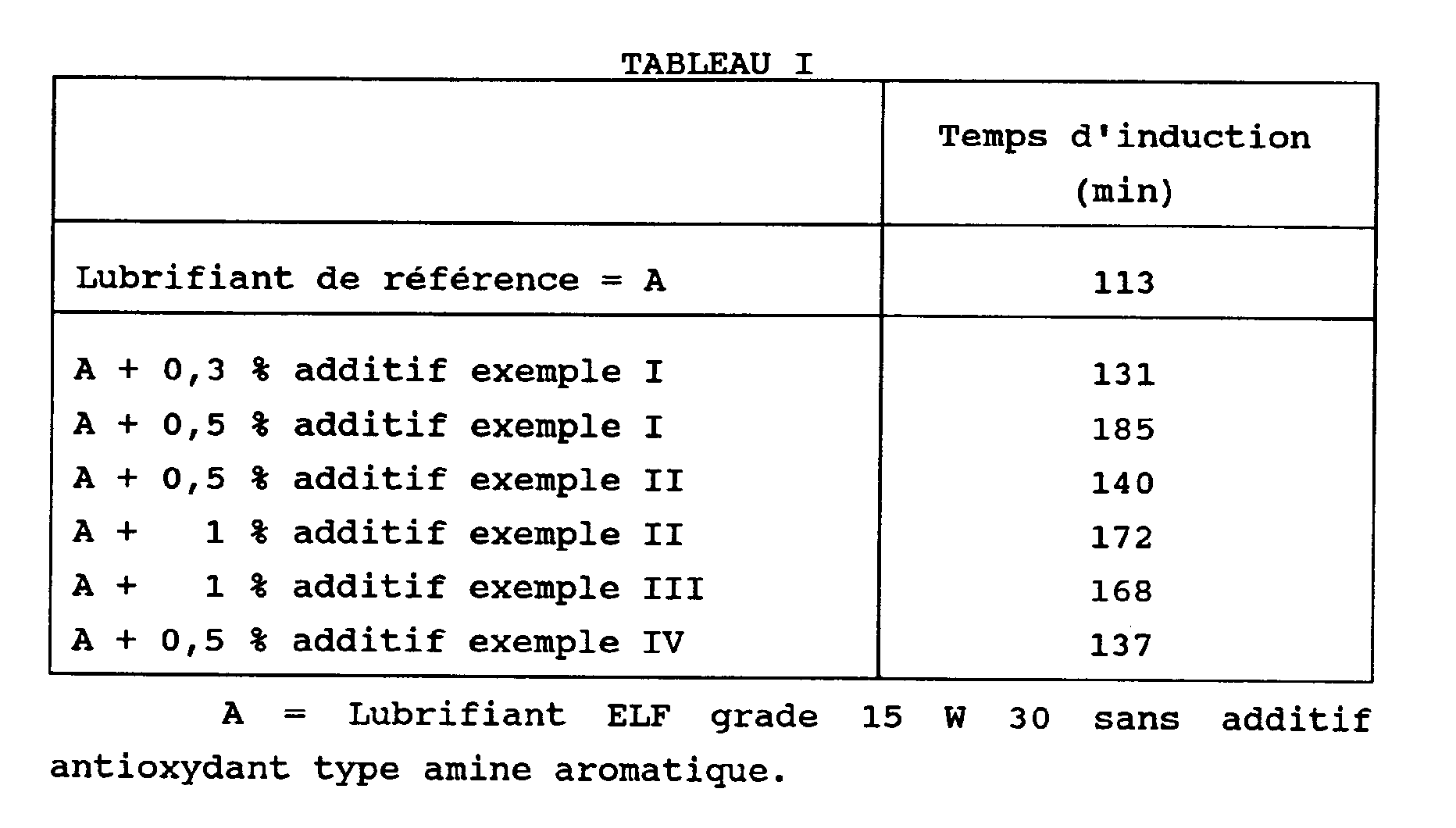
L'eau formée est éliminée avec le solvant au fur et à mesure de sa formation, on laisse ensuite refroidir. Après 2 jours à température ambiante, le précipité obtenu est filtré puis dissous dans le dichlorométhane. Après filtration et élimination du solvant, on recueille 1,3g d'une poudre marron.
Par spectroscopie IR on vérifie la présence de la bande d'adsorption du doublet de l'azote à 3300cm¹ caractéristique du produit attendu.
Claims (9)
- Additifs aux huiles lubrifiantes à effet antioxydant comportant un azote aromatique caractérisés en ce qu'ils répondent à la formule générale
 - Ar et Ar′ sont reliés entre eux pour former avec l'azote auquel ils sont rattachés une structure hétérocyclique aromatique choisi dans le groupe formé par la phénothiazine, l'imidazole, le benzimidazole, le triazole ou le benzotriazole- R et R′ identiques ou différents représentent un radical alkylène linéaire ou ramifié en C₂ à C₁₈, éventuellement substitué par un halogène ou un groupe - OH ou - NH₂- X représente un atome d'oxygène, de soufre ou un groupe - NH - , et- a est un nombre entier entre 0 et 5 et Y est choisi dans le groupe formé par
- N R₁R₂ (II)
où:- R₁ et R₂ identiques ou différents représentent un atome d'hydrogène ou un radical alkyle, alkényle, cycloalkyle ou arylalkyle en C₁ à C₁₂,
- N = CH - Ar₁ (III)
où:- Ar₁ est un radical aryle renfermant au moins un groupement phénolique, choisi dans le groupe formé par le phénol, le p-terbutylphénol, le diterbutyl-2,4-phénol, le diteramyl-2,4-phénol, le diterbutylparacrésol, le dodécylphénol, le dodécylphénol sulfurisé, le catéchol, le bêta-naphtol ou le résorcinol
- NR₁ - CO - Ar₁ (IV) et
 - R₃ est un atome d'hydrogène ou un oligomère d'une oléfine en C₂ à C₅ dont la masse moléculaire est comprise entre 500 et 3000 et de préférence entre 800 et 1500.
 - Additifs selon la revendication 1 caractérisés en ce que R et R′ identiques ou différents représentent un radical alkylène linéaire ou ramifié en C₂ à C₆, avantageusement en C₃.
- Additifs selon la revendication 1 ou 2 caractérisés en ce que a est un nombrer entier entre 0 et 2.
- Additifs selon la revendication 1 caractérisés en ce que R₁ et R₂ identiques ou différents représentent un atome d'hydrogène ou un radical alkyle en C₁ à C₄.
- Additifs selon la revendication 1, caractérisés en ce que R₁ représente un atome d'hydrogène et R₂ représente un radical arylalkyl de formule générale - CH₂- Ar₁.
- Additifs selon la revendication 5 caractérisés en ce que le radical aryle Ar₁ est le diterbutyl 2,4-phénol, ou le dodécylphénol sulfurisé.
- Additifs selon la revendication 1 caractérisés en ce que la structure hétérocyclique aromatique est la phénothiazine.
- Composition lubrifiante caractérisée en ce qu'elle renferme une huile lubrifiante naturelle ou synthétique et 0,01 à 10% poids et de préférence 0,1 à 2,5% poids d'un additif selon l'une des revendications 1 à 7.
- Composition selon la revendication 8 caractérisée en ce qu'elle renferme d'autres additifs usuels des lubrifiants comme des inhibiteurs de corrosion, les détergents et les additifs antiusure, dispersant et antimousse.
Applications Claiming Priority (2)
| Application Number | Priority Date | Filing Date | Title |
|---|---|---|---|
| FR8815913A FR2639956B1 (fr) | 1988-12-05 | 1988-12-05 | Additifs azotes a effet antioxydant et compositions lubrifiantes renfermant lesdits additifs |
| FR8815913 | 1988-12-05 |
Publications (3)
| Publication Number | Publication Date |
|---|---|
| EP0377358A2 EP0377358A2 (fr) | 1990-07-11 |
| EP0377358A3 EP0377358A3 (en) | 1990-09-19 |
| EP0377358B1 true EP0377358B1 (fr) | 1993-03-24 |
Family
ID=9372578
Family Applications (1)
| Application Number | Title | Priority Date | Filing Date |
|---|---|---|---|
| EP89403355A Expired - Lifetime EP0377358B1 (fr) | 1988-12-05 | 1989-12-05 | Additifs azotes à effet antioxydant et compositions lubrifiantes renfermant lesdits additifs |
Country Status (4)
| Country | Link |
|---|---|
| EP (1) | EP0377358B1 (fr) |
| JP (1) | JP2797007B2 (fr) |
| DE (1) | DE68905587T2 (fr) |
| FR (1) | FR2639956B1 (fr) |
Families Citing this family (2)
| Publication number | Priority date | Publication date | Assignee | Title |
|---|---|---|---|---|
| US8268761B2 (en) * | 2009-12-08 | 2012-09-18 | Chevron Oronite Company Llc | Aminomethyl-substituted imidazole compounds for use as friction modifiers in lubricating oil compositions |
| JP2016117788A (ja) * | 2014-12-18 | 2016-06-30 | Jxエネルギー株式会社 | 潤滑油添加剤、および潤滑油組成物 |
Family Cites Families (10)
| Publication number | Priority date | Publication date | Assignee | Title |
|---|---|---|---|---|
| GB672875A (en) * | 1942-07-01 | 1952-05-28 | Anglamol Ltd | Improvements in lubricating compositions containing extreme pressure addition agents |
| GB601419A (en) * | 1944-12-13 | 1948-05-05 | Carbide & Carbon Chem Corp | Improvements in or relating to synthetic lubricant compositions |
| GB684640A (en) * | 1949-11-14 | 1952-12-24 | Socony Vacuum Oil Co Inc | Reaction products of n-acylated polyalkylenepolyamines with alkenyl succinic acids or anhydrides or derivatives thereof |
| US3402200A (en) * | 1966-05-19 | 1968-09-17 | Universal Oil Prod Co | N-polyaminopolyalkylenephenylenediamines |
| US3647694A (en) * | 1969-05-29 | 1972-03-07 | Cities Service Oil Co | Lubricating oil composition |
| FR2140646A1 (en) * | 1971-06-11 | 1973-01-19 | Grace W R Ltd | Oxidation stabilised ester lubricants - contg sec or tert aromatic amines and substd phenothiazines |
| US4116875A (en) * | 1975-05-09 | 1978-09-26 | Mobil Oil Corporation | Multifunctional substituted triazine functional fluid additives and compositions containing same |
| US4247300A (en) * | 1978-04-27 | 1981-01-27 | Phillips Petroleum Company | Imidazoline fuel detergents |
| GB8332797D0 (en) * | 1983-12-08 | 1984-01-18 | Ciba Geigy Ag | Antioxidant production |
| US4785095A (en) * | 1986-09-16 | 1988-11-15 | The Lubrizol Corporation | N-substituted thio alkyl phenothiazines |
-
1988
- 1988-12-05 FR FR8815913A patent/FR2639956B1/fr not_active Expired - Fee Related
-
1989
- 1989-12-05 JP JP1316334A patent/JP2797007B2/ja not_active Expired - Lifetime
- 1989-12-05 DE DE8989403355T patent/DE68905587T2/de not_active Expired - Fee Related
- 1989-12-05 EP EP89403355A patent/EP0377358B1/fr not_active Expired - Lifetime
Also Published As
| Publication number | Publication date |
|---|---|
| EP0377358A2 (fr) | 1990-07-11 |
| DE68905587D1 (de) | 1993-04-29 |
| FR2639956B1 (fr) | 1993-04-23 |
| DE68905587T2 (de) | 1993-09-23 |
| EP0377358A3 (en) | 1990-09-19 |
| JPH02194094A (ja) | 1990-07-31 |
| JP2797007B2 (ja) | 1998-09-17 |
| FR2639956A1 (fr) | 1990-06-08 |
Similar Documents
| Publication | Publication Date | Title |
|---|---|---|
| FR2909683A1 (fr) | Composition d'huile lubrifiante contenant du titane | |
| EP0002158B1 (fr) | Alcénylsuccinimides, leur procédé de préparation et leur emploi comme additifs pour lubrifiants | |
| EP0375503A1 (fr) | Additifs aux lubrifiants résultant de la condensation d'une alkylène polyamine sur un copolymère ayant des groupements carboxyliques vicinaux | |
| CA1081700A (fr) | Compositions a base d'alcenylsuccinimides derives de la n,n,n',n' tetrakis (amino-3 propyl) ethylene diamine | |
| EP0248697B1 (fr) | Lubrifiants et nouveaux composés polyfluorés utilisables comme additifs | |
| CA1276643C (fr) | Composes de thiadiazole, et additifs lubrifiants pour lesdits composes | |
| EP0273868A2 (fr) | Tétrahydroquinoléines N-substituées comme anti-oxydants pour lubrifiants | |
| FR2488615A1 (fr) | Desactivateur de metaux et composition le contenant | |
| US8461387B2 (en) | Preparation of nitrones | |
| EP0296935B1 (fr) | Composés polyfluorés, leur préparation et leur utilisation comme additifs pour lubrifiants | |
| JP4070715B2 (ja) | 潤滑剤のオキサジアゾール添加剤 | |
| EP0377358A2 (fr) | Additifs azotes à effet antioxydant et compositions lubrifiantes renfermant lesdits additifs | |
| CA1113940A (fr) | Compositions a base d'alcenylsuccinimides, derives de la tris(amino-5 thia-3 pentyl) amine, leur procede de preparation et leur application comme additifs pour lubrifiants | |
| US4012408A (en) | Lubricating oil additives | |
| US5269954A (en) | Nitrogenous additives with an antioxidant action and lubricating compositions containing the said additives | |
| US4770799A (en) | Copper salts of hindered phenol substituted succinic anhydride derivatives as antioxidant additives | |
| JPH11158482A (ja) | ペンタエリスリトール誘導体およびその潤滑添加剤としての使用 | |
| EP0307886A2 (fr) | Dérivés amino-méthyles de mono- et dithiocarbamates comme additifs de lubrifiants | |
| JPH11515053A (ja) | 酸化防止剤スラッジ抑制添加剤 | |
| FR2529912A1 (fr) | Procede de preparation de dithiobenzoates de metaux, et compositions hydrocarbonees lubrifiantes contenant un tel additif | |
| EP0516802B1 (fr) | Nouveaux composes sulfures, leur preparation et leur utilisation comme additifs pour huiles lubrifiantes | |
| FR2647117A1 (fr) | ||
| CN115368957B (zh) | 含有无灰tbn分子的润滑剂组合物 | |
| JP2883992B2 (ja) | 安定化有機材料 | |
| SU1498762A1 (ru) | Бис-(бутилтиотиокарбонилметил)сульфид в качестве многофункциональной присадки к смазочным маслам |
Legal Events
| Date | Code | Title | Description |
|---|---|---|---|
| PUAI | Public reference made under article 153(3) epc to a published international application that has entered the european phase |
Free format text: ORIGINAL CODE: 0009012 |
|
| 17P | Request for examination filed |
Effective date: 19891208 |
|
| AK | Designated contracting states |
Kind code of ref document: A2 Designated state(s): BE DE FR GB IT NL |
|
| PUAL | Search report despatched |
Free format text: ORIGINAL CODE: 0009013 |
|
| AK | Designated contracting states |
Kind code of ref document: A3 Designated state(s): BE DE FR GB IT NL |
|
| 17Q | First examination report despatched |
Effective date: 19910308 |
|
| GRAA | (expected) grant |
Free format text: ORIGINAL CODE: 0009210 |
|
| RAP1 | Party data changed (applicant data changed or rights of an application transferred) |
Owner name: ELF ANTAR FRANCE |
|
| AK | Designated contracting states |
Kind code of ref document: B1 Designated state(s): BE DE FR GB IT NL |
|
| REF | Corresponds to: |
Ref document number: 68905587 Country of ref document: DE Date of ref document: 19930429 |
|
| ITF | It: translation for a ep patent filed | ||
| GBT | Gb: translation of ep patent filed (gb section 77(6)(a)/1977) |
Effective date: 19930528 |
|
| PLBE | No opposition filed within time limit |
Free format text: ORIGINAL CODE: 0009261 |
|
| STAA | Information on the status of an ep patent application or granted ep patent |
Free format text: STATUS: NO OPPOSITION FILED WITHIN TIME LIMIT |
|
| 26N | No opposition filed | ||
| PGFP | Annual fee paid to national office [announced via postgrant information from national office to epo] |
Ref country code: FR Payment date: 19981022 Year of fee payment: 10 |
|
| PGFP | Annual fee paid to national office [announced via postgrant information from national office to epo] |
Ref country code: NL Payment date: 19981123 Year of fee payment: 10 Ref country code: GB Payment date: 19981123 Year of fee payment: 10 |
|
| PGFP | Annual fee paid to national office [announced via postgrant information from national office to epo] |
Ref country code: DE Payment date: 19981202 Year of fee payment: 10 |
|
| PGFP | Annual fee paid to national office [announced via postgrant information from national office to epo] |
Ref country code: BE Payment date: 19981223 Year of fee payment: 10 |
|
| PG25 | Lapsed in a contracting state [announced via postgrant information from national office to epo] |
Ref country code: GB Free format text: LAPSE BECAUSE OF NON-PAYMENT OF DUE FEES Effective date: 19991205 |
|
| PG25 | Lapsed in a contracting state [announced via postgrant information from national office to epo] |
Ref country code: BE Free format text: LAPSE BECAUSE OF NON-PAYMENT OF DUE FEES Effective date: 19991231 |
|
| BERE | Be: lapsed |
Owner name: ELF ANTAR FRANCE Effective date: 19991231 |
|
| PG25 | Lapsed in a contracting state [announced via postgrant information from national office to epo] |
Ref country code: NL Free format text: LAPSE BECAUSE OF NON-PAYMENT OF DUE FEES Effective date: 20000701 |
|
| GBPC | Gb: european patent ceased through non-payment of renewal fee |
Effective date: 19991205 |
|
| PG25 | Lapsed in a contracting state [announced via postgrant information from national office to epo] |
Ref country code: FR Free format text: LAPSE BECAUSE OF NON-PAYMENT OF DUE FEES Effective date: 20000831 |
|
| NLV4 | Nl: lapsed or anulled due to non-payment of the annual fee |
Effective date: 20000701 |
|
| PG25 | Lapsed in a contracting state [announced via postgrant information from national office to epo] |
Ref country code: DE Free format text: LAPSE BECAUSE OF NON-PAYMENT OF DUE FEES Effective date: 20001003 |
|
| REG | Reference to a national code |
Ref country code: FR Ref legal event code: ST |
|
| PG25 | Lapsed in a contracting state [announced via postgrant information from national office to epo] |
Ref country code: IT Free format text: LAPSE BECAUSE OF NON-PAYMENT OF DUE FEES;WARNING: LAPSES OF ITALIAN PATENTS WITH EFFECTIVE DATE BEFORE 2007 MAY HAVE OCCURRED AT ANY TIME BEFORE 2007. THE CORRECT EFFECTIVE DATE MAY BE DIFFERENT FROM THE ONE RECORDED. Effective date: 20051205 |