EP0377992A2 - Gleitkommadivisions-Verfahren und -Anordnung - Google Patents
Gleitkommadivisions-Verfahren und -Anordnung Download PDFInfo
- Publication number
- EP0377992A2 EP0377992A2 EP89313402A EP89313402A EP0377992A2 EP 0377992 A2 EP0377992 A2 EP 0377992A2 EP 89313402 A EP89313402 A EP 89313402A EP 89313402 A EP89313402 A EP 89313402A EP 0377992 A2 EP0377992 A2 EP 0377992A2
- Authority
- EP
- European Patent Office
- Prior art keywords
- reciprocal
- guess
- quotient
- computing
- current
- Prior art date
- Legal status (The legal status is an assumption and is not a legal conclusion. Google has not performed a legal analysis and makes no representation as to the accuracy of the status listed.)
- Granted
Links
Images



Classifications
-
- G—PHYSICS
- G06—COMPUTING OR CALCULATING; COUNTING
- G06F—ELECTRIC DIGITAL DATA PROCESSING
- G06F7/00—Methods or arrangements for processing data by operating upon the order or content of the data handled
- G06F7/38—Methods or arrangements for performing computations using exclusively denominational number representation, e.g. using binary, ternary, decimal representation
- G06F7/48—Methods or arrangements for performing computations using exclusively denominational number representation, e.g. using binary, ternary, decimal representation using non-contact-making devices, e.g. tube, solid state device; using unspecified devices
- G06F7/52—Multiplying; Dividing
- G06F7/535—Dividing only
-
- G—PHYSICS
- G06—COMPUTING OR CALCULATING; COUNTING
- G06F—ELECTRIC DIGITAL DATA PROCESSING
- G06F2207/00—Indexing scheme relating to methods or arrangements for processing data by operating upon the order or content of the data handled
- G06F2207/535—Indexing scheme relating to groups G06F7/535 - G06F7/5375
- G06F2207/5351—Multiplicative non-restoring division, e.g. SRT, using multiplication in quotient selection
-
- G—PHYSICS
- G06—COMPUTING OR CALCULATING; COUNTING
- G06F—ELECTRIC DIGITAL DATA PROCESSING
- G06F2207/00—Indexing scheme relating to methods or arrangements for processing data by operating upon the order or content of the data handled
- G06F2207/535—Indexing scheme relating to groups G06F7/535 - G06F7/5375
- G06F2207/5355—Using iterative approximation not using digit recurrence, e.g. Newton Raphson or Goldschmidt
-
- G—PHYSICS
- G06—COMPUTING OR CALCULATING; COUNTING
- G06F—ELECTRIC DIGITAL DATA PROCESSING
- G06F2207/00—Indexing scheme relating to methods or arrangements for processing data by operating upon the order or content of the data handled
- G06F2207/535—Indexing scheme relating to groups G06F7/535 - G06F7/5375
- G06F2207/5356—Via reciprocal, i.e. calculate reciprocal only, or calculate reciprocal first and then the quotient from the reciprocal and the numerator
-
- G—PHYSICS
- G06—COMPUTING OR CALCULATING; COUNTING
- G06F—ELECTRIC DIGITAL DATA PROCESSING
- G06F7/00—Methods or arrangements for processing data by operating upon the order or content of the data handled
- G06F7/38—Methods or arrangements for performing computations using exclusively denominational number representation, e.g. using binary, ternary, decimal representation
- G06F7/48—Methods or arrangements for performing computations using exclusively denominational number representation, e.g. using binary, ternary, decimal representation using non-contact-making devices, e.g. tube, solid state device; using unspecified devices
- G06F7/483—Computations with numbers represented by a non-linear combination of denominational numbers, e.g. rational numbers, logarithmic number system or floating-point numbers
- G06F7/487—Multiplying; Dividing
- G06F7/4873—Dividing
-
- G—PHYSICS
- G06—COMPUTING OR CALCULATING; COUNTING
- G06F—ELECTRIC DIGITAL DATA PROCESSING
- G06F7/00—Methods or arrangements for processing data by operating upon the order or content of the data handled
- G06F7/38—Methods or arrangements for performing computations using exclusively denominational number representation, e.g. using binary, ternary, decimal representation
- G06F7/48—Methods or arrangements for performing computations using exclusively denominational number representation, e.g. using binary, ternary, decimal representation using non-contact-making devices, e.g. tube, solid state device; using unspecified devices
- G06F7/499—Denomination or exception handling, e.g. rounding or overflow
- G06F7/49942—Significance control
- G06F7/49947—Rounding
- G06F7/49957—Implementation of IEEE-754 Standard
Definitions
- This invention relates to data processing system and performing floating point operations and more specifically to a data processing system performing a floating point division operation.
- U.S. Patent No. 4,442,492 discloses a data processing system that includes a technique for inserting a round bit in the appropriate bit of the floating point mantissa.
- U.S. Patent No. 4,413,326 discloses a mechanism for performing floating point calculations in a variable number of steps using a primary microprocessor and second microprocessor where each microprocessor includes its own control read only memory. Floating point operations include the participation of both microprocessors. In executing the division operation mantissa are preconditioned to be normalised, the most significant bit being a logical 1. The operation proceeds until the leading bit of the mantissa becomes a 1 signifying the completion of the operation.
- U.S. Patent No. 4,481,600 discloses a technique of generating quotients from successive iterations.
- U.S. Patent No. 4,707,798 discloses a divide method using an approximate reciprocal divisors to calculate the quotient that can shorten the time required for performing check and correction after intermediate quotients have been calculated through the successive iteration process.
- U.S. Patent No. 3,508,038 discloses an apparatus for dividing a fractional binary dividend by a fractional binary divisor wherein the quotient is developed by performing successive multiplications of the dividend and approximate reciprocals of the divisor.
- U.S. Patent No. 4,011,439 discloses an accelerated method of generating quotients of two binary numbers.
- a divisor array is used to effectively form the reciprocal of the binary divisor and the quotient is determined by multiplying the reciprocal with the dividend.
- U.S. Patent No. 3,648,038 discloses a method for obtaining the reciprocal of a number of using a flow-through technique. In this method the reciprocal of the divisor is multiplied with the dividend to produce the desired quotient.
- U.S. Patent No. 3,633,018 discloses a method which is used to find the reciprocal of a number with two multiplications and the quotient of the two numbers with three multiplications.
- U.S. Patent No. 3,777,132 discloses a method for performing a binary division by multiplying the reciprocal of a divisor by a dividend. The quotient is generated at the same time as the reciprocal of the divisor.
- a method for performing floating point division of a dividend by a divisor for producing a quotient having a mantissa of N bits comprising the steps of:
- the present invention also provides apparatus for performing such a method.
- both a method and apparatus for performing floating point division are described wherein the floating point division is a division of a dividend by a divisor that produces a quotient having a mantissa of n bits.
- the apparatus includes a circuit for computing an initial guess of a reciprocal of the divisor. Also, a circuit for computing an initial guess of the quotient from the initial guess of the reciprocal is included. Circuitry for increasing the precision of the initial guess of the reciprocal guess by computing an error parameter and a computing a current guess the reciprocal from the error parameter and the initial guess of the reciprocal is provided.
- a circuit for increasing the precision of the mantissa of the initial guess of the quotient by computing a current quotient from the current guess of the reciprocal is also provided. Also, a circuit for computing a remainder guess from the current reciprocal guess and the current quotient guess is provided. A circuit for increasing the precision of the mantissa of the reciprocal quotient and remainder are provided. The precision is increased until the precision of the reciprocal and the quotient exceeds n bits. Lastly, a circuit is provided that computes a final quotient from the last current quotient plus the last current reciprocal times the last remainder. Initially, floating point division is accomplished as previously described implementing a rounding scheme by performing round-to-nearest operations. When performing the final operation, i.e., the computation of the final quotient, other rounding schemes may be used such as round-to-zero, round toward negative infinity or round toward positive infinity as well as round-to-nearest.
- the disclosed apparatus for performing floating point division of a dividend by a divisor for producing a quotient having a rounded mantissa of N bit precision comprises means for computing an initial guess of a reciprocal of the divisor; means for computing an initial guess of the quotient from the initial guess of the reciprocal rounding by a round-to-nearest operation; means for increasing the precision of the mantissa of the initial guess of the reciprocal by computing an error parameter and computing a current guess of the reciprocal from the error parameter and the initial guess of the reciprocal rounding by a round-to-nearest operation; means for increasing the precision of the mantissa of the initial guess of the quotient by computing a current quotient from the current guess of the reciprocal rounding by a round-to-nearest operation; means for computing a remainder guess from the current reciprocal guess and the current quotient guess rounding by a round-to-nearest operation; means for increasing the precision of the mantissas of the current guesses of
- the method for performing the floating point division addresses only the treatment of the mantissa of the operands and results.
- the treatment of exponents is well known in the art so will not be addressed in this discussion.
- the five steps of the division will now be discussed.
- round-to-nearest which selects the closest representable number in the mantissa.
- the second possibility is a round-to-zero which discards the fractional bits that don't fit in the mantissa. This is commonly termed truncation.
- Another rounding mode is the round-to-positive infinity which means that the rounding is accomplished by rounding to the next largest representable number.
- round-to-negative infinity includes rounding to the next smaller representative number.
- the round-to-positive infinity and round-to-negative infinity are between in complexity.
- the floating point arithmetic unit performs one primitive operation: A + B*C with three variations (a) -A + B*C; (b) -A - B*C; and (c) A - B*C with each primitive operation being performed with only one rounding error (i.e., rounding is accomplished at the last stage of computation).
- a + B*C with three variations (a) -A + B*C; (b) -A - B*C; and (c) A - B*C with each primitive operation being performed with only one rounding error (i.e., rounding is accomplished at the last stage of computation).
- Rounding is accomplished at the last stage of computation.
- Ordinary addition and subtraction are accomplished by inserting a 1.0 for the C operand and ordinary multiplication is realised by giving the A operand the value of 0.0.
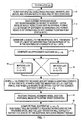
- step 10 numbers such as infinities and zeros together with numbers that do not represent numeric values are removed from the computation. In other words, when such numbers are encountered, the results required by the IEEE standard is returned.
- step 12 the current rounding mode is changed from whatever the current rounding mode is to a round-to-nearest operation.
- step 14 an initial guess of the reciprocal of the divisor is made. If the divisor mantissa is all one bits, the magnitude of the reciprocal must be greater than the actual magnitude of 1/b.
- step 16 the reciprocal y is used with a to compute an initial guess of the quotient. In steps 18 and 20, the reciprocal y and the quotient q are improved.
- step 18 the error term e is computed as shown. This error term is then used to recompute the current guess or estimate of the reciprocal y as shown.
- step 20 the quotient is "improved” by first computing the remainder using the dividend and the divisor together with the last estimate of the quotient and estimating a new quotient by using the last quotient the computed remainder and the latest estimate of the reciprocal. Steps 18 and 20 can be performed iteratively and in either order relative to each other.
- step 22 when the reciprocal y and the quotient q have been iteratively improved to the point where their precision exceeds the precision of the mantissa before the results were rounded, the final remainder is computed as shown. In step 24, the original rounding mode is restored. In step 25, the final quotient is computed as shown.
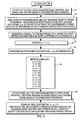
- step 30 the non-numbers, infinities and zeros are filtered out by providing the results dictated by the IEEE standard.
- step 32 the current rounding mode is changed to round-to-nearest operation.
- step 34 an initial guess of the reciprocal y is made by accessing a table as illustrated in Appendix A.
- step 36 the error term e is computed as shown.
- step 38 the first approximation of the quotient q is made.
- step 40 she quotient q and the reciprocal y are "improved" by performing the computations in accordance with the sequence shown.
- step 42 the original rounding mode is restored.
- step 44 the final quotient is computed is shown.
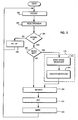
- Figure 3 illustrates a second preferred embodiment of the inventive method.
- step 50 the non-numbers, infinities and zeros are filtered as before.
- step 52 the current rounding mode is altered to a round-to-nearest operation.
- step 54 the initial guess of the reciprocal is made according to the table in Appendix A. The reciprocal is then refined by the computation of the error term e as shown and the following reciprocal calculations.
- step 56 the error term e is recomputed using the latest reciprocal estimate.
- step 58 the quotient estimate is generated.
- step 60 the mantissa of the reciprocal and quotient are "improved" as shown be preforming the computations illustrated.
- step 62 the original rounding mode is restored.
- step 64 the final quotient is computed.
- Figure 4 is a block diagram of a floating point arithmetic unit. This particular floating point unit provides for a multiplication and addition operation to occur in parallel.
- Register file 70 contains 40 floating point arithmetic words. Under the control of control circuitry 106 through control line 108 and a floating point arithmetic data word is loaded into the A OPERATION LATCH 72. Likewise, the contents of B OPERATION LATCH 74 and C OPERATION LATCH 76 are loaded. The contents of the A OPERATION LATCH 72 and B OPERATION LATCH 74 are provided to a multiplier 82. The contents of the B OPERATION LATCH 74 passes through a multiplexor 78 to be explained later.
- the multiplier 82 provides a partial product to latch 86 and a second partial product to latch 88.
- the C OPERATION LATCH 76 provides the floating point number through multiplexor 80 to an align shifter 84.
- the output of the align shifter 84 is provided to the addend latch 90. It should be understood that the contents of the registers that are operated on by the multiplier 82 and the align shifter 84 is that of the mantissa of the floating point number.
- the operation of multiplication of the exponent is provided in the control circuitry 106 and consists of addition.
- the result of the exponent calculation provides an input to the alignment shifter 84 to properly shift the contents of the C OPERATION LATCH so it may be added to the product of the A OPERATION LATCH 72 and B OPERATION LATCH 74.
- the 3:2 carry save adder 92 receives the contents of latches 86, 88 and 90. Two outputs are provided to the full adder 94. The contents of the full adder 94 is normalised in the normalising circuit 96 and then stored in the result latch 98. The output of the result latch 98 is provided to the round incrementor 100. The output of the round incrementor 100 can be provided to the register file 70 or as a substitute for multiplexor 78 to the multiplier or through the multiplexor 80 to the align shifter 84. Since this floating point arithmetic logic unit operates in the pipeline fashion, by providing multiplexor 78 and 80, results from a previous instruction may be used for a successive instruction without being stored in the register file 70.
- control circuitry 106 functions with a divide microcode control circuit 102 via line 104 to implement the divide procedures illustrated in Figures 1, 2, and 3.
- Figure 5 illustrates the control flow of the control circuit 106.
- the floating point instruction is decoded in step 200 and the operands are read in step 202 (from the register file 70).
- step 204 a determination is made as to whether or not the operands are normal numbers (corresponding to step 30, Figure 2, filtering out special cases). If the operands are not normal numbers, the control flow proceeds to step 206 to "fix-up" the numbers according to the IEEE standard and the control flow returns to step 200. However, if the numbers are normal numbers, the control flow proceeds to step 208 to determine if there is a divided instruction present. If there is no divided instruction, the control flow proceeds to step 216.
- step 216 the multiply step
- step 220 the write back into the register file 70.
- Step 216 (the multiply step) corresponds to the multiplication of the remainder r by the reciprocal in step 44.
- step 218 of Figure 5 corresponds to the adding of the quotient to the remainder times reciprocal in step 44.
- the write back to register step 220 corresponds to the writing of the final quotient into the register file 70.
- Figure 6 illustrates the contents of the divide marker code 210.
- the rounding mode is reset to round to nearest rounding mode.
- the reciprocal y is looked up in the look-up table for the first reciprocal guess.
- the error term e is generated.
- the first approximation of the quotient q is made.
- the precision of the reciprocal y and the quotient q are increased by performing the calculations listed in step 240.
- the original rounding mode is restored.
- the multiple step 216, the add step 218 and the write back step 220 then correspond to the computation and storing of the final quotient (step 44, Figure 2).
- the quotient resulting from the floating point division operation is correct to the desired precision without requiring any additional circuitry.
- This appendix describes the generation of a first approximation to the reciprocal of a number, as required by the disclosed arrangements hereof.
- the table at the end generates approximations in the required manner.
- the operation RECIP Y,B is a floating point operation.
- Y and B are both floating point registers.
- the result of the operation is to put into register Y an approximation to the reciprocal of B.
- RECIP need not be exposed in the computer architecture, but instead, it may only be available for use by the DIVIDE instruction. In that case, it may not be necessary to cope with NaNs, infinities, or zeros, since these cases would be treated as special cases by the hardware.
- Each example starts by showing the numerator and denominator, as well as the rounding mode.
- the values generated by the preferred embodiment are shown on the left. The values are indented so as to make it easier to find the successive approximations to the quotients, reciprocals, remainders, and errors in the reciprocal.
- the remainder left for the quotient developed in the disclosed arrangement and the remainder left by the next-closest approximation to the quotient. Note that the approximation of the disclosed arrangement leaves the remainder with the smaller magnitude, as required by the IEEE round to nearest mode of operation.
Landscapes
- Physics & Mathematics (AREA)
- General Physics & Mathematics (AREA)
- Engineering & Computer Science (AREA)
- Computational Mathematics (AREA)
- Mathematical Analysis (AREA)
- Mathematical Optimization (AREA)
- Pure & Applied Mathematics (AREA)
- Theoretical Computer Science (AREA)
- Computing Systems (AREA)
- General Engineering & Computer Science (AREA)
- Complex Calculations (AREA)
Applications Claiming Priority (2)
| Application Number | Priority Date | Filing Date | Title |
|---|---|---|---|
| US29777189A | 1989-01-13 | 1989-01-13 | |
| US297771 | 1989-01-13 |
Publications (3)
| Publication Number | Publication Date |
|---|---|
| EP0377992A2 true EP0377992A2 (de) | 1990-07-18 |
| EP0377992A3 EP0377992A3 (de) | 1992-01-08 |
| EP0377992B1 EP0377992B1 (de) | 1996-04-17 |
Family
ID=23147678
Family Applications (1)
| Application Number | Title | Priority Date | Filing Date |
|---|---|---|---|
| EP19890313402 Expired - Lifetime EP0377992B1 (de) | 1989-01-13 | 1989-12-20 | Gleitkommadivisions-Verfahren und -Anordnung |
Country Status (3)
| Country | Link |
|---|---|
| EP (1) | EP0377992B1 (de) |
| JP (1) | JPH0687219B2 (de) |
| DE (1) | DE68926289T2 (de) |
Cited By (8)
| Publication number | Priority date | Publication date | Assignee | Title |
|---|---|---|---|---|
| EP0411491A3 (en) * | 1989-08-02 | 1992-05-13 | Cyrix Corporation | Method and apparatus for performing division using a rectangular aspect ratio multiplier |
| EP0461240A4 (en) * | 1989-12-29 | 1993-08-11 | Motorola, Inc. | Methods and apparatus for efficient resource allocation for error and exception handling in convergent division |
| US5341321A (en) * | 1993-05-05 | 1994-08-23 | Hewlett-Packard Company | Floating point arithmetic unit using modified Newton-Raphson technique for division and square root |
| GB2372353A (en) * | 2000-12-20 | 2002-08-21 | Sicon Video Corp | Method and apparatus for calculating a reciprocal |
| WO2012031177A1 (en) * | 2010-09-03 | 2012-03-08 | Advanced Micro Devices, Inc. | Method and apparatus for performing floating-point division |
| GB2488665A (en) * | 2011-03-01 | 2012-09-05 | Nvidia Corp | Detecting a valid square root, multiplicative inverse or division of floating point numbers by checking if the error is less than a predetermined margin |
| US9146706B2 (en) | 2006-05-05 | 2015-09-29 | Qualcomm Incorporated | Controlled-precision iterative arithmetic logic unit |
| CN115619883A (zh) * | 2022-10-31 | 2023-01-17 | 上海华虹宏力半导体制造有限公司 | 版图数据精度的转换方法 |
Families Citing this family (1)
| Publication number | Priority date | Publication date | Assignee | Title |
|---|---|---|---|---|
| JP2020166661A (ja) * | 2019-03-29 | 2020-10-08 | 日本電気株式会社 | 除算装置、除算方法及びプログラム |
Family Cites Families (6)
| Publication number | Priority date | Publication date | Assignee | Title |
|---|---|---|---|---|
| US3828175A (en) * | 1972-10-30 | 1974-08-06 | Amdahl Corp | Method and apparatus for division employing table-lookup and functional iteration |
| JPS54136147A (en) * | 1978-04-13 | 1979-10-23 | Panafacom Ltd | Divider |
| JPS5520508A (en) * | 1978-06-29 | 1980-02-14 | Panafacom Ltd | Processor for division |
| US4594680A (en) * | 1983-05-04 | 1986-06-10 | Sperry Corporation | Apparatus for performing quadratic convergence division in a large data processing system |
| JPS60164837A (ja) * | 1984-02-07 | 1985-08-27 | Nec Corp | 除算装置 |
| JPS61262930A (ja) * | 1985-05-17 | 1986-11-20 | Nec Corp | 除算装置 |
-
1989
- 1989-12-20 EP EP19890313402 patent/EP0377992B1/de not_active Expired - Lifetime
- 1989-12-20 DE DE1989626289 patent/DE68926289T2/de not_active Expired - Fee Related
-
1990
- 1990-01-12 JP JP2003659A patent/JPH0687219B2/ja not_active Expired - Lifetime
Cited By (9)
| Publication number | Priority date | Publication date | Assignee | Title |
|---|---|---|---|---|
| EP0411491A3 (en) * | 1989-08-02 | 1992-05-13 | Cyrix Corporation | Method and apparatus for performing division using a rectangular aspect ratio multiplier |
| EP0461240A4 (en) * | 1989-12-29 | 1993-08-11 | Motorola, Inc. | Methods and apparatus for efficient resource allocation for error and exception handling in convergent division |
| US5341321A (en) * | 1993-05-05 | 1994-08-23 | Hewlett-Packard Company | Floating point arithmetic unit using modified Newton-Raphson technique for division and square root |
| GB2372353A (en) * | 2000-12-20 | 2002-08-21 | Sicon Video Corp | Method and apparatus for calculating a reciprocal |
| US9146706B2 (en) | 2006-05-05 | 2015-09-29 | Qualcomm Incorporated | Controlled-precision iterative arithmetic logic unit |
| WO2012031177A1 (en) * | 2010-09-03 | 2012-03-08 | Advanced Micro Devices, Inc. | Method and apparatus for performing floating-point division |
| GB2488665A (en) * | 2011-03-01 | 2012-09-05 | Nvidia Corp | Detecting a valid square root, multiplicative inverse or division of floating point numbers by checking if the error is less than a predetermined margin |
| US8775494B2 (en) | 2011-03-01 | 2014-07-08 | Nvidia Corporation | System and method for testing whether a result is correctly rounded |
| CN115619883A (zh) * | 2022-10-31 | 2023-01-17 | 上海华虹宏力半导体制造有限公司 | 版图数据精度的转换方法 |
Also Published As
| Publication number | Publication date |
|---|---|
| JPH0687219B2 (ja) | 1994-11-02 |
| DE68926289D1 (de) | 1996-05-23 |
| EP0377992B1 (de) | 1996-04-17 |
| EP0377992A3 (de) | 1992-01-08 |
| JPH02227726A (ja) | 1990-09-10 |
| DE68926289T2 (de) | 1996-10-10 |
Similar Documents
| Publication | Publication Date | Title |
|---|---|---|
| US5249149A (en) | Method and apparatus for performining floating point division | |
| JP3541066B2 (ja) | コンピュータにおいて除算および平方根計算を実施するための方法および装置 | |
| EP0421092B1 (de) | Verfahren und Gerät zur Ausführung mathematischer Funktionen mit Hilfe polynomialer Annäherung und eines Multiplizierers rechteckigen Seitenverhältnisses | |
| US5954789A (en) | Quotient digit selection logic for floating point division/square root | |
| CN107769791B (zh) | 用于定点到浮点的转换的装置和方法及2的负幂检测器 | |
| US5046038A (en) | Method and apparatus for performing division using a rectangular aspect ratio multiplier | |
| EP0149248A2 (de) | Verfahren und Gerät zur Division mit Annäherung durch Interpolation | |
| US8060551B2 (en) | Method and apparatus for integer division | |
| EP0356153B1 (de) | Verfahren und Gerät zur Radix-2**n-Division mit überlappender Quotientenbitauswahl und gleichzeitiger Rundung und Korrektur des Quotienten | |
| EP0416308A2 (de) | Rechteckiger Matrixstrukturierter Vorzeichenziffernmultiplizierer | |
| US4594680A (en) | Apparatus for performing quadratic convergence division in a large data processing system | |
| JPH04283831A (ja) | 除算器 | |
| US5260889A (en) | Computation of sticky-bit in parallel with partial products in a floating point multiplier unit | |
| EP0377992B1 (de) | Gleitkommadivisions-Verfahren und -Anordnung | |
| US4996660A (en) | Selection of divisor multipliers in a floating point divide circuit | |
| US6598065B1 (en) | Method for achieving correctly rounded quotients in algorithms based on fused multiply-accumulate without requiring the intermediate calculation of a correctly rounded reciprocal | |
| US8788560B2 (en) | Decimal elementary functions computation | |
| US9658827B2 (en) | Apparatus and method for performing reciprocal estimation operation | |
| CN108153513B (zh) | 前导零预测 | |
| US7752250B2 (en) | Rounding floating point division results | |
| EP0166999A2 (de) | Zeitsparendes Verfahren zum Berechnen von Quadratwurzeln in einem Rechner, welcher eine "Ein Bit zugleich"-Divisionsinstruktion hat | |
| US7689642B1 (en) | Efficient accuracy check for Newton-Raphson divide and square-root operations | |
| EP0137525B1 (de) | Arithmetische Einheit mit Bit-Ausbreitungsschaltung in einem Datenverarbeitungssystem | |
| JP2761145B2 (ja) | 開平演算装置 | |
| JPH0368414B2 (de) |
Legal Events
| Date | Code | Title | Description |
|---|---|---|---|
| PUAI | Public reference made under article 153(3) epc to a published international application that has entered the european phase |
Free format text: ORIGINAL CODE: 0009012 |
|
| AK | Designated contracting states |
Kind code of ref document: A2 Designated state(s): DE FR GB |
|
| 17P | Request for examination filed |
Effective date: 19901113 |
|
| PUAL | Search report despatched |
Free format text: ORIGINAL CODE: 0009013 |
|
| AK | Designated contracting states |
Kind code of ref document: A3 Designated state(s): DE FR GB |
|
| 17Q | First examination report despatched |
Effective date: 19950124 |
|
| GRAA | (expected) grant |
Free format text: ORIGINAL CODE: 0009210 |
|
| AK | Designated contracting states |
Kind code of ref document: B1 Designated state(s): DE FR GB |
|
| REF | Corresponds to: |
Ref document number: 68926289 Country of ref document: DE Date of ref document: 19960523 |
|
| ET | Fr: translation filed | ||
| PGFP | Annual fee paid to national office [announced via postgrant information from national office to epo] |
Ref country code: GB Payment date: 19961126 Year of fee payment: 8 |
|
| PGFP | Annual fee paid to national office [announced via postgrant information from national office to epo] |
Ref country code: DE Payment date: 19970116 Year of fee payment: 8 |
|
| PLBE | No opposition filed within time limit |
Free format text: ORIGINAL CODE: 0009261 |
|
| STAA | Information on the status of an ep patent application or granted ep patent |
Free format text: STATUS: NO OPPOSITION FILED WITHIN TIME LIMIT |
|
| 26N | No opposition filed | ||
| PG25 | Lapsed in a contracting state [announced via postgrant information from national office to epo] |
Ref country code: FR Effective date: 19970829 |
|
| REG | Reference to a national code |
Ref country code: FR Ref legal event code: ST |
|
| PG25 | Lapsed in a contracting state [announced via postgrant information from national office to epo] |
Ref country code: GB Free format text: LAPSE BECAUSE OF NON-PAYMENT OF DUE FEES Effective date: 19971220 |
|
| GBPC | Gb: european patent ceased through non-payment of renewal fee |
Effective date: 19971220 |
|
| PG25 | Lapsed in a contracting state [announced via postgrant information from national office to epo] |
Ref country code: DE Free format text: LAPSE BECAUSE OF NON-PAYMENT OF DUE FEES Effective date: 19980901 |