EP0378077A2 - Verfahren und Vorrichtung zur Analysierung durch Ionenmassenspektroskopie - Google Patents
Verfahren und Vorrichtung zur Analysierung durch Ionenmassenspektroskopie Download PDFInfo
- Publication number
- EP0378077A2 EP0378077A2 EP90100044A EP90100044A EP0378077A2 EP 0378077 A2 EP0378077 A2 EP 0378077A2 EP 90100044 A EP90100044 A EP 90100044A EP 90100044 A EP90100044 A EP 90100044A EP 0378077 A2 EP0378077 A2 EP 0378077A2
- Authority
- EP
- European Patent Office
- Prior art keywords
- specimen
- secondary ions
- scanning
- mass
- primary beam
- Prior art date
- Legal status (The legal status is an assumption and is not a legal conclusion. Google has not performed a legal analysis and makes no representation as to the accuracy of the status listed.)
- Withdrawn
Links
- 238000004611 spectroscopical analysis Methods 0.000 title claims abstract description 28
- 238000000034 method Methods 0.000 title claims abstract description 20
- 150000002500 ions Chemical class 0.000 claims abstract description 71
- 239000006185 dispersion Substances 0.000 claims description 9
- 238000010884 ion-beam technique Methods 0.000 abstract description 9
- 229920006395 saturated elastomer Polymers 0.000 description 6
- 238000004458 analytical method Methods 0.000 description 4
- 238000010586 diagram Methods 0.000 description 3
- 238000005516 engineering process Methods 0.000 description 3
- 230000007935 neutral effect Effects 0.000 description 3
- 239000002245 particle Substances 0.000 description 3
- 230000035945 sensitivity Effects 0.000 description 3
- 238000001514 detection method Methods 0.000 description 2
- 230000005684 electric field Effects 0.000 description 2
- YDLQKLWVKKFPII-UHFFFAOYSA-N timiperone Chemical compound C1=CC(F)=CC=C1C(=O)CCCN1CCC(N2C(NC3=CC=CC=C32)=S)CC1 YDLQKLWVKKFPII-UHFFFAOYSA-N 0.000 description 2
- 229950000809 timiperone Drugs 0.000 description 2
- 238000010276 construction Methods 0.000 description 1
- 238000007796 conventional method Methods 0.000 description 1
- 230000006866 deterioration Effects 0.000 description 1
- 238000012986 modification Methods 0.000 description 1
- 230000004048 modification Effects 0.000 description 1
- 230000002093 peripheral effect Effects 0.000 description 1
- 230000002265 prevention Effects 0.000 description 1
- 238000001004 secondary ion mass spectrometry Methods 0.000 description 1
- 238000004544 sputter deposition Methods 0.000 description 1
Images



Classifications
-
- H—ELECTRICITY
- H01—ELECTRIC ELEMENTS
- H01J—ELECTRIC DISCHARGE TUBES OR DISCHARGE LAMPS
- H01J49/00—Particle spectrometers or separator tubes
- H01J49/02—Details
- H01J49/04—Arrangements for introducing or extracting samples to be analysed, e.g. vacuum locks; Arrangements for external adjustment of electron- or ion-optical components
-
- H—ELECTRICITY
- H01—ELECTRIC ELEMENTS
- H01J—ELECTRIC DISCHARGE TUBES OR DISCHARGE LAMPS
- H01J37/00—Discharge tubes with provision for introducing objects or material to be exposed to the discharge, e.g. for the purpose of examination or processing thereof
- H01J37/252—Tubes for spot-analysing by electron or ion beams; Microanalysers
- H01J37/256—Tubes for spot-analysing by electron or ion beams; Microanalysers using scanning beams
Definitions
- the present invention relates to an ion mass-spectroscopic analysis method and apparatus, and more particularly to an ion mass-spectroscopic analysis method and apparatus suitable for mass-spectroscopic analysis of secondary ions generated from a specimen by bombardment of the specimen with primary ions or neutral particles.
- An object of the present invention is to provide an ion mass-spectroscopic analysis method and apparatus which are capable of making substantially uniform the efficiency of collection of secondary ions derived from a two-dimensional area of a specimen.
- Another object of the present invention is to provide an ion mass-spectroscopic analysis method and apparatus suitable for prevention or reduction of the deterioration of the efficiency of collection of secondary ions at that portion of a two-dimensional area which is distanced from a central portion of the two-dimensional area.
- one of a specimen and a primary beam with which the specimen is to be bombarded is moved relative to the other thereof in a first direction while the other is moved relative to the one in a second direction substantially perpendicular to the first direction.
- the conventionally conducted scanning of the specimen by the primary beam in a direction in which the uniformity of the efficiency of collection of secondary ions is poor can be substituted by the movement of the specimen. Since it is not necessary to move the primary beam in that direction, there is eliminated a fear that the uniformity of the efficiency of collection of secondary ions may be deteriorated in that direction. Accordingly, the efficiency of collection of secondary ions is made substantially uniform over the whole of a two-dimentional area where secondary ions are to be generated.
- a specimen is raster-scanned with a primary beam of diameter d by L X in an X direction and by L Y in a Y direction.
- the primary beam is moved on the specimen by L X in the X direction and by L Y in the Y direction.
- the raster scan causes the substantially uniform sputtering of the specimen by the primary beam, as shown in Fig. 1b.
- Fig. 2a shows the shape of an object point slit in an apparatus for mass-spectroscopic analysis of secondary ions.
- an X direction coincides with a direction of mass dispersion or scattering of secondary ions by a magnetic field in the mass-spectroscopic analysis apparatus.
- FIG. 2b shows a change of the intensity I2 of secondary ions when the primary beam is moved in the X direction or direction of width S0 of the object point slit
- Fig. 2c shows a change of the intensity I2 of secondary ions when the primary beam is moved in the Y direction or direction of height h0 of the object point slit.
- Data shown in Figs. 2b and 2c are data obtained in the case where the element concentration of the sample is constant in each of the X and Y directions. From the figures, it can be seen that the intensity of secondary ions is remarkable or high in the X direction. This tendency becomes more remarkable as the width S0 of the object point slit is made narrow. As a result, in the case where the element concentration distribution image of the two-dimensional area of the specimen is obtained, there arises a problem that the image is bright at a central portion thereof and dark at a peripheral portion thereof.
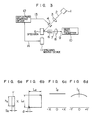
- a primary ion beam 2 generated and accelerated by an ion source 1 is impinged upon a specimen 5 through a lens system 3 and a deflector 4.
- the primary beam may be a high-speed neutral particle beam.
- Secondary ions 7 emitted from the specimen 5 are extracted by an entracting electrode 6 and are focused onto an object point slit 9 by a lens 8.
- the secondary ions emerging from the slit 9 are introduced into a mass spectrometer 10 for mass-spectroscopic analysis thereof.
- the mass spectrometer 10 includes a magnet which generates a magnetic field for mass dispersion. In many cases, the mass spectrometer 10 further includes an electrode which generates an electric field for velocity dispersion.
- a deflection scanning device 12 is connected with the beam deflector 4 for primary ion beam and a specimen moving device 11 which gives a small movement to the specimen 5.
- the deflection scanning device 12 supplies a deflection control signal 13 and a specimen movement control signal 14 to the deflector 4 and the specimen moving device 11, respectively.
- a parallel-plate type electrostatic deflector is used as the deflector 4 for primary ion beam.
- a pulse motor is used as a driver source for the specimen moving device.
- the number of pulses corresponds to the amount of small movement in units of one micron.
- each of the value of d1 in the equation (1) and the value of d2 in the equation (2) is variable.
- the value of d1 may be changed by the voltage V d applied to the deflector and the value of d2 may be changed by the number N P of pulses.
- an electrical scanning time is several ten to several thousand milliseconds per one frame.
- a time per one step for scanning in the Y direction is 0.1 to several ten milliseconds.
- a time per one pulse is 1 to 4 msec.
- the deflection scanning device 12 should be implemented taking account of the above-mentioned features of the electrical scanning or the scanning of the specimen by the primary ion beam and the mechanical scanning or the movement of the specimen.
- Fig. 4 shows an embodiment of the deflection scanning device 12 according to the present invention. Prior to explanation of Fig. 4, one example of the conventional electrical scanning method will be explained by virtue of Fig. 5.
- an X-direction gate circuit 23 operates to input pulses 22A from an oscillator 22 to an up-count input terminal of an up/down counter 24.
- the count value 24C of the up/down counter 24 is converted into an analog value by a D/A converter 25.
- This analog value is set to a voltage value conformable to a scanning width by a scanning width setting circuit 26.
- This voltage value is inputted to a deflection power source 27 which in turn outputs a deflection voltage to be applied to a deflector 28 for X direction of a primary-ion deflecting device 4.
- the counter 24 When the count value of the up/down counter 24 reaches a saturated value, the counter 24 outputs a carry signal (or single-scanning end signal) 24A.
- a gate circuit 29 Upon reception of the carry signal 24A, a gate circuit 29 sends a state signal 29A to the gate circuit 23.
- the gate circuit 23 inputs pulses 23B to a down-count input terminal of the counter 24. Thereby, the saturated count value of the counter 24 is decremented one by one.
- the counter 24 When the count value of the counter 24 becomes zero, the counter 24 outputs a borrow signal (or single-scanning end signal) 24B so that the gate circuit 29 and the gate circuit 23 operate to turn the counter 24 into a count-up condition.
- the scanning in the X direction assumes a triangular scanning.
- the gate circuit 29 sends the carry signal 24A and the borrow signal 24B as an input pulse signal 29B to a gate circuit 30 of a Y scanning circuit.
- the gate circuit 30 sends pulses 30A to an up-count input terminal of an up/down counter 31.
- the count value 31C of the counter 31 is converted into an analog value by a D/A converter 32 and the analog value is set to a voltage value conformable of a scanning width by a scanning width setting circuit 33. This voltage value is inputted to a deflection power source 34 which in turn applies a deflection voltage to a deflector 35 for Y direction.
- the counter 31 When the count value of the up/down counter 31 reaches a saturated value, the counter 31 outputs a carry signal (or single-scanning end signal) 31A.
- a gate circuit 36 Upon reception of the carry signal 31A, a gate circuit 36 sends a state signal 36A to the gate circuit 30.
- the gate circuit 30 inputs pulses 30B to a down-count terminal of the counter 31. Thereby, the saturated count value of the counter 31 is decremented one by one.
- the counter 31 When the count value of the counter 31 becomes zero, the counter 31 outputs a borrow signal (or single-scanning end signal) 31B so that the gate circuit 36 and the gate circuit 30 operate to turn the counter 31 into a count-up condition.
- the scanning in the Y direction assumes a triangular scanning.
- the deflection scanning device it is possible to easily set scanning widths by interlocking the X-direction and Y-direction scanning width setting circuits 26 and 33 with each other. Also, the device can sufficiently cope with the above-mentioned scanning time.
- a Y-direction gate circuit 30 operates input pulses 22A from an oscillator 22 to an up-count input terminal of an up/down counter 31.
- the count value 31C of the up/down counter 31 is converted into an analog value by a D/A converter 32.
- This analog value is set to a voltage value conformable to a scanning width by a scanning width setting circuit 33.
- This voltage value is inputted to a deflection power source 34 which in turn applies an output deflection voltage to a deflecting electrode 35 for Y direction of a primary-ion deflection device 4.
- a deflecting electrode 28 for X direction is made inoperative by grounding or removing it.
- the counter 31 When the count value of the up/down counter 31 reaches a saturated value, the counter 31 outputs a carry signal (or single-scanning end signal) 31A.
- a gate circuit 36 Upon reception of the carry signal 31A, a gate circuit 36 sends a state signal 36A to the gate circuit 30.
- the gate circuit 30 inputs pulses 22A to a down-counter input terminal of the counter 31. Thereby, the saturated count value of the counter 31 is decremented one by one.
- the counter 31 When the count value of the counter 31 becomes zero, the counter 31 a borrow signal (or single-scanning end signal) 31B so that the gate circuit 36 and the gate circuit 30 operate to turn the counter 31 into a count-up condition.
- the scanning in the Y direction assumes a triangular scanning.
- a gate circuit 44 inputs the carry signal 31A and the borrow signal 31B as an input pulse signal 36B to a clockwise-rotation input terminal (or counterclockwise-rotation input terminal) of a pulse motor power source 45.
- the pulse motor power source 45 supplies pulses 45A to an X-direction driving pulse motor 46 of a specimen moving device 11 which gives a small movement to a specimen. Thereby, the pulse motor 46 is rotated by a predetermined angle to cause a small movement of a specimen table 47.
- a counter 40 counts the carry signal 31A and the borrow signal 31B which have been mentioned above.
- the count value of the counter 40 is converted into an analog signal by a D/A converter 41.
- An output signal 41A of the D/A converter 41 is set to a predetermined voltage value by a voltage setter 42 and is thereafter inputted to a comparator 43.
- the comparator 43 compares the output voltage value 42A of the voltage setter 42 and the output voltage value 33A of the voltage setter or Y-direction scanning width setting circuit 33 to so that a pulse 43A is outputted and sent to the gate circuit 44 when the voltage 42A becomes equal to the voltage 33A.
- the gate circuit 44 Upon reception of the pulse 43A, the gate circuit 44 inputs the pulse 36B to a counterclockwise-rotation input terminal (or clockwise-rotation input terminal) of the pulse motor power source 45. Thereby, the direction of rotation of the pulse motor 46 is inverted so that the specimen table 47 is subjected to a small movement in a reverse direction.
- the specimen table 47 repeats a small reciprocating movement thereof with a predetermined scanning width.
- the electrical scanning and the mechanical scanning are matched with each other, thereby permitting an analysis with a high sensitivity.
- Figs. 6c and 6d show the intensities I2 of secondary ions in the X and Y directions in the case where an object point slit, as shown in Fig. 6a, having a width of S0 and a height of h0 is used and the scanning in the X direction or the width direction of the object point slit coincident with the direction of mass dispersion of secondary ions by the mass spectrometer 10 is mechanically made by L X through the small movement of the specimen table while the scanning in the Y direction perpendicular to the X direction is electrically made by L Y through the deflection of the primary beam, as shown in Fig. 6b.
- Figs. 6c and 6d correspond to Figs.
- the intensity of secondary ions in the mechanical scanning direction or the X direction is uniform.
- the intensity of secondary ions in the Y direction in the case of the embodiment of the present invention is substantially the same as that in the case of the prior art. Accordingly, according to the embodiment of the present invention, the intensity of secondary ions obtained in a specimen area of L X ⁇ L Y is substantially uniform.
Landscapes
- Chemical & Material Sciences (AREA)
- Analytical Chemistry (AREA)
- Analysing Materials By The Use Of Radiation (AREA)
- Electron Tubes For Measurement (AREA)
Applications Claiming Priority (2)
| Application Number | Priority Date | Filing Date | Title |
|---|---|---|---|
| JP1001318A JPH02183150A (ja) | 1989-01-09 | 1989-01-09 | イオンの質量分析法および装置 |
| JP1318/89 | 1989-01-09 |
Publications (2)
| Publication Number | Publication Date |
|---|---|
| EP0378077A2 true EP0378077A2 (de) | 1990-07-18 |
| EP0378077A3 EP0378077A3 (de) | 1991-04-24 |
Family
ID=11498149
Family Applications (1)
| Application Number | Title | Priority Date | Filing Date |
|---|---|---|---|
| EP19900100044 Withdrawn EP0378077A3 (de) | 1989-01-09 | 1990-01-02 | Verfahren und Vorrichtung zur Analysierung durch Ionenmassenspektroskopie |
Country Status (2)
| Country | Link |
|---|---|
| EP (1) | EP0378077A3 (de) |
| JP (1) | JPH02183150A (de) |
Cited By (2)
| Publication number | Priority date | Publication date | Assignee | Title |
|---|---|---|---|---|
| US7188031B1 (en) | 2002-06-28 | 2007-03-06 | Canon Kabushiki Kaisha | Method for acquiring information of a biochip using time of flight secondary ion mass spectrometry and an apparatus for acquiring information for the application thereof |
| CN108089064A (zh) * | 2016-11-21 | 2018-05-29 | 中国科学院大连化学物理研究所 | 一种测量脉冲离子束脉冲宽度的装置及方法 |
Family Cites Families (2)
| Publication number | Priority date | Publication date | Assignee | Title |
|---|---|---|---|---|
| JPS532599B2 (de) * | 1972-10-30 | 1978-01-30 | ||
| US3878392A (en) * | 1973-12-17 | 1975-04-15 | Etec Corp | Specimen analysis with ion and electrom beams |
-
1989
- 1989-01-09 JP JP1001318A patent/JPH02183150A/ja active Pending
-
1990
- 1990-01-02 EP EP19900100044 patent/EP0378077A3/de not_active Withdrawn
Cited By (3)
| Publication number | Priority date | Publication date | Assignee | Title |
|---|---|---|---|---|
| US7188031B1 (en) | 2002-06-28 | 2007-03-06 | Canon Kabushiki Kaisha | Method for acquiring information of a biochip using time of flight secondary ion mass spectrometry and an apparatus for acquiring information for the application thereof |
| CN108089064A (zh) * | 2016-11-21 | 2018-05-29 | 中国科学院大连化学物理研究所 | 一种测量脉冲离子束脉冲宽度的装置及方法 |
| CN108089064B (zh) * | 2016-11-21 | 2020-04-28 | 中国科学院大连化学物理研究所 | 一种测量脉冲离子束脉冲宽度的装置及方法 |
Also Published As
| Publication number | Publication date |
|---|---|
| EP0378077A3 (de) | 1991-04-24 |
| JPH02183150A (ja) | 1990-07-17 |
Similar Documents
| Publication | Publication Date | Title |
|---|---|---|
| US4936968A (en) | Ion-beam machining method and apparatus | |
| US5493116A (en) | Detection system for precision measurements and high resolution inspection of high aspect ratio structures using particle beam devices | |
| JPH0530016B2 (de) | ||
| EP0408602B1 (de) | Bilderzeugung und kontrolle eines prozesses, der einen fokussierten ionenstrahl verwendet | |
| KR100523229B1 (ko) | 전자빔장치 | |
| US6326631B1 (en) | Ion implantation device arranged to select neutral ions from the ion beam | |
| JPH0286036A (ja) | イオンマイクロアナライザ | |
| US3881108A (en) | Ion microprobe analyzer | |
| US5216253A (en) | Ion implantation apparatus with variable width slits providing an ion beam of high purity | |
| US6300628B1 (en) | Focused ion beam machining method and device thereof | |
| US5153441A (en) | Electron-beam exposure apparatus | |
| EP0179716B1 (de) | Sekundärer Ionenmassenspektrometer | |
| EP0378077A2 (de) | Verfahren und Vorrichtung zur Analysierung durch Ionenmassenspektroskopie | |
| US5086227A (en) | Secondary ion mass analyzing apparatus | |
| US5012109A (en) | Charged particle beam apparatus | |
| GB2345574A (en) | Apparatus and method for monitoring and tuning an ion beam in an ion implantation apparatus | |
| EP1622186B1 (de) | Elektronenmikroskop | |
| US4160162A (en) | Method for the pictorial display of a diffraction image in a transmission-type, scanning, corpuscular-beam microscope | |
| EP1113482B1 (de) | Hochenergie elektronen beugungsgerät | |
| JPH08222168A (ja) | イオンビーム装置 | |
| JPH025346A (ja) | イオン注入装置およびイオンビームの調整方法 | |
| JPH07312198A (ja) | 集束イオンビーム装置 | |
| JP3126303B2 (ja) | プラズマイオン源質量分析装置 | |
| JPH08212964A (ja) | レーザイオン化質量分析装置及び分析方法 | |
| JPH0731996B2 (ja) | イオン注入装置 |
Legal Events
| Date | Code | Title | Description |
|---|---|---|---|
| PUAI | Public reference made under article 153(3) epc to a published international application that has entered the european phase |
Free format text: ORIGINAL CODE: 0009012 |
|
| AK | Designated contracting states |
Kind code of ref document: A2 Designated state(s): DE GB |
|
| 17P | Request for examination filed |
Effective date: 19901220 |
|
| PUAL | Search report despatched |
Free format text: ORIGINAL CODE: 0009013 |
|
| AK | Designated contracting states |
Kind code of ref document: A3 Designated state(s): DE GB |
|
| RHK1 | Main classification (correction) |
Ipc: H01J 37/256 |
|
| 17Q | First examination report despatched |
Effective date: 19940610 |
|
| STAA | Information on the status of an ep patent application or granted ep patent |
Free format text: STATUS: THE APPLICATION IS DEEMED TO BE WITHDRAWN |
|
| 18D | Application deemed to be withdrawn |
Effective date: 19941021 |