EP0382225B1 - Colorants filtrants pour éléments photographiques - Google Patents
Colorants filtrants pour éléments photographiques Download PDFInfo
- Publication number
- EP0382225B1 EP0382225B1 EP90102511A EP90102511A EP0382225B1 EP 0382225 B1 EP0382225 B1 EP 0382225B1 EP 90102511 A EP90102511 A EP 90102511A EP 90102511 A EP90102511 A EP 90102511A EP 0382225 B1 EP0382225 B1 EP 0382225B1
- Authority
- EP
- European Patent Office
- Prior art keywords
- substituted
- dye
- photographic element
- element according
- unsubstituted
- Prior art date
- Legal status (The legal status is an assumption and is not a legal conclusion. Google has not performed a legal analysis and makes no representation as to the accuracy of the status listed.)
- Expired - Lifetime
Links
Classifications
-
- G—PHYSICS
- G03—PHOTOGRAPHY; CINEMATOGRAPHY; ANALOGOUS TECHNIQUES USING WAVES OTHER THAN OPTICAL WAVES; ELECTROGRAPHY; HOLOGRAPHY
- G03C—PHOTOSENSITIVE MATERIALS FOR PHOTOGRAPHIC PURPOSES; PHOTOGRAPHIC PROCESSES, e.g. CINE, X-RAY, COLOUR, STEREO-PHOTOGRAPHIC PROCESSES; AUXILIARY PROCESSES IN PHOTOGRAPHY
- G03C1/00—Photosensitive materials
- G03C1/76—Photosensitive materials characterised by the base or auxiliary layers
- G03C1/825—Photosensitive materials characterised by the base or auxiliary layers characterised by antireflection means or visible-light filtering means, e.g. antihalation
- G03C1/83—Organic dyestuffs therefor
- G03C1/832—Methine or polymethine dyes
Definitions
- This invention relates to photography, especially to dyes useful as filter dyes in photographic elements.
- Photographic materials may utilize filter dyes for a variety of purposes.
- Filter dyes may be used to adjust the speed of a radiation-sensitive layer, they may be used as so-called absorber dyes to increase image sharpness, they may be used as antihalation dyes to reduce halation, and they may also be used to reduce the amount or intensity of radiation or to prevent radiation of a specific wavelength from reaching one or more of the radiation-sensitive layers in a photographic element.
- the filter dye may be located in any of a number of layers of a photographic element, depending on the specific requirements of the element and the dye, and on the manner in which the element is to be exposed.
- the amounts of filter dyes used varies widely, but they are preferably present in amounts sufficient to alter in some way the photographic response of the element.
- Filter dyes may be located in a layer above a radiation-sensitive layer, in a radiation-sensitive layer, below a radiation-sensitive layer, or in a layer on the opposite side of the support from a radiation-sensitive layer.
- Photographic materials often contain layers sensitized to different regions of the spectrum, such as red, blue, green, ultraviolet, infrared, X-ray, to name a few.
- a typical color photographic element contains a layer sensitized to each of the three primary regions of the visible spectrum, i.e., blue, green, and red.
- Silver halide used in these materials has an intrinsic sensitivity to blue light. Increased sensitivity to blue light, along with sensitivity to green light or red light, is imparted through the use of various sensitizing dyes adsorbed to the silver halide grains. Sensitized silver halide retains its intrinsic sensitivity to blue light.
- blue light reaches a layer containing silver halide that has been sensitized to a region of the spectrum other than blue
- the silver halide grains exposed to the blue light by virtue of their intrinsic sensitivity to blue light, would be rendered developable. This would result in a false rendition of the image information being recorded by the photographic element.
- a material that filters blue light This blue-absorbing material can be located anywhere in the element where it is desired to filter blue light.
- a color photographic element that has layers sensitized to each of the primary colors, it is common to have the blue-sensitized layer closest to the exposure source and to interpose a blue-absorbing, or yellow, filter layer between the blue-sensitized layer and the green- and red-sensitized layers.
- Carey Lea silver The material most commonly used as a blue-absorbing material in photographic elements is yellow colloidal silver, referred to in the art as Carey Lea silver. It absorbs blue light during exposure and is readily removed during processing, usually during the silver bleaching and fixing steps. Carey Lea silver, however, exhibits unwanted absorption in the green region of the spectrum. Also, silver can be an expensive component of a photographic element and can cause unwanted photographic fog.
- US-A-3 770 451 discloses a class of energy-sensitive compounds which under the influence of various forms of energy form a dye base, a proton and an aldehyde. These materials are useful in image reproduction.
- filter dyes for use in photographic elements suffer from stain problems. Some dyes are not fully decolorized or removed during photographic processing, thus causing post-processing stain. Other dyes wander into other layers of the element, adversely affecting image quality. Still other dyes react before exposure with other components of the photographic element, such as color couplers, thus causing incubative stain. Therefore, it would be desirable to provide a filter dye for use in photographic elements that does not suffer from incubative or post-processing stain problems.
- Photographic elements according to the invention contain filter dyes of the formula: wherein R is substituted or unsubstituted alkyl or aryl, X is an electron withdrawing group, R′ is substituted or unsubstituted aryl or a substituted or unsubstituted aromatic heterocyclic nucleus, and L, L′, and L ⁇ are each independently a substituted or unsubstituted methine group.
- the dyes of formula (I) do not cause incubative stain in photographic elements and the elements are readily decolorized during photographic processing.
- R is substituted or unsubstituted alkyl or aryl.
- Preferred alkyl groups include alkyl of from 1 to 20 carbon atoms, including straight chain alkyls such as methyl, ethyl, propyl, butyl, pentyl, decyl, dodecyl, and so on, branched alkyl groups such as isopropyl, isobutyl, t-butyl, and the like.
- alkyl groups may be substituted with any of a number of known substituents, such as sulfo, sulfato, sulfonamide, amido, amino, carboxyl, halogen, alkoxy, hydroxy, phenyl, and the like.
- the substituents may be located essentially anywhere on the alkyl group.
- the possible substituents are not limited to those exemplified, and one skilled in the art could easily choose from a number of substituted alkyl groups that would provide useful compounds according to formula (I).
- Preferred aryl groups for R include aryl of from 6 to 10 carbon atoms (e.g., phenyl, naphthyl), which may be substituted.
- Useful substituents for the aryl group include any of a number of known substituents for aryl groups, such as sulfo, sulfato, sulfonamido (e.g., butanesulfonamido), amido, amino, carboxyl, halogen, alkoxy, hydroxy, acyl, phenyl, alkyl, and the like.
- the aryl group may have substituents that form fused ring systems with it, such as naphthyl.
- the substituents can be located essentially anywhere on the ring.
- the possible substituents are not limited to those exemplified, and one skilled in the art could easily choose from a number of substituted aryl groups that would provide useful compounds according to formula (I).
- Electron withdrawing groups in organic compounds are well-known in the art, such as described in J. Marsh, Advanced Organic Chemistry , 3rd Ed., p. 238, the disclosure of which is incorporated herein by reference in its entirety.
- Useful electron withdrawing groups include, for example, cyano, substituted or unsubstituted carboxylate (preferably of from 2 to 7 carbon atoms, e.g., CO2R3 where R3 is substituted or unsubstituted alkyl or aralkyl), and -CO-R ⁇ where R ⁇ , is primary or secondary amino, and aryl (either unsubstituted or substituted with an electron withdrawing group, e.g., phenyl, p -nitrophenyl, p -cyanophenyl, 3,4-dichlorophenyl).
- the possible substituents for the various X and R ⁇ , groups will be known to those skilled in the art and include those described herein for R and R′.
- R′ represents aryl, preferably of from 6 to 10 carbon atoms, which may be substituted, as described above with respect to R, or a substituted or unsubstituted aromatic heterocyclic ring, preferably a 5- or 6-membered ring, which may be fused with another ring system.
- R′ is a 6-membered heterocyclic ring
- the ring preferably contains at least one nitrogen atom.
- useful aromatic heterocyclic rings include furan, thiophene, pyridine, pyrrole, and imidazole. These rings may be substituted as described with respect to the aryl groups.
- R′ is or is substituted with an electron donor group.
- Electron donor groups for organic compounds are well-known in the art, as described in the above-referenced Marsh, Advanced Organic Chemistry , 3rd. Ed. and include, for example alkoxy, aryloxy, -NHCOR where R is alkyl or aryl, -OCOR where R is alkyl or aryl, and -SR where R is alkyl or aryl.
- R, R′, or X may be substitutedwith at least one solubilizing group.
- solubilizing groups include, for example sulfonate (e.g., SO3Na), sulfato, carboxy salts (e.g., CO2Na), and the like.
- the solubilizing group comprises an ionizable proton (e.g., CO2H, NHSO2R where R is substituted alkyl of from 1 to 12 carbon atoms or substituted or unsubstituted aryl of from 6 to 12 carbon atoms.
- ionizable protons tend to cause the dyes of formula (I) to be insoluble at acid to neutral coating pH's and soluble at neutral to basic processing pH's.
- Dyes according to formula (I) comprising such ionizable protons are well-adapted to use in photographic elements in the form of solid particle dispersions, described below.
- the dye of formula (I) is a yellow filter dye where n is 0 and R′ is selected from the group consisting of furan, methylfuran, pyrrole, aryl, and thiophene.
- the dyes of formula (I) can be prepared by well-known chemical synthetic techniques, such as described in U.S. Patent 3,661,899. The synthesis of dyes according to formula (I) is described below in further detail in the Examples.
- the dyes of formula (I) are useful as filter dyes for any of the purposes and in any of the locations described above where it would be known to one skilled in the art to use filter dyes.
- Such elements generally comprise a support having thereon one or more radiation-sensitive layers, usually silver halide layers along with a number of other layers known to those skilled in the art, as described below.
- the support of the element of the invention can be any of a number of well-known supports for photographic elements. These include polymeric films such as cellulose esters (e.g., cellulose triacetate and diacetate) and polyesters of dibasic aromatic carboxylic acids with divalent alcohols (e.g., poly(ethylene terephthalate)), paper, and polymer-coated paper. Such supports are described in further detail in Research Disclosure , December, 1978, Item 17643 [hereinafter referred to as Research Disclosure ], Section XVII.
- the radiation-sensitive layer of the element of the invention can contain any of the known radiation-sensitive materials, such as silver halide, diazo image-forming systems, light-sensitive tellurium-containing compounds, light-sensitive cobalt-containing compounds, and others described in, for example, J. Kosar, Light-Sensitive Systems: Chemistry and Application of Nonsilver Halide Photographic Processes, J. Wiley & Sons, N.Y. (1965).
- Radiation-sensitive materials exhibiting sensitivity to blue light and especially those sensitive to blue light and at least some other wavelength of radiation are preferred, as the dyes useful in the practice of the invention can be advantageously used to absorb some or all of the blue light.
- Silver halide is especially preferred as a radiation-sensitive material.
- Silver halide emulsions can contain, for example, silver bromide, silver chloride, silver iodide, silver chlorobromide, silver chloroiodide, silver bromoiodide, or mixtures thereof.
- the emulsions can include coarse, medium, or fine silver halide grains bounded, for example, by 100, 111, or 110 crystal planes.
- Silver halide emulsions and their preparation are further described in Research Disclosure , Section I. Also useful are tabular grain silver halide emulsions, as described in Research Disclosure , January, 1983, Item 22534 and U.S. Patent 4,425,426.
- the radiation-sensitive materials described above can be sensitized to a particular wavelength range of radiation, such as the red, blue, or green portions of the visible spectrum, or to other wavelength ranges, such as ultraviolet, infrared, X-ray, and the like.
- Sensitization of silver halide can be accomplished with chemical sensitizers such as gold compounds, iridium compounds, or other group VIII metal compounds, or with spectral sensitizing dyes such as cyanine dyes, merocyanine dyes, styryls, or other known spectral sensitizers. Additional information on sensitization of silver halide is described in Research Disclosure , Sections I-IV.
- the radiation-sensitive material and the dye of formula (I) are preferably dispersed in film forming polymeric vehicles and/or binders, as is well-known in the art. These include both naturally occurring and synthetic binders, such as gelatin and gelatin derivatives, polyvinyl alcohols, acrylamide polymers, polyvinylacetals, polyacrylates, and the like. Additional disclosure relating to useful vehicles and/or binders can be found in Research Disclosure , Section IX. In certain instances, especially where the dye is mobile (e.g., a dye with one or more SO ⁇ 3 substituents), it may be advantageous to use the dye in combination with a mordant, such as polyvinylimidazole or polyvinylpyridine, to aid in immobilizing the dye.
- a mordant such as polyvinylimidazole or polyvinylpyridine
- mordanting dyes are well-known in the art, and is described in further detail in Jones et al U.S. Patent 3,282,699 and Heseltine et al U.S. Patents 3,455,693 and 3,438,779.
- the dye is dispersed in the binder in the form of a solid particle dispersion, where small solid particles of the dye (having a mean diameter on the order of 10 ⁇ m or less and preferably 1 ⁇ m or less) are dispersed throughout the binder.
- Such dispersions are formed either by milling the dye in solid form until the desired particle size range is reached or by precipitating the dye directly in the form of a solid particle dispersion.
- the dye can be loaded into a latex polymer, either during or after polymerization, and the latex can be dispersed in a binder. Additional disclosure on loaded latexes can be found in Milliken U.S. Patent 3,418,127.
- the filter dye of formula (I) may be located in any of a number of layers of a photographic element, depending on the specific requirements of the element and the dye, and on the manner in which the element is to be exposed.
- the dye may be located in a layer above the radiation-sensitive layer, in the radiation-sensitive layer, below the radiation-sensitive layer, or in a layer on the opposite side of the support from the radiation-sensitive layer.
- the dye of formula (I) is present in a layer of the photographic element in an amount to be effective as a photographic filter dye, as would be known to one skilled in the art.
- the dye of formula (I) is preferably present in an amount of from 1 to 2000 mg/m2 and more preferably in an amount of from 50 to 500 mg/m2.
- the dye preferably provides an optical density of 0.1 to 3.0 density units at its ⁇ -max.
- the dye of formula (I) is a yellow filter dye.
- a preferred class of yellow filter dyes are dyes according to formula (I) where n is 0, X is cyano and R′ is furan, thiophene, or pyrrole (preferably furan).
- the hue of the dye can be shifted by increasing or decreasing the charge separation between X and R′ and/or by varying n. Increasing the charge separation, either by making R′ a stronger electron donor or by making X a stronger electron acceptor or both will tend to shift the absorption of the dye to longer wavelengths.
- a yellow filter dye according to formula (I) can be used in any photographic element where it is desirable to absorb light in the blue region of the spectrum.
- the dye could be used, for example, in a separate, non-light-sensitive filter layer or as an intergrain absorber in a radiation-sensitive layer.
- the dye is especially advantageously utilized in photographic elements having at least one silver halide layer that is sensitive to some wavelength of radiation other than blue light in addition to its intrinsic sensitivity to blue light. In such an instance, the dye can be used to reduce or prevent blue light from reaching this silver halide, thus assuring that the response of the silver halide will be to the radiation to which it is sensitized rather than from its intrinsic sensitivity to blue light.
- a yellow dye according to formula (I) can be utilized in any photographic element where it is desired to absorb blue light
- the dye is especially advantageously utilized in photographic elements having at least one silver halide layer that is sensitive to some wavelength of radiation other than blue light, e.g., a color photographic element.
- Color photographic elements generally comprise a blue-sensitive silver halide layer having a yellow color-forming coupler associated therewith, a green-sensitive layer having a magenta color-forming coupler associated therewith, and a red-sensitive silver halide layer having a cyan color-forming coupler associated therewith.
- the yellow filter dye according to formula (I) would preferably be located below the blue-sensitive layer and above the green- and red-sensitive layers.
- Color photographic elements and color-forming couplers are well-known in the art and are further described in Research Disclosure , Section VII.
- the element of the invention can also include any of a number of other well-known additives and layers, as described in Research Disclosure . These include, for example, optical brighteners, antifoggants, image stabilizers, light-absorbing materials such as filter layers or intergrain absorbers, light-scattering materials, gelatin hardeners, coating aids and various surfactants, overcoat layers, interlayers and barrier layers, antistatic layers, plasticizers and lubricants, matting agents, development inhibitor-releasing couplers, bleach accelerator-releasing couplers, and other additives and layers known in the art.
- the dye of formula (I) is in a layer that is positioned between two light-sensitive silver halide layers, at least one of which is sensitive to at least one region of the spectrum other than blue.
- an element can be, for example, a color photographic element having a blue-sensitive layer, a green-sensitive layer, and a red-sensitive layer.
- the layer containing the dye of formula (I) is preferably a yellow filter layer positioned between the blue-sensitive layer and all of the green- and red-sensitive layers, although it is possible for certain applications to have some of the red and/or green layers closer to the blue-sensitive layer than the yellow filter layer.
- a yellow filter layer positioned between the blue-sensitive layer and all of the green- and red-sensitive layers, although it is possible for certain applications to have some of the red and/or green layers closer to the blue-sensitive layer than the yellow filter layer.
- Patent 4,129,446 where a yellow filter layer is positioned between pairs of green- and red-sensitive emulsion layers so that at least some blue light reaches the faster green- and red-sensitive layers before striking the yellow filter layer.
- Other alternative arrangements are described in U.S. Patents 3,658,536, 3,990,898, 4,157,917, and 4,165,236.
- the photographic elements of the invention when exposed, can be processed to yield an image.
- the dye of formula (I) will generally be decolorized and/or removed.
- the formula (I) dye should contribute less than 0.05 density unit, and preferably less than 0.02 density unit to the transmission D-max in the visible region in the minimum density areas of the exposed and processed element.
- Processing can be by any type of known photographic processing, as described in Research Disclosure , Sections XIX-XXIV, although it preferably includes a high pH (i.e., 9 or above) step utilizing an aqueous sulfite solution in order to maximize decolorization and removal of the dye.
- a negative image can be developed by color development with a chromogenic developing agent followed by bleaching and fixing.
- a positive image can be developed by first developing with a non-chromogenic developer, then uniformly fogging the element, and then developing with a chromogenic developer. If the material does not contain a color-forming coupler compound, dye images can be produced by incorporating a coupler in the developer solutions.
- Bleaching and fixing can be performed with any of the materials known to be used for that purpose.
- Bleach baths generally comprise an aqueous solution of an oxidizing agent such as water soluble salts and complexes of iron (III) (e.g., potassium ferricyanide, ferric chloride, ammonium of potassium salts of ferric ethylenediaminetetraacetic acid), water-soluble persulfates (e.g., potassium, sodium, or ammonium persulfate), water-soluble dichromates (e.g., potassium, sodium, and lithium dichromate), and the like.
- an oxidizing agent such as water soluble salts and complexes of iron (III) (e.g., potassium ferricyanide, ferric chloride, ammonium of potassium salts of ferric ethylenediaminetetraacetic acid), water-soluble persulfates (e.g., potassium, sodium, or ammonium persulfate), water-soluble dichromates (e.g., potassium
- Fixing baths generally comprise an aqueous solution of compounds that form soluble salts with silver ions, such as sodium thiosulfate, ammonium thiosulfate, potassium thiocyanate, sodium thiocyanate, thiourea, and the like.
- a solid particle dispersion of Dye 1 was prepared according to the following technique. 1.0 g of the dye was placed in a 60 ml screw-capped bottle along with 21.7 ml water, 2.65 g Triton X-200® surfactant (Rohm & Haas), and 40 ml of 2 mm diameter zirconium oxide beads. The bottle was capped and the contents milled for four days. The container was removed and the contents added to a 12.5% aqueous gelatin (8.0 g) solution. This mixture was placed on a roller mill for 10 minutes to reduce foaming and the resulting mixture was filtered to remove the zirconium oxide beads.
- Dyes according to formula (I) were coated on supports as dispersions in gelatin using high-boiling water-insoluble solvents such as tri-cresyl phosphates and/or N,N-diethyl-dodecanamide, and the spectral absorbance was recorded.
- the elements were then subjected to a 5-minute distilled water wash and the spectrum was remeasured to evaluate dye wandering characteristics at low pH.
- the elements were also processed for 6 minutes in each of the two Kodak E-6® developers at 38°C, followed by 1 minute in a 1% CH2O solution, after which spectral absorbance was recorded again. The results are reported in Table II.
Landscapes
- Chemical & Material Sciences (AREA)
- Engineering & Computer Science (AREA)
- Materials Engineering (AREA)
- Physics & Mathematics (AREA)
- General Physics & Mathematics (AREA)
- Silver Salt Photography Or Processing Solution Therefor (AREA)
- Optical Filters (AREA)
Claims (12)
- Elément photographique comprenant un support recouvert d'une couche d'émulsion d'halogénure d'argent sensible au rayonnement et d'une couche, qui est la même que ou différente de ladite couche d'halogénure d'argent, comprenant un colorant filtrant, caractérisé en ce que le colorant filtrant possède la formule :
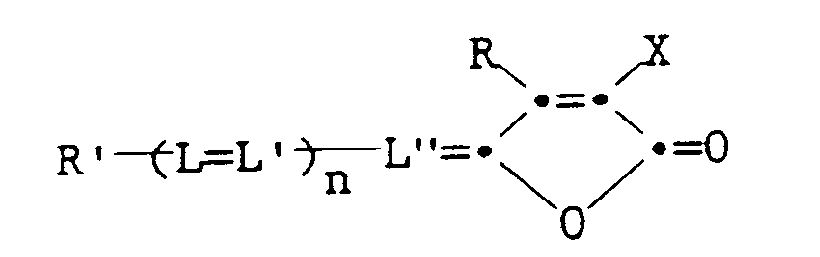
X est un groupe attracteur d'électrons,
R′ est un groupe alkyle ou aryle substitué ou non substitué ou un noyau hétérocyclique aromatique substitué ou non substitué,
L, L′ et L˝ sont chacun indépendamment un groupe méthine substitué ou non substitué et
n est 0 ou un nombre entier positif compris entre 1 et 6. - Elément photographique selon la Revendication 1, dans lequel X est choisi du groupe constitué des groupes cyano, carboxylate substitué ou non substitué, aryle substitué ou non substitué et de -CO-R˝ où R˝ est un groupe amino substitué ou non substitué.
- Elément photographique selon les Revendications 1 à 2, dans lequel R′ est choisi dans le groupe constitué des groupes phényle, furanne, thiophène, pyridine, pyrrole et imidazole.
- Elément photographique selon les Revendications 1 à 3, dans lequel R ou R′ comprennent un substituant qui est un groupe de solubilisation.
- Elément photographique selon la Revendication 4, dans lequel ledit groupe de solubilisation comprend un proton ionisable.
- Elément photographique selon la Revendication 5, dans lequel le colorant est sous la forme d'une dispersion de particules solides.
- Elément photographique selon les Revendications 1 à 6, dans lequel n est 0.
- Elément photographique selon les Revendications 1 à 7, dans lequel R′ est ou est substitué par un donneur d'électrons choisi dans le groupe constitué de furanne, thiophène et pyrrole substitué ou non substitué.
- Elément photographique selon les Revendications 1 à 8, dans lequel R′ est ou est substitué par un noyau furanne substitué ou non substitué.
- Elément photographique selon les Revendications 1 à 9, dans lequel X est un groupe cyano.
- Elément photographique selon les Revendications 1 ou 6, dans lequel le colorant possède la formule :

- Elément photographique selon les Revendications 1 à 11, dans lequel l'élément comprend un support recouvert, dans l'ordre, d'au moins une couche d'halogénure d'argent sensible au rouge, d'au moins une couche d'halogénure d'argent sensible au vert, ladite couche de colorant filtrant et d'au moins une couche d'halogénure d'argent sensible au bleu.
Applications Claiming Priority (2)
| Application Number | Priority Date | Filing Date | Title |
|---|---|---|---|
| US308236 | 1989-02-09 | ||
| US07/308,236 US4923788A (en) | 1989-02-09 | 1989-02-09 | Filter dyes for photographic elements |
Publications (2)
| Publication Number | Publication Date |
|---|---|
| EP0382225A1 EP0382225A1 (fr) | 1990-08-16 |
| EP0382225B1 true EP0382225B1 (fr) | 1994-11-02 |
Family
ID=23193140
Family Applications (1)
| Application Number | Title | Priority Date | Filing Date |
|---|---|---|---|
| EP90102511A Expired - Lifetime EP0382225B1 (fr) | 1989-02-09 | 1990-02-08 | Colorants filtrants pour éléments photographiques |
Country Status (5)
| Country | Link |
|---|---|
| US (1) | US4923788A (fr) |
| EP (1) | EP0382225B1 (fr) |
| JP (1) | JPH02297543A (fr) |
| CA (1) | CA2009266A1 (fr) |
| DE (1) | DE69013708T2 (fr) |
Families Citing this family (28)
| Publication number | Priority date | Publication date | Assignee | Title |
|---|---|---|---|---|
| US5296344A (en) * | 1991-06-11 | 1994-03-22 | Fuji Photo Film Co., Ltd. | Silver halide photographic light-sensitive material |
| US5391443A (en) * | 1991-07-19 | 1995-02-21 | Eastman Kodak Company | Process for the extraction of spectral image records from dye image forming photographic elements |
| EP0524593B1 (fr) * | 1991-07-22 | 1997-06-11 | Eastman Kodak Company | Dispersion de particules solides de colorants filtrants pour éléments photographiques |
| US5213956A (en) * | 1991-07-22 | 1993-05-25 | Eastman Kodak Company | Solid particle dispersions of filter dyes for photographic elements |
| US5266454A (en) * | 1991-07-22 | 1993-11-30 | Eastman Kodak Company | Solid particle dispersions of filter dyes for photographic elements |
| US5298377A (en) * | 1991-08-28 | 1994-03-29 | Eastman Kodak Company | Photographic element with 2-equivalent magenta dye-forming coupler and filter dye |
| EP0566415A3 (fr) * | 1992-04-16 | 1994-11-23 | Eastman Kodak Co | Matériau photographique à faible voile. |
| US5283165A (en) * | 1992-12-23 | 1994-02-01 | Eastman Kodak Company | Pyrrolinone dyes |
| US5360702A (en) * | 1993-01-26 | 1994-11-01 | Eastman Kodak Company | Photographic coating compositions and photographic elements made therefrom |
| JPH06250353A (ja) * | 1993-02-26 | 1994-09-09 | Konica Corp | ハロゲン化銀カラー感光材料および撮影ユニット包装体 |
| US5541055A (en) * | 1993-09-28 | 1996-07-30 | Canon Kabushiki Kaisha | Heat developing photosensitive material and image formed by using the same |
| US5464736A (en) * | 1994-04-28 | 1995-11-07 | Eastman Kodak Company | Photographic elements containing particular sensitizing dyes |
| DE4428292A1 (de) | 1994-08-10 | 1996-02-15 | Agfa Gevaert Ag | Lichtempfindliches fotografisches Aufzeichnungsmaterial mit lichtabsorbierendem Farbstoff |
| JPH08179466A (ja) * | 1994-12-26 | 1996-07-12 | Konica Corp | ハロゲン化銀カラー写真感光材料 |
| JPH08202001A (ja) | 1995-01-30 | 1996-08-09 | Fuji Photo Film Co Ltd | ハロゲン化銀カラー写真感光材料 |
| US5582957A (en) | 1995-03-28 | 1996-12-10 | Eastman Kodak Company | Resuspension optimization for photographic nanosuspensions |
| US5834173A (en) * | 1995-12-22 | 1998-11-10 | Eastman Kodak Company | Filter dyes for photographic elements |
| EP0762198B1 (fr) | 1995-08-02 | 2000-10-04 | Eastman Kodak Company | Eléments photographiques comprenant des colorants filtres |
| US5695917A (en) * | 1995-11-22 | 1997-12-09 | Eastman Kodak Company | Combination of yellow filter dye and 4-equivalent pyrazolone magenta coupler |
| US5834172A (en) * | 1996-02-23 | 1998-11-10 | Eastman Kodak Company | Photographic coating compositions and photographic elements made therefrom |
| DE19652956A1 (de) * | 1996-12-19 | 1998-06-25 | Agfa Gevaert Ag | Farbfotografisches Aufzeichnungsmaterial mit verbesserten mechanischen Eigenschaften und verbesserter Tropenstabilität |
| US6057085A (en) * | 1997-11-24 | 2000-05-02 | Agfa-Gevaert Nv | Color photographic recording material |
| DE69714263T2 (de) * | 1997-12-02 | 2003-03-27 | Tulalip Consultoria Comercial Sociedade Unipessoal S.A., Funchal | Lichtempfindliche photographische Silberhalogenidelemente, die gelbe Filterfarbstoffe enthalten |
| ITSV20000031A1 (it) | 2000-07-07 | 2002-01-07 | Ferrania Spa | Elemento fotografico a colori multistrato agli alogenuri d'argento |
| US6558888B1 (en) | 2002-02-08 | 2003-05-06 | Eastman Kodak Company | Imaging materials containing novel benzothiazine dyes |
| US6881840B2 (en) | 2002-02-08 | 2005-04-19 | Eastman Kodak Company | Benzothiazine dyes for imaging elements |
| US7241562B2 (en) * | 2004-01-21 | 2007-07-10 | Eastman Kodak Company | Color photographic element having improved speed |
| WO2025058077A1 (fr) | 2023-09-15 | 2025-03-20 | 富士フイルム株式会社 | Composé, composition, matériau fonctionnel, matériau photographique à halogénure d'argent photosensible et matériau photographique à halogénure d'argent photosensible de type à transfert par diffusion |
Family Cites Families (3)
| Publication number | Priority date | Publication date | Assignee | Title |
|---|---|---|---|---|
| US3770451A (en) * | 1968-10-09 | 1973-11-06 | Eastman Kodak Co | Silver halide emulsions sensitized with dyes containing heterocyclic nitrogen atoms substituted with an -or group |
| US3661899A (en) * | 1970-06-01 | 1972-05-09 | Eastman Kodak Co | 2(5h)-furanone compounds |
| EP0294461B1 (fr) * | 1986-12-23 | 1991-10-23 | EASTMAN KODAK COMPANY (a New Jersey corporation) | Colorants de filtrage consistant en une dispersion de particules solides pour compositions photographiques |
-
1989
- 1989-02-09 US US07/308,236 patent/US4923788A/en not_active Expired - Lifetime
-
1990
- 1990-02-05 CA CA002009266A patent/CA2009266A1/fr not_active Abandoned
- 1990-02-08 EP EP90102511A patent/EP0382225B1/fr not_active Expired - Lifetime
- 1990-02-08 DE DE69013708T patent/DE69013708T2/de not_active Expired - Fee Related
- 1990-02-09 JP JP2028640A patent/JPH02297543A/ja active Pending
Also Published As
| Publication number | Publication date |
|---|---|
| DE69013708T2 (de) | 1995-06-14 |
| DE69013708D1 (de) | 1994-12-08 |
| EP0382225A1 (fr) | 1990-08-16 |
| CA2009266A1 (fr) | 1990-08-09 |
| US4923788A (en) | 1990-05-08 |
| JPH02297543A (ja) | 1990-12-10 |
Similar Documents
| Publication | Publication Date | Title |
|---|---|---|
| EP0382225B1 (fr) | Colorants filtrants pour éléments photographiques | |
| US4948718A (en) | Photographic silver halide elements containing solid particle dispersions of dyes | |
| US4857446A (en) | Filter dye for photographic element | |
| EP0317308B1 (fr) | Elément photographique contenant des colorants filtres jaunes ayant des groupes tricyanovinyles | |
| EP0294461B1 (fr) | Colorants de filtrage consistant en une dispersion de particules solides pour compositions photographiques | |
| US4950586A (en) | Solid particle dispersions of filter dyes for photographic elements | |
| US4948717A (en) | Solid particle dye dispersions for photographic filter layers | |
| EP0274723B1 (fr) | Colorant filtre pour élément photographique | |
| US4900653A (en) | Photographic elements containing filter dye particle dispersions | |
| US5213956A (en) | Solid particle dispersions of filter dyes for photographic elements | |
| US5098820A (en) | Solid particle dispersions of filter dyes for photographic elements | |
| US4876181A (en) | Photographic elements containing infrared filter dyes | |
| US4994356A (en) | Solid particle dispersions of filter dyes for photographic elements | |
| EP0351593A2 (fr) | Elément photographique manipulable à la lumière avec une couche contenant une dispersion de particules solides de colorant filtre | |
| US5155015A (en) | Silver halide photographic material | |
| US5266454A (en) | Solid particle dispersions of filter dyes for photographic elements | |
| JP2664969B2 (ja) | 色素及びそれを含有する写真要素 | |
| EP0323729B1 (fr) | Dispersions de particules solides de colorants utilisés dans des éléments photographiques | |
| EP0524594B1 (fr) | Dispersions de particules solides de colorants filtrants pour éléments photographiques | |
| JPS6364044A (ja) | ハロゲン化銀写真感光材料 | |
| EP0524593B1 (fr) | Dispersion de particules solides de colorants filtrants pour éléments photographiques |
Legal Events
| Date | Code | Title | Description |
|---|---|---|---|
| PUAI | Public reference made under article 153(3) epc to a published international application that has entered the european phase |
Free format text: ORIGINAL CODE: 0009012 |
|
| AK | Designated contracting states |
Kind code of ref document: A1 Designated state(s): AT BE CH DE ES FR GB IT LI NL SE |
|
| 17P | Request for examination filed |
Effective date: 19900710 |
|
| 17Q | First examination report despatched |
Effective date: 19930429 |
|
| RBV | Designated contracting states (corrected) |
Designated state(s): DE FR GB |
|
| GRAA | (expected) grant |
Free format text: ORIGINAL CODE: 0009210 |
|
| AK | Designated contracting states |
Kind code of ref document: B1 Designated state(s): DE FR GB |
|
| REF | Corresponds to: |
Ref document number: 69013708 Country of ref document: DE Date of ref document: 19941208 |
|
| ET | Fr: translation filed | ||
| PLBE | No opposition filed within time limit |
Free format text: ORIGINAL CODE: 0009261 |
|
| STAA | Information on the status of an ep patent application or granted ep patent |
Free format text: STATUS: NO OPPOSITION FILED WITHIN TIME LIMIT |
|
| 26N | No opposition filed | ||
| REG | Reference to a national code |
Ref country code: GB Ref legal event code: IF02 |
|
| PGFP | Annual fee paid to national office [announced via postgrant information from national office to epo] |
Ref country code: GB Payment date: 20050110 Year of fee payment: 16 |
|
| PGFP | Annual fee paid to national office [announced via postgrant information from national office to epo] |
Ref country code: FR Payment date: 20050202 Year of fee payment: 16 |
|
| PGFP | Annual fee paid to national office [announced via postgrant information from national office to epo] |
Ref country code: DE Payment date: 20050228 Year of fee payment: 16 |
|
| PG25 | Lapsed in a contracting state [announced via postgrant information from national office to epo] |
Ref country code: GB Free format text: LAPSE BECAUSE OF NON-PAYMENT OF DUE FEES Effective date: 20060208 |
|
| PG25 | Lapsed in a contracting state [announced via postgrant information from national office to epo] |
Ref country code: DE Free format text: LAPSE BECAUSE OF NON-PAYMENT OF DUE FEES Effective date: 20060901 |
|
| GBPC | Gb: european patent ceased through non-payment of renewal fee |
Effective date: 20060208 |
|
| REG | Reference to a national code |
Ref country code: FR Ref legal event code: ST Effective date: 20061031 |
|
| PG25 | Lapsed in a contracting state [announced via postgrant information from national office to epo] |
Ref country code: FR Free format text: LAPSE BECAUSE OF NON-PAYMENT OF DUE FEES Effective date: 20060228 |