EP0382661A2 - Objets flexibles électriquement conducteurs et supraconducteurs et procédé pour leur fabrication - Google Patents
Objets flexibles électriquement conducteurs et supraconducteurs et procédé pour leur fabrication Download PDFInfo
- Publication number
- EP0382661A2 EP0382661A2 EP90420065A EP90420065A EP0382661A2 EP 0382661 A2 EP0382661 A2 EP 0382661A2 EP 90420065 A EP90420065 A EP 90420065A EP 90420065 A EP90420065 A EP 90420065A EP 0382661 A2 EP0382661 A2 EP 0382661A2
- Authority
- EP
- European Patent Office
- Prior art keywords
- layer
- cuprate
- further characterized
- electrically conductive
- release layer
- Prior art date
- Legal status (The legal status is an assumption and is not a legal conclusion. Google has not performed a legal analysis and makes no representation as to the accuracy of the status listed.)
- Withdrawn
Links
Images

Classifications
-
- H—ELECTRICITY
- H10—SEMICONDUCTOR DEVICES; ELECTRIC SOLID-STATE DEVICES NOT OTHERWISE PROVIDED FOR
- H10N—ELECTRIC SOLID-STATE DEVICES NOT OTHERWISE PROVIDED FOR
- H10N60/00—Superconducting devices
- H10N60/01—Manufacture or treatment
- H10N60/0268—Manufacture or treatment of devices comprising copper oxide
- H10N60/0296—Processes for depositing or forming copper oxide superconductor layers
-
- H—ELECTRICITY
- H10—SEMICONDUCTOR DEVICES; ELECTRIC SOLID-STATE DEVICES NOT OTHERWISE PROVIDED FOR
- H10N—ELECTRIC SOLID-STATE DEVICES NOT OTHERWISE PROVIDED FOR
- H10N60/00—Superconducting devices
- H10N60/01—Manufacture or treatment
- H10N60/0268—Manufacture or treatment of devices comprising copper oxide
- H10N60/0296—Processes for depositing or forming copper oxide superconductor layers
- H10N60/0576—Processes for depositing or forming copper oxide superconductor layers characterised by the substrate
-
- H—ELECTRICITY
- H10—SEMICONDUCTOR DEVICES; ELECTRIC SOLID-STATE DEVICES NOT OTHERWISE PROVIDED FOR
- H10N—ELECTRIC SOLID-STATE DEVICES NOT OTHERWISE PROVIDED FOR
- H10N60/00—Superconducting devices
- H10N60/01—Manufacture or treatment
- H10N60/0268—Manufacture or treatment of devices comprising copper oxide
- H10N60/0801—Manufacture or treatment of filaments or composite wires
-
- Y—GENERAL TAGGING OF NEW TECHNOLOGICAL DEVELOPMENTS; GENERAL TAGGING OF CROSS-SECTIONAL TECHNOLOGIES SPANNING OVER SEVERAL SECTIONS OF THE IPC; TECHNICAL SUBJECTS COVERED BY FORMER USPC CROSS-REFERENCE ART COLLECTIONS [XRACs] AND DIGESTS
- Y10—TECHNICAL SUBJECTS COVERED BY FORMER USPC
- Y10S—TECHNICAL SUBJECTS COVERED BY FORMER USPC CROSS-REFERENCE ART COLLECTIONS [XRACs] AND DIGESTS
- Y10S428/00—Stock material or miscellaneous articles
- Y10S428/901—Printed circuit
-
- Y—GENERAL TAGGING OF NEW TECHNOLOGICAL DEVELOPMENTS; GENERAL TAGGING OF CROSS-SECTIONAL TECHNOLOGIES SPANNING OVER SEVERAL SECTIONS OF THE IPC; TECHNICAL SUBJECTS COVERED BY FORMER USPC CROSS-REFERENCE ART COLLECTIONS [XRACs] AND DIGESTS
- Y10—TECHNICAL SUBJECTS COVERED BY FORMER USPC
- Y10S—TECHNICAL SUBJECTS COVERED BY FORMER USPC CROSS-REFERENCE ART COLLECTIONS [XRACs] AND DIGESTS
- Y10S428/00—Stock material or miscellaneous articles
- Y10S428/922—Static electricity metal bleed-off metallic stock
- Y10S428/9265—Special properties
- Y10S428/93—Electric superconducting
-
- Y—GENERAL TAGGING OF NEW TECHNOLOGICAL DEVELOPMENTS; GENERAL TAGGING OF CROSS-SECTIONAL TECHNOLOGIES SPANNING OVER SEVERAL SECTIONS OF THE IPC; TECHNICAL SUBJECTS COVERED BY FORMER USPC CROSS-REFERENCE ART COLLECTIONS [XRACs] AND DIGESTS
- Y10—TECHNICAL SUBJECTS COVERED BY FORMER USPC
- Y10S—TECHNICAL SUBJECTS COVERED BY FORMER USPC CROSS-REFERENCE ART COLLECTIONS [XRACs] AND DIGESTS
- Y10S505/00—Superconductor technology: apparatus, material, process
- Y10S505/70—High TC, above 30 k, superconducting device, article, or structured stock
- Y10S505/701—Coated or thin film device, i.e. active or passive
-
- Y—GENERAL TAGGING OF NEW TECHNOLOGICAL DEVELOPMENTS; GENERAL TAGGING OF CROSS-SECTIONAL TECHNOLOGIES SPANNING OVER SEVERAL SECTIONS OF THE IPC; TECHNICAL SUBJECTS COVERED BY FORMER USPC CROSS-REFERENCE ART COLLECTIONS [XRACs] AND DIGESTS
- Y10—TECHNICAL SUBJECTS COVERED BY FORMER USPC
- Y10S—TECHNICAL SUBJECTS COVERED BY FORMER USPC CROSS-REFERENCE ART COLLECTIONS [XRACs] AND DIGESTS
- Y10S505/00—Superconductor technology: apparatus, material, process
- Y10S505/70—High TC, above 30 k, superconducting device, article, or structured stock
- Y10S505/701—Coated or thin film device, i.e. active or passive
- Y10S505/702—Josephson junction present
-
- Y—GENERAL TAGGING OF NEW TECHNOLOGICAL DEVELOPMENTS; GENERAL TAGGING OF CROSS-SECTIONAL TECHNOLOGIES SPANNING OVER SEVERAL SECTIONS OF THE IPC; TECHNICAL SUBJECTS COVERED BY FORMER USPC CROSS-REFERENCE ART COLLECTIONS [XRACs] AND DIGESTS
- Y10—TECHNICAL SUBJECTS COVERED BY FORMER USPC
- Y10S—TECHNICAL SUBJECTS COVERED BY FORMER USPC CROSS-REFERENCE ART COLLECTIONS [XRACs] AND DIGESTS
- Y10S505/00—Superconductor technology: apparatus, material, process
- Y10S505/70—High TC, above 30 k, superconducting device, article, or structured stock
- Y10S505/701—Coated or thin film device, i.e. active or passive
- Y10S505/703—Microelectronic device with superconducting conduction line
-
- Y—GENERAL TAGGING OF NEW TECHNOLOGICAL DEVELOPMENTS; GENERAL TAGGING OF CROSS-SECTIONAL TECHNOLOGIES SPANNING OVER SEVERAL SECTIONS OF THE IPC; TECHNICAL SUBJECTS COVERED BY FORMER USPC CROSS-REFERENCE ART COLLECTIONS [XRACs] AND DIGESTS
- Y10—TECHNICAL SUBJECTS COVERED BY FORMER USPC
- Y10S—TECHNICAL SUBJECTS COVERED BY FORMER USPC CROSS-REFERENCE ART COLLECTIONS [XRACs] AND DIGESTS
- Y10S505/00—Superconductor technology: apparatus, material, process
- Y10S505/70—High TC, above 30 k, superconducting device, article, or structured stock
- Y10S505/704—Wire, fiber, or cable
-
- Y—GENERAL TAGGING OF NEW TECHNOLOGICAL DEVELOPMENTS; GENERAL TAGGING OF CROSS-SECTIONAL TECHNOLOGIES SPANNING OVER SEVERAL SECTIONS OF THE IPC; TECHNICAL SUBJECTS COVERED BY FORMER USPC CROSS-REFERENCE ART COLLECTIONS [XRACs] AND DIGESTS
- Y10—TECHNICAL SUBJECTS COVERED BY FORMER USPC
- Y10T—TECHNICAL SUBJECTS COVERED BY FORMER US CLASSIFICATION
- Y10T428/00—Stock material or miscellaneous articles
- Y10T428/24—Structurally defined web or sheet [e.g., overall dimension, etc.]
- Y10T428/24802—Discontinuous or differential coating, impregnation or bond [e.g., artwork, printing, retouched photograph, etc.]
- Y10T428/24917—Discontinuous or differential coating, impregnation or bond [e.g., artwork, printing, retouched photograph, etc.] including metal layer
-
- Y—GENERAL TAGGING OF NEW TECHNOLOGICAL DEVELOPMENTS; GENERAL TAGGING OF CROSS-SECTIONAL TECHNOLOGIES SPANNING OVER SEVERAL SECTIONS OF THE IPC; TECHNICAL SUBJECTS COVERED BY FORMER USPC CROSS-REFERENCE ART COLLECTIONS [XRACs] AND DIGESTS
- Y10—TECHNICAL SUBJECTS COVERED BY FORMER USPC
- Y10T—TECHNICAL SUBJECTS COVERED BY FORMER US CLASSIFICATION
- Y10T428/00—Stock material or miscellaneous articles
- Y10T428/31504—Composite [nonstructural laminate]
- Y10T428/31678—Of metal
Definitions
- the invention relates to electrically conductive articles and processes for their preparation.
- the invention relates to electrically conductive articles which are superconductive at temperatures in excess of 30°K and processes for their preparation.
- conductive crystalline cuprates A variety of compounds containing copper and other metals in combination with oxygen have been observed to be electrically conductive in crystalline form and to be high temperature superconductors. These materials are herein referred to collectively as "conductive crystalline cuprates". Electrically conductive articles including conductive crystalline cuprate layers exhibiting higher temperature superconductivity are illustrated by the following:
- electrically conductive articles containing conductive crystalline cuprate layers have in each instance been prepared by firing a cuprate layer to its crystallization temperature on a substrate (optionally including one or more barrier layers) selected from a relatively limited class of inorganic materials.
- the substrate materials must withstand the high firing temperatures, must not release ions that excessively degrade the conduction properties of the cuprate layer during firing, and must provide a surface for the cuprate layer that is conducive to crystal formation and growth.
- an object of this invention is to provide flexible electrically conductive articles which contain both a conductive crystalline cuprate layer and a support comprised of an organic film.
- the present invention makes possible achieving in a single electrically conductive article both high temperature superconductivity and highly flexible article constructions.
- the invention has been made possible by the discovery of a novel technique for forming a conductive crystalline cuprate layer on a substrate so that it can be released after its formation. Release materials have been discovered that permit the physical stripping of the conductive crystalline cuprate layer intact from the substrate after lamination to a flexible organic film.
- the release layer discovery not only required finding appropriate release properties, but also sufficient compatibility with the cuprate layer to allow its crystallization into a form having a high level of electrical conductivity-e.g., high temperature superconductivity.
- an electrically conductive article comprised of a support and, bonded to the support, an electrically conductive crystalline cuprate layer.
- the invention is characterized in that the support is comprised of an organic film, a release layer overlies the cuprate layer, and the support, the cuprate layer, and the release layer together form a flexible electrically conductive unit.
- Another aspect of the object of the invention is achieved by a method of forming an electrically conductive article comprised of a support and an electrically conductive crystalline cuprate layer, including the steps of providing a refractory substrate and forming an electrically conductive crystalline cuprate layer on the substrate.
- the invention is characterized in that a release layer is formed on the refractory substrate, the cuprate layer is formed on the release layer, an organic film support is bonded to the cuprate layer, and the release layer, the cuprate layer, and the organic film support are formed to constitute a flexible electrically conductive article when stripped as a unit from the refractory substrate.
- At least one of the release layer and the cuprate layer are modified by the inclusion of a crystal growth accelerating agent to allow the thermal energy (time and/or temperature) of firing to be reduced.
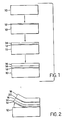
- a refractory substrate 10 optionally including one or more barrier layers on its upper surface is provided as a starting material.
- the refractory substrate can take any of the varied forms taught by the prior art as being suitable substrates for the formation of conductive crystalline cuprate layers.
- the refractory substrate can take any of the varied forms described by R-1 to R-3, cited above.
- release layer 12 Onto the substrate is coated a release layer 12.
- the release layer must be thermally stable at temperatures up to the crystallization temperature of a subsequently formed overlying cuprate layer. Additionally, the release layer is chosen to provide poor adhesion between the overlying cuprate layer and the refractory substrate.
- a preferred class of materials for forming release layers are metals chosen from groups 8 to 11 and periods 5 and 6 of the Periodic Table of Elements. These metals are silver, gold, and the metals of the light platinum metal triad of elements (ruthenium, rhodium, and palladium) and the heavy platinum metal triad of elements (osmium, iridium, and platinum). Of the platinum metals, osmium and platinum are preferred.
- the metals can be employed alone or together (e.g., as alloys). Gold and the platinum metals are particularly advantageous for use in forming the release layer, since they do not oxidize at the firing temperatures of the cuprate layers and can be employed at subsequent manufacturing stages to facilitate circuit bonding (e.g., chip and/or lead attachment) to the conductive cuprate layer.
- Gold is a specifically preferred metal for formation of the release layer and for circuit bonding.
- any convenient conventional technique such as vacuum vapor deposition, sputtering, electroless plating, etc., can be employed for depositing the release layer.
- a convenient practical thickness for the release layer is from abut 0.6 to 5 ⁇ m with a thickness of about 0.8 to 2 microns being preferred.
- the release layer thickness can be further increased without penalty, aside from the use of additional amounts of materials.
- a cuprate or precursor thereof which, following firing to crystallization temperatures, typically in the range of from about 800 to 1000°C, is transformed into a conductive crystalline cuprate layer 14.
- Any of the conventional cuprate starting material compositions and processes for their deposition can be employed in the practice of this invention.
- R-1 to R-3, cited above, contain directly applicable teachings. It is preferred to maintain the thermal energy input to the cuprate layer during crystallization to minimum or near minimum levels. This obviates the risk of localized cuprate penetration of the release layer with resultant localized unwanted bonding to the substrate.
- the thermal energy input (time and/or temperature of firing) required for cuprate layer crystallization can be reduced by associating with the cuprate layer a crystal growth accelerating agent. This can be achieved by modifying one or both of the cuprate layer or release layer by the inclusion of the crystal growth accelerating agent.
- the release layer as a composite of two layers.
- the first of these layers is coated on the refractory substrate as described above.
- the first layer is then overcoated with a thin second layer of a crystal growth accelerating agent.
- the latter offsets the less favorable crystallization environment created when contact of the cuprate layer with the refractory substrate materials (including barrier layers) is replaced by contact with the metal or metals forming the first layer.
- the refractory substrates themselves take crystalline forms similar to that of the crystalline cuprates and therefore constitute favorable sites for epitaxy
- the metal or metals forming the first layer take amorphous, noncrystalline forms at the temperatures of firing and therefore offer no opportunity for epitaxy.
- any amount of the accelerating agent capable of facilitating nucleation in the cuprate layer and thereby accelerating its crystallization can be employed.
- the accelerating agent is provided in the form of a second layer of a composite release layer, it is generally preferred that sufficient crystal growth accelerating agent be present to form a continuous film.
- second layers ranging upward from about 100 ⁇ , preferably at least 500 ⁇ , are contemplated.
- a silver second layer can help nucleate and crystallize the cuprates.
- the silver layer is in the range of from about 0.1 to 1 ⁇ m in thickness. In all cases where this was done, films with larger grain size were obtained, although the thicker (at least 0.5 ⁇ m in thickness) second layers were found to be slightly more effective. Since a significant degree of mixing between the Au and the Ag was observed even at 550°C, thicker layers probably minimized dilution of Ag at the metal-cuprate interface. In the completed article no continuous silver layer has been identified.
- silver forming the second layer may contract to beads on the surface of the gold layer during firing, with the beads serving as nucleation sites for the cuprate crystals.
- silver is employed as the sole metal forming the release layer, thicknesses in the ranges set forth above for gold and the platinum metals should be employed, but with minimum silver layer thicknesses in this instance preferably being greater than 1 ⁇ m to assure that a continuous silver layer remains present at the conclusion of firing.
- Another mechanism for accelerating crystal growth is to modify the composition of the cuprate layer starting materials to include alkali metal ions, such as sodium and/or lithium ions. While the mechanism by which the alkali metal ions accelerate crystal growth has not been conclusively explained, it is believed that the alkali metal ions provide a flux environment that accelerates crystal growth at firing temperatures.
- conductive crystalline cuprate layers exhibit the brittleness characteristic of oxides at the thicknesses characteristic of most self-supported films, they exhibit flexibility at thickness below about 1 mil (25 ⁇ m). Since flexibility increases as cuprate layer thickness decreases, the choice of maximum acceptable layer thicknesses is dictated by the end use application to be served. Minimum acceptable layer thicknesses are dictated not by flexibility, but by required current carrying capacities. For signal level electrical transmission applications in which a degree of flexibility comparable with those of organic polymeric film support circuits is desired, the preferred thickness of the crystalline cuprate layer is typically in the range of from about 0.1 to 10 ⁇ m, optimally from about 0.5 to 5 ⁇ m.
- the layer 16 can take the form of a temporary protective layer of any convenient type.
- the protective layer can perform the function of limiting the contact of air or other moisture sources with the crystalline cuprate layer prior to completion of electrical circuit fabrication.
- the protective layer can take the form of a passivant, such as a polyester ionomer or alkyl cellulose, or the protective layer can take the form of a moisture impenetrable film, such as any convenient polymeric film. In a simple arrangement a protective polymeric film can be simply laid over the cuprate layer with static attraction relied upon to hold the film in position.
- the layer 16 deposited on the conductive cuprate layer 14 is a photocurable polymer that becomes a permanent part of the support for the completed circuit element.
- the layer 16 is spread as a fluid film precursor (e.g., a monomer or low molecular weight polymer containing vinyl unsaturation) over the cuprate layer and then exposed to actinic radiation (e.g., ultraviolet) to produce a solid polymeric protective layer. Until subsequent fabrication steps are taken, the polymeric protective layer acts as both a moisture and abrasion barrier for the cuprate layer.
- a flexible organic film 18 is bonded to the protective layer 16 by an interposed adhesive layer 20.
- the layers are separated from the substrate at its interface with the release layer 12.
- the protective layer 16 is reducing the degree to which the cuprate layer is bent or strained during stripping.
- the protective layer is in part absorbing the stress of stripping. Completion of stripping results in an electrically conductive article according to the invention shown in Figure 3B.
- an electrically conductive article is formed as shown in Figure 3A.
- the electrically conductive articles can be fabricated to the stage shown in Figure 2 just prior to stripping and sold to end users in this form.
- the end user performs the stripping step, and the substrate 10 serves as a protective member during shipment and storage.
- the stripping step can be performed as shown in Figure 2, allowing the refractory substrate to be reused, if desired.
- the refractory substrate can be replaced with any convenient protective member.
- a flexible organic film can serve the function of a protective member.
- the flexible organic film not only protects the cuprate layer from moisture, but also acts to reduce flexing stresses placed on the cuprate layer.
- the organic film serving as the protective member is chosen to match at least approximately the flexibility of the support on the opposite side of the cuprate layer. This has not only the advantage of stress reduction, but also eliminates any tendency of the film to spontaneously curl. This produces an assembly that lies flat and can be more conveniently handled by the end user.
- FIG 4 illustrates an alternative embodiment in which the polymer protective layer 16 alone forms the organic film support.
- Figures 5A-C illustrate a continuous method sequence in which various layers are coated and processed on a cylindrical drum 22 which can otherwise be identical to any of the refractory substrates described above. Layer processing is similar to that illustrated in Figure 1. Following the formation of the release and crystalline layers (illustrated as composite layer 24) and the organic support layer 26, the drum is skived in a helical fashion, as shown at 28 in Figure 5B, and a linear strip 30 is subsequently removed, as shown at 30 in Figure 5C.
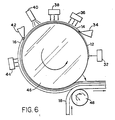
- FIG. 6 An alternative embodiment, which also provides an elongated continuous electrically conductive article, is illustrated in Figure 6.
- a refractory drum 46 is also employed.
- a release layer 12 is deposited first on the drum at coating station 32. This is followed by coating the as yet uncrystallized cuprate or a precursor as a layer 14 at coating station 34. Heating stations 36 and 38 are shown for first volatilizing components of the cuprate layer and then converting the cuprate layer to a crystalline form.
- the conductive crystalline cuprate layer is next reduced in temperature at cooling station 40.
- the protective layer 16 is applied at coating station 42 followed by photocuring at station 44.
- the resulting coatings are next laminated to a flexible organic (e.g., polymeric) film using roller 48. While the method as shown produces the article of Figure 3B, it is apparent that it can be readily modified to formation either the article of Figure 3A or Figure 4.
- the organic film, the cuprate layer, the release layer, and any optional layers, such as the adhesive, bonding, and/or protective layers together form a flexible electrically conductive unit which can itself form an electrically conductive article or be combined with other conventional electrical circuit features to complete an electrically conductive article.
- the electrically conductive unit formed after peeling from the refractory substrate on which it is formed is sufficiently flexible to be bent through a radius of curvature of 5 cm (preferably 2 cm and optimally less than 2 cm) and returned to a flat layer configuration while still retaining the capability of satisfying its intended electrical end use.
- Flexible units can be fabricated which produce no observable physical or electrical degradation upon flexure through these radii of curvature.
- the minimum feasible radius of curvature of the flexible articles is determined by the thickness of the cuprate layer.
- the electrically conductive elements of this invention of highest flexibility are those in which the cuprate layer is within the preferred thickness ranges set forth above.
- a single crystal MgO substrate was coated on a ⁇ 100 ⁇ crystallographic face with a Au film approximately 6000 ⁇ thick using a D.C. sputtering unit in an Ar gas atmosphere.
- a precursor to produce YBa2CU3O 7-y was made as follows: A yttrium precursor was made by mixing 2.35 g of yttrium acetate tetrahydrate with 7.65 g of 2-ethylhexanoic acid. The mixture was refluxed at the boiling point for 10 minutes until a clear solution was obtained. To compensate for solvent evaporation during heating, 0.7 g of 2-ethylhexanoic acid was then added to the solution. The resulting precursor had 6.22% yttrium concentration by weight.
- the copper precursor was made by mixing 2.0 g Cu acetate with 8.0 g 2-ethylhexanoic acid. The mixture was refluxed at the boiling point for 15 minutes until a clear solution was obtained. To compensate for solvent loss during evaporation, 0.55 g of 2-ethylhexanoic acid was added to the solution. The resulting precursor had 6.36% Cu concentration by weight.
- the YBa2CU3O 7-y precursor was made by mixing 6.22 g of the copper precursor with 2.138 g of barium cyclohexanebutyrate (26.6% Ba by weight) with 1.75 g toluene. This mixture was then heated to allow the barium cyclohexanebutyrate to go into solution. To this solution, 3.0 g of the yttrium precursor was added along with 2.0 g Kodak #2315TM rosin to act as a film former. The resulting solution was passed through a 1.2 ⁇ m filter to remove residual particles.
- the YBa2CU3O 7-y precursor was spin-coated on the Au/MgO substrate at 3500 RPM for 20 seconds.
- the film was heated from room temperature at approximately 50°C per minute on a hotplate to 550°C and held at that temperature for 5 minutes. After heating, the film was allowed to cool to room temperature, and a second layer of YBa2CU3O 7-y was deposited using the same procedure. Film thickness at this point was approximately 0.5 ⁇ m. The film exhibited an amorphous structure.
- the multilayer film was then processed at 925°C in a LindbergTM furnace by rapidly heating the sample to that temperature. holding for 3 minutes, and allowing the sample to cool to room temperature in approximately 30 minutes.
- X-ray diffraction (XRD) showed a (1:2:3) superconducting perovskite structure, characteristic of superconducting YBa2CU3O 7-y .
- Transfer of the multilayer film from the MgO substrate to a flexible organic substrate was accomplished by contacting the adhesive surface of an adhesive tape to the top of the YBa2CU3O 7-y layer, and peeling away the multilayer film at the Au-MgO substrate interface.
- the tape used was 3M Scotch Magic 810TM flexible organic polymer type having a width of about 1.25 cm.
- the tape is approximately 25 ⁇ m thick.
- the flexible article was found to be continuous from end to end.
- the 123 film was electrically tested by removing the gold layer using Transene TFATM gold etchant.
- the black YBa2CU3O 7-y film was also found to be electrically continuous from end to end.
- Example 1 The procedure of Example 1 was repeated, except that fused SiO2 was used as a substrate.
- the multilayer structure was processed on the hotplate as previously described and heated to 900°C for 5 minutes in a Lindberg furnace.
- XRD showed the presence of the 123 perovskite structure.
- some evidence of cracking in the YBa2CU3O 7-y layer was observed using transmission optical microscopy.
- the film was still electrically continuous from end to end.
- a silica (SiO2) layer 5000 ⁇ thick was formed on a monocrystalline silicon substrate by thermal oxidation.
- a zirconium metal film 1500 ⁇ in thickness was then evaporated on the silica layer and subsequently annealed in vacuum at 850°C for 30 minutes to produce a barrier layer triad from the substrate up of silica, zirconium silicide and zirconia, respectively.
- An 800°C treatment in air followed to oxidize the zirconium silicide layer.
- a gold film 6000 ⁇ in thickness was deposited over the barrier layer using a d.c. sputtering unit in an argon gas atmosphere. Two layers of the YBa2CU3O 7-y superconductor were then deposited over the gold layer by the method of Example 1.
- the films were then processed at 925°C in a Lindberg furnace by rapidly heating the sample so that temperature, holding for 5 minutes and allowing the sample to cool to room temperature in approximately 30 minutes.
- the film was transferred to adhesive tape as in Example 1. After etching the Au layer with Transene TFATM etchant as in Example 1, a crystalline film was observed, with a grain size of approximately 1 ⁇ m. The film was found to be electrically continuous.
- Example 2 The procedure of Example 2 was repeated. After the 900°C treatment, however, an organic layer was spin-coated to provide additional mechanical support to the multilayer films.
- Norland #61TM ultraviolet responsive photopolymer (viscosity 300 cp) was spin-coated at 5000 RPM for 20 seconds resulting in a film thickness of 37 ⁇ m.
- the layer was then hardened by exposing to ultraviolet using a Blak Ray Model B-100ATM lamp for 10 minutes.
- the photopolymer hardened to a tough film without shrinkage and significantly improved the mechanical integrity of the multilayer structure both during and after transfer.
- the transferred films also provided a more effective base to provide a reliable electrical connection.
- the photopolymer layer did not significantly reduce the flexibility of the article.
- Example 2 The procedure of Example 2 was repeated, except that the substrate is a Si wafer with a thermally-grown silica barrier layer (0.8 ⁇ m thick), covered with a 3.0 um thick Au layer.
- a photopolymer film was applied as in Example 4.
- the films were then transferred from the Si substrate to a transparent adhesive tape as in Example 1.
- the tape was then sliced into thin 1 mm wide strips, 75 mm long. The resistance from end to end of the tape was approximately 0.85 ohms. The resistance was constant during flexure of the tape down to a 1 cm radius of curvature.
- a precursor used to fabricate ceramic films having composition Bi2Sr2CaCu2O 8+x (2:2:1:2) was prepared. This compound was a superconducting cuprate with a transition temperature of approximately 85°K.
- the bismuth precursor is bismuth octoate available commercially from Shepherd Chemicals (8.2% bismuth by weight).
- the solution was concentrated by heating at 100°C in a Buchi Model 461TM water bath while being rotated in a Buchi Model E1131 RotovaporTM rotary evaporator. The resulting concentrated solution was 18.76% bismuth by weight.
- the calcium precursor was made by treating calcium carbonate with excess 2-ethylhexanoic acid and xylene as needed at 120°C for 18 hours.
- the mixture was then filtered and dried with a Kodak Type 3ATM molecular sieve having 1.6 mm pellets. This was followed by concentration and filtering of the solution with 1.2 ⁇ m filters. Analysis showed 3.9% Ca by weight.
- the strontium precursor used strontium cyclohexanebutyrate, is available commercially from Eastman Chemicals. It is supplied with an assay indicating a strontium concentration of 19.4% by weight.
- the copper precursor was made by reacting copper acetate as described in Example 1. The copper content in the resulting precursor was 6.36% Cu by weight.
- the (2:2:1:2) precursor was formed by combining the following amounts of the precursors: 5.0 g Bi (18.76% Bi) 2.31 g Ca (3.9% Ca) 4.48 g Cu (6.36% Cu) 2.03 g Sr cyclohexanebutyrate (19.4% Sr). The mixture was heated at the boiling point until the strontium cyclohexane butyrate went into solution. At this point, a solution containing the correct proportion of cations for the (2:2:1:2) compound was obtained. To provide a film forming agent, 0.5 g rosin (Eastman 2315TM) was then added and the mixture was gently heated until all the rosin went in solution.
- Eastman 2315TM Eastman 2315TM
- a substrate was prepared by vacuum depositing a 1.6 ⁇ m Au layer and then a 0.1 ⁇ m Ag layer on a Si substrate with a 0.8 ⁇ m thermally-grown SiO2 film.
- the Ag was chosen to aid nucleation and growth of the later formed superconductive oxide.
- the precursor described above is spin-coated at 4000 rpm for 20 seconds and then heated to 550°C at the rate of approximately 50°C per minute followed by holding at 550°C for 5 minutes. The sample was then allowed to cool to room temperature. The film thickness of the layer is at this point was 0.7 ⁇ m.
- a second layer was deposited by the same procedure to obtain a total thickness of 1.4 ⁇ m.
- the sample was rapidly inserted into a furnace preheated to 890°C.
- the sample was held for 1 and 1/2 minutes in the furnace and then rapidly removed.
- a well crystallized film resulted, with grain size of approximately 2 ⁇ m.
- the sample was then coated with Norland #61TM photopolymer by spin coating the liquid (300 cp. viscosity) at 6000 rpm for 20 seconds.
- the sample was then exposed to U.V. using a Blak Ray Model B-100ATM lamp for 15 minutes.
- the resulting film thickness of the Norland #61TM layer was approximately 16 ⁇ m.
- the film was then transferred to a transparent adhesive tape as in Example 1. The resultant tape was quite flexible.
- a four point probe resistivity measurement revealed the film to be superconducting.
- the resistivity from room temperature to about 45°K decreased linearly with temperature. At temperatures below 45°K, the resistivity dropped sharply and achieved zero resistance at 11°K.
- a five layer film of Bi2Sr2CaCu2O 8+x was prepared repeating the same procedure as in Example 6, except that five layers were spin-coated instead of two. Total film thickness of the Bi2Sr2CaCu2O 8+x layer was approximately 3.5 ⁇ m.
- the substrate and film were rapidly inserted into a pre-heated furnace set at 890°C and held at that temperature for 1 1/2 minutes. The substrate and film were then rapidly removed from the furnace and allowed to cool down to room temperature.
- X-ray diffraction of the film showed a c-axis highly oriented material.
- the orientation is highly desirable since it has been shown to provide high critical currents.
- the sample was then spin-coated with a layer of Norland #61TM photopolymer at 6000 RPM for 20 seconds which was ultraviolet cured for 10 minutes using a Blak RayTM ultraviolet lamp.
- the film was then transferred to transparent adhesive tape as in Example 1. The resulting tape was quite flexible.
- a Bi2SR2CaCu20 8+x precursor was prepared as follows:
- the Bi, Cu, Sr precursors were similar to those used in Example 6.
- the Ca precursor was made by treating Ca carbonate with excess 2-ethylhexanoic acid and xylene as needed at 120°C for 18 hours. The mixture was then filtered and dried with a molecular sieve as in Example 6. This was followed by concentration and filtering of the solution. Analysis showed 5.05% Ca by weight.
- the (2:2:1:2) precursor was formulated by mixing the individual precursors as follows: 4.0 g Bi (18.76% Bi by weight) 3.637 g Cu (6.29% Cu by weight) 1.626 g Sr (19.4% Sr by weight) 1.428 g Ca (5.05% Ca by weight).
- the mixture was heated at the boiling point until no solids remained.
- 0.7 grams of Kodak 2315TMrosin was added and the mixture was gently heated until all the rosin went into solution.
- the proper amount of Na and Ag metallo-organic precursors are mixed to add 3% Ag and 3.5% Na atomic percent relative to the copper.
- the Ag precursor was made by mixing 0.3 g Ag-cyclohexanebutyrate (39.7% Ag by weight), 5 g 2-ethylhexanoic acid, and 0.9 g rosin. The mixture was heated until boiling to make a clear solution. The final solution had a concentration of 1.78 x 10 ⁇ 4M (Ag)/gram of solution.
- the Na precursor was made by mixing 1.0 g Na cyclohexanebutyrate, 9.0 g of 2-ethylhexanoic acid and heating until boiling.
- the final solution had a concentration of 5.04 x (10 ⁇ 4)M (Na/gram of solution.
- the Bi2Sr2CaCu2O 8+x precursor (3.16 x 10 ⁇ 4M (Cu/gram) was mixed with the Na and Ag precursors described above. In doing this, 5 g of the Bi2Sr2CaCu2O 8+x precursor was combined with 0.27 g and 0.11 g of the Ag and Na precursors, respectively. The solution was mixed thoroughly to provide good homogeneity. The resulting precursor was clear and exhibited good spin coating properties.
- the precursor above was coated onto a Si substrate with films: 0.8 ⁇ m thermally grown SiO2, 2.0 ⁇ m vacuum deposited Au, 0.2 ⁇ m vacuum deposited Ag.
- the doped Bi2Sr2CaCu2O 8+x film was spin-coated at 4000 rpm.
- the film was heated on a hotplate up to 550°C at 50°C/minutes and held at 550°C for 5 minutes. The film was then allowed to cool to room temperature. Film thickness was approximately 0.5 ⁇ m. To compensate for the thinner film, four layers were deposited in this manner to achieve a total film thickness of 2.0 ⁇ m. If film thickness is much less than 1 ⁇ m, the underlying Au/Ag becomes visible on the top side of the superconducting film after the high temperature treatment.
- the four layer film was rapidly inserted in a pre-heated furnace and allowed to heat for 2 and 1/2 minutes at 890°C. Since it is known that at this temperature the Bi2Sr2CaCu2O 8+x may undergo some decomposition and precipitate into a semiconducting crystalline phase, the film was heated at 865°C for 2 and 1/2 minutes in an additional processing step to crystallize the superconducting phase.
- the film was then coated with Norland #61 photopolymer as previously described and transferred to transparent tape as in Example 1.
- a four point probe resistivity measurement revealed that the tape begins its superconductivity transition at approximately 85°K. Zero resistance was achieved at 36°K.
Landscapes
- Engineering & Computer Science (AREA)
- Manufacturing & Machinery (AREA)
- Laminated Bodies (AREA)
- Superconductors And Manufacturing Methods Therefor (AREA)
- Crystals, And After-Treatments Of Crystals (AREA)
- Superconductor Devices And Manufacturing Methods Thereof (AREA)
Applications Claiming Priority (2)
| Application Number | Priority Date | Filing Date | Title |
|---|---|---|---|
| US07/308,297 US4988674A (en) | 1989-02-09 | 1989-02-09 | Electrically conductive articles and processes for their fabrication |
| US308297 | 2002-12-02 |
Publications (2)
| Publication Number | Publication Date |
|---|---|
| EP0382661A2 true EP0382661A2 (fr) | 1990-08-16 |
| EP0382661A3 EP0382661A3 (fr) | 1991-02-27 |
Family
ID=23193394
Family Applications (1)
| Application Number | Title | Priority Date | Filing Date |
|---|---|---|---|
| EP19900420065 Withdrawn EP0382661A3 (fr) | 1989-02-09 | 1990-02-06 | Objets flexibles électriquement conducteurs et supraconducteurs et procédé pour leur fabrication |
Country Status (4)
| Country | Link |
|---|---|
| US (1) | US4988674A (fr) |
| EP (1) | EP0382661A3 (fr) |
| JP (1) | JPH02250218A (fr) |
| CA (1) | CA2008217A1 (fr) |
Cited By (4)
| Publication number | Priority date | Publication date | Assignee | Title |
|---|---|---|---|---|
| EP0428357A3 (en) * | 1989-11-13 | 1991-08-28 | Fujitsu Limited | Josephson junction apparatus |
| WO1999054942A1 (fr) * | 1998-04-20 | 1999-10-28 | Institut für Festkörper- und Werkstofforschung Dresden e.V. | Procede de production de supraconducteurs a haute temperature sous forme de bande |
| WO2006132379A3 (fr) * | 2005-06-07 | 2007-05-03 | Fujifilm Corp | Structure de formation de motifs de film fonctionnel et procede de production dudit film fonctionnel |
| US8012594B2 (en) * | 2005-06-07 | 2011-09-06 | Fujifilm Corporation | Functional film containing structure and method of manufacturing functional film |
Families Citing this family (12)
| Publication number | Priority date | Publication date | Assignee | Title |
|---|---|---|---|---|
| US5204313A (en) * | 1990-12-07 | 1993-04-20 | Eastman Kodak Company | Process of forming a high temperature superconductor on a metal substrate surface |
| DE69224064T2 (de) * | 1991-07-01 | 1998-06-18 | Univ Houston | Verfahren zur herstellung von formkörpern aus hochtemperatursupraleitern mit hohen kritischen stromdichten |
| US5468541A (en) * | 1993-09-07 | 1995-11-21 | United Microelectronics Corporation | Thin film delamination test chip |
| US5527766A (en) * | 1993-12-13 | 1996-06-18 | Superconductor Technologies, Inc. | Method for epitaxial lift-off for oxide films utilizing superconductor release layers |
| JP2010225260A (ja) * | 2009-02-24 | 2010-10-07 | Fujifilm Corp | モールドおよびその製造方法 |
| TWM450934U (zh) * | 2012-10-09 | 2013-04-11 | Unimicron Technology Corp | 軟性電路板 |
| US9105854B2 (en) | 2013-09-20 | 2015-08-11 | International Business Machines Corporation | Transferable transparent conductive oxide |
| US9577196B2 (en) | 2014-02-28 | 2017-02-21 | International Business Machines Corporation | Optoelectronics integration by transfer process |
| CN105702625B (zh) * | 2016-04-12 | 2017-11-03 | 武汉华星光电技术有限公司 | 柔性基板的剥离方法 |
| JP7136669B2 (ja) * | 2018-11-22 | 2022-09-13 | 日東電工株式会社 | 導電性フィルムの製造方法 |
| CN114318289B (zh) * | 2020-10-09 | 2023-07-14 | 天津理工大学 | 增强2d过渡金属硫族化合物光致发光的方法及其应用 |
| CN114121607B (zh) * | 2021-11-19 | 2024-06-25 | 北京航空航天大学 | 一种柔性绝缘基底上制备Cu2O薄膜的方法 |
Family Cites Families (5)
| Publication number | Priority date | Publication date | Assignee | Title |
|---|---|---|---|---|
| DE3885125T2 (de) * | 1987-03-16 | 1994-04-07 | American Telephone & Telegraph | Apparat mit einem supraleitenden Teil und Verfahren zu seiner Herstellung. |
| US4880770A (en) * | 1987-05-04 | 1989-11-14 | Eastman Kodak Company | Metalorganic deposition process for preparing superconducting oxide films |
| EP0291034B1 (fr) * | 1987-05-15 | 1995-03-29 | Mitsubishi Denki Kabushiki Kaisha | Procédé de fabrication d'un oxyde supraconducteur |
| US4908346A (en) * | 1987-07-01 | 1990-03-13 | Eastman Kodak Company | Crystalline rare earth alkaline earth copper oxide thick film circuit element with superconducting onset transition temperature in excess of 77% |
| CA1303252C (fr) * | 1987-08-13 | 1992-06-09 | John A. Agostinelli | Element de circuit a couche d'arret pour proteger une couche d'oxyde conductrice cristalline |
-
1989
- 1989-02-09 US US07/308,297 patent/US4988674A/en not_active Expired - Fee Related
-
1990
- 1990-01-22 CA CA002008217A patent/CA2008217A1/fr not_active Abandoned
- 1990-02-06 EP EP19900420065 patent/EP0382661A3/fr not_active Withdrawn
- 1990-02-08 JP JP2027301A patent/JPH02250218A/ja active Pending
Cited By (6)
| Publication number | Priority date | Publication date | Assignee | Title |
|---|---|---|---|---|
| EP0428357A3 (en) * | 1989-11-13 | 1991-08-28 | Fujitsu Limited | Josephson junction apparatus |
| US5131976A (en) * | 1989-11-13 | 1992-07-21 | Fujitsu Limited | Josephson junction apparatus formed on flexible polymeric film and producing method thereof |
| US5436471A (en) * | 1989-11-13 | 1995-07-25 | Fujitsu Limited | Josephson junction apparatus formed on flexible polymeric film |
| WO1999054942A1 (fr) * | 1998-04-20 | 1999-10-28 | Institut für Festkörper- und Werkstofforschung Dresden e.V. | Procede de production de supraconducteurs a haute temperature sous forme de bande |
| WO2006132379A3 (fr) * | 2005-06-07 | 2007-05-03 | Fujifilm Corp | Structure de formation de motifs de film fonctionnel et procede de production dudit film fonctionnel |
| US8012594B2 (en) * | 2005-06-07 | 2011-09-06 | Fujifilm Corporation | Functional film containing structure and method of manufacturing functional film |
Also Published As
| Publication number | Publication date |
|---|---|
| JPH02250218A (ja) | 1990-10-08 |
| EP0382661A3 (fr) | 1991-02-27 |
| US4988674A (en) | 1991-01-29 |
| CA2008217A1 (fr) | 1990-08-09 |
Similar Documents
| Publication | Publication Date | Title |
|---|---|---|
| US4988674A (en) | Electrically conductive articles and processes for their fabrication | |
| EP0290357B1 (fr) | Procédé de fabrication pour objets supraconducteurs en céramique à base d'oxyde de cuivre | |
| Gurvitch et al. | Preparation and substrate reactions of superconducting Y‐Ba‐Cu‐O films | |
| JPH05345613A (ja) | 立方晶系ペロブスカイト結晶構造体及び該結晶構造の製造方法 | |
| US4956335A (en) | Conductive articles and processes for their preparation | |
| AU599488B2 (en) | Processes for film preparation | |
| US4900709A (en) | Method of patterning superconducting oxide thin films | |
| US5330966A (en) | Method of preparing 2223 phase (Bi,Pb)-Sr-Ca-Cu-O superconducting films | |
| US4950643A (en) | Metalorganic deposition process for preparing heavy pnictide superconducting oxide films | |
| US5024894A (en) | Method of producing silicon and similar wafers buffered for the deposition of metal oxide superconducting (MOS) polymer composites and the like by insulating metal oxides (IMO) suitable as substrates for MOS, and novel buffered wafers provided thereby | |
| US5041420A (en) | Method for making superconductor films from organometallic precursors | |
| US4908348A (en) | Barrier layer arrangement for conductive layers on silicon substrates | |
| US4959346A (en) | Composite with Y-BA-CU-O superconductive film | |
| US4994434A (en) | Method of forming a barrier layer arrangement for conductive layers on silicon substrates | |
| US4983577A (en) | Metalorganic deposition of superconducting Yb-Ba-Cu-O thin films by rapid thermal annealing | |
| US4968664A (en) | Single-crystal wafer having a superconductive ceramic thin film formed thereon | |
| US5070072A (en) | Conductive articles and processes for their preparation | |
| US5082688A (en) | Processes of forming Ag doped conductive crystalline bismuth mixed alkaline earth copper oxide films | |
| US5096881A (en) | Preparation of a superconducting Tl2 Ca2 Ba2 Cu3 O.sub.x2 O3 vapor | |
| JP2814563B2 (ja) | 酸化物超電導膜の製造方法 | |
| US5041417A (en) | Conductive articles and intermediates containing heavy pnictide mixed alkaline earth oxide layers | |
| US5104850A (en) | Preparation of high temperature superconducting coated wires by dipping and post annealing | |
| JPH01286920A (ja) | 超電導体 | |
| JP2601892B2 (ja) | T▲l▼系超電導体配線パタ−ンの製造法 | |
| EP0334093A2 (fr) | Matériau semifini à couche conductive et procédé pour sa fabrication |
Legal Events
| Date | Code | Title | Description |
|---|---|---|---|
| PUAI | Public reference made under article 153(3) epc to a published international application that has entered the european phase |
Free format text: ORIGINAL CODE: 0009012 |
|
| AK | Designated contracting states |
Kind code of ref document: A2 Designated state(s): AT BE CH DE DK ES FR GB GR IT LI LU NL SE |
|
| PUAL | Search report despatched |
Free format text: ORIGINAL CODE: 0009013 |
|
| AK | Designated contracting states |
Kind code of ref document: A3 Designated state(s): AT BE CH DE DK ES FR GB GR IT LI LU NL |
|
| 17P | Request for examination filed |
Effective date: 19910725 |
|
| STAA | Information on the status of an ep patent application or granted ep patent |
Free format text: STATUS: THE APPLICATION HAS BEEN WITHDRAWN |
|
| 18W | Application withdrawn |
Withdrawal date: 19930331 |