EP0384257A2 - Interaktive Audio-Video-Anzeige - Google Patents
Interaktive Audio-Video-Anzeige Download PDFInfo
- Publication number
- EP0384257A2 EP0384257A2 EP90102671A EP90102671A EP0384257A2 EP 0384257 A2 EP0384257 A2 EP 0384257A2 EP 90102671 A EP90102671 A EP 90102671A EP 90102671 A EP90102671 A EP 90102671A EP 0384257 A2 EP0384257 A2 EP 0384257A2
- Authority
- EP
- European Patent Office
- Prior art keywords
- display
- signal
- signals
- video
- high resolution
- Prior art date
- Legal status (The legal status is an assumption and is not a legal conclusion. Google has not performed a legal analysis and makes no representation as to the accuracy of the status listed.)
- Granted
Links
Images





Classifications
-
- G—PHYSICS
- G09—EDUCATION; CRYPTOGRAPHY; DISPLAY; ADVERTISING; SEALS
- G09G—ARRANGEMENTS OR CIRCUITS FOR CONTROL OF INDICATING DEVICES USING STATIC MEANS TO PRESENT VARIABLE INFORMATION
- G09G5/00—Control arrangements or circuits for visual indicators common to cathode-ray tube indicators and other visual indicators
- G09G5/36—Control arrangements or circuits for visual indicators common to cathode-ray tube indicators and other visual indicators characterised by the display of a graphic pattern, e.g. using an all-points-addressable [APA] memory
- G09G5/39—Control of the bit-mapped memory
- G09G5/395—Arrangements specially adapted for transferring the contents of the bit-mapped memory to the screen
- G09G5/397—Arrangements specially adapted for transferring the contents of two or more bit-mapped memories to the screen simultaneously, e.g. for mixing or overlay
-
- G—PHYSICS
- G09—EDUCATION; CRYPTOGRAPHY; DISPLAY; ADVERTISING; SEALS
- G09G—ARRANGEMENTS OR CIRCUITS FOR CONTROL OF INDICATING DEVICES USING STATIC MEANS TO PRESENT VARIABLE INFORMATION
- G09G2340/00—Aspects of display data processing
- G09G2340/12—Overlay of images, i.e. displayed pixel being the result of switching between the corresponding input pixels
- G09G2340/125—Overlay of images, i.e. displayed pixel being the result of switching between the corresponding input pixels wherein one of the images is motion video
-
- G—PHYSICS
- G09—EDUCATION; CRYPTOGRAPHY; DISPLAY; ADVERTISING; SEALS
- G09G—ARRANGEMENTS OR CIRCUITS FOR CONTROL OF INDICATING DEVICES USING STATIC MEANS TO PRESENT VARIABLE INFORMATION
- G09G2360/00—Aspects of the architecture of display systems
- G09G2360/12—Frame memory handling
- G09G2360/126—The frame memory having additional data ports, not inclusive of standard details of the output serial port of a VRAM
Definitions
- the invention is in the field of display devices, and specifically is directed to an audio video interactive display device in which two independent rasters are synchronized, such that a standard TV video and a high resolution computer generated graphics video may each be displayed in different combinations on a high resolution graphics monitor.
- Computer generated audio may be played in conjunction with the display on the high resolution graphics monitor.
- a workstation-based frame buffer is intended to add full-motion, full-color, video and medium-to-high quality stereo audio to a personal workstation environment. It supports the mixing of this motion video with the high-resolution graphics of the host computer, so that video "windows" can be placed on the high resolution screen.
- the source of video can be any standard video source, such as a video camera, an optical videodisc player, a VCR, etc. Many video formats are supported, including, PAL, NTSC, SECAM, SVHS, etc.
- the audio section of the invention allows real time stereo audio playback and recording from the host. This audio processing is completely independent of the video capture process thus allowing the user complete control over the audio portion of a multi-media application. For example, a user may select from one of several "soundtracks" to accompany a given video presentation.
- One application of this feature could be the release of multi-lingual material, where the audio/voice information is shipped in many languages, with the user selecting whichever language is preferred.
- the problem of synchronizing the incoming TV video with the high-resolution graphics output from the host can be solved using the unique dual-port properties of VRAM technology.
- the secondary (serial) port of these special-purpose VRAMs can be operated completely asynchronously to the primary (random) port.
- the primary port can be used to store incoming video information synchronously, as it comes in, while the secondary port can read the video data out of the frame buffer synchronously with the high-resolution graphics display.
- a form of time base correction can be achieved by appropriate use of the independent properties of the video RAM's two ports.
- the system herein described may have many of the specific characteristics generalized to accommodate future improvements in digital television and personal computer display technologies without departing from the spirit of the invention.
- the digital television subsystem is based on a chip set manufactured by Philips.
- the host system is an IBM Personal System/2 Model 70, which includes a VGA graphics (640x480x4 bit pixel) subsystem.
- VGA graphics 640x480x4 bit pixel
- a 12-bit luminance chrominance (Y-C) representation is referred to here, however the concepts described can be generalized to include systems with wider (e.g. 16 or more bits) data paths and higher bandwidths e.g. high definition television (HDTV).
- the high-resolution video described need not be limited to the bandwidth and bits/pixel provided by the VGA. Future digital TV and graphics technologies can readily be incorporated without departing from the spirit of this invention.
- FIG. 1 is a system block diagram showing how a Audio Video Display Controller 100 interfaces to the other components of the system. It takes inputs from digital TV input circuitry 200, a host computer 300, and a digital audio circuitry 400.
- the host computer may receive input commands from input devices such as a mouse 340 and keyboard 360.
- the controller 100 provides outputs to the host computer 300, a digital TV output circuitry 500, the digital audio circuitry 400, and a high-resolution monitor 600 via the digital TV output circuitry 500.
- the digital TV input circuitry 200 and the digital TV output circuitry 500 are of the type set forth in Phillips Corporation's manual 9398 063 30011, date of release 6/88 entitled "Digital Video Signal Processing.”
- the digital TV input circuitry 200 receives a plurality of analog input signals VIN1, VIN2 and VIN3 which may be, for example a cable TV input, a TV antenna input, a VCR input or the like. It is to be appreciated there may be more or less video inputs from different combinations of TV video sources, such as two or more VCR inputs, two or more cable inputs etc.
- the digital TV input circuitry responds to these analog input signals to provide a plurality of digitized TV output signals to the audio video display controller 100.
- These output signals include a TV clock or sampling clock signal TVCK; horizontal and vertical sync signals TVHS and TVVS, respectively; and a digitized TV data signal YCIN.
- Control signals are provided to the input circuit 200 from controller 100 on a control bus SVIN, which may also be known as an I2C bus.
- the host computer 300 which for example may be an IBM Personal System/2, the operation of which is described in detail in the IBM Personal System/2 Model 50 and 60 Technical Reference, provides a plurality of signals to the controller 100.
- These signals include a PC data signal (PCDATA) which may include graphics information for insertion in the on screen portion of a TV frame buffer 145 (FIG. 3), or digitized audio to be stored in an off screen portion of buffer 145 for subsequent play by audio circuit 400, or other data applications; a PC address signal (PCADDR) which indicates where PCDATA is to be stored in the frame buffer 145 (FIG.
- PCDATA PC data signal
- PCADDR PC address signal
- PC control signals PCCNTL
- video data for high resolution display VDAT
- HRHS high resolution horizontal and vertical sync signals
- HRVS high resolution horizontal and vertical sync signals
- HRB high resolution blanking signal
- HRCK high resolution clock signal
- HRRGB high resolution red, green and blue signals
- the Digital Audio Circuitry 400 receives a plurality of audio inputs such as audio in left (AINL) and audio in right (AINR) from audio sources such as microphones, CD players, stereo audio sources and the like. Audio output signals, audio out left (AOUTL) and audio out right (AOUTR) are provided to amplifiers and speakers (not shown).
- the control of the digital audio circuitry is provided by a plurality of signals from the audio video display controller 100. These signals include a sampling clock signal for audio (SCAUD); an audio control or sync signal (ACTL); and an audio data signal ADAT.
- the audio video display controller 100 responds to the respective signals from input circuitry 200, host 300 and audio circuitry 400 to provide a plurality of signals to the digital TV output circuity 500.
- These signals include control signals on bus I2C; a TV video image out (YCOUT); and a video color switch signal (KEY) which selects between the TV image YCOUT and the high resolution image HRRGB from the host for display on the high resolution monitor 600.
- Red, green and blue output signals ROUT, GOUT and BOUT, respectively are applied to the monitor 600 from TV output circuitry 500.
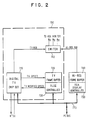
- a logic block 700 includes a digital TV chip set 710, which is a composite of digital TV input and output circuitry 200 and 500, respectively of FIG. 1; a TV frame buffer 720 and VLSI controller 730 which are included in the audio video display controller 100 of FIG. 1; and a switch 740 which is included in the digital TV output circuitry 500 of FIG. 1.
- a Video Graphics Adaptor (VGA) display controller 750 and a high resolution frame buffer 760 are connected to a PC bus 770 and are included in the host computer 300 of FIG. 1.
- the PC bus is also connected to the digital TV chip set 710 and controller 730.
- the controller 730 receives PCDATA, PCADDR and PCCNTL on the PC bus.
- the PC data may be host computer graphics data which is stored in an on screen portion of buffer 720; or PC digital audio data which is stored in an off screen portion of buffer 720. This is described in detail relative to FIGS. 3 and 10.
- an NTSC TV video signal is provided to chip set 710 and is converted to a digitized TV speed signal which is written to the TV frame buffer 720 under control of controller 730.
- a TV modified speed video signal is read from the buffer 720, also under control of controller 730 to chip set 710. The read and write operations are asynchronous with respect to each other.
- a TV RGB signal is then provided from chip set 710 as a first input to switch 740. This first input is from the TV Frame buffer.
- High resolution video information such as graphics video information is provided on PC Buss 770 to VGA display controller 750, which in turn provides high resolution pixel data to frame buffer 760.
- Buffer 760 provides a high resolution graphics RGB signal to a second input of switch 740.
- Switch 740 under control of control signals from computer 300 selects which of the dual buffers 720 and 760 provides a RGB video signal to the high resolution VGA monitor at a given time. At any given time, the following is viewed on the VGA monitor:
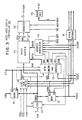
- FIG. 3 is a detailed block diagram, showing the various components of the display controller 100.
- the display controller 100 includes transceivers 90 and 92, a serial interface 94, a sync generator 105; FIFO logic 115; memory controller and arbiter 125; address generator 135; video buffer 145; serializer 155; and color key 165.
- a sync generator 105 receives the TV clock signal (TVCK), TV horizontal sync signal (TVHS) and the TV vertical sync signal (TVVS) and in response thereto generates an audio control signal (ACTL) which is sent to the digital audio circuitry 400 and memory control and arbiter 125 to indicate when control of audio operations is to take place.
- a SREQ signal output is utilized by the memory control and arbiter 125 for windowing operations.
- a FIFO 115 buffers incoming TV video data YCIN under control of TVCK and SGNT from memory control and arbiter 125. Video out from the FIFO 115 is provided to the video bus (VIDBUS) when SGNT is high.
- the VIDBUS also receives data from transceiver AXCVR 90 and transceiver XCVR 92.
- AXCVR 90 transmits to, and receives digital data (ADAT) from digital audio circuit 400.
- XCVR 92 receives PC data from host 300. This PC data may comprise graphics video in the on screen portion of video buffer 145, or digital audio for storage in the off screen portion of video buffer 145.
- Memory control and arbiter 125 controls which of FIFO 115, AXCVR 90 and XCVR 92 is providing data to the VIDBUS at a given time, based on the state of SGNT or AGNT or PGNT, respectively.
- the PC data is audio data that is stored in the off screen portion of video buffer 145, this audio data may then be subsequently read out and provided to AXVR 90 and transmitted to digital audio circuit 400 for subsequent replay.
- the memory controller and arbiter 125 arbitrates for various requests for memory cycles under control of PC control signals (PCCNTL) from host 300. Besides the control signals utilized for FIFO 115, AXCVR 90 and XCVR 92, as discussed above, control signals are also provided to address generator 135 and video buffer 145. Buffer 145 receives a video control signal (VBCTRL) and address generator 135 receives a MOP and DONE signals, which are described shortly.
- PCCNTL PC control signals
- Address generator 135 receives PC addresses (PCADDR) from host 300 which are indicative of where PC data is to be stored. Addresses (VBAADDR) are provided to the video buffer 145 to indicate where data on the VIBUS is to be stored.
- the PCADDR is also applied to a serial interface 94 which connects to the I2C bus, providing SCVIN to digital input circuitry 200; SCVOUT to digital output circuitry 400, and SCAUD to digital audio circuitry 400.
- Serializer 155 takes the video data out from video buffer 145 and provides it to digital TV output circuitry 500.
- Color key 165 provides a KEY signal to digital TV output circuitry 145 for determining which video is displayed on high resolution display 600 at a given time.
- audio video display controller 100 The main components of audio video display controller 100 are described in detail below.
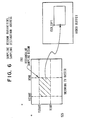
- the main purpose of the Sync Generator circuit 105 is to generate requests to the memory controller for a video sampling cycle whenever the incoming TV raster is within a user-specified region. All information inside this region is written into the video buffer 145, while all information outside of this region is ignored.
- FIG. 6 illustrates how the "video sampling region" is defined. There are four parameters written to the Sync Generator 105 by the host computer 300. These are: XStart, XEnd, YStart, and YEnd.
- HCNT horizontal counter
- TVCK clock signal
- this frequency is 13.5 MHz or 910 times the period of TVHS-.
- TVHS- vertical counter
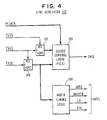
- a source control logic receiver has as inputs, PCDATA, and the outputs from counters 106 and 107.
- An audio timing logic 109 has a single input from counter 106.
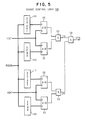
- the source control logic 108 is shown in FIG. 5, and is comprised of two pairs of comparators, one pair 110 and 111 for horizontal comparison, one pair 112 and 113 for vertical comparison.
- the signal INX from gate 116 is asserted.
- the Y- coordinate of the incoming raster falls between YSTART 117 and YEND 118
- the signal INY from gate 119 is asserted.
- the raster is within the rectangular region depicted in FIG. 6, and the Sync Generator 105 generates a Sample Request (SREQ) from gate 120 to the memory controller and arbiter 135.
- SREQ Sample Request
- An additional function of the Sync Generator 105 is to generate the appropriate timing signals to control the digital audio circuit by the audio timing logic 109 (FIG. 4).
- the timing is generated based on the video clock, TVCK which controls counter 106, the output of which controls logic 109.
- the audio sample rate is based on an integer divisor of TVCK. For the system shown, the rate is approximately 64KHz. Every audio sample is initiated by the assertion of an Audio Request (AREQ) signal at a first output of logic 109.
- An LR signal at a second output of logic 109 toggles back and forth on every other audio request, causing the left and right audio channels to be digitized or played back on alternate audio cycles. This yields an effective sampling rate of 32 KHz per channel in this embodiment.
- An AUDDIR signal at a third output of logic 109 is a control register bit that determines the type of audio cycle being requested. If AUDDIR is 0, an audio record (digitize) cycle is performed. If AUDDIR is 1, an audio playback cycle is performed. This signal is used directly to control the direction of the Audio Transceiver (AXCVR).
- a Filter Clock signal (FCK) at a fourth output of logic 109 is used to clock the pre- and post- filters at the appropriate rate. This frequency directly determines the cut-off frequency of these low-pass filters. For a sample rate of 32 KHz, the cutoff frequency should be no more than 16 KHz according to the Nyquist Theorem. If a lower sampling rate is required, for example to handle speech-quality audio, or to reduce host storage requirements, the frequency of FCK would have to be lowered correspondingly.
- the FIFO 115 shown in FIG. 7 is used to buffer the continuous stream of incoming video data while the memory controller is busy handling other requests, such as memory refresh.
- SREQ being asserted at gate 116
- video data on line 117 is shifted into the FIFO at the rate of one video sample per TV Clock (TVCK) at gate 119.
- TVCK video sample per TV Clock
- the memory controller is actually performing Sample cycles (indicated by the fact that Sampling Grant on line 120, or SGNT, is asserted), video data can be shifted out of the other end of the FIFO on line 121, also at the TVCK rate.
- SGNT on line 120 is not active, and no data is clocked out of the FIFO. Any samples that arrive during this time, accumulate in the FIFO.
- VIPUS Video Bus
- This circuit is responsible for arbitrating between the various requests for memory cycles, and then carrying out the cycle by generating the appropriate control signals to the video buffer 145. It also signals to the other components in the system which memory cycle it is currently performing, as well as providing an indication that the current cycle is complete. It controls access to the shared Video Data base (VIDBUS) via a request/grant protocol. Although multiple devices are attached to the Video Bus, this scheme assures that only one device at a time is allowed to drive data onto it. Finally, it can delay the host computer's I/O cycle long enough to insure that the host's data has been safely written to or read from the Video Buffer.
- VIPUS Video Data base
- the arbiter 126 provides input to a memory controller section 127.
- a DONE signal is asserted at the output of controller 127, indicating this fact.
- the currently asserted request with the highest priority is serviced. If the serviced request requires use of the common Video Bus, the requesting device is given control of the bus via an appropriate Grant signal.
- the grant signals are Audio Grant (AGNT), PC Grant (PGNT), and Sample Grant (SGNT) provided at respective outputs of arbiter 126.
- the PGNT signal is used to enable the PC data bus transceiver (PXCVR), while the direction of this transceiver is controlled by the PCDIR signal.
- MOP memory operation code
- control signals for the Video Buffer 145 depends on the particular VRAM devices used to construct it.
- the control signals are typical of all DRAM devices, with the exception of the TR/QE- signal, which is typical of VRAMs only.
- WEY- and WEC- are two separate Write Enable signals at the output of controller 127.
- This allows separate write access to the Luminance (Y) and Chrominance (C) information in the Video Buffer 145.
- the Video Buffer could first be cleared, and then only the Luminance information would be sampled, keeping the Chrominance Write Enable signal (WEC-) inactive (high) throughout.
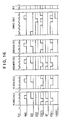
- FIGS. 16 and 17 A typical set of timing diagrams is shown in FIGS. 16 and 17. These control sequences are generated using a generic sequences design, which progresses through multiple states until a given sequence (memory cycle) is completed. At this time the DONE signal from controller 127 is asserted, indicating to the other subsystems that the current cycle is completed.
- the RDY signal from controller 127 is immediately brought inactive (low) in order to extend the host's bus cycle long enough to transfer the data to the video buffer 145.
- the RDY signal is released, allowing the host computer 300 to complete the bus cycle.
- the Address Generator circuit 135 shown in FIG. 9 provides all addresses for the various Video Buffer memory cycles outlined above. It includes separate, dedicated counters for Sampling 136, Host (PC) 137, Display Refresh 138, and Audio addressing 139. As various cycles repeatedly take place, this circuit automatically updates the counters so that the appropriate region of the Video Buffer is accessed. There is a large multiplexor 140 which selects the counter output appropriate for the current operation and correctly divides the address into row and column components for successive output to the Video Buffer during RAS- and CAS- respectively.
- the Sample Address Counters 136 generate a sequence of addresses that fill a rectangular region of the Video Buffer 145 corresponding in size with the input region selected by the Sync Generator 105.
- the upper left corner of this region is stored in two registers: Sampling Destination X-address (SDX) 141 and Sampling Destination Y-address (SDY) 142.
- SDX Sampling Destination X-address
- SDY Sampling Destination Y-address
- VSADDR Vertical Sampling Address
- SDX initial value
- SDY initial value
- This auto-increment scheme allows the host computer to fill a rectangular region of the Video Buffer 145 with a single stream-oriented instruction, such as the OUTSW or INSW instruction of the Intel 80X86 processors.
- the Video Refresh Counter (VREF) 138 is used to determine which scanline of video memory is to be transferred to VRAM serial port on the next Video Refresh (TR/QE-) cycle.
- VRAM Video Refresh Counter
- HRHS- High Resolution display
- one scanline of VRAM must be transferred, so that the contents of the appropriate scanline in the Video Buffer 145 can be shifted out synchronously with the high-resolution display 600.
- the particular sequence of Video Buffer scanlines transferred can be controlled by the host 300 using the Refresh Mode Register (REFMODE) 147. Normally, the lines are transferred progressively, with the Video Refresh Address (VREF) incrementing by one after each scanline is transferred. This in known as progressive scan mode.
- REFMODE Refresh Mode Register
- This mode provides the highest effective vertical resolution, but exhibits some "scalloping" artifacts if the subject moves horizontally from one field to the next. The subject is seen in one position on the even scanlines, and in another on the odd ones in between The effect is most noticeable in distinct vertical edges with substantial horizontal motion.
- each Video Refresh Address is used twice in succession, resulting in each of the incoming scanlines in the first (even) TV field being shown twice in the first high-speed output frame.
- the Video Refresh address are again used twice each, causing the scanlines in the next-speed output frame to again be doubled.
- This mode has slightly lower vertical resolution than the progressive mode, but is more appropriate for images that exhibit artifacts using that mode. Since the scanlines are doubled, each high-speed output frame only contains information from one incoming TV field, so no scalloping occurs.
- HAUDADDR and VAUDADDR are produced by the auto incrementing Audio Counters 139 when PCDATA from host 300 is audio data. They produce a sequence of addresses corresponding to an off-screen region portion of Video Buffer 145. After each audio memory cycle completes (as indicated by MOPAUD and DONE asserted), the counters increment, so that the next audio data from host 300 is sorted in contiguous locations in the Video Buffer 145.
- the Address Multiplexor 140 performs two functions in parallel. First, it selects the appropriate address "type" from among the counters, Sampling 136, Host (PC) 137, Video Refresh 138, and Audio 139. Second, each of these address types must be split into it's row and column components before being driven to the VRAM array. So there are actually 8 possible inputs to the MUX 140, divided into 4 pairs. The appropriate pair is determined by examining the two high order bits of the MOP (the LSB of MOP is only used to indicate direction). The Row Address component must drive the Video Buffer Address while RAS- falls, in order to be strobed into the VRAM's Row Address latches. Once RAS- has fallen, the Column Address component of a pair is selected. Note that the Column Address component of the Video Refresh Address is always exactly 0. This is because it is necessary to start shifting video samples out of the Video Buffer starting with the leftmost sample (column 0).
- the Video Buffer 145 shown in FIG. 10 is an array of Video Memories including an on screen portion and an off screen portion.
- the on screen portion is used to store the live TV video image data as it comes in, and to store PC DATA when it is graphics data.
- the organization is 1,024 video samples across by 512 scanlines high by 12 bits deep, being comprised of 61 Megabit (512x512x4 bit) devices. These numbers were chosen to accommodate the specific resolution and depth characteristics of the digital TV chip set used. For future digital TV systems having either higher resolution or deeper samples, it is simple to change the size of the video buffer to accommodate the new system's characteristics.
- the off screen portion is used to store PC DATA when it is audio data. It is to be appreciated that two separate memories could be utilized in the practice of the invention, that is a first memory to store TV video data and graphics data from the host 300; and a second memory to store audio data from the host 300.
- the incoming data bus (VIDBUS) 148 carries all information to and from the primary port of the VRAM array. This includes incoming TV video data to be sampled, digital audio data (in PC DATA and out), and host computer graphics data (PC DATA in and out). The particular access being performed is determined via standard control signals RAS-, CAS0-, TR/QE, WEY- by the memory controller 125 described above. The address at which a given cycle takes place is determined by VBADDR, which is provided by the Address Generator circuit 135, also described above. As set forth above, TV video data and host computer graphics data are stored in the on screen portion; and host audio data is stored in the off screen portion of video buffer 145.
- each half has a unique CAS-Line, which allows a 2:1 interleaved access to the Frame Buffer. This effectively halves the cycle time required to transfer data into the Buffer. This is critical, since the incoming video samples are being clocked out of the FIFO 115 at the TVCK rate, or approximately every 70 nsec in this system.
- the fastest page mode cycle that can be performed using today's VRAM technology is around 90nsec.
- By using 2:1 interleave effective page mode access times as fast as 45nsec are achieved, which is sufficient for current motion video data rates. For significantly higher data rates, higher interleave ratios and deeper Video Buffer secions are required.
- the serializer 155 takes the incoming serial data from the Video Buffer 145 along 2 parallel 12-bit paths, SDAT0 on line 156 and SDAT1 on line 157, and serializes them by a multiplexor 158, shifting them out onto the high-speed Luminance-Chrominance output data bus (YCOUT) one 12-bit sample at a time by flip-flop 159.
- the YCOUT is clocked synchronously with the host's high resolution display dot clock (HRCK). In the present embodiment, it is clocked using the same signal. This clock frequency can be increased by some fractional amount while remaining synchronous with HRCK using conventional phase-locked loop techniques.
- HRB- high-resolution blanking signal
- SC Video Buffer's serial ports
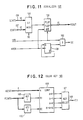
- the Color Key circuit 165 is used to generate a keying signal (KEY) on output line 166, which in turn is used by the digital TV output circuitry 500 to switch between TV video pixels (from the YCOUT bus) and the pixels from the host's high-resolution graphics controller.
- KEY keying signal
- every pixel during which KEY is asserted is seen on the monitor as video from the TV frame buffer 720, while those during which KEY is low are seen as video from the high-resolution frame buffer 760.
- This circuitry serves as the audio Input/Output subsystem in the system.
- the incoming analog stereo audio (AINL 402 and AINR 404) signals to input gain and balance control circuit 406 are first gain and balance adjusted appropriately and are subsequently low-pass prefiltered, so that they contain no frequency content above the Nyquist Frequency.
- the gain and balance can be controlled by the host computer 300 via the 2-bit serial data bus 408 (SCAUD).
- the signals Once the signals have been conditioned, they must be multiplexed onto a common wire by a multiplexor 410, in order to avoid the need for two separate Analog-to-Digital (A/D) convertors. Every other audio sample written into the video buffer comes from alternating channels of the incoming audio source. This toggling is performed via the L/R signal 412 generated by the sync generator 105.
- DAC Digital-to-Analog convertor
- the DAC used in this system is actually a dual channel DAC, taking a single digital input and providing two analog outputs. The two output voltages are updated on every other DAC conversion cycle, in a similar manner to the A/D.
- a reconstruction filter 426 in order to remove unwanted artifacts of the sampling process (i.e. quantization noise).
- This reconstruction filter has a cutoff frequency identical to that of the input filter. The cutoff frequency is controlled by the frequency of the FCK signal from the Sync Generator 105. Thus, a range of sample rates (hence cutoff frequencies) can be accommodated.
- an output amplifier 428 to restore the signals to a level sufficient to drive an audio pre-amp or headphones.
- An interesting additional feature of this circuit is the ability to monitor the digital audio through the DAC as it is being recorded from the A/D. This can be done by driving both the A/D and DAC convert pulses simultaneously, which requires an obvious change in the logic shown in FIG. 13. This feature is a result of the fact that the A/D and DAC share a common data bus (ADAT).
- ADAT common data bus
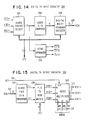
- FIG. 14 shows a typical system for providing the digital video input processed by the rest of the system.
- the video input can be selected by a video source select logic 202 from one of several sources under host control through the use of a I2C serial control bus.
- I2C serial control bus This bus is standard for control Philips chips and described in Signetics/Philips data books as previously referenced.
- these sources can be any of a variety of formats including PAL, NTSC, SECAM, SVHS,RGB, etc. This is a virtue of the digital television approach, since these devices have been designed with that flexibility in mind.
- DMSD Digital Multi-Standard Decoder
- YCIN 12-bit digital Luminance/Chrominance Input Bus
- TVCK TV data rate
- a Sync Separator circuit 210 simply extracts Sync and Clock information from the currently selected video input and provides this information (TVVS-, TVHS-,TVCK) to the rest of the system.
- This circuit converts the high-speed Luminance/Chrominance Bus (YCOUT) information on line 502 back to analog RGB form by a convertor 504 and video Y and C to RGB matrix 506, and multiplexes it in a multiplexer 508 with RGB signals 510 from the host's high-resolution graphics controller, under control of the KEY signals on line 511.
- YCOUT Luminance/Chrominance Bus
- the Y/C to RGB Matrix 506 is a purely analog component which converts the analog Y/C representation to RGB using a standard conversion matrix.
- Various adjustments to the output video can be made by the host via the serial control bus I2C.
- Video Multiplexor 508 selects between the RGB-converted video and the RGB from the high-resolution display controller, on a pixel by pixel basis. This selection is done under control of the KEY signal on line 511 generated by the Color Key circuit of FIG. 12. The output 512 of the multiplexor 508 directly drives the high-resolution display 600.
Landscapes
- Engineering & Computer Science (AREA)
- Physics & Mathematics (AREA)
- Computer Hardware Design (AREA)
- General Physics & Mathematics (AREA)
- Theoretical Computer Science (AREA)
- Controls And Circuits For Display Device (AREA)
- Digital Computer Display Output (AREA)
Applications Claiming Priority (2)
| Application Number | Priority Date | Filing Date | Title |
|---|---|---|---|
| US314623 | 1989-02-23 | ||
| US07/314,623 US4994912A (en) | 1989-02-23 | 1989-02-23 | Audio video interactive display |
Publications (3)
| Publication Number | Publication Date |
|---|---|
| EP0384257A2 true EP0384257A2 (de) | 1990-08-29 |
| EP0384257A3 EP0384257A3 (de) | 1992-06-03 |
| EP0384257B1 EP0384257B1 (de) | 1995-10-04 |
Family
ID=23220711
Family Applications (1)
| Application Number | Title | Priority Date | Filing Date |
|---|---|---|---|
| EP90102671A Expired - Lifetime EP0384257B1 (de) | 1989-02-23 | 1990-02-12 | Interaktive Audio-Video-Anzeige |
Country Status (5)
| Country | Link |
|---|---|
| US (1) | US4994912A (de) |
| EP (1) | EP0384257B1 (de) |
| JP (1) | JPH0820857B2 (de) |
| CA (1) | CA2000021C (de) |
| DE (1) | DE69022752T2 (de) |
Cited By (30)
| Publication number | Priority date | Publication date | Assignee | Title |
|---|---|---|---|---|
| EP0488125A3 (en) * | 1990-11-29 | 1993-06-30 | Esg Elektronik-System- Gesellschaft Mbh | Multi-function display unit |
| WO1993021623A1 (en) * | 1992-04-17 | 1993-10-28 | Intel Corporation | Visual frame buffer architecture |
| EP0484981A3 (en) * | 1990-11-09 | 1993-12-29 | Fuji Photo Film Co Ltd | Image data processing apparatus |
| EP0601647A1 (de) * | 1992-12-11 | 1994-06-15 | Koninklijke Philips Electronics N.V. | System zum Kombinieren von Videosignalen verschiedener Formate und aus verschiedenen Quellen |
| EP0610829A1 (de) * | 1993-02-05 | 1994-08-17 | Brooktree Corporation | Vorrichtung und Verfahren zur Anzeige von Informationen aus einem grafischen Speicher und einem Videospeicher auf einem Anzeigegerät |
| EP0574747A3 (de) * | 1992-06-19 | 1994-11-23 | Intel Corp | Rasterpufferarchitektur. |
| EP0574748A3 (de) * | 1992-06-19 | 1995-03-15 | Intel Corp | Architektur einer skalierbaren Multimedienplattform. |
| US5426731A (en) * | 1990-11-09 | 1995-06-20 | Fuji Photo Film Co., Ltd. | Apparatus for processing signals representative of a computer graphics image and a real image |
| EP0419814B1 (de) * | 1989-09-29 | 1995-06-21 | International Business Machines Corporation | Mechanismus zur Sicherung von Bildelementen für Adapter für gemischte Darstellung von graphischen Signalen und Video |
| EP0682334A1 (de) * | 1994-05-10 | 1995-11-15 | ESSILOR INTERNATIONAL Compagnie Générale d'Optique | Verfahren zur Transformation eines Videobildes in ein Bild für Matrixanzeige |
| WO1996015499A1 (en) * | 1994-11-10 | 1996-05-23 | Brooktree Corporation | System and method for command processing and data transfer in a computer system for sound or the like |
| EP0741379A1 (de) * | 1995-05-04 | 1996-11-06 | Winbond Electronics Corporation | Skalierter Video-Ausgang, der einen graphischen Computerausgang überlagert |
| CN1034150C (zh) * | 1992-12-11 | 1997-02-26 | 菲利浦光灯制造公司 | 用以组合多格式多源视频信号的系统 |
| US5719511A (en) * | 1996-01-31 | 1998-02-17 | Sigma Designs, Inc. | Circuit for generating an output signal synchronized to an input signal |
| EP0782333A3 (de) * | 1995-12-25 | 1998-07-29 | Hitachi, Ltd. | Bildanzeigegerät |
| US5790881A (en) * | 1995-02-07 | 1998-08-04 | Sigma Designs, Inc. | Computer system including coprocessor devices simulating memory interfaces |
| US5797029A (en) * | 1994-03-30 | 1998-08-18 | Sigma Designs, Inc. | Sound board emulation using digital signal processor using data word to determine which operation to perform and writing the result into read communication area |
| US5818468A (en) * | 1996-06-04 | 1998-10-06 | Sigma Designs, Inc. | Decoding video signals at high speed using a memory buffer |
| US5821947A (en) * | 1992-11-10 | 1998-10-13 | Sigma Designs, Inc. | Mixing of computer graphics and animation sequences |
| US5890190A (en) * | 1992-12-31 | 1999-03-30 | Intel Corporation | Frame buffer for storing graphics and video data |
| EP0954171A1 (de) * | 1998-04-29 | 1999-11-03 | CANAL+ Société Anonyme | Empfänger/Dekodierer und Verfahren zur Videodatenbearbeitung |
| US6084909A (en) * | 1994-03-30 | 2000-07-04 | Sigma Designs, Inc. | Method of encoding a stream of motion picture data |
| US6124897A (en) * | 1996-09-30 | 2000-09-26 | Sigma Designs, Inc. | Method and apparatus for automatic calibration of analog video chromakey mixer |
| US6128726A (en) * | 1996-06-04 | 2000-10-03 | Sigma Designs, Inc. | Accurate high speed digital signal processor |
| EP1136906A3 (de) * | 1990-11-30 | 2001-11-14 | Sun Microsystems, Inc. | Verbessertes Verfahren und Vorrichtung zur Erzeugung von virtuellen Welten |
| US6421096B1 (en) | 1994-06-28 | 2002-07-16 | Sigman Designs, Inc. | Analog video chromakey mixer |
| WO2003019512A3 (en) * | 2001-08-22 | 2003-11-27 | Gary Alfred Demos | Method and apparatus for providing computer-compatible fully synchronized audio/video information |
| EP1227675A3 (de) * | 2001-01-19 | 2004-03-17 | SAMSUNG ELECTRONICS Co. Ltd. | Einrichtung und Verfahren zur Realisierung von Transparenz in einem Bildschirmanzeigensystem |
| EP1629667A2 (de) * | 2003-05-30 | 2006-03-01 | Karl Storz GmbH & Co. KG | Verfahren und vorrichtung zum visualisieren von medizinischen patientendaten auf einer medizinischen anzeigeeinheit |
| US7703003B2 (en) | 2001-10-01 | 2010-04-20 | Oracle America, Inc. | XML document frameworks |
Families Citing this family (104)
| Publication number | Priority date | Publication date | Assignee | Title |
|---|---|---|---|---|
| US4855725A (en) | 1987-11-24 | 1989-08-08 | Fernandez Emilio A | Microprocessor based simulated book |
| US5229852A (en) * | 1989-12-05 | 1993-07-20 | Rasterops Corporation | Real time video converter providing special effects |
| US5327243A (en) * | 1989-12-05 | 1994-07-05 | Rasterops Corporation | Real time video converter |
| US5594467A (en) * | 1989-12-06 | 1997-01-14 | Video Logic Ltd. | Computer based display system allowing mixing and windowing of graphics and video |
| JPH05324821A (ja) * | 1990-04-24 | 1993-12-10 | Sony Corp | 高解像度映像及び図形表示装置 |
| US5257348A (en) * | 1990-05-24 | 1993-10-26 | Apple Computer, Inc. | Apparatus for storing data both video and graphics signals in a single frame buffer |
| US5680151A (en) * | 1990-06-12 | 1997-10-21 | Radius Inc. | Method and apparatus for transmitting video, data over a computer bus using block transfers |
| US5229760A (en) * | 1990-06-28 | 1993-07-20 | Xerox Corporation | Arithmetic technique for variable resolution printing in a ros |
| US5228859A (en) * | 1990-09-17 | 1993-07-20 | Interactive Training Technologies | Interactive educational and training system with concurrent digitized sound and video output |
| US5327156A (en) * | 1990-11-09 | 1994-07-05 | Fuji Photo Film Co., Ltd. | Apparatus for processing signals representative of a computer graphics image and a real image including storing processed signals back into internal memory |
| US5138459A (en) * | 1990-11-20 | 1992-08-11 | Personal Computer Cameras, Inc. | Electronic still video camera with direct personal computer (pc) compatible digital format output |
| JP2896414B2 (ja) * | 1991-02-08 | 1999-05-31 | 鹿島建設株式会社 | 表示装置 |
| CA2065979C (en) * | 1991-06-10 | 1999-01-19 | Stephen Patrick Thompson | Mode dependent minimum fifo fill level controls processor access to video memory |
| US5420856A (en) * | 1991-06-18 | 1995-05-30 | Multimedia Design, Inc. | High-speed multi-media switching system |
| US5351067A (en) * | 1991-07-22 | 1994-09-27 | International Business Machines Corporation | Multi-source image real time mixing and anti-aliasing |
| US6088045A (en) * | 1991-07-22 | 2000-07-11 | International Business Machines Corporation | High definition multimedia display |
| GB9120032D0 (en) * | 1991-09-19 | 1991-11-06 | Saulsbury Ashley | An interactive communication device |
| US5157495A (en) * | 1991-12-20 | 1992-10-20 | Eastman Kodak Company | Multi-mode video standard selection circuit and selection method |
| US5642437A (en) * | 1992-02-22 | 1997-06-24 | Texas Instruments Incorporated | System decoder circuit with temporary bit storage and method of operation |
| IT1259343B (it) * | 1992-03-17 | 1996-03-12 | Sip | Circuito di controllo video per applicazioni multimediali |
| US5606652A (en) * | 1992-04-29 | 1997-02-25 | Canon Kabushiki Kaisha | Real-time processing system for animation images to be displayed on high definition television systems |
| KR950008714B1 (ko) * | 1992-05-12 | 1995-08-04 | 삼성전자주식회사 | 다중모드 모니터의 온스크린 디스플레이 장치 및 방법 |
| US5404448A (en) * | 1992-08-12 | 1995-04-04 | International Business Machines Corporation | Multi-pixel access memory system |
| US20020091850A1 (en) * | 1992-10-23 | 2002-07-11 | Cybex Corporation | System and method for remote monitoring and operation of personal computers |
| JPH06233259A (ja) * | 1992-10-29 | 1994-08-19 | Daewoo Electron Co Ltd | イメージデータ走査方式転換装置 |
| US5402147A (en) * | 1992-10-30 | 1995-03-28 | International Business Machines Corporation | Integrated single frame buffer memory for storing graphics and video data |
| US5420801A (en) * | 1992-11-13 | 1995-05-30 | International Business Machines Corporation | System and method for synchronization of multimedia streams |
| US5657423A (en) * | 1993-02-22 | 1997-08-12 | Texas Instruments Incorporated | Hardware filter circuit and address circuitry for MPEG encoded data |
| US5729556A (en) * | 1993-02-22 | 1998-03-17 | Texas Instruments | System decoder circuit with temporary bit storage and method of operation |
| US5412426A (en) * | 1993-04-16 | 1995-05-02 | Harris Corporation | Multiplexing of digitally encoded NTSC and HDTV signals over single microwave communication link from television studio to tower transmitter facility for simultaneous broadcast (simulcast) to customer sites by transmitter facility |
| US5502727A (en) * | 1993-04-20 | 1996-03-26 | At&T Corp. | Image and audio communication system having graphical annotation capability |
| CA2100700C (en) * | 1993-07-16 | 2000-01-11 | Robert P. Bicevskis | Multi-media computer architecture |
| US5617367A (en) * | 1993-09-01 | 1997-04-01 | Micron Technology, Inc. | Controlling synchronous serial access to a multiport memory |
| USRE38610E1 (en) * | 1993-09-30 | 2004-10-05 | Ati Technologies, Inc. | Host CPU independent video processing unit |
| US5523791A (en) * | 1993-10-12 | 1996-06-04 | Berman; John L. | Method and apparatus for applying overlay images |
| US5583652A (en) * | 1994-04-28 | 1996-12-10 | International Business Machines Corporation | Synchronized, variable-speed playback of digitally recorded audio and video |
| US5765142A (en) * | 1994-08-18 | 1998-06-09 | Creatacard | Method and apparatus for the development and implementation of an interactive customer service system that is dynamically responsive to change in marketing decisions and environments |
| US5764964A (en) * | 1994-10-13 | 1998-06-09 | International Business Machines Corporation | Device for protecting selected information in multi-media workstations |
| US6037926A (en) * | 1994-11-18 | 2000-03-14 | Thomson Consumer Electronics, Inc. | Emulation of computer monitor in a wide screen television |
| US6014125A (en) * | 1994-12-08 | 2000-01-11 | Hyundai Electronics America | Image processing apparatus including horizontal and vertical scaling for a computer display |
| US5598525A (en) | 1995-01-23 | 1997-01-28 | Cirrus Logic, Inc. | Apparatus, systems and methods for controlling graphics and video data in multimedia data processing and display systems |
| US5896179A (en) * | 1995-03-31 | 1999-04-20 | Cirrus Logic, Inc. | System for displaying computer generated images on a television set |
| JPH08331472A (ja) * | 1995-05-24 | 1996-12-13 | Internatl Business Mach Corp <Ibm> | 共有フレーム・バッファを含むマルチメディア表示装置においてビデオ・データとグラフィック・データの同期をとる方法及び装置 |
| US6359636B1 (en) | 1995-07-17 | 2002-03-19 | Gateway, Inc. | Graphical user interface for control of a home entertainment system |
| US5675390A (en) * | 1995-07-17 | 1997-10-07 | Gateway 2000, Inc. | Home entertainment system combining complex processor capability with a high quality display |
| US5812144A (en) * | 1995-09-08 | 1998-09-22 | International Business Machines Corporation | System for performing real-time video resizing in a data processing system having multimedia capability |
| US5940610A (en) * | 1995-10-05 | 1999-08-17 | Brooktree Corporation | Using prioritized interrupt callback routines to process different types of multimedia information |
| US5892982A (en) * | 1995-11-29 | 1999-04-06 | Matsushita Electric Industrial Co., Ltd. | External expansion bus interface circuit for connecting a micro control unit, and a digital recording and reproducing apparatus incorporating said interface circuit |
| US5697793A (en) * | 1995-12-14 | 1997-12-16 | Motorola, Inc. | Electronic book and method of displaying at least one reading metric therefor |
| US5893132A (en) * | 1995-12-14 | 1999-04-06 | Motorola, Inc. | Method and system for encoding a book for reading using an electronic book |
| US5761681A (en) * | 1995-12-14 | 1998-06-02 | Motorola, Inc. | Method of substituting names in an electronic book |
| US5761682A (en) * | 1995-12-14 | 1998-06-02 | Motorola, Inc. | Electronic book and method of capturing and storing a quote therein |
| US5815407A (en) * | 1995-12-14 | 1998-09-29 | Motorola Inc. | Method and device for inhibiting the operation of an electronic device during take-off and landing of an aircraft |
| US5661635A (en) * | 1995-12-14 | 1997-08-26 | Motorola, Inc. | Reusable housing and memory card therefor |
| US5663748A (en) * | 1995-12-14 | 1997-09-02 | Motorola, Inc. | Electronic book having highlighting feature |
| US5657088A (en) * | 1995-12-22 | 1997-08-12 | Cirrus Logic, Inc. | System and method for extracting caption teletext information from a video signal |
| US6292176B1 (en) * | 1996-02-26 | 2001-09-18 | Motorola, Inc. | Method and system for displaying textual information |
| US5914711A (en) * | 1996-04-29 | 1999-06-22 | Gateway 2000, Inc. | Method and apparatus for buffering full-motion video for display on a video monitor |
| JPH1079915A (ja) * | 1996-09-02 | 1998-03-24 | Mitsubishi Electric Corp | 記録再生装置 |
| US6195086B1 (en) * | 1996-09-12 | 2001-02-27 | Hearme | Method and apparatus for loosely synchronizing closed free running raster displays |
| KR100233388B1 (ko) * | 1996-10-11 | 1999-12-01 | 구자홍 | 티브이 및 피씨화면 동시 디스플레이장치 |
| US6437829B1 (en) * | 1997-01-16 | 2002-08-20 | Display Laboratories, Inc. | Alignment of cathode ray tube displays using a video graphics controller |
| US6546426B1 (en) | 1997-03-21 | 2003-04-08 | International Business Machines Corporation | Method and apparatus for efficiently processing an audio and video data stream |
| JP3564961B2 (ja) * | 1997-08-21 | 2004-09-15 | 株式会社日立製作所 | ディジタル放送受信装置 |
| IL142119A0 (en) * | 1998-09-22 | 2002-03-10 | Cybex Computer Prod Corp | System and method for accessing and operating personal computers remotely |
| US7046308B1 (en) * | 1998-11-13 | 2006-05-16 | Hewlett-Packard Development Company, L.P. | Method and apparatus for transmitting digital television data |
| US6694379B1 (en) * | 1999-04-09 | 2004-02-17 | Sun Microsystems, Inc. | Method and apparatus for providing distributed clip-list management |
| US6950875B1 (en) | 2000-05-09 | 2005-09-27 | Sun Microsystems, Inc. | Message conductors in a distributed computing environment |
| US6573946B1 (en) * | 2000-08-31 | 2003-06-03 | Intel Corporation | Synchronizing video streams with different pixel clock rates |
| US20030014674A1 (en) * | 2001-07-10 | 2003-01-16 | Huffman James R. | Method and electronic book for marking a page in a book |
| US7313764B1 (en) * | 2003-03-06 | 2007-12-25 | Apple Inc. | Method and apparatus to accelerate scrolling for buffered windows |
| CN1327695C (zh) * | 2004-10-18 | 2007-07-18 | 海信集团有限公司 | 实现高清1080p/60格式的电视机电路 |
| US20060168537A1 (en) * | 2004-12-22 | 2006-07-27 | Hochmuth Roland M | Computer display control system and method |
| US8631342B2 (en) * | 2004-12-22 | 2014-01-14 | Hewlett-Packard Development Company, L.P. | Computer display control system and method |
| CN101496387B (zh) * | 2006-03-06 | 2012-09-05 | 思科技术公司 | 用于移动无线网络中的接入认证的系统和方法 |
| EP2048666A1 (de) * | 2007-10-12 | 2009-04-15 | Magix Ag | System und Methode zur automatischen Erstellung eines Multi/Hybrid Speichermediums |
| US8797377B2 (en) * | 2008-02-14 | 2014-08-05 | Cisco Technology, Inc. | Method and system for videoconference configuration |
| US10229389B2 (en) * | 2008-02-25 | 2019-03-12 | International Business Machines Corporation | System and method for managing community assets |
| US8694658B2 (en) * | 2008-09-19 | 2014-04-08 | Cisco Technology, Inc. | System and method for enabling communication sessions in a network environment |
| US8659637B2 (en) * | 2009-03-09 | 2014-02-25 | Cisco Technology, Inc. | System and method for providing three dimensional video conferencing in a network environment |
| US20100283829A1 (en) * | 2009-05-11 | 2010-11-11 | Cisco Technology, Inc. | System and method for translating communications between participants in a conferencing environment |
| US8659639B2 (en) | 2009-05-29 | 2014-02-25 | Cisco Technology, Inc. | System and method for extending communications between participants in a conferencing environment |
| US9082297B2 (en) * | 2009-08-11 | 2015-07-14 | Cisco Technology, Inc. | System and method for verifying parameters in an audiovisual environment |
| US9225916B2 (en) * | 2010-03-18 | 2015-12-29 | Cisco Technology, Inc. | System and method for enhancing video images in a conferencing environment |
| US9313452B2 (en) | 2010-05-17 | 2016-04-12 | Cisco Technology, Inc. | System and method for providing retracting optics in a video conferencing environment |
| US8896655B2 (en) | 2010-08-31 | 2014-11-25 | Cisco Technology, Inc. | System and method for providing depth adaptive video conferencing |
| US8599934B2 (en) | 2010-09-08 | 2013-12-03 | Cisco Technology, Inc. | System and method for skip coding during video conferencing in a network environment |
| US8599865B2 (en) | 2010-10-26 | 2013-12-03 | Cisco Technology, Inc. | System and method for provisioning flows in a mobile network environment |
| US8699457B2 (en) | 2010-11-03 | 2014-04-15 | Cisco Technology, Inc. | System and method for managing flows in a mobile network environment |
| US8902244B2 (en) | 2010-11-15 | 2014-12-02 | Cisco Technology, Inc. | System and method for providing enhanced graphics in a video environment |
| US8730297B2 (en) | 2010-11-15 | 2014-05-20 | Cisco Technology, Inc. | System and method for providing camera functions in a video environment |
| US9338394B2 (en) | 2010-11-15 | 2016-05-10 | Cisco Technology, Inc. | System and method for providing enhanced audio in a video environment |
| US9143725B2 (en) | 2010-11-15 | 2015-09-22 | Cisco Technology, Inc. | System and method for providing enhanced graphics in a video environment |
| US8542264B2 (en) | 2010-11-18 | 2013-09-24 | Cisco Technology, Inc. | System and method for managing optics in a video environment |
| US8723914B2 (en) | 2010-11-19 | 2014-05-13 | Cisco Technology, Inc. | System and method for providing enhanced video processing in a network environment |
| US9111138B2 (en) | 2010-11-30 | 2015-08-18 | Cisco Technology, Inc. | System and method for gesture interface control |
| US8692862B2 (en) | 2011-02-28 | 2014-04-08 | Cisco Technology, Inc. | System and method for selection of video data in a video conference environment |
| US8670019B2 (en) | 2011-04-28 | 2014-03-11 | Cisco Technology, Inc. | System and method for providing enhanced eye gaze in a video conferencing environment |
| US8786631B1 (en) * | 2011-04-30 | 2014-07-22 | Cisco Technology, Inc. | System and method for transferring transparency information in a video environment |
| US8934026B2 (en) | 2011-05-12 | 2015-01-13 | Cisco Technology, Inc. | System and method for video coding in a dynamic environment |
| US8947493B2 (en) | 2011-11-16 | 2015-02-03 | Cisco Technology, Inc. | System and method for alerting a participant in a video conference |
| US8682087B2 (en) | 2011-12-19 | 2014-03-25 | Cisco Technology, Inc. | System and method for depth-guided image filtering in a video conference environment |
| US9681154B2 (en) | 2012-12-06 | 2017-06-13 | Patent Capital Group | System and method for depth-guided filtering in a video conference environment |
| US9843621B2 (en) | 2013-05-17 | 2017-12-12 | Cisco Technology, Inc. | Calendaring activities based on communication processing |
Family Cites Families (30)
| Publication number | Priority date | Publication date | Assignee | Title |
|---|---|---|---|---|
| US4357624A (en) * | 1979-05-15 | 1982-11-02 | Combined Logic Company | Interactive video production system |
| US4282546A (en) * | 1979-11-28 | 1981-08-04 | Rca Corporation | Television image size altering apparatus |
| US4317114A (en) * | 1980-05-12 | 1982-02-23 | Cromemco Inc. | Composite display device for combining image data and method |
| USRE32201F1 (en) * | 1981-08-12 | 1989-08-01 | Ibm | Apparatus and method for reading and writing text characters in a graphics display |
| US4599611A (en) * | 1982-06-02 | 1986-07-08 | Digital Equipment Corporation | Interactive computer-based information display system |
| US4710873A (en) * | 1982-07-06 | 1987-12-01 | Marvin Glass & Associates | Video game incorporating digitized images of being into game graphics |
| US4562435A (en) * | 1982-09-29 | 1985-12-31 | Texas Instruments Incorporated | Video display system using serial/parallel access memories |
| US4639721A (en) * | 1982-10-09 | 1987-01-27 | Sharp Kabushiki Kaisha | Data selection circuit for the screen display of data from a personal computer |
| JPS59202535A (ja) * | 1983-04-30 | 1984-11-16 | Nec Home Electronics Ltd | 表示メモリ出力・コピ−デ−タ変換回路 |
| JPS59214085A (ja) * | 1983-05-20 | 1984-12-03 | 株式会社東芝 | 信号変換装置 |
| JPS6089278A (ja) * | 1983-10-21 | 1985-05-20 | Pioneer Electronic Corp | 画像情報処理方式 |
| JPS60145761A (ja) * | 1984-01-06 | 1985-08-01 | Nec Corp | フアクシミリ装置の原稿イメ−ジ情報表示回路 |
| US4663617A (en) * | 1984-02-21 | 1987-05-05 | International Business Machines | Graphics image relocation for display viewporting and pel scrolling |
| US4862156A (en) * | 1984-05-21 | 1989-08-29 | Atari Corporation | Video computer system including multiple graphics controllers and associated method |
| JPH0786743B2 (ja) * | 1984-05-25 | 1995-09-20 | 株式会社アスキー | ディスプレイコントローラ |
| US4631588A (en) * | 1985-02-11 | 1986-12-23 | Ncr Corporation | Apparatus and its method for the simultaneous presentation of computer generated graphics and television video signals |
| US4639765A (en) * | 1985-02-28 | 1987-01-27 | Texas Instruments Incorporated | Synchronization system for overlay of an internal video signal upon an external video signal |
| JP2572373B2 (ja) * | 1986-01-14 | 1997-01-16 | 株式会社 アスキ− | カラ−デイスプレイ装置 |
| US4777486A (en) * | 1986-05-09 | 1988-10-11 | A-Squared Systems | Video signal receiver for computer graphics system |
| JPH087567B2 (ja) * | 1986-08-12 | 1996-01-29 | 株式会社日立製作所 | 画像表示装置 |
| JP2526558B2 (ja) * | 1986-10-21 | 1996-08-21 | ソニー株式会社 | ビデオ信号のスキャンコンバ−タ装置 |
| US4862154A (en) * | 1986-10-31 | 1989-08-29 | International Business Machines Corporation | Image display processor for graphics workstation |
| US4870406A (en) * | 1987-02-12 | 1989-09-26 | International Business Machines Corporation | High resolution graphics display adapter |
| JPS63213886A (ja) * | 1987-03-03 | 1988-09-06 | 東芝ライテック株式会社 | 映像表示装置 |
| EP0280932B1 (de) * | 1987-03-04 | 1992-11-19 | Hitachi, Ltd. | Gerät zur Wiedergabe von Videosignalen geringer Auflösung auf Videomonitoren hoher Auflösung |
| EP0314780A4 (en) * | 1987-05-18 | 1991-10-16 | Denyse Dubrucq | The information station |
| US4851826A (en) * | 1987-05-29 | 1989-07-25 | Commodore Business Machines, Inc. | Computer video demultiplexer |
| JP2590899B2 (ja) * | 1987-07-24 | 1997-03-12 | 松下電器産業株式会社 | 文字図形情報表示装置 |
| DE3732111A1 (de) * | 1987-09-24 | 1989-04-06 | Bosch Gmbh Robert | Verfahren zur laufzeitanpassung von video- und audiosignalen an ein referenzsignal |
| US4855813A (en) * | 1987-12-11 | 1989-08-08 | Russell David P | Television image processing system having capture, merge and display capability |
-
1989
- 1989-02-23 US US07/314,623 patent/US4994912A/en not_active Expired - Lifetime
- 1989-10-02 CA CA002000021A patent/CA2000021C/en not_active Expired - Fee Related
- 1989-12-20 JP JP1328617A patent/JPH0820857B2/ja not_active Expired - Fee Related
-
1990
- 1990-02-12 DE DE69022752T patent/DE69022752T2/de not_active Expired - Fee Related
- 1990-02-12 EP EP90102671A patent/EP0384257B1/de not_active Expired - Lifetime
Cited By (41)
| Publication number | Priority date | Publication date | Assignee | Title |
|---|---|---|---|---|
| EP0419814B1 (de) * | 1989-09-29 | 1995-06-21 | International Business Machines Corporation | Mechanismus zur Sicherung von Bildelementen für Adapter für gemischte Darstellung von graphischen Signalen und Video |
| EP0484981A3 (en) * | 1990-11-09 | 1993-12-29 | Fuji Photo Film Co Ltd | Image data processing apparatus |
| US5426731A (en) * | 1990-11-09 | 1995-06-20 | Fuji Photo Film Co., Ltd. | Apparatus for processing signals representative of a computer graphics image and a real image |
| EP0488125A3 (en) * | 1990-11-29 | 1993-06-30 | Esg Elektronik-System- Gesellschaft Mbh | Multi-function display unit |
| EP1136906A3 (de) * | 1990-11-30 | 2001-11-14 | Sun Microsystems, Inc. | Verbessertes Verfahren und Vorrichtung zur Erzeugung von virtuellen Welten |
| US5914729A (en) * | 1992-04-17 | 1999-06-22 | Intel Corporation | Visual frame buffer architecture |
| WO1993021623A1 (en) * | 1992-04-17 | 1993-10-28 | Intel Corporation | Visual frame buffer architecture |
| US5546531A (en) * | 1992-04-17 | 1996-08-13 | Intel Corporation | Visual frame buffer architecture |
| EP0574747A3 (de) * | 1992-06-19 | 1994-11-23 | Intel Corp | Rasterpufferarchitektur. |
| EP0574748A3 (de) * | 1992-06-19 | 1995-03-15 | Intel Corp | Architektur einer skalierbaren Multimedienplattform. |
| US5821947A (en) * | 1992-11-10 | 1998-10-13 | Sigma Designs, Inc. | Mixing of computer graphics and animation sequences |
| CN1034150C (zh) * | 1992-12-11 | 1997-02-26 | 菲利浦光灯制造公司 | 用以组合多格式多源视频信号的系统 |
| EP0601647A1 (de) * | 1992-12-11 | 1994-06-15 | Koninklijke Philips Electronics N.V. | System zum Kombinieren von Videosignalen verschiedener Formate und aus verschiedenen Quellen |
| US5890190A (en) * | 1992-12-31 | 1999-03-30 | Intel Corporation | Frame buffer for storing graphics and video data |
| US5406306A (en) * | 1993-02-05 | 1995-04-11 | Brooktree Corporation | System for, and method of displaying information from a graphics memory and a video memory on a display monitor |
| EP0610829A1 (de) * | 1993-02-05 | 1994-08-17 | Brooktree Corporation | Vorrichtung und Verfahren zur Anzeige von Informationen aus einem grafischen Speicher und einem Videospeicher auf einem Anzeigegerät |
| US6084909A (en) * | 1994-03-30 | 2000-07-04 | Sigma Designs, Inc. | Method of encoding a stream of motion picture data |
| US5797029A (en) * | 1994-03-30 | 1998-08-18 | Sigma Designs, Inc. | Sound board emulation using digital signal processor using data word to determine which operation to perform and writing the result into read communication area |
| FR2719928A1 (fr) * | 1994-05-10 | 1995-11-17 | Essilor Int | Procédé de transformation d'une image vidéo en une image pour matrice d'affichage. |
| EP0682334A1 (de) * | 1994-05-10 | 1995-11-15 | ESSILOR INTERNATIONAL Compagnie Générale d'Optique | Verfahren zur Transformation eines Videobildes in ein Bild für Matrixanzeige |
| US6501512B2 (en) | 1994-06-28 | 2002-12-31 | Sigma Designs, Inc. | Method and apparatus for automatic calibration of analog video chromakey mixer |
| US6421096B1 (en) | 1994-06-28 | 2002-07-16 | Sigman Designs, Inc. | Analog video chromakey mixer |
| WO1996015499A1 (en) * | 1994-11-10 | 1996-05-23 | Brooktree Corporation | System and method for command processing and data transfer in a computer system for sound or the like |
| US5974478A (en) * | 1994-11-10 | 1999-10-26 | Brooktree Corporation | System for command processing or emulation in a computer system, such as emulation of DMA commands using burst mode data transfer for sound |
| US5732279A (en) * | 1994-11-10 | 1998-03-24 | Brooktree Corporation | System and method for command processing or emulation in a computer system using interrupts, such as emulation of DMA commands using burst mode data transfer for sound or the like |
| US5790881A (en) * | 1995-02-07 | 1998-08-04 | Sigma Designs, Inc. | Computer system including coprocessor devices simulating memory interfaces |
| EP0741379A1 (de) * | 1995-05-04 | 1996-11-06 | Winbond Electronics Corporation | Skalierter Video-Ausgang, der einen graphischen Computerausgang überlagert |
| US5710573A (en) * | 1995-05-04 | 1998-01-20 | Winbond Electronics Corp. | Scaled video output overlaid onto a computer graphics output |
| EP0782333A3 (de) * | 1995-12-25 | 1998-07-29 | Hitachi, Ltd. | Bildanzeigegerät |
| US5719511A (en) * | 1996-01-31 | 1998-02-17 | Sigma Designs, Inc. | Circuit for generating an output signal synchronized to an input signal |
| US6128726A (en) * | 1996-06-04 | 2000-10-03 | Sigma Designs, Inc. | Accurate high speed digital signal processor |
| US5818468A (en) * | 1996-06-04 | 1998-10-06 | Sigma Designs, Inc. | Decoding video signals at high speed using a memory buffer |
| US6124897A (en) * | 1996-09-30 | 2000-09-26 | Sigma Designs, Inc. | Method and apparatus for automatic calibration of analog video chromakey mixer |
| WO1999056465A1 (en) * | 1998-04-29 | 1999-11-04 | Canal+ Societe Anonyme | Receiver/decoder and method of processing video data |
| EP0954171A1 (de) * | 1998-04-29 | 1999-11-03 | CANAL+ Société Anonyme | Empfänger/Dekodierer und Verfahren zur Videodatenbearbeitung |
| US7284262B1 (en) | 1998-04-29 | 2007-10-16 | Thomson Licensing S.A. | Receiver/decoder and method of processing video data |
| EP1227675A3 (de) * | 2001-01-19 | 2004-03-17 | SAMSUNG ELECTRONICS Co. Ltd. | Einrichtung und Verfahren zur Realisierung von Transparenz in einem Bildschirmanzeigensystem |
| US6829015B2 (en) | 2001-01-19 | 2004-12-07 | Samsung Electronics Co., Ltd. | Device and method for realizing transparency in an on screen display |
| WO2003019512A3 (en) * | 2001-08-22 | 2003-11-27 | Gary Alfred Demos | Method and apparatus for providing computer-compatible fully synchronized audio/video information |
| US7703003B2 (en) | 2001-10-01 | 2010-04-20 | Oracle America, Inc. | XML document frameworks |
| EP1629667A2 (de) * | 2003-05-30 | 2006-03-01 | Karl Storz GmbH & Co. KG | Verfahren und vorrichtung zum visualisieren von medizinischen patientendaten auf einer medizinischen anzeigeeinheit |
Also Published As
| Publication number | Publication date |
|---|---|
| CA2000021A1 (en) | 1990-08-23 |
| CA2000021C (en) | 1994-11-08 |
| US4994912A (en) | 1991-02-19 |
| EP0384257A3 (de) | 1992-06-03 |
| JPH0820857B2 (ja) | 1996-03-04 |
| JPH02248993A (ja) | 1990-10-04 |
| EP0384257B1 (de) | 1995-10-04 |
| DE69022752T2 (de) | 1996-06-13 |
| DE69022752D1 (de) | 1995-11-09 |
Similar Documents
| Publication | Publication Date | Title |
|---|---|---|
| EP0384257B1 (de) | Interaktive Audio-Video-Anzeige | |
| US5680178A (en) | Video multiplexing system for superimposition of scalable video data streams upon a background video data stream | |
| US5777601A (en) | System and method for generating video in a computer system | |
| US4564915A (en) | YIQ Computer graphics system | |
| US5929933A (en) | Video multiplexing system for superimposition of scalable video data streams upon a background video data stream | |
| US6172669B1 (en) | Method and apparatus for translation and storage of multiple data formats in a display system | |
| US5455628A (en) | Converter to convert a computer graphics signal to an interlaced video signal | |
| US5805148A (en) | Multistandard video and graphics, high definition display system and method | |
| US7030934B2 (en) | Video system for combining multiple video signals on a single display | |
| US5557302A (en) | Method and apparatus for displaying video data on a computer display | |
| US20030038807A1 (en) | Method and apparatus for providing computer-compatible fully synchronized audio/video information | |
| US5258750A (en) | Color synchronizer and windowing system for use in a video/graphics system | |
| JPH05241524A (ja) | ユニバーサルビデオ出力装置 | |
| JP3472667B2 (ja) | ビデオデータ処理装置およびビデオデータ表示装置 | |
| EP0574747A2 (de) | Rasterpufferarchitektur | |
| GB2137857A (en) | Computer Graphics System | |
| JPH0432593B2 (de) | ||
| GB2073997A (en) | Computer graphics system | |
| GB2073995A (en) | Computer graphic system | |
| JP2593427B2 (ja) | 画像処理装置 | |
| JPH06214538A (ja) | 統合されたビデオおよびグラフィックを表示するための、システムおよび方法 | |
| JPS61193580A (ja) | 2画面テレビジヨン受像機 | |
| WO1993015453A1 (en) | Personal computer apparatus for digital video and audio manipulation | |
| JP3611815B2 (ja) | ビデオデバイス | |
| JP3283281B2 (ja) | 画像入出力装置 |
Legal Events
| Date | Code | Title | Description |
|---|---|---|---|
| PUAI | Public reference made under article 153(3) epc to a published international application that has entered the european phase |
Free format text: ORIGINAL CODE: 0009012 |
|
| AK | Designated contracting states |
Kind code of ref document: A2 Designated state(s): DE FR GB |
|
| 17P | Request for examination filed |
Effective date: 19901210 |
|
| PUAL | Search report despatched |
Free format text: ORIGINAL CODE: 0009013 |
|
| AK | Designated contracting states |
Kind code of ref document: A3 Designated state(s): DE FR GB |
|
| 17Q | First examination report despatched |
Effective date: 19931021 |
|
| GRAA | (expected) grant |
Free format text: ORIGINAL CODE: 0009210 |
|
| AK | Designated contracting states |
Kind code of ref document: B1 Designated state(s): DE FR GB |
|
| REF | Corresponds to: |
Ref document number: 69022752 Country of ref document: DE Date of ref document: 19951109 |
|
| ET | Fr: translation filed | ||
| PLBE | No opposition filed within time limit |
Free format text: ORIGINAL CODE: 0009261 |
|
| STAA | Information on the status of an ep patent application or granted ep patent |
Free format text: STATUS: NO OPPOSITION FILED WITHIN TIME LIMIT |
|
| 26N | No opposition filed | ||
| REG | Reference to a national code |
Ref country code: GB Ref legal event code: IF02 |
|
| PGFP | Annual fee paid to national office [announced via postgrant information from national office to epo] |
Ref country code: GB Payment date: 20030203 Year of fee payment: 14 |
|
| PGFP | Annual fee paid to national office [announced via postgrant information from national office to epo] |
Ref country code: FR Payment date: 20030217 Year of fee payment: 14 |
|
| PGFP | Annual fee paid to national office [announced via postgrant information from national office to epo] |
Ref country code: DE Payment date: 20040102 Year of fee payment: 15 |
|
| PG25 | Lapsed in a contracting state [announced via postgrant information from national office to epo] |
Ref country code: GB Free format text: LAPSE BECAUSE OF NON-PAYMENT OF DUE FEES Effective date: 20040212 |
|
| GBPC | Gb: european patent ceased through non-payment of renewal fee |
Effective date: 20040212 |
|
| PG25 | Lapsed in a contracting state [announced via postgrant information from national office to epo] |
Ref country code: FR Free format text: LAPSE BECAUSE OF NON-PAYMENT OF DUE FEES Effective date: 20041029 |
|
| REG | Reference to a national code |
Ref country code: FR Ref legal event code: ST |
|
| PG25 | Lapsed in a contracting state [announced via postgrant information from national office to epo] |
Ref country code: DE Free format text: LAPSE BECAUSE OF NON-PAYMENT OF DUE FEES Effective date: 20050901 |