EP0384699A2 - Verfahren zur Herstellung eines Fluororganopolysiloxans - Google Patents
Verfahren zur Herstellung eines Fluororganopolysiloxans Download PDFInfo
- Publication number
- EP0384699A2 EP0384699A2 EP90301795A EP90301795A EP0384699A2 EP 0384699 A2 EP0384699 A2 EP 0384699A2 EP 90301795 A EP90301795 A EP 90301795A EP 90301795 A EP90301795 A EP 90301795A EP 0384699 A2 EP0384699 A2 EP 0384699A2
- Authority
- EP
- European Patent Office
- Prior art keywords
- formula
- fluoroorganopolysiloxane
- group
- integer
- defined above
- Prior art date
- Legal status (The legal status is an assumption and is not a legal conclusion. Google has not performed a legal analysis and makes no representation as to the accuracy of the status listed.)
- Granted
Links
Images



Classifications
-
- C—CHEMISTRY; METALLURGY
- C08—ORGANIC MACROMOLECULAR COMPOUNDS; THEIR PREPARATION OR CHEMICAL WORKING-UP; COMPOSITIONS BASED THEREON
- C08G—MACROMOLECULAR COMPOUNDS OBTAINED OTHERWISE THAN BY REACTIONS ONLY INVOLVING UNSATURATED CARBON-TO-CARBON BONDS
- C08G77/00—Macromolecular compounds obtained by reactions forming a linkage containing silicon with or without sulfur, nitrogen, oxygen or carbon in the main chain of the macromolecule
- C08G77/04—Polysiloxanes
- C08G77/22—Polysiloxanes containing silicon bound to organic groups containing atoms other than carbon, hydrogen and oxygen
- C08G77/24—Polysiloxanes containing silicon bound to organic groups containing atoms other than carbon, hydrogen and oxygen halogen-containing groups
Definitions
- the present invention relates to a novel fluoroorganopolysiloxane and a process for preparing the same.
- Organopolysiloxanes have low surface tension and low refractive indexes, and are excellent in properties such as heat resistance, cold resistance, electrical insulation properties, water repellency, release properties, defoaming properties and chemical resistance; hence they are nowadays used in extensive industries.
- an organopolysiloxane having a large polymerization degree with a viscosity of 1x10⁶ cP or more is essential as a main ingredient, because an organopolysiloxane with a lower polymerization degree is liable to adhere to rolls when worked with a roll mill and worsen workability extremely, and because resulting compounds produce only cured products with poor mechanical properties such as strength and elongation.
- Fluorosilicone rubbers have good heat resistance, oil resistance, release properties, etc., and require a fluorine-containing organopolysiloxane with a large polymerization degree as a raw material.
- the present invention provides a novel fluoroorganopolysiloxane containing a perfluoroalkylether group and having a sufficiently large polymerization degree, which can be used as a raw material as described above.
- a process may be proposed in which a cyclotrisiloxane having the perfluoroalkylether group is synthesized, and then polymerized according to a known process, i.e., it is polymerized in the presence of such a catalyst as silanolates of alkali, e.g., Li, Na, K and Cs at 100 to 180°C.
- a catalyst as silanolates of alkali, e.g., Li, Na, K and Cs at 100 to 180°C.
- an object of the present invention is to provide a novel fluoroorganopolysiloxane having a perfluoroalkylether group, with a large polymerization degree which can satisfy some of recent requirements to raw materials for high-level functional materials, and a process for preparing it.
- the present invention provides a novel fluoroorganopolysiloxane having the following general unit formula (I): wherein R1 represents a fluorine-containing organic group represented by the following for mula: F-(-C g F 2g O-) d -C h F 2h CH2- where d represents an integer of from 1 to 5, g represents an integer of from 1 to 3, and h is 1 or 2, R2 represents a divalent substituted or unsubstituted hydrocarbon group having 3 to 10 carbon atoms and containing no fluorine atom, R3 represents a substituted or unsubstituted hydrocarbon group containing 1 to 10 carbon atoms and containing no fluorine atom, a is a number of from 0.001 to 0.34, b is a number of from 1.64 to 2.34, c is a number of from 0 to 0.67, and a+b+c ranges from 1.90 to 2.67, and having a viscosity of not less than 1
- the fluoroorganopolysiloxane containing a perfluoroalkylether group in the molecule and having a large polymerization degree of the present invention is useful as a main ingredient of heat-vulcanization type fluorosilicone rubber composition.
- the cured fluorosilicone rubber obtained is excellent in oil resistance, surface release properties, etc.; hence it is useful as a material for members or parts requiring oil resistance and gasoline resistance used in, e.g., automobiles or aircraft, and members requiring surface release properties such as PPC rolls.
- This fluoroorganopolysiloxane can be produced by a process described later.
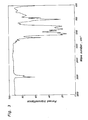
- Fig. 1 and Fig. 2 show the GPC charts of the fluoroorganopolysiloxanes obtained in Example 1 and Comparative Example 1, respectively.
- Figs. 3 to 5 show the IR absorption spectrum, 1H-NMR spectrum and GPC chart, respectively, of the fluoroorganopolysiloxane obtained in Example 4.
- R1 is a fluorine-containing organic group containing the perfluoroalkylether group having the following formula: F-(-C g F 2g O-) d -C h F 2h CH2- where g represents an integer of from 1 to 3, d represents an integer of from 1 to 5, and h is 1 or 2.
- R1 has normally from 3 to 18 carbon atoms, and more typically has from 6 to 15 carbon atoms.
- the perfluoralkylether group having too small a number of carbon atoms may impair the properties of the present polymer, such as release properties, low surface energy, etc.
- the fluorine-containing organic group includes, for example, the groups having the following formulas: CF3CF2CF2O-(CF2CF2CF2O)-CF2CF2CH2-, and CF3CF2O-(CF2CF2O)2-(CF2O)-CF2CH2-.
- R2 is a divalent substituted or unsubstituted hydrocarbon group having from 3 to 10 carbon atoms, and it includes, for example, alkylene groups such as a trimethylene group, a propylene group, and a 2-methyltrimethylene group; and alkylene groups substituted partly by a phenylene radical, such as
- a is a number of from 0.001 to 0.34
- b is a number of from 1.64 to 2.34
- c is a number of from 0 to 0.67
- a+b+c ranges from 1.90 to 2.67.
- the amount of the aliphatic unsaturated hydrocarbon groups contained as an R3 in the molecule of the fluoroorganopolysiloxane of the present invention is not limited.
- the amount of the aliphatic unsaturated groups is suitably adjusted according purposes, and normally ranges from 0.2 to 30 mol% of all the pendant groups bonded to silicon atoms.
- silicone gel In the case it is used as a silicone gel, it may contain less than two aliphatic unsaturated groups on average in the molecule, because it is required that the molar ratio of silicon-bonded hydrogen atoms of an organohydrogenpolysiloxane used in combination to the silicon-bonded aliphatic unsaturated groups in the fluoroorganopolysiloxane of the invention ranges from 1 to 1.5.
- Typical examples of the fluoroorganopolysiloxane represented by the above general formula (I) of the present invention include, for example, a compound having the following general formula (II): wherein R1, R2 and R3 are as defined above, R4 has the same meaning as R3 or represents a hydrogen atom or a group having the formula: where R3 is as defined above, R5 has the same meaning as R3 or represents a group having the formula: -R2OR1 where R1 and R2 are as defined above, m is an integer of at least 2, n is an integer of not less than 1, provided m ⁇ 2n, and having a vinyl group at the both ends and/or a side chain.
- R1, R2 and R3 are as defined above
- R4 has the same meaning as R3 or represents a hydrogen atom or a group having the formula: where R3 is as defined above
- R5 has the same meaning as R3 or represents a group having the formula: -R2OR1 where R1 and R2
- the fluoroorganopolysiloxane of the general formula (II) includes, as a typical example, the ones represented by the general formula (II) wherein R4 at the both ends of the molecule is a triorganosilyl group, for example, the compounds of the following formulas: wherein R1, R2, m and n are as defined above; and the ones represented by the general formula (II) wherein m+n ranges from 3 to 2,000, and the ends of the molecule are terminated by a silanol group.
- the fluoroorganopolysiloxane of the present invention has a viscosity of not less than 1x10⁶ cP at 25°C. No fluoroorganopolysiloxane with such a large polymerization degree is known, heretofore.
- the preparation of the fluoroorganopolysiloxane of the present invention can be carried out by a process comprising the step of polymerizing a fluorine-containing cyclotrisiloxane having the following formula (III): wherein R1, R2 and R3 are as defined above, or a mixture of said fluorine-containing cyclosiloxane of the formula (III) and a cyclosiloxane having the following formula (IV): wherein R3 is as defined above, in the presence of at least one basic catalyst selected from the group consisting of quaternary phosphonium hydroxide, quaternary ammonium hydroxide and corresponding silanolates thereof, or an acidic catalyst and substantially in the absence of water at a temperature of not higher than 80°C.
- a basic catalyst selected from the group consisting of quaternary phosphonium hydroxide, quaternary ammonium hydroxide and corresponding silanolates thereof, or an
- R1, R2 and R3 are as defined in respect of said formula (I).
- the fluorine-containing cyclotrisiloxane of the formula (III) includes, for example, the compounds represented by the following formulas: wherein R1 is as defined above.
- the cyclotrisiloxane of the formula (IV) includes, for example, the compounds represented by the following formulas: wherein R6 and R7 are as defined above.
- the mixing ratio of the fluorine-containing cyclotrisiloxane of said formula (III) to the cyclotrisiloxane of said formula (IV) is decided suitably according to an intended fluoroorganopolysiloxane of the formula (I), and it normally ranges from 99.9/0.1 to 0.1/99.9, by weight.
- the fluorine-containing cyclotrisiloxane of the above formula (III) can be prepared, for example, by the process using a perfluoroalkylene oxide, exemplified be deeplylow, as a starting material.
- a perfluoroalkylene oxide having the formula (V) is polymerized in the presence of a catalyst in a non-protonic polar solvent to produce an acid fluoride having the formula (VI).
- a catalyst in a non-protonic polar solvent to produce an acid fluoride having the formula (VI).
- the non-protonic solvent used in this reaction includes, for example, tetraglyme.
- the catalyst includes, for example, cesium fluoride CsF, potassium fluoride, and the like.
- the acid fluoride of the formula (VI) obtained is reduced with a reducing agent such as, e.g., LiAlH4 and NaBH4, followed by hydrolysis to produce a perfluoroalkyl polyether alcohol represented by the following formula (VII): (See U.S. Patent No. 3,293,306).
- a reducing agent such as, e.g., LiAlH4 and NaBH4
- hydrolysis to produce a perfluoroalkyl polyether alcohol represented by the following formula (VII): (See U.S. Patent No. 3,293,306).
- the perfluoroalkylpolyetheralcohol of the formula (VII) is reacted with a halogenated alkene, e.g., allyl bromide to produce, for example, an ether compound having a vinyl group at its end represented by the following formula (VIII): (see the specification of Japanese Patent Publication (KOKOKU) No. 253044/1988).
- a basic substance such as sodium hydroxide, or a phase-transfer catalyst such as tetrabutyl ammounium-hydrogen-sulfuric acid may be used.
- the ether compound of the formula (VIII) and methyldichlorosilane are subjected to addition reaction in the presence of a platinum catalyst according to the following equation (b) to produce a silane compound of the formula (IX).
- a platinum catalyst according to the following equation (b) to produce a silane compound of the formula (IX).
- the silane compound of the formula (IX) and tetramethyldisiloxane diol are subjected to dehydrochlorination to produce a fluorine-containing cyclotrisiloxane having the formula (IIIa):
- the dehydrochlorination agent which may be used includes, for example, tertiary amines such as triethylamine and active hydrogen-free cyclic amines such as pyridine.
- fluoroorganopolysiloxanes various perfluoroalkylether groups can be prepared.
- use of a mixed starting material containing various perfluoroalkylene oxides can bring about a mixture of various fluorine-containing cyclotrisiloxanes having different perfluoroalkylether groups.
- the fluorine-containing cyclotrisiloxane of the formula (III) obtained as described above, or a mixture of it with the cyclotrisiloxane of the formula (IV) is polymerized in the of the particular basic catalyst described above or an acidic catalyst and substantially in the absence of water to produce the fluoroorganopolysiloxane of the present invention.
- the particular basic catalyst used comprise at least one member selected from the group consisting of quaternary phosphonium hydroxides, quaternary ammonium hydroxides, and silanolates thereof.
- the quaternary phosphonium hydroxides include, for example, the compounds having the formulas:
- the quaternary ammonium hydroxides include, for example, the compounds having the formulas: (CH3)4N-OH, (C4H9)4N-OH, Among these basic catalysts, particularly preferred is (C4H9)4POH, which makes it possible to produce a fluoroorganopolysiloxane containing a very small amount of low molecular weight compounds, in good yield and which is readily available.
- Silanolation of the quaternary phosphonium hydroxide or the quaternary ammonium hydroxide can be performed, for example, by heating an aqueous solution of it with octamethycyclotetrasiloxane at from 50 to 60°C under stirring, with water being distilled under reduced pressure.
- the acidic catalyst preferably includes, for example, ClSO3H, CF3SO3H, FSO3H, H2SO4, and PNCl2.
- the amount of the catalyst is not particularly limited. Normally, the catalyst is preferably used in an amount such that the molar ratio of all the Si in the fluorine-containing cyclotrisiloxane of said formula (III) and the cyclotrisiloxane of the formula (IV) to the catalyst molecule may range from about 2,000 to 50,000. If the catalyst is present in too large an amount, it also binds to monomers, the cyclotrisiloxanes of the formulas (III) and (IV) during polymerization, to form terminal silanolate groups; hence a fluoroorganopolysiloxane with a large polymerization degree can be produced with difficulty. Moreover, neutralization treatment after the polymerization become harder, and salts formed by the neutralization may exert bad influence upon the properties of the resulting fluoroorganopolysiloxane.
- Polymerization is normally carried out at 80°C or lower.
- an acidic catalyst is used, preferably at from -10 to 60°C, and more preferably at from 0 to 30°C.
- a basic catalyst is used, at from 10 to 80°C, and more preferably at from 20 to 60 °C.
- formation of low molecular weight cyclic compounds may be promoted by equilibration reaction.
- Polymerization time can be set to within a time of for from several minutes to several ten minutes as required.
- the polymerization time is set to from 30 minutes to several hours by regulating the catalyst amount and polymerization temperature so that a fluoroorganopolysiloxane with a desired polymerization degree may be prepared.
- nonprotic solvents such as tetrahydrofrun, dioxane, diglyme, tetraglyme, dimethylformamide, and acetonitrile, or inert solvents such as frons may be used.
- the polymerization is carried out substantially in the absence thereof; for example, the water content of the reaction system is preferably controlled to 200 ppm or less, and more preferably to 100 ppm or less.
- the fluorine-containing cyclotrisiloxane of the formula (III), the cyclotrisiloxane of the formula (IV) and the catalyst e.g., the fluorine-containing cyclotrisiloxane of the formula (III), the cyclotrisiloxane of the formula (IV) and the catalyst.
- the fluorine-containing cyclosiloxane of the formula (IV) and the cyclosiloxane of the formula (IV) preferably have a purity of 98 % or more, and more preferably 99 % or more.
- the polysiloxane may be automatically neutralized with hydrochloric acid contained in the silica in a small amount; hence neutralization is not required.
- a reaction mixture resulting from polymerization as described above normally contains a residual basic catalyst or acidic catalyst, it is preferably neutralized, thereby the fluoroorganopolysiloxane being stabilized.
- the neutralization treatment can make the polymer either terminated with a triorganosilyl group or terminated with a silanol group, selectively, by selecting a neutralizing agent suitably.
- the reaction mixture is neutralized with a halosilane compound having the formula (X): R5(R3)2SiX (X) wherein R3 and R5 are as defined above, and X represents a halogen atom, and a disilazane compound having the formula (XI): [R5(R3)2Si]2NH (XI) wherein R3 and R5 are as defined above, in combination, thereby the fluoroorganopolysiloxane is stabilized.
- a halosilane compound having the formula (X): R5(R3)2SiX (X) wherein R3 and R5 are as defined above, and X represents a halogen atom
- a disilazane compound having the formula (XI): [R5(R3)2Si]2NH (XI) wherein R3 and R5 are as defined above
- the disilazane compound of said formula (XI) serves to capture hydrochloric acid which may be by-produced by hydrolysis of said halosilane compound and thereby to control depolymerization. It includes, for example, hexacarbyldisilazanes such as the compounds represented by the formulas: and silazanes having a fluorine-containing organic group, such as the compounds represented by the formulas: wherein d is as defined above.
- the halosilane compound is normally used in an amount such that the molar ratio of it to the catalyst used for polymerization may range from about 0.8 to about 3.0.
- the disilazane compound is normally used in an amount such that the molar ratio of it to the catalyst used for the polymerization may range from about 0.5 to about 10.
- the use of the halosilane compound or the disilazane compound in too large an amount may make the resulting fluoroorganopolysiloxane unstable.
- fluoroorganopolysiloxane is made terminated with a triorganosilyl group by the method of neutralizing by combined use of the halosilane compound and the disilazane as described above, a vinyl group or other functional group can be introduced as a part of the organic groups possessed by the terminal triorganosilyl group.
- the basic catalyst in order to prepare a fluoroorganopolysiloxane terminated with a silanol group, preferably, the basic catalyst is neutralized with an acidic substance such as dilute hydrochloric acid, dilute sulfuric acid, and phosphoric acid, and then salts formed and an excess acidic substance are removed.
- the acidic substance is preferably used in an amount 0.8 to 3 times by equivalent weight that of the basic catalyst used.
- a solution of a basic substance such as an aqueous ammonia and an aqueous amine compound solution is used as a neutralizing agent, and then formed salts and excess basic substance are removed.
- Amine compounds to be used are preferably ones which can be distilled away, including , for example, lower alkylamines such as dimethylamine, propylamine, and ammonium carbonate.
- the basic substance for neutralization is preferably used in an amount such that the nitrogen atoms contained in the basic substance is from 1 to 5 times by equivalent weight the acidic catalyst used.
- an inert solvent may be used as appropriate.
- inert solvents include, for example, fluorine solvents such as fron 113, and m-xylene hexafluoride, chlorine solvents such as methylene chloride and trichloroethane.
- the fluoroorganopolysiloxane of the present invention has a low surface tension and refractive index, and is excellent in properties such as cold resistance and oil resistance. Hence, it is expected to be also used for release agents, fiber modifiers, liquid rubbers, and heatcure rubbers.
- the viscosities are measured at 25°C.
- stirring rate was reduced to about 6 to 10 rpm, and the reaction mixture was aged for 3 hours, thus producing in a colorless transparent fluoroorganopolysiloxane with a viscosity of 6.2x10⁶ cP.
- the fluoroorganopolysiloxane was dissolved in tetrahydrofuran in a concentration of 1 % to exhibit a slightly suspended state. According to GPC analysis, as shown in Fig. 1, peak 11, due to high molecular weight compounds, comprising 98 % of the whole area was measured, indicating that the fluoroorganopolysiloxane hardly contains low molecular weight compounds.
- Example 2 Polymerization was carried out for 16 hours in the same manner as in Example 1 except that it was done at 110°C in place of 40-45°C, to produce an oily fluoroorganopolysiloxane with a viscosity of 4,200 cSt at 25°C.
- the fluoroorganopolysiloxane obtained was analyzed by GPC in the same manner as in Example 1, to give the GPC chart as shown in Fig. 2. It shows that the area of peak 21 due to high molecular weight compounds is about 60 %, and that the fluoroorganopolysiloxane obtained contain a large amount of low molecular weight compounds (peak 22 and peak 23).
- the fluoroorganopolysiloxane obtained had a viscosity of 2.7x10⁶ cP.
- n 1, 49 % by weight of that wherein n is 2, 27 % by weight of that wherein n is 3, 7 % by weight of that wherein n is 4, and 2 % by weight of that wherein n is 5 (purity: all 99.6 %):
- the mixture was dried at 120°C under nitrogen stream for 1 hour. After the mixture was cooled to 30°C, 0.16 g of m-xylene hexafluoride containing 5% by weight of CF3SO3H was added thereto so that the molar ratio of Si/CF3SO3H in the reaction system might become 1,100. Then, polymerization was carried out at 30°C under stirring for 16 hours to produce a reaction mixture containing a transparent gum-like fluoroorganopolysiloxane. To the reaction mixture, 0.48 g of dioxane containing 1 % by weight of water was added and the resulting mixture was stirred for 60 minutes.
- the fluoroorganopolysiloxane obtained had a viscosity of 1.1x10⁶ cP, and was insoluble in tetrahydrofuran.
- the stirring rate was slowed down to 6-10 rpm and the reaction mixture was then aged for about 20 hours, and a fluoroorganopolysiloxane was thereby obtained.
- the polymer obtained was colorless and transparent, and had a viscosity of 4.1x10⁶ cP.
- the fluoroorganopolysiloxane was divided into 10 g portions, which were each put in a glass bottle with an about 30 ml volume. In each bottle, a neutralizing agent given in Table 1 was added and mixed. The mixture was left to stand at room temperature for 6 hours, and then aged at 150°C for 22 hours, followed by measurement of non-volatile content and viscosity. The measurement of viscosity was conducted on 10 weight % solution of the fluoroorganopolysiloxane dissolved in m-xylene hexafluoride. Incidentally, the corresponding solution before the aging treatment had a viscosity of 25.2 cSt. The results are given in Table 1.
- Main characteristic absorption bands are as follows. 1,000 to 1,130 cm ⁇ 1 (Si-O-Si) 2,970, 1,260, 810 cm ⁇ 1 (Si-CH3) 1,000 to 1,400 cm ⁇ 1 (C-F)
- the polymer was dissolved in THF in a concentration of 1 % by weight to form a slightly turbid solution.
- the refractive index, specific gravity, solidification point and vinyl content were measured to be 1.3656, 1.29, -98°C and 0.0017 mol/100 g, respectively.
- the results above show that even in the case polymerization was carried out using TBPH catalyst, without sufficient neutralization after polymerization, the fluoroorganopolysiloxane obtained is not stable. It also show that in the case (CH3)3SiCl and [(CH3)3Si]2NH are used in combination as a neutralizing agent, neutralization can be achieved sufficiently if the amount thereof changes to some degree.
- Example 2 In the same manner as in Example 1, 29.9 g of D2F2 (purity: 99.4 %; Si atoms: ca. 0.12 mol) was charged in a flask, and dried. Then, 0.110 g of TBPH catalyst was added thereto at 30 to 35°C so that the molar ratio of Si/P in the reaction system might become 3,000, and thereafter polymerization was carried out at 30 to 35°C for about 16 hours.
- the fluoroorganopolysiloxane obtained was in a gum-like state and had a viscosity of 5.6x10⁶ cP.
- the specific gravity, and refractive index (n D 25) were measured to be 1.36 and 1.3530, respectively.
- the viscosity of the fluoroorganopolysiloxane obtained was measured to be 2.1x10⁶ cP.
- the fluoroorganopolysiloxane was dissolved in m-xylene hexafluoride in a concentration of 1 % to form a solution, which was subjected to GPC analysis. The result showed that the fluoroorganopolysiloxane hardly contained low molecular weight compounds.
Landscapes
- Chemical & Material Sciences (AREA)
- Health & Medical Sciences (AREA)
- Chemical Kinetics & Catalysis (AREA)
- Medicinal Chemistry (AREA)
- Polymers & Plastics (AREA)
- Organic Chemistry (AREA)
- Silicon Polymers (AREA)
Applications Claiming Priority (2)
| Application Number | Priority Date | Filing Date | Title |
|---|---|---|---|
| JP40960/89 | 1989-02-21 | ||
| JP1040960A JPH0618880B2 (ja) | 1989-02-21 | 1989-02-21 | フルオロオルガノポリシロキサン及びその製造方法 |
Publications (3)
| Publication Number | Publication Date |
|---|---|
| EP0384699A2 true EP0384699A2 (de) | 1990-08-29 |
| EP0384699A3 EP0384699A3 (de) | 1991-08-21 |
| EP0384699B1 EP0384699B1 (de) | 1994-12-21 |
Family
ID=12595050
Family Applications (1)
| Application Number | Title | Priority Date | Filing Date |
|---|---|---|---|
| EP90301795A Expired - Lifetime EP0384699B1 (de) | 1989-02-21 | 1990-02-20 | Verfahren zur Herstellung eines Fluororganopolysiloxans |
Country Status (4)
| Country | Link |
|---|---|
| US (1) | US5118775A (de) |
| EP (1) | EP0384699B1 (de) |
| JP (1) | JPH0618880B2 (de) |
| DE (1) | DE69015226T2 (de) |
Cited By (2)
| Publication number | Priority date | Publication date | Assignee | Title |
|---|---|---|---|---|
| GB2278846A (en) * | 1993-06-10 | 1994-12-14 | Gen Electric | Fluorosilicone terpolymeric fluid |
| EP0881249A3 (de) * | 1997-05-27 | 1999-01-27 | OSi Specialties, Inc. | Siloxan-Polyether-Copolymere mit ungesättigten funktionellen Gruppen und Verfahren zu ihrer Herstellung |
Families Citing this family (44)
| Publication number | Priority date | Publication date | Assignee | Title |
|---|---|---|---|---|
| JPH0813928B2 (ja) * | 1990-05-22 | 1996-02-14 | 信越化学工業株式会社 | シリコーンゴム組成物 |
| US6464713B2 (en) * | 1990-06-28 | 2002-10-15 | Peter M. Bonutti | Body tissue fastening |
| EP0611785B1 (de) * | 1993-02-15 | 2000-05-10 | Shin-Etsu Chemical Co., Ltd. | Verfahren zur Herstellung von linearen Organopolysiloxanen |
| FR2737214B1 (fr) * | 1995-07-25 | 1997-10-24 | Rhone Poulenc Chimie | Polyorganosiloxanes perhalogenes polyfonctionnels et leurs procedes d'obtention |
| US6441118B2 (en) | 1996-04-25 | 2002-08-27 | 3M Innovative Properties Company | Polydiorganosiloxane oligourea segmented copolymers and a process for making same |
| US6664359B1 (en) | 1996-04-25 | 2003-12-16 | 3M Innovative Properties Company | Tackified polydiorganosiloxane polyurea segmented copolymers and a process for making same |
| US6407195B2 (en) | 1996-04-25 | 2002-06-18 | 3M Innovative Properties Company | Tackified polydiorganosiloxane oligourea segmented copolymers and a process for making same |
| US6355759B1 (en) | 1996-04-25 | 2002-03-12 | 3M Innovative Properties Company | Polydiorganosiloxane polyurea segmented copolymers and a process for making same |
| US6846893B1 (en) | 1996-10-23 | 2005-01-25 | Minnesota Mining And Manufacturing Company | Polymer mixtures containing polydiorganosiloxane urea-containing components |
| US6107222A (en) * | 1997-12-01 | 2000-08-22 | 3M Innovative Properties Company | Repositionable sheets with a nonwoven web of pressure-sensitive adhesive fibers |
| US6007914A (en) * | 1997-12-01 | 1999-12-28 | 3M Innovative Properties Company | Fibers of polydiorganosiloxane polyurea copolymers |
| US5892086A (en) * | 1998-05-29 | 1999-04-06 | Pcr, Inc. | Perfluorinated ether organo substituted cyclosiloxanes and copolymers prepared from these cyclosiloxanes |
| US5914420A (en) * | 1998-05-29 | 1999-06-22 | Pcr, Inc. | Perfluorinated organo substituted cyylosiloxanes and copolymers prepared from these cyclosiloxahes |
| US6265515B1 (en) * | 1999-06-14 | 2001-07-24 | The United States Of America As Represented By The Secretary Of The Navy | Fluorinated silicone resin fouling release composition |
| US7090922B2 (en) * | 2001-12-18 | 2006-08-15 | 3M Innovative Properties Company | Silicone priming compositions, articles, and methods |
| US6730397B2 (en) | 2001-12-18 | 2004-05-04 | 3M Innovative Properties Company | Silicone pressure sensitive adhesives, articles and methods |
| US7012110B2 (en) * | 2001-12-18 | 2006-03-14 | 3M Innovative Properties Company | Silicone pressure sensitive adhesives prepared using processing aids, articles, and methods |
| US7407709B2 (en) * | 2003-12-22 | 2008-08-05 | 3M Innovative Properties Company | Silicone pressure sensitive adhesive and articles |
| US7560166B2 (en) * | 2005-12-28 | 2009-07-14 | 3M Innovative Properties Company | Adhesive article, composite article, and methods of making the same |
| US8334037B2 (en) | 2007-05-11 | 2012-12-18 | 3M Innovative Properties Company | Multi-layer assembly, multi-layer stretch releasing pressure-sensitive adhesive assembly, and methods of making and using the same |
| JP2011509338A (ja) * | 2008-01-11 | 2011-03-24 | スリーエム イノベイティブ プロパティズ カンパニー | 延伸剥離性の光学的に透明な感圧性接着剤 |
| WO2013173588A1 (en) | 2012-05-18 | 2013-11-21 | 3M Innovative Properties Company | Adhesive articles for medical applications |
| BR112014031055A2 (pt) | 2012-06-11 | 2017-06-27 | 3M Innovative Properties Co | composições processáveis no estado fundido tendo sinergista e aditivo de processamento polimérico contendo silicone |
| US20150183990A1 (en) | 2012-06-11 | 2015-07-02 | 3M Innovative Properties Company | Melt-processable polyamide compositions having silicone-containing polymeric process additive |
| CN104781354B (zh) | 2012-07-03 | 2017-07-11 | 3M创新有限公司 | 硅氧烷基管涂层 |
| KR20150032568A (ko) | 2012-07-03 | 2015-03-26 | 쓰리엠 이노베이티브 프로퍼티즈 컴파니 | 열-활성화가능한 실록산계 접착제 |
| CN105579515A (zh) | 2013-09-20 | 2016-05-11 | 3M创新有限公司 | 聚合物加工添加剂、组合物和方法 |
| US10982079B2 (en) | 2014-12-19 | 2021-04-20 | 3M Innovative Properties Company | Poly(oxyalkylene) polymer processing additive, compositions, and methods |
| KR102444532B1 (ko) | 2014-12-23 | 2022-09-16 | 쓰리엠 이노베이티브 프로퍼티즈 컴파니 | 양면 다층 접착제 |
| WO2016106022A1 (en) | 2014-12-23 | 2016-06-30 | 3M Innovative Properties Company | Tie layers prepared from particle-containing waterborne suspensions |
| BR112017021396A2 (pt) | 2015-04-06 | 2018-07-03 | 3M Innovative Properties Company | composição em gel, filme e método para aplicação de uma composição em gel |
| US11285702B2 (en) | 2016-07-22 | 2022-03-29 | 3M Innovative Properties Company | Siloxane-based adhesive layers as ceramic precursors |
| WO2018071278A1 (en) | 2016-10-13 | 2018-04-19 | 3M Innovative Properties Company | Removable film-forming gel compositions featuring adhesion promoters |
| EP3700994B1 (de) | 2017-10-26 | 2025-08-13 | 3M Innovative Properties Company | Zusammensetzung mit einem klebstoff auf silikonbasis und zellulose-nanokristallen sowie verfahren und artikel |
| RU2018141773A (ru) | 2018-11-27 | 2020-05-27 | 3М Инновейтив Пропертиз Компани | Композиции полимерных процессинговых добавок и изделия, полученные с использованием указанных композиций |
| EP3976003A1 (de) | 2019-05-31 | 2022-04-06 | Kindeva Drug Delivery L.P. | Entfernbare filmbildende gelzusammensetzungen mit haftvermittlern |
| EP4061901A1 (de) | 2019-11-20 | 2022-09-28 | 3M Innovative Properties Company | Medizinische klebebänder mit hoher optischer klarheit beim überkleben |
| RU2020134081A (ru) | 2020-10-16 | 2022-04-19 | 3М Инновейтив Пропертиз Компани | Формуемые из расплава композиции полиэтилена высокой плотности, содержащие полиорганосилоксановый полимер |
| US20240307416A1 (en) | 2021-07-29 | 2024-09-19 | 3M Innovative Properties Company | Film-forming compositions comprising salicylic acid and methods of use |
| WO2025099507A1 (en) | 2023-11-10 | 2025-05-15 | Solventum Intellectual Properties Company | Method of using a negative pressure wound therapy dressing |
| CN122396742A (zh) | 2023-12-15 | 2026-07-14 | 3M创新有限公司 | 包含聚酰胺层的粘合剂制品和方法 |
| WO2025133985A1 (en) | 2023-12-19 | 2025-06-26 | 3M Innovative Properties Company | Adhesive article release layers comprising diphenyl urethane compound |
| CN122459410A (zh) | 2023-12-27 | 2026-07-24 | 3M创新有限公司 | 包含二苯基化合物的粘合剂制品防粘层 |
| TW202603094A (zh) | 2024-03-01 | 2026-01-16 | 美商3M新設資產公司 | 使鉑聚矽氧離型襯墊適用於聚矽氧系黏著劑的差異化黏著劑 |
Family Cites Families (8)
| Publication number | Priority date | Publication date | Assignee | Title |
|---|---|---|---|---|
| US3639156A (en) * | 1970-05-19 | 1972-02-01 | Us Agriculture | Siloxane polymers for soil-repellent and soil-release textile finishes |
| US4287353A (en) * | 1979-11-09 | 1981-09-01 | General Electric Company | Process for synthesizing silanol chain-stopped fluorosiloxane fluids |
| US4267298A (en) * | 1979-11-09 | 1981-05-12 | General Electric Company | Process for preparing M-stopped silicone fluids from silanol fluids |
| DE3248535A1 (de) * | 1982-12-29 | 1984-07-12 | Wacker-Chemie GmbH, 8000 München | Fluoralkyloxyalkylgruppen aufweisendes diorganopolysiloxan und dessen verwendung |
| JPH0752247B2 (ja) * | 1985-08-28 | 1995-06-05 | 旭硝子株式会社 | 光伝送ファイバー |
| US4683277A (en) * | 1986-07-02 | 1987-07-28 | Dow Corning Corporation | Method for preparing vinyl terminated fluorine-containing polydiorganosiloxane |
| EP0255957A3 (de) * | 1986-08-08 | 1988-11-17 | Asahi Glass Company Ltd. | Fluorsilikonpolymer, Verfahren zu seiner Herstellung und dieses enthaltende Zusammensetzung |
| JPS6474268A (en) * | 1987-09-14 | 1989-03-20 | Shinetsu Chemical Co | Curable silicone composition |
-
1989
- 1989-02-21 JP JP1040960A patent/JPH0618880B2/ja not_active Expired - Lifetime
-
1990
- 1990-02-20 EP EP90301795A patent/EP0384699B1/de not_active Expired - Lifetime
- 1990-02-20 DE DE69015226T patent/DE69015226T2/de not_active Expired - Fee Related
- 1990-02-20 US US07/481,208 patent/US5118775A/en not_active Expired - Fee Related
Cited By (4)
| Publication number | Priority date | Publication date | Assignee | Title |
|---|---|---|---|---|
| GB2278846A (en) * | 1993-06-10 | 1994-12-14 | Gen Electric | Fluorosilicone terpolymeric fluid |
| GB2278846B (en) * | 1993-06-10 | 1997-04-16 | Gen Electric | Fluorosilicone terpolymeric fluid |
| US5635579A (en) * | 1993-06-10 | 1997-06-03 | General Electric Company | Compositional additive comprising terpolymeric fluid |
| EP0881249A3 (de) * | 1997-05-27 | 1999-01-27 | OSi Specialties, Inc. | Siloxan-Polyether-Copolymere mit ungesättigten funktionellen Gruppen und Verfahren zu ihrer Herstellung |
Also Published As
| Publication number | Publication date |
|---|---|
| JPH02219829A (ja) | 1990-09-03 |
| DE69015226D1 (de) | 1995-02-02 |
| EP0384699B1 (de) | 1994-12-21 |
| EP0384699A3 (de) | 1991-08-21 |
| JPH0618880B2 (ja) | 1994-03-16 |
| US5118775A (en) | 1992-06-02 |
| DE69015226T2 (de) | 1995-05-11 |
Similar Documents
| Publication | Publication Date | Title |
|---|---|---|
| EP0384699B1 (de) | Verfahren zur Herstellung eines Fluororganopolysiloxans | |
| US5028679A (en) | Method for preparing perfluoroalkyl group-containing organopolysiloxanes | |
| JPS6010045B2 (ja) | ジオルガノポリシロキサンの製造方法 | |
| EP0279706B1 (de) | Härtbare fluorierte Siloxanzusammensetzungen | |
| US5118777A (en) | Polydimethylsiloxane terminated at one end by a branched aminoalkyl group and preparation thereof | |
| JP4156689B2 (ja) | アルキル置換シロキサンおよびアルキル置換ポリエーテル流体 | |
| US6284859B1 (en) | Polymerization of siloxanes | |
| GB2065153A (en) | Method for producing silanol chain-stopped fluoroalkyl poly-siloxane fluids | |
| EP0540039B1 (de) | Verfahren zur Herstellung von verzweigten Organopolysiloxanen | |
| US3183254A (en) | Organic silicone compounds and method for producing same | |
| US5116928A (en) | Process for preparing a fluoroorganopolysiloxane | |
| US5272225A (en) | Branched organopolysiloxanes | |
| US4640968A (en) | Ethylidene norbornyl group-containing polysiloxane | |
| EP0611785B1 (de) | Verfahren zur Herstellung von linearen Organopolysiloxanen | |
| US5914420A (en) | Perfluorinated organo substituted cyylosiloxanes and copolymers prepared from these cyclosiloxahes | |
| JPH06293831A (ja) | 鎖状ポリオルガノシロキサン及びその製造方法 | |
| JP3110127B2 (ja) | 分岐ポリシロキサンの製造方法 | |
| JPH0739426B2 (ja) | アシルアミノオルガノシリコーン化合物の製造方法 | |
| EP1233020B1 (de) | Fluorierte Organosiliziumverbindungen | |
| JPS6225128A (ja) | シリコ−ン流動体 | |
| JPH09143270A (ja) | 新規シロキサン誘導体及びその製造方法 | |
| JP2745093B2 (ja) | 室温硬化性含フッ素オルガノポリシロキサン組成物及びその硬化物 | |
| JPH1036512A (ja) | 共加水分解縮合反応による含フッ素シリコーン化合物の製造方法 |
Legal Events
| Date | Code | Title | Description |
|---|---|---|---|
| PUAI | Public reference made under article 153(3) epc to a published international application that has entered the european phase |
Free format text: ORIGINAL CODE: 0009012 |
|
| AK | Designated contracting states |
Kind code of ref document: A2 Designated state(s): DE FR GB |
|
| 17P | Request for examination filed |
Effective date: 19901214 |
|
| PUAL | Search report despatched |
Free format text: ORIGINAL CODE: 0009013 |
|
| AK | Designated contracting states |
Kind code of ref document: A3 Designated state(s): DE FR GB |
|
| 17Q | First examination report despatched |
Effective date: 19930521 |
|
| GRAA | (expected) grant |
Free format text: ORIGINAL CODE: 0009210 |
|
| AK | Designated contracting states |
Kind code of ref document: B1 Designated state(s): DE FR GB |
|
| REF | Corresponds to: |
Ref document number: 69015226 Country of ref document: DE Date of ref document: 19950202 |
|
| ET | Fr: translation filed | ||
| PGFP | Annual fee paid to national office [announced via postgrant information from national office to epo] |
Ref country code: GB Payment date: 19950210 Year of fee payment: 6 Ref country code: FR Payment date: 19950210 Year of fee payment: 6 |
|
| PGFP | Annual fee paid to national office [announced via postgrant information from national office to epo] |
Ref country code: DE Payment date: 19950222 Year of fee payment: 6 |
|
| PLBE | No opposition filed within time limit |
Free format text: ORIGINAL CODE: 0009261 |
|
| STAA | Information on the status of an ep patent application or granted ep patent |
Free format text: STATUS: NO OPPOSITION FILED WITHIN TIME LIMIT |
|
| 26N | No opposition filed | ||
| PG25 | Lapsed in a contracting state [announced via postgrant information from national office to epo] |
Ref country code: GB Effective date: 19960220 |
|
| GBPC | Gb: european patent ceased through non-payment of renewal fee |
Effective date: 19960220 |
|
| PG25 | Lapsed in a contracting state [announced via postgrant information from national office to epo] |
Ref country code: FR Effective date: 19961031 |
|
| PG25 | Lapsed in a contracting state [announced via postgrant information from national office to epo] |
Ref country code: DE Effective date: 19961101 |
|
| REG | Reference to a national code |
Ref country code: FR Ref legal event code: ST |