EP0387787A2 - Automatische Analysevorrichtung und Verfahren für klinische Untersuchung - Google Patents
Automatische Analysevorrichtung und Verfahren für klinische Untersuchung Download PDFInfo
- Publication number
- EP0387787A2 EP0387787A2 EP19900104723 EP90104723A EP0387787A2 EP 0387787 A2 EP0387787 A2 EP 0387787A2 EP 19900104723 EP19900104723 EP 19900104723 EP 90104723 A EP90104723 A EP 90104723A EP 0387787 A2 EP0387787 A2 EP 0387787A2
- Authority
- EP
- European Patent Office
- Prior art keywords
- check
- sample
- remeasurement
- measurement
- abnormality
- Prior art date
- Legal status (The legal status is an assumption and is not a legal conclusion. Google has not performed a legal analysis and makes no representation as to the accuracy of the status listed.)
- Granted
Links
Images




Classifications
-
- G—PHYSICS
- G01—MEASURING; TESTING
- G01N—INVESTIGATING OR ANALYSING MATERIALS BY DETERMINING THEIR CHEMICAL OR PHYSICAL PROPERTIES
- G01N35/00—Automatic analysis not limited to methods or materials provided for in any single one of groups G01N1/00 - G01N33/00; Handling materials therefor
- G01N35/00584—Control arrangements for automatic analysers
- G01N35/00594—Quality control, including calibration or testing of components of the analyser
- G01N35/00603—Reinspection of samples
-
- G—PHYSICS
- G01—MEASURING; TESTING
- G01N—INVESTIGATING OR ANALYSING MATERIALS BY DETERMINING THEIR CHEMICAL OR PHYSICAL PROPERTIES
- G01N35/00—Automatic analysis not limited to methods or materials provided for in any single one of groups G01N1/00 - G01N33/00; Handling materials therefor
- G01N35/00584—Control arrangements for automatic analysers
- G01N35/00594—Quality control, including calibration or testing of components of the analyser
-
- G—PHYSICS
- G01—MEASURING; TESTING
- G01N—INVESTIGATING OR ANALYSING MATERIALS BY DETERMINING THEIR CHEMICAL OR PHYSICAL PROPERTIES
- G01N35/00—Automatic analysis not limited to methods or materials provided for in any single one of groups G01N1/00 - G01N33/00; Handling materials therefor
- G01N35/00584—Control arrangements for automatic analysers
- G01N35/0092—Scheduling
- G01N35/0095—Scheduling introducing urgent samples with priority, e.g. Short Turn Around Time Samples [STATS]
-
- G—PHYSICS
- G01—MEASURING; TESTING
- G01N—INVESTIGATING OR ANALYSING MATERIALS BY DETERMINING THEIR CHEMICAL OR PHYSICAL PROPERTIES
- G01N35/00—Automatic analysis not limited to methods or materials provided for in any single one of groups G01N1/00 - G01N33/00; Handling materials therefor
- G01N35/00584—Control arrangements for automatic analysers
- G01N2035/0097—Control arrangements for automatic analysers monitoring reactions as a function of time
-
- G—PHYSICS
- G01—MEASURING; TESTING
- G01N—INVESTIGATING OR ANALYSING MATERIALS BY DETERMINING THEIR CHEMICAL OR PHYSICAL PROPERTIES
- G01N35/00—Automatic analysis not limited to methods or materials provided for in any single one of groups G01N1/00 - G01N33/00; Handling materials therefor
- G01N35/02—Automatic analysis not limited to methods or materials provided for in any single one of groups G01N1/00 - G01N33/00; Handling materials therefor using a plurality of sample containers moved by a conveyor system past one or more treatment or analysis stations
- G01N35/04—Details of the conveyor system
- G01N2035/0401—Sample carriers, cuvettes or reaction vessels
- G01N2035/0412—Block or rack elements with a single row of samples
- G01N2035/0415—Block or rack elements with a single row of samples moving in two dimensions in a horizontal plane
-
- G—PHYSICS
- G01—MEASURING; TESTING
- G01N—INVESTIGATING OR ANALYSING MATERIALS BY DETERMINING THEIR CHEMICAL OR PHYSICAL PROPERTIES
- G01N35/00—Automatic analysis not limited to methods or materials provided for in any single one of groups G01N1/00 - G01N33/00; Handling materials therefor
- G01N35/02—Automatic analysis not limited to methods or materials provided for in any single one of groups G01N1/00 - G01N33/00; Handling materials therefor using a plurality of sample containers moved by a conveyor system past one or more treatment or analysis stations
- G01N35/04—Details of the conveyor system
- G01N2035/0439—Rotary sample carriers, i.e. carousels
- G01N2035/0444—Rotary sample carriers, i.e. carousels for cuvettes or reaction vessels
-
- G—PHYSICS
- G01—MEASURING; TESTING
- G01N—INVESTIGATING OR ANALYSING MATERIALS BY DETERMINING THEIR CHEMICAL OR PHYSICAL PROPERTIES
- G01N2201/00—Features of devices classified in G01N21/00
- G01N2201/12—Circuits of general importance; Signal processing
- G01N2201/127—Calibration; base line adjustment; drift compensation
-
- G—PHYSICS
- G01—MEASURING; TESTING
- G01N—INVESTIGATING OR ANALYSING MATERIALS BY DETERMINING THEIR CHEMICAL OR PHYSICAL PROPERTIES
- G01N35/00—Automatic analysis not limited to methods or materials provided for in any single one of groups G01N1/00 - G01N33/00; Handling materials therefor
- G01N35/00584—Control arrangements for automatic analysers
- G01N35/00594—Quality control, including calibration or testing of components of the analyser
- G01N35/00693—Calibration
-
- G—PHYSICS
- G01—MEASURING; TESTING
- G01N—INVESTIGATING OR ANALYSING MATERIALS BY DETERMINING THEIR CHEMICAL OR PHYSICAL PROPERTIES
- G01N35/00—Automatic analysis not limited to methods or materials provided for in any single one of groups G01N1/00 - G01N33/00; Handling materials therefor
- G01N35/02—Automatic analysis not limited to methods or materials provided for in any single one of groups G01N1/00 - G01N33/00; Handling materials therefor using a plurality of sample containers moved by a conveyor system past one or more treatment or analysis stations
- G01N35/025—Automatic analysis not limited to methods or materials provided for in any single one of groups G01N1/00 - G01N33/00; Handling materials therefor using a plurality of sample containers moved by a conveyor system past one or more treatment or analysis stations having a carousel or turntable for reaction cells or cuvettes
-
- G—PHYSICS
- G01—MEASURING; TESTING
- G01N—INVESTIGATING OR ANALYSING MATERIALS BY DETERMINING THEIR CHEMICAL OR PHYSICAL PROPERTIES
- G01N35/00—Automatic analysis not limited to methods or materials provided for in any single one of groups G01N1/00 - G01N33/00; Handling materials therefor
- G01N35/10—Devices for transferring samples or any liquids to, in, or from, the analysis apparatus, e.g. suction devices, injection devices
-
- Y—GENERAL TAGGING OF NEW TECHNOLOGICAL DEVELOPMENTS; GENERAL TAGGING OF CROSS-SECTIONAL TECHNOLOGIES SPANNING OVER SEVERAL SECTIONS OF THE IPC; TECHNICAL SUBJECTS COVERED BY FORMER USPC CROSS-REFERENCE ART COLLECTIONS [XRACs] AND DIGESTS
- Y10—TECHNICAL SUBJECTS COVERED BY FORMER USPC
- Y10T—TECHNICAL SUBJECTS COVERED BY FORMER US CLASSIFICATION
- Y10T436/00—Chemistry: analytical and immunological testing
- Y10T436/11—Automated chemical analysis
- Y10T436/115831—Condition or time responsive
-
- Y—GENERAL TAGGING OF NEW TECHNOLOGICAL DEVELOPMENTS; GENERAL TAGGING OF CROSS-SECTIONAL TECHNOLOGIES SPANNING OVER SEVERAL SECTIONS OF THE IPC; TECHNICAL SUBJECTS COVERED BY FORMER USPC CROSS-REFERENCE ART COLLECTIONS [XRACs] AND DIGESTS
- Y10—TECHNICAL SUBJECTS COVERED BY FORMER USPC
- Y10T—TECHNICAL SUBJECTS COVERED BY FORMER US CLASSIFICATION
- Y10T436/00—Chemistry: analytical and immunological testing
- Y10T436/12—Condition responsive control
Definitions
- the present invention relates to an automatic analyzing method, and apparatus, for clinical examinations, suitable for performing remeasurement with respect to a sample wherefrom abnormal data have been detected.
- data abnormality is caused in case a certain component is contained in the serum of a patient with an extremely high concentration, in case a patient takes a large dose of medicine for medical treatment, in case blood is fatty because of damence and hence the serum becomes abnormally lipemic, and in case regular use of vitamin C (ascorbic acid) results in high concentration of vitamin C (ascorbic acid) and reaction of medicine for inspection with vitamin C causes false positivity.
- An upper limit value and a lower limit value are set for each item. If these values are exceeded for a sample, the sample is diluted with a physiological solution of sodium chloride or a buffer solution and a remeasurement is taken.
- a clinical examination engineer hereafter abbreviated to engineer performs data judgment and report.
- An example of abnormality whereby the upper limit value or the lower limit value is exceeded is shown in Fig. 1 of U.S. Patent No. 4,263,512.
- the absorbance curve is located at a low level. If there is turbidity in the sample, the absorbance curve often rises to an abnormally high level.
- ⁇ ABS becomes large if the activity of enzyme is high. If the activity of enzyme is abnormally high, however, the substrate of enzyme is rapidly consumed. When a predetermined time has elapsed, reaction is substantially already finished. At this time, therefore, the measured value of ⁇ ABS becomes very small.
- a check line of upper limit or lower limit with respect to the measured value of absorbance is set as ABS ⁇ LIMIT. If reaction becomes rapid because of abnormally high activity of enzyme and hence the absorbance ABS exceeds the above described check line ABS ⁇ LIMIT, an alarm is generated for the sample by an automatic analyzing apparatus as data abnormality. The engineer judges abnormality by this alarm.
- an engineer synthetically judges about abnormality detected by using these three kinds of representative data checking methods, and the engineer thus determines whether a readjustment should be taken or not.
- Remeasurement is made under the same condition as the condition of the first measurement or under a different condition.
- the engineer compares the result of remeasurement with the data obtained by the measurement of the first time and judges which data should be reported to the doctor.
- samples judged abnormal are 5 to 10% of all samples. It makes the labor of examination work excessive for an engineer to take out these abnormal samples out of several hundred samples and request remeasurement of some items for each item, resulting in a problem.
- JP-A-62-98262 an engineer performs limit value check and mutual check between items on the basis of various data obtained from the automatic analyzing apparatus, and reexamination is performed when an abnormal sample is found out.
- an automatic chemical analyzing apparatus disclosed in JP-A-61-262662
- a value measured by the automatic chemical analyzing apparatus is compared with a reference value, and if the measured value exceeds the reference value, that sample is automatically transferred again to an examination station for reexamination of the sample.
- An object of the present invention is to provide an automatic chemical analyzing apparatus, and method, for clinical examination capable of automatically finding out data abnormalities, taking remeasurements with respect to the abnormal samples, and thus saving labor of examination engineers.
- Another object of the present invention is to provide an automatic chemical analyzing apparatus, and method, which allows an engineer to set conditions concerning reexamination on the basis of contents of a data abnormality of an abnormal sample when the abnormal sample has been found out.
- a further object of the present invention is to provide mechanism for carrying an abnormal sample to an analyzing section for the purpose of reexamination when the abnormal sample has been found out.
- an automatic analyzing apparatus for clinical examination including a measurement section for measuring absorbance of samples at preset time intervals, sample transfer means for transferring a sample between preset positions, and retransfer means for transferring a sample to the above described measurement section again comprises a first check section for checking whether an abnormality based upon inadequate presetting in the analyzing apparatus with respect to a measurement object is present or not, a second check section for checking whether an abnormality is present or not on the basis of the change rate of absorbance with respect to measurement time, a third check section for computing correlation between measured data and checking whether an abnormality is present or not, and a data computation processing section for outputting information for each check section, whereby whether remeasurement is necessary or not and condition for remeasurement are determined, and for making the above described measurement section take a remeasurement with respect to the sample.
- the apparatus may be formed so that priority orders may be set among the first to third check sections and check items of respective sections may be altered. Further, the apparatus may be formed so that priority orders may be set among check items of respective check sections.
- an automatic analyzing method comprises a first check step of checking whether an abnormality is present or not on the basis of inadequate setting in an analyzing apparatus with respect to a measurement object, a second check step of checking whether an abnormality is present or not on the basis of the change rate of absorbance with respect to measurement time, a third check step of checking whether an abnormality is present or not by computing correlation among measured data, a step of judging necessity of remeasurement for each of the above described check steps, and a step of outputting measurement conditions to take a remeasurement when remeasurement is necessary.
- An upper limit value and a lower limit value are set for each item. Contents and/or degree of priority of reexamination processing performed when the limit value is exceeded are set.
- check time during the progress of reaction For each item, check time during the progress of reaction, check scheme (change rate of absorbance or absorbance), and contents and/or degree of priority of reexamination processing performed when the preset limit value is exceeded are set.
- Data between items are checked by combining arithmetical operations and insertion of parentheses and coefficients, and limit values are set. For each of checked items, contents and/or degree of priority of reexamination processing performed when a limit value is exceeded are set.
- the engineer may consider priority relationship in accordance with the engineer's idea and specify degrees of priority of respective checks. Thereby, it becomes possible to automatically check a data abnormality and execute as proxy the synthetic check which has been performed by the engineer.
- a sample which has been judged necessary to undergo a remeasurement is automatically extracted by the automatic analyzing apparatus and transferred to the analyzing section.
- a directive concerning the processing contents of remeasurement is also sent to the analyzing section.
- the sample which has been judged necessary by the data computation processing section to undergo a remeasurement automatically undergoes a measurement in the analyzing section, labor of th examination engineer being unnecessitated.
- each of sample racks 11 placed on a line 18 of the analyzing apparatus houses 5 samples.
- a leading sample rack is pushed out onto a line 21 by an arm 14 driven by a motor 17. Further, the sample rack is transferred toward a right line 23 by an arm 22 driven by a motor 24.
- the line 23 comprises a belt driven by a motor 25.
- the sample rack is transferred to the right by that belt and stopped at a predetermined sampling position by a stopper 27 which is positioned by a motor 26. Owing to the function of this stopper, samples housed in the sample rack are successively sampled one by one by a sampler 72 and fractionally injected into reaction vessels 70 on a turntable 71.
- the sample rack When sampling of all samples on the sample rack has been finished, the sample rack is transferred to the right end of the line 23, transferred onto a line 51 by an arm 41, which is moved by drive means 42, and further transferred on the line 51 to the left end by an arm 52 driven by a motor 54. Up to 9 sample racks are held on the line 51 and wait on the line 51 until the analysis results of samples held on each sample rack are outputted.
- a series of operation heretofore described is executed until all sample racks on the line 18 are sent out and sent into the line 64.
- the turntable 71 is rotated by 360° plus the angle corresponding to one reaction vessel each time sampling and injection into each reaction vessel 70 are performed. Each time the turntable 71 completes one revolution, therefore, all reaction vessels are passed through a photometry section 78 to undergo photometry. On the turntable, 50 reaction vessels are disposed on a circumference. If the turntable completes one revolution, therefore, reaction vessels are advanced by a distance corresponding to one reaction vessel. Eventually, each reaction vessel passes through the photometry section 78 fifty times and photometry is performed fifty times until that reaction vessel is stopped again at the same position as the start point. The time whereat each reaction vessel passes through the photometry section is referred to as measuring point. This measuring point can be represented by the number of times the reaction vessel passes through the photometry position since sample injection.
- Rotation of the turntable is executed at intervals of 12 seconds. Since there are 50 reaction vessels, measurements can be taken for one sample up to maximum 10 minutes.
- Numerals 76 and 77 denote positions whereat first and second reagents are injected, respectively.
- Numerals 76 and 77 denote agitation sections, and
- numeral 72 denotes a washing section. Turntable operation, sampling, reagent injection, photometry and washing heretofore described are performed by using generally known methods as shown in "Model 736 Series", catalogue of Hitachi Ltd.
- the sample rack 11 waits for outputting of data at a data output waiting position (the left end of the line 51).
- a data output waiting position the left end of the line 51.
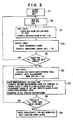
- the data are transmitted from the automatic analyzing apparatus to a data computation processing section 12 (Fig. 2), where it is judged whether an abnormality is present or not.
- a first check is performed at step 33.
- This first check comprises an alarm check relating to the apparatus status in addition to the above described check of the high value and low value.
- Checks having contents shown in Table 1 are performed.
- Table 1 Degree of priority kind of abnormality Contents of disposition 1 Insufficient samples Remeasurement is not taken . Abnormality in A-D converter . Insufficient reagents 2 . ABS ⁇ LIMIT of absorbance is exceeded Remeasurement is taken with a sample quantity less than that of the first time (Sample quantity is specified for each item) .
- Measurement range is exceeded (upper limit value) .
- Immunity antigen is exceeded (Prozone limit) 3 .
- Enzyme reaction curves Remeasurement is taken under the same analysis condition as that of the first time . Cell blank is abnormal . Measurement range is exceeded (lower limit value)
- Enzyme reaction curves indicates the fact that the reaction curve largely deviates from the normal curve by some cause.
- Cell blank is abnormal indicates the fact that an error is caused in the measured value because of dirt or the like of the reaction tube.
- Measurement range is exceeded (lower limit value) indicates the fact that the reaction is abnormally slow. In these cases, remeasurement is taken under the same condition as that of the first time in order to reaffirm the measured value.
- degree of priority is given to contents of processing to be executed as indicated in the left column of Table 1.
- degree of priority is given to contents of processing to be executed as indicated in the left column of Table 1.
- remeasurement is not taken as the disposition.
- alarms of "insufficient samples” and "ABS ⁇ LIMIT is exceeded” are simultaneously generated, remeasurement is not taken in accordance with the contents of the disposition for "insufficient samples” having higher degree of priority. The first check for one measurement item is thus finished.
- a second check relating to the absorbance change is then performed at step 34.
- difference in absorbance, change rate of absorbance and absorbance measuring point are specified, and arithmetic operations, parentheses and coefficients are set for each item as shown in Table 2.
- Check formulas are made, and whether reexamination should be performed or not and reexamination conditions are determined in accordance with the check formulas.
- Fig. 4 shows an example of absorbance change.
- the shaded region indicates the measurement range, and a discontinuous point between curves indicates the injection point of the second reagent.
- GPT is one kind of amino acid transition enzymes. Since its analysis method is also based upon the same principle as that of GOT, the same check method is used.
- the first reagent is added. After the temperature becomes constant and bubbles disappear, change rate of absorbance of the reaction liquid is measured at the measuring point 5 and thereafter.
- As the first reagent an NADH aqueous solution is used.
- As the second reagent pyruvic acid water solution is used. Its side reaction is represented by the following formula.
- reaction vessel is tainted by enzyme reacting on NADH when the first reagent is added, NADH contained in the reagent is consumed and absorbance is at its low level. For this check, therefore, change rate of absorbance at measuring points 5 to 21 is calculated by using the method of least square.
- urea is resolved and ammonia is quantitated. If the serum is left as it is, protein contained in the serum is resolved by micro-organisms and hence ammonia is unfavorably increased in some cases. If absorbance obtained immediately after addition of the second reagent largely changes from absorbance obtained before addition, this fact means that a large quantity of ammonia is present in the serum. Therefore, the difference between the value measured at measuring points 15 and 16 before addition of the second reagent and the value measured at measuring points 26 and 27 immediately after addition of the second reagent is calculated. When the difference is larger than 500, ammonia is judged excessive.
- AMY is enzyme resolving sugar.
- the reagent for AMY measurement contains a fixed quantity of sugar, which is resolved by the action of AMY.
- the reagent reacts on components resulting from resolution.
- the activity value of AMY is measured. If a large quantity of sugar is contained in serum, absorbance rapidly changes after addition of the first reagent. Further, because there are components directly reacting on the reagent and components which first resolve and then react on the reagent, this reaction does not proceed at a fixed rate. Therefore, abnormality is judged present if the difference between the value measured at the measuring points 3 and 4 soon after the addition of the first reagent and the value measured at the measuring points 15 and 16 after the elapse of approximately 2 minutes is larger than 500.
- measuring wavelength of 415 nm is used.
- data rapidly become high values after addition of the first reagent under the influence of hemoglobin and bilirubin contained in serum.
- bilirubin becomes large in absorbance immediately after the addition of the first reagent. Therefore, measurement is taken at measuring points 5 and 6 where the temperature becomes constant and generation of bubbles finishes soon after the addition of the first reagent.
- step 35 If the steps 33 and 34 are finished for one item as heretofore described, it is checked at step 35 whether check has been finished for all measurement items or not. If judgment at the step 35 is "NO", processing returns to the step 32, where data of the next item is read out and the first check and the second check are performed in the same way as the foregoing description. If checks of all items have been judged finished at the step 35, a third check is performed at step 36 and the remeasurement condition is determined in accordance with the condition of the check result having a higher degree of priority at step 37. At step 38, it is judged whether checks of all items included in the third check have been finished or not. At step 39, the remeasurement condition based upon the step 37 is ordered.
- the third check data cross-check between items is performed.
- the third check comprises the steps of adding coefficients to data of respective items, entering parentheses to form formulas, performing arithmetic operations, and comparing the result of operations with a predetermined limit value.
- Figs. 5A to 5E show data check rules between items. Checks based upon these five rules are executed in order complying with priority orders described later.
- rule 1 shown in Fig. 5A relationship between TP and ALB is checked.
- the difference between TP and ALB is globulin. It is known that the quantity of globulin comes into a nearly fixed region. If the difference is too large or too small, reexamination is specified.
- rule 2 shown in Fig. 5B relationship between GOT and GPT is checked. In general, the ratio between them becomes constant. When the ratio comes off its region, reexamination is ordered.
- rule 3 shown in Fig. 5C bilirubin (T-BIL and D-BIL) of a part of examination of liver is checked.
- T-BIL and D-BIL also increases if the other of them increases and one of them also decreases if the other of them decreases. Therefore, the check is performed by checking whether the ratio between them is within a fixed range or not.
- rule 4 shown in Fig. 5D relationship between UA and CRE in examination of kidney performance is checked. In the same way as the case of bilirubin, this is checked in the form of the ratio between them.
- rule 5 shown in Fig. 5E liver performance is checked to see whether an abnormality is present or not.
- reexamination for a certain item is requested at two places, i.e., the second check section and the third check section, reanalysis is performed under the reexamination condition of the second check section having a higher degree of priority. If reexamination request is issued at at least one check section, reexamination is executed.
- the sample rack 11 which has been located at a data output waiting position 51 is housed in the line 64 unless a reexamination request for a sample on the rack is present. If a reexamination request is present, the sample rack 11 is transferred to the analysis section again via the line 21 and analyzed.
- an abnormal sample is automatically checked and picked up, and request item specification of remeasurement and remeasurement are automatically made, resulting in automation and labor saving in the examination room.
- the present invention makes it possible to synthetically judge and find out abnormalities in data at all times without recourse to the engineer's experience. Further, a large number of samples can also be processed in real time. As compared with the case where the engineer checks and judges, labor can be largely saved, resulting in an effect. Further, since the apparatus automatically takes a remeasurement on samples, there is not a fear that the examination engineer takes a wrong sample. The reliability of examination is thus improved, resulting in another effect.
Landscapes
- Analytical Chemistry (AREA)
- Immunology (AREA)
- Physics & Mathematics (AREA)
- Health & Medical Sciences (AREA)
- Life Sciences & Earth Sciences (AREA)
- Chemical & Material Sciences (AREA)
- Quality & Reliability (AREA)
- General Health & Medical Sciences (AREA)
- Engineering & Computer Science (AREA)
- General Physics & Mathematics (AREA)
- Biochemistry (AREA)
- Pathology (AREA)
- Automatic Analysis And Handling Materials Therefor (AREA)
- Investigating Or Analysing Biological Materials (AREA)
- Investigating Or Analysing Materials By Optical Means (AREA)
Applications Claiming Priority (2)
| Application Number | Priority Date | Filing Date | Title |
|---|---|---|---|
| JP1061352A JP2649409B2 (ja) | 1989-03-14 | 1989-03-14 | 臨床検査用の自動分析方法 |
| JP61352/89 | 1989-03-14 |
Publications (3)
| Publication Number | Publication Date |
|---|---|
| EP0387787A2 true EP0387787A2 (de) | 1990-09-19 |
| EP0387787A3 EP0387787A3 (de) | 1991-06-26 |
| EP0387787B1 EP0387787B1 (de) | 1997-06-04 |
Family
ID=13168663
Family Applications (1)
| Application Number | Title | Priority Date | Filing Date |
|---|---|---|---|
| EP90104723A Expired - Lifetime EP0387787B1 (de) | 1989-03-14 | 1990-03-13 | Automatische Analysevorrichtung und Verfahren für klinische Untersuchung |
Country Status (4)
| Country | Link |
|---|---|
| US (1) | US5100622A (de) |
| EP (1) | EP0387787B1 (de) |
| JP (1) | JP2649409B2 (de) |
| DE (1) | DE69030832T2 (de) |
Cited By (14)
| Publication number | Priority date | Publication date | Assignee | Title |
|---|---|---|---|---|
| US5376313A (en) * | 1992-03-27 | 1994-12-27 | Abbott Laboratories | Injection molding a plastic assay cuvette having low birefringence |
| US5507410A (en) | 1992-03-27 | 1996-04-16 | Abbott Laboratories | Meia cartridge feeder |
| US5536471A (en) | 1992-03-27 | 1996-07-16 | Abbott Laboratories | Syringe with bubble flushing |
| US5540890A (en) | 1992-03-27 | 1996-07-30 | Abbott Laboratories | Capped-closure for a container |
| US5575978A (en) | 1992-03-27 | 1996-11-19 | Abbott Laboratories | Sample container segment assembly |
| US5578494A (en) | 1992-03-27 | 1996-11-26 | Abbott Laboratories | Cap actuator for opening and closing a container |
| EP0703456A3 (de) * | 1994-09-21 | 1996-12-11 | Toa Medical Electronics | Vorrichtung und Verfahren zur automatischen Analyse einer Probe |
| US5605665A (en) | 1992-03-27 | 1997-02-25 | Abbott Laboratories | Reaction vessel |
| US5610069A (en) | 1992-03-27 | 1997-03-11 | Abbott Laboratories | Apparatus and method for washing clinical apparatus |
| US5627522A (en) | 1992-03-27 | 1997-05-06 | Abbott Laboratories | Automated liquid level sensing system |
| EP0841556A1 (de) * | 1996-11-12 | 1998-05-13 | Beckman Instruments, Inc. | Sonde und Verfahren zur Bestimmung von Serum-Indexen in Serum-Proben |
| EP1840577A1 (de) * | 2006-03-31 | 2007-10-03 | Sysmex Corporation | Analysevorrictung mit einer wiederholten Analyse beim Verdacht einer Verschleppung |
| CN109030801A (zh) * | 2018-06-02 | 2018-12-18 | 贾晓轻 | 一种临床样本自动生化分析仪 |
| CN115616317A (zh) * | 2022-10-14 | 2023-01-17 | 四川大学华西医院 | 一种基于动态分析变异设计自动审核差值核查规则的方法 |
Families Citing this family (37)
| Publication number | Priority date | Publication date | Assignee | Title |
|---|---|---|---|---|
| US5646046A (en) * | 1989-12-01 | 1997-07-08 | Akzo Nobel N.V. | Method and instrument for automatically performing analysis relating to thrombosis and hemostasis |
| JPH0599930A (ja) * | 1991-01-31 | 1993-04-23 | Shimadzu Corp | 自動化学分析装置 |
| JPH0572216A (ja) * | 1991-09-18 | 1993-03-23 | Hitachi Ltd | 臨床検査用の自動分析装置 |
| US5960160A (en) | 1992-03-27 | 1999-09-28 | Abbott Laboratories | Liquid heater assembly with a pair temperature controlled electric heating elements and a coiled tube therebetween |
| US6190617B1 (en) | 1992-03-27 | 2001-02-20 | Abbott Laboratories | Sample container segment assembly |
| US5646049A (en) | 1992-03-27 | 1997-07-08 | Abbott Laboratories | Scheduling operation of an automated analytical system |
| US5635364A (en) | 1992-03-27 | 1997-06-03 | Abbott Laboratories | Assay verification control for an automated analytical system |
| USD349861S (en) | 1992-07-20 | 1994-08-23 | Abbott Laboratories | Automated analytical instrument |
| ES2106504T3 (es) * | 1992-12-23 | 1997-11-01 | Univ Nebraska | Procedimiento para analisis automaticos de muestras de laboratorio. |
| JP2842758B2 (ja) * | 1993-05-10 | 1999-01-06 | 株式会社日立製作所 | 自動分析装置 |
| JP3476826B2 (ja) * | 1993-08-16 | 2003-12-10 | アクゾ・ノベル・エヌ・ベー | 血栓および止血に関係する分析を自動的に実施する方法および装置 |
| JP3063564B2 (ja) * | 1995-03-17 | 2000-07-12 | 株式会社日立製作所 | 自動分析装置 |
| WO1996030767A1 (en) * | 1995-03-27 | 1996-10-03 | Ngk Insulators, Ltd. | Automatic analysis system |
| JP3156550B2 (ja) * | 1995-07-11 | 2001-04-16 | 株式会社日立製作所 | 試薬管理の方法および装置 |
| WO1998045679A1 (en) * | 1997-04-08 | 1998-10-15 | Akzo Nobel N.V. | Method and apparatus for optimizing assay sequencing on a random access clinical laboratory instrument |
| JP3987675B2 (ja) * | 2000-07-05 | 2007-10-10 | 株式会社日立製作所 | 臨床検査システム |
| JP2002365211A (ja) * | 2001-04-02 | 2002-12-18 | Fuji Photo Film Co Ltd | 測定装置 |
| JP4763160B2 (ja) * | 2001-06-18 | 2011-08-31 | 日立アロカメディカル株式会社 | 分注良否判定装置 |
| US6991764B2 (en) * | 2002-12-13 | 2006-01-31 | Dade Behring Inc. | Method for replacing used reaction cuvettes in an automatic analyzer depending upon next scheduled assay |
| CN103941027B (zh) * | 2005-03-29 | 2016-09-07 | 希森美康株式会社 | 标本分析方法及标本分析装置 |
| JP4925703B2 (ja) * | 2006-03-30 | 2012-05-09 | シスメックス株式会社 | 血液凝固分析装置 |
| US20080020469A1 (en) * | 2006-07-20 | 2008-01-24 | Lawrence Barnes | Method for scheduling samples in a combinational clinical analyzer |
| US8112229B2 (en) * | 2007-05-31 | 2012-02-07 | Abbott Laboratories | Method for determining the order of execution of assays of a sample in a laboratory automation system |
| JP5378859B2 (ja) * | 2009-03-30 | 2013-12-25 | シスメックス株式会社 | 検体検査システム |
| JP5604120B2 (ja) * | 2010-01-25 | 2014-10-08 | エクセリス インコーポレイテッド | ラマンセンサに対するデータ品質および補助的データのチェック |
| JP5738616B2 (ja) * | 2011-02-03 | 2015-06-24 | シスメックス株式会社 | 検体分析システム、検体分析装置、及び検体分析方法 |
| WO2012120755A1 (ja) * | 2011-03-04 | 2012-09-13 | 株式会社 日立ハイテクノロジーズ | 分析装置 |
| JP5843231B2 (ja) * | 2011-10-05 | 2016-01-13 | 株式会社テクノメデイカ | 定性分析装置 |
| JP6378599B2 (ja) * | 2013-10-11 | 2018-08-22 | シスメックス株式会社 | 細胞分析方法および細胞分析装置 |
| JP6812577B2 (ja) * | 2017-12-26 | 2021-01-13 | 株式会社日立ハイテク | 自動分析装置および自動分析方法 |
| CN111398609B (zh) * | 2019-01-02 | 2024-07-02 | 深圳迈瑞生物医疗电子股份有限公司 | 一种样本架的调度方法和进样处理系统 |
| EP4022320A4 (de) | 2019-08-28 | 2022-11-02 | Siemens Healthcare Diagnostics, Inc. | Optische photometerkupplung für einen doppelten inkubationsring unter verwendung eines periskopdesigns |
| CN112858702B (zh) * | 2019-11-28 | 2024-06-28 | 深圳迈瑞生物医疗电子股份有限公司 | 基于样本检测的信息处理方法及样本检测系统和存储介质 |
| CN113125774A (zh) * | 2019-12-31 | 2021-07-16 | 科美诊断技术股份有限公司 | 测试方法及装置 |
| CN115711999A (zh) * | 2021-08-23 | 2023-02-24 | 深圳市帝迈生物技术有限公司 | 样本检测的控制方法、装置、存储介质及凝血分析仪 |
| JP2024107894A (ja) * | 2023-01-30 | 2024-08-09 | アズビル株式会社 | 微生物汚染監視装置、微生物汚染監視方法、及び微生物汚染監視プログラム |
| CN116679074A (zh) * | 2023-04-28 | 2023-09-01 | 中元汇吉生物技术股份有限公司 | 一种样本检测方法、系统、检测仪及介质 |
Family Cites Families (19)
| Publication number | Priority date | Publication date | Assignee | Title |
|---|---|---|---|---|
| DE2847176C2 (de) * | 1977-10-31 | 1982-05-06 | Hitachi, Ltd., Tokyo | Verfahren zur photometrischen Bestimmung von Substanzen im Blutserum |
| US4228831A (en) * | 1978-12-11 | 1980-10-21 | Abbott Laboratories | Probe and syringe drive apparatus |
| JPS56155835A (en) * | 1980-05-02 | 1981-12-02 | Olympus Optical Co Ltd | Component analyzing method |
| JPS5782769A (en) * | 1980-11-10 | 1982-05-24 | Hitachi Ltd | Automatic analyzing device |
| JPS5782753A (en) * | 1980-11-10 | 1982-05-24 | Hitachi Ltd | Method and device for analysis with automatic setting of reaction limit |
| JPS5888663A (ja) * | 1981-11-24 | 1983-05-26 | Toshiba Corp | 自動化学分析装置 |
| JPS59122954A (ja) * | 1982-12-29 | 1984-07-16 | Shimadzu Corp | 自動分析装置 |
| US4750133A (en) * | 1983-07-21 | 1988-06-07 | Beckman Instruments, Inc. | Validation of kinetic chemical reaction |
| JPS61137065A (ja) * | 1984-12-07 | 1986-06-24 | Toshiba Corp | 分析装置の逐次再検査判別方法 |
| JPH0627743B2 (ja) * | 1985-03-25 | 1994-04-13 | 株式会社日立製作所 | 自動分析装置 |
| JPS61235753A (ja) * | 1985-04-12 | 1986-10-21 | Hitachi Ltd | 自動分析装置のリアルタイムデ−タチエツク方式 |
| JPS61262662A (ja) * | 1985-05-16 | 1986-11-20 | Jeol Ltd | 自動化学分析装置 |
| JPS61292540A (ja) * | 1985-06-20 | 1986-12-23 | Jeol Ltd | 化学分析方法 |
| JPS6298262A (ja) * | 1985-10-25 | 1987-05-07 | Hitachi Ltd | 臨床検査システムにおける再検査処理方式 |
| JPH07119768B2 (ja) * | 1986-07-04 | 1995-12-20 | 株式会社日立製作所 | デイスクリート自動分析方法 |
| JPS6361959A (ja) * | 1986-09-03 | 1988-03-18 | Shimadzu Corp | 自動分析装置 |
| JPS63206660A (ja) * | 1987-02-24 | 1988-08-25 | Toshiba Corp | 自動化学分析装置 |
| JPS63218864A (ja) * | 1987-03-09 | 1988-09-12 | Toshiba Corp | 自動化学分析装置 |
| JPS63281057A (ja) * | 1987-05-13 | 1988-11-17 | Toshiba Corp | サンプラ−装置 |
-
1989
- 1989-03-14 JP JP1061352A patent/JP2649409B2/ja not_active Expired - Fee Related
-
1990
- 1990-03-13 DE DE69030832T patent/DE69030832T2/de not_active Expired - Lifetime
- 1990-03-13 US US07/492,853 patent/US5100622A/en not_active Expired - Lifetime
- 1990-03-13 EP EP90104723A patent/EP0387787B1/de not_active Expired - Lifetime
Cited By (17)
| Publication number | Priority date | Publication date | Assignee | Title |
|---|---|---|---|---|
| US5627522A (en) | 1992-03-27 | 1997-05-06 | Abbott Laboratories | Automated liquid level sensing system |
| US5451528A (en) | 1992-03-27 | 1995-09-19 | Abbott Laboratories | Methods for providing homogeneous reagents |
| US5482861A (en) | 1992-03-27 | 1996-01-09 | Abbott Laboratories | Automated continuous and random access analytical system |
| US5507410A (en) | 1992-03-27 | 1996-04-16 | Abbott Laboratories | Meia cartridge feeder |
| US5536471A (en) | 1992-03-27 | 1996-07-16 | Abbott Laboratories | Syringe with bubble flushing |
| US5540890A (en) | 1992-03-27 | 1996-07-30 | Abbott Laboratories | Capped-closure for a container |
| US5575978A (en) | 1992-03-27 | 1996-11-19 | Abbott Laboratories | Sample container segment assembly |
| US5578494A (en) | 1992-03-27 | 1996-11-26 | Abbott Laboratories | Cap actuator for opening and closing a container |
| US5376313A (en) * | 1992-03-27 | 1994-12-27 | Abbott Laboratories | Injection molding a plastic assay cuvette having low birefringence |
| US5605665A (en) | 1992-03-27 | 1997-02-25 | Abbott Laboratories | Reaction vessel |
| US5610069A (en) | 1992-03-27 | 1997-03-11 | Abbott Laboratories | Apparatus and method for washing clinical apparatus |
| EP0703456A3 (de) * | 1994-09-21 | 1996-12-11 | Toa Medical Electronics | Vorrichtung und Verfahren zur automatischen Analyse einer Probe |
| EP0841556A1 (de) * | 1996-11-12 | 1998-05-13 | Beckman Instruments, Inc. | Sonde und Verfahren zur Bestimmung von Serum-Indexen in Serum-Proben |
| EP1840577A1 (de) * | 2006-03-31 | 2007-10-03 | Sysmex Corporation | Analysevorrictung mit einer wiederholten Analyse beim Verdacht einer Verschleppung |
| US8119081B2 (en) | 2006-03-31 | 2012-02-21 | Sysmex Corporation | Specimen analysis apparatus and specimen analysis method |
| CN109030801A (zh) * | 2018-06-02 | 2018-12-18 | 贾晓轻 | 一种临床样本自动生化分析仪 |
| CN115616317A (zh) * | 2022-10-14 | 2023-01-17 | 四川大学华西医院 | 一种基于动态分析变异设计自动审核差值核查规则的方法 |
Also Published As
| Publication number | Publication date |
|---|---|
| DE69030832D1 (de) | 1997-07-10 |
| EP0387787A3 (de) | 1991-06-26 |
| JPH02240569A (ja) | 1990-09-25 |
| JP2649409B2 (ja) | 1997-09-03 |
| DE69030832T2 (de) | 1998-01-08 |
| US5100622A (en) | 1992-03-31 |
| EP0387787B1 (de) | 1997-06-04 |
Similar Documents
| Publication | Publication Date | Title |
|---|---|---|
| EP0387787B1 (de) | Automatische Analysevorrichtung und Verfahren für klinische Untersuchung | |
| US5646046A (en) | Method and instrument for automatically performing analysis relating to thrombosis and hemostasis | |
| JP2524454B2 (ja) | 体液の自動分析用分析装置 | |
| EP0714506B1 (de) | Methode und gerät zur automatischen durchführung von analysen bezüglich thrombose und blutgerinnung | |
| Coe et al. | Variations in vitreous humor chemical values as a result of instrumentation | |
| Johnson et al. | Analytical error of home glucose monitors: a comparison of 18 systems | |
| US4539295A (en) | Binary kinetic assay method and apparatus | |
| JPH07119768B2 (ja) | デイスクリート自動分析方法 | |
| EP0268025B1 (de) | Verfahren zum Analysieren einer hämolysierten Blutprobe | |
| EP0417968B1 (de) | Verfahren und Vorrichtung zur elektrochemischen Analyse und wässerige Lösung zur Durchführung der Analyse | |
| WO2006132797A2 (en) | Preparation of small liquid samples for automated analysis | |
| Li et al. | Improved method for determining erythrocyte creatine by the diacetyl-alpha-naphthol reaction: elimination of endogenous glutathione interference. | |
| Andersen et al. | Analytical and economical optimization of a glucose method with immobilized enzymes | |
| US7539580B2 (en) | Method and apparatus for detecting artifactual output from a chemical analyzer | |
| CA2688191A1 (en) | Method for determining the order of execution of assays of a sample in a laboratory automation system | |
| Pauli et al. | The Abbott Architect c8000: Analytical performance and productivity characteristics of a new analyzer applied to general chemistry testing | |
| JPH0627117A (ja) | 自動分析装置 | |
| Selvakumar et al. | Effect of sample storage and time delay (delayed processing) on analysis of common clinical biochemical parameters | |
| Morley et al. | Use of discriminant analysis in relating maternal anti-D levels to the severity of haemolytic disease of the newborn | |
| JP2000346848A (ja) | グルコースの測定方法及び測定装置 | |
| JPH03100444A (ja) | 臨床検査用の自動分析装置および方法 | |
| Rumley et al. | Evaluation of glycaemic control limits using the Ames DCA 2000 HbA1c analyser | |
| JPH047956B2 (de) | ||
| US7039561B2 (en) | Outlier rejection method in an automatic clinical analyzer | |
| Haven et al. | Data-reduction methods for immunoradiometric assays of thyrotropin compared. |
Legal Events
| Date | Code | Title | Description |
|---|---|---|---|
| PUAI | Public reference made under article 153(3) epc to a published international application that has entered the european phase |
Free format text: ORIGINAL CODE: 0009012 |
|
| 17P | Request for examination filed |
Effective date: 19900313 |
|
| AK | Designated contracting states |
Kind code of ref document: A2 Designated state(s): DE FR |
|
| RIN1 | Information on inventor provided before grant (corrected) |
Inventor name: SATOU, TAKEHIDE Inventor name: MIMURA, TOMONORI |
|
| PUAL | Search report despatched |
Free format text: ORIGINAL CODE: 0009013 |
|
| AK | Designated contracting states |
Kind code of ref document: A3 Designated state(s): DE FR |
|
| 17Q | First examination report despatched |
Effective date: 19930915 |
|
| GRAG | Despatch of communication of intention to grant |
Free format text: ORIGINAL CODE: EPIDOS AGRA |
|
| GRAH | Despatch of communication of intention to grant a patent |
Free format text: ORIGINAL CODE: EPIDOS IGRA |
|
| GRAH | Despatch of communication of intention to grant a patent |
Free format text: ORIGINAL CODE: EPIDOS IGRA |
|
| GRAA | (expected) grant |
Free format text: ORIGINAL CODE: 0009210 |
|
| AK | Designated contracting states |
Kind code of ref document: B1 Designated state(s): DE |
|
| REF | Corresponds to: |
Ref document number: 69030832 Country of ref document: DE Date of ref document: 19970710 |
|
| EN | Fr: translation not filed | ||
| PLBE | No opposition filed within time limit |
Free format text: ORIGINAL CODE: 0009261 |
|
| STAA | Information on the status of an ep patent application or granted ep patent |
Free format text: STATUS: NO OPPOSITION FILED WITHIN TIME LIMIT |
|
| 26N | No opposition filed | ||
| PGFP | Annual fee paid to national office [announced via postgrant information from national office to epo] |
Ref country code: DE Payment date: 20090219 Year of fee payment: 20 |
|
| PG25 | Lapsed in a contracting state [announced via postgrant information from national office to epo] |
Ref country code: DE Free format text: LAPSE BECAUSE OF EXPIRATION OF PROTECTION Effective date: 20100313 |