EP0388032A2 - Speichersteuerung in Mehrprozessoranordnungen mit Cache-Speichern - Google Patents
Speichersteuerung in Mehrprozessoranordnungen mit Cache-Speichern Download PDFInfo
- Publication number
- EP0388032A2 EP0388032A2 EP90301886A EP90301886A EP0388032A2 EP 0388032 A2 EP0388032 A2 EP 0388032A2 EP 90301886 A EP90301886 A EP 90301886A EP 90301886 A EP90301886 A EP 90301886A EP 0388032 A2 EP0388032 A2 EP 0388032A2
- Authority
- EP
- European Patent Office
- Prior art keywords
- protocol
- bus
- data
- cache
- memory
- Prior art date
- Legal status (The legal status is an assumption and is not a legal conclusion. Google has not performed a legal analysis and makes no representation as to the accuracy of the status listed.)
- Ceased
Links
Images

Classifications
-
- G—PHYSICS
- G06—COMPUTING OR CALCULATING; COUNTING
- G06F—ELECTRIC DIGITAL DATA PROCESSING
- G06F13/00—Interconnection of, or transfer of information or other signals between, memories, input/output devices or central processing units
- G06F13/38—Information transfer, e.g. on bus
- G06F13/42—Bus transfer protocol, e.g. handshake; Synchronisation
- G06F13/4204—Bus transfer protocol, e.g. handshake; Synchronisation on a parallel bus
- G06F13/4234—Bus transfer protocol, e.g. handshake; Synchronisation on a parallel bus being a memory bus
-
- G—PHYSICS
- G06—COMPUTING OR CALCULATING; COUNTING
- G06F—ELECTRIC DIGITAL DATA PROCESSING
- G06F12/00—Accessing, addressing or allocating within memory systems or architectures
- G06F12/02—Addressing or allocation; Relocation
- G06F12/08—Addressing or allocation; Relocation in hierarchically structured memory systems, e.g. virtual memory systems
- G06F12/0802—Addressing of a memory level in which the access to the desired data or data block requires associative addressing means, e.g. caches
- G06F12/0806—Multiuser, multiprocessor or multiprocessing cache systems
- G06F12/0815—Cache consistency protocols
- G06F12/0831—Cache consistency protocols using a bus scheme, e.g. with bus monitoring or watching means
- G06F12/0833—Cache consistency protocols using a bus scheme, e.g. with bus monitoring or watching means in combination with broadcast means (e.g. for invalidation or updating)
Definitions
- This invention relates to storage control in cached multiprocessor systems wherein a plurality of processors are connected to a shared bus and a shared memory via respective private caches, and in particular to a multiprocessor system having so-called snoop caches, wherein a controller is provided for each private cache to monitor signals on the shared bus, perform some data manipulation operations for one or more private caches and to assume its part of the responsibility for the maintenance of the consistency of data throughout the private caches.
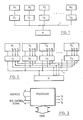
- Fig. 1 shows a multiprocessor system using snoop caches.
- a plurality of processors P1, P2 ... Pn are connected to a shared bus 1 and a shared memory M through private caches C1, C2 ... on, respectively.
- Consistency of data is achieved by a distributed control system, in which a controller is installed at each private cache site to monitor signals on the shared bus 1. This system assures the consistency of data by making each controller operate in accordance with the protocol initialised for the shared bus 1.
- cache protocol is sometimes used in a sense which is wide enough to include data writing and data replacement. In this context, however, the term is limited to shared data handling and, therefore, unless otherwise specified, the term “protocol”, when employed, is assumed to refer to the way of handling shared data.
- the present invention is thought to go a long way towards providing cache control which is simple and which can switch a protocol, if needed, for each variable or work area depending on the type of shared data, without incurring undue overhead.
- the present invention provides a multiprocessor system in which a plurality of processors are connected to a shared bus and a shared memory through private caches and in which access to the shared bus is monitored to process data in the private caches in accordance with a specified protocol, the multiprocessor system further comprising: a protocol bus carrying protocol signals signifying a current one of a plurality of possible protocols, and cache control mechanisms connected in common to the protocol bus and individually effective for and on each private cache; each control mechanism comprising: protocol memory means storing an indication of the current protocol specified for identifiable data memory areas controlled thereby, protocol signal generating means for reading, from the protocol memory means when data is accessed, the protocol of the memory area to which the accessed data belongs and broadcasting a corresponding protocol signal on the protocol bus, and detecting means for detecting protocol signals on the protocol bus and causing the data in the corresponding private cache to be processed under the protocol specified thereby.
- multiprocessor system includes a shared bus and shared memory with snoop caches for each processor, data specifying the protocol used by the caches when accessing an identifiable area, is added to the particular area.
- Each processor or memory control unit
- the additional data signal is also output on the shared bus. All caches connected to the shared bus thus executing a bus snoop (bus monitoring), switch, if necessary, to the protocol indicated by the signal on the shared bus if they have the data area referred to.
- the data carried by the bus can be arranged to specify a processor group as by expanding the shared bus, so that the signal identifying a processor group is outputted during bus access from the processors which are using the bus.
- the snooping operation of the cache is controlled, based on these signals and depending on whether or not the processors belong in the same processor group.
- Fig. 2 schematically shows an embodiment of the invention in which which shared memory protocol can be set dynamically to one of three types - update, invalidate and all-read - each memory area.
- Much of the multiprocessor system is as that of Fig. 1 and part thereof corresponding to those in Fig. 1 are indicated by corresponding numerals and no detailed description of them is needed nor given.
- the "all-read" protocol will be described in detail hereinafter.
- Processors P1, P2 ... P n transmit signals T1, T2 and T3 representing protocol types to a protocol bus 2 through corresponding private caches C1, C2 ... C n respectively.
- the signals T1, T2 and T3 indicate that the protocol type for the data currently on the shared bus, i.e., update, invalidate or all-read.
- Each of the private caches C1, C2 ... C n has a cache control mechanism (not shown) which identifies the protocol to be used with respect to the data on the shared bus 1 by monitoring the protocol type bus 2 and executes the protocol procedure as required (when data is shared).
- protocol type indicating information is not produced for each address of the data, but only for each memory area.
- a cache protocol suitable for each memory is different. Accordingly, controlling the protocol for each memory is critical for improving the performance.
- adding information for representing the type of protocol for each address will require a substantial amount of memory area just for that information as well as controlling hardware, resulting in low efficiency. Therefore, control is performed by information representing the type of protocol for each memory area.
- the unit of memory area is the "page" and attention is paid to the page control mechanism and the information added to each page.
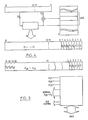
- Fig. 3 shows input and output signals associated with the generic processor P of Fig. 2
- Fig. 4 shows an example of the page control mechanism and a page entry of the arrangement of Fig. 2.
- the page control mechanism controls the memory by page (4 kilobytes in Figs. 3 and 4) and has a page entry for each page which includes the page address in real memory and the page protection to be observed.
- the page entry - or the page entry copy from the translation look-aside buffer, TLB if present and including a copy of the relevant page entry - as indicated by the high order bits of the logical address, is always referenced to check its access authorisation, and the address of the real memory is calculated based on the page, frame, address of the page entry. If and when the access authorisation has been met the real memory is accessed.
- P1 and P0 in Fig. 4 are bits representing the access authorisations corresponding to the protection levels, as shown in the table below.
- A, D and E in the page entry are bits used for the control of virtual memory, indicating whether the page has been accessed, has been rewritten or exists in real memory.
- T2 and T0 are bits representing the protocol types for the page in question and indicate the type of protocol used to access the page data.
- the processor raises the appropriate one of three signal lines provided for outputting the bit indicating that protocol type (Fig. 3).
- the multiprocessor is structured as shown in Fig. 2, if access extends from caches C1, C ...
- Fig. 5 shows an alternative to the protocol control of Fig. 4 which is implemented with a conventional CPU or MMU.
- the alternative in Fig. 5 since no bits such as T2, T1 and T0 are included in the page entry, the upper 2 or 3 bits of an address are used to represent the protocol types (Fig. 5). If 32 bits real address lines are available, the use of 2 or 3 bits for this purpose will still leave 512 Mbytes -- 1 Gbytes of real memory space available, thus raising no problem in practical use.
- protocols which are effective only for some types of data and have not been used until now because their use with other types of data resulted in lowered efficiency, can be effectively used.
- control should be used selectively for suitable data.
- An example of such a protocol is a protocol called "all-read.” This protocol is one in which cache which is performing a bus snoop takes data on the shared bus, which another cache is reading the data on the shared bus.
- This protocol is suitable in the following cases.
- each processor individually reads it and allocate it from the memory to its cache, to treat each cache separately means undue bus traffic on the shared bus before the operation is complete.
- the measure approximates to the product of the amount of data divided by the bus capacity and the number of processors involved. If an all-read protocol is used, the bus traffic reduced to the first stated quantity and high performance can be provided.
- Update type If a write access causes a cache hit, the cache will update the data in the cache with the data on the bus. - Otherwise, it will do nothing (refer to note). Invalidate type - If a write access causes a cache hit, the cache will invalidate the data in the cache. - Otherwise, it will do nothing (refer to the note). All-read type - If a read access does not cause a cache hit and if it is possible to absorb the data without inducing write back due to data replacement (i.e., without access to the system bus), the data on the bus will be written into the cache. - If a write access causes a cache hit, it will perform the same processing as in the case of an update write access. - Otherwise, it will do nothing (refer to the note).
- cache protocol including invalidate read, under which the snooping cache invalidates the data in the cache when read access by other processors using the shared bus has caused a cache hit, but for the purposes of this description, examples are limited to the above three types.
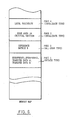
- Fig. 6 Examples of page assignment for each variable and work area are shown in Fig. 6.
- the variables or work areas are assigned in pages having suitable protocol typing.
- Concerning the command codes of the processor, assignment to all-read type page is advantageous from efficiency viewpoint when all processors shared the same codes.
- Each cache in its snooping operation, monitors also the processor group specifying bus to see if it is incorporated in the specified processor group when the access to the system bus is performed under the all-read protocol, and absorbs the data, space permitting, only when selected. If very delicate control is required also for specifying the processor group, some way for storing the specifying information in individual page entries is required so that the specification may be changed page by page. However, this results in a substantial increase in the number of connections that have to be made and thus of the chip pins used up). However, since the basic idea of all-read is to allocate the data to all the caches in a processor group which are processing a certain task simultaneously, it is deemed sufficient to store one item of information in each cache to specify the processor group for that task. Therefore, one register is made available in each cache (Fig. 7)/controller/processor for this purpose.
- processor group specifying circuits 31, 32 ... 3 n and a processor group specifying bus 4 are the cache control mechanism used to achieve this end.
- the width of the processor specifying bus is log2(n+2)-1 lines (n represents the number of processors). Its operations are as follows: - The processor group specifying circuits 31, 32 ... 3 n , when any of the processors P1, P2 ... P n performs all-read type access using the shared bus 1, output onto the processor group specifying bus 4 the processor group identification number held in their internal registers.
- the processor group indication circuits 31, 32 ... 3 n when the processors P1, P2 ...
- P n are not using the shared bus 1, snoop the processor group specifying bus 4, compare the result with values in the registers, and output to the caches C1, C ... C n a signal indicating whether or not any of the processors P1, P2 ... P n are selected.
- the caches C1, C ... C n when the access to the shared bus is all-read, change over the snooping operation according to the signal.
- the setting of the identification numbers for specifying the processor groups in the registers in the processor group specifying circuits 31, 32 ... 3 n is performed by the processors using software. When OS is present, it suffices to set the registers every time the OS assigns processors to a task.
- the signal lines A and E between the caches C1, C ... C n and the processor group specifying circuits 31, 32 ... 3 n in Fig. 7, respectively, are signal lines showing that the processors P1, P2 ... P n are performing the all-read type access and signal lines showing that the processors P1, P2 ... P n have been selected.
- Such arrangements enable change-over between various cache access protocols depending on the shared data type, without undue overhead. This makes it possible to approach selecting an optimal protocol for each item of shared data, thereby reducing the frequency of using the shared bus and, moreover, improving the performance of the multiprocessor system.
Landscapes
- Engineering & Computer Science (AREA)
- Theoretical Computer Science (AREA)
- Physics & Mathematics (AREA)
- General Engineering & Computer Science (AREA)
- General Physics & Mathematics (AREA)
- Memory System Of A Hierarchy Structure (AREA)
- Multi Processors (AREA)
Applications Claiming Priority (2)
| Application Number | Priority Date | Filing Date | Title |
|---|---|---|---|
| JP1057761A JPH0721781B2 (ja) | 1989-03-13 | 1989-03-13 | マルチプロセツサ・システム |
| JP57761/89 | 1989-03-13 |
Publications (2)
| Publication Number | Publication Date |
|---|---|
| EP0388032A2 true EP0388032A2 (de) | 1990-09-19 |
| EP0388032A3 EP0388032A3 (de) | 1991-10-23 |
Family
ID=13064863
Family Applications (1)
| Application Number | Title | Priority Date | Filing Date |
|---|---|---|---|
| EP19900301886 Ceased EP0388032A3 (de) | 1989-03-13 | 1990-02-21 | Speichersteuerung in Mehrprozessoranordnungen mit Cache-Speichern |
Country Status (2)
| Country | Link |
|---|---|
| EP (1) | EP0388032A3 (de) |
| JP (1) | JPH0721781B2 (de) |
Cited By (5)
| Publication number | Priority date | Publication date | Assignee | Title |
|---|---|---|---|---|
| FR2707774A1 (fr) * | 1993-07-15 | 1995-01-20 | Bull Sa | Procédé de gestion cohérente des échanges entre des niveaux d'une hiérarchie de mémoires à au moins trois niveaux. |
| US5644716A (en) * | 1993-07-15 | 1997-07-01 | Bull S.A. | Shared memory information processing system with internode connections enabling improved performance with added processor nodes |
| US5983323A (en) * | 1993-07-15 | 1999-11-09 | Bull, S.A. | Processor node |
| US6240491B1 (en) | 1993-07-15 | 2001-05-29 | Bull S.A. | Process and system for switching between an update and invalidate mode for each cache block |
| US7644237B1 (en) | 2003-06-23 | 2010-01-05 | Mips Technologies, Inc. | Method and apparatus for global ordering to insure latency independent coherence |
Families Citing this family (3)
| Publication number | Priority date | Publication date | Assignee | Title |
|---|---|---|---|---|
| JPH0776942B2 (ja) * | 1991-04-22 | 1995-08-16 | インターナショナル・ビジネス・マシーンズ・コーポレイション | マルチプロセッサ・システムおよびそのデータ伝送装置 |
| JPH04337854A (ja) * | 1991-05-15 | 1992-11-25 | Mitsubishi Electric Corp | データ処理装置 |
| US6643759B2 (en) * | 2001-03-30 | 2003-11-04 | Mips Technologies, Inc. | Mechanism to extend computer memory protection schemes |
Family Cites Families (4)
| Publication number | Priority date | Publication date | Assignee | Title |
|---|---|---|---|---|
| JPS6049944B2 (ja) * | 1980-12-29 | 1985-11-06 | 富士通株式会社 | バッファ記憶制御方式 |
| JPS61141054A (ja) * | 1984-12-14 | 1986-06-28 | Nec Corp | 情報処理装置 |
| US4959777A (en) * | 1987-07-27 | 1990-09-25 | Motorola Computer X | Write-shared cache circuit for multiprocessor system |
| JPH02234247A (ja) * | 1989-03-08 | 1990-09-17 | Nec Corp | キャッシュメモリシステム |
-
1989
- 1989-03-13 JP JP1057761A patent/JPH0721781B2/ja not_active Expired - Lifetime
-
1990
- 1990-02-21 EP EP19900301886 patent/EP0388032A3/de not_active Ceased
Cited By (8)
| Publication number | Priority date | Publication date | Assignee | Title |
|---|---|---|---|---|
| FR2707774A1 (fr) * | 1993-07-15 | 1995-01-20 | Bull Sa | Procédé de gestion cohérente des échanges entre des niveaux d'une hiérarchie de mémoires à au moins trois niveaux. |
| EP0636988A1 (de) * | 1993-07-15 | 1995-02-01 | Bull S.A. | Kohärenter Datenaustausch, Verwaltungsverfahren zwischen den Stufen einer mindestens dreistufigen Speicherhierarchie |
| US5568633A (en) * | 1993-07-15 | 1996-10-22 | Bull S.A. | Process for managing a hierarcy of memories |
| US5644716A (en) * | 1993-07-15 | 1997-07-01 | Bull S.A. | Shared memory information processing system with internode connections enabling improved performance with added processor nodes |
| US5983323A (en) * | 1993-07-15 | 1999-11-09 | Bull, S.A. | Processor node |
| US6240491B1 (en) | 1993-07-15 | 2001-05-29 | Bull S.A. | Process and system for switching between an update and invalidate mode for each cache block |
| US7644237B1 (en) | 2003-06-23 | 2010-01-05 | Mips Technologies, Inc. | Method and apparatus for global ordering to insure latency independent coherence |
| US8037253B2 (en) | 2003-06-23 | 2011-10-11 | Mips Technologies, Inc. | Method and apparatus for global ordering to insure latency independent coherence |
Also Published As
| Publication number | Publication date |
|---|---|
| JPH02238534A (ja) | 1990-09-20 |
| JPH0721781B2 (ja) | 1995-03-08 |
| EP0388032A3 (de) | 1991-10-23 |
Similar Documents
| Publication | Publication Date | Title |
|---|---|---|
| US5317705A (en) | Apparatus and method for TLB purge reduction in a multi-level machine system | |
| US5852738A (en) | Method and apparatus for dynamically controlling address space allocation | |
| US5247648A (en) | Maintaining data coherency between a central cache, an I/O cache and a memory | |
| US5325504A (en) | Method and apparatus for incorporating cache line replacement and cache write policy information into tag directories in a cache system | |
| CA2022656C (en) | Translation look-aside buffer for a computer memory system | |
| EP0557050B1 (de) | Verfahren und Anordnung zur Ausführung von Prozessen in einem Multiprozessor-System | |
| US5689679A (en) | Memory system and method for selective multi-level caching using a cache level code | |
| JP2635058B2 (ja) | アドレス変換方式 | |
| EP0349122B1 (de) | Verfahren und Einrichtung zum Filtern von Ungültigkeitserklärungsanforderungen | |
| US6920521B2 (en) | Method and system of managing virtualized physical memory in a data processing system | |
| US4669043A (en) | Memory access controller | |
| JP2960415B2 (ja) | 記憶保護方法および装置 | |
| US6907494B2 (en) | Method and system of managing virtualized physical memory in a memory controller and processor system | |
| US6904490B2 (en) | Method and system of managing virtualized physical memory in a multi-processor system | |
| EP0083400A2 (de) | Multiprozessor-System mit wenigstens dreistufiger Speicherhierarchie | |
| JPH10320283A (ja) | マルチプロセッサ・データ処理システム内でキャッシュ・コヒーレンシを維持するキャッシュ・コヒーレンシ・プロトコルを提供する方法及び装置 | |
| US5293597A (en) | Concurrent context memory management unit | |
| US5161219A (en) | Computer system with input/output cache | |
| EP0388032A2 (de) | Speichersteuerung in Mehrprozessoranordnungen mit Cache-Speichern | |
| JPH06318174A (ja) | キャッシュ・メモリ・システム及び主メモリに記憶されているデータのサブセットをキャッシュする方法 | |
| US6598050B1 (en) | Apparatus and method for limited data sharing in a multi-tasking system | |
| JPH06202951A (ja) | キャッシュ・メモリ・システム | |
| US5619673A (en) | Virtual access cache protection bits handling method and apparatus | |
| JPH01187650A (ja) | 緩衝記憶装置 | |
| EP0428079A2 (de) | Adressübersetzungspufferspeicher mit Kontrolle paralleler Ausnahme und Aktualisierungsumgebung |
Legal Events
| Date | Code | Title | Description |
|---|---|---|---|
| PUAI | Public reference made under article 153(3) epc to a published international application that has entered the european phase |
Free format text: ORIGINAL CODE: 0009012 |
|
| AK | Designated contracting states |
Kind code of ref document: A2 Designated state(s): DE FR GB |
|
| 17P | Request for examination filed |
Effective date: 19901213 |
|
| PUAL | Search report despatched |
Free format text: ORIGINAL CODE: 0009013 |
|
| AK | Designated contracting states |
Kind code of ref document: A3 Designated state(s): DE FR GB |
|
| 17Q | First examination report despatched |
Effective date: 19951102 |
|
| STAA | Information on the status of an ep patent application or granted ep patent |
Free format text: STATUS: THE APPLICATION HAS BEEN REFUSED |
|
| 18R | Application refused |
Effective date: 19960427 |