EP0393668A2 - Verfahren zur Herstellung von Benzaldehyddialkylacetalen und neue Benzaldehyddialkylacetale - Google Patents
Verfahren zur Herstellung von Benzaldehyddialkylacetalen und neue Benzaldehyddialkylacetale Download PDFInfo
- Publication number
- EP0393668A2 EP0393668A2 EP90107437A EP90107437A EP0393668A2 EP 0393668 A2 EP0393668 A2 EP 0393668A2 EP 90107437 A EP90107437 A EP 90107437A EP 90107437 A EP90107437 A EP 90107437A EP 0393668 A2 EP0393668 A2 EP 0393668A2
- Authority
- EP
- European Patent Office
- Prior art keywords
- electrolysis
- formula
- electrolyte
- general formula
- dialkyl acetals
- Prior art date
- Legal status (The legal status is an assumption and is not a legal conclusion. Google has not performed a legal analysis and makes no representation as to the accuracy of the status listed.)
- Granted
Links
- 0 CC(*)(CC=C1C)CC(C)=C1N=C Chemical compound CC(*)(CC=C1C)CC(C)=C1N=C 0.000 description 1
Classifications
-
- C—CHEMISTRY; METALLURGY
- C07—ORGANIC CHEMISTRY
- C07C—ACYCLIC OR CARBOCYCLIC COMPOUNDS
- C07C43/00—Ethers; Compounds having groups, groups or groups
- C07C43/30—Compounds having groups
- C07C43/313—Compounds having groups containing halogen
-
- C—CHEMISTRY; METALLURGY
- C07—ORGANIC CHEMISTRY
- C07C—ACYCLIC OR CARBOCYCLIC COMPOUNDS
- C07C45/00—Preparation of compounds having >C = O groups bound only to carbon or hydrogen atoms; Preparation of chelates of such compounds
- C07C45/51—Preparation of compounds having >C = O groups bound only to carbon or hydrogen atoms; Preparation of chelates of such compounds by pyrolysis, rearrangement or decomposition
- C07C45/511—Preparation of compounds having >C = O groups bound only to carbon or hydrogen atoms; Preparation of chelates of such compounds by pyrolysis, rearrangement or decomposition involving transformation of singly bound oxygen functional groups to >C = O groups
- C07C45/515—Preparation of compounds having >C = O groups bound only to carbon or hydrogen atoms; Preparation of chelates of such compounds by pyrolysis, rearrangement or decomposition involving transformation of singly bound oxygen functional groups to >C = O groups the singly bound functional group being an acetalised, ketalised hemi-acetalised, or hemi-ketalised hydroxyl group
-
- C—CHEMISTRY; METALLURGY
- C25—ELECTROLYTIC OR ELECTROPHORETIC PROCESSES; APPARATUS THEREFOR
- C25B—ELECTROLYTIC OR ELECTROPHORETIC PROCESSES FOR THE PRODUCTION OF COMPOUNDS OR NON-METALS; APPARATUS THEREFOR
- C25B3/00—Electrolytic production of organic compounds
- C25B3/01—Products
- C25B3/07—Oxygen containing compounds
-
- C—CHEMISTRY; METALLURGY
- C25—ELECTROLYTIC OR ELECTROPHORETIC PROCESSES; APPARATUS THEREFOR
- C25B—ELECTROLYTIC OR ELECTROPHORETIC PROCESSES FOR THE PRODUCTION OF COMPOUNDS OR NON-METALS; APPARATUS THEREFOR
- C25B3/00—Electrolytic production of organic compounds
- C25B3/01—Products
- C25B3/11—Halogen containing compounds
-
- C—CHEMISTRY; METALLURGY
- C25—ELECTROLYTIC OR ELECTROPHORETIC PROCESSES; APPARATUS THEREFOR
- C25B—ELECTROLYTIC OR ELECTROPHORETIC PROCESSES FOR THE PRODUCTION OF COMPOUNDS OR NON-METALS; APPARATUS THEREFOR
- C25B3/00—Electrolytic production of organic compounds
- C25B3/20—Processes
- C25B3/23—Oxidation
Definitions
- This invention relates to a process for the preparation of benzaldehyde dialkyl acetals by electrochemical oxidation of benzyl derivatives and to new halogen-containing benzaldehyde dialkyl acetals and benzyl esters.
- Benzaldehyde dialkyl acetals find e.g. as storage-stable depot compounds for the corresponding benzaldehydes.
- the electrooxidation of toluenes to benzaldehyde dialkyl acetals is e.g. B. in EP-PS 12 240, or DE-OS 2 848 397 and DE-OS 2 935 398.
- the benzaldehyde dialkyl acetals are only obtained in good yields if the toluenes, in the para position to the methyl group, contain electron-rich substituents which lower the oxidation potential of the toluenes.
- Toluene with electron-deficient substituents in the para position to the methyl group or any substituent in the ortho or meta position can either not be electrooxidized at all or only in poor yields directly to benzaldehyde dialkyl acetals.
- Halogenated benzaldehydes are important intermediates, for example for the production of active substances.
- 2,4-dihalobenzaldehydes are required for the preparation of N-substituted tetrahydrophthalimides which are used as herbicides (WO 87/4049).
- Such benzaldehydes are prepared by the most common method by halogenation of the corresponding toluenes and subsequent hydrolysis of the dihalomethylbenzenes (see Houben-Weyl, "Methods of Organic Chemistry", 4th edition, volume 5/3, pages 735-738 and volume 7 / 1, pages 211-214).
- a considerable disadvantage here is that dihalomethylbenzenes have carcinogenic potential and that large amounts of salt are obtained in the hydrolysis. Because of these disadvantages, it has already been proposed to electrochemically oxidize toluenes. Thus, isomerically pure benzaldehydes can be prepared from the correspondingly substituted toluenes by anodic oxidation according to the specifications of the patents DE 2 855 508, EP 72 914 and EP 29 995. Since the use of environmentally harmful reagents can be dispensed with, electrooxidation is superior to other chemical methods. However, the above difficulties arise in the electrooxidation of the toluenes.
- Phthalaldehyde acetals can e.g. B. by reaction of bis (chloromethyl) benzenes with hexamethylenetetramine (J. Chem. Soc. 1950, 214) and subsequent acetalization with o-esters (J. Chem. Soc., Perkin II, 1975, 1656) or by anodic Produce oxidation of alkoxymethylbenzenes (DE-OS 34 21 976). The alkoxymethylbenzenes are in turn obtained from the corresponding bis (halomethyl) benzenes (J. Chem. Soc. 1954, 2819).
- the preparation of the side-chain halogenated intermediates only gives moderate yields. Since large amounts of salt are also formed during hydrolysis and the halogenated intermediates also have carcinogenic potential, these syntheses are not very environmentally friendly.
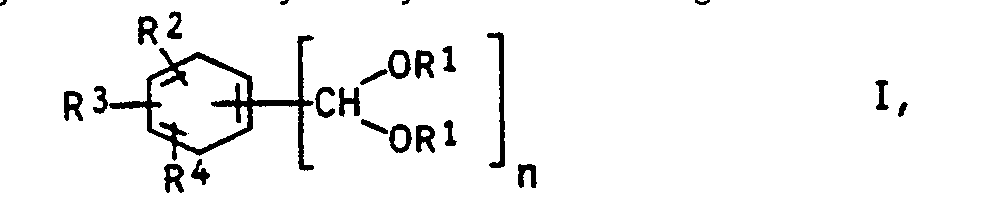
- R1 is an alkyl radical having 1 to 6 carbon atoms
- R2, R3 and R4 are hydrogen or halogen atoms, straight-chain, branched or ring-shaped hydrocarbon radicals or alkoxy, acyloxy, aryloxy or aralkoxy radicals and n is the number 1 or 2 , obtained particularly advantageously when benzyl derivatives of the general formula II in which R2, R3, R4 and n have the abovementioned meaning
- R5 represents a hydrogen atom or an R6-CO radical
- R6 represents a hydrogen atom or an alkyl radical with 1 to 6 C atoms, in the presence of an alcohol of the formula R1-OH, in which R1 has the meaning given above, anodized.
- the particular advantage of the process according to the invention is that isomer-pure benzaldehyde dialkyl acetals are obtained.
- the straight-chain, branched or ring-shaped hydrocarbon radicals which are suitable as substituents R2, R3 and R4 in the benzyl derivatives of the formula II have, for example, 1 to 18, preferably 1 to 12, carbon atoms.
- Hydrocarbon radicals of this type are in particular straight-chain and branched alkyl radicals, cycloalkyl radicals or aryl radicals.
- straight-chain alkyl radicals such. B. called methyl, ethyl, propyl, butyl, hexyl.
- Branched alkyl radicals are e.g. B.
- radicals R8, R9 and R10 are alkyl radicals having 1 to 6, preferably 1 to 3, carbon atoms and R10 can also represent a hydrogen atom.
- residues of this type z.
- B. isopropyl, tert. Butyl sec. Called butyl and iso-butyl.
- Annular hydrocarbon radicals are those which have a cycloalkyl group, a bicycloalkyl group or a benzene or naphthalene ring.
- the cycloalkyl group contain e.g. B.
- cyclic carbon atoms which in turn can carry alkyl groups with 1 to 5, preferably 1 to 3 carbon atoms.
- Cycloalkyl radicals of this type are e.g. B. cyclopropyl, cyclopentyl, cyclohexyl, 3,5-diethylcyclohexyl or tetramethylcyclopropyl.
- the bicycloalkyl groups contain e.g. B. 5 to 12 bicyclic carbon atoms, which in turn may contain alkyl groups with 1 to 5, preferably 1 to 3 carbon atoms. As bicycloalkyl groups such. B.
- Aryl groups are, for example, phenyl, 2-chlorophenyl or biphenylyl.
- the alkoxy, acyloxy, aryloxy and aralkoxy radicals mentioned as further substituents are, for example, methoxy, ethoxy, acetoxy, benzoyloxy, phenoxy, chlorophenoxy or tert-butylphenoxy. Fluorine, chlorine or bromine atoms are preferred as halogen atoms.
- benzyl esters of the formula II used as starting materials for the process according to the invention can be obtained by using the corresponding toluenes of the formula IV in the presence of an alkanoic acid of the formula R6COOH, in which R6 has the meaning given above, oxidized electrochemically.
- the benzaldehyde dialkyl acetals of the formula I can thus be prepared particularly advantageously from the easily accessible toluenes of the formula IV, which cannot be alkoxylated in one stage or can only be alkoxylated in poor yields, in two successive steps of electrochemical oxidation.
- This has the further advantage that the electrolysis discharge of the acyloxylation can be used directly for the anodic alkoxylation without further purification after the solvent and auxiliary electrolyte have been separated off.
- the two electrochemical oxidations ie the process according to the invention for the preparation of the benzaldehyde dialkyl acetals of the formula I and the process for the preparation of the benzyl esters of the formula III from the toluenes of the formula IV can be carried out in electrolysis cells which are conventional per se. Undivided flow cells are preferably used.
- As anode materials z. B. precious metals such as platinum or oxides such as RuO2, Cr2O3 or TiO x / RuO x .
- Anodes made of graphite are preferably used. Possible cathode materials include iron, steel, nickel, precious metals such as platinum or graphite.
- electrolytes which contain the benzyl derivative of the formula II, the alcohol of the formula R1OH and, to increase the conductivity, an auxiliary electrolyte.
- auxiliary salts customary in electrochemistry such as fluorides, e.g. KF, tetrafluoroborates, e.g. Sodium tetrafluoroborate, alcoholates, e.g. Sodium methylate, sulfonates, e.g. Sodium benzenesulfonate or alkyl sulfates, e.g. Sodium methyl sulfate can be used.
- the electrolyte has the following composition: 1 to 49, preferably 5 to 30% by weight of benzyl compound of the formula II, 50 to 99, preferably 70 to 95 wt.% Alcohol of the formula R1OH 0.1 to 5, preferably 0.25 to 2 wt.% Auxiliary electrolyte.
- the electrolysis is advantageously carried out at current densities between 0.2 and 25 A / dm 2 and at temperatures up to about 100 ° C., advantageously between 0 ° C. and about 5 ° C. below the boiling point of the alcohol.
- the benzyl esters or benzyl alcohols used can be largely implemented.
- the electrolysis discharges are worked up by conventional methods, preferably by distillation. Excess alcohol, conductive salt and possibly unreacted benzyl derivative of the formula II can be recycled to the electrolysis.
- a solution of the toluene derivative of the formula IV in an alkanoic acid of the formula R6COOH is used as the electrolyte, to which an auxiliary electrolyte is added to increase the conductivity.
- a cosolvent can also be added to increase the solubility of the toluenes. Suitable cosolvents are, for example, ketones such as acetone or methyl ethyl ketone, nitriles such as acetonitrile or propionitrile and anhydrides such as acetic anhydride.
- the above-mentioned conductive salts are used as auxiliary electrolytes.
- An electrolyte suitable for electrochemical acyloxylation has, for example, the following composition: 1 to 40% by weight of toluene of the general formula IV, 1 to 10% by weight of conducting salt, 0 to 20% by weight cosolvent and 50 to 95% by weight alkanoic acid.
- the current densities and electrolysis temperatures can be varied within wide limits. For example, electrolyzed at 0.2 to 25 A / dm2 and at 15 to 95 ° C.
- the toluenes used can largely be converted; the electrolysis discharges are worked up using methods known per se, e.g. by distillation, extraction and crystallization. After separation from the benzyl esters, cosolvents, excess alkanoic acid and conductive salt can be returned to the electrolysis together with any unreacted toluene.
- alcohols of the formula R1OH e.g. Methanol, ethanol, propanol and butanol are considered.
- carboxylic acids of the formula R6COOH are Formic acid, acetic acid or propionic acid called.
- This invention further relates to the new halogen-containing benzaldehyde dialkyl acetals and benzyl esters of the general formulas in which Hal is a halogen atom, R1 is an alkyl radical having 1 to 6, preferably 1 to 4, carbon atoms, R7 is a straight-chain, branched or ring-shaped hydrocarbon radical having 1 to 18 C atoms, X is a hydrogen or halogen atom, Hal1 is a halogen atom, Hal2 is a halogen atom other than Hal1 and R6 is a hydrogen atom or an alkyl radical having 1 to 6, preferably 1 to 4, carbon atoms.
- radical R7 is a branched or ring-shaped alkyl radical having 3 to 12, in particular 3 to 8, carbon atoms.
- the new benzaldehyde dialkyl acetals of the formulas V and VI can easily be saponified to the corresponding benzaldehydes. They thus provide storage-stable depot compounds for benzaldehydes of the formulas
- the saponification of the diacetals is carried out, for example, by methods known per se, for example simply by heating in water with the addition of catalytic amounts of acid to temperatures of 40 to 95 ° C.
- 2,4-dihalotoluenes which are used for the preparation of benzyl esters of the formula III and the benzaldehyde dialkyl acetals of the formula V are 2,4-dichlorotoluene, 2,4-difluorotoluene, 2-chloro-4-fluorotoluene, 2,4-dibromotoluene, 2-fluoro-4-chlorotoluene and 2-bromo-4-fluorotoluene.
- Examples of benzyl derivatives of the formula II which are used for the preparation of the new benzaldehyde dialkyl acetals of the formula VI are the compounds of the formula shown in the following table into consideration.
- o-xylene is electrolyzed in the electrolysis cell described below under the conditions specified.
- Apparatus undivided cell with 11 bipolar electrodes
- Anode graphite
- Electrolyte 1350 g (12.74 mol) o-xylene, 270 g acetic anhydride, 270 g triethylmethylammonium methyl sulfate and 7110 g acetic acid
- Cathode graphite Current density: 1.33 A / dm2
- Electrolysis temperature 75 o C
- Electrolysis with 2.75 F / mol o-xylene The electrolyte is pumped through the cell at 200 l / h during the electrolysis. After the electrolysis has ended, acetic acid / acetic anhydride are distilled off at atmospheric pressure up to 150 ° C. and the residue is partitioned between water / methyl tert-butyl ether. Methyl tert-butyl ether is distilled off from the organic phase at atmospheric pressure. 1930 g of residue are obtained which, according to gas chromatographic analysis, contains 79.4 g (5%) of 2-methylbenzaldehyde and 1222 g (59%) of 2-methylbenzyl acetate. 2-methylbenzyl acetate is mbar at 2 and purified by distillation 72 o C.
- 2-Methylbenzyl acetate is electrooxidized in the electrolysis cell described in paragraph (a) under the following conditions: Electrolyte: 375 g (2.287 mol) of 2-methylbenzyl acetate, 18.75 g of sodium benzenesulfonate, 6.25 g of sodium methylate and 2100 g of methanol Current density: 3.4 A / dm2 Electrolysis temperature: 25 o C
- Electrolysis with 3.75 F / mol 2-methylbenzyl acetate The electrolyte is pumped through the cell at 200 l / h during the electrolysis. After the electrolysis has ended, the methanol is distilled off at atmospheric pressure, the precipitated conductive salt is filtered off and the filtrate is distilled in vacuo. This gives 14.6 g (5%) 2-methyl benzaldehyde and 248.5 g (66%) of 2-Methylbenzaldehyddimethylacetal (b.p .: 46-48 o C / 2 mbar).
- m-xylene is electrolyzed in the electrolysis cell described in Example 1a under the following conditions: Electrolyte: 900 g (8.49 mol) of m-xylene, 180 g of triethylmethylammonium methyl sulfate, 180 g of acetic anhydride and 4740 g of acetic acid Current density: 1 A / dm2 Electrolysis temperature: 77 o C
- Electrolysis with 3.25 F / mol m-xylene The electrolyte is pumped through the cell at 200 l / h during the electrolysis. Working up is carried out as described in Example 1a). After pure distillation in vacuo, 566.4 g (41%) of 3-methylbenzyl acetate are obtained (Sdp .: 75 o C / 2 mbar).
- 3-methylbenzyl acetate is electrooxidized in the electrolysis cell described in Example 1a under the following conditions: Electrolyte: 375 g (2.29 mol) of 3-methylbenzyl acetate, 18.75 g of sodium benzenesulfonate, 6.25 g of sodium methylate and 2100 g of methanol Current density: 3.4 A / dm2 Electrolysis temperature: 25 o C
- Electrolysis with 3.5 F / mol 3-methylbenzyl acetate The electrolyte is pumped through the cell at 200 l / h during the electrolysis.
- the electrolysis discharge is worked up as described in Example 1b). After purification by distillation under vacuum, 14.9 g (5%) of 3-methylbenzaldehyde and 229.3 g (60%) of 3-Methylbenzaldehyddimethylacetal (bp .: 62 o C / 3 mbar).
- Mesitylene is electrolyzed in the electrolysis cell described in Example 1a under the following conditions: Electrolyte: 945 g (7.875 mol) mesitylene, 210 g potassium benzenesulfonate, 945 g acetic anhydride and 5300 g acetic acid Current density: 0.5 A / dm2 Electrolysis temperature: 70 o C
- Electrolysis with 2.5 F / mol mesitylene The electrolyte is pumped through the cell at 200 l / h during the electrolysis.
- the electrolysis discharge is worked up as described in Example 1a). After purification by distillation under vacuum (b.p .: 1 96 o C / mbar) yields 698.1 g (50%) of 3,5-Dimethylbenzylacetat.
- 3,5-dimethylbenzyl acetate is electrooxidized in the electrolysis cell described in Example 1a under the following conditions: Electrolyte: 665 g (3.736 mol) of 3,5-dimethylbenzyl acetate, 30 g of sodium benzenesulfonate, 30 g of sodium methylate and 5290 g of methanol Current density: 3.4 A / dm2 Electrolysis temperature: 40 o C
- Electrolysis with 5 F / mol 3,5-dimethylbenzyl acetate The electrolyte is pumped through the cell at 200 l / h during the electrolysis.
- the electrolysis discharge is worked up as described in Example 1b).
- At an oxidation degree of 89% (2 bp. 67 o C / mbar) is obtained after purification by distillation under vacuum, 18.1 g (4%) of 3,5-dimethylbenzaldehyde and 292.4 g (44%) of 3,5-Dimethylbenzaldehyddimethylacetal. This results in a selectivity of 54%.
- 4-fluorotoluene is electrolyzed in the electrolysis cell described in Example 1a under the following conditions: Electrolyte: 190 g (1.727 mol) 4-fluorotoluene, 190 g acetic anhydride, 57 g triethyl methyl ammonium methyl sulfate and 1663 g acetic acid Current density: 1.33 A / dm2 Electrolysis temperature: 70 o C
- Electrolysis with 3.75 F / mol 4-fluorotoluene The electrolyte is pumped through the cell at 200 l / h during the electrolysis. The electrolysis discharge is worked up as described in Example 1a). 232 g of residue are obtained which, according to gas chromatographic analysis, contains 43 g (23%) of 4-fluorotoluene, 11.3 g (5%) of 4-fluorobenzaldehyde and 179.3 g (62%) of 4-fluorobenzyl acetate. 4-Fluorbenzylacetat is mbar at 2 and purified by distillation 70 ° C.
- 4-fluorobenzyl acetate is electrooxidized in the electrolysis cell described in Example 1a under the following conditions: Electrolyte: 250 g (1.488 mol) 4-fluorobenzyl acetate, 12.5 g sodium benzenesulfonate, 12.5 g sodium methylate and 2225 g methanol Current density: 3.4 A / dm2 Electrolysis temperature: 25 o C
- Electrolysis with 4 F / mol 4-fluorobenzyl acetate The electrolyte is pumped through the cell at 200 l / h during the electrolysis. After the electrolysis has ended, the discharge is adjusted to pH 8 to 10 with sodium methylate and then worked up further as described in Example 1b). With a degree of oxidation of 94%, 7.7 g (4%) of 4-fluorobenzaldehyde and 135.4 g (54%) of 4-fluorobenzaldehyde dimethyl acetal (bp: 42 o C / 2 mbar) are obtained after pure distillation in vacuo. This results in a selectivity of 62%.
- 2-fluorotoluene is electrooxidized in the electrolysis cell described in Example 1a under the following conditions: Electrolyte: 1013 g (9.206 mol) of 2-fluorotoluene, 675 g of acetic anhydride, 338 g of triethylmethylammonium methyl sulfate and 4727 g of acetic acid Current density: 1.33 A / dm2 Electrolysis temperature: 75 o C
- Electrolysis with 4.5 F / mol 2-fluorotoluene The electrolyte is pumped through the cell at 200 l / h during the electrolysis.
- the electrolysis discharge is worked up as described in Example 1a). After pure distillation in vacuo, 835.2 g (54%) of 2-fluorobenzyl acetate (b.p. 80 o C / 4 mbar) are obtained.
- 2-fluorobenzyl acetate is electrooxidized in the electrolysis cell described in Example 1a under the following conditions: Electrolyte: 740 g (4.405 mol) of 2-fluorobenzyl acetate, 50 g of sodium benzenesulfonate, 25 g of sodium methylate and 4185 g of methanol. Current density: 3.4 A / dm2 Electrolysis temperature: 40 o C
- Electrolysis with 7 F / mol 2-fluorobenzyl acetate The electrolyte is pumped through the cell at 200 l / h during the electrolysis. After the electrolysis has ended, the discharge is adjusted to pH 8-10 with sodium methylate and then worked up further as described in Example 1b). At an oxidation degree of 91% (2 b.p .: 40 ° C / mbar) is obtained after purification by distillation under vacuum 348.8 g (47%) of 2-Fluorbenzaldehyddimethylacetal. The selectivity of the anodic methoxylation is thus 52%.
- 4- (4-methylphenyl) toluene is electrooxidized in the electrolysis cell described in Example 1a under the following conditions: Electrolyte: 350 g (1.923 mol) of 4- (4-methylphenyl) toluene, 600 g of acetic anhydride, 186 g of potassium benzene sulfonate and 6200 g of acetic acid Current density: 0.33 A / dm2 Electrolysis temperature: 70 o C
- Electrolysis with 3 F / mol 4- (4-methylphenyl) toluene The electrolyte is pumped through the cell at 200 l / h during the electrolysis. The electrolysis discharge is worked up as described in Example 1a). 3178 o C / mbar - After purification by distillation under vacuum, 5.5 g (2%) of 4- (4-methylphenyl) toluene and 245.1 g (53%) of 4- (4-methylphenyl) benzyl acetate (boiling 172nd ; Mp: 46 o C).
- 2-Chloro-4-fluorotoluene is oxidized in the electrolysis cell described in Example 1a under the following conditions: Electrolyte: 1200 g (8.307 mol) of 2-chloro-4-fluorotoluene, 400 g of acetic anhydride, 200 g of triethylmethylammonium methyl sulfate and 6200 g of acetic acid Current density: 1.33 A / dm2 Electrolysis temperature: 70 ° C
- Electrolysis with 4.5 F / mol 2-chloro-4-fluorotoluene The electrolyte is pumped through the cell at 200 l / h during the electrolysis.
- the electrolysis discharge is worked up as described in Example 1a. 1575 g of residue are obtained which, according to gas chromatographic analysis, contains 10.1 g of 2-chloro-4-fluorotoluene, 80.1 g of 2-chloro-4-fluorobenzaldehyde and 1081.2 g of 2-chloro-4-fluorobenzyl acetate. This results in a conversion of 99.2%, a yield of 64.3% and a selectivity of 71.0%.
- 2-Chloro-4-fluorobenzyl acetate is oxidized in the electrolysis cell described in Example 1a under the following conditions: Electrolyte: 900 g (4.445 mol) of 2-chloro-4-fluorobenzyl acetate, 30 g of sodium methylate, 90 g of sodium benzene sulfonate and 5040 g of methanol Current density: 3.3 A / dm2 Electrolysis temperature: 45-50 ° C
- Electrolysis with 5 F / mol 2-chloro-4-fluorobenzyl acetate The electrolyte is pumped through the cell at 200 l / h during the electrolysis. After the electrolysis has ended, the discharge is adjusted to pH 7-8 with sodium methylate and then worked up further as described in Example 1b). After pure distillation in vacuo, 44.9 g of 2-chloro-4-fluorobenzaldehyde and 675.7 g of 2-chloro-4-fluorobenzaldehyde dimethyl acetal (bp .: 60-62 o C / 2 mbar) are obtained. This gives a yield of 74.2% and a selectivity of 80.6%.
- p-Xylene is electrolyzed in the electrolysis cell described in Example 1a under the following conditions: Electrolyte: 300 g (2.83 mol) of p-xylene, 300 g of acetic anhydride, 120 g of triethyl methyl ammonium methyl sulfate and 2280 g of acetic acid Current density: 1.33 A / dm2 Electrolysis temperature: 75 o C
- Electrolysis with 5 F / mol p-xylene The electrolyte is pumped through the cell at 200 l / h during the electrolysis. The electrolysis discharge is worked up as described in Example 1a). After pure distillation in vacuo, 194.1 g (31%) of p-xylylene diacetate (bp: 125 o C / 2 mbar) are obtained.
- p-Xylylene diacetate is electrooxidized in the electrolysis cell described in Example 1a under the following conditions: Electrolyte: 450 g (2.027 mol) of p-xylylene diacetate, 15 g of sodium methylate and 2542 g of methanol Current density: 3.4 A / dm2 Electrolysis temperature: 40 o C
- the electrolyte is pumped through the cell at 200 l / h during the electrolysis.
- the discharge is adjusted to pH 8 to 9 by adding sodium methylate and then worked up further as described in Example 1b.
- 44.8 g (12.3%) of terephthalaldehyde dimethyl acetal and 275.1 g (60.1%) of terephthalaldehyde tetramethyl acetal are obtained. This results in a selectivity of 72.3%.
- Terephthaldialdehydtetramethylacetal is purified by distillation at 115 o C and 5 mbar.
- m-xylene is electrolyzed in the electrolysis cell described in Example 1a under the following conditions: Electrolyte: 450 g (4.245 mol) of m-xylene, 300 g of acetic anhydride, 150 g of triethyl methyl ammonium methyl sulfate and 2100 g of acetic acid Current density: 1.33 A / dm2 Electrolysis temperature: 75 o C
- Electrolysis with 7 F / mol m-xylene The electrolyte is pumped through the cell at 200 l / h during the electrolysis.
- the electrolysis discharge is worked up as described in Example 1a). After pure distillation in vacuo, 225.1 g (24%) of m-xylylene diacetate (bp: 120-125 o C / 2 mbar) are obtained.
- m-Xylylene diacetate is electrolyzed in the electrolysis cell described in Example 1a under the following conditions: Electrolyte: 216 g (0.973 mol) of m-xylylene diacetate, 30 g of sodium methylate, 15 g of sodium benzene sulfonate and 2755 g of methanol Current density: 3.4 A / dm2 Electrolysis temperature: 40 o C
- Electrolysis with 8 F / mol 2-chloro-3-isopropylbenzyl acetate The electrolyte is pumped through the cell at 200 l / h during the electrolysis.
- the electrolysis discharge is worked up as described in Example 1b). After purification by distillation under vacuum (Bp .: 92 2 o C / mbar) yields 166.7 g (57%) of 2-chloro-3-isopropylbenzaldehyddimethylacetal.
- 2-Chloro-3-cyclopentylbenzyl acetate is oxidized in the electrolysis cell described in Example 1a under the following conditions: Electrolyte: 98 g (0.388 mol) of 2-chloro-3-cyclopentylbenzyl acetate, 30 g of sodium benzene sulfonate, 15 g of sodium methylate and 2857 g of methanol.
- Electrolysis with 18 F / mol 2-chloro-3-cyclopentylbenzyl acetate The electrolyte is pumped through the cell at 200 l / h during the electrolysis.
- the electrolysis discharge is worked up as described in Example 1b). After purification by distillation under vacuum, 40.4 g (41%) of 2-chloro-3-cyclopentylbenzaldehyddimethylacetal (b.p .: 140-145 o C / 4 mbar).
Landscapes
- Chemical & Material Sciences (AREA)
- Organic Chemistry (AREA)
- Engineering & Computer Science (AREA)
- Chemical Kinetics & Catalysis (AREA)
- Electrochemistry (AREA)
- Materials Engineering (AREA)
- Metallurgy (AREA)
- Electrolytic Production Of Non-Metals, Compounds, Apparatuses Therefor (AREA)
- Organic Low-Molecular-Weight Compounds And Preparation Thereof (AREA)
Abstract
Description
- Diese Erfindung betrifft ein Verfahren zur Herstellung von Benzaldehyddialkylacetalen durch elektrochemische Oxidation von Benzylderivaten sowie neue halogenhaltige Benzaldehyddialkylacetale und Benzylester. Benzaldehyddialkylacetale finden z.B. als lagerstabile Depotverbindungen für die entsprechenden Benzaldehyde Verwendung.
- Die Elektrooxidation von Toluolen zu Benzaldehyddialkylacetalen wird z. B. in der EP-PS 12 240, oder DE-OS 2 848 397 und der DE-OS 2 935 398 beschrieben. Die Benzaldehyddialkylacetale werden dabei allerdings nur dann in guten Ausbeuten erhalten, wenn die Toluole in para Stellung zur Methylgruppe elektronenreiche Substituenten enthalten, die das Oxidationspotential der Toluole absenken. Toluole mit elektronenarmen Substituenten in para Stellung zur Methylgruppe oder beliebigen Substituenten in ortho oder meta Position lassen sich entweder gar nicht oder nur in schlechten Ausbeuten direkt zu Benzaldehyddialkylacetalen elektrooxidieren.
- Aus der US-PS 3,448,021 und J.Org.Chem.51, 4544 (1986) ist bekannt, daß Toluole, die durch ein Halogenatom desaktiviert sind, elektrochemisch zu Benzylacetaten oxidiert werden können.
- Halogenierte Benzaldehyde sind wichtige Zwischenprodukte, z.B. für die Herstellung von Wirkstoffen. So werden z.B. 2,4-Dihalogenbenzaldehyde für die Herstellung N-substituierter Tetrahydrophthalimide benötigt, die als Herbizide Verwendung finden (WO 87/4049). Man stellt solche Benzaldehyde nach der gebräuchlichsten Methode durch Halogenierung der entsprechenden Toluole und anschließende Hydrolyse der Dihalogenmethylbenzole her (s. Houben-Weyl, "Methoden der organischen Chemie", 4. Auflage, Band 5/3, Seiten 735-738 und Band 7/1, Seiten 211-214). Von erheblichem Nachteil ist hierbei, daß Dihalogenmethylbenzole carcinogenes Potential besitzen und daß bei der Hydrolyse große Salzmengen anfallen. Wegen dieser Nachteile hat man schon vorgeschlagen, Toluole elektrochemisch zu oxidieren. So lassen sich isomerenreine Benzaldehyde nach den Angaben der Patentschriften DE 2 855 508, EP 72 914 und EP 29 995 durch eine anodische Oxidation aus den entsprechend substituierten Toluolen herstellen. Da auf die Verwendung umweltbelastender Reagenzien verzichtet werden kann, ist die Elektrooxidation anderen chemischen Methoden überlegen. Allerdings ergeben sich bei der Elektrooxidation der Toluole die obengenannten Schwierigkeiten.
- Phthalaldehydacetale lassen sich z. B. durch Umsetzung von Bis-(chlormethyl)-benzolen mit Hexamethylentetramin (J. Chem. Soc. 1950, 214) und anschließende Acetalisierung mit o-Estern (J. Chem. Soc., Perkin II, 1975, 1656) oder durch anodische Oxidation von Alkoxymethylbenzolen (DE-OS 34 21 976) herstellen. Die Alkoxymethylbenzole erhält man wiederum aus den entsprechenden Bis-(halogenmethyl)benzolen (J. Chem. Soc. 1954, 2819). Die Herstellung der seitenkettenhalogenierten Zwischenstufen liefert jedoch nur mäßige Ausbeuten. Da bei der Hydrolyse zudem große Salzmengen gebildet werden und die halogenierten Zwischenstufen gleichzeitig carcinogenes Potential besitzen, sind diese Synthesen wenig umweltfreundlich.
- Es wurde nun gefunden, daß man Benzaldehyddialkylacetale der allgemeinen Formel I


- Der besondere Vorteil des erfindungsgemäßen Verfahrens besteht darin, daß man isomerenreine Benzaldehyddialkylacetale erhält.
- Die in den Benzylderivaten der Formel II als Substituenten R², R³ und R⁴ in Betracht kommenden geradkettigen, verzweigten oder ringförmigen Kohlenwasserstoffreste haben z.B. 1 bis 18, vorzugsweise 1 bis 12 C-Atome. Kohlenwasserstoffreste dieser Art sind insbesondere geradkettige und verzweigte Alkylreste, Cycloalkylreste oder Arylreste. Als geradkettige Alkylreste seien z. B. Methyl, Ethyl, Propyl, Butyl, Hexyl genannt. Verzweigte Alkylreste sind z. B. solche der Formel

- Die als Ausgangsstoffe für das erfindungsgemäße Verfahren verwendeten Benzylester der Formel II, die zum Teil neu sind, lassen sich dadurch gewinnen, daß man die entsprechenden Toluole der Formel IV

- Man kann die Benzaldehyddialkylacetale der Formel I somit besonders vorteilhaft aus den leicht zugänglichen Toluolen der Formel IV, die sich einstufig nicht oder nur in schlechten Ausbeuten elektrochemisch alkoxilieren lassen, in zwei aufeinander folgenden Schritten der elektrochemischen Oxidation herstellen. Dabei ergibt sich der weitere Vorteil, daß der Elektrolyseaustrag der Acyloxilierung nach Abtrennung von Lösungsmittel und Hilfselektrolyt ohne weitere Reinigung direkt für die anodische Alkoxilierung eingesetzt werden kann.
- Die beiden elektrochemischen Oxidationen, d.h. das erfindungsgemäße Verfahren zur Herstellung der Benzaldehyddialkylacetale der Formel I, wie auch das Verfahren zur Herstellung der Benzylester der Formel III aus den Toluolen der Formel IV können in an sich üblichen Elektrolysezellen durchgeführt werden. Bevorzugt werden ungeteilte Durchflußzellen eingesetzt. Als Anodenmaterialien dienen z. B. Edelmetalle wie Platin oder Oxide wie RuO₂, Cr₂O₃ oder TiOx/RuOx. Bevorzugt werden Anoden aus Graphit eingesetzt. Als Kathodenmaterialien kommen u. a. Eisen, Stahl, Nickel, Edelmetalle, wie Platin oder auch Graphit in Betracht.
- Für die anodische Alkoxilierung werden Elektrolyte eingesetzt, die das Benzylderivat der Formel II, den Alkohol der Formel R¹OH und, zur Erhöhung der Leitfähigkeit, einen Hilfselektrolyten enthalten. Als Hilfselektrolyt können die in der Elektrochemie üblichen Leitsalze, wie Fluoride, z.B. KF, Tetrafluorborate, z.B. Natriumtetrafluoroborat, Alkoholate, z.B. Natriummethylat, Sulfonate, z.B. Natriumbenzolsulfonat oder Alkylsulfate, z.B. Natriummethylsulfat verwendet werden.
- Der Elektrolyt hat beispielsweise folgende Zusammensetzung:
1 bis 49, vorzugsweise 5 bis 30 Gew.% Benzylverbindung der Formel II,
50 bis 99, vorzugsweise 70 bis 95 Gew.% Alkohol der Formel R¹OH
0,1 bis 5, vorzugsweise 0,25 bis 2 Gew.% Hilfselektrolyt. - Man elektrolysiert zweckmäßigerweise bei Stromdichten zwischen 0,2 und 25 A/dm² und bei Temperaturen bis etwa 100°C, zweckmäßigerweise zwischen 0°C und etwa 5°C unterhalb des Siedepunktes des Alkohols. Die eingesetzten Benzylester bzw. Benzylalkohole lassen sich weitgehend umsetzen. Die Aufarbeitung der Elektrolyseausträge erfolgt nach konventionellen Methoden, vorzugsweise wird destillativ aufgearbeitet. Überschüssiger Alkohol, Leitsalz und ggf. nicht umgesetztes Benzylderivat der Formel II können zur Elektrolyse zurückgeführt werden.
- Für die Acyloxilierung verwendet man als Elektrolyten eine Lösung des Toluolderivates der Formel IV in einer Alkansäure der Formel R⁶COOH, der zur Erhöhung der Leitfähigkeit ein Hilfselektrolyt zugegeben wird. Zur Erhöhung der Löslichkeit der Toluole kann man auch ein Colösungsmittel zugeben. Geeignete Colösungsmittel sind z.B. Ketone, wie Aceton oder Methylethylketon, Nitrile, wie Acetonitril oder Propionitril und Anhydride, wie Acetanhydrid. Als Hilfselektrolyte werden z.B. die oben genannten Leitsalze verwendet. Ein für die elektrochemische Acyloxilierung geeigneter Elektrolyt hat z.B. die folgende Zusammensetzung:
1 bis 40 Gew.% Toluol der allgemeinen Formel IV, 1 bis 10 Gew.% Leitsalz,
0 bis 20 Gew.% Colösungsmittel und 50 bis 95 Gew.% Alkansäure. - Die Stromdichten und Elektrolysetemperaturen lassen sich in weiten Grenzen variieren. So wird z.B. bei 0,2 bis 25 A/dm² und bei 15 bis 95°C elektrolysiert. Die eingesetzten Toluole lassen sich weitgehend umsetzen, die Aufarbeitung der Elektrolyseausträge erfolgt nach an sich bekannten Methoden, z.B. durch Destillation, Extraktion und Kristallisation. Colösungsmittel, überschüssige Alkansäure und Leitsalz können nach Abtrennung von den Benzylestern zusammen mit gegebenenfalls nicht umgesetztem Toluol zur Elektrolyse zurückgeführt werden.
- Als Alkohole der Formel R¹OH kommen z.B. Methanol, Ethanol, Propanol und Butanol in Betracht. Als Carbonsäuren der Formel R⁶COOH seien z.B. Ameisensäure, Essigsäure oder Propionsäure genannt.
- Diese Erfindung betrifft ferner die neuen halogenhaltigen Benzaldehyddialkylacetale und Benzylester der allgemeinen Formeln

- Die neuen Benzaldehyddialkylacetale der Formeln V und VI lassen sich leicht zu den entsprechenden Benzaldehyden verseifen. Sie stellen somit lagerstabile Depotverbindungen für Benzaldehyde der Formeln

- Als 2,4-Dihalogentoluole, die man zur Herstellung von Benzylestern der Formel III und der Benzaldehyddialkylacetale der Formel V heranzieht, seien z.B. 2,4-Dichlortoluol, 2,4-Difluortoluol, 2-Chlor-4-fluortoluol, 2,4-Dibromtoluol, 2-Fluor-4-chlortoluol und 2-Brom-4-fluortoluol genannt.
- Als Benzylderivate der Formel II, die man für die Herstellung der neuen Benzaldehyddialkylacetale der Formel VI verwendet, kommen z.B. die aus der folgenden Tabelle ersichtlichen Verbindungen der Formel


- o-Xylol wird in der wie folgt beschriebenen Elektrolysezelle unter den angegebenen Bedingungen elektrolysiert.
Apparatur: ungeteilte Zelle mit 11 bipolaren Elektroden
Anode: Graphit
Elektrolyt: 1350 g (12,74 Mol) o-Xylol, 270 g Acetanhydrid, 270 g Triethylmethylammoniummethylsulfat und 7110 g Essigsäure
Kathode: Graphit
Stromdichte: 1,33 A/dm²
Elektrolysetemperatur: 75 oC - Elektrolyse mit 2,75 F/mol o-Xylol. Der Elektrolyt wird während der Elektrolyse mit 200 l/h durch die Zelle gepumpt. Nach Beendigung der Elektrolyse werden Essigsäure/Acetanhydrid bei Normaldruck bis 150 °C abdestilliert und der Rückstand zwischen Wasser/Methyl-tert.butylether verteilt. Aus der organischen Phase wird Methyl-tert.butylether bei Normaldruck abdestilliert. Man erhält 1930 g Rückstand, der nach gaschromatographischer Analyse 79,4 g (5 %) 2-Methylbenzaldehyd und 1222 g (59 %) 2-Methylbenzylacetat enthält.
2-Methylbenzylacetat wird bei 2 mbar und 72 oC reindestilliert. - 2-Methylbenzylacetat wird in der in Absatz (a) beschriebenen Elektrolysezelle unter den folgenden Bedingungen elektrooxidiert:
Elektrolyt: 375 g (2,287 Mol) 2-Methylbenzylacetat, 18,75 g Natriumbenzolsulfonat, 6,25 g Natriummethylat und 2100 g Methanol
Stromdichte: 3,4 A/dm²
Elektrolysetemperatur: 25 oC - Elektrolyse mit 3,75 F/mol 2-Methylbenzylacetat. Der Elektrolyt wird während der Elektrolyse mit 200 l/h durch die Zelle gepumpt. Nach Beendigung der Elektrolyse wird das Methanol bei Normaldruck abdestilliert, das ausgefallene Leitsalz abfiltriert und das Filtrat im Vakuum reindestilliert. Man erhält 14,6 g (5 %) 2-Methylbenzaldehyd und 248,5 g (66 %) 2-Methylbenzaldehyddimethylacetal (Sdp.: 46 - 48 oC/2 mbar).
- m-Xylol wird in der in Beispiel 1a beschriebenen Elektrolysezelle unter den folgenden Bedingungen elektrolysiert:
Elektrolyt: 900 g (8,49 Mol) m-Xylol, 180 g Triethylmethylammoniummethylsulfat, 180 g Acetanhydrid und 4740 g Essigsäure
Stromdichte: 1 A/dm²
Elektrolysetemperatur: 77 oC - Elektrolyse mit 3,25 F/mol m-Xylol. Der Elektrolyt wird während der Elektrolyse mit 200 l/h durch die Zelle gepumpt. Die Aufarbeitung erfolgt wie in Beispiel 1a) beschrieben. Nach Reindestillation im Vakuum erhält man 566,4 g (41 %) 3-Methylbenzylacetat
(Sdp.: 75 oC/2 mbar). - 3-Methylbenzylacetat wird in der in Beispiel 1a beschriebenen Elektrolysezelle unter den folgenden Bedingungen elektrooxidiert:
Elektrolyt: 375 g (2,29 Mol) 3-Methylbenzylacetat, 18,75 g Natriumbenzolsulfonat, 6,25 g Natriummethylat und 2100 g Methanol
Stromdichte: 3,4 A/dm²
Elektrolysetemperatur: 25 oC - Elektrolyse mit 3,5 F/mol 3-Methylbenzylacetat. Der Elektrolyt wird während der Elektrolyse mit 200 l/h durch die Zelle gepumpt. Die Aufarbeitung des Elektrolyseaustrags erfolgt wie in Beispiel 1b) beschrieben. Nach Reindestillation im Vakuum erhält man 14,9 g (5 %) 3-Methylbenzaldehyd und 229,3 g (60 %) 3-Methylbenzaldehyddimethylacetal (Sdp.: 62 oC/3 mbar).
- Mesitylen wird in der in Beispiel 1a beschriebenen Elektrolysezelle unter den folgenden Bedingungen elektrolysiert:
Elektrolyt: 945 g (7,875 Mol) Mesitylen, 210 g Kaliumbenzolsulfonat, 945 g Acetanhydrid und 5300 g Essigsäure
Stromdichte: 0,5 A/dm²
Elektrolysetemperatur: 70 oC - Elektrolyse mit 2,5 F/mol Mesitylen. Der Elektrolyt wird während der Elektrolyse mit 200 l/h durch die Zelle gepumpt. Die Aufarbeitung des Elektrolyseaustrags erfolgt wie in Beispiel 1a) beschrieben. Nach Reindestillation im Vakuum erhält man 698,1 g (50 %) 3,5-Dimethylbenzylacetat (Sdp.: 96 oC/1 mbar).
- 3,5-Dimethylbenzylacetat wird in der in Beispiel 1a beschriebenen Elektrolysezelle unter den folgenden Bedingungen elektrooxidiert:
Elektrolyt: 665 g (3,736 Mol) 3,5-Dimethylbenzylacetat, 30 g Natriumbenzolsulfonat, 30 g Natriummethylat und 5290 g Methanol
Stromdichte: 3,4 A/dm²
Elektrolysetemperatur: 40 oC - Elektrolyse mit 5 F/mol 3,5-Dimethylbenzylacetat. Der Elektrolyt wird während der Elektrolyse mit 200 l/h durch die Zelle gepumpt. Die Aufarbeitung des Elektrolyseaustrags erfolgt wie in Beispiel 1b) beschrieben. Bei einem Oxidationsgrad von 89 % erhält man nach Reindestillation im Vakuum 18,1 g (4 %) 3,5-Dimethylbenzaldehyd und 292,4 g (44 %) 3,5-Dimethylbenzaldehyddimethylacetal (Sdp. 67 oC/2 mbar). Hieraus errechnet sich eine Selektivität von 54 %.
- 4-Fluortoluol wird in der in Beispiel 1a beschriebenen Elektrolysezelle unter den folgenden Bedingungen elektrolysiert:
Elektrolyt: 190 g (1,727 Mol) 4-Fluortoluol, 190 g Acetanhydrid, 57 g Triethylmethylammoniummethylsulfat und 1663 g Essigsäure
Stromdichte: 1,33 A/dm²
Elektrolysetemperatur: 70 oC - Elektrolyse mit 3,75 F/mol 4-Fluortoluol. Der Elektrolyt wird während der Elektrolyse mit 200 l/h durch die Zelle gepumpt. Die Aufarbeitung des Elektrolyseaustrags erfolgt wie in Beispiel 1a) beschrieben. Man erhält 232 g Rückstand, der nach gaschromatographischer Analyse 43 g (23 %) 4-Fluortoluol, 11,3 g (5 %) 4-Fluorbenzaldehyd und 179,3 g (62 %) 4-Fluorbenzylacetat enthält. 4-Fluorbenzylacetat wird bei 2 mbar und 70 oC reindestilliert.
- 4-Fluorbenzylacetat wird in der in Beispiel 1a beschriebenen Elektrolysezelle unter den folgenden Bedingungen elektrooxidiert:
Elektrolyt: 250 g (1,488 Mol) 4-Fluorbenzylacetat, 12,5 g Natriumbenzolsulfonat, 12,5 g Natriummethylat und 2225 g Methanol
Stromdichte: 3,4 A/dm²
Elektrolysetemperatur: 25 oC - Elektrolyse mit 4 F/mol 4-Fluorbenzylacetat. Der Elektrolyt wird während der Elektrolyse mit 200 l/h durch die Zelle gepumpt. Nach Beendigung der Elektrolyse wird der Austrag mit Natriummethylat auf pH 8 bis 10 eingestellt und anschließend wie in Beispiel 1b) beschrieben, weiter aufgearbeitet. Bei einem Oxidationsgrad von 94 % erhält man nach Reindestillation im Vakuum 7,7 g (4 %) 4-Fluorbenzaldehyd und 135,4 g (54 %) 4-Fluorbenzaldehyddimethylacetal (Sdp.: 42 oC/2 mbar). Hieraus errechnet sich eine Selektivität von 62 %.
- 2-Fluortoluol wird in der in Beispiel 1a beschriebenen Elektrolysezelle unter den folgenden Bedingungen elektrooxidiert:
Elektrolyt: 1013 g (9,206 Mol) 2-Fluortoluol, 675 g Acetanhydrid, 338 g Triethylmethylammoniummethylsulfat und 4727 g Essigsäure
Stromdichte: 1,33 A/dm²
Elektrolysetemperatur: 75 oC - Elektrolyse mit 4,5 F/mol 2-Fluortoluol. Der Elektrolyt wird während der Elektrolyse mit 200 l/h durch die Zelle gepumpt. Die Aufarbeitung des Elektrolyseaustrags erfolgt wie in Beispiel 1a) beschrieben. Nach Reindestillation im Vakuum erhält man 835,2 g (54 %) 2-Fluorbenzylacetat (Sdp. 80 oC/4 mbar).
- 2-Fluorbenzylacetat wird in der in Beispiel 1a beschriebenen Elektrolysezelle unter den folgenden Bedingungen elektrooxidiert:
Elektrolyt: 740 g (4,405 Mol) 2-Fluorbenzylacetat, 50 g Natriumbenzolsulfonat, 25 g Natriummethylat und 4185 g Methanol.
Stromdichte: 3,4 A/dm²
Elektrolysetemperatur: 40 oC - Elektrolyse mit 7 F/mol 2-Fluorbenzylacetat. Der Elektrolyt wird während der Elektrolyse mit 200 l/h durch die Zelle gepumpt. Nach Beendigung der Elektrolyse wird der Austrag mit Natriummethylat auf pH 8 - 10 eingestellt und anschließend wie in Beispiel 1b) beschrieben, weiter aufgearbeitet. Bei einem Oxidationsgrad von 91 % erhält man nach Reindestillation im Vakuum 348,8 g (47 %) 2-Fluorbenzaldehyddimethylacetal (Sdp.: 40 oC/2 mbar). Die Selektivität der anodischen Methoxilierung beträgt somit 52 %.
- 4-(4-Methylphenyl)toluol wird in der in Beispiel 1a beschriebenen Elektrolysezelle unter den folgenden Bedingungen elektrooxidiert:
Elektrolyt: 350 g (1,923 Mol) 4-(4-Methylphenyl)toluol, 600 g Acetanhydrid, 186 g Kaliumbenzolsulfonat und 6200 g Essigsäure
Stromdichte: 0,33 A/dm²
Elektrolysetemperatur: 70 oC - Elektrolyse mit 3 F/mol 4-(4-Methylphenyl)toluol. Der Elektrolyt wird während der Elektrolyse mit 200 l/h durch die Zelle gepumpt. Die Aufarbeitung des Elektrolyseaustrags erfolgt wie in Beispiel 1a) beschrieben. Nach Reindestillation im Vakuum erhält man 5,5 g (2 %) 4-(4-Methylphenyl)toluol und 245,1 g (53 %) 4-(4-Methylphenyl)benzylacetat (Sdp. 172 - 178 oC/3 mbar; Schmp.: 46 oC).
- 4-(4-Methylphenyl)benzylacetat wird in der in Beispiel 1a beschriebenen Elektrolysezelle unter den folgenden Bedingungen elektrooxidiert:
Elektrolyt: 171 g (0,713 Mol) 4-(4-Methylphenyl)benzylacetat, 30 g Natriumbenzolsulfonat, 15 g Natriummethylat und 2784 g Methanol
Stromdichte: 3,4 A/dm²
Elektrolysetemperatur: 40 oC - Elektrolyse mit 6 F/mol 4-(4-Methylphenyl)benzylacetat. Der Elektrolyt wird während der Elektrolyse mit 200 l/h durch die Zelle gepumpt. Die Aufarbeitung des Elektrolyseaustrags erfolgt wie in Beispiel 1b) beschrieben. Bei einem Oxidationsgrad von 96,5 % erhält man nach Reindestillation im Vakuum 5,5 g (4 %) 4-(4-Methylphenyl)benzaldehyd und 63,3 g (37 %) 4-(4-Methylphenyl)benzaldehyddimethylacetal (Sdp. 148 - 155 oC/3 mbar). Hieraus errechnet sich eine Selektivität von 42,5%.
- 2-Chlor-4-fluortoluol wird in der in Beispiel 1a beschriebenen Elektrolysezelle unter den folgenden Bedingungen oxidiert:
Elektrolyt: 1200 g (8,307 Mol) 2-Chlor-4-fluortoluol, 400 g Acetanhydrid, 200 g Triethylmethylammoniummethylsulfat und 6200 g Essigsäure
Stromdichte: 1,33 A/dm²
Elektrolysetemperatur: 70°C - Elektrolyse mit 4,5 F/mol 2-Chlor-4-fluortoluol. Der Elektrolyt wird während der Elektrolyse mit 200 l/h durch die Zelle gepumpt. Die Aufarbeitung des Elektrolyseaustrags erfolgt wie in Beispiel 1a beschrieben. Man erhält 1575 g Rückstand, der nach gaschromatographischer Analyse 10,1 g 2-Chlor-4-fluortoluol, 80,1 g 2-Chlor-4-fluorbenzaldehyd und 1081,2 g 2-Chlor-4-fluorbenzylacetat enthält. Hieraus errechnen sich ein Umsatz von 99,2 %, eine Ausbeute von 64,3 % und eine Selektivität von 71,0 %. 2-Chlor-4-fluorbenzylacetat wird bei 2 mbar und 86-88°C reindestilliert.
¹H-NMR (300 MHz, COCl₃):
(ppm) = 2.12 (s, 3H, CH₃COO-); 5.18 (s, 2H, -CH₂OAc); 7.0, 7.16, 7.4 (jeweils m, 3H, arom.-H) - 2-Chlor-4-fluorbenzylacetat wird in der in Beispiel 1a beschriebenen Elektrolysezelle unter folgenden Bedingungen oxidiert:
Elektrolyt: 900 g (4,445 Mol) 2-Chlor-4-fluorbenzylacetat, 30 g Natriummethylat, 90 g Natriumbenzolsulfonat und 5040 g Methanol
Stromdichte: 3,3 A/dm²
Elektrolysetemperatur: 45-50°C - Elektrolyse mit 5 F/mol 2-Chlor-4-fluorbenzylacetat. Der Elektrolyt wird während der Elektrolyse mit 200 l/h durch die Zelle gepumpt. Nach Beendigung der Elektrolyse wird der Austrag mit Natriummethylat auf pH 7-8 eingestellt und anschließend wie in Beispiel 1b) beschrieben, weiter aufgearbeitet. Nach Reindestillation im Vakuum erhält man 44,9 g 2-Chlor-4-fluorbenzaldehyd und 675,7 g 2-Chlor-4-fluorbenzaldehyddimethylacetal (Sdp.: 60-62 oC/2 mbar). Hieraus errechnen sich eine Ausbeute von 74,2 % und eine Selektivität von 80,6 %.
¹H-NMR (300 MHz, CDCl₃):
(ppm) = 3.37 (s, 6H, OCH₃); 5.59 (s, 1H, -CH(OCH₃)₂); 7.0, 7.13, 7.6 (jeweils m, 3H, arom.-H). - p-Xylol wird in der in Beispiel 1a beschriebenen Elektrolysezelle unter den folgenden Bedingungen elektrolysiert:
Elektrolyt: 300 g (2,83 Mol) p-Xylol, 300 g Acetanhydrid, 120 g Triethylmethylammoniummethylsulfat und 2280 g Essigsäure
Stromdichte: 1,33 A/dm²
Elektrolysetemperatur: 75 oC - Elektrolyse mit 5 F/mol p-Xylol. Der Elektrolyt wird während der Elektrolyse mit 200 l/h durch die Zelle gepumpt. Die Aufarbeitung des Elektrolyseaustrags erfolgt wie in Beispiel 1a) beschrieben. Nach Reindestillation im Vakuum erhält man 194,1 g (31 %) p-Xylylendiacetat (Sdp.: 125 oC/2 mbar).
- p-Xylylendiacetat wird in der in Beispiel 1a beschriebenen Elektrolysezelle unter den folgenden Bedingungen elektrooxidiert:
Elektrolyt: 450 g (2,027 Mol) p-Xylylendiacetat, 15 g Natriummethylat und 2542 g Methanol
Stromdichte: 3,4 A/dm²
Elektrolysetemperatur: 40 oC - Elektrolyse mit 6,5 F/mol p-Xylylendiacetat unter Zusatz von 30 g Schwefelsäure nach 0,5 F/mol. Der Elektrolyt wird während der Elektrolyse mit 200 l/h durch die Zelle gepumpt. Nach Beendigung der Elektrolyse wird der Austrag durch Zugabe von Natriummethylat auf pH 8 bis 9 gestellt und anschließend wie in Beispiel 1b beschrieben, weiter aufgearbeitet. Nach Reindestillation im Vakuum erhält man 44,8 g (12,3 %) Terephthaldialdehyddimethylacetal und 275,1 g (60,1 %) Terephthaldialdehydtetramethylacetal. Hieraus errechnet sich eine Selektivität von 72,3 %. Terephthaldialdehydtetramethylacetal wird bei 115 oC und 5 mbar reindestilliert.
- m-Xylol wird in der in Beispiel 1a beschriebenen Elektrolysezelle unter den folgenden Bedingungen elektrolysiert:
Elektrolyt: 450 g (4,245 Mol) m-Xylol, 300 g Acetanhydrid, 150 g Triethylmethylammoniummethylsulfat und 2100 g Essigsäure
Stromdichte: 1,33 A/dm²
Elektrolysetemperatur: 75 oC - Elektrolyse mit 7 F/mol m-Xylol. Der Elektrolyt wird während der Elektrolyse mit 200 l/h durch die Zelle gepumpt. Die Aufarbeitung des Elektrolyseaustrags erfolgt wie in Beispiel 1a) beschrieben. Nach Reindestillation im Vakuum erhält man 225,1 g (24 %) m-Xylylendiacetat (Sdp.: 120 - 125 oC/2 mbar).
- m-Xylylendiacetat wird in der in Beispiel 1a beschriebenen Elektrolysezelle unter den folgenden Bedingungen elektrolysiert:
Elektrolyt: 216 g (0,973 Mol) m-Xylylendiacetat, 30 g Natriummethylat, 15 g Natriumbenzolsulfonat und 2755 g Methanol
Stromdichte: 3,4 A/dm²
Elektrolysetemperatur: 40 oC - Elektrolyse mit 10 F/mol m-Xylylendiacetat. Der Elektrolyt wird während der Elektrolyse mit 200 l/h durch die Zelle gepumpt. Die Aufarbeitung des Elektrolyseaustrags erfolgt wie in Beispiel 1b) beschrieben. Bei einem Umsatz von 89,3 % erhält man nach Reindestillation im Vakuum 59,2 g (27,0 %) Isophthaldialdehydtetramethylacetal. Hieraus errechnet sich eine Selektivität von 30,2 %. Isophthaldialdehydtetramethylacetal wird bei 108 oC und 3 mbar reindestilliert.
- 2-Chlor-3-isopropylbenzylacetat wird in der in Beispiel 1a beschriebenen Elektrolysezelle unter den folgenden Bedingungen oxidiert:
Elektrolyt: 290 g (1,28 Mol) 2-Chlor-3-isopropylbenzylacetat, 30 g Natriumbenzolsulfonat, 15 g Natriummethylat und 2665 g Methanol
Stromdichte: 3,3 A/dm²
Elektrolysetemperatur: 40 oC - Elektrolyse mit 8 F/mol 2-Chlor-3-isopropylbenzylacetat. Der Elektrolyt wird während der Elektrolyse mit 200 l/h durch die Zelle gepumpt. Die Aufarbeitung des Elektrolyseaustrags erfolgt wie in Beispiel 1b) beschrieben. Nach Reindestillation im Vakuum erhält man 166,7 g (57 %) 2-Chlor-3-isopropylbenzaldehyddimethylacetal (Sdp.: 92 oC/2 mbar).
¹H-NMR (200 MHz, CDCl₃):
δ (ppm) = 1.28 (d, 6H, -CH₃), 3.45 (s, 6H, -OCH₃); 3.50 (m, 1H, -CH(CH₃)₂); 5.71 (s, 1H, -CH(OCH₃)₂); 7.33 (m, 2H, arom.-H); 7.51 (m, 1H, arom.-H). - 2-Chlor-3-cyclopentylbenzylacetat wird in der in Beispiel 1a beschriebenen Elektrolysezelle unter den folgenden Bedingungen oxidiert:
Elektrolyt: 98 g (0,388 Mol) 2-Chlor-3-cyclopentylbenzylacetat, 30 g Natriumbenzolsulfonat, 15 g Natriummethylat und 2857 g Methanol. - Elektrolyse mit 18 F/mol 2-Chlor-3-cyclopentylbenzylacetat. Der Elektrolyt wird während der Elektrolyse mit 200 l/h durch die Zelle gepumpt. Die Aufarbeitung des Elektrolyseaustrags erfolgt wie in Beispiel 1b) beschrieben. Nach Reindestillation im Vakuum erhält man 40,4 g (41 %) 2-Chlor-3-cyclopentylbenzaldehyddimethylacetal (Sdp.: 140 - 145 oC/4 mbar).
¹H-NMR (270 MHz, CDCl₃):
δ (ppm) = 1.5 - 2.15 (m, 8H,-CH₂), 3.34 (s, 6H, -OCH₃); 3.52 (m, 1H, -CH); 5.63 (s, 1H, -CH(OCH₃)₂); 7.2 (m, 2H, arom.-H); 7.44 (d, 1H, arom.-H).
¹³C-NMR (270 MHz, CDCl₃)
δ (ppm) = 25.6 (t, 2C), 33.4 (t, 2C), 42,4 (d), 53.8 (q, 2C), 101.9 (d), 125.7 (d), 126.3 (d), 127.2 (d), 133.3 (s), 136.1 (s), 144.2 (s).
Claims (8)


Applications Claiming Priority (2)
| Application Number | Priority Date | Filing Date | Title |
|---|---|---|---|
| DE3913166 | 1989-04-21 | ||
| DE3913166A DE3913166A1 (de) | 1989-04-21 | 1989-04-21 | Verfahren zur herstellung von benzaldehyddialkylacetalen und neue benzaldehyddialkylacetale und benzylester |
Publications (3)
| Publication Number | Publication Date |
|---|---|
| EP0393668A2 true EP0393668A2 (de) | 1990-10-24 |
| EP0393668A3 EP0393668A3 (de) | 1991-01-23 |
| EP0393668B1 EP0393668B1 (de) | 1994-02-02 |
Family
ID=6379168
Family Applications (1)
| Application Number | Title | Priority Date | Filing Date |
|---|---|---|---|
| EP90107437A Expired - Lifetime EP0393668B1 (de) | 1989-04-21 | 1990-04-19 | Verfahren zur Herstellung von Benzaldehyddialkylacetalen und neue Benzaldehyddialkylacetale |
Country Status (3)
| Country | Link |
|---|---|
| US (1) | US5078838A (de) |
| EP (1) | EP0393668B1 (de) |
| DE (2) | DE3913166A1 (de) |
Cited By (2)
| Publication number | Priority date | Publication date | Assignee | Title |
|---|---|---|---|---|
| EP0554564A1 (de) * | 1992-01-22 | 1993-08-11 | BASF Aktiengesellschaft | Verfahren zur Herstellung von Benzaldehydacetalen |
| WO2002020446A1 (de) * | 2000-09-06 | 2002-03-14 | Basf Aktiengesellschaft | Verfahren zur herstellung von orthocarbonsäuretrialkylestern |
Families Citing this family (1)
| Publication number | Priority date | Publication date | Assignee | Title |
|---|---|---|---|---|
| DE59105416D1 (de) * | 1990-05-31 | 1995-06-14 | Basf Ag | Verfahren zur Herstellung von alpha-Hydroxymethyl-ketalen. |
Family Cites Families (11)
| Publication number | Priority date | Publication date | Assignee | Title |
|---|---|---|---|---|
| US3448021A (en) * | 1966-12-28 | 1969-06-03 | Mobil Oil Corp | Electrolytic process for selective acyloxylation |
| JPS51125034A (en) * | 1974-07-19 | 1976-11-01 | Basf Ag | Electrochemical process of production of aromatic or heterocyclic ester |
| DE2848397C2 (de) * | 1978-11-08 | 1982-09-23 | Basf Ag, 6700 Ludwigshafen | Elektrochemische Herstellung von in 4-Stellung substituierten Benzaldehyddialkylacetalen |
| US4318783A (en) * | 1978-11-30 | 1982-03-09 | Bayer Aktiengesellschaft | Process for the preparation of optionally substituted benzaldehyde dialkyl acetals |
| DE2855508A1 (de) * | 1978-12-22 | 1980-07-10 | Basf Ag | Verfahren zur herstellung von benzaldehyden |
| DE2935398A1 (de) * | 1979-09-01 | 1981-03-26 | Basf Ag, 67063 Ludwigshafen | 4-tert.-butoxy-benzldehyddialkylacetale, ihre herstellung und verwendung |
| DE2948455A1 (de) * | 1979-12-01 | 1981-06-11 | Basf Ag, 6700 Ludwigshafen | Verfahren zur herstellung von 4-tert. butylbenzaldehyd. |
| DE3132726A1 (de) * | 1981-08-19 | 1983-03-03 | Basf Ag, 6700 Ludwigshafen | Verfarhen zur herstellung von alkylsubstituierten benzaldehyden |
| DE3403789A1 (de) * | 1984-02-03 | 1985-08-08 | Basf Ag, 6700 Ludwigshafen | Verfahren zur herstellung von benzaldehyddialkylacetalen |
| DE3421976A1 (de) * | 1984-06-14 | 1985-12-19 | Basf Ag, 6700 Ludwigshafen | Verfahren zur herstellung von phthalaldehydacetalen |
| US4588482A (en) * | 1985-06-10 | 1986-05-13 | Basf Aktiengesellschaft | Preparation of phthalaldehyde acetals |
-
1989
- 1989-04-21 DE DE3913166A patent/DE3913166A1/de not_active Withdrawn
-
1990
- 1990-03-26 US US07/499,063 patent/US5078838A/en not_active Expired - Fee Related
- 1990-04-19 DE DE90107437T patent/DE59004462D1/de not_active Expired - Lifetime
- 1990-04-19 EP EP90107437A patent/EP0393668B1/de not_active Expired - Lifetime
Cited By (4)
| Publication number | Priority date | Publication date | Assignee | Title |
|---|---|---|---|---|
| EP0554564A1 (de) * | 1992-01-22 | 1993-08-11 | BASF Aktiengesellschaft | Verfahren zur Herstellung von Benzaldehydacetalen |
| WO2002020446A1 (de) * | 2000-09-06 | 2002-03-14 | Basf Aktiengesellschaft | Verfahren zur herstellung von orthocarbonsäuretrialkylestern |
| JP2004508463A (ja) * | 2000-09-06 | 2004-03-18 | ビーエーエスエフ アクチェンゲゼルシャフト | オルトカルボン酸トリアルキルエステルの製造方法 |
| US7192512B2 (en) | 2000-09-06 | 2007-03-20 | Basf Aktiengesellschaft | Method for producing orthocarbonic acid trialkyl esters |
Also Published As
| Publication number | Publication date |
|---|---|
| DE3913166A1 (de) | 1990-10-25 |
| US5078838A (en) | 1992-01-07 |
| DE59004462D1 (de) | 1994-03-17 |
| EP0393668B1 (de) | 1994-02-02 |
| EP0393668A3 (de) | 1991-01-23 |
Similar Documents
| Publication | Publication Date | Title |
|---|---|---|
| DE2848397C2 (de) | Elektrochemische Herstellung von in 4-Stellung substituierten Benzaldehyddialkylacetalen | |
| EP0012240B1 (de) | Verfahren zur Herstellung von gegebenenfalls substituierten Benzaldehyd-dialkylacetalen | |
| EP0072914B1 (de) | Verfahren zur Herstellung von alkylsubstituierten Benzaldehyden | |
| EP0012942B1 (de) | Elektrolytisches Verfahren zur Herstellung von Benzaldehyden | |
| EP0129795B1 (de) | Verfahren zur Herstellung von Benzaldehyddialkylacetalen | |
| EP0393668B1 (de) | Verfahren zur Herstellung von Benzaldehyddialkylacetalen und neue Benzaldehyddialkylacetale | |
| EP0339523B1 (de) | Verfahren zur Herstellung von Hydroxicarbonsäureestern | |
| EP0275489B1 (de) | Neue Benzaldehydderivate, ihre Herstellung und Verwendung | |
| EP0502372B1 (de) | 4-tert-Alkyl-2-Methylbenzaldehyddialkylacetale | |
| EP0078004B1 (de) | Elektrochemisches Verfahren zur Herstellung von 2,5-Dialkoxy-2,5-dihydrofuranen | |
| EP0347690B1 (de) | Verfahren zur Herstellung von Benzolderivaten und neue Benzolderivate | |
| EP0164705B1 (de) | Verfahren zur Herstellung von Phthalaldehydacetalen | |
| EP2534281B1 (de) | Verfahren zur herstellung von 4-isopropylcyclohexylmethanol | |
| EP0339521B1 (de) | Verfahren zur Herstellung von Tetralinderivaten und neue Tetralinderivate | |
| EP0152801B1 (de) | Verfahren zur Herstellung von Benzaldehyddialkylacetalen | |
| EP0292889B1 (de) | Neue Benzaldehydderivate, ihre Herstellung und Verwendung | |
| EP0179377B1 (de) | Verfahren zur Herstellung von 1-Alkoxyisochromanen und neue 1-Alkoxy-alkylisochromane | |
| EP0053261A1 (de) | Verfahren zur Herstellung eines Gemisches von Ketalen des Trimethyl-p-benzochinons | |
| DE2923531A1 (de) | Verfahren zur herstellung von gegebenenfalls substituierten benzaldehyd- dialkylacetalen | |
| JPS6319594B2 (de) | ||
| DD283162A5 (de) | Verfahren zur herstellung von 4-ethoxybenzaldehydacetalen | |
| DE3939285A1 (de) | 2-tert.-butyl-p-benzochinontetraalkylketale und ihre herstellung |
Legal Events
| Date | Code | Title | Description |
|---|---|---|---|
| PUAI | Public reference made under article 153(3) epc to a published international application that has entered the european phase |
Free format text: ORIGINAL CODE: 0009012 |
|
| AK | Designated contracting states |
Kind code of ref document: A2 Designated state(s): BE CH DE FR GB IT LI NL |
|
| 17P | Request for examination filed |
Effective date: 19900919 |
|
| PUAL | Search report despatched |
Free format text: ORIGINAL CODE: 0009013 |
|
| AK | Designated contracting states |
Kind code of ref document: A3 Designated state(s): BE CH DE FR GB IT LI NL |
|
| 17Q | First examination report despatched |
Effective date: 19921111 |
|
| GRAA | (expected) grant |
Free format text: ORIGINAL CODE: 0009210 |
|
| AK | Designated contracting states |
Kind code of ref document: B1 Designated state(s): BE CH DE FR GB IT LI NL |
|
| ITF | It: translation for a ep patent filed | ||
| REF | Corresponds to: |
Ref document number: 59004462 Country of ref document: DE Date of ref document: 19940317 |
|
| GBT | Gb: translation of ep patent filed (gb section 77(6)(a)/1977) |
Effective date: 19940222 |
|
| PGFP | Annual fee paid to national office [announced via postgrant information from national office to epo] |
Ref country code: FR Payment date: 19940323 Year of fee payment: 5 |
|
| PGFP | Annual fee paid to national office [announced via postgrant information from national office to epo] |
Ref country code: CH Payment date: 19940325 Year of fee payment: 5 |
|
| PGFP | Annual fee paid to national office [announced via postgrant information from national office to epo] |
Ref country code: BE Payment date: 19940413 Year of fee payment: 5 |
|
| PGFP | Annual fee paid to national office [announced via postgrant information from national office to epo] |
Ref country code: GB Payment date: 19940418 Year of fee payment: 5 |
|
| PGFP | Annual fee paid to national office [announced via postgrant information from national office to epo] |
Ref country code: DE Payment date: 19940422 Year of fee payment: 5 |
|
| PGFP | Annual fee paid to national office [announced via postgrant information from national office to epo] |
Ref country code: NL Payment date: 19940430 Year of fee payment: 5 |
|
| ET | Fr: translation filed | ||
| PLBE | No opposition filed within time limit |
Free format text: ORIGINAL CODE: 0009261 |
|
| STAA | Information on the status of an ep patent application or granted ep patent |
Free format text: STATUS: NO OPPOSITION FILED WITHIN TIME LIMIT |
|
| 26N | No opposition filed | ||
| PG25 | Lapsed in a contracting state [announced via postgrant information from national office to epo] |
Ref country code: GB Effective date: 19950419 |
|
| PG25 | Lapsed in a contracting state [announced via postgrant information from national office to epo] |
Ref country code: DE Effective date: 19950427 |
|
| PG25 | Lapsed in a contracting state [announced via postgrant information from national office to epo] |
Ref country code: LI Effective date: 19950430 Ref country code: CH Effective date: 19950430 Ref country code: BE Effective date: 19950430 |
|
| BERE | Be: lapsed |
Owner name: BASF A.G. Effective date: 19950430 |
|
| PG25 | Lapsed in a contracting state [announced via postgrant information from national office to epo] |
Ref country code: NL Effective date: 19951101 |
|
| GBPC | Gb: european patent ceased through non-payment of renewal fee |
Effective date: 19950419 |
|
| REG | Reference to a national code |
Ref country code: CH Ref legal event code: PL |
|
| PG25 | Lapsed in a contracting state [announced via postgrant information from national office to epo] |
Ref country code: FR Effective date: 19951229 |
|
| NLV4 | Nl: lapsed or anulled due to non-payment of the annual fee |
Effective date: 19951101 |
|
| REG | Reference to a national code |
Ref country code: FR Ref legal event code: ST |
|
| PG25 | Lapsed in a contracting state [announced via postgrant information from national office to epo] |
Ref country code: IT Free format text: LAPSE BECAUSE OF NON-PAYMENT OF DUE FEES;WARNING: LAPSES OF ITALIAN PATENTS WITH EFFECTIVE DATE BEFORE 2007 MAY HAVE OCCURRED AT ANY TIME BEFORE 2007. THE CORRECT EFFECTIVE DATE MAY BE DIFFERENT FROM THE ONE RECORDED. Effective date: 20050419 |