EP0394037A2 - Modification des vitesses de frittage de poudres de palladium argent pour électrodes - Google Patents
Modification des vitesses de frittage de poudres de palladium argent pour électrodes Download PDFInfo
- Publication number
- EP0394037A2 EP0394037A2 EP90304207A EP90304207A EP0394037A2 EP 0394037 A2 EP0394037 A2 EP 0394037A2 EP 90304207 A EP90304207 A EP 90304207A EP 90304207 A EP90304207 A EP 90304207A EP 0394037 A2 EP0394037 A2 EP 0394037A2
- Authority
- EP
- European Patent Office
- Prior art keywords
- internal electrode
- silver
- electrode material
- powder
- palladium
- Prior art date
- Legal status (The legal status is an assumption and is not a legal conclusion. Google has not performed a legal analysis and makes no representation as to the accuracy of the status listed.)
- Withdrawn
Links
Images





Classifications
-
- H—ELECTRICITY
- H01—ELECTRIC ELEMENTS
- H01G—CAPACITORS; CAPACITORS, RECTIFIERS, DETECTORS, SWITCHING DEVICES, LIGHT-SENSITIVE OR TEMPERATURE-SENSITIVE DEVICES OF THE ELECTROLYTIC TYPE
- H01G4/00—Fixed capacitors; Processes of their manufacture
- H01G4/002—Details
- H01G4/005—Electrodes
- H01G4/008—Selection of materials
- H01G4/0085—Fried electrodes
-
- B—PERFORMING OPERATIONS; TRANSPORTING
- B22—CASTING; POWDER METALLURGY
- B22F—WORKING METALLIC POWDER; MANUFACTURE OF ARTICLES FROM METALLIC POWDER; MAKING METALLIC POWDER; APPARATUS OR DEVICES SPECIALLY ADAPTED FOR METALLIC POWDER
- B22F3/00—Manufacture of workpieces or articles from metallic powder characterised by the manner of compacting or sintering; Apparatus specially adapted therefor ; Presses and furnaces
- B22F3/10—Sintering only
- B22F3/1003—Use of special medium during sintering, e.g. sintering aid
-
- Y—GENERAL TAGGING OF NEW TECHNOLOGICAL DEVELOPMENTS; GENERAL TAGGING OF CROSS-SECTIONAL TECHNOLOGIES SPANNING OVER SEVERAL SECTIONS OF THE IPC; TECHNICAL SUBJECTS COVERED BY FORMER USPC CROSS-REFERENCE ART COLLECTIONS [XRACs] AND DIGESTS
- Y10—TECHNICAL SUBJECTS COVERED BY FORMER USPC
- Y10T—TECHNICAL SUBJECTS COVERED BY FORMER US CLASSIFICATION
- Y10T29/00—Metal working
- Y10T29/43—Electric condenser making
- Y10T29/435—Solid dielectric type
Definitions
- the present invention relates to the manufacture of multilayer ceramic capacitors (MLC's) and particularly to silver and palladium silver powders which are used to form the internal electrodes within the MLC's.
- MLC's are typically made by laminating together a number of layers of a dielectric tape onto which internal electrodes have been screen printed. The laminated block is cut or diced apart to form the individual MLC's which are then fired at high temperatures.
- the dielectric tape is made by making a slurry of a ceramic dielectric powder such as BaTiO3 or lead magnesium tungsten niobates and an acrylic or polyvinyl butyrol resin in a fast evaporating liquid or solvent.
- the slurry is cast onto glass plates, plastic sheets or metal belts and then dried to form a thin tape or film about 1.0 to 2.0 ml. thick.
- Internal electrode inks are made by dispersing the fine metal powders typically 1.0 to 5.0 microns average particle size, into a vehicle system of resins and solvents. This ink is screen printed onto the dielectric tape in a pattern which is determined by the final size of the capacitor that is desired.
- a monolithic block is then formed by stacking layers of the tape on each other according to a predetermined number based on the desired capacitance and then the stack is laminated under heat and pressure. The stack or block is then cut up into individual MLC's.
- the MLC's are then slowly heated over a period of generally 12 to 48 hours to a temperature of about 300° to 350°C.
- This heating cycle is referred to as a binder burnout cycle and is used to remove most of the organic components from the MLC's by slowly burning them out prior to firing.
- the MLC's are fired in a kiln to a temperature which is determined by the dielectric composition and usually ranges from 1150° to 1350°C.
- the MLC's are very weak because the organic binders have been removed and are therefore susceptible to damage by stresses such as mechanical shock, differentials in sintering rates and thermal shock, due to rapid heating.
- stresses such as mechanical shock, differentials in sintering rates and thermal shock, due to rapid heating.
- the internal electrode powders sinter and shrink about 20 percent in the 500° to 850°C range.
- the dielectric undergoes very little change.
- the dielectric then sinters and shrinks about 20 percent in the 850° to 1100°C range. Because the two materials sinter at different temperatures or times, stress is developed in the MLC's which causes the different layers of materials to separate and result in defects which are referred to as delaminations or "delams".
- Fig. 1 is a dilatometer trace of a typical dielectric powder which fires at 1150°C and Fig. 2 is a trace of a typical internal electrode powder.
- the traces show the temperature ranges over which the sintering occurs for the two materials.
- Previous solutions in addition to careful selection of electrode powders vehicles and processes include prealloying and preoxidizing the powders. See, for example, U.S. Patent No. 4,500,368.
- the present invention is directed to materials and a method for modifying the rate at which the sintering occurs in the internal electrode powder such that much of the sintering takes place at temperatures higher than normal. This allows about 50 percent of the sintering of the internal electrode powder to occur at the same time that the dielectric is sintering. This is accomplished by adding to the internal electrode powder any of iridium, rhodium or mixtures thereof in the form of a metallo organic resinate, which are deposited directly on the silver and palladium powders and mixtures thereof. Since the sintering occurs much slower and over a much wider temperature range and at least partially while the dielectric is sintering, the stress levels developed during firing are much less than exhibited by MLC's produced according to the prior art. This reduction in stress will reduce the tendency for the MLC's to delaminate and give the manufacturer wider latitudes on materials and processes and result in higher yields in marginal processes.
- the modification of the sintering rate of the internal electrode powder is achieved by coating the particles of the internal electrode powder, whether they are silver or a mixture of palladium and silver particles with iridium or rhodium in the form of a metallo organic resinate such that about 0.1 to 10 percent by weight of either iridium or rhodium metal is deposited on the particles when the metallo organic is decomposed during binder burnout or firing cycles.
- percent by weight of the iridium or rhodium resinate refers to the percent of iridium or rhodium metal in the electrode powder after milling and after binder burn-out firing cycles.
- the iridium or rhodium sintering additive can be added in a variety of ways. It is, however, presently preferred to prepare the palladium and silver particles by a vibratory milling procedure which results in palladium silver powders with a very low or zero fineness of grind value. Other techniques such as micronizing and ball milling may be used to prepare the powders.
- the sinter control additive is applied to the particles by precoating the metal powder by adding the powder to the solvent and then drying the powder prior to micronizing.
- the sinter control additive is added during the ball milling process.
- the sinter control additive may be added after the milling process and mixed with the milled powder by a suitable technique.
- a powder may be milled without the addition of a sinter control additive.
- the powder may then be formed into an ink by mixing in the sinter control additive and a suitable medium containing solvents and thickeners.
- the ink is preferably formed by mixing on a three roll mill although other suitable means may be employed.
- the milled powder containing the sinter control additive may also be formed into an ink by mixing it with a suitable medium.
- the vibratory milling process comprises vibratory milling powders with small (-10/+20) mesh zirconia beads, a lubricant which is typically a saturated or unsaturated fatty acid such as lauric, stearic, palmitic, myristic or capric acid and a solvent such as ethyl acetate, turpentine, esters, aliphatic hydrocarbons, alcohols, terpenes, aromatic hydrocarbons and mixtures thereof with a fast drying rate for easy removal after milling.
- the vibratory milling deagglomerates the powders and coats the spheres with the lubricant so they may be easily dispersible when made into an ink.
- the milling may be carried out in any suitable milling device although a Sweco mill is presently preferred.
- a Sweco mill is presently preferred.
- the vibratory milling process is used to prepare the internal electrode powders, as is presently preferred, the iridium or rhodium metallo organic resinate is added during the vibratory milling procedure.
- Metallo organic resinates are compounds comprising a central metal ion linked to ligands, such as organic and inorganic molecules through a hetero atom bridge.
- the resinates include both naturally occurring resinates (rosin) and synthetic resinates such as, for example, carboxylates having the general formula: (R- -0) n M wherein R is a hydrocarbon containing 8 to 20 carbon atoms and M +n is a central metal ion with valence +n; alcoholates having the general formula: (R-C-0) n M wherein R is a hydrocarbon containing 8 to 20 carbon atoms and M +n is a central metal ion with valence +n, metal mercaptides having the formula: (R-S-) n M wherein R is a hydrocarbon moiety containing 8 to 16 carbon atoms and M is a central metal ion with valence +n; metallo-organic compounds having two different types of ligands having the general formula: (R--0
- iridium trichloride- tris-di-n-butylsulfide and rhodium 2-ethylhexoate it is presently preferred to use iridium trichloride- tris-di-n-butylsulfide and rhodium 2-ethylhexoate, although any rhodium or iridium metallo organic resinate which will decompose to coat the internal electrode powders with iridium or rhodium could be used.
- the metallo organic resinates are added such that 0.1 to 10.0 weight percent and more preferably 0.1 to 0.5 weight percent iridium or rhodium per weight of internal electrode powder is obtained after decomposition after the burn-out and firing cycle, with about 0.1 to 0.25 weight percent being the preferred amount for the rhodium metallo organic and about 0.25 to 0.5 weight percent being the preferred amount for the iridium metallo organic resinate.
- the iridium and rhodium resinates may also be added as a mixture. It is presently preferred to employ a mixture having a ratio of Ir:Rh of from about 6:1 to about 0.65:1, although other ratios may be used.
- the resultant powder is dried. While any suitable drying means may be employed, it is presently preferred to dry the powder by rotary vacuum drying or on a steam table.
- the binder burn-out cycle is generally carried out over a period of 12-24 hours at a temperature starting at room temperature and increasing to 300-400°C.
- the MLC goes through a firing cycle.
- the rhodium or iridium which are insoluble in the silver act as a barrier to the interdiffusion of palladium and silver between the particles.
- the firing cycle is generally carried out over a period of 6-12 hours at a temperature of 1050°-1250°C depending upon the dielectric. The interdiffusion normally occurs fairly rapidly right after the palladium deoxidizes.
- the diffusion of palladium and silver intergranularly to form the alloy solid solution phase should still proceed as if no additive was included. This barrier effect does not prevent the diffusion from occurring but only slows the process so that the sintering process occurs at a much slower rate.
- the iridium or rhodium metallo organic decomposes and coats the palladium silver powder with very fine iridium or rhodium particles.
- thermomechanical analyzer TMA
- the amount of shrinkage is only relative as the results are effected by such things as sample size, initial density of the pressed pellet used in the apparatus and the piece of equipment used.
- the area of interest is the temperature regions in which the shrinkage occurs.
- a palladium silver internal electrode powder containing 30 percent by weight palladium and 70 percent by weight silver was made according to the prior art using a vibratory milling process.
- 100 grams of powder, 0.7g of Stearic Acid, 55g of Ethyl Acetate, 55g of Lactol Spirits and 900g of Zr02 grinding beads are all added to a Sweco mill can and milled for 1 hour.
- the powder was then drained into a porcelain dish removing the Zr02, dried on a steam table at about 85°C and sieved - 100 mesh.
- 7g of powder was pressed into a pellet 1 ⁇ 2" by 1 ⁇ 2".
- Fig. 2 shows the trace from a dilatometer for this powder.
- all of the shrinkage occurs in the 500° to 800°C temperature range.
- the increase in sample length in the 800° to 1000°C temperature range is not understood at this time but is thought to be caused by blistering within the pellet due to entrapped gases from palladium reduction. This does not occur in all samples especially when the final densification temperature is above 850°C.
- a 30 percent palladium, 70 percent silver powder was made by the same vibratory milling process as described in Example 1, except that 0.25 weight percent rhodium as 2-ethylhexoate was added during the milling process.
- the following materials were added to the Sweco mill can: 48.0g powder; 0.35g Stearic Acid; 32.5g Lactol Spirits; 32.5g Ethyl Acetate; 0.85g Rh Resinate (the rhodium metal content of this resinate was 14%) and 400g Zr02 beads.
- the resulting powder was tested in the dilatometer as in Example 1.
- a 30 percent palladium, 70 percent silver powder was made by the same vibratory milling process as described in Example 1, except that 0.5 weight percent iridium as trichloride-tris-di-n-butylsulfide was added during the milling process.
- the resulting powder was tested in a dilatometer as in Example 2. The following materials were used, all of which were milled together: 50.0g metal powder; 0.35g Stearic Acid; 32.5g Lactol Spirits; 32.5g Ethyl Acetate; 1.15g Ir Resinate (the resinate contains 24% Ir metal) and 400g Zr02 beads.
- substantially all of the shrinkage occurs between 550° and 1000°C. There is a small amount of shrinkage that occurs around 300°C but that is due to the decomposition of the metallo organic phase and the lubricant used in the milling.
- Two separate palladium silver powders were made by the same vibratory milling process as described in Example 1, except that the ratio of palladium to silver was 60 weight percent palladium, weight percent silver.
- To one of the palladium silver powders (Material A) was added during the vibratory milling process 0.51 40 weight percent rhodium as 2-ethylhexoate and to the other (Material B) was added 0.55 percent iridium as trichloride-tris-di-n-butylsulfide.
- Material A was made using the following materials, all of which were milled together: 50g metal powder; 0.35g Stearic Acid; 32.5g Lactol Spirits; 32.5g Ethyl Acetate; 1.15g Ir Resinate (the resinate contains 24% Ir metal) and 400g Zr02 beads.
- Material B was made using the following materials: 50g metal powder; 0.35g Stearic Acid; 32.5g Lactol Spirits; 32.5g Ethyl Acetate; 1.70g Rh Resinate (the resinate contains 14% Rh metal) and 400g Zr02 beads.
- Material C (the control made without a sinter control additive) was made using the following materials: 50g metal powder; 0.35g Stearic Acid; 32.5g Lactol Spirits; 32.5g Ethyl Acetate and 400g Zr02 beads.
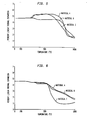
- Fig. 5 shows the shrinkage results of Materials A-C.
- Two palladium silver powders were prepared by the same vibratory milling process as described in Example 1, except that the ratio of palladium to silver for each powder was 15 percent palladium, 85 percent silver.
- 0.5 percent of rhodium as 2-ethylhexoate was added to the powder (Material A) and 0.5 weight percent iridium as trichloride-tris-di-n-butylsulfide was added to the other powder (Material B).
- Materials A and B, along with a control (Material C) were tested in a dilatometer as described in Example 1.
- Material A was made from the following materials, all of which were milled together: 50g metal powder; 0.35g Stearic Acid; 32.5g Lactol Spirits; 32.5g Ethyl Acetate; 1.15g Ir Resinate (the resinate contained 24% Ir metal) and 400g Zr02 beads.
- Material B was made from the following materials, all of which were milled together: 50g metal powder; 0.35g Stearic Acid; 32.5g Lactol Spirits; 32.5g Ethyl Acetate; 1.70g Rh Resinate (the resinate contained 14% Rh metal) and 400g Zr02 beads.
- Material C was made from the following materials, all of which were milled together: 50g metal powder; 0.35g Stearic Acid; 32.5g Lactol Spirits; 32.5g Ethyl Acetate and 400g Zr02 beads.
- Fig. 6 shows the shrinkage results of Materials A-C of this Example.
- Example 2 During a vibratory milling process as described in Example 1, 0.25 percent rhodium as 2-ethylhexoate was added to a substantially 100 percent silver powder (Material A). Another silver powder was prepared by the same technique except that 0.5 percent iridium as trichloride-tris-di-n-butylsulfide was added (Material B). Materials A and B along with a Control (Material C) were tested in a dilatometer as described in Example 1. * The Sulfur is added to silver to prevent formation of large lumps.
- Material A was made from the following materials, all of which were milled together: 200g metal powder; 1.4g Stearic Acid; 130g Lactol Spirits; 130g Ethyl Acetate; 3.4g Rh Resinate (the resinate contained 0.25% Rh metal); 0.2g Sulfur* and 1600 ZrO2 beads.
- Material B was made from the following materials, all of which were milled together: 200g powder; 1.4g Stearic Acid; 130g Lactol Spirits; 130g Ethyl Acetate; 4.35g Ir Resinate (the resinate contained 24% Ir metal); 0.2g sulfur* and 1600g Zr02 beads.
- Material C was made from the following materials, all of which were milled together: 200g powder; 1.4g Stearic Acid; 130g Lactol Spirits; 130g Ethyl Acetate; 0.2g Sulfur* and 1600g Zr02 beads.
- Fig. 7 describes the shrinkage results of Materials A-C.
- the additions to pure silver produce significant changes in the sintering rates and the total additions may have to be reduced to obtain a desirable effect for use in low fired multilayer capacitors.
- a 30% palladium, 70% silver powder was made by the same vibratory milling process as described in Example 1, except that a mixture of 0.25 weight percent iridium as iridium trichloridetris-di-n-butylsulfide and 0.12 weight percent rhodium as 2-ethylhexoate was added to the powder during the milling process.
- the resulting powder was tested in a dilatometer as in Example 1.
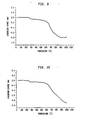
- Fig. 8 shows the shrinkage of the powder of this Example after testing in a dilatometer.
- a 30% palladium, 70% silver powder was made by the same vibratory milling process as described in Example 1, except that a mixture of 0.35 weight percent iridium as iridium trichloride-tris-di-n-butylsulfide and 0.06 weigh percent rhodium as 2-ethlyhexoate was added to the powder during the milling process.
- the resulting powder was tested in a dilatometer as in Example 1. The following materials were used to make up the powder, all of which were milled together.
- Fig. 9 shows the shrinkage of powder of this example after testing in a dilatometer.
- a 30 % palladium, 70% silver powder was made by the same vibratory milling process as described in Example 1, except that a mixture of 0.12 weight percent iridium as iridium trichloride-tris-di-n-butylsulfide and 0.18 weight percent rhodium as 2-ethlyhexoate was added to the powder during the milling process. The resulting powder was tested in dilatometer as in Example 1.
- Fig. 10 shows the shrinkage of powder of this example after testing in a dilatometer.
- a 30% palladium, 70% silver powder was made by the same vibratory milling process as described in Example 1, except that a mixture of 0.25 weight percent iridium as iridium trichloride-tris-di-n-butylsulfide and 0.25 weight percent rhodium as 2-ethylhexoate was added to the powder during the milling process.
- the resulting powder was tested in a dilatometer as in Example 1.
- Fig. 11 shows the shrinkage of the powder of this example after testing in a dilatometer.
- a 30% palladium, 70% silver powder was made by the same vibratory milling process as described in Example 1 and contained the same ingredients. After the milling operation, 0.6g of an iridium resinate, iridium trichloride-tris-di-n-butylsulfide (the resinate contained 24% by weight iridium metal) was added to the powder together with 18.0g of a medium so as to form an ink.
- the medium contained 8% by weight EHEC®, an ethyl hydroxyethylcellulose, manufactured by Hercules, 16% by weight Hercolyn D®, a hydrogenated methyl ester of rosen, manufactured by Hercules, 1.5% by weight Drapex® 4.4, an octyl expoxy tallate, manufactured by Argus Chemical Corporation, 8% by weight Staybelite® resin, a hydrogenated wood rosin, manufactured by Hercules, 15.5% Varsol 3®, an aliphatic petroleum solvent mixture, manufactured by Exxon, 6% by weight HSB® solvent, an aromatic petroleum solvent, manufactured by Amsco and 45% by weight Shell solvent No. 71, an aliphatic hydrocarbon solvent, manufactured by Shell Oil Corporation.
- the powder, resinate and the medium were all mixed together on a three roll mill to form an ink.
- An additional 3.9g of the medium was added during the three roll milling process to adjust the viscosity of the ink.
- a portion of the ink was then air dried and formed into a pellet and then tested in a dilatometer as in Example 1.
- Fig. 12 shows the shrinkage of the material of example after testing in a dilatometer.
- Example 1 three (3) inks were formed from the powders made in Example 1, Example 2 and Example 3. Each ink was made the same way.
- the powder was mixed with a medium, which is the same medium as described in Example 11 and to that medium additional medium was added (Post Ad) during the three roll milling process to obtain the proper viscosity for the ink.
- the amounts of materials added are shown in Table 2 below: MATERIAL A MATERIAL B MATERIAL C Example 1 Powder 27.5g - - Example 2 Powder - 27.5g - Example 3 Powder - - 27.5g Medium 18.0g 18.0g 18.0g Post ad 4.5g 4.5g 4.5g 4.5g 4.5g 4.5g 4.5g 4.5g
- Material C of Example 5 was used as a starting material and mixed together with the following: 50g material C of Example 5; 1.0g iridium, as trichloride-tris-di-n-butylsulfide (the resinate contained 24% iridium metal), 25g Ethyl Acetate; 25g Lactol Spirits and 400g Zr02 beads.
- the components were placed in a jar and mixed together on a roll mill so as to uniformly coat the powder with the resinate.
- the resulting material was tested in a dilatometer for shrinkage as described in Example 1.
- the resulting material contained 0.48% iridium.
- Fig. 16 shows the shrinkage results of the material.
Landscapes
- Engineering & Computer Science (AREA)
- Manufacturing & Machinery (AREA)
- Power Engineering (AREA)
- Chemical & Material Sciences (AREA)
- Materials Engineering (AREA)
- Microelectronics & Electronic Packaging (AREA)
- Mechanical Engineering (AREA)
- Powder Metallurgy (AREA)
- Conductive Materials (AREA)
- Ceramic Capacitors (AREA)
- Electrodes For Compound Or Non-Metal Manufacture (AREA)
- Fixed Capacitors And Capacitor Manufacturing Machines (AREA)
Applications Claiming Priority (2)
| Application Number | Priority Date | Filing Date | Title |
|---|---|---|---|
| US340952 | 1982-01-20 | ||
| US07/340,952 US5001598A (en) | 1989-04-20 | 1989-04-20 | Sinter control additive |
Publications (2)
| Publication Number | Publication Date |
|---|---|
| EP0394037A2 true EP0394037A2 (fr) | 1990-10-24 |
| EP0394037A3 EP0394037A3 (fr) | 1992-04-15 |
Family
ID=23335636
Family Applications (1)
| Application Number | Title | Priority Date | Filing Date |
|---|---|---|---|
| EP19900304207 Withdrawn EP0394037A3 (fr) | 1989-04-20 | 1990-04-19 | Modification des vitesses de frittage de poudres de palladium argent pour électrodes |
Country Status (4)
| Country | Link |
|---|---|
| US (1) | US5001598A (fr) |
| EP (1) | EP0394037A3 (fr) |
| JP (1) | JPH0380513A (fr) |
| CA (1) | CA2012040A1 (fr) |
Cited By (2)
| Publication number | Priority date | Publication date | Assignee | Title |
|---|---|---|---|---|
| EP0410406A3 (en) * | 1989-07-28 | 1992-04-08 | E.I. Du Pont De Nemours And Company | Thick film conductor composition |
| EP0651408A3 (fr) * | 1993-10-29 | 1997-07-30 | Nec Corp | Méthode de fabrication d'un condensateur céramique laminé. |
Families Citing this family (7)
| Publication number | Priority date | Publication date | Assignee | Title |
|---|---|---|---|---|
| JPH07105283B2 (ja) * | 1991-03-07 | 1995-11-13 | 富士ゼロックス株式会社 | 抵抗体膜形成材料、抵抗体膜および電子部品 |
| US5481428A (en) * | 1992-06-18 | 1996-01-02 | Martin Marietta Energy Systems, Inc. | Process for manufacturing multilayer capacitors |
| US5495386A (en) * | 1993-08-03 | 1996-02-27 | Avx Corporation | Electrical components, such as capacitors, and methods for their manufacture |
| KR100229231B1 (ko) | 1995-04-04 | 1999-11-01 | 미다라이 후지오 | 전자 방출 소자 형성용 금속 함유 조성물, 및 전자방출소자,전자원및화상형성장치의제조방법 |
| US6487774B1 (en) * | 1998-01-22 | 2002-12-03 | Matsushita Electric Industrial Co., Ltd. | Method of forming an electronic component using ink |
| EP2946854A1 (fr) * | 2014-05-23 | 2015-11-25 | Heraeus Precious Metals North America Conshohocken LLC | Particules métalliques conductrices revêtues |
| CN112201474B (zh) * | 2020-07-03 | 2022-09-13 | 成都宏科电子科技有限公司 | 一种用于射频微波瓷介电容器的纯钯内电极浆料及其制备方法和应用 |
Family Cites Families (7)
| Publication number | Priority date | Publication date | Assignee | Title |
|---|---|---|---|---|
| US3118095A (en) * | 1960-09-29 | 1964-01-14 | Vitramon Inc | Capacitor and terminal therefor |
| US4082906A (en) * | 1977-02-14 | 1978-04-04 | San Fernando Electric Manufacturing Company | Low temperature fired ceramic capacitors |
| FR2451860A1 (fr) * | 1979-03-21 | 1980-10-17 | Molins Ltd | Dispositif pour detecter des groupes d'objets, tels que des cigarettes, notamment sur des machines d'empaquetage |
| US4435738A (en) * | 1981-05-27 | 1984-03-06 | Union Carbide Corporation | Multilayer ceramic capacitors |
| US4599277A (en) * | 1984-10-09 | 1986-07-08 | International Business Machines Corp. | Control of the sintering of powdered metals |
| US4636332A (en) * | 1985-11-01 | 1987-01-13 | E. I. Du Pont De Nemours And Company | Thick film conductor composition |
| US4811162A (en) * | 1987-04-27 | 1989-03-07 | Engelhard Corporation | Capacitor end termination composition and method of terminating |
-
1989
- 1989-04-20 US US07/340,952 patent/US5001598A/en not_active Expired - Fee Related
-
1990
- 1990-03-13 CA CA002012040A patent/CA2012040A1/fr not_active Abandoned
- 1990-04-19 EP EP19900304207 patent/EP0394037A3/fr not_active Withdrawn
- 1990-04-20 JP JP2105132A patent/JPH0380513A/ja active Pending
Cited By (2)
| Publication number | Priority date | Publication date | Assignee | Title |
|---|---|---|---|---|
| EP0410406A3 (en) * | 1989-07-28 | 1992-04-08 | E.I. Du Pont De Nemours And Company | Thick film conductor composition |
| EP0651408A3 (fr) * | 1993-10-29 | 1997-07-30 | Nec Corp | Méthode de fabrication d'un condensateur céramique laminé. |
Also Published As
| Publication number | Publication date |
|---|---|
| EP0394037A3 (fr) | 1992-04-15 |
| JPH0380513A (ja) | 1991-04-05 |
| CA2012040A1 (fr) | 1990-10-20 |
| US5001598A (en) | 1991-03-19 |
Similar Documents
| Publication | Publication Date | Title |
|---|---|---|
| US4867935A (en) | Method for preparing ceramic tape compositions | |
| KR930004979B1 (ko) | 후막 도체 조성물 | |
| US4426356A (en) | Method for making capacitors with noble metal electrodes | |
| US3717487A (en) | Ceramic slip composition | |
| US4071880A (en) | Ceramic bodies with end termination electrodes | |
| US4641221A (en) | Thin tape for dielectric materials | |
| CA1037691A (fr) | Dielectriques ceramiques | |
| US5001598A (en) | Sinter control additive | |
| DE3115556C2 (de) | Paste zur Ausbildung eines elektrisch leitenden, festen Füllstoffes in einem Hohlraum eines Substrats aus keramischem Material und Verfahren zum Ausfüllen des Hohlraumes | |
| US3784887A (en) | Process for making capacitors and capacitors made thereby | |
| US3772748A (en) | Method for forming electrodes and conductors | |
| US3829356A (en) | Sintered ceramic bodies with porous portions | |
| DE4425815C1 (de) | Edelmetallhaltige Resinatpaste zur Herstellung von keramischen Vielschichtkondensatoren | |
| EP0750597B1 (fr) | Procede de production de corps composites ceramiques | |
| DE2714220B2 (de) | Beschichtetes Aluminiumoxidsubstrat und Pulvergemisch zur Beschichtung von solchen Substraten | |
| DE2309385A1 (de) | Verfahren zum herstellen eines aluminiumoxydsubstrats | |
| DE3341561A1 (de) | Verfahren zur herstellung von schichten aus einem dielektrischen material | |
| DE4107869C2 (de) | Grüne Keramikplatte für eine poröse Schicht | |
| US3380835A (en) | Metalizing compositions | |
| CA1088641A (fr) | Articles comportant des conducteurs internes et mode de fabrication | |
| EP0143426B1 (fr) | Compositions pour électrode de condensateur | |
| JP3261520B2 (ja) | 積層セラミックコンデンサ内部電極用ペースト組成物およびこれを用いた積層セラミックコンデンサ | |
| DE4143539C2 (de) | Verfahren zur Herstellung eines elektrochemischen Elements | |
| DE4143549C2 (de) | Elektrochemisches Element mit einem Festelektrolytkörper | |
| JPS6047314B2 (ja) | ペ−スト用バインダ−系組成 |
Legal Events
| Date | Code | Title | Description |
|---|---|---|---|
| PUAI | Public reference made under article 153(3) epc to a published international application that has entered the european phase |
Free format text: ORIGINAL CODE: 0009012 |
|
| AK | Designated contracting states |
Kind code of ref document: A2 Designated state(s): AT BE CH DE DK ES FR GB GR IT LI LU NL SE |
|
| PUAL | Search report despatched |
Free format text: ORIGINAL CODE: 0009013 |
|
| AK | Designated contracting states |
Kind code of ref document: A3 Designated state(s): AT BE CH DE DK ES FR GB GR IT LI LU NL SE |
|
| 17P | Request for examination filed |
Effective date: 19921009 |
|
| 17Q | First examination report despatched |
Effective date: 19931116 |
|
| STAA | Information on the status of an ep patent application or granted ep patent |
Free format text: STATUS: THE APPLICATION IS DEEMED TO BE WITHDRAWN |
|
| 18D | Application deemed to be withdrawn |
Effective date: 19940329 |