EP0395014A1 - Thermisches Übertragungsmaterial und thermisches Übertragungsaufzeichnungsverfahren - Google Patents
Thermisches Übertragungsmaterial und thermisches Übertragungsaufzeichnungsverfahren Download PDFInfo
- Publication number
- EP0395014A1 EP0395014A1 EP19900107864 EP90107864A EP0395014A1 EP 0395014 A1 EP0395014 A1 EP 0395014A1 EP 19900107864 EP19900107864 EP 19900107864 EP 90107864 A EP90107864 A EP 90107864A EP 0395014 A1 EP0395014 A1 EP 0395014A1
- Authority
- EP
- European Patent Office
- Prior art keywords
- thermal transfer
- transfer material
- ink layer
- recording medium
- heat
- Prior art date
- Legal status (The legal status is an assumption and is not a legal conclusion. Google has not performed a legal analysis and makes no representation as to the accuracy of the status listed.)
- Granted
Links
- 238000012546 transfer Methods 0.000 title claims abstract description 183
- 239000000463 material Substances 0.000 title claims abstract description 180
- 238000000034 method Methods 0.000 title claims description 40
- 238000003860 storage Methods 0.000 claims abstract description 10
- 238000002844 melting Methods 0.000 claims description 101
- 230000008018 melting Effects 0.000 claims description 101
- 239000005038 ethylene vinyl acetate Substances 0.000 claims description 72
- 229920001200 poly(ethylene-vinyl acetate) Polymers 0.000 claims description 72
- 229920005989 resin Polymers 0.000 claims description 37
- 239000011347 resin Substances 0.000 claims description 37
- -1 ester compound Chemical class 0.000 claims description 28
- 235000014113 dietary fatty acids Nutrition 0.000 claims description 27
- 239000000194 fatty acid Substances 0.000 claims description 27
- 229930195729 fatty acid Natural products 0.000 claims description 27
- 239000011230 binding agent Substances 0.000 claims description 24
- 150000002148 esters Chemical class 0.000 claims description 19
- 150000004665 fatty acids Chemical class 0.000 claims description 19
- 239000012948 isocyanate Substances 0.000 claims description 14
- 239000000155 melt Substances 0.000 claims description 14
- 150000005846 sugar alcohols Polymers 0.000 claims description 13
- 229920006242 ethylene acrylic acid copolymer Polymers 0.000 claims description 10
- 229920006244 ethylene-ethyl acrylate Polymers 0.000 claims description 4
- 150000001875 compounds Chemical class 0.000 claims description 3
- IQPQWNKOIGAROB-UHFFFAOYSA-N isocyanate group Chemical group [N-]=C=O IQPQWNKOIGAROB-UHFFFAOYSA-N 0.000 claims 1
- YXFVVABEGXRONW-UHFFFAOYSA-N Toluene Chemical compound CC1=CC=CC=C1 YXFVVABEGXRONW-UHFFFAOYSA-N 0.000 description 198
- 239000000976 ink Substances 0.000 description 173
- 239000010410 layer Substances 0.000 description 155
- 238000000576 coating method Methods 0.000 description 149
- 239000011248 coating agent Substances 0.000 description 146
- 239000007788 liquid Substances 0.000 description 136
- 239000001993 wax Substances 0.000 description 93
- 239000006229 carbon black Substances 0.000 description 64
- UHXUZOCRWCRNSJ-QPJJXVBHSA-N methomyl Chemical compound CNC(=O)O\N=C(/C)SC UHXUZOCRWCRNSJ-QPJJXVBHSA-N 0.000 description 24
- 238000001454 recorded image Methods 0.000 description 20
- 230000000052 comparative effect Effects 0.000 description 19
- 239000003086 colorant Substances 0.000 description 18
- 238000010186 staining Methods 0.000 description 17
- 238000005259 measurement Methods 0.000 description 16
- 241000894007 species Species 0.000 description 16
- 239000000203 mixture Substances 0.000 description 13
- 101710151842 Farnesyl pyrophosphate synthase 2 Proteins 0.000 description 9
- 238000001035 drying Methods 0.000 description 9
- 238000006243 chemical reaction Methods 0.000 description 8
- 238000011156 evaluation Methods 0.000 description 8
- 239000012188 paraffin wax Substances 0.000 description 8
- RSWGJHLUYNHPMX-UHFFFAOYSA-N Abietic-Saeure Natural products C12CCC(C(C)C)=CC2=CCC2C1(C)CCCC2(C)C(O)=O RSWGJHLUYNHPMX-UHFFFAOYSA-N 0.000 description 7
- KHPCPRHQVVSZAH-HUOMCSJISA-N Rosin Natural products O(C/C=C/c1ccccc1)[C@H]1[C@H](O)[C@@H](O)[C@@H](O)[C@@H](CO)O1 KHPCPRHQVVSZAH-HUOMCSJISA-N 0.000 description 7
- 239000002253 acid Substances 0.000 description 7
- 150000002513 isocyanates Chemical class 0.000 description 7
- 229920006267 polyester film Polymers 0.000 description 7
- 239000004576 sand Substances 0.000 description 7
- KHPCPRHQVVSZAH-UHFFFAOYSA-N trans-cinnamyl beta-D-glucopyranoside Natural products OC1C(O)C(O)C(CO)OC1OCC=CC1=CC=CC=C1 KHPCPRHQVVSZAH-UHFFFAOYSA-N 0.000 description 7
- UKMSUNONTOPOIO-UHFFFAOYSA-N docosanoic acid Chemical compound CCCCCCCCCCCCCCCCCCCCCC(O)=O UKMSUNONTOPOIO-UHFFFAOYSA-N 0.000 description 6
- LYCAIKOWRPUZTN-UHFFFAOYSA-N Ethylene glycol Chemical compound OCCO LYCAIKOWRPUZTN-UHFFFAOYSA-N 0.000 description 5
- PEDCQBHIVMGVHV-UHFFFAOYSA-N Glycerine Chemical compound OCC(O)CO PEDCQBHIVMGVHV-UHFFFAOYSA-N 0.000 description 5
- 239000004203 carnauba wax Substances 0.000 description 5
- 235000013869 carnauba wax Nutrition 0.000 description 5
- 238000005520 cutting process Methods 0.000 description 5
- 230000007547 defect Effects 0.000 description 5
- WXZMFSXDPGVJKK-UHFFFAOYSA-N pentaerythritol Chemical compound OCC(CO)(CO)CO WXZMFSXDPGVJKK-UHFFFAOYSA-N 0.000 description 5
- 239000000049 pigment Substances 0.000 description 5
- 230000002829 reductive effect Effects 0.000 description 5
- SMZOUWXMTYCWNB-UHFFFAOYSA-N 2-(2-methoxy-5-methylphenyl)ethanamine Chemical compound COC1=CC=C(C)C=C1CCN SMZOUWXMTYCWNB-UHFFFAOYSA-N 0.000 description 4
- NIXOWILDQLNWCW-UHFFFAOYSA-N 2-Propenoic acid Natural products OC(=O)C=C NIXOWILDQLNWCW-UHFFFAOYSA-N 0.000 description 4
- XTXRWKRVRITETP-UHFFFAOYSA-N Vinyl acetate Chemical compound CC(=O)OC=C XTXRWKRVRITETP-UHFFFAOYSA-N 0.000 description 4
- MTHSVFCYNBDYFN-UHFFFAOYSA-N diethylene glycol Chemical compound OCCOCCO MTHSVFCYNBDYFN-UHFFFAOYSA-N 0.000 description 4
- POULHZVOKOAJMA-UHFFFAOYSA-N dodecanoic acid Chemical compound CCCCCCCCCCCC(O)=O POULHZVOKOAJMA-UHFFFAOYSA-N 0.000 description 4
- 238000010438 heat treatment Methods 0.000 description 4
- IPCSVZSSVZVIGE-UHFFFAOYSA-N hexadecanoic acid Chemical compound CCCCCCCCCCCCCCCC(O)=O IPCSVZSSVZVIGE-UHFFFAOYSA-N 0.000 description 4
- 238000002156 mixing Methods 0.000 description 4
- WQEPLUUGTLDZJY-UHFFFAOYSA-N pentadecanoic acid Chemical compound CCCCCCCCCCCCCCC(O)=O WQEPLUUGTLDZJY-UHFFFAOYSA-N 0.000 description 4
- 230000002441 reversible effect Effects 0.000 description 4
- ZWEHNKRNPOVVGH-UHFFFAOYSA-N 2-Butanone Chemical compound CCC(C)=O ZWEHNKRNPOVVGH-UHFFFAOYSA-N 0.000 description 3
- CSCPPACGZOOCGX-UHFFFAOYSA-N Acetone Chemical compound CC(C)=O CSCPPACGZOOCGX-UHFFFAOYSA-N 0.000 description 3
- 235000021357 Behenic acid Nutrition 0.000 description 3
- UHOVQNZJYSORNB-UHFFFAOYSA-N Benzene Chemical compound C1=CC=CC=C1 UHOVQNZJYSORNB-UHFFFAOYSA-N 0.000 description 3
- KFZMGEQAYNKOFK-UHFFFAOYSA-N Isopropanol Chemical compound CC(C)O KFZMGEQAYNKOFK-UHFFFAOYSA-N 0.000 description 3
- OKKJLVBELUTLKV-UHFFFAOYSA-N Methanol Chemical compound OC OKKJLVBELUTLKV-UHFFFAOYSA-N 0.000 description 3
- DNIAPMSPPWPWGF-UHFFFAOYSA-N Propylene glycol Chemical compound CC(O)CO DNIAPMSPPWPWGF-UHFFFAOYSA-N 0.000 description 3
- 235000021355 Stearic acid Nutrition 0.000 description 3
- 238000010521 absorption reaction Methods 0.000 description 3
- 239000012790 adhesive layer Substances 0.000 description 3
- 229940116226 behenic acid Drugs 0.000 description 3
- IISBACLAFKSPIT-UHFFFAOYSA-N bisphenol A Chemical compound C=1C=C(O)C=CC=1C(C)(C)C1=CC=C(O)C=C1 IISBACLAFKSPIT-UHFFFAOYSA-N 0.000 description 3
- 230000003247 decreasing effect Effects 0.000 description 3
- 239000000975 dye Substances 0.000 description 3
- 230000000694 effects Effects 0.000 description 3
- 229920006226 ethylene-acrylic acid Polymers 0.000 description 3
- 238000009472 formulation Methods 0.000 description 3
- 235000011187 glycerol Nutrition 0.000 description 3
- 230000000977 initiatory effect Effects 0.000 description 3
- 238000011835 investigation Methods 0.000 description 3
- QIQXTHQIDYTFRH-UHFFFAOYSA-N octadecanoic acid Chemical compound CCCCCCCCCCCCCCCCCC(O)=O QIQXTHQIDYTFRH-UHFFFAOYSA-N 0.000 description 3
- OQCDKBAXFALNLD-UHFFFAOYSA-N octadecanoic acid Natural products CCCCCCCC(C)CCCCCCCCC(O)=O OQCDKBAXFALNLD-UHFFFAOYSA-N 0.000 description 3
- 230000036961 partial effect Effects 0.000 description 3
- 230000035515 penetration Effects 0.000 description 3
- 239000003208 petroleum Substances 0.000 description 3
- 238000011160 research Methods 0.000 description 3
- 239000002904 solvent Substances 0.000 description 3
- 239000008117 stearic acid Substances 0.000 description 3
- 230000008542 thermal sensitivity Effects 0.000 description 3
- PUPZLCDOIYMWBV-UHFFFAOYSA-N (+/-)-1,3-Butanediol Chemical compound CC(O)CCO PUPZLCDOIYMWBV-UHFFFAOYSA-N 0.000 description 2
- 229930185605 Bisphenol Natural products 0.000 description 2
- DPUOLQHDNGRHBS-UHFFFAOYSA-N Brassidinsaeure Natural products CCCCCCCCC=CCCCCCCCCCCCC(O)=O DPUOLQHDNGRHBS-UHFFFAOYSA-N 0.000 description 2
- 235000010919 Copernicia prunifera Nutrition 0.000 description 2
- 244000180278 Copernicia prunifera Species 0.000 description 2
- JIGUQPWFLRLWPJ-UHFFFAOYSA-N Ethyl acrylate Chemical compound CCOC(=O)C=C JIGUQPWFLRLWPJ-UHFFFAOYSA-N 0.000 description 2
- AVKYODWULTZQPQ-UHFFFAOYSA-N Ipurolic acid Chemical compound CCCC(O)CCCCCCCC(O)CC(O)=O AVKYODWULTZQPQ-UHFFFAOYSA-N 0.000 description 2
- 239000005639 Lauric acid Substances 0.000 description 2
- CTQNGGLPUBDAKN-UHFFFAOYSA-N O-Xylene Chemical compound CC1=CC=CC=C1C CTQNGGLPUBDAKN-UHFFFAOYSA-N 0.000 description 2
- ZQPPMHVWECSIRJ-UHFFFAOYSA-N Oleic acid Natural products CCCCCCCCC=CCCCCCCCC(O)=O ZQPPMHVWECSIRJ-UHFFFAOYSA-N 0.000 description 2
- 235000021314 Palmitic acid Nutrition 0.000 description 2
- ATUOYWHBWRKTHZ-UHFFFAOYSA-N Propane Chemical compound CCC ATUOYWHBWRKTHZ-UHFFFAOYSA-N 0.000 description 2
- PPBRXRYQALVLMV-UHFFFAOYSA-N Styrene Chemical compound C=CC1=CC=CC=C1 PPBRXRYQALVLMV-UHFFFAOYSA-N 0.000 description 2
- MRQIXHXHHPWVIL-ISLYRVAYSA-N Sudan I Chemical compound OC1=CC=C2C=CC=CC2=C1\N=N\C1=CC=CC=C1 MRQIXHXHHPWVIL-ISLYRVAYSA-N 0.000 description 2
- 239000007983 Tris buffer Substances 0.000 description 2
- 238000009825 accumulation Methods 0.000 description 2
- 238000012644 addition polymerization Methods 0.000 description 2
- YZXBAPSDXZZRGB-DOFZRALJSA-N arachidonic acid Chemical compound CCCCC\C=C/C\C=C/C\C=C/C\C=C/CCCC(O)=O YZXBAPSDXZZRGB-DOFZRALJSA-N 0.000 description 2
- GHVNFZFCNZKVNT-UHFFFAOYSA-N decanoic acid Chemical compound CCCCCCCCCC(O)=O GHVNFZFCNZKVNT-UHFFFAOYSA-N 0.000 description 2
- 150000005690 diesters Chemical class 0.000 description 2
- 238000000113 differential scanning calorimetry Methods 0.000 description 2
- 125000005442 diisocyanate group Chemical group 0.000 description 2
- 239000006185 dispersion Substances 0.000 description 2
- NOPFSRXAKWQILS-UHFFFAOYSA-N docosan-1-ol Chemical compound CCCCCCCCCCCCCCCCCCCCCCO NOPFSRXAKWQILS-UHFFFAOYSA-N 0.000 description 2
- ICAIHSUWWZJGHD-UHFFFAOYSA-N dotriacontanoic acid Chemical compound CCCCCCCCCCCCCCCCCCCCCCCCCCCCCCCC(O)=O ICAIHSUWWZJGHD-UHFFFAOYSA-N 0.000 description 2
- ZQPPMHVWECSIRJ-MDZDMXLPSA-N elaidic acid Chemical compound CCCCCCCC\C=C\CCCCCCCC(O)=O ZQPPMHVWECSIRJ-MDZDMXLPSA-N 0.000 description 2
- 239000000839 emulsion Substances 0.000 description 2
- VXZBFBRLRNDJCS-UHFFFAOYSA-N heptacosanoic acid Chemical compound CCCCCCCCCCCCCCCCCCCCCCCCCCC(O)=O VXZBFBRLRNDJCS-UHFFFAOYSA-N 0.000 description 2
- KEMQGTRYUADPNZ-UHFFFAOYSA-N heptadecanoic acid Chemical compound CCCCCCCCCCCCCCCCC(O)=O KEMQGTRYUADPNZ-UHFFFAOYSA-N 0.000 description 2
- XMHIUKTWLZUKEX-UHFFFAOYSA-N hexacosanoic acid Chemical compound CCCCCCCCCCCCCCCCCCCCCCCCCC(O)=O XMHIUKTWLZUKEX-UHFFFAOYSA-N 0.000 description 2
- 238000007757 hot melt coating Methods 0.000 description 2
- 125000002887 hydroxy group Chemical group [H]O* 0.000 description 2
- QXJSBBXBKPUZAA-UHFFFAOYSA-N isooleic acid Natural products CCCCCCCC=CCCCCCCCCC(O)=O QXJSBBXBKPUZAA-UHFFFAOYSA-N 0.000 description 2
- 239000004200 microcrystalline wax Substances 0.000 description 2
- 235000019808 microcrystalline wax Nutrition 0.000 description 2
- 239000012170 montan wax Substances 0.000 description 2
- ISYWECDDZWTKFF-UHFFFAOYSA-N nonadecanoic acid Chemical compound CCCCCCCCCCCCCCCCCCC(O)=O ISYWECDDZWTKFF-UHFFFAOYSA-N 0.000 description 2
- UTOPWMOLSKOLTQ-UHFFFAOYSA-N octacosanoic acid Chemical compound CCCCCCCCCCCCCCCCCCCCCCCCCCCC(O)=O UTOPWMOLSKOLTQ-UHFFFAOYSA-N 0.000 description 2
- GLDOVTGHNKAZLK-UHFFFAOYSA-N octadecan-1-ol Chemical compound CCCCCCCCCCCCCCCCCCO GLDOVTGHNKAZLK-UHFFFAOYSA-N 0.000 description 2
- 239000003960 organic solvent Substances 0.000 description 2
- PNJWIWWMYCMZRO-UHFFFAOYSA-N pent‐4‐en‐2‐one Natural products CC(=O)CC=C PNJWIWWMYCMZRO-UHFFFAOYSA-N 0.000 description 2
- 229920001568 phenolic resin Polymers 0.000 description 2
- KJFMBFZCATUALV-UHFFFAOYSA-N phenolphthalein Chemical compound C1=CC(O)=CC=C1C1(C=2C=CC(O)=CC=2)C2=CC=CC=C2C(=O)O1 KJFMBFZCATUALV-UHFFFAOYSA-N 0.000 description 2
- 229920001083 polybutene Polymers 0.000 description 2
- 229920001225 polyester resin Polymers 0.000 description 2
- 239000004645 polyester resin Substances 0.000 description 2
- 150000003097 polyterpenes Chemical class 0.000 description 2
- YPFDHNVEDLHUCE-UHFFFAOYSA-N propane-1,3-diol Chemical compound OCCCO YPFDHNVEDLHUCE-UHFFFAOYSA-N 0.000 description 2
- 230000035484 reaction time Effects 0.000 description 2
- 230000001105 regulatory effect Effects 0.000 description 2
- 239000011369 resultant mixture Substances 0.000 description 2
- PYWVYCXTNDRMGF-UHFFFAOYSA-N rhodamine B Chemical compound [Cl-].C=12C=CC(=[N+](CC)CC)C=C2OC2=CC(N(CC)CC)=CC=C2C=1C1=CC=CC=C1C(O)=O PYWVYCXTNDRMGF-UHFFFAOYSA-N 0.000 description 2
- 239000007787 solid Substances 0.000 description 2
- 239000000243 solution Substances 0.000 description 2
- 230000003068 static effect Effects 0.000 description 2
- RGTIBVZDHOMOKC-UHFFFAOYSA-N stearolic acid Chemical compound CCCCCCCCC#CCCCCCCCC(O)=O RGTIBVZDHOMOKC-UHFFFAOYSA-N 0.000 description 2
- TUNFSRHWOTWDNC-HKGQFRNVSA-N tetradecanoic acid Chemical compound CCCCCCCCCCCCC[14C](O)=O TUNFSRHWOTWDNC-HKGQFRNVSA-N 0.000 description 2
- DVKJHBMWWAPEIU-UHFFFAOYSA-N toluene 2,4-diisocyanate Chemical compound CC1=CC=C(N=C=O)C=C1N=C=O DVKJHBMWWAPEIU-UHFFFAOYSA-N 0.000 description 2
- VHOCUJPBKOZGJD-UHFFFAOYSA-N triacontanoic acid Chemical compound CCCCCCCCCCCCCCCCCCCCCCCCCCCCCC(O)=O VHOCUJPBKOZGJD-UHFFFAOYSA-N 0.000 description 2
- SZHOJFHSIKHZHA-UHFFFAOYSA-N tridecanoic acid Chemical compound CCCCCCCCCCCCC(O)=O SZHOJFHSIKHZHA-UHFFFAOYSA-N 0.000 description 2
- 150000005691 triesters Chemical class 0.000 description 2
- ZDPHROOEEOARMN-UHFFFAOYSA-N undecanoic acid Chemical compound CCCCCCCCCCC(O)=O ZDPHROOEEOARMN-UHFFFAOYSA-N 0.000 description 2
- 239000008096 xylene Substances 0.000 description 2
- XMVQWNRDPAAMJB-UHFFFAOYSA-N (+)-13-Cyclopent-2-enyl-tridecansaeure Natural products OC(=O)CCCCCCCCCCCCC1CCC=C1 XMVQWNRDPAAMJB-UHFFFAOYSA-N 0.000 description 1
- JNYAEWCLZODPBN-JGWLITMVSA-N (2r,3r,4s)-2-[(1r)-1,2-dihydroxyethyl]oxolane-3,4-diol Chemical compound OC[C@@H](O)[C@H]1OC[C@H](O)[C@H]1O JNYAEWCLZODPBN-JGWLITMVSA-N 0.000 description 1
- OYHQOLUKZRVURQ-NTGFUMLPSA-N (9Z,12Z)-9,10,12,13-tetratritiooctadeca-9,12-dienoic acid Chemical compound C(CCCCCCC\C(=C(/C\C(=C(/CCCCC)\[3H])\[3H])\[3H])\[3H])(=O)O OYHQOLUKZRVURQ-NTGFUMLPSA-N 0.000 description 1
- PMJHHCWVYXUKFD-SNAWJCMRSA-N (E)-1,3-pentadiene Chemical compound C\C=C\C=C PMJHHCWVYXUKFD-SNAWJCMRSA-N 0.000 description 1
- WRIDQFICGBMAFQ-UHFFFAOYSA-N (E)-8-Octadecenoic acid Natural products CCCCCCCCCC=CCCCCCCC(O)=O WRIDQFICGBMAFQ-UHFFFAOYSA-N 0.000 description 1
- XMVQWNRDPAAMJB-QGZVFWFLSA-N (S)-chaulmoogric acid Chemical compound OC(=O)CCCCCCCCCCCC[C@H]1CCC=C1 XMVQWNRDPAAMJB-QGZVFWFLSA-N 0.000 description 1
- RXUVWJWQFPJWOV-OWOJBTEDSA-N (e)-1,2-diisocyanatoethene Chemical compound O=C=N\C=C\N=C=O RXUVWJWQFPJWOV-OWOJBTEDSA-N 0.000 description 1
- OUPZKGBUJRBPGC-UHFFFAOYSA-N 1,3,5-tris(oxiran-2-ylmethyl)-1,3,5-triazinane-2,4,6-trione Chemical compound O=C1N(CC2OC2)C(=O)N(CC2OC2)C(=O)N1CC1CO1 OUPZKGBUJRBPGC-UHFFFAOYSA-N 0.000 description 1
- 229940058015 1,3-butylene glycol Drugs 0.000 description 1
- OSNILPMOSNGHLC-UHFFFAOYSA-N 1-[4-methoxy-3-(piperidin-1-ylmethyl)phenyl]ethanone Chemical compound COC1=CC=C(C(C)=O)C=C1CN1CCCCC1 OSNILPMOSNGHLC-UHFFFAOYSA-N 0.000 description 1
- KPAPHODVWOVUJL-UHFFFAOYSA-N 1-benzofuran;1h-indene Chemical compound C1=CC=C2CC=CC2=C1.C1=CC=C2OC=CC2=C1 KPAPHODVWOVUJL-UHFFFAOYSA-N 0.000 description 1
- QWDQYHPOSSHSAW-UHFFFAOYSA-N 1-isocyanatooctadecane Chemical compound CCCCCCCCCCCCCCCCCCN=C=O QWDQYHPOSSHSAW-UHFFFAOYSA-N 0.000 description 1
- OQURWGJAWSLGQG-UHFFFAOYSA-N 1-isocyanatopropane Chemical compound CCCN=C=O OQURWGJAWSLGQG-UHFFFAOYSA-N 0.000 description 1
- FRPZMMHWLSIFAZ-UHFFFAOYSA-N 10-undecenoic acid Chemical compound OC(=O)CCCCCCCCC=C FRPZMMHWLSIFAZ-UHFFFAOYSA-N 0.000 description 1
- UGAGPNKCDRTDHP-UHFFFAOYSA-N 16-hydroxyhexadecanoic acid Chemical compound OCCCCCCCCCCCCCCCC(O)=O UGAGPNKCDRTDHP-UHFFFAOYSA-N 0.000 description 1
- XYHKNCXZYYTLRG-UHFFFAOYSA-N 1h-imidazole-2-carbaldehyde Chemical compound O=CC1=NC=CN1 XYHKNCXZYYTLRG-UHFFFAOYSA-N 0.000 description 1
- RWLALWYNXFYRGW-UHFFFAOYSA-N 2-Ethyl-1,3-hexanediol Chemical compound CCCC(O)C(CC)CO RWLALWYNXFYRGW-UHFFFAOYSA-N 0.000 description 1
- TXBCBTDQIULDIA-UHFFFAOYSA-N 2-[[3-hydroxy-2,2-bis(hydroxymethyl)propoxy]methyl]-2-(hydroxymethyl)propane-1,3-diol Chemical compound OCC(CO)(CO)COCC(CO)(CO)CO TXBCBTDQIULDIA-UHFFFAOYSA-N 0.000 description 1
- LQJBNNIYVWPHFW-UHFFFAOYSA-N 20:1omega9c fatty acid Natural products CCCCCCCCCCC=CCCCCCCCC(O)=O LQJBNNIYVWPHFW-UHFFFAOYSA-N 0.000 description 1
- GWYFCOCPABKNJV-UHFFFAOYSA-M 3-Methylbutanoic acid Natural products CC(C)CC([O-])=O GWYFCOCPABKNJV-UHFFFAOYSA-M 0.000 description 1
- UPMLOUAZCHDJJD-UHFFFAOYSA-N 4,4'-Diphenylmethane Diisocyanate Chemical compound C1=CC(N=C=O)=CC=C1CC1=CC=C(N=C=O)C=C1 UPMLOUAZCHDJJD-UHFFFAOYSA-N 0.000 description 1
- PIFPCDRPHCQLSJ-WYIJOVFWSA-N 4,8,12,15,19-Docosapentaenoic acid Chemical compound CC\C=C\CC\C=C\C\C=C\CC\C=C\CC\C=C\CCC(O)=O PIFPCDRPHCQLSJ-WYIJOVFWSA-N 0.000 description 1
- DPKWXRUINJHOOB-UHFFFAOYSA-N 4-(2-hydroxyethoxy)phenol Chemical compound OCCOC1=CC=C(O)C=C1 DPKWXRUINJHOOB-UHFFFAOYSA-N 0.000 description 1
- NMAKJOWVEDTHOA-UHFFFAOYSA-N 4-(chloromethyl)-1,3-thiazol-2-amine;hydron;chloride Chemical compound Cl.NC1=NC(CCl)=CS1 NMAKJOWVEDTHOA-UHFFFAOYSA-N 0.000 description 1
- TYMLOMAKGOJONV-UHFFFAOYSA-N 4-nitroaniline Chemical compound NC1=CC=C([N+]([O-])=O)C=C1 TYMLOMAKGOJONV-UHFFFAOYSA-N 0.000 description 1
- MPVDXIMFBOLMNW-ISLYRVAYSA-N 7-hydroxy-8-[(E)-phenyldiazenyl]naphthalene-1,3-disulfonic acid Chemical compound OC1=CC=C2C=C(S(O)(=O)=O)C=C(S(O)(=O)=O)C2=C1\N=N\C1=CC=CC=C1 MPVDXIMFBOLMNW-ISLYRVAYSA-N 0.000 description 1
- QSBYPNXLFMSGKH-UHFFFAOYSA-N 9-Heptadecensaeure Natural products CCCCCCCC=CCCCCCCCC(O)=O QSBYPNXLFMSGKH-UHFFFAOYSA-N 0.000 description 1
- 239000004925 Acrylic resin Substances 0.000 description 1
- 229920000178 Acrylic resin Polymers 0.000 description 1
- 229920002799 BoPET Polymers 0.000 description 1
- GAWIXWVDTYZWAW-UHFFFAOYSA-N C[CH]O Chemical group C[CH]O GAWIXWVDTYZWAW-UHFFFAOYSA-N 0.000 description 1
- 239000005632 Capric acid (CAS 334-48-5) Substances 0.000 description 1
- OKTJSMMVPCPJKN-UHFFFAOYSA-N Carbon Chemical compound [C] OKTJSMMVPCPJKN-UHFFFAOYSA-N 0.000 description 1
- PIFPCDRPHCQLSJ-UHFFFAOYSA-N Clupanodonic acid Natural products CCC=CCCC=CCC=CCCC=CCCC=CCCC(O)=O PIFPCDRPHCQLSJ-UHFFFAOYSA-N 0.000 description 1
- FBPFZTCFMRRESA-FSIIMWSLSA-N D-Glucitol Natural products OC[C@H](O)[C@H](O)[C@@H](O)[C@H](O)CO FBPFZTCFMRRESA-FSIIMWSLSA-N 0.000 description 1
- FBPFZTCFMRRESA-JGWLITMVSA-N D-glucitol Chemical compound OC[C@H](O)[C@@H](O)[C@H](O)[C@H](O)CO FBPFZTCFMRRESA-JGWLITMVSA-N 0.000 description 1
- URXZXNYJPAJJOQ-UHFFFAOYSA-N Erucic acid Natural products CCCCCCC=CCCCCCCCCCCCC(O)=O URXZXNYJPAJJOQ-UHFFFAOYSA-N 0.000 description 1
- LFQSCWFLJHTTHZ-UHFFFAOYSA-N Ethanol Chemical compound CCO LFQSCWFLJHTTHZ-UHFFFAOYSA-N 0.000 description 1
- XADKGDBMULSEAC-UHFFFAOYSA-N Gorlic acid Natural products OC(=O)CCCCC=CCCCCCCC1CCC=C1 XADKGDBMULSEAC-UHFFFAOYSA-N 0.000 description 1
- 244000043261 Hevea brasiliensis Species 0.000 description 1
- UFHFLCQGNIYNRP-UHFFFAOYSA-N Hydrogen Chemical compound [H][H] UFHFLCQGNIYNRP-UHFFFAOYSA-N 0.000 description 1
- 229910021578 Iron(III) chloride Inorganic materials 0.000 description 1
- YNQGVRJFSHTULP-UHFFFAOYSA-N Jalapinolin-saeure Natural products CCCCCC(O)CCCCCCCCCC(O)=O YNQGVRJFSHTULP-UHFFFAOYSA-N 0.000 description 1
- 239000004166 Lanolin Substances 0.000 description 1
- 235000021353 Lignoceric acid Nutrition 0.000 description 1
- CQXMAMUUWHYSIY-UHFFFAOYSA-N Lignoceric acid Natural products CCCCCCCCCCCCCCCCCCCCCCCC(=O)OCCC1=CC=C(O)C=C1 CQXMAMUUWHYSIY-UHFFFAOYSA-N 0.000 description 1
- QORUGOXNWQUALA-UHFFFAOYSA-N N=C=O.N=C=O.N=C=O.C1=CC=C(C(C2=CC=CC=C2)C2=CC=CC=C2)C=C1 Chemical compound N=C=O.N=C=O.N=C=O.C1=CC=C(C(C2=CC=CC=C2)C2=CC=CC=C2)C=C1 QORUGOXNWQUALA-UHFFFAOYSA-N 0.000 description 1
- 239000005642 Oleic acid Substances 0.000 description 1
- 240000007594 Oryza sativa Species 0.000 description 1
- 235000007164 Oryza sativa Nutrition 0.000 description 1
- 239000004696 Poly ether ether ketone Substances 0.000 description 1
- 229920000538 Poly[(phenyl isocyanate)-co-formaldehyde] Polymers 0.000 description 1
- 239000004952 Polyamide Substances 0.000 description 1
- 239000004698 Polyethylene Substances 0.000 description 1
- 239000002202 Polyethylene glycol Substances 0.000 description 1
- 229920002367 Polyisobutene Polymers 0.000 description 1
- 239000004734 Polyphenylene sulfide Substances 0.000 description 1
- 239000004372 Polyvinyl alcohol Substances 0.000 description 1
- PQRKPYLNZGDCFH-UHFFFAOYSA-N Sterculic-saeure Natural products CCCCCCCCC1=C(CCCCCCCC(O)=O)C1 PQRKPYLNZGDCFH-UHFFFAOYSA-N 0.000 description 1
- 229930006000 Sucrose Natural products 0.000 description 1
- CZMRCDWAGMRECN-UGDNZRGBSA-N Sucrose Chemical compound O[C@H]1[C@H](O)[C@@H](CO)O[C@@]1(CO)O[C@@H]1[C@H](O)[C@@H](O)[C@H](O)[C@@H](CO)O1 CZMRCDWAGMRECN-UGDNZRGBSA-N 0.000 description 1
- 206010057040 Temperature intolerance Diseases 0.000 description 1
- UWHCKJMYHZGTIT-UHFFFAOYSA-N Tetraethylene glycol, Natural products OCCOCCOCCOCCO UWHCKJMYHZGTIT-UHFFFAOYSA-N 0.000 description 1
- 229910021627 Tin(IV) chloride Inorganic materials 0.000 description 1
- ZJCCRDAZUWHFQH-UHFFFAOYSA-N Trimethylolpropane Chemical compound CCC(CO)(CO)CO ZJCCRDAZUWHFQH-UHFFFAOYSA-N 0.000 description 1
- UKLDJPRMSDWDSL-UHFFFAOYSA-L [dibutyl(dodecanoyloxy)stannyl] dodecanoate Chemical compound CCCCCCCCCCCC(=O)O[Sn](CCCC)(CCCC)OC(=O)CCCCCCCCCCC UKLDJPRMSDWDSL-UHFFFAOYSA-L 0.000 description 1
- 230000001476 alcoholic effect Effects 0.000 description 1
- 150000001298 alcohols Chemical class 0.000 description 1
- 125000002723 alicyclic group Chemical group 0.000 description 1
- DTOSIQBPPRVQHS-PDBXOOCHSA-N alpha-linolenic acid Chemical compound CC\C=C/C\C=C/C\C=C/CCCCCCCC(O)=O DTOSIQBPPRVQHS-PDBXOOCHSA-N 0.000 description 1
- 235000020661 alpha-linolenic acid Nutrition 0.000 description 1
- 150000001408 amides Chemical class 0.000 description 1
- 230000003042 antagnostic effect Effects 0.000 description 1
- 229940114079 arachidonic acid Drugs 0.000 description 1
- 235000021342 arachidonic acid Nutrition 0.000 description 1
- 239000004760 aramid Substances 0.000 description 1
- 229920003235 aromatic polyamide Polymers 0.000 description 1
- POJOORKDYOPQLS-UHFFFAOYSA-L barium(2+) 5-chloro-2-[(2-hydroxynaphthalen-1-yl)diazenyl]-4-methylbenzenesulfonate Chemical compound [Ba+2].C1=C(Cl)C(C)=CC(N=NC=2C3=CC=CC=C3C=CC=2O)=C1S([O-])(=O)=O.C1=C(Cl)C(C)=CC(N=NC=2C3=CC=CC=C3C=CC=2O)=C1S([O-])(=O)=O POJOORKDYOPQLS-UHFFFAOYSA-L 0.000 description 1
- GWYFCOCPABKNJV-UHFFFAOYSA-N beta-methyl-butyric acid Natural products CC(C)CC(O)=O GWYFCOCPABKNJV-UHFFFAOYSA-N 0.000 description 1
- 230000000903 blocking effect Effects 0.000 description 1
- CDQSJQSWAWPGKG-UHFFFAOYSA-N butane-1,1-diol Chemical compound CCCC(O)O CDQSJQSWAWPGKG-UHFFFAOYSA-N 0.000 description 1
- 235000019437 butane-1,3-diol Nutrition 0.000 description 1
- QHIWVLPBUQWDMQ-UHFFFAOYSA-N butyl prop-2-enoate;methyl 2-methylprop-2-enoate;prop-2-enoic acid Chemical compound OC(=O)C=C.COC(=O)C(C)=C.CCCCOC(=O)C=C QHIWVLPBUQWDMQ-UHFFFAOYSA-N 0.000 description 1
- 239000004204 candelilla wax Substances 0.000 description 1
- 235000013868 candelilla wax Nutrition 0.000 description 1
- 229940073532 candelilla wax Drugs 0.000 description 1
- 239000003990 capacitor Substances 0.000 description 1
- KHAVLLBUVKBTBG-UHFFFAOYSA-N caproleic acid Natural products OC(=O)CCCCCCCC=C KHAVLLBUVKBTBG-UHFFFAOYSA-N 0.000 description 1
- 125000004432 carbon atom Chemical group C* 0.000 description 1
- 125000003178 carboxy group Chemical group [H]OC(*)=O 0.000 description 1
- 230000015556 catabolic process Effects 0.000 description 1
- 239000003054 catalyst Substances 0.000 description 1
- 239000012461 cellulose resin Substances 0.000 description 1
- MSUOLNSQHLHDAS-UHFFFAOYSA-N cerebronic acid Chemical compound CCCCCCCCCCCCCCCCCCCCCCC(O)C(O)=O MSUOLNSQHLHDAS-UHFFFAOYSA-N 0.000 description 1
- KJDZDTDNIULJBE-QXMHVHEDSA-N cetoleic acid Chemical compound CCCCCCCCCC\C=C/CCCCCCCCCC(O)=O KJDZDTDNIULJBE-QXMHVHEDSA-N 0.000 description 1
- 230000008859 change Effects 0.000 description 1
- ZLFVRXUOSPRRKQ-UHFFFAOYSA-N chembl2138372 Chemical compound [O-][N+](=O)C1=CC(C)=CC=C1N=NC1=C(O)C=CC2=CC=CC=C12 ZLFVRXUOSPRRKQ-UHFFFAOYSA-N 0.000 description 1
- 239000011247 coating layer Substances 0.000 description 1
- 238000004040 coloring Methods 0.000 description 1
- 238000007796 conventional method Methods 0.000 description 1
- 229920001577 copolymer Polymers 0.000 description 1
- XCJYREBRNVKWGJ-UHFFFAOYSA-N copper(II) phthalocyanine Chemical compound [Cu+2].C12=CC=CC=C2C(N=C2[N-]C(C3=CC=CC=C32)=N2)=NC1=NC([C]1C=CC=CC1=1)=NC=1N=C1[C]3C=CC=CC3=C2[N-]1 XCJYREBRNVKWGJ-UHFFFAOYSA-N 0.000 description 1
- ZXJXZNDDNMQXFV-UHFFFAOYSA-M crystal violet Chemical compound [Cl-].C1=CC(N(C)C)=CC=C1[C+](C=1C=CC(=CC=1)N(C)C)C1=CC=C(N(C)C)C=C1 ZXJXZNDDNMQXFV-UHFFFAOYSA-M 0.000 description 1
- 230000006866 deterioration Effects 0.000 description 1
- 229960005215 dichloroacetic acid Drugs 0.000 description 1
- GWZCCUDJHOGOSO-UHFFFAOYSA-N diphenic acid Chemical compound OC(=O)C1=CC=CC=C1C1=CC=CC=C1C(O)=O GWZCCUDJHOGOSO-UHFFFAOYSA-N 0.000 description 1
- SZXQTJUDPRGNJN-UHFFFAOYSA-N dipropylene glycol Chemical compound OCCCOCCCO SZXQTJUDPRGNJN-UHFFFAOYSA-N 0.000 description 1
- 239000002270 dispersing agent Substances 0.000 description 1
- 229960000735 docosanol Drugs 0.000 description 1
- 229920001971 elastomer Polymers 0.000 description 1
- 239000000806 elastomer Substances 0.000 description 1
- 239000003822 epoxy resin Substances 0.000 description 1
- DPUOLQHDNGRHBS-KTKRTIGZSA-N erucic acid Chemical compound CCCCCCCC\C=C/CCCCCCCCCCCC(O)=O DPUOLQHDNGRHBS-KTKRTIGZSA-N 0.000 description 1
- HDERJYVLTPVNRI-UHFFFAOYSA-N ethene;ethenyl acetate Chemical group C=C.CC(=O)OC=C HDERJYVLTPVNRI-UHFFFAOYSA-N 0.000 description 1
- BEFDCLMNVWHSGT-UHFFFAOYSA-N ethenylcyclopentane Chemical compound C=CC1CCCC1 BEFDCLMNVWHSGT-UHFFFAOYSA-N 0.000 description 1
- FARYTWBWLZAXNK-WAYWQWQTSA-N ethyl (z)-3-(methylamino)but-2-enoate Chemical compound CCOC(=O)\C=C(\C)NC FARYTWBWLZAXNK-WAYWQWQTSA-N 0.000 description 1
- WUDNUHPRLBTKOJ-UHFFFAOYSA-N ethyl isocyanate Chemical compound CCN=C=O WUDNUHPRLBTKOJ-UHFFFAOYSA-N 0.000 description 1
- 229920001038 ethylene copolymer Polymers 0.000 description 1
- 229920005648 ethylene methacrylic acid copolymer Polymers 0.000 description 1
- 229960005082 etohexadiol Drugs 0.000 description 1
- 239000010408 film Substances 0.000 description 1
- OIAUFEASXQPCFE-UHFFFAOYSA-N formaldehyde;1,3-xylene Chemical compound O=C.CC1=CC=CC(C)=C1 OIAUFEASXQPCFE-UHFFFAOYSA-N 0.000 description 1
- XADKGDBMULSEAC-MMTGSJLXSA-N gorlic acid Chemical compound OC(=O)CCCC\C=C/CCCCCC[C@@H]1CCC=C1 XADKGDBMULSEAC-MMTGSJLXSA-N 0.000 description 1
- 238000007756 gravure coating Methods 0.000 description 1
- LNEPOXFFQSENCJ-UHFFFAOYSA-N haloperidol Chemical compound C1CC(O)(C=2C=CC(Cl)=CC=2)CCN1CCCC(=O)C1=CC=C(F)C=C1 LNEPOXFFQSENCJ-UHFFFAOYSA-N 0.000 description 1
- 230000020169 heat generation Effects 0.000 description 1
- 230000008543 heat sensitivity Effects 0.000 description 1
- IUJAMGNYPWYUPM-UHFFFAOYSA-N hentriacontane Chemical compound CCCCCCCCCCCCCCCCCCCCCCCCCCCCCCC IUJAMGNYPWYUPM-UHFFFAOYSA-N 0.000 description 1
- 239000001257 hydrogen Substances 0.000 description 1
- 229910052739 hydrogen Inorganic materials 0.000 description 1
- VKOBVWXKNCXXDE-UHFFFAOYSA-N icosanoic acid Chemical compound CCCCCCCCCCCCCCCCCCCC(O)=O VKOBVWXKNCXXDE-UHFFFAOYSA-N 0.000 description 1
- 230000001771 impaired effect Effects 0.000 description 1
- 230000006872 improvement Effects 0.000 description 1
- RBTARNINKXHZNM-UHFFFAOYSA-K iron trichloride Chemical compound Cl[Fe](Cl)Cl RBTARNINKXHZNM-UHFFFAOYSA-K 0.000 description 1
- LDHQCZJRKDOVOX-IHWYPQMZSA-N isocrotonic acid Chemical compound C\C=C/C(O)=O LDHQCZJRKDOVOX-IHWYPQMZSA-N 0.000 description 1
- 229920003049 isoprene rubber Polymers 0.000 description 1
- YNQGVRJFSHTULP-HNNXBMFYSA-N jalapinolic acid Chemical compound CCCCC[C@H](O)CCCCCCCCCC(O)=O YNQGVRJFSHTULP-HNNXBMFYSA-N 0.000 description 1
- 239000006233 lamp black Substances 0.000 description 1
- 235000019388 lanolin Nutrition 0.000 description 1
- 229940039717 lanolin Drugs 0.000 description 1
- 229960004488 linolenic acid Drugs 0.000 description 1
- KQQKGWQCNNTQJW-UHFFFAOYSA-N linolenic acid Natural products CC=CCCC=CCC=CCCCCCCCC(O)=O KQQKGWQCNNTQJW-UHFFFAOYSA-N 0.000 description 1
- 230000001050 lubricating effect Effects 0.000 description 1
- 238000012423 maintenance Methods 0.000 description 1
- 238000004519 manufacturing process Methods 0.000 description 1
- 229910052751 metal Inorganic materials 0.000 description 1
- 239000002184 metal Substances 0.000 description 1
- 150000004702 methyl esters Chemical class 0.000 description 1
- HAMGRBXTJNITHG-UHFFFAOYSA-N methyl isocyanate Chemical compound CN=C=O HAMGRBXTJNITHG-UHFFFAOYSA-N 0.000 description 1
- 239000012184 mineral wax Substances 0.000 description 1
- 238000012986 modification Methods 0.000 description 1
- 230000004048 modification Effects 0.000 description 1
- 235000021290 n-3 DPA Nutrition 0.000 description 1
- HNHVTXYLRVGMHD-UHFFFAOYSA-N n-butyl isocyanate Chemical compound CCCCN=C=O HNHVTXYLRVGMHD-UHFFFAOYSA-N 0.000 description 1
- GOQYKNQRPGWPLP-UHFFFAOYSA-N n-heptadecyl alcohol Natural products CCCCCCCCCCCCCCCCCO GOQYKNQRPGWPLP-UHFFFAOYSA-N 0.000 description 1
- 229920003052 natural elastomer Polymers 0.000 description 1
- 229920001194 natural rubber Polymers 0.000 description 1
- SLCVBVWXLSEKPL-UHFFFAOYSA-N neopentyl glycol Chemical compound OCC(C)(C)CO SLCVBVWXLSEKPL-UHFFFAOYSA-N 0.000 description 1
- FATBGEAMYMYZAF-KTKRTIGZSA-N oleamide Chemical compound CCCCCCCC\C=C/CCCCCCCC(N)=O FATBGEAMYMYZAF-KTKRTIGZSA-N 0.000 description 1
- 150000002924 oxiranes Chemical class 0.000 description 1
- UWJJYHHHVWZFEP-UHFFFAOYSA-N pentane-1,1-diol Chemical compound CCCCC(O)O UWJJYHHHVWZFEP-UHFFFAOYSA-N 0.000 description 1
- 239000012169 petroleum derived wax Substances 0.000 description 1
- 235000019381 petroleum wax Nutrition 0.000 description 1
- 239000005011 phenolic resin Substances 0.000 description 1
- IEQIEDJGQAUEQZ-UHFFFAOYSA-N phthalocyanine Chemical compound N1C(N=C2C3=CC=CC=C3C(N=C3C4=CC=CC=C4C(=N4)N3)=N2)=C(C=CC=C2)C2=C1N=C1C2=CC=CC=C2C4=N1 IEQIEDJGQAUEQZ-UHFFFAOYSA-N 0.000 description 1
- 239000002985 plastic film Substances 0.000 description 1
- 229920006255 plastic film Polymers 0.000 description 1
- 229920001084 poly(chloroprene) Polymers 0.000 description 1
- 229920002647 polyamide Polymers 0.000 description 1
- 229920006122 polyamide resin Polymers 0.000 description 1
- 229920000647 polyepoxide Polymers 0.000 description 1
- 229920000728 polyester Polymers 0.000 description 1
- 229920002530 polyetherether ketone Polymers 0.000 description 1
- 229920000573 polyethylene Polymers 0.000 description 1
- 229920001223 polyethylene glycol Polymers 0.000 description 1
- 229920000139 polyethylene terephthalate Polymers 0.000 description 1
- 239000005020 polyethylene terephthalate Substances 0.000 description 1
- 238000006116 polymerization reaction Methods 0.000 description 1
- 229920005672 polyolefin resin Polymers 0.000 description 1
- 229920000069 polyphenylene sulfide Polymers 0.000 description 1
- 229920001451 polypropylene glycol Polymers 0.000 description 1
- 229920005749 polyurethane resin Polymers 0.000 description 1
- 229920002451 polyvinyl alcohol Polymers 0.000 description 1
- 239000004800 polyvinyl chloride Substances 0.000 description 1
- 229920000915 polyvinyl chloride Polymers 0.000 description 1
- 229940096992 potassium oleate Drugs 0.000 description 1
- MLICVSDCCDDWMD-KVVVOXFISA-M potassium;(z)-octadec-9-enoate Chemical compound [K+].CCCCCCCC\C=C/CCCCCCCC([O-])=O MLICVSDCCDDWMD-KVVVOXFISA-M 0.000 description 1
- 239000000843 powder Substances 0.000 description 1
- 238000002360 preparation method Methods 0.000 description 1
- 238000003825 pressing Methods 0.000 description 1
- 230000002265 prevention Effects 0.000 description 1
- 239000001294 propane Substances 0.000 description 1
- UORVCLMRJXCDCP-UHFFFAOYSA-N propynoic acid Chemical compound OC(=O)C#C UORVCLMRJXCDCP-UHFFFAOYSA-N 0.000 description 1
- 230000009257 reactivity Effects 0.000 description 1
- 235000012739 red 2G Nutrition 0.000 description 1
- 239000004180 red 2G Substances 0.000 description 1
- 229940043267 rhodamine b Drugs 0.000 description 1
- 235000009566 rice Nutrition 0.000 description 1
- WBHHMMIMDMUBKC-XLNAKTSKSA-N ricinelaidic acid Chemical compound CCCCCC[C@@H](O)C\C=C\CCCCCCCC(O)=O WBHHMMIMDMUBKC-XLNAKTSKSA-N 0.000 description 1
- 229960003656 ricinoleic acid Drugs 0.000 description 1
- FEUQNCSVHBHROZ-UHFFFAOYSA-N ricinoleic acid Natural products CCCCCCC(O[Si](C)(C)C)CC=CCCCCCCCC(=O)OC FEUQNCSVHBHROZ-UHFFFAOYSA-N 0.000 description 1
- RAPZEAPATHNIPO-UHFFFAOYSA-N risperidone Chemical compound FC1=CC=C2C(C3CCN(CC3)CCC=3C(=O)N4CCCCC4=NC=3C)=NOC2=C1 RAPZEAPATHNIPO-UHFFFAOYSA-N 0.000 description 1
- 150000003839 salts Chemical class 0.000 description 1
- 238000007127 saponification reaction Methods 0.000 description 1
- 235000003441 saturated fatty acids Nutrition 0.000 description 1
- 150000004671 saturated fatty acids Chemical class 0.000 description 1
- 229920002050 silicone resin Polymers 0.000 description 1
- VVNRQZDDMYBBJY-UHFFFAOYSA-M sodium 1-[(1-sulfonaphthalen-2-yl)diazenyl]naphthalen-2-olate Chemical compound [Na+].C1=CC=CC2=C(S([O-])(=O)=O)C(N=NC3=C4C=CC=CC4=CC=C3O)=CC=C21 VVNRQZDDMYBBJY-UHFFFAOYSA-M 0.000 description 1
- LUPNKHXLFSSUGS-UHFFFAOYSA-M sodium;2,2-dichloroacetate Chemical compound [Na+].[O-]C(=O)C(Cl)Cl LUPNKHXLFSSUGS-UHFFFAOYSA-M 0.000 description 1
- 239000004334 sorbic acid Substances 0.000 description 1
- 229940075582 sorbic acid Drugs 0.000 description 1
- 235000010199 sorbic acid Nutrition 0.000 description 1
- 239000000600 sorbitol Substances 0.000 description 1
- 238000003756 stirring Methods 0.000 description 1
- 229920003048 styrene butadiene rubber Polymers 0.000 description 1
- 239000005720 sucrose Substances 0.000 description 1
- 230000001629 suppression Effects 0.000 description 1
- 239000002344 surface layer Substances 0.000 description 1
- 239000004094 surface-active agent Substances 0.000 description 1
- 238000012360 testing method Methods 0.000 description 1
- 229920002803 thermoplastic polyurethane Polymers 0.000 description 1
- HPGGPRDJHPYFRM-UHFFFAOYSA-J tin(iv) chloride Chemical compound Cl[Sn](Cl)(Cl)Cl HPGGPRDJHPYFRM-UHFFFAOYSA-J 0.000 description 1
- 238000004448 titration Methods 0.000 description 1
- DPUOLQHDNGRHBS-MDZDMXLPSA-N trans-Brassidic acid Chemical compound CCCCCCCC\C=C\CCCCCCCCCCCC(O)=O DPUOLQHDNGRHBS-MDZDMXLPSA-N 0.000 description 1
- LDHQCZJRKDOVOX-UHFFFAOYSA-N trans-crotonic acid Natural products CC=CC(O)=O LDHQCZJRKDOVOX-UHFFFAOYSA-N 0.000 description 1
- ZIBGPFATKBEMQZ-UHFFFAOYSA-N triethylene glycol Chemical compound OCCOCCOCCO ZIBGPFATKBEMQZ-UHFFFAOYSA-N 0.000 description 1
- 229960002703 undecylenic acid Drugs 0.000 description 1
- 235000021122 unsaturated fatty acids Nutrition 0.000 description 1
- 150000004670 unsaturated fatty acids Chemical class 0.000 description 1
- 239000012178 vegetable wax Substances 0.000 description 1
- XLYOFNOQVPJJNP-UHFFFAOYSA-N water Substances O XLYOFNOQVPJJNP-UHFFFAOYSA-N 0.000 description 1
- 238000004804 winding Methods 0.000 description 1
Images




Classifications
-
- B—PERFORMING OPERATIONS; TRANSPORTING
- B41—PRINTING; LINING MACHINES; TYPEWRITERS; STAMPS
- B41M—PRINTING, DUPLICATING, MARKING, OR COPYING PROCESSES; COLOUR PRINTING
- B41M5/00—Duplicating or marking methods; Sheet materials for use therein
- B41M5/26—Thermography ; Marking by high energetic means, e.g. laser otherwise than by burning, and characterised by the material used
- B41M5/382—Contact thermal transfer or sublimation processes
- B41M5/392—Additives, other than colour forming substances, dyes or pigments, e.g. sensitisers, transfer promoting agents
- B41M5/395—Macromolecular additives, e.g. binders
-
- Y—GENERAL TAGGING OF NEW TECHNOLOGICAL DEVELOPMENTS; GENERAL TAGGING OF CROSS-SECTIONAL TECHNOLOGIES SPANNING OVER SEVERAL SECTIONS OF THE IPC; TECHNICAL SUBJECTS COVERED BY FORMER USPC CROSS-REFERENCE ART COLLECTIONS [XRACs] AND DIGESTS
- Y10—TECHNICAL SUBJECTS COVERED BY FORMER USPC
- Y10S—TECHNICAL SUBJECTS COVERED BY FORMER USPC CROSS-REFERENCE ART COLLECTIONS [XRACs] AND DIGESTS
- Y10S428/00—Stock material or miscellaneous articles
- Y10S428/913—Material designed to be responsive to temperature, light, moisture
-
- Y—GENERAL TAGGING OF NEW TECHNOLOGICAL DEVELOPMENTS; GENERAL TAGGING OF CROSS-SECTIONAL TECHNOLOGIES SPANNING OVER SEVERAL SECTIONS OF THE IPC; TECHNICAL SUBJECTS COVERED BY FORMER USPC CROSS-REFERENCE ART COLLECTIONS [XRACs] AND DIGESTS
- Y10—TECHNICAL SUBJECTS COVERED BY FORMER USPC
- Y10S—TECHNICAL SUBJECTS COVERED BY FORMER USPC CROSS-REFERENCE ART COLLECTIONS [XRACs] AND DIGESTS
- Y10S428/00—Stock material or miscellaneous articles
- Y10S428/914—Transfer or decalcomania
-
- Y—GENERAL TAGGING OF NEW TECHNOLOGICAL DEVELOPMENTS; GENERAL TAGGING OF CROSS-SECTIONAL TECHNOLOGIES SPANNING OVER SEVERAL SECTIONS OF THE IPC; TECHNICAL SUBJECTS COVERED BY FORMER USPC CROSS-REFERENCE ART COLLECTIONS [XRACs] AND DIGESTS
- Y10—TECHNICAL SUBJECTS COVERED BY FORMER USPC
- Y10T—TECHNICAL SUBJECTS COVERED BY FORMER US CLASSIFICATION
- Y10T428/00—Stock material or miscellaneous articles
- Y10T428/31504—Composite [nonstructural laminate]
- Y10T428/31855—Of addition polymer from unsaturated monomers
- Y10T428/31935—Ester, halide or nitrile of addition polymer
Definitions
- the present invention relates to a thermal transfer material for use in a thermal transfer recording method, particularly to a thermal transfer material capable of providing good recorded images even when used in a smaller amount than that in the conventional thermal transfer recording method.
- the thermal or heat-sensitive transfer recording method has recently been widely used because it has general advantages of the thermal recording method such that the apparatus employed is light in weight, compact, free of noise, excellent in operability and adapted to easy maintenance, and also has other advantages such that it does not require a color-formation type converted paper but provides recorded images with excellent durability.
- the thermal transfer material since the heat-transferable ink layer of a thermal transfer material is nearly completely transferred to a recording medium (or medium to be recorded) after one heat application, the thermal transfer material is discarded after a single use, whereby the running cost becomes high. Further, the conventional thermal transfer material has a disadvantage such that secrets can be leaked out from the used thermal transfer material.
- ground staining i.e., unnecessary transfer of an ink
- a recording medium such as paper. This may be attributable to a phenomenon such that a thermal transfer material is rubbed with the recording medium in the above-mentioned recording method, and therefore the ink layer of the thermal transfer material is worn off by the surface of the recording medium, whereby a portion of the ink layer is transferred to the entire surface of the recording medium.
- Japanese Laid-Open Patent Application No. 178088/1985 proposes an overcoating layer containing no colorant which is disposed on an ink layer.
- Another problem is that unnecessary transfer 20 of an ink in the form of whiskers or bristles occurs in the trailing edge portion of the transferred ink layer with respect to the moving direction of a thermal head, (i.e., the direction of relative velocity of the thermal head with respect to the recording medium, hereinafter, such unnecessary transfer is referred to as "whisker edge portion"), as shown in Figure 14 described hereinafter.
- This may be attributable to a phenomenon such that the melt viscosity of the ink layer is considerably decreased due to plural heat applications to the same portion of the ink layer, and the thermal transfer material is rubbed with the recording medium in the above-mentioned conventional recording method.
- a thermal transfer material comprising a support and a heat-transferable ink layer disposed thereon comprising heat-fusible binder and a colorant, wherein the binder comprises an ethylene-vinyl acetate copolymer and a wax, and the ink layer has a breakdown strength of 30 -80 kg/cm2 at 25 °C (Japanese Patent Application No. 25278/1989 corr. to U.S. Patent Application filed on January 31, 1990).
- Japanese Patent Application No. 25278/1989 corr. to U.S. Patent Application filed on January 31, 1990 Japanese Patent Application No. 25278/1989 corr. to U.S. Patent Application filed on January 31, 1990.
- the third problem of the above-mentioned recording method is that it is difficult to record one isolated dot which is obtainable by one heat generation of a heat-generating member. This may be attributable to the following reason.
- the heat-transferable ink layer of a thermal transfer material is required to have a thickness larger than that for the conventional thermal transfer recording wherein the thermal transfer material and a recording medium are conveyed so that they have no relative velocity with respect to each other. More specifically, in the above-mentioned recording method, the heat-transferable ink layer is required to have a large thickness in proportion to the number of uses wherein the same portion of the thermal transfer material is repetitively used. As a result, the heat energy emitted from a thermal head is not sufficiently conducted to the surface of the ink layer, whereby the above-mentioned recording of an isolated dot becomes difficult.
- an unused portion of the heat-transferable ink layer is supplied with heat, when one isolated dot is intended to be recorded.
- heat is applied to a portion of the heat-transferable ink corresponding to a length of ( 1 /N), wherein 1 denotes the dimension of the heat-generating member of a thermal head and N denotes the number of heat applications to which the same portion of the thermal transfer material 1 can be subjected, but the other portion corresponding to a length of ( 1 - 1 /N) which has already been subjected to heat application one or more times (maximum, (N-1) times), is again subjected to heat application, whereby the heat-transferable ink layer per se accumulates heat.
- the printing of the successive several dots may be advantageous, as compared with that of the one isolated dot.
- an excessive energy is liable to be imparted to the ink, and therefore it is preferred to rather suppress the energy application, as compared with the conventional thermal transfer recording.
- the recording of one isolated dot further becomes disadvantageous, as compared with that in the conventional thermal transfer recording.
- the ink imparted with heat only reaches a very low temperature, as compared with that in the case of recording of successive several dots. Accordingly, in the above-mentioned recording, the heat-transferable ink layer used therefor is required to have a very high heat sensitivity.
- the same portion of the ink layer is supplied with heat plural times, at most (N-1) times. Since the recording time for each dot is generally several milliseconds, the heat-transferable ink to be supplied with heat plural times is successively subjected to the next heat application, before it is completely cooled to room temperature. Accordingly, the ink reaches a very high temperature (such a phenomenon is referred to as "heat accumulation").
- a principal object of the present invention is, in view of the above-mentioned problems, to provide a thermal transfer material and a thermal transfer recording method which are not only capable of preventing the ground staining and whisker end portion, but also are capable of recording one isolated dot even when used in a recording method wherein the thermal transfer material has a relative velocity with respect to a recording medium (hereinafter, such a recording method is simply referred to as "double density recording").
- the present invention also provides a thermal transfer recording method, comprising: providing a thermal transfer material as described above; causing the thermal transfer material to contact a recording medium with its ink layer side; supplying a pattern of energy from a recording head to the thermal transfer material; and separating the thermal transfer material from the recording medium to leave a transferred image on the recording medium; wherein the thermal transfer material moves in a unit period of time through a length of distance relative to the recording head, which is smaller than the length of distance relative to the recording head through which the recording medium moves in the same period of time.
- the thermal transfer material 1 comprises a support 1a and a heat-fusible (or heat-transferable) ink layer 1b disposed thereon.
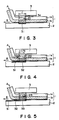
- Figure 1 shows an apparatus for practicing an embodiment (i.e., double density recording method) of the thermal transfer recording method using the thermal transfer material according to the present invention.
- the thermal transfer material 1 of the present invention is superposed on a recording medium (or medium to be recorded) 2 such as paper so that the heat-fusible ink layer of the thermal transfer material 1 contacts the recording medium 2, and the thermal transfer material 1 is heated by means of a recording head 3 such as thermal head, whereby the heat-fusible ink layer is transferred to the recording medium 2 to provide thereon a recorded image.
- the thermal transfer material 1 is moved continuously or successively in the directions of an arrow A by the rotation of a capstan roller 12 and a pinch roller 13, while the recording medium 2 is moved continuously or successively in the direction of an arrow B by the rotation of a platen roller 11, whereby recording is successively effected on the recording medium 2.
- the capstan roller 12 and pinch roller 13 are driven by a motor 14, and the platen roller 11 is driven by a motor 15.
- the thus moved thermal transfer material 1 is wound up about a winding roller 10 driven by the motor 14.
- a spring 16 presses the recording head 3 on the platen roller 11 by the medium of the thermal transfer material 1 and the recording medium 2.
- the thermal transfer material 1 is moved in the same direction as that of the recording medium 2. In the present invention, however, the thermal transfer material 1 may also be moved in the direction reverse to that of the recording medium 2 as shown in Figure 2.
- the thermal transfer material 1 has a relative velocity with respect to the recording medium 2.
- the recording head 3 is not moved while the thermal transfer material 1 is moved at a speed which is lower than that of the recording medium 2.
- the former is smaller than the latter.
- the recording medium 2 is moved through a length of 1 in the arrow B direction, while the thermal transfer material 1 is moved only through a length of 1 /N. Accordingly, a portion of the thermal transfer material 1 corresponding to the length ( 1 - 1 /N), which has already been subjected to first heat application, is again used. As a result, in Figure 4, a portion 22 of the thermal transfer material 1 is subjected to heat application, whereby a transferred image 32 is formed on the recording medium 2.
- N is a positive integer (N ⁇ 2) representing the number of heat applications to which the same portion of the thermal transfer material 1 can be subjected.
- N is 5.
- the thermal transfer material 1 is moved with respect to the recording head 3 at intervals of 1 /N, when subjected to second and third heat applications.
- the thermal transfer material 1 is moved at intervals each of which is smaller than 1 and not smaller than 1 /N.
- Most effective recording may be effected when the length of travel of the thermal transfer material 1 is 1 /N counted from the time of a heat application to that of the next heat application.
- the above-mentioned N may preferably be 2 to 10, more preferably 3 to 8.
- the recording head 3 is not moved in the above-mentioned embodiment, it is also possible to move the recording head 3.
- Such an embodiment may be considered in the same manner as that explained with reference to Figures 3 to 6, when the lengths of travel of the thermal transfer material 1 and recording medium 2 are respectively defined as those counted from the recording head 3 on the basis of the position of the recording head 3.
- the length through which the thermal transfer material 1 is moved with respect to the recording head 3 in a certain period of time is smaller than the length through which the recording medium 2 is moved with respect to the recording head 3 in the same period of time.
- the storage elasticity modulus E′, loss elasticity modulus E ⁇ and thermal differential coefficient of dynamic loss tangent (tan ⁇ ) may be measured in the following manner.
- a sample for dynamic viscoelasticity measurement may be prepared in the following manner:
- An ink material which is the same as that constituting the ink layer of a thermal transfer material is applied onto a release paper by means of an applicator or wire bar so as to provide an ink layer having a thickness of 60 - 200 microns after drying. After the thus applied ink layer is dried, the release paper is removed to prepare an ink film.
- the sample may also be prepared in the following manner.
- a heat-transferable ink in a melted state is poured into a mold imparted with releasability having a predetermined shape (e.g., one having a length of 6 mm, width of 30 mm and a height of 0.2 mm), cooled, and the resultant ink film is released from the mold.
- a predetermined shape e.g., one having a length of 6 mm, width of 30 mm and a height of 0.2 mm
- a thermal transfer material comprising a support and a heat-transferable ink layer disposed thereon may be used as the sample as such.
- the dynamic viscoelasticity of the resultant two-layer system comprising the support and the heat-transferable ink layer are measured. Therefore, the dynamic viscoelasticity of the heat-transferable ink layer may be determined by subtracting that of the support according to the following theoretical formula: E1: (Et - E2t2)/t1 (1)
- E elasticity modulus of thermal transfer material t: thickness of thermal transfer material
- E1 elasticity modulus of heat-transferable ink layer t1: thickness of heat-transferable ink layer
- E2 elasticity modulus of support t2: thickness of support.
- a dynamic viscoelasticity measurement device (Reolograph Solid, mfd. by Toyo Seiki Seisakusho K.K.) is used.
- the thermal differential coefficient of the dynamic energy loss tangent (tan ⁇ ) is calculated on the basis of the thermal change of the tan ⁇ . Measurement condition Frequency of forced vibration: 9.8 Hz Static tension: 20 g Temperature increasing rate: 2°C/min
- a sample having a length of mm, a width of 5 mm and a thickness of 1 mm is used; the both ends of the sample are chucked and the above-mentioned static tension is applied the sample in the longitudinal direction thereof. In such a state, pressing and pulling of the sample are repeated in the longitudinal direction thereof so as to provide the above-mentioned frequency of forced vibration.
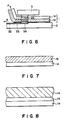
- FIG 7 is a schematic sectional view of an embodiment of the thermal transfer material according to the present invention taken in the thickness direction thereof.
- the thermal transfer material in this embodiment comprises a support 1a and a heat-transferable ink layer 1b disposed thereon which comprises a heat-fusible binder and a colorant mixed in the binder.
- the support or base material 1a known plastic films or papers may be used.
- a support having high heat resistance such as aromatic polyamide film, polyphenylene sulfide film, polyether ether ketone, and capacitor paper may preferably be used.
- polyester film particularly, a polyethylene terephthalate film, i.e., PET film
- a layer of a heat-resistant and/or lubricating material as a back coating layer, on the surface of the film to be heated (i.e., the surface of the film 1a which is reverse to the surface thereof provided with the ink layer 1b).
- the support 1a may preferably have a thickness of 3 - 20 microns, more preferably 4 - 12 microns. if a sufficient heat resistance and a strength are attained, a support can be thinner than 3 microns. Too thick a support is not desirable because the heat conductivity becomes inferior.
- an adhesive layer 1d may be disposed between the support 1a and ink layer 1b so as to enhance the adhesion strength therebetween.
- the adhesive layer 1d may preferably comprise 90 to 100 % thereof of a resin such as urethane resin and polyester resin.
- the adhesive layer 1d may preferably be one which is not transferable to a recording medium.
- the heat-transferable ink layer 1b may preferably comprise a heat-fusible binder such as wax and heat-fusible resin.
- Example of the above-mentioned wax may include natural waxes including vegetable waxes such as carnauba wax, candelilla wax, rice wax, and haze wax; mineral waxes such as ceresine wax, montan wax and derivatives of these (e.g., derivatives of montan wax including acid wax, ester wax and partially saponified ester wax); and petroleum waxes such as paraffin wax, and microcrystalline wax. Further, there can be used synthetic waxes including polyethylene wax and Fischer-Tropsch wax. These waxes may be used singly or as a combination of two or more species thereof.
- Preferred examples of the heat-fusible resin may include: polyolefin resins, polyamide resins, polyester resins, epoxy resins, polyurethane resins, acrylic resins, polyvinyl chloride resins, cellulose resins, polyvinyl alcohol resins, petroleum resins, phenolic resins, styrene resins, and vinyl acetate resins; elastomers such as natural rubber, styrene-butadiene rubber, isoprene rubber, chloroprene rubber and the like; and polyisobutylene, polybutene.
- Particularly preferred examples may include: ethylene- vinyl acetate copolymer, vinyl acetate-ethylene copolymer, ethylene-acrylic acid copolymer, ethylene-methacrylic acid copolymer, ethylene-acrylic acid ester copolymer, polyamide, polyester, etc.
- the above-mentioned resins may be used singly or as a combination of two or more species thereof.
- the heat-fusible binder to be used in the present invention may preferably comprise a wax and a heat-fusible resin, more preferably 20 - 75 % (particularly 30 - 65 %) of a wax and 80 - 25 % (particularly 35 - 70 %) of a heat-fusible resin, based on the total weight of the binder, so that the heat-transferable ink layer 1b provides a storage elasticity modulus E′ satisfying the following formula at 30 °C.
- the wax and heat-fusible resin to be used in the heat-fusible binder may preferably be those which has a good compatibility with each other.
- the wax may preferably be one having a melting point due to DSC (differential scanning calorimetry) of 55 - 80 °C and a melt viscosity at 100 °C of 10 - 500 cps, more preferably 10 - 200 cps. Further, as described hereinafter, the wax may preferably be one showing a melting behavior ⁇ T of 20 °C or smaller, more preferably 5 - 20 °C, particularly preferably 5 - 15 °C. When ⁇ T exceeds 20 °C, the temperature providing the above-mentioned specific d(tan ⁇ )/dT is difficult to be in the range of 40 - 60 °C.
- the ink layer When ⁇ T is 20 °C or smaller, the ink layer may sharply be melted and decrease its viscosity more abruptly, whereby "adhesion" as described hereinafter can be reduced and the transferability can be enhanced.
- the wax may preferably be one having a penetration degree of 5 or below at 25 °C.
- melt viscosity of the wax exceeds 500 cps
- the melting point and melting behavior ⁇ T may be measured by means of the following measurement device.
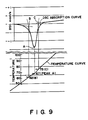
- a differential scanning calorimeter DSC-7 (mfd. by Perkin Elmer Co.) may be used. DSC measurement condition Temperature raising rate: 5 °C/min
- the melting point and ⁇ T may be measured in the following manner.
- the results of measurement of Lanox FPS-7 are shown in Figure 9.
- the point A i.e., the peak value of the absorption is defined as the melting point.
- the melt viscosity may be measured by means of the following device.
- Device E-type viscometer (Rotoviseo RV-12, mfd. by Haake Co.) Cone used: PK-I-0.3
- the heat-fusible resin may preferably be one having a softening point (ring and ball method) of 70 -130 °C, more preferably 85 - 100 °C. Particularly preferred examples thereof may ethylene-vinyl acetate copolymer, ethylene-acrylic acid copolymer and ethylene-ethyl acrylate copolymer. Among these, those having a melt flow rate (MFR) of 150 - 800, more preferably 150 - 400 are preferred. Each of the vinyl acetate content (VA content), acrylic acid content (AA content) and ethyl acrylate content (EA content) may preferably be 15 - 33 %, and such a resin having an MFR of 150 - 400 is particularly preferred.
- the coefficient-providing temperature is liable to be below 40 °C.
- the coefficient-providing temperature is liable to exceed 60 °C.
- the coefficient-providing temperature is liable to be below 40 °C.
- the MFR may be regulated by using a mixture comprising two or more species of resins.
- MFR, VA content, EA content and AA content may be measured in the following manner.
- the melt flow rate (MFR) may be measured according to JIS K 6730.
- the vinyl acetate content (VA content) may be measured according to JIS K 6730.
- the ethyl acrylate content (EA convent) may be measured in a saponification method which is the same as in the case of the VA content.
- Acrylic acid content (AA content)
- An ethylene-acrylic acid copolymer is pulverized to obtain fine powder thereof, which is then charged into a mixture of acetone and water (wt. ratio 70:25). Thereafter, phenolphthalein as an indicator is added to the resultant mixture, and the acrylic acid content in the mixture is titrated by using an alcoholic KOH solution while the mixture is stirred. Based on the resultant titration value, the arylic acid content is calculated.
- the ethylene-vinyl acetate copolymer is particularly preferred.
- the mixing ratio between the EVA and a wax may preferably satisfy the following relationship: 0.5 ⁇ EVA/wax ⁇ 3.5.
- the ratio (EVA/wax) is below 0.5, the wax content becomes too large and the elasticity of the entire ink layer is decreased, whereby ground staining is liable to occur.
- the ratio (EVA/wax) exceeds 3.5, the film strength of the entire ink layer is enhanced and one isolated dot is difficult to be reproduced.
- the wax to be used in the present invention may preferably comprise a compound obtained by subjecting an ester compound containing a residual hydroxyl group and an isocyanate compound to addition polymerization.
- an ester compound may preferably be prepared from a higher fatty acid and a polyhydric alcohol as specifically described hereinafter.
- Preferred examples of the higher fatty acid may include: saturated fatty acids such as capric acid, undecylic acid, lauric acid, tridecylic acid, myristic acid, pentadecylic acid, palmitic acid, heptadecylic acid, steraric acid, nonadecanoic acid, arachic acid, biphenic acid, lignoceric acid, cerotic acid, heptacosanoic acid, montanic acid, melissic acid, and lacceric acid; unsaturated fatty acids such as acrylic acid, crotonic aci, isocrotonic acid, 9-decanoic acid, undecylenic acid, oleic acid, elaidic acid, cetoleic acid, erucic acid, brassidic acid, sorbic acid, linoleic acid, linolenic acid, arachidonic acid, clupanodonic acid, 4,8,12,15,28,21-tetra-
- Preferred examples of the polyhydric alcohol may include; ethylene glycol, diethylene glycol, triethylene glycol, tetraethylene glycol, polyethylene glycol, propylene glycol, dipropylene glycol, polypropylene glycol, trimethylene glycol, butanediol, pentanediol, hexylenediol, octylene glycol, glycerin, trimethylolpropane, pentaerythritol, dipentaerythritol, 1,3-butylene glycol, glycerin monoallyl, (4-(hydroxyethoxy)phenol)propane, sorbitol, neopentyl glycol, tris(hydroxyethyl) isocyanuate, bisphenol, hydrogenated bisphenol, bisphenol glycol ether, and epoxides such as triglycidyl isocyanurate.
- the ester obtained by the reaction between the above-mentioned higher fatty acid and polyhydric alcohol is required to have a reactivity with an isocyanate compound.
- the ester may preferably have a carboxyl group based on the fatty acid or a hydroxyl group based on the polyhydric alcohol, as an active hydrogen-containing group.
- the ester obtained by the reaction of pentaerythritol as a tetrahydric alcohol may be subjected to the reaction with the isocyanate compound as a monoester, diester or triester. These monoester, diester and triester may be used singly or as a mixture of two or three species thereof.
- isocyanate compound may include: mono isocyanates such as methyl isocyanate, ethyl isocyanate, n-propyl isocyanate, n-butyl isocyanate, octadecyl isocyanate and polymethylene polyphenyl isocyanate; diisocyanates such as 2,4-tolylene diisocyanate, 4,4′-diphenylmethane diisocyanate, cyanine diisocyanate, meta-xylylene diisocyanate, 1,5-naphthalene di-isocyanate, transvinylene diisocyanate, N,N′-(4,4′-dimethyl-3,3′-diphenyldiisocyanate), and 2,6-diisocyanate-methyl caproate; triisocyanates such as triphenylmethane triisocyanate, tris(4-phenylisocyanate-thiophosphate), and 4,4′
- the reaction of the above-mentioned ester and the isocyanate may be conducted under heating and stirring according to an ordinary method.
- the heating temperature in this reaction may preferably be in the range of about 70 - 150 °C, since too high a temperature invites considerable coloring of the resultant product, and too low a temperature requires a long reaction time.
- the above-mentioned reaction may be caused to relatively rapidly progress at a lower temperature by using a metal salt catalyst, such as stannic chloride, ferric chloride, potassium oleate, and dibutyltin laurate.
- the reaction time may suitably be about 0.5 - 5 hours.
- the amount of the isocyanate used in the above reaction may appropriately be selected depending on the kind of respective material and reaction conditions used. In general, however, the amount of the isocyanate may preferably be about 0.1 - 40 wt. %, more preferably about 0.1 - 30 wt. %, based on the weight of the ester, so that a desired polymerization reaction is promoted to provide a wax.
- pentaerythritol is particularly preferred. Accordingly in the present invention, a polymerized product prepared from an isocyanate and a higher fatty acid pentaerythritol ester may preferably used as the wax.
- the polymerized product prepared from a fatty acid pentaerythritol ester and an isocyanate may show good solubility in an organic solvent, particularly, benzene, toluene, xylene, etc. Accordingly, operating conditions in the production of a thermal transfer material may be improved since the vaporized solvent due to heating of an ink for application may be reduced. Further, since the above polymerized product is less liable to be deposited, a homogeneous heat-transferable ink layer may efficiently be formed.
- the resultant thermal transfer material is very little curled, and is easy to be handled. This may be attributable to a relatively small volume shrinkage factor, when the above isocyanate-polymerized product is converted from a melted state to a solidified state.
- a higher fatty acid polyhydric alcohol ester may more preferably be used, as desired, as the wax component, in combination with the above-mentioned isocyanate-polymerized product prepared from an ester prepared from a higher fatty acid and a polyhydricalcohol.
- the higher fatty acid polyhydric alcohol ester to be used for such a purpose may be those as described hereinabove.
- the higher fatty acid polyhydric alcohol ester to be used in combination with the isocyanate-polymerized product is effective in slightly regulating the melting point or melt viscosity of the wax component, whereby the characteristic of the heat-transferable ink can be variously changed.
- the mixing amount of the above higher fatty acid polyhydric alcohol ester to be used in combination with the isocyanate-polymerized product may preferably be 50 % or below, more preferably 40 % or below, particularly preferably 35 % or below, based on the total weight of the heat-fusible binder. If the mixing amount exceeds 50 %, the wax component is liable to have a poor solubility in a solvent, and deterioration in operating conditions and curl are liable to occur.
- wax main component may preferably be contained in an amount of 20 - 75 wt. %, more preferably 30 - 65 wt. %, based on the total binder weight.
- the melting point, melting behavior ⁇ T and penetration degree of the wax main component may be measured in the same manner as those of the wax as described hereinabove (e.g., melting point by DSC).
- the thermal transfer material to be used for double density recording may preferably be one comprising a heat-transferable ink layer capable of showing thermal behavior which is not substantially changed depending on the heated temperature thereof.
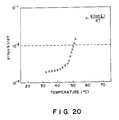
- a thermal transfer material having a specific melt viscosity characteristic may effectively be used in double density recording with respect to coverage therein. More specifically, such a thermal transfer material may preferably satisfy the following formula: (ln ⁇ 100°C - ln ⁇ 150°C )/50 ⁇ 0.05 (2) wherein ⁇ 100°C denotes the melt viscosity (cps) of the ink layer at 100 °C, an ⁇ 150°C denotes the melt viscosity thereof at 150 °C.
- a wax having a melting point of 55 - 80 °C may preferably be contained in an amount of 40 - 75 %, more preferably 50 - 75 %, based on the binder.
- a thermal transfer material 1 forms a recorded image on a recording medium 2 such as paper while being rubbed with the recording medium. Accordingly, there sometimes occurs a phenomenon such that the thermal transfer material adheres to the recording medium.
- Figures 10A and 10B show conventional thermal transfer recording wherein a thermal transfer material 1 has no relative velocity with respect to a recording medium 2.
- Figure 10A schematically shows a state at the time of recording and
- Figure 10B is an enlarged view for schematically showing some forces exerted on the ink material at the time of heat application.
- the force exerted on an ink layer 1b is a shear force F1 acting in the plane direction of the heat-transferable ink layer 1b.
- the heat-fusible ink layer 1b of the thermal transfer material 1 may have a thickness of several microns to some ten (or ten to twenty) microns
- the thermal head 3 may have a heater size of some ten microns to hundred and some ten microns, and Ft ⁇ ⁇ F1 with respect to the shear force exerted on the heat-transferable ink layer 1b.
- the wax component as a heat-fusible binder constituting the heat-transferable ink layer is softened or melted at a temperature not lower than the melting point thereof and promotes the softening or melting of a resin component, thereby to develop an adhesion force. Accordingly, the melting point of the wax component may control the transfer initiation of the heat-transferable ink layer to the recording medium 2.
- the difference between the melting point mp1 of the wax and the melting point mp2 of the resin is considerably large, there is a certain limit to the promotion of the softening or melting of the resin component, even when the wax component is softened or melted. As a result, cohesion failure in the plane direction of the heat-transferable ink layer does not sufficiently occur but the sticking phenomenon is liable to occur.
- the melting point mp2 of the resin is lower than the melting point mp1 of the wax and the difference therebetween is considerably large, the transfer initiation to the recording medium is liable to depend on the melting point of the resin. Accordingly, it is preferred to select a resin having a relatively low molecular weight.
- the weight-average molecular weight of the resin may preferably be 10x104 or below, more preferably 7x10⁴ or below.
- the molecular weight of the resin should not be restricted to the above-mentioned molecular weight value.
- the colorant may preferably be contained in the ink layer in an amount of 1 - 50 wt. %, more preferably 5 - 35 %, based on the total weight of the ink layer. If the the colorant content is smaller than 1 wt. %, the image density of a recorded image becomes low. On the other hand, the colorant content exceeds 50 wt. %, there can occur undesirable problems such as decrease in the elasticity of the ink layer.
- the thickness of the ink layer may preferably be 6 - 30 g/m2, more preferably 6 - 20 g/m2, in terms of coating weight after drying, while it depends on the number (N) of heat applications as described hereinabove.
- N number of heat applications as described hereinabove.
- the thickness of the ink layer is below 6 g/m2, a sufficient recording density cannot be obtained in double density recording.
- the thickness exceeds 30 g/m2, there undesirably occur problems such as increase in recording energy.
- various dyes or pigments may be used as the colorant.
- specific examples of such colorant may include one or more of known dyes or pigments such as carbon black, Nigrosin dyes, lamp black, Sudan Black SM, Fast Yellow G, Benzidine Yellow, Pigment Yellow, Indo Fast Orange, Irgadine Red, Paranitroaniline Red, Toluidine Red, Carmine FB, Permanent Bordeaux FRR, Pigment Orange R, Lithol Red 2G, Lake Red C, Rhodamine FB, Rhodamine B Lake, Methyl Violet B Lake, Phthalocyanine Blue, Pigment Blue, Brilliant Green B, Phthalocyanine Green, Oil Yellow GG, Zapon Fast Yellow CGG, Kayaset Y963, Smiplast Yellow GG, Zapon Fast Orange RR, Oil Scarlet, Smiplast Orange G, Orazole Brown G, Zapon Fast Scarlet CG, Aizen Spiron Red F4R, Fastgen Blue 5007, Sudan Blue,and Oil Peacock Blue.
- the heat-fusible binder can further contain another material including: higher fatty acids such as lauric acid, myristic acid, palmitic acid, stearic acid, behenic acid and the like; higher alcohols such as stearyl alcohol, behenyl alcohol and the like; esters such as fatty acid esters of sucrose, fatty acid esters of sorbitan and the like; and amides such as oleic amide and the like.
- higher fatty acids such as lauric acid, myristic acid, palmitic acid, stearic acid, behenic acid and the like
- higher alcohols such as stearyl alcohol, behenyl alcohol and the like
- esters such as fatty acid esters of sucrose, fatty acid esters of sorbitan and the like
- amides such as oleic amide and the like.
- a resin so-called “tackifier” may preferably be added to the heat-fusible binder, as desired.
- the tackifier may preferably be one or more species selected from: coumarone-indene resins, phenol-formaldehyde resins, polyterpene resins, xylene- formaldehyde resins, polybutene, rosin pentaerythritol ester, rosin glycerin ester, hydrogenated rosin, hydrogenated rosin methyl ester, hydrogenated rosin ethylene glycol ester, hydrogenated rosin pentaerythritol ester, polymerized rosin ester aliphatic petroleum resin, alicyclic petroleum resin, synthetic polyterpene, pentadiene resin, etc. These materials may be used singly or as a mixture of two or more species thereof.
- the heat-transferable ink layer to be disposed on a support has a one-layer structure, but the heat-transferable ink layer may have a multi-layer structure comprising two or ore layers.
- the respective ink layer constituting it may be considered in the same manner as in the above-mentioned one-layer structure, but the entire ink layer may preferably provide a mixing proportion satisfying the following formula: 0.6 ⁇ (resin)/(wax) ⁇ 3.0.
- an ink layer 1c (i.e., top layer or topcoat layer) as shown in Figure 12 may be disposed as desired so that the top layer is most distant from a support 1a among the ink layers constituting a multi-layer structure. It is preferred to make the top layer transparent, since unnecessary ink is prevented from transferring to a recording medium. Such a transparent top layer 1c can also enhance the transferability of the ink layer.
- the top layer can contain a colorant while it may preferably contain no colorant.
- the colorant content may preferably be 4.0 % or below based on the weight of the top layer 1c.
- the melting point of the top layer 1c is denoted by mp (top)
- the melting point of the ink layer is denoted by mp (ink)
- they may preferably satisfy a relationship of mp(ink) ⁇ mp(top).
- mp(ink) ⁇ mp(top)
- the melting point mp(ink) of the ink layer 1b may preferably be 50 - 150 °C, more preferably 60 - 130 °C, and the melting point mp(top) of the top layer 1c may preferably be 40 - 130 °C, more preferably 50 - 110 °C.
- the melting point of the top layer 1c is lower than 40 °C, the heat energy to be applied which is required for ink transfer can be reduced, but a decrease in storability (e.g., offset of an ink material due to blocking) is liable to occur.
- the above melting point exceeds 130 °C, the heat energy to be applied is increased and the durability of a thermal head is deteriorated.
- the difference i.e., (mp(ink) - mp(top)) between the above-mentioned melting point of the ink layer and that of the top layer may more preferably 0 -40 °C, particularly 0 - 20 °C.
- the wax contained in each ink layer may preferably be caused to have a higher melting point, as the ink layer becomes closer to a support 1a, since the resolution decrease of a recorded image is more effectively be prevented.
- the ink layers disposed on a support 1a are named a first ink layer 1b, a second ink layer 1e, a third ink layer 1f, a fourth ink layer, et. seq., in this order from the support.
- the difference between melting points of adjacent ink layers may preferably be 2 °C or larger, more preferably 5 °C or larger. When the difference is smaller than 2 °C, it is difficult to obtain an intended effect.
- the melting point of the wax contained in the ink layer disposed closest to the recording medium may preferably be 50 - 80 °C, more preferably 55 - 75 °C, and the melting point of the wax contained in the ink layer disposed closest to the support may preferably be 60 - 120 °C, more preferably 65 - 110 °C.
- the thermal transfer material of the present invention may preferably be obtained in the following manner (i.e., solvent coating method).
- the binder which has been selected in consideration of the above-mentioned viewpoint is dissolved in an organic solvent such as toluene, methyl ethyl ketone, isopropyl alcohol, methanol and xylene, a colorant is then mixed in the resultant solution and sufficiently dispersed by means of a dispersing machine such as sand mill, and the thus obtained coating liquid is applied onto a support by a coating method such as bar coating and gravure coating.
- an organic solvent such as toluene, methyl ethyl ketone, isopropyl alcohol, methanol and xylene
- a colorant is then mixed in the resultant solution and sufficiently dispersed by means of a dispersing machine such as sand mill, and the thus obtained coating liquid is applied onto a support by a coating method such as bar coating and gravure coating.
- the binder is heated up to a temperature of above the softening point thereof, a colorant is dispersed or dissolved therein and the resultant mixture is applied onto a support by a so-called hot-melt coating.
- the binder and colorant may be formed into an aqueous emulsion by the addition of a dispersant such as surfactant, and the aqueous emulsion may be applied onto a support (or another ink layer) to form an ink layer.
- a dispersant such as surfactant
- each ink layer may successively be formed by coating methods as described above.
- a mono-color thermal transfer material may be obtained.
- inks having plural colors e.g., two or more species selected from cyan ink, magenta ink, yellow ink, blue ink, green ink, red ink, etc.
- a thermal transfer material for multi-color recording may be obtained.
- Multi-color recording may be effected by using such a thermal transfer material so that prescribed colors are superposed on a recording medium.
- Lanox (a wax mfd. by Yoshikawa Seiyu K.K.) comprises a mixture of an addition-polymerized product and an esterified product.
- the addition-polymerized product is obtained by forming an ester from pentaerythritol and a higher fatty acid mixture comprising behenic acid and stearic acid, and subjecting the resultant ester to addition polymerization together with tolylene diisocyanate.
- the esterified product is obtained by forming an ester from pentaerythritol and a higher fatty acid mixture comprising behenic acid and stearic acid.
- the above materials were dissolved or dispersed by means of a sand mill, thereby to prepare a coating liquid for heat-transferable ink.
- the coating liquid was applied onto a 6 micron-thick polyester film having a treated back surface, by means of a wire bar and then dried to form thereon a heat-transferable ink layer having a coating amount of 16 g/m2 (after drying), whereby a thermal transfer material was obtained.
- Example 5 Ethylene-vinyl acetate copolymer (Evaflex 420, mfd.
- Example 9 Ethylene-vinyl acetate copolymer (Evaflex 210, mfd.
- thermal transfer materials were prepared in the same manner as in Example 1 except for using each of formulations of Examples 2 to 9 and Comparative Examples 1, 3 and 4.
- the thermal transfer material of Comparative Example 2 was prepared by hot-melt coating method.
- the materials as described hereinafter were respectively dissolved or dispersed by means of a sand mill, thereby to prepare 12 species of coating liquids for heat-transferable ink.
- Each coating liquid was applied onto a 6 micron-thick polyester film having a treated back surface, by means of a wire bar and then dried by using hot air to form thereon a heat-transferable ink layer having a coating amount of 16 g/m2 (after drying), whereby 12 species of thermal transfer materials were obtained.
- the above materials were dissolved or dispersed by means of a sand mill, thereby to prepare a coating liquid for heat-transferable ink.
- the coating liquid was applied onto a 6 micron-thick polyester film having a back surface treated with silicone resin, by means of a wire bar and then dried to form thereon a heat-transferable ink layer having a coating amount of 15 g/m2 (after drying), whereby a thermal transfer material having a structure as shown in Figure 7 was obtained.
- the materials as described hereinafter were respectively dissolved or dispersed by means of a sand mill, thereby to prepare 11 species of coating liquids for heat-transferable ink.
- Example 28 Wax (Lanox FPS-3, mfd.
- the above materials constituting the coating liquids A to D were dissolved or dispersed by means of a sand mill, thereby to prepare four species of coating liquids for heat-transferable ink.
- the coating liquids were applied onto a 6 micron-thick polyester film having a treated back surface as shown in the following Tables 1 and 2, by means of a wire bar and then dried by using hot air, whereby thermal transfer materials having a structure as shown in Figure 12 were obtained.
- the ink layer 1b had a coating amount (after drying) of 12 g/m2, and the top layer 1c had a coating amount (after drying) of 3 g/m2.
- Example 32 Coating liquid C Coating liquid A Table 2 Ink layer Top layer Comparative Example 7 Coating liquid D Coating liquid B
- the above materials were dissolved or dispersed by means of a sand mill to prepare a coating liquid 1.
- Coating liquids 2 - 24 were prepared in the same manner as in the Coating liquid 1 except for respectively using the following formulations.
- ⁇ Coating liquid 2> Ethylene-vinyl acetate copolymer (the same as in coating liquid 1) 40 parts Wax (FP-7208, mfd. by Yoshikawa Seiyu K.K., mp 66 °C) 45 parts Carbon black (the same as in coating liquid 1) 15 parts Toluene 300 parts
- Each of the above coating liquids 1 to 24 was applied onto a 6 micron-thick polyester film having a treated back surface as shown in the following Tables 3 and 4, by means of a wire bar and then dried, whereby ten species of thermal transfer materials having a multi-layer structure were prepared.
- the coating amounts of respective layers are shown in parentheses in the following Tables 3 and 4 in terms of coating amount after drying.
- Example 33 coating liquid 3 (6 g/m2) coating liquid 2 (6 g/m2) coating liquid 1 (6 g/m2) - Example 34 coating liquid 6 (5 g/m2) coating liquid 5 (5 g/m2) coating liquid 4 (5 g/m2) - Example 35 coating liquid 9 (5 g/m2) coating liquid 8 (5 g/m2) coating liquid 7 (5 g/m2) - Example 36 coating liquid 11 (7 g/m2) coating liquid 10 (7 g/m2) - - Example 37 coating liquid 12 (4 g/m2) coating liquid 3 (3 g/m2) coating liquid 11 (3 g/m2) coating liquid 10 (4 g/m2) Example 38 coating liquid 15 (5 g/m2) coating liquid 14 (5 g/m2) coating liquid 13 (5 g/m2) - Example 39 coating liquid 18 (5 g/m2) coating liquid 17 (5 g/m2) coating liquid 16 (5 g/m2) - Table 4 First ink layer Second ink layer Third ink layer Comp.
- Example 8 coating liquid 1 (5 g/m2) coating liquid 2 (5 g/m2) coating liquid 3 (5 g/m2) Comp.
- Example 9 coating liquid 21 (5 g/m2) coating liquid 20 (5 g/m2) coating liquid 19 (5 g/m2) Comp.
- Example 10 coating liquid 24 (5 g/m2) coating liquid 23 (5 g/m2) coating liquid 22 (5 g/m2)
- the above-mentioned thermal transfer materials of Examples 1 - 39 and Comparative Examples 1 - 10 were evaluated by using a facsimile machine in double density recording.
- the facsimile machine used herein was one obtained by partially modifying a commercially available facsimile machine (trade name: Canofax 630, mfd. by Canon K.K.) so as to effect double density recording.
- mechanical and physical conditions were as follows:
- Cutting property (clearness in the periphery of recorded images) o: Cutting property was good. ⁇ : Cutting property was somewhat poor, but the resultant images were acceptable to practical use. x: Cutting property was poor. Uniformity in recorded image density o: Substantially no image density unevenness in the form of streak was observed, but uniform images were provided. ⁇ : Somewhat image density unevenness in the form of streaks was observed, but the resultant images were acceptable to practical use. x: Considerable image density unevenness in the form of streaks was observed and no uniform image was provided. Adhesion o: No white streak was observed. ⁇ : Minute white streaks were slightly observed in the case of a solid black image, but the resultant images were acceptable to practical use.
- the reproducibility of the one isolated dot was evaluated by outputting a portrait image (an image portion of the left eye) contained in an evaluation image for "Canon GENESIS" on plain paper as a received image by means of the above-mentioned evaluation machine according to a half-tone mode, and evaluating the resultant image.
- the thus formed images corresponding to the left eye were photographed as shown in Figures 15 to 17.
- Figure 15 is an enlarged photograph of the image of the left eye output by using the thermal transfer material of Example 1.
- Figure 16 is an enlarged photograph of the left eye image output by using the thermal transfer material of Example 7
- Figure 17 is an enlarged photograph of the left eye image output by using the thermal transfer material of Comparative Example 3.
- Each of the photographs of Figures 15 to 17 has a magnification of 11.3.
- Figures 15 and 16 shows clearer recorded images of isolated one dot as compared with that in Figure 17.
- the thermal transfer material of Comparative Example 1 is a typical example of the thermal transfer material to be used for the conventional thermal transfer recording, wherein a thermal transfer material is conveyed while having no relative velocity with respect to a recording medium.
- a thermal transfer facsimile machine (trade name: Canofax 630, mfd. by Canon K.K.) without modification.
- the thermal transfer material of Comparative Example 1 in the case of the above conventional thermal transfer recording provided no staining nor whisker edge portion, and provided clear printed letters while well reproducing one isolated dot.
- thermal dispersion of E′, E ⁇ and tan ⁇ were measured by using the above-mentioned respective samples for dynamic viscoelasticity measurement.
- measurement results with respect to Example 1 are shown in Figures 18 to 19.
- differential values at respective temperatures were plotted as shown in Figure 20.
- Example 20 The ink of the heat-transferable ink layer used in Example 20 was dried for melt viscosity measurement, and the melt viscosities thereof were measured by means of the above-mentioned device at 100 °C and 150 °C. The results are shown in Table 7 appearing hereinafter.
Landscapes
- Physics & Mathematics (AREA)
- Optics & Photonics (AREA)
- Thermal Transfer Or Thermal Recording In General (AREA)
- Adhesives Or Adhesive Processes (AREA)
Applications Claiming Priority (16)
| Application Number | Priority Date | Filing Date | Title |
|---|---|---|---|
| JP111020/89 | 1989-04-27 | ||
| JP1111020A JP2510723B2 (ja) | 1989-04-27 | 1989-04-27 | 感熱転写記録方法 |
| JP1198272A JPH0361588A (ja) | 1989-07-31 | 1989-07-31 | 感熱転写材及びそれを用いる感熱転写記録方法 |
| JP198272/89 | 1989-07-31 | ||
| JP201026/89 | 1989-08-01 | ||
| JP201028/89 | 1989-08-01 | ||
| JP201025/89 | 1989-08-01 | ||
| JP201024/89 | 1989-08-01 | ||
| JP1201028A JPH0363186A (ja) | 1989-08-01 | 1989-08-01 | 感熱転写材及び感熱転写記録方法 |
| JP1201025A JP2608331B2 (ja) | 1989-08-01 | 1989-08-01 | 感熱転写記録方法及び感熱転写材 |
| JP1201027A JPH0741745B2 (ja) | 1989-08-01 | 1989-08-01 | 感熱転写材及びそれを用いる感熱転写記録方法 |
| JP1201024A JP2547858B2 (ja) | 1989-08-01 | 1989-08-01 | 感熱転写記録方法及び感熱転写材 |
| JP1201026A JPH0363180A (ja) | 1989-08-01 | 1989-08-01 | 感熱転写材及び感熱転写記録方法 |
| JP201027/89 | 1989-08-01 | ||
| JP203064/89 | 1989-08-04 | ||
| JP1203064A JPH0365386A (ja) | 1989-08-04 | 1989-08-04 | 感熱転写材及びそれを用いる感熱転写記録方法 |
Publications (2)
| Publication Number | Publication Date |
|---|---|
| EP0395014A1 true EP0395014A1 (de) | 1990-10-31 |
| EP0395014B1 EP0395014B1 (de) | 1994-07-13 |
Family
ID=27573009
Family Applications (1)
| Application Number | Title | Priority Date | Filing Date |
|---|---|---|---|
| EP19900107864 Expired - Lifetime EP0395014B1 (de) | 1989-04-27 | 1990-04-25 | Thermisches Übertragungsmaterial und thermisches Übertragungsaufzeichnungsverfahren |
Country Status (4)
| Country | Link |
|---|---|
| US (2) | US5268052A (de) |
| EP (1) | EP0395014B1 (de) |
| AT (1) | ATE108373T1 (de) |
| DE (1) | DE69010554T2 (de) |
Cited By (3)
| Publication number | Priority date | Publication date | Assignee | Title |
|---|---|---|---|---|
| EP0513757A1 (de) * | 1991-05-13 | 1992-11-19 | Matsushita Electric Industrial Co., Ltd. | Wärmeempfindliches Übertragungsdruckverfahren und Aufzeichnungsmaterialien |
| EP0522707A3 (en) * | 1991-06-07 | 1993-03-10 | Kabushiki Kaisha Toshiba | Thermal transfer recording medium |
| EP0849089A4 (de) * | 1996-07-05 | 1999-02-03 | Pilot Kk | Thermisches übertragungsaufzeichnungsmaterial und thermisches übertragungsaufzeichnungsverfahren |
Families Citing this family (7)
| Publication number | Priority date | Publication date | Assignee | Title |
|---|---|---|---|---|
| US5268052A (en) * | 1989-04-27 | 1993-12-07 | Canon Kabushiki Kaisha | Thermal transfer material and thermal transfer recording method |
| US5372852A (en) * | 1992-11-25 | 1994-12-13 | Tektronix, Inc. | Indirect printing process for applying selective phase change ink compositions to substrates |
| JP2961712B2 (ja) * | 1994-06-10 | 1999-10-12 | フジコピアン株式会社 | 熱転写記録媒体 |
| US5654105A (en) * | 1995-08-25 | 1997-08-05 | Ncr Corporation | Multi-layer thermally transferable printing ribbons |
| JP4772244B2 (ja) * | 1999-09-17 | 2011-09-14 | ザ プロクター アンド ギャンブル カンパニー | 低応力緩和エラストマー状材料 |
| US20050136227A1 (en) * | 2003-12-19 | 2005-06-23 | Illinois Tool Works, Inc. | Variable data heat transfer label |
| CN103042845B (zh) * | 2013-01-15 | 2015-05-13 | 杭州兴甬复合材料有限公司 | 一种热转印色带 |
Citations (4)
| Publication number | Priority date | Publication date | Assignee | Title |
|---|---|---|---|---|
| US3368989A (en) * | 1963-07-02 | 1968-02-13 | Pacific Ind Inc | Image transfer compositions comprising ethylene-vinyl acetate or ethyleneethyl acrylate copolymer, wax and incompatible plasticizer |
| EP0126906A1 (de) * | 1983-04-27 | 1984-12-05 | RENKER GmbH & Co. KG | Wärmeempfindliches Aufzeichnungs/Übertragungsmaterial |
| US4681796A (en) * | 1984-09-28 | 1987-07-21 | Konishiroku Photo Industry Co., Ltd. | Thermal transfer recording medium |
| EP0352519A2 (de) * | 1988-07-27 | 1990-01-31 | Pelikan GmbH | Thermofarbband |
Family Cites Families (28)
| Publication number | Priority date | Publication date | Assignee | Title |
|---|---|---|---|---|
| US3982940A (en) * | 1973-10-05 | 1976-09-28 | Canon Kabushiki Kaisha | Process for the formation of images |
| JPS6020198B2 (ja) * | 1978-11-07 | 1985-05-20 | 日本電信電話株式会社 | 感熱性多数回転写材 |
| JPS5783471A (en) * | 1980-11-14 | 1982-05-25 | Canon Inc | Thermal copying printer |
| JPS587377A (ja) * | 1981-07-08 | 1983-01-17 | Toshiba Corp | 感熱転写型プリンタ |
| JPS58201686A (ja) * | 1982-05-20 | 1983-11-24 | Ricoh Co Ltd | 熱転写式プリンタ |
| US4564534A (en) * | 1983-07-23 | 1986-01-14 | Canon Kabushiki Kaisha | Heat-sensitive transfer material and heat-sensitive transfer recording method |
| JPS60120093A (ja) * | 1983-12-02 | 1985-06-27 | Konishiroku Photo Ind Co Ltd | 感熱転写記録媒体 |
| JPS60178088A (ja) * | 1984-02-24 | 1985-09-12 | General Kk | 遅送り感熱転写媒体 |
| JPS60189488A (ja) * | 1984-03-09 | 1985-09-26 | Canon Inc | 感熱転写材 |
| US4880324A (en) * | 1985-06-24 | 1989-11-14 | Canon Kabushiki Kaisha | Transfer method for heat-sensitive transfer recording |
| JPS6227179A (ja) * | 1985-07-29 | 1987-02-05 | Oji Paper Co Ltd | 熱転写プリンタ−用インクシ−ト |
| JPS6227180A (ja) * | 1985-07-29 | 1987-02-05 | Oji Paper Co Ltd | 熱転写プリンタ−用インクシ−ト |
| US4743920A (en) * | 1985-07-31 | 1988-05-10 | Canon Kabushiki Kaisha | Thermal transfer recording method and apparatus |
| US4882593A (en) * | 1985-12-23 | 1989-11-21 | Canon Kabushiki Kaisha | Method and apparatus for carrying out transference recording of an ink image |
| JPS6381087A (ja) * | 1986-09-24 | 1988-04-11 | Canon Inc | 感熱転写材 |
| JPS6389386A (ja) * | 1986-10-02 | 1988-04-20 | Canon Inc | 感熱転写材 |
| US4880686A (en) * | 1986-10-17 | 1989-11-14 | Canon Kabushiki Kaisha | Thermal transfer material |
| US5120383A (en) * | 1986-12-29 | 1992-06-09 | Seiko Epson Corporation | Thermal transfer ink sheet and method of printing |
| JP2712182B2 (ja) * | 1987-07-21 | 1998-02-10 | トヨタ自動車株式会社 | 図形処理装置 |
| JP2664166B2 (ja) * | 1987-10-13 | 1997-10-15 | コニカ株式会社 | 感熱転写記録媒体およびその製造法 |
| DE68918883T2 (de) * | 1988-03-04 | 1995-02-23 | Matsushita Electric Ind Co Ltd | Thermisches Übertragungsdruckverfahren, Farbstoffübertragungsschichten und Verfahren zu deren Herstellung, Farbstoffempfangsschichten und ein thermisches Drucksystem. |
| JPH023337A (ja) * | 1988-06-17 | 1990-01-08 | Canon Inc | 感熱転写記録方法 |
| JP2567039B2 (ja) * | 1988-06-17 | 1996-12-25 | キヤノン株式会社 | 倍密記録方法 |
| JPH0673982B2 (ja) * | 1988-10-11 | 1994-09-21 | 富士通株式会社 | 熱転写インクシート |
| JPH02128856A (ja) * | 1988-11-09 | 1990-05-17 | Canon Inc | 熱転写記録装置及び該装置を用いたフアクシミリ装置 |
| ATE151698T1 (de) * | 1989-02-02 | 1997-05-15 | Canon Kk | Thermisches übertragungsmaterial und thermisches übertragungsaufzeichnungsverfahren |
| JP2925153B2 (ja) * | 1989-02-02 | 1999-07-28 | キヤノン株式会社 | 熱転写記録方法 |
| US5268052A (en) * | 1989-04-27 | 1993-12-07 | Canon Kabushiki Kaisha | Thermal transfer material and thermal transfer recording method |
-
1990
- 1990-04-24 US US07/513,896 patent/US5268052A/en not_active Expired - Fee Related
- 1990-04-25 AT AT90107864T patent/ATE108373T1/de not_active IP Right Cessation
- 1990-04-25 DE DE69010554T patent/DE69010554T2/de not_active Expired - Fee Related
- 1990-04-25 EP EP19900107864 patent/EP0395014B1/de not_active Expired - Lifetime
-
1993
- 1993-09-02 US US08/115,105 patent/US5389429A/en not_active Expired - Fee Related
Patent Citations (4)
| Publication number | Priority date | Publication date | Assignee | Title |
|---|---|---|---|---|
| US3368989A (en) * | 1963-07-02 | 1968-02-13 | Pacific Ind Inc | Image transfer compositions comprising ethylene-vinyl acetate or ethyleneethyl acrylate copolymer, wax and incompatible plasticizer |
| EP0126906A1 (de) * | 1983-04-27 | 1984-12-05 | RENKER GmbH & Co. KG | Wärmeempfindliches Aufzeichnungs/Übertragungsmaterial |
| US4681796A (en) * | 1984-09-28 | 1987-07-21 | Konishiroku Photo Industry Co., Ltd. | Thermal transfer recording medium |
| EP0352519A2 (de) * | 1988-07-27 | 1990-01-31 | Pelikan GmbH | Thermofarbband |
Non-Patent Citations (5)
| Title |
|---|
| PATENT ABSTRACTS OF JAPAN vol. 11, no. 210 (M-604)(2657) 08 July 1987, & JP-A-62 27179 (OJI PAPER COMPANY LIMITED) 05 February 1987, * |
| PATENT ABSTRACTS OF JAPAN vol. 11, no. 210 (M-604)(2657) 08 July 1987, & JP-A-62 27180 (OJI PAPER COMPANY LIMITED) 05 February 1987, * |
| PATENT ABSTRACTS OF JAPAN vol. 12, no. 321 (M-736)(3168) 31 August 1988, & JP-A-63 89386 (CANON INCORPORATED) 20 April 1988, * |
| PATENT ABSTRACTS OF JAPAN vol. 13, no. 311 (M-851)(3659) 17 July 1989, & JP-A-01 99884 (KONICA CORPORATION) 18 April 1989, * |
| PATENT ABSTRACTS OF JAPAN vol. 9, no. 275 (M-426)(1998) 02 November 1985, & JP-A-60 120093 (KONISHIROKU SHASHIN KOGYO K.K.) 27 June 1985, * |
Cited By (6)
| Publication number | Priority date | Publication date | Assignee | Title |
|---|---|---|---|---|
| EP0513757A1 (de) * | 1991-05-13 | 1992-11-19 | Matsushita Electric Industrial Co., Ltd. | Wärmeempfindliches Übertragungsdruckverfahren und Aufzeichnungsmaterialien |
| EP0522707A3 (en) * | 1991-06-07 | 1993-03-10 | Kabushiki Kaisha Toshiba | Thermal transfer recording medium |
| US5328746A (en) * | 1991-06-07 | 1994-07-12 | Kabushiki Kaisha Toshiba | Thermal transfer recording medium |
| EP0649756A1 (de) * | 1991-06-07 | 1995-04-26 | Kabushiki Kaisha Toshiba | Wärmeempfindliches Übertragungsaufzeichnungsmaterial |
| EP0849089A4 (de) * | 1996-07-05 | 1999-02-03 | Pilot Kk | Thermisches übertragungsaufzeichnungsmaterial und thermisches übertragungsaufzeichnungsverfahren |
| US5964976A (en) * | 1996-07-05 | 1999-10-12 | Kabushiki Kaisha Pilot | Thermal-transfer recording medium and thermal transfer recording method |
Also Published As
| Publication number | Publication date |
|---|---|
| US5389429A (en) | 1995-02-14 |
| EP0395014B1 (de) | 1994-07-13 |
| DE69010554D1 (de) | 1994-08-18 |
| DE69010554T2 (de) | 1994-11-24 |
| US5268052A (en) | 1993-12-07 |
| ATE108373T1 (de) | 1994-07-15 |
Similar Documents
| Publication | Publication Date | Title |
|---|---|---|
| US5286521A (en) | Reusable ink sheet for use in heat transfer recording and production process thereof | |
| US4923749A (en) | Thermal transfer ribbon | |
| JP3585598B2 (ja) | 熱転写シート | |
| EP0342713A1 (de) | Wärmeübertragungsmaterial und Verfahren | |
| US4572860A (en) | Thermal transfer recording medium | |
| EP0604023B1 (de) | Verfahren zum Aufbringen von selektiver Phaseaustauschtinte zum Substraten durch indirekten Druck | |
| EP0395014B1 (de) | Thermisches Übertragungsmaterial und thermisches Übertragungsaufzeichnungsverfahren | |
| EP0659584B1 (de) | Thermisches Übertragungsmaterial | |
| US5597641A (en) | Thermal transfer medium | |
| US4960632A (en) | Thermal transfer material | |
| US6063842A (en) | Thermal transfer ink layer composition for dye-donor element used in sublimation thermal dye transfer | |
| EP0381169B1 (de) | Thermisches Übertragungsmaterial und thermisches Übertragungsaufzeichnungsverfahren | |
| EP0673789A1 (de) | Thermisches Übertragungsaufzeichnungsmaterial | |
| EP0686510B1 (de) | Thermisches Übertragungsaufzeichnungsmaterial | |
| JP2547858B2 (ja) | 感熱転写記録方法及び感熱転写材 | |
| JPH05131770A (ja) | 熱転写記録媒体 | |
| US5268704A (en) | Thermal transfer recording method reducing ground staining and improving ink transferability | |
| US5430466A (en) | Thermal transfer recording method | |
| EP0548367B1 (de) | Mehrfach verwendbare farbstoffenthaltende schicht für thermoübertragungsdruck | |
| EP0547233B1 (de) | Farbstoffenthaltende schicht für thermoübertragungsdruck zur herstellung von farbbildern | |
| JP2630943B2 (ja) | 熱転写シート | |
| EP0313355A2 (de) | Thermisches Übertragungsmaterial | |
| JPH0363180A (ja) | 感熱転写材及び感熱転写記録方法 | |
| EP0733489A1 (de) | Thermisches Übertragungsaufzeichnungsmaterial | |
| JP2895492B2 (ja) | 熱転写シート |
Legal Events
| Date | Code | Title | Description |
|---|---|---|---|
| PUAI | Public reference made under article 153(3) epc to a published international application that has entered the european phase |
Free format text: ORIGINAL CODE: 0009012 |
|
| 17P | Request for examination filed |
Effective date: 19900425 |
|
| AK | Designated contracting states |
Kind code of ref document: A1 Designated state(s): AT BE CH DE DK ES FR GB GR IT LI LU NL SE |
|
| 17Q | First examination report despatched |
Effective date: 19930915 |
|
| GRAA | (expected) grant |
Free format text: ORIGINAL CODE: 0009210 |
|
| AK | Designated contracting states |
Kind code of ref document: B1 Designated state(s): AT BE CH DE DK ES FR GB GR IT LI LU NL SE |
|
| PG25 | Lapsed in a contracting state [announced via postgrant information from national office to epo] |
Ref country code: IT Free format text: LAPSE BECAUSE OF FAILURE TO SUBMIT A TRANSLATION OF THE DESCRIPTION OR TO PAY THE FEE WITHIN THE PRE;WARNING: LAPSES OF ITALIAN PATENTS WITH EFFECTIVE DATE BEFORE 2007 MAY HAVE OCCURRED AT ANY TIME BEFORE 2007. THE CORRECT EFFECTIVE DATE MAY BE DIFFERENT FROM THE ONE RECORDED.SCRIBED TIME-LIMIT Effective date: 19940713 Ref country code: GR Free format text: LAPSE BECAUSE OF FAILURE TO SUBMIT A TRANSLATION OF THE DESCRIPTION OR TO PAY THE FEE WITHIN THE PRESCRIBED TIME-LIMIT Effective date: 19940713 Ref country code: LI Effective date: 19940713 Ref country code: CH Effective date: 19940713 Ref country code: FR Effective date: 19940713 Ref country code: DK Effective date: 19940713 Ref country code: ES Free format text: THE PATENT HAS BEEN ANNULLED BY A DECISION OF A NATIONAL AUTHORITY Effective date: 19940713 Ref country code: BE Effective date: 19940713 Ref country code: AT Effective date: 19940713 Ref country code: NL Effective date: 19940713 |
|
| REF | Corresponds to: |
Ref document number: 108373 Country of ref document: AT Date of ref document: 19940715 Kind code of ref document: T |
|
| REF | Corresponds to: |
Ref document number: 69010554 Country of ref document: DE Date of ref document: 19940818 |
|
| PG25 | Lapsed in a contracting state [announced via postgrant information from national office to epo] |
Ref country code: SE Effective date: 19941013 |
|
| REG | Reference to a national code |
Ref country code: CH Ref legal event code: PL |
|
| EN | Fr: translation not filed | ||
| NLV1 | Nl: lapsed or annulled due to failure to fulfill the requirements of art. 29p and 29m of the patents act | ||
| PG25 | Lapsed in a contracting state [announced via postgrant information from national office to epo] |
Ref country code: LU Free format text: LAPSE BECAUSE OF NON-PAYMENT OF DUE FEES Effective date: 19950430 |
|
| PLBE | No opposition filed within time limit |
Free format text: ORIGINAL CODE: 0009261 |
|
| STAA | Information on the status of an ep patent application or granted ep patent |
Free format text: STATUS: NO OPPOSITION FILED WITHIN TIME LIMIT |
|
| 26N | No opposition filed | ||
| REG | Reference to a national code |
Ref country code: GB Ref legal event code: IF02 |
|
| PGFP | Annual fee paid to national office [announced via postgrant information from national office to epo] |
Ref country code: GB Payment date: 20030423 Year of fee payment: 14 |
|
| PGFP | Annual fee paid to national office [announced via postgrant information from national office to epo] |
Ref country code: DE Payment date: 20030508 Year of fee payment: 14 |
|
| PG25 | Lapsed in a contracting state [announced via postgrant information from national office to epo] |
Ref country code: GB Free format text: LAPSE BECAUSE OF NON-PAYMENT OF DUE FEES Effective date: 20040425 |
|
| PG25 | Lapsed in a contracting state [announced via postgrant information from national office to epo] |
Ref country code: DE Free format text: LAPSE BECAUSE OF NON-PAYMENT OF DUE FEES Effective date: 20041103 |
|
| GBPC | Gb: european patent ceased through non-payment of renewal fee |
Effective date: 20040425 |