EP0399384B1 - Verfahren zum Trocknen von Aluminoxan und Verfahren zum Herstellen von Polymeren - Google Patents
Verfahren zum Trocknen von Aluminoxan und Verfahren zum Herstellen von Polymeren Download PDFInfo
- Publication number
- EP0399384B1 EP0399384B1 EP90109404A EP90109404A EP0399384B1 EP 0399384 B1 EP0399384 B1 EP 0399384B1 EP 90109404 A EP90109404 A EP 90109404A EP 90109404 A EP90109404 A EP 90109404A EP 0399384 B1 EP0399384 B1 EP 0399384B1
- Authority
- EP
- European Patent Office
- Prior art keywords
- aluminoxane
- drying
- dryer
- styrene
- polymerization
- Prior art date
- Legal status (The legal status is an assumption and is not a legal conclusion. Google has not performed a legal analysis and makes no representation as to the accuracy of the status listed.)
- Expired - Lifetime
Links
Images



Classifications
-
- C—CHEMISTRY; METALLURGY
- C07—ORGANIC CHEMISTRY
- C07F—ACYCLIC, CARBOCYCLIC OR HETEROCYCLIC COMPOUNDS CONTAINING ELEMENTS OTHER THAN CARBON, HYDROGEN, HALOGEN, OXYGEN, NITROGEN, SULFUR, SELENIUM OR TELLURIUM
- C07F5/00—Compounds containing elements of Groups 3 or 13 of the Periodic Table
- C07F5/06—Aluminium compounds
- C07F5/061—Aluminium compounds with C-aluminium linkage
- C07F5/066—Aluminium compounds with C-aluminium linkage compounds with Al linked to an element other than Al, C, H or halogen (this includes Al-cyanide linkage)
- C07F5/068—Aluminium compounds with C-aluminium linkage compounds with Al linked to an element other than Al, C, H or halogen (this includes Al-cyanide linkage) preparation of alum(in)oxanes
-
- B—PERFORMING OPERATIONS; TRANSPORTING
- B01—PHYSICAL OR CHEMICAL PROCESSES OR APPARATUS IN GENERAL
- B01J—CHEMICAL OR PHYSICAL PROCESSES, e.g. CATALYSIS OR COLLOID CHEMISTRY; THEIR RELEVANT APPARATUS
- B01J19/00—Chemical, physical or physico-chemical processes in general; Their relevant apparatus
- B01J19/18—Stationary reactors having moving elements inside
- B01J19/20—Stationary reactors having moving elements inside in the form of helices, e.g. screw reactors
-
- C—CHEMISTRY; METALLURGY
- C08—ORGANIC MACROMOLECULAR COMPOUNDS; THEIR PREPARATION OR CHEMICAL WORKING-UP; COMPOSITIONS BASED THEREON
- C08F—MACROMOLECULAR COMPOUNDS OBTAINED BY REACTIONS ONLY INVOLVING CARBON-TO-CARBON UNSATURATED BONDS
- C08F10/00—Homopolymers and copolymers of unsaturated aliphatic hydrocarbons having only one carbon-to-carbon double bond
-
- Y—GENERAL TAGGING OF NEW TECHNOLOGICAL DEVELOPMENTS; GENERAL TAGGING OF CROSS-SECTIONAL TECHNOLOGIES SPANNING OVER SEVERAL SECTIONS OF THE IPC; TECHNICAL SUBJECTS COVERED BY FORMER USPC CROSS-REFERENCE ART COLLECTIONS [XRACs] AND DIGESTS
- Y10—TECHNICAL SUBJECTS COVERED BY FORMER USPC
- Y10S—TECHNICAL SUBJECTS COVERED BY FORMER USPC CROSS-REFERENCE ART COLLECTIONS [XRACs] AND DIGESTS
- Y10S526/00—Synthetic resins or natural rubbers -- part of the class 520 series
- Y10S526/943—Polymerization with metallocene catalysts
Definitions
- the present invention relates to a process for drying aluminoxane and a process for producing polymers, and more particularly, it relates to a process for obtaining aluminoxane which is used as a catalyst in polymerization of polymerizable monomers, in a state suitable for a use as the catalyst.
- Aluminoxane is usually obtained from an organoaluminum compound such as trialkylaluminum as the starting material, and it results in a solution diluted with a large-amount of organic solvents containing unreacted organoaluminum. Accordingly, a drying step for removing said organoaluminum and the organic solvents is required at the last stage.
- the resulting aluminoxane solution is heated to dry without any treatment, it evaporates into a glassy solid state, through a state of highly viscous solution. Therein a large amount of power is required to reach such a dryness, and a uniform drying is difficult.
- aluminoxane As the catalyst for production of polymers, aluminoxane is desired to be in powder form, which is easy to dissolve. To obtain aluminoxane powder, however, only the spray-drying method and the solvent deposition method have been known.
- Said spray-drying method requires a large amount of inert gas, accompanies a considerable amount of aliminoxane losses, and gives a poor yield.
- the solvent deposition method requires a large amount of solvent, and in addition, another step for removing solvents.
- the resulting aluminoxane sometimes contains residual trialkylaluminum in a large amount, and it was difficult to obtain an aluminoxane of high quality.
- EP-A-0257695 discloses the preparation of an aluminoxane powder by stripping off the solvent from an aluminoxane dispersion, wherein a solution a trialkylaluminum compound in a liquid, dry, inert, hydrocarbon solvent is mixed with a second solution of a liquid inert hydrocarbon solvent having water dispersed therein by using a high speed, high shear-inducing impeller.
- EP-A-0279586 discloses the preparation of a (finely divided) solid aluminoxane by spray-drying a solution of aluminoxane or by filtering an aluminoxane suspension.
- An object of the present invention is to provide a process for producing aluminoxane, according to which the viscous solution of aluminoxane after preparation is easily dried, and aluminoxane powder of improved quality results in a high yield.
- Another object of the invention is to provide a process for producing an aluminoxane in a state suitable to be used as a catalyst for production of polymer.
- the present invention provides a process for drying aluminoxane, which comprises drying a viscous solution containing aluminoxane while providing a shearing force sufficient to keep said viscous solution in a dispersion state, so as to make a dispersion of dry particulate aluminoxane.
- Fig. 1 is an illustration of a dryer provided with a double helical ribbon blade
- Fig. 2 is an illustration of a dryer of Nauta mixer provided with a screw-type agitating blade which rotates about its own axis while also orbiting around the center axis of hte conical tank
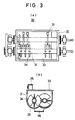
- Fig. 3 is an illustration of a kneader-type dryer provided with biaxial rotating blade, with Fig. 3 (a) being a cross-sectional view and Fig. 3 (b) being another cross-sectional view
- Fig. 4 is an illustration of a single rotor dryer
- Fig. 5 is an illustration of a micron dryer-type dryer.
- Aluminoxanes desired in the present invention are, for example, chain alkylaluminoxanes represented by the general formula: wherein R 1 indicates an alkyl group having 1 to 8 carbon atoms, and n indicates polymerization degree, and cycloalkylaluminoxanes having a repeating unit represented by the general formula: wherein R 1 is as defined above.
- aluminoxanes are usually prepared by contacting an organoaluminum compound represented by the general formula: AlR 1 3 (wherein R 1 is as defined above) and a condensing agent.
- organoaluminum compounds are trialkylaluminums including trimethylaluminum, triethylaluminum, triisobutylaluminum, and tributylaluminum.
- a typical example of the condensing agent is water.
- any compounds capable of undergoing a condensation reaction with organoaluminum compounds can be used.
- the reaction of the organoaluminum compound and water is not specified, but can be performed according to known methods; for example, (1) a method in which an organoaluminum compound is dissolved in an organic solvent and then contacted with water or steam; (2) a method in which water is dissolved in an organic solvent, and then an organoaluminum compound is added; and (3) a method in which an organoaluminum compound is reacted with water of crystallization contained in metal salts and the like, or water adsorbed in inorganic or organic compounds.
- the reaction product of organoaluminum compounds such as trialkylaluminum and water includes the abovementioned chain alkylaluminoxane and cycloalkylaluminoxane, unreacted trialkylaluminum, a mixture of various condensation products, and further complicatedly associated molecules thereof, which become various products according to the contacting conditions of trialkylaluminum and water.
- aluminoxane is obtained in the state of a solution diluted with an organic solvent containing unreacted organoaluminum compounds, as described above.
- the aluminoxane solution obtained in such a state is dried, while a shearing force sufficient to keep it to be polydispersive is applied, so as to be substantially a solid-state polydispersoid.
- the reaction product may be substantially a solid-state polydispersoid, while providing a shearing force sufficient to keep it in a polydispersive state, as described above, various dryers can be used. Specific examples of dryers are illustrated in the drawings.
- Fig. 1 illustrates dryer 10 provided with a double helical ribbon blade 11.
- Said dryer 10 is capable of heating Material (material to be dried) to a prescribed temperature, by supplying a proper heating fluid such as steam to the heating jacket 12 surrounding the container, while applying prescribed shearing force to Material by use of the double helical ribbon blade 11.
- Fig. 2 shows a dryer 20 of Nauta mixer type, provided with a rotating screw-type agitating blade 21 orbiting in a conical tank.
- agitating blade 21 provided at the end of the swing arm 23 is revolved and rotated by the swing arm 23, to obtain a prescribed shearing force.
- Said dryer 20 can heat Material to a prescribed temperature, by supplying a heating fluid to the heating jacket 22 surrounding the container.
- Figs. 3 (a) and (b) show the dryer 30 of kneader-type provided with uniaxial or biaxial rotating blade 31.
- Fig. 4 shows the dryer 40 of single rotor-type, in which Material is always agitated by the agitating action of paddle 41 rotating at a high speed in the dryer, and Material is heated to dry by being impacted rapidly against heating jacket 42 by the centrifugal force of said rotation, to be subjected to heat transferred from heating jacket 42 and/or turbulent contact with hot gas.
- Said dryer 40 can also dry Material continuously flowing from inlet 43 at one end to outlet 44 at the other end.
- Fig. 5 shows dryer 50 of micron dryer type, in which Material is ground and dispersed in the grinding part 52 provided below inlet 51 for supplying Material, and hot air is introduced from inlet for hot air 53 below grinding part 52, that means, grinding and dispersing of Material and rapid heat exchange are effected simultaneously.
- said dryer 50 of micron dryer-type Material after drying is exhausted together with hot air from outlet 55 by way of classifying part 54 in the upper part.
- the conditions under which aluminoxane is dried by use of these dryers are appropriately set according to the kind of aluminoxane, the properties of aluminoxane solution due to the methods of preparing aluminoxane, or the kind of the dryer.
- the preferred shearing force to be applied is usually 0.01 kg/cm 2 or greater, more preferably 0.02 to 1 kg/cm 2 .
- the proper temperature for drying is usually in the range of 0 to 200°C, preferably 10 to 150°C. Pressure also can be set optionally, but drying under atmospheric pressure to reduced pressure will improve the efficiency of drying.
- solid-state polydispersoids mean those in a dispersive form such as powders or flakes, and more preferably powders having uniform particle diameters.
- the aluminoxane thus obtained is in the form of a uniform powder, and when used as the catalyst for production of polymers (that is, polymerization of polymerizable monomers), it shows a favorable solubility and activity, and accordingly, can improve the efficiency in polymerization of monomers.
- aluminoxane is dried in the drying process, so as to be a solid-state polydispersoid, it can be prevented from adhering to the inner wall of the tank or the agitating blade of the dryer, and the yield of aluminoxane will be improved. Further, the drying step can be simplified, since no specific inert gas or solvent is required, and thus the cost for drying can be reduced.
- the aluminoxane obtained in the process of the present invention can improve the yield of these polymers.
- styrene polymers As the other catalytic components in the production of these polymers, usual ones can be used. Particularly in the production of styrene polymers, if titanium compound is used with the above-mentioned aluminoxane, especially, methylalumimoxane as a component of the catalyst, styrene polymers having a high syndiotactic configuration as disclosed in Japanese Patent Application Laid-Open No. 104818/1987 can be obtained.
- titanium compounds are those represented by the general formula: TiR 2 XYZ wherein R 2 is a cyclopentadienyl group, a substituted cyclopentadienyl group or an indenyl group, X, Y, and Z are independently an alkyl group having 1 to 12 carbon atoms, an alkoxyl group having 1 to 12 carbon atoms, an aryl group having 6 to 12 carbon atoms, an aryloxyl group having 6 to 20 carbon atoms, an arylalkyl group having 6 to 20 carbon atoms, or a halogen atom, and the condensed titanium compounds represented by the general formula: wherein R 3 and R 4 are each a halogen atom, an alkoxyl group having 1 to 20 carbon atoms, or an acyloxyl group having 1 to 20 carbon atoms, and k is a number of 2 to 20.
- titanium compounds including titanium tetrachloride, and tetraethoxy titanium can be used. Further, these titanium compounds can be used as complexes with esters, ethers and the like.
- other kinds of catalyst for example, organic zirconium compounds can be used.
- the high syndiotactic configuration in the styrene polymer means that the polymer has a stereostructure with a configuration that is highly syndiotactic, that is, the stereostructure in which phenyl groups or substituted phenyl groups as side chains are located alternately at opposite directions relative to the main chain consisting of carbon-carbon bonds (racemic modification).
- the tacticity is quantitatively determined by the nuclear magnetic resonance method using carbon isotope ( 13 C-NMR method).
- the tacticity determined by the 13 C-NMR method can be indicated in terms of proportions of structural units continuously connected to each other, i.e., a diad in which two structural units are connected to each other, a triad in which three structural units are connected to each other, or pentad in which five structural untis are connected to each other.
- “Styrene polymers having a high syndiotactic configuration" of the present invention include poly(alkylstyrene) such as polystyrene, poly(p-methylstyrene), and poly(m-methylstyrene); poly(halogenated styrene) such as poly(p--chlorostyrene); poly(alkoxystyrene), and styrene copolymers such as styrene-p-methylstyrene copolymer and the like, having such a syndiotacticity that the proportion of racemic diad is at least 75% and preferably at least 85%, of the proportion of racemic pentad is at least 30% and preferably at least 50%.
- the styrene polymers produced by the present invention generally have a weight average molecular weight of 5,000 or more, preferably 10,000 to 20,000,000, and a number average molecular weight of 2,500 or more, preferably 5,000 to 10,000,000, and have a high syndiotacticity as described above.
- the above-mentioned styrene polymers having a high syndiotactic configuration can be obtained, for example, by polymerizing a styrene monomer (corresponding to the desired styrene polymer, including styrene and styrene derivatives) with a catalyst comprising the above-mentioned titanium compound and the aluminoxane obtained by drying according to the process of the present invention, in the presence or absence of an inert hydrocarbon solvent.
- a styrene monomer corresponding to the desired styrene polymer, including styrene and styrene derivatives
- a catalyst comprising the above-mentioned titanium compound and the aluminoxane obtained by drying according to the process of the present invention, in the presence or absence of an inert hydrocarbon solvent.
- the aluminoxane can be used singly, or in combination with said organoaluminum compound or with other organometallic compounds, or can be used in the deposited or adsorbed form on an inorganic substance, etc.
- the amounts of the abovementioned titanium compounds and the aluminoxane are not determined unconditionally but optionally set depending on the types of styrene or styrene derivatives as the starting material and the types of the catalyst component and other conditions.
- the ratio of aluminum/titanium (molar ratio) is in the range of 1 to 10 6 , preferably 10 to 10 4 .
- the catalyst also other catalyst components may be added.
- Solvents to be used in the polymerization are aliphatic hydrocarbons such as pentane, hexane, and heptane, alicyclic hydrocarbons such as cyclohexane, and aromatic hydrocarbons such as benzene, toluene, and xylene.
- the reaction temperature at the said polymerization is not critical and generally it is set to a temperature of 0°C to 100°C, preferably 10°C to 70°C.
- the period of polymerization is five minutes to 24 hours, preferably one hour or longer.
- the aluminoxane powder to be obtained is uniform and easy to treat, and is excellent in solubility and activity when used as the catalyst for producing polymers.
- aluminoxane is dried so as to be a solid-state polydispersoid, adhesion of aluminoxane to the inner wall of the tank, agitating blade or other parts in the dryer is prevented, to improve the yield of aluminoxane. Furthermore, since such drying requires no specific inert gas or solvent, the drying procedure can be simplified, and the cost for drying can be reduced.
- the efficiency in producing polymer can be remarkably improved.
- the process in the present invention has a very high value for practical use as a process for producing aluminoxane powder efficiently in industrial scale, and as a process for producing polymer in a high yield.
- ethylene was introduced continuously into the autoclave, and subjected to a polymerization reaction under 8 kg/cm 2 for one hour. After the reaction, methanol was added to decompose the catalyst, and then dried to obtain 130 g of polyethylene.
- the polymerization activity in the above process was 285 kg/g-Zr.
- a solution was prepared in the same manner as in Example 1 (1), and after removal of solid matter, said solution was transferred to a dryer in which the agitating blade is anchor-type, and then toluene was distilled away while agitating at 50°C, but the viscosity was raised and methylaluminoxane was solidified.
- Ethylene was polymerized in the same manner as in Example 1 (2) except that methylaluminoxane obtained in (1) above was used as aluminoxane, to obtain 84 g of polyethylene.
- the polymerization activity in that process was 184 kg/g-Zr.
- Styrene was polymerized in the same manner as in Example 1 (3) except that methylaluminoxane obtained in (1) above was used as aluminoxane, to obtain 91.4 g of polystyrene. The results are shown in Table 1.
- a solution was prepared in the same manner as in Example 1(1). After removal of the solid portion, the solution was transferred to the dryer with a rotating screw-type agitating blades orbiting in a conical tank illustrated in Fig. 2, and agitated at 50°C to distillate toluene away.
- Example 1 (2) The procedure of Example 1 (2) was repeated except that methylaluminoxane obtained in (1) above was used as aluminoxane, to obtain 129 g of polyethylene.
- the polymerization activity then was 283 kg/g-Zr.
- Styrene was polymerized in the same manner as in Example 1 (3) except that methylaluminoxane obtained in (1) above was used as aluminoxane, to obtain 101.2 g of polystyrene.
- Example 1 The procedure of Example 1 was repeated except that aluminoxane solution was dried in the kneader-type dryer provided with biaxial rotating blade illustrated in Fig. 3, to obtain aluminoxane, polyethylene and polystyrene. The results are shown in Table 1.
- Example 1 The procedure of Example 1 was repeated except that aluminoxane solution was dried in the single rotor dryer illustrated in Fig. 4, to obtain aluminoxane, polyethylene and polystyrene. The results are shown in Table 1.
- Example 1 The procedure of Example 1 was repeated except that aluminoxane solution was dried in the micron dryer-type dryer illustrated in Fig. 5, to obtain aluminoxane, polyethylene and polystyrene.
Landscapes
- Chemical & Material Sciences (AREA)
- Organic Chemistry (AREA)
- Chemical Kinetics & Catalysis (AREA)
- Health & Medical Sciences (AREA)
- Medicinal Chemistry (AREA)
- Polymers & Plastics (AREA)
- Toxicology (AREA)
- Transition And Organic Metals Composition Catalysts For Addition Polymerization (AREA)
- Polymers With Sulfur, Phosphorus Or Metals In The Main Chain (AREA)
- Vaporization, Distillation, Condensation, Sublimation, And Cold Traps (AREA)
Claims (7)
- Verfahren zum Trocknen von Aluminoxan, welches Trocknen einer Aluminoxan enthaltenden viskosen Lösung umfaßt, während eine ausreichende Scherkraft angewendet wird, um diese viskose Lösung im Dispersionszustand zu halten, wobeieine Dispersion von trockenem partikelförmigem Aluminoxan hergestellt wird.
- Verfahren nach Anspruch 1, wobei die anzuwendende Scherkraft 0,01 kg/cm2 oder größer beträgt.
- Verfahren entsprechend Anspruch 1, wobei die anzuwendende Scherkraft 0,02 bis 1 kg/cm2 beträgt.
- Verfahren ensprechend Anspruch 1, wobei das Aluminoxan Methylaluminoxan ist.
- Verfahren zur Herstellung von Polymeren, welches Polymerisieren eines polymerisierbaren Monomeren unter Verwendung des Aluminoxans als einer Komponente des Katalysators umfaßt, welches entsprechend dem Verfahren von Anspruch 1 erhalten wurde.
- Verfahren entsprechend Anspruch 5, wobei das Polymer ein Olefinpolymer oder ein Styrolpolymer ist.
- Verfahren entsprechend Anspruch 6, wobei das Styrolpolymer ein Styrolpolymer mit hochsyndiotaktischer Konfiguration ist.
Applications Claiming Priority (2)
| Application Number | Priority Date | Filing Date | Title |
|---|---|---|---|
| JP130253/89 | 1989-05-25 | ||
| JP1130253A JP2752695B2 (ja) | 1989-05-25 | 1989-05-25 | アルミノキサンの乾燥方法およびポリマーの製造方法 |
Publications (3)
| Publication Number | Publication Date |
|---|---|
| EP0399384A2 EP0399384A2 (de) | 1990-11-28 |
| EP0399384A3 EP0399384A3 (de) | 1992-07-29 |
| EP0399384B1 true EP0399384B1 (de) | 1996-10-16 |
Family
ID=15029829
Family Applications (1)
| Application Number | Title | Priority Date | Filing Date |
|---|---|---|---|
| EP90109404A Expired - Lifetime EP0399384B1 (de) | 1989-05-25 | 1990-05-18 | Verfahren zum Trocknen von Aluminoxan und Verfahren zum Herstellen von Polymeren |
Country Status (5)
| Country | Link |
|---|---|
| US (1) | US5070160A (de) |
| EP (1) | EP0399384B1 (de) |
| JP (1) | JP2752695B2 (de) |
| AT (1) | ATE144261T1 (de) |
| DE (1) | DE69028873T2 (de) |
Families Citing this family (12)
| Publication number | Priority date | Publication date | Assignee | Title |
|---|---|---|---|---|
| JP2649131B2 (ja) * | 1992-11-18 | 1997-09-03 | 神鋼パンテツク株式会社 | 攪拌装置及びこれに使用するボトムリボン翼 |
| CA2180180C (en) * | 1994-01-11 | 2006-03-14 | Jeffrey Harold Butler | Alumoxanes and catalysts comprising alumoxanes |
| US5869570A (en) * | 1996-03-19 | 1999-02-09 | Energy & Environmental International, L.C. | Composition of and process for forming polyalphaolefin drag reducing agents |
| US6015779A (en) * | 1996-03-19 | 2000-01-18 | Energy & Environmental International, L.C. | Methods for forming amorphous ultra-high molecular weight polyalphaolefin drag reducing agents |
| US6034024A (en) * | 1996-05-10 | 2000-03-07 | Albemarle Corporation | Heat treated alumoxanes |
| US6815011B2 (en) | 2000-11-27 | 2004-11-09 | Energy & Environmental International, L.C. | Alpha olefin monomer partitioning agents for drag reducing agents and methods of forming drag reducing agents using alpha olefin monomer partitioning agents |
| CN1310960C (zh) | 2001-01-16 | 2007-04-18 | 能源及环境国际有限公司 | 用作减阻剂的无定形超高分子量聚烯烃的形成方法 |
| US7012046B2 (en) | 2001-06-08 | 2006-03-14 | Eaton Gerald B | Drag reducing agent slurries having alfol alcohols and processes for forming drag reducing agent slurries having alfol alcohols |
| EP2360191B2 (de) * | 2008-11-11 | 2020-01-22 | Tosoh Finechem Corporation | Feste polymethylaluminoxanzusammensetzung und herstellungsverfahren dafür |
| CN105999757B (zh) * | 2016-07-06 | 2019-04-02 | 靖江神驹容器制造有限公司 | 液淬粗馏反应釜 |
| JP6947540B2 (ja) * | 2017-06-07 | 2021-10-13 | 積水化学工業株式会社 | ポリビニルアセタール樹脂、ポリビニルアセタール樹脂の製造方法及び合わせガラス用中間膜 |
| CN109612235A (zh) * | 2018-11-07 | 2019-04-12 | 浙江巨化装备制造有限公司 | 一种用于电磁加热搅拌烘干装置及其烘干方法 |
Family Cites Families (5)
| Publication number | Priority date | Publication date | Assignee | Title |
|---|---|---|---|---|
| JPS62187708A (ja) * | 1985-11-11 | 1987-08-17 | Idemitsu Kosan Co Ltd | スチレン系重合体の製造法 |
| US4730072A (en) * | 1986-08-15 | 1988-03-08 | Shell Oil Company | Process for preparing aluminoxanes |
| JPH0742301B2 (ja) * | 1987-02-14 | 1995-05-10 | 三井石油化学工業株式会社 | 微粒子状アルミノオキサン、その製法およびその用途 |
| JPS63268710A (ja) * | 1987-04-27 | 1988-11-07 | Asahi Chem Ind Co Ltd | 立体規則性ポリスチレン製造方法 |
| US4772736A (en) * | 1987-11-23 | 1988-09-20 | Union Carbide Corporation | Process for the preparation of aluminoxanes |
-
1989
- 1989-05-25 JP JP1130253A patent/JP2752695B2/ja not_active Expired - Fee Related
-
1990
- 1990-04-25 US US07/514,420 patent/US5070160A/en not_active Expired - Fee Related
- 1990-05-18 DE DE69028873T patent/DE69028873T2/de not_active Expired - Fee Related
- 1990-05-18 EP EP90109404A patent/EP0399384B1/de not_active Expired - Lifetime
- 1990-05-18 AT AT90109404T patent/ATE144261T1/de not_active IP Right Cessation
Also Published As
| Publication number | Publication date |
|---|---|
| ATE144261T1 (de) | 1996-11-15 |
| US5070160A (en) | 1991-12-03 |
| EP0399384A2 (de) | 1990-11-28 |
| JPH02308802A (ja) | 1990-12-21 |
| DE69028873D1 (de) | 1996-11-21 |
| JP2752695B2 (ja) | 1998-05-18 |
| EP0399384A3 (de) | 1992-07-29 |
| DE69028873T2 (de) | 1997-02-13 |
Similar Documents
| Publication | Publication Date | Title |
|---|---|---|
| EP0322731B1 (de) | Polymere aus Vinylcyclohexan und Verfahren zu deren Herstellung | |
| US5070160A (en) | Process for drying aluminoxane and process for producing polymers | |
| US5306790A (en) | Process for producing styrenic polymer | |
| KR940008349B1 (ko) | 스티렌계 중합체의 제조방법 | |
| US5037907A (en) | Process for producing mainly syndiotactic styrene-based polymers | |
| JP3378563B2 (ja) | 生成物循環方式を用いたシンジオタクチックスチレン系重合体の製造方法 | |
| AU622784B2 (en) | Process for producing a styrene-based polymer | |
| JP2911501B2 (ja) | スチレン系重合体の製造方法 | |
| JP3860751B2 (ja) | シンジオタクチックスチレン系ポリマー重合用新規メタロセン支持触媒 | |
| JP3178620B2 (ja) | スチレン系重合体の精製方法 | |
| KR100529367B1 (ko) | 스티렌계 중합체 제조 방법 | |
| JP2700189B2 (ja) | スチレン系重合体の製造方法 | |
| EP1866348B1 (de) | Verfahren zur herstellung von styrolpolymeren mittels hochgeschwindigkeits-katalysatordispergierungstechnologie | |
| US7084220B2 (en) | Catalyst system for preparing styrene polymer and method for preparing of styrene polymer using the same | |
| KR100508904B1 (ko) | 중합체 제조 시스템 | |
| KR100837422B1 (ko) | 중합체 제조 장치 및 그를 이용한 중합체 제조 방법 | |
| JPH0275607A (ja) | スチレン系重合体の製造装置及び製造方法 | |
| CN101151284A (zh) | 采用高速催化分散技术制备苯乙烯聚合物的方法 | |
| JPH0725906A (ja) | スチレン系重合体の製造方法 |
Legal Events
| Date | Code | Title | Description |
|---|---|---|---|
| PUAI | Public reference made under article 153(3) epc to a published international application that has entered the european phase |
Free format text: ORIGINAL CODE: 0009012 |
|
| AK | Designated contracting states |
Kind code of ref document: A2 Designated state(s): AT BE CH DE ES FR GB IT LI NL SE |
|
| 17P | Request for examination filed |
Effective date: 19901220 |
|
| PUAL | Search report despatched |
Free format text: ORIGINAL CODE: 0009013 |
|
| AK | Designated contracting states |
Kind code of ref document: A3 Designated state(s): AT BE CH DE ES FR GB IT LI NL SE |
|
| 17Q | First examination report despatched |
Effective date: 19941205 |
|
| GRAH | Despatch of communication of intention to grant a patent |
Free format text: ORIGINAL CODE: EPIDOS IGRA |
|
| GRAH | Despatch of communication of intention to grant a patent |
Free format text: ORIGINAL CODE: EPIDOS IGRA |
|
| GRAA | (expected) grant |
Free format text: ORIGINAL CODE: 0009210 |
|
| AK | Designated contracting states |
Kind code of ref document: B1 Designated state(s): AT BE CH DE ES FR GB IT LI NL SE |
|
| PG25 | Lapsed in a contracting state [announced via postgrant information from national office to epo] |
Ref country code: IT Free format text: LAPSE BECAUSE OF FAILURE TO SUBMIT A TRANSLATION OF THE DESCRIPTION OR TO PAY THE FEE WITHIN THE PRE;WARNING: LAPSES OF ITALIAN PATENTS WITH EFFECTIVE DATE BEFORE 2007 MAY HAVE OCCURRED AT ANY TIME BEFORE 2007. THE CORRECT EFFECTIVE DATE MAY BE DIFFERENT FROM THE ONE RECORDED.SCRIBED TIME-LIMIT Effective date: 19961016 Ref country code: LI Effective date: 19961016 Ref country code: FR Effective date: 19961016 Ref country code: ES Free format text: THE PATENT HAS BEEN ANNULLED BY A DECISION OF A NATIONAL AUTHORITY Effective date: 19961016 Ref country code: CH Effective date: 19961016 Ref country code: AT Effective date: 19961016 |
|
| REF | Corresponds to: |
Ref document number: 144261 Country of ref document: AT Date of ref document: 19961115 Kind code of ref document: T |
|
| REF | Corresponds to: |
Ref document number: 69028873 Country of ref document: DE Date of ref document: 19961121 |
|
| PG25 | Lapsed in a contracting state [announced via postgrant information from national office to epo] |
Ref country code: SE Effective date: 19970116 |
|
| NLR4 | Nl: receipt of corrected translation in the netherlands language at the initiative of the proprietor of the patent | ||
| EN | Fr: translation not filed | ||
| EN | Fr: translation not filed |
Free format text: CORRECTIONS |
|
| REG | Reference to a national code |
Ref country code: CH Ref legal event code: PL |
|
| PG25 | Lapsed in a contracting state [announced via postgrant information from national office to epo] |
Ref country code: GB Effective date: 19970518 |
|
| PLBE | No opposition filed within time limit |
Free format text: ORIGINAL CODE: 0009261 |
|
| STAA | Information on the status of an ep patent application or granted ep patent |
Free format text: STATUS: NO OPPOSITION FILED WITHIN TIME LIMIT |
|
| 26N | No opposition filed | ||
| GBPC | Gb: european patent ceased through non-payment of renewal fee |
Effective date: 19970518 |
|
| PGFP | Annual fee paid to national office [announced via postgrant information from national office to epo] |
Ref country code: BE Payment date: 19980512 Year of fee payment: 9 |
|
| PGFP | Annual fee paid to national office [announced via postgrant information from national office to epo] |
Ref country code: NL Payment date: 19980531 Year of fee payment: 9 |
|
| PG25 | Lapsed in a contracting state [announced via postgrant information from national office to epo] |
Ref country code: BE Free format text: LAPSE BECAUSE OF NON-PAYMENT OF DUE FEES Effective date: 19990531 |
|
| BERE | Be: lapsed |
Owner name: IDEMITSU KOSAN CY LTD Effective date: 19990531 |
|
| PG25 | Lapsed in a contracting state [announced via postgrant information from national office to epo] |
Ref country code: NL Free format text: LAPSE BECAUSE OF NON-PAYMENT OF DUE FEES Effective date: 19991201 |
|
| NLV4 | Nl: lapsed or anulled due to non-payment of the annual fee |
Effective date: 19991201 |
|
| PGFP | Annual fee paid to national office [announced via postgrant information from national office to epo] |
Ref country code: DE Payment date: 20050512 Year of fee payment: 16 |
|
| PG25 | Lapsed in a contracting state [announced via postgrant information from national office to epo] |
Ref country code: DE Free format text: LAPSE BECAUSE OF NON-PAYMENT OF DUE FEES Effective date: 20061201 |