EP0400409A2 - Aromatische Copolyetherketone - Google Patents
Aromatische Copolyetherketone Download PDFInfo
- Publication number
- EP0400409A2 EP0400409A2 EP90109396A EP90109396A EP0400409A2 EP 0400409 A2 EP0400409 A2 EP 0400409A2 EP 90109396 A EP90109396 A EP 90109396A EP 90109396 A EP90109396 A EP 90109396A EP 0400409 A2 EP0400409 A2 EP 0400409A2
- Authority
- EP
- European Patent Office
- Prior art keywords
- formula
- mol
- diphenolate
- diphenols
- residues
- Prior art date
- Legal status (The legal status is an assumption and is not a legal conclusion. Google has not performed a legal analysis and makes no representation as to the accuracy of the status listed.)
- Granted
Links
Classifications
-
- C—CHEMISTRY; METALLURGY
- C08—ORGANIC MACROMOLECULAR COMPOUNDS; THEIR PREPARATION OR CHEMICAL WORKING-UP; COMPOSITIONS BASED THEREON
- C08G—MACROMOLECULAR COMPOUNDS OBTAINED OTHERWISE THAN BY REACTIONS ONLY INVOLVING UNSATURATED CARBON-TO-CARBON BONDS
- C08G65/00—Macromolecular compounds obtained by reactions forming an ether link in the main chain of the macromolecule
- C08G65/34—Macromolecular compounds obtained by reactions forming an ether link in the main chain of the macromolecule from hydroxy compounds or their metallic derivatives
- C08G65/38—Macromolecular compounds obtained by reactions forming an ether link in the main chain of the macromolecule from hydroxy compounds or their metallic derivatives derived from phenols
- C08G65/40—Macromolecular compounds obtained by reactions forming an ether link in the main chain of the macromolecule from hydroxy compounds or their metallic derivatives derived from phenols from phenols (I) and other compounds (II), e.g. OH-Ar-OH + X-Ar-X, where X is halogen atom, i.e. leaving group
- C08G65/4012—Other compound (II) containing a ketone group, e.g. X-Ar-C(=O)-Ar-X for polyetherketones
- C08G65/4043—(I) or (II) containing oxygen other than as phenol or carbonyl group
- C08G65/405—(I) or (II) containing oxygen other than as phenol or carbonyl group in ring structure, e.g. phenolphtalein
-
- B—PERFORMING OPERATIONS; TRANSPORTING
- B01—PHYSICAL OR CHEMICAL PROCESSES OR APPARATUS IN GENERAL
- B01D—SEPARATION
- B01D71/00—Semi-permeable membranes for separation processes or apparatus characterised by the material; Manufacturing processes specially adapted therefor
- B01D71/06—Organic material
- B01D71/52—Polyethers
- B01D71/522—Aromatic polyethers
- B01D71/5222—Polyetherketone, polyetheretherketone, or polyaryletherketone
Definitions
- the invention relates to aromatic polyether ketones (and a process for their preparation) based on 5 to 90 mol%, based on the total amount of all bisphenols, dihydroxydiphenylcycloalkanes of the formula (I) wherein R1 and R2 independently of one another are hydrogen, halogen, preferably chlorine or bromine, C1-C8-alkyl, C5-C6-cycloalkyl, C6-C10-aryl, preferably phenyl and C7-C12-aralkyl, preferably phenyl-C1-C4-alkyl- , especially benzyl and cumyl m is an integer from 4 to 7, preferably 4 or 5, R3 and R4 individually selectable for each X, independently of one another hydrogen, C1-C6-alkyl and X is carbon, with the proviso that on at least one atom X R3 and R4 simultaneously mean alkyl, and 10 to 95 mol% based on the total amount of all bisphenols phthal
- formula (I) are preferably at 1-2 atoms X, in particular only on one atom X, R3 and R4 simultaneously alkyl.
- the preferred alkyl radical is methyl; the X atoms in the ⁇ -position to the di-phenyl-substituted C atom (C-1) are preferably not dialkyl-substituted, whereas the alkyl-di-substitution in the ⁇ -position to C-1 is preferred.
- R7 and R8 is preferably hydrogen.
- Dihydroxydiphenylcycloalkanes of the formula (I) can be prepared in a manner known per se by condensation of phenols of the formula (VI) and ketones of the formula (VII) are prepared, wherein in the formulas (VI) and (VII) X, R1, R2, R3, R4 and m have the meaning given for formula (I).
- the phenols of the formula (VI) are either known or can be obtained by known processes (see, for example, Ullmann, Encyklopadie der industrial chemistry, 4th edition, volume 15, pp. 61-77).
- Suitable phenols of the formula (VI) are: phenol, o-cresol, m-cresol, 2,6-dimethylphenol, 2-chlorophenol, 3-chlorophenol, 2,6-dichlorophenol, 2-cyclohexylphenol, diphenylphenol, o-phenylphenol and o- or p-benzylphenols.
- the ketones of the formula (VI) are known (see, for example, Beilsteins Handbuch der organic Chemie, 4th edition, volume 7; a general process for the preparation of ketones of the formula (VI) is described, for example, in "Organikum", 15th edition 1977, VEB -German Publishing House of Sciences, Berlin, 5,698.
- ketones of the formula (VII) are: 3,3-dimethylcyclopentanone, 2,2-dimethylcyclohexanone, 3,3-dimethylcyclohexanone, 4,4-dimethylcyclohexanone, 3-ethyl-3-methylcyclopentanone, 2,3,3-trimethylcyclopentanone, 2,4,4-trimethylcyclopentanone, 3, 3,4-trimethylcyclopentanone, 3,3-dimethylcycloheptanone, 4,4-dimethylcycloheptanone, 3-ethyl-3-methylcyclohexanone, 4-ethyl-4-methylcyclohexanone, 2,3,3-trimethylcyclohexanone, 2,4,4-trimethylcyclohexanone, 3,3,4-trimethylcyclohexanone, 2,5,5-trimethylcyclohexanone, 3,3,5-trimethylcyclohexanone, 3,4,4-trimethylcyclohexanone, 2,3,3,4-te
- Bisphenol preparation generally uses 2 to 10 mol, preferably 2.5 to 6 mol, of phenol of the formula (VI) per mol of ketone of the formula (VII). Preferred reaction times are 1 to 100 hours. In general, temperatures from -30 ° C to 300 ° C, preferably from -15 ° C to 150 ° C and at pressures from 1 to 20 bar, preferably from 1 to 10 bar.
- the condensation is generally carried out in the presence of acidic catalysts.
- acidic catalysts examples are hydrogen chloride, hydrogen bromide, hydrogen fluoride, boron trifluoride, aluminum trichloride, zinc dichloride, titanium tetrachloride, tin tetrachloride, phosphorus halides, phosphorus pentoxide, phosphoric acid, concentrated hydrochloric acid or sulfuric acid and mixtures of acetic acid and acetic anhydride.
- acidic ion exchangers is also possible.
- reaction can be accelerated by adding co-catalysts such as C1-C18 alkyl mercaptans, hydrogen sulfide, thiophenols, thioacids and dialkyl sulfides.
- co-catalysts such as C1-C18 alkyl mercaptans, hydrogen sulfide, thiophenols, thioacids and dialkyl sulfides.
- the condensation can be carried out without a solvent or in the presence of an inert solvent (e.g. aliphatic and aromatic hydrocarbon, chlorinated hydrocarbon).
- an inert solvent e.g. aliphatic and aromatic hydrocarbon, chlorinated hydrocarbon.
- Suitable dehydrating agents are, for example: acetic anhydride, zeolites, polyphosphoric acid and phosphorus pentoxide.
- the phthaleins of formula (II) are known, for example from Ullmann's Encyclopedia of techn. Chemistry, 3rd edition (1957), Vol. 8, pp. 766-767. You can, for example, according to US Pat. No. 2,522,940 or Z. general Chem. 178 , pp. 49 ff. (1929).
- Suitable phthaleins of the formula (II) are, for example, phenolphthalein, the various isomeric cresolphthaleins, xylenolphthaleins, thymolphthaleins. Phenolphthalein is preferred.
- This invention relates to aromatic polyether ketones with the recurring structural unit -OEOE′- (VIII) wherein -E'- a divalent radical of an aromatic ketone of the formula (IXa) -Ar- -Ar′- (IXa) With Ar and Ar 'as the same or different difunctional aromatic radical having 6 to 50 carbon atoms and in what -OEO- (Xa) is a divalent diphenolate residue, which are characterized in that 5 to 90 mol%, preferably 20 to 80 mol%.
- the aromatic polyether ketones of the invention preferably have average molecular weights M w (weight average), determined e.g. B. by gel permeation chromatography or light scattering from 1000 to 500,000, preferably from 3,000 to 200,000 and in particular from 5,000 to 100,000.
- M w weight average
- Aromatic polyether ketones are known (see for example GB-PS 1 078 234, US-PS 4 010 147 and EP-A 0 135 938). They can be prepared, for example, by reacting dialkali salts of diphenols with dihalodiaryl ketones in a polar solvent (see, for example, GB-PS 1 078 234), the dialkali salts of the diphenols also being able to be produced in situ.
- the polyether ketones according to the invention can also be prepared by this method, the polar solvent preferably being C1-C5-alkyl-substituted caprolactam, such as N-methyl-caprolactam, N-ethyl-caprolactam, Nn-propyl-caprolactam, N-isopropyl-caprolactam, preferably N-methyl-caprolactam, and preferably on the nitrogen C1-C5-alkyl-substituted pyrrolidones, such as N-methylpyrrolidone, N, N-dimethylformamide, N, N-dimethylacetamide, dimethyl sulfoxide, dimethyl sulfone, sulfolane and tetramethyl urea.
- the polar solvent preferably being C1-C5-alkyl-substituted caprolactam, such as N-methyl-caprolactam, N-ethyl-caprolactam, Nn-propyl
- polar solvent for example 0.1 to 200% by weight, based on the weight of the polar solvent, other less polar solvents can also be used, for example aromatic hydrocarbons such as toluene, xylene, mesitylene, chlorobenzene or aliphatic hydrocarbons such as gasoline, cyclohexane.
- aromatic hydrocarbons such as toluene, xylene, mesitylene, chlorobenzene or aliphatic hydrocarbons such as gasoline, cyclohexane.
- the polyether ketones according to the invention can also contain diphenolate residues derived from other diphenols of the formula HO-E-OH (X), and the amount thereof can be 0 to 85 mol%, preferably 0 to 60 Mol% and particularly preferably 0 to 45 mol% of all diphenolate residues (these amounts result from the required minimum amounts of diphenolate residues of the formulas Ia and IIa).
- Suitable diphenols of the formula (X) are, for example Hydroquinone, Resorcinol, Dihydroxydiphenyls, Bis (hydroxyphenyl) alkanes, Bis (hydroxyphenyl) cycloalkanes, Bis (hydroxyphenyl) sulfides, Bis (hydroxyphenyl) ether, Bis (hydroxyphenyl) sulfones, Bis (hydroxyphenyl) sulfoxides, ⁇ , ⁇ ′-bis (hydroxyphenyl) diisopropylbenzenes and their nuclear alkylated and nuclear halogenated compounds.
- diphenols (X) are e.g. in US Pat. Nos. 3,028,365, 2,999,835, 3,148,172, 3,275,601, 2,991,273, 3,271,367, 3,062,781, 2,970,131 and 2,999,846, in DE-OS 1,570,703, 2 063 050, 2 063 052, 2 211 0956, FR-PS 1 561 518 and in the monograph "H. Schnell, Chemistry and Physics of Polycarbonates, Interscience Publishers, New York 1964".
- Preferred other diphenols (X) are, for example: 4,4'-dihydroxydiphenyl, 2,2-bis (4-hydroxyphenyl) propane, 2,4-bis (4-hydroxyphenyl) -2-methylbutane, 1,1-bis (4-hydroxyphenyl) cyclohexane, ⁇ , ⁇ ′-bis (4-hydroxyphenyl) -p-diisopropylbenzene, 2,2-bis (3-methyl-4-hydroxyphenyl) propane, 2,2-bis (3-chloro-4-hydroxyphenyl) propane, Bis (3,5-dimethyl-4-hydroxyphenyl) methane, 2,2-bis (3,5-dimethyl-4-hydroxyphenyl) propane, Bis (3,5-dimethyl-4-hydroxyphenyl) sulfone, 2,4-bis (3,5-dimethyl-4-hydroxyphenyl) -2-methylbutane, 1, 1-bis (3,5-dimethyl-4-hydroxyphenyl) cyclohexane, ⁇ , ⁇ ′
- diphenols (X) are, for example: 2,2-bis (4-hydroxyphenyl) propane, 2,2-bis (3,5-dimethyl-4-hydroxyphenyl) propane, 2,2-bis (3,5-dichloro-4-hydroxyphenyl) propane, 2,2-bis (3,5-dibromo-4-hydroxyphenyl) propane, 1,1-bis (4-hydroxyphenyl) cyclohexane and 4,4'-dihydroxydiphenyl sulfone.
- Sodium or potassium is preferably used as the alkali in the dialkaliphenolates (I b), (II b) and (X b).
- Preferred polyether ketones according to the invention are those which have at least 10 mol%. recurring structural units of the formula and at least 10 mol% of repeating structural units of the formula contain and a molecular weight M w of over 3000 g / mol (weight average).
- the aromatic polyether ketones can be used at temperatures of 130 ° C. to 350 ° C., preferably 145 ° C. to 280 ° C, and at pressures of 0.8 to 10 bar, preferably 1 to 3 bar, in particular at atmospheric ambient pressure.
- the molar ratio of the alkali diphenolates (Ib), (IIb) and (X b) to the dihalo-diaryl ketones (IX) is 0.67 to 2, preferably 0.8 to 1.2, particularly preferably 0.95 to 1 , 05, a ratio of 1 or very close to 1 must be selected for high molecular weights.
- the amount of polar solvents is 0.5 to 50, preferably 2 to 20 parts by weight, based on the total weight of the polyether ketone raw materials (I), (II), (X) and (IX).
- the polyether ketones according to the invention can be obtained, for example, as follows from the reaction mixtures obtained:
- the reaction mixture is diluted, especially if very highly viscous solutions are present, e.g. B. with the polar reaction solvent or another solvent for the polyether ketone, and filtered.
- a suitable acid e.g. B. acetic acid
- the polyether ketone is poured into a suitable precipitation medium, such as water or alcohols, such as. B. methanol or isopropanol or water-alcohol mixtures, for. B. H2O / methanol 1: 1, precipitated, isolated and then dried.
- the polyether ketones according to the invention are thermoplastic materials with high heat resistance, excellent gas permeability and excellent flame resistance.
- They can be processed, for example, by extrusion, injection molding, sintering or pressing.
- Any shaped body can be produced.
- These can be used wherever polyether ketones with high dimensional stability are required, e.g. in the field of electrical engineering and electronics for printed circuit boards, vehicle construction including aerospace, for sports equipment, functional parts and dishes, for microwave ovens, sterilizable medical devices, coffee machine parts, Egg cookers, hot water containers, pipes and pumps, hair dryers and the like.
- the polyether ketones according to the invention are particularly suitable for films and membranes for which good gas permeability is required in the case of high flame resistance and thermal and mechanical stability.
- the polyether ketones according to the invention can also contain conventional additives such as plasticizers, mold release agents, stabilizers such as.
- the low molecular weight polyether ketones according to the invention are particularly suitable via their functional end groups (halogen or hydroxyl) for incorporation into block copolymers in conjunction with other co-condensable building blocks.
- the polyether ketones according to the invention can also be mixed with other polymers in a manner known per se and processed into molded parts.
- the permeation depends on the temperature and the water content of the gas.
- the measuring arrangement consists of a thermostatted two-chamber system. One chamber is designed to hold the target gas and the other to hold the permeate. The chambers are separated by the polymer membrane to be measured.
- Both chambers are evacuated to 0.001 mbar and the specification chamber is then filled with gas.
- the permeated gas then causes a pressure increase in the permeate chamber (at constant volume), which can be measured with a pressure sensor, e.g. Baratron from the company MKS, depending on the time until steady state is registered. From this, V at standard temperature according to the above Formula calculated, t is known.
- the specified pressure difference taking into account the external air pressure, is set to 10,000 Pa in each case.
- the membrane area F is known.
- the membrane thickness d is determined by means of a micrometer screw as the average of 10 thickness measurements independently distributed over the membrane surface.
- the permeation coefficient P is to be determined in dimension from these variables referring to a membrane thickness of 1 mm.
- Other measurement parameters are: Temperature: 25 ° C (accuracy 1 ° C) rel gas humidity: 0%
- Example 2 3.10 g (0.01 mol) of the bisphenol of the formula (A), 28.64 g (0.09 mol) of phenolphthalein and 21.82 g (0.1 mol) of 4,4'-difluorobenzophenone converted to polyether ketone and worked up analogously. Yield: 34.0 g, relative viscosity measured in methylene chloride at 25 ° C and a polymer concentration of 5 g per liter: 1.214 glass temperature, determined using the DSC method at a heating rate of 20 K / min: 228 ° C. Permeation coefficient P versus N2 O2 CO2
- Example 2 2.28 g (0.01 mol) of bisphenol A, 3.10 g (0.01 mol) of the bisphenol of the formula (A), 25.46 g (0.08 mol) of phenolphthalein and 21.82 g (0.1 mol) of 4,4′-difluorobenzophenone converted to the polyether ketone and worked up analogously. Yield: 33.9 g, relative viscosity measured in methylene chloride at 25 ° C. and a polymer concentration of 5 g per liter: 1.25 glass temperature, determined using the DSC method at a heating rate of 20 K / min: 226 ° C.
Landscapes
- Chemical & Material Sciences (AREA)
- Chemical Kinetics & Catalysis (AREA)
- Crystallography & Structural Chemistry (AREA)
- Health & Medical Sciences (AREA)
- Medicinal Chemistry (AREA)
- Polymers & Plastics (AREA)
- Organic Chemistry (AREA)
- Polyethers (AREA)
- Organic Low-Molecular-Weight Compounds And Preparation Thereof (AREA)
- Furan Compounds (AREA)
- Polyesters Or Polycarbonates (AREA)
Abstract
Description
- Die Erfindung betrifft aromatische Polyetherketone (und ein Verfahren zu ihrer Herstellung) auf Basis von 5 bis 90 Mol-%, bezogen auf die Gesamtmenge aller Bisphenole, Dihydroxydiphenylcycloalkanen der Formel (I)

R¹ und R² unabhängig voneinander Wasserstoff, Halogen, bevorzugt Chlor oder Brom, C₁-C₈-Alkyl, C₅-C₆-Cycloalkyl, C₆-C₁₀-Aryl, bevorzugt Phenyl und C₇-C₁₂-Aralkyl, bevorzugt Phenyl-C₁-C₄-alkyl-, insbesondere Benzyl und Cumyl
m eine ganze Zahl von 4 bis 7, bevorzugt 4 oder 5,
R³ und R⁴ für jedes X individuell wählbar, unabhängig voneinander Wasserstoff, C₁-C₆-Alkyl und
X Kohlenstoff bedeuten,
mit der Maßgabe, daß an mindestens einem Atom X R³ und R⁴ gleichzeitig Alkyl bedeuten,
und 10 bis 95 Mol-% bezogen auf die Gesamtmenge aller Bisphenole Phthaleinen der Formel (II), worin R⁵ bis R⁸ die für R¹ und R² oben genannte Bedeutung haben (jedoch unabhängig von R¹ und R²).
- In Formel (I) sind bevorzugt an 1-2 Atomen X, insbesondere nur an einem Atom X, R³ und R⁴ gleichzeitig Alkyl. Bevorzugter Alkylrest ist Methyl; die X-Atome in α-Stellung zu dem di-phenyl-substitutierten C-Atom (C-1) sind bevorzugt nicht dialkyl-substitutiert, dagegen ist die Alkyl-di-substitution in β-Stellung zu C-1 bevorzugt. In Formel II ist R⁷ und R⁸ bevorzugt Wasserstoff.
- Besonders bevorzugt als Ausgangsmaterial gemäß Formel (I) sind Dihydroxydiphenylcycloalkane mit 5 bis 6 Ring- C-Atomen im cycloaliphatischen Rest [m = 4 oder 5 in Formel (I)], beispielsweise die Diphenole der Formeln

- Dihydroxydiphenylcycloalkane der Formel (I) können in an sich bekannter Weise durch Kondensation von Phenolen der Formel (VI)


- Die Phenole der Formel (VI) sind entweder bekannt oder nach bekannten Verfahren erhältlich (vgl. z.B. Ullmann, Encyklopädie der technischen Chemie, 4. Auflage, Band 15, S. 61-77).
- Beispiele für geeignete Phenole der Formel (VI) sind: Phenol, o-Kresol, m-Kresol, 2,6-Dimethylphenol, 2-Chlorphenol, 3-Chlorphenol, 2,6-Dichlorphenol, 2-Cyclohexylphenol, Diphenylphenol, o-Phenylphenol und o- oder p-Benzylphenole.
Die Ketone der Formel (VI) sind bekannt (siehe beispielsweise Beilsteins Handbuch der organischen Chemie, 4. Auflage, Band 7; ein allgemeines Verfahren zur Herstellung von Ketonen der Formel (VI) ist beispielsweise in "Organikum", 15. Auflage 1977, VEB-Deutscher Verlag der Wissenschaften, Berlin, 5. 698, beschrieben. - Beispiele für bekannte Ketone der Formel (VII) sind:
3,3-Dimethylcyclopentanon, 2,2-Dimethylcyclohexanon, 3,3-Dimethylcyclohexanon, 4,4-Dimethylcyclohexanon, 3-Ethyl-3-methylcyclopentanon, 2,3,3-Trimethylcyclopentanon, 2,4,4-Trimethylcyclopentanon, 3,3,4-Trimethylcyclopentanon, 3,3-Dimethylcycloheptanon, 4,4-Dimethylcycloheptanon, 3-Ethyl-3-methylcyclohexanon, 4-Ethyl-4-methylcyclohexanon, 2,3,3-Trimethylcyclohexanon, 2,4,4-Trimethylcyclohexanon, 3,3,4-Trimethylcyclohexanon, 2,5,5-Trimethylcyclohexanon, 3,3,5-Trimethylcyclohexanon, 3,4,4-Trimethylcyclohexanon, 2,3,3,4-Tetramethylcyclopentanon, 2,3,4,4-Tetramethylcyclopentanon, 3,3,4,4-Tetramethylcyclopentanon, 2,2,5-Trimethylcycloheptanon, 2,2,6-Trimethylcycloheptanon, 2,6,6-Trimethylcycloheptanon, 3,3,5-Trimethylcycloheptanon, 3,5,5-Trimethylcycloheptanon, 5-Ethyl-2,5-dimethylcycloheptanon, 2,3,3,5-Tetramethylcycloheptanon, 2,3,5,5-Tetramethylcycloheptanon, 3,3,5,5-Tetramethylcycloheptanon, 4-Ethyl-2,3,4-trimethylcyclopentanon, 2-Isopropyl-4,4-dimethylcyclopentanon, 4-Isopropyl-2,4-dimethylcyclopentanon, 2-Ethyl-3,5,5-trimethylcyclohexanon, 3-Ethyl-3,5,5-trimethylcyclohexanon, 3-Ethyl-4-isopropyl-3-methyl-cyclopentanon, 4-sec. Butyl-3,3-dimethylcyclopentanon, 2-Isopropyl-3,3,4-trimethylcyclopentanon, 3-Ethyl-4-isopropyl-3-methyl-cyclohexanon, 4-Ethyl-3-isopropyl-4-methyl-cyclohexanon, 3-sec.Butyl-4,4-dimethylcyclohexanon, 3-Isopropyl-3,5,5-trimethylcyclohexanon, 4-Isopropyl-3,5,5-trimethylcyclohexanon, 3,3,5-Trimethyl-5-propylcyclohexanon, 3,5,5-Trimethyl-5-propylcyclohexanon, 2-Butyl-3,3,4-trimethylcyclopentanon, 2- Butyl-3,3,4-trimethylcyclohexanon, 4-Butyl-3,3,5-trimethylcyclohexanon, 3-Isohexyl-3-methylcyclohexanon, 5-Ethyl-2,4-diisopropyl-5-methylcyclohexanon, 2,2-Dimethylcyclooctanon, und 3,3,8-Trimethylcyclooctanon. - Beispiele für bevorzugte Ketone der Formel (VII) sind

- Zur Bisphenolherstellung werden im allgemeinen 2 bis 10 Mol, vorzugsweise 2,5 bis 6 Mol Phenol der Formel (VI) pro Mol Keton der Formel (VII), verwendet. Bevorzugte Reaktionszeiten sind 1 bis 100 Stunden. Im allgemeinen arbeitet man bei Temperaturen von -30°C bis 300°C, vorzugsweise von -15°C bis 150°C und bei Drucken von 1 bis 20 bar, vorzugsweise von 1 bis 10 bar.
- Die Kondensation wird im allgemeinen in Gegenwart saurer Katalysatoren durchgeführt. Beispiele sind Chlorwasserstoff, Bromwasserstoff, Fluorwasserstoff, Bortrifluorid, Aluminiumtrichlorid, Zinkdichlorid, Titantetrachlorid, Zinntetrachlorid, Phosphorhalogenide, Phosphorpentoxid, Phosphorsäure, konzentrierte Salzsäure oder Schwefelsäure sowie Mischungen aus Essigsäure und Acetanhydrid. Die Verwendung saurer Ionenaustauscher ist ebenfalls möglich.
- Weiter kann die Umsetzung durch Zugabe von Co-Katalysatoren wie C₁-C₁₈-Alkyl-Mercaptanen, Schwefelwasserstoff, Thiophenolen, Thiosäuren und Dialkylsulfiden beschleunigt werden.
- Die Kondensation kann ohne Lösungsmittel oder in Gegenwart eines inerten Lösungsmittels (z.B. aliphatischer und aromatischer Kohlenwasserstoff, Chlorkohlenwasserstoff) durchgeführt werden.
- In den Fällen, in denen der Katalysator gleichzeitig als wasserentziehendes Mittel fungiert, ist es nicht erforderlich, zusätzlich wasserentziehende Mittel einzusetzen; dies ist jedoch zur Erzielung guter Umsätze dann vorteilhaft, wenn der eingesetzte Katalysator das Reaktionswasser nicht bindet
- Geeignete wasserentziehende Mittel sind beispielsweise: Acetanhydrid, Zeolithe, Polyphosphorsäure und Phosphorpentoxid.
- Die Herstellung der Diphenole entsprechend Formel (I), ist in der Deutschen Offenlegungsschrift 38 32 396 beschrieben.
- Die Phthaleine der Formel (II) sind bekannt, z.B. aus Ullmann's Encyclopädie der techn. Chemie, 3. Auflage (1957), Bd. 8, S. 766-767. Sie-können z.B. nach US-PS 2 522 940 oder Z. anorg. allgem. Chem. 178, S. 49 ff. (1929) hergestellt werden.
- Geeignete Phthaleine der Formel (II) sind zB Phenolphthalein, die verschiedenen isomeren Kresolphthaleine, Xylenolphthaleine, Thymolphthaleine. Bevorzugt wird Phenolphthalein.
- Gegenstand dieser Erfindung sind aromatische Polyetherketone mit der wiederkehrenden Struktureinheit
-O-E-O-E′- (VIII)
worin
-E′- ein zweibindiger Rest eines aromatischen Ketons der Formel (IXa)
-Ar--Ar′- (IXa)
mit
Ar und Ar′ als gleichen oder verschiedenen difunktionellen aromatischen Rest mit 6 bis 50 C-Atomen
und worin
-O-E-O- (Xa)
ein zweibindiger Diphenolat-Rest ist, die dadurch gekennzeichnet sind, daß 5 bis 90 Mol-%, vorzugsweise 20 bis 80 Mol-%. und insbesondere 30 bis 75 Mol-% der Diphenolat-Reste der Formel (Xa) solche der Formel (Ia)

- Die aromatischen Polyetherketone der Erfindung haben bevorzugt mittlere Molekulargewichte
M w (Gewichtsmittel), ermittelt z. B. durch Gelpermeationschromatographie oder Lichtstreuung von 1000 bis 500.000, vorzugsweise von 3.000 bis 200.000 und insbesondere von 5.000 bis 100.000. - Aromatische Polyetherketone sind bekannt (siehe beispielsweise GB-PS 1 078 234, US-PS 4 010 147 und EP-A 0 135 938). Sie können beispielsweise durch Umsetzung von Dialkalisalzen von Diphenolen mit Dihalogen-diarylketonen in einem polaren Lösungsmittel hergestellt werden, (siehe beispielsweise GB-PS 1 078 234), wobei die Dialkalisalze der Diphenole auch in situ erzeugt werden können.
- Die erfindungsgemäßen Polyetherketone können ebenfalls nach dieser Methode hergestellt werden, wobei als polares Lösungsmittel bevorzugt am Stickstoff C₁-C₅-alkylsubstituiertes Caprolactam, wie N-Methyl-caprolactam, N-Ethyl-caprolactam, N-n-Propyl-caprolactam, N-Isopropyl-caprolactam, vorzugsweise N-Methyl-caprolactam, und vorzugsweise am Stickstoff C₁-C₅-alkylsubstituierte Pyrrolidone, wie N-Methylpyrrolidon, N,N-Dimethylformamid, N,N-Dimethylacetamid, Dimethylsulfoxid, Dimethylsulfon, Sulfolan und Tetramethylharnstoff eingesetzt werden. Es können anteilig, z B. 0,1 bis 200 Gew.-%, bezogen auf das Gewicht des polaren Lösungsmittels, andere weniger polare Lösungsmittel mitverwendet werden, z.B. aromatische Kohlenwasserstoffe, wie Toluol, Xylol, Mesitylen, Chlorbenzol oder aliphatische Kohlenwasserstoffe wie Benzine, Cyclohexan.
- Gegenstand dieser Erfindung ist auch ein Verfahren zur Herstellung der erfindungsgemäßen Polyetherketone mit der wiederkehrenden Struktureinheit der Formel (VIII) durch Umsetzung von Dialkalidiphenolaten der Formel (Xb)
Alkali-O-E-O-Alkali (Xb)
mit Dihalogen-diaryl-Ketonen der Formel (IX)
Hal-Ar--Ar′-Hal (IX)
mit Ar und Ar′ = gleiche oder verschiedene difunktionelle, aromatische Reste mit 6 bis 50 C-Atomen und Hal = Halogen wie Fluor, Chlor, Brom, bevorzugt Fluor und Chlor
in Lösungsmitteln, das dadurch gekennzeichnet ist, daß (jeweils bezogen auf die Gesamtmenge an Bisphenolen) 5 bis 90 Mol-%, vorzugsweise 20 bis 80 Mol-% und insbesondere 30 bis 75 Mol-%, der Dialkalidiphenolate der Formel (Xb) der Formel (Ib)
worin X, R¹, R²,R³, R⁴ und m die für die Formel (I) genannte Bedeutung haben, daß 10 bis 95 Mol-%, vorzugsweise 20 bis 80 Mol-% und insbesondere 25 bis 70 Mol-% der Dialkalidiphenolate der Formel (Xb) der Formel (IIb)
- Neben den Diphenolat-Resten der Formel Ia und IIa können die erfindungsgemäßen Polyetherketone auch von anderen Diphenolen der Formel HO-E-OH (X) abgeleitete Diphenolat-Reste enthalten, und zwar kann deren Menge 0 bis 85 Mol-%, bevorzugt 0 bis 60 Mol-% und besonders bevorzugt 0 bis 45 Mol-% aller Diphenolatreste sein (Diese Mengen ergeben sich aus den erforderlichen Minimalmengen von Diphenolatresten der Formeln Ia und IIa).
- Die Formeln (X), (Xa) und (Xb) stellen jeweils das Diphenol, den daraus abgeleiteten Diphenolatrest und das entsprechende Di-alkalisalz dar.
- Geeignete Diphenole der Formel (X) sind z.B.
Hydrochinon,
Resorcin,
Dihydroxydiphenyle,
Bis-(hydroxyphenyl)-alkane,
Bis-(hydroxyphenyl)-cycloalkane,
Bis-(hydroxyphenyl)-sulfide,
Bis-(hydroxyphenyl)-ether,
Bis-(hydroxyphenyl)-sulfone,
Bis-(hydroxyphenyl)-sulfoxide,
α,α′-Bis(hydroxyphenyl)-diisopropylbenzole
sowie deren kernalkylierte und kernhalogenierte Verbindungen. - Diese und weitere geeignete andere Diphenole (X) sind z.B. in den US-PS 3 028 365, 2 999 835, 3 148 172, 3 275 601, 2 991 273, 3 271 367, 3 062 781, 2 970 131 und 2 999 846, in den DE-OS 1 570 703, 2 063 050, 2 063 052, 2 211 0956, der FR-PS 1 561 518 und in der Monographie "H. Schnell, Chemistry and Physics of Polycarbonates, Interscience Publishers, New York 1964", beschrieben.
- Bevorzugte andere Diphenole (X) sind beispielsweise:
4,4′-Dihydroxydiphenyl,
2,2-Bis- (4-hydroxyphenyl)-propan,
2,4-Bis-(4-hydroxyphenyl)-2-methylbutan,
1,1-Bis-(4-hydroxyphenyl)-cyclohexan,
α,α′-Bis-(4-hydroxyphenyl)-p-diisopropylbenzol,
2,2-Bis-(3-methyl-4-hydroxyphenyl)-propan,
2,2-Bis-(3-chlor-4-hydroxyphenyl)-propan,
Bis-(3,5-dimethyl-4-hydroxyphenyl)-methan,
2,2-Bis-(3,5-dimethyl-4-hydroxyphenyl)-propan,
Bis-(3,5-dimethyl-4-hydroxyphenyl)-sulfon,
2,4-Bis-(3,5-dimethyl-4-hydroxyphenyl)-2-methylbutan,
1 ,1-Bis-(3,5-dimethyl-4-hydroxyphenyl)-cyclohexan,
α,α′-Bis-(3,5-dimethyl-4-hydroxyphenyl)-p-diisopropylbenzol,
2,2-Bis-(3,5-dichlor-4-hydroxyphenyl)-propan,
2,2-Bis-(3,5-dibrom-4-hydroxyphenyl)-propan und
4,4′-Dihydroxydiphenylsulfon. - Besonders bevorzugte andere Diphenole (X) sind beispielsweise:
2,2-Bis-(4-hydroxyphenyl)-propan,
2,2-Bis-(3,5-dimethyl-4-hydroxyphenyl)-propan,
2,2-Bis-(3,5-dichlor-4-hydroxyphenyl)-propan,
2,2-Bis-(3,5-dibrom-4-hydroxyphenyl)-propan,
1,1-Bis-(4-hydroxyphenyl)-cyclohexan und
4,4′-Dihydroxydiphenylsulfon. - Sie können einzeln oder im Gemisch eingesetzt werden.
- Geeignete Dihalogendiarylketone (IX) sind:
4,4′-Dichlorbenzophenon
4-Chlor-4′-Fluorbenzophenon
4,4′-Difluorbenzophenon


- Der bevorzugte Rest Ar und Ar′ in der Formel (XI) ist somit der p-Phenylenrest, der auch substituiert sein kann, z.B. mit Alkyl oder Nitrogruppen substituierte p-Phenylenreste oder Reste der Formel

- Als Alkali in den Dialkaliphenolaten (I b), (II b) und (X b) dient vorzugsweise Natrium oder Kalium.
- Als Halogen in den Dihalogendiarylketonen (IX) dient Fluor, Chlor und Brom, vorzugsweise Fluor und Chlor.
- Bevorzugte, erfindungsgemäße Polyetherketone sind solche, die mindestens 10 Mol-%. wiederkehrende Struktureinheiten der Formel


M w von über 3000 g/mol aufweisen (Gewichtsmittel). - Erfindungsgemäß können die aromatischen Polyetherketone bei Temperaturen von 130°C bis 350°C, bevorzugt 145°C bis 280°C, und bei Drucken von 0,8 bis 10 bar, bevorzugt 1 bis 3 bar, insbesondere bei atmosphärischem Umgebungsdruck hergestellt werden.
- Das molare Mengenverhältnis der Alkalidiphenolate (Ib), (IIb) und (X b) zu den Dihalogen-diaryl-ketonen (IX) ist 0,67 bis 2, bevorzugt 0,8 bis 1,2, besonders bevorzugt 0,95 bis 1,05, wobei für hohe Molekulargewichte ein Verhältnis von 1 oder sehr nahe bei 1 gewählt werden muß.
- Die Menge an polaren Lösungsmitteln beträgt 0,5 bis 50, bevorzugt 2 bis 20 Gewichtsteile, bezogen auf das Gesamtgewicht der Polyetherketonrohstoffe (I), (II), (X) und (IX).
- Die erfindungsgemäßen Polyetherketone können z B. wie folgt aus den erhaltenen Reaktionsgemischen gewonnen werden:
- Man verdünnt das Reaktionsgemisch, insbesondere wenn sehr hochviskose Lösungen vorliegen, z. B. mit dem polaren Reaktions-Lösungsmittel oder einem anderen Lösungsmittel für das Polyetherketon, und filtriert. Nach Neutralisation des Filtrats mit einer geeigneten Säure, z. B. Essigsäure, wird das Polyetherketon durch Eingießen in ein geeignetes Fällungsmedium, z B. Wasser oder Alkohole, wie z. B. Methanol oder Isopropanol oder Wasser-Alkohol-Gemische, z. B. H₂O/Methanol 1 : 1, ausgefällt, isoliert und anschließend getrocknet.
- Die erfindungsgemäßen Polyetherketone sind thermoplastische Kunststoffe mit hoher Wärmeformbeständigkeit bei ausgezeichneter Gaspermeabilität und vorzüglicher Flammfestigkeit.
- Sie können beispielsweise verarbeitet werden durch Extrusion, Spritzgießen, Sintern oder Verpressen.
- Es können beliebige Formkörper hergestellt werden. Diese sind überall dort einsetzbar, wo Polyetherketone hoher Formstabilität gefordert sind, also beispielsweise auf dem Gebiet der Elektrotechnik und Elektronikzß für Leiterplatten, Fahrzeugbau incl Luft- und Raumfahrt, für Sportgeräte, Funk-tionsteile und Geschirr, für Mikrowellenherde, sterilisierbare medizinische Geräte, Kaffeemaschinenteile, Eierkocher, Heißwasserbehälter, -leitungen und -pumpen, Haartrockner und ähnliches mehr. Besonders geeignet sind die erfindungsgemäßen Polyetherketone jedoch für Folien und Membranen, für die bei hoher Flammwidrigkeit und thermischer und mechanischer Stabilität eine gute Gaspermeabilität gefordert wird.
- Den erfindungsgemäßen Polyetherketonen können noch übliche Additive wie Weichmacher, Entformungsmittel, Stabilisatoren wie z. B. UV-Absorber und Antioxidantien, Intumeszenzhilfsmittel (Flammschutzmittel), Verstärkungsfasern wie Glasfasern, Kohlenstoffasern oder Aramidfasern, Füllstoffe, anorganische oder organische Pigmente, keramische Grundstoffe, Ruß etc. zugesetzt werden, bevorzugt in Mengen von 0 bis 80 Gew.-%, insbesondere von 0 bis 60 Gew.-%, bezogen auf Polyetherketon = 100 %, zweckmäßig vor der Verarbeitung der erfindungsgemäßen Polyetherketone zu Formkörpern.
- Die niedermolekularen erfindungsgemäßen Polyetherketone eignen sich über ihre funktionellen Endgruppen (Halogen oder Hydroxyl) besonders für den Einbau in Blockcopolymere in Verbindung mit anderen co-kondensierbaren Bausteinen.
- Die erfindungsgemäßen Polyetherketone können auch mit anderen Polymeren in an sich bekannter Weise abgemischt und zu Formteilen verarbeitet werden.
- In den folgenden Beispielen wurde die Permeationseigenschaft wie folgt gemessen:
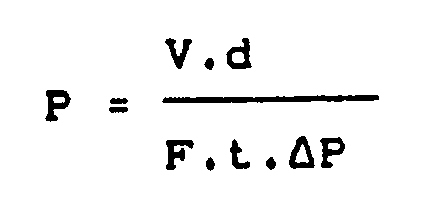
- Der Durchgang eines Gases durch eine dichte Polymermembran wird durch einen Lösungs-Diffusionsvorgang beschrieben( Die kennzeichnende Konstante für diesen Prozeß ist der Permeationskoeffizient P, der angibt, welches Gasvolumen V bei gegebener Druckdifferenz ΔP in einer bestimmten Zeit t durch eine Folie bekannter Fläche F und Dicke d hindurchtritt( Für den stationären Zustand läßt sich aus den Differentialgleichungen des Permationsvorgangs ableiten:
- Zusätzlich ist die Permeation abhängig von der Temperatur und von dem Wassergehalt des Gases.
- Die Meßanordnung besteht aus einem thermostatisierten Zwei-Kammer-System. Die eine Kammer ist für die Aufnahme des Vorgabegases und die andere für die Aufnahme des Permeates ausgelegt. Die Kammern sind durch die zu messende Polymermembran getrennt.
- Beide Kammern werden auf 0,001 mbar evakuiert und die Vorgabekammer dann mit Gas gefüllt. Das permeierte Gas bewirkt dann in der Permeatkammer (bei konstantem Volumen) einen Druckanstieg, der mit einem Druckaufnehmer, z.B. Baratron der Firma MKS, in Abhängigkeit von der Zeit bis zum stationären Zustand registriert wird. Hieraus wird V bei Normtemperatur nach der o.a. Formel errechnet, t ist bekannt. Die vorgegebene Druckdifferenz unter Berücksichtigung des äußeren Luftdruckes wird jeweils auf 10 000 Pa eingestellt. Die Membranfläche F ist bekannt. Die Membrandicke d wird mittels Mikrometerschraube als Mittel aus 10 unabhängig über die Membranfläche verteilten Dickenmessungen ermittelt.
- Aus diesen Größen ist der Permeationskoeffizient P zu bestimmen in der Dimension

Temperatur: 25°C (Genauigkeit 1°C)
rel Gasfeuchte: 0 % - Zur qualitativen Beschreibung des Meßvorgangs siehe auch EP-A 0 242 147, Beispiel 1 (S.15).
-

- In einem 1-Liter-Rundkolben mit Rührer, Tropftrichter, Thermometer, Rückflußkühler und Gaseinleitungsrohr werden 7,5 Mol (705 g) Phenol und 0,15 Mol (30,3 g) Dodecanthiol bei 28 bis 30°C mit trockenem HCl-Gas gesättigt. Zu dieser Lösung werden bei 28 bis 30°C innerhalb 3 Stunden eine Mischung von 1,5 Mol Dihydroisophoron (210 g) und 1,5 Mol (151 g) Phenol zugetropft, wobei weiterhin HCl-Gas durch die Reaktionslösung geleitet wird. Nach beendeter Zugabe wird weitere 5 Stunden HCl-Gas eingeleitet. Zur Vervollständigung der Reaktion läßt man 8 Stunden bei Zimmertemperatur stehen. Anschließend wird überschüssiges Phenol durch Wasserdampf-Destillation entfernt. Der verbleibende Rückstand wird zweimal mit je 500 ml Petrolether (60-90) und einmal mit 500 ml Methylenchlorid heiß extrahiert und abfiltriert. Ausbeute: 370 g entspricht 79 %. Schmelzpunkt: 205-207°C
- In einer mit Stickstoff gespülten Rührapparatur, die mit einem Wasserabscheider versehen ist, werden 18,62 g (0,06 Mol) des Bisphenols der Formel (A) 12,73 g (0,04 Mol) Phenolphthalein, 21,82 g 4,4′-Difluorbenzophenon (0,1 Mol), 200 ml N-Methylpyrrolidon, 100 ml Toluol und 18 g Kaliumcarbonat vorgelegt. Es wird destillativ azeotrop entwässert bis der Ansatz wasserfrei ist. Durch Abdestillieren von Toluol wird die Sumpftemperatur innerhalb einer Stunde auf 18°C erhöht. Der Ansatz wird 4 Stunden bei 180°C gerührt und anschließend 1 Stunde lang auf 190-195°C aufgeheizt. Danach wird mit 200 ml N-Methylpyrrolidon verdünnt und heiß abgesaugt. Das Filtrat wird mit Essigsäure neutralisiert und das Polymer durch Fällung in einer Methanol-Wasser-Mischung (1:1) daraus isoliert. Zur weiteren Reinigung wird das Polymer in Methylenchlorid gelöst und anschießend in Methanol gefällt. Abschließend wird 14 Stunden bei 120°C im Vakuum getrocknet. Ausbeute: 37,52 g; relative Viskosität (ηrel) gemessen in Methylenchlorid bei 25°C und einer Polymerkonzentration von 5 g pro Liter:1,513, Glastemperatur, bestimmt mit Hilfe der DSC-Methode bei einer Aufheizgeschwindigkeit von 20 K/min:221°C.
Permeationskoeffizienten P gegenüber N₂ O₂ CO₂ Beispiel 2 122 765 4307 Vergleich* 116 382 * Vergleich: Polyetherketon aus Phenolphthalein und 4,4′-Difluorbenzophenon, ηrel = 1,808 - Entsprechend Beispiel 2 werden 3,10 g (0,01 Mol) des Bisphenols der Formel (A), 28,64 g (0,09 Mol) Phenolphthalein und 21,82 g (0,1 Mol) 4,4′-Difluorbenzophenon zum Polyetherketon umgesetzt und analog aufgearbeitet. Ausbeute: 34,0 g, relative Viskosität gemessen in Methylenchlorid bei 25°C und einer Polymerkonzentration von 5 g pro Liter: 1,214 Glastemperatur, bestimmt mit Hilfe der DSC-Methode bei einer Aufheizgeschwindigkeit von 20 K/min:228°C.
Permeationskoeffizienten P gegenüber N₂ O₂ CO₂ Beispiel 3 60 410 2417 Vergleich* 116 382 * Vergleich: Polyetherketon aus Phenolphthalein und 4,4′-Difluorbenzophenon, ηrel = 1,808. - In einer mit Stickstoff gespülten Rührapparatur, die mit einem Wasserabscheider versehen ist, werden 15,52 g (0,05 Mol) des Bisphenols der Formel (A), 15,91 g (0,05 Mol) Phenolphthalein, 21,82 g 4,4′-Difluorbenzophenon (0,1 Mol), 200 ml N-Methylpyrrolidon, 100 ml Toluol und 18 g Kaliumcarbonat vorgelegt. Es wird destillativ azeotrop entwässert bis der Ansatz wasserfrei ist. Durch Abdestillieren von Toluol wird die Sumpftemperatur innerhalb einer Stunde auf 180°C erhöht. Der Ansatz wird 4 Stunden bei 180°C gerührt und anschließend 1 Stunde lang auf 190-195°C aufgeheizt. Danach wird mit 200 ml N-Methylpyrrolidon verdünnt und heiß abgesaugt. Das Filtrat wird mit Essigsäure neutralisiert und das Polymer durch Fällung in einer Methanol-Wasser-Mischung (1:1) daraus isoliert. Zur weiteren Reinigung wird das Polymer in Methylenchlorid gelöst und anschießend in Methanol gefällt. Abschließend wird 14 Stunden bei 120°C im Vakuum getrocknet. Ausbeute: 33,2 g; relative Viskosität (ηrel) gemessen in Methylenchlorid bei 25°C und einer Polymerkonzentration von 5 g pro Liter: 1,23, Glastemperatur, bestimmt mit Hilfe der DSC-Methode bei einer Aufheizgeschwindigkeit von 20 K/min:223°C.
- Entsprechend Beispiel 2 werden 2,28 g (0,01 Mol) Bisphenol A, 3,10 g (0,01 Mol) des Bisphenols der Formel (A), 25,46 g (0,08 Mol) Phenolphthalein und 21,82 g (0,1 Mol) 4,4′-Difluorbenzophenon zum Polyetherketon umgesetzt und analog aufgearbeitet. Ausbeute: 33,9 g, relative Viskosität gemessen in Methylenchlorid bei 25°C und einer Polymerkonzentration von 5 g pro Liter: 1,25 Glastemperatur, bestimmt mit Hilfe der DSC-Methode bei einer Aufheizgeschwindigkeit von 20 K/min:226°C.
Claims (6)
-O-E-O-E′- (VIII)
worin -E′- ein zweibindiger Rest eines aromatischen Ketons der Formel (IXa) ist
-Ar-

mit -Ar- und Ar′ gleiche oder verschiedene difunktionelle aromatische Reste mit 6 bis 50 C-Atomen,
und worin -O-E-O- (X a) ein zweibindiger Diphenolat-Rest ist, dadurch gekennzeichnet, daß 5 bis 90 Mol-% der Diphenolat-Reste der Formel (Xa) solche der Formel (Ia) sind

R¹ und R² unabhängig voneinander Wasserstoff, Halogen, C₁-C₈-Alkyl, C₅-C₆-Cycloalkyl, C₆-C₁₀-Aryl und C₇-C₁₂-Aralkyl,
m eine ganze Zahl von 4 bis 7,
R³ und R⁴, für jedes X individuell wählbar, unabhängig voneinander Wasserstoff oder C₁-C₆-Alkyl,
und
X Kohlenstoff bedeuten,
mit der Maßgabe, daß an mindestens einem Atom X R³ und R⁴ gleichzeitig Alkyl bedeuten, 10 bis 95 Mol-% der Diphenolat-Reste der Formel (Xa) solche der Formel (IIa) sind,

Hal-Ar-

worin -Ar- und -Ar′- gleiche oder verschiedene difunktionelle aromatische Reste mit 6 bis 50°C-Atomen und Hal Halogen wie Fluor, Chlor, Brom bedeuten, dadurch gekennzeichnet, daß 5 Mol-% bis 90 Mol-% der Dialkalidiphenolate der Formel (Xb) solche der Formel (Ib)

worin X, R¹, R², R³, R⁴ und m die für Formel I in Anspruch 1 genannte Bedeutung haben, 10 bis 95 Mol-% der Dialkalidiphenolate der Formel (Xb) der Formel (IIb)


R¹ und R² unabhängig voneinander Wasserstoff, Halogen, C₁-C₈-Alkyl, C₅-C₆-Cycloalkyl, C₆-C₁₀-Arylund C₇-C₁₂-Aralkyl,
m eine ganze Zahl von 4 bis 7,
R³ und R⁴, für jedes X individuell wählbar, unabhängig voneinander Wasserstoff oder C₁-C₆-Alkyl
und
X Kohlenstoff bedeuten,
mit der Maßgabe, daß an mindestens einem Atom X R³ und R⁴ gleichzeitig Alkyl bedeuten, und R⁵, R⁶, R⁷, R⁸ die für R¹ und R² angegebene Bedeutung haben aber unabhängig von R¹ und R² sind, im Molverhältnis Diphenole I: Diphenole II von 1:19 bis 9:1 zur Herstellung von aromatischen Polyetherketonen.
Applications Claiming Priority (2)
| Application Number | Priority Date | Filing Date | Title |
|---|---|---|---|
| DE3917628A DE3917628A1 (de) | 1989-05-31 | 1989-05-31 | Aromatische copolyetherketone |
| DE3917628 | 1989-05-31 |
Publications (3)
| Publication Number | Publication Date |
|---|---|
| EP0400409A2 true EP0400409A2 (de) | 1990-12-05 |
| EP0400409A3 EP0400409A3 (de) | 1991-10-23 |
| EP0400409B1 EP0400409B1 (de) | 1994-08-24 |
Family
ID=6381706
Family Applications (1)
| Application Number | Title | Priority Date | Filing Date |
|---|---|---|---|
| EP90109396A Expired - Lifetime EP0400409B1 (de) | 1989-05-31 | 1990-05-18 | Aromatische Copolyetherketone |
Country Status (5)
| Country | Link |
|---|---|
| US (1) | US5115076A (de) |
| EP (1) | EP0400409B1 (de) |
| JP (1) | JP2968560B2 (de) |
| DE (2) | DE3917628A1 (de) |
| ES (1) | ES2057258T3 (de) |
Cited By (1)
| Publication number | Priority date | Publication date | Assignee | Title |
|---|---|---|---|---|
| EP0697243A1 (de) * | 1994-08-18 | 1996-02-21 | L'air Liquide, Societe Anonyme Pour L'etude Et L'exploitation Des Procedes Georges Claude | Gastrennungsmembranen aus aromatischem Polyetherketon |
Families Citing this family (7)
| Publication number | Priority date | Publication date | Assignee | Title |
|---|---|---|---|---|
| US5393324A (en) * | 1993-11-05 | 1995-02-28 | L'air Liquide S.A. | Aromatic polyetherketone gas separation membranes |
| RU2256967C1 (ru) * | 2004-02-03 | 2005-07-20 | Кольцова Анастасия Андриановна | Электроактивный полимер и материал на его основе |
| CN101580583B (zh) * | 2009-06-26 | 2011-03-30 | 金发科技股份有限公司 | 采用四元共聚技术制备聚芳醚酮类共聚物的方法 |
| RU2688943C1 (ru) * | 2018-09-18 | 2019-05-23 | Российская Федерация, от имени которой выступает ФОНД ПЕРСПЕКТИВНЫХ ИССЛЕДОВАНИЙ | Ароматический огнестойкий полиэфирэфиркетон и способ его получения |
| RU2684328C1 (ru) * | 2018-09-18 | 2019-04-08 | Российская Федерация, от имени которой выступает ФОНД ПЕРСПЕКТИВНЫХ ИССЛЕДОВАНИЙ | Одностадийный способ получения ароматического полиэфира |
| WO2024117252A1 (ja) * | 2022-12-01 | 2024-06-06 | 本州化学工業株式会社 | 電子機器・デバイス用ポリアリールエーテルケトン樹脂材料及びこれを用いた電子機器・デバイス |
| TW202432662A (zh) * | 2022-12-01 | 2024-08-16 | 日商本州化學工業股份有限公司 | 聚芳基醚酮、聚芳基醚酮樹脂組成物及此等之成形品、及使用此等之電子器材、裝置 |
Family Cites Families (4)
| Publication number | Priority date | Publication date | Assignee | Title |
|---|---|---|---|---|
| US4175175A (en) * | 1963-07-16 | 1979-11-20 | Union Carbide Corporation | Polyarylene polyethers |
| DE1545106C3 (de) * | 1963-07-16 | 1979-05-31 | Union Carbide Corp., New York, N.Y. (V.St.A.) | Verfahren zur Herstellung von linearen Polyarylenpolyäthern |
| US3761449A (en) * | 1971-11-23 | 1973-09-25 | M Kaufman | High molecular weight polyalkylaryl ethers |
| ES2058427T3 (es) * | 1988-10-01 | 1994-11-01 | Bayer Ag | Polietercetonas aromaticas. |
-
1989
- 1989-05-31 DE DE3917628A patent/DE3917628A1/de not_active Withdrawn
-
1990
- 1990-05-18 EP EP90109396A patent/EP0400409B1/de not_active Expired - Lifetime
- 1990-05-18 DE DE59006876T patent/DE59006876D1/de not_active Expired - Fee Related
- 1990-05-18 ES ES90109396T patent/ES2057258T3/es not_active Expired - Lifetime
- 1990-05-21 US US07/526,446 patent/US5115076A/en not_active Expired - Fee Related
- 1990-05-29 JP JP2137298A patent/JP2968560B2/ja not_active Expired - Lifetime
Cited By (1)
| Publication number | Priority date | Publication date | Assignee | Title |
|---|---|---|---|---|
| EP0697243A1 (de) * | 1994-08-18 | 1996-02-21 | L'air Liquide, Societe Anonyme Pour L'etude Et L'exploitation Des Procedes Georges Claude | Gastrennungsmembranen aus aromatischem Polyetherketon |
Also Published As
| Publication number | Publication date |
|---|---|
| US5115076A (en) | 1992-05-19 |
| EP0400409B1 (de) | 1994-08-24 |
| JPH0312423A (ja) | 1991-01-21 |
| DE3917628A1 (de) | 1990-12-06 |
| JP2968560B2 (ja) | 1999-10-25 |
| EP0400409A3 (de) | 1991-10-23 |
| ES2057258T3 (es) | 1994-10-16 |
| DE59006876D1 (de) | 1994-09-29 |
Similar Documents
| Publication | Publication Date | Title |
|---|---|---|
| EP0364741B1 (de) | Aromatische Polyetherketone | |
| EP0365916B1 (de) | Polymermischungen | |
| EP0362603B1 (de) | Aromatische Polyethersulfone | |
| DE3789354T2 (de) | Aromatischer Polyether und Verfahren zur Herstellung eines Polyethers. | |
| EP0388358B1 (de) | Neue Polyarylenether | |
| EP0365917B1 (de) | Polymermischungen | |
| EP0400411B1 (de) | Aromatische Polyethersulfone | |
| EP0400409B1 (de) | Aromatische Copolyetherketone | |
| DE2433400C3 (de) | Verfahren zur Herstellung eines aromatischen Polymeren | |
| EP0581058A1 (de) | Folien aus Polyarylenethern | |
| DE3614753A1 (de) | Hochtemperaturbestaendige copolykondensat-formmassen | |
| DE4121138A1 (de) | Polyarylenether und ihre verwendung | |
| DE4121139B4 (de) | Verfahren zur Herstellung von Polyarylenethern und ihre Verwendung | |
| EP0445409A2 (de) | Estergruppen enthaltende aromatische Polyether | |
| DE4016711A1 (de) | Aromatische polyethersulfone und polyetherketone | |
| DE3833386A1 (de) | Aromatische polyetherketone | |
| DE3833385A1 (de) | Aromatische polyethersulfone | |
| EP0413222A2 (de) | Polyarylensulfid-Mischungen | |
| DE1595709A1 (de) | Verfahren zur Herstellung von Polyarylendisulfimidsulfonen | |
| AT228510B (de) | Verfahren zur Herstellung linearer Polyester | |
| EP0417462A1 (de) | Folien aus Polyarylensulfid-Mischungen und ihre Verwendung zur Gastrennung | |
| DE4216597A1 (de) | Polycyanarylenether auf Basis von 1,1-Bis(4-hydroxypphenyl)alkylcycloalkanen | |
| DE4217379B4 (de) | Polyarylenether mit Xanthon- und Dixanthoneinheiten und Verfahren zu deren Herstellung und ihre Verwendung | |
| DE4128118A1 (de) | Estergruppen enthaltende aromatische polyether | |
| EP0413662A2 (de) | Neue Polyarylenether |
Legal Events
| Date | Code | Title | Description |
|---|---|---|---|
| PUAI | Public reference made under article 153(3) epc to a published international application that has entered the european phase |
Free format text: ORIGINAL CODE: 0009012 |
|
| 17P | Request for examination filed |
Effective date: 19900531 |
|
| AK | Designated contracting states |
Kind code of ref document: A2 Designated state(s): DE ES FR GB IT NL |
|
| PUAL | Search report despatched |
Free format text: ORIGINAL CODE: 0009013 |
|
| AK | Designated contracting states |
Kind code of ref document: A3 Designated state(s): DE ES FR GB IT NL |
|
| 17Q | First examination report despatched |
Effective date: 19940121 |
|
| GRAA | (expected) grant |
Free format text: ORIGINAL CODE: 0009210 |
|
| AK | Designated contracting states |
Kind code of ref document: B1 Designated state(s): DE ES FR GB IT NL |
|
| REF | Corresponds to: |
Ref document number: 59006876 Country of ref document: DE Date of ref document: 19940929 |
|
| REG | Reference to a national code |
Ref country code: ES Ref legal event code: FG2A Ref document number: 2057258 Country of ref document: ES Kind code of ref document: T3 |
|
| GBT | Gb: translation of ep patent filed (gb section 77(6)(a)/1977) |
Effective date: 19941004 |
|
| ITF | It: translation for a ep patent filed | ||
| ET | Fr: translation filed | ||
| PLBE | No opposition filed within time limit |
Free format text: ORIGINAL CODE: 0009261 |
|
| STAA | Information on the status of an ep patent application or granted ep patent |
Free format text: STATUS: NO OPPOSITION FILED WITHIN TIME LIMIT |
|
| 26N | No opposition filed | ||
| PGFP | Annual fee paid to national office [announced via postgrant information from national office to epo] |
Ref country code: DE Payment date: 19990421 Year of fee payment: 10 |
|
| PGFP | Annual fee paid to national office [announced via postgrant information from national office to epo] |
Ref country code: ES Payment date: 19990506 Year of fee payment: 10 |
|
| PGFP | Annual fee paid to national office [announced via postgrant information from national office to epo] |
Ref country code: GB Payment date: 19990512 Year of fee payment: 10 |
|
| PGFP | Annual fee paid to national office [announced via postgrant information from national office to epo] |
Ref country code: FR Payment date: 19990525 Year of fee payment: 10 |
|
| PGFP | Annual fee paid to national office [announced via postgrant information from national office to epo] |
Ref country code: NL Payment date: 19990531 Year of fee payment: 10 |
|
| PG25 | Lapsed in a contracting state [announced via postgrant information from national office to epo] |
Ref country code: GB Free format text: LAPSE BECAUSE OF NON-PAYMENT OF DUE FEES Effective date: 20000518 |
|
| PG25 | Lapsed in a contracting state [announced via postgrant information from national office to epo] |
Ref country code: ES Free format text: THE PATENT HAS BEEN ANNULLED BY A DECISION OF A NATIONAL AUTHORITY Effective date: 20000519 |
|
| PG25 | Lapsed in a contracting state [announced via postgrant information from national office to epo] |
Ref country code: NL Free format text: LAPSE BECAUSE OF NON-PAYMENT OF DUE FEES Effective date: 20001201 |
|
| GBPC | Gb: european patent ceased through non-payment of renewal fee |
Effective date: 20000518 |
|
| PG25 | Lapsed in a contracting state [announced via postgrant information from national office to epo] |
Ref country code: FR Free format text: LAPSE BECAUSE OF NON-PAYMENT OF DUE FEES Effective date: 20010131 |
|
| NLV4 | Nl: lapsed or anulled due to non-payment of the annual fee |
Effective date: 20001201 |
|
| PG25 | Lapsed in a contracting state [announced via postgrant information from national office to epo] |
Ref country code: DE Free format text: LAPSE BECAUSE OF NON-PAYMENT OF DUE FEES Effective date: 20010301 |
|
| REG | Reference to a national code |
Ref country code: FR Ref legal event code: ST |
|
| REG | Reference to a national code |
Ref country code: ES Ref legal event code: FD2A Effective date: 20020204 |
|
| PG25 | Lapsed in a contracting state [announced via postgrant information from national office to epo] |
Ref country code: IT Free format text: LAPSE BECAUSE OF NON-PAYMENT OF DUE FEES;WARNING: LAPSES OF ITALIAN PATENTS WITH EFFECTIVE DATE BEFORE 2007 MAY HAVE OCCURRED AT ANY TIME BEFORE 2007. THE CORRECT EFFECTIVE DATE MAY BE DIFFERENT FROM THE ONE RECORDED. Effective date: 20050518 |