EP0413222A2 - Polyarylensulfid-Mischungen - Google Patents
Polyarylensulfid-Mischungen Download PDFInfo
- Publication number
- EP0413222A2 EP0413222A2 EP90115019A EP90115019A EP0413222A2 EP 0413222 A2 EP0413222 A2 EP 0413222A2 EP 90115019 A EP90115019 A EP 90115019A EP 90115019 A EP90115019 A EP 90115019A EP 0413222 A2 EP0413222 A2 EP 0413222A2
- Authority
- EP
- European Patent Office
- Prior art keywords
- bis
- hydroxyphenyl
- formula
- mol
- diphenols
- Prior art date
- Legal status (The legal status is an assumption and is not a legal conclusion. Google has not performed a legal analysis and makes no representation as to the accuracy of the status listed.)
- Withdrawn
Links
Classifications
-
- C—CHEMISTRY; METALLURGY
- C08—ORGANIC MACROMOLECULAR COMPOUNDS; THEIR PREPARATION OR CHEMICAL WORKING-UP; COMPOSITIONS BASED THEREON
- C08L—COMPOSITIONS OF MACROMOLECULAR COMPOUNDS
- C08L81/00—Compositions of macromolecular compounds obtained by reactions forming in the main chain of the macromolecule a linkage containing sulfur with or without nitrogen, oxygen or carbon only; Compositions of polysulfones; Compositions of derivatives of such polymers
- C08L81/02—Polythioethers; Polythioether-ethers
-
- C—CHEMISTRY; METALLURGY
- C08—ORGANIC MACROMOLECULAR COMPOUNDS; THEIR PREPARATION OR CHEMICAL WORKING-UP; COMPOSITIONS BASED THEREON
- C08L—COMPOSITIONS OF MACROMOLECULAR COMPOUNDS
- C08L65/00—Compositions of macromolecular compounds obtained by reactions forming a carbon-to-carbon link in the main chain; Compositions of derivatives of such polymers
-
- C—CHEMISTRY; METALLURGY
- C08—ORGANIC MACROMOLECULAR COMPOUNDS; THEIR PREPARATION OR CHEMICAL WORKING-UP; COMPOSITIONS BASED THEREON
- C08L—COMPOSITIONS OF MACROMOLECULAR COMPOUNDS
- C08L69/00—Compositions of polycarbonates; Compositions of derivatives of polycarbonates
-
- C—CHEMISTRY; METALLURGY
- C08—ORGANIC MACROMOLECULAR COMPOUNDS; THEIR PREPARATION OR CHEMICAL WORKING-UP; COMPOSITIONS BASED THEREON
- C08L—COMPOSITIONS OF MACROMOLECULAR COMPOUNDS
- C08L71/00—Compositions of polyethers obtained by reactions forming an ether link in the main chain; Compositions of derivatives of such polymers
-
- C—CHEMISTRY; METALLURGY
- C08—ORGANIC MACROMOLECULAR COMPOUNDS; THEIR PREPARATION OR CHEMICAL WORKING-UP; COMPOSITIONS BASED THEREON
- C08L—COMPOSITIONS OF MACROMOLECULAR COMPOUNDS
- C08L81/00—Compositions of macromolecular compounds obtained by reactions forming in the main chain of the macromolecule a linkage containing sulfur with or without nitrogen, oxygen or carbon only; Compositions of polysulfones; Compositions of derivatives of such polymers
- C08L81/06—Polysulfones; Polyethersulfones
Definitions
- the invention relates to gas-permeable, preferably highly permeable to sulfur dioxide, polyarylene sulfide mixtures containing 95 to 99.8 parts of polyarylene sulfide, 5 to 0.2 parts by weight of bisphenols with special cycloaliphatic side groups and / or polymers based on at least 20 mol% of these bisphenols and optionally 0 to 80 parts by weight of known additives such as plasticizers, fillers or reinforcing materials.
- the invention further relates to a method for producing the mixtures and their use as shaped bodies.
- DE-A 3 832 396 describes the starting products of the formula (I) and examples of polymers which can be used according to the invention, namely (co) polycarbonates.
- DE-A 3 833 386 describes polyether ketones based on the bisphenols (I)
- DE-A 3 833 385 describes polyether sulfones based on the bisphenols (I).
- the starting products for the polycarbonates, polyether ketones and polyether sulfones are dihydroxydiphenylcycloalkanes of the formula (I).
- dihydroxydiphenylcycloalkanes of the formula (I) are preferred at 1-2 atoms X, in particular only on one atom X, R3 and R4 simultaneously alkyl.
- the preferred alkyl radical is methyl.
- the X atoms in alpha position to the diphenyl-substituted C atom (C-1) are preferably not dialkyl-substituted. Alkyl disubstitution beta to C-1 is preferred.
- Dihydroxydiphenylcycloalkanes with 5 and 6 ring C atoms in the cycloaliphatic radical (m 4 or 5 in formula (I)), for example the diphenols of the formulas, are preferred
- 1,1-bis (4-hydroxyphenyl) -3,3,3-trimethylcyclohexane (II) is particularly preferred.
- the diphenols of the formula (I) can be used on their own - without being used as a polymer - in the stated weight range. In this case, up to a further 5 parts by weight of other diphenols can also be added.
- the diphenols of the formula (I) can, however, also be used to prepare polymers which, in turn, can be used as component (b) - optionally with a mixture of diphenols (I).
- Polymers made from such diphenols are polycarbonates, polyether ketones and polyether sulfones.
- diphenols (I) with other known diphenols can also be used to prepare the polymers (b) which can be used according to the invention.
- Diphenols of the formula (I) themselves can also be admixed with these copolymers (random or block) up to the parts by weight indicated.
- any mixtures of these different polymers for example polycarbonate / polyether sulfone mixtures
- the component and / or polymers (b) contains diphenols of the formula (I) based on the diphenols of the formula (I). Copolymers are preferred if they consist of at least 20 mol% of diphenols of the formula (I).
- the molecular weights of the components (b) which can be used according to the invention can range from the molecular weight of the pure diphenol to high molecular weight polymers, that is to say molecular weights above 300,000 g / mol. Oligomers and mixtures of the oligomers with high molecular weight polymers can also be used. To avoid undesired evaporation, polymers with a molecular weight of 10,000 to 250,000 g / mol (weight average M w , measured, for example, by gel permeation chromatography) are preferred. In particular, molecular weights between 15,000 and 230,000 g / mol are preferred.
- any mixtures of the polymers polyether ketone, polyether sulfone, polycarbonate and diphenols (I) - together 5 to 0.2 parts by weight - can be used as component (b). Consequently, these can be individual components, binary mixtures, ternary mixtures and mixtures of all four components with one another.
- the individual components themselves are preferred, of which in turn the polymers, in particular the (co) polycarbonates, are preferred.
- diphenols for component (b) are diphenols of the formula (V) HO-Z-OH (V), in which Z is an aromatic radical having 6 to 50 carbon atoms, which may contain one or more aromatic radicals, may be substituted and may contain aliphatic radicals or cycloaliphatic radicals other than that of the formula (I) or heteroatoms as bridge members.
- Suitable diphenols are, for example Hydroquinone, Resorcinol, Dihydroxy diphenyls, Bis (hydroxyphenyl) alkanes, Bis (hydroxyphenyl) cycloalkanes, Bis (hydroxyphenyl) sulfides, Bis (hydroxyphenyl) ether, Bis (hydroxyphenyl) ketones, Bis (hydroxyphenyl) sulfones, Bis (hydroxyphenyl) sulfoxides, ⁇ , ⁇ ′-bis (hydroxyphenyl) diisopropylbenzenes, and their nuclear alkylated and nuclear halogenated compounds.
- These and other suitable other diphenols are described, for example, in US Pat. Nos.
- Preferred diphenols are Hydroquinone, 4,4'-dihydroxydiphenyl ether, 4,4′-dihydroxybenzophenone, 4,4'-dihydroxydiphenyl, 2,2-bis (4-hydroxyphenyl) propane, 2,4-bis (4-hydroxyphenyl) -2-methylbutane, 1,1-bis (4-hydroxyphenyl) cyclohexane.
- 2,2-bis (4-hydroxyphenyl) propane (bisphenol A) is very particularly preferred.
- the preparation of the diphenols (I) and the (co) polycarbonates can be found in detail in DE-A 3 832 396.
- the production of the other two polycondensates can be found in DE-A 3 833 385 and DE-A 3 833 386.
- Polymers (b) are, for example, polycarbonates, polyether ketones, polyether sulfones.
- the dihydroxydiphenylcycloalkanes of the formula (I) can be prepared in a manner known per se by condensation of phenols of the formula (VI) and ketones of the formula (VII) are prepared, wherein in the formulas (VI) and (VII) X, R1, R2, R3, R4 and m have the meaning given for formula (I).
- the phenols of the formula (VI) are either known from the literature or can be obtained by processes known from the literature (see, for example, for cresols and xylenols, Ullmann's Encyclopedia of Industrial Chemistry 4th revised and expanded edition volume 15, pages 61-77, Verlag Chemie-Weinheim-New York 1978 ; for chlorophenols, Ullmann's Encyclopedia of Industrial Chemistry, 4th edition, Verlag Chemie, 1975, Volume 9, pages 573-582; Alkylphenols, Ullmann's Encyclopedia of Industrial Chemistry, 4th edition, Verlag Chemie 1979, Volume 18, pages 191-214 ).
- Suitable phenols of the formula (VI) are: phenol, o-cresol, m-cresol, 2,6-dimethylphenol, 2-chlorophenol, 3-chlorophenol, 2,6-dichlorophenol, 2-cyclohexylphenol, phenylphenols and o- or p-benzylphenols.
- ketones of the formula (VII) are known from the literature (see, for example, Beilsteins Handbuch der Organischen Chemie, 7th volume, 4th edition, Springer-Verlag, Berlin, 1925 and the corresponding supplementary volumes 1 to 4, and J. Am. Chem. Soc. Vol 79 (1957), pages 1488, 1490 and 1491, U.S. Patent 2,692,289, Allen et al., J. Chem. Soc., (1954), 2186, 2191 and J. Org. Chem. Vol. 38, No. 26, (1973), pages 4431 ff, J. Am. Chem. Soc. 87 , (1965), page 1353 ff, in particular page 1355).
- a general process for the preparation of ketones of the formula (VII) is described, for example, in "Organikum, 15th edition, 1977, VEB-Deutscher Verlag dermaschineen, Berlin, for example page 698.”
- ketones of the formula (VII) are: 3,3-dimethylcyclopentanone, 2,2-dimethylcyclohexanone, 3,3-dimethylcyclohexanone, 4,4-dimethylcyclohexanone, 3-ethyl-3-methylcyclopentanone, 2,3,3-trimethylcyclopentanone, 2,4,4-trimethylcyclopentanone, 3, 3,4-trimethylcyclopentanone, 3,3-dimethylcycloheptanone, 4,4-dimethylcycloheptanone, 3-ethyl-3-methylcyclohexanone, 4-ethyl-4-methylcyclohexanone, 2,3,3-trimethylcyclohexanone, 2,4,4-trimethylcyclohexanone, 3,3,4-trimethylcyclohexanone, 2,5,5-trimethylcyclohexanone, 3,3,5-trimethylcyclohexanone, 3,4,4-trimethylcyclohexanone, 2,3,3,4-te
- Bisphenol preparation generally uses 2 to 10 mol, preferably 2.5 to 6 mol, of phenol (VI) per mol of ketone (VI). Preferred reaction times are 1 to 100 hours. In general, temperatures from -30 ° C to 300 ° C, preferably from -15 ° C to 150 ° C and at pressures from 1 to 20 bar, preferably from 1 to 10 bar.
- the condensation is generally carried out in the presence of acidic catalysts.
- acidic catalysts examples are hydrogen chloride, hydrogen bromide, hydrogen fluoride, boron trifluoride, aluminum trichloride, zinc dichloride, titanium tetrachloride, tin tetrachloride, phosphorus halides, phosphorus pentoxide, phosphoric acid, concentrated hydrochloric acid or sulfuric acid and mixtures of acetic acid and acetic anhydride.
- acidic ion exchangers is also possible.
- reaction can be accelerated by adding co-catalysts such as C1-C18 alkyl mercaptans, hydrogen sulfide, thiophenols, thioacids and dialkyl sulfides.
- co-catalysts such as C1-C18 alkyl mercaptans, hydrogen sulfide, thiophenols, thioacids and dialkyl sulfides.
- the condensation can be carried out without a solvent or in the presence of an inert solvent (e.g. aliphatic and aromatic hydrocarbon, chlorinated hydrocarbon).
- an inert solvent e.g. aliphatic and aromatic hydrocarbon, chlorinated hydrocarbon.
- Suitable dehydrating agents are, for example, acetic anhydride, zeolites, polyphosphoric acid and phosphorus pentoxide.
- Preferred in formula (I) are 1-2 atoms X, in particular only one atom X, R3 and R4 simultaneously alkyl.
- the preferred alkyl radical is methyl; ethyl or C3-C6-alkyl radicals, which can be straight-chain or branched, can also be used.
- the X atoms in the ⁇ -position to the di-phenyl-substituted C atom (C-1) are preferably not dialkyl-substituted, but disubstitution with alkyl in the ⁇ -position in C-1 is preferred.
- reaction is not entirely uniform, ie several different products can be formed, so that the desired compound must first be isolated from a mixture.
- the reaction can be controlled by choosing appropriate catalysts and reaction conditions so that the desired compound precipitates or crystallizes out, which facilitates their isolation.
- the polycarbonates (b) can be prepared from diphenols of the formula (I).
- diphenols of the formula (I) can also be used in a mixture with other diphenols, for example with those of the formula HO-Z-OH (VIII), for the production of high-molecular, thermoplastic, aromatic polycarbonates.
- Suitable other diphenols of the formula HO-Z-OH (VIII) are those in which Z is an aromatic radical having 6 to 30 carbon atoms, which may contain one or more aromatic nuclei, may be substituted and aliphatic radicals or other cycloaliphatic radicals than that of the formula (I) or heteroatoms as bridge members.
- diphenols of the formula (VIII) are Hydroquinone, Resorcinol, Dihydroxydiphenyls, Bis (hydroxyphenyl) alkanes, Bis (hydroxyphenyl) cycloalkanes, Bis (hydroxyphenyl) sulfides, Bis (hydroxyphenyl) ether, Bis (hydroxyphenyl) ketones, Bis (hydroxyphenyl) sulfones, Bis (hydroxyphenyl) sulfoxides, ⁇ , ⁇ ′-bis (hydroxyphenyl) diisopropylbenzenes and their nuclear alkylated and nuclear halogenated compounds.
- Preferred other diphenols are, for example: 4,4'-dihydroxydiphenyl, 2,2-bis (4-hydroxyphenyl) propane, 2,4-bis (4-hydroxyphenyl) -2-methylbutane, 1,1-bis (4-hydroxyphenyl) cyclohexane, ⁇ , ⁇ ′-bis (4-hydroxyphenyl) -p-diisopropylbenzene, 2,2-bis (3-methyl-4-hydroxyphenyl) propane, 2,2-bis (3-chloro-4-hydroxyphenyl) propane, Bis (3,5-dimethyl-4-hydroxyphenyl) methane, 2,2-bis (3,5-dimethyl-4-hydroxyphenyl) propane, Bis (3,5-dimethyl-4-hydroxyphenyl) sulfone, 2,4-bis (3,5-dimethyl-4-hydroxyphenyl) -2-methylbutane, 1,1-bis (3,5-dimethyl-4-hydroxyphenyl) cyclohexane, ⁇ , ⁇ ′-bis
- diphenols of the formula (VIII) are: 2,2-bis (4-hydroxyphenyl) propane, 2,2-bis (3,5-dimethyl-4-hydroxyphenyl) propane, 2,2-bis (3,5-dichloro-4-hydroxyphenyl) propane, 2,2-bis (3,5-dibromo-4-hydroxyphenyl) propane and 1,1-bis (4-hydroxyphenyl) cyclohexane.
- the other diphenols can be used both individually and in a mixture.
- the molar ratio of diphenols of the formula (I) to the other diphenols optionally to be used, for example those of the formula (VIII), should be between 100 mol% (I) to 0 mol% of other diphenol and 2 mol% (I) to 98 mol% of other diphenol, preferably between 100 mol% (I) to 0 mol% of other diphenol and 5 mol% (I ) to 95 mol% of other diphenol and in particular between 100 mol% (I) to 0 mol% of other diphenol and 10 mol% (I) to 90 mol% of other diphenol and 10 mol% (I) to 90 mol% of other diphenol and whole especially between 100 mol% (I) to 0 mol% of other diphenol and 20 mol% (I) to 80 mol% of other diphenol.
- the high molecular weight polycarbonates from the diphenols of the formula (I), optionally in combination with other diphenols, can be prepared by the known polycarbonate production processes.
- the various diphenols can be linked to one another both statistically and in blocks.
- the polycarbonates can be branched in a manner known per se. If branching is desired, it can be carried out in a known manner by condensing in small amounts, preferably amounts between 0.05 and 2.0 mol% (based on the diphenols used), of three or more than three-functional compounds, in particular those with three or more than three phenolic hydroxyl groups can be achieved.
- Some branching agents with three or more than three phenolic hydroxyl groups are Phloroglucin, 4,6-dimethyl-2,4,6-tri- (4-hydroxyphenyl) -hepten-2, 4,6-dimethyl-2,4,6-tri- (4-hydroxyphenyl) heptane, 1,3,5-tri- (4-hydroxyphenyl) benzene, 1,1,1-tri- (4-hydroxyphenyl) ethane, Tri- (4-hydroxyphenyl) phenylmethane, 2,2-bis (4,4-bis (4-hydroxyphenyl) cyclohexyl) propane, 2,4-bis (4-hydroxyphenyl-isopropyl) phenol, 2,6-bis (2-hydroxy-5'-methylbenzyl) -4-methylphenol, 2- (4-hydroxyphenyl) -2- (2,4-dihydroxyphenyl) propane, Hexa- (4- (4-hydroxyphenyl-isopropyl) phenyl) orthoterephthalic acid ester,
- Some of the other three-functional compounds are 2,4-dihydroxybenzoic acid, trimesic acid, cyanuric chloride and 3,3-bis (3-methyl-4-hydroxyphenyl) -2-oxo-2,3-dihydroindole.
- Monofunctional compounds in conventional concentrations serve as chain terminators for regulating the molecular weight of the polycarbonates (a), which is known per se.
- Suitable compounds are, for example, phenol, tert-butylphenols or other alkyl-C1-C7-substituted phenols.
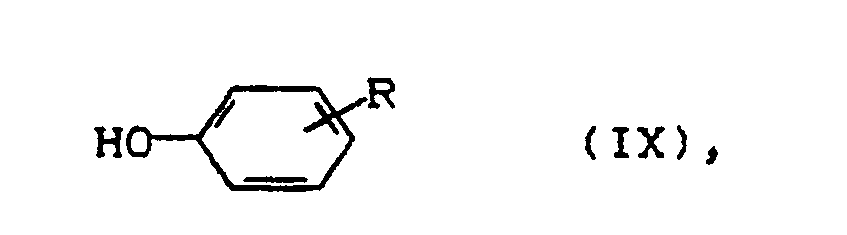
- Small amounts of phenols of the formula (IX) are particularly suitable for regulating the molecular weight wherein R represents a branched C8 and / or C9 alkyl radical.
- the proportion of CH3 protons in the alkyl radical R between 47 and 89% and the proportion of CH and CH2 protons between 53 and 11%; R is also preferably in the o- and / or p-position to the OH group, and particularly preferably the upper limit of the ortho fraction 20%.
- the chain terminators are generally used in amounts of 0.5 to 10, preferably 1.5 to 8 mol%, based on the diphenols used.
- the polycarbonates (b) can preferably be prepared in a manner known per se by the phase interface method (cf. H. Schnell, "Chemistry and Physics of Polycarbonates", Polymer Reviews, Vol. IX, page 33 ff., Interscience Publ., 1964) .
- the diphenols of the formula (I) are dissolved in an aqueous alkaline phase. Mixtures of diphenols of the formula (I) and the other diphenols, for example those of the formula (VIII), are used to prepare copolycarbonates with other diphenols.
- chain terminators e.g. of the formula (IX) are added.
- reaction with phosgene is carried out according to the phase interface condensation method.
- the reaction temperature is between 0 ° C and 40 ° C.
- the branching agents which are optionally used can either be initially charged with the diphenols in the aqueous alkaline phase or added dissolved in the organic solvent before the phosgenation.
- diphenols of the formula (I) and optionally other diphenols (VIII) their mono- and / or bis-chlorocarbonic acid esters can also be used, these being added in solution in organic solvents.
- the amount of chain terminators and branching agents then depends on the molar amount of diphenolate residues corresponding to formula (I) and optionally formula (VIII); if chlorocarbonic acid esters are used, the amount of phosgene can be reduced accordingly in a known manner.
- Suitable organic solvents for the chain terminators and optionally for the branching agents and the chlorocarbonic acid esters are, for example, methylene chloride, chlorobenzene, acetone, acetonitrile and mixtures of these solvents, in particular mixtures of methylene chloride and chlorobenzene. If necessary, the chain terminators and branches used can be solved in the same solvent.
- the organic phase for the interfacial polycondensation is, for example, methylene chloride, chlorobenzene and mixtures of methylene chloride and chlorobenzene.
- Aqueous NaOH solution for example, serves as the aqueous alkaline phase.
- the polycarbonates (b) can be prepared by the phase interface process in the customary manner by means of catalysts such as tertiary amines, in particular tertiary ones aliphatic amines such as tributylamine or triethylamine are catalyzed; the catalysts can be used in amounts of 0.05 to 10 mol%, based on moles of diphenols used.
- the catalysts can be added before the start of phosgenation or during or after the phosgenation.
- the polycarbonates (b) can also be prepared by the known process in homogeneous phase, the so-called “pyridine process” and by the known melt transesterification process using, for example, diphenyl carbonate instead of phosgene.
- the polycarbonates (b) preferably have molecular weights M w (weight average, determined by gel chromatography after prior calibration) of at least 10,000, particularly preferably from 10,000 to 200,000 and in particular from 20,000 to 80,000. They can be linear or branched, they are homopolycarbonates or copolycarbonates based on the diphenols of the Formula (I).
- Suitable polymers (b) are also aromatic polyether ketones with the recurring structural unit -OEOE′- (X), wherein -E'- a divalent radical of an aromatic ketone of the formula (XI) -Ar- -Ar′- (XI) With Ar and Ar ′ are the same or different difunctional aromatic radicals with 6 to 50 carbon atoms and in what -OEO- (XII), is a double-bonded diphenolate radical, which are characterized in that from 0.1 mol% to 100 mol%, preferably from 3 mol% to 100 mol% and in particular from 10 mol% to 100 mol% of the diphenolate radicals (XII) those of the formula (I a) are in which X, R1, R2, R3, R4 and m are as defined in formula (I).
- the aromatic polyether ketones preferably have average molecular weights M w (weight average), determined, for example, by gel permeation chromatography or light scattering from 742 to 500,000, preferably from 3,000 to 200,000 and in particular from 5,000 to 100,000.
- Aromatic polyether ketones are known (see for example GB-A 1 078 234, US-A 4 010 147 and EP-A 0 135 938). They can be prepared, for example, by reacting dialkali salts of diphenols with dihalodiaryl ketones in a polar solvent (see, for example, GB-PS 1 078 234), the dialkali salts of the diphenols also being able to be produced in situ.
- the polyether ketones can also be prepared by this method, with the polar solvent preferably C1-C5-alkyl-substituted caprolactam, such as N-methyl-caprolactam, N-ethyl-caprolactam, Nn-propyl-caprolactam, N-isopropyl-caprolactam, preferably N-methyl-caprolactam, and preferably nitrogen-substituted C1-C5-alkyl pyrrolidones, such as N-methylpyrrolidone, N, N-dimethylformamide, N, N-dimethylacetamide, dimethyl sulfoxide, dimethyl sulfone, sulfolane and tetramethyl urea.
- the polar solvent preferably C1-C5-alkyl-substituted caprolactam, such as N-methyl-caprolactam, N-ethyl-caprolactam, Nn-propyl-caprolactam, N
- polar solvent e.g. 0.1 to 200% by weight, based on the weight of the polar solvent
- other less polar solvents may also be used, e.g. aromatic hydrocarbons such as toluene, xylene, mesitylene, chlorobenzene or aliphatic hydrocarbons such as gasolines, cyclohexane.
- aromatic hydrocarbons such as toluene, xylene, mesitylene, chlorobenzene or aliphatic hydrocarbons such as gasolines, cyclohexane.
- Suitable diphenols of the formula (VIII) are, for example Hydroquinone, Resorcinol, Dihydroxydiphenyls, Bis (hydroxyphenyl) alkanes, Bis (hydroxyphenyl) cycloalkanes, Bis (hydroxyphenyl) sulfides, Bis (hydroxyphenyl) ether, Bis (hydroxyphenyl) ketones, Bis (hydroxyphenyl) sulfones, Bis (hydroxyphenyl) sulfoxides, ⁇ , ⁇ ′-bis (hydroxyphenyl) diisopropylbenzenes and their nuclear alkylated and nuclear halogenated compounds.
- Preferred other diphenols (VIII) are, for example: 4,4'-dihydroxydiphenyl, 2,2-bis (4-hydroxyphenyl) propane, 2,4-bis (4-hydroxyphenyl) -2-methylbutane, 1,1-bis (4-hydroxyphenyl) cyclohexane, ⁇ , ⁇ ′-bis (4-hydroxyphenyl) -p-diisopropylbenzene, 2,2-bis (3-methyl-4-hydroxyphenyl) propane, 2,2-bis (3-chloro-4-hydroxyphenyl) propane, Bis (3,5-dimethyl-4-hydroxyphenyl) methane, 2,2-bis (3,5-dimethyl-4-hydroxyphenyl) propane, Bis (3,5-dimethyl-4-hydroxyphenyl) sulfone, 2,4-bis (3,5-dimethyl-4-hydroxyphenyl) -2-methylbutane, 1,1-bis (3,5-dimethyl-4-hydroxyphenyl) cyclohexane, ⁇ ,
- diphenols (VII) are, for example: 2,2-bis (4-hydroxyphenyl) propane, 2,2-bis (3,5-dimethyl-4-hydroxyphenyl) propane, 2,2-bis (3,5-dichloro-4-hydroxyphenyl) propane, 2,2-bis (3,5-dibromo-4-hydroxyphenyl) propane, 1,1-bis (4-hydroxyphenyl) cyclohexane and 4,4'-dihydroxydiphenyl sulfone.
- Formula (XII) represents the residues of these diphenols formed by the removal of 2 H atoms or the alkali salts of this compound.
- Suitable dihalodiaryl ketones are: 4,4'-dichlorobenzophenone 4-chloro-4'-fluorobenzophenone 4,4′-difluorobenzophenone 4,4'-dichloroterephthalophenone 4,4'-difluoroterephthalophenone 4,4'-dichloroisophthalophenone 4,4'-difluoroisophthalophenone 4,4'-bis (p-chlorobenzoyl) diphenyl ether 4,4'-bis (p-fluorobenzoyl) diphenyl ether 3,3'-dinitro-4,4'-dichlorobenzophenone 3,3'-dinitro-4,4'-difluorobenzophenone 4,4'-bis (p-chlorobenzoyl) biphenyl 4,4'-bis (p-fluorobenzoyl) biphenyl 2,8-bis (p-chlorobenzoyl) diphenylene oxide 4,4'-bis (p-hal
- Sodium or potassium is preferably used as the alkali in the dialkaliphenolates.
- Preferred polyether ketones are those which have at least 10 mol% recurring structural units of the formula contain and have a molecular weight of over 3000 g / mol (weight average).
- the aromatic polyether ketones can be produced at temperatures of 130 ° C. to 350 ° C., preferably 145 ° C. to 280 ° C., and at a pressure of 0.8 to 10 bar, preferably 1 to 3 bar, in particular at atmospheric ambient pressure.
- the molar ratio of the alkali diphenolates to the dihalo-diaryl ketones (XI) is between 0.5 and 2, preferably between 0.8 and 1.2, particularly preferably between 0.95 and 1.05, a ratio for high molecular weights must be chosen from 1 or very close to 1.
- the polyether ketones can e.g. B. can be obtained as follows from the reaction mixtures obtained:
- the reaction mixture is diluted, especially if very highly viscous solutions are present, e.g. B. with the polar reaction solvent or another solvent for the polyether ketone, and filtered.
- a suitable acid e.g. Acetic acid
- the polyether ketone is poured into a suitable precipitation medium, e.g. B. water or alcohols, such as. B. methanol or isopropanol or water-alcohol mixtures, for. B. H2O / methanol 1: 1, precipitated, isolated and then dried.
- the aromatic polyether sulfones (b) preferably have average molecular weights M w (weight average) from 758 to 500,000, in particular from 3,000 to 200,000 and especially from 5,000 to 100,000.
- Aromatic polyether sulfones are known (see for example GB-A 1 078 234, US-A 4 010 147 and EP-A 0 135 938). They can be prepared, for example, by reacting dialkali salts of diphenols with dihalodiarylsulfones in a polar solvent (see, for example, GB-A 1 078 234), the dialkali salts of the diphenols also being able to be produced in situ.
- the polyether sulfones (b) can also be prepared by this method, the polar solvent preferably being C1-C5-alkyl-substituted caprolactam, such as N-methyl-caprolactam, N-ethyl-caprolactam, Nn-propyl-caprolactam, N-isopropyl, as the polar solvent.
- the polar solvent preferably being C1-C5-alkyl-substituted caprolactam, such as N-methyl-caprolactam, N-ethyl-caprolactam, Nn-propyl-caprolactam, N-isopropyl, as the polar solvent.
- caprolactam preferably N-methyl-caprolactam, and preferably on the nitrogen C1-C Pyr-alkyl-substituted pyrrolidones, such as N-methylpyrrolidone: N, N-dimethylformamide, N, N-dimethylacetamide, dimethyl sulfoxide, diphenyl sulfone, sulfolane or tetramethyl urea, are used.
- Proportionally e.g. 0.1 to 200% by weight, based on the weight of the polar solvent, of other less polar solvents, e.g. aromatic hydrocarbons such as toluene, xylene, mesitylene, chlorobenzene, or aliphatic hydrocarbons such as gasoline, cyclohexane.
- the polyether sulfones with the structural unit (XIII) are thus by reacting dialkalidiphenolates Alkali-OEO-alkali (XVI), with dihalo-diaryl sulfones (XIVa), wherein Ar and Ar 'are the same or different difunctional aromatic radicals having 6 to 50 carbon atoms and Hal halogen, preferably fluorine, chlorine and bromine, implemented in polar solvents by from 0.1 mol% to 100 mol%, preferably of 3 mol% to 100 mol% and in particular from 10 mol% to 100 mol% of the dialkalidiphenolates (XVI) of the formula Ib correspond, wherein X, R1, R2, R3, R4 and m are as defined in formula (I), used and the reaction in polar solvents such as N-alkylated caprolactams or N-alkylated pyrrolidones, preferably in N-alkylated pyrrolidones.
- polar solvents such as N
- Suitable diphenols are, for example Hydroquinone, Resorcinol, Dihydroxydiphenyls, Bis (hydroxyphenyl) alkanes, Bis (hydroxyphenyl) cycloalkanes, Bis (hydroxyphenyl) sulfides, Bis (hydroxyphenyl) ether, Bis (hydroxyphenyl) ketones, Bis (hydroxyphenyl) sulfones, Bis (hydroxyphenyl) sulfoxides, ⁇ , ⁇ ′-bis (hydroxyphenyl) diisopropylbenzenes and their nuclear alkylated and nuclear halogenated compounds.
- Preferred other diphenols are, for example: 4,4'-dihydroxydiphenyl, 2,2-bis (4-hydroxyphenyl) propane, 2,4-bis (4-hydroxyphenyl) -2-methylbutane, 1,1-bis (4-hydroxyphenyl) cyclohexane, ⁇ , ⁇ ′-bis (4-hydroxyphenyl) -p-diisopropylbenzene, 2,2-bis (3-methyl-4-hydroxyphenyl) propane, 2,2-bis (3-chloro-4-hydroxyphenyl) propane, Bis (3,5-dimethyl-4-hydroxyphenyl) methane, 2,2-bis (3,5-dimethyl-4-hydroxyphenyl) propane, Bis (3,5-dimethyl-4-hydroxyphenyl) sulfone, 2,4-bis (3,5-dimethyl-4-hydroxyphenyl) -2-methylbutane, 1,1-bis (3,5-dimethyl-4-hydroxyphenyl) cyclohexane, ⁇ , ⁇ ′-bis
- diphenols are, for example: 2,2-bis (4-hydroxyphenyl) propane, 2,2-bis (3,5-dimethyl-4-hydroxyphenyl) propane, 2,2-bis (3,5-dichloro-4-hydroxyphenyl) propane, 2,2-bis (3,5-dibromo-4-hydroxyphenyl) propane and 1,1-bis (4-hydroxyphenyl) cyclohexane and 4,4'-dihydroxydiphenyl sulfone.
- Suitable dihalodiarylsulfones are, for example 4,4′-dichlorodiphenyl sulfone, 4,4′-difluorodiphenyl sulfone, 4-chloro-4′-fluorodiphenyl sulfone, 3,3′-dinitro-4,4′-dichlorodiphenyl sulfone, 3,3'-dinitro-4,4'-difluorodiphenyl sulfone, 4,4′-dibromodiphenyl sulfone,
- Sodium and potassium are preferably used as the alkali in the dialkaliphenolates (Ib) and (XVI).
- Chlorine and fluorine, in particular chlorine, are preferably used as the halogen in the dihalodiaryl sulfones.
- Preferred polyether sulfones according to the invention are those which contain at least 10 mol% of the repeating unit contain, and have a molecular weight (weight average) of over 3000 g / mol.
- the aromatic polyether sulfones (b) can be prepared at temperatures from 130 ° C. to 320 ° C., preferably 145 ° C. to 280 ° C. and at pressures from 0.8 to 10 bar, preferably 1 to 3 bar, in particular at atmospheric ambient pressure.
- the molar ratio of the alkali diphenolates (Ib) and (XVI) to the dihalodiaryl sulfones (XIII) is between 0.5 and 2, preferably 0.8 and 1.2, particularly preferably 0.95 and 1.05, a ratio of 1 or close to 1 must be chosen for high molecular weights.
- the amount of polar solvents is 0.5 to 50, preferably 2 to 20 parts by weight, based on the total weight of the polyether sulfone formation components.
- the polyether sulfones (b) can be obtained from the reaction mixtures obtained as follows.
- the reaction mixture is diluted, especially if very highly viscous solutions are present, e.g. with the polar reaction solvent or another solvent for the polyether sulfone, and filtered.
- a suitable acid e.g. Acetic acid
- the polyethersulfone is poured into a suitable precipitation medium, e.g. Water, alcohols (such as methanol, isopropanol) or water-alcohol mixtures, e.g. H2O / methanol 1: 1, precipitated, isolated and then dried.
- a suitable precipitation medium e.g. Water, alcohols (such as methanol, isopropanol) or water-alcohol mixtures, e.g. H2O / methanol 1: 1, precipitated, isolated and then dried.
- Polyarylene sulfides suitable according to the invention can be linear or branched polyarylene sulfides of the formula (XVII) (-S-Ar-) n (XVII), in which -Ar- stands for a C6-C30 arylene group, which may optionally contain other groups such as carbonyl, sulfone, etc.
- radicals Ar are p-phenylene, m-phenylene, o-phenylene groups, alkyl-substituted phenylenes, p, p'-biphenylene, p, p'-diphenyl ether, p, p'-diphenylcarbonyl or higher aromatic (hetero ) Cycles such as naphthalene. If appropriate, admixtures of disulfide, dibenzothiophene, thiantrene, sulfone structures and branching agents can also be present.
- the polyarylene sulfides of the formula (XVII) which are suitable according to the invention can furthermore be modified in a known manner with known end groups.
- the polyarylene sulfides are known (e.g. US-A 3 354 129, EP-A 171 021) and commercially available (e.g. Ryton®, Tedur®, Fortron®).
- the linear or branched polyarylene sulfides suitable according to the invention preferably have at least 40% by weight, based on the total weight of component (a), structural units of the formula (XVIII) in which R1 to R4 are independent of one another or are identical and are C1-C6-alkyl, phenyl or hydrogen.
- the polyarylene sulfides may furthermore preferably also contain biphenylene, diphenyl ketone and / or diphenyl sulfone units.
- the mixtures may also contain additives (c).
- suitable additives are: - inorganic or organic fillers - fibers - nucleating agents - protective and coloring agents etc., as described, for example, in Modern Plastics Encyclopedia 1988, Vol 66, No. 10A, pp. 183-194 and pp. 127-178.
- Inorganic fillers are particularly suitable as fillers, e.g. Ceramic fillers such as aluminum nitride, silicates, titanium dioxide, talc, chalk, mica, carbon black, graphite, glass spheres etc. It is also possible to use fibers made of glass, carbon and fibers made of polymers.
- the fibers should not melt at the usual processing temperature of the mixtures according to the invention and should have tensile moduli of elasticity (measured in a tensile test at room temperature and a tensile speed of less than 10 cm / min) of more than 10 GPa, preferably more than 18 GPa.
- Such polymer fibers are, for example, fibers made from fully aromatic liquid-crystalline polymers.
- Nucleating agents are, for example, barium sulfate or titanium dioxide.
- additives can be added to components (a) or (b) either before the mixtures according to the invention are prepared, or together with component (b) to component (a) or subsequently to the mixtures from (a) and (b).
- the additives mentioned can be added to the polycarbonates of component (b) before or during or after mixing with component (a) in the usual amounts.
- the mixtures contain from 95 to 99.8 parts by weight, preferably from 96 to 99.5 parts by weight, in particular from 96 to 99 parts by weight of component (a), from 5 to 0.2 parts by weight, preferably from 4 to 0.5 parts by weight, in particular from 4 to 1.0 parts by weight of component (b), and if necessary from 0 to 80 parts by weight, preferably from 0 to 75 parts by weight, in particular from 0 to 70 parts by weight of component (c).
- the mixtures are prepared by the starting components in a manner known per se at temperatures from 250 ° C. to 450 ° C., preferably from 260 ° C. to 430 ° C., in particular from 280 ° C. to 430 ° C., with shear rates of 0. 1 s ⁇ 1 to 1000 s ⁇ 1, preferably from 1 s ⁇ 1 to 800 s ⁇ 1, mixed by intimate mixing, extrusion or kneading and then optionally granulated and further processed in injection molding to give molded parts.
- the invention also relates to a process for the preparation of the mixtures according to the invention from components (a), (b) and optionally (c), characterized in that the individual components (a) and (b) at temperatures from 250 ° C. to 450 ° C. ° C at shear rates from 0.1 s ⁇ 1 to 1000 s ⁇ 1 mixed by kneading, extruding or other methods in known mixing equipment.
- Another object of the present invention is the use of the mixtures for the production of shaped bodies.
- These shaped bodies can be used in the electrical and electronics sector, in the automotive sector (automotive interior and exterior equipment), as films for covering or wrapping or for protecting any other shaped parts and as fibers either as reinforcing agents in other polymers or for the production of fabrics.
- the moldings produced from the mixtures according to the invention are readily permeable to sulfur dioxide. This means that any SO2 inclusions in polyarylene sulfides can be outgassed - even during the manufacture of the molded parts.
- the outgassing of a substance in a molded part can be described physically by the permeation of the outgassing substance by the polymer from which the molded part is made.
- the permeation depends on the temperature and the gas humidity.
- the measuring arrangement consists of a thermostatted two-chamber system.
- One chamber is designed to hold the target gas and the other to hold the permeate.
- the chambers are closed by measuring polymer membrane separated.
- the increase in pressure in the permeate chamber is recorded with a pressure sensor, for example a baratron from MKS, as a function of the time until the stationary gas passage.
- the permeation coefficient P is in units measured, referring to a membrane thickness of 1mm. Other measurement parameters are: Temperature: 25 ° C at a rel. Gas humidity of 0%
- 1 part by weight of the polycarbonate from Example 2 is intimately mixed with 99 parts by weight of polyarylene sulfide from Example 5 in a kneader at about 315 ° C. and from the mixture at 275 ° C. under a pressure of 200 bar within 4 minutes after five minutes of tempering at 270 ° C. Molded part with a thickness of 368 ⁇ m pressed under a circular area of 5 cm2.
- the permeability for SO2 was 54.9 standard units.
- Example 3 1 part by weight of the polyether ketone from Example 3 is mixed with 99 parts by weight of polyarylene sulfide from Example 5 as in Example 1 according to the invention and a molded part of similar size, but with a thickness of 390 ⁇ m, is pressed.
- the permeability for SO2 was 9.1 standard units.
Landscapes
- Chemical & Material Sciences (AREA)
- Health & Medical Sciences (AREA)
- Chemical Kinetics & Catalysis (AREA)
- Medicinal Chemistry (AREA)
- Polymers & Plastics (AREA)
- Organic Chemistry (AREA)
- Compositions Of Macromolecular Compounds (AREA)
- Polyesters Or Polycarbonates (AREA)
Abstract
Die Erfindung betrifft gasdurchlässige, vorzugsweise für Schwefeldioxid besonders gut durchlässige Polyarylensulfid-Mischungen, enthaltend 95 bis 99,8 Teile Polyarylensulfid, 5 bis 0,2 Gewichtsteile Bisphenole mit speziellen cycloaliphatischen Seitengruppen und/oder Polymere auf Basis von wenigstens 20 Mol.-% dieser Bisphenole sowie gegebenenfalls 0 bis 80 Gewichtsteile bekannte Additive wie Weichmacher, Füllstoffe oder Verstärkungsstoffe. Weiterhin betrifft die Erfindung ein Verfahren zur Herstellung der Mischungen und ihre Verwendung als geformte Körper.
Description
- Die Erfindung betrifft gasdurchlässige, vorzugsweise für Schwefeldioxid besonders gut durchlässige Polyarylensulfid-Mischungen, enthaltend 95 bis 99,8 Teile Polyarylensulfid, 5 bis 0,2 Gewichsteile Bisphenole mit speziellen cycloaliphatischen Seitengruppen und/oder Polymere auf Basis von wenigstens 20 Mol.-% dieser Bisphenole sowie gegebenenfalls 0 bis 80 Gewichtsteile bekannte Additive wie Weichmacher, Füllstoffe oder Verstärkungsstoffe. Weiterhin betrifft die Erfindung ein Verfahren zur Herstellung der Mischungen und ihre Verwendung als geformte Körper.
- Gegenstand der Erfindung sind Mischungen, enthaltend
- a) 95 bis 99,8 Gewichts-Teile Polyarylensulfid (PAS), vorzugsweise Polyphenylensulfid (PPS) und
- b) 5 bis 0,2 Gewichts-Teile Polymere und/oder Oligomere auf Basis der Bisphenole der Formel (I) und/oder Bisphenole der Formel (I) selbst,

R₁ und R₂ unabhängig voneinander Wasserstoff, Halogen (Cl, Br), C₁-C₈-Alkyl, C₅-C₆-Cycloalkyl, C₆-C₁₀-Aryl, C₇-C₁₂-Aralkyl und C₇-C₁₂-Alkylaryl bedeuten,
m für die Zahlen 4, 5, 6 oder 7 steht,
R₃ und R₄ für jedes X individuell wählbar, unabhängig voneinander Wasserstoff oder C₁-C₆-Alkyl und
X Kohlenstoff bedeuten,
mit der Maßgabe, daß an mindestens einem Atom X, R₃ und R₄ gleichzeitig Alkyl ist,
sowie gegebenenfalls - c) 0 bis 80 Gewichts-Teile weitere Additive.
- In der DE-A 3 832 396 sind die Ausgangsprodukte der Formel (I) sowie Beispiele für erfindungsgemäß verwendbare Polymere, nämlich (Co-)Polycarbonate beschrieben.
- In der DE-A 3 833 386 sind Polyetherketone auf Basis der Bisphenole (I) beschrieben, in der DE-A 3 833 385 sind Polyethersulfone auf Basis der Bisphenole (I) beschrieben.
- Ausgangsprodukte für die Polycarbonate, Polyetherketone und Polyethersulfone sind Dihydroxydiphenylcycloalkane der Formel (I). Bevorzugt sind an 1-2 Atomen X, insbesondere nur an einem Atom X, R₃ und R₄ gleichzeitig Alkyl. Bevorzugter Alkyl-Rest ist Methyl. Die X-Atome in alpha-Stellung zu dem Diphenyl-substituierten C-Atom (C-1) sind bevorzugt nicht dialkylsubstitiert. Eine Alkyldisubstitution in beta-Stellung zu C-1 ist bevorzugt. Bevorzugt sind Dihydroxydiphenylcycloalkane mit 5 und 6 Ring-C-Atomen im cycloaliphatischen Rest (m=4 oder 5 in Formel (I)), beispielsweise die Diphenole der Formeln

- 1,1-Bis-(4-hydroxyphenyl)-3,3,3-trimethylcyclohexan (II) ist besonders bevorzugt.
- Die Diphenole der Formel (I) können für sich - ohne als Polymer eingesetzt zu werden - in dem angegebenen Gewichtsbereich eingesetzt werden. Es können für diesen Fall noch bis zu weiteren 5 Gewichts-Teilen andere Diphenole mit zugegeben werden.
- Die Diphenole der Formel (I) können aber auch zur Herstellung von Polymeren verwendet werden, die ihrerseits als Komponente (b) - gegebenenfalls mit einem Gemisch aus Diphenolen (I) - eingesetzt werden können.
- Polymere aus solchen Diphenolen sind Polycarbonate, Polyetherketone und Polyethersulfone.
- Es können auch Gemische der Diphenole (I) mit anderen bekannten Diphenolen zur Herstellung der erfindungsgemäß verwendbaren Polymere (b) eingesetzt werden. Auch diesen Copolymeren (statistisch oder Block-) können - bis zu den angegebenen Gewichtsteilen - Diphenole der Formel (I) selbst zugemischt werden. Weiterhin können auch beliebige Mischungen dieser verschiedenen Polymere (z.B. Polycarbonat/Polyethersulfon-Mischungen) als Komponente (b) verwendet werden. Die Komponente und/oder Polymere (b) enthält Diphenole der Formel (I) auf Basis der Diphenole der Formel (I). Copolymere sind dann bevorzugt, wenn sie aus wenigstens 20 Mol.-% Diphenolen der Formel (I) bestehen.
- Die Molekulargewichte der erfindungsgemäß verwendbaren Komponenten (b) können vom Molekulargewicht des reinen Diphenols bis hin zu hochmolekularen Polymeren, also bis hin zu Molekulargewichten oberhalb 300.000 g/mol reichen. Auch Oligomere und Mischungen der Oligomeren mit hochmolekularen Polymeren sind verwendbar Zur Vermeidung von unerwünschten Ausdampfungen sind Polymere mit einem Molekulargewicht von 10.000 bis 250.000 g/mol (Gewichtsmittel Mw, gemessen beispielsweise mit der Gelpermeationschromatographie) bevorzugt. Insbesondere sind Molekulargewichte zwischen 15.000 und 230.000 g/mol bevorzugt. Die chemische Uneinheitlichkeit un = Mw/Mn ⁻ 1 kann bis zu 20 betragen.
- Erfindungsgemäß können beliebige Mischungen der Polymere Polyetherketon, Polyethersulfon, Polycarbonat und Diphenole (I) - zusammen 5 bis 0,2 Gewichtsteile - als Komponente (b) verwendet werden. Dies können folglich Einzelkomponenten, binäre Mischungen, ternäre Mischungen sowie Mischungen aller vier Komponenten untereinander sein. Bevorzugt sind die Einzelkomponenten selbst, von denen wiederum die Polymere, insbesondere die (Co-)Polycarbonate, bevorzugt sind.
- Andere Diphenole für die Komponente (b) sind Diphenole der Formel (V)
HO-Z-OH (V),
in welcher
Z ein aromatischer Rest mit 6 bis 50 C-Atomen ist, der einen oder mehrere aromatische Reste enthalten kann, substituiert sein kann und aliphatische Reste oder andere cycloaliphatische Reste als die der Formel (I) oder Heteroatome als Brückenglieder enthalten kann. - Geeignete Diphenole sind z.B.
Hydrochinon,
Resorcin,
Dihydroxidiphenyle,
Bis-(hydroxyphenyl)-alkane,
Bis-(hydroxyphenyl)-cycloalkane,
Bis-(hydroxyphenyl)-sulfide,
Bis-(hydroxyphenyl)-ether,
Bis-(hydroxyphenyl)-ketone,
Bis-(hydroxyphenyl)-sulfone,
Bis-(hydroxyphenyl)-sulfoxide,
α,α′-Bis-(hydroxyphenyl)-diisopropylbenzole,
sowie deren kernalkylierte und kernhalogenierte Verbindungen. Diese und weitere geignete andere Diphenole sind z.B. in den US-A 3 028 365, 2 999 835, 3 148 172, 3 275 601, 2 991 273, 3 271 367, 3 062 781, 2 970 131 und 2 999 846, in den DE-A 1 570 703, 2 063 050, 2 063 050, 2 063 052, 2 211 956, der FR-A 1 561 518 und in der Monographie "H. Schnell, Chemistry and Physics of Polycarbonates, Interscience Publishers, New York, 1964, beschrieben. - Bevorzugte Diphenole sind
Hydrochinon,
4,4′-Dihydroxydiphenylether,
4,4′-Dihydroxybenzophenon,
4,4′-Dihydroxydiphenyl,
2,2-Bis-(4-hydroxyphenyl)-propan,
2,4-Bis-(4-hydroxyphenyl)-2-methylbutan,
1,1-Bis-(4-hydroxyphenyl)-cyclohexan. - Ganz besonders bevorzugt ist 2,2-Bis-(4-hydroxyphenyl)-propan (Bisphenol A).
- Die Herstellung der Diphenole (I) sowie der (Co-)Polycarbonate ist im Detail der DE-A 3 832 396 zu entnehmen. Die Herstellung der beiden anderen Polykondensate entnimmt man der DE-A 3 833 385 bzw. DE-A 3 833 386.
- Im folgenden sind die Herstellverfahren für die Diphenole (I) sowie die Polymeren (b) nochmals beschrieben.
- Polymere (b) sind beispielsweise Polycarbonate, Polyetherketone, Polyethersulfone.
- Die Dihydroxydiphenylcycloalkane der Formel (I) können in an sich bekannter Weise durch Kondensation von Phenolen der Formel (VI)


- Die Phenole der Formel (VI) sind entweder literaturbekannt oder nach literaturbekannten Verfahren erhältlich (siehe beispielsweise für Kresole und Xylenole, Ullmanns Encyklopädie der technischen Chemie 4. neubearbeitete und erweiterte Auflage Band 15, Seiten 61 - 77, Verlag Chemie-Weinheim-New York 1978; für Chlorphenole, Ullmanns Encyklopädie der technischen Chemie, 4. Auflage, Verlag Chemie, 1975, Band 9, Seiten 573-582; Alkylphenole, Ullmanns Encyklopädie der technischen Chemie, 4. Auflage, Verlag Chemie 1979, Band 18, Seiten 191-214).
- Beispiele für geeignete Phenole der Formel (VI) sind: Phenol, o-Kresol, m-Kresol, 2,6-Dimethylphenol, 2-Chlorphenol, 3-Chlorphenol, 2,6-Dichlorphenol, 2-Cyclohexylphenol, Phenylphenole und o- oder p-Benzylphenole.
- Die Ketone der Formel (VII) sind literaturbekannt (siehe beispielsweise Beilsteins Handbuch der Organischen Chemie, 7. Band, 4. Auflage, Springer-Verlag, Berlin, 1925 und die entsprechenden Ergänzungsbände 1 bis 4, und J. Am. Chem. Soc. Vol 79 (1957), Seiten 1488, 1490 und 1491, US-PS 2 692 289, Allen et al., J. Chem. Soc., (1954), 2186, 2191 und J. Org. Chem. Vol. 38, No. 26, (1973), Seiten 4431 ff, J. Am. Chem. Soc. 87, (1965), Seite 1353 ff, insbesondere Seite 1355). Ein allgemeines Verfahren zur Herstellung von Ketonen der Formel (VII) ist beispielsweise in "Organikum, 15. Auflage, 1977, VEB-Deutscher Verlag der Wissenschaften, Berlin, beispielsweise Seite 698. beschrieben.
- Beispiele für bekannte Ketone der Formel (VII) sind:
3,3-Dimethylcyclopentanon, 2,2-Dimethylcyclohexanon, 3,3-Dimethylcyclohexanon, 4,4-Dimethylcyclohexanon, 3-Ethyl-3-Methylcyclopentanon, 2,3,3-Trimethylcyclopentanon, 2,4,4-Trimethylcyclopentanon, 3,3,4-Trimethylcyclopentanon, 3,3-Dimethylcycloheptanon, 4,4-Dimethylcycloheptanon, 3-Ethyl-3-methylcyclohexanon, 4-Ethyl-4-methylcyclohexanon, 2,3,3-Trimethylcyclohexanon, 2,4,4-Trimethylcyclohexanon, 3,3,4-Trimethylcyclohexanon, 2,5,5-Trimethylcyclohexanon, 3,3,5-Trimethylcyclohexanon, 3,4,4-Trimethylcyclohexanon, 2,3,3,4-Tetramethylcyclopentanon, 2,3,4,4-Tetramethylcyclopentanon, 3,3,4,4-Tetramethylcyclopentanon, 2,2,5-Trimethylcycloheptanon, 2,2,6-Trimethylcycloheptanon, 2,6,6-Trimethylcycloheptanon, 3,3,5-Trimethylcycloheptanon, 3,5,5-Trimethylcycloheptanon, 5-Ethyl-2,5-dimethylcycloheptanon, 2,3,3,5-Tetramethylcycloheptanon, 2,3,5,5-Tetra methylcycloheptanon, 3,3,5,5-Tetramethylcycloheptanon, 4-Ethyl-2,3,4-trimethylcyclopentanon, 2-Isopropyl-4,4-dimethylcyclopentanon, 4-Isopropyl-2,4-dimethylcyclopentanon, 2-Ethyl-3,5,5-trimethylcyclohexanon, 3-Ethyl-3,5,5-trimethylcyclohexanon, 3-Ethyl-4-isopropyl-3-methyl-cyclopentanon, 4-sec. Butyl-3,3-dimethylcyclopentanon, 2-Isopropyl-3,3,4-trimethylcyclopentanon, 3-Ethyl-4-isopropyl-3-methyl-cyclohexanon, 4-Ethyl-3-isopropyl-4-methyl-cyclohexanon, 3-sec.Butyl-4,4-dimethylcyclohexanon, 3-Isopropyl-3,5,5-trimethylcyclohexanon, 4-Isopropyl-3,5,5-trimethylcyclohexanon, 3,3,5-Trimethyl-5-propylcyclohexanon, 3,5,5-Trimethyl-5-propylcyclohexanon, 2-Butyl-3,3,4-trimethylcyclopentanon, 2-Butyl-3,3,4-trimethylcyclohexanon, 4-Butyl-3,3,5-trimethylcyclohexanon, 3-Isohexyl-3-methylcyclohexanon, 5-Ethyl-2,4-diisopropyl-5-methylcyclohexanon, 2,2-Dimethylcyclooctanon, und 3,3,8-Trimethylcyclooctanon. - Beispiele für bevorzugte Ketone sind

- Zur Bisphenolherstellung werden im allgemeinen 2 bis 10 Mol, vorzugsweise 2,5 bis 6 Mol Phenol (VI) pro Mol Keton (VI), verwendet. Bevorzugte Reaktionszeiten betragen 1 bis 100 Stunden. Im allgemeinen arbeitet man bei Temperaturen von -30°C bis 300°C, vorzugsweise von -15°C bis 150°C und bei Drücken von 1 bis 20 bar, vorzugsweise von 1 bis 10 bar.
- Die Kondensation wird im allgemeinen in Gegenwart saurer Katalysatoren durchgeführt. Beispiele sind Chlorwasserstoff, Bromwasserstoff, Fluorwasserstoff, Bortrifluorid, Aluminiumtrichlorid, Zinkdichlorid, Titantetrachlorid, Zinntetrachlorid, Phosphorhalogenide, Phosphorpentoxid, Phosphorsäure, konzentrierte Salzsäure oder Schwefelsäure sowie Mischungen aus Essigsäure und Acetanhydrid. Die Verwendung saurer Ionenaustauscher ist ebenfalls möglich.
- Weiterhin kann die Umsetzung durch Zugabe von Co-Katalysatoren wie C₁-C₁₈-Alkyl-Mercaptanen, Schwefelwasserstoff, Thiophenolen, Thiosäuren und Dialkylsulfiden beschleunigt werden.
- Die Kondensation kann ohne Lösungsmittel oder in Gegenwart eines inerten Lösungsmittels (z.B. aliphatischer und aromatischer Kohlenwasserstoff, Chlorkohlenwasserstoff) durchgeführt werden.
- In den Fällen, in denen der Katalysator gleichzeitig als wasserentziehendes Mittel fungiert, ist es nicht erforderlich, zusätzlich wasserentziehende Mittel einzu setzen, letzteres ist jedoch zur Erzielung guter Umsätze in jedem Fall dann vorteilhaft, wenn der eingesetzte Katalysator das Reaktionswasser nicht bindet.
- Geeignete wasserentziehende Mittel sind beispielsweise Acetanhydrid, Zeolithe, Polyphosphorsäure und Phosphorpentoxid.
- Man kann Phenol (VI) und Keton (VII) im Molverhältnis (VI) : (VII) zwischen 2:1 und 10:1, vorzugsweise zwischen 2,5 : 1 und 6 : 1 bei Temperaturen zwischen -30°C und 300°C, vorzugsweise zwischen -15°C und 150°C und bei Drücken von 1 bis 20 bar, vorzugsweise von 1 bis 10 bar in Anwesenheit saurer Katalysatoren und gegebenenfalls in Anwesenheit von Co-Katalysatoren und/oder Lösungsmitteln und/oder wasserentziehenden Mitteln umsetzen.
- Bevorzugt sind in Formel (I) an 1 - 2 Atomen X, insbesondere nur an einem Atom X, R³ und R⁴ gleichzeitig Alkyl. Bevorzugter Alkylrest ist Methyl; ebenfalls verwendbar sind Ethyl oder C₃-C₆-Alkylreste, die geradkettig oder verzweigt sein können. Die X-Atome in α-Stellung zu dem di-phenylsubstituierten C-Atom (C-1) sind bevorzugt nicht dialkylsubstituiert, dagegen ist die Disubstitution mit Alkyl in β-Stellung in C-1 bevorzugt.
- In manchen Fällen verläuft die Reaktion nicht ganz einheitlich, d.h. es können mehrere, unterschiedliche Produkte entstehen, so daß die gewünschte Verbindung zunächst aus einem Gemisch isoliert werden muß. Für Ein zelheiten der Kondensation sei auf Schnell, Chemistry und Physics of Polycarbonates, Interscience Publishers, New York 1964 verwiesen. Manchmal kann die Reaktion durch Wahl entsprechender Katalysatoren und Reaktionsbedingungen so gesteuert werden, daß die gewünschte Verbindung ausfällt oder auskristallisiert, was deren Isolierung erleichtert.
- Die Polycarbonate (b) können gemäß der DE-A 3 832 396 aus Diphenolen der Formel (I) hergestellt werden.
- Es können sowohl ein Diphenol der Formel (I) unter Bildung von Homopolycarbonaten als auch mehrere Diphenole der Formel (I) unter Bildung von Copolycarbonaten verwendet werden.
- Außerdem können die Diphenole der Formel (I) auch im Gemisch mit anderen Diphenolen, beispielsweise mit denen der Formel HO-Z-OH (VIII), zur Herstellung von hochmolekularen, thermoplastischen, aromatischen Polycarbonaten verwendet werden.
- Geeignete andere Diphenole der Formel HO-Z-OH (VIII) sind solche, in denen Z ein aromatischer Rest mit 6 bis 30 C-Atomen ist, der einen oder mehrere aromatische Kerne enthalten kann, substituiert sein kann und aliphatische Reste oder andere cycloaliphatische Reste als die der Formel (I) oder Heteroatome als Brückenglieder enthalten kann.
- Beispiele für Diphenole der Formel (VIII) sind
Hydrochinon,
Resorcin,
Dihydroxydiphenyle,
Bis-(hydroxyphenyl)-alkane,
Bis-(hydroxyphenyl)-cycloalkane,
Bis-(hydroxyphenyl)-sulfide,
Bis-(hydroxyphenyl)-ether,
Bis-(hydroxyphenyl)-ketone,
Bis-(hydroxyphenyl)-sulfone,
Bis-(hydroxyphenyl)-sulfoxide,
α,α′-Bis(hydroxyphenyl)-diisopropylbenzole
sowie deren kernalkylierte und kernhalogenierte Verbindungen. - Diese und weitere geeignete andere Diphenole sind z.B. in den US-A 3 028 365, 2 999 835, 3 148 172, 3 275 601, 2 991 273, 3 271 367, 3 062 781, 2 970 131 und 2 999 846, in den DE-A 1 570 703, 2 063 050, 2 063 052, 2 211 0956, der Fr-A 1 561 518 und in der Monographie "H. Schnell, Chemistry and Physics of Polycarbonates, Interscience Publishers, New York 1964", beschrieben.
- Bevorzugte andere Diphenole sind beispielsweise:
4,4′-Dihydroxydiphenyl,
2,2-Bis-(4-hydroxyphenyl)-propan,
2,4-Bis-(4-hydroxyphenyl)-2-methylbutan,
1,1-Bis-(4-hydroxyphenyl)-cyclohexan,
α,α′-Bis-(4-hydroxyphenyl)-p-diisopropylbenzol,
2,2-Bis-(3-methyl-4-hydroxyphenyl)-propan,
2,2-Bis-(3-chlor-4-hydroxyphenyl)-propan,
Bis-(3,5-dimethyl-4-hydroxyphenyl)-methan,
2,2-Bis-(3,5-dimethyl-4-hydroxyphenyl)-propan,
Bis-(3,5-dimethyl-4-hydroxyphenyl)-sulfon,
2,4-Bis-(3,5-dimethyl-4-hydroxyphenyl)-2-methylbutan,
1,1-Bis-(3,5-dimethyl-4-hydroxyphenyl)-cyclohexan,
α,α′-Bis-(3,5-dimethyl-4-hydroxyphenyl)-p-diisopropylbenzol,
2,2-Bis-(3,5-dichlor-4-hydroxyphenyl)-propan und
2,2-Bis-(3,5-dibrom-4-hydroxyphenyl )-propan. - Besonders bevorzugte Diphenole der Formel (VIII) sind beispielsweise:
2,2-Bis-(4-hydroxyphenyl)-propan,
2,2-Bis-(3,5-dimethyl-4-hydroxyphenyl)-propan,
2,2-Bis-(3,5-dichlor-4-hydroxyphenyl)-propan,
2,2-Bis-(3,5-dibrom-4-hydroxyphenyl)-propan und
1,1-Bis-(4-hydroxyphenyl)-cyclohexan. - Insbesondere ist 2,2-Bis-(4-hydroxyphenyl)-propan bevorzugt.
- Die anderen Diphenole können sowohl einzeln als auch im Gemisch eingesetzt werden.
- Das molare Verhältnis von Diphenolen der Formel (I) zu den gegebenenfalls mitzuverwendenden anderen Diphenolen, beispielsweise denen der Formel (VIII), soll zwischen 100 Mol-% (I) zu 0 Mol-% anderem Diphenol und 2 Mol-% (I) zu 98 Mol-% anderem Diphenol, vorzugsweise zwischen 100 Mol% (I) zu 0 Mol% anderem Diphenol und 5 Mol% (I) zu 95 Mol% anderem Diphenol und insbesondere zwischen 100 Mol%(I) zu 0 Mol% anderem Diphenol und 10 Mol% (I) zu 90 Mol% anderem Diphenol und 10 Mol% (I) zu 90 Mol% anderem Diphenol und ganz besonders zwischen 100 Mol% (I) zu 0 Mol% anderem Diphenol und 20 Mol% (I) zu 80 Mol% anderem Diphenol liegen.
- Die hochmolekularen Polycarbonate aus den Diphenolen der Formel (I), gegebenenfalls in Kombination mit anderen Diphenolen können nach den bekannten Polycarbonatherstellungsverfahren hergestellt werden. Dabei können die verschiedenen Diphenole sowohl statistisch als auch blockweise miteinander verknüpft sein.
- Die Polycarbonate können in an sich bekannter Weise verzweigt sein. Wenn Verzweigung gewünscht wird, kann sie in bekannter Weise durch Einkondensieren geringer Mengen, vorzugsweise Mengen zwischen 0,05 und 2,0 Mol% (bezogen auf eingesetzte Diphenole), an drei-oder mehr als dreifunktionellen Verbindungen, insbesondere solchen mit drei oder mehr als drei phenolischen Hydroxylgruppen erreicht werden. Einige Verzweiger mit drei oder mehr als drei phenolischen Hydroxylgruppen sind
Phloroglucin,
4,6-Dimethyl-2,4,6-tri-(4-hydroxyphenyl)-hepten-2,
4,6-Dimethyl-2,4,6-tri-(4-hydroxyphenyl)-heptan,
1,3,5-Tri-(4-hydroxyphenyl)-benzol,
1,1,1-Tri-(4-hydroxyphenyl)-ethan,
Tri-(4-hydroxyphenyl)-phenylmethan,
2,2-Bis-(4,4-bis-(4-hydroxyphenyl)-cyclohexyl)-propan,
2,4-Bis-(4-hydroxyphenyl-isopropyl)-phenol,
2,6-Bis-(2-hydroxy-5′-methyl-benzyl)-4-methylphenol,
2-(4-Hydroxyphenyl)-2-(2,4-dihydroxyphenyl)-propan,
Hexa-(4-(4-hydroxyphenyl-isopropyl)-phenyl)-ortho-terephthalsäureester,
Tetra-(4-hydroxyphenyl)-methan,
Tetra-(4-(4-hydroxyphenyl-isopropyl)-phenoxy)-methan und
1,4-Bis-((4′-,4˝-dihydroxytriphenyl)-methyl)-benzol. - Einige der sonstigen dreifunktionellen Verbindungen sind 2,4-Dihydroxybenzoesäure, Trimesinsäure, Cyanurchlorid und 3,3-Bis-(3-methyl-4-hydroxyphenyl)-2-oxo-2,3-dihydroindol.
- Als Kettenabbrecher zur an sich bekannten Regelung des Molekulargewichts der Polycarbonate (a) dienen monofunktionelle Verbindungen in üblichen Konzentrationen. Geeignete Verbindungen sind z.B. Phenol, tert.-Butylphenole oder andere Alkyl-C₁-C₇-substituierte Phenole. Zur Regelung des Molekulargewichts sind insbesondere kleine Mengen Phenole der Formel (IX) geeignet
- Die Polycarbonate (b) können vorzugsweise nach dem Phasengrenzflächenverfahren (vgl. H. Schnell, "Chemistry and Physics of Polycarbonates", Polymer Reviews, Vol. IX, Seite 33 ff., Interscience Publ., 1964) in an sich bekannter Weise hergestellt werden. Hierbei werden die Diphenole der Formel (I) in wäßrig alkalischer Phase gelöst. Zur Herstellung von Co-Polycarbonaten mit anderen Diphenolen werden Gemische von Diphenolen der Formel (I) und den anderen Diphenolen, beispielsweise denen der Formel (VIII), eingesetzt. Zur Regulierung des Molekulargewichtes können Kettenabbrecher z.B. der Formel (IX) zugegeben werden. Dann wird in Gegenwart einer inerten, vorzugsweise Polycarbonat lösenden, organischen Phase mit Phosgen nach der Methode der Phasengrenzflächenkondensation umgesetzt. Die Reaktionstemperatur liegt zwischen 0°C und 40°C.
- Die gegebenenfalls mitverwendeten Verzweiger (bevorzugt 0,05 bis 2 Mol-%) können entweder mit den Diphenolen in der wäßrig alkalischen Phase vorgelegt werden oder in dem organischen Lösungsmittel gelöst vor der Phosgenierung zugegeben werden.
- Neben den Diphenolen der Formel (I) und gegebenenfalls anderen Diphenolen (VIII) können auch deren Mono- und/oder Bis-chlorkohlensäureester mitverwendet werden, wobei diese in organischen Lösungsmitteln gelöst zugegeben werden. Die Menge an Kettenabbrechern sowie an Verzweigern richtet sich dann nach der molaren Menge von Diphenolat-Resten entsprechend Formel (I) und gegebenenfalls Formel (VIII); bei Mitverwendung von Chlorkohlensäureestern kann die Phosgenmenge in bekannter Weise entsprechend reduziert werden.
- Geeignete organische Lösungsmittel für die Kettenabbrecher sowie gegebenenfalls für die Verzweiger und die Chlorkohlensäureester sind beispielsweise Methylenchlorid, Chlorbenzol, Aceton, Acetonitril sowie Mischungen dieser Lösungsmittel, insbesondere Mischungen aus Methylenchlorid und Chlorbenzol. Gegebenenfalls können die verwendeten Kettenabbrecher und Verzweiger im gleichen Solvens gelöst werden.
- Als organische Phase für die Phasengrenzflächenpolykondensation dient beispielsweise Methylenchlorid, Chlorbenzol sowie Mischungen aus Methylenchlorid und Chlorbenzol.
- Als wäßrige alkalische Phase dient beispielsweise wäßrige NaOH-Lösung.
- Die Herstellung der Polycarbonate (b) nach dem Phasengrenzflächenverfahren kann in üblicher Weise durch Katalysatoren wie tertiäre Amine, insbesondere tertiäre aliphatische Amine wie Tributylamin oder Triethylamin katalysiert werden; die Katalysatoren können in Mengen von 0,05 bis 10 Mol-%, bezogen auf Mole an eingesetzten Diphenolen eingesetzt werden. Die Katalysatoren können vor Beginn der Phosgenierung oder wahrend oder auch nach der Phosgenierung zugesetzt werden.
- Die Polycarbonate (b) können auch nach dem bekannten Verfahren in homogener Phase, dem sogenannten "Pyridinverfahren" sowie nach dem bekannten Schmelzumesterungsverfahren unter Verwendung von beispielsweise Diphenylcarbonat anstelle von Phosgen hergestellt werden.
- Die Polycarbonate (b) haben bevorzugt Molekulargewichte
M w (Gewichtsmittel, ermittelt durch Gelchromatographie nach vorheriger Eichung) von mindestens 10 000, besonders bevorzugt von 10 000 bis 200 000 und insbesondere von 20 000 bis 80 000. Sie können linear oder verzweigt sein, sie sind Homopolycarbonate oder Copolycarbonate auf Basis der Diphenole der Formel (I). - Geeignete Polymere (b) sind auch aromatische Polyetherketone mit der wiederkehrenden Struktureinheit
-O-E-O-E′- (X),
worin
-E′- ein zweibindiger Rest eines aromatischen Ketons der Formel (XI)
-Ar--Ar′- (XI)
mit
Ar und Ar′ gleiche oder verschiedene difunktionelle aromatische Reste mit 6 bis 50 C-Atomen
und worin
-O-E-O- (XII),
ein zweibindiger Diphenolat-Rest ist, die dadurch gekennzeichnet sind, daß von 0,1 Mol% bis 100 Mol%, vorzugsweise von 3 Mol% bis 100 Mol% und insbesondere von 10 Mol% bis 100 Mol% der Diphenolat-Reste (XII) solche der Formel (I a)
- Die aromatischen Polyetherketone haben bevorzugt mittlere Molekulargewichte
M w (Gewichtsmittel), ermittelt z.B. durch Gelpermeationschromatographie oder Lichtstreuung von 742 bis 500.000, vorzugsweise von 3.000 bis 200.000 und insbesondere von 5.000 bis 100.000. - Aromatische Polyetherketone sind bekannt (siehe beispielsweise GB-A 1 078 234, US-A 4 010 147 und EP-A 0 135 938). Sie können beispielsweise durch Umsetzung von Dialkalisalzen von Diphenolen mit Dihalogen-diarylketonen in einem polaren Lösungsmittel hergestellt werden, (siehe beispielsweise GB-PS 1 078 234), wobei die Dialkalisalze der Diphenole auch in situ erzeugt werden können.
- Die Polyetherketone können ebenfalls nach dieser Methode hergestellt werden, wobei als polares Lösungsmittel bevorzugt am Stickstoff C₁-C₅-alkylsubstituiertes Caprolactam, wie N-Methyl-caprolactam, N-Ethyl-caprolactam, N-n-Propyl-caprolactam, N-Isopropyl-caprolactam, vorzugsweise N-Methyl-caprolactam, und vorzugsweise am Stickstoff C₁-C₅-alkylsubstituierte Pyrrolidone, wie N-Methylpyrrolidon, N,N-Dimethylformamid, N,N-Dimethylacetamid, Dimethylsulfoxid, Dimethylsulfon, Sulfolan und Tetramethylharnstoff eingesetzt werden. Es können anteilig, z. B. 0,1 bis 200 Gew.-%, bezogen auf das Gewicht des polaren Lösungsmittels, andere weniger polare Lösungsmittel mitverwendet werden, z.B. aromatische Kohlenwasserstoff, wie Toluol, Xylol, Mesitylen, Chlorbenzol oder aliphatische Kohlenwasserstoffe wie Benzine, Cyclohexan.
- Geeignete Diphenole der Formel (VIII) sind z.B.
Hydrochinon,
Resorcin,
Dihydroxydiphenyle,
Bis-(hydroxyphenyl)-alkane,
Bis-(hydroxyphenyl)-cycloalkane,
Bis-(hydroxyphenyl)-sulfide,
Bis-(hydroxyphenyl)-ether,
Bis-(hydroxyphenyl)-ketone,
Bis-(hydroxyphenyl)-sulfone,
Bis-(hydroxyphenyl)-sulfoxide,
α,α′-Bis(hydroxyphenyl)-diisopropylbenzole
sowie deren kernalkylierte und kernhalogenierte Verbindungen. - Diese und weitere geeignete andere Diphenole (VIII) sind z.B. in den US-A 3 028 365, 2 999 835, 3 148 172, 3 275 601, 2 991 273, 3 271 367, 3 062 781, 2 970 131 und 2 999 846, in den DE-A 1 570 703, 2 063 050, 2 063 052, 2 211 0956, der FR-A 1 561 518 und in der Monographie "H. Schnell, Chemistry and Physics of Polycarbonates, Interscience Publishers, New York 1964", beschrieben.
- Bevorzugte andere Diphenole (VIII) sind beispielsweise:
4,4′-Dihydroxydiphenyl,
2,2-Bis-(4-hydroxyphenyl)-propan,
2,4-Bis-(4-hydroxyphenyl)-2-methylbutan,
1,1-Bis-(4-hydroxyphenyl)-cyclohexan,
α,α′-Bis-(4-hydroxyphenyl)-p-diisopropylbenzol,
2,2-Bis-(3-methyl-4-hydroxyphenyl)-propan,
2,2-Bis-(3-chlor-4-hydroxyphenyl)-propan,
Bis-(3,5-dimethyl-4-hydroxyphenyl)-methan,
2,2-Bis-(3,5-dimethyl-4-hydroxyphenyl)-propan,
Bis-(3,5-dimethyl-4-hydroxyphenyl)-sulfon,
2,4-Bis-(3,5-dimethyl-4-hydroxyphenyl)-2-methylbutan,
1,1-Bis-(3,5-dimethyl-4-hydroxyphenyl)-cyclohexan,
α,α′-Bis-(3,5-dimethyl-4-hydroxyphenyl)-p-diisopropylbenzol,
2,2-Bis-(3,5-dichlor-4-hydroxyphenyl)-propan,
2,2-Bis-(3,5-dibrom-4-hydroxyphenyl)-propan und
4,4′-Dihydroxydiphenylsulfon. - Besonders bevorzugte andere Diphenole (VII) sind beispielsweise:
2,2-Bis-(4-hydroxyphenyl)-propan,
2,2-Bis-(3,5-dimethyl-4-hydroxyphenyl)-propan,
2,2-Bis-(3,5-dichlor-4-hydroxyphenyl)-propan,
2,2-Bis-(3,5-dibrom-4-hydroxyphenyl)-propan,
1,1-Bis-(4-hydroxyphenyl)-cyclohexan und
4,4′-Dihydroxydiphenylsulfon. - Sie können einzeln oder im Gemisch eingesetzt werden.
- Die Formel (XII) stellt die durch Entfernen von 2 H-Atomen gebildeten Reste dieser Diphenole bzw. die Alkalisalze dieser Verbindung dar.
- Geeignete Dihalogendiarylketone sind:
4,4′-Dichlorbenzophenon
4-Chlor-4′-fluorbenzophenon
4,4′-Difluorbenzophenon
4,4′-Dichlorterephthalophenon



3,3′-Dinitro-4,4′-difluorbenzophenon
4,4′-Bis-(p-chlorbenzoyl)-biphenyl


- Der bevorzugte Rest Ar und Ar′ in der Formel (XI) ist somit der p-Phenylenrest, der auch substituiert sein kann, z.B. mit Alkyl oder Nitrogruppen substituierte p-Phenylenreste oder Reste der Formel

- Als Alkali in den Dialkaliphenolaten dient vorzugsweise Natrium oder Kalium.
- Als Halogen in den Dihalogendiarylketonen (VIII) dient Fluor, Chlor und Brom, vorzugsweise Fluor und Chlor.
- Bevorzugte Polyetherketone sind solche, die mindestens 10 Mol-% wiederkehrende Struktureinheiten der Formel

- Die aromatischen Polyetherketone können bei Temperaturen von 130°C bis 350°C, bevorzugt 145°C bis 280°C, und bei Druck von 0,8 bis 10 bar, bevorzugt 1 bis 3 bar, insbesondere bei atmosphärischem Umgebungsdruck hergestellt werden.
- Das molare Mengenverhältnis der Alkalidiphenolate zu den Dihalogen-diaryl-ketonen (XI) liegt zwischen 0,5 und 2, bevorzugt zwischen 0,8 und 1,2, besonders bevorzugt zwischen 0,95 und 1,05, wobei für hohe Molekulargewichte ein Verhältnis von 1 oder sehr nahe bei 1 gewählt werden muß.
- Die Menge an polaren Lösungsmitteln beträgt 0,5 bis 50, bevorzugt 2 bis 20 Gewichtsteile, bezogen auf das Gesamtgewicht der Polyetherketonrohstoffe (= 1 Gew.-Teil).
- Die Polyetherketone können z. B. wie folgt aus den erhaltenen Reaktionsgemischen gewonnen werden:
- Man verdünnt das Reaktionsgemisch, insbesondere wenn sehr hochviskose Lösungen vorliegen, z. B. mit dem polaren Reaktions-Lösungsmittel oder einem anderen Lösungsmittel für das Polyetherketon, und filtriert. Nach Neutralisation des Filtrats mit einer geeigneten Säure, z.B. Essigsäure, wird das Polyetherketon durch Eingießen in ein geeignetes Fällungsmedium, z. B. Wasser oder Alkohole, wie z. B. Methanol oder Isopropanol oder Wasser-Alkohol-Gemische, z. B. H₂O/Methanol 1 : 1, ausgefällt, isoliert und anschließend getrocknet.
- Geeignete Polymere (b) sind auch aromatische Polyethersulfone mit der wiederkehrenden Struktureinheit
-O-E-O-E′- (XIII),
worin -E- ein zweibindiger Rest eines aromatischen Sulfons der Formel (XIV)
und worin
-O-E-O- (XV),
ein zweibindiger Diphenolat-Rest ist, die dadurch gekennzeichnet sind, daß von 0,1 Mol% bis 100 Mol%, vorzugsweise von 3 Mol% bis 100 Mol% und insbesondere von 10 Mol% bis 100 Mol% der Diphenolat-Reste (XV) solche der Formel (Ia)
- Die aromatischen Polyethersulfone (b) haben bevorzugt mittlere Molekulargewichte
M w (Gewichtsmittel) von 758 bis 500 000, insbesonders von 3 000 bis 200 000 und speziell von 5 000 bis 100 000. - Aromatische Polyethersulfone sind bekannt (siehe beispielsweise GB-A 1 078 234, US-A 4 010 147 und EP-A 0 135 938). Sie können beispielsweise durch Umsetzung von Dialkalisalzen von Diphenolen mit Dihalogen-diarylsulfonen in einem polaren Lösungsmittel hergestellt werden, (siehe beispielsweise GB-A 1 078 234), wobei die Dialkalisalze der Diphenole auch in situ erzeugt werden können.
- Die Polyethersulfone (b) können ebenfalls nach dieser Methode hergestellt werden, wobei als polares Lösungsmittel bevorzugt am Stickstoff C₁-C₅-alkylsubstituiertes Caprolactam, wie N-Methyl-caprolactam, N-Ethyl-caprolactam, N-n-Propyl-caprolactam, N-Isopropyl-caprolactam, vorzugsweise N-Methyl-caprolactam, und vorzugsweise am Stickstoff C₁-C₅-alkylsubstituierte Pyrrolidone, wie N-Methylpyrrolidon: N,N-Dimethylformamid, N,N-Dimethylacetamid, Dimethylsulfoxid, Diphenylsulfon, Sulfolan oder Tetramethylharnstoff, eingesetzt werden. Es können anteilig z.B. 0,1 bis 200 Gew.-%,bezogen auf das Gewicht des polaren Lösungsmittels andere weniger polare Lösungsmittel mitverwendet werden,z.B. aromatische Kohlenwasserstoffe wie Toluol, Xylol, Mesitylen, Chlorbenzol, oder aliphatische Kohlenwasserstoffe wie Benzin, Cyclohexan.
- Die Polyethersulfone mit der Struktureinheit (XIII) werden also durch Umsetzung von Dialkalidiphenolaten
Alkali-O-E-O-Alkali (XVI),
mit Dihalogen-diaryl-sulfonen (XIVa),

worin X, R¹, R²,R³, R⁴ und m wie in Formel (I) definiert sind, verwendet und die Umsetzung in polaren Lösungsmitteln wie N-alkylierten Caprolactamen oder N-alkylierten Pyrrolidonen, vorzugsweise in N-alkylierten Pyrrolidonen durchführt. - Geeignete Diphenole sind z.B.
Hydrochinon,
Resorcin,
Dihydroxydiphenyle,
Bis-(hydroxyphenyl)-alkane,
Bis-(hydroxyphenyl)-cycloalkane,
Bis-(hydroxyphenyl)-sulfide,
Bis-(hydroxyphenyl)-ether,
Bis-(hydroxyphenyl)-ketone,
Bis-(hydroxyphenyl)-sulfone,
Bis-(hydroxyphenyl)-sulfoxide,
α,α′-Bis(hydroxyphenyl)-diisopropylbenzole
sowie deren kernalkylierte und kernhalogenierte Verbindungen. - Diese und weitere geeignete andere Diphenole sind z.B. in den US-A 3 028 365, 2 999 835, 3 148 172, 3 275 601, 2 991 273, 3 271 367, 3 062 781, 2 970 131 und 2 999 846, in den DE-A 1 570 703, 2 063 050, 2 063 052, 2 211 0956, der Fr-A 1 561 518 und in der Monographie "H. Schnell, Chemistry and Physics of Polycarbonates4", beschrieben.
- Bevorzugte andere Diphenole sind beispielsweise:
4,4′-Dihydroxydiphenyl,
2,2-Bis-(4-hydroxyphenyl)-propan,
2,4-Bis-(4-hydroxyphenyl)-2-methylbutan,
1,1-Bis-(4-hydroxyphenyl)-cyclohexan,
α,α′-Bis-(4-hydroxyphenyl)-p-diisopropylbenzol,
2,2-Bis-(3-methyl-4-hydroxyphenyl)-propan,
2,2-Bis-(3-chlor-4-hydroxyphenyl)-propan,
Bis-(3,5-dimethyl-4-hydroxyphenyl)-methan,
2,2-Bis-(3,5-dimethyl-4-hydroxyphenyl)-propan,
Bis-(3,5-dimethyl-4-hydroxyphenyl)-sulfon,
2,4-Bis-(3,5-dimethyl-4-hydroxyphenyl)-2-methylbutan,
1,1-Bis-(3,5-dimethyl-4-hydroxyphenyl)-cyclohexan,
α,α′-Bis-(3,5-dimethyl-4-hydroxyphenyl)-p-diisopropylbenzol,
2,2-Bis-(3,5-dichlor-4-hydroxyphenyl)-propan,
2,2-Bis-(3,5-dibrom-4-hydroxyphenyl)-propan und
4,4′-Dihydroxydiphenylsulfon. - Besonders bevorzugte andere Diphenole sind beispielsweise:
2,2-Bis-(4-hydroxyphenyl)-propan,
2,2-Bis-(3,5-dimethyl-4-hydroxyphenyl)-propan,
2,2-Bis-(3,5-dichlor-4-hydroxyphenyl)-propan,
2,2-Bis-(3,5-dibrom-4-hydroxyphenyl)-propan und
1,1-Bis-(4-hydroxyphenyl)-cyclohexan und
4,4′-Dihydroxydiphenylsulfon. - Sie können einzeln oder im Gemisch eingesetzt werden.
- Die Formel (XV) und (XVI) stellen in durch Entfernen von 2 H-Atomen gebildeten Reste dieser Diphenole beziehungsweise die Alkalisalze dieser Verbindungen dar.
- Geeignete Dihalogendiarylsulfone (XIII) sind z.B.
4,4′-Dichlordiphenylsulfon,
4,4′-Difluordiphenylsulfon,
4-Chlor-4′-fluordiphenylsulfon,
3,3′-Dinitro-4,4′-dichlordiphenylsulfon,
3,3′-Dinitro-4,4′-difluordiphenylsulfon,
4,4′-Dibromdiphenylsulfon,
- Bevorzugt sind demnach in Formel (XIII)
- Ar und Ar′ p-Phenylenreste oder mit Alkyl oder Nitrogruppen substituierte p-Phenylenreste oder Reste der Formel

und Hal = Fluor, Chlor oder Brom. - Als Alkali in den Dialkaliphenolaten (Ib) und (XVI) dient vorzugsweise Natrium und Kalium.
- Als Halogen in den Dihalogendiarylsulfonen dient vorzugsweise Chlor und Fluor, insbesondere Chlor.
- Bevorzugte, erfindungsgemäße Polyethersulfone sind solche,die mindestens 10 Mol-% der wiederkehrenden Einheit

- Die aromatischen Polyethersulfone (b) können bei Temperaturen von 130°C bis 320°C, bevorzugt 145°C bis 280°C und bei Drucken von 0,8 bis 10 bar, vorzugsweise 1 bis 3 bar,insbesondere bei atmosphärischem Umgebungsdruck hergestellt werden.
- Das molare Mengenverhältnis der Alkalidiphenolate (I b) und (XVI) zu den Dihalogen-diaryl-sulfonen (XIII) liegt zwischen 0,5 und 2, bevorzugt 0,8 und 1,2, besonders bevorzugt 0,95 und 1,05, wobei für hohe Molekulargewichte ein Verhältnis von 1 oder nahe bei 1 gewählt werden muß.
- Die Menge an polaren Lösungsmitteln beträgt 0,5 bis 50, bevorzugt 2 bis 20 Gewichtsteile bezogen auf das Gesamtgewicht der Polyethersulfonbildungskomponenten.
- Die Polyethersulfone (b) können wie folgt aus den erhaltenen Reaktionsgemischen gewonnen werden.
- Man verdünnt das Reaktionsgemisch, insbesondere wenn sehr hochviskose Lösungen vorliegen, z.B. mit den polaren Reaktions-Lösemittel oder einem anderen Lösungsmittel für das Polyethersulfon, und filtriert. Nach Neutralisation des Filtrats mit einer geeigneten Säure, z.B. Essigsäure, wird das Polyethersulfon durch Eingießen in ein geeignetes Fällungsmedium, z.B. Wasser, Alkohole (wie z.B. Methanol, Isopropanol) oder Wasser-Alkohol-Gemische, z.B. H₂O/Methanol 1:1, ausgefällt, isoliert und anschließend getrocknet.
- Erfindungsgemäß geeignete Polyarylensulfide, vorzugsweise Polyphenylensulfid, können lineare oder verzweigte Polyarylensulfide der Formel (XVII) sein
(-S-Ar-)n (XVII),
in welcher
-Ar- für eine C₆-C₃₀-Arylengrupe steht, die gegebenenfalls weitere Gruppen wie Carbonyl, Sulfon etc. enthalten kann. - Beispiele für Reste Ar sind p-Phenylen, m-Phenylen, o-Phenylen-Gruppen, alkylsubstituierte Phenylene, p,p′-Biphenylene-, p,p′-Diphenylether-, p,p′-Diphenylcarbonyl- oder höherwertige aromatische (Hetero)cyclen wie beispielsweise Naphthalin. Gegebenenfalls können auch Beimengen von Disulfid-, Dibenzothiophen-, Thiantren-, Sulfonstrukturen und Verzweigern enthalten sein. Die erfindungsgemäß geeigneten Polyarylensulfide der Formel (XVII) können weiterhin in bekannter Weise mit bekannten Endgruppen modifiziert sein.
- Die Polyarylensulfide sind bekannt (z.B. US-A 3 354 129, EP-A 171 021) und handelsüblich (z.B. Ryton®, Tedur®, Fortron®).
- Bevorzugt haben die erfindungsgemäß geeigneten linearen oder verzweigten Polyarylensulfide mindestens zu 40 Gew.-%, bezogen auf das Gesamtgewicht der Komponente (a) Struktureinheiten der Formel (XVIII)

R₁ bis R₄ unabhängig voneinander sind oder gleich sind und für C₁-C₆-Alkyl, Phenyl oder Wasserstoff stehen. - Weiterhin können die Polyarylensulfide bevorzugt auch Biphenylen-, Diphenylketon und/oder Diphenylsulfon-Einheiten enthalten.
- Gegebenenfalls enthalten die Mischungen auch Additive (c). Als Additive kommen erfindungsgemäß in Frage:
- anorganische oder organische Füllstoffe
- Fasern
- Nukleierungsmittel
- Schutz- und Farbstoffe etc.,
wie sie z.B. in Modern Plastics Encyclopedia 1988, Vol 66, No. 10A, S. 183 - 194 und S. 127 - 178, beschrieben sind. - Als Füllstofe sind insbesondere anorganische Füllstoffe geeignet, z.B. Keramikfüllstoffe wie Aluminiumnitrid, Silikate, Titandioxid, Talkum, Kreide, Glimmer, Ruß, Graphit, Glaskugeln u.s.w..Es können auch Fasern aus Glas, Kohlenstoff sowie Fasern aus Polymeren eingesetzt werden. Die Fasern sollten bei der üblichen Verarbeitungstemperatur der erfindungsgemäßen Mischungen nicht aufschmelzen und Zug-Elastizitätsmodule (gemessen im Zugversuch bei Raumtemperatur und einer Zuggeschwindigkeit von weniger als 10 cm/min) von mehr als 10 GPa, bevorzugt mehr als 18 GPa haben. Solche Polymerfasern sind beispielsweise Fasern aus vollaromatischen flüssigkristallinen Polymeren.
- Nukleierungsmittel sind beispielsweise Bariumsulfat oder Titandioxid.
- Diese Additive können entweder vor der Herstellung der erfindungsgemäßen Mischungen den Komponenten (a) oder (b) oder zusammen mit der Komponente (b) der Komponente (a) oder nachträglich den Mischungen aus (a) und (b) zugemischt werden. Ebenso können den Polycarbonaten der Komponenten (b) -vor oder während oder nach der Abmischung mit der Komponente (a) - die genannten Additive in den üblichen Mengen zugesetzt werden.
- Die Mischungen enthalten - wie bereits beschrieben -
von 95 bis 99,8 Gewichts-Teile,
bevorzugt von 96 bis 99,5 Gewichts-Teile,
insbesondere von 96 bis 99 Gewichts-Teile Komponente (a),
von 5 bis 0,2 Gewichts-Teile,
bevorzugt von 4 bis 0,5 Gewichts-Teile,
insbesondere von 4 bis 1,0 Gewichts-Teile Komponente (b),
sowie gegebenenfalls
von 0 bis 80 Gewichts-Teile,
bevorzugt von 0 bis 75 Gewichts-Teile,
insbesondere von 0 bis 70 Gewichts-Teile Komponente (c). - Die Mischungen werden hergestellt, indem man die Ausgangskomponenten in an sich bekannter Weise bei Temperaturen von 250°C bis 450°C, bevorzugt von 260°C bis 430°C, insbesondere von 280°C bis 430°C, bei Schergefällen von 0,1 s⁻¹ bis 1000 s⁻¹, bevorzugt von 1 s⁻¹ bis 800 s⁻¹ durch inniges Vermischen, Extrudieren oder Kneten vermengt und anschließend gegebenenfalls granuliert und im Spritzguß weiterverarbeitet werden zu Formteilen.
- Gegenstand der Erfindung ist auch ein Verfahren zur Herstellung der erfindungsgemäßen Mischungen aus den Komponenten (a), (b) und gegebenenfalls (c), dadurch gekennzeichnet, daß man die Einzelkomponenten (a) und (b) bei Temperaturen von 250°C bis 450°C bei Schergefällen von 0,1 s⁻¹ bis 1000 s⁻¹ durch Kneten, Extrudieren oder andere Methoden in an sich bekannten Vermischapparaturen vermengt.
- Ein weiterer Gegenstand der vorliegenden Erfindung ist die Verwendung der Mischungen zur Herstellung geformter Körper.
- Im Elektro- und Elektronikbereich, im Automobilbereich (KFZ-innen- und Außenausstattung), als Folien zur Abdeckung oder Umhüllung oder zum Schutze von anderen beliebigen Formteilen und als Fasern entweder als Verstärkungsmittel in anderen Polymeren oder zur Herstellung von Geweben sind diese geformten Körper einsetzbar.
- Die aus den erfindungsgemäßen Mischungen hergestellten Formteile sind für Schwefeldioxid gut permeabel. Damit können eventuelle SO₂-Einschlüsse in Polyarylensulfiden - schon während der Herstellung der Formteile - ausgasen.
- Die Ausgasung eines Stoffes in einem Formteil läßt sich physikalisch durch die Permeation des ausgasenden Stoffes durch das Polymere beschreiben, aus dem das Formteil besteht.
- Der Durchgang eines Gases durch eine dichte Polymermembran wird durch einen Lösungs-Diffusionsvorgang beschrieben. Die kennzeichnende Konstante für diesen Prozeß ist der Permeationskoeffizient P, der angibt, welches Gasvolumen V bei gegebener Druckdifferenz ΔP in einer bestimmten Zeit t durch eine Folie bekannter Fläche F und Dicke d hindurchtritt. Für den stationären Zustand läßt sich aus den Differentialgleichungen des Permationsvorgangs bekanntermaßen ableiten:

- Darüber hinaus ist die Permeation abhängig von der Temperatur und der Gasfeuchte.
- Die Meßanordnung besteht aus einem thermostatisierten Zwei-Kammer-System. Die eine Kammer ist für die Aufnahme des Vorgabegases und die andere für die Aufnahme des Permeates ausgelegt. Die Kammern sind durch die zu messende Polymermembran getrennt. Der Druckanstieg in der Permeatkammer wird mit einem Druckaufnehmer, z.B. Baratron der Firma MKS, als Funktion der Zeit bis in den stationären Gasdurchgang registriert.
- Der Permeationskoeffizient P wird in den Einheiten

Temperatur: 25°C bei einer rel. Gasfeuchte von 0 % - In einem 1-Liter-Rundkolben mit Rührer, Tropftrichter, Thermometer, Rückflußkühler und Gasleitungsrohr werden 7,5 Mol (705 g) Phenol und 0,15 Mol (30,3 g) Dodecanthiol vorgelegt und bei 28 bis 30°C mit trockenem HCl-Gas gesättigt. Zu dieser Lösung werden innerhalb von 3 Stunden eine Lösung von 1,5 Mol (210 g) Dihydroisophoron (3,3,5-Trimethyl-cyclohexan-1-on) und 1,5 Mol (151 g) Phenol zugetropft, wobei weiterhin HCl-Gas durch die Reaktionslösung zugeleitet wird. Nach beendeter Zugabe leitet man für weitere 5 Stunden HCl-Gas ein. Man läßt 8 Stunden bei Zimmertemperatur nachreagieren. Anschließend wird das überschüssige Phenol durch Wasserdampfdestillation entfernt. Der verbleibende Rückstand wird zweimal mit Petrolether (60 - 90) und einmal mit Methylenchlorid heiß extrahiert und abfiltriert.
Ausbeute: 370 g
Schmelzpunkt: 205 bis 207°C - 30,94 g (0,1 Mol) des Diphenols aus Beispiel 1, 33,6 g (0,6 Mol) KOH und 560 g Wasser werden in einer Inertgas-Atmosphäre unter Rühren gelöst. Dann fügt man eine Losung von 0,188 g (2 Mol-%) Phenol in 560 g Methylenchlorid zu. In die gut gerührte Lösung wurden bei pH 13 bis 14 und 21 bis 25°C 189,8 g (0,2 Mol) Phosgen eingeleitet. Danach wird 0,1 ml Ethylpyridin zugegeben und noch 45 Minuten gerührt. Die bisphenolatfreie wäßrige Phase wird abgetrennt, die organische Phase nach Ansäuern mit Phosphorsäure mit Wasser neutral gewaschen und vom Lösungsmittel befreit. Das Polycarbonat hatte eine relative Lösungsviskosität, gemessen in Methylenchlorid bei T = 25°C und einer Polymerkonzentration von 5 g/l, sowie eine Glastemperatur nach DSC (Differential Scanning Calorimetry bei einer Aufheizrate von 20 K/min.) von 233°C
- In einer mit Stickstoff gespülten Rührapparatur, die mit einem Wasserabscheider ausgerüstet ist, werden 31,04 g (0,1 Mol) des Bisphenols aus Beispiel 1, 21,82 g 4,4′-Difluorbenzophenon, 200 ml N-Methyl-pyrrolidon, 100 ml Toluol und 18 g Kaliumcarbonat vorgelegt. Es wird destillativ azeotrop entwässert, bis der Ansatz wasserfrei ist, Durch Abdestillieren von Toluol wird die Sumpftemperatur innerhalb einer Stunde auf 180°C erhöht. Der Ansatz wird 4 Stunden bei 180°C gerührt und anschließend für 1 Stunde auf 190 - 195°C aufgeheizt. Danach wird mit 200 ml N-Methylpyrrolidon verdünnt und heiß abgesaugt. Das Filtrat wird mit Essigsäure neutralisiert und das Polymer durch Fällung in einer Methanol-Wasser-Mischung (1 : 1) daraus isoliert. Zur weiteren Reinigung wird das Polymer in Methylenchlorid gelöst und anschließend in Methanol gefällt. Abschließend wird 14 Stunden bei 120°C im Vakuum getrocknet.
Ausbeute: 37,6 g
relative Viskosität, gemessen in Methylenchlorid bei 25°C und einer Polymerkonzentration von 5 g/Liter: 1,297 Glastemperatur, bestimmt mit Hilfe der DSC-Methode bei einer Aufheizgeschwindigkeit von 20 K/min: 223°C - In einer mit Stickstoff gespülten Rührapparatur, die mit einem Wasserabscheider ausgerüstet ist, werden 31,04 g (0,1 Mol) des Bisphenols aus Beispiel 1, 28,72 g 4,4′-Dichlordiphenylsulfon, 200 ml N-Methyl-pyrrolidon, 100 ml Toluol und 18 g Kaliumcarbonat vorgelegt. Es wird destillativ azeotrop entwässert, bis der Ansatz wasserfrei ist. Durch Abdestillieren von Toluol wird die Sumpftemperatur innerhalb einer Stunde auf 180°C erhöht.
- Der Ansatz wird 4 Stunden bei 180°C gerührt und anschließend für 1 Stunde auf 190 - 195°C aufgeheizt. Danach wird mit 200 ml N-Methylpyrrolidon verdünnt und heiß abgesaugt. Das Filtrat wird mit Essigsäure neutralisiert und das Polymer durch Fällung in einer Methanol-Wasser-Mischung (1 : 1) daraus isoliert. Zur weiteren Reinigung wird das Polymer in Methylenchlorid gelöst und anschließend in Methanol gefällt. Abschließend wird 14 Stunden bei 120°C im Vakuum getrocknet.
Ausbeute: 35,8 g
relative Viskosität, gemessen wie in Beispiel 3: 1,19
Glastemperatur: 236°C - Als Komponente (a) - Polyarylensulfid - wurde für die nachfolgenden erfindungsgemäßen Beispiele das nach EP-A 142 042, Beispiel 2, hergestellte Polyarylensulfid verwendet.
- 1 Gewichtsteil des Polycarbonats aus Beispiel 2 wird mit 99 Gewichtsteilen Polyarylensulfid aus Beispiel 5 in einem Kneter bei etwa 315°C innig vermischt und aus der Mischung bei 275°C unter einem Druck von 200 bar innerhalb 4 Minuten nach fünfminütiger Temperung bei 270°C ein Formteil einer Dicke von 368 µm unter einer kreisförmigen Fläche von 5 cm² gepreßt. Die Permeabilität für SO₂ betrug 54,9 Standard-Einheiten.
- 1 Gewichtsteil des Polyetherketons aus Beispiel 3 wird mit 99 Gewichtsteilen Polyarylensulfid aus Beispiel 5 wie in dem erfindungsgemäßen Beispiel 1 vermischt und ein Formteil ähnlicher Größe, jedoch mit einer Dicke von 390 µm, gepreßt. Die Permeabilität für SO₂ betrug 9,1 Standard-Einheiten.
- 1 Gewichtsteil des Polyethersulfons aus Beispiel 4 wird mit 99 Gewichtsteilen Polyarylensulfid aus Beispiel 5 wie oben vermischt und ein Formteil ähnlicher Fläche, jedoch mit einer Dicke von von 411 µm, hergestellt. Die Permeabilität für SO₂ betrug 14,0 Einheiten.
- Aus dem Polyarylensulfid nach Beispiel 5 wird bei 275°C ein Formteil einer Dicke von 350 m und einer kreisähnlichen Fläche von etwa 5 cm² hergestellt und die Permeabilität für SO₂ gemessen. Sie betrug nur 5,8 Standard-Einheiten und ist gegenüber allen erfindungsgemäßen Beispielen deutlich verringert.
Claims (3)
1. Mischungen enthaltend
a) 95 bis 99,8 Gewichts-Teile Polyarylensulfid,
b) 5 bis 0,2 Gewichts-Teile Polymere und/oder Oligomere, auf Basis der Bisphenole der Formel (I) und/oder Bisphenole der Formel (I) selbst,
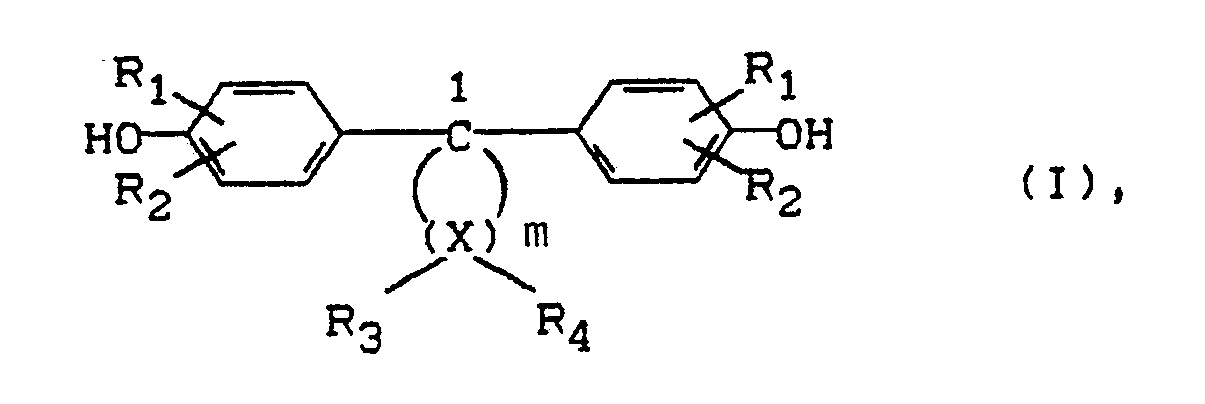
in welcher
R₁ und R₂ unabhängig voneinander Wasserstoff, Halogen, C₁-C₈-Alkyl, C₅-C₆-Cycloalkyl, C₆-C₁₀-Aryl, C₇-C₁₂-Aralkyl und C₇-C₁₂-Alkyryl bedeuten,
m für die Zahl 4, 5, 6 oder 7,
R₃ und R₄ für jedes X individuell wählbar, unabhängig voneinander Wasserstoff oder C₁-C₆-Alkyl und
X Kohlenstoff bedeuten,
mit der Maßgabe, daß an mindestens einem Atom X, R₃ und R₄ gleichzeitig Alkyl ist
sowie gegebenenfalls
R₁ und R₂ unabhängig voneinander Wasserstoff, Halogen, C₁-C₈-Alkyl, C₅-C₆-Cycloalkyl, C₆-C₁₀-Aryl, C₇-C₁₂-Aralkyl und C₇-C₁₂-Alkyryl bedeuten,
m für die Zahl 4, 5, 6 oder 7,
R₃ und R₄ für jedes X individuell wählbar, unabhängig voneinander Wasserstoff oder C₁-C₆-Alkyl und
X Kohlenstoff bedeuten,
mit der Maßgabe, daß an mindestens einem Atom X, R₃ und R₄ gleichzeitig Alkyl ist
sowie gegebenenfalls
c) 0 bis 80 Gewichts-Teile weitere Additive.
2. Verfahren zur Herstellung der Mischungen nach Anspruch 1 aus den Komponenten (a), (b) und gegebenenfalls (c), dadurch gekennzeichnet, daß man die Einzelkomponenten (a) und (b) bei Temperaturen von 250°C bis 450°C bei Schergefällen von 0,1 s⁻¹ bis 1000 s⁻¹ durch Kneten, Extrudieren oder andere Methoden in an sich bekannten Vermisch-Apparaturen vermengt.
3. Verwendung der Mischungen nach Anspruch 1 zur Herstellung geformter Körper.
Applications Claiming Priority (2)
| Application Number | Priority Date | Filing Date | Title |
|---|---|---|---|
| DE19893927137 DE3927137A1 (de) | 1989-08-17 | 1989-08-17 | Polyarylensulfid-mischungen |
| DE3927137 | 1989-08-17 |
Publications (2)
| Publication Number | Publication Date |
|---|---|
| EP0413222A2 true EP0413222A2 (de) | 1991-02-20 |
| EP0413222A3 EP0413222A3 (en) | 1991-09-18 |
Family
ID=6387278
Family Applications (1)
| Application Number | Title | Priority Date | Filing Date |
|---|---|---|---|
| EP19900115019 Withdrawn EP0413222A3 (en) | 1989-08-17 | 1990-08-04 | Polyarylene sulfide resin composition |
Country Status (3)
| Country | Link |
|---|---|
| EP (1) | EP0413222A3 (de) |
| JP (1) | JPH0388847A (de) |
| DE (1) | DE3927137A1 (de) |
Family Cites Families (6)
| Publication number | Priority date | Publication date | Assignee | Title |
|---|---|---|---|---|
| US4021596A (en) * | 1975-04-22 | 1977-05-03 | Phillips Petroleum Company | Polyarylene sulfide resin alloys |
| CA1257433A (en) * | 1984-06-29 | 1989-07-11 | Stephen B. Rimsa | Molded electrical device and composition therefore |
| CA1340125C (en) * | 1988-10-06 | 1998-11-10 | Dieter Freitag | Mixture of special new polycarbonates with other thermoplastics or with elastomers |
| DE3836183A1 (de) * | 1988-10-24 | 1990-05-03 | Bayer Ag | Polymermischungen |
| DE3836176A1 (de) * | 1988-10-24 | 1990-05-03 | Bayer Ag | Polymermischungen |
| DE3841022A1 (de) * | 1988-12-06 | 1990-06-07 | Bayer Ag | Formmassen aus arylensulfidpolymeren und phenolischen verbindungen |
-
1989
- 1989-08-17 DE DE19893927137 patent/DE3927137A1/de not_active Withdrawn
-
1990
- 1990-08-04 EP EP19900115019 patent/EP0413222A3/de not_active Withdrawn
- 1990-08-15 JP JP21444490A patent/JPH0388847A/ja active Pending
Also Published As
| Publication number | Publication date |
|---|---|
| DE3927137A1 (de) | 1991-02-21 |
| EP0413222A3 (en) | 1991-09-18 |
| JPH0388847A (ja) | 1991-04-15 |
Similar Documents
| Publication | Publication Date | Title |
|---|---|---|
| EP0402678B1 (de) | Verwendung von Polycarbonatmischungen in der Optik | |
| EP0359953B1 (de) | Dihydroxydiphenylcycloalkane, ihre Herstellung und ihre Verwendung zur Herstellung von hochmolekularen Polycarbonaten | |
| EP0365916B1 (de) | Polymermischungen | |
| EP0362646B1 (de) | Mischungen von speziellen, neuen Polycarbonaten mit anderen Thermoplasten oder mit Elastomeren | |
| DE3844633A1 (de) | Dihydroxydiphenylcycloalkane, ihre herstellung und ihre verwendung zur herstellung von hochmolekularen polycarbonaten | |
| EP0000732B1 (de) | Abmischungen von verzweigtem Polyarylsulfon-Polycarbonat sowie ihre Verwendung zur Herstellung von Extrusionsfolien | |
| EP0364741A1 (de) | Aromatische Polyetherketone | |
| EP0739925A2 (de) | Polysulfon/Polyether-Blockcopolykondensate | |
| EP0365917B1 (de) | Polymermischungen | |
| DE3833953A1 (de) | Mischungen von speziellen, neuen polycarbonaten mit anderen thermoplasten oder mit elastomeren | |
| EP0414083B1 (de) | Stabilisierte Polycarbonate | |
| EP0400411B1 (de) | Aromatische Polyethersulfone | |
| EP0400409B1 (de) | Aromatische Copolyetherketone | |
| EP0218064B1 (de) | Verfahren zur Herstellung von Polyethersulfonen | |
| EP0413222A2 (de) | Polyarylensulfid-Mischungen | |
| EP0422438A2 (de) | Polycarbonate aus Dihydroxydiphenylcycloalkanen mit Additiven | |
| EP0417462A1 (de) | Folien aus Polyarylensulfid-Mischungen und ihre Verwendung zur Gastrennung | |
| DE3833386A1 (de) | Aromatische polyetherketone | |
| DD297654A5 (de) | Verfahren zur herstellung von hochmolekularen thermoplastischen, aromatischen polycarbonaten | |
| DE3929671A1 (de) | Uv-absorberhaltige polycarbonate | |
| DE3833385A1 (de) | Aromatische polyethersulfone | |
| DE3930673A1 (de) | Stabilisierte polycarbonate | |
| DE4217379B4 (de) | Polyarylenether mit Xanthon- und Dixanthoneinheiten und Verfahren zu deren Herstellung und ihre Verwendung | |
| DE1595709A1 (de) | Verfahren zur Herstellung von Polyarylendisulfimidsulfonen | |
| DE10339357A1 (de) | Verzweigte Polyformale und Copolyformale, ihre Herstellung und Verwendung |
Legal Events
| Date | Code | Title | Description |
|---|---|---|---|
| PUAI | Public reference made under article 153(3) epc to a published international application that has entered the european phase |
Free format text: ORIGINAL CODE: 0009012 |
|
| 17P | Request for examination filed |
Effective date: 19900804 |
|
| AK | Designated contracting states |
Kind code of ref document: A2 Designated state(s): DE FR GB IT |
|
| PUAL | Search report despatched |
Free format text: ORIGINAL CODE: 0009013 |
|
| AK | Designated contracting states |
Kind code of ref document: A3 Designated state(s): DE FR GB IT |
|
| STAA | Information on the status of an ep patent application or granted ep patent |
Free format text: STATUS: THE APPLICATION HAS BEEN WITHDRAWN |
|
| 18W | Application withdrawn |
Withdrawal date: 19930217 |