EP0400641A1 - Kolloidales Fluorid und orale Zusammensetzung - Google Patents
Kolloidales Fluorid und orale Zusammensetzung Download PDFInfo
- Publication number
- EP0400641A1 EP0400641A1 EP90110358A EP90110358A EP0400641A1 EP 0400641 A1 EP0400641 A1 EP 0400641A1 EP 90110358 A EP90110358 A EP 90110358A EP 90110358 A EP90110358 A EP 90110358A EP 0400641 A1 EP0400641 A1 EP 0400641A1
- Authority
- EP
- European Patent Office
- Prior art keywords
- fluoride
- solution
- fluorine
- water
- soluble
- Prior art date
- Legal status (The legal status is an assumption and is not a legal conclusion. Google has not performed a legal analysis and makes no representation as to the accuracy of the status listed.)
- Granted
Links
Images


Classifications
-
- A—HUMAN NECESSITIES
- A61—MEDICAL OR VETERINARY SCIENCE; HYGIENE
- A61Q—SPECIFIC USE OF COSMETICS OR SIMILAR TOILETRY PREPARATIONS
- A61Q11/00—Preparations for care of the teeth, of the oral cavity or of dentures; Dentifrices, e.g. toothpastes; Mouth rinses
-
- A—HUMAN NECESSITIES
- A61—MEDICAL OR VETERINARY SCIENCE; HYGIENE
- A61K—PREPARATIONS FOR MEDICAL, DENTAL OR TOILETRY PURPOSES
- A61K8/00—Cosmetics or similar toiletry preparations
- A61K8/18—Cosmetics or similar toiletry preparations characterised by the composition
- A61K8/19—Cosmetics or similar toiletry preparations characterised by the composition containing inorganic ingredients
- A61K8/20—Halogens; Compounds thereof
- A61K8/21—Fluorides; Derivatives thereof
-
- B—PERFORMING OPERATIONS; TRANSPORTING
- B82—NANOTECHNOLOGY
- B82Y—SPECIFIC USES OR APPLICATIONS OF NANOSTRUCTURES; MEASUREMENT OR ANALYSIS OF NANOSTRUCTURES; MANUFACTURE OR TREATMENT OF NANOSTRUCTURES
- B82Y5/00—Nanobiotechnology or nanomedicine, e.g. protein engineering or drug delivery
-
- A—HUMAN NECESSITIES
- A61—MEDICAL OR VETERINARY SCIENCE; HYGIENE
- A61K—PREPARATIONS FOR MEDICAL, DENTAL OR TOILETRY PURPOSES
- A61K2800/00—Properties of cosmetic compositions or active ingredients thereof or formulation aids used therein and process related aspects
- A61K2800/40—Chemical, physico-chemical or functional or structural properties of particular ingredients
- A61K2800/41—Particular ingredients further characterized by their size
- A61K2800/413—Nanosized, i.e. having sizes below 100 nm
Definitions
- the present invention relates to a colloidal fluoride solution and a process for producing it.
- the present invention provides a colloidal solution of a difficultly soluble fluoride which gives a fluoride ion concentration of 1 to 10,000 ppm when dissolved in water.
- the colloid of the present invention can be used alone or in the form of an oral composition comprising it in such an amount that the fluorine content thereof will be 10 to 100,000 ppm and other substances for preventing the tooth from decaying.
- the present invention relates to an oral composition characterized in that fluorine and calcium contained therein are at least partially reacted with each other to form a colloidal fluoride in the presence of a suitable saccharide derivative as a peptizer to enhance the availability of fluorine for the tooth and improve its effect of preventing the tooth from decaying.
- fluorides such as sodium fluoride, sodium monofluorophosphate and stannous fluoride.
- the fluorides are effective mainly due to the fluoride ions for improving the acid resistance of the tooth and accelerating recalcification of a decayed tooth in its early stage wherein the decalcification has proceeded only slightly.
- the effect of improving the acid resistance of the tooth is thought to be due to the fact that the fluoride ions are incorporated into a crystal lattice of hydroxyapatite which is the main constituent of the tooth enamel or, in other words, fluoride ions partially fluorinate hydroxyapatite and simultaneously repair the lattice irregularities.
- the recalcification is a reaction for recovering or substantially recovering the hydroxyapatite, which was shortened, modified or lost by the decalcification of the enmale, by a reaction reverse to the decalcification to inhibit the decaying of the tooth. This reaction ordinarily proceeds in addition to the decalcification and is remarkably accelerated in the presence of a fluoride ion.
- Fluorides are thus added to tap water, used in the form of tablets to be crushed with the teeth, added to foods, applied to the tooth surface or added to mouth-washes or dentifrices.
- the extent of the effect of the fluorides for preventing the tooth from decaying it is 50 to 65% when it is added to tap water, 30 to 40% when it is applied to the tooth surface, and 20 to 50% when it is used in the form of a mouth-wash or dentifrice.
- the effect of the iodides is far more remarkable than that of other agents for preventing the tooth from decaying, complete prevention of the decaying is still ideal. From this point of view, the effect of the fluorides is yet insufficient.
- the fluoride is not orally administered but directly applied to the tooth (local application) as in the case of a mouth wash or dentifrice, the effect thereof for preventing the decaying of the tooth is yet small. Thus it leaves much room for improvement.
- the efficiency of fluorine uptake is low and a large amount of fluorine is disgorged without exhibiting any effect, so that various investigations are in progress for increasing the fluorine uptake.
- the tooth must be partially disintegrated in the treatment with the acidic sodium fluoride or the fluoride of a high concentration, so that some problems might occur during the application for a long period of time. Further, the acute toxicity of fluorine is by no means low, and the increase of the fluorine concentration is undesirable when it is taken by mistake.
- Another expected method of accelerating the fluorine uptake comprises using various metallic ions in combination with the fluoride.
- metallic ions for example, aluminum ion and calcium ion [J. Kyushu Dental Soc., 4 (1): 247 to 259] and lanthanum [Jap. J. Pedodontics, 25 (1): 1 to 113 have the effect of accelerating the fluorine uptake.
- the insoluble fluoride thus formed is adsorbed on apatite.
- the metallic ion is a calcium ion
- the insoluble fluoride is the very calcium fluoride. In principle, this is similar to the treatment with the fluoride of a high concentration. However, the enamel is not disintegrated unlike the treatment with the fluoride of a high concentration.
- a calcium ion has an effect of accelerating the recalcification and that a combination thereof with the fluorine-containing agent is effective.
- Examples of the combinations are disclosed in Japanese Patent Laid-Open Nos. 039642/1972 (Beecham Group) and 091339/1975 (Procter & Gamble) and some of them are available on the market.
- composition comprising a combination of a fluoride ion with a metallic ion is expected to be quite useful.
- composition comprising the combination of a fluoride ion with a metallic ion has many problems to be solved when it is practically used.
- Fluorides of calcium, magnesium, strontium, lanthanoids such as lanthanum, molybdenum, manganese, aluminum and indium having the effect of preventing the tooth from decaying are insoluble or difficultly soluble in water.
- lanthanoids such as lanthanum, molybdenum, manganese, aluminum and indium having the effect of preventing the tooth from decaying
- the processes heretofore proposed include, for example, a process disclosed in Japanese Patent Laid-Open No. 212112/1982 (Colgate-Palmolive) wherein aluminum and fluorine are kept in an oil layer and an aqueous layer, respectively, so that they are mixed at the time of use, a process disclosed in Japanese Patent Laid-Open No. 219107/1983 (Procter & Gamble) wherein most of calcium ions are protected by chelation and a process disclosed in Japanese Patent Laid-Open No. 091339/1975 (Procter & Gamble) wherein the pH of the solution is extremely lowered.
- the emulsion has a special texture which is unsuitable for giving pleasantness in its use.
- the chelation of calcium sacrifices the effect of the dentifrice.
- the low pH restricts the formulation and is not good for the tooth.
- fluorine has an effect of preventing the tooth from decaying. Fluorine is added in a very small amount (about 1 ppm) to tap water, incorporated into a dentifrice or mouth-wash (1,000 ppm or less) or applied to the surface of the tooth (about 10,000 ppm) by dentists.
- the effect of preventing the tooth from decaying is most remarkable when it is added to tap water and the effect is halved when it is incorporated into the dentifrice or mouth-wash.
- the incorporation thereof into the dentifrice or mouth-wash is desirable, since it is easy and economically advantageous.
- one of the problems in the field of dental hygiene is an improvement of the above-described effect.
- HAP hydroxyapative
- FAP fluoroapative
- the fluoride ion contained in a dentifrice or mouth-wash forms calcium fluoride by the chemical reaction on the surface of the tooth, thereby deposited thereon, and then exhibits the effect of preventing the tooth from decaying after the conversion of HAP to FAP. Therefore, it is necessary to bring the fluoride ion of an as high as possible concentration into contact with the tooth for an as long as possible time when the tooth is brushed with the dentifrice. Since, however, the upper limit of the fluorine convent in the dentifrice is regulated and the time of brushing the tooth cannot be prolonged so much, there remains a problem that the uptake of fluorine by the tooth cannot be sufficiently increased.
- the inventors After investigations, the inventors have succeeded in colloidizing a difficultly soluble fluoride precipitate. On the basis of this finding, the inventors have succeeded in developing a composition comprising the colloid to increase the fluorine uptake by the tooth enamel. The fluorine thus takenup is then gradually released over a long period of time to exhibit an effect far superior to that of ordinary ones.
- the composition also has an excellent storage stability and the teeth can be effectively prevented from decaying with an oral composition containing this colloidal solution.
- the inventors After further intensive investigations made for the purpose of retaining the effect of the colloidal calcium fluoride for a long period of time, the inventors have found that when fluoride ions are reacted with calcium ions in the presence of a peptizer comprising a particular saccharide derivative, a colloidal fluoride having an extremely small particle diameter can be formed and it exhibits an extremely high adsorption on the tooth. Therefore, it can efficiently supply fluorine to the tooth to improve its resistance to decaying. Further, the colloid has a high stability and its effect lasts for a long period of times The present invention has been completed by applying it in the production of an oral composition.
- a colloidal solution comprises a fluoride(s) being difficultly soluble in water comprises colloidal particles of the fluoride having a particle size of 0.005 to 1 micron, said fluoride having a fluoride ion concentration of 1 to 10,000 ppm in the state of saturation.
- the solution may further comprises a peptizer(s) to colloidize the fluoride.
- the solution may comprise 1 to 100,000 ppm, based on the entire solution, of fluorine in the colloidal particles, 10 to 100 percent by weight of the fluorine contained in the entire solution being included in the colloidal particles.
- the peptizer is preferably selected from polyolphosphoric acids, polyolsulfuric acids, polyolcarboxylic acids and salts of each before-mentioned acid.
- the solution may comprise 1 to 95,000 ppm, based on the entire solution, of fluorine in the colloidal particles, 10 to 95 percent by weight of the fluorine contained in the entire solution being included in the colloidal particles.
- the colloidal particles of the fluoride may have a particle size of 0.005 to 1 micron.
- the invention provides a process for preparing a colloidal solution of a fluoride(s) being difficultly soluble in water, which comprises the steps of mixing a water-soluble fluoride with a water-soluble cationic salt to form precipitates and then add a peptizer(s) to the precipitates to produce colloidal particles having a size of 0.005 to 1 micron.
- the invention provides a process for preparing a colloidal solution of a fluoride(s) being difficultly soluble in water, which comprises the steps of mixing an aqueous solution of a water-soluble fluoride with an aqueous solution of a water-soluble cationic salt to form precipitates, at least either of both solutions containing a peptizer(s), to produce colloidal particles having a size of 0.005 to 1 micron.
- colloidal particles can be obtained by conducting the process as defined above and removing out water. They can be also obtained by removing out water from the solution.
- the fluoride(s) is a water-soluble hydrofluoric acid and the salt(s) is a water-soluble calcium salt.
- the invention provides an oral composition comprising a water-soluble fluoride(s), a water-soluble cationic salt(s) and a peptizer(s).
- composition is preferred to comprise 10 ppm or more of fluorine, more preferably from 10 ppm to 100,000 ppm of fluorine, most preferably from 150 ppm to 60,000 ppm of fluorine.
- the composition comprises 1 mol part of the calcium, 0.01 to 100 mol parts of the fluorine and 0.01 to 100 mol parts of the saccharide, more preferably 1 mol part of the calcium, 0.1 to 10 mol parts of the fluorine and 0.1 to 10 mol parts of the saccharide.
- the peptizer(s) is preferably polyol phosphates, polyol sulfates, polyol carboxylates and salts of the before mentioned.
- a fluorine concentration may range from 10 to 100,000 ppm in the entire colloidal solution.
- Such a colloidal solution can be obtained by selecting a fluoride to give a fluorine ion concentration of 1 to 10,000 ppm in the state of saturation.
- the formation of colloid in the solution can be experimentally recognized by the following methods (1) to (4).
- the present invention provides a colloidal fluoride solution prepared by dissolving a difficultly soluble fluoride, which gives a fluoride ion concentration of 1 to 10,000 ppm when dissolved in water, in the form of fine colloidal particles having a diameter of 0.01 to 1 ⁇ m in water.
- the colloidal solution of the present invention contains a compound which causes precipitation in nature kept in a metastable state when it is subjected to a change such as the application to the mouth, the metastable state is lost and the colloidal particles begin to precipitate and the precipitates thus formed deposit on the tooth. Since fluorine is contained in the colloidal particles, the deposit gradually releases fluorine. The higher the fluorine content of the particles, the better. From our experience, a fluorine content of at least 10 wt.% is effective.
- the fluorine concentration of the entire colloidal solution can be 10 to 1,000,000 ppm.
- Such a colloid is obtained by suitably selecting the difficultly soluble fluoride capable of giving a fluoride ion concentration of 1 to 10,000 ppm when dissolved in water.
- the fluoride is desirably calcium fluoride, aluminum fluoride, magnesium fluoride, barium fluoride, titanium fluoride, strontium fluoride, indium fluoride or a lanthanoid fluoride such as lanthanum fluoride, or a compound containing such a component in its structure.
- the peptizer is particularly effective in maintaining the stability of the colloid and adhesion thereof to, for example, the tooth.
- the peptizer is desirably a compound having a structure of a polyolphosphoric acid such as glucose-1-phosphate,and glucose-6-phosphate, polyolsulfuric acid such as sucrose sulfate or polyolcarboxylic acid such as gluconic acid, or salts of each acids.
- a polyolphosphoric acid such as glucose-1-phosphate,and glucose-6-phosphate
- polyolsulfuric acid such as sucrose sulfate
- polyolcarboxylic acid such as gluconic acid
- solubility of the fluoride in the solution is quite high. Particularly when a sugar phosphate is used, the solubility is high and a transparent colloidal solution containing up to 100,000 ppm (in terms of fluorine) of the fluoride can be obtained.
- the amount of fluorine in the colloidal particles was 95,000 ppm (95% based on the whole colloidal solution).
- the solubility of sodium fluoride was at most 20,000 ppm in terms of fluorine, so that the above-mentioned colloidal solution is superior to the conventional one in this respect.
- the colloidal solution of the fluoride intended in the present invention is produced desirably by the following processes:
- colloidal solutions of the difficultly soluble fluoride produced by each of the above-described processes have the same physical and chemical properties and they are not different form one another depending on the processes. Namely, no difference can be found in the properties such as viscosity, electric conductivity, light scattering and results of elementary analysis.
- any process wherein an insoluble or difficultly soluble fluoride is formed and simultaneously or thereafter a peptizer is added thereto to form the colloidal solution may be employed in the present invention.
- the temperature in the process ranges preferably from room temperature to around 40°C, other temperature conditions are also possible.
- the fluorides to be used in the present invention are not particularly limited except for the solubility thereof.
- a difficultly soluble fluoride capable of forming a saturated solution thereof having a fluorine concentration of 1 to 10,000 ppm, preferably 1 to 4,000 ppm, is necessary is that when it is soluble, no precipitate is formed and the colloidization by the peptization is impossible, and that it is indispensable when the fluoride is used in the form of an oral composition for reinforcing the tooth that it is soluble to some extent to release fluoride ions at a suitable rate.
- the soluble fluorides used for the purpose of forming the difficultly soluble fluoride in the present invention are not particularly limited as far as they are capable of releasing fluoride ions.
- sodium fluoride or potassium fluoride which forms a palatable colloidal solution is most suitable for forming the oral composition.
- the cations used for the purpose of forming the difficultly soluble fluoride in the present invention are not particularly limited.
- the present invention relates to an oral composition
- an oral composition comprising three ingredients, i.e. a water-soluble hydrofluoric acid (a first ingredient), a water-soluble calcium salt (a second ingredient) and a peptizer (a third ingredient) which accelerates the colloidization of a reaction product between the first ingredient and the second ingredient.
- the fluorine sources usable for producing the colloidal fluoride of the present invention include hydrofluoric acid and pharmacologically acceptable water-soluble hydrofluorides such as sodium fluoride, potassium fluoride, lithium fluoride, ammonium fluoride and tin fluoride.
- the calcium sources usable herein include water-soluble calcium salts such as chloride, nitrate, acetate, glycerophosphate, glucose 1-phosphate and glucose 6-phosphate.
- the particular peptizers usable herein include one or more saccharide derivatives selected from the group consisting of saccharide phosphates such as glyceraldehyde 3-phosphate, ⁇ -glycerophosphoric acid, ⁇ -glycerophosphoric acid, erythrose 4-phosphate, ribose 5-phosphate, glucose 1-phosphate, glucose 6-diphosphate, inositol monophosphate, inositol hexaphosphate, fructose 1-phosphate, fructose 6-phosphate, fructose 1,6-diphosphate, ascorbic acid 2-phosphate and heptulose 7-phosphate; saccharide sulfates such as sucrose sulfate and ascorbic acid 2-sulfate; glyceric acid and gluconic acid; and salts of them.
- saccharide phosphates such as glyceraldehyde 3-phosphate, ⁇ -glycerophosphoric acid, ⁇ -
- a calcium salt of the saccharide derivative When a calcium salt of the saccharide derivative has a high solubility in water, it can serve as both the second ingredient (water-soluble calcium salt) and the third ingredient (peptizer).
- the molar proportions of the fluoride ion, the calcium ion and the peptizer are as wide as 0.01 to 1 00/1/0.01 to 100.
- the molar ratio of fluorine to calcium is desirably as close as the ratio of the stoichiometrical amounts of them for forming a salt, namely, a ratio of the fluoride ion to the calcium ion of 2/1.
- the amount of the saccharide derivative is desirably sufficient for stabilizing the colloidal particles. Namely, the ratio of the calcium ion to the peptizer is as close to 1/1 as possible.
- the proportions of the fluoride ion, the calcium ion and the peptizer are particularly preferably 0.1 to 10/1/0.05 to 20.
- the ratio of the fluoride ion to the calcium ion in the combination of them is different from the stoichiometrical ratio of them for forming a salt, free fluoride ions or calcium ions which do not form colloidal particles are contained in the composition as a matter of course, but such ions do not impair the effect of the present invention.
- colloidal fluoride particles are usually quite fine and the particle diameter is often as small as about 10 nm.
- a homogeneous colloidal fluoride in the form of a transparent solution can be prepared when the ingredients are used at suitable proportions under suitable conditions. Therefore, when the present invention is applied to the production of a transparent mouth-wash or dentifrice, the commercial value thereof can be further increased.
- Fluoride ions in the oral composition of the present invention react with calcium ions and a suitable peptizer to form a fluoride colloid having an excellent effect of supplying fluorine to the tooth, whereby the composition has an excellent effect of preventing the tooth from decaying.
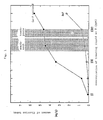
- Fig. 1 is a graph showing the effect of the invention.
- Fig. 2, 3 and 4 showing data for obtaining fluorine amounts.
- FIG. 3 shows peaks of fluorine in the colloid and fluorine ion in the solution, respectively, obtained by adding 4.87 g of calcium glucose-1-phosphate tetrahydrate and 1.1 g of sodium fluoride to 100 ml of water and allowing it to stand for 1 day, determined by the above shown NMR.
- Fig. 4 shows determination of colloidal particles having a size of about 5 nm, obtained by adding calcium glucose-1-phosphate tetrahydrate and sodium fluoride at a mole ratio of 1:2 to water to reach the entire fluorine concentration of 500 ppm and allowing it to stand for 1 day, using the dynamic light scattering method.
- the present invention has been completed on the basis of a methodology contrary to the prior art wherein efforts were made so that no water-insoluble or difficultly water-soluble precipitate is formed. Namely, the present invention has been completed on the basis of an idea that even when the water-insoluble or difficultly water-soluble precipitate is formed, the effect of the fluoride ion can be maintained as far as the particles thereof are fine.
- calcium and fluoride ions in amounts beyond ordinary solubilities of them were detected in a colloidal solution of calcium fluoride (fine particle solution of the present invention).
- the colloidal solution is diluted with water, calcium fluoride is dissolved at a dissolution rate far higher than that of ordinary calcium fluoride to release fluoride ions.
- An example of this phenomenon is given in Example 1.
- Example 1 F ion Amount of dissolution CaF2 colloid ( ⁇ 0.22 to 0.65 ⁇ m) 15 5 CaF2 colloid (peptizer added) ( ⁇ 0.22 ⁇ m) 100 20 CaF2 powder (1 to 2 ⁇ m) 8 0.1 CaF2 powder (2 ⁇ m ⁇ ) 8 0.1
- the colloidal particle was one which can be adsorbed on hydroxyapatite which is a constituent of the tooth.
- the effect of fluorine was exhibited not only for a short time of staying of the composition in the mouth but also lasted for a long period of time to retain the fluorine concentration in the mouth.
- the stability of the colloidal solution was remarkably improved by adding the peptizer.
- Example 2 gives the results of examination of the state of the colloid and fluorine uptake before and after the storage at room temperature for 6 months.
- the colloidal solution was stable also to salts and surfactants usually incorporated into oral compositions. However, it was unstable when the pH was 5.0 or below or 9.0 or above.
- Calcium glucose-1-phosphate tetrahydrate and sodium fluoride are mixed with each other at a mole ratio of 1:2. Distilled water is added to the mixture to obtain a testing colloidal solution having a fluorine ion concentration of 2,000 ppm.
- Example 2 Effect of disodium glucose 1-phosphate on the state of solution and fluorine uptake effect after storage at room temperature for 6 months Before storage After storage state fluorine uptake state fluorine uptake Disodium glucose 1-phosphate added transparent liquid 6.2 transparent liquid 6.1 No disodium glucose 1-phosphate added bluish white precipitate suspended 2.3 to 6.3 white precipitate found at the bottom ⁇ 0.1
- a nondecayed human tooth was cut into three pieces, and the surface of each piece was polished and manicured, while leaving a part (1 x 1 mm) to be exposed to an acid in each piece.
- These pieces were immersed in the colloidal solution of the present invention, a sodium fluoride solution, and distilled water, respectively, for 1 min and then delimed with an acid solution.
- the colloidal solution and the sodium fluoride solution each contained 100 ppm of fluorine.
- the acid solution was adding hydroxyapatite in a concentration of 50% of the saturation to 0.1 M lactic acid, further adding 0.2% polyacrylic acid thereto and adjusting the pH to 5.
- the tooth Since the tooth generally becomes cloudy by the deliming, its acid resistance was judged from the extent of formation of white spots in the part exposed to the acid.
- the white spots were scarcely found in the part which had been treated with the colloidal solution before the exposure to the acid; considerable spots were found in the part which had been treated with distilled water before the exposure to the acid; and some spots were found in the part which had been treated with the NaF solution before the exposure to the acid.
- an extremely high effect of the treatment with the colloidal solution of the present invention was confirmed.
- the above shown colloid solution was obtained in the same way as shown in Example 1, using the above shown method (ii), at a mole ratio of the peptizer to the cation to sodium fluoride of 1:1:2, having a fluorine ion concentration of 2,000 ppm in the solution.
- the solution was allowed to stand for 1 day before determination of properties.
- a fluorine amount in the colloidal particles is calculated by reducing a fluorine ion amount dissolved in the solution, determined by the fluorine ion electrode, from the entire fluorine amount of the solution.
- a fluorine amount uptaken by the apertite is determined in the same way as shown in Example 1.
- Colloids superior to the fluorine-containing agents heretofore used were those having a fluorine content of the colloidal particles of at least 10%.
- the colloid containing strontium in Example 3 had a fluorine content of the colloidal particles of 18% and fluorine uptake of 6 times as high as that of the control and, therefore, it is superior to the fluorine-containing agents heretofore used.
- polyphosphoric acid serves as the peptizer, it does not seem to be adsorbable on teeth.
- the colloidal solution of the present invention is used singly or in combination with other substances so as to have a fluorine content of 10 to 100,000 ppm, or the composition thus formed can be supported on another carrier to form an oral composition usable for preventing the tooth from decaying.
- Example 4 mouth-wash glycerol 20.0% by weight sorbitol 24.0% " propylene glycol 3.0%” polyoxyethylene polyoxypropylene glycol 1.0% “ methyl p-hydroxybenzoate 0.1% " saccharin sodium 1.0% “ flavor 0.9% " colloidal solution (Note 1) 50.0% “ 100.0% “ Note 1) A 3 mM solution of calcium chloride or strontium chloride was prepared and an equal amount of 6 mM sodium fluoride was added to this solution. Immediately thereafter, 1 M slurry of disodium glycerophosphate or disodium ribose 5-phosphate was added dropwise thereto to make the mixture transparent.
- Example 5 (tablets for mouth-wash) (Note 1) dry fluoride gel (Note 2) 25.0% by weight common salt 68.0% " hydroxyethylcellulose 1.0% “ saccharin sodium 5.0% “ flavor 1.0% " 100.0% “ Note 1) A tablet weighing 5 g is dissolved in 100 ml of water or hot water for use in mouth-washing. Note 2) 12 g of aluminum chloride and 18 g of disodium glucose 1-phosphate tetrahydrate were added to 4.2 g of sodium fluoride. 100 ml of water was added to the mixture and stirred to give a transparent mixture. It was centrifuged with a centrifugal separator (200,000 G) for 10 h and a precipitate thus formed was dried and pulverized.
- a centrifugal separator 200,000 G
- abrasive (Note 1) 40.0% by weight glycerol 20.0% “ sorbitol 24.0% “ propylene glycol 3.0% “ hydroxyethylcellulose 1.0% “ sodium lauryl sulfate 1.0% “ methyl p-hydroxybenzoate 0.1% " saccharin sodium 1.0% “ flavor 0.9% “ dry fluoride gel (Note 2) 1.0% “ 100.0% “ Note 1) Either calcium hydrogenphosphate dihydrate or calcium pyrophosphate was used. Note 2) The same as the dry gel in Note 2) of Application Example 2.
- the oral composition will be explained in reference to its tests and examples.
- a mixture of predetermined amounts of sodium fluoride as the fluorine source and calcium glucose 1-phosphate as both the calcium source and peptizer source, or calcium chloride as the control was dissolved in purified water to give a predetermined mixing ratio.
- the solution was left to stand at room temperature for one day and a precipitate thus formed was observed with naked eyes.
- the mixing molar proportions of the fluoride ion, the calcium ion and the glucose 1-phosphate ion were 0.1 to 10/1/1.
- the total fluorine concentration in the solution was 50 to 5,000 ppm.
- Table 1 Precipitate formation from solution of mixture of sodium fluoride and calcium glucose 1-phosphate Total fluorine concn.
- the calcium ion concentration was measured with an ion-selective electrode (mfd. by Orion) to find that the free calcium ion concentration therein was less than 1 mM. Namely, substantially no free calcium ion was present therein. This fact suggests that calcium present in the solution is substantially in the form of colloidal particles and is no more in the form of an ion.
- hydroxyapatite (a calcium phosphate constituting at least 90% of the enamel of the tooth) powder was used as a model tooth.
- the mixture was treated at room temperature for one minute and then centrifuged at 3,000 rpm to give hydroxyapatite powder, which was then washed by dispersing in pure water. This procedure was repeated again.
- the powder was dissolved in 3 ml of concentrated hydrochloric acid and the solution was suitably diluted. The quantity of fluorine taken therein was determined with an ion-selective electrode.
- Fig. 1 is a graph showing changes in the quantity of fluorine taken into hydroxyapatite when a colloidal fluoride solution or a sodium fluoride solution (control) was used and the total fluorine concentration in the solution was varied from 10 to 3,300 ppm. It is apparent from the graph that when the fluorine concentration was adjusted to that of ordinary dentifrices or mouth-washes, the colloidal fluoride had at least 10 times as high fluorine-supplying capacity as that of sodium fluoride.
- Table 2 Function of various saccharide derivatives as the peptizer Peptizer State of solution (precipitate formation) Supply of fluorine (mg/g) glyceraldehyde 3-phosphate - 1.2 ⁇ -glycerophosphate - 1.7 ⁇ -glycerophosphate - 3.1 erythrose 4-phosphate - 2.2 ribose 5-phosphate - 2.8 glucose 1-phosphate - 4.2 glucose 6-diphosphate - 3.8 inositol monophosphate - 2.5 inositol hexaphosphate - 1.3 fructose 1-phosphate - 2.5 fructose 6-phosphate - 1.6 fructose 1,6-diphosphate - 1.0 ascorbic acid 2-phosphate - 2.0 heptulose 7-phosphate - 1.7 sucrose sulfate + 1.0 ascorbic acid 2-sulfate + 1.1 glyceric acid + 0.6 gluconic acid + 0.8 control (no pep
- the saccharide derivative used in the above-described experiment was the sodium salt
- a calcium salt of the saccharide derivative can also be used if it is highly soluble in water.
- the calcium salts include calcium glucose 1-phosphate, calcium glucose 6-phosphate and calcium fructose 1,6-diphosphate. When such a calcium salt is used, the incorporation of an additional water-soluble calcium salt is not always necessary.
- the colloidal fluoride solution can be used as an oral composition in various forms such as a dentifrice, a mouth-wash, a tooth coating agent, buccal tablets and chewing gum.
- Various bases and other medicinal ingredients usually incorporated into dentifrices, mouth-washes, agents to be applied to the tooth and buccal tablets can be also incorporated thereinto.
- composition of the present invention comprising the colloidal fluoride and effective in preventing the tooth from decaying with further illustrate the present invention, which by no means limit the invention.
- potassium fluoride 0.2% by weight calcium glucose 6-phosphate tetrahydrate 2.0% " calcium hydrogenphosphate for dentifrice 25.0% " sodium carboxymethylcellulose 1.0% “ hydroxyethylcellulose 1.0% “ soidum lauryl sulfate 1.5% " fatty acid diethanolamide 0.5% " glycerol 10.0% “ 70% sorbitol solution 15.0% “ methylparaben 0.1% " flavor 1.0% “ sodium saccharin 0.2% " purified water a suitable amount total 100.0% by weight
- the dry powder comprising fluoride colloid particles prepared in Example 15 was kneaded together with ingredients listed below under heating and the mixture was shaped into a chewing gum. 10 g of the chewing gum was finely broken in 50 ml of purified water to form a dispersion. The effect of this dispersion of preventing the tooth from initial decaying was evaluated by the method employed in Experiment 3. The results indicated an excellent effect thereof.
- dry powder of fluoride colloid particles 1.0% by weight gum base 20.0% " corn syrup 20.0% " citric acid 0.1% " flavor a suitable amount sucrose powder a suitalbe amount total 100.0% by weight
Landscapes
- Health & Medical Sciences (AREA)
- Life Sciences & Earth Sciences (AREA)
- Chemical & Material Sciences (AREA)
- General Health & Medical Sciences (AREA)
- Engineering & Computer Science (AREA)
- Nanotechnology (AREA)
- Animal Behavior & Ethology (AREA)
- Public Health (AREA)
- Veterinary Medicine (AREA)
- Biophysics (AREA)
- Pharmacology & Pharmacy (AREA)
- Biotechnology (AREA)
- General Engineering & Computer Science (AREA)
- Medical Informatics (AREA)
- Medicinal Chemistry (AREA)
- Molecular Biology (AREA)
- Bioinformatics & Cheminformatics (AREA)
- Crystallography & Structural Chemistry (AREA)
- Oral & Maxillofacial Surgery (AREA)
- Inorganic Chemistry (AREA)
- Birds (AREA)
- Epidemiology (AREA)
- Cosmetics (AREA)
Priority Applications (1)
| Application Number | Priority Date | Filing Date | Title |
|---|---|---|---|
| AT90110358T ATE96019T1 (de) | 1989-05-31 | 1990-05-31 | Kolloidales fluorid und orale zusammensetzung. |
Applications Claiming Priority (4)
| Application Number | Priority Date | Filing Date | Title |
|---|---|---|---|
| JP138037/89 | 1989-05-31 | ||
| JP138036/89 | 1989-05-31 | ||
| JP13803689 | 1989-05-31 | ||
| JP13803789 | 1989-05-31 |
Publications (2)
| Publication Number | Publication Date |
|---|---|
| EP0400641A1 true EP0400641A1 (de) | 1990-12-05 |
| EP0400641B1 EP0400641B1 (de) | 1993-10-20 |
Family
ID=26471181
Family Applications (1)
| Application Number | Title | Priority Date | Filing Date |
|---|---|---|---|
| EP90110358A Expired - Lifetime EP0400641B1 (de) | 1989-05-31 | 1990-05-31 | Kolloidales Fluorid und orale Zusammensetzung |
Country Status (7)
| Country | Link |
|---|---|
| US (2) | US5049375A (de) |
| EP (1) | EP0400641B1 (de) |
| CA (1) | CA2017918A1 (de) |
| DE (1) | DE69004004T2 (de) |
| ES (1) | ES2059883T3 (de) |
| HK (1) | HK152495A (de) |
| PH (1) | PH27072A (de) |
Cited By (7)
| Publication number | Priority date | Publication date | Assignee | Title |
|---|---|---|---|---|
| US5130146A (en) * | 1989-05-31 | 1992-07-14 | Kao Corporation | Fluoride colloid and oral composition |
| US5244651A (en) * | 1991-09-04 | 1993-09-14 | Kao Corporation | Method of desensitizing hypersensitive dentin |
| EP1428518A2 (de) | 2002-12-12 | 2004-06-16 | Colgate-Palmolive Company | Verfahren zur Optimierung der Fluoridaufnahme von Zähnen durch Anwendung einer flüssigen Zahnputzzusammensetzung |
| WO2011098240A2 (en) | 2010-02-15 | 2011-08-18 | Cargill, Incorporated | Epimerisation of saccharides |
| WO2012064319A1 (en) * | 2010-11-08 | 2012-05-18 | Colgate-Palmolive Company | Oral compositions containing microaggregates |
| US9107838B2 (en) | 2012-04-25 | 2015-08-18 | Therametrics Technologies, Inc. | Fluoride varnish |
| WO2015122910A1 (en) * | 2014-02-14 | 2015-08-20 | Therametric Technologies, Inc. | Fluoride varnish |
Families Citing this family (18)
| Publication number | Priority date | Publication date | Assignee | Title |
|---|---|---|---|---|
| US6000341A (en) * | 1989-05-24 | 1999-12-14 | American Dental Association Health Foundation | Methods and composition for mineralizing and fluoridating calcified tissues |
| US6056930A (en) * | 1989-05-24 | 2000-05-02 | American Dental Association Health Foundation | Methods and compositions for mineralizing and fluoridating calcified tissues |
| CA2192315A1 (en) * | 1994-06-06 | 1995-12-14 | James L. Gingold | Relief of dentinal hypersensitivity by submicron particles |
| ZA962939B (en) * | 1995-04-12 | 1997-10-13 | Quest Int | Oral care compositions. |
| US10470985B2 (en) | 1999-11-12 | 2019-11-12 | The Procter & Gamble Company | Method of protecting teeth against erosion |
| US20040146466A1 (en) | 1999-11-12 | 2004-07-29 | The Procter & Gamble Company | Method of protecting teeth against erosion |
| US7387774B2 (en) * | 1999-11-12 | 2008-06-17 | The Procter & Gamble Co. | Method of enhancing fluoridation and mineralization of teeth |
| DE10028975B4 (de) * | 2000-06-16 | 2005-06-30 | Henkel Kgaa | Zusammensetzungen zur Behandlung von Zahn- und/oder Knochengewebe |
| US20080317807A1 (en) * | 2007-06-22 | 2008-12-25 | The University Of Hong Kong | Strontium fortified calcium nano-and microparticle compositions and methods of making and using thereof |
| GB0724246D0 (en) * | 2007-12-12 | 2008-01-23 | Glaxo Group Ltd | Noval use |
| WO2012148557A1 (en) * | 2011-02-28 | 2012-11-01 | Ada Foundation | Method for preparation of well-dispersed, discrete nanoparticles by spray drying techniques |
| US20130288194A1 (en) * | 2012-04-25 | 2013-10-31 | Therametric Technologies, Inc. | Fluoride varnish |
| US10123953B2 (en) | 2012-06-21 | 2018-11-13 | The Procter & Gamble Company | Reduction of tooth staining derived from cationic antimicrobials |
| CN104045670B (zh) * | 2013-03-15 | 2017-06-06 | 大连中科格莱克生物科技有限公司 | 一种甘露糖的制备方法 |
| CN105101934B (zh) * | 2013-03-26 | 2017-09-22 | 可乐丽则武齿科株式会社 | 牙科用固化性组合物 |
| US11666515B2 (en) * | 2018-03-28 | 2023-06-06 | Greenmark Biomedical Inc. | Phosphate crosslinked starch nanoparticle and dental treatments |
| CN113747948B (zh) | 2019-04-26 | 2023-12-15 | 宝洁公司 | 减少来源于阳离子抗微生物剂的牙齿变色 |
| CN115138379B (zh) * | 2022-07-07 | 2023-07-07 | 浙江师范大学 | 一种金属氟化物粉末催化剂的成型方法 |
Citations (7)
| Publication number | Priority date | Publication date | Assignee | Title |
|---|---|---|---|---|
| US4177258A (en) * | 1978-10-13 | 1979-12-04 | Colgate Palmolive Company | Dentifrice for dental remineralization |
| US4565691A (en) * | 1982-04-20 | 1986-01-21 | Beecham Group P.L.C. | Oral hygiene compositions |
| US4606912A (en) * | 1981-07-22 | 1986-08-19 | Caries Research Group Of Rochester, Inc. | Method of making a clear, stable aqueous mouthwash solution and the solution made by that method for the enhancement of cells of the oral cavity and the remineralization of teeth |
| EP0200323A2 (de) * | 1985-03-23 | 1986-11-05 | Beecham Group Plc | Orales Hygienemittel |
| EP0233059A2 (de) * | 1986-02-10 | 1987-08-19 | The Procter & Gamble Company | Mittel zur oralen Verwendung |
| GB2188548A (en) * | 1986-04-05 | 1987-10-07 | Beecham Group Plc | Oral hygiene compositions |
| EP0263638A2 (de) * | 1986-10-02 | 1988-04-13 | Unilever Plc | Mündliche Zusammensetzung |
Family Cites Families (7)
| Publication number | Priority date | Publication date | Assignee | Title |
|---|---|---|---|---|
| GB1238069A (de) * | 1968-06-07 | 1971-07-07 | ||
| IE42129B1 (en) * | 1974-10-10 | 1980-06-04 | Procter & Gamble | Compositions for remineralizing tooth enamel |
| GB1535847A (en) * | 1976-03-19 | 1978-12-13 | Radiochemical Centre Ltd | Technetium-99m labelled tin colloid for body scanning |
| GB2100126B (en) * | 1981-06-11 | 1984-08-01 | Colgate Palmolive Co | A dentifrice |
| JPS58219107A (ja) * | 1982-03-10 | 1983-12-20 | ザ・プロクタ−・エンド・ギヤンブル・カンパニ− | 口腔衛生用製品 |
| JP2715540B2 (ja) * | 1989-04-15 | 1998-02-18 | ダイキン工業株式会社 | 含フッ素樹脂の水性分散体、複合粉末およびオルガノゾル組成物 |
| US5049375A (en) * | 1989-05-31 | 1991-09-17 | Kao Corporation | Oral compositions containing colloidal fluoride |
-
1990
- 1990-05-24 US US07/527,776 patent/US5049375A/en not_active Expired - Lifetime
- 1990-05-28 PH PH40571A patent/PH27072A/en unknown
- 1990-05-30 CA CA002017918A patent/CA2017918A1/en not_active Abandoned
- 1990-05-31 ES ES90110358T patent/ES2059883T3/es not_active Expired - Lifetime
- 1990-05-31 EP EP90110358A patent/EP0400641B1/de not_active Expired - Lifetime
- 1990-05-31 DE DE90110358T patent/DE69004004T2/de not_active Expired - Fee Related
-
1991
- 1991-06-10 US US07/712,742 patent/US5130146A/en not_active Expired - Fee Related
-
1995
- 1995-09-21 HK HK152495A patent/HK152495A/en not_active IP Right Cessation
Patent Citations (7)
| Publication number | Priority date | Publication date | Assignee | Title |
|---|---|---|---|---|
| US4177258A (en) * | 1978-10-13 | 1979-12-04 | Colgate Palmolive Company | Dentifrice for dental remineralization |
| US4606912A (en) * | 1981-07-22 | 1986-08-19 | Caries Research Group Of Rochester, Inc. | Method of making a clear, stable aqueous mouthwash solution and the solution made by that method for the enhancement of cells of the oral cavity and the remineralization of teeth |
| US4565691A (en) * | 1982-04-20 | 1986-01-21 | Beecham Group P.L.C. | Oral hygiene compositions |
| EP0200323A2 (de) * | 1985-03-23 | 1986-11-05 | Beecham Group Plc | Orales Hygienemittel |
| EP0233059A2 (de) * | 1986-02-10 | 1987-08-19 | The Procter & Gamble Company | Mittel zur oralen Verwendung |
| GB2188548A (en) * | 1986-04-05 | 1987-10-07 | Beecham Group Plc | Oral hygiene compositions |
| EP0263638A2 (de) * | 1986-10-02 | 1988-04-13 | Unilever Plc | Mündliche Zusammensetzung |
Cited By (9)
| Publication number | Priority date | Publication date | Assignee | Title |
|---|---|---|---|---|
| US5130146A (en) * | 1989-05-31 | 1992-07-14 | Kao Corporation | Fluoride colloid and oral composition |
| US5244651A (en) * | 1991-09-04 | 1993-09-14 | Kao Corporation | Method of desensitizing hypersensitive dentin |
| EP1428518A2 (de) | 2002-12-12 | 2004-06-16 | Colgate-Palmolive Company | Verfahren zur Optimierung der Fluoridaufnahme von Zähnen durch Anwendung einer flüssigen Zahnputzzusammensetzung |
| WO2011098240A2 (en) | 2010-02-15 | 2011-08-18 | Cargill, Incorporated | Epimerisation of saccharides |
| WO2012064319A1 (en) * | 2010-11-08 | 2012-05-18 | Colgate-Palmolive Company | Oral compositions containing microaggregates |
| CN103189037A (zh) * | 2010-11-08 | 2013-07-03 | 高露洁-棕榄公司 | 含有微聚集体的口腔组合物 |
| US9271906B2 (en) | 2010-11-08 | 2016-03-01 | Colgate-Palmolive Company | Oral compositions containing microaggregates |
| US9107838B2 (en) | 2012-04-25 | 2015-08-18 | Therametrics Technologies, Inc. | Fluoride varnish |
| WO2015122910A1 (en) * | 2014-02-14 | 2015-08-20 | Therametric Technologies, Inc. | Fluoride varnish |
Also Published As
| Publication number | Publication date |
|---|---|
| HK152495A (en) | 1995-09-29 |
| EP0400641B1 (de) | 1993-10-20 |
| ES2059883T3 (es) | 1994-11-16 |
| PH27072A (en) | 1993-02-01 |
| DE69004004D1 (de) | 1993-11-25 |
| US5130146A (en) | 1992-07-14 |
| DE69004004T2 (de) | 1994-02-17 |
| US5049375A (en) | 1991-09-17 |
| CA2017918A1 (en) | 1990-11-30 |
Similar Documents
| Publication | Publication Date | Title |
|---|---|---|
| US5049375A (en) | Oral compositions containing colloidal fluoride | |
| AU3229593A (en) | Methods and compositions for mineralizing and fluoridating calcified tissues | |
| EP0806936A1 (de) | Calciumfluoride bildungskontrolle in mundspülungen, zahnpasten und gels | |
| KR20090016733A (ko) | 탄산염-치환 수산화인회석의 생물학적으로 활성인 나노입자, 이의 제조 방법 및 이를 포함하는 조성물 | |
| CN1330534A (zh) | 难溶钙盐的细粉悬浮液和它在牙齿维护剂中的应用 | |
| CA2338021A1 (en) | Odontostomatologic use of apatite-based nanostructured materials | |
| JPS637523B2 (de) | ||
| CN1121310A (zh) | 防治牙石的小苏打牙膏的制造方法 | |
| EP3473235A1 (de) | Zusammensetzung von materialien zur zahnremineralisierung | |
| EP4051211B1 (de) | Stabilisierte amorphe calciummagnesiumphosphatteilchen-zusammensetzungen | |
| KR101142305B1 (ko) | 나노크기의 탄산아파타이트를 함유하는 지각과민성 치아용 치약 조성물 | |
| JP2510762B2 (ja) | 口腔用組成物 | |
| JPH0774140B2 (ja) | フッ化物コロイド液 | |
| JPH04217618A (ja) | 口腔用組成物 | |
| US20250122088A1 (en) | Amorphous calcium magnesium fluoride phosphate particles | |
| WO2009074589A2 (en) | Novel use | |
| JPH04310231A (ja) | フッ化物コロイド液 | |
| US20230339757A1 (en) | Ion substituted calcium phosphate particles | |
| JPH04217617A (ja) | 口腔用組成物 | |
| JPH06298631A (ja) | 口腔用組成物 | |
| JPH04275213A (ja) | 口腔用剤 | |
| AU1931995A (en) | Carbonated solutions for treating, mineralizing and fluoridating calcified tissues and methods for their use | |
| JPH04221307A (ja) | 口腔用組成物 | |
| JPS63215504A (ja) | リン酸水素カルシウム・2水和物およびその製造方法 | |
| JPH04217616A (ja) | 口腔用組成物 |
Legal Events
| Date | Code | Title | Description |
|---|---|---|---|
| PUAI | Public reference made under article 153(3) epc to a published international application that has entered the european phase |
Free format text: ORIGINAL CODE: 0009012 |
|
| AK | Designated contracting states |
Kind code of ref document: A1 Designated state(s): AT CH DE ES FR GB LI NL |
|
| 17P | Request for examination filed |
Effective date: 19901213 |
|
| 17Q | First examination report despatched |
Effective date: 19920402 |
|
| GRAA | (expected) grant |
Free format text: ORIGINAL CODE: 0009210 |
|
| AK | Designated contracting states |
Kind code of ref document: B1 Designated state(s): AT CH DE ES FR GB LI NL |
|
| REF | Corresponds to: |
Ref document number: 96019 Country of ref document: AT Date of ref document: 19931115 Kind code of ref document: T |
|
| REF | Corresponds to: |
Ref document number: 69004004 Country of ref document: DE Date of ref document: 19931125 |
|
| ET | Fr: translation filed | ||
| PLBE | No opposition filed within time limit |
Free format text: ORIGINAL CODE: 0009261 |
|
| STAA | Information on the status of an ep patent application or granted ep patent |
Free format text: STATUS: NO OPPOSITION FILED WITHIN TIME LIMIT |
|
| 26N | No opposition filed | ||
| REG | Reference to a national code |
Ref country code: ES Ref legal event code: FG2A Ref document number: 2059883 Country of ref document: ES Kind code of ref document: T3 |
|
| PGFP | Annual fee paid to national office [announced via postgrant information from national office to epo] |
Ref country code: AT Payment date: 19950512 Year of fee payment: 6 |
|
| PGFP | Annual fee paid to national office [announced via postgrant information from national office to epo] |
Ref country code: CH Payment date: 19950524 Year of fee payment: 6 |
|
| PGFP | Annual fee paid to national office [announced via postgrant information from national office to epo] |
Ref country code: NL Payment date: 19950531 Year of fee payment: 6 |
|
| PG25 | Lapsed in a contracting state [announced via postgrant information from national office to epo] |
Ref country code: AT Effective date: 19960531 Ref country code: CH Effective date: 19960531 Ref country code: LI Effective date: 19960531 |
|
| PG25 | Lapsed in a contracting state [announced via postgrant information from national office to epo] |
Ref country code: NL Effective date: 19961201 |
|
| REG | Reference to a national code |
Ref country code: CH Ref legal event code: PL |
|
| NLV4 | Nl: lapsed or anulled due to non-payment of the annual fee |
Effective date: 19961201 |
|
| REG | Reference to a national code |
Ref country code: GB Ref legal event code: IF02 |
|
| PGFP | Annual fee paid to national office [announced via postgrant information from national office to epo] |
Ref country code: ES Payment date: 20070524 Year of fee payment: 18 Ref country code: DE Payment date: 20070524 Year of fee payment: 18 |
|
| PGFP | Annual fee paid to national office [announced via postgrant information from national office to epo] |
Ref country code: GB Payment date: 20070530 Year of fee payment: 18 |
|
| PGFP | Annual fee paid to national office [announced via postgrant information from national office to epo] |
Ref country code: FR Payment date: 20070510 Year of fee payment: 18 |
|
| GBPC | Gb: european patent ceased through non-payment of renewal fee |
Effective date: 20080531 |
|
| REG | Reference to a national code |
Ref country code: FR Ref legal event code: ST Effective date: 20090119 |
|
| PG25 | Lapsed in a contracting state [announced via postgrant information from national office to epo] |
Ref country code: FR Free format text: LAPSE BECAUSE OF NON-PAYMENT OF DUE FEES Effective date: 20080602 Ref country code: DE Free format text: LAPSE BECAUSE OF NON-PAYMENT OF DUE FEES Effective date: 20081202 |
|
| PG25 | Lapsed in a contracting state [announced via postgrant information from national office to epo] |
Ref country code: GB Free format text: LAPSE BECAUSE OF NON-PAYMENT OF DUE FEES Effective date: 20080531 |
|
| REG | Reference to a national code |
Ref country code: ES Ref legal event code: FD2A Effective date: 20080602 |
|
| PG25 | Lapsed in a contracting state [announced via postgrant information from national office to epo] |
Ref country code: ES Free format text: LAPSE BECAUSE OF NON-PAYMENT OF DUE FEES Effective date: 20080602 |