EP0401675B1 - Dérivés de peptides inhibitant des enzymes - Google Patents
Dérivés de peptides inhibitant des enzymes Download PDFInfo
- Publication number
- EP0401675B1 EP0401675B1 EP90110321A EP90110321A EP0401675B1 EP 0401675 B1 EP0401675 B1 EP 0401675B1 EP 90110321 A EP90110321 A EP 90110321A EP 90110321 A EP90110321 A EP 90110321A EP 0401675 B1 EP0401675 B1 EP 0401675B1
- Authority
- EP
- European Patent Office
- Prior art keywords
- hydrogen
- lower alkyl
- benzyl
- methyl
- phe
- Prior art date
- Legal status (The legal status is an assumption and is not a legal conclusion. Google has not performed a legal analysis and makes no representation as to the accuracy of the status listed.)
- Expired - Lifetime
Links
Classifications
-
- C—CHEMISTRY; METALLURGY
- C07—ORGANIC CHEMISTRY
- C07K—PEPTIDES
- C07K5/00—Peptides containing up to four amino acids in a fully defined sequence; Derivatives thereof
- C07K5/02—Peptides containing up to four amino acids in a fully defined sequence; Derivatives thereof containing at least one abnormal peptide link
- C07K5/0227—Peptides containing up to four amino acids in a fully defined sequence; Derivatives thereof containing at least one abnormal peptide link containing the (partial) peptide sequence -Phe-His-NH-(X)2-C(=0)-, e.g. Renin-inhibitors with n = 2 - 6; for n > 6 see C07K5/06 - C07K5/10
-
- A—HUMAN NECESSITIES
- A61—MEDICAL OR VETERINARY SCIENCE; HYGIENE
- A61P—SPECIFIC THERAPEUTIC ACTIVITY OF CHEMICAL COMPOUNDS OR MEDICINAL PREPARATIONS
- A61P43/00—Drugs for specific purposes, not provided for in groups A61P1/00-A61P41/00
-
- A—HUMAN NECESSITIES
- A61—MEDICAL OR VETERINARY SCIENCE; HYGIENE
- A61P—SPECIFIC THERAPEUTIC ACTIVITY OF CHEMICAL COMPOUNDS OR MEDICINAL PREPARATIONS
- A61P9/00—Drugs for disorders of the cardiovascular system
-
- A—HUMAN NECESSITIES
- A61—MEDICAL OR VETERINARY SCIENCE; HYGIENE
- A61P—SPECIFIC THERAPEUTIC ACTIVITY OF CHEMICAL COMPOUNDS OR MEDICINAL PREPARATIONS
- A61P9/00—Drugs for disorders of the cardiovascular system
- A61P9/12—Antihypertensives
Definitions
- This invention relates to compounds having valuable pharmacological properties. More specifically, the invention relates to peptide derivatives (hereinafter called "peptides") exhibiting activity against particular retroviruses, to processes for producing the peptides, to pharmaceutical preparations thereof, and to a method of using the peptides to combat infections caused by the retroviruses.
- the invention also includes pharmaceutical formulations and a method of treatment for renin-associated hypertension and for congestive heart failure wherein the peptides serve as the active agent.
- HIV-1 human immunodeficiency virus type 1
- HIV-2 human immunodeficiency virus type 2
- pepstatin A as an anti-HIV agent seems improbable in view of its multiple activities.
- M.L. Moore et al., Biochem. Biophys. Res. Comm., 159 , 420 (1989) reported on investigations showing the inhibition of HIV protease by three heptapeptide analogs modeled after a conserved cleavage site (gag gene region) of the viral genomic polyprotein.
- A.D. Richards et al., FEBS Letters, 247 , 113(1989) also have reported in vitro inhibition of HIV protease be acetylpepstatin and a nonapeptide analog.
- the present application discloses a group of peptide derivatives which are potent inhibitors of HIV protease and renin. These attributes, together with the attributes of a relatively selective action and an apparent lack of toxicity, renders the peptides useful as agents for combating HIV infections and for treating renin-associated hypertension and congestive heart failure.
- the present peptides of this application are distinguished readily from pepstatin A and the previously noted peptide analogs by chemical and biochemical differences.
- the present peptides also possess a partial structural resemblance to peptide derivatives reported to be renin inhibitors; for instance, see D.F. Veber et al., European patent application 77,028, published April 20, 1983, and A. Wagner et al., Australian patent application 76241/87, published February 4, 1988.
- the remaining structural features and differences in biological profiles distinguish these latter prior art compounds from the present peptide derivatives, notwithstanding the existence of broad generic disclosures, such as R. Ten Brink, PCT patent application WO87/02986, published May 21, 1987, encompassing a myriad of compounds ranging in the millions.
- R1 is a derived amino acid radical of formula 2 wherein R5 is hydrogen, lower alkyl, or R7OC(O)- or R7C(O)-wherein R7 is lower aikyl, lower cycloalkyl, (lower cycloalkyl)methyl, phenyl, phenyl monosubstitued with lower alkyl, lower alkoxy or halo, benzyl or benzyl monosubstituted with lower alkyl, lower alkoxy or halo; R6 is hydrogen, lower alkyl, lower cycloalkyl, (lower cycloalkyl)methyl, phenyl, phenyl monosubstitued with lower alkyl, lower alkoxy or halo, benzyl, or benzyl monosubstituted with lower alkyl, lower alkoxy or halo; L
- R1 is the radical of formula 2 wherein R5 hydrogen, lower alkyl, or R7OC(O)- or R7C(O)- wherein R7 is lower alkyl, R6 is hydrogen, lower alkyl or benzyl, L is hydrogen or one or two halo substituents as defined herein;
- R2 is -N(R8)CH(R9)CO- wherein R8 is hydrogen or methyl ad
- R9 is lower alkyl, lower cycloalkyl, cyclopropylmethyl, cyclohexylmethyl, -CH2CH2COOH, - CH2CH2CONH2, -CH2CONH2 or benzyl;
- Y is -NHCH(R13)-W-wherein R13 is lower alkyl, (lower cycloalkyl)methyl, -CH2CH2-SCH3, benzyl or (4-methoxyphenyl)methyl
- R1 is the radical of formula 2 wherein R5 is hydrogen or tertiary-butyloxycarbonyl, R6 is hydrogen, methyl, ethyl or benzyl, and L is hydrogen or one or two halo substituents at position 3 or positions 3 and 5, respectively, of the aromatic ring;
- R2 is Val, Ala, Leu, Ile, Gly, Tbg, Cpa, Cha, Glu, Gln, Asn or Phe;
- Y is -NHCH(R13)-W- wherein R13 is 1-methylethyl, Glu, Gln, 2-methylpropyl, cyclohexylmethyl, -CH2CH2SCH3, benzyl or (4-methoxyphenyl)methyl, and W is -CH(OH)CH2C(O)- or
- a most preferred group for inhibiting HIV protease is represented by compounds of formula 1 in which R1 is the radical of formula 2 wherein R5 is hydrogen or tertiary-butyloxycarbonyl, R6 is hydrogen or benzyl and L is hydrogen or one or two halo substituents at position 3 or positions 3 and 5, respectively, of the aromatic ring; R2 and Y are as defined in the last instance; R3 is Leu, Nle, Ile, Val, Ala, Cha, Glu or Gln; and R4 either is Ile-NH2, Ala-NH2, Thr(OBzl)-NH2, Cha-NH2 or Phe-NH2, or is -NHCR18(R21)CH2OH wherein R18 is 1-methylethyl, 1-methylpropyl, 2-methylpropyl, -CH2OH or -CH(OH)C6H5 and R21 is hydrogen or methyl; or a therapeutically acceptable salt thereof.
- compositions for treating HIV infections in a human comprising a compound of formula 1, or a therapeutically acceptable salt thereof, and a pharmaceutically acceptable carrier.
- the scope of the invention includes as well a method for treating HlV infections in a human comprising administering thereto an effective amount of the compound of formula 1, or a therapeutically acceptable salt thereof.
- Also included within the scope is a method for protecting human cells against HIV pathogenesis comprising treating said cells with an anti-HIV effective amount of a compound of formula 1, or a therapeutically acceptable salt thereof.
- the scope of the invention includes pharmaceutical formulations and a method of treatment for renin-associated hypertension or a method of treating congestive heart failure ma mammal wherein the active agent is a peptide of formula 1.
- the method comprises 'administering to the mammal a renin-lowering effective amount of the peptide of formula 1 or a therapeutically acceptable salt thereof.
- residue with reference to an amino acid means a radical derived from the corresponding ⁇ -amino acid by eliminating the hydroxyl of the carboxy group and one hydrogen of the ⁇ -amino group.
- Cpa and Cha represent the residues of 2(S)-amino-3-cyclopropylpropionic acid (L-cyclopropylalanine) and 2(S)-amino-3-cyclohexylpropionic acid (L-cyclohexylalanine), respectively.
- the symbols “Nle” and “Tbg” represent the residues of 2(S)-aminohexanoic acid (L-norleucine) and 2(S)-amino-3,3-dimethylbutyric acid, respectively.
- lower alkyl as used herein, either alone or in combination with a radical, means straight chain alkyl radicals containing one to four carbon atoms and branched chain alkyl radicals containing three to four carbon atoms and includes methyl, ethyl, propyl, butyl, 1-methylethyl, 1-methylpropyl, 2-methylpropyl and 1,1-dimethylethyl.
- lower cycloalkyl as used herein, either alone or in combination with a radical, means saturated cyclic hydrocarbon radicals containing from three to six carbon atoms and includes cyclopropyl, cyclobutyl, cyclopentyl and cyclohexyl.
- lower alkoxy as used herein means straight chain alkoxy radicals containing one to four carbon atoms and branched chain alkoxy radicals containing three to four carbon atoms and includes methoxy, ethoxy, propoxy, 1-methylethoxy, butoxy and 1,1-dimethylethoxy.
- the latter radical is known commonly as tertiary-butyloxy.
- Boc represents 1,1-dimethylethoxycarbonyl, known commonly as tertiary-butyloxycarbonyl.
- C6H5 represents a phenyl radical.
- halo as used herein means a halo radical selected from bromo, chloro, fluoro or iodo.
- the radical "-NHCH(R13)-W-" wherein R13 is as defined hereinabove and W is -CH(OH)CH2CO- represents the radical derived from the ⁇ -amino acid known as statine (i.e. 4(S)-amino-3(S)-hydroxy-6-methylheptanoic acid) and its close analogs.
- statine i.e. 4(S)-amino-3(S)-hydroxy-6-methylheptanoic acid
- the radical is derived by eliminating the hydroxyl of the carboxy group and one hydrogen of the amino group of the corresponding ⁇ -amino acid.
- Each such radical has two chiral centers and thus can exist in various optically active or optically inactive forms.
- Sta represents the radical -NHCH(2-methylpropyl)CH(OH)CH2C(O)-, derived from statine.
- ACHPA represents the radical -NHCH(cyclohexylmethyl)-CH(OH)CH2C(O)-, derived from 4-amino-5-cyclohexyl-3-hydroxy-pentanoic acid
- AHPPA represents the radical NHCH(benzyl)CH(OH)CH2C(O)-, derived from 4-amino-3-hydroxy-5-phenylpentanoic acid.
- the 4(S)-amino-3(S)-hydroxy enantiomers of these last three embodiments are preferred. Unless designated otherwise by an antecedent such as (3R, 4R), the terms Sta, ACHPA and AHPPA represent their respective 4(S)-amino-3(S)-hydroxy enantiomers.
- the asymmetric carbon atoms of the R1, R2, R3 and R4 units of the peptides of formula 1 have an S configuration, except those residing in the side chain of the amino acid or derived amino acid residues which may also have the R configuration.
- amino as used herein means an amino radical of formula -NH2.
- lower alkylamino as used herein means alkylamino radicals containing one to six carbon atoms and includes methylamino, ethylamino, propylamino, 1-methylethylamino and 2-methylbutylamino.
- di(lower alkyl)amino means an amino radical having two lower alkyl substituents each of which contains one to six carbon atoms and includes dimethylamino, diethylamino, ethylmethylamino and the like.
- the latter radical can be expressed symbolically as two amino acid residues (in the three letter system) with the symbol " ⁇ [CH2NH]" inserted between the designation of the two adjoining amino acid residues.
- Coupled agent means an agent capable of effecting the dehydrative coupling of an amino acid or peptide free carboxy group with a free amino group of another amino acid or peptide to form an amide bond between the reactants.
- the agents promote or facilitate the dehydrative coupling by activating the carboxy group.
- Descriptions of such coupling agents and activated groups are included in general textbooks of peptide chemistry; for instance, E. Schröder and K.L. Lübke, "The Peptides”, Vol. 1, Academic Press, New York, N.Y., 1965, pp 2-128, and K.D. Kopple, "Peptides and Amino acids", W.A.
- coupling agents are thionyl chloride, diphenylphosphoryl azide, dicyclohexylcarbodiimide, N-hydroxysuccinimide, or 1-hydroxybenzotriazole in the presence of dicyclohexylcarbodiimide.
- a very practical and useful coupling agent is (benzotriazol-1-yloxy)tris(dimethylamino)phosphonium hexafluorophosphate, described by B. Castro et al., Tetrahedron Letters, 1219 (1975), see also D. Hudson, J. Org. Chem., 53 , 617 (1988), either by itself or in the presence of 1-hydroxybenzotriazole.
- pharmaceutically acceptable carrier means a non-toxic, generally inert vehicle for the active ingredient, which does not adversely affect the ingredient.
- an effective amount means a predetermined amount of the peptide of this invention sufficient to be effective against HIV in vivo or renin-associated hypertension.
- the peptides of formula 1 can be prepared by processes which incorporate therein methods commonly used in peptide synthesis such as classical solution coupling of amino acid residues and/or peptide fragments, and if desired solid phase techniques. Such methods are described, for example, by E. Schröder and K. Lübke, cited above, in the textbook series, "The Peptides: Analysis, Synthesis, Biology", E. Gross et al., Eds., Academic Press, New York, N.Y., 1979-1987, Volumes 1 to 8, and by J.M. Stewart and J.D. Young in “Solid Phase Peptide Synthesis", 2nd ed., Pierce Chem. Co., Rockford, IL, USA, 1984.
- a common feature of the aforementioned processes for the peptides is the protection of the labile side chain groups of the various amino acid residues or derived amino acid residues with suitable protective groups which will prevent a chemical reaction from occurring at that site until the protective group is ultimately removed.
- suitable protective groups which will prevent a chemical reaction from occurring at that site until the protective group is ultimately removed.
- protection of an ⁇ -amino group on an amino acid or a fragment while that entity reacts at the carboxy group followed by the selective removal of the ⁇ -amino protective group to allow subsequent reaction to take place at that location.
- the unit Y can be either of two subunits, i.e. -NHCH(R13)CH(OH)CH2C(O)- wherein R13 is as defined herein or -NHCH(R13)CH2NHCH(R14)C(O)- wherein R13 and R14 as defined herein.
- the first-mentioned subunit can readily be incorporated into the peptide by coupling the N-protected derivative of the corresponding 4-amino-3-hydroxypentanoic acid (of formula NH2-CH(R13)CH(OH)CH2C(O)OH), noted above, at the appropriate point during the preparation of the peptide by the classical methods of coupling of amino acid residues or fragments.
- the second-mentioned subunit, -NHCH(R13)CH2NHCH(R14)C(O)- can be incorporated by forming the linear peptidyl framework of the peptide of formula 1, or a fragment thereof, by a reductive alkylation between two sub-fragments, each sub-fragment containing a precursor portion of the Y unit and at least one of the subfragments containing one or more of the amino acid units, whereby the CH2NH bond of the Y unit is formed; for example, the reductive N-alkylation of the dipeptide of formula NH2CH(R14)C(O)-R3-R4 with Boc-NHCH(R13)CHO in the presence of sodium cyanoborohydride to give the fragment Boc-NHCH(R13)-CH2NHCH(R14)C(O)-R3-R4.
- the peptides of formula 1 can be prepared by:
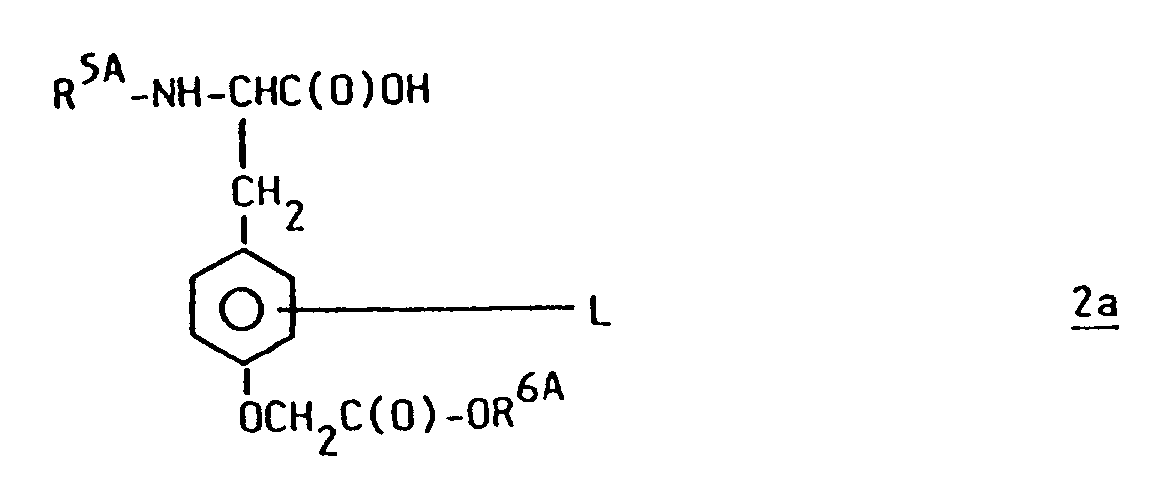
- the peptides of formula 1 in which R1 is the derived amino acid radical of formula 2 in which R5, R6 and L are as defined herein, and R2, Y, R3 and R4 are as defined herein can be prepared by subjecting the intermediate of formula 3 wherein R 5A , L, R 2A , Y, R 3A and R 4A are as defined hereinabove, to O-alkylation with an alkylating agent of formula XCH2C-(O)OR 6A wherein X is bromo, chloro or iodo and R 6A is as defined hereinabove, in the presence of a suitable strong base; followed, if required, by deprotection to obtain the desired corresponding peptide of formula 1.
- the intermediate of formula 3 can be prepared by conventional methods; for example, see D.F. Veber et al., European patent application, 77,028, published April 20, 1983.
- Suitable strong bases for the above-noted alkylation include alkali metal carbonates, preferably potassium carbonate; alkali metal hydroxides, preferably sodium hydroxide or potassium hydroxide; or alkali metal hydrides, preferably sodium hydride.
- the peptide of formula 1 of this invention can be obtained in the form of a therapeutically acceptable salt.
- examples of such salts are those with organic acids, e.g. acetic, lactic, succinic, benzoic, salicylic, methanesulfonic or p-toluenesulfonic acid, as well as polymeric acids such as tannic acid or carboxymethyl cellulose, and also salts with inorganic acids such as hydrohalic acids, e.g. hydrochloric acid, or sulfuric acid, or phosphoric acid.
- a particular acid addition salt is converted into another acid addition salt, such as a non-toxic, pharmaceutically acceptable salt, by treatment with the appropriate ion exchange resin in the manner described by R.A. Boissonnas et al., Helv. Chim. Acta, 43 , 1849(1960).
- examples of such salts are those with the sodium, potassium or calcium cations, or with strong organic bases, for example, triethylamine or N-methylmorpholine.
- the therapeutically acceptable salts of the peptides of formula 1 are biologically fully equivalent to the peptides themselves.
- HIV protease inhibiting properties and the cell protective effect against HIV pathogenesis of the peptides of formula 1, or a therapeutically acceptable salt thereof, can be demonstrated by biochemical, microbiological and biological procedures.
- a particular useful procedure for demonstrating the HIV protease inhibiting properties of the peptides of formula 1 or their therapeutically acceptable salts is the "Recombinant HIV Protease HPLC Assay".
- the procedure is based on the capacity of the test compound to inhibit enzymatic cleavage by HIV protease of a decapeptide (the substrate) having an amino acid sequence which includes a known HIV protease cleavage site of the HIV polyprotein; see H.G. Krausslich et al., Proc. Natl. Acad. Sci. USA, 86 , 807 (1989). Details of this assay together with the results obtained for exemplified peptides of formula 1 are described in the examples hereinafter.
- the cell protective effect of the peptides or their therapeutically acceptable salts can he demonstrated by microbiological procedures for evaluating the effect of test compounds in inhibiting the cytopathogenicity of HIV in human T4 cell lines; for example, see M. Baba et al., Biochem. Biophys. Res. Comm., 142 , 128 (1987).
- the peptide When a peptide of this invention, or a therapeutically acceptable salt thereof, is used to combat HIV infections in a human, the peptide can be administered orally, topically or parenterally, in a vehicle comprising one or more pharmaceutically acceptable carriers, the proportion of which is determined by the solubility and chemical nature of the peptide, chosen route of administration and standard biological practice.
- the peptide or a therapeutically acceptable salt thereof can be formulated in unit dosage forms such as capsules or tablets each containing a predetermined amount of the active ingredient, ranging from about 25 to 500 mg, in a pharmaceutically acceptable carrier.
- the peptide For topical administration, the peptide can be formulated in a pharmaceutically acceptable vehicle containing 0.1 to 10 percent, preferably 0.5 to 5 percent, of the active agent.
- Such formulations can be in the form of a cream, lotion, sublingual tablet, or preferably a transdermal patch or buccal patch.
- the peptide of formula 1 is administered by either intravenous, subcutaneous or intramuscular injection, in compositions with pharmaceutically acceptable vehicles or carriers.
- pharmaceutically acceptable vehicles or carriers for administration by injection, it is preferred to use the peptide in solution in a sterile aqueous vehicle which may also contain other solutes such as buffers or preservatives as well as sufficient quantities of pharmaceutically acceptable salts or of glucose to make the solution isotonic.
- Suitable vehicles or carriers for the above noted formulations can be found in standard pharmaceutical texts, e.g. in "Remington's Pharmaceutical Sciences", 16th ed, Mack Publishing Company, Easton, Penn., 1980.
- the dosage of the peptide will vary with the form of administration and the particular active agent chosen. Furthermore, it will vary with the particular host under treatment. Generally, treatment is initiated with small dosages substantially less than the optimum dose of the peptide. Thereafter, the dosage is increased by small increments until the optimum effect under the circumstances is reached. In general, the peptide is most desirably administered at a concentration level that will generally afford antivirally effective results without causing any harmful or deleterious side effects.
- the peptide or a therapeutically acceptable salt is administered in the range of 1.0 to 75 mg per kilogram of body weight per day, with a preferred range of 2.5 to 20 mg per kilogram.
- the peptide of formula 1 is administered at a dosage of 10 mcg to 1000 mcg per kilogram of body weight per day, although the aforementioned variations will occur. However, a dosage level that is in the range of from about 50 mcg to 500 mcg per kilogram of body weight per day is most desirably employed in order to achieve effective results.
- formulations disclosed hereinabove are effective and relatively safe medications for treating HIV infections, the possible concurrent administration of these formulations with other antiviral medications or agents to obtain beneficial results is not excluded.
- antiviral medications or agents include soluble CD4, zidovudine, dideoxycytidine, phosphonoformate, ribavarin, antiviral interferons (e.g. ⁇ -interferon or interleukin-2) or aerosol pentamidine.
- the peptides of formula 1 also possess the ability to inhibit renin activity.
- the renin inhibiting activity of the compounds can be demonstrated in standard pharmacological tests such as those described by M.G. Bock et al., J. Med. Chem., 31 , 1918(1988).
- the peptides are indicated for the diagnosis, prophylaxis and treatment of renin-associated hypertension and for the treatment of congestive heart failure in mammals including humans.
- the peptides can be formulated and administered in the same manner as described above, but usually at higher dosages which can be determined conventionally by using well known pharmacological protocols.
- R1 is the radical of formula 2 wherein R5 is R7OC(O)- wherein R7 is lower alkyl, R6 is hydrogen or benzyl and L is hydrogen; R2 is -N(R8)CH(R8)CO-wherein R8 is hydrogen and R9 is lower alkyl, lower alkyl monosubstituted with hydroxy, benzyl, 4-imidazolylmethyl, 2-thienylmethyl or 2-thiazolylmethyl, Y is Sta, ACHPA or AHPPA, R3 is absent or is -N(R15)CH(R16)CO- wherein R15 is hydrogen and R16 is lower alkyl, and R4 is either -NR17CH(R18)C(O)-Z wherein R17 is hydrogen, R18 is lower alkyl, lower alkyl monosubstituted with hydroxy or benzyloxy, -CH(OH)C6H5 or benzy
- a more preferred group of peptides for inhibiting renin is represented by formula 1 wherein R1 is the radical of formula 2 wherein R5 is tertiary-butyloxycarbonyl, R6 is hydrogen, methyl or benzyl and L is hydrogen, R2 is Val, Ala or Phe, Y is as defined in the last instance, R3 is absent or Ala, Ile or Leu, and R4 is Ala-NH2, Phe-NH2 or -NHCR18(R21)CH2OH wherein R18 is -CH2OH, -CH(OH)CH3 or -CH(OH)C6H5 and R21 is hydrogen or methyl, or a therapeutically acceptable salt thereof.
- peptides of formula 1 include: H-Tyr(O-AcOBzl)-Ala-ACHPA-Leu-Phe-NHC(CH2OH)2CH3 H-Tyr-(O-AcOH)-(N-Me)Asp-ACHPA-Cha-Asn-NH2 H-(3-iodo)-Tyr(O-AcOBzl)-Val-ACHPA-Leu-Phe-NH2 H-(3,5-diiodo)-Tyr(O-AcOBzl)-Val-ACHPA-Leu-Phe-NH2 Boc-Tyr(O-AcOEt)-Ala-AHPPA-Gln-Ile-OH H-Tyr(O-AcOH)-Cpa-ACHPA-Tyr-NHCH3 Boc-Tyr(O-AcOH)-Val-ACHPA-NHC(CH2OH)2CH3
- Enzyme HIV protease was expressed in E. coli and purified to ca. 50% purity according to the procedure described by H.-G. Krausslich et al., Proc. Natl. Acad. Sci. USA, 86 , 807 (1989). The enzyme was stored as 10 ⁇ L aliquots at -70°C. The aliquots were diluted to 1/10th of the original concentration with buffer prior to use (enzyme working solution).
- Substrate VSFNFPQITL-NH2, MW 1164, see Krausslich et al., supra, was used as substrate. The substrate was made into 10 mM stock in DMSO and stored at -20°C.
- the stock Prior to use, the stock was diluted with buffer to give a 400 ⁇ M solution substrate working solution.
- Buffer 2-(4-Morpholino)ethanesulfonic acid (50mM), NaCl (25mM) and EDTA (5mM) was dissolved in distilled H2O (90mL) and the solution was adjusted to pH6 with concentrated aqueous NaOH. The latter solution was diluted to 100 mL with H2O to give the buffer.
- Procedure (1) The test compound was dissolved in DMSO to give a solution having 40X the final concentration of the test compound in the assay mixture (see step 2) so that the amount of DMSO in the assay mixture was 5% (v,v) or less.
- the assay mixture was prepared by mixing 10 ⁇ L of the substrate working solution, 0.5 ⁇ L of the solution of the test compound in DMSO from step 1, and 10 ⁇ L of the enzyme working solution. (3) The assay mixture was incubated at 37°C for 1h. (4) The reaction was quenched by adding 100 of 2% aqueous TFA. (5) The substrate and products (i.e. VSFNF and PQITL-NH2) were separated by subjecting 100 ⁇ L of the quenched assay mixture to HPLC using Nucleosil ® C18 column with a 26-min linear gradient at 1 mL/min from 11% to 70% acetonitrile in H2O with 0.05% aqueous TFA. Elution was monitored at 210 nm.
Landscapes
- Health & Medical Sciences (AREA)
- Chemical & Material Sciences (AREA)
- Organic Chemistry (AREA)
- General Health & Medical Sciences (AREA)
- Medicinal Chemistry (AREA)
- Life Sciences & Earth Sciences (AREA)
- Veterinary Medicine (AREA)
- Nuclear Medicine, Radiotherapy & Molecular Imaging (AREA)
- Bioinformatics & Cheminformatics (AREA)
- Pharmacology & Pharmacy (AREA)
- General Chemical & Material Sciences (AREA)
- Animal Behavior & Ethology (AREA)
- Engineering & Computer Science (AREA)
- Public Health (AREA)
- Chemical Kinetics & Catalysis (AREA)
- Cardiology (AREA)
- Heart & Thoracic Surgery (AREA)
- Biochemistry (AREA)
- Biophysics (AREA)
- Genetics & Genomics (AREA)
- Molecular Biology (AREA)
- Proteomics, Peptides & Aminoacids (AREA)
- Medicines That Contain Protein Lipid Enzymes And Other Medicines (AREA)
- Peptides Or Proteins (AREA)
Claims (12)
- Peptide de formule 1
R¹-R²-Y-R³-R⁴ 1
dans laquelle R¹ est un radical d'acide aminé dérivé de formule 2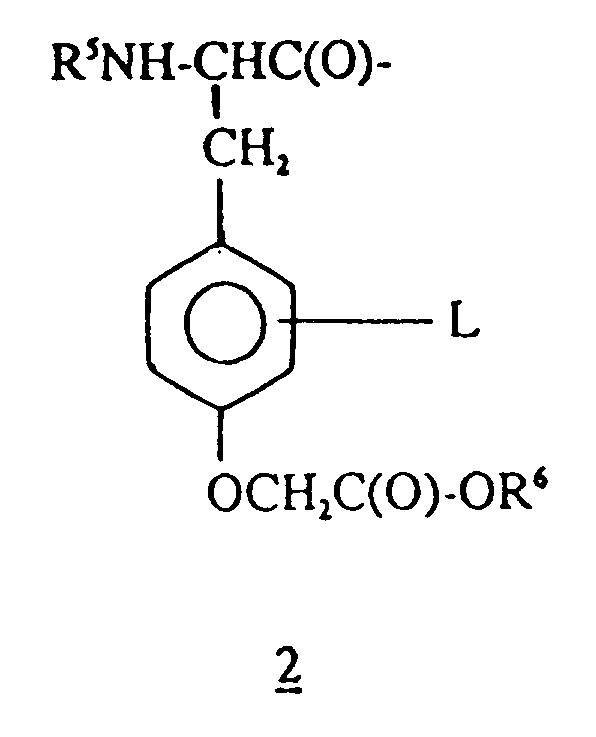
R² représente -N(R⁸)CH(R⁹)C(O)- où R⁸ représente l'hydrogène ou un groupe alkyle inférieur et R⁹ représente l'hydrogène, un groupe alkyle inférieur, alkyle inférieur monosubstitué avec un groupe hydroxyle, méthoxy, méthylthio ou benzyloxy, cycloalkyle inférieur, (cycloalkyle inférieur)méthyle, benzyle, 4-imidazolylméthyle, 2-thiénylméthyle, 2-thiazolylméthyle, (4-hydroxyphényl)méthyle, [4-alcoxy inférieur)phényl]méthyle, -CH(OH)C₆H₅, -(CH₂)₄NH₂, ou -(CH₂)nC(O)OR¹⁰ ou -(CH₂)nC(O)NR¹¹R¹² où n représente l'entier un, deux ou trois, R¹⁰ représente l'hydrogène, un groupe alkyle linéaire ou ramifié contenant un à dix atomes de carbone, ou un groupe phénylalkyle inférieur et R¹¹ et R¹² représentent chacun indépendamment l'hydrogène, un groupe alkyle inférieur, phénylalkyle inférieur ou bien R¹¹ et R¹² forment avec l'atome d'azote auquel ils sont liés un groupe pyrrolidino, pipéridino, morpholino, pipérazino ou 4-(alkyle inférieur)pipérazino;
Y représente un radical d'acide aminé dérivé de formule -NHCH(R¹³)-W- où R¹³ représente un groupe alkyle inférieur, (cycloalkyle inférieur)méthyle, -CH₂CH₂SCH₃, benzyle ou benzyle substitué sur sa partie aromatique avec hydroxyle ou alcoxy inférieur, et W représente -(CH(OH)CH₂C(O)- ou -CH₂NHCH(R¹⁴)C(O)- où R¹⁴ a la même signification que celle donnée pour R¹³, et
R³ est absent ou représente -N(R¹⁵)CH(R¹⁶)C(O)- où R¹⁵ représente l'hydrogène ou un groupe alkyle inférieur et R¹⁶ a la même signification que celle donnée ici pour R⁹, et
R⁴ représente [-NR¹⁷CH(R¹⁸)C(O)]p-Z où R¹⁷ représente l'hydrogène ou un groupe alkyle inférieur, R¹⁸ a la même signification que celle donnée pour R⁹, p représente l'entier zéro ou un, et Z représente un groupe hydroxyle, alcoxy inférieur, benzyloxy ou -NR¹⁹R²⁰ où R¹⁹ et R²⁰ représentent chacun indépendamment l'hydrogène, un groupe alkyle inférieur ou phénylalkyle inférieur, ou bien R¹⁹ et R²⁰ forment avec l'atome d'azote auquel ils sont liés un groupe pyrrolidino, pipéridino, morpholino, pipérazino ou 4-(alkyle inférieur)pipérazino, ou bien
R⁴ représente -NR¹⁷CR¹⁸(R²¹)CH₂OH où R¹⁷ et R¹⁸ sont tels que définis dans cette revendication et R²¹ représente l'hydrogène, un groupe alkyle inférieur ou alkyle inférieur monosubstitué avec un groupe hydroxyle, dans les définitions ci-dessus, alkyle inférieur signifiant des radicaux alkyle linéaires contenant un à quatre atomes de carbone et des radicaux alkyle ramifiés contenant trois à quatre atomes de carbone, cycloalkyle inférieur signifiant des radicaux hydrocarbonés cycliques saturés contenant trois à six atomes de carbone et alcoxy inférieur signifiant des radicaux alcoxy linéaires contenant un à quatre atomes de carbone et des radicaux alcoxy ramifiés contenant trois à quatre atomes de carbone;
ou sel acceptable du point de vue thérapeutique de celui-ci. - Peptide selon la revendication 1, dans lequel R¹ représente le radical de formule 2 où R⁵ représente l'hydrogène, un groupe alkyle inférieur, ou R⁷OC(O)- ou R⁷C(O)- où R⁷ représente un groupe alkyle inférieur, R⁶ représente l'hydrogène, ou un groupe alkyle inférieur ou benzyle, L représente l'hydrogène ou un ou deux substituants halogéno, R² représente -N(R⁸)CH(R⁹)CO- où R⁸ représente l'hydrogène ou un groupe méthyle et R⁹ représente un groupe alkyle inférieur, cycloalkyle inférieur, cyclopropylméthyle, cyclohexylméthyle, -CH₂CH₂COOH, -CH₂CH₂CONH₂, -CH₂CONH₂ ou benzyle, Y représente -NHCH(R¹³)-W- où R¹³ représente un groupe alkyle inférieur, (cycloalkyle inférieur)méthyle, -CH₂CH₂SCH₃, benzyle ou (4-méthoxyphényl)méthyle et W représente -CH(OH)CH₂C(O)- ou -CH₂NHCH(R¹⁴)C(O)- où R¹⁴ représente un groupe alkyle inférieur ou (cycloalkyle inférieur)méthyle, R³ est absent ou représente -N(R¹⁵)CH(R¹⁶)C(O)- où R¹⁵ représente l'hydrogène ou un groupe méthyle et R¹⁶ représente l'hydrogène, un groupe alkyle inférieur, cyclopropylméthyle, cyclohexylméthyle, benzyle, -CH(OH)CH₃ ou -(CH₂)nC(O)OR¹⁰ ou -(CH₂)nC(O)NR¹¹R¹² où n représente l'entier un, deux ou trois, R¹⁰ représente l'hydrogène ou un groupe alkyle linéaire ou ramifié contenant un à dix atomes de carbone, et R¹¹ et R¹² représentent chacun indépendamment l'hydrogène ou un groupe méthyle ou éthyle, et R⁴ représente -NH(R¹⁷)CH(R¹⁸)C(O)Z où R¹⁷ représente l'hydrogène ou un groupe méthyle et R¹⁸ représente un groupe alkyle inférieur, alkyle inférieur monosubstitué avec un groupe hydroxyle ou benzyloxy, cyclopropylméthyle, cyclohexylméthyle, -CH(OH)C₆H₅ ou benzyle, et Z représente un groupe hydroxyle ou NR¹⁹R²⁰ où R¹⁹ et R²⁰ représentent chacun indépendamment l'hydrogène, un groupe méthyle, éthyle ou 2-méthylbutyle, ou bien R¹⁹ et R²⁰ forment avec l'atome d'azote auquel ils sont liés un groupe pyrrolidino ou pipéridino, ou bien R⁴ représente -NR¹⁷CR¹⁸(R²¹)CH₂OH où R¹⁷ et R¹⁸ sont tels que définis dans cette revendication et R²¹ représente l'hydrogène, un groupe alkyle inférieur ou alkyle inférieur substitué avec un groupe hydroxyle, ou sel acceptable du point de vue thérapeutique de celui-ci.
- Peptide selon la revendication 2, dans lequel R¹ représente le radical de formule 2 où R⁵ représente l'hydrogène ou un groupe tertiobutyloxycarbonyle, R⁶ représente l'hydrogène, un groupe méthyle, éthyle ou benzyle, et L représente l'hydrogène ou un ou deux substituants halogéno à la position 3 ou aux positions 3 et 5, respectivement, du cycle aromatique, R² représente Val, Ala, Leu, Ile, Gly, Tbg, Cpa, Cha, Glu, Gln, Asn ou Phe, Y représente -NHCH(R¹³)-W- où R¹³ représente un groupe 1-méthyléthyle, 2-méthylpropyle, cyclohexylméthyle, -CH₂CH₂SCH₃, benzyle ou (4-méthoxyphényl)méthyle, et W représente -CH(OH)CH₂C(O)- ou -CH₂NHCH(R¹⁴)C(O)- où R¹⁴ représente un groupe 2-méthylpropyle ou cyclohexylméthyle, R³ est absent ou représente Leu, Nle, Ile, Val, Ala, Gly, Cha, Phe, Thr, Glu, Gln, Asp ou Asn, R⁴ représente Leu-NH₂, Leu-OH, Ile-NH₂, Ile-OH, Val-NH₂, Val-OH, Ala-NH₂, Ala-OH, Thr(OBzl)-NH₂, Cpa-NH₂, Cpa-OH, Cha-NH₂, Cha-OH, Phe-NH₂, Phe-NH[CH₂CH(CH₃)C₂H₅], Phe-N(C₂H₅)2 ou Phe-OH, ou bien R⁴ représente -NHCR¹⁸(R²¹)CH₂OH où R¹⁸ représente un groupe alkyle inférieur, -CH₂OH, -CH(OH)CH₃, -CH₂CH₂OH ou -CH(OH)C₆H₅ et R²¹ représente l'hydrogène, un groupe méthyle ou -CH₂OH, ou sel acceptable du point de vue thérapeutique de celui-ci.
- Peptide selon la revendication 3, dans lequel R¹ représente le radical de formule 2 où R⁵ représente l'hydrogène ou un groupe tertiobutyloxycarbonyle, R⁶ représente l'hydrogène ou un groupe benzyle et L représente l'hydrogène ou un ou deux substituants haiogéno à la position 3 ou aux positions 3 et 5, respectivement, du cycle aromatique, R² et Y sont tels que définis dans la revendication 3, R³ représente Leu, Nle, Ile, Val, Ala, Cha, Glu ou Gln, et R⁴ représente Ile-NH₂, Ala-NH₂, Thr(OBzl)-NH₂, Cha-NH₂ ou Phe-NH₂, ou représente -NHCR¹⁸(R²¹)-CH₂OH où R¹⁸ représente un groupe 1-méthyléthyle, 1-méthylpropyle, 2-méthylpropyle, -CH₂OH ou -CH(OH)C₆H₅ et R²¹ représente l'hydrogène ou un groupe méthyle, ou sel acceptable du point de vue thérapeutique de celui-ci.
- Peptide selon la revendication 1, dans lequel R¹ représente le radical de formule 2 où R⁵ représente R⁷OC(O)-où R⁷ représente un groupe alkyle inférieur, R⁶ représente l'hydrogène ou un groupe benzyle et L représente l'hydrogène, R² représente -N(R⁸)CH(R⁹)CO- où R⁸ représente l'hydrogène et R⁹ représente un groupe alkyle inférieur ou benzyle, Y représente Sta, ACHPA ou AHPPA, R³ est absent ou représente -N(R¹⁵)CH(R¹⁶)CO- où R¹⁵ représente l'hydrogène et R¹⁶ représente un groupe alkyle inférieur, et R⁴ représente -NR¹⁷CH(R¹⁸)C(O)Z où R¹⁷ représente l'hydrogène, R¹⁸ représente un groupe alkyle inférieur, -CH(OH)C₆H₅ ou benzyle, et Z représente un groupe hydroxyle ou amino, ou bien R⁴ représente -NR¹⁷CR¹⁸(R²¹)CH₂OH où R¹⁷ représente l'hydrogène, R¹⁸ représente un groupe alkyle inférieur, alkyle inférieur monosubstitué avec un groupe hydroxyle, CH(OH)C₆H₅ ou benzyle et R²¹ représente l'hydrogène ou un groupe alkyle inférieur, ou sel acceptable du point de vue thérapeutique de celui-ci.
- Peptide selon la revendication 5, dans lequel R¹ représente le radical de formule 2 où R⁵ représente un groupe tertiobutyloxycarbonyle, R⁶ représente l'hydrogène ou un groupe benzyle et L représente l'hydrogène, R² représente Val, Ala ou Phe, Y est tel que défini dans la revendication 5, R³ est absent ou représente Ala, Lle ou Leu, et R⁴ représente Ala-NH₂, Phe-NH₂ ou -NHCR¹⁸(R²¹)CH₂OH où R¹⁸ représente -CH₂OH, -CH(OH)CH₃ ou -CH(OH)C₆H₅ et R²¹ représente l'hydrogène ou un groupe méthyle, ou sel acceptable du point de vue thérapeutique de celui-ci.
- Peptide selon la revendication 1, choisi dans le groupe consistant en:
Boc-Tyr(O-AcOBzl)-Val-ACHPA-Leu-Phe-NH₂
H-Tyr(O-AcOBzl)-Val-ACHPA-Leu-Phe-NH₂
Boc-Tyr(O-AcOH)-Val-ACHPA-Leu-Phe-NH₂
H-Tyr(O-AcOH)-Val-ACHPA-Leu-Phe-NH₂
Boc-Tyr(O-AcOH)-Phe-ACHPA-Leu-Phe-NH₂ - Composition pharmaceutique comprenant un peptide selon l'une quelconque des revendications 1 à 7 ou un sel acceptable du point de vue thérapeutique de celui-ci, et un vecteur acceptable du point de vue pharmaceutique.
- Utilisation d'un peptide selon l'une quelconque des revendications 1 à 7 pour la préparation d'une composition pour traiter les infections à VIH chez un humain.
- Utilisation d'un peptide selon l'une quelconque des revendications 1 à 7 pour la préparation d'une composition pour protéger des cellules humaines contre une pathogenèse à VIH.
- Utilisation d'un peptide selon l'une quelconque des revendications 1 à 7 pour la préparation d'une composition pour traiter l'hypertension artérielie réninedépendante ou l'insuffisance cardiaque congestive chez un mammifère.
- Procédé de préparation d'un peptide de formule 1 selon la revendication 1, comprenant:(i) le couplage de l'acide aminé dérivé de formule 2a
 (ii) la soumission de l'intermédiaire de formule 3

suivie, si nécessaire, par une déprotection des groupes amino ou carboxyle pour donner le peptide correspondant de formule 1, et, si on le souhaite, la transformation du peptide en un sel acceptable du point de vue thérapeutique.
Applications Claiming Priority (2)
| Application Number | Priority Date | Filing Date | Title |
|---|---|---|---|
| US361895 | 1989-06-06 | ||
| US07/361,895 US5126326A (en) | 1989-06-06 | 1989-06-06 | Enzyme inhibiting peptide derivatives |
Publications (2)
| Publication Number | Publication Date |
|---|---|
| EP0401675A1 EP0401675A1 (fr) | 1990-12-12 |
| EP0401675B1 true EP0401675B1 (fr) | 1994-12-28 |
Family
ID=23423841
Family Applications (1)
| Application Number | Title | Priority Date | Filing Date |
|---|---|---|---|
| EP90110321A Expired - Lifetime EP0401675B1 (fr) | 1989-06-06 | 1990-05-31 | Dérivés de peptides inhibitant des enzymes |
Country Status (7)
| Country | Link |
|---|---|
| US (1) | US5126326A (fr) |
| EP (1) | EP0401675B1 (fr) |
| JP (1) | JPH0341091A (fr) |
| AT (1) | ATE116332T1 (fr) |
| AU (1) | AU645751B2 (fr) |
| CA (1) | CA2016663C (fr) |
| DE (1) | DE69015451T2 (fr) |
Families Citing this family (15)
| Publication number | Priority date | Publication date | Assignee | Title |
|---|---|---|---|---|
| WO1993002674A1 (fr) * | 1991-08-02 | 1993-02-18 | Smithkline Beecham Corporation | Inhibiteurs de la protease du vih |
| US5643878A (en) * | 1991-09-12 | 1997-07-01 | Ciba-Geigy Corporation | 5-amino-4-hydroxyhexanoic acid derivatives |
| EP0532466A3 (en) * | 1991-09-12 | 1993-06-16 | Ciba-Geigy Ag | Derivatives of 5-amino-4-hydroxy-hexanoic acid and their therapeutical use |
| DE69333270T2 (de) | 1992-03-11 | 2004-08-05 | Narhex Ltd. | Aminderivate von oxo- und hydroxy- substituierten kohlenwasserstoffen |
| US5888992A (en) * | 1992-03-11 | 1999-03-30 | Narhex Limited | Polar substituted hydrocarbons |
| BR9306058A (pt) * | 1992-03-11 | 1997-11-18 | Narhex Ltd | Derivados de amina de hidrocarbonetos oxo- e hidroxi- substituidos |
| US6071895A (en) * | 1992-03-11 | 2000-06-06 | Narhex Limited | Polar-substituted hydrocarbons |
| TW217410B (fr) * | 1992-04-01 | 1993-12-11 | Ciba Geigy | |
| US5559256A (en) * | 1992-07-20 | 1996-09-24 | E. R. Squibb & Sons, Inc. | Aminediol protease inhibitors |
| US5430150A (en) * | 1992-12-16 | 1995-07-04 | American Cyanamid Company | Retroviral protease inhibitors |
| IL110898A0 (en) * | 1993-09-10 | 1994-11-28 | Narhex Australia Pty Ltd | Polar-substituted hydrocarbons |
| US6222043B1 (en) | 1995-06-30 | 2001-04-24 | Japan Energy Corporation | Methods of preparing novel dipeptide compounds or pharmaceutically acceptable salts thereof |
| US5932550A (en) * | 1995-06-30 | 1999-08-03 | Japan Energy Corporation | Dipeptide compound or pharmaceutically acceptable salt thereof and medical use thereof |
| US5849691A (en) * | 1996-02-20 | 1998-12-15 | The United States Of America As Represented By The Department Of Health And Human Services | Peptidomimetic inhibitors of cathepsin D and plasmepsins I and II |
| EP0900566A4 (fr) | 1996-12-27 | 2001-04-25 | Japan Energy Corp | Nouveaux composes de tripeptides et medicaments anti-sida |
Family Cites Families (5)
| Publication number | Priority date | Publication date | Assignee | Title |
|---|---|---|---|---|
| CA1258748A (fr) * | 1981-10-08 | 1989-08-22 | Daniel F. Veber | Peptides inhibiteurs de la renine |
| EP0118223A1 (fr) * | 1983-02-07 | 1984-09-12 | Aktiebolaget Hässle | Inhibiteurs d'enzymes |
| WO1987002986A1 (fr) * | 1985-11-15 | 1987-05-21 | The Upjohn Company | Nouveaux analogues de polypeptides inhibiteurs de renine contenant s-aryl-d-cysteinyle ou l-cysteinyle ou dl-cysteinyle, de l'acide 3-(arylthio) lactique ou des moities de 3-(arylthio)-alkyl |
| DE3627877A1 (de) * | 1986-07-30 | 1988-02-04 | Hoechst Ag | Renin-hemmende di- und tripeptide, verfahren zu deren herstellung, diese enthaltende mittel und ihre verwendung |
| FR2614533A1 (fr) * | 1987-04-23 | 1988-11-04 | Sandoz Sa | Nouveaux derives peptidiques, leur preparation et leur utilisation comme medicaments |
-
1989
- 1989-06-06 US US07/361,895 patent/US5126326A/en not_active Expired - Lifetime
-
1990
- 1990-05-14 CA CA002016663A patent/CA2016663C/fr not_active Expired - Fee Related
- 1990-05-31 EP EP90110321A patent/EP0401675B1/fr not_active Expired - Lifetime
- 1990-05-31 DE DE69015451T patent/DE69015451T2/de not_active Expired - Fee Related
- 1990-05-31 AT AT90110321T patent/ATE116332T1/de not_active IP Right Cessation
- 1990-06-05 AU AU56288/90A patent/AU645751B2/en not_active Ceased
- 1990-06-05 JP JP2147158A patent/JPH0341091A/ja active Pending
Also Published As
| Publication number | Publication date |
|---|---|
| US5126326A (en) | 1992-06-30 |
| JPH0341091A (ja) | 1991-02-21 |
| DE69015451T2 (de) | 1995-05-24 |
| DE69015451D1 (de) | 1995-02-09 |
| CA2016663C (fr) | 2000-04-11 |
| AU645751B2 (en) | 1994-01-27 |
| EP0401675A1 (fr) | 1990-12-12 |
| ATE116332T1 (de) | 1995-01-15 |
| CA2016663A1 (fr) | 1990-12-06 |
| AU5628890A (en) | 1990-12-13 |
Similar Documents
| Publication | Publication Date | Title |
|---|---|---|
| EP0401676B1 (fr) | Inhibiteurs d'enzymes | |
| EP1105422B1 (fr) | Peptides inhibiteurs de l'hepatite c | |
| US5126326A (en) | Enzyme inhibiting peptide derivatives | |
| EP0155809A2 (fr) | Inhibiteurs de larénine contenant de la rénine ou ses dérivés | |
| CZ280292A3 (en) | Novel derivatives of 5-amino-4-hydroxyhexanoic acid which derivatives act as therapeutic agents | |
| CA2036398C (fr) | Agents d'inhibition de la protease du vih | |
| EP0498784B1 (fr) | Inhibiteurs de protéases rétrovirales | |
| EP1165492A1 (fr) | Derives d'hydroxyphenyle possedant des proprietes inhibitrices de l'integrase du vih | |
| CA2036397C (fr) | Inhibiteurs de la protease du vih, renfermant des unites d'amino-acides | |
| HU215520B (hu) | Eljárás HIV-proteáz inhibitor hatású szubsztituált pirrolidinszármazékok és ezeket tartalmazó gyógyszerkészítmények előállítására | |
| WO1991006561A1 (fr) | Procede de traitement d'hvi et d'autres virus, et composes utiles a cet effet | |
| EP0552247A1 (fr) | Peptides contenant des 1,4-diamines substituees comme segments d'insertion a l'etat de transition | |
| HU185229B (en) | Process for preparing pharmaceutically active peptides and acetates thereof | |
| KR0139535B1 (ko) | 신규 펩티다제 억제제 | |
| US4713367A (en) | Retro-inverso analogs of the bradykinin potentiating peptide BPP5a | |
| EP0443560A2 (fr) | Inhibiteurs d'HIV-protéase | |
| JPH04504716A (ja) | 新規な極性n―末端基を有するペプチド類 | |
| KR100273620B1 (ko) | 레트로바이러스 감염의 억제방법 | |
| EP0222523A2 (fr) | Polypeptides contenant de la difluorocyclostatine | |
| CA1284550C (fr) | Analogues retro-inverso du peptide bpp____ potentiateur de la bradykinine | |
| CN1165521A (zh) | 苯基肽,该肽及含有所述肽的药物组合物的制备方法 | |
| WO1990009172A1 (fr) | Inhibiteurs de renine contenant du phosphore | |
| EP0375058A2 (fr) | Analogues de la thrymopentine, leur procédé de préparation et leur emploi pour préparer des compositions pharmaceutiques | |
| CA2302144A1 (fr) | Derives hydroxyphenyliques ayant des proprietes inhibitrices de vih-integrase |
Legal Events
| Date | Code | Title | Description |
|---|---|---|---|
| PUAI | Public reference made under article 153(3) epc to a published international application that has entered the european phase |
Free format text: ORIGINAL CODE: 0009012 |
|
| AK | Designated contracting states |
Kind code of ref document: A1 Designated state(s): AT BE CH DE DK ES FR GB GR IT LI LU NL SE |
|
| 17P | Request for examination filed |
Effective date: 19901207 |
|
| 17Q | First examination report despatched |
Effective date: 19930125 |
|
| RAP1 | Party data changed (applicant data changed or rights of an application transferred) |
Owner name: BIO-MEGA/BOEHRINGER INGELHEIM RESEARCH INC. |
|
| GRAA | (expected) grant |
Free format text: ORIGINAL CODE: 0009210 |
|
| AK | Designated contracting states |
Kind code of ref document: B1 Designated state(s): AT BE CH DE DK ES FR GB GR IT LI LU NL SE |
|
| PG25 | Lapsed in a contracting state [announced via postgrant information from national office to epo] |
Ref country code: NL Effective date: 19941228 Ref country code: GR Free format text: LAPSE BECAUSE OF FAILURE TO SUBMIT A TRANSLATION OF THE DESCRIPTION OR TO PAY THE FEE WITHIN THE PRESCRIBED TIME-LIMIT Effective date: 19941228 Ref country code: ES Free format text: THE PATENT HAS BEEN ANNULLED BY A DECISION OF A NATIONAL AUTHORITY Effective date: 19941228 Ref country code: DK Effective date: 19941228 Ref country code: BE Effective date: 19941228 Ref country code: AT Effective date: 19941228 |
|
| REF | Corresponds to: |
Ref document number: 116332 Country of ref document: AT Date of ref document: 19950115 Kind code of ref document: T |
|
| REF | Corresponds to: |
Ref document number: 69015451 Country of ref document: DE Date of ref document: 19950209 |
|
| ITF | It: translation for a ep patent filed | ||
| PG25 | Lapsed in a contracting state [announced via postgrant information from national office to epo] |
Ref country code: SE Effective date: 19950328 |
|
| ET | Fr: translation filed | ||
| PGFP | Annual fee paid to national office [announced via postgrant information from national office to epo] |
Ref country code: FR Payment date: 19950414 Year of fee payment: 6 |
|
| PGFP | Annual fee paid to national office [announced via postgrant information from national office to epo] |
Ref country code: GB Payment date: 19950523 Year of fee payment: 6 |
|
| PGFP | Annual fee paid to national office [announced via postgrant information from national office to epo] |
Ref country code: DE Payment date: 19950524 Year of fee payment: 6 |
|
| PG25 | Lapsed in a contracting state [announced via postgrant information from national office to epo] |
Ref country code: LU Free format text: LAPSE BECAUSE OF NON-PAYMENT OF DUE FEES Effective date: 19950531 |
|
| PGFP | Annual fee paid to national office [announced via postgrant information from national office to epo] |
Ref country code: CH Payment date: 19950601 Year of fee payment: 6 |
|
| NLV1 | Nl: lapsed or annulled due to failure to fulfill the requirements of art. 29p and 29m of the patents act | ||
| PLBE | No opposition filed within time limit |
Free format text: ORIGINAL CODE: 0009261 |
|
| STAA | Information on the status of an ep patent application or granted ep patent |
Free format text: STATUS: NO OPPOSITION FILED WITHIN TIME LIMIT |
|
| 26N | No opposition filed | ||
| PG25 | Lapsed in a contracting state [announced via postgrant information from national office to epo] |
Ref country code: LI Effective date: 19960531 Ref country code: GB Effective date: 19960531 Ref country code: CH Effective date: 19960531 |
|
| REG | Reference to a national code |
Ref country code: CH Ref legal event code: PL |
|
| GBPC | Gb: european patent ceased through non-payment of renewal fee |
Effective date: 19960531 |
|
| PG25 | Lapsed in a contracting state [announced via postgrant information from national office to epo] |
Ref country code: FR Effective date: 19970131 |
|
| PG25 | Lapsed in a contracting state [announced via postgrant information from national office to epo] |
Ref country code: DE Effective date: 19970201 |
|
| REG | Reference to a national code |
Ref country code: FR Ref legal event code: ST |
|
| PG25 | Lapsed in a contracting state [announced via postgrant information from national office to epo] |
Ref country code: IT Free format text: LAPSE BECAUSE OF NON-PAYMENT OF DUE FEES;WARNING: LAPSES OF ITALIAN PATENTS WITH EFFECTIVE DATE BEFORE 2007 MAY HAVE OCCURRED AT ANY TIME BEFORE 2007. THE CORRECT EFFECTIVE DATE MAY BE DIFFERENT FROM THE ONE RECORDED. Effective date: 20050531 |