EP0404320A2 - Moteur deux temps à dispositif de contrôle d'épuration des gaz d'échappement - Google Patents
Moteur deux temps à dispositif de contrôle d'épuration des gaz d'échappement Download PDFInfo
- Publication number
- EP0404320A2 EP0404320A2 EP90304856A EP90304856A EP0404320A2 EP 0404320 A2 EP0404320 A2 EP 0404320A2 EP 90304856 A EP90304856 A EP 90304856A EP 90304856 A EP90304856 A EP 90304856A EP 0404320 A2 EP0404320 A2 EP 0404320A2
- Authority
- EP
- European Patent Office
- Prior art keywords
- exhaust
- port
- exhaust port
- passage
- cylinder
- Prior art date
- Legal status (The legal status is an assumption and is not a legal conclusion. Google has not performed a legal analysis and makes no representation as to the accuracy of the status listed.)
- Granted
Links
Images


Classifications
-
- F—MECHANICAL ENGINEERING; LIGHTING; HEATING; WEAPONS; BLASTING
- F01—MACHINES OR ENGINES IN GENERAL; ENGINE PLANTS IN GENERAL; STEAM ENGINES
- F01N—GAS-FLOW SILENCERS OR EXHAUST APPARATUS FOR MACHINES OR ENGINES IN GENERAL; GAS-FLOW SILENCERS OR EXHAUST APPARATUS FOR INTERNAL-COMBUSTION ENGINES
- F01N3/00—Exhaust or silencing apparatus having means for purifying, rendering innocuous, or otherwise treating exhaust
- F01N3/08—Exhaust or silencing apparatus having means for purifying, rendering innocuous, or otherwise treating exhaust for rendering innocuous
- F01N3/10—Exhaust or silencing apparatus having means for purifying, rendering innocuous, or otherwise treating exhaust for rendering innocuous by thermal or catalytic conversion of noxious components of exhaust
- F01N3/18—Exhaust or silencing apparatus having means for purifying, rendering innocuous, or otherwise treating exhaust for rendering innocuous by thermal or catalytic conversion of noxious components of exhaust characterised by methods of operation; Control
- F01N3/20—Exhaust or silencing apparatus having means for purifying, rendering innocuous, or otherwise treating exhaust for rendering innocuous by thermal or catalytic conversion of noxious components of exhaust characterised by methods of operation; Control specially adapted for catalytic conversion
- F01N3/2006—Periodically heating or cooling catalytic reactors, e.g. at cold starting or overheating
- F01N3/2046—Periodically cooling catalytic reactors
-
- F—MECHANICAL ENGINEERING; LIGHTING; HEATING; WEAPONS; BLASTING
- F01—MACHINES OR ENGINES IN GENERAL; ENGINE PLANTS IN GENERAL; STEAM ENGINES
- F01N—GAS-FLOW SILENCERS OR EXHAUST APPARATUS FOR MACHINES OR ENGINES IN GENERAL; GAS-FLOW SILENCERS OR EXHAUST APPARATUS FOR INTERNAL-COMBUSTION ENGINES
- F01N3/00—Exhaust or silencing apparatus having means for purifying, rendering innocuous, or otherwise treating exhaust
- F01N3/08—Exhaust or silencing apparatus having means for purifying, rendering innocuous, or otherwise treating exhaust for rendering innocuous
- F01N3/10—Exhaust or silencing apparatus having means for purifying, rendering innocuous, or otherwise treating exhaust for rendering innocuous by thermal or catalytic conversion of noxious components of exhaust
- F01N3/18—Exhaust or silencing apparatus having means for purifying, rendering innocuous, or otherwise treating exhaust for rendering innocuous by thermal or catalytic conversion of noxious components of exhaust characterised by methods of operation; Control
- F01N3/20—Exhaust or silencing apparatus having means for purifying, rendering innocuous, or otherwise treating exhaust for rendering innocuous by thermal or catalytic conversion of noxious components of exhaust characterised by methods of operation; Control specially adapted for catalytic conversion
-
- F—MECHANICAL ENGINEERING; LIGHTING; HEATING; WEAPONS; BLASTING
- F01—MACHINES OR ENGINES IN GENERAL; ENGINE PLANTS IN GENERAL; STEAM ENGINES
- F01N—GAS-FLOW SILENCERS OR EXHAUST APPARATUS FOR MACHINES OR ENGINES IN GENERAL; GAS-FLOW SILENCERS OR EXHAUST APPARATUS FOR INTERNAL-COMBUSTION ENGINES
- F01N13/00—Exhaust or silencing apparatus characterised by constructional features
- F01N13/08—Other arrangements or adaptations of exhaust conduits
- F01N13/10—Other arrangements or adaptations of exhaust conduits of exhaust manifolds
-
- F—MECHANICAL ENGINEERING; LIGHTING; HEATING; WEAPONS; BLASTING
- F01—MACHINES OR ENGINES IN GENERAL; ENGINE PLANTS IN GENERAL; STEAM ENGINES
- F01N—GAS-FLOW SILENCERS OR EXHAUST APPARATUS FOR MACHINES OR ENGINES IN GENERAL; GAS-FLOW SILENCERS OR EXHAUST APPARATUS FOR INTERNAL-COMBUSTION ENGINES
- F01N3/00—Exhaust or silencing apparatus having means for purifying, rendering innocuous, or otherwise treating exhaust
- F01N3/08—Exhaust or silencing apparatus having means for purifying, rendering innocuous, or otherwise treating exhaust for rendering innocuous
- F01N3/10—Exhaust or silencing apparatus having means for purifying, rendering innocuous, or otherwise treating exhaust for rendering innocuous by thermal or catalytic conversion of noxious components of exhaust
- F01N3/18—Exhaust or silencing apparatus having means for purifying, rendering innocuous, or otherwise treating exhaust for rendering innocuous by thermal or catalytic conversion of noxious components of exhaust characterised by methods of operation; Control
- F01N3/20—Exhaust or silencing apparatus having means for purifying, rendering innocuous, or otherwise treating exhaust for rendering innocuous by thermal or catalytic conversion of noxious components of exhaust characterised by methods of operation; Control specially adapted for catalytic conversion
- F01N3/2006—Periodically heating or cooling catalytic reactors, e.g. at cold starting or overheating
-
- F—MECHANICAL ENGINEERING; LIGHTING; HEATING; WEAPONS; BLASTING
- F01—MACHINES OR ENGINES IN GENERAL; ENGINE PLANTS IN GENERAL; STEAM ENGINES
- F01N—GAS-FLOW SILENCERS OR EXHAUST APPARATUS FOR MACHINES OR ENGINES IN GENERAL; GAS-FLOW SILENCERS OR EXHAUST APPARATUS FOR INTERNAL-COMBUSTION ENGINES
- F01N3/00—Exhaust or silencing apparatus having means for purifying, rendering innocuous, or otherwise treating exhaust
- F01N3/08—Exhaust or silencing apparatus having means for purifying, rendering innocuous, or otherwise treating exhaust for rendering innocuous
- F01N3/10—Exhaust or silencing apparatus having means for purifying, rendering innocuous, or otherwise treating exhaust for rendering innocuous by thermal or catalytic conversion of noxious components of exhaust
- F01N3/18—Exhaust or silencing apparatus having means for purifying, rendering innocuous, or otherwise treating exhaust for rendering innocuous by thermal or catalytic conversion of noxious components of exhaust characterised by methods of operation; Control
- F01N3/20—Exhaust or silencing apparatus having means for purifying, rendering innocuous, or otherwise treating exhaust for rendering innocuous by thermal or catalytic conversion of noxious components of exhaust characterised by methods of operation; Control specially adapted for catalytic conversion
- F01N3/2053—By-passing catalytic reactors, e.g. to prevent overheating
-
- F—MECHANICAL ENGINEERING; LIGHTING; HEATING; WEAPONS; BLASTING
- F02—COMBUSTION ENGINES; HOT-GAS OR COMBUSTION-PRODUCT ENGINE PLANTS
- F02B—INTERNAL-COMBUSTION PISTON ENGINES; COMBUSTION ENGINES IN GENERAL
- F02B33/00—Engines characterised by provision of pumps for charging or scavenging
- F02B33/02—Engines with reciprocating-piston pumps; Engines with crankcase pumps
- F02B33/28—Component parts, details or accessories of crankcase pumps, not provided for in, or of interest apart from, subgroups F02B33/02 - F02B33/26
- F02B33/30—Control of inlet or outlet ports
-
- F—MECHANICAL ENGINEERING; LIGHTING; HEATING; WEAPONS; BLASTING
- F02—COMBUSTION ENGINES; HOT-GAS OR COMBUSTION-PRODUCT ENGINE PLANTS
- F02B—INTERNAL-COMBUSTION PISTON ENGINES; COMBUSTION ENGINES IN GENERAL
- F02B75/00—Other engines
- F02B75/02—Engines characterised by their cycles, e.g. six-stroke
- F02B2075/022—Engines characterised by their cycles, e.g. six-stroke having less than six strokes per cycle
- F02B2075/025—Engines characterised by their cycles, e.g. six-stroke having less than six strokes per cycle two
-
- Y—GENERAL TAGGING OF NEW TECHNOLOGICAL DEVELOPMENTS; GENERAL TAGGING OF CROSS-SECTIONAL TECHNOLOGIES SPANNING OVER SEVERAL SECTIONS OF THE IPC; TECHNICAL SUBJECTS COVERED BY FORMER USPC CROSS-REFERENCE ART COLLECTIONS [XRACs] AND DIGESTS
- Y02—TECHNOLOGIES OR APPLICATIONS FOR MITIGATION OR ADAPTATION AGAINST CLIMATE CHANGE
- Y02T—CLIMATE CHANGE MITIGATION TECHNOLOGIES RELATED TO TRANSPORTATION
- Y02T10/00—Road transport of goods or passengers
- Y02T10/10—Internal combustion engine [ICE] based vehicles
- Y02T10/12—Improving ICE efficiencies
Definitions
- This invention relates to emission control apparatus for two-stroke-cycle internal combustion engines, commonly and hereafter called two cycle engines.
- the invention relates to divided exhaust flow emission control apparatus and to means for controlling the separation of blowdown and scavenging portions of the exhaust gases for enhancing exhaust treatment and protecting the associated catalytic devices.
- An emission control apparatus in accordance with the present invention is characterised by the features specified in the characterising portion of Claim 1.
- the present invention involves modification of the arrangements of prior U.S. patent application 347,634 to include multiple exhaust ports having separate flow timing and dividing control means that provide a greater variety of gas flow control options. Through suitable operation of the control means, greater exhaust gas emission control effectiveness may be realized and protection of the associated catalytic converters may be improved.
- Two cycle engine 10 generally indicates a two cycle engine as disclosed in the above noted prior patent application 347,634.
- Two cycle engine 10 ( Figures 1 and 2) is of the crankcase scavenged, spark ignited, cylinder fuel injection type and includes at least one exhaust port 11 for each cylinder having means for separating the exhaust gas flow into blowdown and scavenging portions.
- the blowdown portion comprises that part of the exhaust gas from each exhaust event which is discharged first during the opening of the exhaust port. It consists largely of burned charge, usually with some products of incomplete combustion and excess air, and is at a relatively high temperature dependent upon the rate of combustion and the engine operating conditions.
- the scavenging portion comprises the remaining part of the gas from each exhaust event. It is at a substantially lower temperature as it includes a substantial amount of bypassed scavenging air that has mixed with the exhaust gas and is forced from the cylinder during the scavenging process.
- the two cycle engine 10 is connected with an emission control apparatus 12, a prime element of which is a first catalytic converter 14 (first exhaust treatment means) that is connected, preferably in close-coupled fashion, to receive and treat the blowdown exhaust gas.
- first catalytic converter 14 first exhaust treatment means
- second catalytic converter 15 second exhaust treatment means
- the separate catalytic treatment of the hotter blowdown gases allows the first catalytic converter 14 to reach its operating temperature faster than would be possible if all the exhaust gases were mixed together.
- the exothermic operation of the first catalytic converter 14 further heats the treated blowdown gases so that when they are mixed with the cooler scavenge gases, the mixture is warmed further by the added heat of the first catalytic converter.
- the second catalytic converter 15 is thereby aided in reaching its operating temperature earlier.
- the exhaust gas separation also results during extended idle and light load operation in maintaining the first catalytic converter 14 hot enough to provide continued effective emission control.
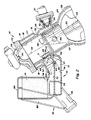
- FIG. 2 shows the arrangement of the two cycle engine 10 and emission control apparatus 12.
- the two cycle engine 10 includes a cylinder block 16 having a plurality of cylinders 18, only one of which is shown.
- the cylinders 18 may comprise cast iron or alloy liners inserted or cast into a cylinder block 16 of aluminium or other material which includes coolant passages 19 adjacent to the upper portions of the cylinder bore.
- Pistons 20 are supported for reciprocation within the cylinders 18 and are connected by connecting rods 22 to a crankshaft 23.
- the crankshaft 23 is rotatably journaled within a crankcase 24 defined, at least in part, by the lower portion of the cylinder block 16 and separated longitudinally into individual crankcase chambers 25 located beneath each of the cylinders 18.
- the upper ends of the cylinders 18 are closed by a cylinder head 26 mounted on the cylinder block 16.
- the cylinder head 26 cooperates with the cylinders 18 and the heads of the pistons 20 to form working chambers 27 that include at their upper ends, combustion chambers 28 primarily defined by recesses in the cylinder head 26.
- a fuel injection nozzle 30 is fixed to the cylinder head 26 near the top of each combustion chamber 28 to deliver atomized fuel thereto, preferably with a pressurized air charge in known manner.
- a spark plug is also provided to ignite air-fuel mixtures formed in the combustion chamber 28.
- Fresh air charges are delivered to each crankcase chamber 25 during upward movement of its respective piston 20 from an air inlet manifold 31 through an associated intake port 32 formed in the cylinder block 16.
- a reed-type valve 34 in the intake port 32 prevents reverse flow.
- the downstream end of each intake port 32 communicates through a (piston controlled) opening 35 with its respective crankcase chamber 25 as the piston 20 approaches its top dead centre position.
- a plurality of main scavenge passages 36 extend from each of the crankcase chambers 25 through the cylinder block 16 and scavenge ports 38 in the respective cylinder 18 to discharge into its working chamber 27 when the piston 20 approaches its bottom dead centre position.
- the scavenge ports 38 are configured to direct the scavenge and intake charges toward one side of the cylinder 18 from which they are deflected in an upward direction toward the combustion chamber 28.
- An auxiliary intake or boost port 39 extends directly from the intake port 32 into the working chamber 27 when the piston 20 is near bottom dead centre.
- the boost port 39 is also configured to assist the direction of the intake charge toward the combustion chamber 28 as previously described.
- An exhaust port 11 opens through the side of each cylinder 18 opposite to the area where the scavenge charge impinges and the boost port 39 is located.
- the exhaust port 11 extends in the cylinder 18 somewhat above the scavenging and boost ports 38, 39 in the direction of the combustion chamber 28 so that the exhaust port is opened first as the piston moves downward on its expansion stroke.
- the exhaust port 11 communicates through a valve chamber 42 with an exhaust manifold and emission control apparatus 12.
- the piston 20 uncovers first the top of the exhaust port 11, causing the cylinder pressure to drop as a hot blowdown pulse of burned gas is forced out of the cylinder 18.
- the scavenge and boost ports 38, 39 are opened and the slightly pressurized air charge in the associated crankcase chamber 25 is forced into the cylinder 18. This forces the remaining burned gas and some of the scavenging air out of the cylinder 18 through the exhaust port 11 while a fresh charge of air is left in the cylinder, ready for the next compression stroke.
- a separating and timing device or exhaust valve 43 is located in the valve chamber 42 and is pivotable on an axis 44 spaced outward of the cylinder 18 and transverse to the cylinder axis 46.
- the exhaust valve 43 includes a separating wall or splitter 47 that, in a lower position, extends from the axis 44 into and laterally across the exhaust port 11, separating it into upper and lower sections.
- a timing shroud 48 Spaced above the splitter 47 within the exhaust port 11 is a timing shroud 48 that, along with the splitter 47, has an inner surface nearly coplanar with the interior surface of the associated cylinder 18 when the exhaust valve 43 is in its lower position.
- the exhaust valve 43 is provided with upstanding side walls 50 that extend from the axis 44 to the exhaust port 11 and support the timing shroud 48 at a fixed distance above the inner edge of the splitter 47.
- a stop 51 may be provided extending downward from one of the side walls 50 to engage an abutment 52 of the cylinder block 16 and thereby limit the downward motion of the exhaust valve 43.
- An actuating lever 54 connects with a shaft 55 that lies along the axis 44 and preferably engages the exhaust valves 43 for each of the cylinders 18. In the drawings, the actuating lever 54 extends upwardly so that outward movement thereof pivots the exhaust valve 43 upwardly from its lower position toward an upper position (shown in dashed lines in Figure 2) where the splitter 47 is near the upper edge of the exhaust port 11.
- the movement of the exhaust valve 43 is effective to vary the timing of the blowdown pulse through raising and lowering of the timing shroud 48.
- the splitter 47 acts to separate the blowdown portion of the exhaust gas from the scavenging portion, the two portions being primarily directed into separate parts of the valve chamber 42 which are respectively above and below the splitter 47. This function is most effective when the exhaust valve 43 is in its lowest position as would be the case for lower speeds and loads where highest efficiency is desired.
- the exhaust blowdown timing is advanced as desired for higher speed and heavier load operation.
- the timing shroud 48 and splitter 47 also move farther away from the piston side, allowing more leakage between the sections.
- the splitter 47 approaches the top of the exhaust port 11 so that nearly all of the exhaust flow is through the lower portion of the valve chamber 42.
- the splitter 47 can be made to overtravel upward to block the flow through the upper portion and block all flow to the close coupled catalytic converter. This feature can be used to protect the close coupled catalytic converter against operation at excessive temperatures if that should be a problem.
- Exhaust manifold 70 Connected to the valve chambers 42 is an exhaust manifold 70 which incorporates specific features forming part of the previously described emission control apparatus 12.
- Exhaust manifold 70 includes a plurality of dual legs 71 having upper and lower passages 72, 74 respectively.
- the dual legs 71 attach directly to the housings of the valve chambers 42 of the various cylinders 18, the upper passages 72 (first exhaust passages) and lower passages 74 (second exhaust passages) connecting respectively with the upper and lower sections of their connected valve chambers.
- the lower passages 74 also connect with a lower plenum 75 that directly feeds an outlet duct 76.
- the upper passages 72 connect with an upper plenum 78 above which is mounted a catalytic converter element which comprises the first catalytic converter 14 of the emission control apparatus 12 previously described.
- a cover 80 on the manifold portion housing the element of the first catalytic converter 14 connects the outlet thereof through a transfer duct 82 to the outlet duct 76.
- the outlet duct 76 is adapted for connection with an exhaust conduit, not shown, which will preferably include the second catalytic converter 15 as previously described.
- the upper passages 72 receive the blowdown portion of the exhaust gas from the upper sections of the valve chambers 42 and direct them through the (close coupled) first catalytic converter 14.
- the reacted products are then mixed in the outlet duct 76 with the scavenging portion of the exhaust carried through the lower passages 74 and delivered to the second catalytic converter 15 in the exhaust conduit.
- an engine and emission control apparatus should be considered essentially similar in construction and operation to the embodiments heretofore shown and described except for certain modifications discussed hereafter.
- Figures 3 and 4 show one embodiment which incorporates loop scavenging (with the inlet ports on the same side as the exhaust ports) rather than the previously described arrangement using cross scavenging (with the inlet ports opposite the exhaust port in the cylinder).
- the cylinder 110 has on one side a central exhaust port 111 (second exhaust port), a pair of side exhaust ports 112 (first exhaust port) located on either side of the central exhaust port and slightly below its upper edge, and a pair of inlet ports 114 below the side exhaust ports and aligned with the bottom of the central exhaust port 111.
- the side exhaust ports 112 each have associated therewith a splitter 115 (separating means) similar in function to the splitter 47 of the prior system but absent an attached timing shroud 48.
- the splitter 115 may be fixed or adjustable as desired and each divides its respective side exhaust port into an upper portion 116 and a lower portion 118.
- the central exhaust port 111 is provided with some form of control valve to restrict or time, or both, the flow of exhaust flow therethrough.
- a guillotine valve 119 (control means) is shown but flapper, rotary, butterfly or other valve types may be equally suitable.
- the guillotine valve 119 is preferably mounted as close to the cylinder wall as possible to maximize the control of gas flow.
- Figure 5 shows a similar embodiment arranged for cross scavenging so that the inlet ports (not shown) are across the cylinder and only central exhaust port 111 and two side exhaust ports 112 are shown.
- the side exhaust ports 112 are aligned with the lower portion of the central exhaust port 111 and somewhat below its top as before.
- Splitters 115 in the side exhaust ports 112 and a guillotine valve 119 in the central exhaust port 111 are provided as before.
- the central exhaust ports 111 as well as the lower portions 118 of the side exhaust ports 112 are connected to the lower passages 74 of the exhaust manifold or its equivalent which feed exhaust gas to the second (distant) catalytic converter 15.
- the upper portions 116 of the side exhaust ports 112 are connected to the upper passages 72 of the exhaust manifold to feed exhaust gas directly to the (close coupled) first catalytic converter 14.
- control of the guillotine valve 119 or other valve in the central exhaust port 111 is effective to control the direction of flow of the exhaust blowdown to the first or second catalytic converter 14,15.
- the guillotine valve 119 is opened to the blowdown and scavenging flow to primarily pass directly to the second catalytic converter 15 so as to avoid overheating of the (close coupled) first catalytic converter 14.
- the central exhaust port 111 may be closed so that the exhaust flow all passes out the side exhaust ports 112.
- Careful matching of the exhaust gas flow separation with the scavenging and fuel delivery processes provides the potential for achieving stoichiometric or richer combustion in some or all of the cylinder charge.
- the possibility is raised of obtaining some NO x reduction in the (close coupled) first catalytic converter 14.
- the arrangements can provide variable exhaust port timing as desired to enhance engine thermal and charge trapping efficiencies.
- Figures 6 and 7 show a different port arrangement for cross scavenging operation wherein the cylinder 120 is provided with a central exhaust port 121 (first exhaust port) having a splitter 122 (separating means) and there are two higher located side exhaust ports 123 (second exhaust port).
- the side exhaust ports 123 are provided with suitable control valves such as guillotine valves 124 (control means).
- Figures 8 and 9 show a similar embodiment arranged for combined cross-loop scavenging.
- the cylinder 126 has the central and side exhaust ports 121, 123, splitter 122 and guillotine valves 124 arranged as in Figures 6 and 7. However there are added inlet transfer ports 127 on either side of the lower portion of the central exhaust port 121 in addition to boost ports 128 located across the cylinder 126.
- the splitter 122 divides the central exhaust port 121 into an upper portion 130 and a lower portion 131 which are respectively connected to the upper 72 and lower 74 passages.
- the side exhaust ports 123 are both connected to the lower passages 74.
- positioning of the guillotine valves 124 is effective to determine how much of the blowdown and scavenging flow is directed through the side exhaust ports 123 via the lower passages 74 to the second catalytic converter 15 and how much flow remains for transfer through the split central exhaust port 121 via the upper passages 72 to the first catalytic converter 14.
- control of the arrangements of Figures 6-9 is similar to that of the embodiments of Figures 3-5.
Landscapes
- Engineering & Computer Science (AREA)
- Chemical & Material Sciences (AREA)
- Chemical Kinetics & Catalysis (AREA)
- Mechanical Engineering (AREA)
- General Engineering & Computer Science (AREA)
- Combustion & Propulsion (AREA)
- Toxicology (AREA)
- Health & Medical Sciences (AREA)
- Exhaust Gas After Treatment (AREA)
- Combustion Methods Of Internal-Combustion Engines (AREA)
- Exhaust-Gas Circulating Devices (AREA)
- Cylinder Crankcases Of Internal Combustion Engines (AREA)
- Output Control And Ontrol Of Special Type Engine (AREA)
Applications Claiming Priority (2)
| Application Number | Priority Date | Filing Date | Title |
|---|---|---|---|
| US369240 | 1989-06-21 | ||
| US07/369,240 US4969330A (en) | 1989-06-21 | 1989-06-21 | Two cycle engine catalytic emission control |
Publications (3)
| Publication Number | Publication Date |
|---|---|
| EP0404320A2 true EP0404320A2 (fr) | 1990-12-27 |
| EP0404320A3 EP0404320A3 (fr) | 1991-01-16 |
| EP0404320B1 EP0404320B1 (fr) | 1993-06-09 |
Family
ID=23454693
Family Applications (1)
| Application Number | Title | Priority Date | Filing Date |
|---|---|---|---|
| EP90304856A Expired - Lifetime EP0404320B1 (fr) | 1989-06-21 | 1990-05-04 | Moteur deux temps à dispositif de contrôle d'épuration des gaz d'échappement |
Country Status (7)
| Country | Link |
|---|---|
| US (1) | US4969330A (fr) |
| EP (1) | EP0404320B1 (fr) |
| JP (1) | JPH03275923A (fr) |
| KR (1) | KR930008677B1 (fr) |
| BR (1) | BR9002927A (fr) |
| CA (1) | CA2016381C (fr) |
| DE (1) | DE69001865T2 (fr) |
Cited By (4)
| Publication number | Priority date | Publication date | Assignee | Title |
|---|---|---|---|---|
| WO1993012327A1 (fr) * | 1991-12-12 | 1993-06-24 | Emitec Gesellschaft Für Emissionstechnologie Mbh | Dispositif pour l'epuration des gaz d'echappement de moteurs a combustion interne, en particulier pour les vehicules automobiles |
| WO1993018285A1 (fr) * | 1992-03-10 | 1993-09-16 | Institut Français Du Petrole | Ligne d'echappement pour moteurs a combustion interne a deux temps |
| GB2280711A (en) * | 1993-08-05 | 1995-02-08 | Ford Motor Co | Two stroke i.c. engine with catalytic converters. |
| US9726094B2 (en) | 2013-11-21 | 2017-08-08 | Tula Technology, Inc. | System for managing catalytic converter temperature |
Families Citing this family (10)
| Publication number | Priority date | Publication date | Assignee | Title |
|---|---|---|---|---|
| ES2050525T3 (es) * | 1990-05-15 | 1994-05-16 | Albin Sterbenz | Motor de combustion interna de dos tiempos. |
| FR2668798B1 (fr) * | 1990-11-02 | 1994-10-14 | Renault | Moteur deux temps. |
| US5080049A (en) * | 1991-05-10 | 1992-01-14 | General Motors Corporation | Two stroke engine with tiered cylinder cooling |
| US6468122B1 (en) * | 2000-11-28 | 2002-10-22 | Bombardier Motor Corporation Of America | Fuel injected engine with cross scavenging |
| KR20030059981A (ko) * | 2002-01-05 | 2003-07-12 | 주식회사 카이젤 | 토스터 제빵기 |
| KR100740693B1 (ko) * | 2004-05-19 | 2007-07-18 | 주식회사 오성사 | 건강발효 기능을 갖는 제빵기 및 그 구동 방법 |
| US7146806B2 (en) * | 2004-07-07 | 2006-12-12 | Homelite Technologies, Ltd. | Internal combustion engine cylinder and muffler assembly with catalytic converter |
| US7367319B2 (en) * | 2005-11-16 | 2008-05-06 | Gm Global Technology Operations, Inc. | Method and apparatus to determine magnitude of combustion chamber deposits |
| US7412824B1 (en) | 2005-12-19 | 2008-08-19 | Miratech Corporation | Catalytic converter system for diesel engines |
| WO2009016433A2 (fr) * | 2006-09-15 | 2009-02-05 | Ottawa Health Research Institute | Rhabdovirus oncolytique |
Family Cites Families (9)
| Publication number | Priority date | Publication date | Assignee | Title |
|---|---|---|---|---|
| US1477994A (en) * | 1921-03-31 | 1923-12-18 | Buchi Alfred | Two-stroke-cycle internal-combustion engine and scavenging and charging process thereof |
| US2393341A (en) * | 1944-01-24 | 1946-01-22 | Schneider Brothers Company | Two-cycle internal-combustion engine |
| US3670502A (en) * | 1970-03-06 | 1972-06-20 | Joseph C Firey | Engine exhaust gas separating devices |
| DE2731098A1 (de) * | 1977-07-09 | 1979-01-25 | Audi Nsu Auto Union Ag | Brennkraftmaschine mit einer nachverbrennungseinrichtung |
| CA1140010A (fr) * | 1978-09-05 | 1983-01-25 | Hisamoto Aihara | Systeme de remise en circulation des gaz d'echappement d'un moteur thermique |
| FR2608677B1 (fr) * | 1986-12-19 | 1989-04-28 | Inst Francais Du Petrole | Dispositif et procede d'amorcage rapide d'un catalyseur d'oxydation pour un moteur deux temps |
| JPS63253114A (ja) * | 1987-04-07 | 1988-10-20 | Honda Motor Co Ltd | 2サイクルエンジンの排気系 |
| CA1336413C (fr) * | 1987-10-26 | 1995-07-25 | Mark Lear | Moteurs a combustion interne a deux temps |
| US4903482A (en) * | 1988-04-27 | 1990-02-27 | Ricardo Group Plc | Two-stroke otto cycle engines |
-
1989
- 1989-06-21 US US07/369,240 patent/US4969330A/en not_active Expired - Fee Related
-
1990
- 1990-05-04 EP EP90304856A patent/EP0404320B1/fr not_active Expired - Lifetime
- 1990-05-04 DE DE9090304856T patent/DE69001865T2/de not_active Expired - Fee Related
- 1990-05-09 CA CA002016381A patent/CA2016381C/fr not_active Expired - Fee Related
- 1990-06-08 KR KR1019900008385A patent/KR930008677B1/ko not_active Expired - Fee Related
- 1990-06-21 JP JP2163993A patent/JPH03275923A/ja active Pending
- 1990-06-21 BR BR909002927A patent/BR9002927A/pt not_active IP Right Cessation
Cited By (6)
| Publication number | Priority date | Publication date | Assignee | Title |
|---|---|---|---|---|
| WO1993012327A1 (fr) * | 1991-12-12 | 1993-06-24 | Emitec Gesellschaft Für Emissionstechnologie Mbh | Dispositif pour l'epuration des gaz d'echappement de moteurs a combustion interne, en particulier pour les vehicules automobiles |
| WO1993018285A1 (fr) * | 1992-03-10 | 1993-09-16 | Institut Français Du Petrole | Ligne d'echappement pour moteurs a combustion interne a deux temps |
| FR2688540A1 (fr) * | 1992-03-10 | 1993-09-17 | Inst Francais Du Petrole | Ligne d'echappement avec catalyseur pour moteurs a combustion interne a deux temps et procede de traitement de gaz d'echappement comportant une telle ligne. |
| US5433073A (en) * | 1992-03-10 | 1995-07-18 | Institut Francais Du Petrole | Exhaust line with catalyst for two-stroke internal-combustion engines |
| GB2280711A (en) * | 1993-08-05 | 1995-02-08 | Ford Motor Co | Two stroke i.c. engine with catalytic converters. |
| US9726094B2 (en) | 2013-11-21 | 2017-08-08 | Tula Technology, Inc. | System for managing catalytic converter temperature |
Also Published As
| Publication number | Publication date |
|---|---|
| DE69001865T2 (de) | 1993-09-23 |
| JPH03275923A (ja) | 1991-12-06 |
| CA2016381C (fr) | 1994-02-08 |
| EP0404320A3 (fr) | 1991-01-16 |
| BR9002927A (pt) | 1991-08-20 |
| CA2016381A1 (fr) | 1990-12-21 |
| DE69001865D1 (de) | 1993-07-15 |
| KR910001224A (ko) | 1991-01-30 |
| KR930008677B1 (ko) | 1993-09-11 |
| EP0404320B1 (fr) | 1993-06-09 |
| US4969330A (en) | 1990-11-13 |
Similar Documents
| Publication | Publication Date | Title |
|---|---|---|
| US4969329A (en) | Two cycle engine with exhaust emission control | |
| EP0404320B1 (fr) | Moteur deux temps à dispositif de contrôle d'épuration des gaz d'échappement | |
| EP0159834B1 (fr) | Moteur à combustion interne et méthode d'opération | |
| US6928988B2 (en) | Control system for engine | |
| RU2150590C1 (ru) | Двухтактный двигатель внутреннего сгорания | |
| US5251580A (en) | Crank chamber precompression type two-cycle internal combustion engine | |
| CA1278475C (fr) | Agent promoteur de combustion pour moteur a combustion interne | |
| GB2115485A (en) | Stratified charge two-stroke engines | |
| WO2005068804A1 (fr) | Moteur deux temps a allumage par compression | |
| US4236490A (en) | Internal combustion engine | |
| JP2003328906A (ja) | 2サイクルエンジンの運転方法と2サイクルエンジン | |
| IL127848A0 (en) | Two-stroke engine operation method and internal combustion two-stroke engine | |
| JP2820793B2 (ja) | ポンプシリンダと動力シリンダを備えたレシプロエンジン | |
| US5769040A (en) | Two cycle internal combustion engine | |
| JP2001521092A (ja) | 2ストロークエンジン | |
| US6213088B1 (en) | Method and device for operating an internal combustion engine | |
| US3970057A (en) | Internal combustion engine | |
| US3475905A (en) | Internal combustion engine | |
| JPH0791271A (ja) | 直接噴射燃焼エンジンとこのエンジンの駆動方法 | |
| EP0670415A1 (fr) | Moteur à combustion interne à deux temps du type en V | |
| US5934262A (en) | Combustion chamber for internal combustion engine | |
| US6386184B1 (en) | Internal combustion engine comprising at least one cylinder and individual intake passages | |
| JPH09250429A (ja) | 燃料噴射供給式エンジン | |
| JPH0347423A (ja) | 回転仕切り弁付き2サイクル・エンジンとその利用 | |
| JP2865672B2 (ja) | 混合気圧縮式二サイクル内燃機関 |
Legal Events
| Date | Code | Title | Description |
|---|---|---|---|
| PUAI | Public reference made under article 153(3) epc to a published international application that has entered the european phase |
Free format text: ORIGINAL CODE: 0009012 |
|
| PUAL | Search report despatched |
Free format text: ORIGINAL CODE: 0009013 |
|
| AK | Designated contracting states |
Kind code of ref document: A2 Designated state(s): DE FR GB IT |
|
| AK | Designated contracting states |
Kind code of ref document: A3 Designated state(s): DE FR GB IT |
|
| 17P | Request for examination filed |
Effective date: 19910307 |
|
| 17Q | First examination report despatched |
Effective date: 19920416 |
|
| ITF | It: translation for a ep patent filed | ||
| GRAA | (expected) grant |
Free format text: ORIGINAL CODE: 0009210 |
|
| AK | Designated contracting states |
Kind code of ref document: B1 Designated state(s): DE FR GB IT |
|
| REF | Corresponds to: |
Ref document number: 69001865 Country of ref document: DE Date of ref document: 19930715 |
|
| ET | Fr: translation filed | ||
| PLBE | No opposition filed within time limit |
Free format text: ORIGINAL CODE: 0009261 |
|
| STAA | Information on the status of an ep patent application or granted ep patent |
Free format text: STATUS: NO OPPOSITION FILED WITHIN TIME LIMIT |
|
| PG25 | Lapsed in a contracting state [announced via postgrant information from national office to epo] |
Ref country code: GB Effective date: 19940504 |
|
| 26N | No opposition filed | ||
| GBPC | Gb: european patent ceased through non-payment of renewal fee |
Effective date: 19940504 |
|
| PG25 | Lapsed in a contracting state [announced via postgrant information from national office to epo] |
Ref country code: FR Effective date: 19950131 |
|
| PG25 | Lapsed in a contracting state [announced via postgrant information from national office to epo] |
Ref country code: DE Effective date: 19950201 |
|
| REG | Reference to a national code |
Ref country code: FR Ref legal event code: ST |
|
| PG25 | Lapsed in a contracting state [announced via postgrant information from national office to epo] |
Ref country code: IT Free format text: LAPSE BECAUSE OF NON-PAYMENT OF DUE FEES;WARNING: LAPSES OF ITALIAN PATENTS WITH EFFECTIVE DATE BEFORE 2007 MAY HAVE OCCURRED AT ANY TIME BEFORE 2007. THE CORRECT EFFECTIVE DATE MAY BE DIFFERENT FROM THE ONE RECORDED. Effective date: 20050504 |