EP0404817B1 - Procede de cristallisation de la subtilisine - Google Patents
Procede de cristallisation de la subtilisine Download PDFInfo
- Publication number
- EP0404817B1 EP0404817B1 EP89903871A EP89903871A EP0404817B1 EP 0404817 B1 EP0404817 B1 EP 0404817B1 EP 89903871 A EP89903871 A EP 89903871A EP 89903871 A EP89903871 A EP 89903871A EP 0404817 B1 EP0404817 B1 EP 0404817B1
- Authority
- EP
- European Patent Office
- Prior art keywords
- subtilisin
- solution
- concentration
- salt
- crystallization
- Prior art date
- Legal status (The legal status is an assumption and is not a legal conclusion. Google has not performed a legal analysis and makes no representation as to the accuracy of the status listed.)
- Expired - Lifetime
Links
- 108090000787 Subtilisin Proteins 0.000 title claims abstract description 138
- 238000000034 method Methods 0.000 title claims abstract description 70
- 238000002425 crystallisation Methods 0.000 title claims abstract description 52
- 230000008025 crystallization Effects 0.000 title claims abstract description 52
- 239000013078 crystal Substances 0.000 claims abstract description 59
- FAPWRFPIFSIZLT-UHFFFAOYSA-M Sodium chloride Chemical compound [Na+].[Cl-] FAPWRFPIFSIZLT-UHFFFAOYSA-M 0.000 claims abstract description 40
- -1 halide salt Chemical class 0.000 claims abstract description 34
- 150000003839 salts Chemical class 0.000 claims abstract description 33
- 239000011780 sodium chloride Substances 0.000 claims abstract description 20
- UXVMQQNJUSDDNG-UHFFFAOYSA-L Calcium chloride Chemical compound [Cl-].[Cl-].[Ca+2] UXVMQQNJUSDDNG-UHFFFAOYSA-L 0.000 claims abstract description 14
- 239000001110 calcium chloride Substances 0.000 claims abstract description 14
- 229910001628 calcium chloride Inorganic materials 0.000 claims abstract description 14
- 239000000203 mixture Substances 0.000 claims description 18
- 238000000855 fermentation Methods 0.000 claims description 16
- 230000004151 fermentation Effects 0.000 claims description 16
- 239000007787 solid Substances 0.000 claims description 12
- 230000015572 biosynthetic process Effects 0.000 claims description 11
- FVAUCKIRQBBSSJ-UHFFFAOYSA-M sodium iodide Chemical group [Na+].[I-] FVAUCKIRQBBSSJ-UHFFFAOYSA-M 0.000 claims description 9
- NLKNQRATVPKPDG-UHFFFAOYSA-M potassium iodide Chemical compound [K+].[I-] NLKNQRATVPKPDG-UHFFFAOYSA-M 0.000 claims description 7
- WCUXLLCKKVVCTQ-UHFFFAOYSA-M Potassium chloride Chemical compound [Cl-].[K+] WCUXLLCKKVVCTQ-UHFFFAOYSA-M 0.000 claims description 6
- 238000002360 preparation method Methods 0.000 claims description 6
- 238000000746 purification Methods 0.000 claims description 6
- 235000014469 Bacillus subtilis Nutrition 0.000 claims description 4
- 241000894006 Bacteria Species 0.000 claims description 4
- 239000001103 potassium chloride Substances 0.000 claims description 3
- 235000011164 potassium chloride Nutrition 0.000 claims description 3
- 235000009518 sodium iodide Nutrition 0.000 claims description 3
- 235000007715 potassium iodide Nutrition 0.000 claims description 2
- 241000193830 Bacillus <bacterium> Species 0.000 claims 2
- 239000012141 concentrate Substances 0.000 abstract description 6
- 239000000243 solution Substances 0.000 description 67
- DNIAPMSPPWPWGF-UHFFFAOYSA-N Propylene glycol Chemical compound CC(O)CO DNIAPMSPPWPWGF-UHFFFAOYSA-N 0.000 description 21
- 108090000790 Enzymes Proteins 0.000 description 18
- 102000004190 Enzymes Human genes 0.000 description 18
- 239000000047 product Substances 0.000 description 14
- 238000011084 recovery Methods 0.000 description 13
- 235000011148 calcium chloride Nutrition 0.000 description 10
- 102000004169 proteins and genes Human genes 0.000 description 10
- 108090000623 proteins and genes Proteins 0.000 description 10
- XLYOFNOQVPJJNP-UHFFFAOYSA-N water Substances O XLYOFNOQVPJJNP-UHFFFAOYSA-N 0.000 description 10
- 229960002713 calcium chloride Drugs 0.000 description 7
- 238000001556 precipitation Methods 0.000 description 7
- 239000012452 mother liquor Substances 0.000 description 6
- 239000002244 precipitate Substances 0.000 description 6
- 239000002002 slurry Substances 0.000 description 6
- BFNBIHQBYMNNAN-UHFFFAOYSA-N ammonium sulfate Chemical compound N.N.OS(O)(=O)=O BFNBIHQBYMNNAN-UHFFFAOYSA-N 0.000 description 5
- 229910052921 ammonium sulfate Inorganic materials 0.000 description 5
- 235000011130 ammonium sulphate Nutrition 0.000 description 5
- 239000012263 liquid product Substances 0.000 description 5
- 238000000926 separation method Methods 0.000 description 5
- 108091005804 Peptidases Proteins 0.000 description 4
- 239000004365 Protease Substances 0.000 description 4
- 102100037486 Reverse transcriptase/ribonuclease H Human genes 0.000 description 4
- 238000005119 centrifugation Methods 0.000 description 4
- 239000008188 pellet Substances 0.000 description 4
- 230000001376 precipitating effect Effects 0.000 description 4
- 238000000108 ultra-filtration Methods 0.000 description 4
- 239000004280 Sodium formate Substances 0.000 description 3
- 230000003247 decreasing effect Effects 0.000 description 3
- 238000001914 filtration Methods 0.000 description 3
- 238000004519 manufacturing process Methods 0.000 description 3
- HLBBKKJFGFRGMU-UHFFFAOYSA-M sodium formate Chemical compound [Na+].[O-]C=O HLBBKKJFGFRGMU-UHFFFAOYSA-M 0.000 description 3
- 235000019254 sodium formate Nutrition 0.000 description 3
- 239000006228 supernatant Substances 0.000 description 3
- 241000193744 Bacillus amyloliquefaciens Species 0.000 description 2
- PEDCQBHIVMGVHV-UHFFFAOYSA-N Glycerine Chemical compound OCC(O)CO PEDCQBHIVMGVHV-UHFFFAOYSA-N 0.000 description 2
- PMZURENOXWZQFD-UHFFFAOYSA-L Sodium Sulfate Chemical compound [Na+].[Na+].[O-]S([O-])(=O)=O PMZURENOXWZQFD-UHFFFAOYSA-L 0.000 description 2
- 238000013019 agitation Methods 0.000 description 2
- 239000000872 buffer Substances 0.000 description 2
- 239000003795 chemical substances by application Substances 0.000 description 2
- 238000007796 conventional method Methods 0.000 description 2
- 230000000694 effects Effects 0.000 description 2
- 230000002255 enzymatic effect Effects 0.000 description 2
- 239000012527 feed solution Substances 0.000 description 2
- 238000009472 formulation Methods 0.000 description 2
- 239000000463 material Substances 0.000 description 2
- 244000005700 microbiome Species 0.000 description 2
- 239000012460 protein solution Substances 0.000 description 2
- JHJLBTNAGRQEKS-UHFFFAOYSA-M sodium bromide Chemical compound [Na+].[Br-] JHJLBTNAGRQEKS-UHFFFAOYSA-M 0.000 description 2
- PUZPDOWCWNUUKD-UHFFFAOYSA-M sodium fluoride Chemical compound [F-].[Na+] PUZPDOWCWNUUKD-UHFFFAOYSA-M 0.000 description 2
- 229910052938 sodium sulfate Inorganic materials 0.000 description 2
- 235000011152 sodium sulphate Nutrition 0.000 description 2
- 239000012265 solid product Substances 0.000 description 2
- 239000002904 solvent Substances 0.000 description 2
- 238000005406 washing Methods 0.000 description 2
- 244000063299 Bacillus subtilis Species 0.000 description 1
- FBPFZTCFMRRESA-FSIIMWSLSA-N D-Glucitol Natural products OC[C@H](O)[C@H](O)[C@@H](O)[C@H](O)CO FBPFZTCFMRRESA-FSIIMWSLSA-N 0.000 description 1
- FBPFZTCFMRRESA-JGWLITMVSA-N D-glucitol Chemical compound OC[C@H](O)[C@@H](O)[C@H](O)[C@H](O)CO FBPFZTCFMRRESA-JGWLITMVSA-N 0.000 description 1
- 235000019733 Fish meal Nutrition 0.000 description 1
- ROHFNLRQFUQHCH-UHFFFAOYSA-N Leucine Natural products CC(C)CC(N)C(O)=O ROHFNLRQFUQHCH-UHFFFAOYSA-N 0.000 description 1
- 229920005654 Sephadex Polymers 0.000 description 1
- 239000012507 Sephadex™ Substances 0.000 description 1
- BQCADISMDOOEFD-UHFFFAOYSA-N Silver Chemical compound [Ag] BQCADISMDOOEFD-UHFFFAOYSA-N 0.000 description 1
- 230000001580 bacterial effect Effects 0.000 description 1
- 239000012267 brine Substances 0.000 description 1
- LLSDKQJKOVVTOJ-UHFFFAOYSA-L calcium chloride dihydrate Chemical compound O.O.[Cl-].[Cl-].[Ca+2] LLSDKQJKOVVTOJ-UHFFFAOYSA-L 0.000 description 1
- 229940052299 calcium chloride dihydrate Drugs 0.000 description 1
- 238000004587 chromatography analysis Methods 0.000 description 1
- 238000010924 continuous production Methods 0.000 description 1
- 239000008367 deionised water Substances 0.000 description 1
- 229910021641 deionized water Inorganic materials 0.000 description 1
- 238000011033 desalting Methods 0.000 description 1
- 238000013461 design Methods 0.000 description 1
- 239000003599 detergent Substances 0.000 description 1
- 238000010586 diagram Methods 0.000 description 1
- 230000007613 environmental effect Effects 0.000 description 1
- 238000001704 evaporation Methods 0.000 description 1
- 230000008020 evaporation Effects 0.000 description 1
- 238000000605 extraction Methods 0.000 description 1
- 230000002349 favourable effect Effects 0.000 description 1
- 239000000706 filtrate Substances 0.000 description 1
- 239000004467 fishmeal Substances 0.000 description 1
- 235000013305 food Nutrition 0.000 description 1
- 235000011187 glycerol Nutrition 0.000 description 1
- 238000011534 incubation Methods 0.000 description 1
- 239000007788 liquid Substances 0.000 description 1
- 239000006193 liquid solution Substances 0.000 description 1
- 238000012423 maintenance Methods 0.000 description 1
- 238000001471 micro-filtration Methods 0.000 description 1
- 238000012986 modification Methods 0.000 description 1
- 230000004048 modification Effects 0.000 description 1
- 230000006911 nucleation Effects 0.000 description 1
- 238000010899 nucleation Methods 0.000 description 1
- 239000003960 organic solvent Substances 0.000 description 1
- 239000000843 powder Substances 0.000 description 1
- 238000012545 processing Methods 0.000 description 1
- 235000013772 propylene glycol Nutrition 0.000 description 1
- 239000002994 raw material Substances 0.000 description 1
- 229920006395 saturated elastomer Polymers 0.000 description 1
- 238000004062 sedimentation Methods 0.000 description 1
- 239000004332 silver Substances 0.000 description 1
- 229910052709 silver Inorganic materials 0.000 description 1
- 239000011775 sodium fluoride Substances 0.000 description 1
- 235000013024 sodium fluoride Nutrition 0.000 description 1
- HPALAKNZSZLMCH-UHFFFAOYSA-M sodium;chloride;hydrate Chemical compound O.[Na+].[Cl-] HPALAKNZSZLMCH-UHFFFAOYSA-M 0.000 description 1
- 239000000600 sorbitol Substances 0.000 description 1
- 241000894007 species Species 0.000 description 1
- 230000000087 stabilizing effect Effects 0.000 description 1
- 239000000126 substance Substances 0.000 description 1
- 238000003828 vacuum filtration Methods 0.000 description 1
- 239000011534 wash buffer Substances 0.000 description 1
- 239000002699 waste material Substances 0.000 description 1
Images

Classifications
-
- C—CHEMISTRY; METALLURGY
- C12—BIOCHEMISTRY; BEER; SPIRITS; WINE; VINEGAR; MICROBIOLOGY; ENZYMOLOGY; MUTATION OR GENETIC ENGINEERING
- C12N—MICROORGANISMS OR ENZYMES; COMPOSITIONS THEREOF; PROPAGATING, PRESERVING, OR MAINTAINING MICROORGANISMS; MUTATION OR GENETIC ENGINEERING; CULTURE MEDIA
- C12N9/00—Enzymes; Proenzymes; Compositions thereof; Processes for preparing, activating, inhibiting, separating or purifying enzymes
- C12N9/14—Hydrolases (3)
- C12N9/48—Hydrolases (3) acting on peptide bonds (3.4)
- C12N9/50—Proteinases, e.g. Endopeptidases (3.4.21-3.4.25)
- C12N9/52—Proteinases, e.g. Endopeptidases (3.4.21-3.4.25) derived from bacteria or Archaea
- C12N9/54—Proteinases, e.g. Endopeptidases (3.4.21-3.4.25) derived from bacteria or Archaea bacteria being Bacillus
Definitions
- the present invention relates to enzyme recovery and purification and, more particularly, to a process for purification of subtilisin by crystallization.
- Subtilisin is a protease having a wide range of applications including use in laundry detergents, silver recovery, manufacturing of fish meal and other products and processes.
- the crystalline form of subtilisin is preferred for a number of reasons.
- Crystalline subtilisin is of higher purity than other forms of subtilisin produced by other routes, such as precipitation of amorphous subtilisin.
- Subtilisin crystals afford a high degree of stability as well as flexibility in choices of media and formulation for various desired end uses.
- Subtilisin, whether in crystalline or in precipitated amorphous form can be dried and used in various granular or powdered products.
- liquid products e.g., in aqueous, glycerin, sorbitol, propylene glycol, etc., solutions, for use in liquid products or for use in manufacturing of liquid or solid products.
- crystalline subtilisin and liquid products made from the crystalline form have a number of high grade uses, such as in medical applications and in food grade products.
- the subtilisin crystals themselves are rhomboidal plates usually ranging in size from about 5 to about 50 microns.
- the crystals have a solubility of about 4 grams per liter(g/l) in water, about 8 g/l in brine, and over about 500 g/l in propylene glycol.
- Subtilisin crystals have been obtained from fermentation of Bacillus subtilis in much the same way as crystals of other enzymes are obtained from given fermentations.
- a fermentation mixture is first subjected to a separation step which removes bacterial cells and suspended solids to form a resulting solution or broth free of solids.
- the resulting solution is often concentrated to provide a certain minimum concentration level of the desired enzyme. Crystallization is then carried out, usually with the aid of seed crystals, and the high purity crystalline product separated from the solution.
- subtilisin As is apparent from the above discussion, currently known techniques for the preparation of crystalline subtilisin are often unreliable and difficult to control. Not only must the practitioner be able to determine the point at which a subtilisin solution is slightly supersaturated but once crystallization commences, such practitioner must also continually adjust the solution system to maintain the desired concentration to avoid loss of the valuable subtilisin product and to avoid any too highly supersaturated conditions and the consequent formation of the amorphous form of the subtilisin.
- Another object of the present invention is to provide a process for the purification of subtilisin by crystallization which has low raw material and operating costs.
- Another object of the present invention is to provide a process for the purification of subtilisin by crystallization which has the capability of high yields and high throughputs.
- Another object of the present invention is to provide a process for the purification of subtilisin by crystallization which produces a subtilisin product which is of high purity and which is virtually free of microorganisms.
- this invention provides a process for the preparation of subtilisin crystals comprising:
- the process of this invention provides various advantages over the prior art including certain unexpected advantages compared to the prior art processes.
- another advantage provided by the use of the halide salts as provided in the process of this invention is that the subtilisin crystals form at the best rates when the salt/subtilisin solution is not near the saturation level. Therefore, it is not necessary (or even desirable) to maintain the concentration near or slightly above a saturated level.
- the present process is easy to operate and control because the salt level can be maintained and adjusted over a wider, less critical range during operation without having to keep the total solution at or near saturation.
- a surprising and unexpected advantage provided by the present invention is that, contrary to prior processes, even if the halide salt/subtilisin solution becomes supersaturated, for example by addition of excess salt to the solution or by lowering the temperature of the solution, the amorphous form of the subtilisin does not appear. Surprisingly, even under salt concentrations as high as 2M or even 4M, only the crystalline form of subtilisin is produced, thereby providing consistently high purity crystalline subtilisin over a wide range of operating conditions.
- Another advantage provided by the process of the present invention is that optimum rates of crystallization of the subtilisin usually occurs at a salt concentration far below saturation, e.g., 0.05M to 0.6M.
- the halide salt may be added to the concentrated subtilisin solution or it may be added earlier in the process to the subtilisin solution before it is concentrated. Moreover, the halide salt may be added even earlier in the process, i.e., to the fermentation mixture. This process thereby provides various options in this regard depending on the process design desired for commercial use of the process of this invention to produce crystalline subtilisin from the concentrated solution. Addition of the halide salt to the concentrated solution may be preferred in some instances for more precise control of the crystal formation. In other instances, it may be preferred to add the halide salt earlier in the process, particularly where the halide salt may have a stabilizing effect on the subtilisin being processed, which can increase the total yield of the process.
- this invention provides a composition comprising a subtilisin solution containing a halide salt present in an amount effective to cause crystallization of subtilisin from the solution.
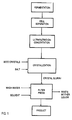
- Figure 1 is a schematic diagram of a preferred embodiment of the process of this invention.
- Figure 2 is a graph depicting the percent of crystal recovery for various concentrations of sodium chloride and calcium chloride.
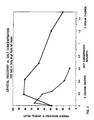
- Figure 3 is a graph depicting the dependence of subtilisin crystal growth in sodium chloride as a function of time.
- Preparation of crystalline subtilisin is carried out by preparing a fermentation of B. subtilis , removing cells and suspended solids from the fermentation mixture to form a subtilisin solution, concentrating the solution such that the subtilisin enzyme is present in a concentration of at least about 40 grams per liter (g/l), adding a halide salt to the concentrated solution in an amount effective to form subtilisin crystals, and allowing crystals of subtilisin to form.
- This embodiment of the process of this invention is illustrated in the overall process schematically shown in Fig. 1, which shows the basic steps of fermentation of a subtilisin-producing bacterium, separation of the cells and suspended solids from the fermentation mixture, and concentration of the resulting subtilisin solution to the desired level.
- halide salt and seed crystals are added to perform the crystallization step to form a crystal slurry.
- the crystals can then be recovered by conventional filter press methods and washed to provide the desired product, which can be in dry powder or granular form or can be in the more common liquid solution form.
- the fermented mixture containing cells, various suspended solids, and the desired solution of the subtilisin product is first processed to separate such cells and suspended solids from the subtilisin solution.
- conventional solid-liquid separation techniques may be employed such as filtration, centrifugation, microfiltration, rotary vacuum filtration and the like.
- Concentrations under about 40 g/l are less desirable because poor or unsatisfactory yields in crystallization usually result, while as a general rule, the process operates best and most efficiently at higher concentrations. It is preferred to use the highest concentration of subtilisin that can be achieved in the concentrated solution used in the crystallization step. However, concentrations above about 100 g/l are difficult to achieve for many subtilisin solutions; the optimum operating range for most subtilisin solutions is usually about 90 to about 100 g/l or higher when practical. Concentration of the solution may be achieved by a variety of conventional techniques including ultrafiltration, evaporation, extraction, chromatography or precipitation followed by redissolution. Selection of the concentration technique or process to be used may be influenced in part by whether the halide salt has been added according to this invention to the fermentation mixture or to the solution to be concentrated.
- subtilisin remaining in the rejected mother liquor after completion of the crystallization step is decreased when higher starting concentrations of subtilisin is used in the concentrated solution fed to the crystallization step. That is, the higher the starting concentration of the subtilisin in the concentrated solution at the beginning of the crystallization, the higher will be the percent of total subtilisin recovered by crystallization, thereby providing the highest overall yields of crystalline subtilisin and the lowest losses of uncrystallized subtilisin remaining in the mother liquor.
- a crystalizer feed solution having a concentration of 100 g/l subtilisin will produce, after crystallization, about 22% v/v crystal solids as a slurry suspended in an equilibrium mother liquor having a concentration of about 15 g/l remaining subtilisin, which provides a maximum recovery of about 100 - (100-22)(15/100), or an overall yield of 88.3%.
- a feed solution having a concentration of 80 g/l subtilisin will produce about 20% v/v crystal solids in the crystallization step in an equilibrium mother liquor having a concentration of about 18 g/l remaining subtilisin, which provides a maximum recovery of about 100-(100-20)(18/80) or an overall yield of 82%.
- Crystallization of subtilisin from the concentrated solution is achieved by adding an amount of a halide salt which is effective to cause the formation of subtilisin crystals.
- the halide salts useful in this invention include sodium chloride, calcium chloride, sodium bromide, sodium iodide, potassium chloride, potassium iodide, sodium fluoride and other halide salts and mixtures thereof which are compatible with the subtilisin being crystallized.
- the halide salts preferred for commercial use at present are sodium chloride and calcium chloride.
- the amount of halide salt effective to cause formation of subtilisin crystals will vary depending on the particular subtilisin in solution, other materials present in the solution, the concentration of the subtilisin in the solution as well as the particular halide salt or salts being used.
- the salt concentration should be at least about 0.01M (10mM), preferably from about 0.01 to about 2M, more preferably from about 0.02 to about 1.5M and most preferably from about 0.03 to about 1M.
- Optimum ranges for some solution/salt combinations are in the range of about 0.02 to about 0.18M, while others are in the range of about 0.1 to about 0.7M.
- the halide salts used according to the present invention induce crystallization of subtilisin in a different manner than classical precipitants for subtilisin such as ammonium sulfate. More specifically, precipitants such as ammonium sulfate induce crystallization of the subtilisin crystals when the concentration of the solution is near saturation level. At higher levels they can lead to the precipitation of amorphous subtilisin. In contrast to classical precipitants, the halide salts used according to the present invention induce crystallization of subtilisin at a relatively low salt concentration.
- halide salts according to this invention will not induce precipitation of the amorphous form of subtilisin, even at salt levels as high as 2M or even 4M.
- crystallization of subtilisin drops off, but only crystalline subtilisin is produced and no amorphous subtilisin is precipitated.
- This invention removes the risk of precipitating the amorphous form of subtilisin.
- optimum crystallization occurs in the process of the present invention at lower salt concentrations, whereas overall yields are lower at very high salt concentrations.
- sodium chloride has a higher possible yield over a wider optimum operating range and is therefore a preferred salt for the process of this invention. Beyond these optimum ranges for these particular salts, the percent recovery of crystallized subtilisin is decreased. However, the formation of amorphous precipitates of subtilisin was not observed at any concentration of these salts.
- the optimum concentration of sodium chloride can range between about 200 and about 600 mM and is preferably between about 400 and about 500 mM, which translates to between about 1.2% to 3.5% and preferably about 2.3% to about 2.9%, respectively.
- the concentration of calcium chloride can range between about 50 and about 200 mM and is preferably between about 100 and about 150 mM, which translates to between about 0.7% and about 2.9%, and preferably between about 1.5% and about 2.2%, respectively.
- subtilisin seed crystals are preferably added in an amount up to about 10% by weight, based on the weight of the solution, to promote the crystallization process.
- the use of seed crystals makes the kinetics of the crystallization more favorable and seems to increase overall yield of crystalline subtilisin. Nucleation may also be promoted by providing crystallization vessels having surface properties conducive to crystallization, which properties are well known by persons skilled in the art.
- the use of the minimum but effective amount of seed crystals for a given subtilisin solution, size of operation, process conditions, etc., will be apparent to one skilled in the art, as in conventional crystallization processes.
- the crystals present in the crystallizer will act as seed crystals for fresh concentrated solution feed entering the crystallizer. Crystal growth is usually further promoted by providing gentle agitation of the crystallization vessel.
- any material which may inhibit crystallization such as propylene glycol, sodium formate, sodium sulfate, etc., should not be added to the solutions in the process of this invention until after the desired degree of crystallization has been achieved.
- the temperature during crystallization should generally be between about 1 and about 10°C and preferably, between about 3 and about 5°C.
- the pH at which crystallization is carried out depends on the species of the enzyme but should be in a range where the enzyme is stable, e.g., for sodium chloride and B. amyloliquefaciens subtilisin the pH should generally be between about 5.2 and 5.8 and preferably between 5.3 and 5.6. At pH levels below about 5.2 or above about 5.8, the subtilisin may be unstable.
- the amount of time required for the crystallization process to go to substantial completion or to the desired equilibrium depends not only on the various process conditions but also on whether or not seed crystals are used.
- Figure 3 illustrates a typical crystallization versus time curve for subtilisin crystallized from a concentrated solution containing about 80 g/l subtilisin, where sodium chloride was added to the concentrated solution as the precipitating salt and where seed crystals were employed. The amount of additional crystal growth after about 16 hours was insubstantial.
- product may be recovered from the crystal-containing slurry by centrifugation, sedimentation, or filtration.
- the slurry may be used as a feed to a process for making a solid product.
- a filter aid is first added to the diluted crystal slurry and this mixture is pumped to a precoated plate-and-frame filter press.
- the crystal-free mother liquor filtrate is rejected.
- Several volumes of water or buffer can then be pumped through the press thereby efficiently washing the crystals under approximately plug-flow conditions.
- wash buffer the amount of enzymatic activity lost is insignificant due to the low solubility (3-8 g/l) of the protease crystals in water.
- the crystalline enzyme is recovered with a buffer containing propylene glycol, sodium formate, and water.
- a mixture of B. amyloliquifaciens subtilisin produced by fermentation of B. subtilis was filtered to remove cells and suspended solids to produce a partially concentrated broth or solution of subtilisin, which was desalted on a 900 ml Pharmacia "Sephadex" G-25 column and equilibrated with 14 mM (0.206%) calcium chloride dihydrate.
- the original broth had a conductivity of 44 mS/cm but after desalting, the conductivity dropped to 3.9 mS/cm.
- the solution was diluted with water from 15.8 g/l to 12.3 g/l subtilisin, then concentrated in Amicon stirred UF cells to produce concentrates containing about 65 g/l of subtilisin enzyme.
- One ml samples of the concentrate were combined matrix-wise with varying quantities of sodium chloride and calcium chloride in microfuge tubes placed in an ice bath, and allowed to sit without agitation.
- microfuge tubes containing the crystallized subtilisin were spun in a clinical centrifuge at about 5000 rpm for 4-5 minutes and the supernatant decanted with a Pasteur Pipette. The pellets were taken up first in 100% propylene glycol and then enough 14 mM aqueous CaCl2 was added to give 20% propylene glycol overall. Supernatant and pellet volumes were measured by weight.
- a variant enzyme of the B. amyloliquilofaciens protease (made by substituting the amino acid leucine at position 217 in the subtilisin molecule) was fermented, filtered, concentrated and crystallized by the same method as in Example 1.
- a cell-free solution of the protease was concentrated in this case by ultrafiltration to 69 g/l subtilisin. Varying levels of sodium chloride and natural enzyme seed crystal were added to the concentrate, resulting in the following yields of the engineered enzyme crystals: %v/v Seed Added NaCl (mM) % Activity Recovered 0 400 41 1 0 24 1 200 69 1 400 78
- a subtilisin solution from ultrafiltration was concentrated to 99 g/l.
- Various halide salts at 400 mM were added to the conventional solution and 1% v/v enzyme crystal seed was added. Resulting crystal recoveries after 6 days incubation at 4°C were as follows: Salt % Solids @ 1 Day % Solids @ 6 Days % Activity Recovered None 8 16 34 NaCl 23 22 68 NaI 25 23 76 KCl 27 25 84 KI 26 25 81
Landscapes
- Life Sciences & Earth Sciences (AREA)
- Chemical & Material Sciences (AREA)
- Health & Medical Sciences (AREA)
- Genetics & Genomics (AREA)
- Organic Chemistry (AREA)
- Zoology (AREA)
- Engineering & Computer Science (AREA)
- Bioinformatics & Cheminformatics (AREA)
- Wood Science & Technology (AREA)
- Microbiology (AREA)
- Biotechnology (AREA)
- Biomedical Technology (AREA)
- Molecular Biology (AREA)
- Biochemistry (AREA)
- General Engineering & Computer Science (AREA)
- General Health & Medical Sciences (AREA)
- Medicinal Chemistry (AREA)
- Preparation Of Compounds By Using Micro-Organisms (AREA)
- Peptides Or Proteins (AREA)
- Enzymes And Modification Thereof (AREA)
- Organic Low-Molecular-Weight Compounds And Preparation Thereof (AREA)
Claims (19)
- Procédé de préparation de cristaux de subtilisine comprenant:(i) la préparation d'une solution de subtilisine par élimination des cellules et des solides en suspension dans un mélange de fermentation produit par fermentation d'une bactérie produisant de la subtilisine ;(ii) la formation d'une solution concentrée par concentration de la solution de subtilisine de telle manière que la subtilisine soit présente à une concentration d'au moins 40 g/l environ ;(iii) l'addition d'une quantité efficace de sel d'halogénure pour provoquer la formation de cristaux de subtilisine ; et(iv) la formation des cristaux de subtilisine.
- Procédé selon la revendication 1 dans lequel le sel d'halogénure est ajouté au mélange de fermentation.
- Procédé selon la revendication 1 dans lequel le sel d'halogénure est ajouté à la solution de subtilisine.
- Procédé selon le revendication 1 dans lequel le sel d'halogénure est ajouté à la solution concentrée.
- Procédé selon la revendication 1 dans lequel l'étape de concentration (ii) est conduite de telle manière que la concentration de subtilisine soit d'au moins 80 g/l environ.
- Procédé selon la revendication 1 dans lequel le sol est du chlorure de sodium ou du chlorure de calcium.
- Procédé selon le revendication 4 dans lequel le sel est du chlorure de sodium et est ajouté pour former une solution contenant de 400 environ à 500 mM environ de chlorure de sodium.
- Procédé selon la revendication 4 dans lequel le sel est du chlorure de calcium et est ajouté pour former une solution contenant de 50 environ à 200 mM environ de chlorure de calcium.
- Procédé selon la revendication 1 comprenant en outre l'addition de germes cristallins de subtilisine à la solution concentrée.
- Procédé selon la revendication 1 dans lequel ladite étape (iii) de formation des cristaux de subtilisine est conduite à un pH compris entre 5,2 environ et 5,8 environ.
- Procédé selon la revendication 1 dans lequel la bactéria est un bacille.
- Procédé selon la revendication 11 dans lequel le bacille est le Bacillus subtilis.
- Procédé selon la revendication 5 dans lequel la concentration de subtilisine est comprise entre environ 80 et environ 100 g/l.
- Procédé selon la revendication 1 dans lequel le sel est de l'iodure de sodium, du chlorure de potassium ou de l'iodure de potassium.
- Procédé de purification de la subtilisine comprenant l'addition d'un sel d'halogénure à une solution de subtilisine dans laquelle la quantité de sel d'halogénure est une quantité efficace pour provoquer la cristallisation de la subtilisine en solution.
- Procédé selon la revendication 15 qui comprend on outre la préparation d'une solution de subtilisine concentrée ayant une concentration de subtilisine d'au moins 40 g/l environ.
- Procédé selon la revendication 15 dans lequel la concentration du sel d'halogénure dans la solution est comprise entre environ 0,01 et environ 2M, et la concentration de la subtilisine dans la solution est d'au moins 40 g/l environ.
- Composition comprenant une solution de subtilisine contenant un sel d'halogénure présent dans une quantité efficace pour provoquer la cristallisation de la subtilisine en solution.
- Composition selon la revendication 18 dans laquelle la concentration du sel dans la solution est comprise entre environ 0,01 et environ 2M et la concentration de la subtilisine dans la solution est d'au moins 40 g/l environ.
Applications Claiming Priority (3)
| Application Number | Priority Date | Filing Date | Title |
|---|---|---|---|
| US16999088A | 1988-03-18 | 1988-03-18 | |
| US169990 | 1988-03-18 | ||
| PCT/US1989/001100 WO1989008703A1 (fr) | 1988-03-18 | 1989-03-17 | Procede de cristallisation de la subtilisine |
Publications (2)
| Publication Number | Publication Date |
|---|---|
| EP0404817A1 EP0404817A1 (fr) | 1991-01-02 |
| EP0404817B1 true EP0404817B1 (fr) | 1994-11-30 |
Family
ID=22618060
Family Applications (1)
| Application Number | Title | Priority Date | Filing Date |
|---|---|---|---|
| EP89903871A Expired - Lifetime EP0404817B1 (fr) | 1988-03-18 | 1989-03-17 | Procede de cristallisation de la subtilisine |
Country Status (5)
| Country | Link |
|---|---|
| EP (1) | EP0404817B1 (fr) |
| JP (1) | JP2886921B2 (fr) |
| AT (1) | ATE114714T1 (fr) |
| DE (1) | DE68919688T2 (fr) |
| WO (1) | WO1989008703A1 (fr) |
Families Citing this family (8)
| Publication number | Priority date | Publication date | Assignee | Title |
|---|---|---|---|---|
| DE69004101T2 (de) * | 1989-12-21 | 1994-03-24 | Novonordisk As | Verfahren zur kristallisation von enzymen. |
| US5837513A (en) * | 1989-12-21 | 1998-11-17 | Nielsen; Niels-Viktor | Method for crystallization of enzymes |
| WO1991009928A1 (fr) * | 1989-12-21 | 1991-07-11 | Novo Nordisk A/S | Procede de production d'un detergent liquide transparent |
| WO1991009941A1 (fr) * | 1989-12-21 | 1991-07-11 | Novo Nordisk A/S | Preparation contenant des enzymes et detergent contenant une telle preparation |
| US5281526A (en) * | 1992-10-20 | 1994-01-25 | Solvay Enzymes, Inc. | Method of purification of amylase by precipitation with a metal halide and 4-hydroxybenzic acid or a derivative thereof |
| NZ295735A (en) * | 1994-12-28 | 1999-06-29 | Genencor International Indiana | Method for stabilizing enzymes in liquid compositions comprising forming an enzyme in an insoluble form and combining with an agent |
| US6207437B1 (en) | 1996-03-11 | 2001-03-27 | Genencor International, Inc. | Crystalline protease and method for producing same |
| CA2361507C (fr) * | 1999-03-05 | 2014-05-06 | Genencor International, Inc. | Procede permettant d'obtenir rapidement des cristaux avec des morphologies desirees |
Family Cites Families (1)
| Publication number | Priority date | Publication date | Assignee | Title |
|---|---|---|---|---|
| JPS5739782A (en) * | 1980-08-22 | 1982-03-05 | Toyo Soda Mfg Co Ltd | Preparation of saturated enzyme solution |
-
1989
- 1989-03-17 DE DE68919688T patent/DE68919688T2/de not_active Expired - Lifetime
- 1989-03-17 JP JP1504012A patent/JP2886921B2/ja not_active Expired - Lifetime
- 1989-03-17 WO PCT/US1989/001100 patent/WO1989008703A1/fr not_active Ceased
- 1989-03-17 AT AT89903871T patent/ATE114714T1/de not_active IP Right Cessation
- 1989-03-17 EP EP89903871A patent/EP0404817B1/fr not_active Expired - Lifetime
Non-Patent Citations (2)
| Title |
|---|
| Chemical Abstracts, vol. 107, no. 19, 9 November 1987 (Columbus, Ohio, US) L. Svensson et al. abstract no. 171427b, & Proteins: Struct. Funct. Genet. 1986, 1(4), 370-5 * |
| Chemical Abstracts, vol. 97, no. 1, July 1982 (Columbus, Ohio, US) s.p. 295, abstract no. 2861h & JP,A.8239782 (TOYO SODA Mfg.Co. Ltd) 5 March 1982 * |
Also Published As
| Publication number | Publication date |
|---|---|
| DE68919688D1 (de) | 1995-01-12 |
| ATE114714T1 (de) | 1994-12-15 |
| EP0404817A1 (fr) | 1991-01-02 |
| WO1989008703A1 (fr) | 1989-09-21 |
| JP2886921B2 (ja) | 1999-04-26 |
| JPH03504320A (ja) | 1991-09-26 |
| DE68919688T2 (de) | 1995-04-13 |
Similar Documents
| Publication | Publication Date | Title |
|---|---|---|
| US5041377A (en) | Subtilisin crystallization process | |
| US5281526A (en) | Method of purification of amylase by precipitation with a metal halide and 4-hydroxybenzic acid or a derivative thereof | |
| EP0166427B1 (fr) | Concentré stable de glucose-isomérase et procédé de préparation | |
| US5532148A (en) | Process for producing of citric acid and monovalent citrate salts | |
| EP0404817B1 (fr) | Procede de cristallisation de la subtilisine | |
| EP1159410B1 (fr) | Procede permettant d'obtenir rapidement des cristaux avec des morphologies desirees | |
| US4956290A (en) | Large scale process for the purification of alcohol oxidase | |
| EP0196782B1 (fr) | Purification et récupération de phénylalanine | |
| US6207437B1 (en) | Crystalline protease and method for producing same | |
| KR940000810B1 (ko) | 결정상태의 글루타민산을 제조하는 방법 | |
| SU1575946A3 (ru) | Способ получени концентрата глюкозоизомеразы | |
| US3206506A (en) | Separation of acetylglutamine | |
| JP2804005B2 (ja) | L−アスパラギン酸の製造方法 | |
| KR880001120B1 (ko) | 엘라스타제의 정제 방법(Elastase의 精製方法) | |
| JP2804004B2 (ja) | L−アスパラギン酸の製造方法 | |
| KR800000242B1 (ko) | 발효 원료의 제조방법 | |
| JPS6135791A (ja) | グルタミン酸ナトリウムの晶折法 | |
| US3278391A (en) | Process for producing an enzyme system capable of degrading penicillin g to 6-apa using a quaternary ammonium halide | |
| US3705085A (en) | Method for extracting and separating enzymes | |
| JPH0323152B2 (fr) |
Legal Events
| Date | Code | Title | Description |
|---|---|---|---|
| PUAI | Public reference made under article 153(3) epc to a published international application that has entered the european phase |
Free format text: ORIGINAL CODE: 0009012 |
|
| 17P | Request for examination filed |
Effective date: 19900914 |
|
| AK | Designated contracting states |
Kind code of ref document: A1 Designated state(s): AT BE CH DE FR GB IT LI LU NL SE |
|
| 17Q | First examination report despatched |
Effective date: 19940406 |
|
| RAP1 | Party data changed (applicant data changed or rights of an application transferred) |
Owner name: GENENCOR INTERNATIONAL, INC. |
|
| GRAA | (expected) grant |
Free format text: ORIGINAL CODE: 0009210 |
|
| AK | Designated contracting states |
Kind code of ref document: B1 Designated state(s): AT BE CH DE FR GB IT LI LU NL SE |
|
| REF | Corresponds to: |
Ref document number: 114714 Country of ref document: AT Date of ref document: 19941215 Kind code of ref document: T |
|
| REF | Corresponds to: |
Ref document number: 68919688 Country of ref document: DE Date of ref document: 19950112 |
|
| ITF | It: translation for a ep patent filed | ||
| ET | Fr: translation filed | ||
| EAL | Se: european patent in force in sweden |
Ref document number: 89903871.5 |
|
| PLBE | No opposition filed within time limit |
Free format text: ORIGINAL CODE: 0009261 |
|
| STAA | Information on the status of an ep patent application or granted ep patent |
Free format text: STATUS: NO OPPOSITION FILED WITHIN TIME LIMIT |
|
| 26N | No opposition filed | ||
| PGFP | Annual fee paid to national office [announced via postgrant information from national office to epo] |
Ref country code: LU Payment date: 19970425 Year of fee payment: 9 |
|
| PG25 | Lapsed in a contracting state [announced via postgrant information from national office to epo] |
Ref country code: LU Free format text: LAPSE BECAUSE OF NON-PAYMENT OF DUE FEES Effective date: 19980317 |
|
| PGFP | Annual fee paid to national office [announced via postgrant information from national office to epo] |
Ref country code: SE Payment date: 20000307 Year of fee payment: 12 |
|
| PGFP | Annual fee paid to national office [announced via postgrant information from national office to epo] |
Ref country code: AT Payment date: 20000313 Year of fee payment: 12 |
|
| PG25 | Lapsed in a contracting state [announced via postgrant information from national office to epo] |
Ref country code: AT Free format text: LAPSE BECAUSE OF NON-PAYMENT OF DUE FEES Effective date: 20010317 |
|
| PG25 | Lapsed in a contracting state [announced via postgrant information from national office to epo] |
Ref country code: SE Free format text: LAPSE BECAUSE OF NON-PAYMENT OF DUE FEES Effective date: 20010318 |
|
| EUG | Se: european patent has lapsed |
Ref document number: 89903871.5 |
|
| REG | Reference to a national code |
Ref country code: GB Ref legal event code: IF02 |
|
| PG25 | Lapsed in a contracting state [announced via postgrant information from national office to epo] |
Ref country code: IT Free format text: LAPSE BECAUSE OF NON-PAYMENT OF DUE FEES Effective date: 20050317 |
|
| PGFP | Annual fee paid to national office [announced via postgrant information from national office to epo] |
Ref country code: CH Payment date: 20080313 Year of fee payment: 20 |
|
| PGFP | Annual fee paid to national office [announced via postgrant information from national office to epo] |
Ref country code: NL Payment date: 20080203 Year of fee payment: 20 Ref country code: GB Payment date: 20080312 Year of fee payment: 20 |
|
| PGFP | Annual fee paid to national office [announced via postgrant information from national office to epo] |
Ref country code: DE Payment date: 20080313 Year of fee payment: 20 Ref country code: FR Payment date: 20080311 Year of fee payment: 20 |
|
| PGFP | Annual fee paid to national office [announced via postgrant information from national office to epo] |
Ref country code: BE Payment date: 20080410 Year of fee payment: 20 |
|
| BE20 | Be: patent expired |
Owner name: *GENENCOR INTERNATIONAL INC. Effective date: 20090317 |
|
| REG | Reference to a national code |
Ref country code: CH Ref legal event code: PL |
|
| REG | Reference to a national code |
Ref country code: GB Ref legal event code: PE20 Expiry date: 20090316 |
|
| NLV7 | Nl: ceased due to reaching the maximum lifetime of a patent |
Effective date: 20090317 |
|
| PG25 | Lapsed in a contracting state [announced via postgrant information from national office to epo] |
Ref country code: NL Free format text: LAPSE BECAUSE OF EXPIRATION OF PROTECTION Effective date: 20090317 |
|
| PG25 | Lapsed in a contracting state [announced via postgrant information from national office to epo] |
Ref country code: GB Free format text: LAPSE BECAUSE OF EXPIRATION OF PROTECTION Effective date: 20090316 |