EP0405365A1 - Leicht zu öffnender Verpackungsbehälter - Google Patents
Leicht zu öffnender Verpackungsbehälter Download PDFInfo
- Publication number
- EP0405365A1 EP0405365A1 EP90111904A EP90111904A EP0405365A1 EP 0405365 A1 EP0405365 A1 EP 0405365A1 EP 90111904 A EP90111904 A EP 90111904A EP 90111904 A EP90111904 A EP 90111904A EP 0405365 A1 EP0405365 A1 EP 0405365A1
- Authority
- EP
- European Patent Office
- Prior art keywords
- container
- flange
- layer
- heat
- threadlike
- Prior art date
- Legal status (The legal status is an assumption and is not a legal conclusion. Google has not performed a legal analysis and makes no representation as to the accuracy of the status listed.)
- Granted
Links
- 238000004806 packaging method and process Methods 0.000 title claims abstract description 37
- 238000007789 sealing Methods 0.000 claims abstract description 21
- 229920003023 plastic Polymers 0.000 claims abstract description 20
- 239000004033 plastic Substances 0.000 claims abstract description 20
- 230000002093 peripheral effect Effects 0.000 claims abstract description 16
- 238000000926 separation method Methods 0.000 claims abstract description 7
- 239000002985 plastic film Substances 0.000 claims description 26
- 229920006255 plastic film Polymers 0.000 claims description 24
- 239000000565 sealant Substances 0.000 claims description 13
- 239000000463 material Substances 0.000 claims description 12
- 238000003825 pressing Methods 0.000 claims description 3
- 239000010410 layer Substances 0.000 claims 21
- 239000012790 adhesive layer Substances 0.000 claims 1
- 238000000034 method Methods 0.000 description 14
- -1 polyethylene Polymers 0.000 description 11
- 235000013305 food Nutrition 0.000 description 10
- 239000004743 Polypropylene Substances 0.000 description 8
- 229920001155 polypropylene Polymers 0.000 description 8
- 230000000694 effects Effects 0.000 description 7
- 230000015572 biosynthetic process Effects 0.000 description 6
- 239000000203 mixture Substances 0.000 description 5
- 238000001125 extrusion Methods 0.000 description 4
- 229920005989 resin Polymers 0.000 description 4
- 239000011347 resin Substances 0.000 description 4
- 238000007666 vacuum forming Methods 0.000 description 4
- 239000002699 waste material Substances 0.000 description 4
- 239000004698 Polyethylene Substances 0.000 description 3
- 230000001070 adhesive effect Effects 0.000 description 3
- 238000010586 diagram Methods 0.000 description 3
- 230000004927 fusion Effects 0.000 description 3
- 230000005484 gravity Effects 0.000 description 3
- 238000002844 melting Methods 0.000 description 3
- 230000008018 melting Effects 0.000 description 3
- 229920000728 polyester Polymers 0.000 description 3
- 229920000573 polyethylene Polymers 0.000 description 3
- 230000001954 sterilising effect Effects 0.000 description 3
- 238000004659 sterilization and disinfection Methods 0.000 description 3
- 240000007594 Oryza sativa Species 0.000 description 2
- 235000007164 Oryza sativa Nutrition 0.000 description 2
- 239000000853 adhesive Substances 0.000 description 2
- 235000015278 beef Nutrition 0.000 description 2
- 239000007767 bonding agent Substances 0.000 description 2
- 238000005266 casting Methods 0.000 description 2
- 238000009820 dry lamination Methods 0.000 description 2
- 239000011888 foil Substances 0.000 description 2
- 229920001903 high density polyethylene Polymers 0.000 description 2
- 239000004700 high-density polyethylene Substances 0.000 description 2
- 239000012535 impurity Substances 0.000 description 2
- 229920006284 nylon film Polymers 0.000 description 2
- 238000012856 packing Methods 0.000 description 2
- 235000009566 rice Nutrition 0.000 description 2
- 238000009751 slip forming Methods 0.000 description 2
- 235000013547 stew Nutrition 0.000 description 2
- 239000000454 talc Substances 0.000 description 2
- 229910052623 talc Inorganic materials 0.000 description 2
- 238000003856 thermoforming Methods 0.000 description 2
- OEPOKWHJYJXUGD-UHFFFAOYSA-N 2-(3-phenylmethoxyphenyl)-1,3-thiazole-4-carbaldehyde Chemical compound O=CC1=CSC(C=2C=C(OCC=3C=CC=CC=3)C=CC=2)=N1 OEPOKWHJYJXUGD-UHFFFAOYSA-N 0.000 description 1
- RSWGJHLUYNHPMX-UHFFFAOYSA-N Abietic-Saeure Natural products C12CCC(C(C)C)=CC2=CCC2C1(C)CCCC2(C)C(O)=O RSWGJHLUYNHPMX-UHFFFAOYSA-N 0.000 description 1
- 229920000181 Ethylene propylene rubber Polymers 0.000 description 1
- 229920000219 Ethylene vinyl alcohol Polymers 0.000 description 1
- 244000068988 Glycine max Species 0.000 description 1
- 235000010469 Glycine max Nutrition 0.000 description 1
- 235000006089 Phaseolus angularis Nutrition 0.000 description 1
- 244000046052 Phaseolus vulgaris Species 0.000 description 1
- 235000010627 Phaseolus vulgaris Nutrition 0.000 description 1
- 229920011250 Polypropylene Block Copolymer Polymers 0.000 description 1
- 239000004793 Polystyrene Substances 0.000 description 1
- KHPCPRHQVVSZAH-HUOMCSJISA-N Rosin Natural products O(C/C=C/c1ccccc1)[C@H]1[C@H](O)[C@@H](O)[C@@H](O)[C@@H](CO)O1 KHPCPRHQVVSZAH-HUOMCSJISA-N 0.000 description 1
- 235000010711 Vigna angularis Nutrition 0.000 description 1
- 240000007098 Vigna angularis Species 0.000 description 1
- XAGFODPZIPBFFR-UHFFFAOYSA-N aluminium Chemical compound [Al] XAGFODPZIPBFFR-UHFFFAOYSA-N 0.000 description 1
- 229910052782 aluminium Inorganic materials 0.000 description 1
- 230000004888 barrier function Effects 0.000 description 1
- 229920001400 block copolymer Polymers 0.000 description 1
- 238000009835 boiling Methods 0.000 description 1
- 150000001875 compounds Chemical class 0.000 description 1
- 239000000470 constituent Substances 0.000 description 1
- 238000010276 construction Methods 0.000 description 1
- 238000007796 conventional method Methods 0.000 description 1
- 235000021438 curry Nutrition 0.000 description 1
- 238000013461 design Methods 0.000 description 1
- 239000006185 dispersion Substances 0.000 description 1
- 239000005038 ethylene vinyl acetate Substances 0.000 description 1
- 238000004299 exfoliation Methods 0.000 description 1
- 239000012943 hotmelt Substances 0.000 description 1
- 239000011256 inorganic filler Substances 0.000 description 1
- 229910003475 inorganic filler Inorganic materials 0.000 description 1
- 239000004922 lacquer Substances 0.000 description 1
- 238000010030 laminating Methods 0.000 description 1
- 238000003475 lamination Methods 0.000 description 1
- 238000005259 measurement Methods 0.000 description 1
- 235000013372 meat Nutrition 0.000 description 1
- 239000012169 petroleum derived wax Substances 0.000 description 1
- 235000019381 petroleum wax Nutrition 0.000 description 1
- 229920001200 poly(ethylene-vinyl acetate) Polymers 0.000 description 1
- 229920000515 polycarbonate Polymers 0.000 description 1
- 239000004417 polycarbonate Substances 0.000 description 1
- 229920002223 polystyrene Polymers 0.000 description 1
- 150000003097 polyterpenes Chemical class 0.000 description 1
- 229920002635 polyurethane Polymers 0.000 description 1
- 239000004814 polyurethane Substances 0.000 description 1
- 239000004800 polyvinyl chloride Substances 0.000 description 1
- 229920000915 polyvinyl chloride Polymers 0.000 description 1
- 235000015277 pork Nutrition 0.000 description 1
- 238000012545 processing Methods 0.000 description 1
- 238000004080 punching Methods 0.000 description 1
- 239000002904 solvent Substances 0.000 description 1
- 235000014347 soups Nutrition 0.000 description 1
- 238000012360 testing method Methods 0.000 description 1
- KHPCPRHQVVSZAH-UHFFFAOYSA-N trans-cinnamyl beta-D-glucopyranoside Natural products OC1C(O)C(O)C(CO)OC1OCC=CC1=CC=CC=C1 KHPCPRHQVVSZAH-UHFFFAOYSA-N 0.000 description 1
Images




Classifications
-
- B—PERFORMING OPERATIONS; TRANSPORTING
- B65—CONVEYING; PACKING; STORING; HANDLING THIN OR FILAMENTARY MATERIAL
- B65B—MACHINES, APPARATUS OR DEVICES FOR, OR METHODS OF, PACKAGING ARTICLES OR MATERIALS; UNPACKING
- B65B7/00—Closing containers or receptacles after filling
- B65B7/16—Closing semi-rigid or rigid containers or receptacles not deformed by, or not taking-up shape of, contents, e.g. boxes or cartons
- B65B7/162—Closing semi-rigid or rigid containers or receptacles not deformed by, or not taking-up shape of, contents, e.g. boxes or cartons by feeding web material to securing means
- B65B7/164—Securing by heat-sealing
-
- B—PERFORMING OPERATIONS; TRANSPORTING
- B29—WORKING OF PLASTICS; WORKING OF SUBSTANCES IN A PLASTIC STATE IN GENERAL
- B29C—SHAPING OR JOINING OF PLASTICS; SHAPING OF MATERIAL IN A PLASTIC STATE, NOT OTHERWISE PROVIDED FOR; AFTER-TREATMENT OF THE SHAPED PRODUCTS, e.g. REPAIRING
- B29C65/00—Joining or sealing of preformed parts, e.g. welding of plastics materials; Apparatus therefor
- B29C65/02—Joining or sealing of preformed parts, e.g. welding of plastics materials; Apparatus therefor by heating, with or without pressure
- B29C65/18—Joining or sealing of preformed parts, e.g. welding of plastics materials; Apparatus therefor by heating, with or without pressure using heated tools
-
- B—PERFORMING OPERATIONS; TRANSPORTING
- B29—WORKING OF PLASTICS; WORKING OF SUBSTANCES IN A PLASTIC STATE IN GENERAL
- B29C—SHAPING OR JOINING OF PLASTICS; SHAPING OF MATERIAL IN A PLASTIC STATE, NOT OTHERWISE PROVIDED FOR; AFTER-TREATMENT OF THE SHAPED PRODUCTS, e.g. REPAIRING
- B29C65/00—Joining or sealing of preformed parts, e.g. welding of plastics materials; Apparatus therefor
- B29C65/76—Making non-permanent or releasable joints
-
- B—PERFORMING OPERATIONS; TRANSPORTING
- B29—WORKING OF PLASTICS; WORKING OF SUBSTANCES IN A PLASTIC STATE IN GENERAL
- B29C—SHAPING OR JOINING OF PLASTICS; SHAPING OF MATERIAL IN A PLASTIC STATE, NOT OTHERWISE PROVIDED FOR; AFTER-TREATMENT OF THE SHAPED PRODUCTS, e.g. REPAIRING
- B29C66/00—General aspects of processes or apparatus for joining preformed parts
- B29C66/01—General aspects dealing with the joint area or with the area to be joined
- B29C66/02—Preparation of the material, in the area to be joined, prior to joining or welding
- B29C66/022—Mechanical pre-treatments, e.g. reshaping
- B29C66/0222—Mechanical pre-treatments, e.g. reshaping without removal of material, e.g. cleaning by air blowing or using brushes
-
- B—PERFORMING OPERATIONS; TRANSPORTING
- B29—WORKING OF PLASTICS; WORKING OF SUBSTANCES IN A PLASTIC STATE IN GENERAL
- B29C—SHAPING OR JOINING OF PLASTICS; SHAPING OF MATERIAL IN A PLASTIC STATE, NOT OTHERWISE PROVIDED FOR; AFTER-TREATMENT OF THE SHAPED PRODUCTS, e.g. REPAIRING
- B29C66/00—General aspects of processes or apparatus for joining preformed parts
- B29C66/01—General aspects dealing with the joint area or with the area to be joined
- B29C66/05—Particular design of joint configurations
- B29C66/10—Particular design of joint configurations particular design of the joint cross-sections
- B29C66/11—Joint cross-sections comprising a single joint-segment, i.e. one of the parts to be joined comprising a single joint-segment in the joint cross-section
- B29C66/112—Single lapped joints
-
- B—PERFORMING OPERATIONS; TRANSPORTING
- B29—WORKING OF PLASTICS; WORKING OF SUBSTANCES IN A PLASTIC STATE IN GENERAL
- B29C—SHAPING OR JOINING OF PLASTICS; SHAPING OF MATERIAL IN A PLASTIC STATE, NOT OTHERWISE PROVIDED FOR; AFTER-TREATMENT OF THE SHAPED PRODUCTS, e.g. REPAIRING
- B29C66/00—General aspects of processes or apparatus for joining preformed parts
- B29C66/01—General aspects dealing with the joint area or with the area to be joined
- B29C66/05—Particular design of joint configurations
- B29C66/10—Particular design of joint configurations particular design of the joint cross-sections
- B29C66/13—Single flanged joints; Fin-type joints; Single hem joints; Edge joints; Interpenetrating fingered joints; Other specific particular designs of joint cross-sections not provided for in groups B29C66/11 - B29C66/12
- B29C66/131—Single flanged joints, i.e. one of the parts to be joined being rigid and flanged in the joint area
-
- B—PERFORMING OPERATIONS; TRANSPORTING
- B29—WORKING OF PLASTICS; WORKING OF SUBSTANCES IN A PLASTIC STATE IN GENERAL
- B29C—SHAPING OR JOINING OF PLASTICS; SHAPING OF MATERIAL IN A PLASTIC STATE, NOT OTHERWISE PROVIDED FOR; AFTER-TREATMENT OF THE SHAPED PRODUCTS, e.g. REPAIRING
- B29C66/00—General aspects of processes or apparatus for joining preformed parts
- B29C66/01—General aspects dealing with the joint area or with the area to be joined
- B29C66/05—Particular design of joint configurations
- B29C66/20—Particular design of joint configurations particular design of the joint lines, e.g. of the weld lines
- B29C66/23—Particular design of joint configurations particular design of the joint lines, e.g. of the weld lines said joint lines being multiple and parallel or being in the form of tessellations
- B29C66/232—Particular design of joint configurations particular design of the joint lines, e.g. of the weld lines said joint lines being multiple and parallel or being in the form of tessellations said joint lines being multiple and parallel, i.e. the joint being formed by several parallel joint lines
-
- B—PERFORMING OPERATIONS; TRANSPORTING
- B29—WORKING OF PLASTICS; WORKING OF SUBSTANCES IN A PLASTIC STATE IN GENERAL
- B29C—SHAPING OR JOINING OF PLASTICS; SHAPING OF MATERIAL IN A PLASTIC STATE, NOT OTHERWISE PROVIDED FOR; AFTER-TREATMENT OF THE SHAPED PRODUCTS, e.g. REPAIRING
- B29C66/00—General aspects of processes or apparatus for joining preformed parts
- B29C66/01—General aspects dealing with the joint area or with the area to be joined
- B29C66/05—Particular design of joint configurations
- B29C66/20—Particular design of joint configurations particular design of the joint lines, e.g. of the weld lines
- B29C66/24—Particular design of joint configurations particular design of the joint lines, e.g. of the weld lines said joint lines being closed or non-straight
- B29C66/242—Particular design of joint configurations particular design of the joint lines, e.g. of the weld lines said joint lines being closed or non-straight said joint lines being closed, i.e. forming closed contours
-
- B—PERFORMING OPERATIONS; TRANSPORTING
- B29—WORKING OF PLASTICS; WORKING OF SUBSTANCES IN A PLASTIC STATE IN GENERAL
- B29C—SHAPING OR JOINING OF PLASTICS; SHAPING OF MATERIAL IN A PLASTIC STATE, NOT OTHERWISE PROVIDED FOR; AFTER-TREATMENT OF THE SHAPED PRODUCTS, e.g. REPAIRING
- B29C66/00—General aspects of processes or apparatus for joining preformed parts
- B29C66/01—General aspects dealing with the joint area or with the area to be joined
- B29C66/05—Particular design of joint configurations
- B29C66/20—Particular design of joint configurations particular design of the joint lines, e.g. of the weld lines
- B29C66/24—Particular design of joint configurations particular design of the joint lines, e.g. of the weld lines said joint lines being closed or non-straight
- B29C66/242—Particular design of joint configurations particular design of the joint lines, e.g. of the weld lines said joint lines being closed or non-straight said joint lines being closed, i.e. forming closed contours
- B29C66/2422—Particular design of joint configurations particular design of the joint lines, e.g. of the weld lines said joint lines being closed or non-straight said joint lines being closed, i.e. forming closed contours being circular, oval or elliptical
- B29C66/24221—Particular design of joint configurations particular design of the joint lines, e.g. of the weld lines said joint lines being closed or non-straight said joint lines being closed, i.e. forming closed contours being circular, oval or elliptical being circular
-
- B—PERFORMING OPERATIONS; TRANSPORTING
- B29—WORKING OF PLASTICS; WORKING OF SUBSTANCES IN A PLASTIC STATE IN GENERAL
- B29C—SHAPING OR JOINING OF PLASTICS; SHAPING OF MATERIAL IN A PLASTIC STATE, NOT OTHERWISE PROVIDED FOR; AFTER-TREATMENT OF THE SHAPED PRODUCTS, e.g. REPAIRING
- B29C66/00—General aspects of processes or apparatus for joining preformed parts
- B29C66/01—General aspects dealing with the joint area or with the area to be joined
- B29C66/05—Particular design of joint configurations
- B29C66/20—Particular design of joint configurations particular design of the joint lines, e.g. of the weld lines
- B29C66/24—Particular design of joint configurations particular design of the joint lines, e.g. of the weld lines said joint lines being closed or non-straight
- B29C66/242—Particular design of joint configurations particular design of the joint lines, e.g. of the weld lines said joint lines being closed or non-straight said joint lines being closed, i.e. forming closed contours
- B29C66/2422—Particular design of joint configurations particular design of the joint lines, e.g. of the weld lines said joint lines being closed or non-straight said joint lines being closed, i.e. forming closed contours being circular, oval or elliptical
- B29C66/24223—Particular design of joint configurations particular design of the joint lines, e.g. of the weld lines said joint lines being closed or non-straight said joint lines being closed, i.e. forming closed contours being circular, oval or elliptical being oval
-
- B—PERFORMING OPERATIONS; TRANSPORTING
- B29—WORKING OF PLASTICS; WORKING OF SUBSTANCES IN A PLASTIC STATE IN GENERAL
- B29C—SHAPING OR JOINING OF PLASTICS; SHAPING OF MATERIAL IN A PLASTIC STATE, NOT OTHERWISE PROVIDED FOR; AFTER-TREATMENT OF THE SHAPED PRODUCTS, e.g. REPAIRING
- B29C66/00—General aspects of processes or apparatus for joining preformed parts
- B29C66/01—General aspects dealing with the joint area or with the area to be joined
- B29C66/05—Particular design of joint configurations
- B29C66/20—Particular design of joint configurations particular design of the joint lines, e.g. of the weld lines
- B29C66/24—Particular design of joint configurations particular design of the joint lines, e.g. of the weld lines said joint lines being closed or non-straight
- B29C66/242—Particular design of joint configurations particular design of the joint lines, e.g. of the weld lines said joint lines being closed or non-straight said joint lines being closed, i.e. forming closed contours
- B29C66/2424—Particular design of joint configurations particular design of the joint lines, e.g. of the weld lines said joint lines being closed or non-straight said joint lines being closed, i.e. forming closed contours being a closed polygonal chain
- B29C66/24243—Particular design of joint configurations particular design of the joint lines, e.g. of the weld lines said joint lines being closed or non-straight said joint lines being closed, i.e. forming closed contours being a closed polygonal chain forming a quadrilateral
- B29C66/24244—Particular design of joint configurations particular design of the joint lines, e.g. of the weld lines said joint lines being closed or non-straight said joint lines being closed, i.e. forming closed contours being a closed polygonal chain forming a quadrilateral forming a rectangle
-
- B—PERFORMING OPERATIONS; TRANSPORTING
- B29—WORKING OF PLASTICS; WORKING OF SUBSTANCES IN A PLASTIC STATE IN GENERAL
- B29C—SHAPING OR JOINING OF PLASTICS; SHAPING OF MATERIAL IN A PLASTIC STATE, NOT OTHERWISE PROVIDED FOR; AFTER-TREATMENT OF THE SHAPED PRODUCTS, e.g. REPAIRING
- B29C66/00—General aspects of processes or apparatus for joining preformed parts
- B29C66/01—General aspects dealing with the joint area or with the area to be joined
- B29C66/05—Particular design of joint configurations
- B29C66/302—Particular design of joint configurations the area to be joined comprising melt initiators
- B29C66/3022—Particular design of joint configurations the area to be joined comprising melt initiators said melt initiators being integral with at least one of the parts to be joined
- B29C66/30223—Particular design of joint configurations the area to be joined comprising melt initiators said melt initiators being integral with at least one of the parts to be joined said melt initiators being rib-like
-
- B—PERFORMING OPERATIONS; TRANSPORTING
- B29—WORKING OF PLASTICS; WORKING OF SUBSTANCES IN A PLASTIC STATE IN GENERAL
- B29C—SHAPING OR JOINING OF PLASTICS; SHAPING OF MATERIAL IN A PLASTIC STATE, NOT OTHERWISE PROVIDED FOR; AFTER-TREATMENT OF THE SHAPED PRODUCTS, e.g. REPAIRING
- B29C66/00—General aspects of processes or apparatus for joining preformed parts
- B29C66/50—General aspects of joining tubular articles; General aspects of joining long products, i.e. bars or profiled elements; General aspects of joining single elements to tubular articles, hollow articles or bars; General aspects of joining several hollow-preforms to form hollow or tubular articles
- B29C66/51—Joining tubular articles, profiled elements or bars; Joining single elements to tubular articles, hollow articles or bars; Joining several hollow-preforms to form hollow or tubular articles
- B29C66/53—Joining single elements to tubular articles, hollow articles or bars
- B29C66/534—Joining single elements to open ends of tubular or hollow articles or to the ends of bars
- B29C66/5346—Joining single elements to open ends of tubular or hollow articles or to the ends of bars said single elements being substantially flat
- B29C66/53461—Joining single elements to open ends of tubular or hollow articles or to the ends of bars said single elements being substantially flat joining substantially flat covers and/or substantially flat bottoms to open ends of container bodies
-
- B—PERFORMING OPERATIONS; TRANSPORTING
- B29—WORKING OF PLASTICS; WORKING OF SUBSTANCES IN A PLASTIC STATE IN GENERAL
- B29C—SHAPING OR JOINING OF PLASTICS; SHAPING OF MATERIAL IN A PLASTIC STATE, NOT OTHERWISE PROVIDED FOR; AFTER-TREATMENT OF THE SHAPED PRODUCTS, e.g. REPAIRING
- B29C66/00—General aspects of processes or apparatus for joining preformed parts
- B29C66/70—General aspects of processes or apparatus for joining preformed parts characterised by the composition, physical properties or the structure of the material of the parts to be joined; Joining with non-plastics material
- B29C66/72—General aspects of processes or apparatus for joining preformed parts characterised by the composition, physical properties or the structure of the material of the parts to be joined; Joining with non-plastics material characterised by the structure of the material of the parts to be joined
- B29C66/723—General aspects of processes or apparatus for joining preformed parts characterised by the composition, physical properties or the structure of the material of the parts to be joined; Joining with non-plastics material characterised by the structure of the material of the parts to be joined being multi-layered
-
- B—PERFORMING OPERATIONS; TRANSPORTING
- B29—WORKING OF PLASTICS; WORKING OF SUBSTANCES IN A PLASTIC STATE IN GENERAL
- B29C—SHAPING OR JOINING OF PLASTICS; SHAPING OF MATERIAL IN A PLASTIC STATE, NOT OTHERWISE PROVIDED FOR; AFTER-TREATMENT OF THE SHAPED PRODUCTS, e.g. REPAIRING
- B29C66/00—General aspects of processes or apparatus for joining preformed parts
- B29C66/80—General aspects of machine operations or constructions and parts thereof
- B29C66/83—General aspects of machine operations or constructions and parts thereof characterised by the movement of the joining or pressing tools
- B29C66/832—Reciprocating joining or pressing tools
- B29C66/8322—Joining or pressing tools reciprocating along one axis
-
- B—PERFORMING OPERATIONS; TRANSPORTING
- B29—WORKING OF PLASTICS; WORKING OF SUBSTANCES IN A PLASTIC STATE IN GENERAL
- B29C—SHAPING OR JOINING OF PLASTICS; SHAPING OF MATERIAL IN A PLASTIC STATE, NOT OTHERWISE PROVIDED FOR; AFTER-TREATMENT OF THE SHAPED PRODUCTS, e.g. REPAIRING
- B29C66/00—General aspects of processes or apparatus for joining preformed parts
- B29C66/80—General aspects of machine operations or constructions and parts thereof
- B29C66/84—Specific machine types or machines suitable for specific applications
- B29C66/849—Packaging machines
-
- B—PERFORMING OPERATIONS; TRANSPORTING
- B65—CONVEYING; PACKING; STORING; HANDLING THIN OR FILAMENTARY MATERIAL
- B65B—MACHINES, APPARATUS OR DEVICES FOR, OR METHODS OF, PACKAGING ARTICLES OR MATERIALS; UNPACKING
- B65B61/00—Auxiliary devices, not otherwise provided for, for operating on sheets, blanks, webs, binding material, containers or packages
- B65B61/18—Auxiliary devices, not otherwise provided for, for operating on sheets, blanks, webs, binding material, containers or packages for making package-opening or unpacking elements
-
- B—PERFORMING OPERATIONS; TRANSPORTING
- B65—CONVEYING; PACKING; STORING; HANDLING THIN OR FILAMENTARY MATERIAL
- B65D—CONTAINERS FOR STORAGE OR TRANSPORT OF ARTICLES OR MATERIALS, e.g. BAGS, BARRELS, BOTTLES, BOXES, CANS, CARTONS, CRATES, DRUMS, JARS, TANKS, HOPPERS, FORWARDING CONTAINERS; ACCESSORIES, CLOSURES, OR FITTINGS THEREFOR; PACKAGING ELEMENTS; PACKAGES
- B65D77/00—Packages formed by enclosing articles or materials in preformed containers, e.g. boxes, cartons, sacks or bags
- B65D77/10—Container closures formed after filling
- B65D77/20—Container closures formed after filling by applying separate lids or covers, i.e. flexible membrane or foil-like covers
- B65D77/2024—Container closures formed after filling by applying separate lids or covers, i.e. flexible membrane or foil-like covers the cover being welded or adhered to the container
- B65D77/2028—Means for opening the cover other than, or in addition to, a pull tab
- B65D77/2032—Means for opening the cover other than, or in addition to, a pull tab by peeling or tearing the cover from the container
- B65D77/2044—Means for opening the cover other than, or in addition to, a pull tab by peeling or tearing the cover from the container whereby a layer of the container or cover fails, e.g. cohesive failure
-
- B—PERFORMING OPERATIONS; TRANSPORTING
- B29—WORKING OF PLASTICS; WORKING OF SUBSTANCES IN A PLASTIC STATE IN GENERAL
- B29C—SHAPING OR JOINING OF PLASTICS; SHAPING OF MATERIAL IN A PLASTIC STATE, NOT OTHERWISE PROVIDED FOR; AFTER-TREATMENT OF THE SHAPED PRODUCTS, e.g. REPAIRING
- B29C66/00—General aspects of processes or apparatus for joining preformed parts
- B29C66/70—General aspects of processes or apparatus for joining preformed parts characterised by the composition, physical properties or the structure of the material of the parts to be joined; Joining with non-plastics material
- B29C66/71—General aspects of processes or apparatus for joining preformed parts characterised by the composition, physical properties or the structure of the material of the parts to be joined; Joining with non-plastics material characterised by the composition of the plastics material of the parts to be joined
-
- B—PERFORMING OPERATIONS; TRANSPORTING
- B29—WORKING OF PLASTICS; WORKING OF SUBSTANCES IN A PLASTIC STATE IN GENERAL
- B29C—SHAPING OR JOINING OF PLASTICS; SHAPING OF MATERIAL IN A PLASTIC STATE, NOT OTHERWISE PROVIDED FOR; AFTER-TREATMENT OF THE SHAPED PRODUCTS, e.g. REPAIRING
- B29C66/00—General aspects of processes or apparatus for joining preformed parts
- B29C66/70—General aspects of processes or apparatus for joining preformed parts characterised by the composition, physical properties or the structure of the material of the parts to be joined; Joining with non-plastics material
- B29C66/72—General aspects of processes or apparatus for joining preformed parts characterised by the composition, physical properties or the structure of the material of the parts to be joined; Joining with non-plastics material characterised by the structure of the material of the parts to be joined
- B29C66/723—General aspects of processes or apparatus for joining preformed parts characterised by the composition, physical properties or the structure of the material of the parts to be joined; Joining with non-plastics material characterised by the structure of the material of the parts to be joined being multi-layered
- B29C66/7232—General aspects of processes or apparatus for joining preformed parts characterised by the composition, physical properties or the structure of the material of the parts to be joined; Joining with non-plastics material characterised by the structure of the material of the parts to be joined being multi-layered comprising a non-plastics layer
- B29C66/72321—General aspects of processes or apparatus for joining preformed parts characterised by the composition, physical properties or the structure of the material of the parts to be joined; Joining with non-plastics material characterised by the structure of the material of the parts to be joined being multi-layered comprising a non-plastics layer consisting of metals or their alloys
-
- B—PERFORMING OPERATIONS; TRANSPORTING
- B29—WORKING OF PLASTICS; WORKING OF SUBSTANCES IN A PLASTIC STATE IN GENERAL
- B29C—SHAPING OR JOINING OF PLASTICS; SHAPING OF MATERIAL IN A PLASTIC STATE, NOT OTHERWISE PROVIDED FOR; AFTER-TREATMENT OF THE SHAPED PRODUCTS, e.g. REPAIRING
- B29C66/00—General aspects of processes or apparatus for joining preformed parts
- B29C66/70—General aspects of processes or apparatus for joining preformed parts characterised by the composition, physical properties or the structure of the material of the parts to be joined; Joining with non-plastics material
- B29C66/72—General aspects of processes or apparatus for joining preformed parts characterised by the composition, physical properties or the structure of the material of the parts to be joined; Joining with non-plastics material characterised by the structure of the material of the parts to be joined
- B29C66/723—General aspects of processes or apparatus for joining preformed parts characterised by the composition, physical properties or the structure of the material of the parts to be joined; Joining with non-plastics material characterised by the structure of the material of the parts to be joined being multi-layered
- B29C66/7234—General aspects of processes or apparatus for joining preformed parts characterised by the composition, physical properties or the structure of the material of the parts to be joined; Joining with non-plastics material characterised by the structure of the material of the parts to be joined being multi-layered comprising a barrier layer
-
- B—PERFORMING OPERATIONS; TRANSPORTING
- B29—WORKING OF PLASTICS; WORKING OF SUBSTANCES IN A PLASTIC STATE IN GENERAL
- B29L—INDEXING SCHEME ASSOCIATED WITH SUBCLASS B29C, RELATING TO PARTICULAR ARTICLES
- B29L2031/00—Other particular articles
- B29L2031/712—Containers; Packaging elements or accessories, Packages
-
- B—PERFORMING OPERATIONS; TRANSPORTING
- B65—CONVEYING; PACKING; STORING; HANDLING THIN OR FILAMENTARY MATERIAL
- B65D—CONTAINERS FOR STORAGE OR TRANSPORT OF ARTICLES OR MATERIALS, e.g. BAGS, BARRELS, BOTTLES, BOXES, CANS, CARTONS, CRATES, DRUMS, JARS, TANKS, HOPPERS, FORWARDING CONTAINERS; ACCESSORIES, CLOSURES, OR FITTINGS THEREFOR; PACKAGING ELEMENTS; PACKAGES
- B65D2577/00—Packages formed by enclosing articles or materials in preformed containers, e.g. boxes, cartons, sacks, bags
- B65D2577/10—Container closures formed after filling
- B65D2577/20—Container closures formed after filling by applying separate lids or covers
- B65D2577/2025—Multi-layered container, e.g. laminated, coated
- B65D2577/2033—Multi-layered container, e.g. laminated, coated with one or more layers of container being torn off upon initial opening
-
- B—PERFORMING OPERATIONS; TRANSPORTING
- B65—CONVEYING; PACKING; STORING; HANDLING THIN OR FILAMENTARY MATERIAL
- B65D—CONTAINERS FOR STORAGE OR TRANSPORT OF ARTICLES OR MATERIALS, e.g. BAGS, BARRELS, BOTTLES, BOXES, CANS, CARTONS, CRATES, DRUMS, JARS, TANKS, HOPPERS, FORWARDING CONTAINERS; ACCESSORIES, CLOSURES, OR FITTINGS THEREFOR; PACKAGING ELEMENTS; PACKAGES
- B65D2577/00—Packages formed by enclosing articles or materials in preformed containers, e.g. boxes, cartons, sacks, bags
- B65D2577/10—Container closures formed after filling
- B65D2577/20—Container closures formed after filling by applying separate lids or covers
- B65D2577/2066—Means on, or attached to, container flange facilitating opening, e.g. non-bonding region, cut-out
Definitions
- This invention relates to an easy-opening container packaging used in the industry of packing food in a sealing manner.
- This kind of easy-opening container packaging includes a type of sealed packaging having a seal provided between a cover member and a container formed of, for example, polyvinyl chloride, polyethylene, polyester, polypropylene, polycarbonate or the like.
- the seal is formed in such a manner that a hot melt bonding agent consisting of a mixture of, for example, an ethylene-vinyl acetate copolymer plastic, rosin, and a material such as polyterpene resin for providing adhesive properties or a petroleum wax, or a heat seal lacquer formed by dissolving in a suitable solvent a compound blended so as to have suitable peeling properties after heat sealing is coated to the cover base and is dried to form a film.
- a hot melt bonding agent consisting of a mixture of, for example, an ethylene-vinyl acetate copolymer plastic, rosin, and a material such as polyterpene resin for providing adhesive properties or a petroleum wax, or a heat seal lacquer formed by dissolving in
- Another type of sealed packaging is known in which a container formed of a suitable material is closed by heat sealing with a cover member to which an easy-peeling sealant film is bonded by a dry lamination method using a bonding agent.
- This easy-peeling sealant film is formed in such a manner that a sealant resin devised to be easy to peel off after heat sealing is converted to a film by an extrusion lamination or extrusion casting apparatus based on a method commonly used in this industrial field.
- Japanese Patent Laid-Open No.62-251362 discloses a method in which an innermost layer plastic film of an easy-peeling sealant provided in association with an adjacent layer plastic is partially cut so that the innermost layer can be peeled from outer layers at the interface with the adjacent layer.
- an easy-opening container based on this method has a layer-exfoliation structure such that the innermost layer of the easy-peeling sealant is peeled from the adjacent plastic film at the interface therebetween, the desired effects cannot be achieved unless the innermost layer plastic film is cut to a substantial extent, and cut waste pieces are formed when the innermost layer plastic film is cut, and there is therefore a risk of the waste pieces being mixed in the content food. It is difficult to completely remove such waste pieces.
- the strength of a heat seal between the cover member and the container of the ordinary easy-opening packaging is set to a value within a range of about 0.5 to 1.5 kg/15 mm such that the cover can be suitably separated by an ordinary human hand force.
- polypropylene, heat resistant polyester or the like cannot be used and only high density polyethylene can be used; the temperature at which the packaging is heated for retort sterilization is at most 120 °C. Further, because a particular means such as a notch in the flange is required, the width of the flange becomes unnecessarily large, which result is undesirable in terms of appearance and cost.
- An ideal construction of easy-opening packaging is such that, for separation of the heat-sealed cover member from the container, the seal strength against an opening force applied from the outside of the flange is reduced to facilitate opening while the seal strength against a force applied from the inside of the flange or from the position of the content stuff is maximized for protection of the content stuff.
- An easy-opening container packaging in accordance with the present invention has suitable easy-opening properties such that the packaging can be easily opened by a force applied from the outside of the flange while it cannot be easily opened by a force applied from the inside of the flange or from the position of the content stuff since its has a large seal strength against a force applied in this direction. It is thus improved in seal protecting performance.
- this packaging there is no possibility of formation of cut waste pieces which problem is encountered in the case of the conventional easy-opening packagings, while the desired breaking opening effects can be obtained based on formation of a portion of a flange uniformly reduced in thickness without being influenced by the non-uniformity of the flange thickness.
- the packaging of the present invention is improved in the impurity sealing properties.
- Peeling for opening the packaging is based on film ply separation of the cohesion-destructive film.
- the sealing condition range is therefore wide and the resulting sealing strength can be maintained with stability.
- the present invention is applied to containers having high heat resistance, e.g., polypropylene or polyester containers, a legal retort food standard can be satisfied.
- the present invention is of wide application; it can also be applied to polystyrene or polyethylene containers.
- a type of container having a flange which is formed on its outer periphery and which is fusion-bonded to a cover member is constructed to achieve the above described object of the present invention.
- the container in accordance with the present invention has a plastic film formed as an outermost layer or an uppermost layer on the flange and having a film ply strength of 2.5 kg/15 mm or larger, an easy-peeling plastic sealant adjacent to the innermost plastic film, fusion bonded to the same, having cohesion-destructive properties and having a film ply strength of 0.3 to 2.0 kg/15 mm.
- the innermost plastic layer of an inner annular portion of the flange forming an upper surface of the flange is continuously reduced in thickness.
- the portions of the cover member and the container fusion-bonded to each other are spaced apart by at least 1 to 2 mm from the portion of the flange reduced in thickness.
- Another type of container is constructed which has a rib or a curled portion downwardly extending from the outer end of the container flange.
- two annular threadlike protrusions upwardly protruding are formed on inner and outer peripheral portions of the flange.
- the film ply strength is measured as described below.
- a film having a thickness of 50 ⁇ m is formed from the plastic material for each layer by an extrusion casting apparatus.
- Each film thereby formed and an oriented nylon film having a thickness of 15 ⁇ m are applied to each other by a dry lamination method using an adhesive commonly used in this industrial field to form a sample. Sealing surfaces of this sample are fusion-bonded to each other by using a hot plate sealer, and the peeling resistance of the film interface is measured as film ply strength under the conditions of a test width of 15 mm, a tensile speed 300 mm/min and a peeling angle of 90°.
- Figs. 1-1 and 1-2 show cross-sections of multilayer sheets from which a container 1 of the present invention is formed.
- a cohesion-destructive plastic 4-2 and a non-cohesion-destructive plastic film 4-3 are fusion-bonded to a container base member 4-1.
- a cohesion-destructive plastic 4-2 is fusion-bonded to a container base member 4-1
- a non-cohesion-destructive plastic film 4-3 is bonded to the cohesion-destructive plastic 4-2 by a bonding layer resin 4-4.
- a barrier film e.g., a vinylidene chloride film, an ethylene-vinyl alcohol copolymer film or foil such as aluminum foil, may be interposed between the base layer 4-1 and the intermediate layer 4-2.
- the container 1 in accordance with the present invention is formed from each of these multilayer sheets as described below.
- the container 1 is formed with a flange 11 having an inner annular portion 3-1 on which one or two threadlike protrusions 3-2 are formed such that the base member 4-1 forming the outer surface of the container is recessed while the innermost layer 4-3 is protruded.
- the size of the threadlike protrusion 3-2 may be selected as desired. Ordinarily, it is suitable to set the width to about 1 mm and the height to about 1 mm.
- thermoforming For formation of the container 1, a forming means for thermoforming such as vacuum forming or pressure forming is used.
- the position at which the threadlike protrusion 3-2 is, preferably, at a distance of about 1 mm from the inner peripheral end of the flange 11 defining the opening of the container 1.
- the upwardly protruding annular threadlike protrusions 3-2 are formed in the vicinity of the inner and outer peripheral ends of the heat seal flange 11, that is, preferably, they are formed at the same positions as the inner and outer ends of the flange 11 or at a distance of about 1 mm from the same.
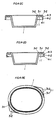
- the outer peripheral protrusion 3-2 may be replaced with a pair of protruding portions 11a formed in opposite positions on the flange 11, as shown in Fig. 4-2E, while the inner peripheral protrusion 3-2 is formed so as to make a round.
- protruding ends of the threadlike protrusions 3-2 on the innermost layer plastic surface 4-3 of the inner annular portion 3-1 of the flange 11 are heat-pressed with a heat impressing die ⁇ to reduce the thickness of the innermost plastic film layer 4-3 at the corresponding positions.
- the suitable minimum thickness of the innermost layer plastic surface 4-3 at the protrusions 3-2 which depends upon the kind of the plastic material is, for example, 15 ⁇ m or, more preferably, 5 to 10 ⁇ m in the case of polypropylene.
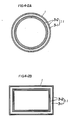
- the shape of the container 1 of the present invention is selected from various types, including round types such as those shown in Figs. 4-1A and 4-2A, rectangular types such as those shown in Figs. 4-1B and 4-2B, and an elliptical type such as that shown in Fig. 4-2E.
- the flange 11 formed on the outer periphery of the opening of the container 1 is illustrated together with a thinner portion 3-2a of the uppermost (innermost) plastic layer obtained by heat-pressing the uppermost layer threadlike protrusion 3-2 provided on the inner annular portion 3-1 and with a portion 3-1 not reduced in thickness.
- the method of reducing the thickness of the container 1 or a cover member 2 at a predetermined position is as described below.
- a multilayer plastic sheet ⁇ in accordance with the present invention is formed at a stage A by a thermoforming apparatus such as a vacuum forming machine or a pressure forming machine and by using a mold ⁇ and a plug ⁇ while being sufficiently plasticized at its both surfaces by a sheet softening apparatus ⁇ using infrared light or the like.
- the sheet ⁇ is thereby formed into a shape of a container 1 such that a continuous threadlike protrusion 3-2 is formed on an inner annular portion 3-1 of a flange 11, as shown in Fig. 2-1 or 2-2.
- the protruding end of the thread-like protrusion 3-2 is pressed with an impressing die ⁇ to about half the height of the formed threadlike protrusion 3-2.
- the formed container sheet is set in a die at a stage B for a separate impressing operation, and the desired portions of the flange 11 is plasticized again and suitably pressed with a heat impressing die ⁇ .
- the formed sheet is punched by a punching machine ⁇ to form the final shape of the container, thereby obtaining a container ⁇ reduced in thickness at the predetermined position of the flange 11, i.e., at the threadlike protrusion 3-2 in accordance with the present invention.
- containers ⁇ having continuous threadlike protrusions 3-2 formed on the inner annular portions 3-1 of the flange 11 as shown in Fig. 2-1 or 2-2 are provided on a container receiver ⁇ .
- the threadlike protrusion 3-2 of each container piece is suitably heat-pressed with a heat impressing die ⁇ at a stage C before a content stuff is packed, thereby being reduced in thickness.
- the container is filled with the content stuff by a filling machine k, and a sealed container packaging ⁇ with a punched cover member ⁇ is obtained.
- the container 1 having the structure of the present invention is closed by a cover member 2 and by using a heat seal ring 7, as shown in Figs. 7-1 and 7-2.
- the heat-sealed portion is spaced apart from the thinner portion 3-2a in the direction of the outer peripheral end of the flange 11 by a distance of 1 mm or more, or more preferably, 2 to 4 mm.
- the heat seal between the container 1 having the structure of the present invention may be such that, as shown in Fig. 9-2C, the annular portion 3-1 is upwardly curved between the two threadlike protrusions 3-2 formed on the flange 11 so that the top of the curved portion is higher than the thinner portions 3-2a, that is, the thinner portions 3-2a are positioned below the level of the sealant surface of the cover member, thereby improving the impurity sealing performance.
- the innermost plastic layer 4-3 of threadlike protrusion 3-2 formed on the inner annular portion 3-1 of the flange 11 is crushed by being heat-impressed so that the distance between the outside surface of the layer 4-3 and the adjacent cohesion-destructive plastic layer 4-2 at the threadlike protrusion 3-2 is reduced, that is, the minimum thickness of the layer 4-3 at this position is h.
- the container having the structure of the present invention is capped with the cover member 2 by heat sealing at a distance of b from the heat-pressed portion, as shown in Figs. 9-1A, 9-2A, or 9-2C.
- a part or the whole of the threadlike protrusion 3-2 in the vicinity of the outer periphery of the flange is heat-sealed, while the threadlike protrusion 3-2 located on the inner peripheral side of the flange is not heat-sealed since it is at the distance of b from the inner end of the heat-sealed portion.
- an end 8 of the cover member 2 is pulled upward so that the intermediate layer 4-2 having cohesion-destructive properties is broken at the position indicated by the double-dot-dash line in Fig. 8 starting from the outer end of the container flange 11.
- the breaking progresses to the thinner portion 32a of the innermost layer of the threadlike protrusion 3-2, the innermost layer plastic film 4-3 is torn at the minimum thickness portion h shown in Fig. 8.
- the packaging is thereby opened.
- the cover is opened as shown in Fig. 9-1B or 9-2B, and the progression of tearing of the minimum thickness portion h of the innermost layer 4-3 from the intermediate layer 4-2 can be smoothly progressed by virtue of the fusion bonding between these layers. If these layers are separated, the innermost layer cannot be torn apart smoothly.
- the container having the structure of the present invention which include a rib or curl downwardly extending from the outer end of the heat-sealed flange portion which rib or curl is provided to improve the rigidity of the flange or for a design purpose, is also improved in the performance of protecting the content stuff by the effect of heat sealing at the position shown in Fig. 9-2A, i.e., the effect of shifting the point of application of a peeling force from the side of the seal having the structure already proposed so as to reduce the force applied to the weakest portion of the inner threadlike protrusion, thereby increasing the seal strength against the force applied from the inside.
- the structure of the present invention shown in Fig. 9-2A enables achievement of the object of the present invention based on reversing the effect of the corresponding structure already proposed.
- the strength against a peeling force applied from the inside of the container can be set to a value four times or more larger than the strength against a peeling force applied from the outside.
- the strength against a peeling force applied from the inside of the casing can be set to 4 kg/15 mm while the strength against a peeling force applied from the outside is 1 kg/15 mm.
- the former is sufficiently higher than 2.3 kg/15 mm which is a standard value of the retort food seal strength in conformity with the law (in Japan).
- a multilayer sheet having a thickness of 800 ⁇ m was formed by three-layer extrusion of an innermost container layer 4-3 of a non-cohesion-destructive material (a polypropylene having an MFR [melt flow rate at 230 °C] value of 9 g/10 min, a melting point of 160 °C, a tensile strength of 450 kg/cm2 and an elongation ratio of 400 %), an intermediate layer 4-2 of a cohesion-destructive material (a blended resin consisting of a mixture of a polypropylene having an MFR [melt flow rate at 230 °C] value of 20 g/10 min, a melting point of 150 °C, a tensile strength of 300 kg/cm2 and an elongation ratio of 400 %, a polyethylene having an MI value of 7, specific gravity of 0.92, a ten
- the type of container shown in Fig. 2-1 was formed by a vacuum forming machine with a die ⁇ such as to enable formation of a container shape having a diameter of 50 mm, a depth of 30 mm and a flange 11 width of 10 mm with a threadlike protrusion having a width of 1 mm and a height of 1 mm and continuously formed on the inner annular portion 3-1 of the innermost layer 4-3 of the flange 11. From the same multilayer sheet, the type of container shown in Fig.
- 2-2 was formed by a vacuum forming machine with a die ⁇ such as to enable formation of a container shape having a diameter of 50 mm, a depth of 30 mm and a flange 11 width of 10 mm with a rib downwardly extending from the outer end of the flange 11 by 2 mm and threadlike protrusions each having a width of 0.5 mm and a height of 0.5 mm and continuously formed at inner and outer positions on the inner annular portion 3-1 of the innermost layer 4-3 of the flange 11.
- the threadlike protrusion 3-2 was heat-pressed to a height of 0.5 mm with a heat impressing die ⁇ (having a contact surface Teflon-baked for mold release) heated at a temperature of 180 °C, thereby forming a minimum thickness portion of the innermost layer plastic film 4-3 having a thickness of 5 ⁇ m.
- a beef stew was packed in each of the containers having the structures of the present invention, and the container was tightly closed by heat sealing with a cover member formed by dry-laminating with a polyurethane adhesive a biaxially oriented nylon film having a thickness of 15 ⁇ m and a polypropylene block copolymer film having a thickness of 60 ⁇ m, which block copolymer film is commonly used for retort pouch packaging in this industrial field.
- the container and the cover member were sealed between the outer peripheral end of the flange and an inner position of the same at a distance of 5 mm from the outer end.
- the packaging thereby formed was retort-processed at 125 °C for 30 minutes and was cooled. Thereafter, the cover member could be smoothly peeled from the container to open the packaging, as shown in Fig. 9-1B or 9-2B.
- the same heat-sealed portion was cut to have a width of 15 mm and the seal strength of this piece was tested by applying a force in each of the inward and outward radial directions of the flange to separate the sealed portion at a peeling speed of 300 mm/min.
- the heat-sealed portion exhibited a seal strength of 1.2 kg/15 mm against a peeling force applied from the outside of the flange, while it exhibited a seal strength of 4.5 kg/15 mm against a force applied from the inside of the flange.
- This value is greater than 2.3 kg/15 mm which is the standard value of the seal strength of retort food container packagings in conformity with the law.
- the easy-opening container packaging in accordance with the present invention is improved in heat resistance and can therefore be applied to food containers which are processed by boiling or retorting for high temperature sterilization, e.g., packagings for curry soup, borsch, beef stew, meat source, pork sauté, hamburg, chinese food, boiled white rice, rice boiled and served in a pot, cooked beans (adzuki beans, soybeans) and so on.
Landscapes
- Engineering & Computer Science (AREA)
- Mechanical Engineering (AREA)
- Packages (AREA)
Applications Claiming Priority (4)
| Application Number | Priority Date | Filing Date | Title |
|---|---|---|---|
| JP1164194A JPH0329768A (ja) | 1989-06-27 | 1989-06-27 | 易開封性容器包装体 |
| JP164194/89 | 1989-06-27 | ||
| JP33014089A JPH03200559A (ja) | 1989-12-20 | 1989-12-20 | 易開封性容器包装体 |
| JP330140/89 | 1989-12-20 |
Publications (2)
| Publication Number | Publication Date |
|---|---|
| EP0405365A1 true EP0405365A1 (de) | 1991-01-02 |
| EP0405365B1 EP0405365B1 (de) | 1994-02-23 |
Family
ID=26489391
Family Applications (1)
| Application Number | Title | Priority Date | Filing Date |
|---|---|---|---|
| EP90111904A Expired - Lifetime EP0405365B1 (de) | 1989-06-27 | 1990-06-22 | Leicht zu öffnender Verpackungsbehälter |
Country Status (3)
| Country | Link |
|---|---|
| US (1) | US5118002A (de) |
| EP (1) | EP0405365B1 (de) |
| DE (1) | DE69006785T2 (de) |
Cited By (18)
| Publication number | Priority date | Publication date | Assignee | Title |
|---|---|---|---|---|
| EP0657366A1 (de) * | 1993-12-09 | 1995-06-14 | Pechiney Emballage Alimentaire | Dichtungsverschluss für einen Kunststoffbehälter mit einem aufreissbaren und wiederverschliessbaren Deckel |
| DE19514072A1 (de) * | 1995-04-13 | 1996-10-17 | Albiplast Ag | Behälter und Verfahren zu dessen Herstellung |
| WO1998039218A3 (en) * | 1997-03-03 | 1999-02-25 | Abbott Lab | Heat sealer and method for using same |
| DE19813846A1 (de) * | 1998-03-27 | 1999-10-14 | 4P Rube Goettingen Gmbh | Verfahren zum Versiegeln eines Behälters |
| US5983607A (en) * | 1997-03-03 | 1999-11-16 | Abbott Laboratories | Heat sealer and method for using same |
| US6070507A (en) * | 1997-03-03 | 2000-06-06 | Abbott Laboratories | Method for punching a sealed package from first and second webs |
| US6286705B1 (en) | 1997-03-03 | 2001-09-11 | Abbott Laboratories | Container having tapered sidewall made from sheet material and lid to seal same |
| GB2420338A (en) * | 2004-11-20 | 2006-05-24 | Nicholas Martin Cohen | Improvements in and relating to packaging |
| WO2007118661A1 (de) * | 2006-04-12 | 2007-10-25 | Multivac Sepp Haggenmüller Gmbh & Co. Kg | Verfahren zum herstellen einer verpackung und verpackungsmaschine |
| EP1818265A3 (de) * | 2006-02-10 | 2007-12-12 | Andre Philip Wilkins | Verbesserungen an und im Zusammenhang mit hochtemperaturgeformten Kartonverpackungs-Trays für hermetische Versiegelung |
| EP1953089A1 (de) * | 2007-01-31 | 2008-08-06 | CFS Kempten GmbH | Auf einem Backblech gegartes Fleischprodukt |
| WO2008092692A1 (en) * | 2007-01-31 | 2008-08-07 | Cfs Bakel B.V. | Meat product cooked in a tray |
| EP2025605A1 (de) * | 2007-08-14 | 2009-02-18 | Andre Philip Wilkins | Verbesserungen an und im Zusammenhang mit hochtemperaturgeformten Kartonverpackungs-Trays für hermetische Versiegelung |
| EP2036817A1 (de) * | 2007-09-12 | 2009-03-18 | CFS Kempten GmbH | Verpackung von Haustierfutter |
| US7798359B1 (en) * | 2004-08-17 | 2010-09-21 | Momar Industries LLC | Heat-sealed, peelable lidding membrane for retort packaging |
| EP2431297A4 (de) * | 2009-05-13 | 2014-02-19 | Shikoku Kakoki Co Ltd | Verfahren zur herstellung eines mit einem lebensmittel gefüllten und versiegelten behälters |
| IT201700119347A1 (it) * | 2017-10-20 | 2019-04-20 | Sarong Spa | Metodo e apparato per realizzare un contenitore contenente un prodotto e relativo contenitore |
| FR3133600A1 (fr) * | 2022-03-21 | 2023-09-22 | 1/4 Vin | Procédé de thermoscellage d’un opercule sur un contenant en matière plastique |
Families Citing this family (21)
| Publication number | Priority date | Publication date | Assignee | Title |
|---|---|---|---|---|
| WO1993005945A1 (de) * | 1991-09-17 | 1993-04-01 | Tetra Alfa Holdings S.A. | Verschlusseinheit an gebinde für fliessfähiges gut |
| DK1006056T3 (da) * | 1998-12-01 | 2004-04-05 | Wipak Gryspeert Sa | Beholder til næringsmidler og lægemidler, og som let kan åbnes og lukkes |
| US6460720B1 (en) * | 2000-08-03 | 2002-10-08 | Creative Foods, Llc | Container with improved lid seal and lid sealing method |
| DE20100355U1 (de) | 2001-01-10 | 2001-04-05 | Hueck Folien GmbH & Co. KG, 92712 Pirk | Behälter |
| US20030029736A1 (en) * | 2001-08-09 | 2003-02-13 | Phillips Robert Briggs | Contact lens package |
| US7172779B2 (en) | 2002-09-27 | 2007-02-06 | Kraft Foods Holdings, Inc. | Container for sliced and fluffed food products |
| EP2045195B1 (de) * | 2003-11-04 | 2013-01-02 | Toyo Seikan Kaisha, Ltd. | Versiegelter Behälter und Verfahren zu dessen Herstellung |
| ATE406325T1 (de) * | 2003-12-16 | 2008-09-15 | Amcor Flexibles Europe | Verpackung mit durchsteckbarem deckel |
| US7810302B2 (en) * | 2005-10-25 | 2010-10-12 | Kraft Foods Global Brands Llc | Method of forming reclose mechanism in a reclosable package |
| US7475780B2 (en) * | 2006-02-24 | 2009-01-13 | Kraft Foods Global Brands Llc | Reclosable food package having an easy-open feature |
| ES2350592T3 (es) * | 2006-07-13 | 2011-01-25 | Impress Metal Packaging Sa | Tapa de recipiente con una membrana desprendible. |
| US20090056281A1 (en) * | 2007-08-27 | 2009-03-05 | Pouch Pac Innovations, Llc | Shaped Flexible Pouch With Elongated Neck And Method Of Manufacture |
| CA2754704A1 (en) * | 2009-03-13 | 2010-09-16 | Nestec S.A. | Composite covers for containers |
| US8911807B2 (en) * | 2009-11-06 | 2014-12-16 | Kraft Foods Group Brands Llc | Container for sliced and fluffed food products |
| NL2007024C2 (nl) * | 2011-06-29 | 2013-01-03 | Steen Dekker Beheer B V Van | Verpakking voor voedsel. |
| US9096346B2 (en) * | 2013-08-07 | 2015-08-04 | Sonoco Development, Inc. | Flexible package structure with a press-and-pull opening feature |
| MX391431B (es) * | 2015-01-28 | 2025-03-21 | Kimberly Clark Co | Empaque de facil apertura. |
| WO2016130910A1 (en) | 2015-02-13 | 2016-08-18 | Direct Pack, Inc. | Container comprising integral film lid |
| IT201800009295A1 (it) | 2018-10-09 | 2020-04-09 | Sacmi Cooperativa Mecc Imola Societa' Cooperativa | Apparato e metodo per lavorare tazze |
| EP3747786B1 (de) * | 2019-06-04 | 2022-04-27 | silver plastics GmbH & Co. KG | Verpackungsschale mit profiliertem siegelrand |
| US11628032B2 (en) * | 2019-08-01 | 2023-04-18 | Medtronic Vascular, Inc. | Stress-absorbing buffer zone for sealed tray |
Citations (3)
| Publication number | Priority date | Publication date | Assignee | Title |
|---|---|---|---|---|
| EP0037101A1 (de) * | 1980-03-29 | 1981-10-07 | Scheuch Folien- u.Papierverarbeitung GmbH & Co. KG | Mehrschichtfolie und Vorrichtung zum Verschluss von Gefässen |
| EP0262652A1 (de) * | 1986-09-30 | 1988-04-06 | Idemitsu Petrochemical Co. Ltd. | Leicht zu öffnender Behälterdeckel |
| EP0282773A1 (de) * | 1986-04-08 | 1988-09-21 | Idemitsu Petrochemical Co. Ltd. | Mehrlagige Platte zur Herstellung eines mehrlagigen Behälters |
Family Cites Families (7)
| Publication number | Priority date | Publication date | Assignee | Title |
|---|---|---|---|---|
| NL282414A (de) * | 1961-08-23 | 1900-01-01 | ||
| JPS59199461A (ja) * | 1983-04-23 | 1984-11-12 | テルモ株式会社 | 包装容器およびその密封方法 |
| US4771935A (en) * | 1985-07-03 | 1988-09-20 | Continental Can Company, Inc. | Plastic containers embodying a peel seal and method of preparing same |
| US4595117A (en) * | 1985-08-16 | 1986-06-17 | Continental Can Company, Inc. | Sealing lip for lid on thermoformed container |
| US4913307A (en) * | 1986-09-30 | 1990-04-03 | Idemitsu Petrochemical Co., Ltd. | Easily openable packaging container and method for producing the same |
| US4865217A (en) * | 1987-08-31 | 1989-09-12 | Sumitomo Bakelite Company, Limited | Easily openable sealed container |
| NZ226028A (en) * | 1987-09-09 | 1990-06-26 | Idemitsu Petrochemical Co | Hermetically sealed package which can be resealed after opening |
-
1990
- 1990-06-22 DE DE69006785T patent/DE69006785T2/de not_active Expired - Fee Related
- 1990-06-22 EP EP90111904A patent/EP0405365B1/de not_active Expired - Lifetime
- 1990-06-27 US US07/543,886 patent/US5118002A/en not_active Expired - Lifetime
Patent Citations (3)
| Publication number | Priority date | Publication date | Assignee | Title |
|---|---|---|---|---|
| EP0037101A1 (de) * | 1980-03-29 | 1981-10-07 | Scheuch Folien- u.Papierverarbeitung GmbH & Co. KG | Mehrschichtfolie und Vorrichtung zum Verschluss von Gefässen |
| EP0282773A1 (de) * | 1986-04-08 | 1988-09-21 | Idemitsu Petrochemical Co. Ltd. | Mehrlagige Platte zur Herstellung eines mehrlagigen Behälters |
| EP0262652A1 (de) * | 1986-09-30 | 1988-04-06 | Idemitsu Petrochemical Co. Ltd. | Leicht zu öffnender Behälterdeckel |
Cited By (23)
| Publication number | Priority date | Publication date | Assignee | Title |
|---|---|---|---|---|
| FR2713603A1 (fr) * | 1993-12-09 | 1995-06-16 | Pechiney Emballage Alimentaire | Fermeture étanche d'un récipient non métallique avec un couvercle non métallique, pelable et réutilisable. |
| EP0657366A1 (de) * | 1993-12-09 | 1995-06-14 | Pechiney Emballage Alimentaire | Dichtungsverschluss für einen Kunststoffbehälter mit einem aufreissbaren und wiederverschliessbaren Deckel |
| DE19514072A1 (de) * | 1995-04-13 | 1996-10-17 | Albiplast Ag | Behälter und Verfahren zu dessen Herstellung |
| DE19514072C2 (de) * | 1995-04-13 | 1998-04-09 | Albiplast Ag | Behälter und Verfahren zu dessen Herstellung |
| WO1998039218A3 (en) * | 1997-03-03 | 1999-02-25 | Abbott Lab | Heat sealer and method for using same |
| US5983607A (en) * | 1997-03-03 | 1999-11-16 | Abbott Laboratories | Heat sealer and method for using same |
| US6070507A (en) * | 1997-03-03 | 2000-06-06 | Abbott Laboratories | Method for punching a sealed package from first and second webs |
| US6286705B1 (en) | 1997-03-03 | 2001-09-11 | Abbott Laboratories | Container having tapered sidewall made from sheet material and lid to seal same |
| DE19813846A1 (de) * | 1998-03-27 | 1999-10-14 | 4P Rube Goettingen Gmbh | Verfahren zum Versiegeln eines Behälters |
| US7798359B1 (en) * | 2004-08-17 | 2010-09-21 | Momar Industries LLC | Heat-sealed, peelable lidding membrane for retort packaging |
| GB2420338A (en) * | 2004-11-20 | 2006-05-24 | Nicholas Martin Cohen | Improvements in and relating to packaging |
| EP1818265A3 (de) * | 2006-02-10 | 2007-12-12 | Andre Philip Wilkins | Verbesserungen an und im Zusammenhang mit hochtemperaturgeformten Kartonverpackungs-Trays für hermetische Versiegelung |
| WO2007118661A1 (de) * | 2006-04-12 | 2007-10-25 | Multivac Sepp Haggenmüller Gmbh & Co. Kg | Verfahren zum herstellen einer verpackung und verpackungsmaschine |
| US9227743B2 (en) | 2006-04-12 | 2016-01-05 | Multivac Sepp Haggenmueller Gmbh & Co. Kg | Method for producing a package and packaging machine |
| WO2008092692A1 (en) * | 2007-01-31 | 2008-08-07 | Cfs Bakel B.V. | Meat product cooked in a tray |
| EP1953089A1 (de) * | 2007-01-31 | 2008-08-06 | CFS Kempten GmbH | Auf einem Backblech gegartes Fleischprodukt |
| EP2025605A1 (de) * | 2007-08-14 | 2009-02-18 | Andre Philip Wilkins | Verbesserungen an und im Zusammenhang mit hochtemperaturgeformten Kartonverpackungs-Trays für hermetische Versiegelung |
| EP2036817A1 (de) * | 2007-09-12 | 2009-03-18 | CFS Kempten GmbH | Verpackung von Haustierfutter |
| EP2431297A4 (de) * | 2009-05-13 | 2014-02-19 | Shikoku Kakoki Co Ltd | Verfahren zur herstellung eines mit einem lebensmittel gefüllten und versiegelten behälters |
| IT201700119347A1 (it) * | 2017-10-20 | 2019-04-20 | Sarong Spa | Metodo e apparato per realizzare un contenitore contenente un prodotto e relativo contenitore |
| WO2019077562A1 (en) * | 2017-10-20 | 2019-04-25 | Sarong Societa' Per Azioni | METHOD AND APPARATUS FOR MANUFACTURING CONTAINER CONTAINING PRODUCT AND CORRESPONDING CONTAINER |
| FR3133600A1 (fr) * | 2022-03-21 | 2023-09-22 | 1/4 Vin | Procédé de thermoscellage d’un opercule sur un contenant en matière plastique |
| WO2023180657A1 (fr) * | 2022-03-21 | 2023-09-28 | 1/4 Vin | Procédé de thermoscellage d'un opercule sur un contenant en matière plastique |
Also Published As
| Publication number | Publication date |
|---|---|
| US5118002A (en) | 1992-06-02 |
| DE69006785D1 (de) | 1994-03-31 |
| DE69006785T2 (de) | 1994-09-08 |
| EP0405365B1 (de) | 1994-02-23 |
Similar Documents
| Publication | Publication Date | Title |
|---|---|---|
| EP0405365B1 (de) | Leicht zu öffnender Verpackungsbehälter | |
| US4934544A (en) | Z-tab innerseal for a container and method of application | |
| US5226281A (en) | Z-tab innerseal for a container and method of application | |
| AU2007249092B2 (en) | Container closure | |
| EP2539242B1 (de) | Verpackung mit originalitätssicherung und abziehbarem deckel | |
| US4280653A (en) | Composite container including a peelable membrane closure member, and method | |
| CA2322667C (en) | Sealant layer for container lid | |
| US20050208242A1 (en) | Container closure | |
| JPH05201436A (ja) | 開口装置及びその製造方法 | |
| US20230348157A1 (en) | Tabbed Seal With Oversized Tab | |
| JP2020516556A (ja) | 両面接着が可能な高周波誘導加熱容器封止体及びそれを適用したタンパー機能を有するコンパクト化粧品容器並びにそれを適用したタンパー機能のあるフリップキャップを有する容器 | |
| CA2477623C (en) | Easy-opening high barrier plastic closure and method therefor | |
| AU2016341805B2 (en) | Sealing foil with pull tab | |
| JPH03200559A (ja) | 易開封性容器包装体 | |
| JPH0567508B2 (de) | ||
| AU722202B2 (en) | Peelable heat seals and method for making same | |
| WO1991018795A2 (en) | Easy-open containers | |
| JPH04253656A (ja) | 密封容器 | |
| JP3126092B2 (ja) | 密封容器とその製造方法 | |
| US6029426A (en) | Detection of transversal and longitudinal seals of a package composed of a laminated material | |
| JPH0329768A (ja) | 易開封性容器包装体 | |
| CA2037354C (en) | Method for sealing retort container | |
| NZ741858B2 (en) | Sealing foil with pull tab | |
| JPS63307073A (ja) | 易開封性包装体およびその製造方法 | |
| JPH0398872A (ja) | 密封容器の製造方法 |
Legal Events
| Date | Code | Title | Description |
|---|---|---|---|
| PUAI | Public reference made under article 153(3) epc to a published international application that has entered the european phase |
Free format text: ORIGINAL CODE: 0009012 |
|
| AK | Designated contracting states |
Kind code of ref document: A1 Designated state(s): DE ES FR GB IT |
|
| 17P | Request for examination filed |
Effective date: 19910304 |
|
| 17Q | First examination report despatched |
Effective date: 19921229 |
|
| GRAA | (expected) grant |
Free format text: ORIGINAL CODE: 0009210 |
|
| AK | Designated contracting states |
Kind code of ref document: B1 Designated state(s): DE ES FR GB IT |
|
| PG25 | Lapsed in a contracting state [announced via postgrant information from national office to epo] |
Ref country code: IT Free format text: LAPSE BECAUSE OF FAILURE TO SUBMIT A TRANSLATION OF THE DESCRIPTION OR TO PAY THE FEE WITHIN THE PRE;WARNING: LAPSES OF ITALIAN PATENTS WITH EFFECTIVE DATE BEFORE 2007 MAY HAVE OCCURRED AT ANY TIME BEFORE 2007. THE CORRECT EFFECTIVE DATE MAY BE DIFFERENT FROM THE ONE RECORDED.SCRIBED TIME-LIMIT Effective date: 19940223 Ref country code: ES Free format text: THE PATENT HAS BEEN ANNULLED BY A DECISION OF A NATIONAL AUTHORITY Effective date: 19940223 Ref country code: FR Free format text: THE PATENT HAS BEEN ANNULLED BY A DECISION OF A NATIONAL AUTHORITY Effective date: 19940223 |
|
| REF | Corresponds to: |
Ref document number: 69006785 Country of ref document: DE Date of ref document: 19940331 |
|
| EN | Fr: translation not filed | ||
| PLBE | No opposition filed within time limit |
Free format text: ORIGINAL CODE: 0009261 |
|
| STAA | Information on the status of an ep patent application or granted ep patent |
Free format text: STATUS: NO OPPOSITION FILED WITHIN TIME LIMIT |
|
| 26N | No opposition filed | ||
| REG | Reference to a national code |
Ref country code: GB Ref legal event code: IF02 |
|
| PGFP | Annual fee paid to national office [announced via postgrant information from national office to epo] |
Ref country code: GB Payment date: 20060615 Year of fee payment: 17 |
|
| PGFP | Annual fee paid to national office [announced via postgrant information from national office to epo] |
Ref country code: DE Payment date: 20060616 Year of fee payment: 17 |
|
| GBPC | Gb: european patent ceased through non-payment of renewal fee |
Effective date: 20070622 |
|
| PG25 | Lapsed in a contracting state [announced via postgrant information from national office to epo] |
Ref country code: DE Free format text: LAPSE BECAUSE OF NON-PAYMENT OF DUE FEES Effective date: 20080101 |
|
| PG25 | Lapsed in a contracting state [announced via postgrant information from national office to epo] |
Ref country code: GB Free format text: LAPSE BECAUSE OF NON-PAYMENT OF DUE FEES Effective date: 20070622 |